Molecular Diagnostics
Techniques
1
Presented by:
SAYED MUHAMMAD TOUSEEF
Department of Biotechnology
2
Outline
Introduction
History
How it works
Applications
Techniques used
3
Introduction of
MOLECULAR DIAGNOSTICS
TECHNIQUES
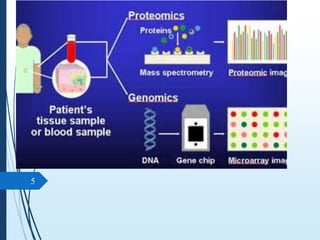
 Molecular diagnostics is a collection of techniques.
 used to analyze biological markers in
the genome and proteome.
 The technique is used to diagnose and monitor disease,
detect risk, and decide which therapies will work best for
individual patients.
 molecular diagnostics offers the prospect
of personalized medicine.
4
5
History
 In 1980, Yuet Wai Kan et al. suggested a prenatal genetic test
for Thalassemia that did not rely upon DNA sequencing—then in
its infancy—but on restriction enzymes that cut DNA where they
recognized specific short sequences, creating different lengths of
DNA strand depending on which allele (genetic variation) the fetus
possessed.
 in 1995, the Association for Molecular Pathology (AMP) was
formed to give it structure.
6
 In 1999, the AMP co-founded The Journal of Medical
Diagnostics.
 In 2012, molecular diagnostic techniques for
Thalassemia use genetic hybridization tests to identify
the specific single nucleotide polymorphism causing an
individual's disease
7
How it works??
 Every organisms contain some unique species specific DNA
sequences.
 Molecular diagnostics makes the specie specific DNA visible
8
Applications
 Classification of organism based on genetic relatedness
(genotyping)
 Identification and confirmation of isolate obtained from
culture
 Early detection of pathogens in clinical specimen
 Rapid detection of antibiotic resistance
 Detection of mutations
 Detection of toxigenic from non toxigenic strains
 Also useful in forensic medicine
9
Techniques used
 Plasmid profiling
 Nucleotide sequencing
 Restriction Fragment Length Polymorphism
(RFLP)
 Amplification techniques
10
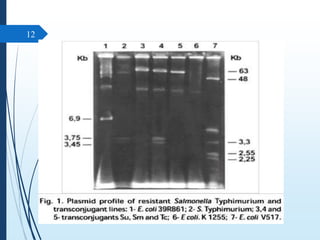
Plasmid profiling
 Plasmids are the extra chromosomal circular double stranded DNA
found in most bacteria
 Each bacterium has one or several plasmids
 Cells are lysed and the nucleic acid are subjected to electrophoresis
 The size and number of plasmids can be estimated
 Drawback: some species may contain variable number of plasmids or
even unrelated bacteria may have similar number of plasmids
11
12
Nucleotide sequencing
 For determination of the nucleotide sequence in the given
DNA molecule
 Methods:
1. Chemical cleavage method
2 .Chain termination method
 Not much role in diagnostic microbiology
For structure of gene, mutations and to design primers
13
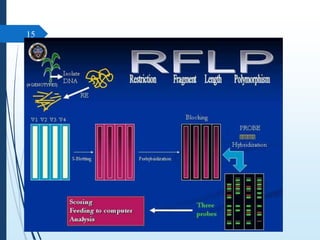
Restriction Fragment Length
Polymorphism (RFLP)
 Polymorphism in nucleotide sequence is present in all
organism
 Restriction sites are the strands of DNA that are specifically
recognized and cleaved by restriction endonucleases
 Useful as a
1. Epidemiological typing tool
2. Ribotyping – phylogenetic classification
14
15
Nucleic Acid Sequence Based
Amplification
• Isothermic non PCR procedure
• Definition: A primer dependent technology that
can be used for the continuous amplification of
nucleic acid in a single mixture at one
temperature.
• 3 SR: self sustained replication
• 3 enzymes: AMV reverse transcriptase,
Ribonuclease H, t7 RNA polymerase
16
Transcription Based Amplification
• Useful in the amplification of ss RNA rather than
DNA
• Developed by Gen-probe
• Used in clinical laboratories to detect Chlamydia
trachomatis and Neisseria gonorrhea
17
Strand Displacement Amplification
• It is an isothermal technique
• Based on restriction endonuclease nicking its
recognition site and a polymer extending the
nick at its 3’ end displacing the downstream
strand
• Required restriction enzyme cleavage of the
DNA sample prior to amplification
18
cont…
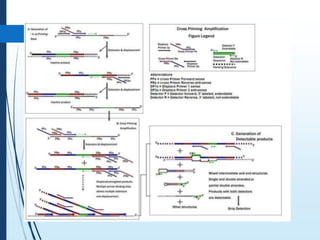
• Normally restriction enzyme cleavage produce dsDNA
which is not suitable template for SDA
• By incorporating alpha thio substituted nucleotides a
double stranded hemiphosphorothioated DNA is created
where the restriction site in newly synthesized strand is
resistant to cleavage
19
20
Signal Amplification
• Amplify the signal generated by the labelled
probes
• bDNA-Branched DNA probes
• Hybrid Capture- Anti DNA-RNA hybrid antibody
21
Cont…
• Signal amplification-used to increase the sensitivity of the
probe based assays
• 103-105 nucleic acid targets can be detected
• Branched DNA probe system:
• Target sequence is captured using a capture step
• Hybridization with an unlabeled probe that has two
hybridization sequence
• One directed against target sequence
• Second hybridizes with bDNA amplification number
22
Cont…
• Multimer system—chemically synthesized
oligonucleotide chain with a comb like backbone that can
bind to several reporter probes
• Highly sensitive because the target nucleic acid has to
bind both to the capture as well as target probes before
the signals are amplified
23
THANK-YOU
24

Molecular diagnostics techniques

  • 1.
  • 2.
    Presented by: SAYED MUHAMMADTOUSEEF Department of Biotechnology 2
  • 3.
  • 4.
    Introduction of MOLECULAR DIAGNOSTICS TECHNIQUES Molecular diagnostics is a collection of techniques.  used to analyze biological markers in the genome and proteome.  The technique is used to diagnose and monitor disease, detect risk, and decide which therapies will work best for individual patients.  molecular diagnostics offers the prospect of personalized medicine. 4
  • 5.
  • 6.
    History  In 1980,Yuet Wai Kan et al. suggested a prenatal genetic test for Thalassemia that did not rely upon DNA sequencing—then in its infancy—but on restriction enzymes that cut DNA where they recognized specific short sequences, creating different lengths of DNA strand depending on which allele (genetic variation) the fetus possessed.  in 1995, the Association for Molecular Pathology (AMP) was formed to give it structure. 6
  • 7.
     In 1999,the AMP co-founded The Journal of Medical Diagnostics.  In 2012, molecular diagnostic techniques for Thalassemia use genetic hybridization tests to identify the specific single nucleotide polymorphism causing an individual's disease 7
  • 8.
    How it works?? Every organisms contain some unique species specific DNA sequences.  Molecular diagnostics makes the specie specific DNA visible 8
  • 9.
    Applications  Classification oforganism based on genetic relatedness (genotyping)  Identification and confirmation of isolate obtained from culture  Early detection of pathogens in clinical specimen  Rapid detection of antibiotic resistance  Detection of mutations  Detection of toxigenic from non toxigenic strains  Also useful in forensic medicine 9
  • 10.
    Techniques used  Plasmidprofiling  Nucleotide sequencing  Restriction Fragment Length Polymorphism (RFLP)  Amplification techniques 10
  • 11.
    Plasmid profiling  Plasmidsare the extra chromosomal circular double stranded DNA found in most bacteria  Each bacterium has one or several plasmids  Cells are lysed and the nucleic acid are subjected to electrophoresis  The size and number of plasmids can be estimated  Drawback: some species may contain variable number of plasmids or even unrelated bacteria may have similar number of plasmids 11
  • 12.
  • 13.
    Nucleotide sequencing  Fordetermination of the nucleotide sequence in the given DNA molecule  Methods: 1. Chemical cleavage method 2 .Chain termination method  Not much role in diagnostic microbiology For structure of gene, mutations and to design primers 13
  • 14.
    Restriction Fragment Length Polymorphism(RFLP)  Polymorphism in nucleotide sequence is present in all organism  Restriction sites are the strands of DNA that are specifically recognized and cleaved by restriction endonucleases  Useful as a 1. Epidemiological typing tool 2. Ribotyping – phylogenetic classification 14
  • 15.
  • 16.
    Nucleic Acid SequenceBased Amplification • Isothermic non PCR procedure • Definition: A primer dependent technology that can be used for the continuous amplification of nucleic acid in a single mixture at one temperature. • 3 SR: self sustained replication • 3 enzymes: AMV reverse transcriptase, Ribonuclease H, t7 RNA polymerase 16
  • 17.
    Transcription Based Amplification •Useful in the amplification of ss RNA rather than DNA • Developed by Gen-probe • Used in clinical laboratories to detect Chlamydia trachomatis and Neisseria gonorrhea 17
  • 18.
    Strand Displacement Amplification •It is an isothermal technique • Based on restriction endonuclease nicking its recognition site and a polymer extending the nick at its 3’ end displacing the downstream strand • Required restriction enzyme cleavage of the DNA sample prior to amplification 18
  • 19.
    cont… • Normally restrictionenzyme cleavage produce dsDNA which is not suitable template for SDA • By incorporating alpha thio substituted nucleotides a double stranded hemiphosphorothioated DNA is created where the restriction site in newly synthesized strand is resistant to cleavage 19
  • 20.
  • 21.
    Signal Amplification • Amplifythe signal generated by the labelled probes • bDNA-Branched DNA probes • Hybrid Capture- Anti DNA-RNA hybrid antibody 21
  • 22.
    Cont… • Signal amplification-usedto increase the sensitivity of the probe based assays • 103-105 nucleic acid targets can be detected • Branched DNA probe system: • Target sequence is captured using a capture step • Hybridization with an unlabeled probe that has two hybridization sequence • One directed against target sequence • Second hybridizes with bDNA amplification number 22
  • 23.
    Cont… • Multimer system—chemicallysynthesized oligonucleotide chain with a comb like backbone that can bind to several reporter probes • Highly sensitive because the target nucleic acid has to bind both to the capture as well as target probes before the signals are amplified 23
  • 24.