Molecular Diagnosis
Dr.M.Malathi
Postgraduate II year
Department of Microbiology
Chengalpattu medical college
Molecular technology
• Molecular diagnosis is the most appropriate
for infectious agents that are difficult to
detect, identify, or test for susceptibility in a
timely fashion with conventional mehtods.
• Need of molecular methods is most important
in diagnosis of Mycobacterium tuberculosis,
Chlamydia trachomatis, meningoencephalitis
syndrome and respiratory viral illness.
Where traditional methods fails??
• Microscopy gives false positive results in
T.vaginalis, N.gonorrhoeae
• Intracellular pathogens – Chlamydia
• Subtyping in case of HSV, HPV, HCV
• Microbial growth is slow – Myco.tb
How it works??
• Every organism contains some unique, species
specific DNA sequences
• Molecular diagnostics makes the species
specific DNA visible
Applications
• Classification of organism based on genetic
relatedness (genotyping)
• Identification and confirmation of isolate
obtained from culture
• Early detection of pathogens in clinical
specimen
• Rapid detection of antibiotic resistance
• Detection of mutations
• Differentiation of toxigenic from non toxigenic
strains
• Detection of microorganisms that lose viability
during transport, impossible, dangerous and
costly to culture, grow slowly or present in
extremely small numbers in clinical specimen
• Apart from microbiology, useful in forensic
medicine
Techniques used
• Nucleic acid hybridisation
• Amplification techniques
• Plasmid profiling
• Nucleotide sequencing
• Restriction Fragment Length Polymorphism
• Pulse Field Gel electrophoresis
TARGET AMPLIFICATION
• PCR Based
• Non PCR based (Isothermal)
 NASBA
 TBA
 SDA
 LAMP
Nucleic Acid Sequence Based
Amplification
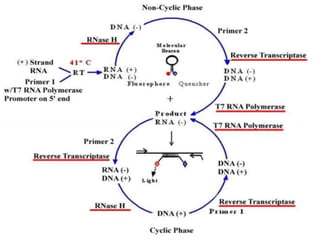
• Isothermic non PCR procedure
• Definition: a primer dependent technology that
can be used for the continuous amplification of
nucleic acids in a single mixture at one
temperature ( 1991, J Compton)
• 3 SR : self sustained sequence replication
• 3 enzymes : AMV reverse transcriptase,
Ribonuclease H, T7 RNA polymerase
• Immediately after the invention of NASBA, it
was used for the rapid diagnosis and
quantification of HIV-1 in patients` sera
• Quicker than PCR
• Isothermal
• More sensitive
• Used to detect pathogenic viruses with ssRNA
genomes Eg: influenza A, Foot and mouth
disease virus, SARS, HboV, Trypanosoma
brucei
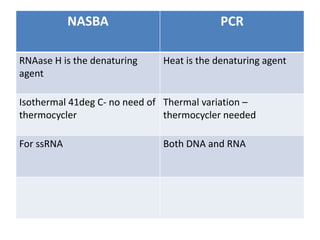
NASBA PCR
RNAase H is the denaturing
agent
Heat is the denaturing agent
Isothermal 41deg C- no need of
thermocycler
Thermal variation –
thermocycler needed
For ssRNA Both DNA and RNA
Transcription Based Amplification
• Useful in the amplification of ss RNA rather
than DNA
• Similar to NASBA
• Developed by Gen-probe, Inc
• Used in clinical laboratories to detect
Chlamydia trachomatis and Neisseria
gonorrheae from clinical specimens
Strand Displacement Amplification
• Isothermal
• Based on restriction endonuclease nicking its
recognition site and a polymerase extending
the nick at its 3` end displacing the
downstream strand.
• Required restriction enzyme cleavage of the
DNA sample prior to amplification
• Normally restriction enzyme cleavage
produces dsDNA, which is not suitable
template for SDA
• By incorporating alpha thio substituted
nucleotides , a double stranded
hemiphosphorothioated DNA is created where
the restriction site in newly synthesized strand
is resistant to cleavage.
Loop Mediated Isothermal
Amplification (LAMP)
• LAMP assay – simple, rapid, specific and cost
effective nucleic acid amplification developed
by Eiken chemical co.ltd
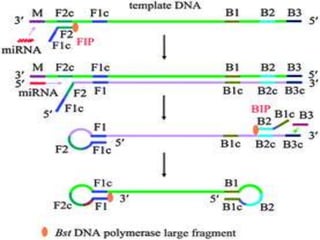
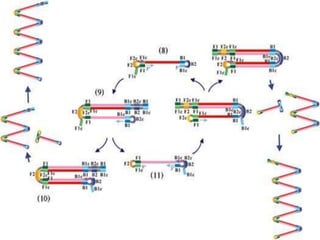
• 4 different primers designed to recognise 6
distinct regions on the target gene and the
reaction process proceeds at a constant
temperature using strand displacement
reaction.
• High amplification efficiency with 1010 times in
15 to 60 minutes
• No need for denaturation
• High specificity
• Cost effective
Primers in LAMP
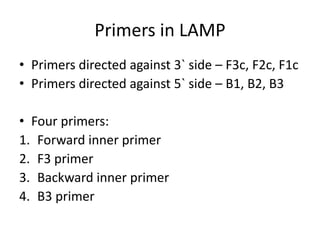
• Primers directed against 3` side – F3c, F2c, F1c
• Primers directed against 5` side – B1, B2, B3
• Four primers:
1. Forward inner primer
2. F3 primer
3. Backward inner primer
4. B3 primer
SIGNAL AMPLIFICATION
• Amplify the signal generated by the labelled
probes
• bDNA – Branched DNA probes
• Hybrid capture – Anti DNA-RNA hybrid
antibody
• Signal amplification – used to increase the
sensitivity of the probe based assays.
• 103 - 105 nucleic acid targets can be detected
• Branched DNA probe system:
Target sequence is captured using a
capture step  hybridization with an
unlabeled probe that has two hybridisation
sequences  one directed against target
sequence  another hybridises with bDNA
amplification number.
• Multimer system  chemically synthesized
oligonucleotide chain with a comb like
backbone that can bind to several reporter
probes
• Highly sensitive because the target nucleic
acid has to bind both to the capture as well as
target probes before the signals are amplified
PROBE AMPLIFICATION
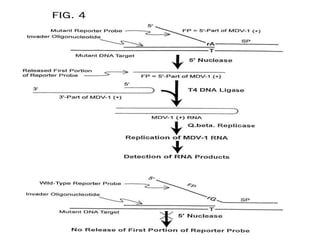
• Ligase Chain reaction
• Q Beta Replicase
Ligase Chain Reaction
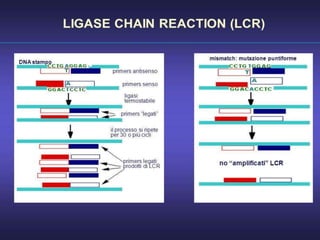
• Based on sequential rounds of template
dependent ligation of two juxtaposed
oligonucleotide probes
• Exponential amplification is achieved when
two pairs of oligonucleotide probes, one
complementary to the lower stand of target
and other complementary to the upper strand
of target are used
• Allows the discrimination of DNA sequences
differing in only a single base pair
• The original method employed two sets of
complementary primers and repeated cycles
of denaturation at 100degC and ligation at
30degC using the mesophilic T4 DNA ligase.
• Use of mesophilic T4 or Escherichia coli ligase
has the drawback of requiring the addition of
fresh ligase after each denaturation step, as
well as appearance of target independent
ligation products
• PRINICIPLE: Based on the ligation of two
adjacent synthetic oligonucleotide primers,
which uniquely hybridise to one strand of the
target DNA
• Applications: HPV, HSV, HIV, Myco.tb,
Chlamydia, Neisseria, Listeria, Borrelia
Detection of pathogens by LCR
• Eg: in case of Listeria monocytogens , the
nucleotide 1258 is A-T base pair, while in case
of Listeria innocua it is G-C base pair
• With this single nucleotide bp changes, LCR
detects the pathogenic species
Q beta Replicase
• Q beta replicase is a RNA dependent RNA
polymerase derived from the bacteriophage
Q-beta.
• The enzyme complex has four subunits  one
derived from Q- beta bacteriophage and
remaining three from E.coli host
Q beta replicase - features
1. Effects 10,000 fold amplification of the 4200-
nucleotide single stranded RNA of Q beta
during a very short interval
2. Replicates the viral genomic RNA in the
presence of a vast excess of host RNA
3. Copies entire template RNA from 3` to 5`
terminus without utilising endogenous
primers
MDV RNA
• Midivariant (MDV) RNA is the most
extensively studied non viral substrate for Q-
beta replicase into which the probe sequences
are inserted
Advantages:
• Duration  2 to 3 hours
• Isothermal
• Very sensitive
• Simultaneous detection of multiple targets
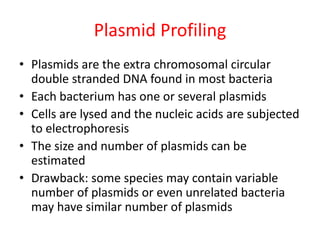
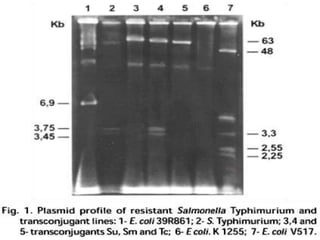
Plasmid Profiling
• Plasmids are the extra chromosomal circular
double stranded DNA found in most bacteria
• Each bacterium has one or several plasmids
• Cells are lysed and the nucleic acids are subjected
to electrophoresis
• The size and number of plasmids can be
estimated
• Drawback: some species may contain variable
number of plasmids or even unrelated bacteria
may have similar number of plasmids
Nucleotide sequencing
• For determination of the nucleotide sequence
in the given DNA molecule
• Methods:
1. Chemical cleavage method
2. Chain termination method
Both these are automated methods
• Not much role in diagnostic microbiology
For structure of gene, mutations and to design
primers
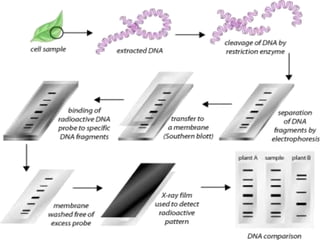
Restriction Fragment Length
Polymorphism (RFLP)
• Polymorphism in nucleotide sequence is
present in all organism
• Restriction sites are the strands of DNA that
are specifically recognised and cleaved by
restriction endonucleases
• Useful as a
1. Epidemiological typing tool
2. Ribotyping - phylogenetic classification
Summary
• Plasmid profiling
• Nucleotide sequening
• RFLP
• Nucleic acid hybridisation
• Amplification techniques
References
• Textbook of Diagnostic Microbiology – Connie
R Mahon – 3rd edition
• Bailey and Scotts`s Diagnostic Microbiology -
13th edition
• Practical microbiology – Mackie and
Mccartney – 14th edition
• Molecular techiniques in clinical microbiology
– www.microrao.com

Molecular techniques

  • 1.
    Molecular Diagnosis Dr.M.Malathi Postgraduate IIyear Department of Microbiology Chengalpattu medical college
  • 2.
    Molecular technology • Moleculardiagnosis is the most appropriate for infectious agents that are difficult to detect, identify, or test for susceptibility in a timely fashion with conventional mehtods. • Need of molecular methods is most important in diagnosis of Mycobacterium tuberculosis, Chlamydia trachomatis, meningoencephalitis syndrome and respiratory viral illness.
  • 3.
    Where traditional methodsfails?? • Microscopy gives false positive results in T.vaginalis, N.gonorrhoeae • Intracellular pathogens – Chlamydia • Subtyping in case of HSV, HPV, HCV • Microbial growth is slow – Myco.tb
  • 4.
    How it works?? •Every organism contains some unique, species specific DNA sequences • Molecular diagnostics makes the species specific DNA visible
  • 5.
    Applications • Classification oforganism based on genetic relatedness (genotyping) • Identification and confirmation of isolate obtained from culture • Early detection of pathogens in clinical specimen • Rapid detection of antibiotic resistance • Detection of mutations
  • 6.
    • Differentiation oftoxigenic from non toxigenic strains • Detection of microorganisms that lose viability during transport, impossible, dangerous and costly to culture, grow slowly or present in extremely small numbers in clinical specimen • Apart from microbiology, useful in forensic medicine
  • 7.
    Techniques used • Nucleicacid hybridisation • Amplification techniques • Plasmid profiling • Nucleotide sequencing • Restriction Fragment Length Polymorphism • Pulse Field Gel electrophoresis
  • 8.
    TARGET AMPLIFICATION • PCRBased • Non PCR based (Isothermal)  NASBA  TBA  SDA  LAMP
  • 9.
    Nucleic Acid SequenceBased Amplification • Isothermic non PCR procedure • Definition: a primer dependent technology that can be used for the continuous amplification of nucleic acids in a single mixture at one temperature ( 1991, J Compton) • 3 SR : self sustained sequence replication • 3 enzymes : AMV reverse transcriptase, Ribonuclease H, T7 RNA polymerase
  • 10.
    • Immediately afterthe invention of NASBA, it was used for the rapid diagnosis and quantification of HIV-1 in patients` sera • Quicker than PCR • Isothermal • More sensitive • Used to detect pathogenic viruses with ssRNA genomes Eg: influenza A, Foot and mouth disease virus, SARS, HboV, Trypanosoma brucei
  • 11.
    NASBA PCR RNAase His the denaturing agent Heat is the denaturing agent Isothermal 41deg C- no need of thermocycler Thermal variation – thermocycler needed For ssRNA Both DNA and RNA
  • 13.
    Transcription Based Amplification •Useful in the amplification of ss RNA rather than DNA • Similar to NASBA • Developed by Gen-probe, Inc • Used in clinical laboratories to detect Chlamydia trachomatis and Neisseria gonorrheae from clinical specimens
  • 14.
    Strand Displacement Amplification •Isothermal • Based on restriction endonuclease nicking its recognition site and a polymerase extending the nick at its 3` end displacing the downstream strand. • Required restriction enzyme cleavage of the DNA sample prior to amplification
  • 15.
    • Normally restrictionenzyme cleavage produces dsDNA, which is not suitable template for SDA • By incorporating alpha thio substituted nucleotides , a double stranded hemiphosphorothioated DNA is created where the restriction site in newly synthesized strand is resistant to cleavage.
  • 17.
    Loop Mediated Isothermal Amplification(LAMP) • LAMP assay – simple, rapid, specific and cost effective nucleic acid amplification developed by Eiken chemical co.ltd • 4 different primers designed to recognise 6 distinct regions on the target gene and the reaction process proceeds at a constant temperature using strand displacement reaction.
  • 18.
    • High amplificationefficiency with 1010 times in 15 to 60 minutes • No need for denaturation • High specificity • Cost effective
  • 19.
    Primers in LAMP •Primers directed against 3` side – F3c, F2c, F1c • Primers directed against 5` side – B1, B2, B3 • Four primers: 1. Forward inner primer 2. F3 primer 3. Backward inner primer 4. B3 primer
  • 22.
    SIGNAL AMPLIFICATION • Amplifythe signal generated by the labelled probes • bDNA – Branched DNA probes • Hybrid capture – Anti DNA-RNA hybrid antibody
  • 23.
    • Signal amplification– used to increase the sensitivity of the probe based assays. • 103 - 105 nucleic acid targets can be detected • Branched DNA probe system: Target sequence is captured using a capture step  hybridization with an unlabeled probe that has two hybridisation sequences  one directed against target sequence  another hybridises with bDNA amplification number.
  • 24.
    • Multimer system chemically synthesized oligonucleotide chain with a comb like backbone that can bind to several reporter probes • Highly sensitive because the target nucleic acid has to bind both to the capture as well as target probes before the signals are amplified
  • 25.
    PROBE AMPLIFICATION • LigaseChain reaction • Q Beta Replicase
  • 26.
    Ligase Chain Reaction •Based on sequential rounds of template dependent ligation of two juxtaposed oligonucleotide probes • Exponential amplification is achieved when two pairs of oligonucleotide probes, one complementary to the lower stand of target and other complementary to the upper strand of target are used
  • 27.
    • Allows thediscrimination of DNA sequences differing in only a single base pair • The original method employed two sets of complementary primers and repeated cycles of denaturation at 100degC and ligation at 30degC using the mesophilic T4 DNA ligase. • Use of mesophilic T4 or Escherichia coli ligase has the drawback of requiring the addition of fresh ligase after each denaturation step, as well as appearance of target independent ligation products
  • 28.
    • PRINICIPLE: Basedon the ligation of two adjacent synthetic oligonucleotide primers, which uniquely hybridise to one strand of the target DNA • Applications: HPV, HSV, HIV, Myco.tb, Chlamydia, Neisseria, Listeria, Borrelia
  • 30.
    Detection of pathogensby LCR • Eg: in case of Listeria monocytogens , the nucleotide 1258 is A-T base pair, while in case of Listeria innocua it is G-C base pair • With this single nucleotide bp changes, LCR detects the pathogenic species
  • 31.
    Q beta Replicase •Q beta replicase is a RNA dependent RNA polymerase derived from the bacteriophage Q-beta. • The enzyme complex has four subunits  one derived from Q- beta bacteriophage and remaining three from E.coli host
  • 32.
    Q beta replicase- features 1. Effects 10,000 fold amplification of the 4200- nucleotide single stranded RNA of Q beta during a very short interval 2. Replicates the viral genomic RNA in the presence of a vast excess of host RNA 3. Copies entire template RNA from 3` to 5` terminus without utilising endogenous primers
  • 33.
    MDV RNA • Midivariant(MDV) RNA is the most extensively studied non viral substrate for Q- beta replicase into which the probe sequences are inserted
  • 35.
    Advantages: • Duration 2 to 3 hours • Isothermal • Very sensitive • Simultaneous detection of multiple targets
  • 36.
    Plasmid Profiling • Plasmidsare the extra chromosomal circular double stranded DNA found in most bacteria • Each bacterium has one or several plasmids • Cells are lysed and the nucleic acids are subjected to electrophoresis • The size and number of plasmids can be estimated • Drawback: some species may contain variable number of plasmids or even unrelated bacteria may have similar number of plasmids
  • 38.
    Nucleotide sequencing • Fordetermination of the nucleotide sequence in the given DNA molecule • Methods: 1. Chemical cleavage method 2. Chain termination method Both these are automated methods • Not much role in diagnostic microbiology For structure of gene, mutations and to design primers
  • 39.
    Restriction Fragment Length Polymorphism(RFLP) • Polymorphism in nucleotide sequence is present in all organism • Restriction sites are the strands of DNA that are specifically recognised and cleaved by restriction endonucleases • Useful as a 1. Epidemiological typing tool 2. Ribotyping - phylogenetic classification
  • 41.
    Summary • Plasmid profiling •Nucleotide sequening • RFLP • Nucleic acid hybridisation • Amplification techniques
  • 42.
    References • Textbook ofDiagnostic Microbiology – Connie R Mahon – 3rd edition • Bailey and Scotts`s Diagnostic Microbiology - 13th edition • Practical microbiology – Mackie and Mccartney – 14th edition • Molecular techiniques in clinical microbiology – www.microrao.com