Submitted By:
Soma Majumdar
PGDCVI 2nd Semester
A1217322004
Submiting to:
Dr. Naveen K. Kaushik
Amity Institute of
Virology
&
Immunology
Molecular biology test
for
Tuberculosis
Advanced Molecular Diagnostics
Molecular biology test
for
Tuberculosis
Advanced Molecular Diagnostics
• It is an airborne infectious disease primarily in lungs, but it can also
manifest in the kidney, bones and central nervous system too.
• Tuberculosis (TB) caused by M. tuberculosis, M. africanum, M. bovis
and other & compoundly known as Mycobacterium tuberculosis
complex (MTBC).
• This Bacteria has high amount of Mycolic acid which makes it
impervious to gram staining so Acid fast stain (Ziehl-Neelsen) or
fluorescent stains (auramine) used to identify it under microscope.
What is tuberculosis?
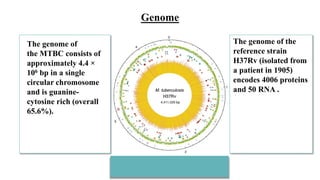
The genome of the
reference strain
H37Rv (isolated from
a patient in 1905)
encodes 4006 proteins
and 50 RNA .
Molecular test for T.B.
• It is based on detection of nucleic acid, both DNA and RNA, that are specific
to both M. tuberculosis, by amplification techniques such as PCR.
• Detection of mutation in the genes that are associated with resistance to anti-
TB drugs by sequencing or nucleic acid hybridization.
• Direct detection of TB from clinical samples
• Additional genotypic methods for detection of drug resistance
1. Polymerase chain reaction (PCR)
2. Transcription mediated amplification (TMA)
3. Real-time PCR techniques
Polymerase chain reaction (PCR)
• PCR is an in-vitro method for amplifying specific DNA sequence.
• It start with extremely minute amounts of a particular nucleic acid sequence from any
source.
• TB PCR test amplifies IS6110 region which is present in MTB complex.
• Few Indian strains lack IS6110, in such cases this test is of no use.
• It is DNA-based technology and cannot differentiate between dead and viable organisms.
• Application of TB-PCR in routine practice is of very limited value because of high rate of
false positive cases as well as contamination issues.
• In real-time PCR, the accumulation of amplification product is measured as the
reaction progresses
• We do not look at bands on a gel at the end of the reaction, the process is
monitored in “real time.”
• In this we link the amplification of DNA to the generation of fluorescence, which
can simply be detected with a detector during each PCR cycle.
• The number of gene copies increases during the reaction, so the fluorescence
increases.
• Main advantages of real-time PCR techniques are the speed of the test and a
lower risk of contamination.
# Molecular beacon assays, which work on the principle of real-
time PCR, are based on a stem and loop structure with the loop in
the probe.
# Easier to perform, real time formats such as GeneXpert are
being currently evaluated directly from samples.
# These assays have huge potential as they are rapid and can be
performed in a real world setting out of the molecular lab.
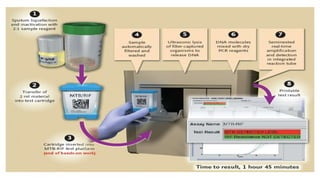
• The Xpert MTB/RIF assay is a NAAT that uses a disposable cartridge
with the GeneXpert Instrument System.
• DNA amplification, extraction & detection in one cartridge.
• Integrated positive control assures that a negative result is not due to
NAA inhibitors in the specimen.
• Validate for sputum samples only.
• This can be in the form of 1 ml of raw sputum that ideally has been
refrigerated.
Xpert MTB/ RIF
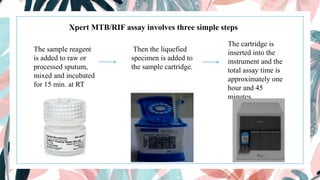
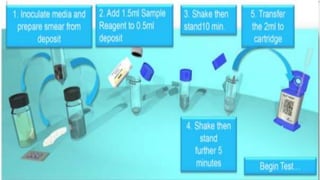
Xpert MTB/RIF assay involves three simple steps
The cartridge is
inserted into the
instrument and the
total assay time is
approximately one
hour and 45
minutes.
Then the liquefied
specimen is added to
the sample cartridge.
The sample reagent
is added to raw or
processed sputum,
mixed and incubated
for 15 min. at RT
• Lower Ct values= higher concentration of DNA template
• higher Ct values= lower concentration of DNA template for TB
detection.
Ct range : High <16, Medium 16-22, Low 22-28, Very Low >28
Xpert MTB/ RIF
• The Xpert MTB/RIF assay detects rifampicin resistance by PCR
amplification of the 81-bp fragment of the MTB rpoB gene.
• It is probed with five molecular beacons (Probes A – E) for mutations
within the rifampin resistance determining region (RRDR)
• .Each molecular beacon is labeled with a different fluorophore.
• Max Ct value for probes A,B & C= 39.0
• Mac Ct value for probes D and E= 36.0 are set for MTB/RIF data
analysis.
Xpert MTB/ RIF
• MTB DETECTED is reported when at least two probes result in Ct values within
the valid range and a delta Ct min (the smallest Ct difference between any pair of
probes) of less than 2.0.
• Rif Resistance NOT DETECTED is reported if the delta Ct max (the Ct
difference between the earliest and latest probe) is ≤4.0.
• Rif Resistance DETECTED is reported if the delta Ct max is >4.0.
• MTB NOT DETECTED is reported when there is only one or no positive probe.
• The sensitivity is greater in smear positive samples, the limit of detection has
been estimated at 131 colony-forming units per milliliter of sample.
• The specificity is high and nearly 98%.
• The sensitivity is also lower in smear negative samples.
Advantages:
• It is very quick within approximately two hours.
• Minimal technical training is required to run the test.
• This is a closed system with a single cartridge, which minimizes
contamination issues.
• There is also limited specimen manipulation, which limits the biosafety
concerns.
• The GeneXpert cartridge can be used for up to 7 days after opening the
foil packaging.
Reference
• Mycobacterial genomics and structural bioinformatics: opportunities and
challenges in drug discovery by: Vaishali P. Waman, Sundeep Chaitanya
Vedithi, Sherine . Thomas, Bridget P. Bannerman, Asma Munir
https://www.ncbi.nlm.nih.gov/pmc/articles/PMC6334779/#:~:text=The%20M.,seq
uenced%20in%202001%20%5B23%5D.
• Use of IS6110 DNA fingerprinting in tracing man-to-man transmission of
Mycobacterium tuberculosis in the Czech Republic by: K Kremer, D van
Soolingen, I Půtová, M Kubín
https://pubmed.ncbi.nlm.nih.gov/8996660/
Thank you

Molecular biology test for Tuberculosis

  • 1.
    Submitted By: Soma Majumdar PGDCVI2nd Semester A1217322004 Submiting to: Dr. Naveen K. Kaushik Amity Institute of Virology & Immunology
  • 2.
    Molecular biology test for Tuberculosis AdvancedMolecular Diagnostics Molecular biology test for Tuberculosis Advanced Molecular Diagnostics
  • 3.
    • It isan airborne infectious disease primarily in lungs, but it can also manifest in the kidney, bones and central nervous system too. • Tuberculosis (TB) caused by M. tuberculosis, M. africanum, M. bovis and other & compoundly known as Mycobacterium tuberculosis complex (MTBC). • This Bacteria has high amount of Mycolic acid which makes it impervious to gram staining so Acid fast stain (Ziehl-Neelsen) or fluorescent stains (auramine) used to identify it under microscope. What is tuberculosis?
  • 4.
    The genome ofthe reference strain H37Rv (isolated from a patient in 1905) encodes 4006 proteins and 50 RNA .
  • 5.
    Molecular test forT.B. • It is based on detection of nucleic acid, both DNA and RNA, that are specific to both M. tuberculosis, by amplification techniques such as PCR. • Detection of mutation in the genes that are associated with resistance to anti- TB drugs by sequencing or nucleic acid hybridization. • Direct detection of TB from clinical samples • Additional genotypic methods for detection of drug resistance 1. Polymerase chain reaction (PCR) 2. Transcription mediated amplification (TMA) 3. Real-time PCR techniques
  • 6.
    Polymerase chain reaction(PCR) • PCR is an in-vitro method for amplifying specific DNA sequence. • It start with extremely minute amounts of a particular nucleic acid sequence from any source. • TB PCR test amplifies IS6110 region which is present in MTB complex. • Few Indian strains lack IS6110, in such cases this test is of no use. • It is DNA-based technology and cannot differentiate between dead and viable organisms. • Application of TB-PCR in routine practice is of very limited value because of high rate of false positive cases as well as contamination issues.
  • 7.
    • In real-timePCR, the accumulation of amplification product is measured as the reaction progresses • We do not look at bands on a gel at the end of the reaction, the process is monitored in “real time.” • In this we link the amplification of DNA to the generation of fluorescence, which can simply be detected with a detector during each PCR cycle. • The number of gene copies increases during the reaction, so the fluorescence increases. • Main advantages of real-time PCR techniques are the speed of the test and a lower risk of contamination.
  • 8.
    # Molecular beaconassays, which work on the principle of real- time PCR, are based on a stem and loop structure with the loop in the probe. # Easier to perform, real time formats such as GeneXpert are being currently evaluated directly from samples. # These assays have huge potential as they are rapid and can be performed in a real world setting out of the molecular lab.
  • 9.
    • The XpertMTB/RIF assay is a NAAT that uses a disposable cartridge with the GeneXpert Instrument System. • DNA amplification, extraction & detection in one cartridge. • Integrated positive control assures that a negative result is not due to NAA inhibitors in the specimen. • Validate for sputum samples only. • This can be in the form of 1 ml of raw sputum that ideally has been refrigerated. Xpert MTB/ RIF
  • 10.
    Xpert MTB/RIF assayinvolves three simple steps The cartridge is inserted into the instrument and the total assay time is approximately one hour and 45 minutes. Then the liquefied specimen is added to the sample cartridge. The sample reagent is added to raw or processed sputum, mixed and incubated for 15 min. at RT
  • 13.
    • Lower Ctvalues= higher concentration of DNA template • higher Ct values= lower concentration of DNA template for TB detection. Ct range : High <16, Medium 16-22, Low 22-28, Very Low >28 Xpert MTB/ RIF
  • 14.
    • The XpertMTB/RIF assay detects rifampicin resistance by PCR amplification of the 81-bp fragment of the MTB rpoB gene. • It is probed with five molecular beacons (Probes A – E) for mutations within the rifampin resistance determining region (RRDR) • .Each molecular beacon is labeled with a different fluorophore. • Max Ct value for probes A,B & C= 39.0 • Mac Ct value for probes D and E= 36.0 are set for MTB/RIF data analysis. Xpert MTB/ RIF
  • 15.
    • MTB DETECTEDis reported when at least two probes result in Ct values within the valid range and a delta Ct min (the smallest Ct difference between any pair of probes) of less than 2.0. • Rif Resistance NOT DETECTED is reported if the delta Ct max (the Ct difference between the earliest and latest probe) is ≤4.0. • Rif Resistance DETECTED is reported if the delta Ct max is >4.0. • MTB NOT DETECTED is reported when there is only one or no positive probe. • The sensitivity is greater in smear positive samples, the limit of detection has been estimated at 131 colony-forming units per milliliter of sample. • The specificity is high and nearly 98%. • The sensitivity is also lower in smear negative samples.
  • 16.
    Advantages: • It isvery quick within approximately two hours. • Minimal technical training is required to run the test. • This is a closed system with a single cartridge, which minimizes contamination issues. • There is also limited specimen manipulation, which limits the biosafety concerns. • The GeneXpert cartridge can be used for up to 7 days after opening the foil packaging.
  • 17.
    Reference • Mycobacterial genomicsand structural bioinformatics: opportunities and challenges in drug discovery by: Vaishali P. Waman, Sundeep Chaitanya Vedithi, Sherine . Thomas, Bridget P. Bannerman, Asma Munir https://www.ncbi.nlm.nih.gov/pmc/articles/PMC6334779/#:~:text=The%20M.,seq uenced%20in%202001%20%5B23%5D. • Use of IS6110 DNA fingerprinting in tracing man-to-man transmission of Mycobacterium tuberculosis in the Czech Republic by: K Kremer, D van Soolingen, I Půtová, M Kubín https://pubmed.ncbi.nlm.nih.gov/8996660/
  • 18.