RESEARCH POSTER PRESENTATION DESIGN © 2015
www.PosterPresentations.com
Project Lab in Biotechnology, Brandeis University, Waltham, MA
Urja Bhatt, Karthikeyan Ponnienselvan, Lingzhi Ren, Esther Revai, MacRegga Severe, Janelle Vultaggio
Generation and Analysis of Temperature Sensitive med17/srb4 Mutants in S. cerevisiae
Introduction Materials and Methods
•  A two-plasmid system used to generate
mutations and characterize galactose and
temperature sensitive phenotypes
•  Mutant srb4 was generated and transformed
into a wild type strain, Z572, as well as wild
type SRB4 plasmid DNA (Figure 2)
•  Transformed strains containing mutagenized
srb4 were patched on 5-Fluoroorotic acid
(FOA) plates
•  Quantitative assays were performed using
surviving mutant cells and objected to 20%
galactose rich environments and temperatures
of 20 °C and 37 °C
Results
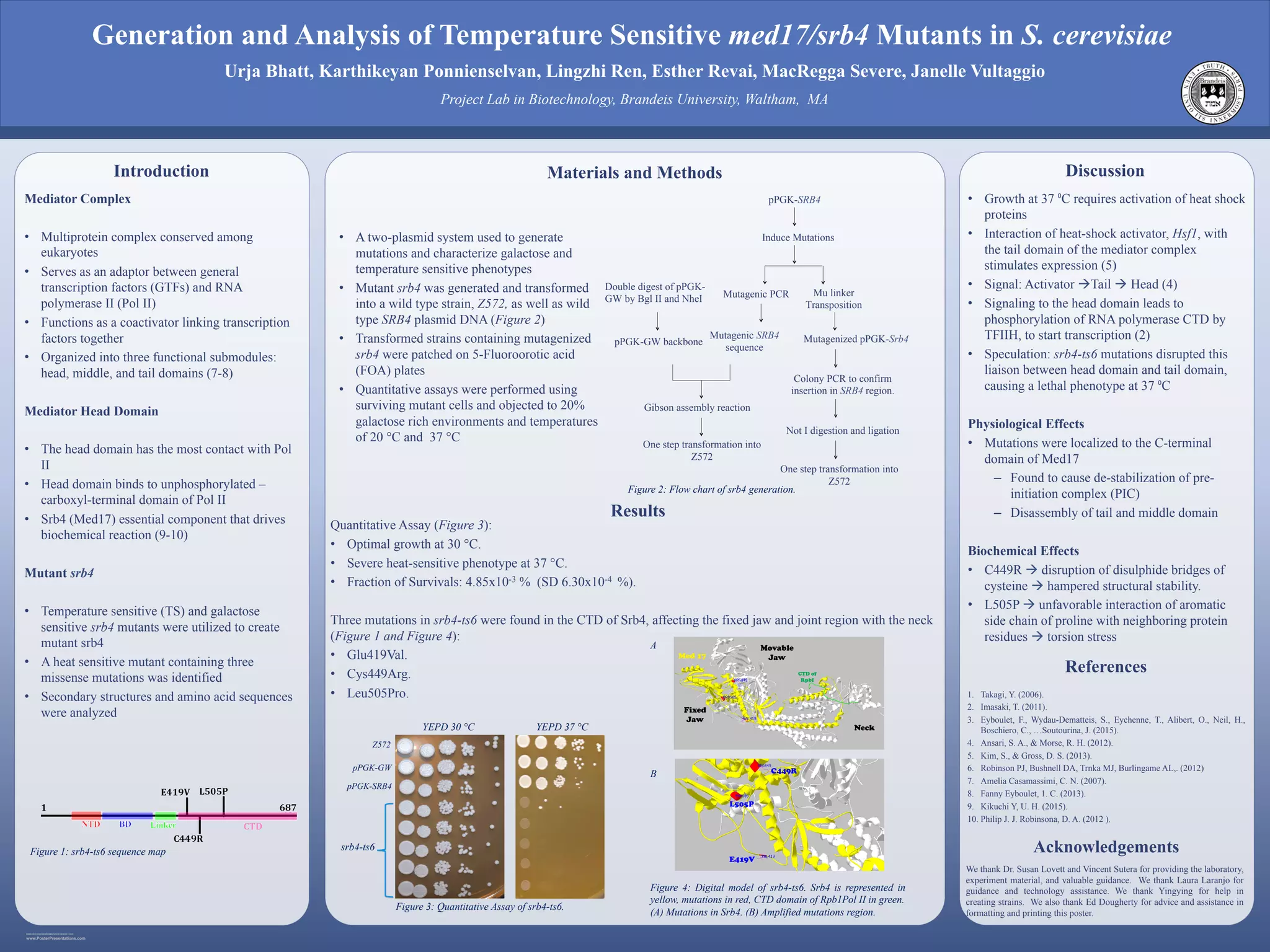
Quantitative Assay (Figure 3):
•  Optimal growth at 30 °C.
•  Severe heat-sensitive phenotype at 37 °C.
•  Fraction of Survivals: 4.85x10⁻³ % (SD 6.30x10⁻⁴ %).
Three mutations in srb4-ts6 were found in the CTD of Srb4, affecting the fixed jaw and joint region with the neck
(Figure 1 and Figure 4):
•  Glu419Val.
•  Cys449Arg.
•  Leu505Pro.
Figure 3: Quantitative Assay of srb4-ts6.
YEPD 30 °C YEPD 37 °C
Z572
pPGK-GW
pPGK-SRB4
srb4-ts6
Mediator Complex
•  Multiprotein complex conserved among
eukaryotes
•  Serves as an adaptor between general
transcription factors (GTFs) and RNA
polymerase II (Pol II)
•  Functions as a coactivator linking transcription
factors together
•  Organized into three functional submodules:
head, middle, and tail domains (7-8)
Mediator Head Domain
•  The head domain has the most contact with Pol
II
•  Head domain binds to unphosphorylated –
carboxyl-terminal domain of Pol II
•  Srb4 (Med17) essential component that drives
biochemical reaction (9-10)
Mutant srb4
•  Temperature sensitive (TS) and galactose
sensitive srb4 mutants were utilized to create
mutant srb4
•  A heat sensitive mutant containing three
missense mutations was identified
•  Secondary structures and amino acid sequences
were analyzed
Figure 1: srb4-ts6 sequence map
Figure 4: Digital model of srb4-ts6. Srb4 is represented in
yellow, mutations in red, CTD domain of Rpb1Pol II in green.
(A) Mutations in Srb4. (B) Amplified mutations region.
A
B
•  Growth at 37 ⁰C requires activation of heat shock
proteins
•  Interaction of heat-shock activator, Hsf1, with
the tail domain of the mediator complex
stimulates expression (5)
•  Signal: Activator àTail à Head (4)
•  Signaling to the head domain leads to
phosphorylation of RNA polymerase CTD by
TFIIH, to start transcription (2)
•  Speculation: srb4-ts6 mutations disrupted this
liaison between head domain and tail domain,
causing a lethal phenotype at 37 ⁰C
Physiological Effects
•  Mutations were localized to the C-terminal
domain of Med17
–  Found to cause de-stabilization of pre-
initiation complex (PIC)
–  Disassembly of tail and middle domain
Biochemical Effects
•  C449R à disruption of disulphide bridges of
cysteine à hampered structural stability.
•  L505P à unfavorable interaction of aromatic
side chain of proline with neighboring protein
residues à torsion stress
Discussion
References
Acknowledgements
1.  Takagi, Y. (2006).
2.  Imasaki, T. (2011).
3.  Eyboulet, F., Wydau-Dematteis, S., Eychenne, T., Alibert, O., Neil, H.,
Boschiero, C., …Soutourina, J. (2015).
4.  Ansari, S. A., & Morse, R. H. (2012).
5.  Kim, S., & Gross, D. S. (2013).
6.  Robinson PJ, Bushnell DA, Trnka MJ, Burlingame AL,. (2012)
7.  Amelia Casamassimi, C. N. (2007).
8.  Fanny Eyboulet, 1. C. (2013).
9.  Kikuchi Y, U. H. (2015).
10. Philip J. J. Robinsona, D. A. (2012 ).
We thank Dr. Susan Lovett and Vincent Sutera for providing the laboratory,
experiment material, and valuable guidance. We thank Laura Laranjo for
guidance and technology assistance. We thank Yingying for help in
creating strains. We also thank Ed Dougherty for advice and assistance in
formatting and printing this poster.
Gibson assembly reaction
One step transformation into
Z572
Not I digestion and ligation
One step transformation into
Z572
pPGK-SRB4
Induce Mutations
Mutagenic PCR Mu linker
Transposition
Mutagenic SRB4
sequence
Mutagenized pPGK-Srb4
Colony PCR to confirm
insertion in SRB4 region.
Double digest of pPGK-
GW by Bgl II and NheI
pPGK-GW backbone
Figure 2: Flow chart of srb4 generation.

Module 3- Poster Presentation

  • 1.
    RESEARCH POSTER PRESENTATIONDESIGN © 2015 www.PosterPresentations.com Project Lab in Biotechnology, Brandeis University, Waltham, MA Urja Bhatt, Karthikeyan Ponnienselvan, Lingzhi Ren, Esther Revai, MacRegga Severe, Janelle Vultaggio Generation and Analysis of Temperature Sensitive med17/srb4 Mutants in S. cerevisiae Introduction Materials and Methods •  A two-plasmid system used to generate mutations and characterize galactose and temperature sensitive phenotypes •  Mutant srb4 was generated and transformed into a wild type strain, Z572, as well as wild type SRB4 plasmid DNA (Figure 2) •  Transformed strains containing mutagenized srb4 were patched on 5-Fluoroorotic acid (FOA) plates •  Quantitative assays were performed using surviving mutant cells and objected to 20% galactose rich environments and temperatures of 20 °C and 37 °C Results Quantitative Assay (Figure 3): •  Optimal growth at 30 °C. •  Severe heat-sensitive phenotype at 37 °C. •  Fraction of Survivals: 4.85x10⁻³ % (SD 6.30x10⁻⁴ %). Three mutations in srb4-ts6 were found in the CTD of Srb4, affecting the fixed jaw and joint region with the neck (Figure 1 and Figure 4): •  Glu419Val. •  Cys449Arg. •  Leu505Pro. Figure 3: Quantitative Assay of srb4-ts6. YEPD 30 °C YEPD 37 °C Z572 pPGK-GW pPGK-SRB4 srb4-ts6 Mediator Complex •  Multiprotein complex conserved among eukaryotes •  Serves as an adaptor between general transcription factors (GTFs) and RNA polymerase II (Pol II) •  Functions as a coactivator linking transcription factors together •  Organized into three functional submodules: head, middle, and tail domains (7-8) Mediator Head Domain •  The head domain has the most contact with Pol II •  Head domain binds to unphosphorylated – carboxyl-terminal domain of Pol II •  Srb4 (Med17) essential component that drives biochemical reaction (9-10) Mutant srb4 •  Temperature sensitive (TS) and galactose sensitive srb4 mutants were utilized to create mutant srb4 •  A heat sensitive mutant containing three missense mutations was identified •  Secondary structures and amino acid sequences were analyzed Figure 1: srb4-ts6 sequence map Figure 4: Digital model of srb4-ts6. Srb4 is represented in yellow, mutations in red, CTD domain of Rpb1Pol II in green. (A) Mutations in Srb4. (B) Amplified mutations region. A B •  Growth at 37 ⁰C requires activation of heat shock proteins •  Interaction of heat-shock activator, Hsf1, with the tail domain of the mediator complex stimulates expression (5) •  Signal: Activator àTail à Head (4) •  Signaling to the head domain leads to phosphorylation of RNA polymerase CTD by TFIIH, to start transcription (2) •  Speculation: srb4-ts6 mutations disrupted this liaison between head domain and tail domain, causing a lethal phenotype at 37 ⁰C Physiological Effects •  Mutations were localized to the C-terminal domain of Med17 –  Found to cause de-stabilization of pre- initiation complex (PIC) –  Disassembly of tail and middle domain Biochemical Effects •  C449R à disruption of disulphide bridges of cysteine à hampered structural stability. •  L505P à unfavorable interaction of aromatic side chain of proline with neighboring protein residues à torsion stress Discussion References Acknowledgements 1.  Takagi, Y. (2006). 2.  Imasaki, T. (2011). 3.  Eyboulet, F., Wydau-Dematteis, S., Eychenne, T., Alibert, O., Neil, H., Boschiero, C., …Soutourina, J. (2015). 4.  Ansari, S. A., & Morse, R. H. (2012). 5.  Kim, S., & Gross, D. S. (2013). 6.  Robinson PJ, Bushnell DA, Trnka MJ, Burlingame AL,. (2012) 7.  Amelia Casamassimi, C. N. (2007). 8.  Fanny Eyboulet, 1. C. (2013). 9.  Kikuchi Y, U. H. (2015). 10. Philip J. J. Robinsona, D. A. (2012 ). We thank Dr. Susan Lovett and Vincent Sutera for providing the laboratory, experiment material, and valuable guidance. We thank Laura Laranjo for guidance and technology assistance. We thank Yingying for help in creating strains. We also thank Ed Dougherty for advice and assistance in formatting and printing this poster. Gibson assembly reaction One step transformation into Z572 Not I digestion and ligation One step transformation into Z572 pPGK-SRB4 Induce Mutations Mutagenic PCR Mu linker Transposition Mutagenic SRB4 sequence Mutagenized pPGK-Srb4 Colony PCR to confirm insertion in SRB4 region. Double digest of pPGK- GW by Bgl II and NheI pPGK-GW backbone Figure 2: Flow chart of srb4 generation.