DAY 2
Determines the structure of a specific academic text
Differentiates language used in academic text from various
discipline
ACADEMIC TEXT
•Any written material or
composition that uses
ACADEMIC LANGUAGE
ACADEMIC LANGUAGE
• Academic language represents the language demands
of school (academics). Academic language includes
language used in textbooks, in classrooms, on tests,
and in each discipline. It is different in vocabulary and
structure from the everyday spoken English of social
interactions. Each type of communication (both
academic and social) has its purpose, and neither is
superior to the other
SPECIFICATION OF ACADEMIC LANGUAGE
• LANGUAGE OF JOURNALISM
• LANGUAGE OF SCIENCE/ MEDICINE
• LANGUAGE OF LAW
• LANGUAGE OF POLITICS
• LANGUAGE OF BUSINESS
• LANGUAGE OF FINANCE
ACADEMIC VOCABULARY
• Academic vocabulary is used in all academic disciplines to teach
about the content of the discipline, e.g., a water table is different
from a periodic elements table. Before taking chemistry, for example,
some students know the technical words used in chemistry, while
others do not. Pre-teaching of vocabulary and subject-specific
terminology helps to address that need. Teaching academic language
can be challenging because struggling readers and English learners do
not always know the vocabulary used to learn specific academic
terms or key concepts.
ACADEMIC STRUCTURE
• Academic structure also includes the established ways of organizing
writing (which can affect how one reads) in a discipline. Different
genres, paragraph/sentence structure, level of text difficulty, purpose,
intended audience, overall organization, and knowledge of outside
resources for the text all affect how one writes and reads in that
discipline.
WAYS TO DETERMINE LANGUAGE OF ACAD
TEXT
• Identify the text and then analyze the genre, academic structure and
academic vocabulary
• Identify and analyze the explicit instruction/deconstruction
concerning the text; consider multiple models if necessary.
• Use explicit, scaffolded instruction: a clear instructions, both auditory
and visual, and make models of expected or possible outcomes.
• Bring academic language to the surface: identify its usage to a
particular discipline.
Activity 1. Guess the Word
GROUP ACTIVITY 3. They Mean It!
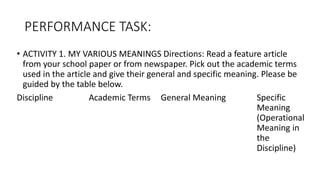
PERFORMANCE TASK:
• ACTIVITY 1. MY VARIOUS MEANINGS Directions: Read a feature article
from your school paper or from newspaper. Pick out the academic terms
used in the article and give their general and specific meaning. Please be
guided by the table below.
Discipline Academic Terms General Meaning Specific
Meaning
(Operational
Meaning in
the
Discipline)

Module 2- EAPP Grade 11, Presentation about Academic Text

  • 1.
    DAY 2 Determines thestructure of a specific academic text Differentiates language used in academic text from various discipline
  • 2.
    ACADEMIC TEXT •Any writtenmaterial or composition that uses ACADEMIC LANGUAGE
  • 3.
    ACADEMIC LANGUAGE • Academiclanguage represents the language demands of school (academics). Academic language includes language used in textbooks, in classrooms, on tests, and in each discipline. It is different in vocabulary and structure from the everyday spoken English of social interactions. Each type of communication (both academic and social) has its purpose, and neither is superior to the other
  • 4.
    SPECIFICATION OF ACADEMICLANGUAGE • LANGUAGE OF JOURNALISM • LANGUAGE OF SCIENCE/ MEDICINE • LANGUAGE OF LAW • LANGUAGE OF POLITICS • LANGUAGE OF BUSINESS • LANGUAGE OF FINANCE
  • 5.
    ACADEMIC VOCABULARY • Academicvocabulary is used in all academic disciplines to teach about the content of the discipline, e.g., a water table is different from a periodic elements table. Before taking chemistry, for example, some students know the technical words used in chemistry, while others do not. Pre-teaching of vocabulary and subject-specific terminology helps to address that need. Teaching academic language can be challenging because struggling readers and English learners do not always know the vocabulary used to learn specific academic terms or key concepts.
  • 6.
    ACADEMIC STRUCTURE • Academicstructure also includes the established ways of organizing writing (which can affect how one reads) in a discipline. Different genres, paragraph/sentence structure, level of text difficulty, purpose, intended audience, overall organization, and knowledge of outside resources for the text all affect how one writes and reads in that discipline.
  • 7.
    WAYS TO DETERMINELANGUAGE OF ACAD TEXT • Identify the text and then analyze the genre, academic structure and academic vocabulary • Identify and analyze the explicit instruction/deconstruction concerning the text; consider multiple models if necessary. • Use explicit, scaffolded instruction: a clear instructions, both auditory and visual, and make models of expected or possible outcomes. • Bring academic language to the surface: identify its usage to a particular discipline.
  • 8.
  • 9.
    GROUP ACTIVITY 3.They Mean It!
  • 10.
    PERFORMANCE TASK: • ACTIVITY1. MY VARIOUS MEANINGS Directions: Read a feature article from your school paper or from newspaper. Pick out the academic terms used in the article and give their general and specific meaning. Please be guided by the table below. Discipline Academic Terms General Meaning Specific Meaning (Operational Meaning in the Discipline)