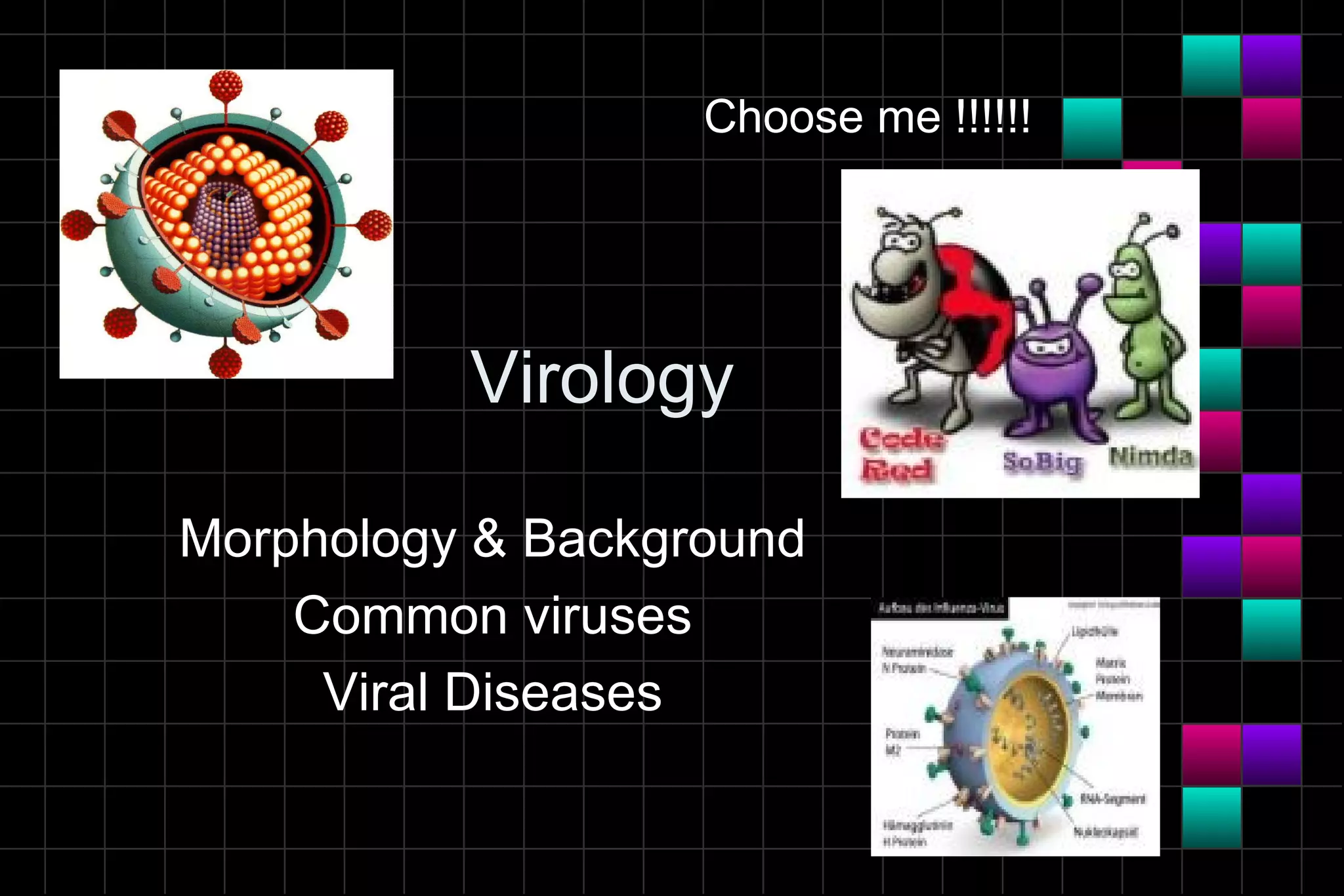
Choose me !!!!!!


          Virology

Morphology & Background
    Common viruses
     Viral Diseases
Background Information:)
s   virus are parasites,   s   all cells can be
    not cells                  parasitized by
s   virus are packages         virus, they only
    of genetic info -          attack closely
    nucleic acids in           related organisms
    protein coats          s   virus comes from a
s   virus only supplies        latin word “poison”
    information, rest is       or “slime”
    dependent on host
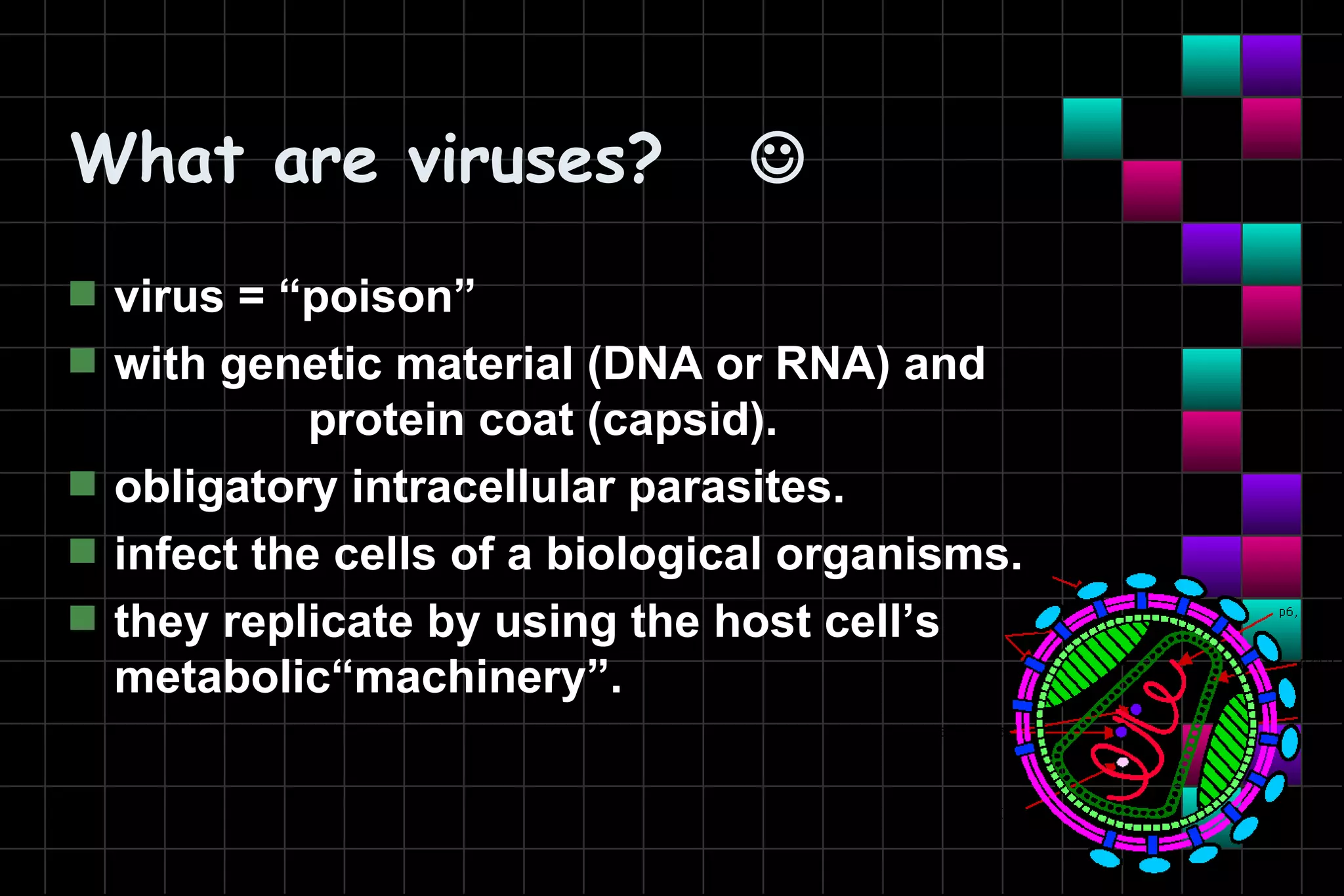
What are viruses?                 
s   virus = “poison”
s   with genetic material (DNA or RNA) and
              protein coat (capsid).
s   obligatory intracellular parasites.
s   infect the cells of a biological organisms.
s   they replicate by using the host cell’s
    metabolic“machinery”.
Definition of Terms: 
s Capsid- protein shell, or coat, that
  encloses the nucleic acid genome
s Capsomere – Morphologic units of virus
  seen under the EM on the surface of
  icosahedral virus particles
    • Represents clusters of polypeptide
s   Defective virus – virus particle that is
    functionally deficient in some aspect of
    replication
More terms: 
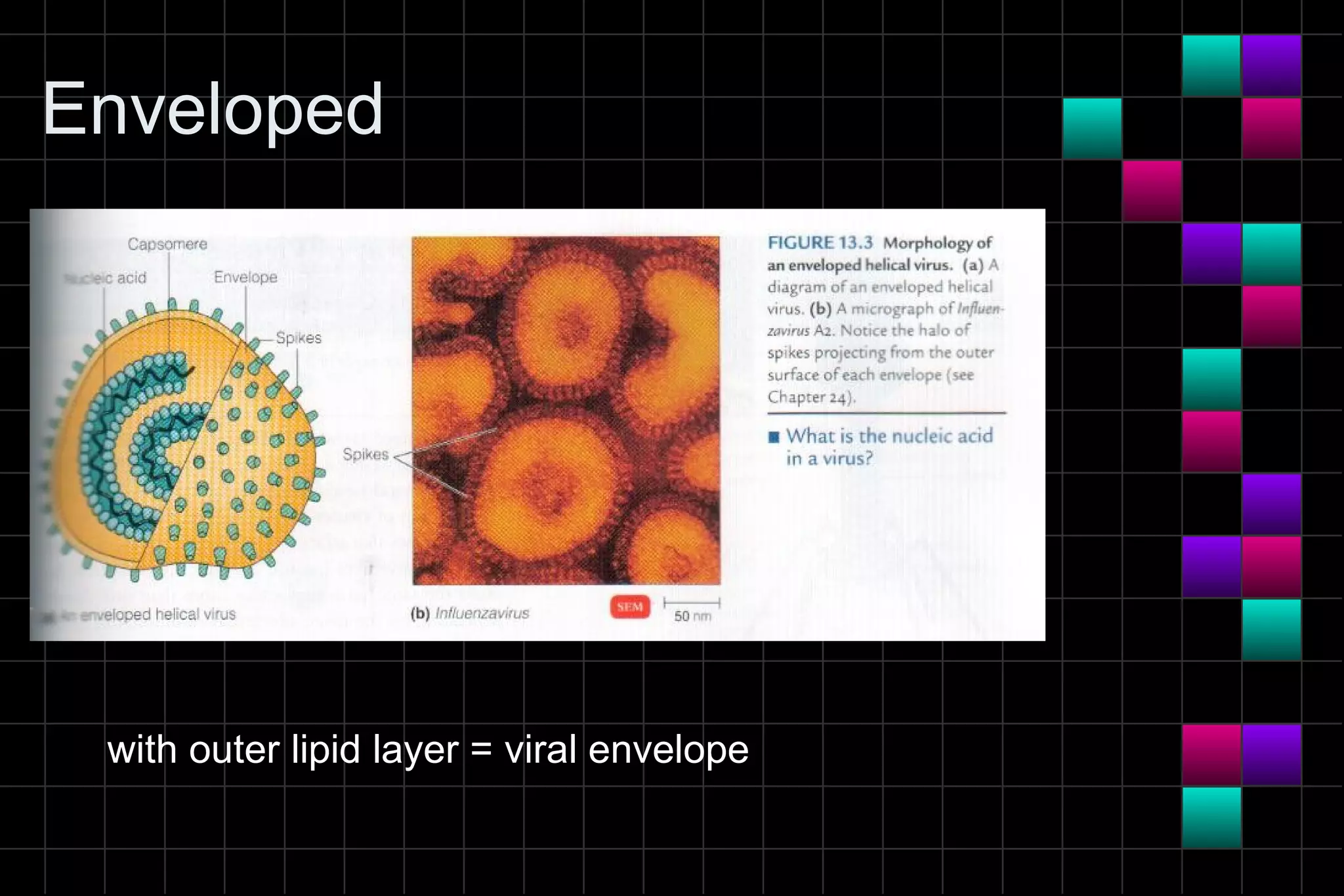
s   Envelope – lipid containing membrane
    that surrounds some virus particles
    • Acquired during viral maturation by a
      budding process thru a cellular membrane
s Nucleocapsid – protein nucleic acid
  complex representing the packaged
  form of the viral genome
s Subunit – single folded viral polypeptide
  chain
s   Structural units – Basic protein building
    blocks of the coat.
    • Usually a collection of more than one
      nonidentical protein unit.
    • The structural unit is often referred to a
      protomer.
s   Virion – Complete virus particle. In
    some instances, the virion is identical to
    the nucleocapsid. In more complex
    virions, this includes the nucleocapsid
    plus a surrounding envelope.
Background Information: 
s   Dmitri Iwanowski -     s   Are viruses alive??
    1892 first isolation        they contain
    of TMV                     macromolecules
s   Martinus Beijerinck        but does not
    - filterable viruses       reproduce directly
s   Wendell Stanley -          --- virions are
                               intact, non-
    1935 purified &
                               replicating virus
    crystallized TMV
                               particles ( no life)
Basis of classification
s   Virus morphology       s   Virus genome
    • Size                     properties
    • Shape                    • Nucleic Acid ( DNA
    • Type of symmetry           or RNA )
    • Presence & absence       • Size of genomes in
      of peplomers               kb (kilobase pairs )
    • Presence & absence       • Strandedness (single
      of membranes               or double )
                               • Nucleotide sequence
Basis for Classification:
s   Host Range                s   Size
    • Plant virus                 • 25 nm to 300 nm
    • Animal Virus                • 1/10 to 1/3 of
    • Bacteriophage                 bacteria
                                  • no cytoplasmic
    • Specificity cultivars         structures
      ( plants), race or          • can be 77 genes
      strains, receptors            or 3 genes but
      (protein)                     still very lethal
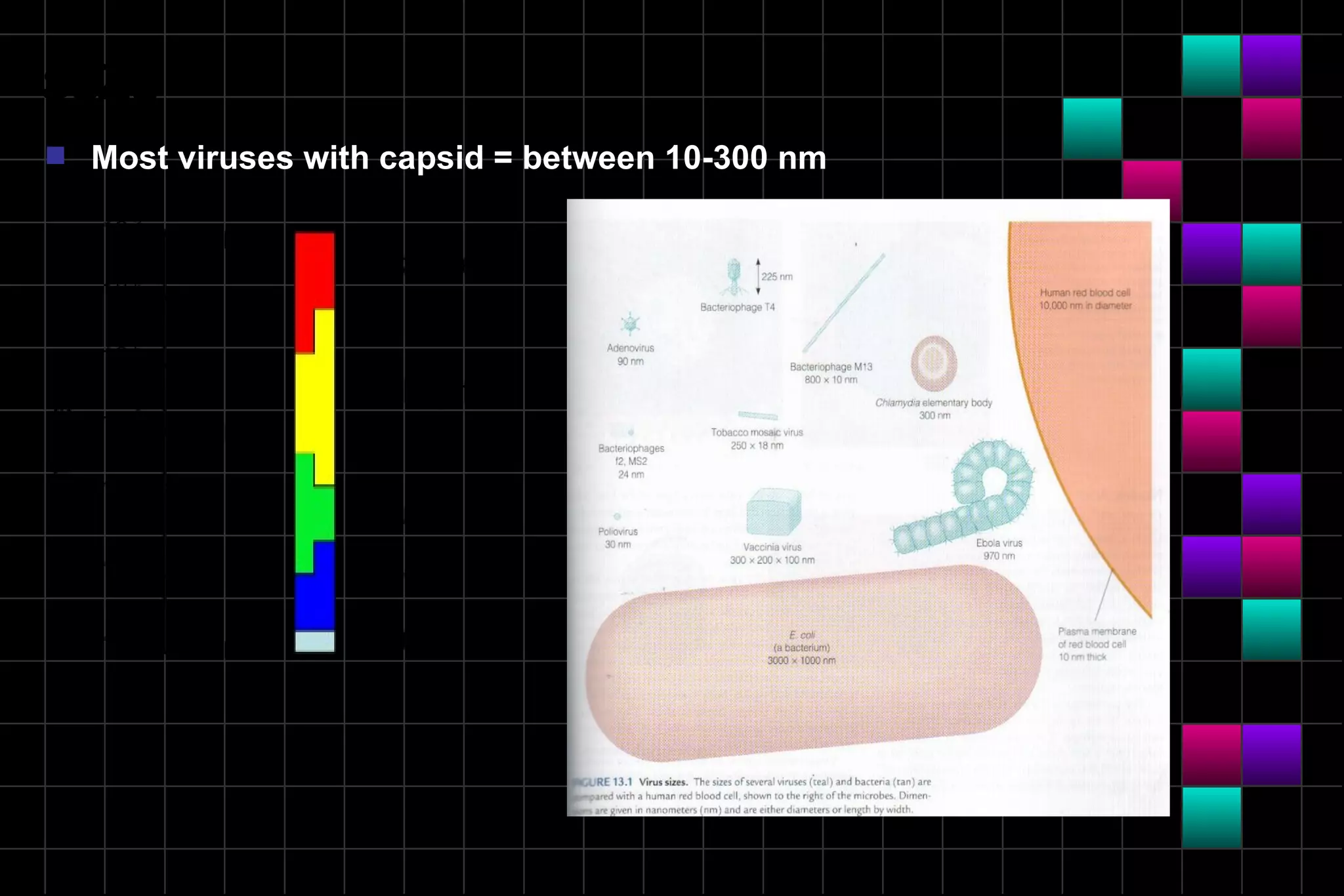
SIZE
s   Most viruses with capsid = between 10-300 nm
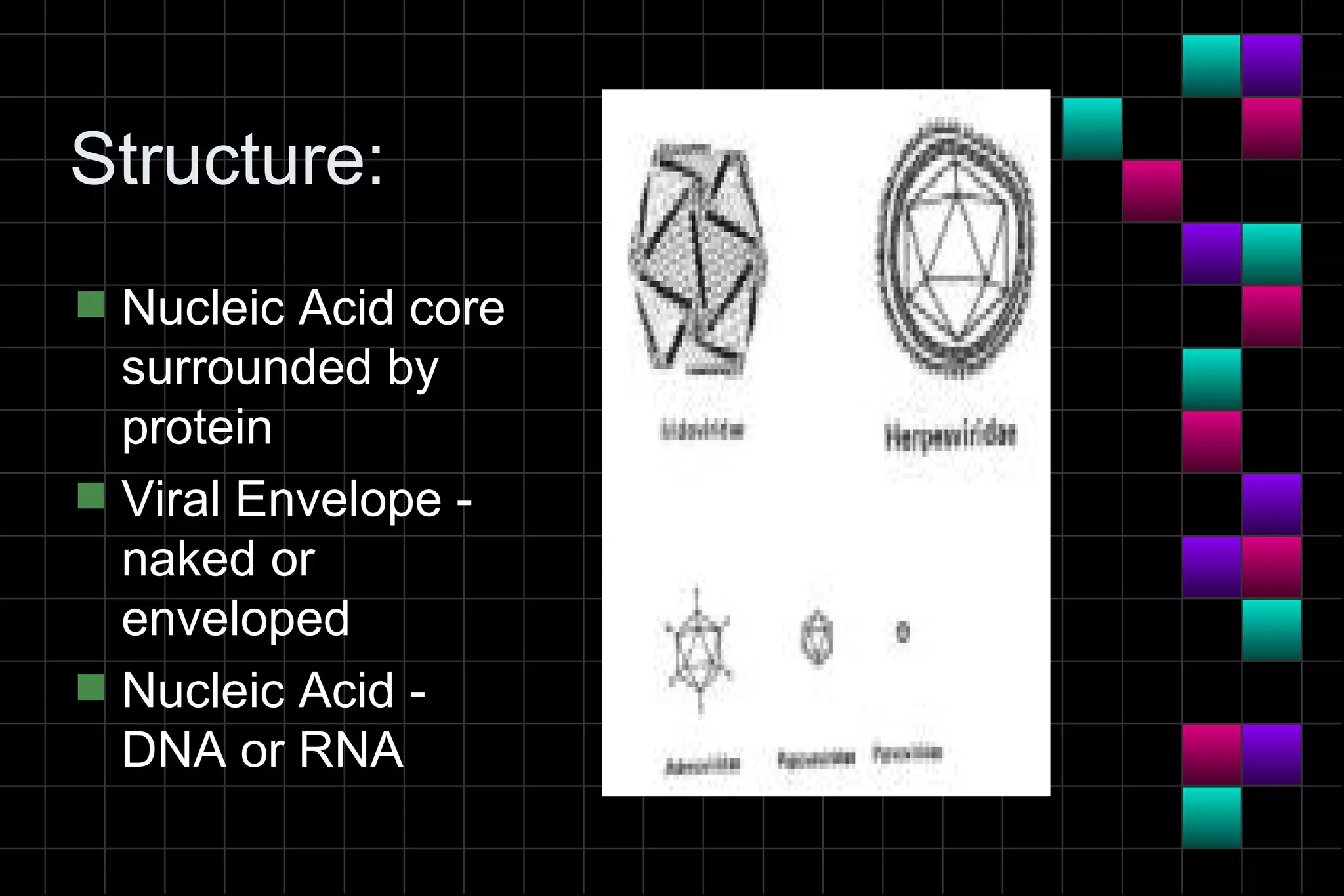
Structure:
s   Nucleic Acid core
    surrounded by
    protein
s   Viral Envelope -
    naked or
    enveloped
s   Nucleic Acid -
    DNA or RNA
s   Genome
    organization &
    replication          s   Antigenic properties
    • Gene order
    • Gene number
                         s   Biologic properties
    • Position of open
                             including :
      reading frames         • Natural host range
    • Patterns of            • Mode of
      replication              transmission
    • Cellular sites         • Vector relationship
                             • Pathogenecity
                             • Tissue tropisms
                             • Pathology
s   Physiochemical                 s   Virus protein
    Properties of the                  properties
    virion                             • Number
    •   Molecular mass                 • Size
    •   Buoyant density                • Functional activities
    •   pH stability                   • Amino acid
    •   Thermal stability                sequence
    •   Susceptibility to agents       • Modifications &
         – Ethers                        special functions
         – Detergents                      –   Transcriptase
                                           –   Reverse trans.
                                           –   Neuramidase
                                           –   fusion
Types of Structure

s   Four morphological types:
    •   1. Helical Viruses
    •   2. Icosahedral viruses
    •   3. Enveloped viruses
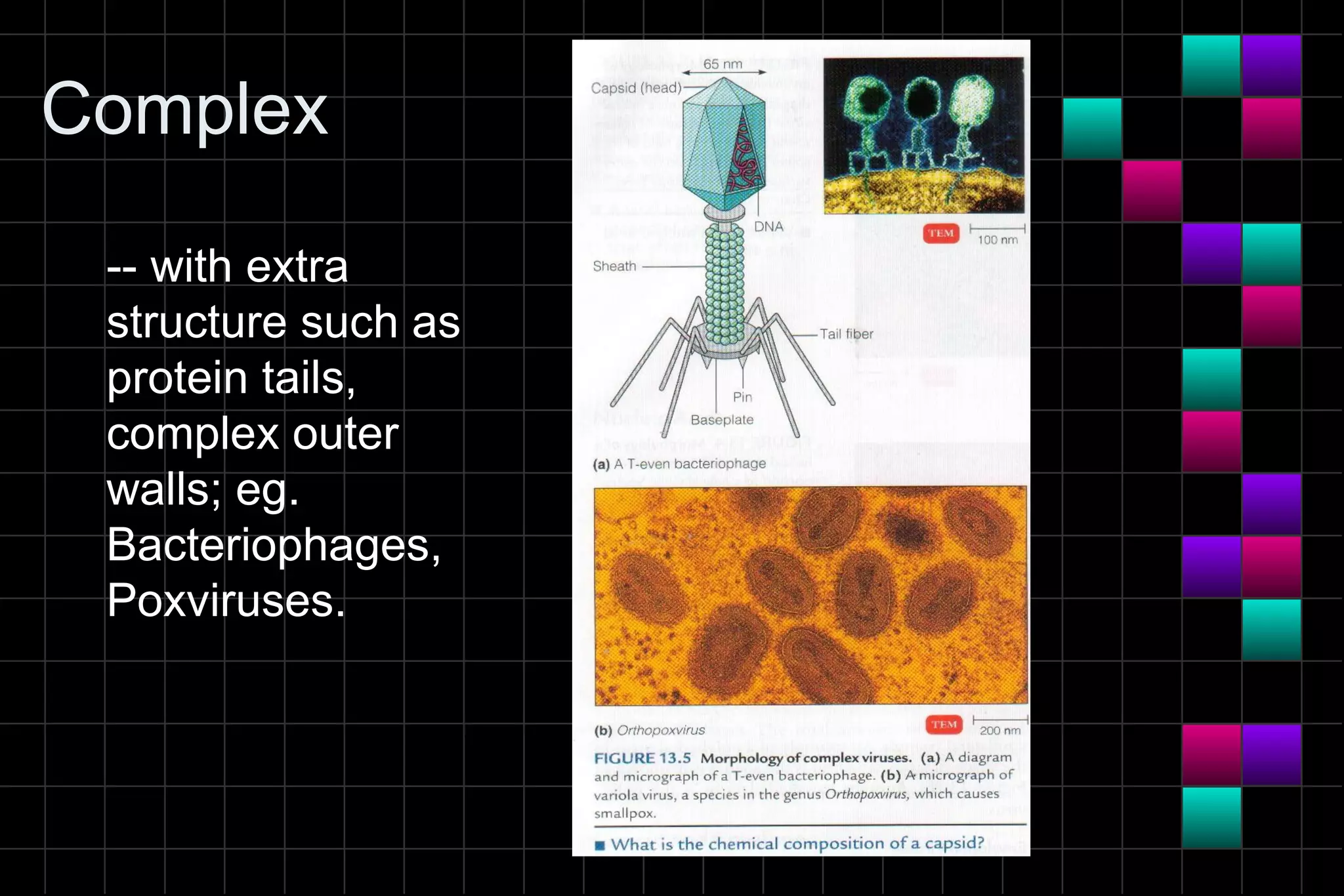
    •   4. Complex viruses
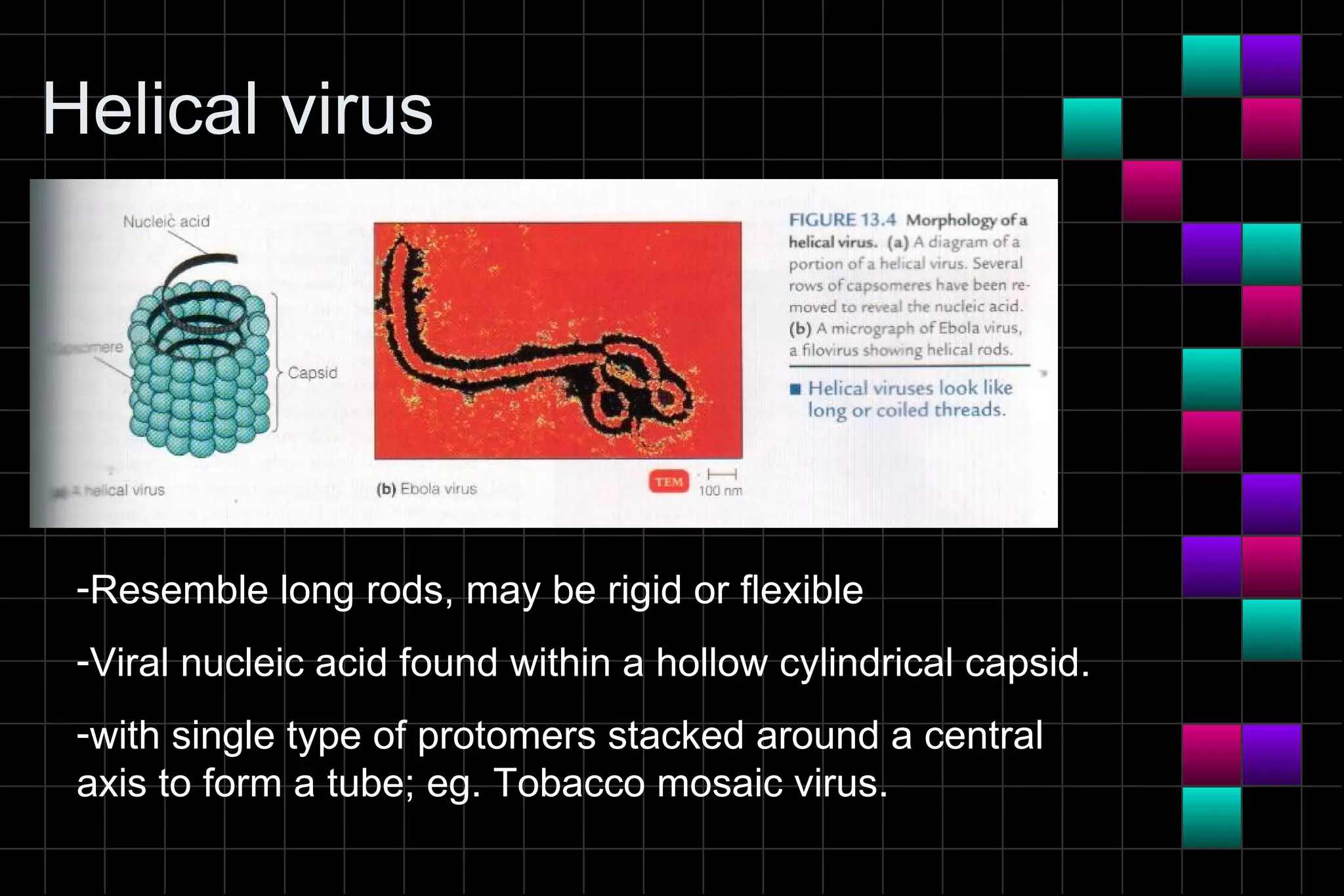
Helical virus


 -Resemble long rods, may be rigid or flexible
 -Viral nucleic acid found within a hollow cylindrical capsid.
 -with single type of protomers stacked around a central
 axis to form a tube; eg. Tobacco mosaic virus.
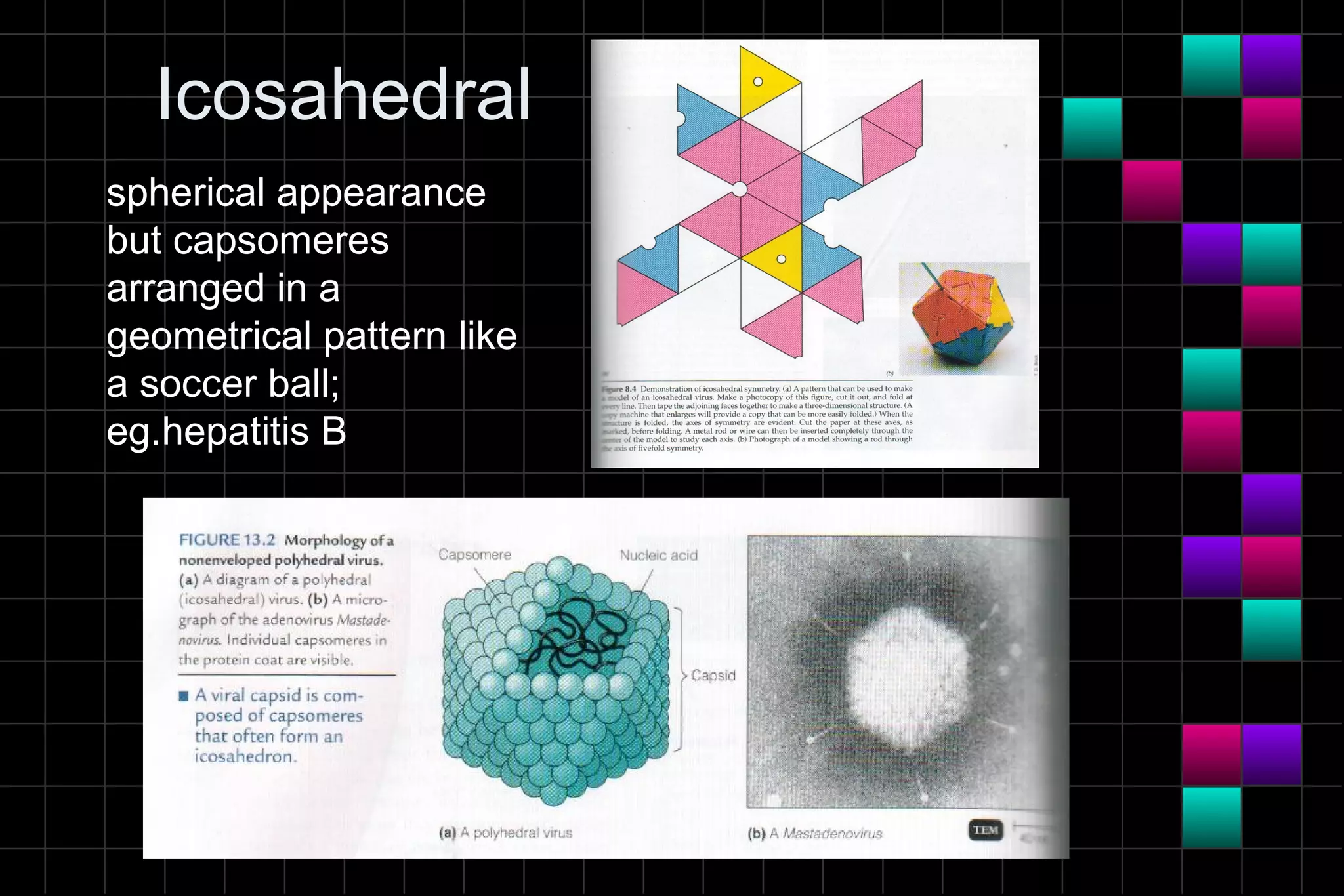
Icosahedral
spherical appearance
but capsomeres
arranged in a
geometrical pattern like
a soccer ball;
eg.hepatitis B
Enveloped


 with outer lipid layer = viral envelope
Complex

 -- with extra
 structure such as
 protein tails,
 complex outer
 walls; eg.
 Bacteriophages,
 Poxviruses.
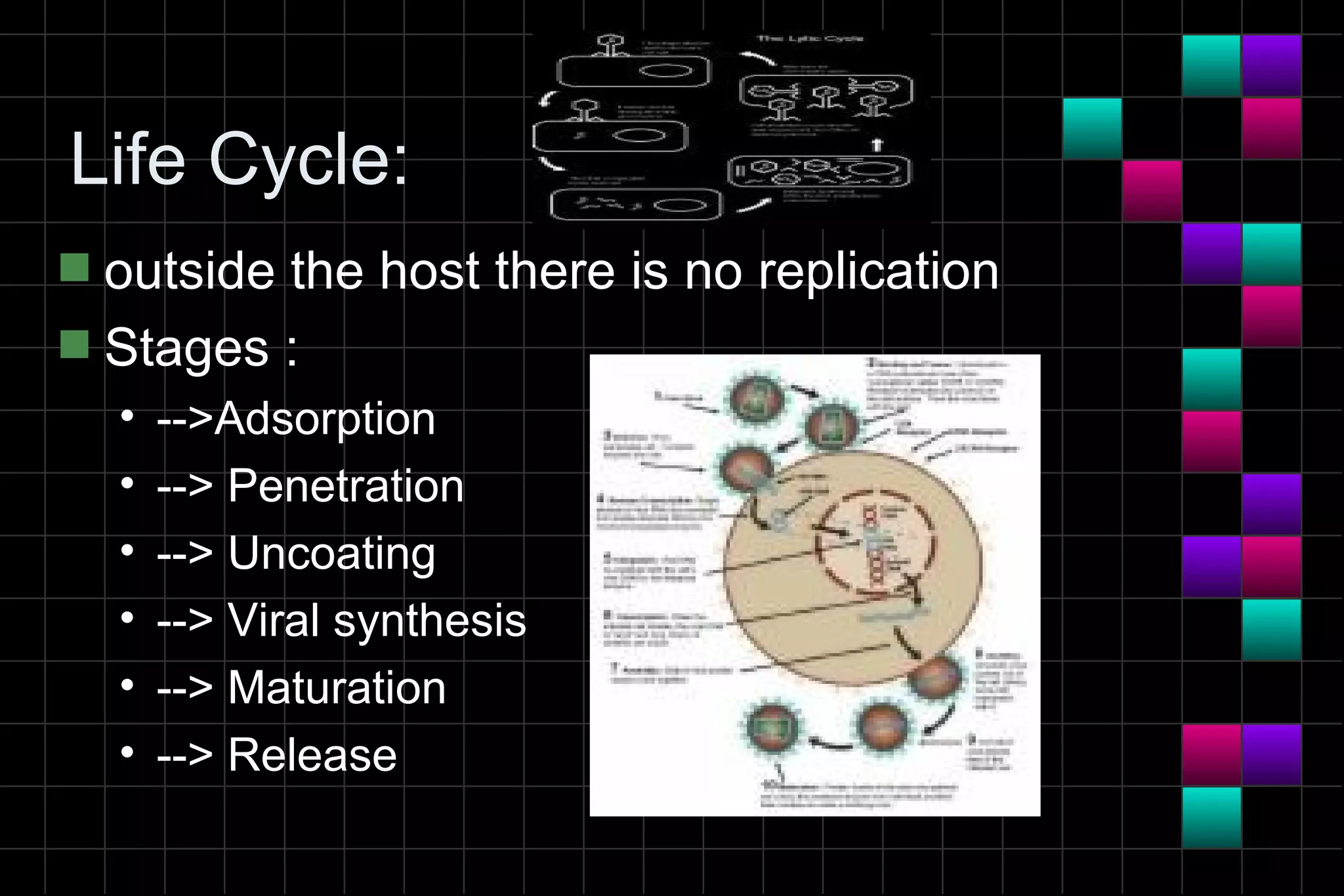
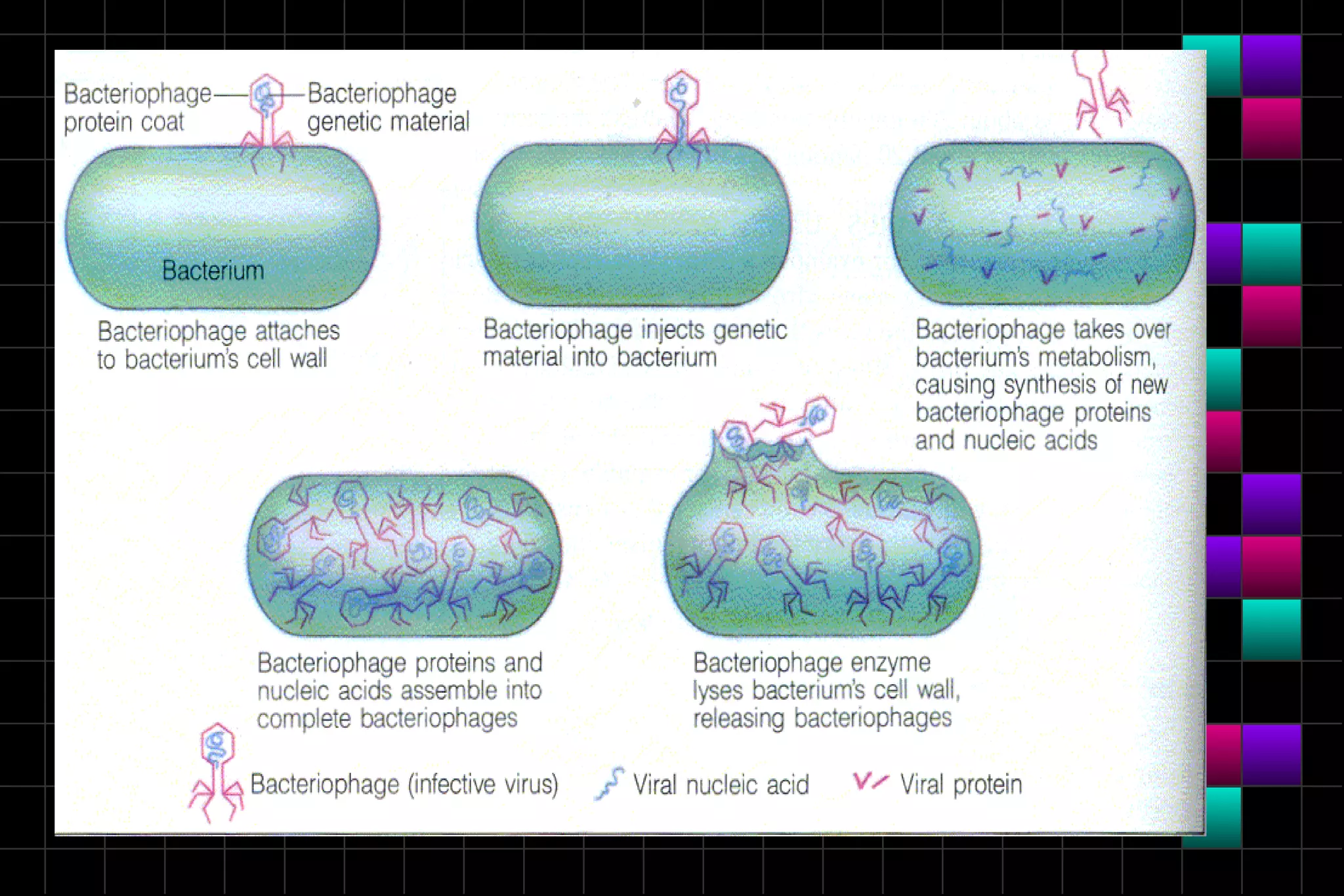
Life Cycle:
s outside the host there is no replication
s Stages :
    •   -->Adsorption
    •   --> Penetration
    •   --> Uncoating
    •   --> Viral synthesis
    •   --> Maturation
    •   --> Release
Multiplication of Viruses

s   Lytic cycle – ends with the lysis and
    death of the host cell.

s   Lysogenic cycle- host cell remains alive
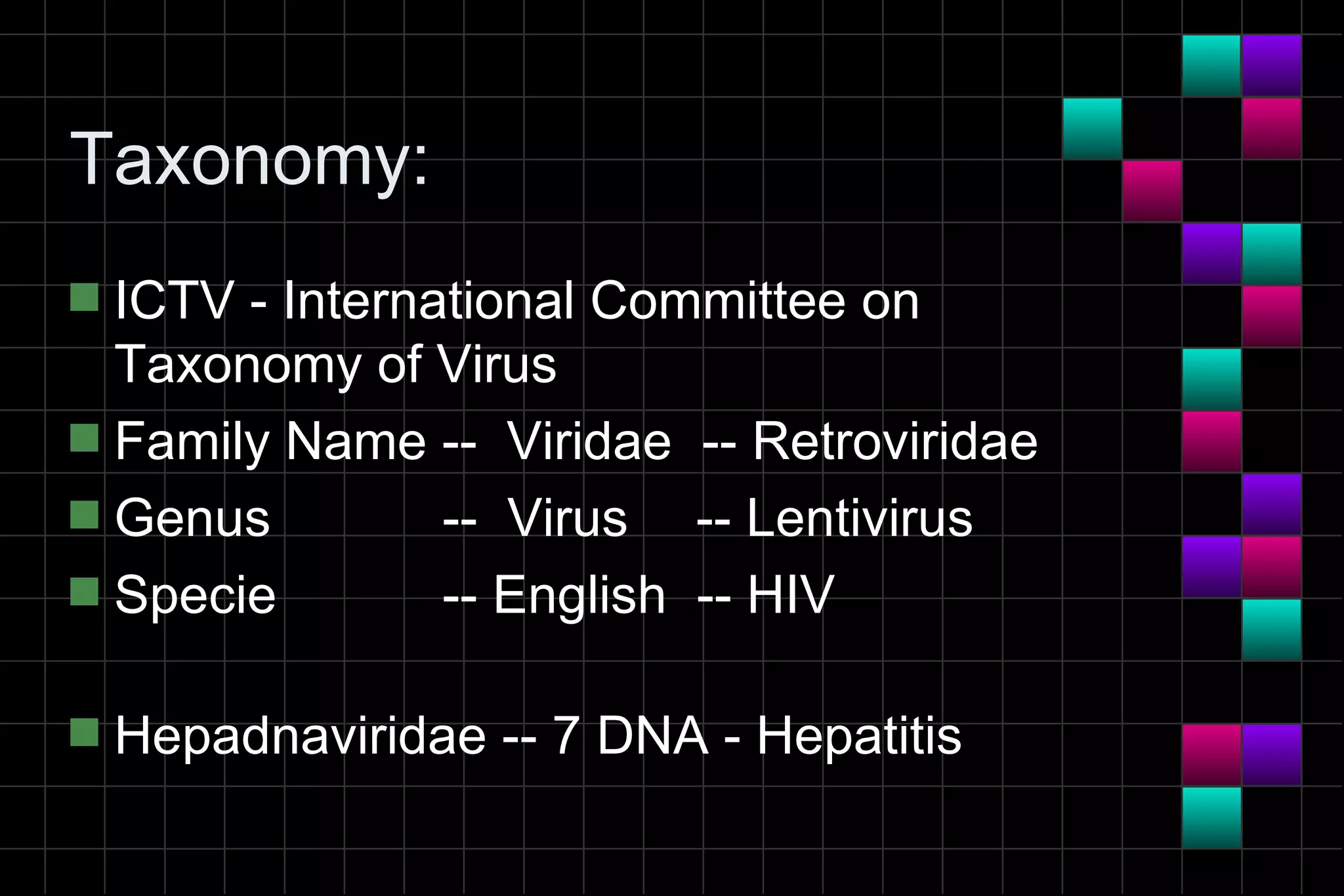
Taxonomy:
s ICTV - International Committee on
  Taxonomy of Virus
s Family Name -- Viridae -- Retroviridae
s Genus         -- Virus -- Lentivirus
s Specie        -- English -- HIV

s   Hepadnaviridae -- 7 DNA - Hepatitis
Misc. Information:
s Replication applicable to all virus
s Plaque count - PFU Plaque forming
  units
s One Step Growth Phase -- Latent --->
  Burst Period
Common viruses in animals:
s Line 1 - Family
s Line 2 - Classification based on N.A.
s Line 3 - Properties
s Line 4 - Virus (species or Genus)
s Line 5 - Diseases


          ***   Legend
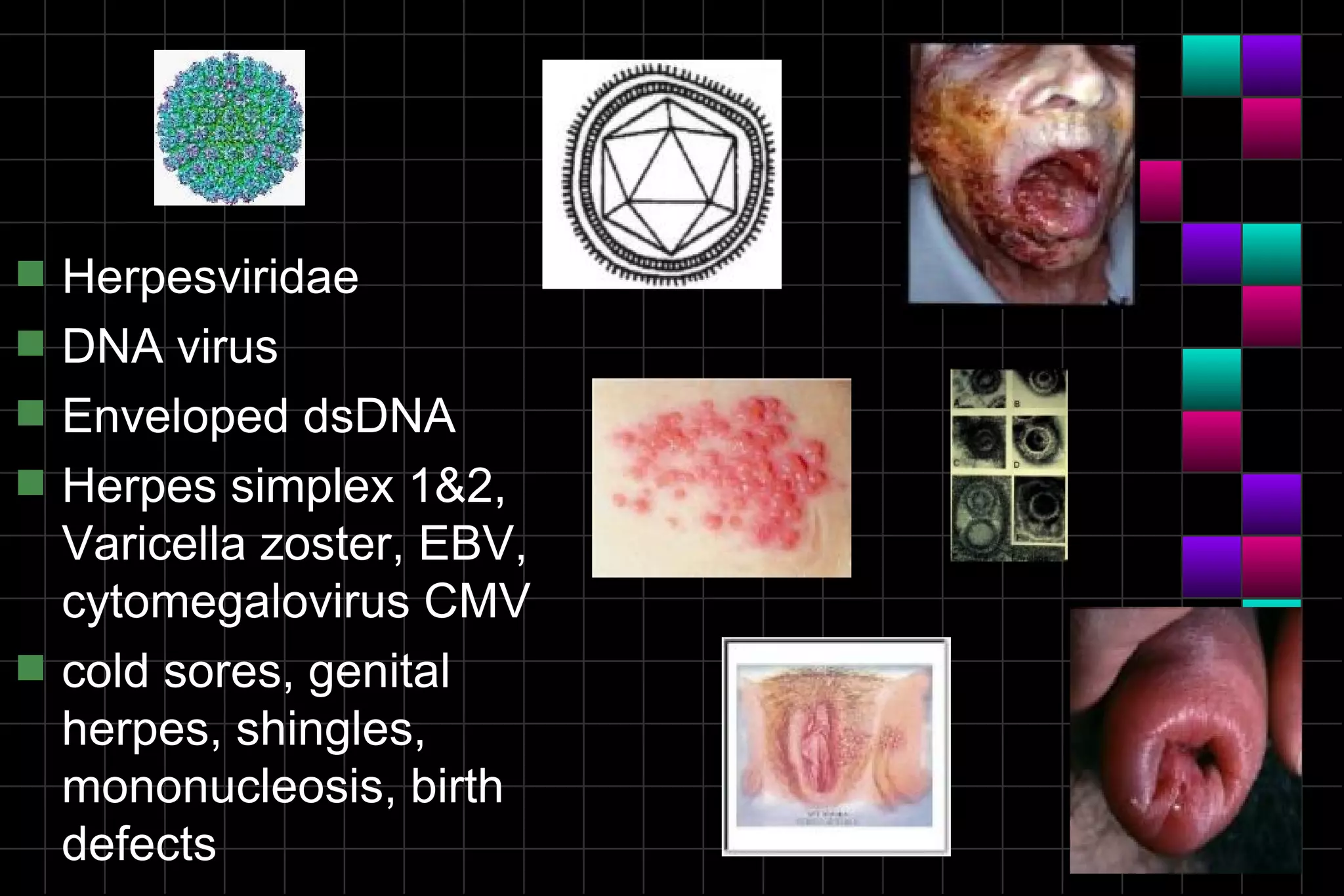
s   Herpesviridae
s   DNA virus
s   Enveloped dsDNA
s   Herpes simplex 1&2,
    Varicella zoster, EBV,
    cytomegalovirus CMV
s   cold sores, genital
    herpes, shingles,
    mononucleosis, birth
    defects
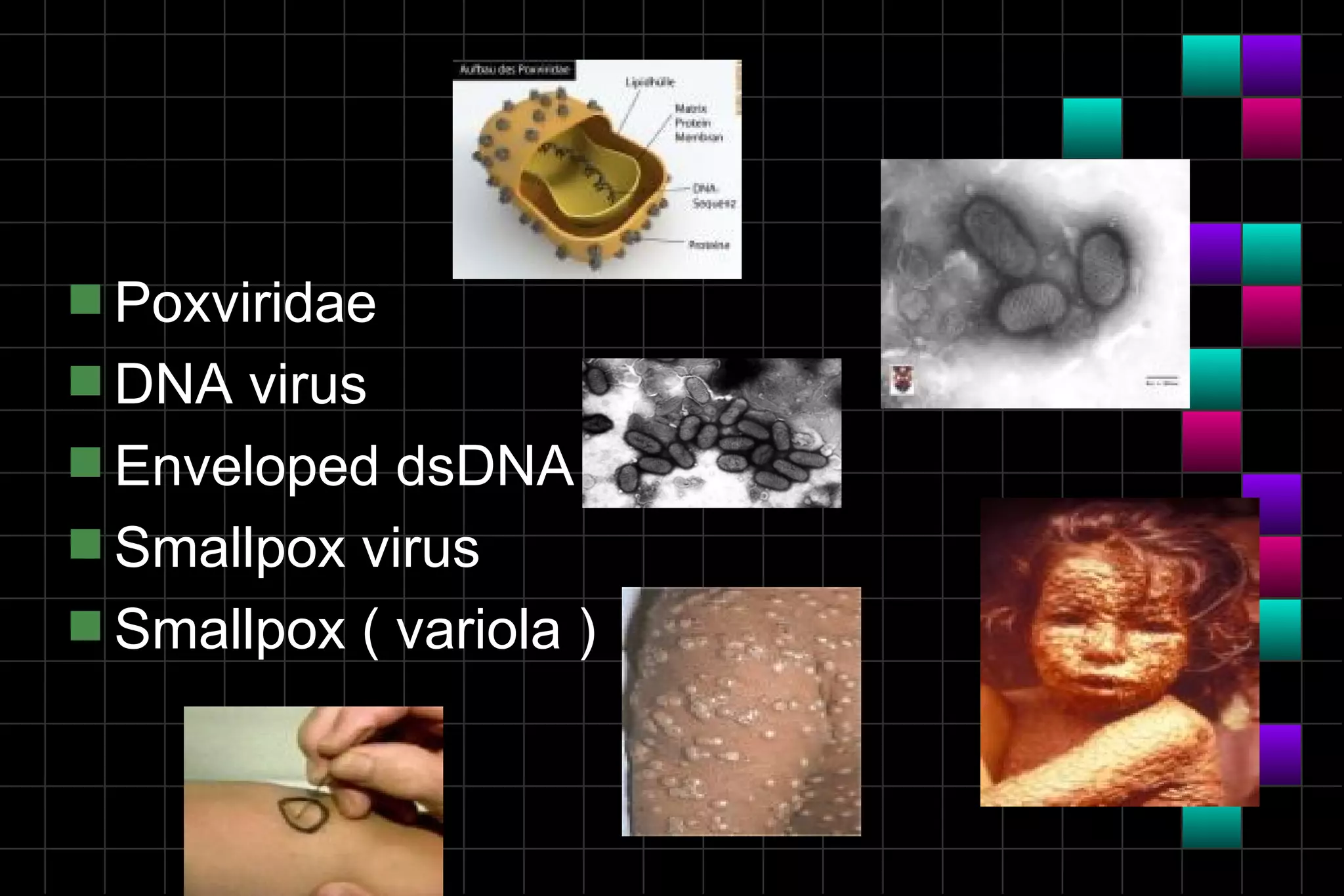
s Poxviridae
s DNA virus
s Enveloped dsDNA
s Smallpox virus
s Smallpox ( variola )
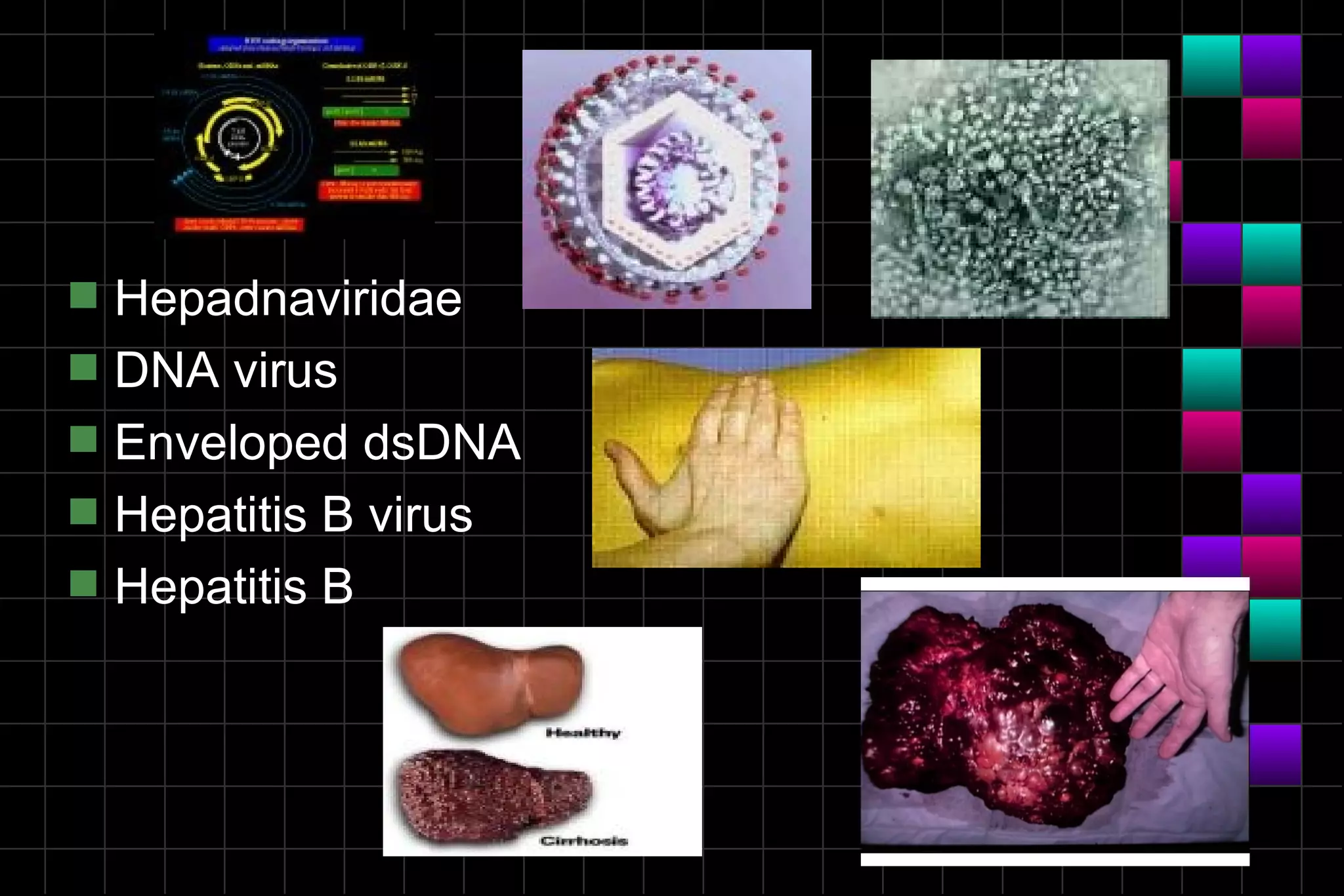
s   Hepadnaviridae
s   DNA virus
s   Enveloped dsDNA
s   Hepatitis B virus
s   Hepatitis B
New Nomenclature for
Hepatitis Virus
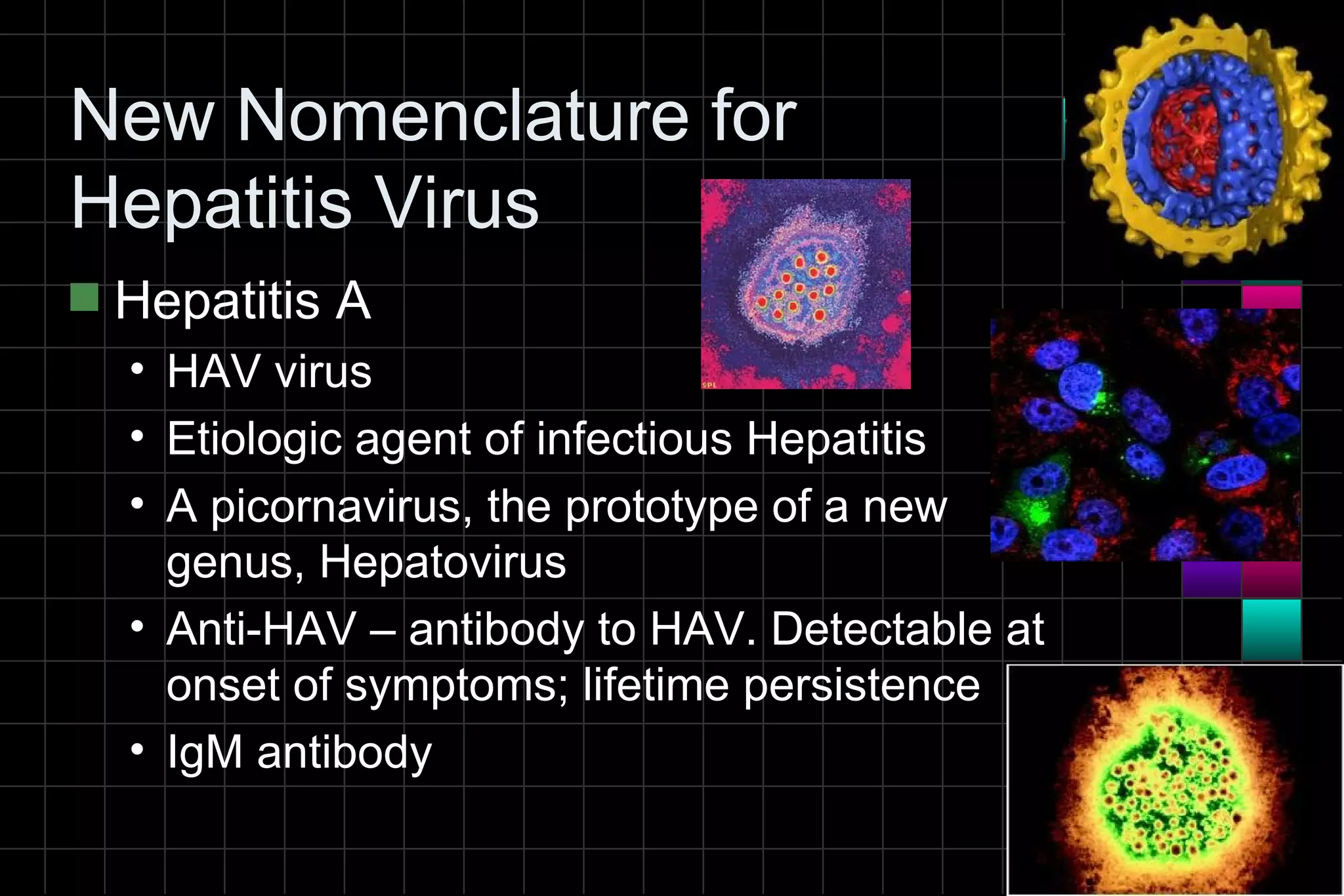
s   Hepatitis A
    • HAV virus
    • Etiologic agent of infectious Hepatitis
    • A picornavirus, the prototype of a new
      genus, Hepatovirus
    • Anti-HAV – antibody to HAV. Detectable at
      onset of symptoms; lifetime persistence
    • IgM antibody
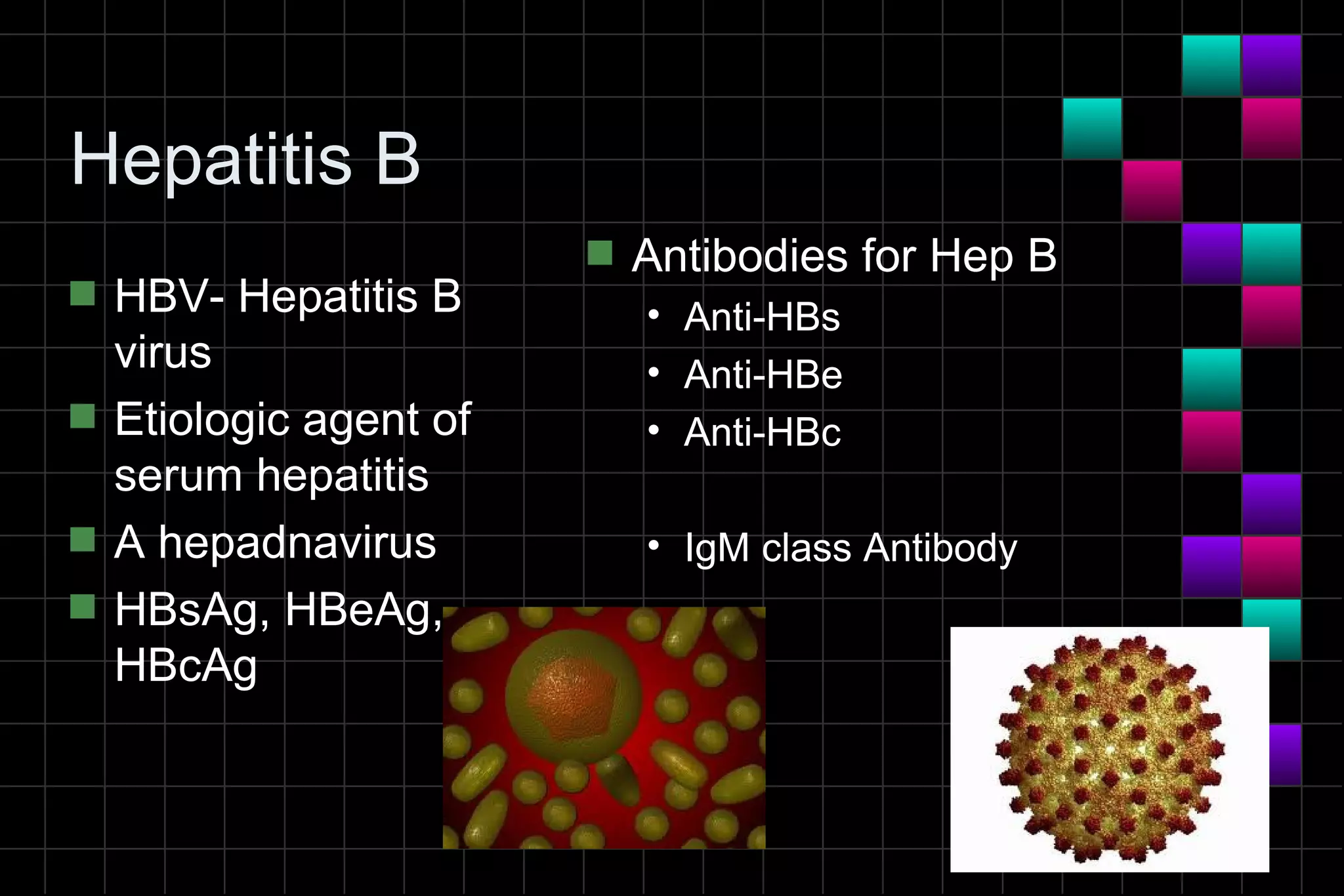
Hepatitis B
                         s   Antibodies for Hep B
s   HBV- Hepatitis B         • Anti-HBs
    virus                    • Anti-HBe
s   Etiologic agent of       • Anti-HBc
    serum hepatitis
s   A hepadnavirus           • IgM class Antibody
s   HBsAg, HBeAg,
    HBcAg
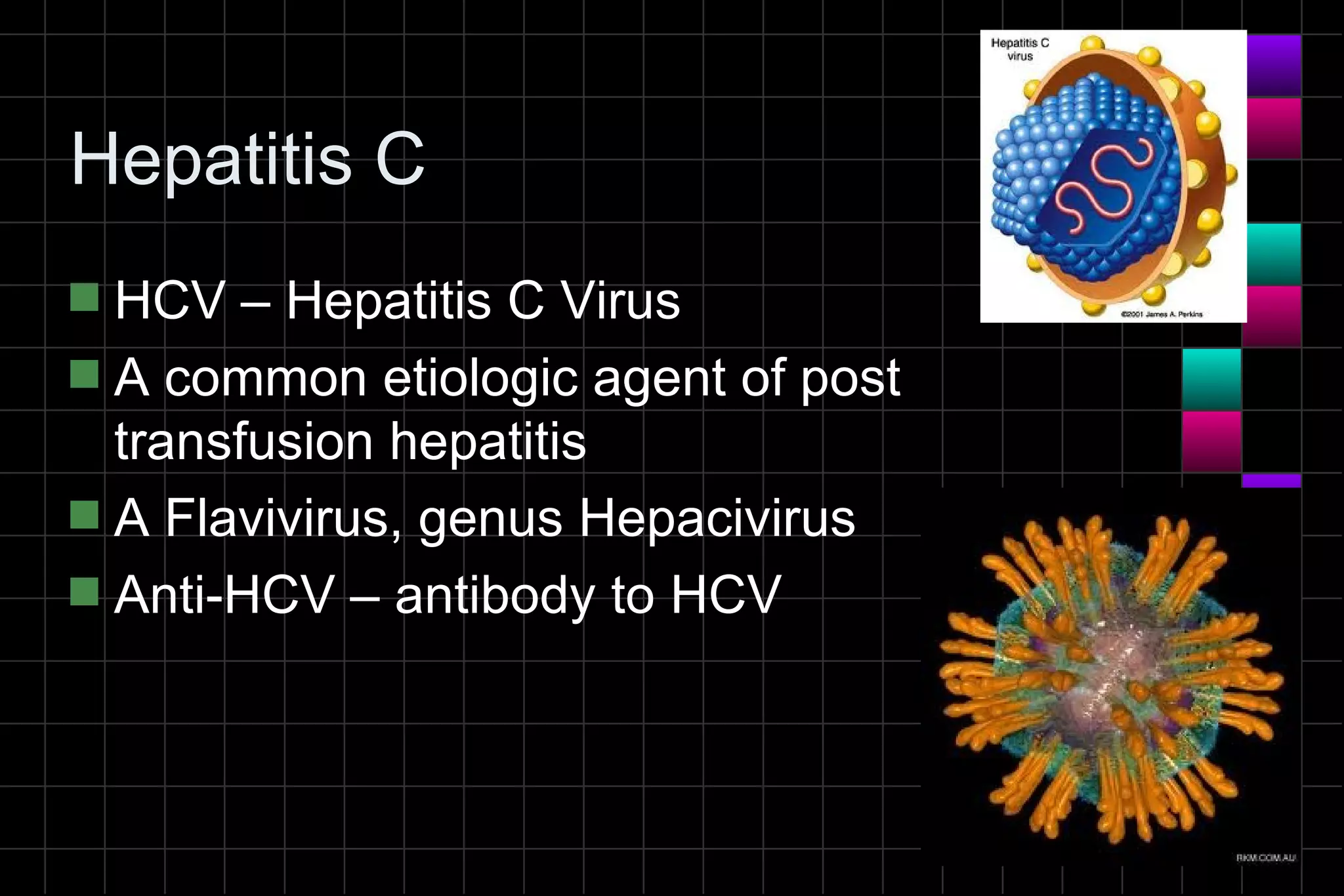
Hepatitis C
s HCV – Hepatitis C Virus
s A common etiologic agent of post
  transfusion hepatitis
s A Flavivirus, genus Hepacivirus
s Anti-HCV – antibody to HCV
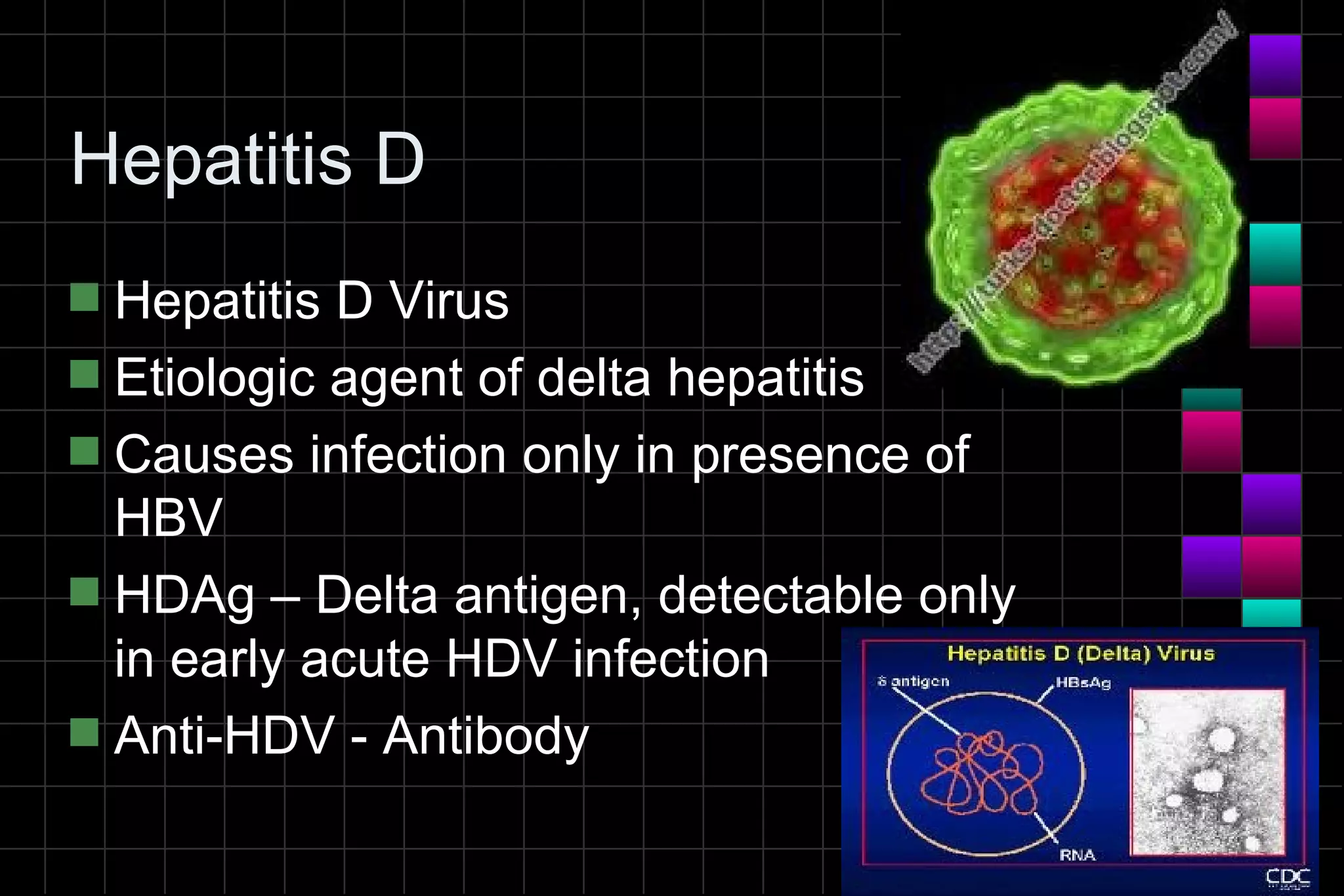
Hepatitis D
s Hepatitis D Virus
s Etiologic agent of delta hepatitis
s Causes infection only in presence of
  HBV
s HDAg – Delta antigen, detectable only
  in early acute HDV infection
s Anti-HDV - Antibody
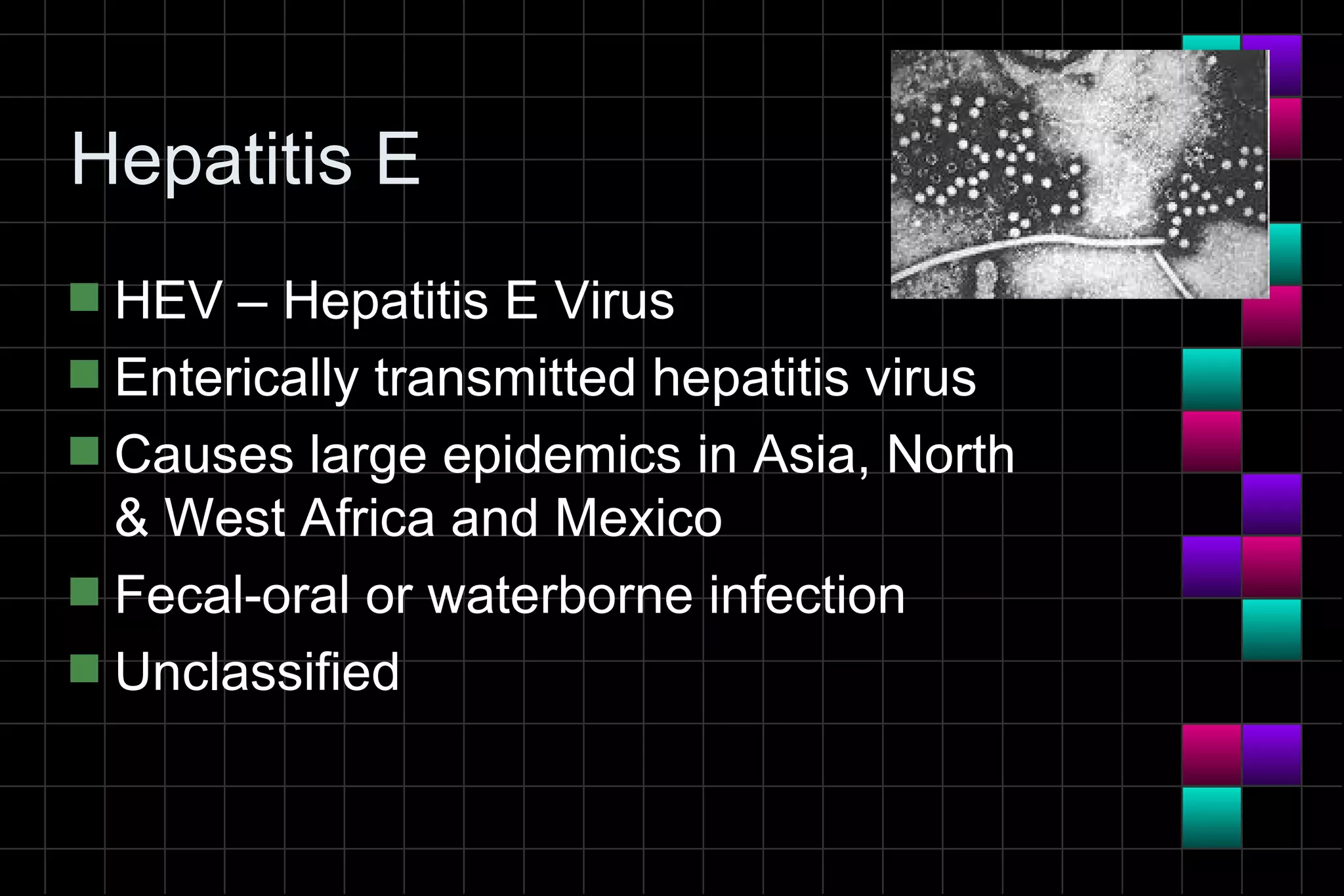
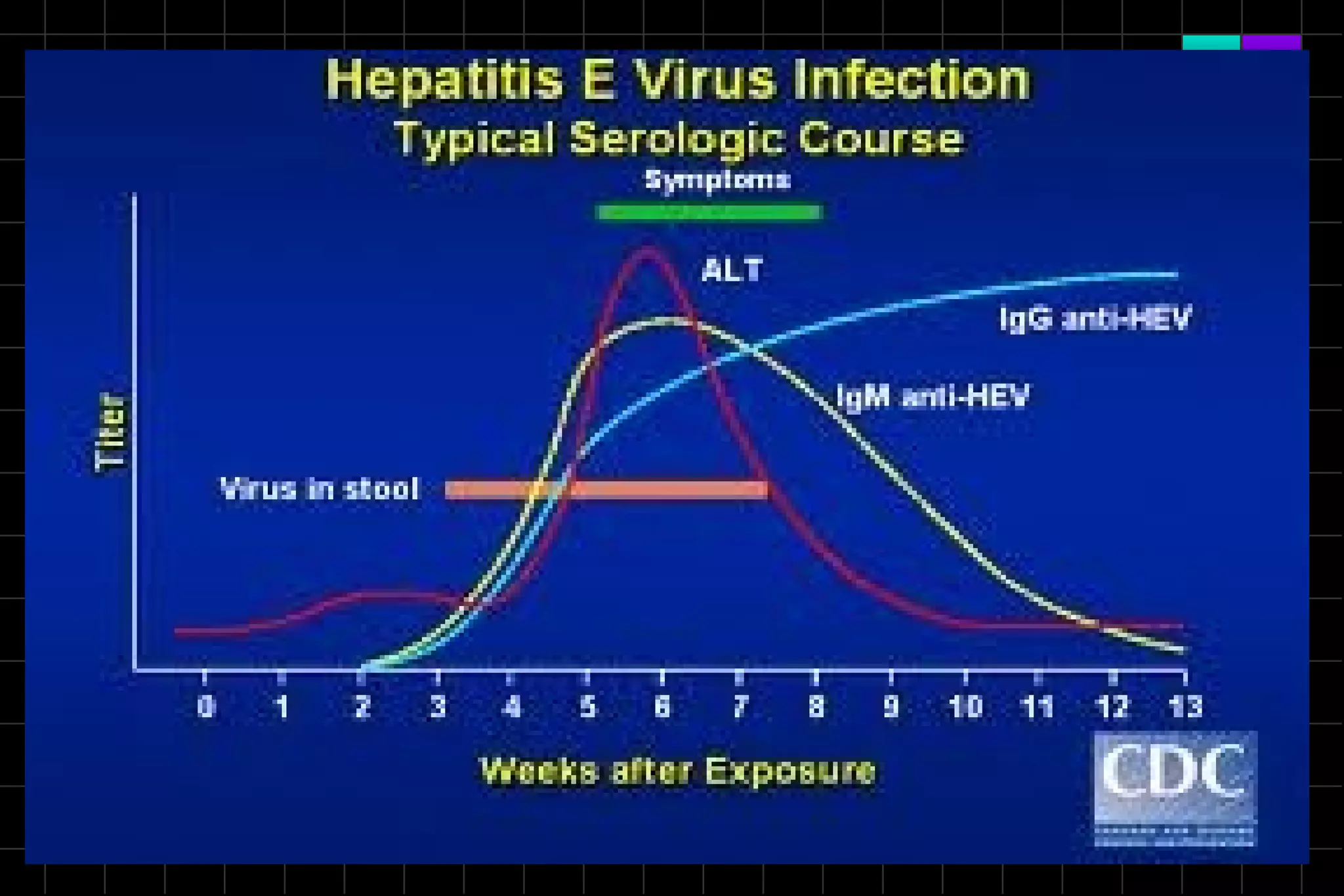
Hepatitis E
s HEV – Hepatitis E Virus
s Enterically transmitted hepatitis virus
s Causes large epidemics in Asia, North
  & West Africa and Mexico
s Fecal-oral or waterborne infection
s Unclassified
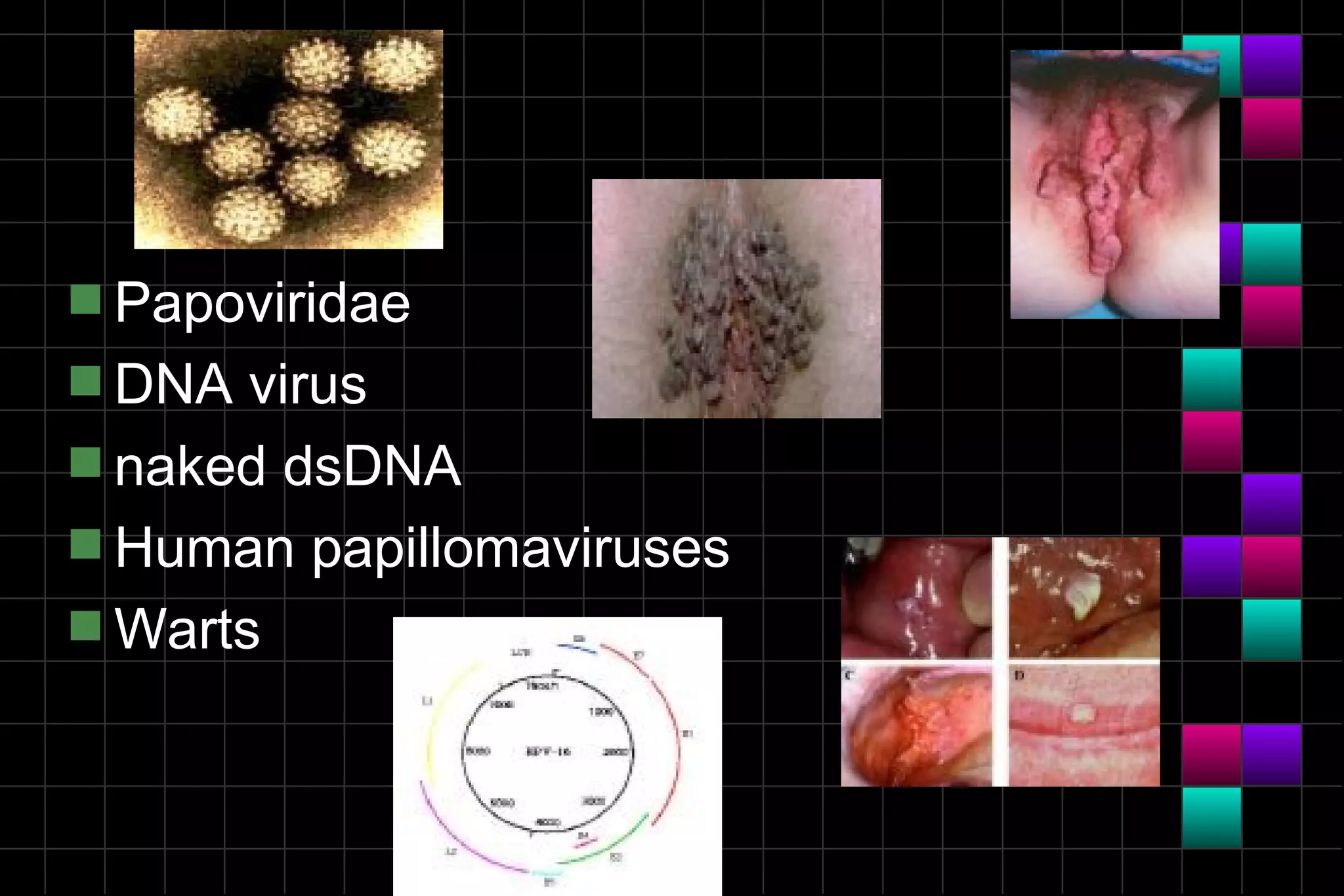
s Papoviridae
s DNA  virus
s naked dsDNA
s Human papillomaviruses
s Warts
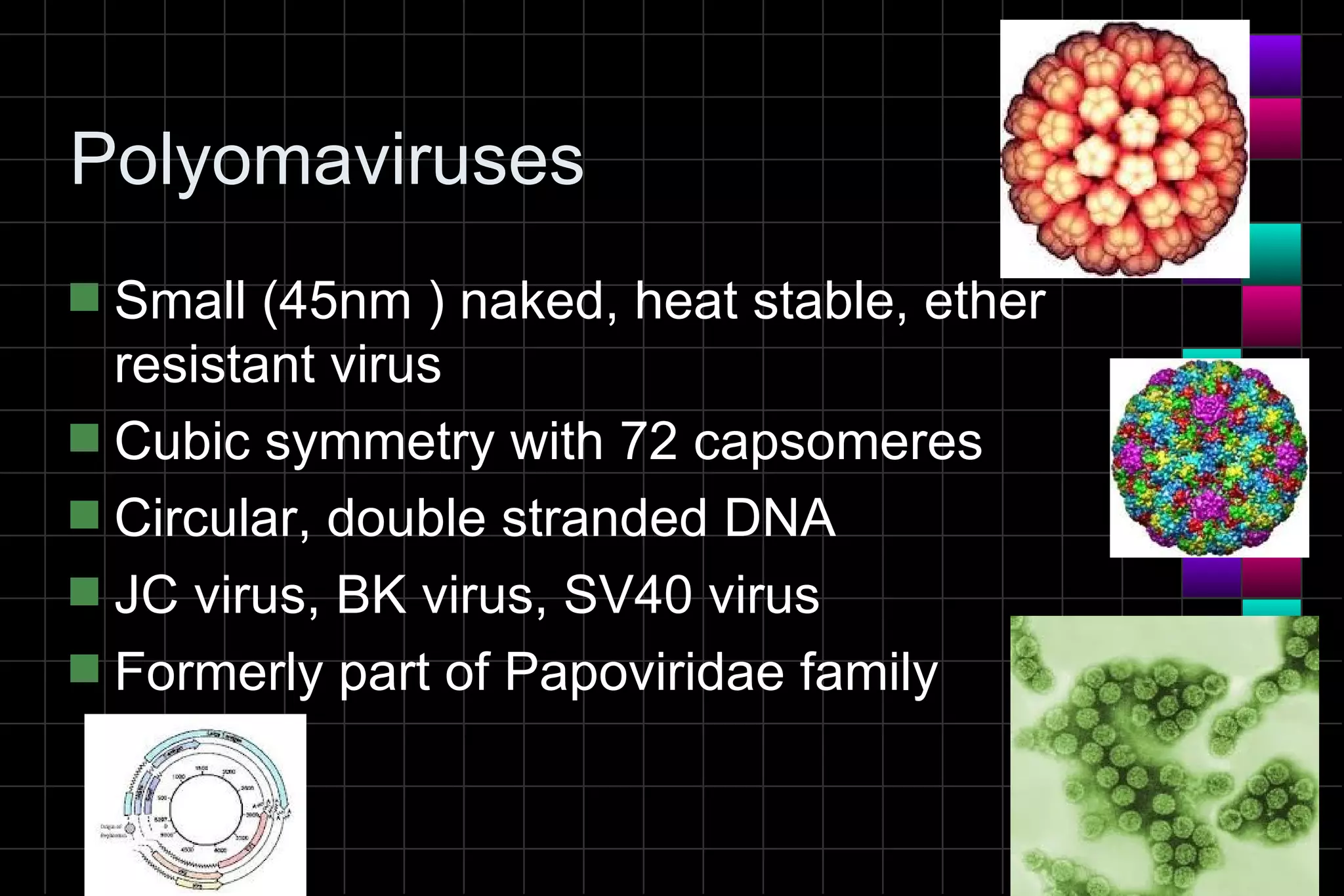
Polyomaviruses
s Small (45nm ) naked, heat stable, ether
  resistant virus
s Cubic symmetry with 72 capsomeres
s Circular, double stranded DNA
s JC virus, BK virus, SV40 virus
s Formerly part of Papoviridae family
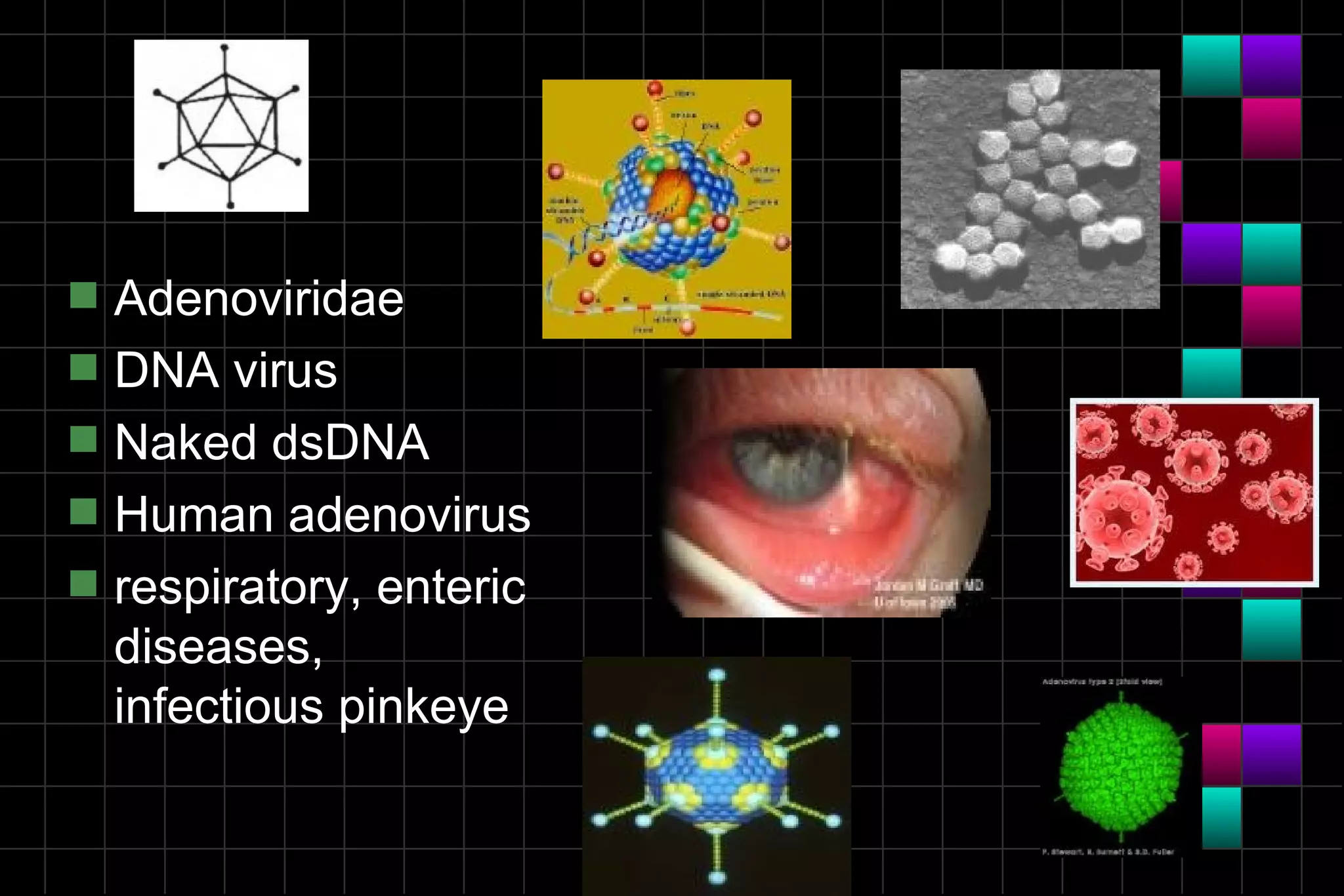
s   Adenoviridae
s   DNA virus
s   Naked dsDNA
s   Human adenovirus
s   respiratory, enteric
    diseases,
    infectious pinkeye
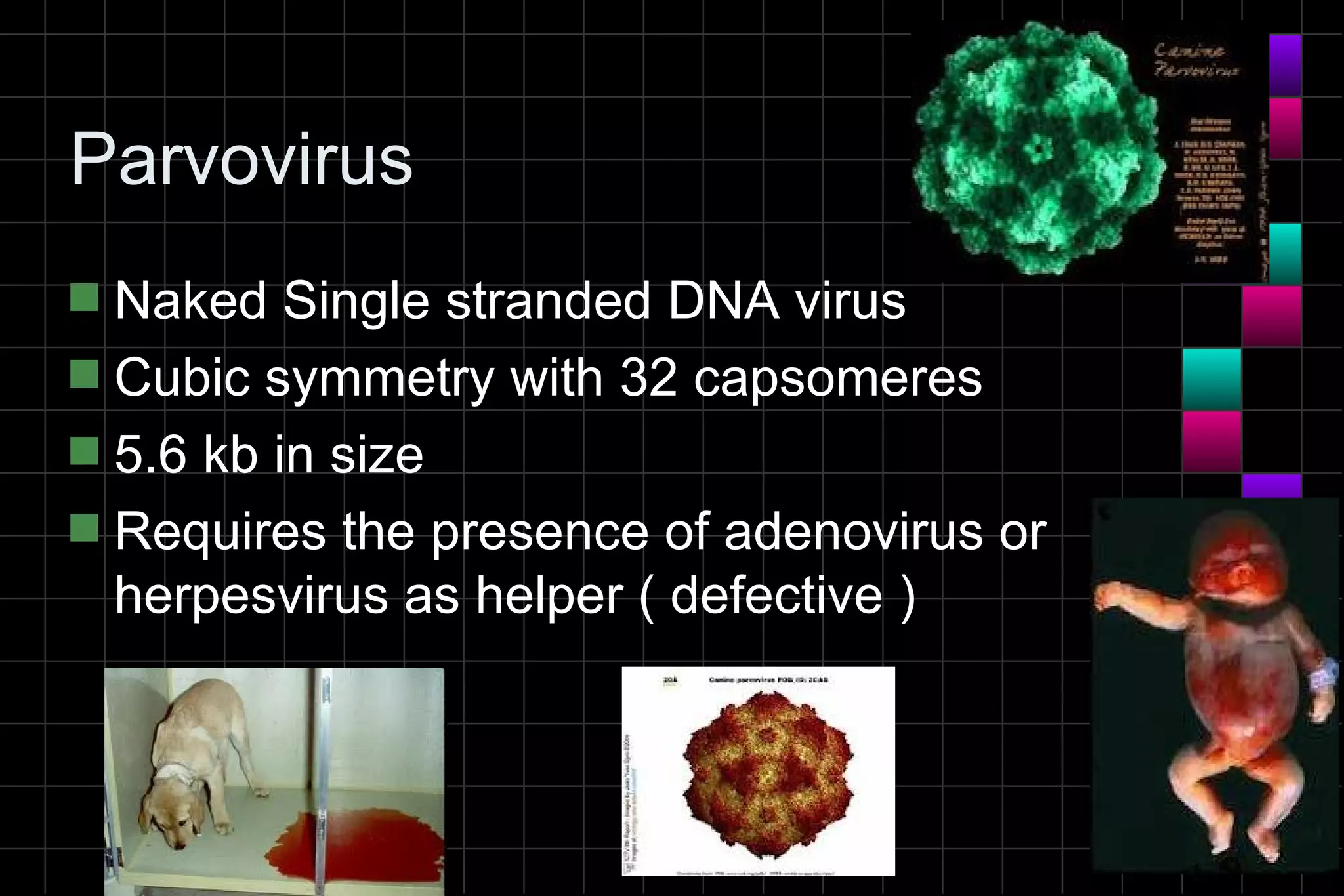
Parvovirus
s Naked Single stranded DNA virus
s Cubic symmetry with 32 capsomeres
s 5.6 kb in size
s Requires the presence of adenovirus or
  herpesvirus as helper ( defective )
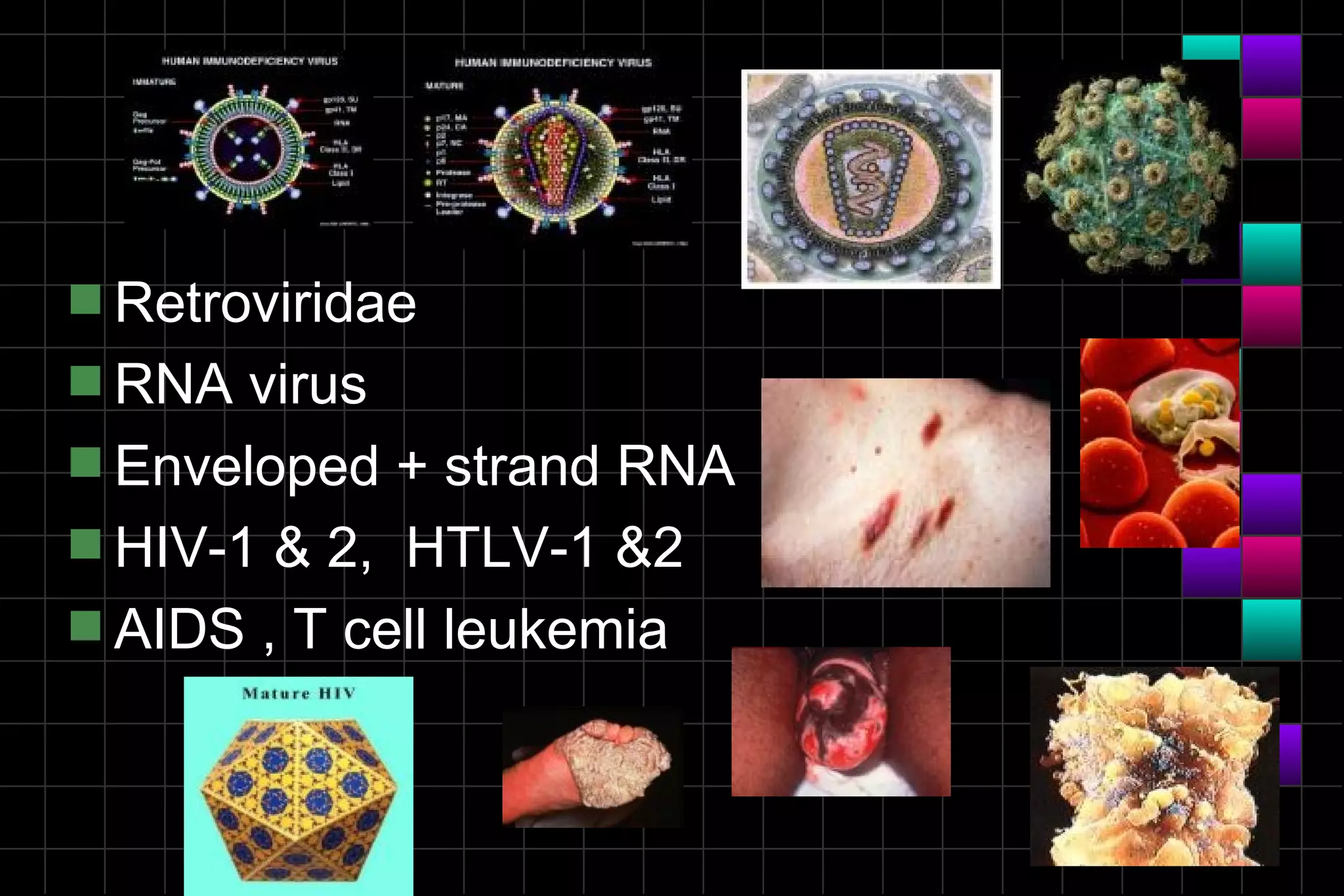
s Retroviridae
s RNA  virus
s Enveloped + strand RNA
s HIV-1 & 2, HTLV-1 &2
s AIDS , T cell leukemia
Life Cycle of HIV Virus
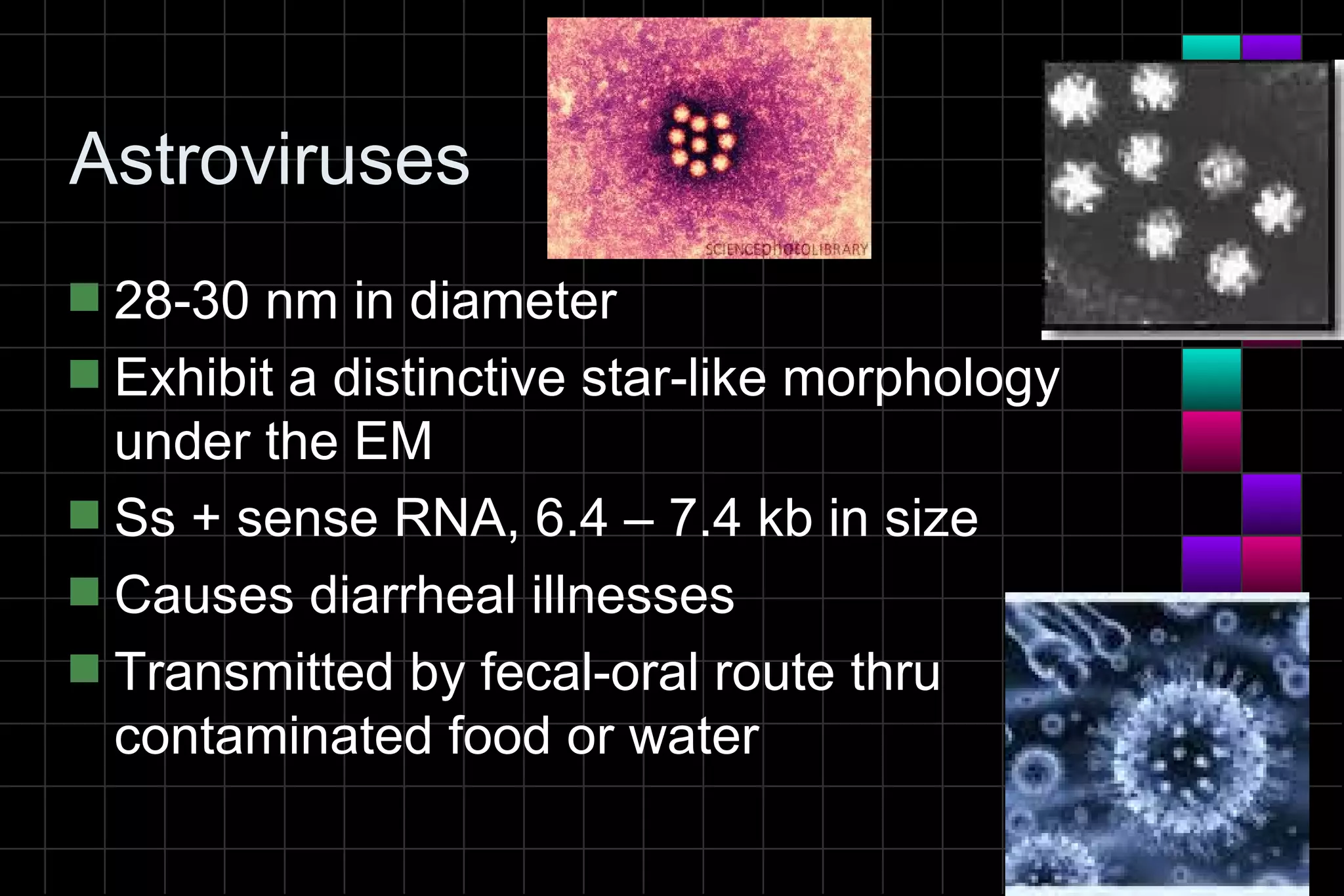
Astroviruses
s 28-30 nm in diameter
s Exhibit a distinctive star-like morphology
  under the EM
s Ss + sense RNA, 6.4 – 7.4 kb in size
s Causes diarrheal illnesses
s Transmitted by fecal-oral route thru
  contaminated food or water
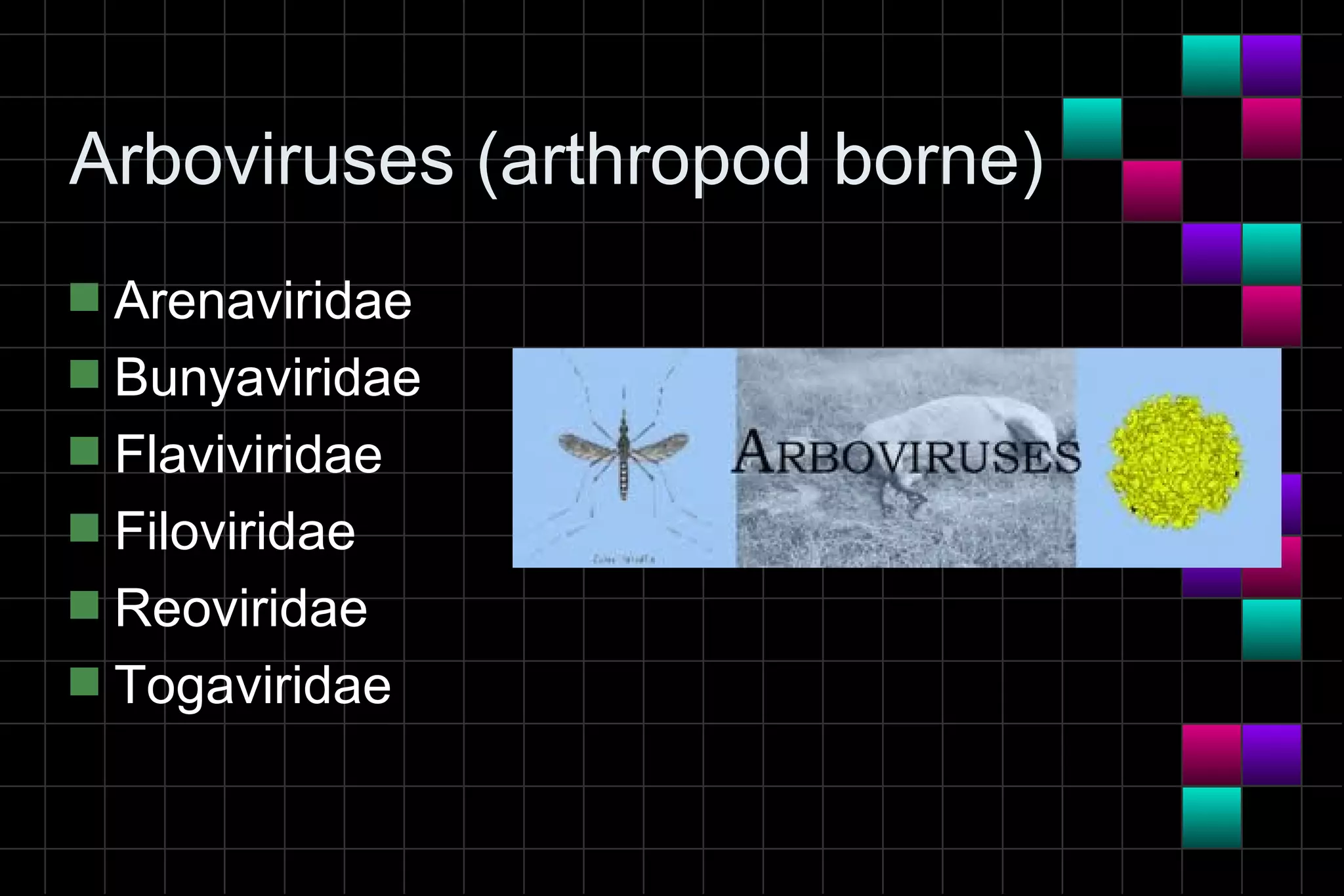
Arboviruses (arthropod borne)
s Arenaviridae
s Bunyaviridae
s Flaviviridae
s Filoviridae
s Reoviridae
s Togaviridae
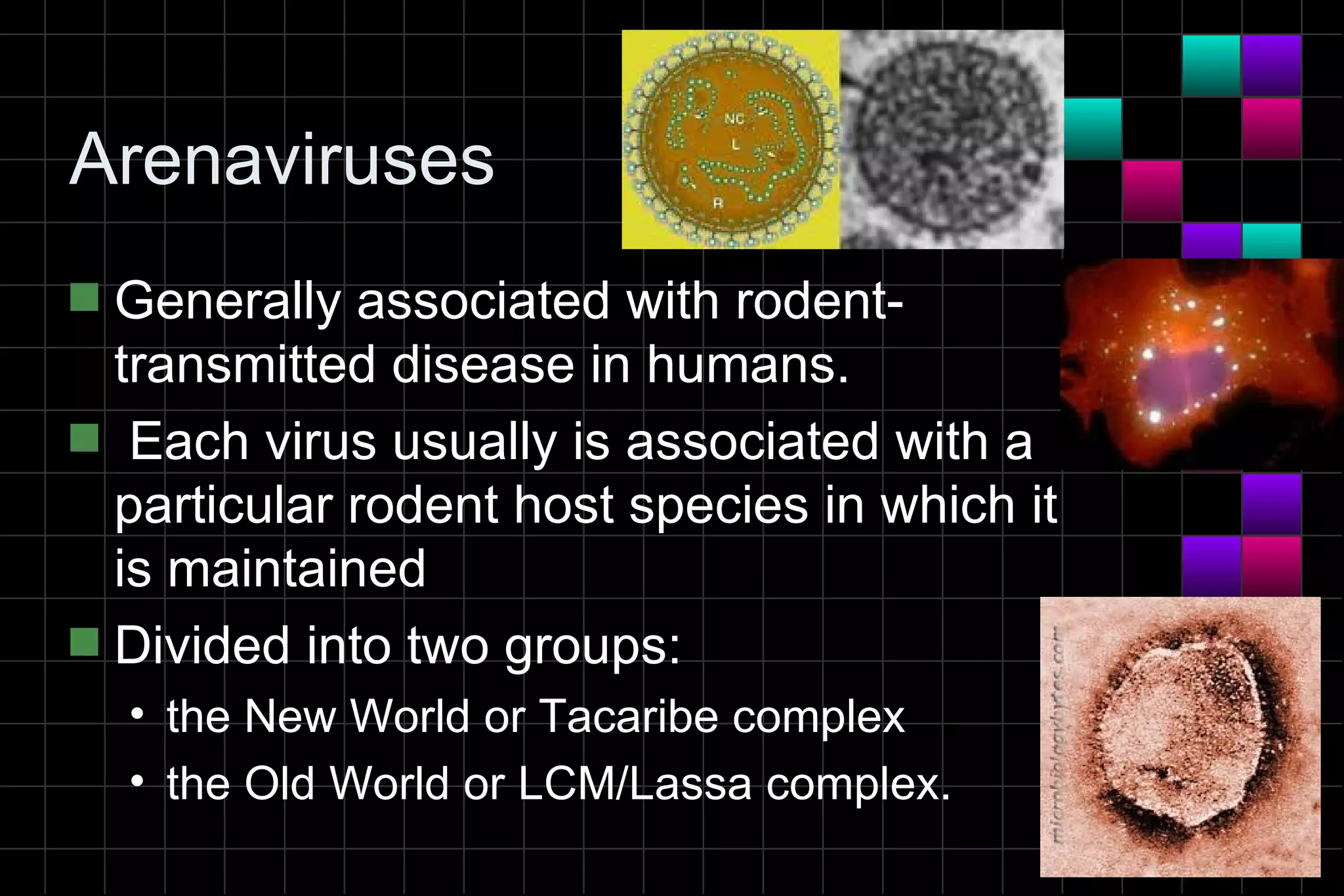
Arenaviruses
s Generally associated with rodent-
  transmitted disease in humans.
s Each virus usually is associated with a
  particular rodent host species in which it
  is maintained
s Divided into two groups:
    • the New World or Tacaribe complex
    • the Old World or LCM/Lassa complex.
Filoviruses
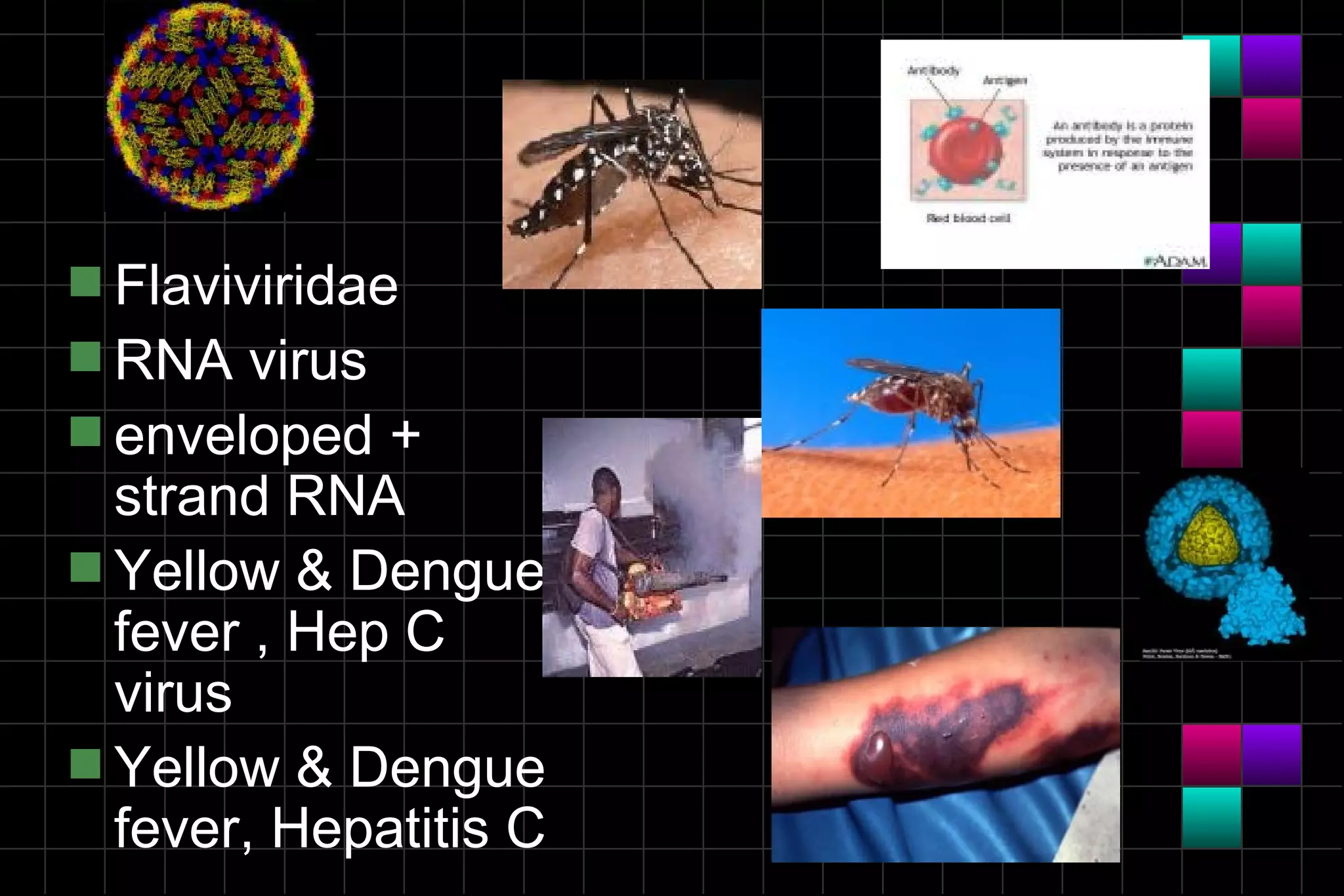
s Flaviviridae
s RNA   virus
s enveloped +
  strand RNA
s Yellow & Dengue
  fever , Hep C
  virus
s Yellow & Dengue
  fever, Hepatitis C
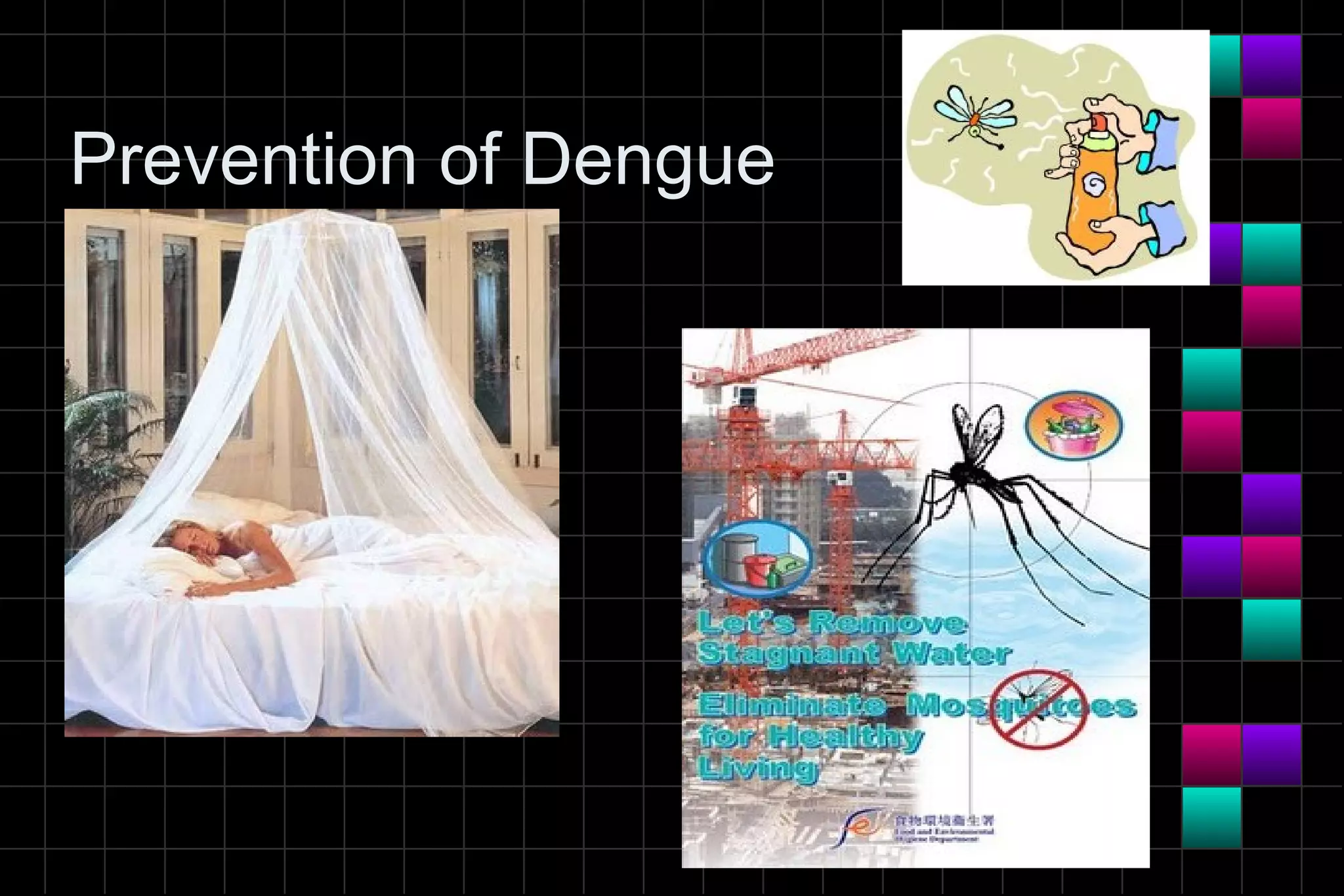
Prevention of Dengue
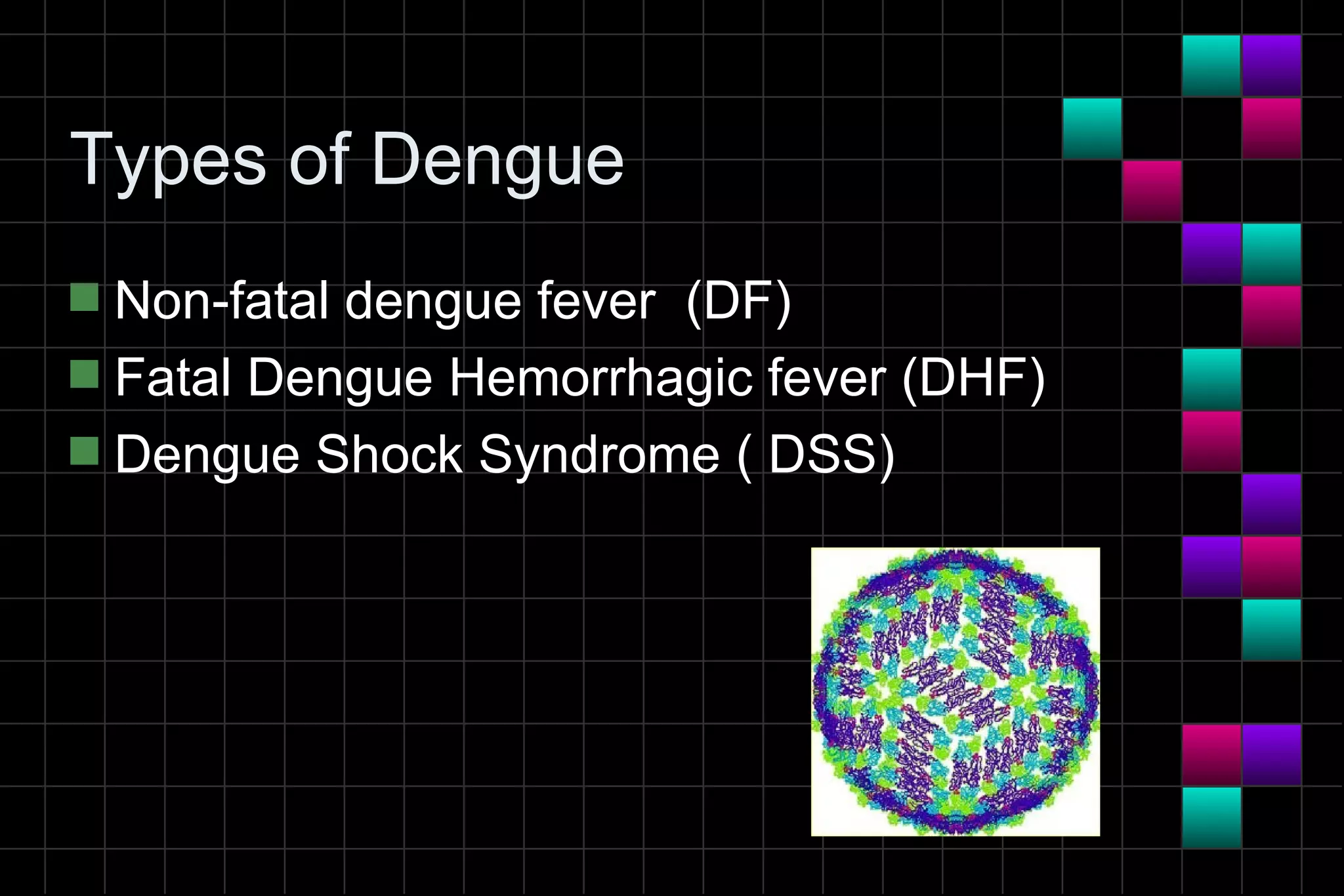
Types of Dengue
s Non-fatal dengue fever (DF)
s Fatal Dengue Hemorrhagic fever (DHF)
s Dengue Shock Syndrome ( DSS)
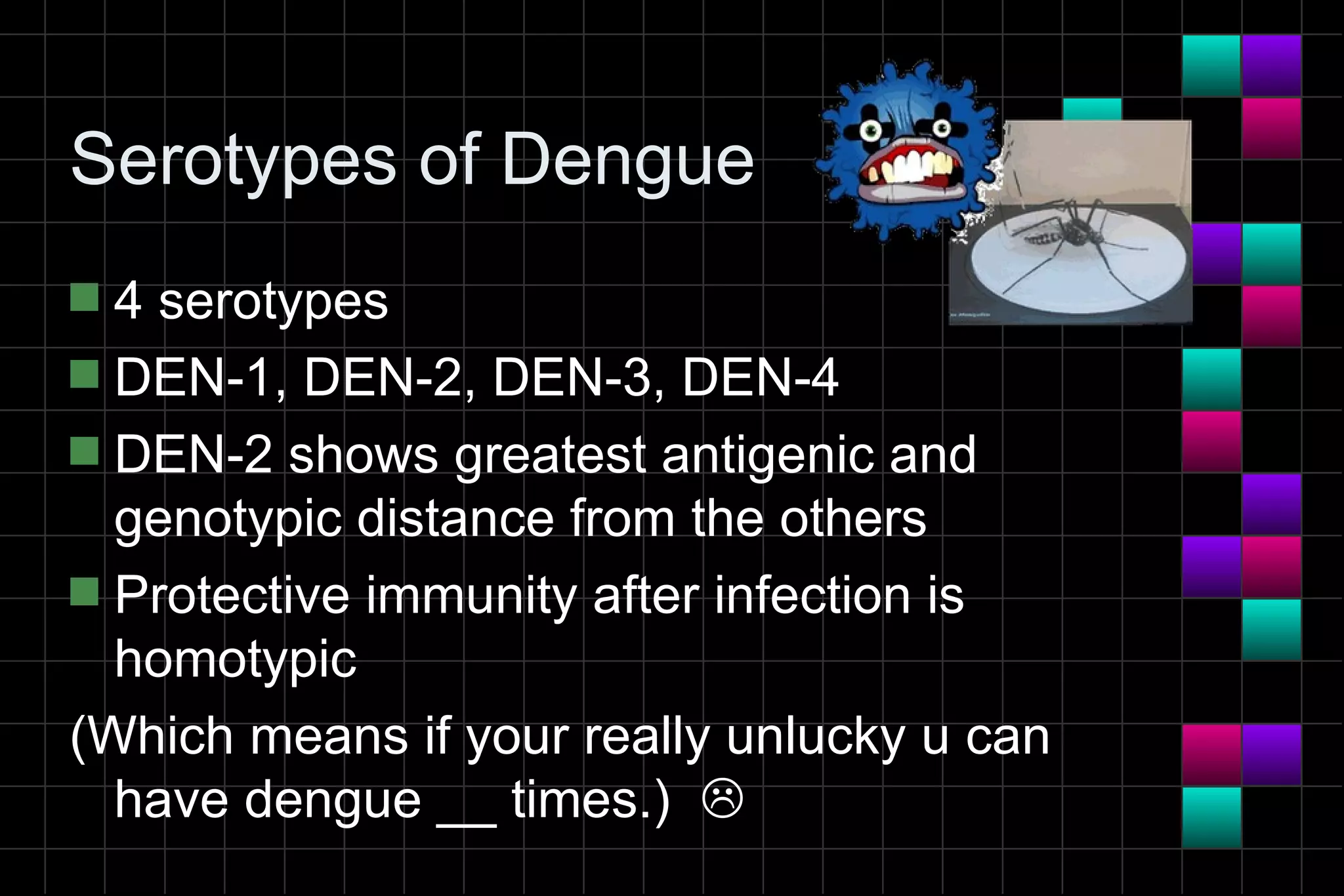
Serotypes of Dengue
s 4 serotypes
s DEN-1, DEN-2, DEN-3, DEN-4
s DEN-2 shows greatest antigenic and
  genotypic distance from the others
s Protective immunity after infection is
  homotypic
(Which means if your really unlucky u can
  have dengue __ times.) 
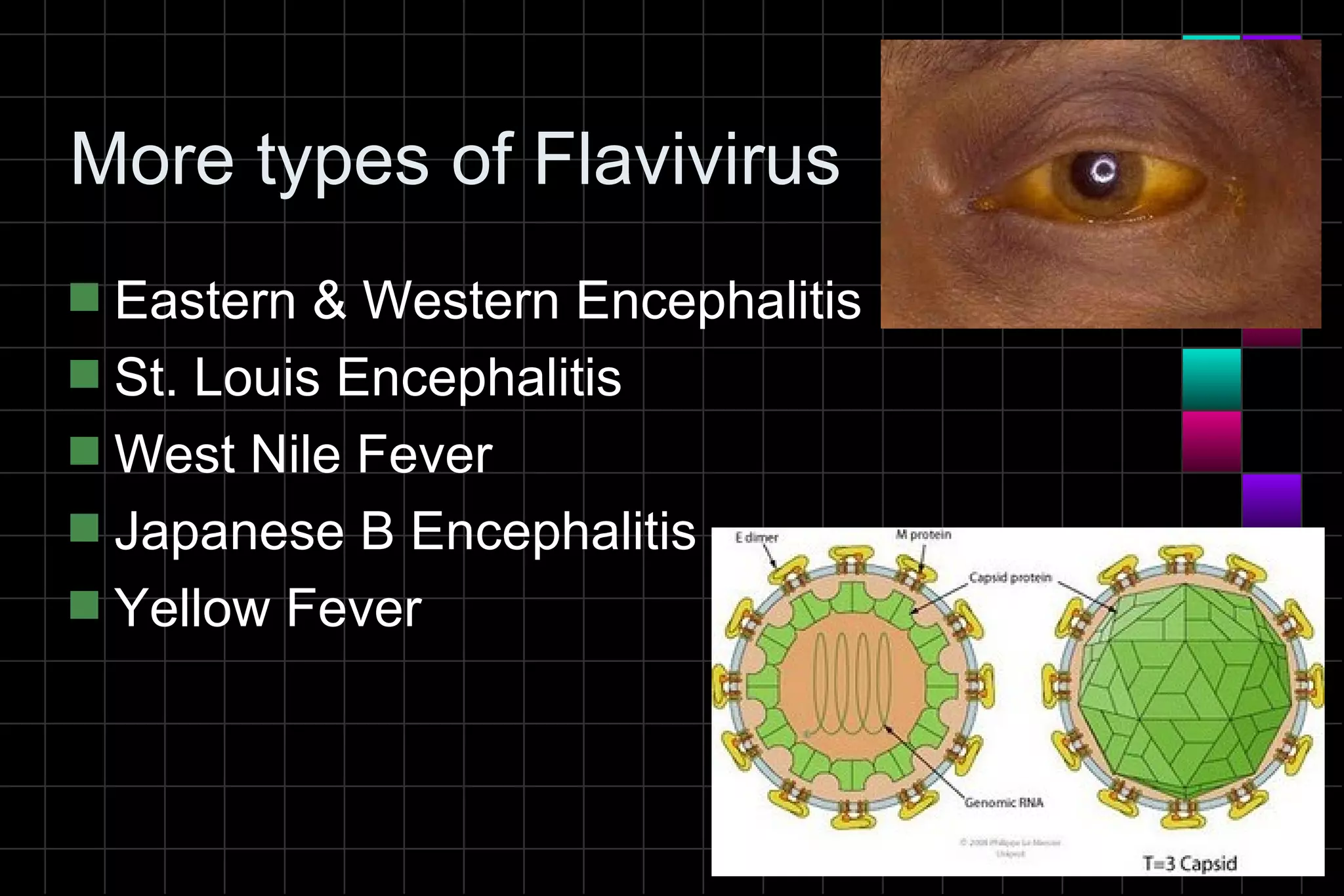
More types of Flavivirus
s Eastern & Western Encephalitis
s St. Louis Encephalitis
s West Nile Fever
s Japanese B Encephalitis
s Yellow Fever
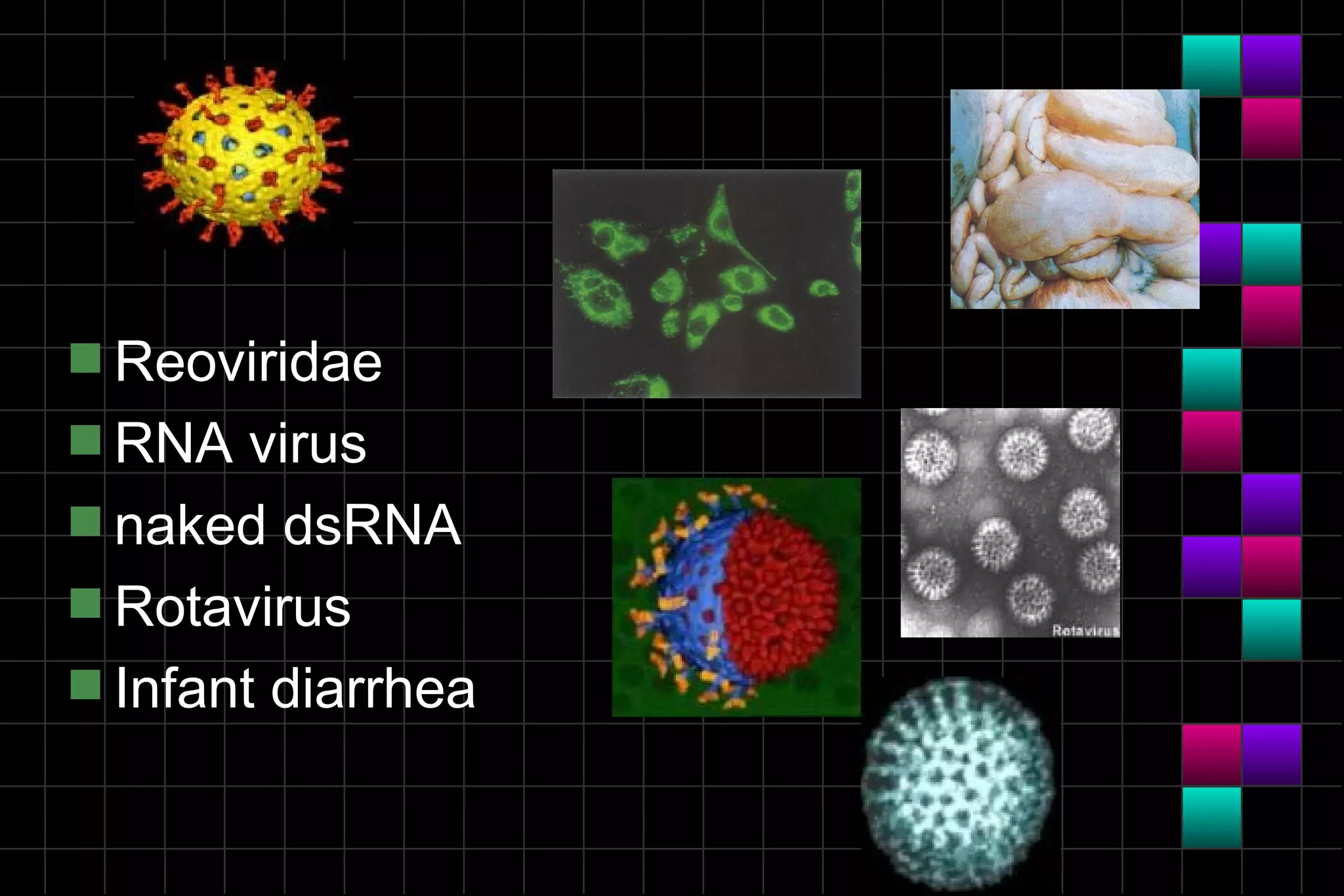
s Reoviridae
s RNA   virus
s naked dsRNA
s Rotavirus
s Infant diarrhea
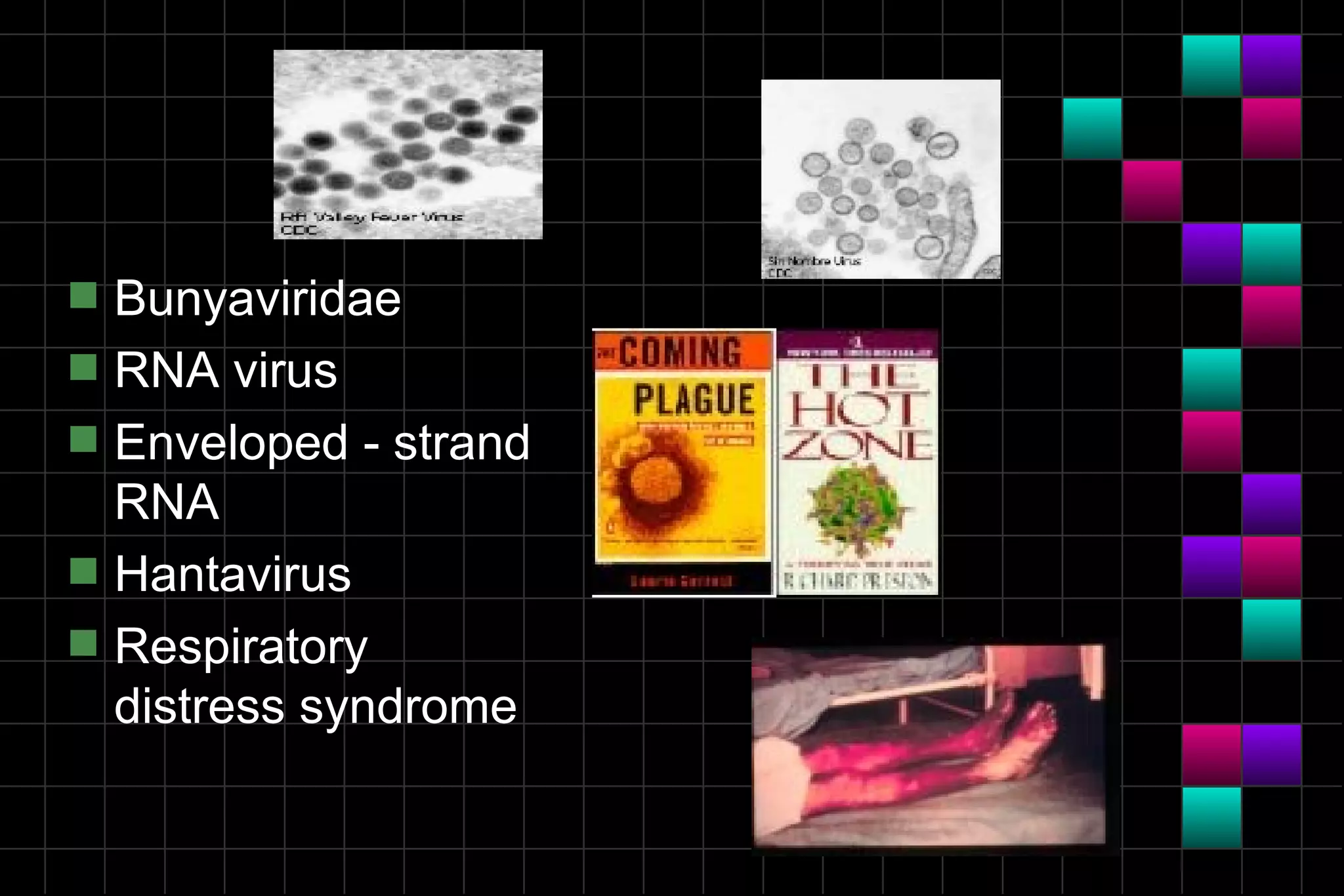
s   Bunyaviridae
s   RNA virus
s   Enveloped - strand
    RNA
s   Hantavirus
s   Respiratory
    distress syndrome
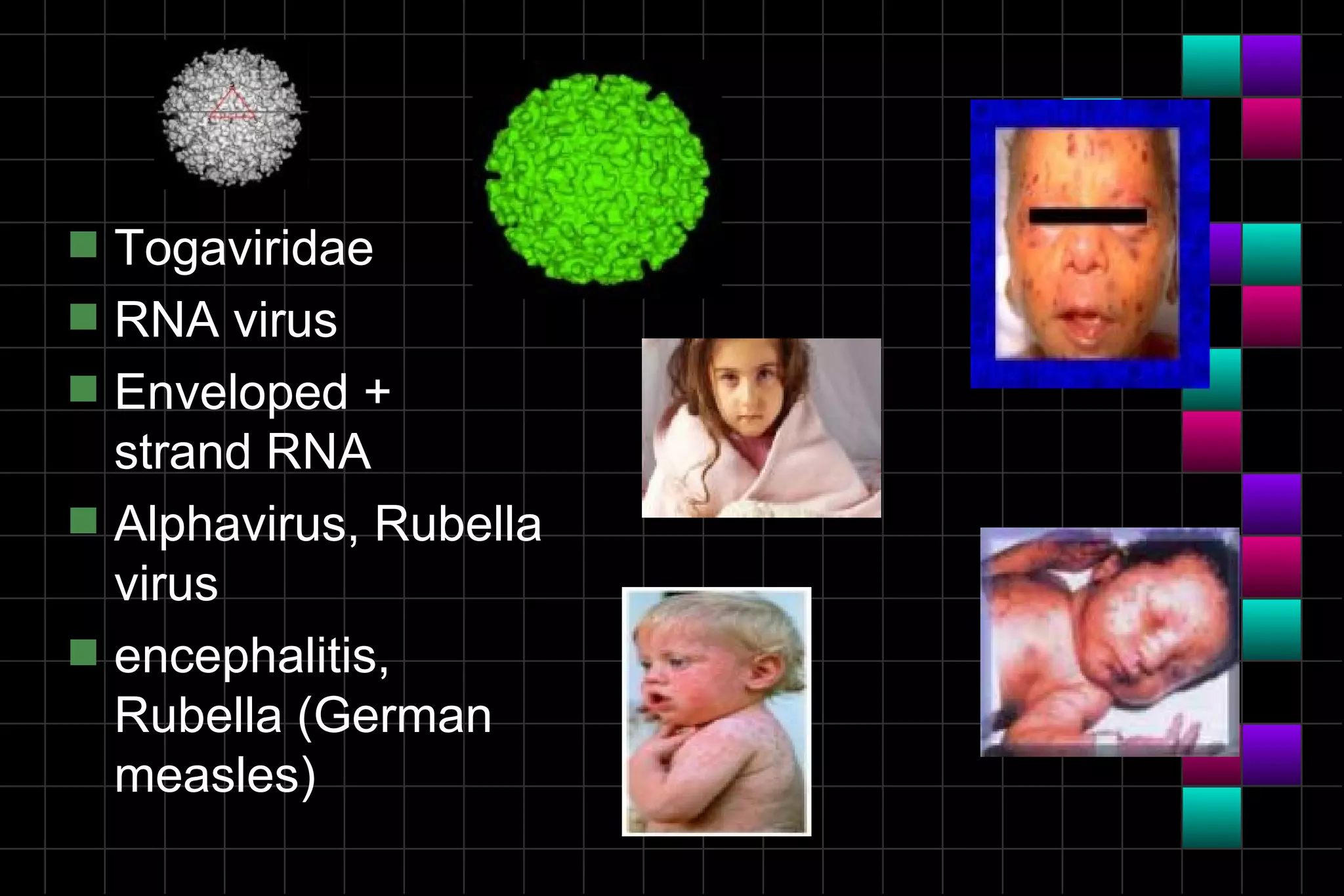
s   Togaviridae
s   RNA virus
s   Enveloped +
    strand RNA
s   Alphavirus, Rubella
    virus
s   encephalitis,
    Rubella (German
    measles)
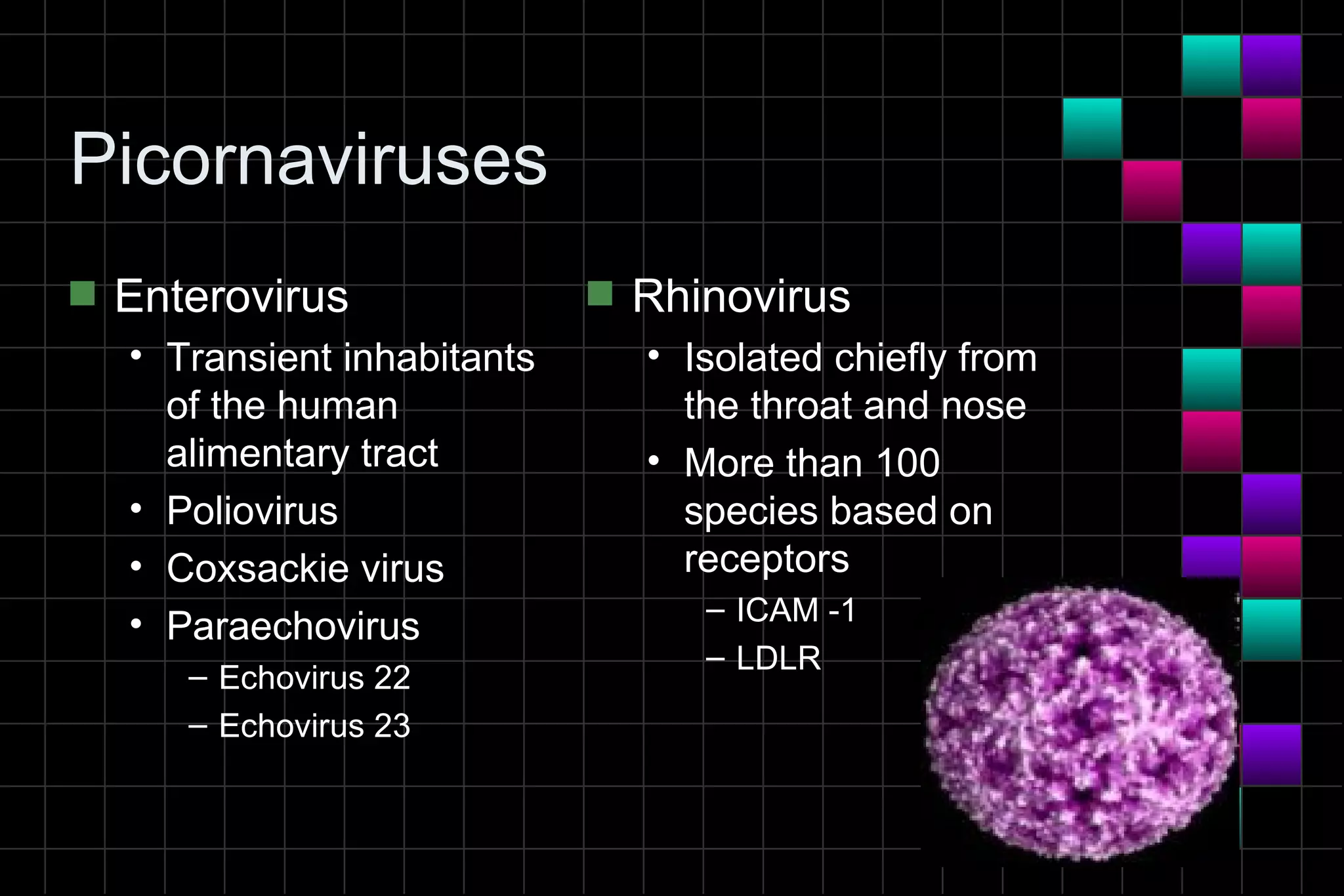
Picornaviruses
s   Enterovirus               s   Rhinovirus
    • Transient inhabitants       • Isolated chiefly from
      of the human                  the throat and nose
      alimentary tract            • More than 100
    • Poliovirus                    species based on
    • Coxsackie virus               receptors
                                     – ICAM -1
    • Paraechovirus
                                     – LDLR
       – Echovirus 22
       – Echovirus 23
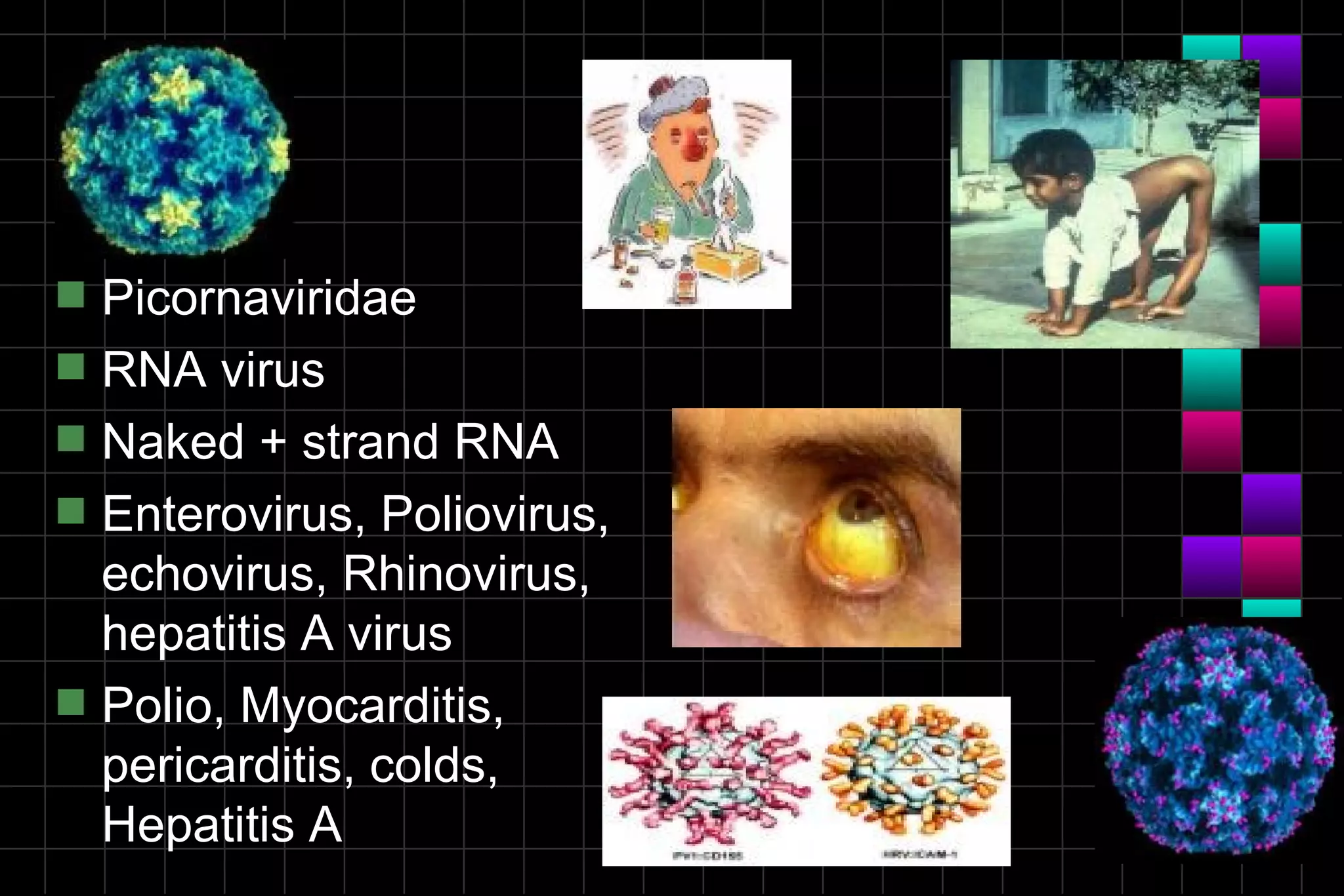
s   Picornaviridae
s   RNA virus
s   Naked + strand RNA
s   Enterovirus, Poliovirus,
    echovirus, Rhinovirus,
    hepatitis A virus
s   Polio, Myocarditis,
    pericarditis, colds,
    Hepatitis A
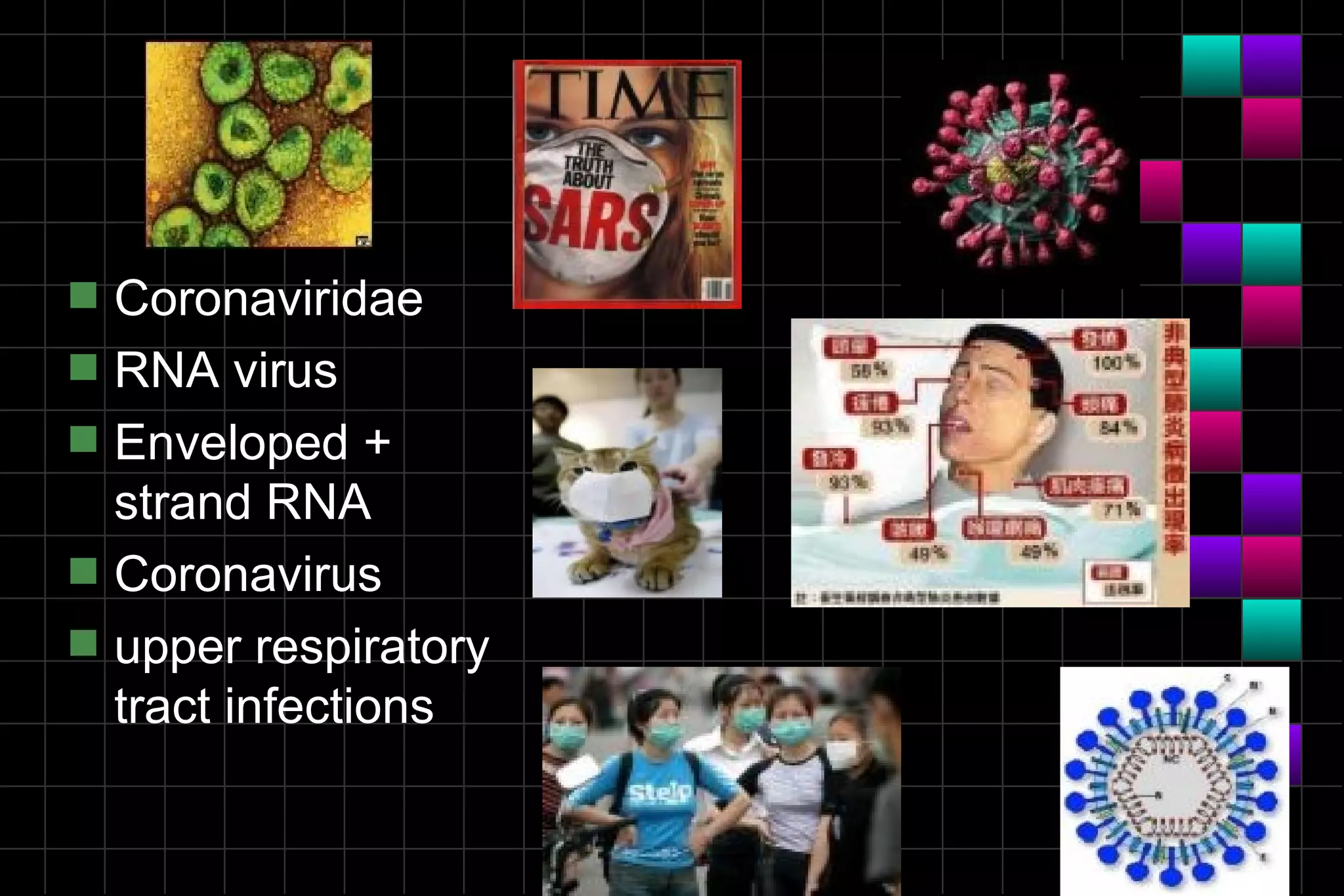
s   Coronaviridae
s   RNA virus
s   Enveloped +
    strand RNA
s   Coronavirus
s   upper respiratory
    tract infections
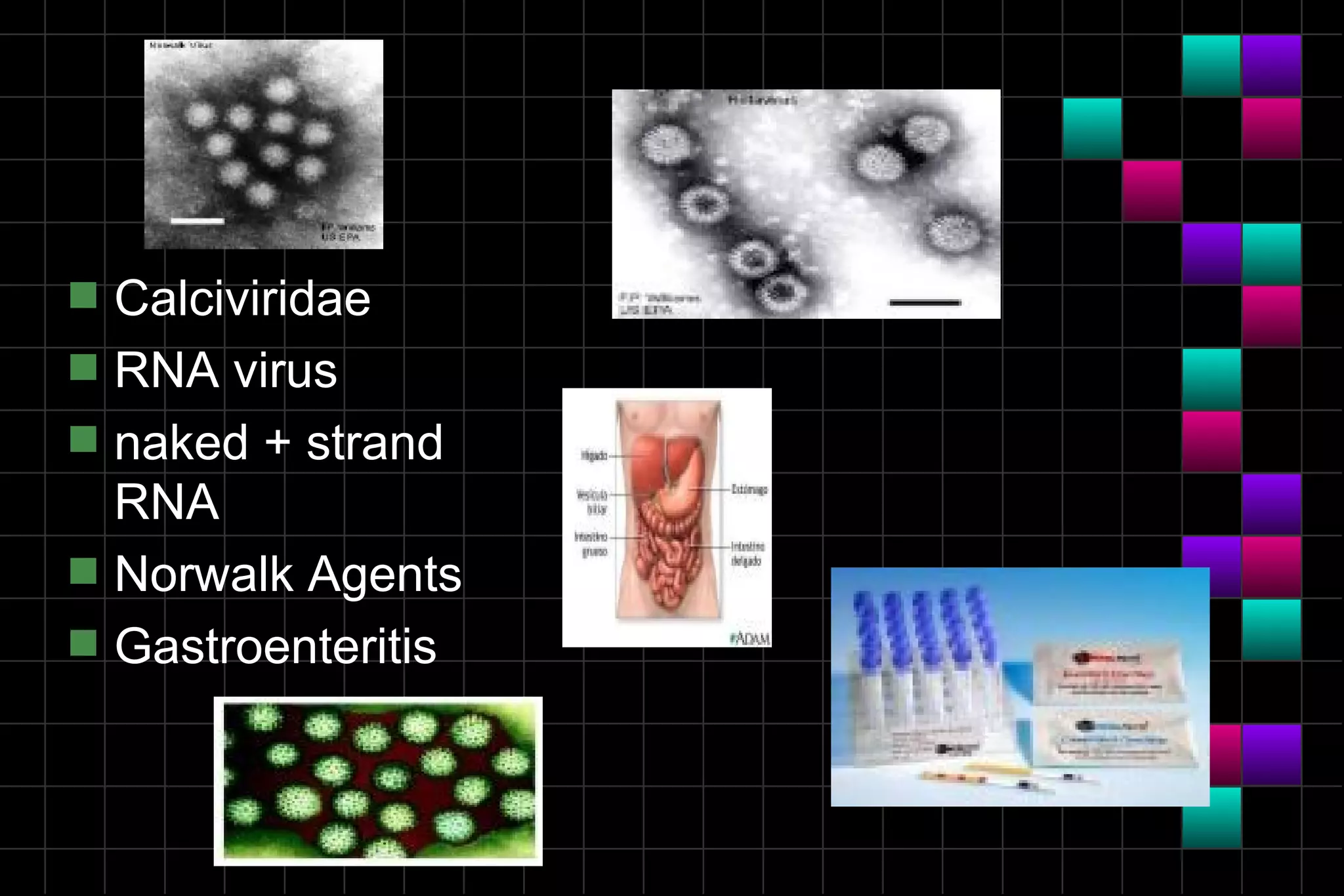
s   Calciviridae
s   RNA virus
s   naked + strand
    RNA
s   Norwalk Agents
s   Gastroenteritis
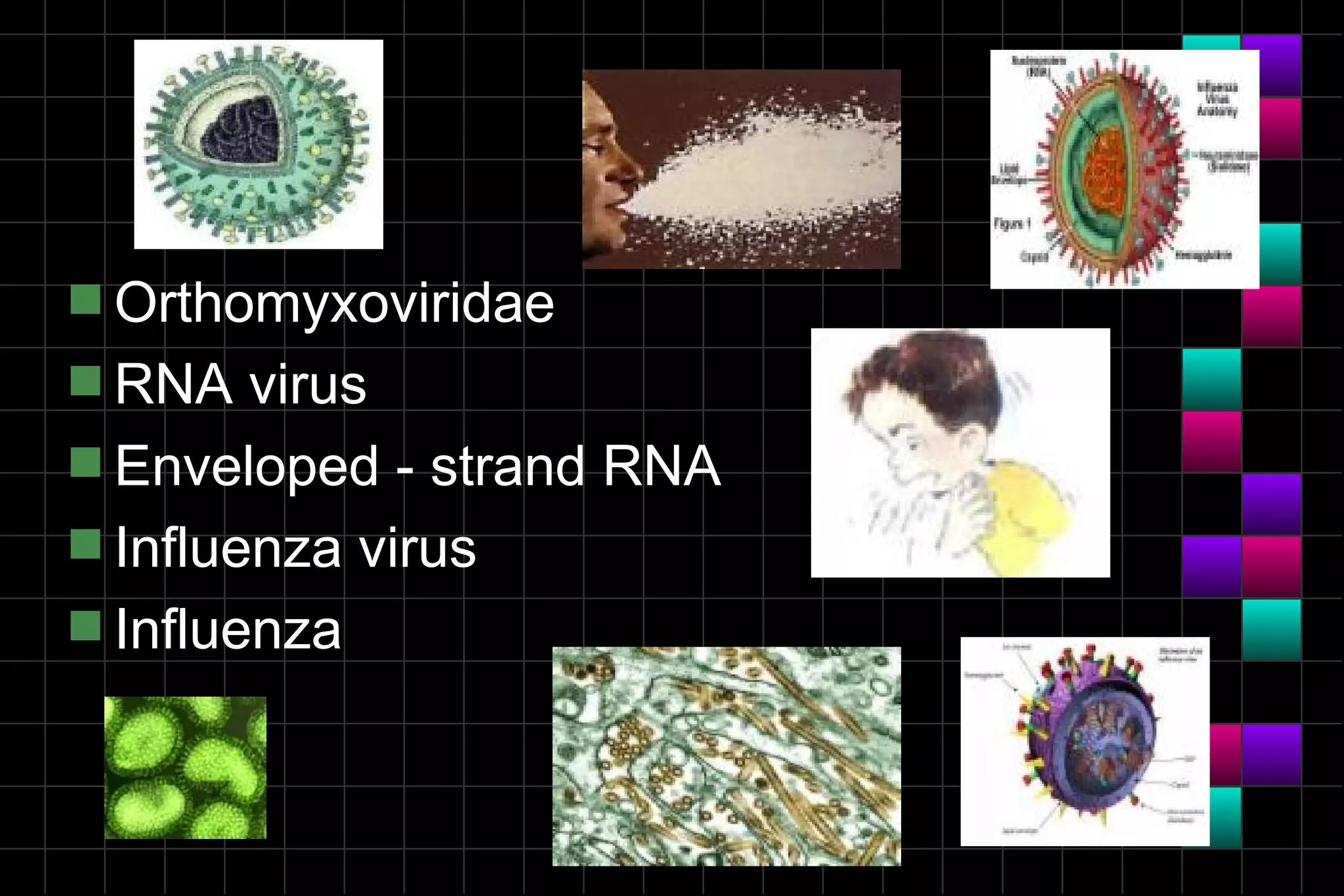
s Orthomyxoviridae
s RNA   virus
s Enveloped - strand RNA
s Influenza virus
s Influenza
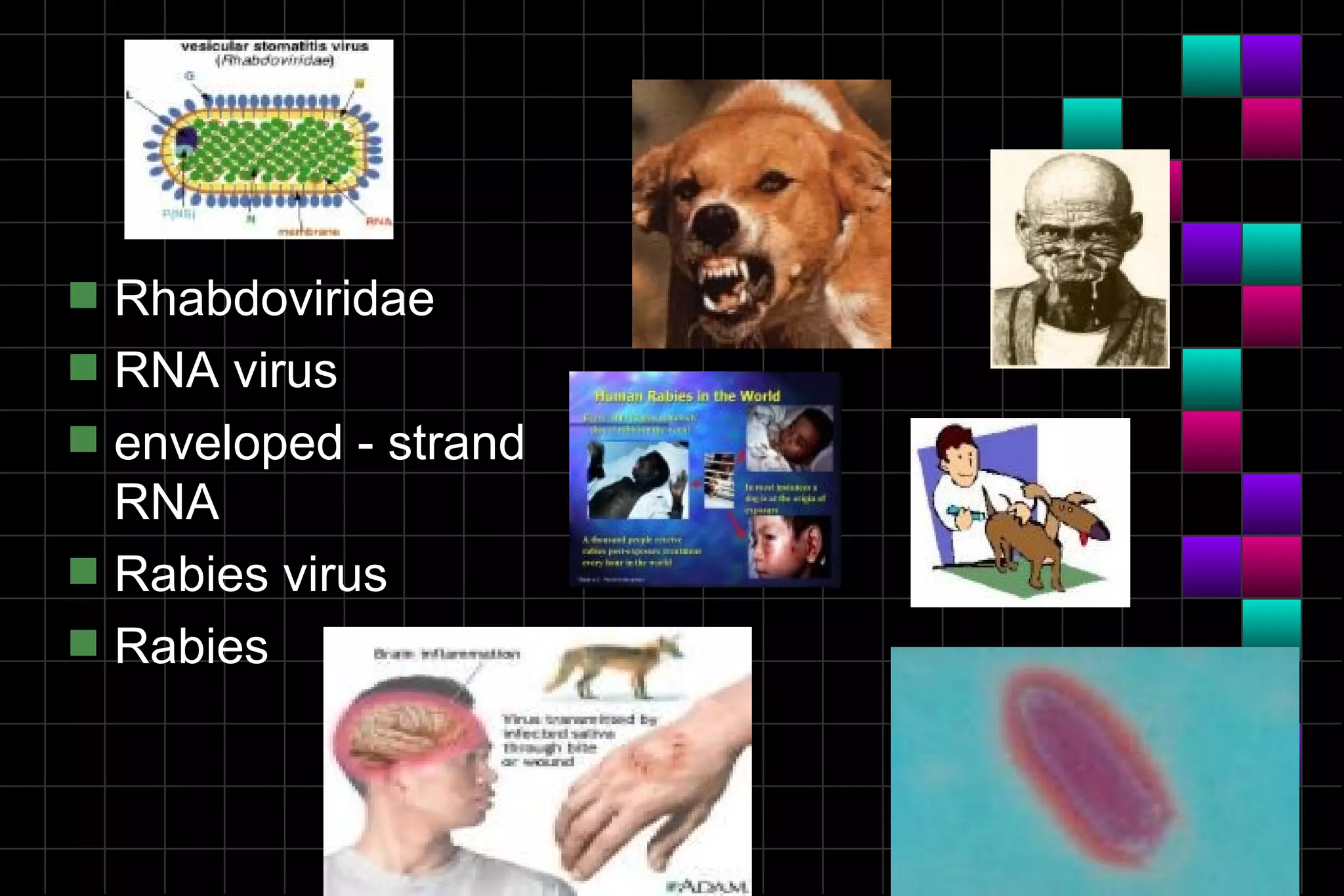
s   Rhabdoviridae
s   RNA virus
s   enveloped - strand
    RNA
s   Rabies virus
s   Rabies
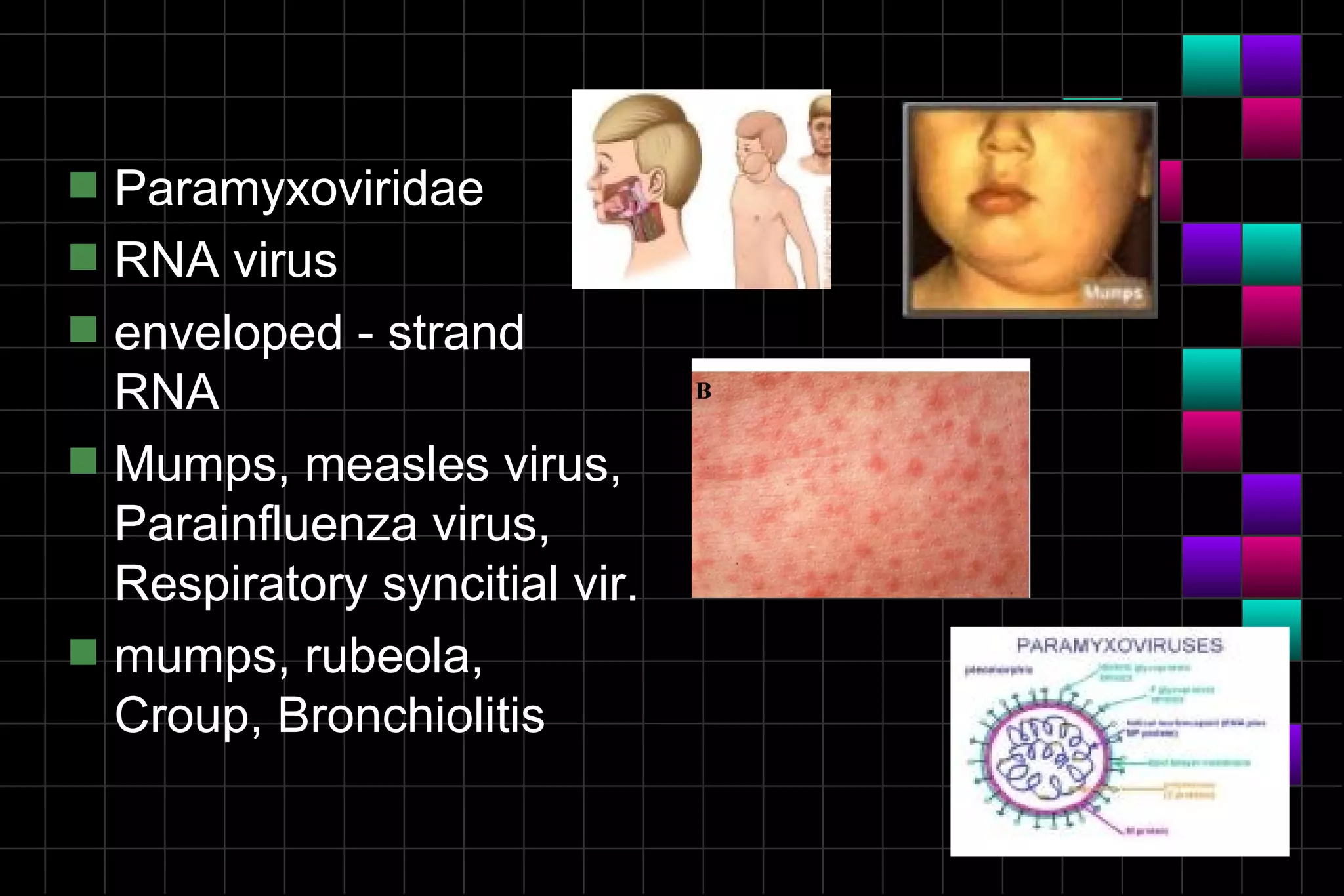
s   Paramyxoviridae
s   RNA virus
s   enveloped - strand
    RNA
s   Mumps, measles virus,
    Parainfluenza virus,
    Respiratory syncitial vir.
s   mumps, rubeola,
    Croup, Bronchiolitis
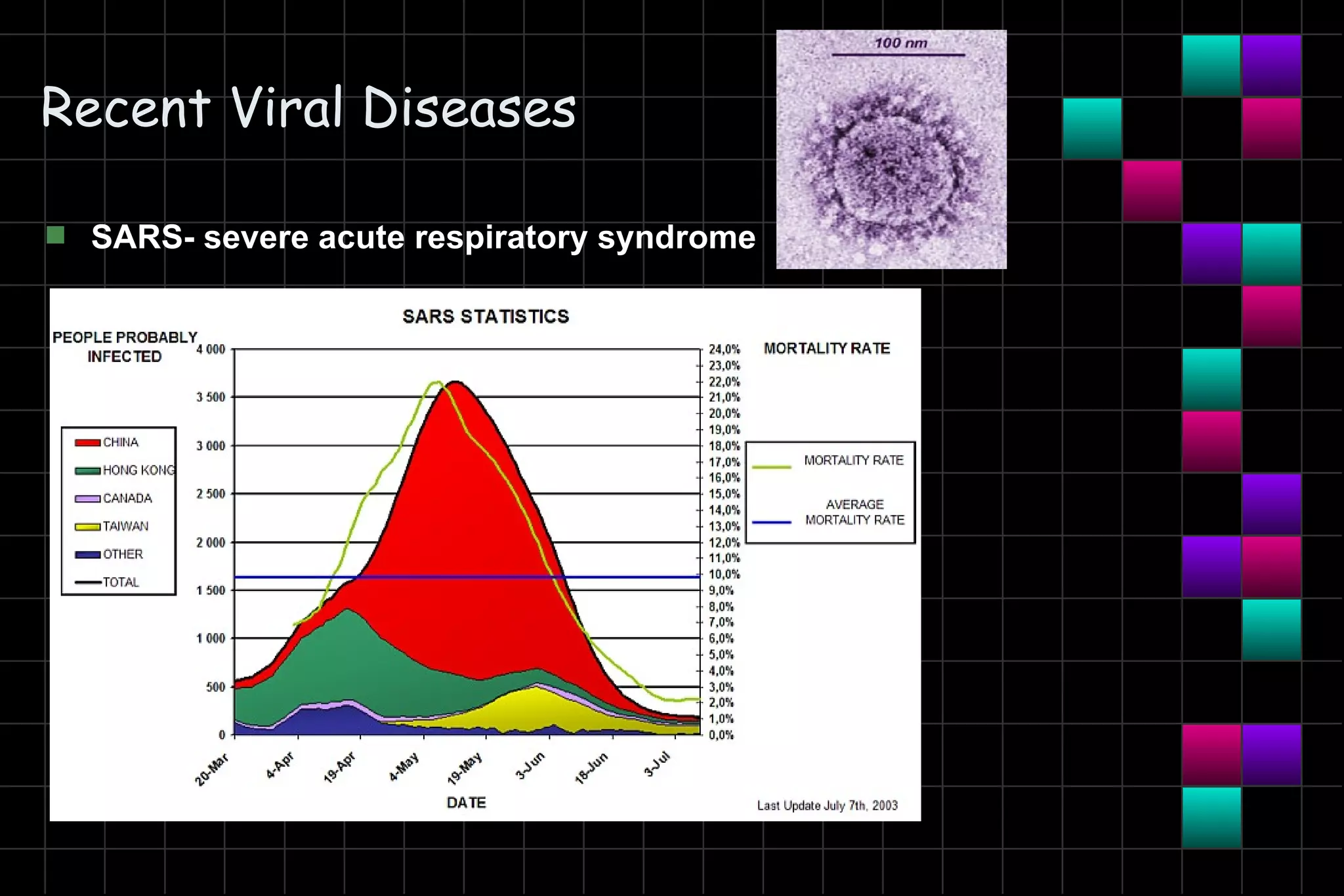
Recent Viral Diseases

s   SARS- severe acute respiratory syndrome
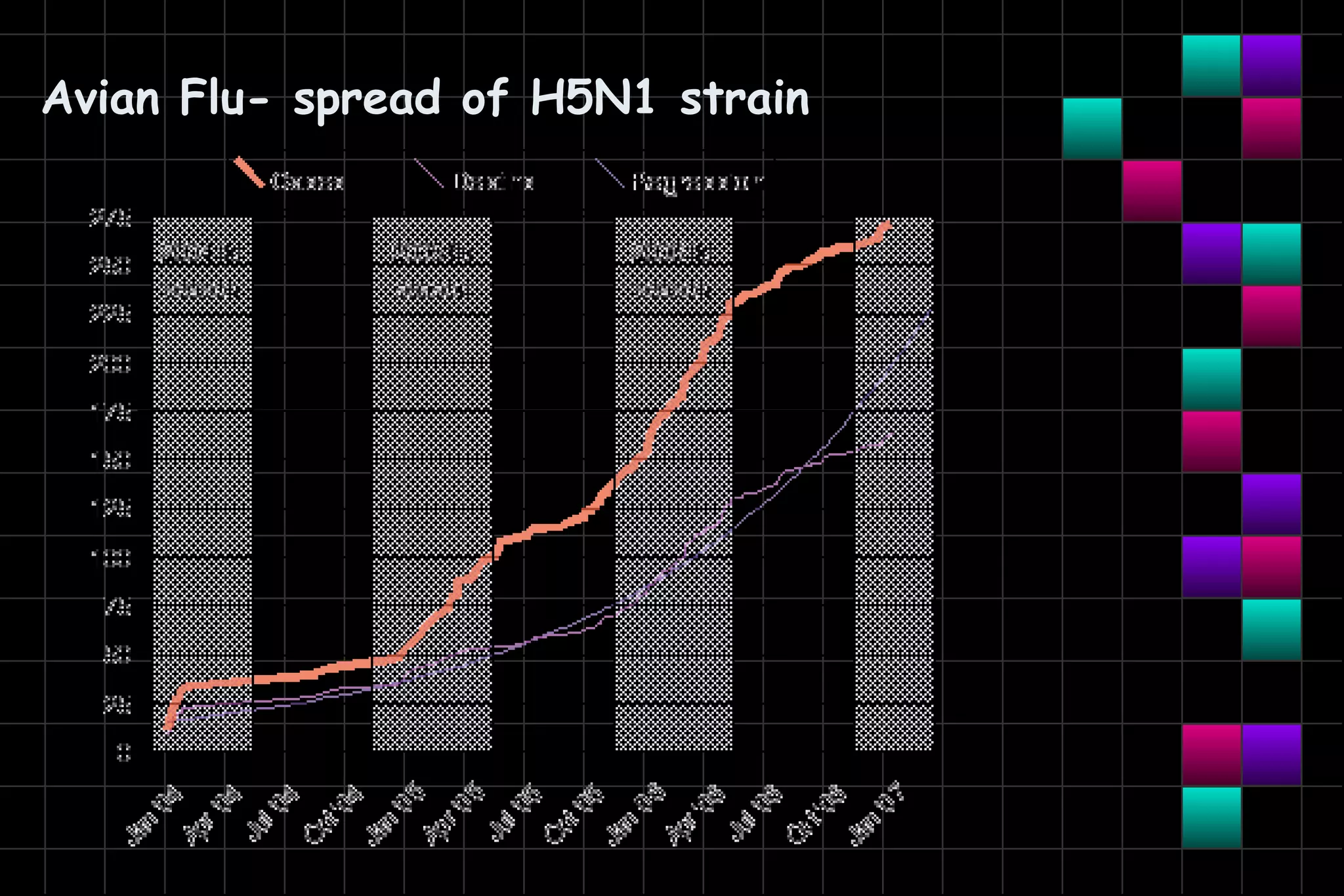
Avian Flu- spread of H5N1 strain
Influenza Pandemic
(1918-1919)
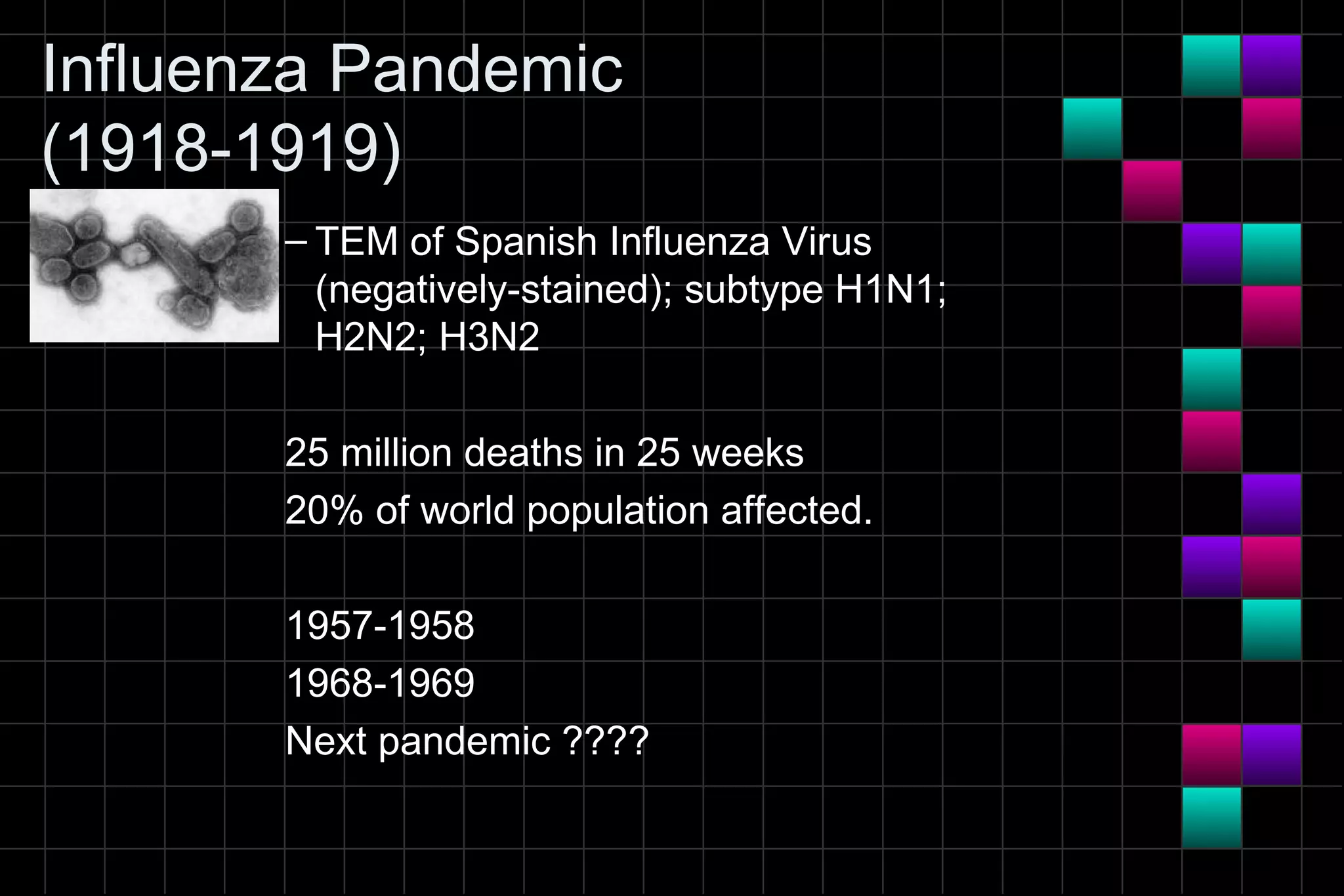
       – TEM of Spanish Influenza Virus
         (negatively-stained); subtype H1N1;
         H2N2; H3N2

       25 million deaths in 25 weeks
       20% of world population affected.

       1957-1958
       1968-1969
       Next pandemic ????
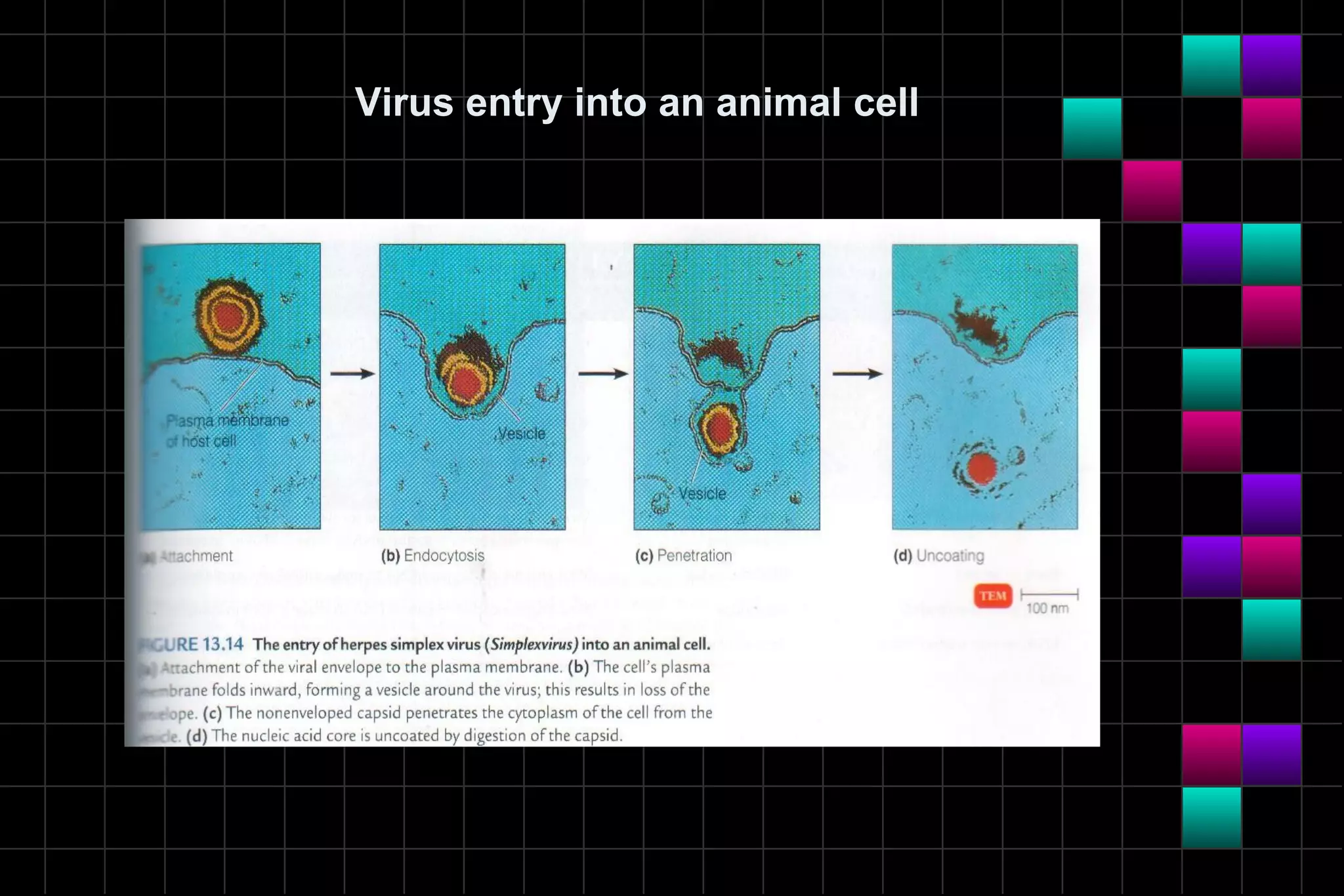
Virus entry into an animal cell
What other roles could be
attributed to viruses other than
being pathogens?

s   Basic research, molecular biology and
    biotechnology
s   Horticulture
s   Cross- protection
s   Gene therapy
s   Phage therapy
s   Viro-therapy
Continuation……..
s   Material Science and Nanotechnology- In April 2006,
    MIT scientists created nanoscale metallic wires using
    a genetically-modified virus. The MIT team was able
    to use the virus to create a working battery with an
    energy density up to three times more than current
    materials. The potential exists for this technology to
    be used in liquid crystals, solar cells, fuel cells, and
    other electronics in the future.
s   Biological warfare- synthesis/recreation of viruses in
    laboratory (eg. 1918 flu virus, smallpox virus- Variola
    major)

Module 10a virology

  • 1.
    Choose me !!!!!! Virology Morphology & Background Common viruses Viral Diseases
  • 2.
    Background Information:) s virus are parasites, s all cells can be not cells parasitized by s virus are packages virus, they only of genetic info - attack closely nucleic acids in related organisms protein coats s virus comes from a s virus only supplies latin word “poison” information, rest is or “slime” dependent on host
  • 3.
    What are viruses?  s virus = “poison” s with genetic material (DNA or RNA) and protein coat (capsid). s obligatory intracellular parasites. s infect the cells of a biological organisms. s they replicate by using the host cell’s metabolic“machinery”.
  • 4.
    Definition of Terms: s Capsid- protein shell, or coat, that encloses the nucleic acid genome s Capsomere – Morphologic units of virus seen under the EM on the surface of icosahedral virus particles • Represents clusters of polypeptide s Defective virus – virus particle that is functionally deficient in some aspect of replication
  • 5.
    More terms:  s Envelope – lipid containing membrane that surrounds some virus particles • Acquired during viral maturation by a budding process thru a cellular membrane s Nucleocapsid – protein nucleic acid complex representing the packaged form of the viral genome s Subunit – single folded viral polypeptide chain
  • 6.
    s Structural units – Basic protein building blocks of the coat. • Usually a collection of more than one nonidentical protein unit. • The structural unit is often referred to a protomer. s Virion – Complete virus particle. In some instances, the virion is identical to the nucleocapsid. In more complex virions, this includes the nucleocapsid plus a surrounding envelope.
  • 7.
    Background Information:  s Dmitri Iwanowski - s Are viruses alive?? 1892 first isolation they contain of TMV macromolecules s Martinus Beijerinck but does not - filterable viruses reproduce directly s Wendell Stanley - --- virions are intact, non- 1935 purified & replicating virus crystallized TMV particles ( no life)
  • 8.
    Basis of classification s Virus morphology s Virus genome • Size properties • Shape • Nucleic Acid ( DNA • Type of symmetry or RNA ) • Presence & absence • Size of genomes in of peplomers kb (kilobase pairs ) • Presence & absence • Strandedness (single of membranes or double ) • Nucleotide sequence
  • 9.
    Basis for Classification: s Host Range s Size • Plant virus • 25 nm to 300 nm • Animal Virus • 1/10 to 1/3 of • Bacteriophage bacteria • no cytoplasmic • Specificity cultivars structures ( plants), race or • can be 77 genes strains, receptors or 3 genes but (protein) still very lethal
  • 10.
    SIZE s Most viruses with capsid = between 10-300 nm
  • 11.
    Structure: s Nucleic Acid core surrounded by protein s Viral Envelope - naked or enveloped s Nucleic Acid - DNA or RNA
  • 12.
    s Genome organization & replication s Antigenic properties • Gene order • Gene number s Biologic properties • Position of open including : reading frames • Natural host range • Patterns of • Mode of replication transmission • Cellular sites • Vector relationship • Pathogenecity • Tissue tropisms • Pathology
  • 13.
    s Physiochemical s Virus protein Properties of the properties virion • Number • Molecular mass • Size • Buoyant density • Functional activities • pH stability • Amino acid • Thermal stability sequence • Susceptibility to agents • Modifications & – Ethers special functions – Detergents – Transcriptase – Reverse trans. – Neuramidase – fusion
  • 14.
    Types of Structure s Four morphological types: • 1. Helical Viruses • 2. Icosahedral viruses • 3. Enveloped viruses • 4. Complex viruses
  • 15.
    Helical virus -Resemblelong rods, may be rigid or flexible -Viral nucleic acid found within a hollow cylindrical capsid. -with single type of protomers stacked around a central axis to form a tube; eg. Tobacco mosaic virus.
  • 16.
    Icosahedral spherical appearance but capsomeres arrangedin a geometrical pattern like a soccer ball; eg.hepatitis B
  • 17.
    Enveloped with outerlipid layer = viral envelope
  • 18.
    Complex -- withextra structure such as protein tails, complex outer walls; eg. Bacteriophages, Poxviruses.
  • 19.
    Life Cycle: s outsidethe host there is no replication s Stages : • -->Adsorption • --> Penetration • --> Uncoating • --> Viral synthesis • --> Maturation • --> Release
  • 20.
    Multiplication of Viruses s Lytic cycle – ends with the lysis and death of the host cell. s Lysogenic cycle- host cell remains alive
  • 22.
    Taxonomy: s ICTV -International Committee on Taxonomy of Virus s Family Name -- Viridae -- Retroviridae s Genus -- Virus -- Lentivirus s Specie -- English -- HIV s Hepadnaviridae -- 7 DNA - Hepatitis
  • 23.
    Misc. Information: s Replicationapplicable to all virus s Plaque count - PFU Plaque forming units s One Step Growth Phase -- Latent ---> Burst Period
  • 24.
    Common viruses inanimals: s Line 1 - Family s Line 2 - Classification based on N.A. s Line 3 - Properties s Line 4 - Virus (species or Genus) s Line 5 - Diseases *** Legend
  • 25.
    s Herpesviridae s DNA virus s Enveloped dsDNA s Herpes simplex 1&2, Varicella zoster, EBV, cytomegalovirus CMV s cold sores, genital herpes, shingles, mononucleosis, birth defects
  • 26.
    s Poxviridae s DNAvirus s Enveloped dsDNA s Smallpox virus s Smallpox ( variola )
  • 27.
    s Hepadnaviridae s DNA virus s Enveloped dsDNA s Hepatitis B virus s Hepatitis B
  • 28.
    New Nomenclature for HepatitisVirus s Hepatitis A • HAV virus • Etiologic agent of infectious Hepatitis • A picornavirus, the prototype of a new genus, Hepatovirus • Anti-HAV – antibody to HAV. Detectable at onset of symptoms; lifetime persistence • IgM antibody
  • 29.
    Hepatitis B s Antibodies for Hep B s HBV- Hepatitis B • Anti-HBs virus • Anti-HBe s Etiologic agent of • Anti-HBc serum hepatitis s A hepadnavirus • IgM class Antibody s HBsAg, HBeAg, HBcAg
  • 30.
    Hepatitis C s HCV– Hepatitis C Virus s A common etiologic agent of post transfusion hepatitis s A Flavivirus, genus Hepacivirus s Anti-HCV – antibody to HCV
  • 31.
    Hepatitis D s HepatitisD Virus s Etiologic agent of delta hepatitis s Causes infection only in presence of HBV s HDAg – Delta antigen, detectable only in early acute HDV infection s Anti-HDV - Antibody
  • 32.
    Hepatitis E s HEV– Hepatitis E Virus s Enterically transmitted hepatitis virus s Causes large epidemics in Asia, North & West Africa and Mexico s Fecal-oral or waterborne infection s Unclassified
  • 34.
    s Papoviridae s DNA virus s naked dsDNA s Human papillomaviruses s Warts
  • 35.
    Polyomaviruses s Small (45nm) naked, heat stable, ether resistant virus s Cubic symmetry with 72 capsomeres s Circular, double stranded DNA s JC virus, BK virus, SV40 virus s Formerly part of Papoviridae family
  • 36.
    s Adenoviridae s DNA virus s Naked dsDNA s Human adenovirus s respiratory, enteric diseases, infectious pinkeye
  • 37.
    Parvovirus s Naked Singlestranded DNA virus s Cubic symmetry with 32 capsomeres s 5.6 kb in size s Requires the presence of adenovirus or herpesvirus as helper ( defective )
  • 38.
    s Retroviridae s RNA virus s Enveloped + strand RNA s HIV-1 & 2, HTLV-1 &2 s AIDS , T cell leukemia
  • 39.
    Life Cycle ofHIV Virus
  • 40.
    Astroviruses s 28-30 nmin diameter s Exhibit a distinctive star-like morphology under the EM s Ss + sense RNA, 6.4 – 7.4 kb in size s Causes diarrheal illnesses s Transmitted by fecal-oral route thru contaminated food or water
  • 41.
    Arboviruses (arthropod borne) sArenaviridae s Bunyaviridae s Flaviviridae s Filoviridae s Reoviridae s Togaviridae
  • 42.
    Arenaviruses s Generally associatedwith rodent- transmitted disease in humans. s Each virus usually is associated with a particular rodent host species in which it is maintained s Divided into two groups: • the New World or Tacaribe complex • the Old World or LCM/Lassa complex.
  • 43.
  • 44.
    s Flaviviridae s RNA virus s enveloped + strand RNA s Yellow & Dengue fever , Hep C virus s Yellow & Dengue fever, Hepatitis C
  • 45.
  • 46.
    Types of Dengue sNon-fatal dengue fever (DF) s Fatal Dengue Hemorrhagic fever (DHF) s Dengue Shock Syndrome ( DSS)
  • 47.
    Serotypes of Dengue s4 serotypes s DEN-1, DEN-2, DEN-3, DEN-4 s DEN-2 shows greatest antigenic and genotypic distance from the others s Protective immunity after infection is homotypic (Which means if your really unlucky u can have dengue __ times.) 
  • 48.
    More types ofFlavivirus s Eastern & Western Encephalitis s St. Louis Encephalitis s West Nile Fever s Japanese B Encephalitis s Yellow Fever
  • 49.
    s Reoviridae s RNA virus s naked dsRNA s Rotavirus s Infant diarrhea
  • 50.
    s Bunyaviridae s RNA virus s Enveloped - strand RNA s Hantavirus s Respiratory distress syndrome
  • 51.
    s Togaviridae s RNA virus s Enveloped + strand RNA s Alphavirus, Rubella virus s encephalitis, Rubella (German measles)
  • 52.
    Picornaviruses s Enterovirus s Rhinovirus • Transient inhabitants • Isolated chiefly from of the human the throat and nose alimentary tract • More than 100 • Poliovirus species based on • Coxsackie virus receptors – ICAM -1 • Paraechovirus – LDLR – Echovirus 22 – Echovirus 23
  • 53.
    s Picornaviridae s RNA virus s Naked + strand RNA s Enterovirus, Poliovirus, echovirus, Rhinovirus, hepatitis A virus s Polio, Myocarditis, pericarditis, colds, Hepatitis A
  • 54.
    s Coronaviridae s RNA virus s Enveloped + strand RNA s Coronavirus s upper respiratory tract infections
  • 55.
    s Calciviridae s RNA virus s naked + strand RNA s Norwalk Agents s Gastroenteritis
  • 56.
    s Orthomyxoviridae s RNA virus s Enveloped - strand RNA s Influenza virus s Influenza
  • 57.
    s Rhabdoviridae s RNA virus s enveloped - strand RNA s Rabies virus s Rabies
  • 58.
    s Paramyxoviridae s RNA virus s enveloped - strand RNA s Mumps, measles virus, Parainfluenza virus, Respiratory syncitial vir. s mumps, rubeola, Croup, Bronchiolitis
  • 59.
    Recent Viral Diseases s SARS- severe acute respiratory syndrome
  • 60.
    Avian Flu- spreadof H5N1 strain
  • 61.
    Influenza Pandemic (1918-1919) – TEM of Spanish Influenza Virus (negatively-stained); subtype H1N1; H2N2; H3N2 25 million deaths in 25 weeks 20% of world population affected. 1957-1958 1968-1969 Next pandemic ????
  • 62.
    Virus entry intoan animal cell
  • 63.
    What other rolescould be attributed to viruses other than being pathogens? s Basic research, molecular biology and biotechnology s Horticulture s Cross- protection s Gene therapy s Phage therapy s Viro-therapy
  • 64.
    Continuation…….. s Material Science and Nanotechnology- In April 2006, MIT scientists created nanoscale metallic wires using a genetically-modified virus. The MIT team was able to use the virus to create a working battery with an energy density up to three times more than current materials. The potential exists for this technology to be used in liquid crystals, solar cells, fuel cells, and other electronics in the future. s Biological warfare- synthesis/recreation of viruses in laboratory (eg. 1918 flu virus, smallpox virus- Variola major)