What is Poetry? Instructor: Willony Barclay
Welcome! Welcome to Exploring the Elements of Poetry! Please feel free to  contact me  if you have any questions or concerns about this module or the course.  May you have a happy journey into becoming future poets!
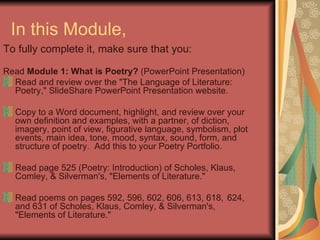
In this Module,  To fully complete it, make sure that you:  Read  Module 1: What is Poetry?  (PowerPoint Presentation) Read and review over the "The Language of Literature: Poetry," SlideShare PowerPoint Presentation website. Copy to a Word document, highlight, and review over  your own definition and examples, with a partner, of diction, imagery, point of view, figurative language, symbolism, plot events, main idea, tone, mood, syntax, sound, form, and structure of poetry.  Add this to your Poetry Portfolio. Read page 525 (Poetry: Introduction) of Scholes, Klaus, Comley, & Silverman's, "Elements of Literature." Read poems on pages 592, 596, 602, 606, 613, 618,  624, and 631 of Scholes, Klaus, Comley, & Silverman's, "Elements of Literature."
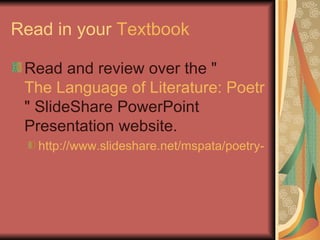
Read in your  Textbook Read and review over the " The Language of Literature: Poetry " SlideShare PowerPoint Presentation website. http://www.slideshare.net/mspata/poetry-powerpoint-1204716
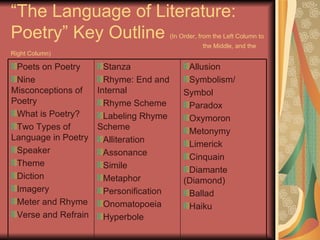
“ The Language of Literature: Poetry” Key Outline  (In Order, from the Left Column to  the Middle, and the Right Column) Allusion Symbolism/ Symbol Paradox Oxymoron Metonymy Limerick Cinquain Diamante (Diamond) Ballad Haiku Stanza Rhyme: End and Internal Rhyme Scheme Labeling Rhyme Scheme Alliteration Assonance Simile Metaphor Personification Onomatopoeia Hyperbole Poets on Poetry Nine Misconceptions of Poetry What is Poetry? Two Types of Language in Poetry Speaker Theme Diction Imagery Meter and Rhyme Verse and Refrain
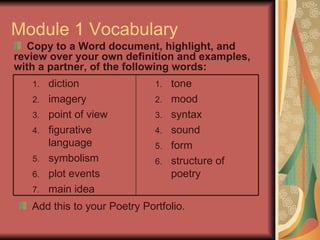
Module 1 Vocabulary Copy to a Word document, highlight, and review over your own definition and examples, with a partner, of the following words: Add this to your Poetry Portfolio. tone                  mood  syntax  sound  form  structure of poetry  diction  imagery  point of view  figurative language symbolism  plot events  main idea
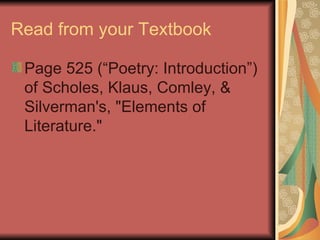
Read from your Textbook Page 525 (“Poetry: Introduction”) of Scholes, Klaus, Comley, & Silverman's, "Elements of Literature."
Read Poems from your Textbook Pages 592, 596, 602, 606, 613, 618, 624, and 631 of Scholes, Klaus, Comley, & Silverman's, "Elements of Literature."
Grading System Unsatisfactory The student does not show a clear understanding of the module 1 requirements; Appropriate headings are missing, Tasks were not submitted by the due date and/or additional requirements were not met (such as did not list partner’s name with Module 1 Vocabulary definitions, Definitions not complete, “Language of Literature: Poetry” Key Outline is not complete, Did not read pages from the textbook and/or PowerPoint Presentation). Satisfactory The student shows a clear understanding of the module 1 requirements; Appropriate headings are found, Tasks submitted by the due date and any additional requirements met.
Other Helpful Resources Poets.org PoetryArchive.org  for Students Wikipedia – Definition of Poetry
 

Module 1 - What Is Poetry

  • 1.
    What is Poetry?Instructor: Willony Barclay
  • 2.
    Welcome! Welcome toExploring the Elements of Poetry! Please feel free to contact me if you have any questions or concerns about this module or the course. May you have a happy journey into becoming future poets!
  • 3.
    In this Module, To fully complete it, make sure that you: Read Module 1: What is Poetry? (PowerPoint Presentation) Read and review over the "The Language of Literature: Poetry," SlideShare PowerPoint Presentation website. Copy to a Word document, highlight, and review over your own definition and examples, with a partner, of diction, imagery, point of view, figurative language, symbolism, plot events, main idea, tone, mood, syntax, sound, form, and structure of poetry.  Add this to your Poetry Portfolio. Read page 525 (Poetry: Introduction) of Scholes, Klaus, Comley, & Silverman's, "Elements of Literature." Read poems on pages 592, 596, 602, 606, 613, 618, 624, and 631 of Scholes, Klaus, Comley, & Silverman's, "Elements of Literature."
  • 4.
    Read in your Textbook Read and review over the " The Language of Literature: Poetry " SlideShare PowerPoint Presentation website. http://www.slideshare.net/mspata/poetry-powerpoint-1204716
  • 5.
    “ The Languageof Literature: Poetry” Key Outline (In Order, from the Left Column to the Middle, and the Right Column) Allusion Symbolism/ Symbol Paradox Oxymoron Metonymy Limerick Cinquain Diamante (Diamond) Ballad Haiku Stanza Rhyme: End and Internal Rhyme Scheme Labeling Rhyme Scheme Alliteration Assonance Simile Metaphor Personification Onomatopoeia Hyperbole Poets on Poetry Nine Misconceptions of Poetry What is Poetry? Two Types of Language in Poetry Speaker Theme Diction Imagery Meter and Rhyme Verse and Refrain
  • 6.
    Module 1 VocabularyCopy to a Word document, highlight, and review over your own definition and examples, with a partner, of the following words: Add this to your Poetry Portfolio. tone                 mood syntax sound  form structure of poetry diction imagery point of view figurative language symbolism plot events main idea
  • 7.
    Read from yourTextbook Page 525 (“Poetry: Introduction”) of Scholes, Klaus, Comley, & Silverman's, "Elements of Literature."
  • 8.
    Read Poems fromyour Textbook Pages 592, 596, 602, 606, 613, 618, 624, and 631 of Scholes, Klaus, Comley, & Silverman's, "Elements of Literature."
  • 9.
    Grading System UnsatisfactoryThe student does not show a clear understanding of the module 1 requirements; Appropriate headings are missing, Tasks were not submitted by the due date and/or additional requirements were not met (such as did not list partner’s name with Module 1 Vocabulary definitions, Definitions not complete, “Language of Literature: Poetry” Key Outline is not complete, Did not read pages from the textbook and/or PowerPoint Presentation). Satisfactory The student shows a clear understanding of the module 1 requirements; Appropriate headings are found, Tasks submitted by the due date and any additional requirements met.
  • 10.
    Other Helpful ResourcesPoets.org PoetryArchive.org for Students Wikipedia – Definition of Poetry
  • 11.