Module 2
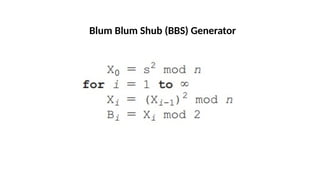
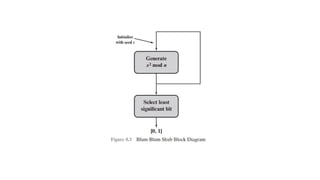
Blum Blum Shub (BBS) Generator
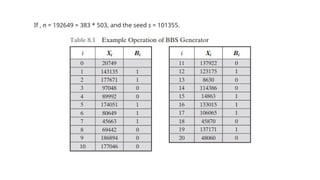
If , n = 192649 = 383 * 503, and the seed s = 101355.
Private-Key Cryptography
• traditional private/secret/single key cryptography uses one key
• shared by both sender and receiver
• if this key is disclosed communications are compromised
• also is symmetric, parties are equal
• hence does not protect sender from receiver forging a message &
claiming is sent by sender
Public-Key Cryptography
• probably most significant advance in the 3000 year history of
cryptography
• uses two keys – a public & a private key
• asymmetric since parties are not equal
• uses clever application of number theoretic concepts to function
• complements rather than replaces private key crypto
Public-Key Cryptography
• public-key/two-key/asymmetric cryptography involves the use of
two keys:
• a public-key, which may be known by anybody, and can be used to encrypt
messages, and verify signatures
• a private-key, known only to the recipient, used to decrypt messages, and
sign (create) signatures
• is asymmetric because
• those who encrypt messages or verify signatures cannot decrypt messages or
create signatures
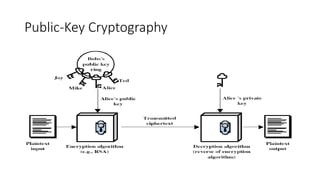
Public-Key Cryptography
Why Public-Key Cryptography?
• developed to address two key issues:
• key distribution – how to have secure communications in general without
having to trust a KDC with your key
• digital signatures – how to verify a message comes intact from the claimed
sender
• public invention due to Whitfield Diffie & Martin Hellman at Stanford
Uni in 1976
• known earlier in classified community
Public-Key Characteristics
• Public-Key algorithms rely on two keys with the characteristics that it
is:
• computationally infeasible to find decryption key knowing only algorithm &
encryption key
• computationally easy to en/decrypt messages when the relevant (en/decrypt)
key is known
• either of the two related keys can be used for encryption, with the other used
for decryption (in some schemes)
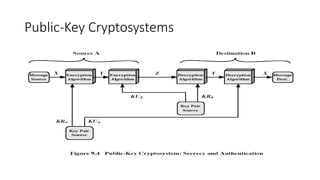
Public-Key Cryptosystems
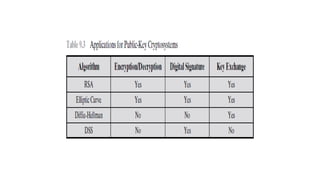
Public-Key Applications
• can classify uses into 3 categories:
• encryption/decryption (provide secrecy)
• digital signatures (provide authentication)
• key exchange (of session keys)
• some algorithms are suitable for all uses, others are specific to one
Requirements for Public-Key Cryptography
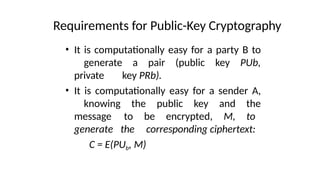
• It is computationally easy for a party B to
generate a pair (public key PUb,
private key PRb).
• It is computationally easy for a sender A,
knowing the public key and the
message to be encrypted, M, to
generate the corresponding ciphertext:
C = E(PUb, M)
• It is computationally easy for the receiver
B to decrypt the resulting
ciphertext using the private key to
recover the original message:
M = D(PRb,C) = D[PRb, E(PUb,M)]
• It is computationally infeasible for an
adversary, knowing the public key,
PUb,to determine the private key, PRb.
• It is computationally infeasible for an
adversary, knowing the public key,
PUb, and a ciphertext, C, to
recover the original message, M.
• The two keys can be applied in
either order:
M = D[PUb, E(PRb, M)] = D[PRb, E(PUb, M)]
One-way Function
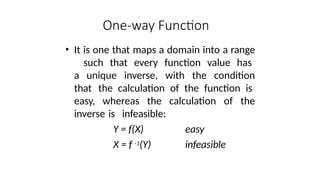
• It is one that maps a domain into a range
such that every function value has
a unique inverse, with the condition
that the calculation of the function is
easy, whereas the calculation of the
inverse is infeasible:
Y = f(X)
X = f -1(Y)
easy
infeasible
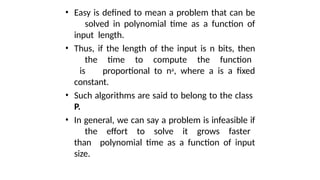
• Easy is defined to mean a problem that can be
solved in polynomial time as a function of
input length.
• Thus, if the length of the input is n bits, then
the time to compute the function
is proportional to na, where a is a fixed
constant.
• Such algorithms are said to belong to the class
P.
• In general, we can say a problem is infeasible if
the effort to solve it grows faster
than polynomial time as a function of input
size.
Trap-door One-way Function
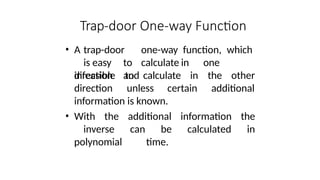
• A trap-door one-way function, which
is easy to calculate in one
direction and in the other
infeasible to calculate
direction unless certain additional
information is known.
• With the additional information the
inverse can be calculated in
polynomial time.
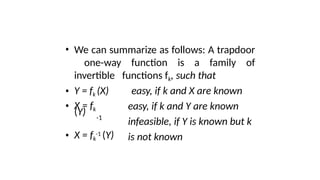
• We can summarize as follows: A trapdoor
one-way function is a family of
invertible functions fk, such that
• Y = fk (X)
• X = fk
(Y) -1
• X = fk
-1 (Y)
easy, if k and X are known
easy, if k and Y are known
infeasible, if Y is known but k
is not known
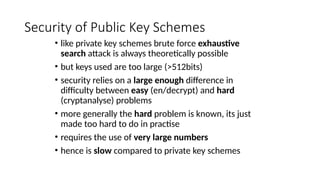
Security of Public Key Schemes
• like private key schemes brute force exhaustive
search attack is always theoretically possible
• but keys used are too large (>512bits)
• security relies on a large enough difference in
difficulty between easy (en/decrypt) and hard
(cryptanalyse) problems
• more generally the hard problem is known, its just
made too hard to do in practise
• requires the use of very large numbers
• hence is slow compared to private key schemes
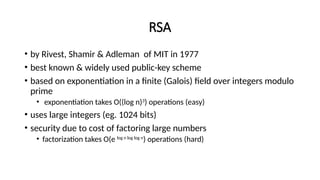
RSA
• by Rivest, Shamir & Adleman of MIT in 1977
• best known & widely used public-key scheme
• based on exponentiation in a finite (Galois) field over integers modulo
prime
• exponentiation takes O((log n)3
) operations (easy)
• uses large integers (eg. 1024 bits)
• security due to cost of factoring large numbers
• factorization takes O(e log n log log n
) operations (hard)
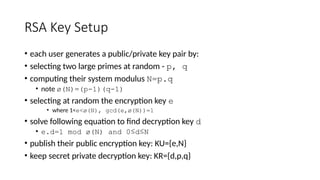
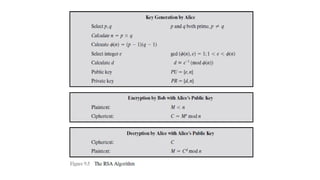
RSA Key Setup
• each user generates a public/private key pair by:
• selecting two large primes at random - p, q
• computing their system modulus N=p.q
• note ø(N)=(p-1)(q-1)
• selecting at random the encryption key e
• where 1<e<ø(N), gcd(e,ø(N))=1
• solve following equation to find decryption key d
• e.d=1 mod ø(N) and 0≤d≤N
• publish their public encryption key: KU={e,N}
• keep secret private decryption key: KR={d,p,q}
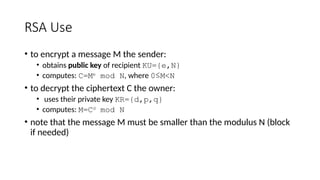
RSA Use
• to encrypt a message M the sender:
• obtains public key of recipient KU={e,N}
• computes: C=Me
mod N, where 0≤M<N
• to decrypt the ciphertext C the owner:
• uses their private key KR={d,p,q}
• computes: M=Cd
mod N
• note that the message M must be smaller than the modulus N (block
if needed)
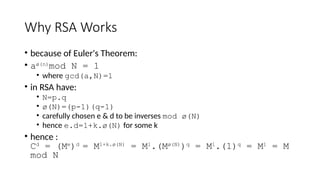
Why RSA Works
• because of Euler's Theorem:
• aø(n)
mod N = 1
• where gcd(a,N)=1
• in RSA have:
• N=p.q
• ø(N)=(p-1)(q-1)
• carefully chosen e & d to be inverses mod ø(N)
• hence e.d=1+k.ø(N) for some k
• hence :
Cd
= (Me
)d
= M1+k.ø(N)
= M1
.(Mø(N)
)q
= M1
.(1)q
= M1
= M
mod N
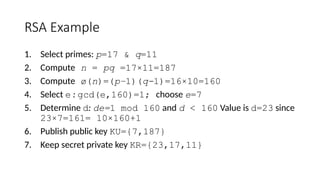
RSA Example
1. Select primes: p=17 & q=11
2. Compute n = pq =17×11=187
3. Compute ø(n)=(p–1)(q-1)=16×10=160
4. Select e : gcd(e,160)=1; choose e=7
5. Determine d: de=1 mod 160 and d < 160 Value is d=23 since
23×7=161= 10×160+1
6. Publish public key KU={7,187}
7. Keep secret private key KR={23,17,11}
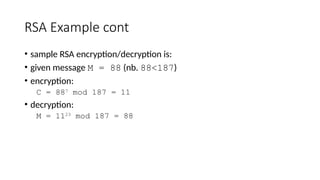
RSA Example cont
• sample RSA encryption/decryption is:
• given message M = 88 (nb. 88<187)
• encryption:
C = 887
mod 187 = 11
• decryption:
M = 1123
mod 187 = 88
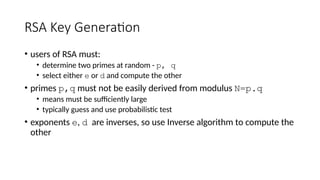
RSA Key Generation
• users of RSA must:
• determine two primes at random - p, q
• select either e or d and compute the other
• primes p,q must not be easily derived from modulus N=p.q
• means must be sufficiently large
• typically guess and use probabilistic test
• exponents e, d are inverses, so use Inverse algorithm to compute the
other
RSA Security
• three approaches to attacking RSA:
• brute force key search (infeasible given size of numbers)
• mathematical attacks (based on difficulty of computing ø(N), by factoring
modulus N)
• timing attacks (on running of decryption)
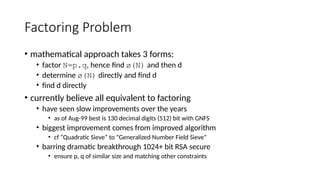
Factoring Problem
• mathematical approach takes 3 forms:
• factor N=p.q, hence find ø(N) and then d
• determine ø(N) directly and find d
• find d directly
• currently believe all equivalent to factoring
• have seen slow improvements over the years
• as of Aug-99 best is 130 decimal digits (512) bit with GNFS
• biggest improvement comes from improved algorithm
• cf “Quadratic Sieve” to “Generalized Number Field Sieve”
• barring dramatic breakthrough 1024+ bit RSA secure
• ensure p, q of similar size and matching other constraints
Timing Attacks
• developed in mid-1990’s
• exploit timing variations in operations
• eg. multiplying by small vs large number
• or IF's varying which instructions executed
• infer operand size based on time taken
• RSA exploits time taken in exponentiation
• countermeasures
• use constant exponentiation time
• add random delays
• blind values used in calculations
Chosen Ciphertext Attacks
RSA is vulnerable to a Chosen Ciphertext Attack (CCA)
-attackerschooses ciphertexts & gets decrypted
plaintext back
-chooseciphertext to exploit properties of RSA to provide info
to help cryptanalysis
-can counter with random pad of plaintext
or use Optimal Asymmetric Encryption Padding (OASP)
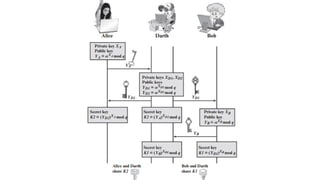
Diffie-Hellman Key Exchange
• first public-key type scheme proposed
• For key distribution only
• by Diffie & Hellman in 1976 along with the exposition of public key
concepts
• note: now know that James Ellis (UK CESG) secretly proposed the concept in
1970
• is a practical method for public exchange of a secret key
• used in a number of commercial products
37
Diffie-Hellman Key Exchange
• a public-key distribution scheme
• cannot be used to exchange an arbitrary message
• rather it can establish a common key
• known only to the two participants
• value of key depends on the participants (and their private and public
key information)
• based on exponentiation in a finite (Galois) field (modulo a prime or a
polynomial) - easy
• security relies on the difficulty of computing discrete logarithms
(similar to factoring) – hard
38
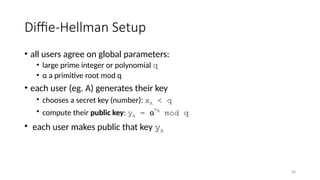
Diffie-Hellman Setup
• all users agree on global parameters:
• large prime integer or polynomial q
• α a primitive root mod q
• each user (eg. A) generates their key
• chooses a secret key (number): xA < q
• compute their public key: yA = α
xA
mod q
• each user makes public that key yA
39
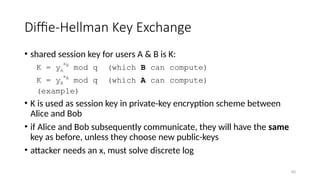
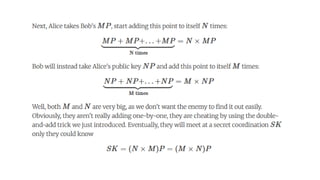
Diffie-Hellman Key Exchange
• shared session key for users A & B is K:
K = yA
xB
mod q (which B can compute)
K = yB
xA
mod q (which A can compute)
(example)
• K is used as session key in private-key encryption scheme between
Alice and Bob
• if Alice and Bob subsequently communicate, they will have the same
key as before, unless they choose new public-keys
• attacker needs an x, must solve discrete log
40
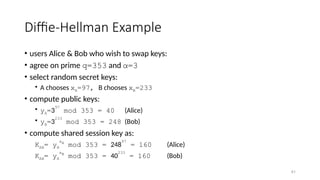
Diffie-Hellman Example
• users Alice & Bob who wish to swap keys:
• agree on prime q=353 and α=3
• select random secret keys:
• A chooses xA=97, B chooses xB=233
• compute public keys:
• yA=3
97
mod 353 = 40 (Alice)
• yB=3
233
mod 353 = 248 (Bob)
• compute shared session key as:
KAB= yB
xA
mod 353 = 248
97
= 160 (Alice)
KAB= yA
xB
mod 353 = 40
233
= 160 (Bob)
41
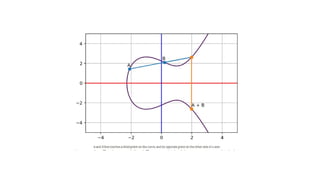
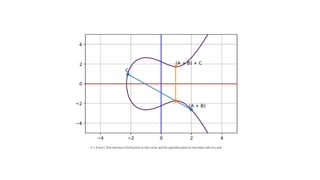
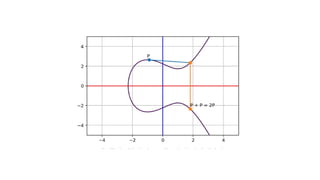
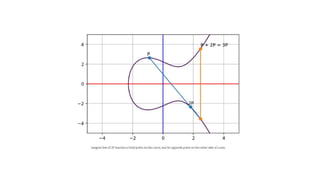
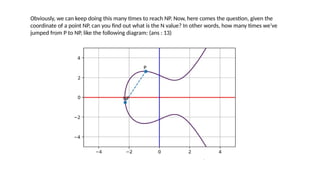
Obviously, we can keep doing this many times to reach NP. Now, here comes the question, given the
coordinate of a point NP, can you find out what is the N value? In other words, how many times we’ve
jumped from P to NP, like the following diagram: (ans : 13)
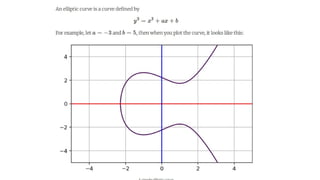
Elliptic Curve Diffie–Hellman
modernencryptionthatinvolvesdes-ppt.pptx

modernencryptionthatinvolvesdes-ppt.pptx

  • 1.
  • 5.
    Blum Blum Shub(BBS) Generator
  • 7.
    If , n= 192649 = 383 * 503, and the seed s = 101355.
  • 8.
    Private-Key Cryptography • traditionalprivate/secret/single key cryptography uses one key • shared by both sender and receiver • if this key is disclosed communications are compromised • also is symmetric, parties are equal • hence does not protect sender from receiver forging a message & claiming is sent by sender
  • 9.
    Public-Key Cryptography • probablymost significant advance in the 3000 year history of cryptography • uses two keys – a public & a private key • asymmetric since parties are not equal • uses clever application of number theoretic concepts to function • complements rather than replaces private key crypto
  • 10.
    Public-Key Cryptography • public-key/two-key/asymmetriccryptography involves the use of two keys: • a public-key, which may be known by anybody, and can be used to encrypt messages, and verify signatures • a private-key, known only to the recipient, used to decrypt messages, and sign (create) signatures • is asymmetric because • those who encrypt messages or verify signatures cannot decrypt messages or create signatures
  • 11.
  • 12.
    Why Public-Key Cryptography? •developed to address two key issues: • key distribution – how to have secure communications in general without having to trust a KDC with your key • digital signatures – how to verify a message comes intact from the claimed sender • public invention due to Whitfield Diffie & Martin Hellman at Stanford Uni in 1976 • known earlier in classified community
  • 13.
    Public-Key Characteristics • Public-Keyalgorithms rely on two keys with the characteristics that it is: • computationally infeasible to find decryption key knowing only algorithm & encryption key • computationally easy to en/decrypt messages when the relevant (en/decrypt) key is known • either of the two related keys can be used for encryption, with the other used for decryption (in some schemes)
  • 14.
  • 15.
    Public-Key Applications • canclassify uses into 3 categories: • encryption/decryption (provide secrecy) • digital signatures (provide authentication) • key exchange (of session keys) • some algorithms are suitable for all uses, others are specific to one
  • 17.
    Requirements for Public-KeyCryptography • It is computationally easy for a party B to generate a pair (public key PUb, private key PRb). • It is computationally easy for a sender A, knowing the public key and the message to be encrypted, M, to generate the corresponding ciphertext: C = E(PUb, M)
  • 18.
    • It iscomputationally easy for the receiver B to decrypt the resulting ciphertext using the private key to recover the original message: M = D(PRb,C) = D[PRb, E(PUb,M)] • It is computationally infeasible for an adversary, knowing the public key, PUb,to determine the private key, PRb. • It is computationally infeasible for an adversary, knowing the public key, PUb, and a ciphertext, C, to recover the original message, M.
  • 19.
    • The twokeys can be applied in either order: M = D[PUb, E(PRb, M)] = D[PRb, E(PUb, M)]
  • 20.
    One-way Function • Itis one that maps a domain into a range such that every function value has a unique inverse, with the condition that the calculation of the function is easy, whereas the calculation of the inverse is infeasible: Y = f(X) X = f -1(Y) easy infeasible
  • 21.
    • Easy isdefined to mean a problem that can be solved in polynomial time as a function of input length. • Thus, if the length of the input is n bits, then the time to compute the function is proportional to na, where a is a fixed constant. • Such algorithms are said to belong to the class P. • In general, we can say a problem is infeasible if the effort to solve it grows faster than polynomial time as a function of input size.
  • 22.
    Trap-door One-way Function •A trap-door one-way function, which is easy to calculate in one direction and in the other infeasible to calculate direction unless certain additional information is known. • With the additional information the inverse can be calculated in polynomial time.
  • 23.
    • We cansummarize as follows: A trapdoor one-way function is a family of invertible functions fk, such that • Y = fk (X) • X = fk (Y) -1 • X = fk -1 (Y) easy, if k and X are known easy, if k and Y are known infeasible, if Y is known but k is not known
  • 24.
    Security of PublicKey Schemes • like private key schemes brute force exhaustive search attack is always theoretically possible • but keys used are too large (>512bits) • security relies on a large enough difference in difficulty between easy (en/decrypt) and hard (cryptanalyse) problems • more generally the hard problem is known, its just made too hard to do in practise • requires the use of very large numbers • hence is slow compared to private key schemes
  • 25.
    RSA • by Rivest,Shamir & Adleman of MIT in 1977 • best known & widely used public-key scheme • based on exponentiation in a finite (Galois) field over integers modulo prime • exponentiation takes O((log n)3 ) operations (easy) • uses large integers (eg. 1024 bits) • security due to cost of factoring large numbers • factorization takes O(e log n log log n ) operations (hard)
  • 26.
    RSA Key Setup •each user generates a public/private key pair by: • selecting two large primes at random - p, q • computing their system modulus N=p.q • note ø(N)=(p-1)(q-1) • selecting at random the encryption key e • where 1<e<ø(N), gcd(e,ø(N))=1 • solve following equation to find decryption key d • e.d=1 mod ø(N) and 0≤d≤N • publish their public encryption key: KU={e,N} • keep secret private decryption key: KR={d,p,q}
  • 27.
    RSA Use • toencrypt a message M the sender: • obtains public key of recipient KU={e,N} • computes: C=Me mod N, where 0≤M<N • to decrypt the ciphertext C the owner: • uses their private key KR={d,p,q} • computes: M=Cd mod N • note that the message M must be smaller than the modulus N (block if needed)
  • 28.
    Why RSA Works •because of Euler's Theorem: • aø(n) mod N = 1 • where gcd(a,N)=1 • in RSA have: • N=p.q • ø(N)=(p-1)(q-1) • carefully chosen e & d to be inverses mod ø(N) • hence e.d=1+k.ø(N) for some k • hence : Cd = (Me )d = M1+k.ø(N) = M1 .(Mø(N) )q = M1 .(1)q = M1 = M mod N
  • 29.
    RSA Example 1. Selectprimes: p=17 & q=11 2. Compute n = pq =17×11=187 3. Compute ø(n)=(p–1)(q-1)=16×10=160 4. Select e : gcd(e,160)=1; choose e=7 5. Determine d: de=1 mod 160 and d < 160 Value is d=23 since 23×7=161= 10×160+1 6. Publish public key KU={7,187} 7. Keep secret private key KR={23,17,11}
  • 30.
    RSA Example cont •sample RSA encryption/decryption is: • given message M = 88 (nb. 88<187) • encryption: C = 887 mod 187 = 11 • decryption: M = 1123 mod 187 = 88
  • 32.
    RSA Key Generation •users of RSA must: • determine two primes at random - p, q • select either e or d and compute the other • primes p,q must not be easily derived from modulus N=p.q • means must be sufficiently large • typically guess and use probabilistic test • exponents e, d are inverses, so use Inverse algorithm to compute the other
  • 33.
    RSA Security • threeapproaches to attacking RSA: • brute force key search (infeasible given size of numbers) • mathematical attacks (based on difficulty of computing ø(N), by factoring modulus N) • timing attacks (on running of decryption)
  • 34.
    Factoring Problem • mathematicalapproach takes 3 forms: • factor N=p.q, hence find ø(N) and then d • determine ø(N) directly and find d • find d directly • currently believe all equivalent to factoring • have seen slow improvements over the years • as of Aug-99 best is 130 decimal digits (512) bit with GNFS • biggest improvement comes from improved algorithm • cf “Quadratic Sieve” to “Generalized Number Field Sieve” • barring dramatic breakthrough 1024+ bit RSA secure • ensure p, q of similar size and matching other constraints
  • 35.
    Timing Attacks • developedin mid-1990’s • exploit timing variations in operations • eg. multiplying by small vs large number • or IF's varying which instructions executed • infer operand size based on time taken • RSA exploits time taken in exponentiation • countermeasures • use constant exponentiation time • add random delays • blind values used in calculations
  • 36.
    Chosen Ciphertext Attacks RSAis vulnerable to a Chosen Ciphertext Attack (CCA) -attackerschooses ciphertexts & gets decrypted plaintext back -chooseciphertext to exploit properties of RSA to provide info to help cryptanalysis -can counter with random pad of plaintext or use Optimal Asymmetric Encryption Padding (OASP)
  • 37.
    Diffie-Hellman Key Exchange •first public-key type scheme proposed • For key distribution only • by Diffie & Hellman in 1976 along with the exposition of public key concepts • note: now know that James Ellis (UK CESG) secretly proposed the concept in 1970 • is a practical method for public exchange of a secret key • used in a number of commercial products 37
  • 38.
    Diffie-Hellman Key Exchange •a public-key distribution scheme • cannot be used to exchange an arbitrary message • rather it can establish a common key • known only to the two participants • value of key depends on the participants (and their private and public key information) • based on exponentiation in a finite (Galois) field (modulo a prime or a polynomial) - easy • security relies on the difficulty of computing discrete logarithms (similar to factoring) – hard 38
  • 39.
    Diffie-Hellman Setup • allusers agree on global parameters: • large prime integer or polynomial q • α a primitive root mod q • each user (eg. A) generates their key • chooses a secret key (number): xA < q • compute their public key: yA = α xA mod q • each user makes public that key yA 39
  • 40.
    Diffie-Hellman Key Exchange •shared session key for users A & B is K: K = yA xB mod q (which B can compute) K = yB xA mod q (which A can compute) (example) • K is used as session key in private-key encryption scheme between Alice and Bob • if Alice and Bob subsequently communicate, they will have the same key as before, unless they choose new public-keys • attacker needs an x, must solve discrete log 40
  • 41.
    Diffie-Hellman Example • usersAlice & Bob who wish to swap keys: • agree on prime q=353 and α=3 • select random secret keys: • A chooses xA=97, B chooses xB=233 • compute public keys: • yA=3 97 mod 353 = 40 (Alice) • yB=3 233 mod 353 = 248 (Bob) • compute shared session key as: KAB= yB xA mod 353 = 248 97 = 160 (Alice) KAB= yA xB mod 353 = 40 233 = 160 (Bob) 41
  • 49.
    Obviously, we cankeep doing this many times to reach NP. Now, here comes the question, given the coordinate of a point NP, can you find out what is the N value? In other words, how many times we’ve jumped from P to NP, like the following diagram: (ans : 13)
  • 50.

Editor's Notes

  • #8 So far all the cryptosystems discussed have been private/secret/single key (symmetric) systems. All classical, and modern block and stream ciphers are of this form.
  • #9 Will now discuss the radically different public key systems, in which two keys are used. Anyone knowing the public key can encrypt messages or verify signatures, but cannot decrypt messages or create signatures, counter-intuitive though this may seem. It works by the clever use of number theory problems that are easy one way but hard the other. Note that public key schemes are neither more secure than private key (security depends on the key size for both), nor do they replace private key schemes (they are too slow to do so), rather they complement them.
  • #11 Stallings Fig 9.1
  • #12 The idea of public key schemes, and the first practical scheme, which was for key distribution only, was published in 1977 by Diffie & Hellman. The concept had been previously described in a classified report in 1970 by James Ellis (UK CESG) - and subsequently declassified in 1987. See History of Non-secret Encryption (at CESG). Its interesting to note that they discovered RSA first, then Diffie-Hellman, opposite to the order of public discovery!
  • #13 Public key schemes utilise problems that are easy (P type) one way but hard (NP type) the other way, eg exponentiation vs logs, multiplication vs factoring. Consider the following analogy using padlocked boxes: traditional schemes involve the sender putting a message in a box and locking it, sending that to the receiver, and somehow securely also sending them the key to unlock the box. The radical advance in public key schemes was to turn this around, the receiver sends an unlocked box to the sender, who puts the message in the box and locks it (easy - and having locked it cannot get at the message), and sends the locked box to the receiver who can unlock it (also easy), having the key. An attacker would have to pick the lock on the box (hard).
  • #14 Stallings Fig 9.4 Here see various components of public-key schemes used for both secrecy and authentication. Note that separate key pairs are used for each of these – receiver owns and creates secrecy keys, sender owns and creates authentication keys.
  • #24 Public key schemes are no more or less secure than private key schemes - in both cases the size of the key determines the security. Note also that you can't compare key sizes - a 64-bit private key scheme has very roughly similar security to a 512-bit RSA - both could be broken given sufficient resources. But with public key schemes at least there's usually a firmer theoretical basis for determining the security since its based on well-known and well studied number theory problems.
  • #25 RSA is the best known, and by far the most widely used general public key encryption algorithm.
  • #26 This key setup is done once (rarely) when a user establishes (or replaces) their public key. The exponent e is usually fairly small, just must be relatively prime to ø(N). Need to compute its inverse to find d. It is critically important that the private key KR={d,p,q} is kept secret, since if any part becomes known, the system can be broken. Note that different users will have different moduli N.
  • #28 Can show that RSA works as a direct consequence of Euler’s Theorem.
  • #29 Here walk through example using “trivial” sized numbers. Selecting primes requires the use of primality tests. Finding d as inverse of e mod ø(n) requires use of Inverse algorithm (see Ch4)
  • #30 Rather than having to laborious repeatedly multiply, can use the "square and multiply" algorithm with modulo reductions to implement all exponentiations quickly and efficiently (see next).
  • #32 Both the prime generation and the derivation of a suitable pair of inverse exponents may involve trying a number of alternatives, but theory shows the number is not large.
  • #34 See Stallings Table 9.3 for progress in factoring. Best current algorithm is the “Generalized Number Field Sieve” (GNFS), which replaced the earlier “Quadratic Sieve” in mid-1990’s. Do have an even more powerful and faster algorithm - the “Special Number Field Sieve” (SNFS) which currently only works with numbers of a particular form (not RSA like). However expect it may in future be used with all forms. Numbers of size 1024+ bits look reasonable at present, and the factors should be of similar size
  • #37 The idea of public key schemes, and the first practical scheme, which was for key distribution only, was published in 1977 by Diffie & Hellman. The concept had been previously described in a classified report in 1970 by James Ellis (UK CESG) - and subsequently declassified in 1987. See History of Non-secret Encryption (at CESG).
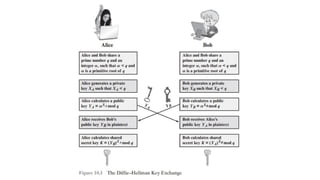
  • #39 The prime q and primitive root α can be common to all using some instance of the D-H scheme. Note that the primitive root α is a number whose powers successively generate all the elements mod q. Alice and Bob choose random secrets x's, and then "protect" them using exponentiation to create the y's. For an attacker monitoring the exchange of the y's to recover either of the x's, they'd need to solve the discrete logarithm problem, which is hard.
  • #40 The actual key exchange for either party consists of raising the others "public key' to power of their private key. The resulting number (or as much of as is necessary) is used as the key for a block cipher or other private key scheme. For an attacker to obtain the same value they need at least one of the secret numbers, which means solving a discrete log, which is computationally infeasible given large enough numbers