Cryptography and
Network Security
Chapter 9
Fifth Edition
by William Stallings
Lecture slides by Lawrie Brown
Chapter 9 – Public Key
Cryptography and RSA
Every Egyptian received two names, which were
known respectively as the true name and the
good name, or the great name and the little
name; and while the good or little name was
made public, the true or great name appears to
have been carefully concealed.
—The Golden Bough, Sir James George Frazer
Private-Key Cryptography
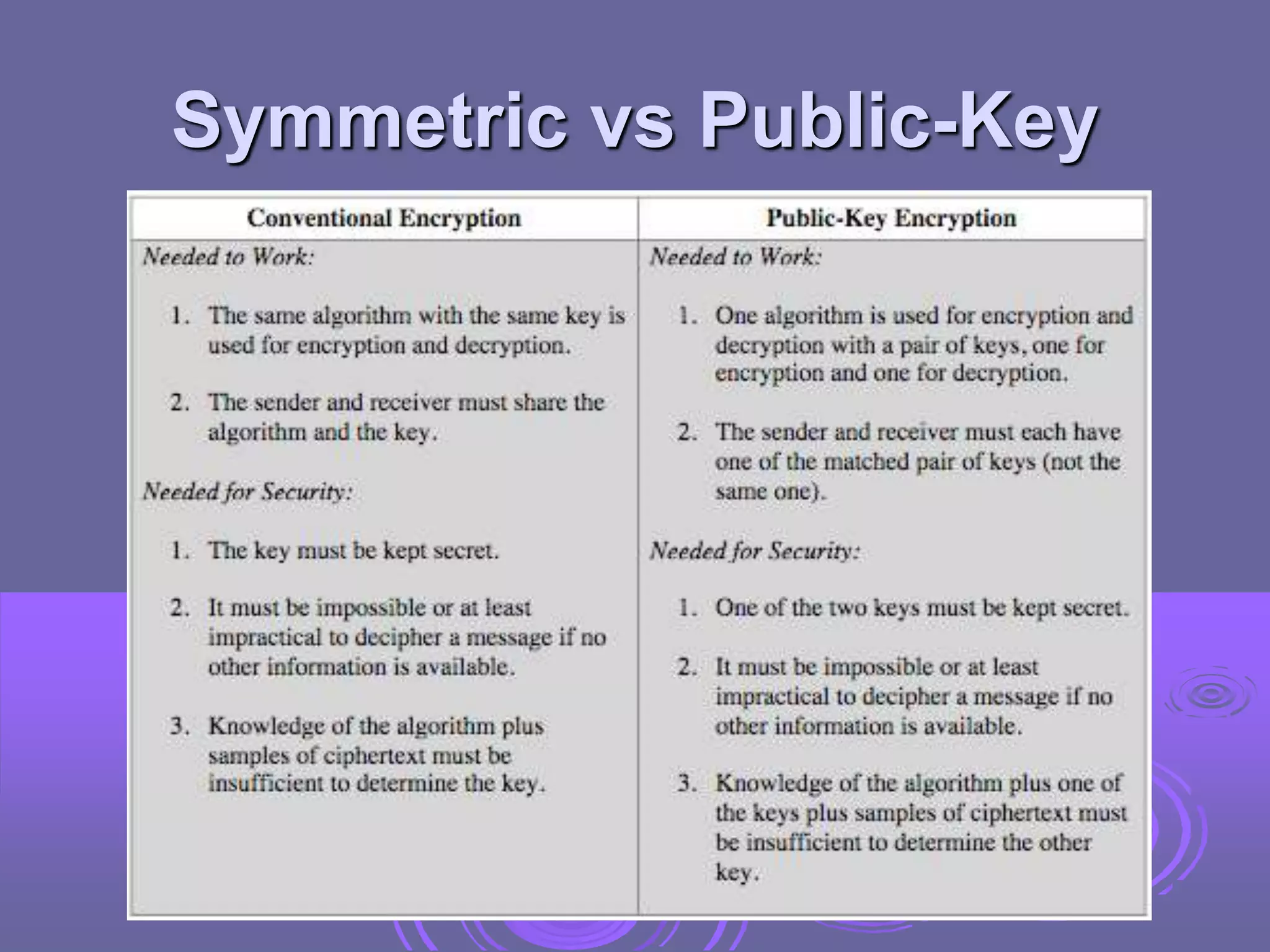
 traditional private/secret/single key
cryptography uses one key
 shared by both sender and receiver
 if this key is disclosed communications are
compromised
 also is symmetric, parties are equal
 hence does not protect sender from
receiver forging a message & claiming is
sent by sender
Public-Key Cryptography
 probably most significant advance in the
3000 year history of cryptography
 uses two keys – a public & a private key
 asymmetric since parties are not equal
 uses clever application of number
theoretic concepts to function
 complements rather than replaces private
key crypto
Why Public-Key
Cryptography?
 developed to address two key issues:
 key distribution – how to have secure
communications in general without having to
trust a KDC with your key
 digital signatures – how to verify a message
comes intact from the claimed sender
 public invention due to Whitfield Diffie &
Martin Hellman at Stanford Uni in 1976
 known earlier in classified community
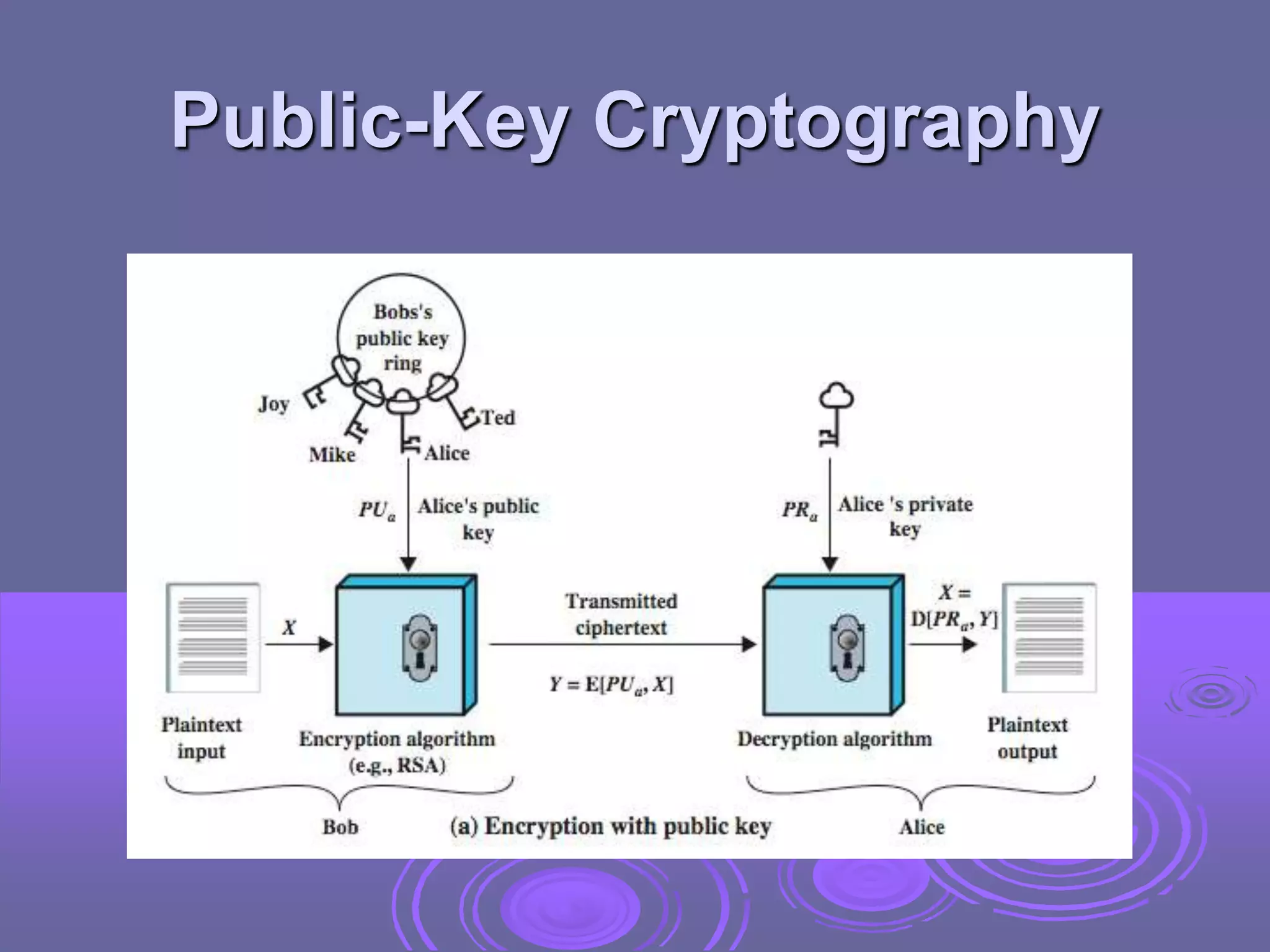
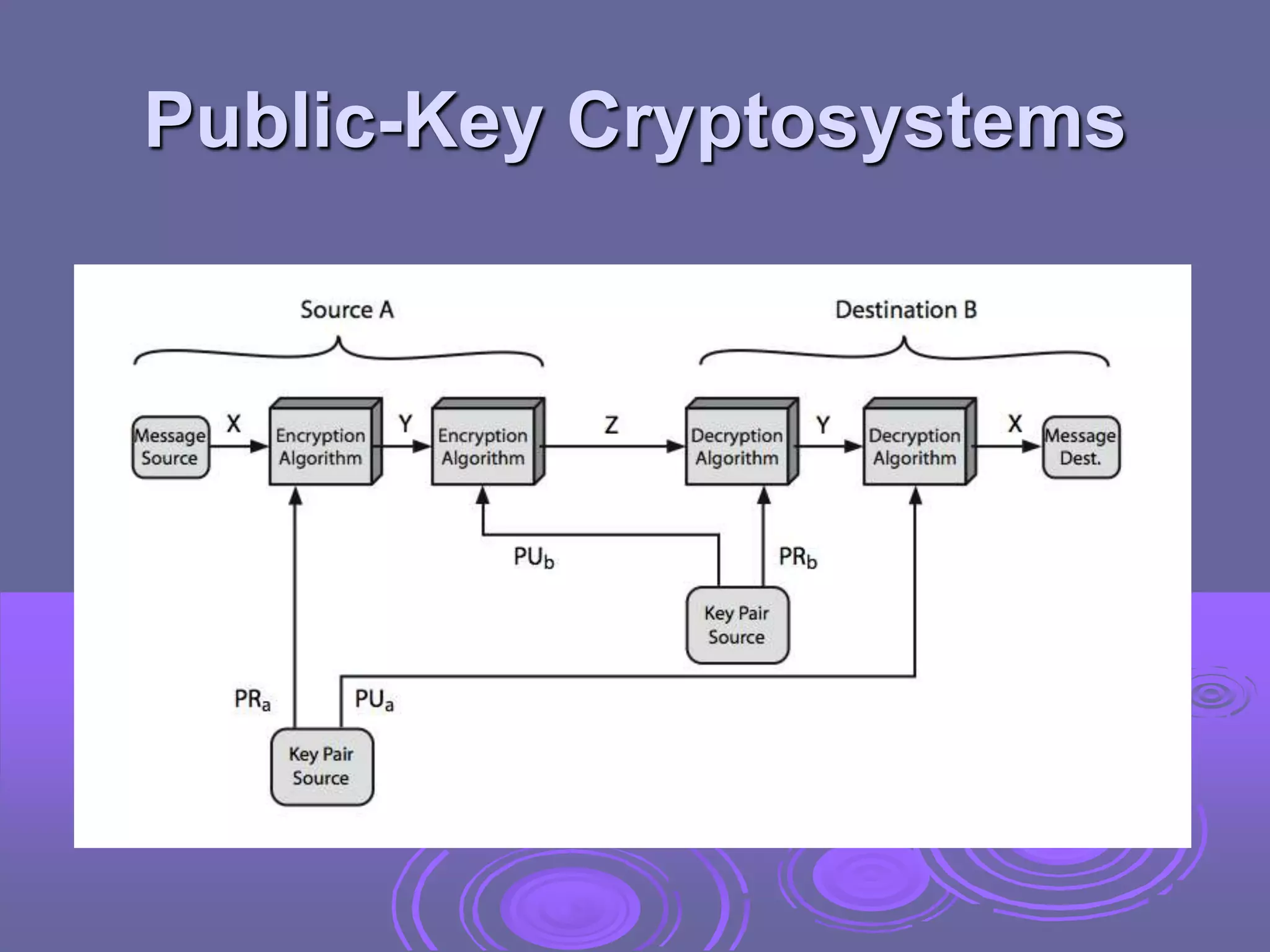
Public-Key Cryptography
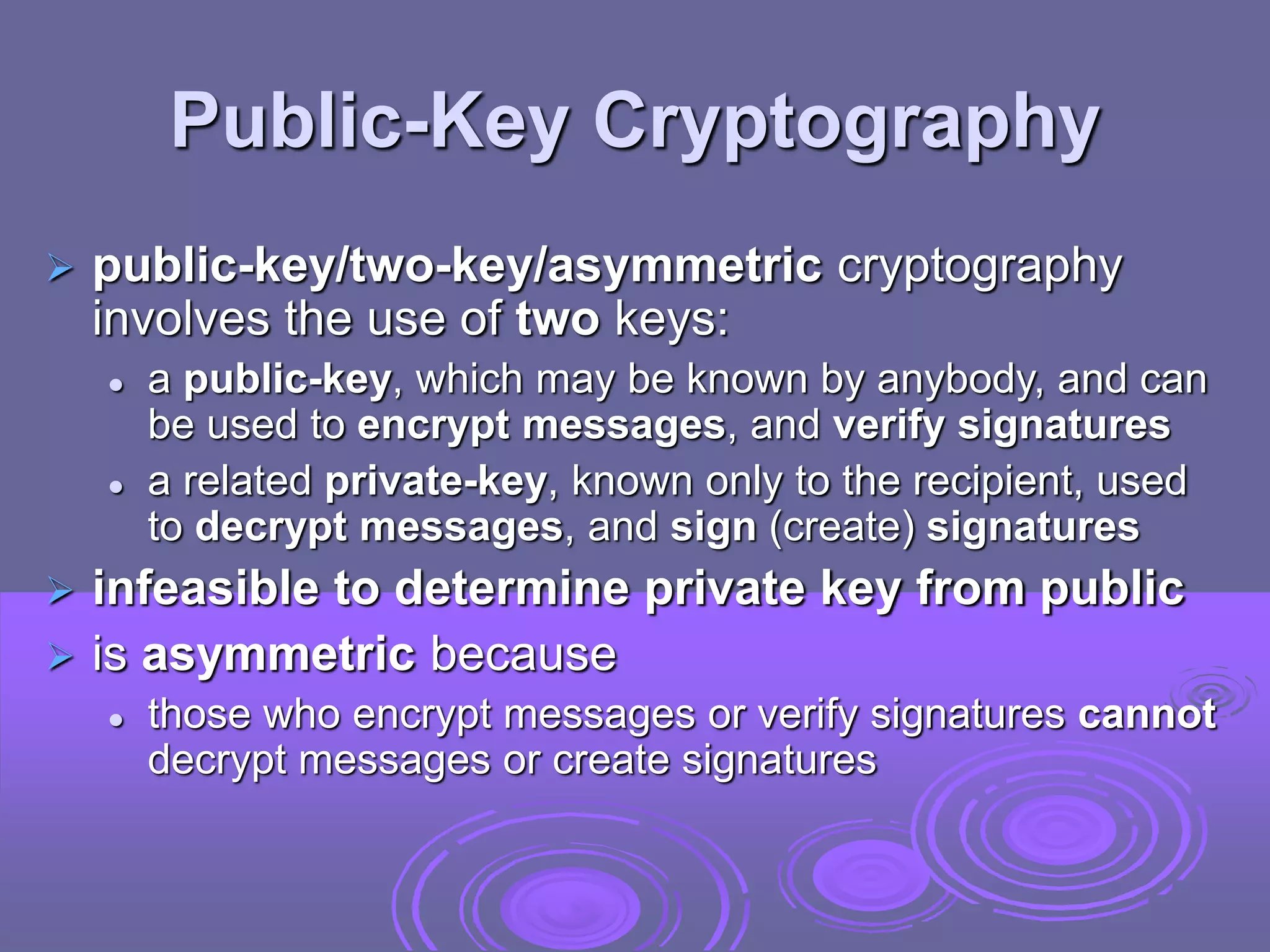
 public-key/two-key/asymmetric cryptography
involves the use of two keys:
 a public-key, which may be known by anybody, and can
be used to encrypt messages, and verify signatures
 a related private-key, known only to the recipient, used
to decrypt messages, and sign (create) signatures
 infeasible to determine private key from public
 is asymmetric because
 those who encrypt messages or verify signatures cannot
decrypt messages or create signatures
Public-Key Cryptography
Symmetric vs Public-Key
Public-Key Cryptosystems
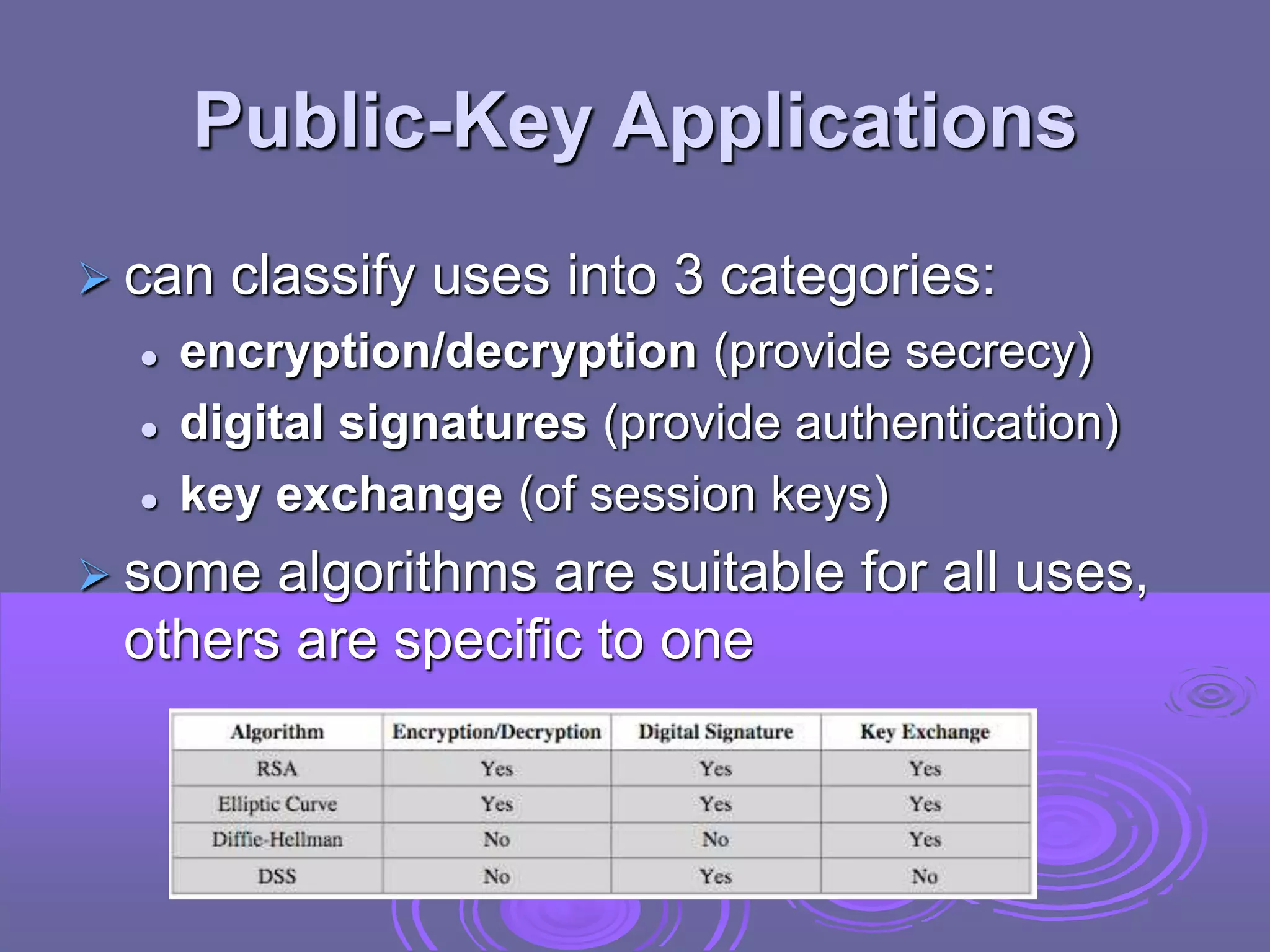
Public-Key Applications
 can classify uses into 3 categories:
 encryption/decryption (provide secrecy)
 digital signatures (provide authentication)
 key exchange (of session keys)
 some algorithms are suitable for all uses,
others are specific to one
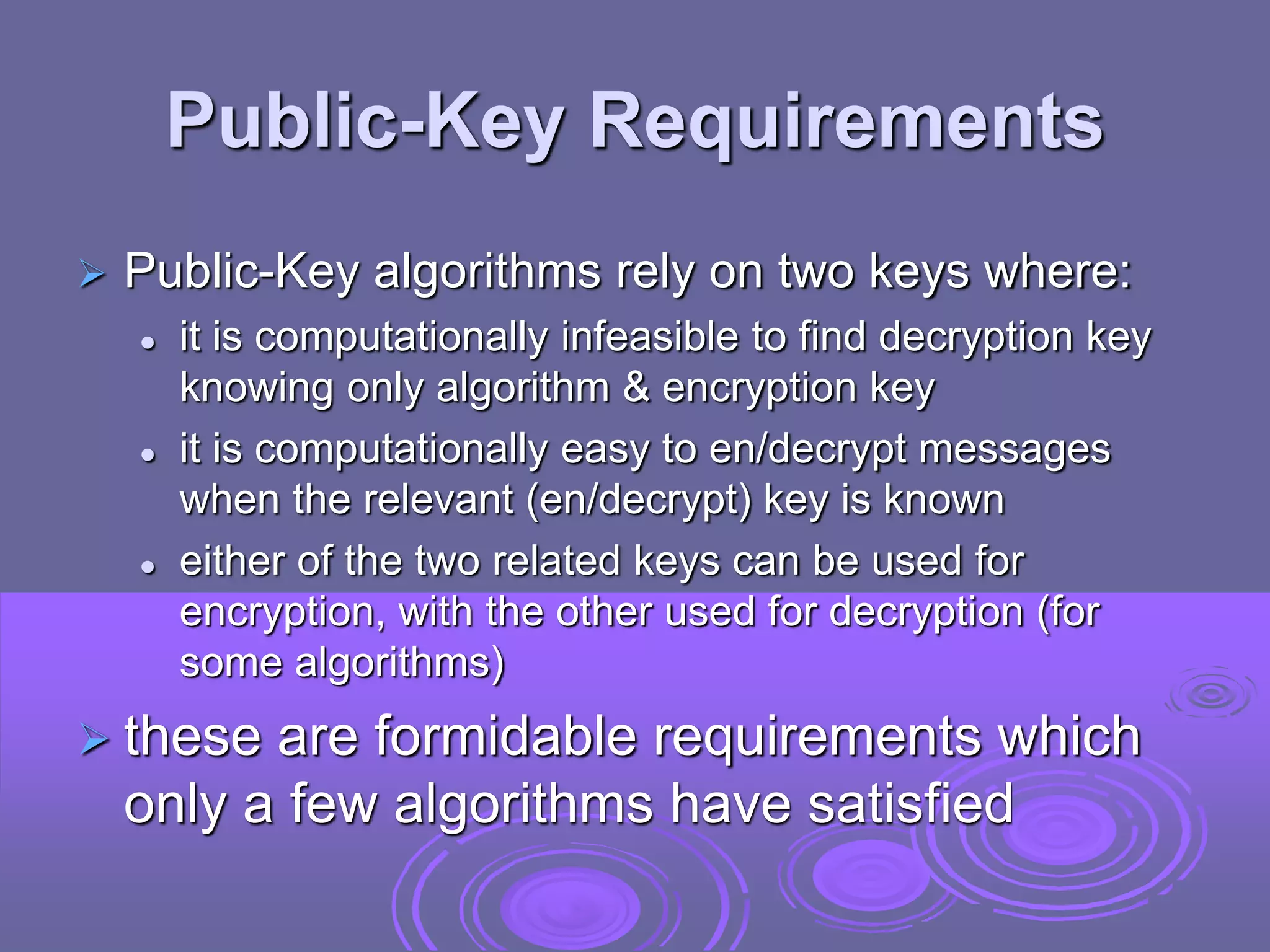
Public-Key Requirements
 Public-Key algorithms rely on two keys where:
 it is computationally infeasible to find decryption key
knowing only algorithm & encryption key
 it is computationally easy to en/decrypt messages
when the relevant (en/decrypt) key is known
 either of the two related keys can be used for
encryption, with the other used for decryption (for
some algorithms)
 these are formidable requirements which
only a few algorithms have satisfied
Public-Key Requirements
 need a trapdoor one-way function
 one-way function has
 Y = f(X) easy
 X = f–1(Y) infeasible
 a trap-door one-way function has
 Y = fk(X) easy, if k and X are known
 X = fk
–1(Y) easy, if k and Y are known
 X = fk
–1(Y) infeasible, if Y known but k not known
 a practical public-key scheme depends on
a suitable trap-door one-way function
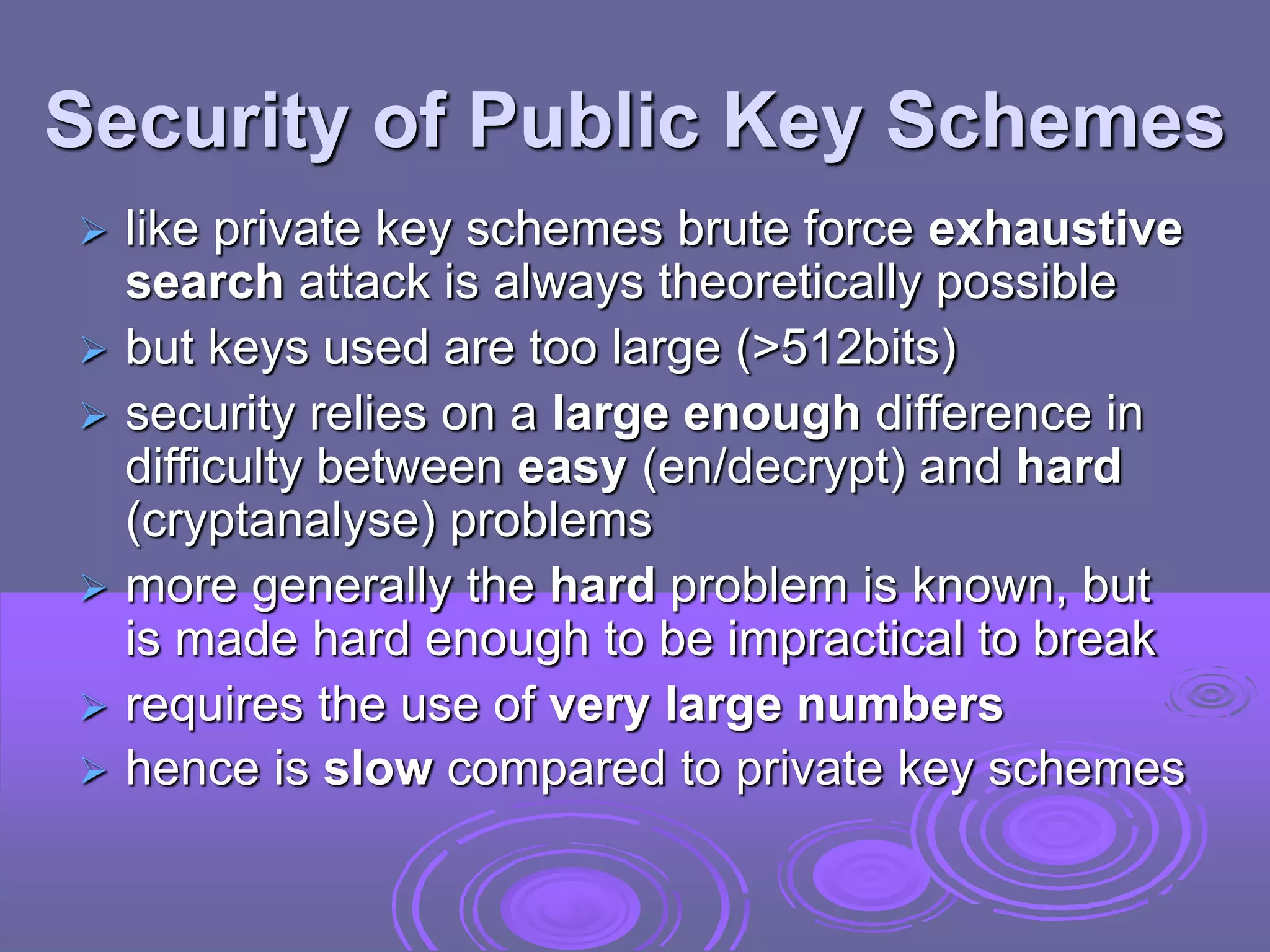
Security of Public Key Schemes
 like private key schemes brute force exhaustive
search attack is always theoretically possible
 but keys used are too large (>512bits)
 security relies on a large enough difference in
difficulty between easy (en/decrypt) and hard
(cryptanalyse) problems
 more generally the hard problem is known, but
is made hard enough to be impractical to break
 requires the use of very large numbers
 hence is slow compared to private key schemes
RSA
 by Rivest, Shamir & Adleman of MIT in 1977
 best known & widely used public-key scheme
 based on exponentiation in a finite (Galois) field
over integers modulo a prime
 nb. exponentiation takes O((log n)3) operations (easy)
 uses large integers (eg. 1024 bits)
 security due to cost of factoring large numbers
 nb. factorization takes O(e log n log log n) operations (hard)
RSA En/decryption
 to encrypt a message M the sender:
 obtains public key of recipient PU={e,n}
 computes: C = Me mod n, where 0≤M<n
 to decrypt the ciphertext C the owner:
 uses their private key PR={d,n}
 computes: M = Cd mod n
 note that the message M must be smaller
than the modulus n (block if needed)
RSA Key Setup
 each user generates a public/private key pair by:
 selecting two large primes at random: p, q
 computing their system modulus n=p.q
 note ø(n)=(p-1)(q-1)
 selecting at random the encryption key e
 where 1<e<ø(n), gcd(e,ø(n))=1
 solve following equation to find decryption key d
 e.d=1 mod ø(n) and 0≤d≤n
 publish their public encryption key: PU={e,n}
 keep secret private decryption key: PR={d,n}
Why RSA Works
 because of Euler's Theorem:
 aø(n)mod n = 1 where gcd(a,n)=1
 in RSA have:
 n=p.q
 ø(n)=(p-1)(q-1)
 carefully chose e & d to be inverses mod ø(n)
 hence e.d=1+k.ø(n) for some k
 hence :
Cd = Me.d = M1+k.ø(n) = M1.(Mø(n))k
= M1.(1)k = M1 = M mod n
RSA Example - Key Setup
1. Select primes: p=17 & q=11
2. Calculate n = pq =17 x 11=187
3. Calculate ø(n)=(p–1)(q-
1)=16x10=160
4. Select e: gcd(e,160)=1; choose e=7
5. Determine d: de=1 mod 160 and d < 160
Value is d=23 since 23x7=161= 10x160+1
6. Publish public key PU={7,187}
7. Keep secret private key PR={23,187}
RSA Example - En/Decryption
 sample RSA encryption/decryption is:
 given message M = 88 (nb. 88<187)
 encryption:
C = 887 mod 187 = 11
 decryption:
M = 1123 mod 187 = 88
Exponentiation
 can use the Square and Multiply Algorithm
 a fast, efficient algorithm for exponentiation
 concept is based on repeatedly squaring base
 and multiplying in the ones that are needed to
compute the result
 look at binary representation of exponent
 only takes O(log2 n) multiples for number n
 eg. 75 = 74.71 = 3.7 = 10 mod 11
 eg. 3129 = 3128.31 = 5.3 = 4 mod 11
Exponentiation
c = 0; f = 1
for i = k downto 0
do c = 2 x c
f = (f x f) mod n
if bi == 1 then
c = c + 1
f = (f x a) mod n
return f
Efficient Encryption
 encryption uses exponentiation to power e
 hence if e small, this will be faster
 often choose e=65537 (216-1)
 also see choices of e=3 or e=17
 but if e too small (eg e=3) can attack
 using Chinese remainder theorem & 3
messages with different modulii
 if e fixed must ensure gcd(e,ø(n))=1
 ie reject any p or q not relatively prime to e
Efficient Decryption
 decryption uses exponentiation to power d
 this is likely large, insecure if not
 can use the Chinese Remainder Theorem
(CRT) to compute mod p & q separately.
then combine to get desired answer
 approx 4 times faster than doing directly
 only owner of private key who knows
values of p & q can use this technique
RSA Key Generation
 users of RSA must:
 determine two primes at random - p, q
 select either e or d and compute the other
 primes p,q must not be easily derived
from modulus n=p.q
 means must be sufficiently large
 typically guess and use probabilistic test
 exponents e, d are inverses, so use
Inverse algorithm to compute the other
RSA Security
 possible approaches to attacking RSA are:
 brute force key search - infeasible given size
of numbers
 mathematical attacks - based on difficulty of
computing ø(n), by factoring modulus n
 timing attacks - on running of decryption
 chosen ciphertext attacks - given properties of
RSA
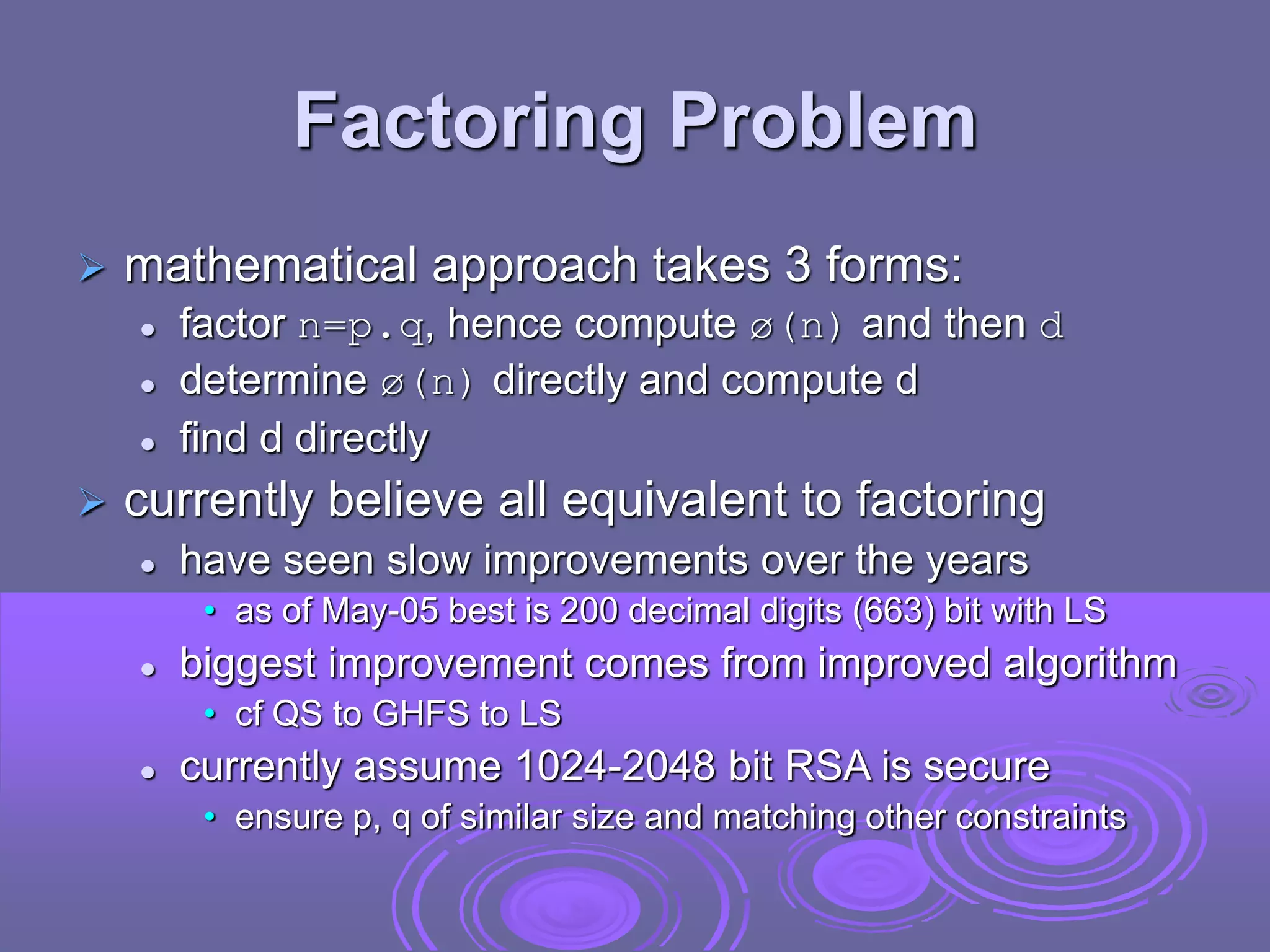
Factoring Problem
 mathematical approach takes 3 forms:
 factor n=p.q, hence compute ø(n) and then d
 determine ø(n) directly and compute d
 find d directly
 currently believe all equivalent to factoring
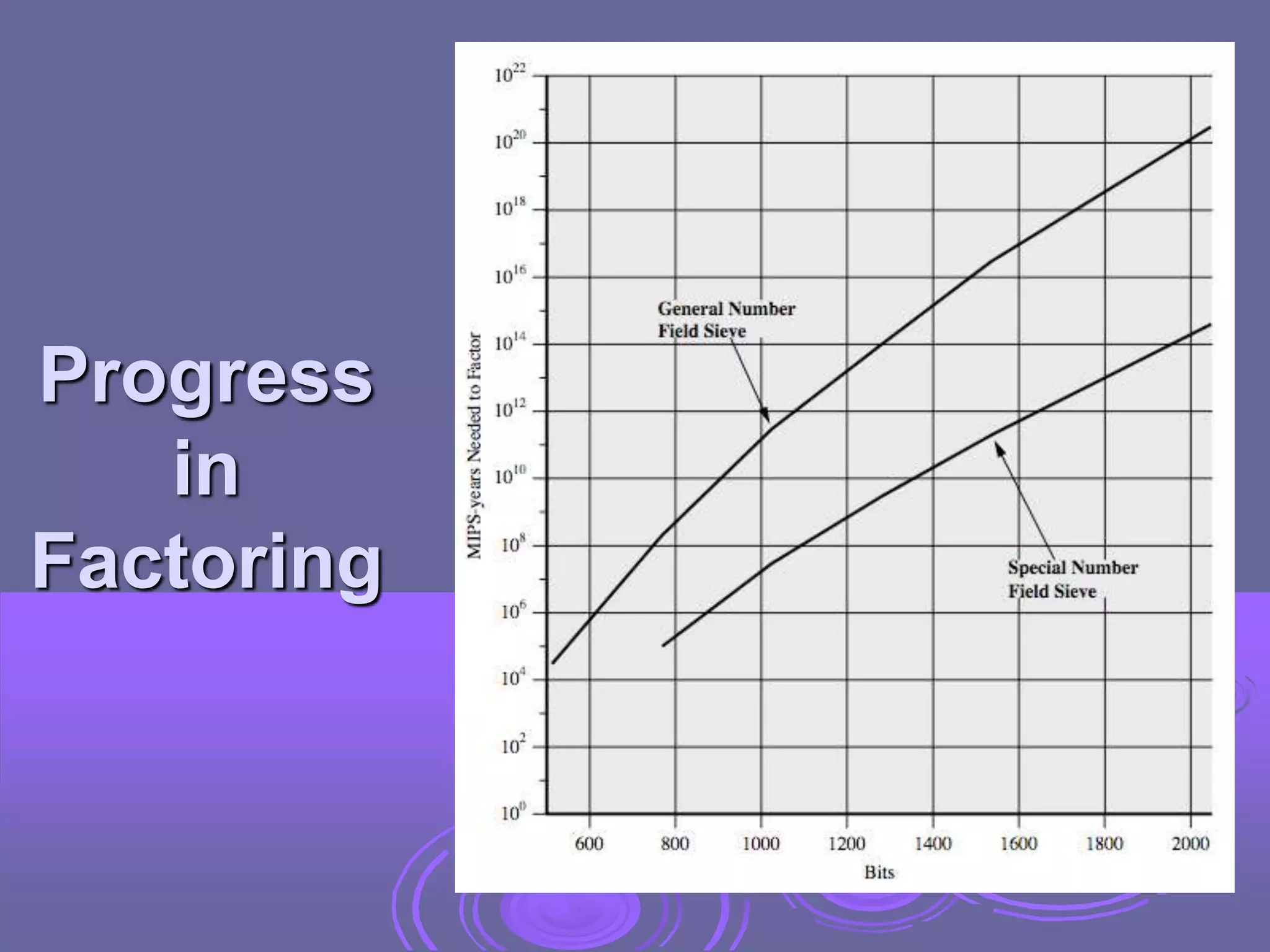
 have seen slow improvements over the years
• as of May-05 best is 200 decimal digits (663) bit with LS
 biggest improvement comes from improved algorithm
• cf QS to GHFS to LS
 currently assume 1024-2048 bit RSA is secure
• ensure p, q of similar size and matching other constraints
Progress in Factoring
Progress
in
Factoring
Timing Attacks
 developed by Paul Kocher in mid-1990’s
 exploit timing variations in operations
 eg. multiplying by small vs large number
 or IF's varying which instructions executed
 infer operand size based on time taken
 RSA exploits time taken in exponentiation
 countermeasures
 use constant exponentiation time
 add random delays
 blind values used in calculations
Chosen Ciphertext Attacks
• RSA is vulnerable to a Chosen Ciphertext
Attack (CCA)
• attackers chooses ciphertexts & gets
decrypted plaintext back
• choose ciphertext to exploit properties of
RSA to provide info to help cryptanalysis
• can counter with random pad of plaintext
• or use Optimal Asymmetric Encryption
Padding (OASP)
Optimal
Asymmetric
Encryption
Padding
(OASP)
Summary
 have considered:
 principles of public-key cryptography
 RSA algorithm, implementation, security

ch09_rsa_nemo.ppt

  • 1.
    Cryptography and Network Security Chapter9 Fifth Edition by William Stallings Lecture slides by Lawrie Brown
  • 2.
    Chapter 9 –Public Key Cryptography and RSA Every Egyptian received two names, which were known respectively as the true name and the good name, or the great name and the little name; and while the good or little name was made public, the true or great name appears to have been carefully concealed. —The Golden Bough, Sir James George Frazer
  • 3.
    Private-Key Cryptography  traditionalprivate/secret/single key cryptography uses one key  shared by both sender and receiver  if this key is disclosed communications are compromised  also is symmetric, parties are equal  hence does not protect sender from receiver forging a message & claiming is sent by sender
  • 4.
    Public-Key Cryptography  probablymost significant advance in the 3000 year history of cryptography  uses two keys – a public & a private key  asymmetric since parties are not equal  uses clever application of number theoretic concepts to function  complements rather than replaces private key crypto
  • 5.
    Why Public-Key Cryptography?  developedto address two key issues:  key distribution – how to have secure communications in general without having to trust a KDC with your key  digital signatures – how to verify a message comes intact from the claimed sender  public invention due to Whitfield Diffie & Martin Hellman at Stanford Uni in 1976  known earlier in classified community
  • 6.
    Public-Key Cryptography  public-key/two-key/asymmetriccryptography involves the use of two keys:  a public-key, which may be known by anybody, and can be used to encrypt messages, and verify signatures  a related private-key, known only to the recipient, used to decrypt messages, and sign (create) signatures  infeasible to determine private key from public  is asymmetric because  those who encrypt messages or verify signatures cannot decrypt messages or create signatures
  • 7.
  • 8.
  • 9.
  • 10.
    Public-Key Applications  canclassify uses into 3 categories:  encryption/decryption (provide secrecy)  digital signatures (provide authentication)  key exchange (of session keys)  some algorithms are suitable for all uses, others are specific to one
  • 11.
    Public-Key Requirements  Public-Keyalgorithms rely on two keys where:  it is computationally infeasible to find decryption key knowing only algorithm & encryption key  it is computationally easy to en/decrypt messages when the relevant (en/decrypt) key is known  either of the two related keys can be used for encryption, with the other used for decryption (for some algorithms)  these are formidable requirements which only a few algorithms have satisfied
  • 12.
    Public-Key Requirements  needa trapdoor one-way function  one-way function has  Y = f(X) easy  X = f–1(Y) infeasible  a trap-door one-way function has  Y = fk(X) easy, if k and X are known  X = fk –1(Y) easy, if k and Y are known  X = fk –1(Y) infeasible, if Y known but k not known  a practical public-key scheme depends on a suitable trap-door one-way function
  • 13.
    Security of PublicKey Schemes  like private key schemes brute force exhaustive search attack is always theoretically possible  but keys used are too large (>512bits)  security relies on a large enough difference in difficulty between easy (en/decrypt) and hard (cryptanalyse) problems  more generally the hard problem is known, but is made hard enough to be impractical to break  requires the use of very large numbers  hence is slow compared to private key schemes
  • 14.
    RSA  by Rivest,Shamir & Adleman of MIT in 1977  best known & widely used public-key scheme  based on exponentiation in a finite (Galois) field over integers modulo a prime  nb. exponentiation takes O((log n)3) operations (easy)  uses large integers (eg. 1024 bits)  security due to cost of factoring large numbers  nb. factorization takes O(e log n log log n) operations (hard)
  • 15.
    RSA En/decryption  toencrypt a message M the sender:  obtains public key of recipient PU={e,n}  computes: C = Me mod n, where 0≤M<n  to decrypt the ciphertext C the owner:  uses their private key PR={d,n}  computes: M = Cd mod n  note that the message M must be smaller than the modulus n (block if needed)
  • 16.
    RSA Key Setup each user generates a public/private key pair by:  selecting two large primes at random: p, q  computing their system modulus n=p.q  note ø(n)=(p-1)(q-1)  selecting at random the encryption key e  where 1<e<ø(n), gcd(e,ø(n))=1  solve following equation to find decryption key d  e.d=1 mod ø(n) and 0≤d≤n  publish their public encryption key: PU={e,n}  keep secret private decryption key: PR={d,n}
  • 17.
    Why RSA Works because of Euler's Theorem:  aø(n)mod n = 1 where gcd(a,n)=1  in RSA have:  n=p.q  ø(n)=(p-1)(q-1)  carefully chose e & d to be inverses mod ø(n)  hence e.d=1+k.ø(n) for some k  hence : Cd = Me.d = M1+k.ø(n) = M1.(Mø(n))k = M1.(1)k = M1 = M mod n
  • 18.
    RSA Example -Key Setup 1. Select primes: p=17 & q=11 2. Calculate n = pq =17 x 11=187 3. Calculate ø(n)=(p–1)(q- 1)=16x10=160 4. Select e: gcd(e,160)=1; choose e=7 5. Determine d: de=1 mod 160 and d < 160 Value is d=23 since 23x7=161= 10x160+1 6. Publish public key PU={7,187} 7. Keep secret private key PR={23,187}
  • 19.
    RSA Example -En/Decryption  sample RSA encryption/decryption is:  given message M = 88 (nb. 88<187)  encryption: C = 887 mod 187 = 11  decryption: M = 1123 mod 187 = 88
  • 20.
    Exponentiation  can usethe Square and Multiply Algorithm  a fast, efficient algorithm for exponentiation  concept is based on repeatedly squaring base  and multiplying in the ones that are needed to compute the result  look at binary representation of exponent  only takes O(log2 n) multiples for number n  eg. 75 = 74.71 = 3.7 = 10 mod 11  eg. 3129 = 3128.31 = 5.3 = 4 mod 11
  • 21.
    Exponentiation c = 0;f = 1 for i = k downto 0 do c = 2 x c f = (f x f) mod n if bi == 1 then c = c + 1 f = (f x a) mod n return f
  • 22.
    Efficient Encryption  encryptionuses exponentiation to power e  hence if e small, this will be faster  often choose e=65537 (216-1)  also see choices of e=3 or e=17  but if e too small (eg e=3) can attack  using Chinese remainder theorem & 3 messages with different modulii  if e fixed must ensure gcd(e,ø(n))=1  ie reject any p or q not relatively prime to e
  • 23.
    Efficient Decryption  decryptionuses exponentiation to power d  this is likely large, insecure if not  can use the Chinese Remainder Theorem (CRT) to compute mod p & q separately. then combine to get desired answer  approx 4 times faster than doing directly  only owner of private key who knows values of p & q can use this technique
  • 24.
    RSA Key Generation users of RSA must:  determine two primes at random - p, q  select either e or d and compute the other  primes p,q must not be easily derived from modulus n=p.q  means must be sufficiently large  typically guess and use probabilistic test  exponents e, d are inverses, so use Inverse algorithm to compute the other
  • 25.
    RSA Security  possibleapproaches to attacking RSA are:  brute force key search - infeasible given size of numbers  mathematical attacks - based on difficulty of computing ø(n), by factoring modulus n  timing attacks - on running of decryption  chosen ciphertext attacks - given properties of RSA
  • 26.
    Factoring Problem  mathematicalapproach takes 3 forms:  factor n=p.q, hence compute ø(n) and then d  determine ø(n) directly and compute d  find d directly  currently believe all equivalent to factoring  have seen slow improvements over the years • as of May-05 best is 200 decimal digits (663) bit with LS  biggest improvement comes from improved algorithm • cf QS to GHFS to LS  currently assume 1024-2048 bit RSA is secure • ensure p, q of similar size and matching other constraints
  • 27.
  • 28.
  • 29.
    Timing Attacks  developedby Paul Kocher in mid-1990’s  exploit timing variations in operations  eg. multiplying by small vs large number  or IF's varying which instructions executed  infer operand size based on time taken  RSA exploits time taken in exponentiation  countermeasures  use constant exponentiation time  add random delays  blind values used in calculations
  • 30.
    Chosen Ciphertext Attacks •RSA is vulnerable to a Chosen Ciphertext Attack (CCA) • attackers chooses ciphertexts & gets decrypted plaintext back • choose ciphertext to exploit properties of RSA to provide info to help cryptanalysis • can counter with random pad of plaintext • or use Optimal Asymmetric Encryption Padding (OASP)
  • 31.
  • 32.
    Summary  have considered: principles of public-key cryptography  RSA algorithm, implementation, security