Mobile Internet Enabling Technologies and
Services 1st Edition Apostolis K. Salkintzis pdf
download
https://ebookname.com/product/mobile-internet-enabling-
technologies-and-services-1st-edition-apostolis-k-salkintzis/
Get Instant Ebook Downloads – Browse at https://ebookname.com
Instant digital products (PDF, ePub, MOBI) available
Download now and explore formats that suit you...
Internet Technologies and Information Services 2nd
Edition Joseph B. Miller
https://ebookname.com/product/internet-technologies-and-
information-services-2nd-edition-joseph-b-miller/
Developing Technologies in E Services Self Services and
Mobile Communication New Concepts 1st Edition Ada
Scupola
https://ebookname.com/product/developing-technologies-in-e-
services-self-services-and-mobile-communication-new-concepts-1st-
edition-ada-scupola/
Mobile Messaging Technologies and Services SMS EMS and
MMS 2nd Edition Gwenaël Le Bodic
https://ebookname.com/product/mobile-messaging-technologies-and-
services-sms-ems-and-mms-2nd-edition-gwenael-le-bodic/
The Fiction of Robin Jenkins Some Kind of Grace 1st
Edition Linden Bicket
https://ebookname.com/product/the-fiction-of-robin-jenkins-some-
kind-of-grace-1st-edition-linden-bicket/
Single Molecule Enzymology Nanomechanical Manipulation
and Hybrid Methods 1st Edition Edition Maria Spies And
Yann R. Chemla (Eds.)
https://ebookname.com/product/single-molecule-enzymology-
nanomechanical-manipulation-and-hybrid-methods-1st-edition-
edition-maria-spies-and-yann-r-chemla-eds/
The Biennial Reader 2010 Carlos Basualdo
https://ebookname.com/product/the-biennial-reader-2010-carlos-
basualdo/
The Mexican Seafood Cookbook Marissa Marie
https://ebookname.com/product/the-mexican-seafood-cookbook-
marissa-marie/
Industrial Network Security Securing Critical
Infrastructure Networks for Smart Grid SCADA and Other
Industrial Control Systems 1st Edition Eric D. Knapp
https://ebookname.com/product/industrial-network-security-
securing-critical-infrastructure-networks-for-smart-grid-scada-
and-other-industrial-control-systems-1st-edition-eric-d-knapp/
Key Account Management Second Edition The Definitive
Guide Malcolm Mcdonald
https://ebookname.com/product/key-account-management-second-
edition-the-definitive-guide-malcolm-mcdonald/
Lua Programming Gems Luiz Henrique De Figueiredo
https://ebookname.com/product/lua-programming-gems-luiz-henrique-
de-figueiredo/
THE ELECTRICAL ENGINEERING
AND APPLIED SIGNAL PROCESSING SERIES
Edited by Alexander Poularikas
The Advanced Signal Processing Handbook:
Theory and Implementation for Radar, Sonar,
and Medical Imaging Real-Time Systems
Stergios Stergiopoulos
The Transform and Data Compression Handbook
K.R. Rao and P.C. Yip
Handbook of Multisensor Data Fusion
David Hall and James Llinas
Handbook of Neural Network Signal Processing
Yu Hen Hu and Jenq-Neng Hwang
Handbook of Antennas in Wireless Communications
Lal Chand Godara
Noise Reduction in Speech Applications
Gillian M. Davis
Signal Processing Noise
Vyacheslav P. Tuzlukov
Digital Signal Processing with Examples in MATLAB®
Samuel Stearns
Applications in Time-Frequency Signal Processing
Antonia Papandreou-Suppappola
The Digital Color Imaging Handbook
Gaurav Sharma
Pattern Recognition in Speech and Language Processing
Wu Chou and Biing-Hwang Juang
Propagation Handbook for Wireless Communication System Design
Robert K. Crane
Nonlinear Signal and Image Processing: Theory, Methods, and Applications
Kenneth E. Barner and Gonzalo R. Arce
Mobile Internet: Enabling Technologies and Services
Apostolis K. Salkintzis
Forthcoming Titles
Smart Antennas
Lal Chand Godara
Soft Computing with MATLAB®
Ali Zilouchian
© 2004 by CRC Press LLC
Forthcoming Titles (continued)
Signal and Image Processing in Navigational Systems
Vyacheslav P. Tuzlukov
Wireless Internet: Technologies and Applications
Apostolis K. Salkintzis and Alexander Poularikas
© 2004 by CRC Press LLC
CRC PR ESS
Boca Raton London New York Washington, D.C.
Mobile
internet
Enabling Technologies and Services
Edited by
Apostolis K. Salkintzis
© 2004 by CRC Press LLC
This book contains information obtained from authentic and highly regarded sources. Reprinted material is quoted with
permission, and sources are indicated. A wide variety of references are listed. Reasonable efforts have been made to publish
reliable data and information, but the authors and the publisher cannot assume responsibility for the validity of all materials
or for the consequences of their use.
Neither this book nor any part may be reproduced or transmitted in any form or by any means, electronic or mechanical,
including photocopying, microfilming, and recording, or by any information storage or retrieval system, without prior
permission in writing from the publisher.
All rights reserved. Authorization to photocopy items for internal or personal use, or the personal or internal use of specific
clients, may be granted by CRC Press LLC, provided that $1.50 per page photocopied is paid directly to Copyright Clearance
Center, 222 Rosewood Drive, Danvers, MA 01923 USA. The fee code for users of the Transactional Reporting Service is
ISBN 0-8493-1631-6/04/$0.00+$1.50. The fee is subject to change without notice. For organizations that have been granted
a photocopy license by the CCC, a separate system of payment has been arranged.
The consent of CRC Press LLC does not extend to copying for general distribution, for promotion, for creating new works,
or for resale. Specific permission must be obtained in writing from CRC Press LLC for such copying.
Direct all inquiries to CRC Press LLC, 2000 N.W. Corporate Blvd., Boca Raton, Florida 33431.
Trademark Notice: Product or corporate names may be trademarks or registered trademarks, and are used only for
identification and explanation, without intent to infringe.
Visit the CRC Press Web site at www.crcpress.com
© 2004 by CRC Press LLC
No claim to original U.S. Government works
International Standard Book Number 0-8493-1631-6
Library of Congress Card Number 2003069582
Printed in the United States of America 1 2 3 4 5 6 7 8 9 0
Printed on acid-free paper
Library of Congress Cataloging-in-Publication Data
Mobile Internet: enabling technologies and services / edited by Apostolis K. Salkintzis.
p. cm. -- (Electrical engineering and applied signal processing series)
Includes bibliographical references and index.
ISBN 0-8493-1631-6 (alk. paper)
1. Wireless Internet. I. Salkintzis, Apostolis K. II. Title. III. Series.
TK5103.4885.M63 2004
004.67'8--dc22
2003069582
© 2004 by CRC Press LLC
Dedication
To my mother and father
© 2004 by CRC Press LLC
Preface
The migration of the most common Internet services to a mobile environment has long been an evolving
demand of both business and consumer markets. The ability to be connected to the Internet while on
the go and to benefit from using such applications as e-mail, instant messaging, audio and video
streaming, Web browsing, and e-commerce creates an exciting new lifestyle and sets the foundation for
increased work efficiency and productivity. In addition, however, it introduces numerous technical
challenges inherently associated with the user’s mobility and wireless connectivity. This book addresses
these technical challenges and provides a thorough examination of the most recent and up-to-date
technologies designed to deal with them and enable the so-called mobile Internet. It is written by some
of the most eminent academic and industry professionals in the areas of mobile and multimedia net-
working.
In more detail, this book first discusses the evolution toward the mobile Internet and the associated
technological trends and visions. In this context, it illustrates the key features of this evolution, including
the migration to all-IP networks, the enabling of advanced multimedia services, the provision of end-
to-end quality of service (QoS), and the integration of heterogeneous access networks. In addition, we
discuss the key players in the evolution toward the mobile Internet (e.g.,the Third-Generation Partnership
Project [3GPP], 3GPP2, the Internet Engineering Task Force [IETF], and the Institute of Electrical &
Electronics Engineers [IEEE]) and summarize their corresponding activities. This allows the reader to
obtain a coherent understanding of how the technology is being evolved to meet the requirement of the
mobile Internet and who is involved in this evolution.
Subsequently, the most common mobile and wireless network technologies that can provide the means
for mobile Internet connectivity are examined. In this context, Internet access over technologies such as
wireless local area networks (WLANs), General Packet Radio Service (GPRS), and satellites is discussed
in a comprehensive way in order for the reader to understand their respective characteristics, advantages,
and disadvantages. To explain how well each technology can support Internet applications, we review
their QoS and routing features. In addition, we present performance results and demonstrate how WLAN
and cellular networks can be integrated in order to provide heterogeneous mobile data networks that are
capable of ubiquitous data services with very high data rates in strategic locations, such as airports, hotels,
shopping centers, and university campuses. Such heterogeneous networks are generally considered to be
a key characteristic of fourth-generation (4G) mobile data networks.
A large part of this book concentrates on mobility-management techniques, which are necessary in a
mobile IP environment where the user’s point of network attachment can constantly change. Both
macromobility (e.g., Mobile IP) and micromobility (e.g., Cellular IP) management protocols are exten-
sively discussed. In addition, we examine the security concerns associated with mobility management
and look at several methods that can provide secure mobility management. We further elaborate on the
issue of security and tackle such topics as security in WLANs and third-generation (3G) cellular networks.
In this context, we explain the most common security attacks, including the man-in-the-middle attack,
denial of service, and identity theft.
© 2004 by CRC Press LLC
Because many modern Internet applications, such as context broadcasting and videoconferencing, are
based on multicasting, this book also reviews the key technical challenges of multicasting in mobile
environments and the most promising technologies that can support it. In addition, QoS provisioning,
considered a key aspect of the mobile Internet, is examined at length. The classical IP QoS techniques
(both Differentiated Services [DiffServ] and Integrated Services [IntServ]) are reviewed, and we propose
extensions for addressing their deficiencies in mobile IP networks.
Moreover, for enabling the efficient provision of Internet multimedia services in wireless networks,
where the use of radio resources needs to be highly optimized, this book examines the characteristics of
several header compression schemes designed specifically for wireless environments. Finally, it discusses
the challenges of video streaming in wireless IP networks as well as techniques tailored to operate in such
networks and significantly improve their performance.
In short, this original book provides a thorough study of all the key technologies that can enable the
provision of ubiquitous mobile Internet services, focusing on mobility, QoS, security, and multicasting.
Apart from reviewing the technical challenges and the prime technologies developed to deal with them,
this book proposes some novel techniques and examines performance results.
Apostolis K. Salkintzis, Ph.D.
© 2004 by CRC Press LLC
Editor
Apostolis K. Salkintzis, Ph.D., received his diploma in 1991 (honors) and his Ph.D. degree in 1997, both
from the Department of Electrical and Computer Engineering, Democritus University of Thrace, Xanthi,
Greece. From 1992 to 1997, he was a research engineer at Democritus University, studying mobile data
networks and working on research projects dealing with the design and implementation of wireless data
networks and protocols. In 1999 he was a sessional lecturer at the Department of Electrical and Computer
Engineering, University of British Columbia, Vancouver, Canada, and from October 1998 to December
1999 he was also post-doctoral fellow in the same department. During 1999, Dr. Salkintzis was a visiting
fellow at the Advanced Systems Institute of British Columbia, Vancouver; during 2000, he was with the
Institute of Space Applications and Remote Sensing (ISARS) of the National Observatory of Athens,
Greece, where he conducted research on digital satellite communication systems. Since September 1999,
he has been with Motorola Inc., working on the design, evolution, and standardization of mobile
telecommunication networks, focusing in particular on General Packet Radio Service (GPRS), Universal
Mobile Telecommunications System (UMTS), Terrestrial Trunked Radio (TETRA), and wireless local
area networks (WLANs).
Dr. Salkintzis has served as lead guest editor for a number of special articles, such as “Mobile Data
Networks: Advanced Technologies and Services,” in Mobile Networks and Applications Journal; “The
Evolution of Mobile Data Networking,” in IEEE Personal Communications; “Satellite-Based Internet
Technology and Services,” in IEEE Communications; “Multimedia Communications over Satellites,” in
IEEE Personal Communications; “IP Multimedia in Next Generation Mobile Networks: Services Protocols
and Technologies,” in IEEE Wireless Communications; and “The Evolution of Wireless LANs and PANs,”
in IEEE Wireless Communications, among others. He has served as a TPC member and referee for
numerous international conferences, including Globecom03, ICC200, ICC2003, VTC03-Fall, VTC03-
Spring, VTC00, VTC99, Globecom01, ICC01, and INFOCOM03. He has organized many technical
sessions and symposia in various conferences and has chaired most of them.
Dr. Salkintzis has published more than 40 papers in peer-reviewed journals and international confer-
ences and has also published 3 book chapters.
His primary research activities lie in the areas of wireless communications and mobile networking.
He is particularly interested in mobility management, IP multimedia over mobile networks, mobile
network architectures and protocols, quality of service (QoS) for wireless networks, and radio modem
design with digital signal processors (DSPs). Recently, he has been active in WLAN/3G interworking and
with the evolution and standardization of GPRS and UMTS networks. Until 2002, he was an active
participant and contributor in the Third-Generation Partnership Project (3GPP) standards development
organization and was an editor of several 3GPP specifications.
Dr. Salkintzis is a member of the Institute of Electrical and Electronics Engineers (IEEE) as well as a
member of the Technical Chamber of Greece.
© 2004 by CRC Press LLC
Contributors
A.H. Aghvami
King’s College London
London, England
Farooq Anjum
Telcordia Technologies, Inc.
Morristown, New Jersey
Jari Arkko
Ericsson Research Nomadiclab
Jorvas, Finland
Subir Das
Telcordia Technologies, Inc.
New Providence, New Jersey
Lila V. Dimopoulou
National Technical University
of Athens
Athens, Greece
Frank H.P. Fitzek
Acticom GmbH
Berlin, Germany
Stefan Hendrata
Acticom GmbH
Berlin, Germany
Antonio Iera
University Mediterranea
of Reggio Calabria
Italy
Christophe Janneteau
Motorola, Inc.
Gif-sur-Yvette, France
Hong-Yon Lach
Motorola, Inc.
Gif-sur-Yvette, France
Antonella Molinaro
University of Reggio Calabria
Italy
Bongkyo Moon
King’s College London
London, England
Pekka Nikander
Ericsson Research Nomadiclab
Jorvas, Finland
Yoshihiro Ohba
Toshiba America Research, Inc.
Convent Station, New Jersey
Nikos Passas
University of Athens
Athens, Greece
Alexandru Petrescu
Motorola, Inc.
Gif-sur-Yvette, France
Martin Reisslein
Arizona State University
Tempe, Arizona
Imed Romdhani
Motorola, Inc.
Gif-sur-Yvette, France
Apostolis K. Salkintzis
Motorola, Inc.
Athens, Greece
Patrick Seeling
Arizona State University
Tempe, Arizona
Iakovos S. Venieris
National Technical University
of Athens
Athens, Greece
© 2004 by CRC Press LLC
Contents
1 The Evolution toward the Mobile Internet
Apostolis K. Salkintzis
2 Internet Access over Wireless LANs
Nikos Passas
3 Internet Access over GPRS
Apostolis K. Salkintzis
4 Internet Access over Satellites
Antonio Iera and Antonella Molinaro
5 Mobility Management in Mobile IP Networks
Lila V. Dimopoulou and Iakovos S. Venieris
6 Quality of Service in Mobile IP Networks
Bongkyo Moon and A.H. Aghvami
7 Multicast in Mobile IP Networks
Hong-Yon Lach, Christophe Janneteau, Imed Romdhani, and Alexandru Petrescu
8 Secure Mobility in Wireless IP Networks
Pekka Nikander and Jari Arkko
9 Security Issues in Wireless IP Networks
Subir Das, Farooq Anjum, Yoshihiro Ohba, and Apostolis K. Salkintzis
10 Header Compression Schemes for Wireless Internet Access
Frank H.P. Fitzek, Stefan Hendrata, Patrick Seeling, and Martin Reisslein
11 Video Streaming in Wireless Internet
Frank H.P. Fitzek, Patrick Seeling, and Martin Reisslein
12 Integration of WLANs and Cellular Data Networks for Next-Generation
Mobile Internet Access
Apostolis K. Salkintzis
© 2004 by CRC Press LLC
1
The Evolution toward
the Mobile Internet
1.1 Introduction
1.2 Key Aspects of the Evolution toward the Mobile
Internet
Evolution to IP-Based Core Networks • IP-Based Core
Networks in the Enterprise
1.3 Key Players in the Evolution toward the Mobile
Internet
Third-Generation Partnership Project (3GPP) • Third-
Generation Partnership Project 2 (3GPP2) • Institute of
Electrical and Electronics Engineers (IEEE) • European
Telecommunications Standards Institute (ETSI) • Internet
Engineering Task Force (IETF)
1.4 Concluding Remarks
1.1 Introduction
Simply stated, the mobile Internet can be thought of as the migration of standard Internet applications
and services to a mobile environment. The introduction of mobility, however, raises a number of new
considerations: What wireless technology is most appropriate for the provision of Internet services? Is
this technology equally appropriate for applications with dissimilar requirements, such as e-mail and
video broadcasting? How do we provide ubiquitous Internet services while users move across different
locations, where the same wireless service may not be available? Will it be more appropriate to consider
several wireless technologies, such as cellular data networks, wireless local area networks (WLANs),
wireless personal area networks (WPANs), and so forth? If so, then how do we combine them into a
seamless wireless service? How do we optimize the utilization of wireless resources to accommodate as
many mobile Internet users as possible? How do we handle the security issues raised by the wireless
transmission and possibly by the use of different wireless services provided by different operators?
These are just a few of the questions we must address in our attempt to make the mobile Internet a
reality. One important clarification is in order here: The fact that today we can use our laptop or personal
digital assistant (PDA) along with a wireless device (e.g., a cellular phone or WLAN adapter) to establish
access to our Internet/intranet e-mail or other Internet Protocol (IP) services does not really mean that
the mobile Internet is already available. In reality, what is defined as the mobile Internet is far more
complex than that. By definition, the Internet is a network of millions of users who communicate by
means of standard Internet protocols. Therefore, in the mobile Internet we also need to support millions
of always-connected mobile/wireless users. The key phrases we need to bear in mind are “always con-
nected”and“millions of users.”To be“always connected”means that we do not have to make a connection
before every transaction or after we change wireless service. Our assumption is that we always have
connectivity to public Internet services and that we are always reachable through a public IP address, no
Apostolis K. Salkintzis
Motorola, Inc.
© 2004 by CRC Press LLC
matter where we are. This calls for extensive mobility management and seamless handover across different
wireless networks. And we do need several wireless networks (and several wireless technologies, as we
will see later on) because no sole wireless network can provide ubiquitous wireless services, and therefore
no sole wireless network can meet the always-connected requirement. A typical mobile Internet user is
assumed to move seamlessly between different wireless networks (or even between fixed and wireless
networks), which may or may not employ the same radio-access technology. This is schematically
illustrated in Figure 1.1. The seamless fashion of movement suggests that our (virtual) connection to the
public Internet is transferred from one access network to the other without any actions from the user’s
side. In effect, this creates a virtual wireless network from the user’s perspective that provides ever-present
Internet connectivity.
We need also to support millions of users wirelessly connected to the Internet in order to be compliant
with the large scale of users supported by the Internet. This creates capacity concerns and better explains
why no single wireless network is sufficient. The capacity concerns have direct implications in several design
aspects.For instance,the wireless technology needs to be as spectrum efficient as possible; it has to implement
a random access scheme that can accommodate a large number of users and degrade gracefully in overload
conditions; the IP addressing scheme should be able to support the required user capacity; and the end-to-
end transport schemes and applications should probably take mobility into account.
It is interesting to note that most research projects nowadays, as well as standardization activities, are
moving around such goals. In this context, the correlation between the mobile Internet and the so-called
beyond third-generation (3G) technologies is evident. In reality, most of the beyond-3G technologies are
tailored to support the requirements for mobile Internet: increased capacity, quality of service (QoS),
mobility, security, TCP/IP enhanced performance, and integration of diverse technologies into one
ubiquitous virtual network.
Despite the fact that in this book we focus entirely on wireless networks as a potential means of access
for the mobile Internet, it is important to note that fixed-access networks and their associated technologies
(e.g., xDSL [x Digital Subscriber Line] and cable modems) do play a significant role. In fact, the vision
of the mobile Internet entails both wireless and fixed-access technologies,as well as methods for seamlessly
integrating them into an IP-based core network (see Figure 1.2). A typical usage scenario that shows the
fundamental interworking requirements between fixed- and wireless-access networks is when a user
downloads a file over the Internet by using, for instance, a cable modem, and in the middle of the file
transfer takes his or her laptop to his or her car and drives to the airport (refer to Figure 1.1). In a mobile-
Internet environment, the file download would be seamlessly switched from the cable connection to, say,
a cellular data connection and would be carried on while the user is on the go.
FIGURE 1.1 The concept of always being connected.
WLAN, xDSL, cable
WPAN,
Cellular
WLAN,
Cellular
WLAN,
cellular,
air-to-ground
WLAN,
Satellite,
xDSL
WLAN,
xDSL
© 2004 by CRC Press LLC
In our mobile-Internet environment, as defined above, it is evident that enhanced mobility is a key
requirement, and Chapter 5 discusses it in detail. Without a doubt, the technologies that can provide
wireless access to the Internet are also of paramount importance.We will look at several of them,including
WLANs in Chapter 2, the General Packet Radio Service (GPRS) in Chapter 3, and satellite access in
Chapter 4. The issues of IP QoS and multicast in mobile environments are addressed in Chapters 6 and
7, respectively. The remaining chapters deal with several other equally important issues, such as content
streaming, security, and integration between WLANs and 3G networks.
1.2 Key Aspects of the Evolution toward the Mobile Internet
Bearing in mind the above discussion, we list below the key aspects of the evolution toward the mobile
Internet. In the next section, we look more closely at how these aspects are handled by several organi-
zations worldwide, such as the Third-Generation Partnership Project (3GPP), the Third-Generation
Partnership Project 2 (3GPP2), the Internet Engineering Task Force (IETF), and the Institute of Electrical
and Electronics Engineers (IEEE), among others.
• Mobile networks will evolve to an architecture encompassing an IP-based core network and many
wireless-access networks. The key feature in this architecture is that signaling with the core network
is based on IP protocols (more correctly, on protocols developed by IETF), and it is independent
of the access network (be it Universal Mobile Telecommunications System [UMTS], Code Division
Multiple Access [CDMA], CDMA2000, WLAN, or whatever). Therefore, the same IP-based ser-
vices could be accessed over any networked system. An IP-based core network uses IP-based
protocols for all purposes, including data transport, networking, application-level signaling, and
mobility. The first commercial approach toward this IP-based core network is the IP Multimedia
Core Network Subsystem (IMS) standardized by 3GPP and 3GPP2. We further discuss the concept
of IP-based network in Section 1.2.1. In addition, the IMS is discussed in Section 1.3.1.2.1.
FIGURE 1.2 The architecture of the mobile Internet is tightly coupled with the beyond-3G network architecture.
ubiquitous service provisioning and end-to-end QoS
UMTS
PS domain
(3GPP)
CDMA Packet
Data Service
(3GPP2)
Wireless IP
Access network
(IETF)
Legacy Networks
(PSTN, PDN, ISDN)
GPRS, EDGE,
W-CDMA, HSDPA
IS-95b, cdma2000 1x
1xEV-DO, 1xEV-DV
IEEE 802.11a/b/g/e
ETSI HIPERLAN/2
Broadband Wireless Internet Services
(HTTP servers,
SIP servers, streaming
servers, etc.)
Mobile IP
Terminals
Wireline
Broadband
e.g. ADSL
(T1.413)
Varity of access networks
with different wireless
/fixed technologies
Millions of users,
always connected,
anywhere/anytime
Core network based on IP signaling and
transport protocols with mobility support,
© 2004 by CRC Press LLC
• The long-term trend is toward all-IP mobile networks, where not only the core network but also
the radio-access network is solely based on IP technology. In this approach, the base stations in
a cellular system are IP access routers and mobility/session management is carried out with IP-
based protocols (possibly replacing the cellular-specific mobility/session management protocols).
• Enhanced IP multimedia applications will be enabled by means of application-level signaling
protocols standardized by IETF (e.g., Session Initiation Protocol [SIP] and Hypertext Transfer
Protocol [HTTP]). This again is addressed by the 3GPP/3GPP2 IMS.
• End-to-end QoS provisioning will be important for supporting the demanding multimedia appli-
cations. In this context, extended interworking between, say, UMTS QoS and IP QoS schemes is
needed, or more generally, interworking between Layer 2 QoS schemes and IP QoS is required
for end-to-end QoS provisioning.
• Voiceover IP (VoIP) will be a key technology. As discussed in the next section, several standards
organizations are specifying technology that will enable VoIP (e.g., the European Telecommuni-
cations Standards Institute [ETSI] Broadband Radio Access Networks [BRAN] and Telecommu-
nications Internet Protocol Harmonization over Networks [TIPHON] projects and the IETF SIP
working group).
• The mobile terminals will be based on software-configurable radios with capabilities for sup-
porting many radio-access technologies across several frequency bands.
• The ability to move across hybrid access technologies will be an important requirement that calls
for efficient and fast vertical handovers and seamless session mobility. As explained later, the
IETF Seamoby and Mobile IP working groups are addressing some of the issues related to seamless
mobility. Fast Mobile IP and micromobility schemes are chief technologies in this area.
• In the highly hybrid access environment of the mobile Internet, security will also play a critical
role. IEEE 802.11 task group I (TGi) is standardizing new mechanisms for enhanced security in
WLANs. IETF Seamoby also addresses the protocols that deal with security context transfer during
handovers.
• For extended roaming between different administrative domains or different access technologies,
advanced Authentication,Authorization,and Accounting (AAA) protocols and AAA interwork-
ing mechanisms will be required. AAA interworking between WLANs and 3GPP networks is
currently being studied by 3GPP and 3GPP2, and it is also discussed in Chapter 12.
• Enhanced networking application programming interfaces (APIs) for QoS-, multicast-, and
location-aware applications will be needed.
• WPANs will start spreading, initially based on Bluetooth technology (see www.bluetooth.com)
and later on IEEE 802.15.3 high-speed WPAN technology, which satisfies the requirement of the
digital consumer electronic market (e.g., wireless video communications between a personal
computer [PC] and a video camera).
• Millions of users are envisioned to be always connected to the IP core infrastructure. Market
forecasts suggest that about 1 billion addresses are needed by 2005 for integration of Internet-
based systems into means of transportation (cars, aircraft, trains, ships, and freight transport) and
associated infrastructures for mobile e-commerce. This indicates that there is a strong need for
IP version 6 (IPv6 is being adapted in 3GPP). The European Union in particular is pushing for
the fast adoption of IPv6.
• Wireless communication technology will evolve further and will support higher bit rates. For
instance, WLANs will soon support bit rates of more than 100 Mbps. This issue is being addressed
by the IEEE Wireless Next Generation Standing Committee (see www.ieee802.org/11 and Section
1.3.3.1). Higher bit rates are typically accompanied by smaller coverage areas; therefore, efficient,
fast, and secure horizontal handovers will be required.
These evolutionary aspects lead to a high-level network architecture like the one shown in Figure 1.3.
Note that each administrative domain represents a network part that is typically operated by a single
mobile network operator.
© 2004 by CRC Press LLC
1.2.1 Evolution to IP-Based Core Networks
Without a doubt, the most widely supported evolution is toward IP-based core networks, also referred
to as all-IP core networks. The term “all-IP” emphasizes the fact that IP-based protocols are used for all
purposes, including transport, application-level signaling, mobility, security, and QoS. Typically, several
wireless and fixed-access networks are connected to an all-IP core network, as illustrated in Figure 1.2
and Figure 1.3. Users will be able to use multimedia applications over terminals with software-config-
urable radios capable of supporting a vast range of radio-access technologies, such as WLANs, WPANs,
UMTS, and CDMA2000. In this environment, seamless mobility across the various access technologies
is considered a key issue by many vendors and operators.
In the all-IP network architecture, the mobile terminals use the IP-based protocols defined by IETF
to communicate with the core network and perform, for example, session/call control and traffic routing.
All services in this architecture are provided on top of the IP protocol. As shown in the protocol
architecture of Figure 1.4, the mobile networks, such as UMTS and CDMA2000, turn into access networks
that provide only mobile-bearer services. The teleservices in these networks (e.g., cellular voice) are used
to support only the legacy second-generation (2G) and 3G terminals, which do not support IP-based
applications (e.g., IP telephony). For the provision of mobile bearer services, the access networks mainly
implement micromobility management, radio resource management, and traffic management for pro-
visioning of QoS. Micromobility management in 3GPP access networks is based on the GPRS Tunneling
Protocol (GTP) and uses a hierarchical tunneling scheme for data forwarding. On the other hand,
micromobility management in 3GPP2 access networks is typically based on IP micromobility protocols.
Macromobility (inter-domain mobility) is typically based on Mobile IP, as per Request for Comment
(RFC) 3220. All these mobility schemes are discussed in more detail in Chapter 5.
In the short term, the all-IP core network architecture would be based on the IMS architecture specified
by 3GPP/3GPP2 (see Section 1.3.1.2.1), which in turn is based on the IP multimedia architecture and
protocols specified by IETF. This IMS architecture would provide a new communications paradigm based
on integrated voice, video, and data. You could call a user’s IMS number, for instance, and be redirected
to his or her home page, where you could have several options, such as writing a message, recording a
voice message, or clicking on an alternative number to call if he or she is on vacation. You could place
an SIP call to a server and update your communication preferences — for example, “Only my manager
can call me, all others are redirected to my home page” (or vice versa!). At the same time, you could be
on a conference call.
FIGURE 1.3 A high-level architecture of the mobile Internet.
signaling
Administrative
Domain
Internet
IPv4→ IPv6
Administrative Domain
Fixed
Access
IPv6-based
Core network
2.5G Access
(GPRS/IS-95b)
Wireless
IP access
(Wireless LANs
&PANs)
4G
Access
Seamless Mobility
Management
Enhanced IP
Multimedia
Applications
Integrated
AAA/Security
3G Access
(UMTS/cdma1x)
IP-based
© 2004 by CRC Press LLC
1.2.2 IP-Based Core Networks in the Enterprise
Figure 1.5 shows how an enterprise could take advantage of an all-IP core network to minimize its
communication costs and increase communications efficiency. The typical IP network of the enterprise
could be evolved to an IP multimedia network, which would support the following:
• IP signaling with the end terminals for establishing and controlling multimedia sessions
• Provisioning of QoS
• Policy-based admission control
• Authentication, authorization, and possibly accounting
The all-IP network provides an integrated infrastructure for efficiently supporting a vast range of
applications with diverse QoS requirements, and, in addition, provides robust security mechanisms. The
architecture of this all-IP network could be based on the IMS architecture specified by 3GPP/3GPP2 (see
specification 3GPP TS 23.228 at www.3gpp.org/ftp/specs/2003-09/Rel-5/23_series/23228-5a0.zip for a
detailed description).
In the example shown in Figure 1.5, an employee in the European office requests a voice call to another
employee, for example, in the U.S. office. This request is then routed to the default Proxy Call State
Control Function (P-CSCF) that serves the European office. This P-CSCF relays the request to the Serving
CSCF (S-CSCF) of the calling employee — that is, to the CSCF with which this employee has previously
registered.This S-CSCF holds the subscription information of the calling employee and can verify whether
that individual is allowed to place the requested call. In turn, the S-CSCF finds another S-CSCF, with
which the called subscriber has registered, and relays the request to this S-CSCF. Note that if the calling
employee in the European office were calling a normal Public Switched Telephone Network (PSTN)
FIGURE 1.4 A simplified protocol architecture in an all-IP network architecture: (a) user plane and (b) control plane.
(a)
(b)
UTRAN
User
plane
IP
GPRS
Control
plane
802.11 HIPERLAN
UDP
TCP
HTTP FTP RTCP RTP
RTSP
Cdma2000
User
plane
UTRAN
Control
plane
IP
TCP/UDP
SIP
Cdma2000
Control
plane
Access Network Signaling
e.g., 24.008, IS-136
Radio Access Signaling
e.g., RRC, RLC
GSM-MAP
IS-41
UTRAN,
GERAN,
cdma2000
All-IP
Core
Network
Core Network Signaling
e.g., SIP
GPRS
User
plane
RSVP
Access
network
Access
network
© 2004 by CRC Press LLC
number in the U.S., the call would be routed through the IP network to a break-out gateway that is
closest to the called PSTN number. This way, the long-distance charges are saved.
The S-CSCF of the called U.S. employee holds information on the employee’s whereabouts and can
route the call to the correct location. In case that employee happens to be roaming in Europe, the call
would be routed to the appropriate P-CSCF, which currently serves this employee. It is important to note
that, although signaling can travel a long path in such a case (say, from Europe to the U.S. and then back
to Europe), the user-plane path would be the shortest possible.
The support of roaming is another important advantage of the above architecture. For instance, a
European employee could take his dual-mode mobile phone to the U.S. office. After powering on his
mobile and registering his current IP address (with his S-CSCF), he would be able to receive calls at his
standard number.
Even when the employee is away from his office and cannot directly attach to the enterprise network
(e.g., he is driving on the highway), it is still possible to reach him on his standard number. In such a
case, the employee uses, for example, the UMTS network to establish a mobile signaling channel to his
all-IP enterprise network, which assigns him an IPv6 address. The employee registers this IP address with
an S-CSCF (via the appropriate P-CSCF), and thereafter he can receive calls at his standard number. The
signaling mobile channel remains active for as long as the employee uses UMTS to access the enterprise
network. In such a scenario, the UMTS network is used only to provide access to the enterprise network
and to support the mobile bearers required for IP multimedia services. To establish IP multimedia calls,
the employee would need to request the appropriate UMTS bearers, each one with the appropriate QoS
properties. For instance, to receive an audio-video call, two additional UMTS bearers would be required,
one for each media component. The mapping between the application-level QoS and the UMTS QoS,
as well as the procedures required to establish the appropriate UMTS bearers, are identified in 3GPP Rel-
5 specifications, in particular 3GPP TS 24.008 and 3GPP TS 24.229 (available at www.3gpp.org/ftp/specs/
2003-09/Rel-5).
If the enterprise network supports a macromobility protocol, such as Mobile IP, providing session
mobility across the enterprise WLAN and the UMTS network becomes possible. In this case, when the
employee moves from the WLAN to the UMTS, he uses Mobile IP to register his new IPv6 address with
FIGURE 1.5 Deployment of all-IP networks in the enterprise.
Mobile IP
UMTS
PS Bearer Service
Enterprise IP
multimedia network
P-CSCF
S-CSCF
Office in Europe
VoIP
terminal
Office in U.S.
PSTN/ISDN/GSM
Break-out
gateway
S-CSCF
MGW
MGW
HSS
WLAN
Policy
Server
Dual mode
wireless IP
terminal
FA
HA
© 2004 by CRC Press LLC
his home agent. After that, any subsequent terminating traffic is tunneled from the employee’s home
agent to the foreign agent that serves the employee over the UMTS network.
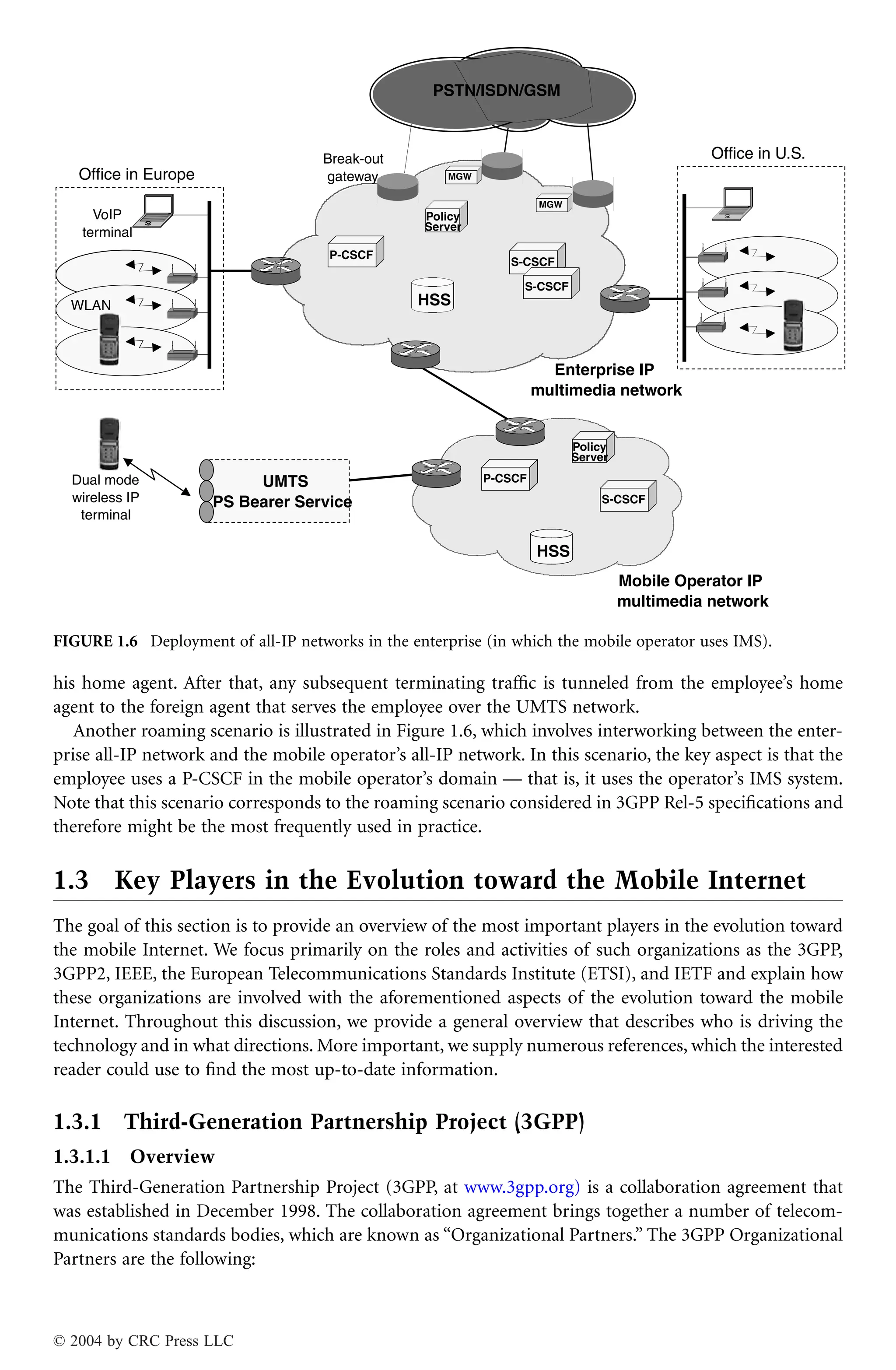
Another roaming scenario is illustrated in Figure 1.6, which involves interworking between the enter-
prise all-IP network and the mobile operator’s all-IP network. In this scenario, the key aspect is that the
employee uses a P-CSCF in the mobile operator’s domain — that is, it uses the operator’s IMS system.
Note that this scenario corresponds to the roaming scenario considered in 3GPP Rel-5 specifications and
therefore might be the most frequently used in practice.
1.3 Key Players in the Evolution toward the Mobile Internet
The goal of this section is to provide an overview of the most important players in the evolution toward
the mobile Internet. We focus primarily on the roles and activities of such organizations as the 3GPP,
3GPP2, IEEE, the European Telecommunications Standards Institute (ETSI), and IETF and explain how
these organizations are involved with the aforementioned aspects of the evolution toward the mobile
Internet. Throughout this discussion, we provide a general overview that describes who is driving the
technology and in what directions. More important, we supply numerous references, which the interested
reader could use to find the most up-to-date information.
1.3.1 Third-Generation Partnership Project (3GPP)
1.3.1.1 Overview
The Third-Generation Partnership Project (3GPP, at www.3gpp.org) is a collaboration agreement that
was established in December 1998. The collaboration agreement brings together a number of telecom-
munications standards bodies, which are known as “Organizational Partners.” The 3GPP Organizational
Partners are the following:
FIGURE 1.6 Deployment of all-IP networks in the enterprise (in which the mobile operator uses IMS).
terminal
UMTS
PS Bearer Service
Enterprise IP
multimedia network
P-CSCF
S-CSCF
Office in Europe
VoIP
terminal
Office in U.S.
PSTN/ISDN/GSM
Break-out
gateway
S-CSCF
MGW
MGW
HSS
WLAN
Policy
Server
Mobile Operator IP
multimedia network
P-CSCF
S-CSCF
Policy
Server
HSS
Dual mode
wireless IP
© 2004 by CRC Press LLC
• ARIB, the Association of Radio Industries and Businesses (Japan — www.arib.or.jp)
• CWTS, the China Wireless Telecommunication Standards Group (China — www.cwts.org/cwts/
index_eng.html)
• TTA, the Telecommunications Technology Association (Korea — www.tta.or.kr)
• TTC, the Telecommunications Technology Committee (Japan — www.ttc.or.jp)
• T1 (North America)
• ETSI, the European Telecommunication Standards Institute (Europe — www.etsi.org)
The original scope of 3GPP was to produce globally applicable technical specifications for a 3G mobile
network, called the UMTS, based on an evolved Global System for Mobile (GSM) core network and the
Universal Terrestrial Radio Access (UTRA) network. The scope was subsequently amended to include
the maintenance and development of the GSM network, including its related radio-access technologies,
such as General Packet Radio Service (GPRS) and Enhanced Data for GSM Evolution (EDGE).
1.3.1.2 Key Standardization Activities in 3GPP
This section briefly discusses some key standardization activities undertaken by 3GPP regarding the
mobile Internet. You can find more up-to-date information at www.3gpp.org.
1.3.1.2.1 IP Multimedia Services
The purpose of this activity is to specify an IP-based core network, formally called IP Multimedia Core
Network Subsystem (IMS),that provides a standard IP-based interface to wireless IP terminals for accessing
a vast range of services independently from the access technology used by the terminals (see Figure 1.7).
This interface uses the Session Initiation Protocol (SIP) specified by IETF for multimedia session control
(see RFC 3261). In addition, SIP is used as an interface between the IMS session control entities and the
service platforms. The goal of IMS is to enable the mobile operators to offer to their subscribers multi-
media services based on, and built on, Internet applications, services, and protocols. Note that the IMS
architecture is identical between 3GPP and 3GPP2, and it is based on IETF specifications. Thus, IMS
forms a single core-network architecture that is globally available and that can be accessed through a
FIGURE 1.7 The all-IP core network provides a consistent signaling for accessing IP-based services.
accessing services
UMTS
PS Bearer Service
GPRS, EDGE,
W-CDMA, HSDPA
Wireless IP
Terminals with
IMS subscription
All-IP
Core network
(IMS)
Services always on top of IP
e.g., Presence, Instant Messaging, etc.
Standardized signaling (SIP) for
accessing services
Wireless Terminals
without
IMS subscription
Operator-specific
Packet switched
Services
Enterprise
Networks
Internet
Services could be on top of IP
No standardized signaling for
© 2004 by CRC Press LLC
variety of technologies, such as mobile data networks, wireless LANs, and fixed broadband (e.g., xDSL).
No matter what technology is used to access IMS, the user always uses the same signaling protocols and
accesses the same services.
In a way, the goal of IMS is to allow mobile operators to offer popular Internet-alike services, such as
instant messaging and Internet telephony. IMS offers versatility that lets us quickly develop new appli-
cations. In addition, IMS is global (identical across 3GPP and 3GPP2), and it is the first convergence
between the mobile world and the IETF world.
A general description of IMS architecture can be found in 3GPP Technical Standard (TS) 23.228, and the
definition of IMS functional elements can be found in 3GPP TS 23.002. All 3GPP specs are available at
www.3gpp.org/ftp/specs/.
1.3.1.2.2 IMS Messaging
This standardization work deals with the support of messaging in the IMS as part of the Release 6
timeframe. By combining the support of messaging with other IMS service capabilities, such as Presence
(see Section 1.3.1.2.3), we can create new rich and enhanced messaging services for end users.
The goal of 3GPP is to extend messaging to the IP Multimedia Core Network Subsystem, which is
about to be deployed whilst also interoperating with the existing SMS, EMS, and MMS wireless
messaging solutions as well as SIP-based Internet messaging services. The SIP-based messaging
service should support interoperability with the existing 3GPP messaging services SMS, EMS and
MMS as well as enable development of new messaging services, such as Instant Messaging, Chat, etc.
It should be possible in a standardized way to create message groups (chat rooms) and address
messages to the group of recipients as a whole, as well as individual recipients. Additional standard-
ized mechanisms are expected to be needed to create, and delete message groups, enable and
authorize members to join and leave the group and also to issue mass invitations to members of
the group.
SIP based messaging should also integrate well with the Presence service also being developed by
3GPP.
Support of messaging in IMS will provide various messaging services, such as instant messaging, chat,
and store and forward messaging, with rich multimedia components.
1.3.1.2.3 Presence
This work addresses the concept of presence (see Figure 1.8), whereby users make themselves “visible”
or “invisible” to other parties of their choice, allowing services such as group and private chats to take
place. Presence is an attribute related to mobility information and provides a different capability that
can be exploited by other services. The concept of the Presence service enables other multimedia services;
Presence serves mainly as an enabling technology that supports other multimedia services and commu-
nications. Among the multimedia services that could potentially exploit the Presence capability are chats,
e-mail, multimedia messaging, and instant messaging.
The architectural and functional specification of Presence is included in 3GPP TR 23.841
(www.3gpp.org/ftp/specs/2003-09/Rel-6/23_series/23841-600.zip).
1.3.1.2.4 Packet-Switched Streaming Service
The aim of this activity is to provide the ability to stream sound and movies to mobile devices. Streaming
is a mechanism whereby media content can be reproduced in the client while it is being transferred over
the data network. Therefore, streaming services enable instant access to media content in contrast to
other multimedia services (such as Mobile Multimedia Service [MMS]), where the media content is
presented to the user after being downloaded within a “message.”
Streaming services enable the delivery of information on-demand. For instance, users are able to request
music, videos, and news on-demand. In addition, users can request live media content, such as the
delivery of radio and television programs. Such services are already supported in the Internet, but they
need special handling to be available in mobile terminals.
© 2004 by CRC Press LLC
In addition to providing the streaming mechanism, packet-switched streaming encompasses the com-
position of media objects, thereby allowing compelling multimedia services to be provided. For instance,
a mobile cinema ticketing application would allow the user to view the film trailers.
Relevant specifications include 3GPP TS 22.233,“Transparent End-to-End Packet-Switched Streaming
Service: Stage 1” and 3GPP TS 26.233, “Transparent End-to-End Packet-Switched Streaming Service:
General Description.”
1.3.1.2.5 Interworking with Wireless LANs
The purpose of this activity is to identify and analyze interworking architectures between 3GPP cellular
systems and WLANs, such as the IEEE 802.11 family, HiperLAN/2, and MMAC HISWAN. The moti-
vation behind this work is to make it possible for mobile operators to provide WLAN subscriptions
to new subscribers (without Universal Subscriber Identity Module [USIM] cards in their WLAN
terminals), and to enable the existing mobile subscribers to use their USIM cards for accessing WLAN
services. This way, the mobile operators aim at getting into the WLAN business and exploit the WLAN
market, which is projected to grow exponentially. Recent market analysis forecasts 20 million users of
public WLAN in Europe by 2006 and 21 million Americans by 2007; this is compared with 600,000
WLANs users in 2002.
More details on interworking between WLAN and 3G networks are provided in Chapter 12, which is
entirely devoted to this subject. The interested reader could also refer to the relevant 3GPP specifications,
mainly 3GPP TS 23.234.
1.3.1.2.6 Multimedia Broadcast and Multicast Services
Multimedia Broadcast and Multicast Services (MBMS) deals with situations in which multiple users need
to receive the same data at the same time. The benefit of MBMS in the network is that the data is sent
once on each link. For example, the core network sends a single multicast packet to the radio-access
network regardless of the number of users who wish to receive it. The benefit of MBMS on the air
FIGURE 1.8 The concept of Presence. (Taken from 3GPP publicly available documents.)
around!
User Status
Available
Not available
Discreet
Invisible
Location
City
Country
Mark’s Presentity
Paggy
Access
Rules
Mark
Paul
Jude
…see you in the
bar at 7:30
…I think the car
alarm is playing up…
…shame, Mark can’t
tell me where Paul is
Hello, weather is
great here!
Watcher group
…looks like
Mark is not
© 2004 by CRC Press LLC
interface is that many users can receive the same data on a common channel; this strategy avoids
congesting the air interface with multiple transmissions of the same data.
MBMS is considered a key enabler of mobile-Internet applications and a congestion-relief mechanism
if certain types of multimedia services become popular and start to flood the mobile-access networks.
Typical examples of such services could be video clips with sports highlights. MBMS contains two
elements: broadcast and multicast. The broadcast element is the traditional type of broadcast in which
the network “broadcasts” the information in a given geographical area, irrespective of the presence of
users in that area. On the other hand, for the multicast element the network has knowledge about the
users who subscribe to the service and their geographical location. With this information, the network
can then choose to transmit the information only on those cells where there actually are mobiles expecting
to receive it.
The functional requirements of MBMS are included in 3GPP TS 22.146 and the respective architectural
description is included in report 3GPP TS 23.846.
1.3.2 Third-Generation Partnership Project 2 (3GPP2)
1.3.2.1 Overview
The Third-Generation Partnership Project 2 (www.3gpp2.org) is a collaborative standards-setting project,
which does the following:
• Specifies the evolution of ANSI/TIA/EIA-41 “Cellular Radio-Telecommunication Intersystem
Operations” network toward a 3G telecommunications system
• Develops global specifications for the radio transmission technologies supported by ANSI/TIA/
EIA-41
3GPP2 was born out of the International Telecommunication Union’s International Mobile Telecom-
munications IMT-2000 initiative (www.itu.int/imt/). 3GPP2 is a collaborative effort between the follow-
ing five organizations:
• ARIB, the Association of Radio Industries and Businesses (Japan — www.arib.or.jp)
• CWTS, the China Wireless Telecommunication Standards Group (China — www.cwts.org/cwts/
index_eng.html)
• TIA, the Telecommunications Industry Association (North America — www.tiaonline.org)
• TTA, the Telecommunications Technology Association (Korea — www.tta.or.kr)
• TTC, the Telecommunications Technology Committee (Japan — www.ttc.or.jp)
3GPP2 specifications (www.3gpp2.org/Public_html/Specs/index.cfm) are developed by five Technical
Specification Groups (TSGs) consisting of representatives from the project’s individual member compa-
nies. The 3GPP2 TSGs and their respective areas of work are the following:
• TSG-A (Access Network Interfaces; www.3gpp2.org/Public_html/A/index.cfm)
• Physical links, transports, and signaling
• Support for access network mobility
• 3G capability (e.g., high-speed data support)
• The Abis interface
• Interoperability specification
• Support for 3GPP2 radio-access technologies
• TSG-C (CDMA2000; www.3gpp2.org/Public_html/C/index.cfm)
• Radio Layer 1 specifications
• Radio Layer 2 specifications
• Radio Layer 3 specifications
• Mobile station/base station radio-performance specifications
© 2004 by CRC Press LLC
• Radio-link protocol
• Support for enhanced privacy, authentication, and encryption
• Digital speech codecs and related minimum performance specifications
• Video codec selection and specification of related video services
• Data and other ancillary services support
• Conformance test plans
• Removable User Identity Module (R-UIM)
• Location-based services support
• TSG-N (Intersystem Operations; www.3gpp2.org/Public_html/N/index.cfm)
• Evolution of core network to support interoperability and intersystem operations
• User Identity Module (UIM) support (detachable and integrated)
• Support for enhanced privacy, authentication, encryption, and other security aspects
• VHE (Virtual Home Environment)
• Support for new supplemental services (including Integrated Services Digital Network [ISDN]
interworking)
• Optimal interoperability specification for international roaming (e.g., selection of required
parameters options)
• New features for internal roaming (global emergency number, optimal routing)
• IMT-2000 issues, as necessary, to ensure support of the ANSI-41 family member
• TSG-P (Wireless Packet Data Networking; www.3gpp2.org/Public_html/P/index.cfm)
• Wireless IP services (including IP mobility management)
• Voiceover IP
• AAA and security
• Private network access
• Internet/intranet access
• Multimedia support
• QoS support
• TSG-S (Services and Systems Aspects; www.3gpp2.org/Public_html/S/index.cfm)
• Development and maintenance of 3GPP2 System Capabilities Guide
• Development, management, and maintenance of 3GPP2 Work Plan
• Stage 1 services and features requirements definition
• High-level functionality description development for system services and capabilities
• Management and technical coordination as well as architectural and requirements development
associated with all end-to-end features, services, and system capabilities including, but not
limited to, security and QoS
• Requirements for international roaming
• Development of 3GPP2 Operations, Administration, Maintenance & Provisioning (OAM&P)
across all TSGs including (1) Stage 1 high-level requirements and (2) Stage 2 and Stage 3 for
the interface between network management system and element management functions
• High-level coordination of the work performed in other TSGs and monitoring of progress
• Coordination to resolve technical discrepancies between the works undertaken by other TSGs
Each TSG meets about 10 times a year to produce technical specifications and reports. Because 3GPP2
has no legal status, ownership and copyright of these output documents is shared between the Organi-
zational Partners. The documents cover all areas of the project’s charter, including CDMA2000 and its
enhancements.
1.3.2.2 Standardization Activities in 3GPP2
1.3.2.2.1 CDMA2000 Air Interface
CDMA2000 is the radio-transmission technology standardized by 3GPP2 (TSG-C) to meet the IMT-
2000 requirements for 3G mobile systems. CDMA2000 comes in two versions: CDMA2000 1x and
© 2004 by CRC Press LLC
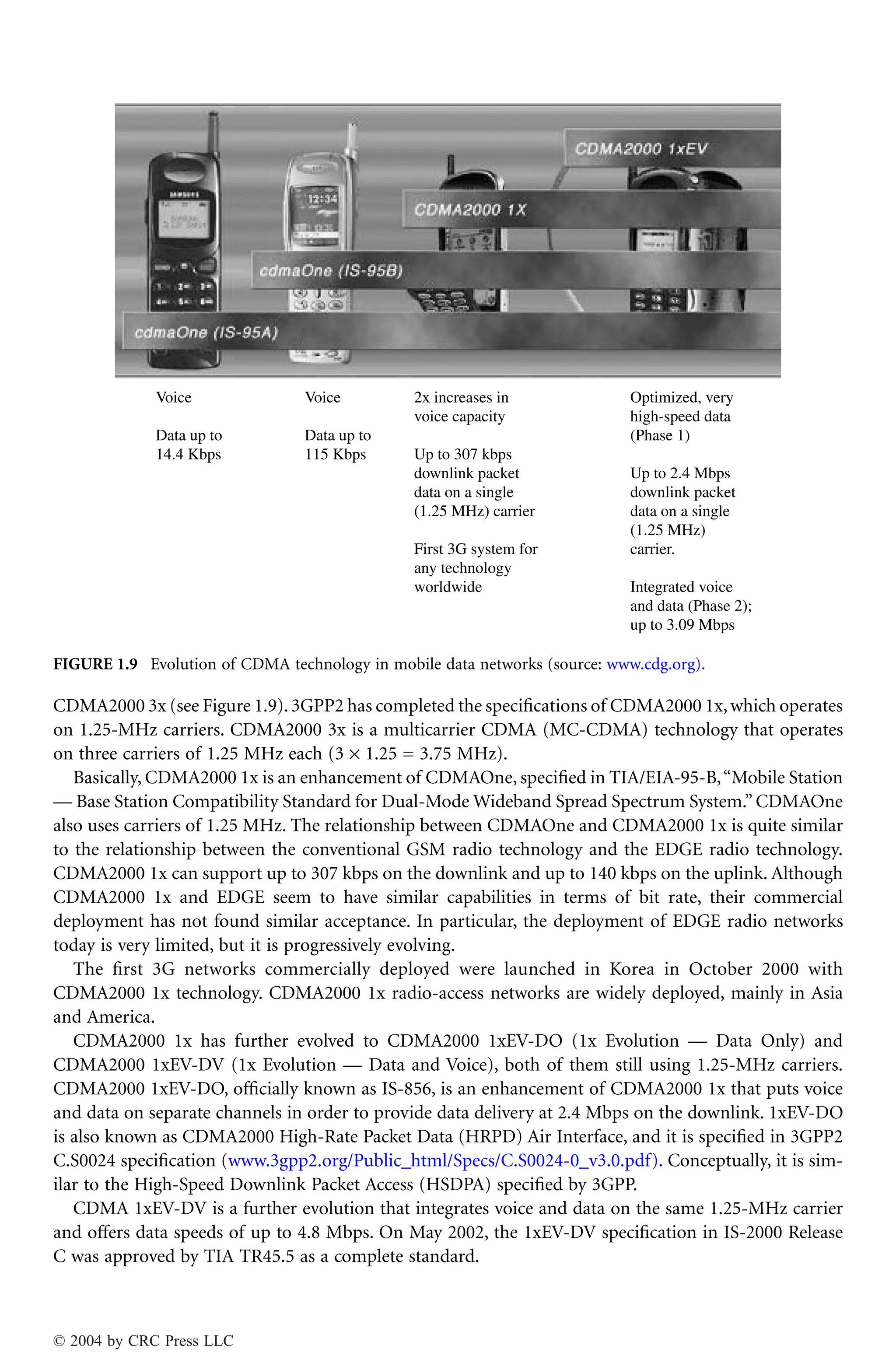
CDMA2000 3x (see Figure 1.9).3GPP2 has completed the specifications of CDMA2000 1x,which operates
on 1.25-MHz carriers. CDMA2000 3x is a multicarrier CDMA (MC-CDMA) technology that operates
on three carriers of 1.25 MHz each (3 × 1.25 = 3.75 MHz).
Basically, CDMA2000 1x is an enhancement of CDMAOne, specified in TIA/EIA-95-B,“Mobile Station
— Base Station Compatibility Standard for Dual-Mode Wideband Spread Spectrum System.” CDMAOne
also uses carriers of 1.25 MHz. The relationship between CDMAOne and CDMA2000 1x is quite similar
to the relationship between the conventional GSM radio technology and the EDGE radio technology.
CDMA2000 1x can support up to 307 kbps on the downlink and up to 140 kbps on the uplink. Although
CDMA2000 1x and EDGE seem to have similar capabilities in terms of bit rate, their commercial
deployment has not found similar acceptance. In particular, the deployment of EDGE radio networks
today is very limited, but it is progressively evolving.
The first 3G networks commercially deployed were launched in Korea in October 2000 with
CDMA2000 1x technology. CDMA2000 1x radio-access networks are widely deployed, mainly in Asia
and America.
CDMA2000 1x has further evolved to CDMA2000 1xEV-DO (1x Evolution — Data Only) and
CDMA2000 1xEV-DV (1x Evolution — Data and Voice), both of them still using 1.25-MHz carriers.
CDMA2000 1xEV-DO, officially known as IS-856, is an enhancement of CDMA2000 1x that puts voice
and data on separate channels in order to provide data delivery at 2.4 Mbps on the downlink. 1xEV-DO
is also known as CDMA2000 High-Rate Packet Data (HRPD) Air Interface, and it is specified in 3GPP2
C.S0024 specification (www.3gpp2.org/Public_html/Specs/C.S0024-0_v3.0.pdf). Conceptually, it is sim-
ilar to the High-Speed Downlink Packet Access (HSDPA) specified by 3GPP.
CDMA 1xEV-DV is a further evolution that integrates voice and data on the same 1.25-MHz carrier
and offers data speeds of up to 4.8 Mbps. On May 2002, the 1xEV-DV specification in IS-2000 Release
C was approved by TIA TR45.5 as a complete standard.
FIGURE 1.9 Evolution of CDMA technology in mobile data networks (source: www.cdg.org).
Voice
Data up to
14.4 Kbps
Voice
Data up to
115 Kbps
2x increases in
voice capacity
Up to 307 kbps
downlink packet
data on a single
(1.25 MHz) carrier
First 3G system for
any technology
worldwide
Optimized, very
high-speed data
(Phase 1)
Up to 2.4 Mbps
downlink packet
data on a single
(1.25 MHz)
carrier.
Integrated voice
and data (Phase 2);
up to 3.09 Mbps
© 2004 by CRC Press LLC
Exploring the Variety of Random
Documents with Different Content
the “Association for the Improvement of the Infirmaries of London
Workhouses,” should especially be mentioned. But the person who
inspired the proper nursing of the sick poor, and who, behind the
scenes, was a prime mover in the legislation of 1867, was Florence
Nightingale.
II
The reform began in Liverpool, and the initiative was due to a
philanthropist of that city, Mr. William Rathbone. He used to speak of
Miss Nightingale as his “beloved Chief”; and she, when he died, sent
a wreath inscribed “In remembrance and humblest love of one of
God's best and greatest sons.” His voluminous correspondence with
her began in 1861 when he was desirous of introducing a system of
District Nursing among the poor of Liverpool. There were no trained
nurses anywhere to be had, and he consulted Miss Nightingale. She
suggested to him that Liverpool had better train nurses for itself in
its own principal hospital, the Royal Infirmary. Mr. Rathbone took up
the idea, and built a Training School and Home for Nurses. This
institution provided nurses both for the Royal Infirmary and for poor
patients in their own homes. Miss Nightingale gave to all
Mr. Rathbone's plans as close and constant consideration “as if she
were going to be herself the matron.”[75] The scheme was started in
1862, and it proved so great a success that Mr. Rathbone was
encouraged to attempt an extension of his benevolent enterprise.
The Workhouse Infirmary at Liverpool was believed to be better than
most places of its kind; but there, as elsewhere, the nursing—if so it
could be called—was done by able-bodied pauper women. Able-
bodied women who enter workhouses are never among the mentally
and morally efficient; and in a seaport like Liverpool they were of an
especially low and vicious kind. The work of the nurses, selected
from this unpromising material, “was superintended by a very small
number of paid but untrained parish officers, who were in the habit,
it was said, of wearing kid gloves in the wards to protect their
hands. All night a policeman patrolled some of the wards to keep
order, while others, in which the inmates were too sick or infirm to
make disturbance, were locked up and left unvisited all night.”[76]
On Jan. 31, 1864, Mr. Rathbone wrote to Miss Nightingale,
propounding a plan for introducing a staff of trained nurses and
promising to guarantee the cost for a term of years if she would help
with counsel and by finding a suitable Lady Superintendent. He
asked for two letters—“one for influence,” to be shown to the Vestry,
the other for his private advice.[77] She and Dr. Sutherland drew up
the required documents; she arranged that twelve “Nightingale
Nurses” should be sent from St. Thomas's Hospital; and she selected
a Lady Superintendent—a choice on which, as both she and
Mr. Rathbone felt, everything would depend. The Vestry agreed in
May to accept Mr. Rathbone's scheme, but many months passed
before it was actually launched. “There has been as much
diplomacy,” wrote Miss Nightingale to the Mother of the Bermondsey
Convent (Sept. 3, 1864), “and as many treaties, and as much of
people working against each other, as if we had been going to
occupy a kingdom instead of a Workhouse.” The correspondence
forms one of the bulkiest bundles among Miss Nightingale's Papers.
The Lady Superintendent—the pioneer of workhouse nursing—was
Miss Agnes Jones, an Irish girl, daughter of Colonel Jones, of Fahan,
Londonderry, and niece of Sir John Lawrence. She was attractive and
rich, young and witty, but intensely religious and devoted to her
work.[78] “Ideal in her beauty,” Miss Nightingale said of her;[79] “like
a Louis XIV. shepherdess.” She was one of the many girls who had
been thrilled by Miss Nightingale's volunteering for the Crimea.
“Perhaps it is well,” she wrote, when entering St. Thomas's Hospital,
“that I shall bear the name of a ‘Nightingale Probationer,’ for that
honoured name is associated with my first thought of hospital life. In
the winter of 1854, when I had those first longings for work and had
for months so little to satisfy them, how I wished I were competent
to join the Nightingale band when they started for the Crimea! I
listened to the animadversions of many, but I almost worshipped her
who braved them all.” In 1860 Miss Jones followed in her heroine's
steps to Kaiserswerth. In 1862 she introduced herself to Miss
Nightingale, who advised her to complete her apprenticeship by a
year's training at St. Thomas's. “Hitherto,” the Matron reported to
Miss Nightingale (Feb. 25, 1863), “I have had no lady probationer
equal on all points to Miss Jones.” After completing her year's
training at St. Thomas's she took service as a nurse in the Great
Northern Hospital, and she was there when the invitation came to
Liverpool. Miss Jones was at first diffident, but after an interview
with Miss Nightingale “the conviction was borne in upon her,” as she
wrote, that it was God's call and therefore must be obeyed in trust
and with good hope.
In the history of modern nursing in this country the Sixteenth of
May 1865 is a date only less memorable than the Twenty-fourth of
June 1860. On the earlier day the Nightingale Training School was
opened at St. Thomas's; on the latter twelve trained Nightingale
nurses began work in the Liverpool Infirmary, and the reform of
workhouse nursing was therein inaugurated. Miss Jones herself had
arrived a few weeks earlier. Mr. Rathbone felt the importance of the
occasion, and marked it by a pretty attention to Miss Nightingale. “I
beg,” he wrote (May 12, Miss Nightingale's birthday), “to be allowed
to constitute myself your gardener to the extent of doing what I
have long wished—providing a flower-stand for your room and
keeping it supplied with plants. I hope you will not be offended with
my presumption or refuse me the great pleasure of thinking that in
your daily work you may have with you a reminder of my
affectionate gratitude for all you have done for our town and for me.
If the plants will only flourish, as the good seed you have planted
here is doing, they will be bright enough; and as for my personal
obligations, you can never know how great they are to you for
guiding me to and in this work.” Mr. Rathbone and other kindly
Liverpool men (among whom Mr. J. W. Cropper should be
remembered) were equally thoughtful of Miss Jones. At their own
expense they furnished rooms for her in the workhouse, and made
them bright with flowers and pictures. But it was a formidable task
to which she was called, and the pleasantness of her rooms made
the workhouse wards look yet more terrible, she said, by contrast. A
young woman, well-bred, sensitive, and refined, accustomed as yet
only to well-appointed hospitals, was thrown into the rough-and-
tumble of great pauper wards, where the officials, though well-
intentioned, had necessarily caught something of the surrounding
atmosphere. “Your kind letter,” she had written to Miss Nightingale,
after a preliminary visit (Aug. 1864), “came in answer to earnest
prayer, and gave me courage so that even now while waiting for the
committee I do not feel nervous. The governor has promised me
every co-operation and told me ‘not to be down-hearted if the
undertaking seemed formidable at first, as he would pull me through
everything.’ You will laugh when I tell you how at first his want of
refinement prejudiced me, but his earnest hearty initiative in the
whole work has quite won me.” Their relations afterwards were only
indifferently good. Miss Jones's standard was too strict, he thought,
for rough workhouse ways.
The greatest shock to Miss Jones, however, was the nature of the
human beings whom she was sent to nurse. Sin and wickedness,
she said, had hitherto been only names to her. Now she was plunged
into a sink of human corruption. The foul language, the
drunkenness, the vicious habits, the bodily and mental degradation
on all sides appalled her. The wards, she said in her first letter from
the workhouse, are “like Dante's Inferno.” “Una and the Lion”[80]
was the title given by Miss Nightingale to her account of Agnes
Jones and her paupers, “far more untamable than lions.” She had, it
is true, the help of twelve trained nurses, devoted alike to her and to
their work; but there were 1200 inmates, and of the other “nurses”
some were probationers of an indifferent class, and the rest “pauper
nurses,” of whom Miss Jones had to dismiss 35 in the first few
months for drunkenness. Then, the standard of workhouse
cleanliness was sadly low. She found that the men wore the same
shirts for seven weeks. Bed-clothes were sometimes not washed for
months. The diet was hopelessly meagre compared to a hospital
standard. It is “Scutari over again,” wrote Miss Nightingale, and Miss
Jones was strengthened by the thought that the disciple was
experiencing some of the difficulties which had beset the Mistress.
By way of smoothing things over, Miss Nightingale had written to the
governor of the workhouse saying, in effect, that the eyes of the
world were upon him as the leader in a great reform; and he
“seemed so gratified and flattered by your letter,” reported Miss
Jones. Miss Nightingale was constant in advice and encouragement
to her disciple. “No one ever helps and encourages me as you do.” “I
could never pull through without you.” “God bless you for all your
kindness.” Such expressions show how welcome and how unfailing
was Miss Nightingale's help. And in every detail she was consulted.
There was all the friction which usually accompanies a new
experiment. There were disputes of every kind, and all were referred
to Miss Nightingale—sometimes by Mr. Rathbone, sometimes by Miss
Jones, sometimes by both. When things seemed critical,
Mr. Rathbone would come up to see Miss Nightingale in person; on
less serious occasions he would write. Miss Nightingale and
Dr. Sutherland would then sit as a kind of Conciliation Board, and
see how matters could be adjusted. In one of Dr. Sutherland's draft
judgments submitted for Miss Nightingale's concurrence there is a
blank left for her to fill, as the note explains, with “soft sawder.” His
breezy manner may sometimes have been of comfort to his friend.
On one occasion, when everything at Liverpool seemed to be at
sixes and sevens, his note to Miss Nightingale was: “I don't despair
by any means. The entire proceeding has in it the elements of an
Irish row, for they are all more or less Hibernian there, and they will
cool down.” And so they did. Miss Jones, who was at first a little too
stiff-necked, soon found out a more excellent way, and there is “the
Nightingale touch” in many of her later reports. “To-day they were a
little cross, but I got my way all the same.” She is “much amused at
the manner in which she now gets all she asks for.” She suggests
things. She is laughed at. She persists. A decent interval is allowed
to elapse; and then the things are suggested to her by the officials;
she says the suggestions are excellent, and the things are done. It is
obvious to Miss Nightingale and Dr. Sutherland that sooner or later
the powers of the Lady Superintendent must be better defined;
obvious, too, that the worthless probationers and drunken pauper
“nurses” must be cleared out; but that is just one of the things that
the experiment is meant to prove, and meanwhile it is enough to
drive in the thin end of the wedge. So well does Miss Jones do her
work that opinion, in the workhouse and outside, begins even to be
impatient for the thicker end. The experiment has so far been limited
to the male wards. The doctors go to Miss Jones and ask eagerly
when she and more Nightingale nurses are to be given charge of the
female wards also. Old women who go in to see their husbands or
brothers report wonderful changes in the House since “the London
nurses” came. Visiting ladies report to the same effect. The
experiment is becoming popular; and the Liverpool Vestry begins to
wonder whether the cost hitherto borne by Mr. Rathbone's private
purse should not be thrown upon the rates. Miss Nightingale has
good cause to be pleased. She has been throwing herself into the
work, not only in order to make the particular experiment a success,
but also because she wants to use it as a lever for promoting larger
reforms.
III
Liverpool had shown the way, and Miss Nightingale resolved in her
own mind that the way should be followed in London. The struggle
was long and arduous; the fortune of political war went at a critical
moment against her; the victory of 1867 was only partial, and
indeed there are other parts of her designs which even to this day
await fruition. But the insight with which from the very first, as her
Papers show, she seized the essential positions was masterly. I can
understand how it was that Mr. Charles Villiers, not usually given to
such outbursts of admiration, exclaimed to a friend: “I delight to
read the Nightingale's song about it all. If any of them had the tenth
part of her vigour of mind we might expect something.”
The opening move in her campaign was made in December 1864.
There had been an inquest on the death of one Timothy Daly, which
had figured in the newspapers as “Horrible Treatment of a Pauper.”
The facts, as ultimately sifted, were not in this particular case as bad
as they were painted in the press, but the circumstances were
distressing and public opinion was excited. The situation was in that
favourable condition for moving Ministers when there is a feeling in
the air that “something must be done.” Miss Nightingale seized the
opportunity to open communications with the President of the Poor
Law Board, Mr. Villiers. She did not in this first letter disclose her
whole scheme, though she said just enough to show that she had
considered the subject in its larger bearings. She knew the art of
beginning on a moderate, and even a humble, note. She presumed
to write because the case involved a question of nursing, in which
matter she had had some practical experience; she had, moreover,
been “put in trust by her fellow-countrymen with the means of
training nurses.” She described what was to be done in the Liverpool
Infirmary by a Matron who had been trained under the “Nightingale
Fund,” and she invited the Minister's attention to the possibility of
preventing the scandals, with which the newspapers were ringing,
by starting some scheme of a like kind in London. This letter, in the
composition of which Dr. Sutherland had a hand, went straight to its
mark. Mr. Villiers at once replied (Dec. 31, 1864) that he would like
to communicate with Miss Nightingale personally on the subject. In
January the interview took place, and this was the beginning of a
long series of personal and written communications between them
during the next few years. On one occasion early in 1865 Mr. Villiers,
being prevented by official business from keeping an appointment
with Miss Nightingale, begged her to receive in his place his right-
hand man, Mr. H. B. Farnall, Poor Law Inspector for the Metropolitan
district. Mr. Farnall called, and he and Miss Nightingale became as
thick as conspirators in no time. For Poor Law purposes he soon
became the Chief of her Staff. Mr. Farnall was a man after her own
heart. He not only knew the facts with which he had to deal, but he
felt them, with something of her “divine impatience.” “It's intolerable
to me,” he said, “to know that there are some 12,000 gasping and
miserable sick poor whom we might solace and perhaps in some
5000 cases save, and yet that we have to let them wait while the
world gets ready to get out of bed and think about it all.” He was a
keen and broadminded reformer, and Miss Nightingale's ideas were
upon lines which he too had considered. He was an old official hand,
but he hated official obstruction: “all this is treason to King Red
Tape, but I know that the old King is always happy after a change,
though he gets very red while the change progresses.” Miss
Nightingale instantly set her new ally to work. Here, as in all that she
undertook, she knew that the first thing needful was to collect the
facts. She drew up a schedule of inquiries, to be filled up with regard
to all the sick-wards and infirmaries in London. “I will immediately
issue your Forms,” wrote Mr. Farnall (Feb. 16, 1865). He required
them to be filled up in duplicate, and Miss Nightingale's set of them
is preserved amongst her Papers. Throughout the year she and
Mr. Farnall were engaged in the work of inspiring and incensing
Mr. Villiers in the direction of radical reform. He was throughout very
willing, but he was becoming an old man, he had many other things
to think about, and he was apt to see lions in the path. Moreover,
not all the officials at the Poor Law Board were reformers; there
were those, more highly placed than Mr. Farnall, who were of a very
different opinion; and some of the medical officers were inclined to
dispute the necessity of any radical changes. However, on the
subject of workhouse nursing, Mr. Villiers promptly authorized
Mr. Farnall to press upon the Guardians the importance of employing
competent nurses, and he told the House of Commons (May 5) that
“in consequence of communications lately received at the Poor Law
Board from Miss Nightingale, who was now taking much interest in
the matter,” he was hopeful that great reforms in nursing might
come about. She, however, knew perfectly well that the only way to
such reform was by reform also in administration and finance. In the
following month Mr. Farnall persuaded his Chief to insinuate into an
innocent little “Poor Law Board Continuation Bill,” a clause which
would enable the Board to compel Guardians to improve their
workhouses; but the clause was struck out, Mr. Farnall was
disappointed, and Miss Nightingale wrote to reassure him. They
must work all the harder to secure, not by a side-wind, but by a
direct move in the next session of Parliament, a full and far-reaching
measure of reform. “Your kind note,” said Mr. Farnall (July 3), “has
done me a world of good; there is not a single expression or hope in
it which I cannot make my own. So we hope together for next year's
ripened fruit. I hope, too, that we may really taste it. I pledge myself
to you to relax in nothing till the task is done. It is something to live
for, and something to have heard you say that such a victory will
some day be claimed by me. It is a pleasant thing to think of, and I
shall think of it as a soldier thinks of his Flag.”
So, then, Miss Nightingale set to work, with the help of Mr. Farnall
and Dr. Sutherland, in elaborating a scheme for 1866. There are
several drafts in her handwriting for the Memorandum finally
submitted to Mr. Villiers, and many notes and emendations by
Dr. Sutherland. The scheme was sent also (at a later date) to
Mr. Chadwick (one of the few survivors of the famous Poor Law
Commission of 1834) in order that he might submit it to John Stuart
Mill, whom Miss Nightingale sought to enlist in the cause.[81] The
essential points and considerations were these:—
A. To insist on the great principle of separating the Sick, Insane,
“Incurable,” and, above all, the Children, from the usual population of the
Metropolis.
B. To advocate a single Central Administration.
C. To place the Sick, Insane, etc., under a distinct administration,
supported by a “General Hospital Rate” to be levied for this purpose over
the whole Metropolitan area.
These are the ABC of the reform required.
(A) So long as a sick man, woman, or child is considered
administratively to be a pauper to be repressed, and not a fellow-creature
to be nursed into health, so long will these most shameful disclosures
have to be made. The care and government of the sick poor is a thing
totally different from the government of paupers. Why do we have
Hospitals in order to cure, and Workhouse Infirmaries in order not to
cure? Taken solely from the point of view of preventing pauperism, what a
stupidity and anomaly this is!… The past system of mixing up all kinds of
poor in workhouses will never be submitted to in future. The very first
thing wanted is classification and separation.
(B) Uniformity of system is absolutely necessary, both for efficiency and
for economy.
(C) For the purpose of providing suitable establishments for the care
and treatment of the Sick, Insane, etc., consolidation and a General Rate
are essential. To provide suitable treatment in each Workhouse would
involve an expenditure which even London could not bear. The entire
Medical Relief of London should be under one central management which
would know where vacant beds were to be found, and be able so to
distribute[134] the Sick, etc., as to use all the establishments in the most
economical way.
Miss Nightingale elaborated her views in detail, going into the
questions of Hospitals, Nursing, Workhouse Schools, etc. The
cardinal point was what Mr. Farnall spoke of to her as “your Hospital
and Asylum Rate.” The Minister was favourable to the idea. “I have
conferred with Mr. Villiers,” wrote Mr. Farnall (Dec. 12), “and he has
decided on adopting your scheme. He thinks it will be popular and
just, and I think so also, but I think too that it will be the means of
my carrying out a further reform some of these days. That is my
hope and belief. If your plans are carried my struggle is half over.
Under these circumstances I shall to-morrow commence a list of
facts for you on which those who are to support your plan in print
will be able to hang a considerable amount of flesh, for I shall
furnish a very nice skeleton.” Miss Nightingale had already, through
an intermediary, interested the editor of the Times in the matter, and
he had been to see Mr. Villiers. Further public support came from the
Association above mentioned (p. 124), which sent a deputation to
the Poor Law Board. Mr. Villiers in reply (April 14, 1866)
foreshadowed legislation on Miss Nightingale's lines, and he
appointed Mr. Farnall and another of her friends, Dr. Angus Smith, to
inspect all the Infirmaries. Their Report has already been cited.
Public opinion was ripe for radical reform; but the Whig Ministry was
tottering, no fresh contentious legislation was deemed advisable,
and in June 1866 Mr. Villiers was out. The opportunity had passed,
and Miss Nightingale was left crying, “Alas! Alas! Alas!”
IV
She was not one, however, to waste much time in empty
lamentations. She had to begin over again, that was all; and she
wrote at once, as we have heard,[82] to the new Minister. She also
procured an introduction for Mr. Farnall to Lord Derby, and the Prime
Minister seemed sympathetic. Mr. Hardy had answered politely, but
did not follow up his letter, and his first move seemed sinister. He
dismissed Mr. Farnall from Whitehall and sent him to the Yorkshire
Poor Law District. The anti-reform party was believed to have gained
the ascendant. But now a fortunate thing happened. Mr. Hardy made
a speech in which he implied that the existing laws were adequate, if
properly enforced, to meet the case. Technically there was a
measure of truth in this statement, but in practice it was fallacious;
[83] and in any case Mr. Hardy's remark was a reflection on his
predecessor's administration. This nettled Mr. Villiers greatly; he was
“not going to sit down under it,” he said; he became red-hot for
reform; very much on the alert, too, to trip his successor up. Miss
Nightingale did not fail to add fuel to the flame. Mr. Villiers
corresponded with her at great length; saw her repeatedly; reported
all he was able to learn of how things were going at Whitehall, and
begged her to do the like for him. “The public are led to infer,” he
said to her, “that nothing was needed but a touch from Mr. Hardy's
wand to set all things straight.” The public, thought Miss Nightingale
also, would soon discover his mistake. Mr. Hardy would find that he
had either to do nothing, or to legislate; unless indeed the Tory
Ministry were overthrown first.
Now, Miss Nightingale was a Whig, and she, too, would have been
glad enough to see the Tories out and Mr. Villiers in again at the
Poor Law Board. But there was something that she cared about a
great deal more, namely, that the neglect of the sick poor should be
remedied at the earliest possible moment; and as the Tories might
after all weather the storm, she must see what she could do to get a
Poor Law Bill out of them. In the autumn Mr. Hardy appointed a
Committee, mainly composed of doctors, to report “upon the
requisite amount of space, and other matters, in relation to
workhouses and workhouse infirmaries.” One of the “other matters”
was nursing, and the Committee, instead of expressing an opinion
on the subject themselves, asked Miss Nightingale to send them a
Paper. In this Memorandum, dated Jan. 19, 1867, she made full use
of her opportunity; for she pointed out that the question of nursing
could not, either in logic or in effective practice, be separated from
that of administration. “In the recent inquiries,” she wrote, “the point
which strikes an experienced hospital manager is not the individual
cases which have been made so much of (though these are striking
enough), but the view which the best Matrons, the best Masters,
and other officials of the workhouses give from their own lips (in
evidence) of what they considered their duties. These bore as little
reference to what are usually considered (not by me alone, but by all
Christendom) the duties of hospital superintendents as they bear to
the duties of railway superintendents. Your Committee is probably
well acquainted with the administration of the Assistance Publique at
Paris. No great stretch of imagination is required to conceive what
they think of the system or no system reigning here.[84] I allude to
the heaping up aged, infirm, sick, able-bodied, lunatics, and
sometimes children in the same building instead of having, as in
every other Christian country, your asylum for aged, your hospital for
sick, your lunatic asylum, your union school, &c., &c., &c., each
under its proper administration, and your able-bodied quite apart
from any of these categories. This point is of such vital importance
to the introduction and successful working of an efficient nursing
system that I shall illustrate it.…” And she went on to outline her
general scheme. In accordance with her usual custom, Miss
Nightingale had copies of her Paper struck off separately, and
circulated them among influential people. The Committee had given
her a platform, but its own Report was only of subsidiary value. She
put her point of view with a touch of exaggeration characteristic of
her familiar letters to Captain Galton, one of the members of the
Committee. “I look upon the cubic space as the least of the evils—
indeed as rather a good, for it is a very good thing to suffocate the
pauper sick out of their misery.” Meanwhile she thought it
wholesome that the “ins” should know that the “outs” did not mean
to let the subject of Poor Law Reform be shelved. “I have had a
great deal of clandestine correspondence,” she wrote to a friend who
might pass the information on (Oct. 28, 1866), “with my old loves at
the Poor Law Board these last two months. The belief among the old
loves is that the new master is bent on—doing nothing. There is only
one thing of which I am quite sure. And that is that Mr. Villiers will
lead Mr. Gathorne Hardy no easy life next February.”
V
Mr. Hardy kept his own counsel and made no sign. As the session
drew near, Miss Nightingale became anxious and she poured in
letters and memoranda upon him. In one of these she made what
turned out to be an unfortunate mistake. She was too frank. She
was pressing upon Mr. Hardy's attention the importance of the
Liverpool experiment, and in the course of her exposition she said
incidentally that there had been difficulties. Mr. Hardy misinterpreted
the remark and made use of it to explain in the House of Commons
why he did not propose to take any direct action in the matter of
nursing reform. Indirectly, however, his proposals did a great deal.
On February 8, 1867, Mr. Hardy introduced his Bill. So, legislation
had, after all, been found necessary to meet the demand that
something must be done. To that extent, then, Mr. Villiers had no
need to make Mr. Hardy's life a burden to him. The question was,
How much did the Bill do? and was what it did, good or bad? Those
who had been working for reform were anxious to know what Miss
Nightingale thought. “I should amazingly like to hear,” wrote
Mr. Villiers to her, “what you say to this seven months' child born in
the workhouse at Whitehall.” Mr. Ernest Hart's Association, whose
attitude was summed up by Mr. Villiers as “silenced but not
satisfied,” applied for her opinion. Her journalistic friends wanted
hints. Dr. Sutherland was told, in a note requiring his instant
attention, that “X. wants to know in what tone he is to write his
article in the Daily News,” and that “Y. will write an article in the Pall
Mall in any sense we wish.” Now, whenever a Bill is introduced
touching a question which demands, or admits of, large reforms,
there are two points of view from which it may be regarded. One
man compares what is proposed with the existing state of things,
and asks himself, Is there any decided improvement? Another,
comparing the proposals with what might exist in the future, asks,
Does the Bill approximate to the ideal? The former is the view which
“practical politicians” take; the latter, the view which is apt to be
taken by administrative enthusiasts. Miss Nightingale's administrative
mind saw chiefly, and at first saw only, the points at which, and the
measure in which, Mr. Hardy's Bill fell short of logical perfection. It
was a tentative measure; it was largely permissive; it did something
to separate the sick and the children from the ordinary paupers, but
it did not do all. Moreover, so far as direct and express enactment
went, it did nothing to improve workhouse nursing. Miss Nightingale
pronounced the Bill, therefore, “a humbug.” Its principles were
“none”; its details, “beastly.” She tried hard to get the Bill amended
and extended. Sir Harry Verney, who might perhaps be described as
“Member of Parliament for Miss Nightingale,” gave every assistance
that was possible; and Mr. Mill, inspired largely by his old friend
Mr. Chadwick (with whom Miss Nightingale also was in constant
correspondence), took a prominent part in the debates to the same
end. But he seldom pressed his points to a division, and there was
little life in the opposition. Mr. Villiers was as critical as he could
reasonably be, but the real fact was that the Bill made a great and a
surprising step in the direction which Miss Nightingale had pressed
upon him. These were days in which Disraeli was educating his party
in the political art of dishing the Whigs, and the difficulty was, as
Mr. Jowett wrote to Miss Nightingale, to discover any clear difference
between a Tory and a Radical. Mr. Mill, with the candour that
became a philosopher, “had no doubt that the Bill would effect a vast
improvement”; Mr. Villiers, with the determination of the politician to
score a point, admitted that “the Bill would set the ball rolling,” and
reflected that anything might presently come from a party which had
been converted “from pure Conservatism to Household Suffrage in
48 hours”; and Mr. Hardy, in his conduct of the measure, was careful
to conciliate the other side. He agreed to all the objections “in
principle,” pleaded the difficulty of doing everything in a moment,
and claimed for his Bill that it was “only a beginning.” And so, in fact,
it turned out; while, even at the time, the reforms made by the Bill,
which became an Act on March 29, 1867, were sufficiently
beneficent. The whole of the unions and parishes in London were
formed, by an Order under the Act, into one district, “The
Metropolitan Asylum District,” for the treatment of insane, fever, and
small-pox cases, which had hitherto been dealt with in the
workhouses. Separate infirmaries were formed for the non-infectious
sick, with a greatly enlarged cubic space per inmate. Dispensaries
were established throughout the metropolis. Above all, the
“Metropolitan Common Poor Fund” (the “Hospital and Asylum Rate”
of Miss Nightingale's Memorandum) was established, and to it were
charged the maintenance of the “asylums,” medicines, etc., and the
maintenance of pauper children in separate schools. When the battle
was lost—or won—Miss Nightingale counted up the gains, and said,
“This is a beginning; we shall get more in time.”[85] And such has
been the case. The Act of 1867 was the foundation on which many
improvements in medical relief under the Poor Law have been laid,
[86] and the principles implied in the Act—the separation of the sick
from the paupers, and in the case of London the making medical
relief a common charge—are likely to receive yet further recognition.
They are the principles for which Miss Nightingale contended. Her
influence in forming the public opinion which made the legislation of
1867 possible was referred to in both Houses of Parliament.[87]
VI
Soon after the Act of 1867 came into operation, to the
improvement of London workhouses, the pioneer of improved
workhouse nursing died in Liverpool. The work of Miss Agnes Jones,
whose early difficulties have been described above, had gone ahead
with ever-increasing success. The difficulties indeed continued, and
throughout 1867 Miss Nightingale was still busy in giving
encouragement and advice; but the results of the work were so
satisfactory that in March 1867 the Liverpool Vestry decided to
extend the trained nursing to the female wards and to throw the
whole cost upon the rates. When the strain of the increased work
was at its severest point, Miss Jones was attacked by fever, and she
died on February 19, 1868. To Good Words in the following June
Miss Nightingale contributed a touching paper in memory of her
friend and disciple:—
She died as she had lived, at her post in one of the largest workhouse
infirmaries in the Kingdom. She lived the life, and died the death, of the
saints and martyrs; though the greatest sinner would not have been more
surprised than she to have heard this said of herself. In less than three
years she had reduced one of the most disorderly hospital populations in
the world to something like Christian discipline, such as the police
themselves wondered at. She had converted a vestry to the conviction of
the economy as well as humanity of nursing pauper sick by trained
nurses. She had converted the Poor-Law Board—a body, perhaps, not
usually given to much enthusiasm. She had disarmed all opposition, all
sectarian zealotism; so that Roman Catholic and Unitarian, High Church
and Low Church, all literally rose up and called her “blessed.” All, of all
shades of religious creed, seemed to have merged their differences in her,
seeing in her the one true essential thing, compared with which they
acknowledged their differences to be as nothing. And aged paupers made
verses in her honour after her death.
In less than three years—the time generally given to the ministry on
earth of that Saviour whom she so earnestly strove closely to follow—she
did all this. She had the gracefulness, the wit, the unfailing cheerfulness—
qualities so remarkable but so much overlooked in our Saviour's life. She
had the absence of all asceticism, or “mortification,” for mortification's
sake, which characterized His work, and any real work in the present[141]
day as in His day. And how did she do all this? She was not, when a girl,
of any conspicuous ability, except that she had cultivated in herself to the
utmost a power of getting through business in a short time, without
slurring it over and without fid-fadding at it;—real business—her Father's
business. She was always filled with the thought that she must be about
her “Father's business.” How can any undervalue business-habits? as if
anything could be done without them. She could do, and she did do, more
of her Father's business in six hours than ordinary women do in six
months, or than most of even the best women do in six days.… What she
went through during her workhouse life is scarcely known but to God and
to one or two. Yet she said that she had “never been so happy in all her
life.” All the last winter she had under her charge above 50 nurses and
probationers, above 150 pauper scourers, from 1290 to 1350 patients,
being from two to three hundred more than the number of beds. All this
she had to provide for and arrange for, often receiving an influx of
patients without a moment's warning. She had to manage and persuade
the patients to sleep three and four in two beds; sometimes six, or even
eight children had to be put in one bed; and being asked on one occasion
whether they did not “kick one another,” they answered, “Oh, no, ma'am,
we're so comfor'ble.” Poor little things, they scarcely remembered ever to
have slept in a bed before. But this is not the usual run of workhouse life.
And, if any one would know what are the lowest depths of human vice
and misery, would see the festering mass of decay of living human bodies
and human souls, and then would try what one loving soul, filled with the
spirit of her God, can do to let in the light of God into this hideous well
(worse than the well of Cawnpore), to bind up the wounds, to heal the
broken-hearted, to bring release to the captives—let her study the ways,
and follow in the steps of this one young, frail woman, who has died to
show us the way—blessed in her death as in her life.
The death of Miss Jones involved Miss Nightingale in much anxiety
and additional responsibility. “The whole work of finding her
successor has fallen upon me,” she wrote to Madame Mohl (March
20); “and in addition they expect me to manage the Workhouse at
Liverpool from my bedroom.” And again (April 30): “I have seven or
eight hours a day additional writing for the last two months about
this Liverpool workhouse.” The bundle of correspondence on the
subject makes this statement quite credible. “I believe I have found
a successor[88] at last. I don't think anything in the course of my
long life ever struck me so much as the deadlock we have been
placed in by the death of one pupil—combined, you know, with the
enormous jaw, the infinite female ink which England pours forth on
‘Woman's Work.’ It used to be said that people gave their blood to
their country. Now they give their ink.” Miss Nightingale's first
concern was to put heart and strength into the nurses who were
now deprived of their Chief. Writing as their “affectionate friend and
fellow-sufferer,” she called upon them to fight the good fight without
flinching. “Many battles which seemed desperate while the General
lived have been fought and won by the soldiers who, when they saw
their General fall, were determined to save his name and win the
ground he had died for. And shall we fight a heavenly battle, a battle
to cure the bodies and souls of God's poor, less well than men fight
an earthly battle to kill and wound?” “The nurses have been
splendid,” she was able to report presently. Miss Nightingale
concluded her paper in Good Words with a stirring appeal to others
—Poor Law officials, on their part, and devoted women, on theirs—
to go and do likewise. “The Son of God goes forth to war, who
follows in his train? Oh, daughters of God, are there so few to
answer?” The appeal awoke a response in at least one heart. One of
the most valued of Miss Nightingale's disciples ascribed her call to
this article in Good Words. “Some of us,” she says, “who were
children in the days of the Crimean War when Miss Nightingale's
most famous work was done, were responsible girls at home,
nursing as occasion arose in our families, by the light of her Notes,
to the music of Longfellow's verse, when once again she came
before us, flashing out of her retirement with the trumpet-call of
‘Una.’” Many are now called to such work, but few, I suppose, are
chosen—in the sense of being found worthy to do the work in the
spirit of Agnes Jones. The Liverpool experiment, rendered successful
by her devotion, rapidly made its mark. In ten years' time the
system of employing pauper inmates as nurses had been entirely
superseded, in all sick asylums and separate infirmaries, by paid
nurses. In 1897 the employment of pauper nurses in any workhouse
was forbidden, and the training of the paid nurses has been
continuously improved.[89] To Miss Nightingale, here as in all her
undertakings, each point gained was only a step on the road to
perfectibility. Among some communings with herself, written in 1867,
there is this entry: “Easter Sunday. Never think that you have done
anything effectual in nursing in London till you nurse, not only the
sick poor in workhouses, but those at home.”
CHAPTER II
ALLIANCE WITH SIR BARTLE FRERE
(1867–1868)
Truly these poor people will have cause to bless you long after English
Viceroys and dynasties are of the past.—Sir Bartle Frere (Letter to Miss
Nightingale, May 6, 1869).
When Sidney Herbert died, his work as an army reformer was in part
arrested because he had never put in what Miss Nightingale called
“the main-spring.” He had failed to reform the War Office. There had
thus been no such effective organization set up as would ensure
even the permanent possession of ground already gained and much
less a continuous advance. There was now some danger of a like
state of things in connection with Public Health in India, and Miss
Nightingale turned her thoughts to avert it.
There had been many improvements; but there was as yet no
consistent scheme of organization, and in some respects there had
already been backsliding. The Sanitary Commissions had been
reduced on the ground of expense to two officers (a President and a
Secretary) in each case, and a further retrenchment was now in
contemplation. Under each Local Government there was to be one
sanitary officer, and it was proposed that this officer should be the
Inspector-General of Prisons. A “Sanitary Commissioner with the
Government of India” would remain, who would not combine that
duty with an inspectorship of prisons; but such a scheme would
assuredly not supply any “mainspring” for sanitary improvement.
Meanwhile Sir John Lawrence's term of office was coming to an end;
and Miss Nightingale, regarding him as the indispensable man,
looked upon the end of his viceroyalty as an event almost
comparable to the death of Sidney Herbert. The same error must not
be made a second time. Before Sir John Lawrence retired, the
mainspring of the machinery for sanitary progress in India must be
inserted. Miss Nightingale had a clear policy in her mind, and she
secured most of her points with a celerity and a completeness which
entitle this episode to rank among her most brilliant campaigns. It
will make the moves more easily intelligible if the main points are
indicated at once. What Miss Nightingale sought to attain was an
efficient machine which would turn out sanitary improvement in
accordance with the best knowledge of the day and of which the
working would be subject to the propelling force of public opinion.
She, therefore, set herself to secure, if by any means she could, (1)
an executive sanitary authority in India, (2) an expert controlling
(and, incidentally, an inspiring) authority in London, and (3) the
publication of an annual report on the work done, so as to make
both parts of the machinery amenable to public inspection.
On the first of these points, Miss Nightingale was doomed to some
disappointment. Neither at the time with which we are here
concerned, nor in her later years, nor yet to the present day, has any
supreme and executive sanitary machinery been established in India.
“It was true,” said the Secretary of State during a debate in the
House of Lords on Indian sanitation in 1913 (June 9), “that the
present system fell very far short of a great independent Sanitary
Department supreme over the Provincial Governments and forming
one of the main departments of the Government of India.” That was
Miss Nightingale's ideal at this time, though in later years, as we
shall learn,[90] she recognized that sanitary progress in India could
not be turned out by clockwork; but at the opposite pole stood the
scheme by which she was threatened in 1867 for consigning sanitary
administration in the Local Governments to a sub-head of the prison
department. She had the satisfaction before Sir John Lawrence left
India of seeing another scheme adopted, which was at any rate as
far removed from the Prison as from her Ideal. On the other two
points, stated above, she was at the time completely successful. She
had in all this a valuable ally; and it was her way to see something
like special providence in fortunate circumstances. The most logical
mind sometimes admits exceptions; yet there was in fact no
exception. Providence, according to her belief, is Law; and it had
become a law that men interested in her interests should go to her.
Hence it was that she made at this time a friendship with one whose
disinterested devotion to the cause of sanitary reform in India
equalled her own, and whose co-operation was to prove of the
greatest value. The new friend was Sir Bartle Frere.
II
For a year and more the question of the Public Health Service in
India had slumbered, so far as organization was concerned. Sir John
Lawrence's dispatch had been lost at the India Office for some
months (p. 109). Then, when it had been found and Miss
Nightingale had drafted the reply, Lord de Grey had gone out of
office before the reply could be sent (p. 110). She had opened
communications with his successor, Lord Cranborne (p. 114); but his
stay at the India Office was brief, for when Disraeli's Franchise Bill
was introduced, he resigned. He was succeeded by Sir Stafford
Northcote, with whom as yet Miss Nightingale had no acquaintance.
She had been diligent in writing to Sir John Lawrence, who
continued to ask her advice and send her papers; but she had held
her hand on this side. The reason was that all her friends told her
that “the Tories would be out in a week.” Dr. Sutherland, greatly
daring, went further and talked treason against Sir John Lawrence:
“He is our worst enemy,” and “we had better wait.” Miss Nightingale
ascribed this ribaldry to a desire of Dr. Sutherland to be off cholera-
hunting in the Mediterranean, and reproached him in some
impromptu rhymes.[91] Sir John Lawrence was her hero. If he did
amiss sometimes (as she had to admit), she put it down, I suppose,
to his Council, with whom he was notoriously not on good terms;
whatever was done aright was his doing. And meanwhile the weeks
passed and the Tories did not go out; they looked, on the contrary,
very much like staying in. Miss Nightingale determined to wait no
longer. She announced her determination in a letter to Captain
Galton (May 28, 1867). He was in touch with Indian sanitary
business as a member of the War Office Sanitary Committee, to
which such business was often referred, and she attached
considerable weight to his judgment. “Our Indian affairs,” she wrote,
“are getting as drunk as they can be”; she was resolved to have
them put straight. She had been “strongly advised to communicate
direct with Sir Stafford Northcote”; advised, I imagine, by Mr. Jowett
(for was not Sir Stafford a Balliol man, and therefore specially
amenable to reason?) What did Captain Galton advise? He agreed
that things were not going well, and was glad that she meant to
move. He would give her an introduction, if she liked, to Sir Stafford,
and he advised her to see Sir Bartle Frere, “as I fancy you could
make him useful.” He had just returned from the governorship of
Bombay, and had been given a seat on the India Council in London.
A fortnight later (June 14) he and Miss Nightingale met:—
(Miss Nightingale to Captain Galton.) 35 South Street, June 16 [1867]. I
have seen Sir Bartle Frere. He came on Friday by his own appointment.
And we had a great talk. He impressed me wonderfully—more than any
Indian I have ever seen except Sir John Lawrence; and I seemed to learn
more in an hour from him upon Indian administration and the way it is
going than I did from Ellis in six months, or from Strachey in two days, or
from Indian Councils (Secretaries of State and Royal Commissions and all)
in six years. I hope Sir B. Frere will be of use to us. I have not yet applied
to you to put me into communication with Sir S. Northcote. Because why?
Your Committee won't sit. It won't sit on Monday because Monday is Whit
Monday. And Tuesday is Whit Tuesday. And Wednesday is Ash Wednesday.
And Thursday is Ascension Day. And Friday is Good Friday. And Saturday
is the Drawing Room. And Sunday is Sunday. And that's the way that
British business is done. Now you are come back, you must[148] send for
the police and make the Committee do something. As for Sutherland, I
never see him. Malta is the world. And Gibraltar is the “next world.” And
India is that little island in the Pacific like Honolulu.
Miss Nightingale must have impressed Sir Bartle Frere as greatly
as he had impressed her. He now became one of her constant
visitors, and a busy correspondence began between them. He and
his family became friends too of Mr. and Mrs. Nightingale, whom
they visited at Embley. “There are amongst his papers for 1867 and
the five following years considerably more than a hundred letters,
short or long, from Miss Nightingale to him, mostly upon sanitary
questions affecting India.”[92] The letters from him to her are not
less numerous. “I will make 35 South Street the India Office,” he
said, “while this affair is pending.” Miss Nightingale took note of his
conversations, principally for communication to Dr. Sutherland, but
also for her own guidance. But if she had much to learn from him,
he also must have found something to learn, and some inspiration to
derive, from her. The work which she had done for the Royal
Commission had given her a great knowledge of sanitary, or rather
insanitary, details in India; and on the principles of sanitation she
was an acknowledged expert. Her acquaintance with the official
history of the Indian Public Health question was unique, for no other
Welcome to our website – the ideal destination for book lovers and
knowledge seekers. With a mission to inspire endlessly, we offer a
vast collection of books, ranging from classic literary works to
specialized publications, self-development books, and children's
literature. Each book is a new journey of discovery, expanding
knowledge and enriching the soul of the reade
Our website is not just a platform for buying books, but a bridge
connecting readers to the timeless values of culture and wisdom. With
an elegant, user-friendly interface and an intelligent search system,
we are committed to providing a quick and convenient shopping
experience. Additionally, our special promotions and home delivery
services ensure that you save time and fully enjoy the joy of reading.
Let us accompany you on the journey of exploring knowledge and
personal growth!
ebookname.com

Mobile Internet Enabling Technologies and Services 1st Edition Apostolis K. Salkintzis

  • 1.
    Mobile Internet EnablingTechnologies and Services 1st Edition Apostolis K. Salkintzis pdf download https://ebookname.com/product/mobile-internet-enabling- technologies-and-services-1st-edition-apostolis-k-salkintzis/ Get Instant Ebook Downloads – Browse at https://ebookname.com
  • 2.
    Instant digital products(PDF, ePub, MOBI) available Download now and explore formats that suit you... Internet Technologies and Information Services 2nd Edition Joseph B. Miller https://ebookname.com/product/internet-technologies-and- information-services-2nd-edition-joseph-b-miller/ Developing Technologies in E Services Self Services and Mobile Communication New Concepts 1st Edition Ada Scupola https://ebookname.com/product/developing-technologies-in-e- services-self-services-and-mobile-communication-new-concepts-1st- edition-ada-scupola/ Mobile Messaging Technologies and Services SMS EMS and MMS 2nd Edition Gwenaël Le Bodic https://ebookname.com/product/mobile-messaging-technologies-and- services-sms-ems-and-mms-2nd-edition-gwenael-le-bodic/ The Fiction of Robin Jenkins Some Kind of Grace 1st Edition Linden Bicket https://ebookname.com/product/the-fiction-of-robin-jenkins-some- kind-of-grace-1st-edition-linden-bicket/
  • 3.
    Single Molecule EnzymologyNanomechanical Manipulation and Hybrid Methods 1st Edition Edition Maria Spies And Yann R. Chemla (Eds.) https://ebookname.com/product/single-molecule-enzymology- nanomechanical-manipulation-and-hybrid-methods-1st-edition- edition-maria-spies-and-yann-r-chemla-eds/ The Biennial Reader 2010 Carlos Basualdo https://ebookname.com/product/the-biennial-reader-2010-carlos- basualdo/ The Mexican Seafood Cookbook Marissa Marie https://ebookname.com/product/the-mexican-seafood-cookbook- marissa-marie/ Industrial Network Security Securing Critical Infrastructure Networks for Smart Grid SCADA and Other Industrial Control Systems 1st Edition Eric D. Knapp https://ebookname.com/product/industrial-network-security- securing-critical-infrastructure-networks-for-smart-grid-scada- and-other-industrial-control-systems-1st-edition-eric-d-knapp/ Key Account Management Second Edition The Definitive Guide Malcolm Mcdonald https://ebookname.com/product/key-account-management-second- edition-the-definitive-guide-malcolm-mcdonald/
  • 4.
    Lua Programming GemsLuiz Henrique De Figueiredo https://ebookname.com/product/lua-programming-gems-luiz-henrique- de-figueiredo/
  • 6.
    THE ELECTRICAL ENGINEERING ANDAPPLIED SIGNAL PROCESSING SERIES Edited by Alexander Poularikas The Advanced Signal Processing Handbook: Theory and Implementation for Radar, Sonar, and Medical Imaging Real-Time Systems Stergios Stergiopoulos The Transform and Data Compression Handbook K.R. Rao and P.C. Yip Handbook of Multisensor Data Fusion David Hall and James Llinas Handbook of Neural Network Signal Processing Yu Hen Hu and Jenq-Neng Hwang Handbook of Antennas in Wireless Communications Lal Chand Godara Noise Reduction in Speech Applications Gillian M. Davis Signal Processing Noise Vyacheslav P. Tuzlukov Digital Signal Processing with Examples in MATLAB® Samuel Stearns Applications in Time-Frequency Signal Processing Antonia Papandreou-Suppappola The Digital Color Imaging Handbook Gaurav Sharma Pattern Recognition in Speech and Language Processing Wu Chou and Biing-Hwang Juang Propagation Handbook for Wireless Communication System Design Robert K. Crane Nonlinear Signal and Image Processing: Theory, Methods, and Applications Kenneth E. Barner and Gonzalo R. Arce Mobile Internet: Enabling Technologies and Services Apostolis K. Salkintzis Forthcoming Titles Smart Antennas Lal Chand Godara Soft Computing with MATLAB® Ali Zilouchian © 2004 by CRC Press LLC
  • 7.
    Forthcoming Titles (continued) Signaland Image Processing in Navigational Systems Vyacheslav P. Tuzlukov Wireless Internet: Technologies and Applications Apostolis K. Salkintzis and Alexander Poularikas © 2004 by CRC Press LLC
  • 8.
    CRC PR ESS BocaRaton London New York Washington, D.C. Mobile internet Enabling Technologies and Services Edited by Apostolis K. Salkintzis © 2004 by CRC Press LLC
  • 9.
    This book containsinformation obtained from authentic and highly regarded sources. Reprinted material is quoted with permission, and sources are indicated. A wide variety of references are listed. Reasonable efforts have been made to publish reliable data and information, but the authors and the publisher cannot assume responsibility for the validity of all materials or for the consequences of their use. Neither this book nor any part may be reproduced or transmitted in any form or by any means, electronic or mechanical, including photocopying, microfilming, and recording, or by any information storage or retrieval system, without prior permission in writing from the publisher. All rights reserved. Authorization to photocopy items for internal or personal use, or the personal or internal use of specific clients, may be granted by CRC Press LLC, provided that $1.50 per page photocopied is paid directly to Copyright Clearance Center, 222 Rosewood Drive, Danvers, MA 01923 USA. The fee code for users of the Transactional Reporting Service is ISBN 0-8493-1631-6/04/$0.00+$1.50. The fee is subject to change without notice. For organizations that have been granted a photocopy license by the CCC, a separate system of payment has been arranged. The consent of CRC Press LLC does not extend to copying for general distribution, for promotion, for creating new works, or for resale. Specific permission must be obtained in writing from CRC Press LLC for such copying. Direct all inquiries to CRC Press LLC, 2000 N.W. Corporate Blvd., Boca Raton, Florida 33431. Trademark Notice: Product or corporate names may be trademarks or registered trademarks, and are used only for identification and explanation, without intent to infringe. Visit the CRC Press Web site at www.crcpress.com © 2004 by CRC Press LLC No claim to original U.S. Government works International Standard Book Number 0-8493-1631-6 Library of Congress Card Number 2003069582 Printed in the United States of America 1 2 3 4 5 6 7 8 9 0 Printed on acid-free paper Library of Congress Cataloging-in-Publication Data Mobile Internet: enabling technologies and services / edited by Apostolis K. Salkintzis. p. cm. -- (Electrical engineering and applied signal processing series) Includes bibliographical references and index. ISBN 0-8493-1631-6 (alk. paper) 1. Wireless Internet. I. Salkintzis, Apostolis K. II. Title. III. Series. TK5103.4885.M63 2004 004.67'8--dc22 2003069582 © 2004 by CRC Press LLC
  • 10.
    Dedication To my motherand father © 2004 by CRC Press LLC
  • 11.
    Preface The migration ofthe most common Internet services to a mobile environment has long been an evolving demand of both business and consumer markets. The ability to be connected to the Internet while on the go and to benefit from using such applications as e-mail, instant messaging, audio and video streaming, Web browsing, and e-commerce creates an exciting new lifestyle and sets the foundation for increased work efficiency and productivity. In addition, however, it introduces numerous technical challenges inherently associated with the user’s mobility and wireless connectivity. This book addresses these technical challenges and provides a thorough examination of the most recent and up-to-date technologies designed to deal with them and enable the so-called mobile Internet. It is written by some of the most eminent academic and industry professionals in the areas of mobile and multimedia net- working. In more detail, this book first discusses the evolution toward the mobile Internet and the associated technological trends and visions. In this context, it illustrates the key features of this evolution, including the migration to all-IP networks, the enabling of advanced multimedia services, the provision of end- to-end quality of service (QoS), and the integration of heterogeneous access networks. In addition, we discuss the key players in the evolution toward the mobile Internet (e.g.,the Third-Generation Partnership Project [3GPP], 3GPP2, the Internet Engineering Task Force [IETF], and the Institute of Electrical & Electronics Engineers [IEEE]) and summarize their corresponding activities. This allows the reader to obtain a coherent understanding of how the technology is being evolved to meet the requirement of the mobile Internet and who is involved in this evolution. Subsequently, the most common mobile and wireless network technologies that can provide the means for mobile Internet connectivity are examined. In this context, Internet access over technologies such as wireless local area networks (WLANs), General Packet Radio Service (GPRS), and satellites is discussed in a comprehensive way in order for the reader to understand their respective characteristics, advantages, and disadvantages. To explain how well each technology can support Internet applications, we review their QoS and routing features. In addition, we present performance results and demonstrate how WLAN and cellular networks can be integrated in order to provide heterogeneous mobile data networks that are capable of ubiquitous data services with very high data rates in strategic locations, such as airports, hotels, shopping centers, and university campuses. Such heterogeneous networks are generally considered to be a key characteristic of fourth-generation (4G) mobile data networks. A large part of this book concentrates on mobility-management techniques, which are necessary in a mobile IP environment where the user’s point of network attachment can constantly change. Both macromobility (e.g., Mobile IP) and micromobility (e.g., Cellular IP) management protocols are exten- sively discussed. In addition, we examine the security concerns associated with mobility management and look at several methods that can provide secure mobility management. We further elaborate on the issue of security and tackle such topics as security in WLANs and third-generation (3G) cellular networks. In this context, we explain the most common security attacks, including the man-in-the-middle attack, denial of service, and identity theft. © 2004 by CRC Press LLC
  • 12.
    Because many modernInternet applications, such as context broadcasting and videoconferencing, are based on multicasting, this book also reviews the key technical challenges of multicasting in mobile environments and the most promising technologies that can support it. In addition, QoS provisioning, considered a key aspect of the mobile Internet, is examined at length. The classical IP QoS techniques (both Differentiated Services [DiffServ] and Integrated Services [IntServ]) are reviewed, and we propose extensions for addressing their deficiencies in mobile IP networks. Moreover, for enabling the efficient provision of Internet multimedia services in wireless networks, where the use of radio resources needs to be highly optimized, this book examines the characteristics of several header compression schemes designed specifically for wireless environments. Finally, it discusses the challenges of video streaming in wireless IP networks as well as techniques tailored to operate in such networks and significantly improve their performance. In short, this original book provides a thorough study of all the key technologies that can enable the provision of ubiquitous mobile Internet services, focusing on mobility, QoS, security, and multicasting. Apart from reviewing the technical challenges and the prime technologies developed to deal with them, this book proposes some novel techniques and examines performance results. Apostolis K. Salkintzis, Ph.D. © 2004 by CRC Press LLC
  • 13.
    Editor Apostolis K. Salkintzis,Ph.D., received his diploma in 1991 (honors) and his Ph.D. degree in 1997, both from the Department of Electrical and Computer Engineering, Democritus University of Thrace, Xanthi, Greece. From 1992 to 1997, he was a research engineer at Democritus University, studying mobile data networks and working on research projects dealing with the design and implementation of wireless data networks and protocols. In 1999 he was a sessional lecturer at the Department of Electrical and Computer Engineering, University of British Columbia, Vancouver, Canada, and from October 1998 to December 1999 he was also post-doctoral fellow in the same department. During 1999, Dr. Salkintzis was a visiting fellow at the Advanced Systems Institute of British Columbia, Vancouver; during 2000, he was with the Institute of Space Applications and Remote Sensing (ISARS) of the National Observatory of Athens, Greece, where he conducted research on digital satellite communication systems. Since September 1999, he has been with Motorola Inc., working on the design, evolution, and standardization of mobile telecommunication networks, focusing in particular on General Packet Radio Service (GPRS), Universal Mobile Telecommunications System (UMTS), Terrestrial Trunked Radio (TETRA), and wireless local area networks (WLANs). Dr. Salkintzis has served as lead guest editor for a number of special articles, such as “Mobile Data Networks: Advanced Technologies and Services,” in Mobile Networks and Applications Journal; “The Evolution of Mobile Data Networking,” in IEEE Personal Communications; “Satellite-Based Internet Technology and Services,” in IEEE Communications; “Multimedia Communications over Satellites,” in IEEE Personal Communications; “IP Multimedia in Next Generation Mobile Networks: Services Protocols and Technologies,” in IEEE Wireless Communications; and “The Evolution of Wireless LANs and PANs,” in IEEE Wireless Communications, among others. He has served as a TPC member and referee for numerous international conferences, including Globecom03, ICC200, ICC2003, VTC03-Fall, VTC03- Spring, VTC00, VTC99, Globecom01, ICC01, and INFOCOM03. He has organized many technical sessions and symposia in various conferences and has chaired most of them. Dr. Salkintzis has published more than 40 papers in peer-reviewed journals and international confer- ences and has also published 3 book chapters. His primary research activities lie in the areas of wireless communications and mobile networking. He is particularly interested in mobility management, IP multimedia over mobile networks, mobile network architectures and protocols, quality of service (QoS) for wireless networks, and radio modem design with digital signal processors (DSPs). Recently, he has been active in WLAN/3G interworking and with the evolution and standardization of GPRS and UMTS networks. Until 2002, he was an active participant and contributor in the Third-Generation Partnership Project (3GPP) standards development organization and was an editor of several 3GPP specifications. Dr. Salkintzis is a member of the Institute of Electrical and Electronics Engineers (IEEE) as well as a member of the Technical Chamber of Greece. © 2004 by CRC Press LLC
  • 14.
    Contributors A.H. Aghvami King’s CollegeLondon London, England Farooq Anjum Telcordia Technologies, Inc. Morristown, New Jersey Jari Arkko Ericsson Research Nomadiclab Jorvas, Finland Subir Das Telcordia Technologies, Inc. New Providence, New Jersey Lila V. Dimopoulou National Technical University of Athens Athens, Greece Frank H.P. Fitzek Acticom GmbH Berlin, Germany Stefan Hendrata Acticom GmbH Berlin, Germany Antonio Iera University Mediterranea of Reggio Calabria Italy Christophe Janneteau Motorola, Inc. Gif-sur-Yvette, France Hong-Yon Lach Motorola, Inc. Gif-sur-Yvette, France Antonella Molinaro University of Reggio Calabria Italy Bongkyo Moon King’s College London London, England Pekka Nikander Ericsson Research Nomadiclab Jorvas, Finland Yoshihiro Ohba Toshiba America Research, Inc. Convent Station, New Jersey Nikos Passas University of Athens Athens, Greece Alexandru Petrescu Motorola, Inc. Gif-sur-Yvette, France Martin Reisslein Arizona State University Tempe, Arizona Imed Romdhani Motorola, Inc. Gif-sur-Yvette, France Apostolis K. Salkintzis Motorola, Inc. Athens, Greece Patrick Seeling Arizona State University Tempe, Arizona Iakovos S. Venieris National Technical University of Athens Athens, Greece © 2004 by CRC Press LLC
  • 15.
    Contents 1 The Evolutiontoward the Mobile Internet Apostolis K. Salkintzis 2 Internet Access over Wireless LANs Nikos Passas 3 Internet Access over GPRS Apostolis K. Salkintzis 4 Internet Access over Satellites Antonio Iera and Antonella Molinaro 5 Mobility Management in Mobile IP Networks Lila V. Dimopoulou and Iakovos S. Venieris 6 Quality of Service in Mobile IP Networks Bongkyo Moon and A.H. Aghvami 7 Multicast in Mobile IP Networks Hong-Yon Lach, Christophe Janneteau, Imed Romdhani, and Alexandru Petrescu 8 Secure Mobility in Wireless IP Networks Pekka Nikander and Jari Arkko 9 Security Issues in Wireless IP Networks Subir Das, Farooq Anjum, Yoshihiro Ohba, and Apostolis K. Salkintzis 10 Header Compression Schemes for Wireless Internet Access Frank H.P. Fitzek, Stefan Hendrata, Patrick Seeling, and Martin Reisslein 11 Video Streaming in Wireless Internet Frank H.P. Fitzek, Patrick Seeling, and Martin Reisslein 12 Integration of WLANs and Cellular Data Networks for Next-Generation Mobile Internet Access Apostolis K. Salkintzis © 2004 by CRC Press LLC
  • 16.
    1 The Evolution toward theMobile Internet 1.1 Introduction 1.2 Key Aspects of the Evolution toward the Mobile Internet Evolution to IP-Based Core Networks • IP-Based Core Networks in the Enterprise 1.3 Key Players in the Evolution toward the Mobile Internet Third-Generation Partnership Project (3GPP) • Third- Generation Partnership Project 2 (3GPP2) • Institute of Electrical and Electronics Engineers (IEEE) • European Telecommunications Standards Institute (ETSI) • Internet Engineering Task Force (IETF) 1.4 Concluding Remarks 1.1 Introduction Simply stated, the mobile Internet can be thought of as the migration of standard Internet applications and services to a mobile environment. The introduction of mobility, however, raises a number of new considerations: What wireless technology is most appropriate for the provision of Internet services? Is this technology equally appropriate for applications with dissimilar requirements, such as e-mail and video broadcasting? How do we provide ubiquitous Internet services while users move across different locations, where the same wireless service may not be available? Will it be more appropriate to consider several wireless technologies, such as cellular data networks, wireless local area networks (WLANs), wireless personal area networks (WPANs), and so forth? If so, then how do we combine them into a seamless wireless service? How do we optimize the utilization of wireless resources to accommodate as many mobile Internet users as possible? How do we handle the security issues raised by the wireless transmission and possibly by the use of different wireless services provided by different operators? These are just a few of the questions we must address in our attempt to make the mobile Internet a reality. One important clarification is in order here: The fact that today we can use our laptop or personal digital assistant (PDA) along with a wireless device (e.g., a cellular phone or WLAN adapter) to establish access to our Internet/intranet e-mail or other Internet Protocol (IP) services does not really mean that the mobile Internet is already available. In reality, what is defined as the mobile Internet is far more complex than that. By definition, the Internet is a network of millions of users who communicate by means of standard Internet protocols. Therefore, in the mobile Internet we also need to support millions of always-connected mobile/wireless users. The key phrases we need to bear in mind are “always con- nected”and“millions of users.”To be“always connected”means that we do not have to make a connection before every transaction or after we change wireless service. Our assumption is that we always have connectivity to public Internet services and that we are always reachable through a public IP address, no Apostolis K. Salkintzis Motorola, Inc. © 2004 by CRC Press LLC
  • 17.
    matter where weare. This calls for extensive mobility management and seamless handover across different wireless networks. And we do need several wireless networks (and several wireless technologies, as we will see later on) because no sole wireless network can provide ubiquitous wireless services, and therefore no sole wireless network can meet the always-connected requirement. A typical mobile Internet user is assumed to move seamlessly between different wireless networks (or even between fixed and wireless networks), which may or may not employ the same radio-access technology. This is schematically illustrated in Figure 1.1. The seamless fashion of movement suggests that our (virtual) connection to the public Internet is transferred from one access network to the other without any actions from the user’s side. In effect, this creates a virtual wireless network from the user’s perspective that provides ever-present Internet connectivity. We need also to support millions of users wirelessly connected to the Internet in order to be compliant with the large scale of users supported by the Internet. This creates capacity concerns and better explains why no single wireless network is sufficient. The capacity concerns have direct implications in several design aspects.For instance,the wireless technology needs to be as spectrum efficient as possible; it has to implement a random access scheme that can accommodate a large number of users and degrade gracefully in overload conditions; the IP addressing scheme should be able to support the required user capacity; and the end-to- end transport schemes and applications should probably take mobility into account. It is interesting to note that most research projects nowadays, as well as standardization activities, are moving around such goals. In this context, the correlation between the mobile Internet and the so-called beyond third-generation (3G) technologies is evident. In reality, most of the beyond-3G technologies are tailored to support the requirements for mobile Internet: increased capacity, quality of service (QoS), mobility, security, TCP/IP enhanced performance, and integration of diverse technologies into one ubiquitous virtual network. Despite the fact that in this book we focus entirely on wireless networks as a potential means of access for the mobile Internet, it is important to note that fixed-access networks and their associated technologies (e.g., xDSL [x Digital Subscriber Line] and cable modems) do play a significant role. In fact, the vision of the mobile Internet entails both wireless and fixed-access technologies,as well as methods for seamlessly integrating them into an IP-based core network (see Figure 1.2). A typical usage scenario that shows the fundamental interworking requirements between fixed- and wireless-access networks is when a user downloads a file over the Internet by using, for instance, a cable modem, and in the middle of the file transfer takes his or her laptop to his or her car and drives to the airport (refer to Figure 1.1). In a mobile- Internet environment, the file download would be seamlessly switched from the cable connection to, say, a cellular data connection and would be carried on while the user is on the go. FIGURE 1.1 The concept of always being connected. WLAN, xDSL, cable WPAN, Cellular WLAN, Cellular WLAN, cellular, air-to-ground WLAN, Satellite, xDSL WLAN, xDSL © 2004 by CRC Press LLC
  • 18.
    In our mobile-Internetenvironment, as defined above, it is evident that enhanced mobility is a key requirement, and Chapter 5 discusses it in detail. Without a doubt, the technologies that can provide wireless access to the Internet are also of paramount importance.We will look at several of them,including WLANs in Chapter 2, the General Packet Radio Service (GPRS) in Chapter 3, and satellite access in Chapter 4. The issues of IP QoS and multicast in mobile environments are addressed in Chapters 6 and 7, respectively. The remaining chapters deal with several other equally important issues, such as content streaming, security, and integration between WLANs and 3G networks. 1.2 Key Aspects of the Evolution toward the Mobile Internet Bearing in mind the above discussion, we list below the key aspects of the evolution toward the mobile Internet. In the next section, we look more closely at how these aspects are handled by several organi- zations worldwide, such as the Third-Generation Partnership Project (3GPP), the Third-Generation Partnership Project 2 (3GPP2), the Internet Engineering Task Force (IETF), and the Institute of Electrical and Electronics Engineers (IEEE), among others. • Mobile networks will evolve to an architecture encompassing an IP-based core network and many wireless-access networks. The key feature in this architecture is that signaling with the core network is based on IP protocols (more correctly, on protocols developed by IETF), and it is independent of the access network (be it Universal Mobile Telecommunications System [UMTS], Code Division Multiple Access [CDMA], CDMA2000, WLAN, or whatever). Therefore, the same IP-based ser- vices could be accessed over any networked system. An IP-based core network uses IP-based protocols for all purposes, including data transport, networking, application-level signaling, and mobility. The first commercial approach toward this IP-based core network is the IP Multimedia Core Network Subsystem (IMS) standardized by 3GPP and 3GPP2. We further discuss the concept of IP-based network in Section 1.2.1. In addition, the IMS is discussed in Section 1.3.1.2.1. FIGURE 1.2 The architecture of the mobile Internet is tightly coupled with the beyond-3G network architecture. ubiquitous service provisioning and end-to-end QoS UMTS PS domain (3GPP) CDMA Packet Data Service (3GPP2) Wireless IP Access network (IETF) Legacy Networks (PSTN, PDN, ISDN) GPRS, EDGE, W-CDMA, HSDPA IS-95b, cdma2000 1x 1xEV-DO, 1xEV-DV IEEE 802.11a/b/g/e ETSI HIPERLAN/2 Broadband Wireless Internet Services (HTTP servers, SIP servers, streaming servers, etc.) Mobile IP Terminals Wireline Broadband e.g. ADSL (T1.413) Varity of access networks with different wireless /fixed technologies Millions of users, always connected, anywhere/anytime Core network based on IP signaling and transport protocols with mobility support, © 2004 by CRC Press LLC
  • 19.
    • The long-termtrend is toward all-IP mobile networks, where not only the core network but also the radio-access network is solely based on IP technology. In this approach, the base stations in a cellular system are IP access routers and mobility/session management is carried out with IP- based protocols (possibly replacing the cellular-specific mobility/session management protocols). • Enhanced IP multimedia applications will be enabled by means of application-level signaling protocols standardized by IETF (e.g., Session Initiation Protocol [SIP] and Hypertext Transfer Protocol [HTTP]). This again is addressed by the 3GPP/3GPP2 IMS. • End-to-end QoS provisioning will be important for supporting the demanding multimedia appli- cations. In this context, extended interworking between, say, UMTS QoS and IP QoS schemes is needed, or more generally, interworking between Layer 2 QoS schemes and IP QoS is required for end-to-end QoS provisioning. • Voiceover IP (VoIP) will be a key technology. As discussed in the next section, several standards organizations are specifying technology that will enable VoIP (e.g., the European Telecommuni- cations Standards Institute [ETSI] Broadband Radio Access Networks [BRAN] and Telecommu- nications Internet Protocol Harmonization over Networks [TIPHON] projects and the IETF SIP working group). • The mobile terminals will be based on software-configurable radios with capabilities for sup- porting many radio-access technologies across several frequency bands. • The ability to move across hybrid access technologies will be an important requirement that calls for efficient and fast vertical handovers and seamless session mobility. As explained later, the IETF Seamoby and Mobile IP working groups are addressing some of the issues related to seamless mobility. Fast Mobile IP and micromobility schemes are chief technologies in this area. • In the highly hybrid access environment of the mobile Internet, security will also play a critical role. IEEE 802.11 task group I (TGi) is standardizing new mechanisms for enhanced security in WLANs. IETF Seamoby also addresses the protocols that deal with security context transfer during handovers. • For extended roaming between different administrative domains or different access technologies, advanced Authentication,Authorization,and Accounting (AAA) protocols and AAA interwork- ing mechanisms will be required. AAA interworking between WLANs and 3GPP networks is currently being studied by 3GPP and 3GPP2, and it is also discussed in Chapter 12. • Enhanced networking application programming interfaces (APIs) for QoS-, multicast-, and location-aware applications will be needed. • WPANs will start spreading, initially based on Bluetooth technology (see www.bluetooth.com) and later on IEEE 802.15.3 high-speed WPAN technology, which satisfies the requirement of the digital consumer electronic market (e.g., wireless video communications between a personal computer [PC] and a video camera). • Millions of users are envisioned to be always connected to the IP core infrastructure. Market forecasts suggest that about 1 billion addresses are needed by 2005 for integration of Internet- based systems into means of transportation (cars, aircraft, trains, ships, and freight transport) and associated infrastructures for mobile e-commerce. This indicates that there is a strong need for IP version 6 (IPv6 is being adapted in 3GPP). The European Union in particular is pushing for the fast adoption of IPv6. • Wireless communication technology will evolve further and will support higher bit rates. For instance, WLANs will soon support bit rates of more than 100 Mbps. This issue is being addressed by the IEEE Wireless Next Generation Standing Committee (see www.ieee802.org/11 and Section 1.3.3.1). Higher bit rates are typically accompanied by smaller coverage areas; therefore, efficient, fast, and secure horizontal handovers will be required. These evolutionary aspects lead to a high-level network architecture like the one shown in Figure 1.3. Note that each administrative domain represents a network part that is typically operated by a single mobile network operator. © 2004 by CRC Press LLC
  • 20.
    1.2.1 Evolution toIP-Based Core Networks Without a doubt, the most widely supported evolution is toward IP-based core networks, also referred to as all-IP core networks. The term “all-IP” emphasizes the fact that IP-based protocols are used for all purposes, including transport, application-level signaling, mobility, security, and QoS. Typically, several wireless and fixed-access networks are connected to an all-IP core network, as illustrated in Figure 1.2 and Figure 1.3. Users will be able to use multimedia applications over terminals with software-config- urable radios capable of supporting a vast range of radio-access technologies, such as WLANs, WPANs, UMTS, and CDMA2000. In this environment, seamless mobility across the various access technologies is considered a key issue by many vendors and operators. In the all-IP network architecture, the mobile terminals use the IP-based protocols defined by IETF to communicate with the core network and perform, for example, session/call control and traffic routing. All services in this architecture are provided on top of the IP protocol. As shown in the protocol architecture of Figure 1.4, the mobile networks, such as UMTS and CDMA2000, turn into access networks that provide only mobile-bearer services. The teleservices in these networks (e.g., cellular voice) are used to support only the legacy second-generation (2G) and 3G terminals, which do not support IP-based applications (e.g., IP telephony). For the provision of mobile bearer services, the access networks mainly implement micromobility management, radio resource management, and traffic management for pro- visioning of QoS. Micromobility management in 3GPP access networks is based on the GPRS Tunneling Protocol (GTP) and uses a hierarchical tunneling scheme for data forwarding. On the other hand, micromobility management in 3GPP2 access networks is typically based on IP micromobility protocols. Macromobility (inter-domain mobility) is typically based on Mobile IP, as per Request for Comment (RFC) 3220. All these mobility schemes are discussed in more detail in Chapter 5. In the short term, the all-IP core network architecture would be based on the IMS architecture specified by 3GPP/3GPP2 (see Section 1.3.1.2.1), which in turn is based on the IP multimedia architecture and protocols specified by IETF. This IMS architecture would provide a new communications paradigm based on integrated voice, video, and data. You could call a user’s IMS number, for instance, and be redirected to his or her home page, where you could have several options, such as writing a message, recording a voice message, or clicking on an alternative number to call if he or she is on vacation. You could place an SIP call to a server and update your communication preferences — for example, “Only my manager can call me, all others are redirected to my home page” (or vice versa!). At the same time, you could be on a conference call. FIGURE 1.3 A high-level architecture of the mobile Internet. signaling Administrative Domain Internet IPv4→ IPv6 Administrative Domain Fixed Access IPv6-based Core network 2.5G Access (GPRS/IS-95b) Wireless IP access (Wireless LANs &PANs) 4G Access Seamless Mobility Management Enhanced IP Multimedia Applications Integrated AAA/Security 3G Access (UMTS/cdma1x) IP-based © 2004 by CRC Press LLC
  • 21.
    1.2.2 IP-Based CoreNetworks in the Enterprise Figure 1.5 shows how an enterprise could take advantage of an all-IP core network to minimize its communication costs and increase communications efficiency. The typical IP network of the enterprise could be evolved to an IP multimedia network, which would support the following: • IP signaling with the end terminals for establishing and controlling multimedia sessions • Provisioning of QoS • Policy-based admission control • Authentication, authorization, and possibly accounting The all-IP network provides an integrated infrastructure for efficiently supporting a vast range of applications with diverse QoS requirements, and, in addition, provides robust security mechanisms. The architecture of this all-IP network could be based on the IMS architecture specified by 3GPP/3GPP2 (see specification 3GPP TS 23.228 at www.3gpp.org/ftp/specs/2003-09/Rel-5/23_series/23228-5a0.zip for a detailed description). In the example shown in Figure 1.5, an employee in the European office requests a voice call to another employee, for example, in the U.S. office. This request is then routed to the default Proxy Call State Control Function (P-CSCF) that serves the European office. This P-CSCF relays the request to the Serving CSCF (S-CSCF) of the calling employee — that is, to the CSCF with which this employee has previously registered.This S-CSCF holds the subscription information of the calling employee and can verify whether that individual is allowed to place the requested call. In turn, the S-CSCF finds another S-CSCF, with which the called subscriber has registered, and relays the request to this S-CSCF. Note that if the calling employee in the European office were calling a normal Public Switched Telephone Network (PSTN) FIGURE 1.4 A simplified protocol architecture in an all-IP network architecture: (a) user plane and (b) control plane. (a) (b) UTRAN User plane IP GPRS Control plane 802.11 HIPERLAN UDP TCP HTTP FTP RTCP RTP RTSP Cdma2000 User plane UTRAN Control plane IP TCP/UDP SIP Cdma2000 Control plane Access Network Signaling e.g., 24.008, IS-136 Radio Access Signaling e.g., RRC, RLC GSM-MAP IS-41 UTRAN, GERAN, cdma2000 All-IP Core Network Core Network Signaling e.g., SIP GPRS User plane RSVP Access network Access network © 2004 by CRC Press LLC
  • 22.
    number in theU.S., the call would be routed through the IP network to a break-out gateway that is closest to the called PSTN number. This way, the long-distance charges are saved. The S-CSCF of the called U.S. employee holds information on the employee’s whereabouts and can route the call to the correct location. In case that employee happens to be roaming in Europe, the call would be routed to the appropriate P-CSCF, which currently serves this employee. It is important to note that, although signaling can travel a long path in such a case (say, from Europe to the U.S. and then back to Europe), the user-plane path would be the shortest possible. The support of roaming is another important advantage of the above architecture. For instance, a European employee could take his dual-mode mobile phone to the U.S. office. After powering on his mobile and registering his current IP address (with his S-CSCF), he would be able to receive calls at his standard number. Even when the employee is away from his office and cannot directly attach to the enterprise network (e.g., he is driving on the highway), it is still possible to reach him on his standard number. In such a case, the employee uses, for example, the UMTS network to establish a mobile signaling channel to his all-IP enterprise network, which assigns him an IPv6 address. The employee registers this IP address with an S-CSCF (via the appropriate P-CSCF), and thereafter he can receive calls at his standard number. The signaling mobile channel remains active for as long as the employee uses UMTS to access the enterprise network. In such a scenario, the UMTS network is used only to provide access to the enterprise network and to support the mobile bearers required for IP multimedia services. To establish IP multimedia calls, the employee would need to request the appropriate UMTS bearers, each one with the appropriate QoS properties. For instance, to receive an audio-video call, two additional UMTS bearers would be required, one for each media component. The mapping between the application-level QoS and the UMTS QoS, as well as the procedures required to establish the appropriate UMTS bearers, are identified in 3GPP Rel- 5 specifications, in particular 3GPP TS 24.008 and 3GPP TS 24.229 (available at www.3gpp.org/ftp/specs/ 2003-09/Rel-5). If the enterprise network supports a macromobility protocol, such as Mobile IP, providing session mobility across the enterprise WLAN and the UMTS network becomes possible. In this case, when the employee moves from the WLAN to the UMTS, he uses Mobile IP to register his new IPv6 address with FIGURE 1.5 Deployment of all-IP networks in the enterprise. Mobile IP UMTS PS Bearer Service Enterprise IP multimedia network P-CSCF S-CSCF Office in Europe VoIP terminal Office in U.S. PSTN/ISDN/GSM Break-out gateway S-CSCF MGW MGW HSS WLAN Policy Server Dual mode wireless IP terminal FA HA © 2004 by CRC Press LLC
  • 23.
    his home agent.After that, any subsequent terminating traffic is tunneled from the employee’s home agent to the foreign agent that serves the employee over the UMTS network. Another roaming scenario is illustrated in Figure 1.6, which involves interworking between the enter- prise all-IP network and the mobile operator’s all-IP network. In this scenario, the key aspect is that the employee uses a P-CSCF in the mobile operator’s domain — that is, it uses the operator’s IMS system. Note that this scenario corresponds to the roaming scenario considered in 3GPP Rel-5 specifications and therefore might be the most frequently used in practice. 1.3 Key Players in the Evolution toward the Mobile Internet The goal of this section is to provide an overview of the most important players in the evolution toward the mobile Internet. We focus primarily on the roles and activities of such organizations as the 3GPP, 3GPP2, IEEE, the European Telecommunications Standards Institute (ETSI), and IETF and explain how these organizations are involved with the aforementioned aspects of the evolution toward the mobile Internet. Throughout this discussion, we provide a general overview that describes who is driving the technology and in what directions. More important, we supply numerous references, which the interested reader could use to find the most up-to-date information. 1.3.1 Third-Generation Partnership Project (3GPP) 1.3.1.1 Overview The Third-Generation Partnership Project (3GPP, at www.3gpp.org) is a collaboration agreement that was established in December 1998. The collaboration agreement brings together a number of telecom- munications standards bodies, which are known as “Organizational Partners.” The 3GPP Organizational Partners are the following: FIGURE 1.6 Deployment of all-IP networks in the enterprise (in which the mobile operator uses IMS). terminal UMTS PS Bearer Service Enterprise IP multimedia network P-CSCF S-CSCF Office in Europe VoIP terminal Office in U.S. PSTN/ISDN/GSM Break-out gateway S-CSCF MGW MGW HSS WLAN Policy Server Mobile Operator IP multimedia network P-CSCF S-CSCF Policy Server HSS Dual mode wireless IP © 2004 by CRC Press LLC
  • 24.
    • ARIB, theAssociation of Radio Industries and Businesses (Japan — www.arib.or.jp) • CWTS, the China Wireless Telecommunication Standards Group (China — www.cwts.org/cwts/ index_eng.html) • TTA, the Telecommunications Technology Association (Korea — www.tta.or.kr) • TTC, the Telecommunications Technology Committee (Japan — www.ttc.or.jp) • T1 (North America) • ETSI, the European Telecommunication Standards Institute (Europe — www.etsi.org) The original scope of 3GPP was to produce globally applicable technical specifications for a 3G mobile network, called the UMTS, based on an evolved Global System for Mobile (GSM) core network and the Universal Terrestrial Radio Access (UTRA) network. The scope was subsequently amended to include the maintenance and development of the GSM network, including its related radio-access technologies, such as General Packet Radio Service (GPRS) and Enhanced Data for GSM Evolution (EDGE). 1.3.1.2 Key Standardization Activities in 3GPP This section briefly discusses some key standardization activities undertaken by 3GPP regarding the mobile Internet. You can find more up-to-date information at www.3gpp.org. 1.3.1.2.1 IP Multimedia Services The purpose of this activity is to specify an IP-based core network, formally called IP Multimedia Core Network Subsystem (IMS),that provides a standard IP-based interface to wireless IP terminals for accessing a vast range of services independently from the access technology used by the terminals (see Figure 1.7). This interface uses the Session Initiation Protocol (SIP) specified by IETF for multimedia session control (see RFC 3261). In addition, SIP is used as an interface between the IMS session control entities and the service platforms. The goal of IMS is to enable the mobile operators to offer to their subscribers multi- media services based on, and built on, Internet applications, services, and protocols. Note that the IMS architecture is identical between 3GPP and 3GPP2, and it is based on IETF specifications. Thus, IMS forms a single core-network architecture that is globally available and that can be accessed through a FIGURE 1.7 The all-IP core network provides a consistent signaling for accessing IP-based services. accessing services UMTS PS Bearer Service GPRS, EDGE, W-CDMA, HSDPA Wireless IP Terminals with IMS subscription All-IP Core network (IMS) Services always on top of IP e.g., Presence, Instant Messaging, etc. Standardized signaling (SIP) for accessing services Wireless Terminals without IMS subscription Operator-specific Packet switched Services Enterprise Networks Internet Services could be on top of IP No standardized signaling for © 2004 by CRC Press LLC
  • 25.
    variety of technologies,such as mobile data networks, wireless LANs, and fixed broadband (e.g., xDSL). No matter what technology is used to access IMS, the user always uses the same signaling protocols and accesses the same services. In a way, the goal of IMS is to allow mobile operators to offer popular Internet-alike services, such as instant messaging and Internet telephony. IMS offers versatility that lets us quickly develop new appli- cations. In addition, IMS is global (identical across 3GPP and 3GPP2), and it is the first convergence between the mobile world and the IETF world. A general description of IMS architecture can be found in 3GPP Technical Standard (TS) 23.228, and the definition of IMS functional elements can be found in 3GPP TS 23.002. All 3GPP specs are available at www.3gpp.org/ftp/specs/. 1.3.1.2.2 IMS Messaging This standardization work deals with the support of messaging in the IMS as part of the Release 6 timeframe. By combining the support of messaging with other IMS service capabilities, such as Presence (see Section 1.3.1.2.3), we can create new rich and enhanced messaging services for end users. The goal of 3GPP is to extend messaging to the IP Multimedia Core Network Subsystem, which is about to be deployed whilst also interoperating with the existing SMS, EMS, and MMS wireless messaging solutions as well as SIP-based Internet messaging services. The SIP-based messaging service should support interoperability with the existing 3GPP messaging services SMS, EMS and MMS as well as enable development of new messaging services, such as Instant Messaging, Chat, etc. It should be possible in a standardized way to create message groups (chat rooms) and address messages to the group of recipients as a whole, as well as individual recipients. Additional standard- ized mechanisms are expected to be needed to create, and delete message groups, enable and authorize members to join and leave the group and also to issue mass invitations to members of the group. SIP based messaging should also integrate well with the Presence service also being developed by 3GPP. Support of messaging in IMS will provide various messaging services, such as instant messaging, chat, and store and forward messaging, with rich multimedia components. 1.3.1.2.3 Presence This work addresses the concept of presence (see Figure 1.8), whereby users make themselves “visible” or “invisible” to other parties of their choice, allowing services such as group and private chats to take place. Presence is an attribute related to mobility information and provides a different capability that can be exploited by other services. The concept of the Presence service enables other multimedia services; Presence serves mainly as an enabling technology that supports other multimedia services and commu- nications. Among the multimedia services that could potentially exploit the Presence capability are chats, e-mail, multimedia messaging, and instant messaging. The architectural and functional specification of Presence is included in 3GPP TR 23.841 (www.3gpp.org/ftp/specs/2003-09/Rel-6/23_series/23841-600.zip). 1.3.1.2.4 Packet-Switched Streaming Service The aim of this activity is to provide the ability to stream sound and movies to mobile devices. Streaming is a mechanism whereby media content can be reproduced in the client while it is being transferred over the data network. Therefore, streaming services enable instant access to media content in contrast to other multimedia services (such as Mobile Multimedia Service [MMS]), where the media content is presented to the user after being downloaded within a “message.” Streaming services enable the delivery of information on-demand. For instance, users are able to request music, videos, and news on-demand. In addition, users can request live media content, such as the delivery of radio and television programs. Such services are already supported in the Internet, but they need special handling to be available in mobile terminals. © 2004 by CRC Press LLC
  • 26.
    In addition toproviding the streaming mechanism, packet-switched streaming encompasses the com- position of media objects, thereby allowing compelling multimedia services to be provided. For instance, a mobile cinema ticketing application would allow the user to view the film trailers. Relevant specifications include 3GPP TS 22.233,“Transparent End-to-End Packet-Switched Streaming Service: Stage 1” and 3GPP TS 26.233, “Transparent End-to-End Packet-Switched Streaming Service: General Description.” 1.3.1.2.5 Interworking with Wireless LANs The purpose of this activity is to identify and analyze interworking architectures between 3GPP cellular systems and WLANs, such as the IEEE 802.11 family, HiperLAN/2, and MMAC HISWAN. The moti- vation behind this work is to make it possible for mobile operators to provide WLAN subscriptions to new subscribers (without Universal Subscriber Identity Module [USIM] cards in their WLAN terminals), and to enable the existing mobile subscribers to use their USIM cards for accessing WLAN services. This way, the mobile operators aim at getting into the WLAN business and exploit the WLAN market, which is projected to grow exponentially. Recent market analysis forecasts 20 million users of public WLAN in Europe by 2006 and 21 million Americans by 2007; this is compared with 600,000 WLANs users in 2002. More details on interworking between WLAN and 3G networks are provided in Chapter 12, which is entirely devoted to this subject. The interested reader could also refer to the relevant 3GPP specifications, mainly 3GPP TS 23.234. 1.3.1.2.6 Multimedia Broadcast and Multicast Services Multimedia Broadcast and Multicast Services (MBMS) deals with situations in which multiple users need to receive the same data at the same time. The benefit of MBMS in the network is that the data is sent once on each link. For example, the core network sends a single multicast packet to the radio-access network regardless of the number of users who wish to receive it. The benefit of MBMS on the air FIGURE 1.8 The concept of Presence. (Taken from 3GPP publicly available documents.) around! User Status Available Not available Discreet Invisible Location City Country Mark’s Presentity Paggy Access Rules Mark Paul Jude …see you in the bar at 7:30 …I think the car alarm is playing up… …shame, Mark can’t tell me where Paul is Hello, weather is great here! Watcher group …looks like Mark is not © 2004 by CRC Press LLC
  • 27.
    interface is thatmany users can receive the same data on a common channel; this strategy avoids congesting the air interface with multiple transmissions of the same data. MBMS is considered a key enabler of mobile-Internet applications and a congestion-relief mechanism if certain types of multimedia services become popular and start to flood the mobile-access networks. Typical examples of such services could be video clips with sports highlights. MBMS contains two elements: broadcast and multicast. The broadcast element is the traditional type of broadcast in which the network “broadcasts” the information in a given geographical area, irrespective of the presence of users in that area. On the other hand, for the multicast element the network has knowledge about the users who subscribe to the service and their geographical location. With this information, the network can then choose to transmit the information only on those cells where there actually are mobiles expecting to receive it. The functional requirements of MBMS are included in 3GPP TS 22.146 and the respective architectural description is included in report 3GPP TS 23.846. 1.3.2 Third-Generation Partnership Project 2 (3GPP2) 1.3.2.1 Overview The Third-Generation Partnership Project 2 (www.3gpp2.org) is a collaborative standards-setting project, which does the following: • Specifies the evolution of ANSI/TIA/EIA-41 “Cellular Radio-Telecommunication Intersystem Operations” network toward a 3G telecommunications system • Develops global specifications for the radio transmission technologies supported by ANSI/TIA/ EIA-41 3GPP2 was born out of the International Telecommunication Union’s International Mobile Telecom- munications IMT-2000 initiative (www.itu.int/imt/). 3GPP2 is a collaborative effort between the follow- ing five organizations: • ARIB, the Association of Radio Industries and Businesses (Japan — www.arib.or.jp) • CWTS, the China Wireless Telecommunication Standards Group (China — www.cwts.org/cwts/ index_eng.html) • TIA, the Telecommunications Industry Association (North America — www.tiaonline.org) • TTA, the Telecommunications Technology Association (Korea — www.tta.or.kr) • TTC, the Telecommunications Technology Committee (Japan — www.ttc.or.jp) 3GPP2 specifications (www.3gpp2.org/Public_html/Specs/index.cfm) are developed by five Technical Specification Groups (TSGs) consisting of representatives from the project’s individual member compa- nies. The 3GPP2 TSGs and their respective areas of work are the following: • TSG-A (Access Network Interfaces; www.3gpp2.org/Public_html/A/index.cfm) • Physical links, transports, and signaling • Support for access network mobility • 3G capability (e.g., high-speed data support) • The Abis interface • Interoperability specification • Support for 3GPP2 radio-access technologies • TSG-C (CDMA2000; www.3gpp2.org/Public_html/C/index.cfm) • Radio Layer 1 specifications • Radio Layer 2 specifications • Radio Layer 3 specifications • Mobile station/base station radio-performance specifications © 2004 by CRC Press LLC
  • 28.
    • Radio-link protocol •Support for enhanced privacy, authentication, and encryption • Digital speech codecs and related minimum performance specifications • Video codec selection and specification of related video services • Data and other ancillary services support • Conformance test plans • Removable User Identity Module (R-UIM) • Location-based services support • TSG-N (Intersystem Operations; www.3gpp2.org/Public_html/N/index.cfm) • Evolution of core network to support interoperability and intersystem operations • User Identity Module (UIM) support (detachable and integrated) • Support for enhanced privacy, authentication, encryption, and other security aspects • VHE (Virtual Home Environment) • Support for new supplemental services (including Integrated Services Digital Network [ISDN] interworking) • Optimal interoperability specification for international roaming (e.g., selection of required parameters options) • New features for internal roaming (global emergency number, optimal routing) • IMT-2000 issues, as necessary, to ensure support of the ANSI-41 family member • TSG-P (Wireless Packet Data Networking; www.3gpp2.org/Public_html/P/index.cfm) • Wireless IP services (including IP mobility management) • Voiceover IP • AAA and security • Private network access • Internet/intranet access • Multimedia support • QoS support • TSG-S (Services and Systems Aspects; www.3gpp2.org/Public_html/S/index.cfm) • Development and maintenance of 3GPP2 System Capabilities Guide • Development, management, and maintenance of 3GPP2 Work Plan • Stage 1 services and features requirements definition • High-level functionality description development for system services and capabilities • Management and technical coordination as well as architectural and requirements development associated with all end-to-end features, services, and system capabilities including, but not limited to, security and QoS • Requirements for international roaming • Development of 3GPP2 Operations, Administration, Maintenance & Provisioning (OAM&P) across all TSGs including (1) Stage 1 high-level requirements and (2) Stage 2 and Stage 3 for the interface between network management system and element management functions • High-level coordination of the work performed in other TSGs and monitoring of progress • Coordination to resolve technical discrepancies between the works undertaken by other TSGs Each TSG meets about 10 times a year to produce technical specifications and reports. Because 3GPP2 has no legal status, ownership and copyright of these output documents is shared between the Organi- zational Partners. The documents cover all areas of the project’s charter, including CDMA2000 and its enhancements. 1.3.2.2 Standardization Activities in 3GPP2 1.3.2.2.1 CDMA2000 Air Interface CDMA2000 is the radio-transmission technology standardized by 3GPP2 (TSG-C) to meet the IMT- 2000 requirements for 3G mobile systems. CDMA2000 comes in two versions: CDMA2000 1x and © 2004 by CRC Press LLC
  • 29.
    CDMA2000 3x (seeFigure 1.9).3GPP2 has completed the specifications of CDMA2000 1x,which operates on 1.25-MHz carriers. CDMA2000 3x is a multicarrier CDMA (MC-CDMA) technology that operates on three carriers of 1.25 MHz each (3 × 1.25 = 3.75 MHz). Basically, CDMA2000 1x is an enhancement of CDMAOne, specified in TIA/EIA-95-B,“Mobile Station — Base Station Compatibility Standard for Dual-Mode Wideband Spread Spectrum System.” CDMAOne also uses carriers of 1.25 MHz. The relationship between CDMAOne and CDMA2000 1x is quite similar to the relationship between the conventional GSM radio technology and the EDGE radio technology. CDMA2000 1x can support up to 307 kbps on the downlink and up to 140 kbps on the uplink. Although CDMA2000 1x and EDGE seem to have similar capabilities in terms of bit rate, their commercial deployment has not found similar acceptance. In particular, the deployment of EDGE radio networks today is very limited, but it is progressively evolving. The first 3G networks commercially deployed were launched in Korea in October 2000 with CDMA2000 1x technology. CDMA2000 1x radio-access networks are widely deployed, mainly in Asia and America. CDMA2000 1x has further evolved to CDMA2000 1xEV-DO (1x Evolution — Data Only) and CDMA2000 1xEV-DV (1x Evolution — Data and Voice), both of them still using 1.25-MHz carriers. CDMA2000 1xEV-DO, officially known as IS-856, is an enhancement of CDMA2000 1x that puts voice and data on separate channels in order to provide data delivery at 2.4 Mbps on the downlink. 1xEV-DO is also known as CDMA2000 High-Rate Packet Data (HRPD) Air Interface, and it is specified in 3GPP2 C.S0024 specification (www.3gpp2.org/Public_html/Specs/C.S0024-0_v3.0.pdf). Conceptually, it is sim- ilar to the High-Speed Downlink Packet Access (HSDPA) specified by 3GPP. CDMA 1xEV-DV is a further evolution that integrates voice and data on the same 1.25-MHz carrier and offers data speeds of up to 4.8 Mbps. On May 2002, the 1xEV-DV specification in IS-2000 Release C was approved by TIA TR45.5 as a complete standard. FIGURE 1.9 Evolution of CDMA technology in mobile data networks (source: www.cdg.org). Voice Data up to 14.4 Kbps Voice Data up to 115 Kbps 2x increases in voice capacity Up to 307 kbps downlink packet data on a single (1.25 MHz) carrier First 3G system for any technology worldwide Optimized, very high-speed data (Phase 1) Up to 2.4 Mbps downlink packet data on a single (1.25 MHz) carrier. Integrated voice and data (Phase 2); up to 3.09 Mbps © 2004 by CRC Press LLC
  • 30.
    Exploring the Varietyof Random Documents with Different Content
  • 31.
    the “Association forthe Improvement of the Infirmaries of London Workhouses,” should especially be mentioned. But the person who inspired the proper nursing of the sick poor, and who, behind the scenes, was a prime mover in the legislation of 1867, was Florence Nightingale. II The reform began in Liverpool, and the initiative was due to a philanthropist of that city, Mr. William Rathbone. He used to speak of Miss Nightingale as his “beloved Chief”; and she, when he died, sent a wreath inscribed “In remembrance and humblest love of one of God's best and greatest sons.” His voluminous correspondence with her began in 1861 when he was desirous of introducing a system of District Nursing among the poor of Liverpool. There were no trained nurses anywhere to be had, and he consulted Miss Nightingale. She suggested to him that Liverpool had better train nurses for itself in its own principal hospital, the Royal Infirmary. Mr. Rathbone took up the idea, and built a Training School and Home for Nurses. This institution provided nurses both for the Royal Infirmary and for poor patients in their own homes. Miss Nightingale gave to all Mr. Rathbone's plans as close and constant consideration “as if she were going to be herself the matron.”[75] The scheme was started in 1862, and it proved so great a success that Mr. Rathbone was encouraged to attempt an extension of his benevolent enterprise. The Workhouse Infirmary at Liverpool was believed to be better than most places of its kind; but there, as elsewhere, the nursing—if so it could be called—was done by able-bodied pauper women. Able- bodied women who enter workhouses are never among the mentally and morally efficient; and in a seaport like Liverpool they were of an especially low and vicious kind. The work of the nurses, selected
  • 32.
    from this unpromisingmaterial, “was superintended by a very small number of paid but untrained parish officers, who were in the habit, it was said, of wearing kid gloves in the wards to protect their hands. All night a policeman patrolled some of the wards to keep order, while others, in which the inmates were too sick or infirm to make disturbance, were locked up and left unvisited all night.”[76] On Jan. 31, 1864, Mr. Rathbone wrote to Miss Nightingale, propounding a plan for introducing a staff of trained nurses and promising to guarantee the cost for a term of years if she would help with counsel and by finding a suitable Lady Superintendent. He asked for two letters—“one for influence,” to be shown to the Vestry, the other for his private advice.[77] She and Dr. Sutherland drew up the required documents; she arranged that twelve “Nightingale Nurses” should be sent from St. Thomas's Hospital; and she selected a Lady Superintendent—a choice on which, as both she and Mr. Rathbone felt, everything would depend. The Vestry agreed in May to accept Mr. Rathbone's scheme, but many months passed before it was actually launched. “There has been as much diplomacy,” wrote Miss Nightingale to the Mother of the Bermondsey Convent (Sept. 3, 1864), “and as many treaties, and as much of people working against each other, as if we had been going to occupy a kingdom instead of a Workhouse.” The correspondence forms one of the bulkiest bundles among Miss Nightingale's Papers. The Lady Superintendent—the pioneer of workhouse nursing—was Miss Agnes Jones, an Irish girl, daughter of Colonel Jones, of Fahan, Londonderry, and niece of Sir John Lawrence. She was attractive and rich, young and witty, but intensely religious and devoted to her work.[78] “Ideal in her beauty,” Miss Nightingale said of her;[79] “like a Louis XIV. shepherdess.” She was one of the many girls who had
  • 33.
    been thrilled byMiss Nightingale's volunteering for the Crimea. “Perhaps it is well,” she wrote, when entering St. Thomas's Hospital, “that I shall bear the name of a ‘Nightingale Probationer,’ for that honoured name is associated with my first thought of hospital life. In the winter of 1854, when I had those first longings for work and had for months so little to satisfy them, how I wished I were competent to join the Nightingale band when they started for the Crimea! I listened to the animadversions of many, but I almost worshipped her who braved them all.” In 1860 Miss Jones followed in her heroine's steps to Kaiserswerth. In 1862 she introduced herself to Miss Nightingale, who advised her to complete her apprenticeship by a year's training at St. Thomas's. “Hitherto,” the Matron reported to Miss Nightingale (Feb. 25, 1863), “I have had no lady probationer equal on all points to Miss Jones.” After completing her year's training at St. Thomas's she took service as a nurse in the Great Northern Hospital, and she was there when the invitation came to Liverpool. Miss Jones was at first diffident, but after an interview with Miss Nightingale “the conviction was borne in upon her,” as she wrote, that it was God's call and therefore must be obeyed in trust and with good hope. In the history of modern nursing in this country the Sixteenth of May 1865 is a date only less memorable than the Twenty-fourth of June 1860. On the earlier day the Nightingale Training School was opened at St. Thomas's; on the latter twelve trained Nightingale nurses began work in the Liverpool Infirmary, and the reform of workhouse nursing was therein inaugurated. Miss Jones herself had arrived a few weeks earlier. Mr. Rathbone felt the importance of the occasion, and marked it by a pretty attention to Miss Nightingale. “I beg,” he wrote (May 12, Miss Nightingale's birthday), “to be allowed to constitute myself your gardener to the extent of doing what I
  • 34.
    have long wished—providinga flower-stand for your room and keeping it supplied with plants. I hope you will not be offended with my presumption or refuse me the great pleasure of thinking that in your daily work you may have with you a reminder of my affectionate gratitude for all you have done for our town and for me. If the plants will only flourish, as the good seed you have planted here is doing, they will be bright enough; and as for my personal obligations, you can never know how great they are to you for guiding me to and in this work.” Mr. Rathbone and other kindly Liverpool men (among whom Mr. J. W. Cropper should be remembered) were equally thoughtful of Miss Jones. At their own expense they furnished rooms for her in the workhouse, and made them bright with flowers and pictures. But it was a formidable task to which she was called, and the pleasantness of her rooms made the workhouse wards look yet more terrible, she said, by contrast. A young woman, well-bred, sensitive, and refined, accustomed as yet only to well-appointed hospitals, was thrown into the rough-and- tumble of great pauper wards, where the officials, though well- intentioned, had necessarily caught something of the surrounding atmosphere. “Your kind letter,” she had written to Miss Nightingale, after a preliminary visit (Aug. 1864), “came in answer to earnest prayer, and gave me courage so that even now while waiting for the committee I do not feel nervous. The governor has promised me every co-operation and told me ‘not to be down-hearted if the undertaking seemed formidable at first, as he would pull me through everything.’ You will laugh when I tell you how at first his want of refinement prejudiced me, but his earnest hearty initiative in the whole work has quite won me.” Their relations afterwards were only indifferently good. Miss Jones's standard was too strict, he thought, for rough workhouse ways.
  • 35.
    The greatest shockto Miss Jones, however, was the nature of the human beings whom she was sent to nurse. Sin and wickedness, she said, had hitherto been only names to her. Now she was plunged into a sink of human corruption. The foul language, the drunkenness, the vicious habits, the bodily and mental degradation on all sides appalled her. The wards, she said in her first letter from the workhouse, are “like Dante's Inferno.” “Una and the Lion”[80] was the title given by Miss Nightingale to her account of Agnes Jones and her paupers, “far more untamable than lions.” She had, it is true, the help of twelve trained nurses, devoted alike to her and to their work; but there were 1200 inmates, and of the other “nurses” some were probationers of an indifferent class, and the rest “pauper nurses,” of whom Miss Jones had to dismiss 35 in the first few months for drunkenness. Then, the standard of workhouse cleanliness was sadly low. She found that the men wore the same shirts for seven weeks. Bed-clothes were sometimes not washed for months. The diet was hopelessly meagre compared to a hospital standard. It is “Scutari over again,” wrote Miss Nightingale, and Miss Jones was strengthened by the thought that the disciple was experiencing some of the difficulties which had beset the Mistress. By way of smoothing things over, Miss Nightingale had written to the governor of the workhouse saying, in effect, that the eyes of the world were upon him as the leader in a great reform; and he “seemed so gratified and flattered by your letter,” reported Miss Jones. Miss Nightingale was constant in advice and encouragement to her disciple. “No one ever helps and encourages me as you do.” “I could never pull through without you.” “God bless you for all your kindness.” Such expressions show how welcome and how unfailing was Miss Nightingale's help. And in every detail she was consulted. There was all the friction which usually accompanies a new
  • 36.
    experiment. There weredisputes of every kind, and all were referred to Miss Nightingale—sometimes by Mr. Rathbone, sometimes by Miss Jones, sometimes by both. When things seemed critical, Mr. Rathbone would come up to see Miss Nightingale in person; on less serious occasions he would write. Miss Nightingale and Dr. Sutherland would then sit as a kind of Conciliation Board, and see how matters could be adjusted. In one of Dr. Sutherland's draft judgments submitted for Miss Nightingale's concurrence there is a blank left for her to fill, as the note explains, with “soft sawder.” His breezy manner may sometimes have been of comfort to his friend. On one occasion, when everything at Liverpool seemed to be at sixes and sevens, his note to Miss Nightingale was: “I don't despair by any means. The entire proceeding has in it the elements of an Irish row, for they are all more or less Hibernian there, and they will cool down.” And so they did. Miss Jones, who was at first a little too stiff-necked, soon found out a more excellent way, and there is “the Nightingale touch” in many of her later reports. “To-day they were a little cross, but I got my way all the same.” She is “much amused at the manner in which she now gets all she asks for.” She suggests things. She is laughed at. She persists. A decent interval is allowed to elapse; and then the things are suggested to her by the officials; she says the suggestions are excellent, and the things are done. It is obvious to Miss Nightingale and Dr. Sutherland that sooner or later the powers of the Lady Superintendent must be better defined; obvious, too, that the worthless probationers and drunken pauper “nurses” must be cleared out; but that is just one of the things that the experiment is meant to prove, and meanwhile it is enough to drive in the thin end of the wedge. So well does Miss Jones do her work that opinion, in the workhouse and outside, begins even to be impatient for the thicker end. The experiment has so far been limited
  • 37.
    to the malewards. The doctors go to Miss Jones and ask eagerly when she and more Nightingale nurses are to be given charge of the female wards also. Old women who go in to see their husbands or brothers report wonderful changes in the House since “the London nurses” came. Visiting ladies report to the same effect. The experiment is becoming popular; and the Liverpool Vestry begins to wonder whether the cost hitherto borne by Mr. Rathbone's private purse should not be thrown upon the rates. Miss Nightingale has good cause to be pleased. She has been throwing herself into the work, not only in order to make the particular experiment a success, but also because she wants to use it as a lever for promoting larger reforms. III Liverpool had shown the way, and Miss Nightingale resolved in her own mind that the way should be followed in London. The struggle was long and arduous; the fortune of political war went at a critical moment against her; the victory of 1867 was only partial, and indeed there are other parts of her designs which even to this day await fruition. But the insight with which from the very first, as her Papers show, she seized the essential positions was masterly. I can understand how it was that Mr. Charles Villiers, not usually given to such outbursts of admiration, exclaimed to a friend: “I delight to read the Nightingale's song about it all. If any of them had the tenth part of her vigour of mind we might expect something.” The opening move in her campaign was made in December 1864. There had been an inquest on the death of one Timothy Daly, which had figured in the newspapers as “Horrible Treatment of a Pauper.” The facts, as ultimately sifted, were not in this particular case as bad
  • 38.
    as they werepainted in the press, but the circumstances were distressing and public opinion was excited. The situation was in that favourable condition for moving Ministers when there is a feeling in the air that “something must be done.” Miss Nightingale seized the opportunity to open communications with the President of the Poor Law Board, Mr. Villiers. She did not in this first letter disclose her whole scheme, though she said just enough to show that she had considered the subject in its larger bearings. She knew the art of beginning on a moderate, and even a humble, note. She presumed to write because the case involved a question of nursing, in which matter she had had some practical experience; she had, moreover, been “put in trust by her fellow-countrymen with the means of training nurses.” She described what was to be done in the Liverpool Infirmary by a Matron who had been trained under the “Nightingale Fund,” and she invited the Minister's attention to the possibility of preventing the scandals, with which the newspapers were ringing, by starting some scheme of a like kind in London. This letter, in the composition of which Dr. Sutherland had a hand, went straight to its mark. Mr. Villiers at once replied (Dec. 31, 1864) that he would like to communicate with Miss Nightingale personally on the subject. In January the interview took place, and this was the beginning of a long series of personal and written communications between them during the next few years. On one occasion early in 1865 Mr. Villiers, being prevented by official business from keeping an appointment with Miss Nightingale, begged her to receive in his place his right- hand man, Mr. H. B. Farnall, Poor Law Inspector for the Metropolitan district. Mr. Farnall called, and he and Miss Nightingale became as thick as conspirators in no time. For Poor Law purposes he soon became the Chief of her Staff. Mr. Farnall was a man after her own heart. He not only knew the facts with which he had to deal, but he
  • 39.
    felt them, withsomething of her “divine impatience.” “It's intolerable to me,” he said, “to know that there are some 12,000 gasping and miserable sick poor whom we might solace and perhaps in some 5000 cases save, and yet that we have to let them wait while the world gets ready to get out of bed and think about it all.” He was a keen and broadminded reformer, and Miss Nightingale's ideas were upon lines which he too had considered. He was an old official hand, but he hated official obstruction: “all this is treason to King Red Tape, but I know that the old King is always happy after a change, though he gets very red while the change progresses.” Miss Nightingale instantly set her new ally to work. Here, as in all that she undertook, she knew that the first thing needful was to collect the facts. She drew up a schedule of inquiries, to be filled up with regard to all the sick-wards and infirmaries in London. “I will immediately issue your Forms,” wrote Mr. Farnall (Feb. 16, 1865). He required them to be filled up in duplicate, and Miss Nightingale's set of them is preserved amongst her Papers. Throughout the year she and Mr. Farnall were engaged in the work of inspiring and incensing Mr. Villiers in the direction of radical reform. He was throughout very willing, but he was becoming an old man, he had many other things to think about, and he was apt to see lions in the path. Moreover, not all the officials at the Poor Law Board were reformers; there were those, more highly placed than Mr. Farnall, who were of a very different opinion; and some of the medical officers were inclined to dispute the necessity of any radical changes. However, on the subject of workhouse nursing, Mr. Villiers promptly authorized Mr. Farnall to press upon the Guardians the importance of employing competent nurses, and he told the House of Commons (May 5) that “in consequence of communications lately received at the Poor Law Board from Miss Nightingale, who was now taking much interest in
  • 40.
    the matter,” hewas hopeful that great reforms in nursing might come about. She, however, knew perfectly well that the only way to such reform was by reform also in administration and finance. In the following month Mr. Farnall persuaded his Chief to insinuate into an innocent little “Poor Law Board Continuation Bill,” a clause which would enable the Board to compel Guardians to improve their workhouses; but the clause was struck out, Mr. Farnall was disappointed, and Miss Nightingale wrote to reassure him. They must work all the harder to secure, not by a side-wind, but by a direct move in the next session of Parliament, a full and far-reaching measure of reform. “Your kind note,” said Mr. Farnall (July 3), “has done me a world of good; there is not a single expression or hope in it which I cannot make my own. So we hope together for next year's ripened fruit. I hope, too, that we may really taste it. I pledge myself to you to relax in nothing till the task is done. It is something to live for, and something to have heard you say that such a victory will some day be claimed by me. It is a pleasant thing to think of, and I shall think of it as a soldier thinks of his Flag.” So, then, Miss Nightingale set to work, with the help of Mr. Farnall and Dr. Sutherland, in elaborating a scheme for 1866. There are several drafts in her handwriting for the Memorandum finally submitted to Mr. Villiers, and many notes and emendations by Dr. Sutherland. The scheme was sent also (at a later date) to Mr. Chadwick (one of the few survivors of the famous Poor Law Commission of 1834) in order that he might submit it to John Stuart Mill, whom Miss Nightingale sought to enlist in the cause.[81] The essential points and considerations were these:— A. To insist on the great principle of separating the Sick, Insane, “Incurable,” and, above all, the Children, from the usual population of the
  • 41.
    Metropolis. B. To advocatea single Central Administration. C. To place the Sick, Insane, etc., under a distinct administration, supported by a “General Hospital Rate” to be levied for this purpose over the whole Metropolitan area. These are the ABC of the reform required. (A) So long as a sick man, woman, or child is considered administratively to be a pauper to be repressed, and not a fellow-creature to be nursed into health, so long will these most shameful disclosures have to be made. The care and government of the sick poor is a thing totally different from the government of paupers. Why do we have Hospitals in order to cure, and Workhouse Infirmaries in order not to cure? Taken solely from the point of view of preventing pauperism, what a stupidity and anomaly this is!… The past system of mixing up all kinds of poor in workhouses will never be submitted to in future. The very first thing wanted is classification and separation. (B) Uniformity of system is absolutely necessary, both for efficiency and for economy. (C) For the purpose of providing suitable establishments for the care and treatment of the Sick, Insane, etc., consolidation and a General Rate are essential. To provide suitable treatment in each Workhouse would involve an expenditure which even London could not bear. The entire Medical Relief of London should be under one central management which would know where vacant beds were to be found, and be able so to distribute[134] the Sick, etc., as to use all the establishments in the most economical way. Miss Nightingale elaborated her views in detail, going into the questions of Hospitals, Nursing, Workhouse Schools, etc. The cardinal point was what Mr. Farnall spoke of to her as “your Hospital and Asylum Rate.” The Minister was favourable to the idea. “I have
  • 42.
    conferred with Mr.Villiers,” wrote Mr. Farnall (Dec. 12), “and he has decided on adopting your scheme. He thinks it will be popular and just, and I think so also, but I think too that it will be the means of my carrying out a further reform some of these days. That is my hope and belief. If your plans are carried my struggle is half over. Under these circumstances I shall to-morrow commence a list of facts for you on which those who are to support your plan in print will be able to hang a considerable amount of flesh, for I shall furnish a very nice skeleton.” Miss Nightingale had already, through an intermediary, interested the editor of the Times in the matter, and he had been to see Mr. Villiers. Further public support came from the Association above mentioned (p. 124), which sent a deputation to the Poor Law Board. Mr. Villiers in reply (April 14, 1866) foreshadowed legislation on Miss Nightingale's lines, and he appointed Mr. Farnall and another of her friends, Dr. Angus Smith, to inspect all the Infirmaries. Their Report has already been cited. Public opinion was ripe for radical reform; but the Whig Ministry was tottering, no fresh contentious legislation was deemed advisable, and in June 1866 Mr. Villiers was out. The opportunity had passed, and Miss Nightingale was left crying, “Alas! Alas! Alas!” IV She was not one, however, to waste much time in empty lamentations. She had to begin over again, that was all; and she wrote at once, as we have heard,[82] to the new Minister. She also procured an introduction for Mr. Farnall to Lord Derby, and the Prime Minister seemed sympathetic. Mr. Hardy had answered politely, but did not follow up his letter, and his first move seemed sinister. He dismissed Mr. Farnall from Whitehall and sent him to the Yorkshire Poor Law District. The anti-reform party was believed to have gained
  • 43.
    the ascendant. Butnow a fortunate thing happened. Mr. Hardy made a speech in which he implied that the existing laws were adequate, if properly enforced, to meet the case. Technically there was a measure of truth in this statement, but in practice it was fallacious; [83] and in any case Mr. Hardy's remark was a reflection on his predecessor's administration. This nettled Mr. Villiers greatly; he was “not going to sit down under it,” he said; he became red-hot for reform; very much on the alert, too, to trip his successor up. Miss Nightingale did not fail to add fuel to the flame. Mr. Villiers corresponded with her at great length; saw her repeatedly; reported all he was able to learn of how things were going at Whitehall, and begged her to do the like for him. “The public are led to infer,” he said to her, “that nothing was needed but a touch from Mr. Hardy's wand to set all things straight.” The public, thought Miss Nightingale also, would soon discover his mistake. Mr. Hardy would find that he had either to do nothing, or to legislate; unless indeed the Tory Ministry were overthrown first. Now, Miss Nightingale was a Whig, and she, too, would have been glad enough to see the Tories out and Mr. Villiers in again at the Poor Law Board. But there was something that she cared about a great deal more, namely, that the neglect of the sick poor should be remedied at the earliest possible moment; and as the Tories might after all weather the storm, she must see what she could do to get a Poor Law Bill out of them. In the autumn Mr. Hardy appointed a Committee, mainly composed of doctors, to report “upon the requisite amount of space, and other matters, in relation to workhouses and workhouse infirmaries.” One of the “other matters” was nursing, and the Committee, instead of expressing an opinion on the subject themselves, asked Miss Nightingale to send them a
  • 44.
    Paper. In thisMemorandum, dated Jan. 19, 1867, she made full use of her opportunity; for she pointed out that the question of nursing could not, either in logic or in effective practice, be separated from that of administration. “In the recent inquiries,” she wrote, “the point which strikes an experienced hospital manager is not the individual cases which have been made so much of (though these are striking enough), but the view which the best Matrons, the best Masters, and other officials of the workhouses give from their own lips (in evidence) of what they considered their duties. These bore as little reference to what are usually considered (not by me alone, but by all Christendom) the duties of hospital superintendents as they bear to the duties of railway superintendents. Your Committee is probably well acquainted with the administration of the Assistance Publique at Paris. No great stretch of imagination is required to conceive what they think of the system or no system reigning here.[84] I allude to the heaping up aged, infirm, sick, able-bodied, lunatics, and sometimes children in the same building instead of having, as in every other Christian country, your asylum for aged, your hospital for sick, your lunatic asylum, your union school, &c., &c., &c., each under its proper administration, and your able-bodied quite apart from any of these categories. This point is of such vital importance to the introduction and successful working of an efficient nursing system that I shall illustrate it.…” And she went on to outline her general scheme. In accordance with her usual custom, Miss Nightingale had copies of her Paper struck off separately, and circulated them among influential people. The Committee had given her a platform, but its own Report was only of subsidiary value. She put her point of view with a touch of exaggeration characteristic of her familiar letters to Captain Galton, one of the members of the Committee. “I look upon the cubic space as the least of the evils—
  • 45.
    indeed as rathera good, for it is a very good thing to suffocate the pauper sick out of their misery.” Meanwhile she thought it wholesome that the “ins” should know that the “outs” did not mean to let the subject of Poor Law Reform be shelved. “I have had a great deal of clandestine correspondence,” she wrote to a friend who might pass the information on (Oct. 28, 1866), “with my old loves at the Poor Law Board these last two months. The belief among the old loves is that the new master is bent on—doing nothing. There is only one thing of which I am quite sure. And that is that Mr. Villiers will lead Mr. Gathorne Hardy no easy life next February.” V Mr. Hardy kept his own counsel and made no sign. As the session drew near, Miss Nightingale became anxious and she poured in letters and memoranda upon him. In one of these she made what turned out to be an unfortunate mistake. She was too frank. She was pressing upon Mr. Hardy's attention the importance of the Liverpool experiment, and in the course of her exposition she said incidentally that there had been difficulties. Mr. Hardy misinterpreted the remark and made use of it to explain in the House of Commons why he did not propose to take any direct action in the matter of nursing reform. Indirectly, however, his proposals did a great deal. On February 8, 1867, Mr. Hardy introduced his Bill. So, legislation had, after all, been found necessary to meet the demand that something must be done. To that extent, then, Mr. Villiers had no need to make Mr. Hardy's life a burden to him. The question was, How much did the Bill do? and was what it did, good or bad? Those who had been working for reform were anxious to know what Miss Nightingale thought. “I should amazingly like to hear,” wrote Mr. Villiers to her, “what you say to this seven months' child born in
  • 46.
    the workhouse atWhitehall.” Mr. Ernest Hart's Association, whose attitude was summed up by Mr. Villiers as “silenced but not satisfied,” applied for her opinion. Her journalistic friends wanted hints. Dr. Sutherland was told, in a note requiring his instant attention, that “X. wants to know in what tone he is to write his article in the Daily News,” and that “Y. will write an article in the Pall Mall in any sense we wish.” Now, whenever a Bill is introduced touching a question which demands, or admits of, large reforms, there are two points of view from which it may be regarded. One man compares what is proposed with the existing state of things, and asks himself, Is there any decided improvement? Another, comparing the proposals with what might exist in the future, asks, Does the Bill approximate to the ideal? The former is the view which “practical politicians” take; the latter, the view which is apt to be taken by administrative enthusiasts. Miss Nightingale's administrative mind saw chiefly, and at first saw only, the points at which, and the measure in which, Mr. Hardy's Bill fell short of logical perfection. It was a tentative measure; it was largely permissive; it did something to separate the sick and the children from the ordinary paupers, but it did not do all. Moreover, so far as direct and express enactment went, it did nothing to improve workhouse nursing. Miss Nightingale pronounced the Bill, therefore, “a humbug.” Its principles were “none”; its details, “beastly.” She tried hard to get the Bill amended and extended. Sir Harry Verney, who might perhaps be described as “Member of Parliament for Miss Nightingale,” gave every assistance that was possible; and Mr. Mill, inspired largely by his old friend Mr. Chadwick (with whom Miss Nightingale also was in constant correspondence), took a prominent part in the debates to the same end. But he seldom pressed his points to a division, and there was little life in the opposition. Mr. Villiers was as critical as he could
  • 47.
    reasonably be, butthe real fact was that the Bill made a great and a surprising step in the direction which Miss Nightingale had pressed upon him. These were days in which Disraeli was educating his party in the political art of dishing the Whigs, and the difficulty was, as Mr. Jowett wrote to Miss Nightingale, to discover any clear difference between a Tory and a Radical. Mr. Mill, with the candour that became a philosopher, “had no doubt that the Bill would effect a vast improvement”; Mr. Villiers, with the determination of the politician to score a point, admitted that “the Bill would set the ball rolling,” and reflected that anything might presently come from a party which had been converted “from pure Conservatism to Household Suffrage in 48 hours”; and Mr. Hardy, in his conduct of the measure, was careful to conciliate the other side. He agreed to all the objections “in principle,” pleaded the difficulty of doing everything in a moment, and claimed for his Bill that it was “only a beginning.” And so, in fact, it turned out; while, even at the time, the reforms made by the Bill, which became an Act on March 29, 1867, were sufficiently beneficent. The whole of the unions and parishes in London were formed, by an Order under the Act, into one district, “The Metropolitan Asylum District,” for the treatment of insane, fever, and small-pox cases, which had hitherto been dealt with in the workhouses. Separate infirmaries were formed for the non-infectious sick, with a greatly enlarged cubic space per inmate. Dispensaries were established throughout the metropolis. Above all, the “Metropolitan Common Poor Fund” (the “Hospital and Asylum Rate” of Miss Nightingale's Memorandum) was established, and to it were charged the maintenance of the “asylums,” medicines, etc., and the maintenance of pauper children in separate schools. When the battle was lost—or won—Miss Nightingale counted up the gains, and said, “This is a beginning; we shall get more in time.”[85] And such has
  • 48.
    been the case.The Act of 1867 was the foundation on which many improvements in medical relief under the Poor Law have been laid, [86] and the principles implied in the Act—the separation of the sick from the paupers, and in the case of London the making medical relief a common charge—are likely to receive yet further recognition. They are the principles for which Miss Nightingale contended. Her influence in forming the public opinion which made the legislation of 1867 possible was referred to in both Houses of Parliament.[87] VI Soon after the Act of 1867 came into operation, to the improvement of London workhouses, the pioneer of improved workhouse nursing died in Liverpool. The work of Miss Agnes Jones, whose early difficulties have been described above, had gone ahead with ever-increasing success. The difficulties indeed continued, and throughout 1867 Miss Nightingale was still busy in giving encouragement and advice; but the results of the work were so satisfactory that in March 1867 the Liverpool Vestry decided to extend the trained nursing to the female wards and to throw the whole cost upon the rates. When the strain of the increased work was at its severest point, Miss Jones was attacked by fever, and she died on February 19, 1868. To Good Words in the following June Miss Nightingale contributed a touching paper in memory of her friend and disciple:— She died as she had lived, at her post in one of the largest workhouse infirmaries in the Kingdom. She lived the life, and died the death, of the saints and martyrs; though the greatest sinner would not have been more surprised than she to have heard this said of herself. In less than three years she had reduced one of the most disorderly hospital populations in the world to something like Christian discipline, such as the police
  • 49.
    themselves wondered at.She had converted a vestry to the conviction of the economy as well as humanity of nursing pauper sick by trained nurses. She had converted the Poor-Law Board—a body, perhaps, not usually given to much enthusiasm. She had disarmed all opposition, all sectarian zealotism; so that Roman Catholic and Unitarian, High Church and Low Church, all literally rose up and called her “blessed.” All, of all shades of religious creed, seemed to have merged their differences in her, seeing in her the one true essential thing, compared with which they acknowledged their differences to be as nothing. And aged paupers made verses in her honour after her death. In less than three years—the time generally given to the ministry on earth of that Saviour whom she so earnestly strove closely to follow—she did all this. She had the gracefulness, the wit, the unfailing cheerfulness— qualities so remarkable but so much overlooked in our Saviour's life. She had the absence of all asceticism, or “mortification,” for mortification's sake, which characterized His work, and any real work in the present[141] day as in His day. And how did she do all this? She was not, when a girl, of any conspicuous ability, except that she had cultivated in herself to the utmost a power of getting through business in a short time, without slurring it over and without fid-fadding at it;—real business—her Father's business. She was always filled with the thought that she must be about her “Father's business.” How can any undervalue business-habits? as if anything could be done without them. She could do, and she did do, more of her Father's business in six hours than ordinary women do in six months, or than most of even the best women do in six days.… What she went through during her workhouse life is scarcely known but to God and to one or two. Yet she said that she had “never been so happy in all her life.” All the last winter she had under her charge above 50 nurses and probationers, above 150 pauper scourers, from 1290 to 1350 patients, being from two to three hundred more than the number of beds. All this she had to provide for and arrange for, often receiving an influx of patients without a moment's warning. She had to manage and persuade the patients to sleep three and four in two beds; sometimes six, or even eight children had to be put in one bed; and being asked on one occasion whether they did not “kick one another,” they answered, “Oh, no, ma'am, we're so comfor'ble.” Poor little things, they scarcely remembered ever to
  • 50.
    have slept ina bed before. But this is not the usual run of workhouse life. And, if any one would know what are the lowest depths of human vice and misery, would see the festering mass of decay of living human bodies and human souls, and then would try what one loving soul, filled with the spirit of her God, can do to let in the light of God into this hideous well (worse than the well of Cawnpore), to bind up the wounds, to heal the broken-hearted, to bring release to the captives—let her study the ways, and follow in the steps of this one young, frail woman, who has died to show us the way—blessed in her death as in her life. The death of Miss Jones involved Miss Nightingale in much anxiety and additional responsibility. “The whole work of finding her successor has fallen upon me,” she wrote to Madame Mohl (March 20); “and in addition they expect me to manage the Workhouse at Liverpool from my bedroom.” And again (April 30): “I have seven or eight hours a day additional writing for the last two months about this Liverpool workhouse.” The bundle of correspondence on the subject makes this statement quite credible. “I believe I have found a successor[88] at last. I don't think anything in the course of my long life ever struck me so much as the deadlock we have been placed in by the death of one pupil—combined, you know, with the enormous jaw, the infinite female ink which England pours forth on ‘Woman's Work.’ It used to be said that people gave their blood to their country. Now they give their ink.” Miss Nightingale's first concern was to put heart and strength into the nurses who were now deprived of their Chief. Writing as their “affectionate friend and fellow-sufferer,” she called upon them to fight the good fight without flinching. “Many battles which seemed desperate while the General lived have been fought and won by the soldiers who, when they saw their General fall, were determined to save his name and win the ground he had died for. And shall we fight a heavenly battle, a battle to cure the bodies and souls of God's poor, less well than men fight
  • 51.
    an earthly battleto kill and wound?” “The nurses have been splendid,” she was able to report presently. Miss Nightingale concluded her paper in Good Words with a stirring appeal to others —Poor Law officials, on their part, and devoted women, on theirs— to go and do likewise. “The Son of God goes forth to war, who follows in his train? Oh, daughters of God, are there so few to answer?” The appeal awoke a response in at least one heart. One of the most valued of Miss Nightingale's disciples ascribed her call to this article in Good Words. “Some of us,” she says, “who were children in the days of the Crimean War when Miss Nightingale's most famous work was done, were responsible girls at home, nursing as occasion arose in our families, by the light of her Notes, to the music of Longfellow's verse, when once again she came before us, flashing out of her retirement with the trumpet-call of ‘Una.’” Many are now called to such work, but few, I suppose, are chosen—in the sense of being found worthy to do the work in the spirit of Agnes Jones. The Liverpool experiment, rendered successful by her devotion, rapidly made its mark. In ten years' time the system of employing pauper inmates as nurses had been entirely superseded, in all sick asylums and separate infirmaries, by paid nurses. In 1897 the employment of pauper nurses in any workhouse was forbidden, and the training of the paid nurses has been continuously improved.[89] To Miss Nightingale, here as in all her undertakings, each point gained was only a step on the road to perfectibility. Among some communings with herself, written in 1867, there is this entry: “Easter Sunday. Never think that you have done anything effectual in nursing in London till you nurse, not only the sick poor in workhouses, but those at home.”
  • 52.
    CHAPTER II ALLIANCE WITHSIR BARTLE FRERE (1867–1868) Truly these poor people will have cause to bless you long after English Viceroys and dynasties are of the past.—Sir Bartle Frere (Letter to Miss Nightingale, May 6, 1869). When Sidney Herbert died, his work as an army reformer was in part arrested because he had never put in what Miss Nightingale called “the main-spring.” He had failed to reform the War Office. There had thus been no such effective organization set up as would ensure even the permanent possession of ground already gained and much less a continuous advance. There was now some danger of a like state of things in connection with Public Health in India, and Miss Nightingale turned her thoughts to avert it. There had been many improvements; but there was as yet no consistent scheme of organization, and in some respects there had already been backsliding. The Sanitary Commissions had been reduced on the ground of expense to two officers (a President and a Secretary) in each case, and a further retrenchment was now in contemplation. Under each Local Government there was to be one sanitary officer, and it was proposed that this officer should be the Inspector-General of Prisons. A “Sanitary Commissioner with the Government of India” would remain, who would not combine that duty with an inspectorship of prisons; but such a scheme would assuredly not supply any “mainspring” for sanitary improvement. Meanwhile Sir John Lawrence's term of office was coming to an end; and Miss Nightingale, regarding him as the indispensable man,
  • 53.
    looked upon theend of his viceroyalty as an event almost comparable to the death of Sidney Herbert. The same error must not be made a second time. Before Sir John Lawrence retired, the mainspring of the machinery for sanitary progress in India must be inserted. Miss Nightingale had a clear policy in her mind, and she secured most of her points with a celerity and a completeness which entitle this episode to rank among her most brilliant campaigns. It will make the moves more easily intelligible if the main points are indicated at once. What Miss Nightingale sought to attain was an efficient machine which would turn out sanitary improvement in accordance with the best knowledge of the day and of which the working would be subject to the propelling force of public opinion. She, therefore, set herself to secure, if by any means she could, (1) an executive sanitary authority in India, (2) an expert controlling (and, incidentally, an inspiring) authority in London, and (3) the publication of an annual report on the work done, so as to make both parts of the machinery amenable to public inspection. On the first of these points, Miss Nightingale was doomed to some disappointment. Neither at the time with which we are here concerned, nor in her later years, nor yet to the present day, has any supreme and executive sanitary machinery been established in India. “It was true,” said the Secretary of State during a debate in the House of Lords on Indian sanitation in 1913 (June 9), “that the present system fell very far short of a great independent Sanitary Department supreme over the Provincial Governments and forming one of the main departments of the Government of India.” That was Miss Nightingale's ideal at this time, though in later years, as we shall learn,[90] she recognized that sanitary progress in India could not be turned out by clockwork; but at the opposite pole stood the
  • 54.
    scheme by whichshe was threatened in 1867 for consigning sanitary administration in the Local Governments to a sub-head of the prison department. She had the satisfaction before Sir John Lawrence left India of seeing another scheme adopted, which was at any rate as far removed from the Prison as from her Ideal. On the other two points, stated above, she was at the time completely successful. She had in all this a valuable ally; and it was her way to see something like special providence in fortunate circumstances. The most logical mind sometimes admits exceptions; yet there was in fact no exception. Providence, according to her belief, is Law; and it had become a law that men interested in her interests should go to her. Hence it was that she made at this time a friendship with one whose disinterested devotion to the cause of sanitary reform in India equalled her own, and whose co-operation was to prove of the greatest value. The new friend was Sir Bartle Frere. II For a year and more the question of the Public Health Service in India had slumbered, so far as organization was concerned. Sir John Lawrence's dispatch had been lost at the India Office for some months (p. 109). Then, when it had been found and Miss Nightingale had drafted the reply, Lord de Grey had gone out of office before the reply could be sent (p. 110). She had opened communications with his successor, Lord Cranborne (p. 114); but his stay at the India Office was brief, for when Disraeli's Franchise Bill was introduced, he resigned. He was succeeded by Sir Stafford Northcote, with whom as yet Miss Nightingale had no acquaintance. She had been diligent in writing to Sir John Lawrence, who continued to ask her advice and send her papers; but she had held her hand on this side. The reason was that all her friends told her
  • 55.
    that “the Torieswould be out in a week.” Dr. Sutherland, greatly daring, went further and talked treason against Sir John Lawrence: “He is our worst enemy,” and “we had better wait.” Miss Nightingale ascribed this ribaldry to a desire of Dr. Sutherland to be off cholera- hunting in the Mediterranean, and reproached him in some impromptu rhymes.[91] Sir John Lawrence was her hero. If he did amiss sometimes (as she had to admit), she put it down, I suppose, to his Council, with whom he was notoriously not on good terms; whatever was done aright was his doing. And meanwhile the weeks passed and the Tories did not go out; they looked, on the contrary, very much like staying in. Miss Nightingale determined to wait no longer. She announced her determination in a letter to Captain Galton (May 28, 1867). He was in touch with Indian sanitary business as a member of the War Office Sanitary Committee, to which such business was often referred, and she attached considerable weight to his judgment. “Our Indian affairs,” she wrote, “are getting as drunk as they can be”; she was resolved to have them put straight. She had been “strongly advised to communicate direct with Sir Stafford Northcote”; advised, I imagine, by Mr. Jowett (for was not Sir Stafford a Balliol man, and therefore specially amenable to reason?) What did Captain Galton advise? He agreed that things were not going well, and was glad that she meant to move. He would give her an introduction, if she liked, to Sir Stafford, and he advised her to see Sir Bartle Frere, “as I fancy you could make him useful.” He had just returned from the governorship of Bombay, and had been given a seat on the India Council in London. A fortnight later (June 14) he and Miss Nightingale met:— (Miss Nightingale to Captain Galton.) 35 South Street, June 16 [1867]. I have seen Sir Bartle Frere. He came on Friday by his own appointment. And we had a great talk. He impressed me wonderfully—more than any
  • 56.
    Indian I haveever seen except Sir John Lawrence; and I seemed to learn more in an hour from him upon Indian administration and the way it is going than I did from Ellis in six months, or from Strachey in two days, or from Indian Councils (Secretaries of State and Royal Commissions and all) in six years. I hope Sir B. Frere will be of use to us. I have not yet applied to you to put me into communication with Sir S. Northcote. Because why? Your Committee won't sit. It won't sit on Monday because Monday is Whit Monday. And Tuesday is Whit Tuesday. And Wednesday is Ash Wednesday. And Thursday is Ascension Day. And Friday is Good Friday. And Saturday is the Drawing Room. And Sunday is Sunday. And that's the way that British business is done. Now you are come back, you must[148] send for the police and make the Committee do something. As for Sutherland, I never see him. Malta is the world. And Gibraltar is the “next world.” And India is that little island in the Pacific like Honolulu. Miss Nightingale must have impressed Sir Bartle Frere as greatly as he had impressed her. He now became one of her constant visitors, and a busy correspondence began between them. He and his family became friends too of Mr. and Mrs. Nightingale, whom they visited at Embley. “There are amongst his papers for 1867 and the five following years considerably more than a hundred letters, short or long, from Miss Nightingale to him, mostly upon sanitary questions affecting India.”[92] The letters from him to her are not less numerous. “I will make 35 South Street the India Office,” he said, “while this affair is pending.” Miss Nightingale took note of his conversations, principally for communication to Dr. Sutherland, but also for her own guidance. But if she had much to learn from him, he also must have found something to learn, and some inspiration to derive, from her. The work which she had done for the Royal Commission had given her a great knowledge of sanitary, or rather insanitary, details in India; and on the principles of sanitation she was an acknowledged expert. Her acquaintance with the official history of the Indian Public Health question was unique, for no other
  • 57.
    Welcome to ourwebsite – the ideal destination for book lovers and knowledge seekers. With a mission to inspire endlessly, we offer a vast collection of books, ranging from classic literary works to specialized publications, self-development books, and children's literature. Each book is a new journey of discovery, expanding knowledge and enriching the soul of the reade Our website is not just a platform for buying books, but a bridge connecting readers to the timeless values of culture and wisdom. With an elegant, user-friendly interface and an intelligent search system, we are committed to providing a quick and convenient shopping experience. Additionally, our special promotions and home delivery services ensure that you save time and fully enjoy the joy of reading. Let us accompany you on the journey of exploring knowledge and personal growth! ebookname.com