Mobile Communications


         Prepared by:

  R – THANDAIAH PRABU M.E.,
        LECTURER / ECE


        Mobile Communications   1
Frequency Reuse
Each cellular base station is allocated a
group of radio channels.
Base stations in adjacent cells are
assigned channel groups which contain
different channels than neighboring cells.
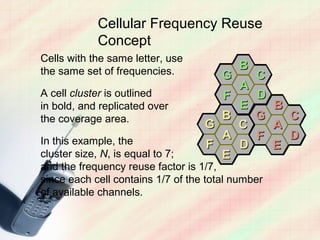
Cellular Frequency Reuse
            Concept
Cells with the same letter, use
the same set of frequencies.
                                          B
                                      G       C
                                          A
A cell cluster is outlined            F       D
in bold, and replicated over              E       B
the coverage area.                    B       G       C
                                  G       C       A
In this example, the
                                        A      F   D
                                     F      D    E
cluster size, N, is equal to 7;         E
and the frequency reuse factor is 1/7,
since each cell contains 1/7 of the total number
of available channels.
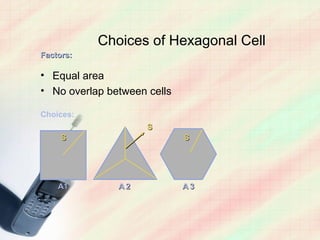
Choices of Hexagonal Cell
Factors:

• Equal area
• No overlap between cells

Choices:
                     S
     S                       S


    A1         A2            A3
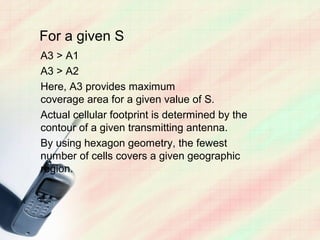
For a given S
A3 > A1
A3 > A2
Here, A3 provides maximum
coverage area for a given value of S.
Actual cellular footprint is determined by the
contour of a given transmitting antenna.
By using hexagon geometry, the fewest
number of cells covers a given geographic
region.
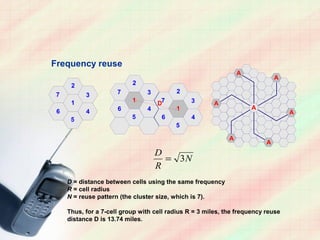
Frequency reuse
                                                                 A
                                                                              A
      2                    2
                      7         3          2
 7         3
                           1
      1                             D7          3       A
                      6         4         1                          A
 6         4                                                                      A
      5                    5         6          4
                                          5

                                                             A
                                                                          A
                                    D
                                      = 3N
                                    R
     D = distance between cells using the same frequency
     R = cell radius
     N = reuse pattern (the cluster size, which is 7).

     Thus, for a 7-cell group with cell radius R = 3 miles, the frequency reuse
     distance D is 13.74 miles.
Channel Capacity
Let a cellular system have total of
S duplex channels for use.
If S channels are divided into N cells (in a cluster) into
unique and disjoint channel groups which each has
the same number of channels, total number of
available radio channels is:
S = KN
Where K is the number of channels / cell.
…Channel Capacity
If a cluster is replicated M times within
the system, the total number of
duplex channels, C, or the capacity, is

C = MKN = MS.
Cluster size N = 4, 7 or 12
Design of cluster size N
In order to connect without gaps between
adjacent cells (to tessellate)

N = i2 + ij + j2

Where i and j are non-negative integers

Example i = 2, j = 1

N = 22 + 2(1) + 12 = 4 + 2 + 1 = 7
To Find the Nearest
Co-channel Neighbor of
Particular Cell:
• Move i cells along any chain
  or hexagon.
• Then turn 60 degrees counterclockwise
  and
  move j cells.
How to Locate Co-channel
Cells in a Cellular System

          A
                              In this example,
                      A       N = 19
                              ( i.e.,
                                i = 3,
  A
                                j = 2)
              A
                          A
                              Adapted from
                              [Oet83] © IEEE.

      A
                  A
Example

If a particular FDD (frequency duplex) cellular telephone
system has a total bandwidth of 33 MHz,and if the phone
system uses two 25 KHz simplex channels to provide full
duplex voice and control channels...
compute the number of
channels per cell if
N = 4, 7, 12.
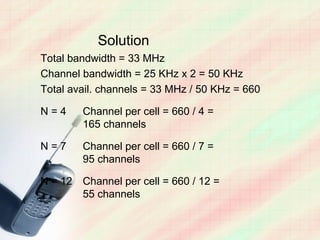
Solution
Total bandwidth = 33 MHz
Channel bandwidth = 25 KHz x 2 = 50 KHz
Total avail. channels = 33 MHz / 50 KHz = 660

N=4     Channel per cell = 660 / 4 =
        165 channels

N=7     Channel per cell = 660 / 7 =
        95 channels

N = 12 Channel per cell = 660 / 12 =
       55 channels
Interference and
System Capacity

Major limiting factor in performance
of cellular radio systems - two main
types:
– Co-channel interference
– Adjacent channel interference
Co-Channel Interference
Cells that use the same set of
frequencies are called
co-channel cells.
Interference between
the cells is called
co-channel interference.
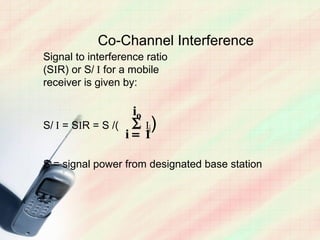
Co-Channel Interference
Signal to interference ratio
(SIR) or S/ I for a mobile
receiver is given by:

                   io
S/ I = SIR = S /( ∑ Ii)
                  i= 1

S = signal power from designated base station
First Tier of Co-channel Cells
for a Cluster Size of N = 7
When the mobile is at the cell boundary (point A),
it experiences worst case co-channel interference on

the forward channel.

The marked distances between the mobile and
different co-channel cells are based on
approximations made for easy analysis.
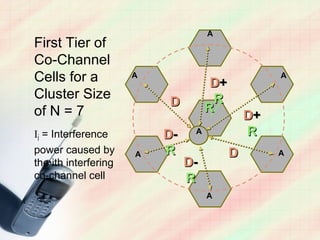
A
First Tier of
Co-Channel
Cells for a           A
                                     D+
                                                   A

Cluster Size                         R
                          D         R
of N = 7                                      D+
Ii = Interference         D-    A             R
power caused by       A   R               D        A
the ith interfering            D-
co-channel cell                R
                                    A
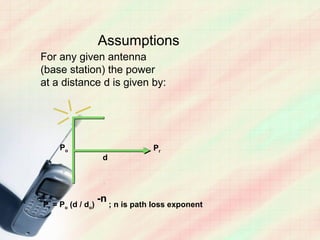
Assumptions
For any given antenna
(base station) the power
at a distance d is given by:


     Po                            Pr
                    d


                   -n
Pr = Po (d / do)        ; n is path loss exponent
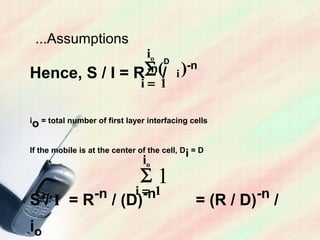
...Assumptions
                                 io   D
                ∑ (/ i )-n
Hence, S / I = R -n
                               i= 1

io = total number of first layer interfacing cells


If the mobile is at the center of the cell, Di = D
                                io
                               ∑      1
                  -n          i= 1
                               -n                          -n
S/I =R                 / (D)                   = (R / D)        /
io
For a hexagonal geometry

D / R =√(3N) = Q - co-channel
reuse ratio

S / I = [√(3N) ] n / io
Maximum co-channel interface –
when mobile is at cell boundary.
For N = 7

S / I~R-4 /
      [ 2(D-R)-4+2(D+R)-4+ 2D-4]
Adjacent Channel Interference
• Interference resulting from
  signals which are adjacent in
  frequency to the desired signal.
• Due to imperfect receiver filters that allow nearby
  frequencies to leak into pass band.
• Can be minimized by careful filtering and
  assignments; and, by keeping frequency separation
  between channels in a given cell as large as
  possible, the adjacent channel interference may be
  reduced considerably.
Channel Assignment Strategies:
             Fixed Channel Assignments

• Each cell is allocated a pre-determined
  set of voice channels.
• If all the channels in that cell are occupied, the call
  is blocked, and the subscriber does not receive
  service.
• Variation includes a borrowing strategy:
  a cell is allowed to borrow channels from a
  neighboring cell if all its own channels are
  occupied. This is supervised by the MSC.
Channel Assignment Strategies:
            Dynamic Channel Assignments

• Voice channels are not allocated to different
  cells permanently.
• Each time a call request is made, the serving
  base station requests a channel from the MSC.
• The switch then allocates a channel to the
  requested call, based on a decision algorithm
  taking into account different factors - frequency
  re-use of candidate channel, cost factors.
...Channel Assignment
            Strategies:
            Dynamic Channel Assignments

Dynamic channel assignment is more
complex (real time), but reduces likelihood
of blocking.
Improving Capacity in
            Cellular Systems

• As demand for wireless services increases,
  the number of channels assigned to a cell is
  not enough to support the required number of
  users.

• Solution is to increase channels per unit
  coverage area.
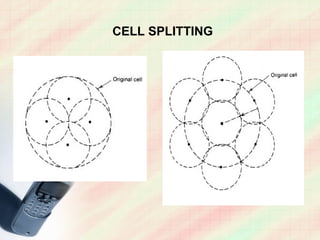
CELL SPLITTING
• The main aim of cellular mobile systems is to
  improve utilization of spectrum efficiency

• The frequency reuse scheme is one concept,
  and cell splitting is another concept.

• When traffic density is very high then each cell
  cannot provide enough mobile calls. Then the
  original cell can be split into smaller cells
  resulting in cell splitting.

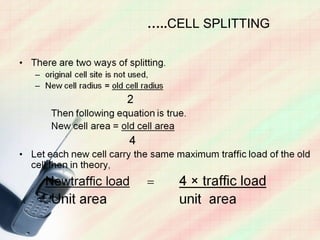
• Usually the new radius is one-half the original
  radius.
Cell Splitting

• Subdivides a congested cell into smaller
  cells, each with its own base station.
• Increases the capacity of a cellular
  system.
CELL SPLITTING
…..CELL SPLITTING
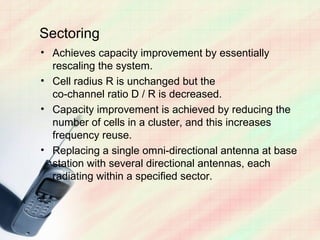
Sectoring
• Achieves capacity improvement by essentially
  rescaling the system.
• Cell radius R is unchanged but the
  co-channel ratio D / R is decreased.
• Capacity improvement is achieved by reducing the
  number of cells in a cluster, and this increases
  frequency reuse.
• Replacing a single omni-directional antenna at base
  station with several directional antennas, each
  radiating within a specified sector.
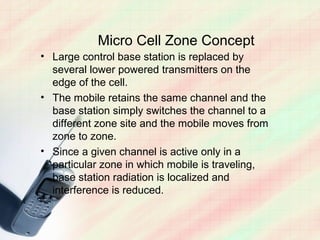
Micro Cell Zone Concept
• Large control base station is replaced by
  several lower powered transmitters on the
  edge of the cell.
• The mobile retains the same channel and the
  base station simply switches the channel to a
  different zone site and the mobile moves from
  zone to zone.
• Since a given channel is active only in a
  particular zone in which mobile is traveling,
  base station radiation is localized and
  interference is reduced.
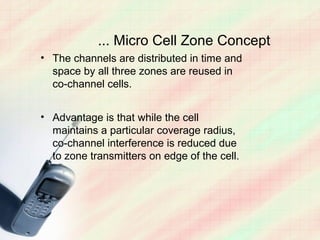
... Micro Cell Zone Concept
• The channels are distributed in time and
  space by all three zones are reused in
  co-channel cells.


• Advantage is that while the cell
  maintains a particular coverage radius,
  co-channel interference is reduced due
  to zone transmitters on edge of the cell.
Microwave or
       fiber optic link


                                     Zone Selector
                                     Zone Selector
                                                      Base
                                                     station
                                  The Micro
Tx/R                      Tx/Rx   Cell Concept
x
                                  (Adapted from
                                  [Lee91b] ©
         Tx/R                     IEEE)
         x
Antennas
• Antenna pattern, antenna gain, antenna
  tilting, and antenna height all affect the
  cellular system design
• Different antenna patterns and antenna
  gains at the cell site and at the mobile
  units would affect the system performance
  and so must be considered in the system
  design.
• Antenna tilting can reduce the interference
  to the neighboring cells and enhance the
  weak spots in the cell
Trunking and Grade of Service
• Cellular radio system relies on trunking to
  accommodate a large number of users in a
  limited radio spectrum - How a large population
  can be accommodated by a limited number of
  services.
• Trunking - each user is allocated a channel on a
  per-call basis; and upon termination of the call,
  the previously occupied channel is immediately
  returned to the pool of available channels
• Initiated by Danish mathematician, Erlang.
Why 800 MHz frequency is selected for mobiles?
•  
• Fixed Station Services         -            30 MHz to 100 MHz
• Television Broadcasting        -           41 MHz to 960 MHz
• FM Broadcasting                -           100 MHz
• Air to Ground system           -            118 MHz to 136 MHz
• Maritime mobile services       -            160 MHz
• Military Aircraft use          -            225 MHz to 400 MHz
• Frequency bands between 30 MHz to 400 MHz is crowded with large number of 
  services and above 10 GHz is not used due to propagation path loss, multipath 
  fading and improper medium due to rain activity. So 800 MHz is chosen for 
  mobile communication


                                Mobile Communications                       38

Mobile communication concepts

  • 1.
    Mobile Communications Prepared by: R – THANDAIAH PRABU M.E., LECTURER / ECE Mobile Communications 1
  • 2.
    Frequency Reuse Each cellularbase station is allocated a group of radio channels. Base stations in adjacent cells are assigned channel groups which contain different channels than neighboring cells.
  • 3.
    Cellular Frequency Reuse Concept Cells with the same letter, use the same set of frequencies. B G C A A cell cluster is outlined F D in bold, and replicated over E B the coverage area. B G C G C A In this example, the A F D F D E cluster size, N, is equal to 7; E and the frequency reuse factor is 1/7, since each cell contains 1/7 of the total number of available channels.
  • 4.
    Choices of HexagonalCell Factors: • Equal area • No overlap between cells Choices: S S S A1 A2 A3
  • 5.
    For a givenS A3 > A1 A3 > A2 Here, A3 provides maximum coverage area for a given value of S. Actual cellular footprint is determined by the contour of a given transmitting antenna. By using hexagon geometry, the fewest number of cells covers a given geographic region.
  • 6.
    Frequency reuse A A 2 2 7 3 2 7 3 1 1 D7 3 A 6 4 1 A 6 4 A 5 5 6 4 5 A A D = 3N R D = distance between cells using the same frequency R = cell radius N = reuse pattern (the cluster size, which is 7). Thus, for a 7-cell group with cell radius R = 3 miles, the frequency reuse distance D is 13.74 miles.
  • 7.
    Channel Capacity Let acellular system have total of S duplex channels for use. If S channels are divided into N cells (in a cluster) into unique and disjoint channel groups which each has the same number of channels, total number of available radio channels is: S = KN Where K is the number of channels / cell.
  • 8.
    …Channel Capacity If acluster is replicated M times within the system, the total number of duplex channels, C, or the capacity, is C = MKN = MS. Cluster size N = 4, 7 or 12
  • 9.
    Design of clustersize N In order to connect without gaps between adjacent cells (to tessellate) N = i2 + ij + j2 Where i and j are non-negative integers Example i = 2, j = 1 N = 22 + 2(1) + 12 = 4 + 2 + 1 = 7
  • 10.
    To Find theNearest Co-channel Neighbor of Particular Cell: • Move i cells along any chain or hexagon. • Then turn 60 degrees counterclockwise and move j cells.
  • 11.
    How to LocateCo-channel Cells in a Cellular System A In this example, A N = 19 ( i.e., i = 3, A j = 2) A A Adapted from [Oet83] © IEEE. A A
  • 12.
    Example If a particularFDD (frequency duplex) cellular telephone system has a total bandwidth of 33 MHz,and if the phone system uses two 25 KHz simplex channels to provide full duplex voice and control channels... compute the number of channels per cell if N = 4, 7, 12.
  • 13.
    Solution Total bandwidth =33 MHz Channel bandwidth = 25 KHz x 2 = 50 KHz Total avail. channels = 33 MHz / 50 KHz = 660 N=4 Channel per cell = 660 / 4 = 165 channels N=7 Channel per cell = 660 / 7 = 95 channels N = 12 Channel per cell = 660 / 12 = 55 channels
  • 14.
    Interference and System Capacity Majorlimiting factor in performance of cellular radio systems - two main types: – Co-channel interference – Adjacent channel interference
  • 15.
    Co-Channel Interference Cells thatuse the same set of frequencies are called co-channel cells. Interference between the cells is called co-channel interference.
  • 16.
    Co-Channel Interference Signal tointerference ratio (SIR) or S/ I for a mobile receiver is given by: io S/ I = SIR = S /( ∑ Ii) i= 1 S = signal power from designated base station
  • 17.
    First Tier ofCo-channel Cells for a Cluster Size of N = 7 When the mobile is at the cell boundary (point A), it experiences worst case co-channel interference on the forward channel. The marked distances between the mobile and different co-channel cells are based on approximations made for easy analysis.
  • 18.
    A First Tier of Co-Channel Cellsfor a A D+ A Cluster Size R D R of N = 7 D+ Ii = Interference D- A R power caused by A R D A the ith interfering D- co-channel cell R A
  • 19.
    Assumptions For any givenantenna (base station) the power at a distance d is given by: Po Pr d -n Pr = Po (d / do) ; n is path loss exponent
  • 20.
    ...Assumptions io D ∑ (/ i )-n Hence, S / I = R -n i= 1 io = total number of first layer interfacing cells If the mobile is at the center of the cell, Di = D io ∑ 1 -n i= 1 -n -n S/I =R / (D) = (R / D) / io
  • 21.
    For a hexagonalgeometry D / R =√(3N) = Q - co-channel reuse ratio S / I = [√(3N) ] n / io
  • 22.
    Maximum co-channel interface– when mobile is at cell boundary. For N = 7 S / I~R-4 / [ 2(D-R)-4+2(D+R)-4+ 2D-4]
  • 23.
    Adjacent Channel Interference •Interference resulting from signals which are adjacent in frequency to the desired signal. • Due to imperfect receiver filters that allow nearby frequencies to leak into pass band. • Can be minimized by careful filtering and assignments; and, by keeping frequency separation between channels in a given cell as large as possible, the adjacent channel interference may be reduced considerably.
  • 24.
    Channel Assignment Strategies: Fixed Channel Assignments • Each cell is allocated a pre-determined set of voice channels. • If all the channels in that cell are occupied, the call is blocked, and the subscriber does not receive service. • Variation includes a borrowing strategy: a cell is allowed to borrow channels from a neighboring cell if all its own channels are occupied. This is supervised by the MSC.
  • 25.
    Channel Assignment Strategies: Dynamic Channel Assignments • Voice channels are not allocated to different cells permanently. • Each time a call request is made, the serving base station requests a channel from the MSC. • The switch then allocates a channel to the requested call, based on a decision algorithm taking into account different factors - frequency re-use of candidate channel, cost factors.
  • 26.
    ...Channel Assignment Strategies: Dynamic Channel Assignments Dynamic channel assignment is more complex (real time), but reduces likelihood of blocking.
  • 27.
    Improving Capacity in Cellular Systems • As demand for wireless services increases, the number of channels assigned to a cell is not enough to support the required number of users. • Solution is to increase channels per unit coverage area.
  • 28.
    CELL SPLITTING • Themain aim of cellular mobile systems is to improve utilization of spectrum efficiency • The frequency reuse scheme is one concept, and cell splitting is another concept. • When traffic density is very high then each cell cannot provide enough mobile calls. Then the original cell can be split into smaller cells resulting in cell splitting. • Usually the new radius is one-half the original radius.
  • 29.
    Cell Splitting • Subdividesa congested cell into smaller cells, each with its own base station. • Increases the capacity of a cellular system.
  • 30.
  • 31.
  • 32.
    Sectoring • Achieves capacityimprovement by essentially rescaling the system. • Cell radius R is unchanged but the co-channel ratio D / R is decreased. • Capacity improvement is achieved by reducing the number of cells in a cluster, and this increases frequency reuse. • Replacing a single omni-directional antenna at base station with several directional antennas, each radiating within a specified sector.
  • 33.
    Micro Cell ZoneConcept • Large control base station is replaced by several lower powered transmitters on the edge of the cell. • The mobile retains the same channel and the base station simply switches the channel to a different zone site and the mobile moves from zone to zone. • Since a given channel is active only in a particular zone in which mobile is traveling, base station radiation is localized and interference is reduced.
  • 34.
    ... Micro CellZone Concept • The channels are distributed in time and space by all three zones are reused in co-channel cells. • Advantage is that while the cell maintains a particular coverage radius, co-channel interference is reduced due to zone transmitters on edge of the cell.
  • 35.
    Microwave or fiber optic link Zone Selector Zone Selector Base station The Micro Tx/R Tx/Rx Cell Concept x (Adapted from [Lee91b] © Tx/R IEEE) x
  • 36.
    Antennas • Antenna pattern,antenna gain, antenna tilting, and antenna height all affect the cellular system design • Different antenna patterns and antenna gains at the cell site and at the mobile units would affect the system performance and so must be considered in the system design. • Antenna tilting can reduce the interference to the neighboring cells and enhance the weak spots in the cell
  • 37.
    Trunking and Gradeof Service • Cellular radio system relies on trunking to accommodate a large number of users in a limited radio spectrum - How a large population can be accommodated by a limited number of services. • Trunking - each user is allocated a channel on a per-call basis; and upon termination of the call, the previously occupied channel is immediately returned to the pool of available channels • Initiated by Danish mathematician, Erlang.
  • 38.
    Why 800 MHzfrequency is selected for mobiles? •   • Fixed Station Services - 30 MHz to 100 MHz • Television Broadcasting -           41 MHz to 960 MHz • FM Broadcasting -           100 MHz • Air to Ground system - 118 MHz to 136 MHz • Maritime mobile services - 160 MHz • Military Aircraft use - 225 MHz to 400 MHz • Frequency bands between 30 MHz to 400 MHz is crowded with large number of  services and above 10 GHz is not used due to propagation path loss, multipath  fading and improper medium due to rain activity. So 800 MHz is chosen for  mobile communication Mobile Communications 38