The 3rd International Conference on Networking,
Information Systems & Security
MOBILE CLOUD COMPUTING:
Architecture, Advantages and Security
Issues
Authors:
Hadjer Fellah
Abbes Laghror University Khenchela, Algeria
Pr. Chaker Mezioud Pr. Batouche Mohamed
Abdelhamid Mahri University Constantine, Algeria
2019/2020
1
1
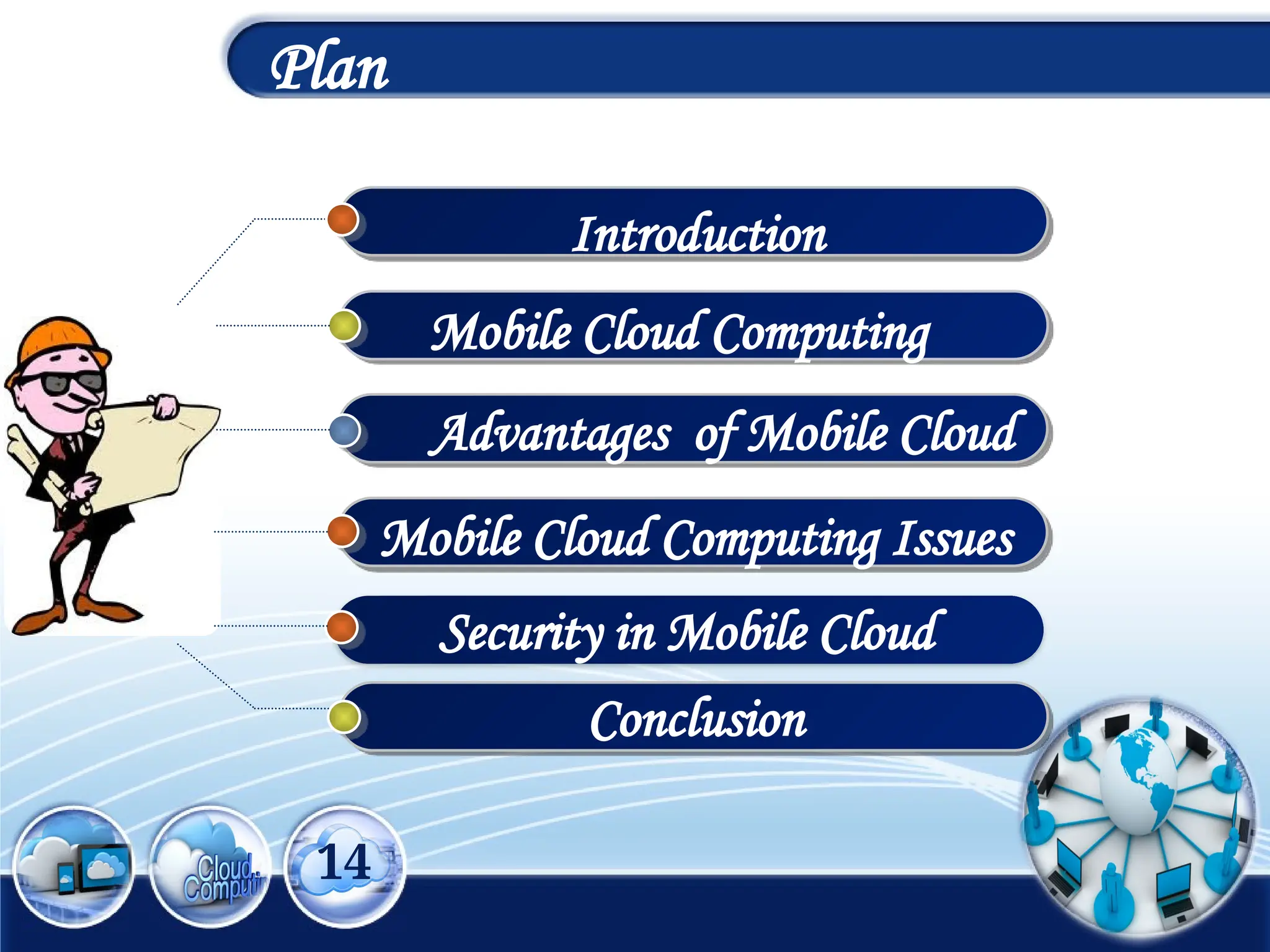
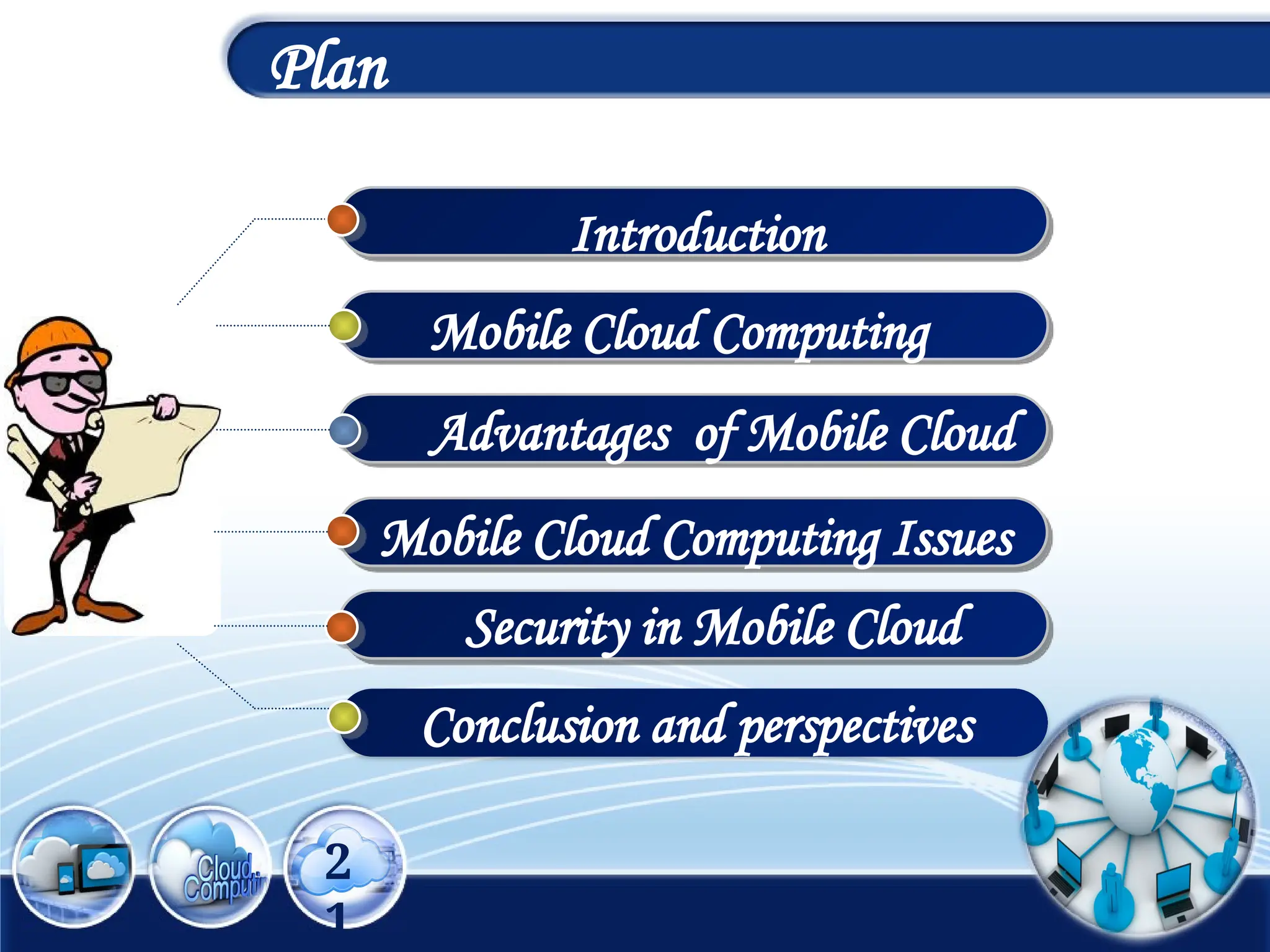
Plan
Introduction
Mobile Cloud Computing
Advantages of Mobile Cloud
Mobile Cloud Computing Issues
Conclusion
Security in Mobile Cloud
2
Introduction
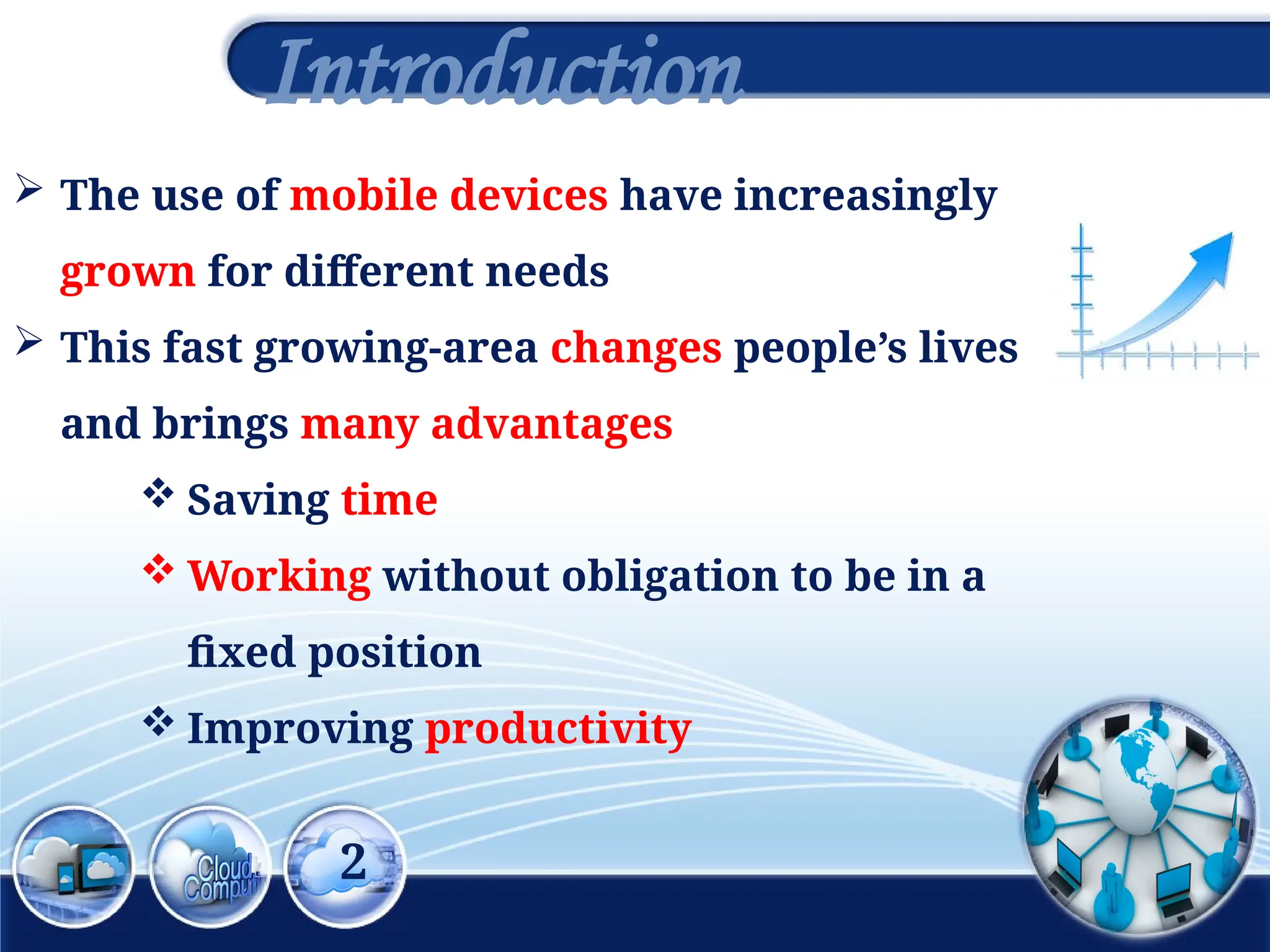
 The use of mobile devices have increasingly
grown for different needs
 This fast growing-area changes people’s lives
and brings many advantages
 Saving time
 Working without obligation to be in a
fixed position
 Improving productivity
3
Introduction
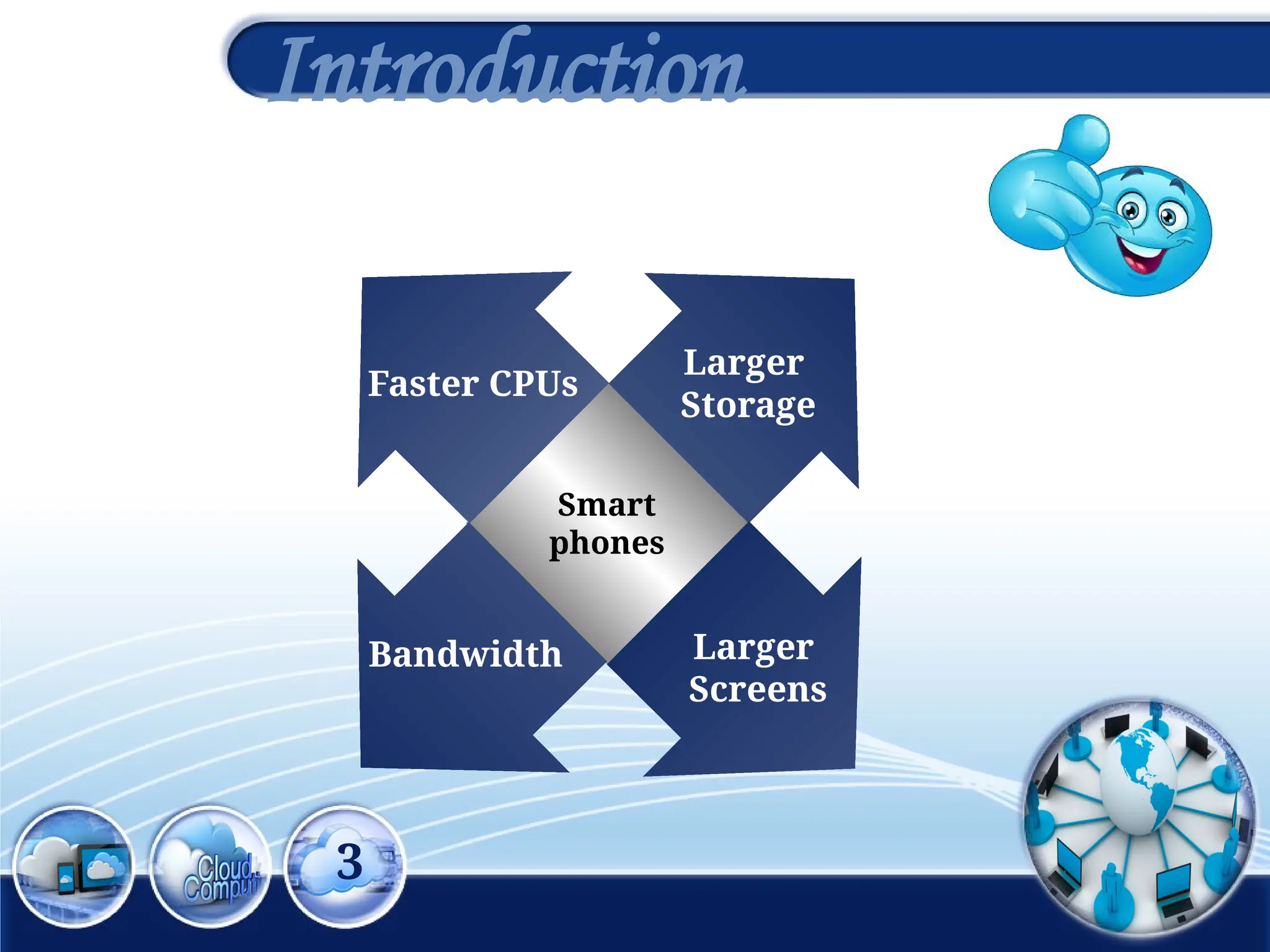
Larger
Screens
Faster CPUs
Larger
Storage
Smart
phones
Bandwidth
4
Introduction
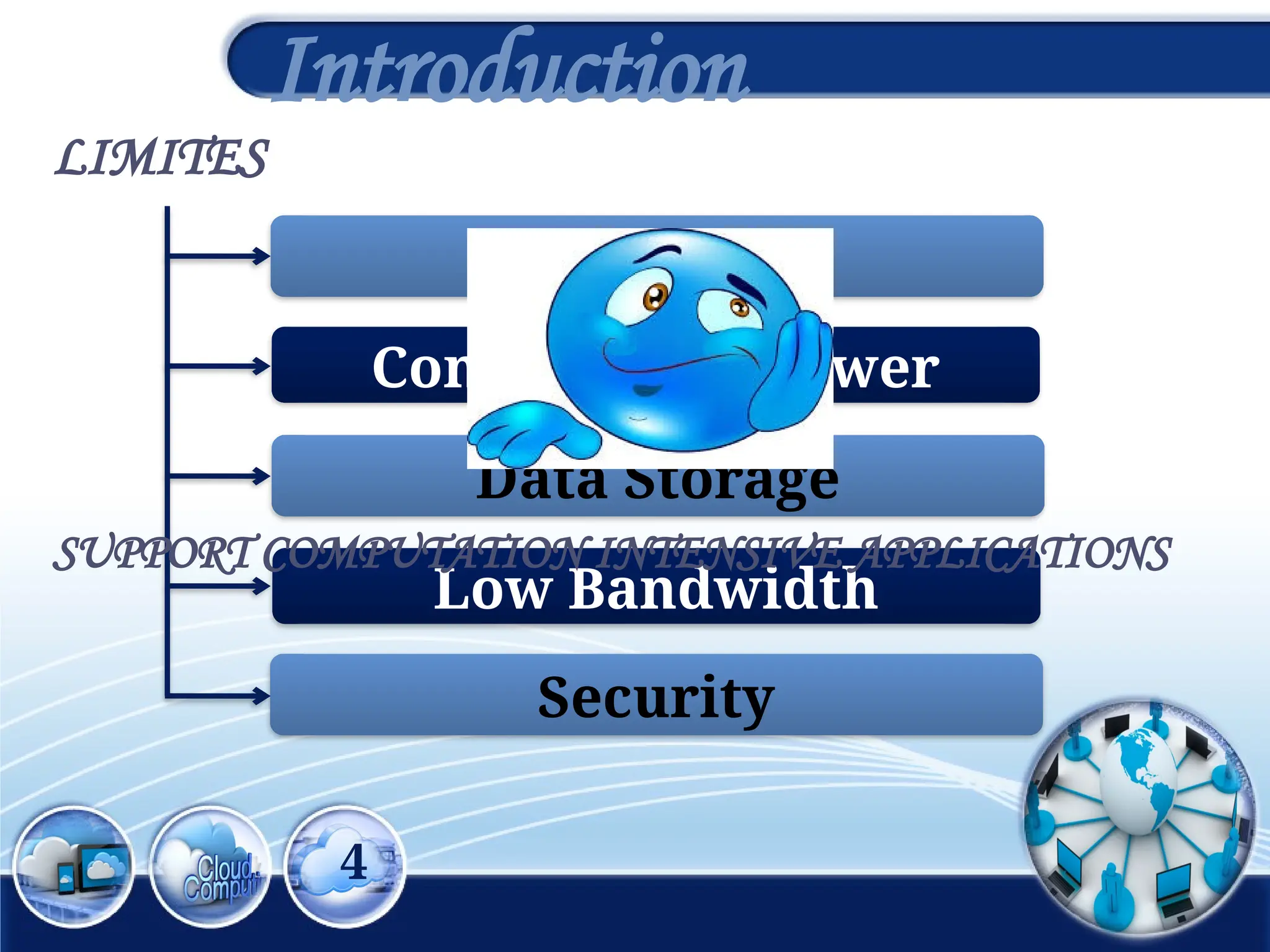
LIMITES
Computation power
Battery life
Data Storage
Low Bandwidth
Security
SUPPORT COMPUTATION INTENSIVE APPLICATIONS
5
Introduction
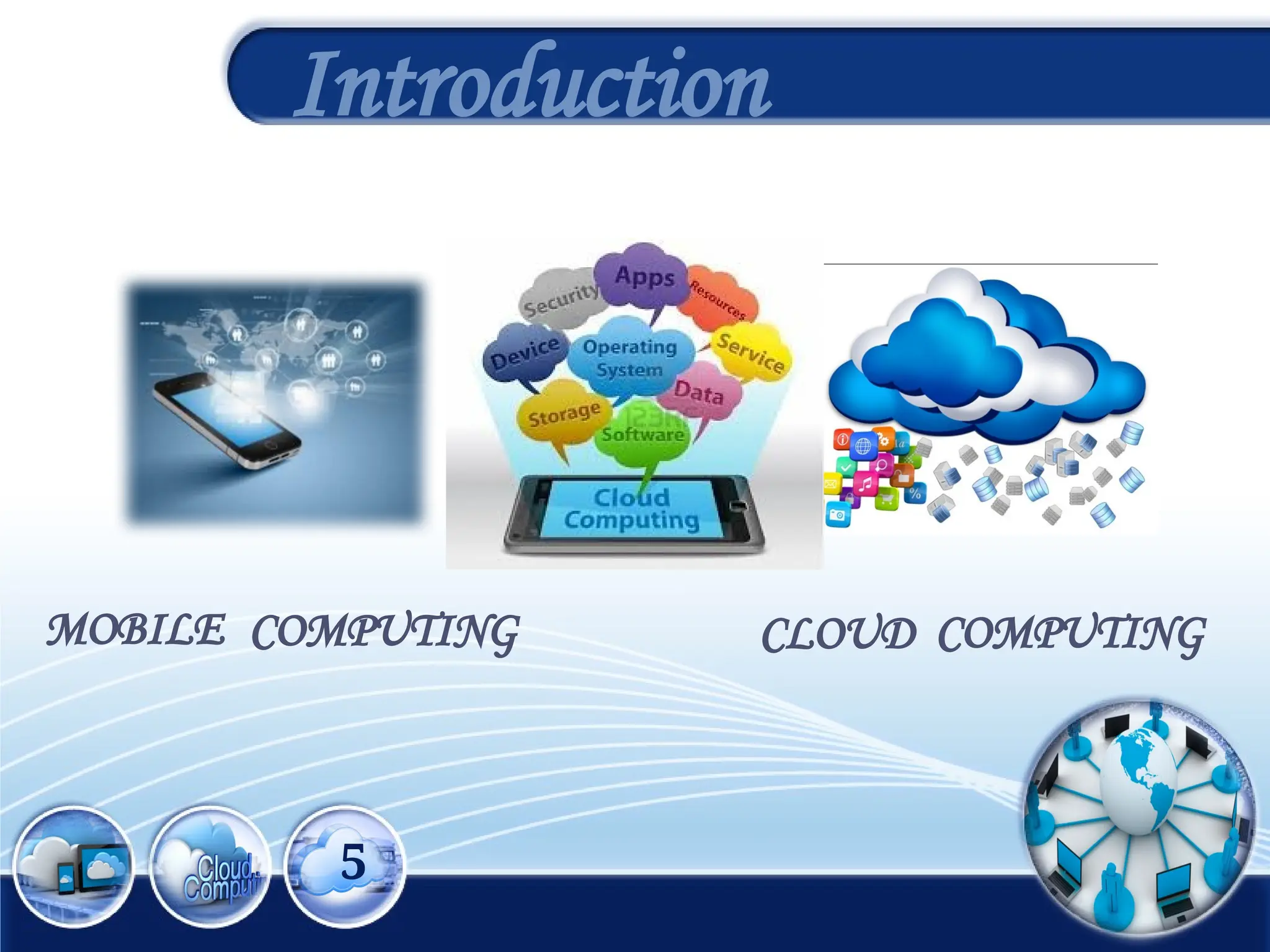
CLOUD
MOBILE COMPUTING
COMPUTING
1
6
Plan
Mobile Cloud Computing
Introduction
Advantages of Mobile Cloud
Mobile Cloud Computing Issues
Conclusion
Security in Mobile Cloud
7
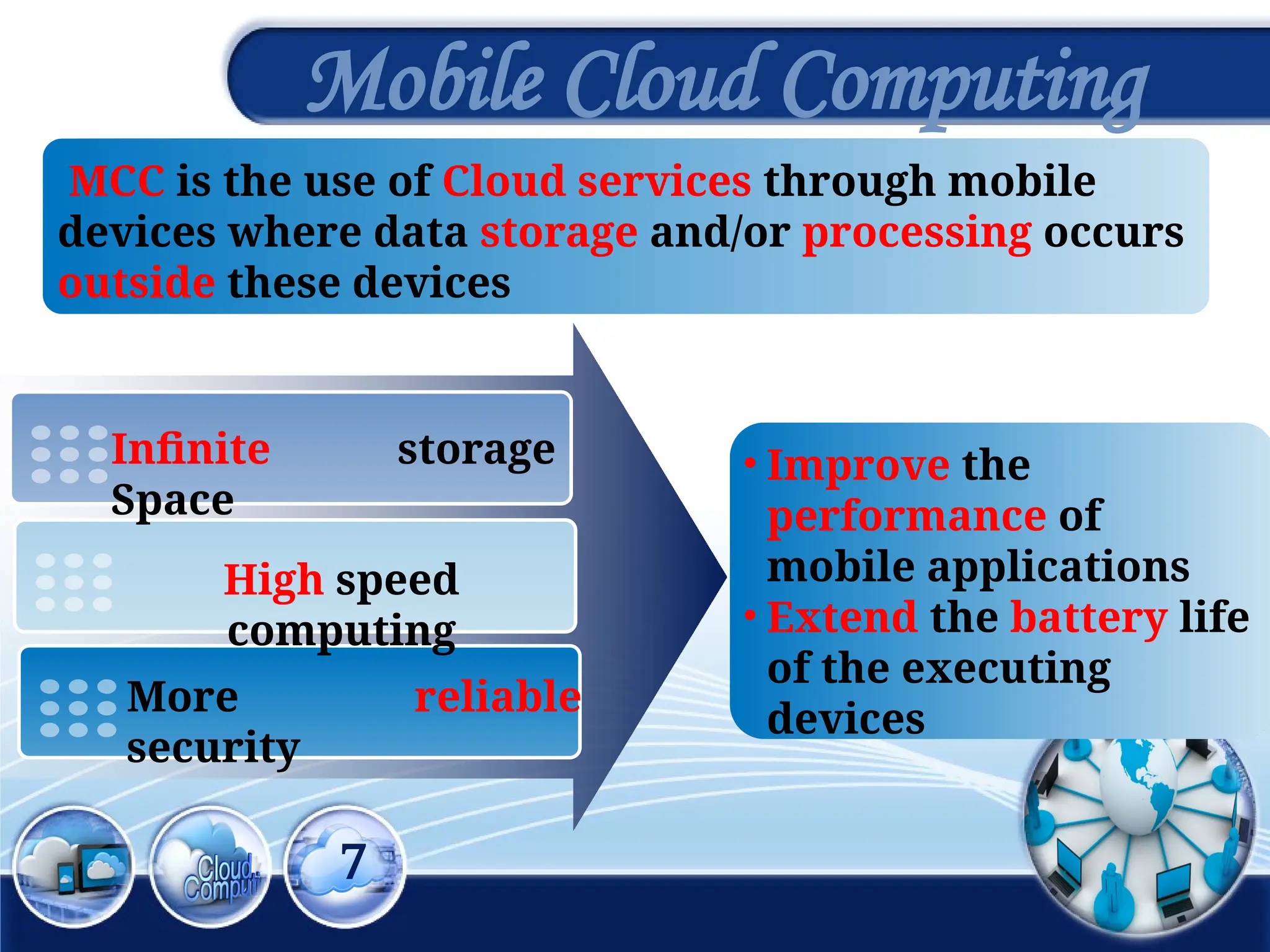
Mobile Cloud Computing
MCC is the use of Cloud services through mobile
devices where data storage and/or processing occurs
outside these devices
Infinite storage
Space
High speed
computing
More reliable
security
• Improve the
performance of
mobile applications
• Extend the battery life
of the executing
devices
8
Mobile Cloud Computing
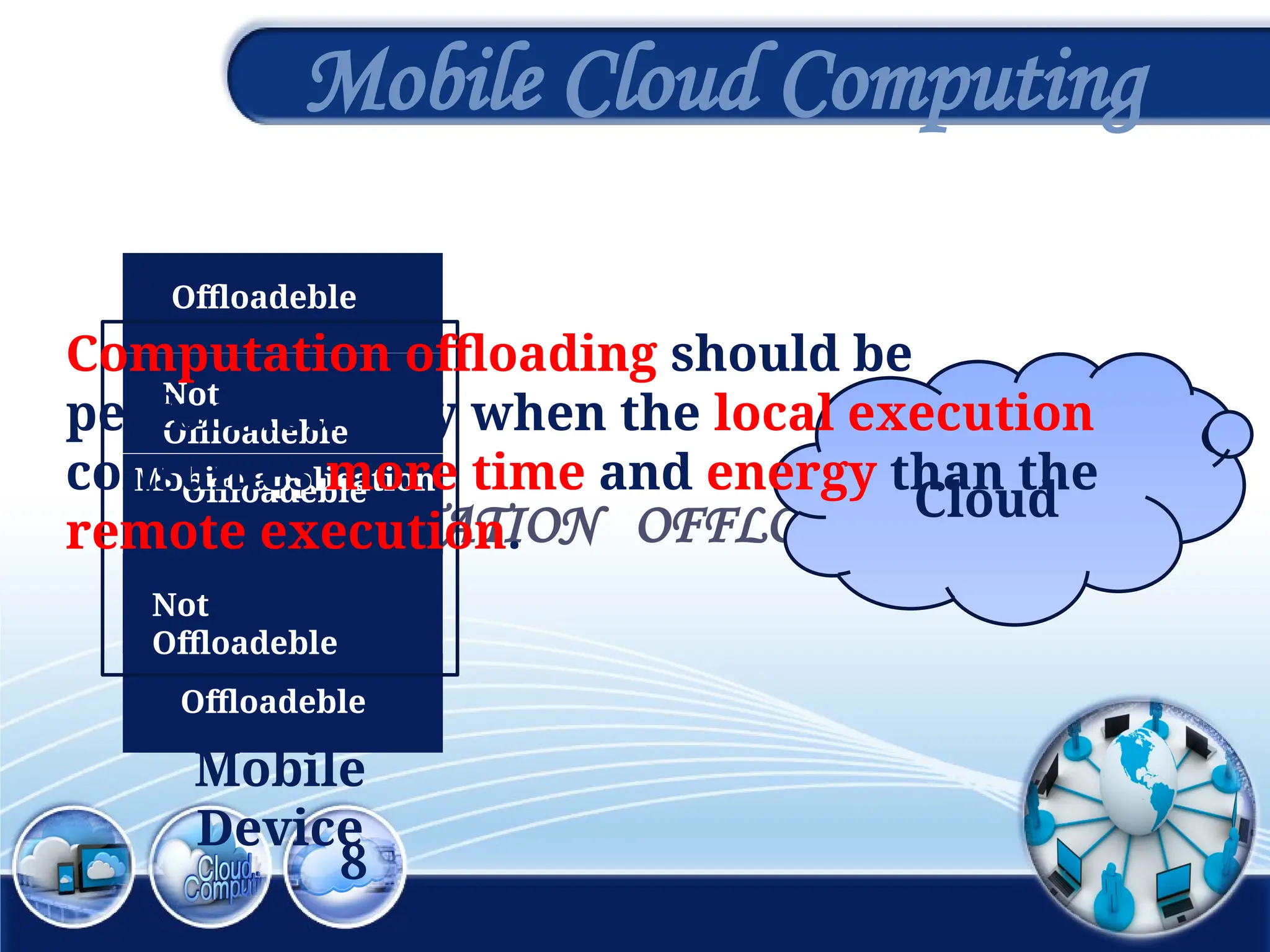
COMPUTATION OFFLOADING
Mobile application
Offloadeble
Not
Offloadeble
Offloadeble
Offloadeble
Not
Offloadeble
Cloud
Mobile
Device
Computation offloading should be
performed only when the local execution
consumes more time and energy than the
remote execution.
1
10
Plan
Advantages of Mobile Cloud
Introduction
Mobile Cloud Computing
Mobile Cloud Computing Issues
Conclusion
Security in Mobile Cloud
1
1
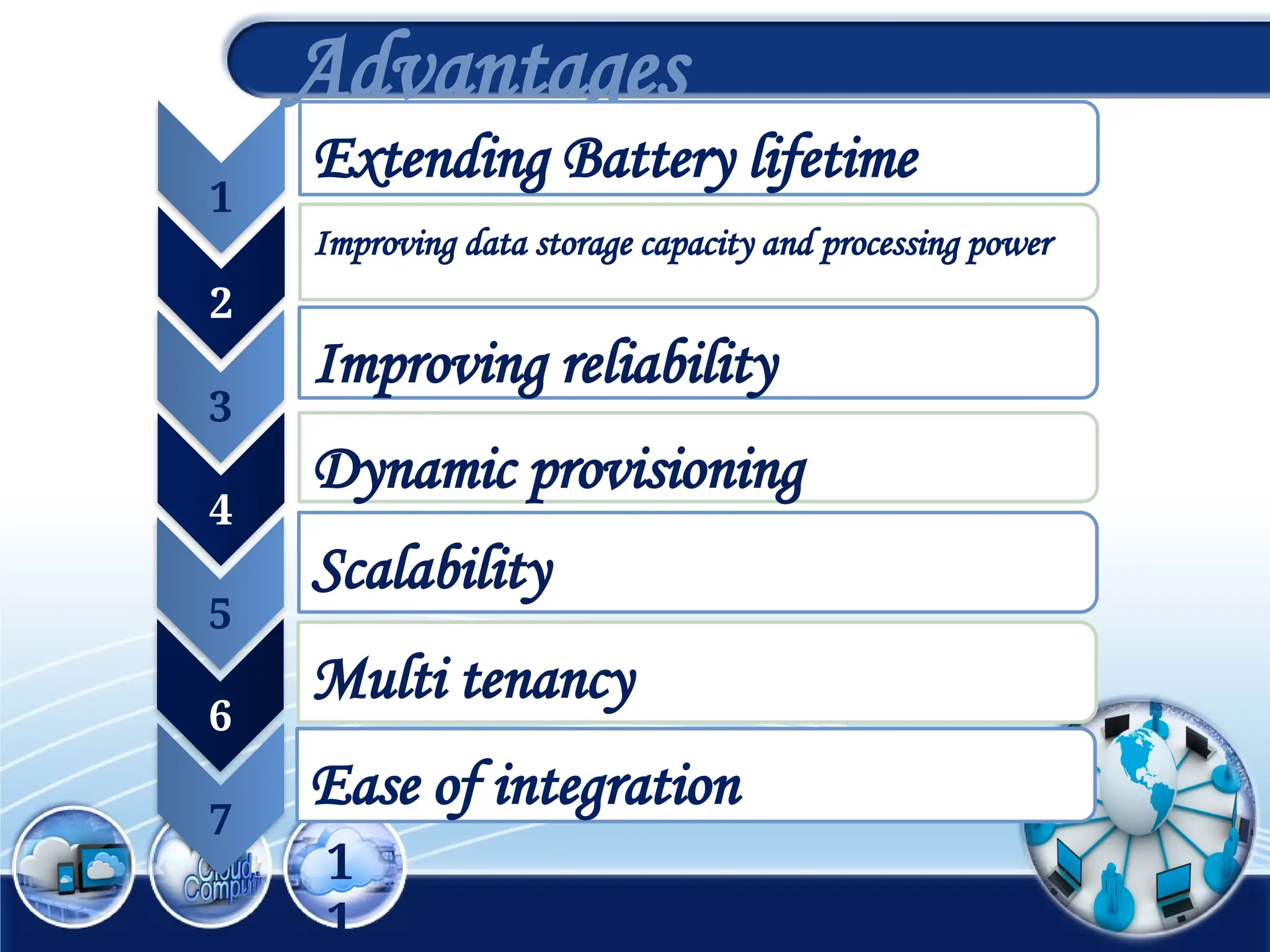
Advantages
1
Extending Battery lifetime
2
Improving data storage capacity and processing power
3
Improving reliability
5
Scalability
Dynamic provisioning
6
Multi tenancy
7
Ease of integration
4
1
12
Plan
Mobile Cloud Computing Issues
Mobile Cloud Computing
Advantages of Mobile Cloud
Introduction
Conclusion
Security in Mobile Cloud
13
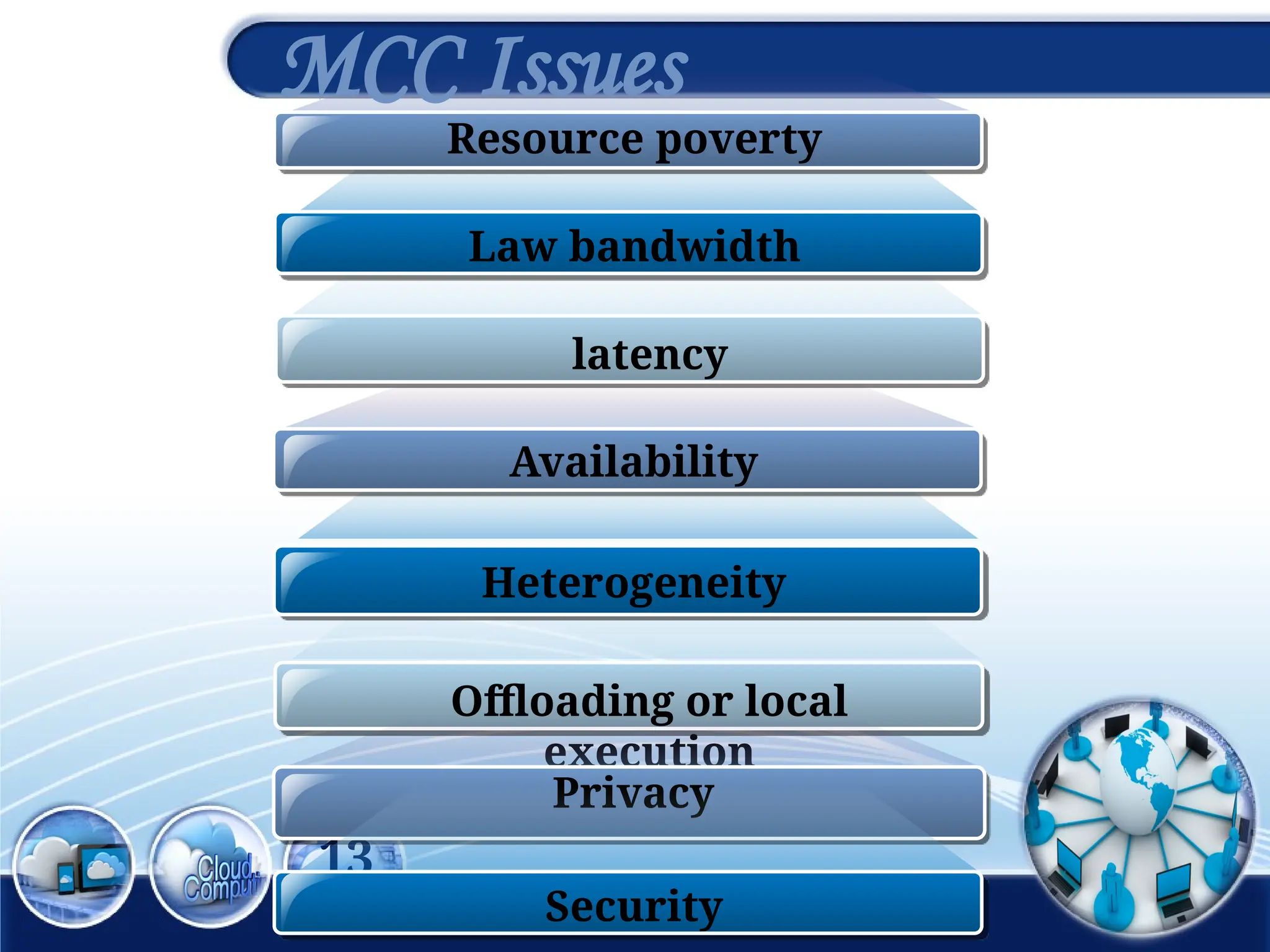
Resource poverty
Law bandwidth
latency
MCC Issues
Availability
Heterogeneity
Offloading or local
execution
Privacy
Security
Mobile Cloud Computing Issues
1
14
Plan
Security in Mobile Cloud
Mobile Cloud Computing
Advantages of Mobile Cloud
Introduction
Conclusion
15
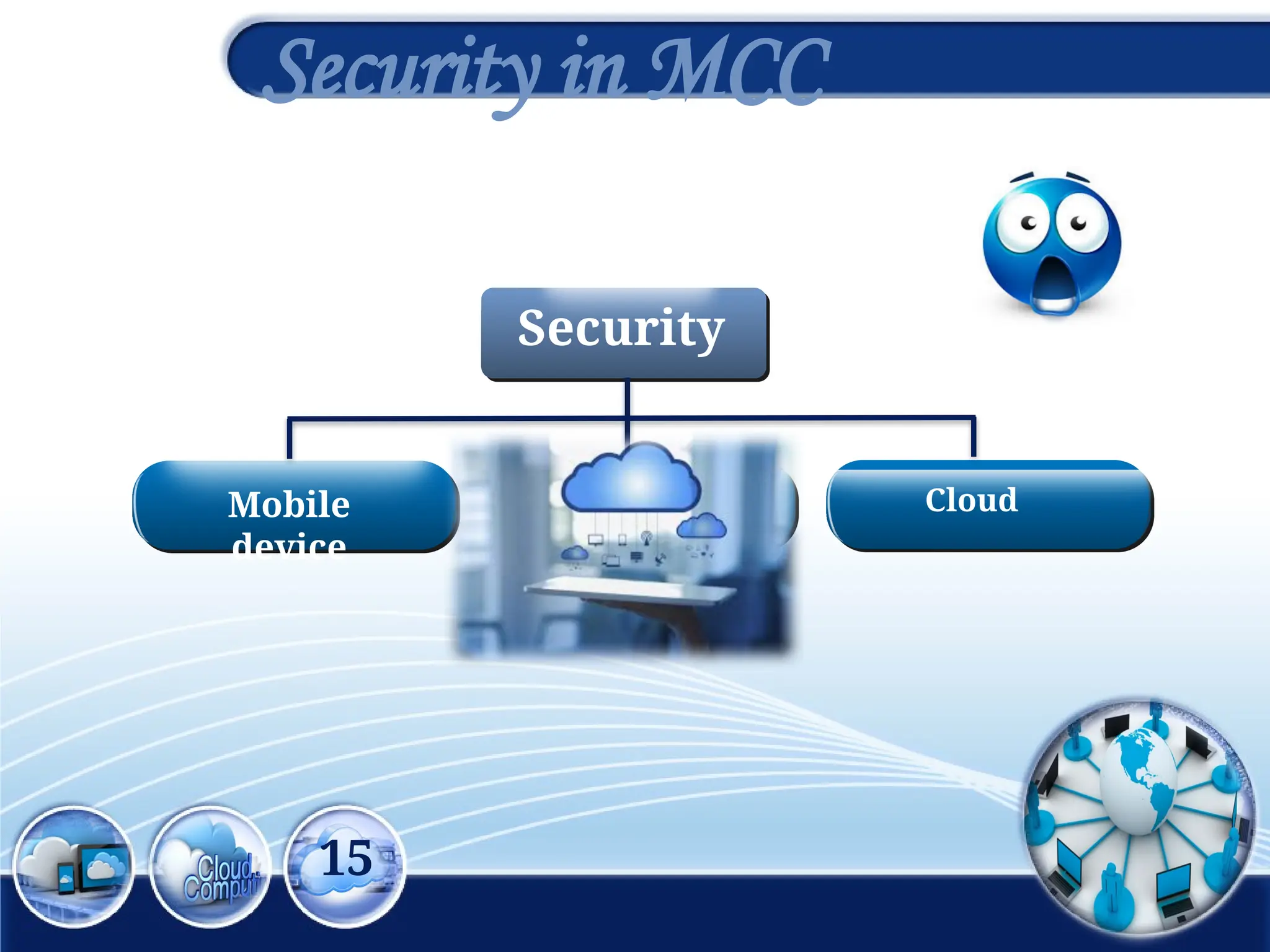
Security
Cloud
Mobile
Network
Mobile
device
Security in MCC
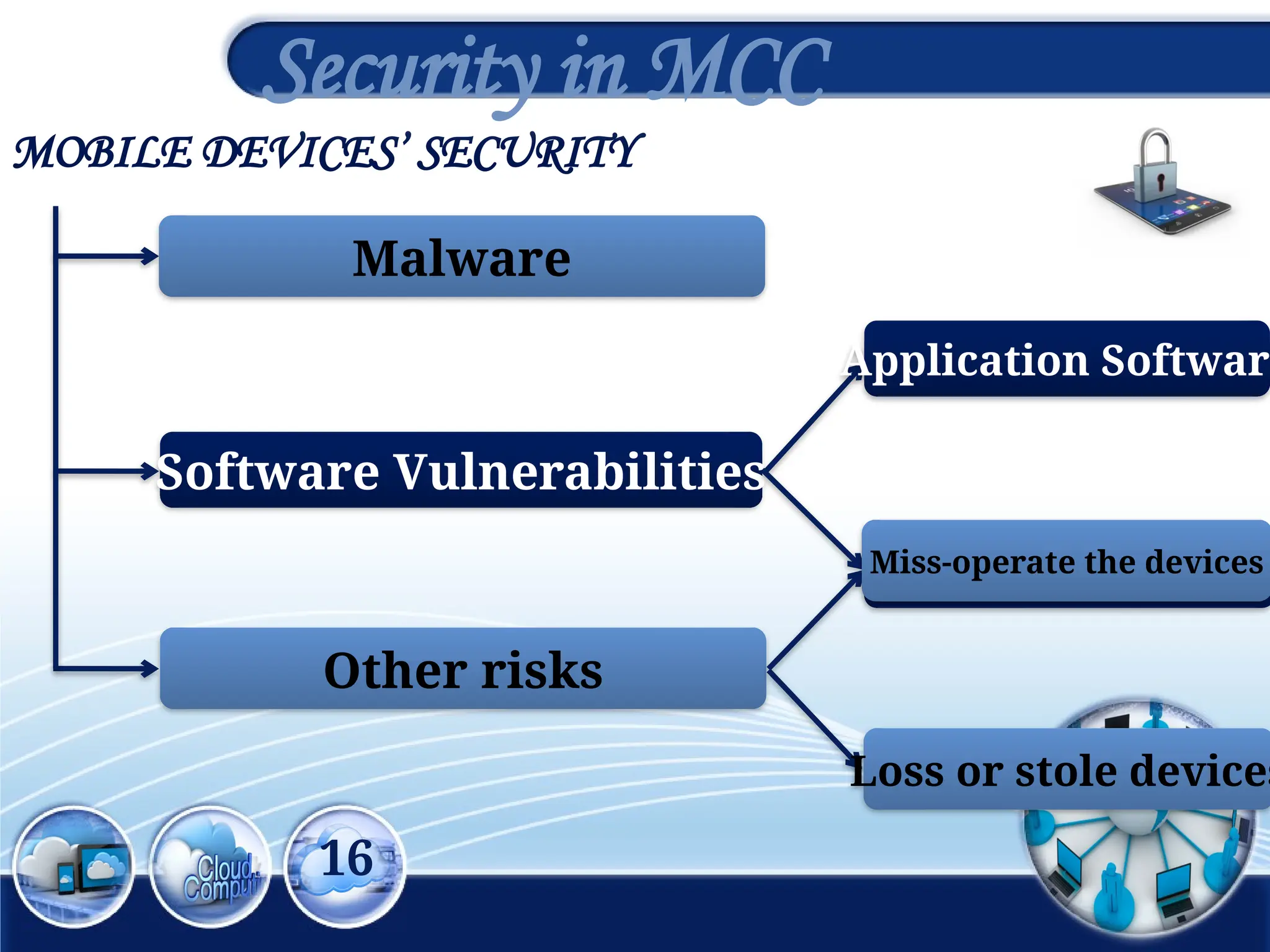
MOBILE DEVICES’ SECURITY
Software Vulnerabilities
Malware
Other risks
16
Security in MCC
Application Software
Operating System
Miss-operate the devices
Loss or stole devices
17
Introduction
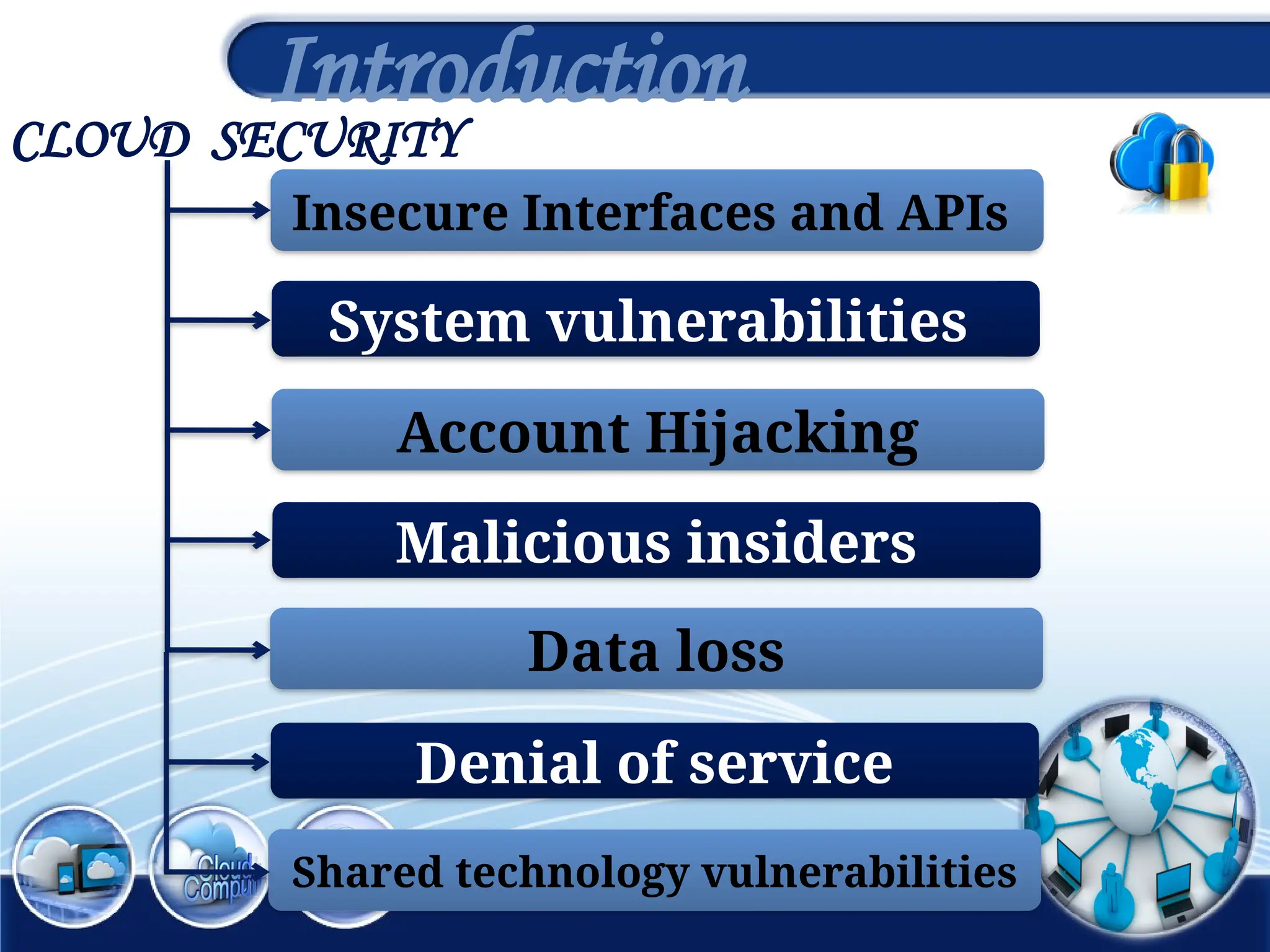
CLOUD SECURITY
System vulnerabilities
Insecure Interfaces and APIs
Account Hijacking
Malicious insiders
Data loss
Denial of service
Shared technology vulnerabilities
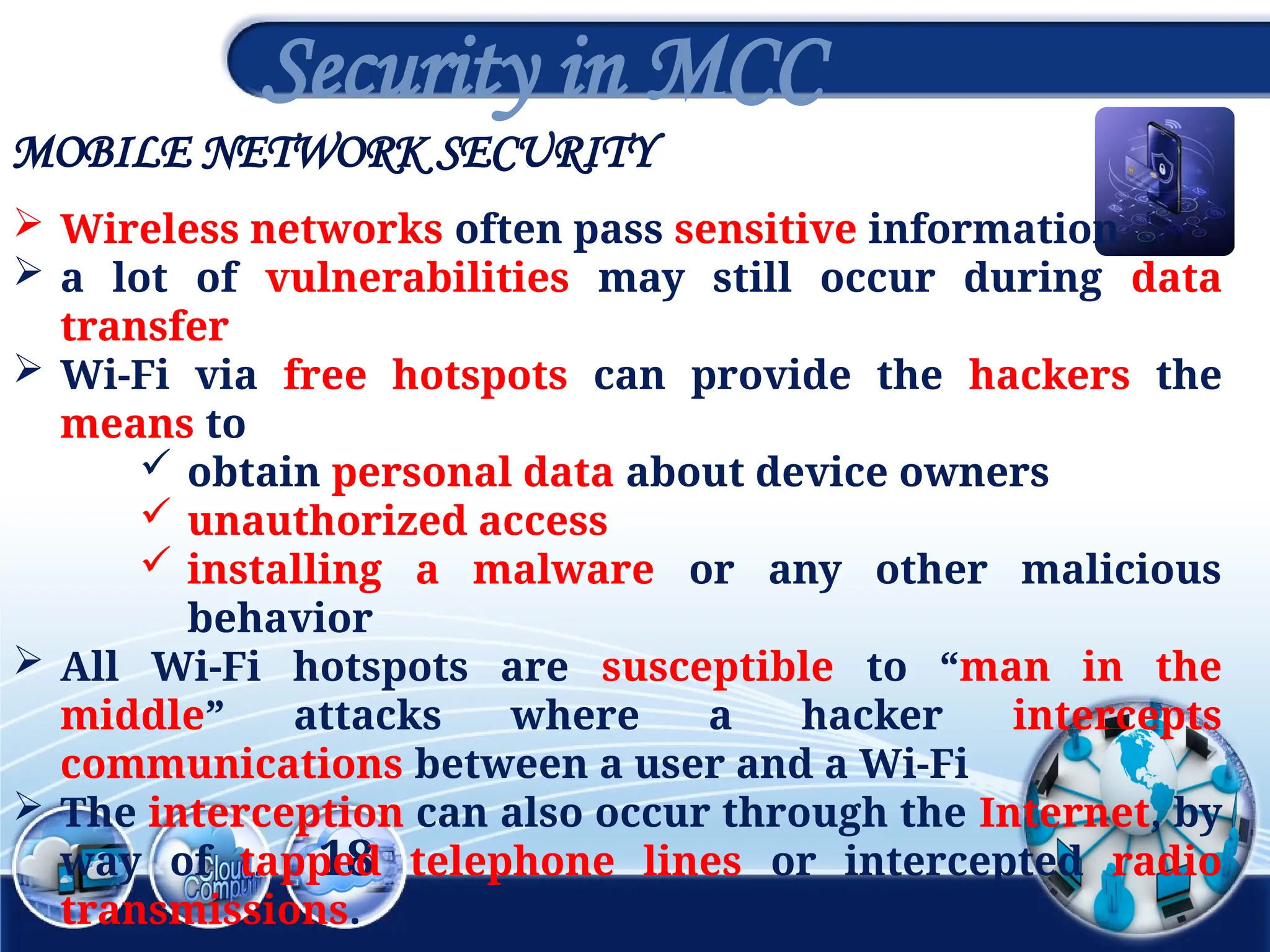
MOBILE NETWORK SECURITY
18
Security in MCC
 Wireless networks often pass sensitive information
 a lot of vulnerabilities may still occur during data
transfer
 Wi-Fi via free hotspots can provide the hackers the
means to
 obtain personal data about device owners
 unauthorized access
 installing a malware or any other malicious
behavior
 All Wi-Fi hotspots are susceptible to “man in the
middle” attacks where a hacker intercepts
communications between a user and a Wi-Fi
 The interception can also occur through the Internet, by
way of tapped telephone lines or intercepted radio
transmissions.
1
9
Security in MCC
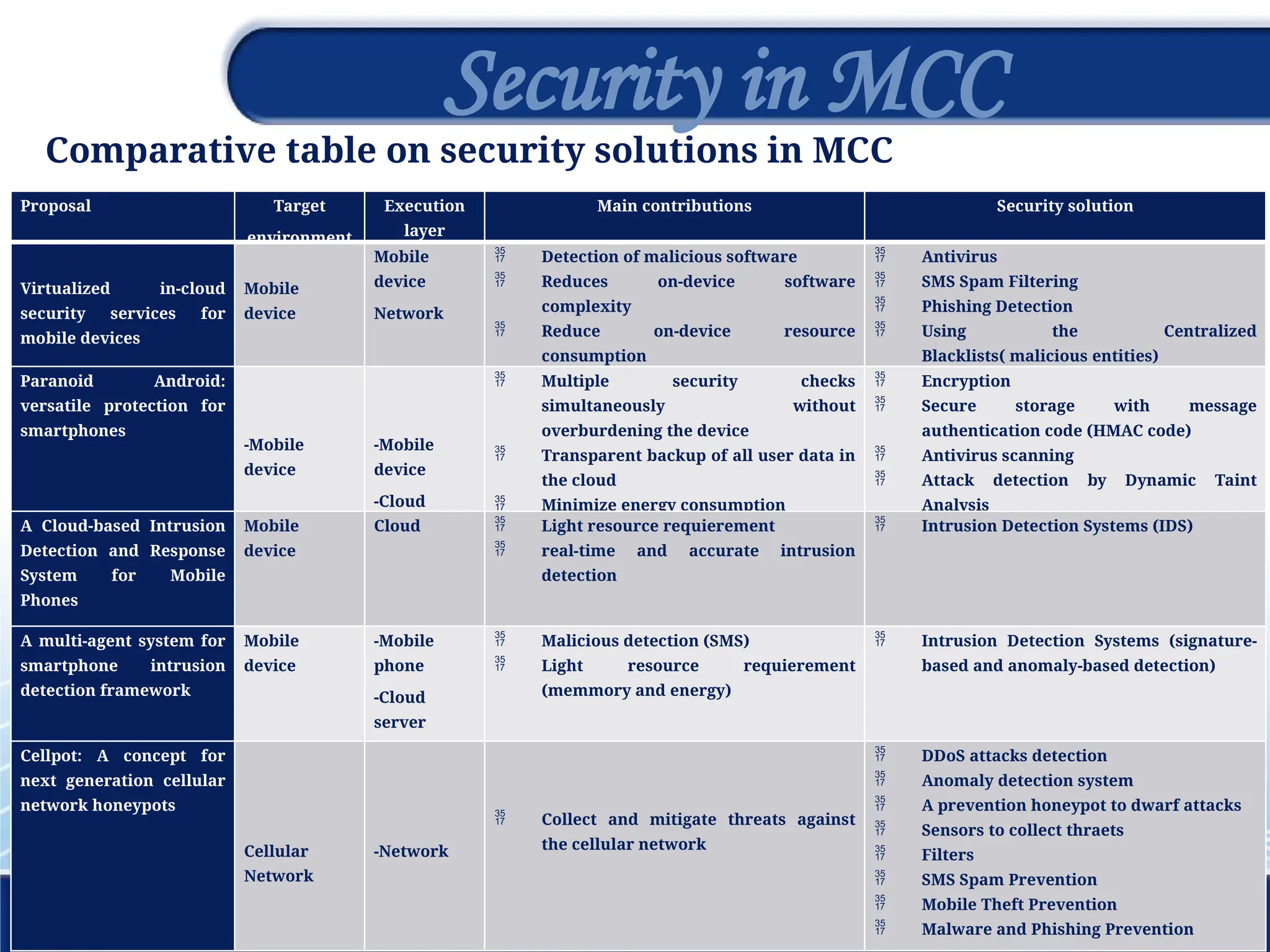
Comparative table on security solutions in MCC
Proposal Target
environment
Execution
layer
Main contributions Security solution
Virtualized in-cloud
security services for
mobile devices
Mobile
device
Mobile
device
Network
 Detection of malicious software
 Reduces on-device software
complexity
 Reduce on-device resource
consumption
 Antivirus
 SMS Spam Filtering
 Phishing Detection
 Using the Centralized
Blacklists( malicious entities)
Paranoid Android:
versatile protection for
smartphones
-Mobile
device
-Mobile
device
-Cloud
 Multiple security checks
simultaneously without
overburdening the device
 Transparent backup of all user data in
the cloud
 Minimize energy consumption
 Encryption
 Secure storage with message
authentication code (HMAC code)
 Antivirus scanning
 Attack detection by Dynamic Taint
Analysis
A Cloud-based Intrusion
Detection and Response
System for Mobile
Phones
Mobile
device
Cloud  Light resource requierement
 real-time and accurate intrusion
detection
 Intrusion Detection Systems (IDS)
A multi-agent system for
smartphone intrusion
detection framework
Mobile
device
-Mobile
phone
-Cloud
server
 Malicious detection (SMS)
 Light resource requierement
(memmory and energy)
 Intrusion Detection Systems (signature-
based and anomaly-based detection)
Cellpot: A concept for
next generation cellular
network honeypots
Cellular
Network
-Network
 Collect and mitigate threats against
the cellular network
 DDoS attacks detection
 Anomaly detection system
 A prevention honeypot to dwarf attacks
 Sensors to collect thraets
 Filters
 SMS Spam Prevention
 Mobile Theft Prevention
 Malware and Phishing Prevention
20
Security in MCC
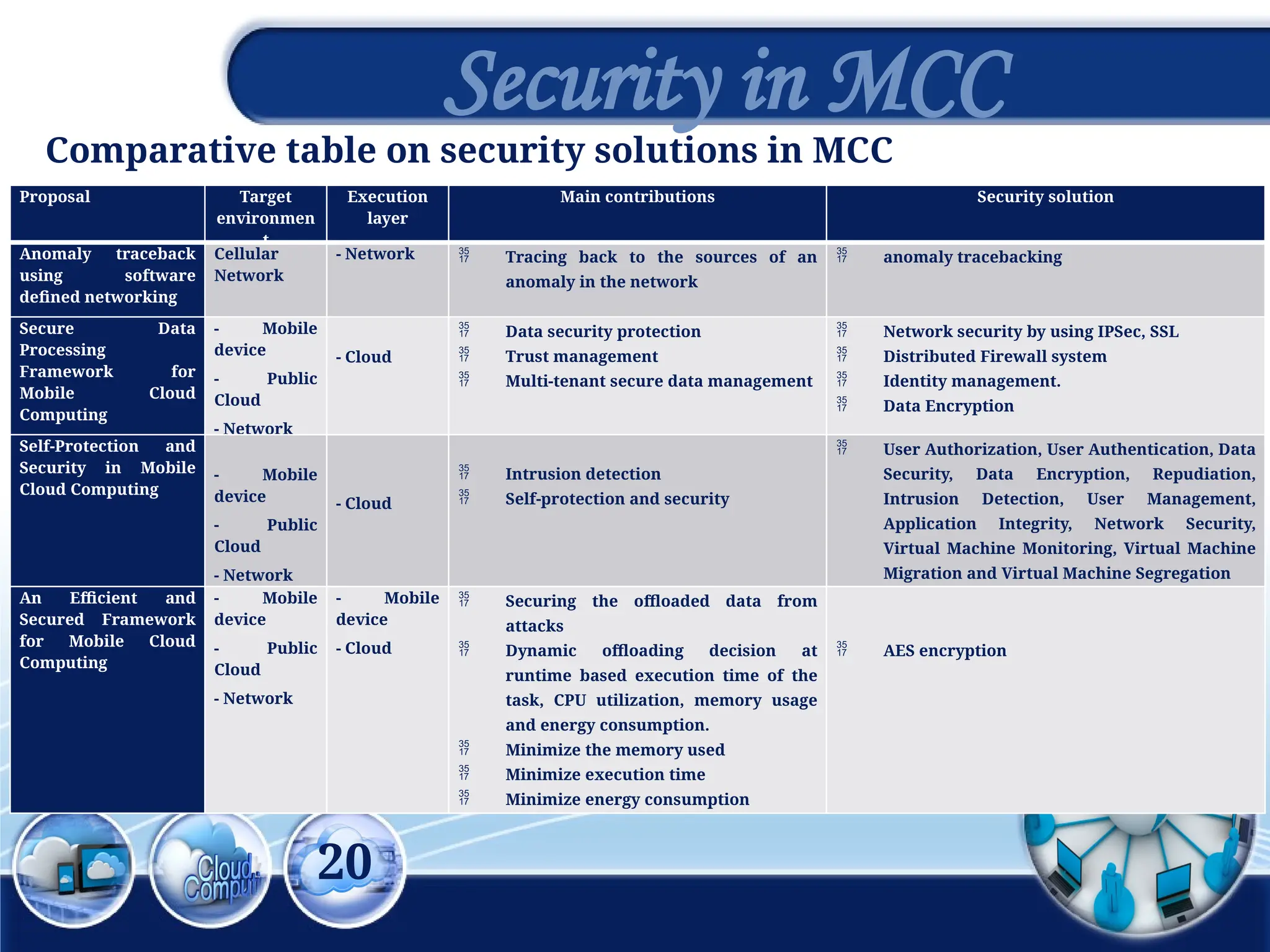
Comparative table on security solutions in MCC
Proposal Target
environmen
t
Execution
layer
Main contributions Security solution
Anomaly traceback
using software
defined networking
Cellular
Network
- Network  Tracing back to the sources of an
anomaly in the network
 anomaly tracebacking
Secure Data
Processing
Framework for
Mobile Cloud
Computing
- Mobile
device
- Public
Cloud
- Network
- Cloud
 Data security protection
 Trust management
 Multi-tenant secure data management
 Network security by using IPSec, SSL
 Distributed Firewall system
 Identity management.
 Data Encryption
Self-Protection and
Security in Mobile
Cloud Computing
- Mobile
device
- Public
Cloud
- Network
- Cloud
 Intrusion detection
 Self-protection and security
 User Authorization, User Authentication, Data
Security, Data Encryption, Repudiation,
Intrusion Detection, User Management,
Application Integrity, Network Security,
Virtual Machine Monitoring, Virtual Machine
Migration and Virtual Machine Segregation
An Efficient and
Secured Framework
for Mobile Cloud
Computing
- Mobile
device
- Public
Cloud
- Network
- Mobile
device
- Cloud
 Securing the offloaded data from
attacks
 Dynamic offloading decision at
runtime based execution time of the
task, CPU utilization, memory usage
and energy consumption.
 Minimize the memory used
 Minimize execution time
 Minimize energy consumption
 AES encryption
Mobile Cloud Computing Issues
1
2
1
Plan
Conclusion and perspectives
Mobile Cloud Computing
Advantages of Mobile Cloud
Introduction
Security in Mobile Cloud
2
2
Conclusion
 The concept of Cloud Computing provides a
new opportunity for Mobile Cloud
Computing’s development
 Since it serves as a powerful complement to
the resources-constraint nature of mobile
devices.
 However it still suffers from some issues
especially security issues.
23
Perspectives
 Proposing an approach that serves to keep the
vulnerable parts in the mobile device to be executed
and to deport the rest in a way to guarantee their
security.
 We inspired from the Centralized Organic Computing
 its architecture that is based on the principle of
observer / controller and characterized by Self-X
characteristics
 Self-Protect,
 Self-Heal,
 Self-Optimize,
 Self-Configure
 allows making decisions on the partitions that will be
deported in the Cloud and those that remain at the
mobile terminal level.
2
4
Questions/Responses
Thank you for your attention

Mobile Cloud Computing1 informatique.pptx

  • 1.
    The 3rd InternationalConference on Networking, Information Systems & Security MOBILE CLOUD COMPUTING: Architecture, Advantages and Security Issues Authors: Hadjer Fellah Abbes Laghror University Khenchela, Algeria Pr. Chaker Mezioud Pr. Batouche Mohamed Abdelhamid Mahri University Constantine, Algeria 2019/2020
  • 2.
    1 1 Plan Introduction Mobile Cloud Computing Advantagesof Mobile Cloud Mobile Cloud Computing Issues Conclusion Security in Mobile Cloud
  • 3.
    2 Introduction  The useof mobile devices have increasingly grown for different needs  This fast growing-area changes people’s lives and brings many advantages  Saving time  Working without obligation to be in a fixed position  Improving productivity
  • 4.
  • 5.
    4 Introduction LIMITES Computation power Battery life DataStorage Low Bandwidth Security SUPPORT COMPUTATION INTENSIVE APPLICATIONS
  • 6.
  • 7.
    1 6 Plan Mobile Cloud Computing Introduction Advantagesof Mobile Cloud Mobile Cloud Computing Issues Conclusion Security in Mobile Cloud
  • 8.
    7 Mobile Cloud Computing MCCis the use of Cloud services through mobile devices where data storage and/or processing occurs outside these devices Infinite storage Space High speed computing More reliable security • Improve the performance of mobile applications • Extend the battery life of the executing devices
  • 9.
    8 Mobile Cloud Computing COMPUTATIONOFFLOADING Mobile application Offloadeble Not Offloadeble Offloadeble Offloadeble Not Offloadeble Cloud Mobile Device Computation offloading should be performed only when the local execution consumes more time and energy than the remote execution.
  • 10.
    1 10 Plan Advantages of MobileCloud Introduction Mobile Cloud Computing Mobile Cloud Computing Issues Conclusion Security in Mobile Cloud
  • 11.
    1 1 Advantages 1 Extending Battery lifetime 2 Improvingdata storage capacity and processing power 3 Improving reliability 5 Scalability Dynamic provisioning 6 Multi tenancy 7 Ease of integration 4
  • 12.
    1 12 Plan Mobile Cloud ComputingIssues Mobile Cloud Computing Advantages of Mobile Cloud Introduction Conclusion Security in Mobile Cloud
  • 13.
    13 Resource poverty Law bandwidth latency MCCIssues Availability Heterogeneity Offloading or local execution Privacy Security
  • 14.
    Mobile Cloud ComputingIssues 1 14 Plan Security in Mobile Cloud Mobile Cloud Computing Advantages of Mobile Cloud Introduction Conclusion
  • 15.
  • 16.
    MOBILE DEVICES’ SECURITY SoftwareVulnerabilities Malware Other risks 16 Security in MCC Application Software Operating System Miss-operate the devices Loss or stole devices
  • 17.
    17 Introduction CLOUD SECURITY System vulnerabilities InsecureInterfaces and APIs Account Hijacking Malicious insiders Data loss Denial of service Shared technology vulnerabilities
  • 18.
    MOBILE NETWORK SECURITY 18 Securityin MCC  Wireless networks often pass sensitive information  a lot of vulnerabilities may still occur during data transfer  Wi-Fi via free hotspots can provide the hackers the means to  obtain personal data about device owners  unauthorized access  installing a malware or any other malicious behavior  All Wi-Fi hotspots are susceptible to “man in the middle” attacks where a hacker intercepts communications between a user and a Wi-Fi  The interception can also occur through the Internet, by way of tapped telephone lines or intercepted radio transmissions.
  • 19.
    1 9 Security in MCC Comparativetable on security solutions in MCC Proposal Target environment Execution layer Main contributions Security solution Virtualized in-cloud security services for mobile devices Mobile device Mobile device Network  Detection of malicious software  Reduces on-device software complexity  Reduce on-device resource consumption  Antivirus  SMS Spam Filtering  Phishing Detection  Using the Centralized Blacklists( malicious entities) Paranoid Android: versatile protection for smartphones -Mobile device -Mobile device -Cloud  Multiple security checks simultaneously without overburdening the device  Transparent backup of all user data in the cloud  Minimize energy consumption  Encryption  Secure storage with message authentication code (HMAC code)  Antivirus scanning  Attack detection by Dynamic Taint Analysis A Cloud-based Intrusion Detection and Response System for Mobile Phones Mobile device Cloud  Light resource requierement  real-time and accurate intrusion detection  Intrusion Detection Systems (IDS) A multi-agent system for smartphone intrusion detection framework Mobile device -Mobile phone -Cloud server  Malicious detection (SMS)  Light resource requierement (memmory and energy)  Intrusion Detection Systems (signature- based and anomaly-based detection) Cellpot: A concept for next generation cellular network honeypots Cellular Network -Network  Collect and mitigate threats against the cellular network  DDoS attacks detection  Anomaly detection system  A prevention honeypot to dwarf attacks  Sensors to collect thraets  Filters  SMS Spam Prevention  Mobile Theft Prevention  Malware and Phishing Prevention
  • 20.
    20 Security in MCC Comparativetable on security solutions in MCC Proposal Target environmen t Execution layer Main contributions Security solution Anomaly traceback using software defined networking Cellular Network - Network  Tracing back to the sources of an anomaly in the network  anomaly tracebacking Secure Data Processing Framework for Mobile Cloud Computing - Mobile device - Public Cloud - Network - Cloud  Data security protection  Trust management  Multi-tenant secure data management  Network security by using IPSec, SSL  Distributed Firewall system  Identity management.  Data Encryption Self-Protection and Security in Mobile Cloud Computing - Mobile device - Public Cloud - Network - Cloud  Intrusion detection  Self-protection and security  User Authorization, User Authentication, Data Security, Data Encryption, Repudiation, Intrusion Detection, User Management, Application Integrity, Network Security, Virtual Machine Monitoring, Virtual Machine Migration and Virtual Machine Segregation An Efficient and Secured Framework for Mobile Cloud Computing - Mobile device - Public Cloud - Network - Mobile device - Cloud  Securing the offloaded data from attacks  Dynamic offloading decision at runtime based execution time of the task, CPU utilization, memory usage and energy consumption.  Minimize the memory used  Minimize execution time  Minimize energy consumption  AES encryption
  • 21.
    Mobile Cloud ComputingIssues 1 2 1 Plan Conclusion and perspectives Mobile Cloud Computing Advantages of Mobile Cloud Introduction Security in Mobile Cloud
  • 22.
    2 2 Conclusion  The conceptof Cloud Computing provides a new opportunity for Mobile Cloud Computing’s development  Since it serves as a powerful complement to the resources-constraint nature of mobile devices.  However it still suffers from some issues especially security issues.
  • 23.
    23 Perspectives  Proposing anapproach that serves to keep the vulnerable parts in the mobile device to be executed and to deport the rest in a way to guarantee their security.  We inspired from the Centralized Organic Computing  its architecture that is based on the principle of observer / controller and characterized by Self-X characteristics  Self-Protect,  Self-Heal,  Self-Optimize,  Self-Configure  allows making decisions on the partitions that will be deported in the Cloud and those that remain at the mobile terminal level.
  • 24.

Editor's Notes

  • #1 Good morning, My name is Hadjer Fellah, I’m from Abbes Laghror University/Algeria. Today, I’m going to present my work untitled “Mobile Cloud Computing: architecture, advantages and security issues”.
  • #2 In today’s presentation, I’ll start with an introduction Next, I’ll pass to describe our field of research: the Mobile Cloud Computing Then, I’ll explain the advantages of this technology And also its issues in the next point Before concluding our presentation, I’ll highlight some security problems and give a comparative table on previous works.
  • #3 In recent years, the use of mobile devices; such as Smartphones, personal digital assistants, tablets, and others, have increasingly grown in people’s daily life for different needs. This fast growing-area changes people’s lives and brings many advantages such as saving time, working without obligation to be in a fixed position and improving productivity.
  • #4 New smart phones are lunched with faster CPUs, larger storage, and larger screens. The bandwidth of wireless networks has also increased from kilobits per second to megabits per second in just a few years
  • #5 However, it is still difficult to support computation-intensive applications (e.g., image processing, augmented reality, face recognition) on mobile devices, where they still have many limitations in terms of battery life, computation power, data storage, low bandwidth and security.
  • #6  To overcome these limitations of Mobile Computing and with the emergence of cloud computing, mobile computing has been combined with Cloud Computing giving birth to a new technology called Mobile Cloud Computing (MCC). Here, data will be offloaded into the cloud from mobile devices for computation or storage
  • #7 now, we pass to describe mobile cloud computin
  • #8 MCC can be defined as the use of cloud services through mobile devices where data storage and/or processing (in most of times) occurs outside these devices on a remote resource rich server   The Cloud servers can offer a theoretically infinite storage space, high speed computing and more reliable security compared to what any existent mobile devices can provide. This can dramatically improve the performance of mobile applications and extend the battery life of the executing devices.
  • #9 The task of moving computation intensive application components to remote cloud servers is called “Computation Offloading” In order to extend and enhance the mobile device’s capabilities, these applications are partitioned to components, which are offloaded to remote servers for remote execution
  • #13 Despite the previous advantages, MCC systems still face some issues which have become a barrier in its rapid growth
  • #15 Since MCC is the combination of cloud computing and mobile computing, security issues are then inherited from both fields making it vulnerable to a wider range of attacks than traditional mobile computing systems. User’s data can be a target for attackers in MCC at multiple locations: mobile device, cloud or even the link utilized in transferring data and code to cloud
  • #18 Wireless networks often pass sensitive information (credit cards numbers, passwords …etc.) and a lot of vulnerabilities may still occur during data transfer from the cloud to the mobile device and vice versa
  • #19 in this table we summarized some works that have been made in MCC security field and highlighted for each work, which environment it targets, its execution layer, its main contributions and the security solution that have been made .
  • #22 The concept of cloud computing provides a new opportunity for mobile cloud computing’s development since it serves as a powerful complement to the resources-constraint nature of mobile devices. However it still suffers from some issues especially security issue.