Search . . .
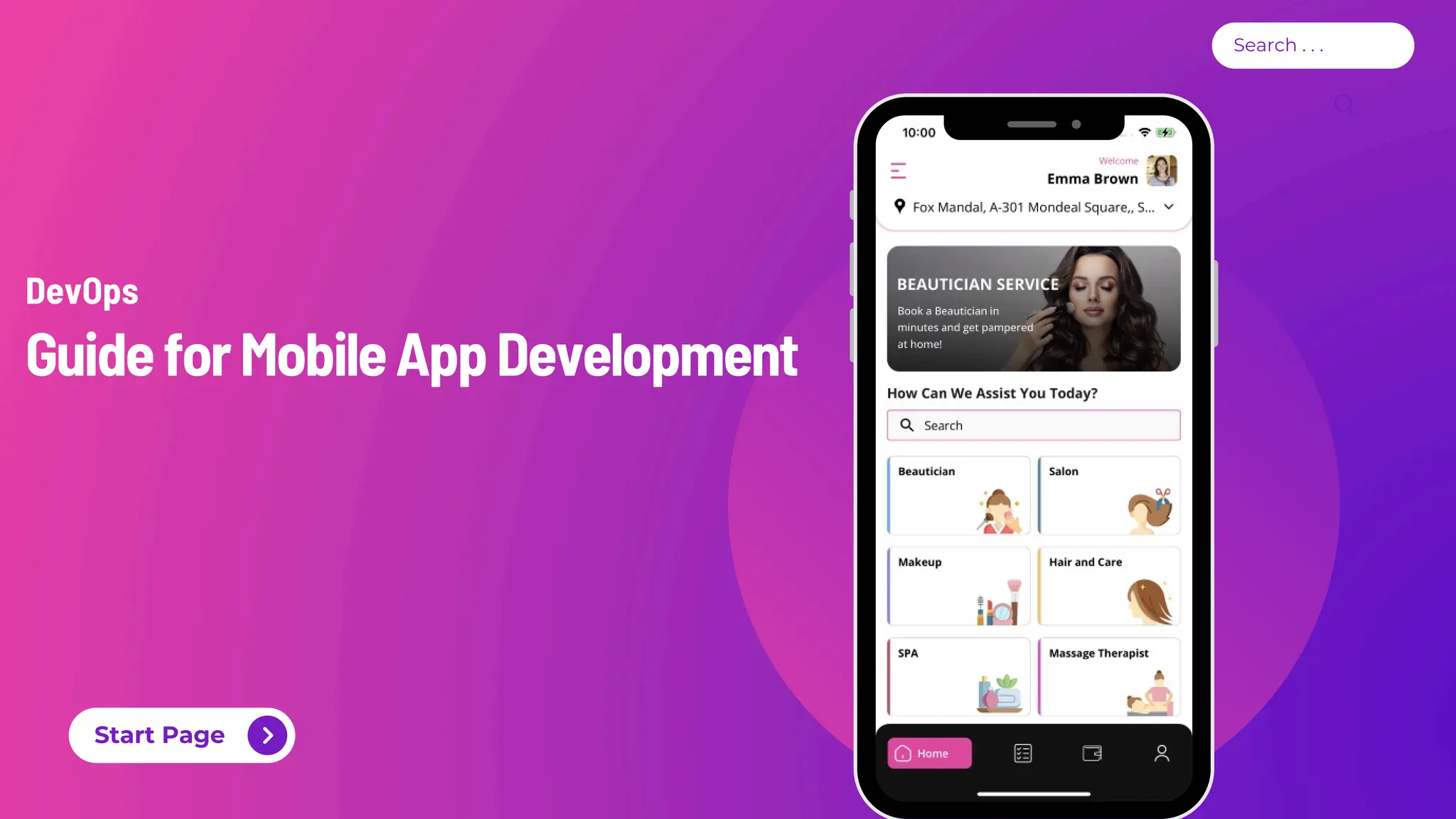
GuideforMobileAppDevelopment
DevOps
Start Page
Search . . .
The Mobile App Development landscape is undergoing a
gradual shift towards adopting DevOps practices as
mobile apps become increasingly complex. Moreover,
modern app development teams are realizing the
limitations of traditional app development approaches.
In this blog, learn what DevOps is and what it means for
the mobile app market.
Guide For Mobile App Development
To Understand DevOps
More Info
More Info
Search . . .
The growing popularity of DevOps, with its focus on
agility, automation, and collaboration between teams,
has led mobile developers to take notice. By
incorporating key DevOps rules, many top mobile app
development teams have started streamlining their
processes and culture. The results speak for themselves,
as improved release cycles, better testing, and faster
feedback are found to be better. Let’s understand what
the DevOps model does.
Introduction
Search . . .
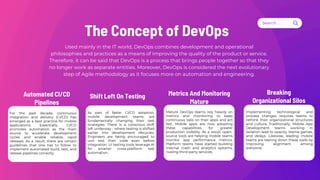
Automated CI/CD
Pipelines
Used mainly in the IT world, DevOps combines development and operational
philosophies and practices as a means of improving the quality of the product or service.
Therefore, it can be said that DevOps is a process that brings people together so that they
no longer work as separate entities. Moreover, DevOps is considered the next evolutionary
step of Agile methodology as it focuses more on automation and engineering.
The Concept of DevOps
For the past decade, continuous
integration and delivery (CI/CD) has
emerged as a best practice for mobile
applications. Essentially, CI/CD
promotes automation as the main
source to accelerate development
cycles and enable reliable, rapid
releases. As a result, there are certain
guidelines that one has to follow to
implement automated build, test, and
release pipelines correctly.
Shift Left On Testing
As part of faster CI/CD adoption,
mobile development teams are
fundamentally changing their test
strategies. There is a conscious shift
left underway - where testing is shifted
earlier into development lifecycles.
Engineers are being encouraged to
unit test their code even before
integration. UI testing tools leverage AI
for smarter cross-platform test
automation.
Metrics And Monitoring
Mature
Mature DevOps teams rely heavily on
metrics and monitoring to keep
continuous tabs on their apps and act
fast. Mobile apps are now adopting
these capabilities for greater
production visibility. As a result, open-
source tools are helping mobile teams
monitor app performance metrics.
Platform teams have started building
internal crash and analytics systems,
rivaling third-party services.
Breaking
Organizational Silos
Implementing technological and
process changes requires teams to
rethink their organizational structures
and culture. Traditionally, Mobile App
Development teams working in
isolation lead to opacity, blame games,
and delays. Likewise, leading mobile
teams are tearing down these walls by
improving alignment among
everyone.
Search . . .
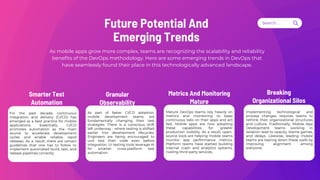
Smarter Test
Automation
As mobile apps grow more complex, teams are recognizing the scalability and reliability
benefits of the DevOps methodology. Here are some emerging trends in DevOps that
have seamlessly found their place in this technologically advanced landscape.
Future Potential And
Emerging Trends
For the past decade, continuous
integration and delivery (CI/CD) has
emerged as a best practice for mobile
applications. Essentially, CI/CD
promotes automation as the main
source to accelerate development
cycles and enable reliable, rapid
releases. As a result, there are certain
guidelines that one has to follow to
implement automated build, test, and
release pipelines correctly.
Granular
Observability
As part of faster CI/CD adoption,
mobile development teams are
fundamentally changing their test
strategies. There is a conscious shift
left underway - where testing is shifted
earlier into development lifecycles.
Engineers are being encouraged to
unit test their code even before
integration. UI testing tools leverage AI
for smarter cross-platform test
automation.
Metrics And Monitoring
Mature
Mature DevOps teams rely heavily on
metrics and monitoring to keep
continuous tabs on their apps and act
fast. Mobile apps are now adopting
these capabilities for greater
production visibility. As a result, open-
source tools are helping mobile teams
monitor app performance metrics.
Platform teams have started building
internal crash and analytics systems,
rivaling third-party services.
Breaking
Organizational Silos
Implementing technological and
process changes requires teams to
rethink their organizational structures
and culture. Traditionally, Mobile App
Development teams working in
isolation lead to opacity, blame games,
and delays. Likewise, leading mobile
teams are tearing down these walls by
improving alignment among
everyone.
What’s Next?
Search . . .
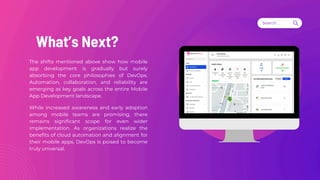
The shifts mentioned above show how mobile
app development is gradually but surely
absorbing the core philosophies of DevOps.
Automation, collaboration, and reliability are
emerging as key goals across the entire Mobile
App Development landscape.
While increased awareness and early adoption
among mobile teams are promising, there
remains significant scope for even wider
implementation. As organizations realize the
benefits of cloud automation and alignment for
their mobile apps, DevOps is poised to become
truly universal.
Conclusion
Search . . .
The maturity of the cloud, test automation,
observability, and platform capabilities will all
shape how rapidly mobile makes the transition.
The mobile landscape will transform towards
highly automated, collaborative, and insight-
driven application lifecycles - all central tenets
of DevOps. The benefits are too tangible, even
now, for mobile teams to ignore.
More Info
Contact Us
Search . . .
+1 (858) 427-0668
Email
sales@ondemandclone.com
Website
Phone
www.ondemandclone.com

Mobile App Development Projects Understand DevOps.pdf

  • 1.
    Search . .. GuideforMobileAppDevelopment DevOps Start Page
  • 2.
    Search . .. The Mobile App Development landscape is undergoing a gradual shift towards adopting DevOps practices as mobile apps become increasingly complex. Moreover, modern app development teams are realizing the limitations of traditional app development approaches. In this blog, learn what DevOps is and what it means for the mobile app market. Guide For Mobile App Development To Understand DevOps More Info
  • 3.
    More Info Search .. . The growing popularity of DevOps, with its focus on agility, automation, and collaboration between teams, has led mobile developers to take notice. By incorporating key DevOps rules, many top mobile app development teams have started streamlining their processes and culture. The results speak for themselves, as improved release cycles, better testing, and faster feedback are found to be better. Let’s understand what the DevOps model does. Introduction
  • 4.
    Search . .. Automated CI/CD Pipelines Used mainly in the IT world, DevOps combines development and operational philosophies and practices as a means of improving the quality of the product or service. Therefore, it can be said that DevOps is a process that brings people together so that they no longer work as separate entities. Moreover, DevOps is considered the next evolutionary step of Agile methodology as it focuses more on automation and engineering. The Concept of DevOps For the past decade, continuous integration and delivery (CI/CD) has emerged as a best practice for mobile applications. Essentially, CI/CD promotes automation as the main source to accelerate development cycles and enable reliable, rapid releases. As a result, there are certain guidelines that one has to follow to implement automated build, test, and release pipelines correctly. Shift Left On Testing As part of faster CI/CD adoption, mobile development teams are fundamentally changing their test strategies. There is a conscious shift left underway - where testing is shifted earlier into development lifecycles. Engineers are being encouraged to unit test their code even before integration. UI testing tools leverage AI for smarter cross-platform test automation. Metrics And Monitoring Mature Mature DevOps teams rely heavily on metrics and monitoring to keep continuous tabs on their apps and act fast. Mobile apps are now adopting these capabilities for greater production visibility. As a result, open- source tools are helping mobile teams monitor app performance metrics. Platform teams have started building internal crash and analytics systems, rivaling third-party services. Breaking Organizational Silos Implementing technological and process changes requires teams to rethink their organizational structures and culture. Traditionally, Mobile App Development teams working in isolation lead to opacity, blame games, and delays. Likewise, leading mobile teams are tearing down these walls by improving alignment among everyone.
  • 5.
    Search . .. Smarter Test Automation As mobile apps grow more complex, teams are recognizing the scalability and reliability benefits of the DevOps methodology. Here are some emerging trends in DevOps that have seamlessly found their place in this technologically advanced landscape. Future Potential And Emerging Trends For the past decade, continuous integration and delivery (CI/CD) has emerged as a best practice for mobile applications. Essentially, CI/CD promotes automation as the main source to accelerate development cycles and enable reliable, rapid releases. As a result, there are certain guidelines that one has to follow to implement automated build, test, and release pipelines correctly. Granular Observability As part of faster CI/CD adoption, mobile development teams are fundamentally changing their test strategies. There is a conscious shift left underway - where testing is shifted earlier into development lifecycles. Engineers are being encouraged to unit test their code even before integration. UI testing tools leverage AI for smarter cross-platform test automation. Metrics And Monitoring Mature Mature DevOps teams rely heavily on metrics and monitoring to keep continuous tabs on their apps and act fast. Mobile apps are now adopting these capabilities for greater production visibility. As a result, open- source tools are helping mobile teams monitor app performance metrics. Platform teams have started building internal crash and analytics systems, rivaling third-party services. Breaking Organizational Silos Implementing technological and process changes requires teams to rethink their organizational structures and culture. Traditionally, Mobile App Development teams working in isolation lead to opacity, blame games, and delays. Likewise, leading mobile teams are tearing down these walls by improving alignment among everyone.
  • 6.
    What’s Next? Search .. . The shifts mentioned above show how mobile app development is gradually but surely absorbing the core philosophies of DevOps. Automation, collaboration, and reliability are emerging as key goals across the entire Mobile App Development landscape. While increased awareness and early adoption among mobile teams are promising, there remains significant scope for even wider implementation. As organizations realize the benefits of cloud automation and alignment for their mobile apps, DevOps is poised to become truly universal.
  • 7.
    Conclusion Search . .. The maturity of the cloud, test automation, observability, and platform capabilities will all shape how rapidly mobile makes the transition. The mobile landscape will transform towards highly automated, collaborative, and insight- driven application lifecycles - all central tenets of DevOps. The benefits are too tangible, even now, for mobile teams to ignore. More Info
  • 8.
    Contact Us Search .. . +1 (858) 427-0668 Email sales@ondemandclone.com Website Phone www.ondemandclone.com