Dealing with Legal Matters
What is LAW?
Lets Acknowledge Wisdom
Sources of Law in Pakistan
•The Constitution
•The Legislature
•The Judiciary
•The Executive
The Constitution
•Approved in1973
•Consisted of 280 Articles, 6 Schedules
•Salient Features:
•Fundamental Rights – The Basic Purpose
•Legislature – The Law Making Process
•Judiciary – The Protector (Rule of Law)
•Executive – The Government
Fundamental Rights
Rights to Life, Property, Education, Fair trial,
Information, Non-discrimination, Association,
Movement, Trade, Business, Profession etc.
Protection of Fundamental Rights?
The Legislature
• Parliamentary System
• Majlis-i-Shoora
The National Assembly
The Senate
•The Provincial Assemblies
The Judiciary
• The Supreme Court
• The High Courts
The Executive
• Administrative Law
OR
• Delegated Legislation
• Administrative Tribunals / Courts
The Executive (Service Laws)
Service laws for WAPDA’s Employees
WAPDA Rules / Civil Servants Act,1973
Services Tribunal Act, 1973
Master-Servant Rule for Companies’ Employees
•Civil Procedure Code, 1908 / Civil Courts
•Writ Jurisdiction of High Courts
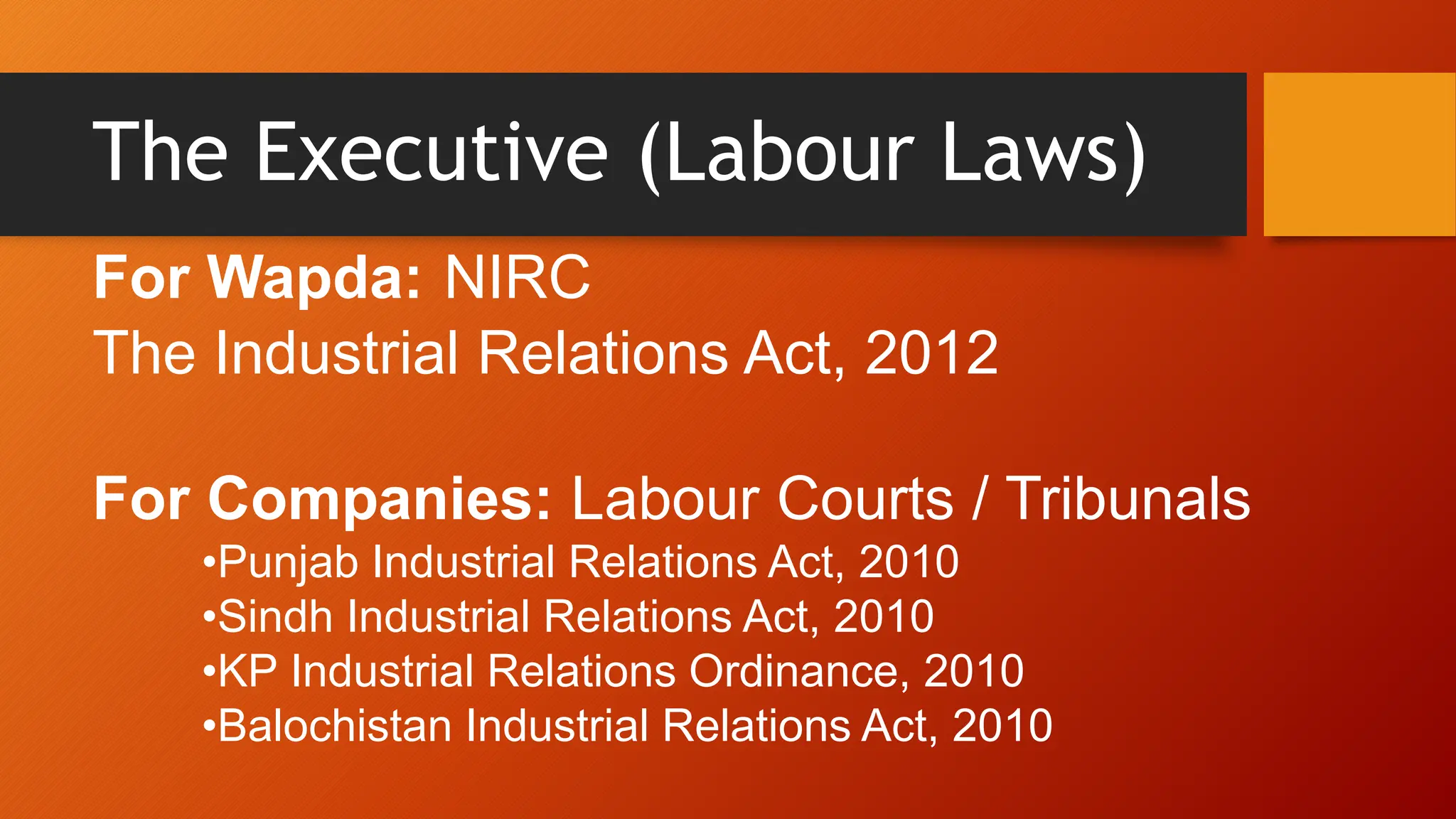
The Executive (Labour Laws)
For Wapda: NIRC
The Industrial Relations Act, 2012
For Companies: Labour Courts / Tribunals
•Punjab Industrial Relations Act, 2010
•Sindh Industrial Relations Act, 2010
•KP Industrial Relations Ordinance, 2010
•Balochistan Industrial Relations Act, 2010
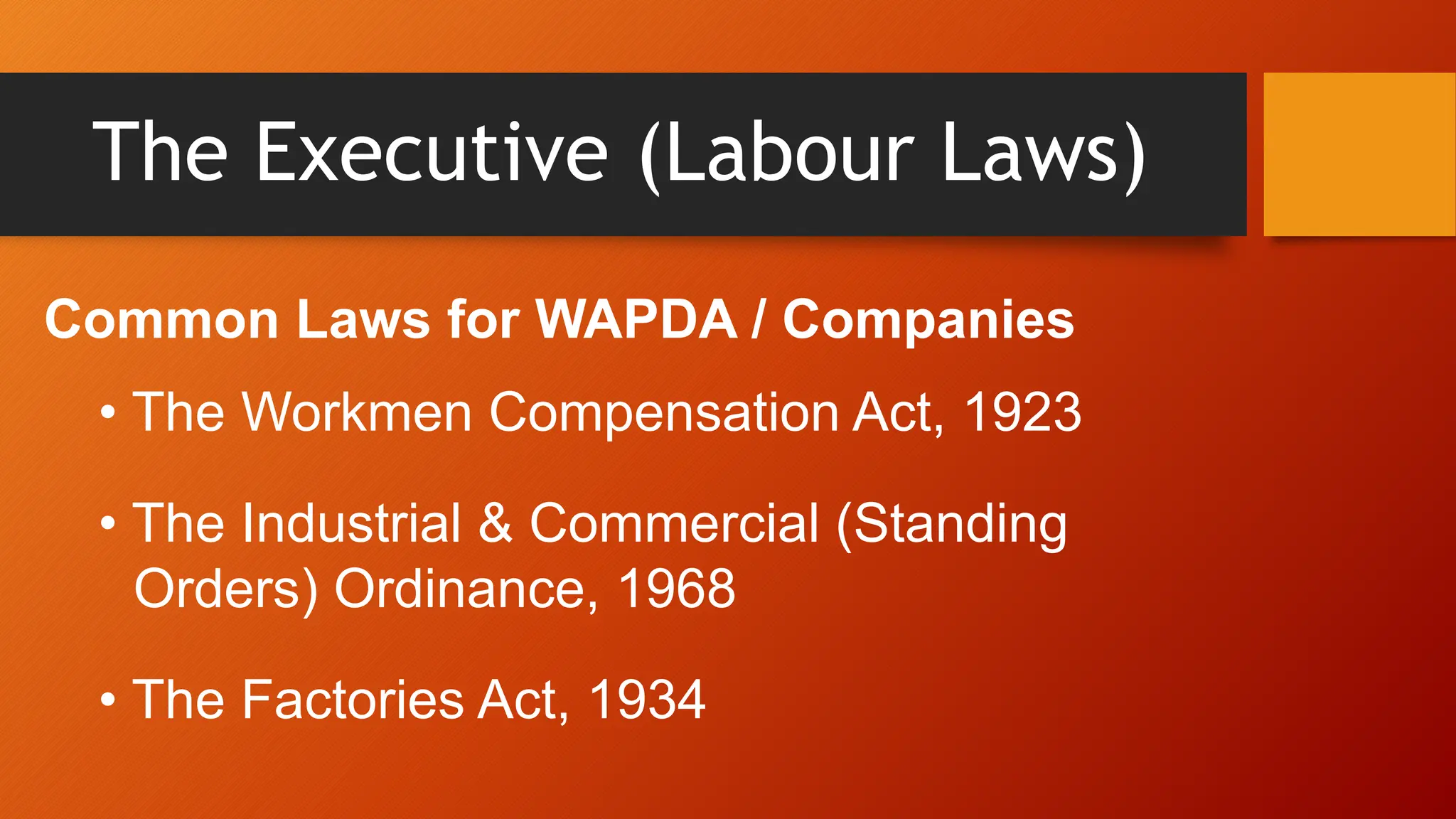
The Executive (Labour Laws)
Common Laws for WAPDA / Companies
• The Workmen Compensation Act, 1923
• The Industrial & Commercial (Standing
Orders) Ordinance, 1968
• The Factories Act, 1934
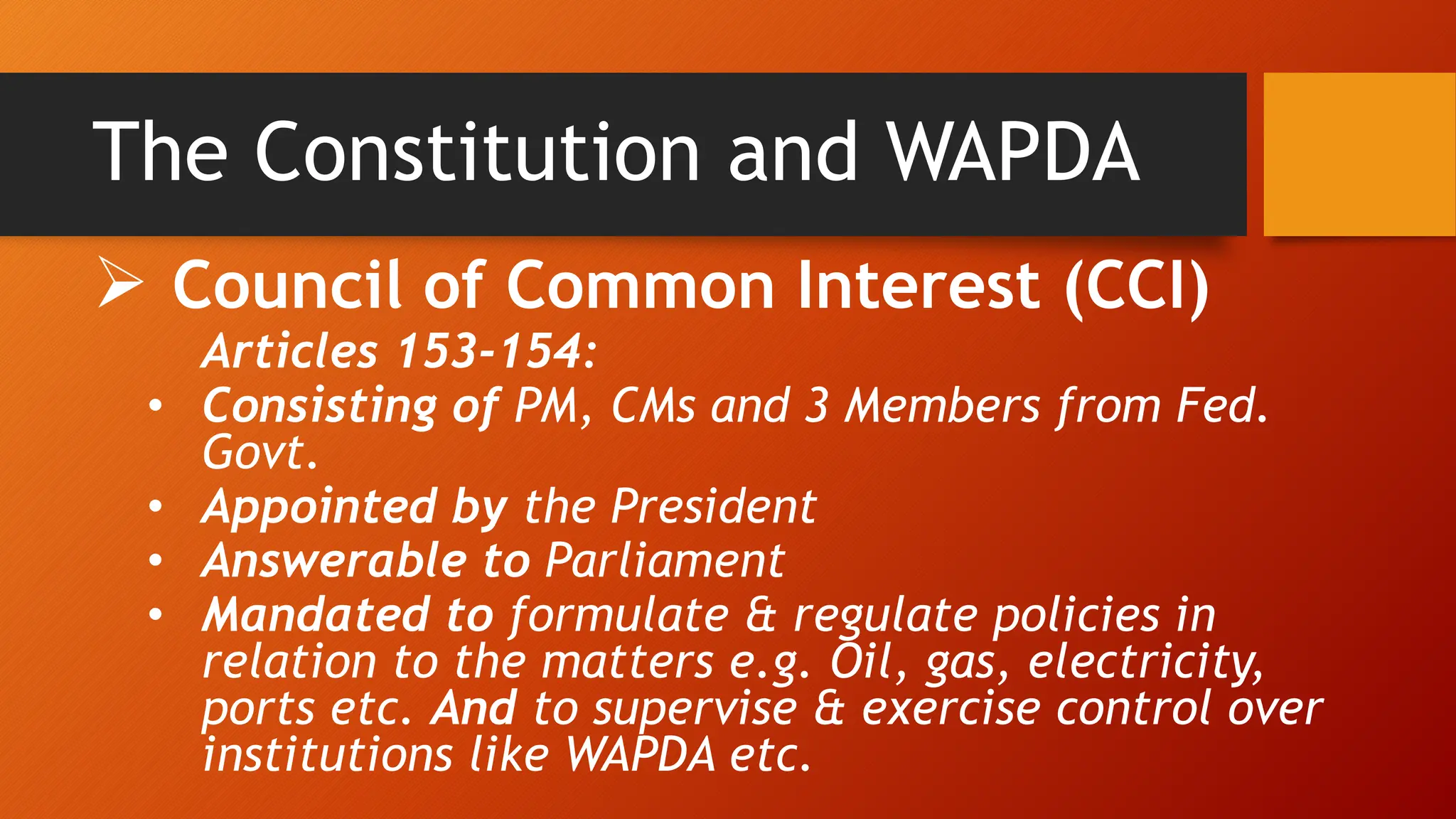
The Constitution and WAPDA
 Council of Common Interest (CCI)
Articles 153-154:
• Consisting of PM, CMs and 3 Members from Fed.
Govt.
• Appointed by the President
• Answerable to Parliament
• Mandated to formulate & regulate policies in
relation to the matters e.g. Oil, gas, electricity,
ports etc. And to supervise & exercise control over
institutions like WAPDA etc.
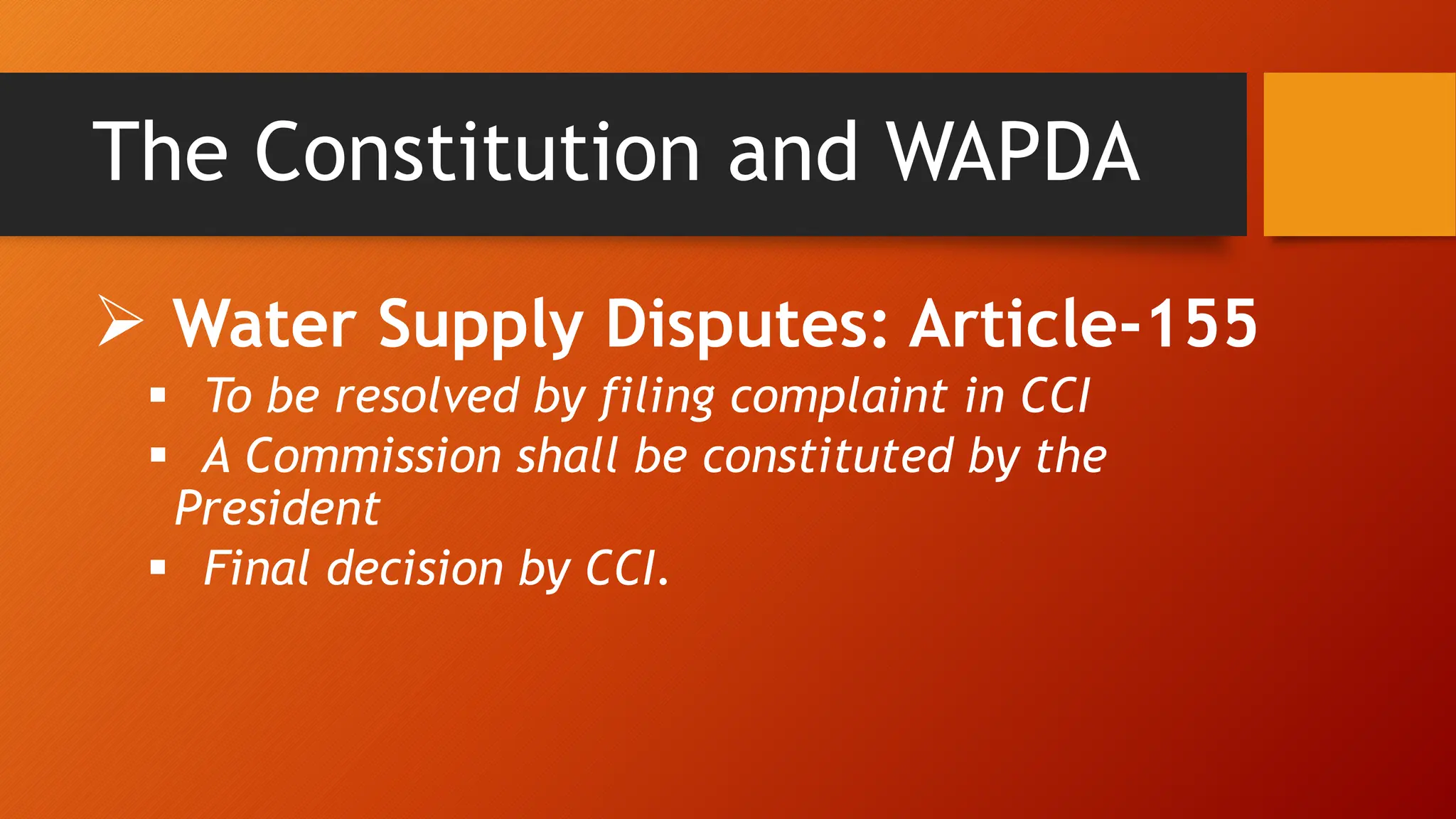
The Constitution and WAPDA
 Water Supply Disputes: Article-155
 To be resolved by filing complaint in CCI
 A Commission shall be constituted by the
President
 Final decision by CCI.
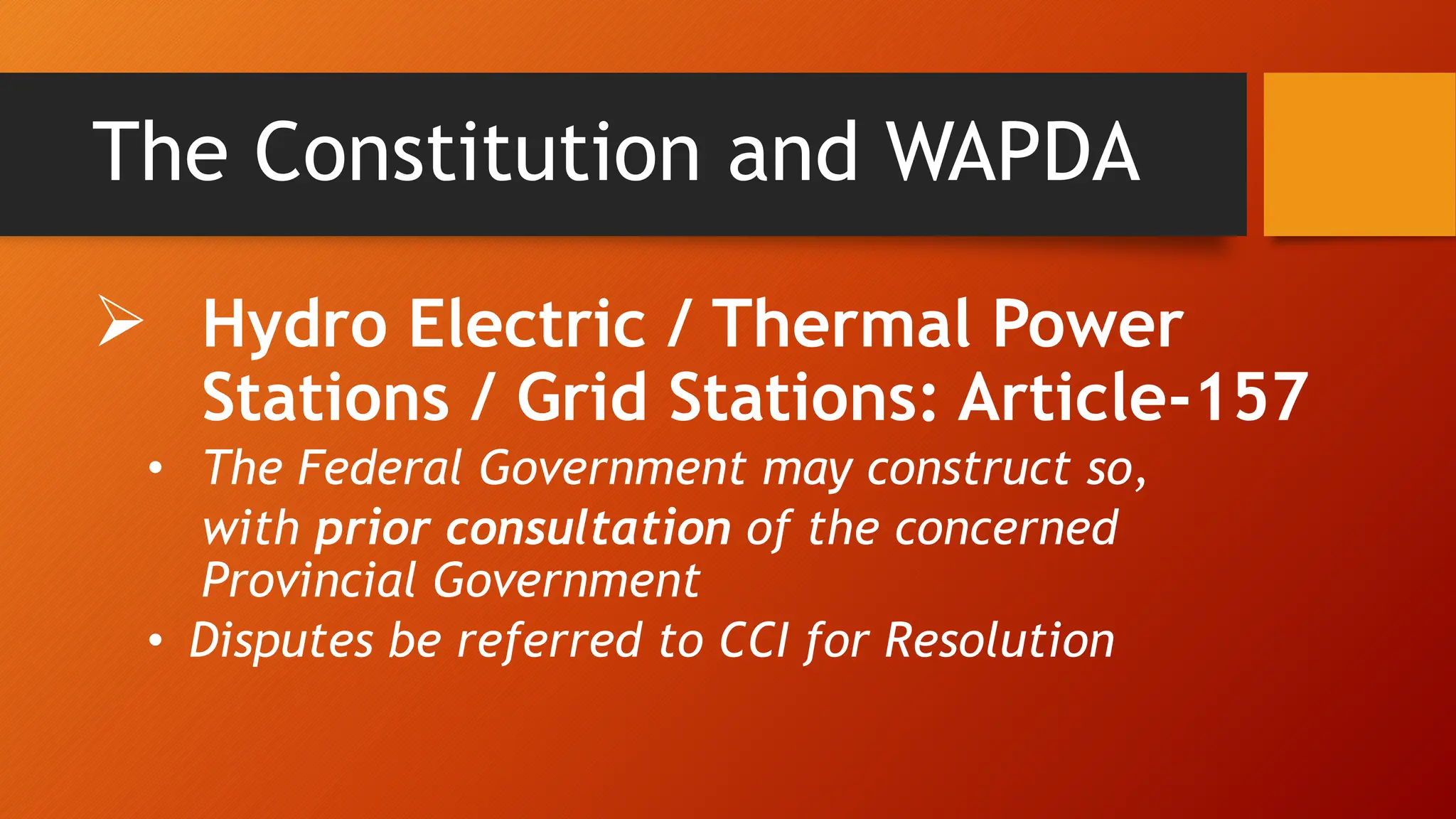
The Constitution and WAPDA
 Hydro Electric / Thermal Power
Stations / Grid Stations: Article-157
• The Federal Government may construct so,
with prior consultation of the concerned
Provincial Government
• Disputes be referred to CCI for Resolution
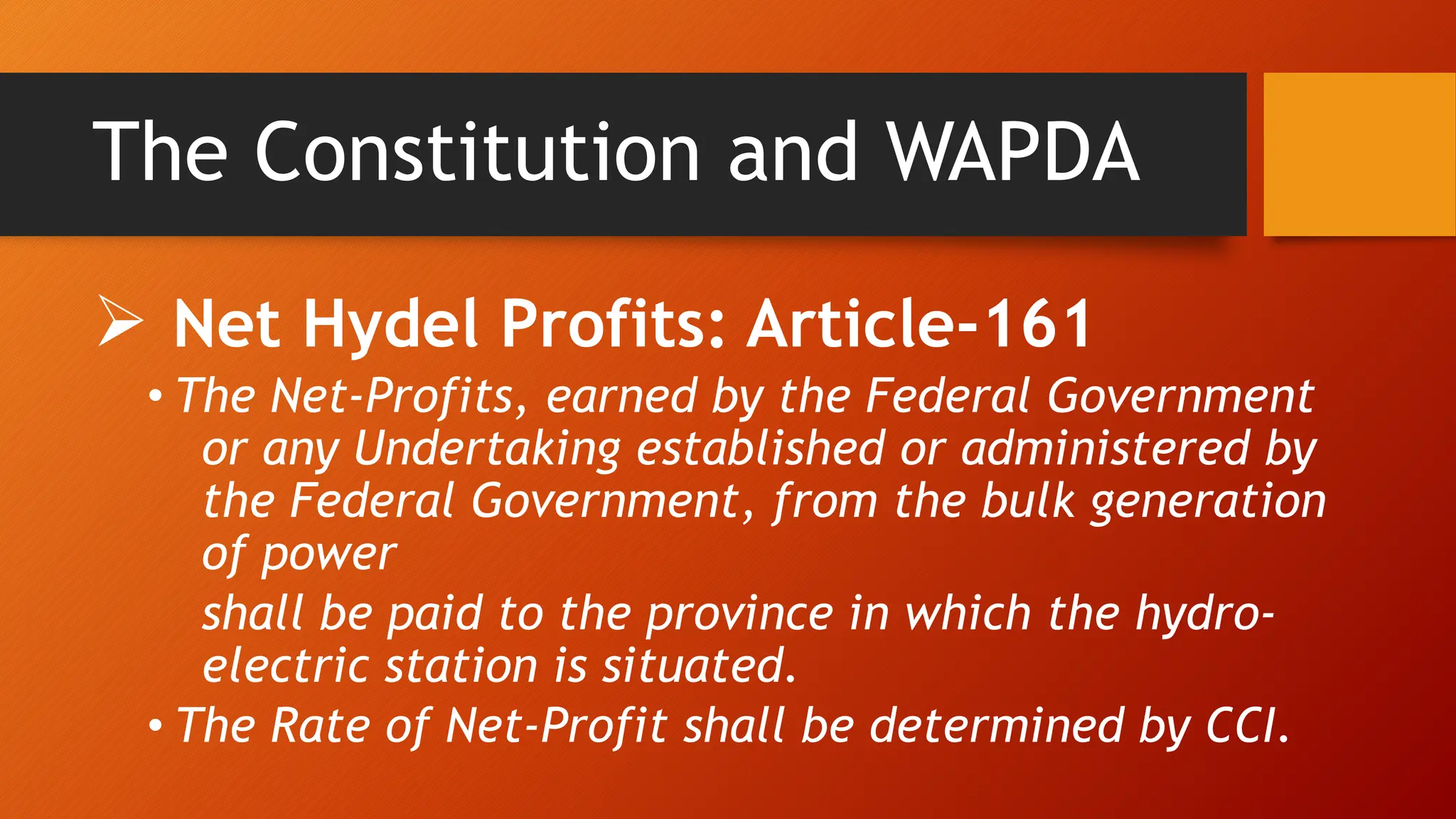
The Constitution and WAPDA
 Net Hydel Profits: Article-161
• The Net-Profits, earned by the Federal Government
or any Undertaking established or administered by
the Federal Government, from the bulk generation
of power
shall be paid to the province in which the hydro-
electric station is situated.
• The Rate of Net-Profit shall be determined by CCI.
Legal Framework
 WAPDA
 DISCOs
 GENCOs
 NTDC
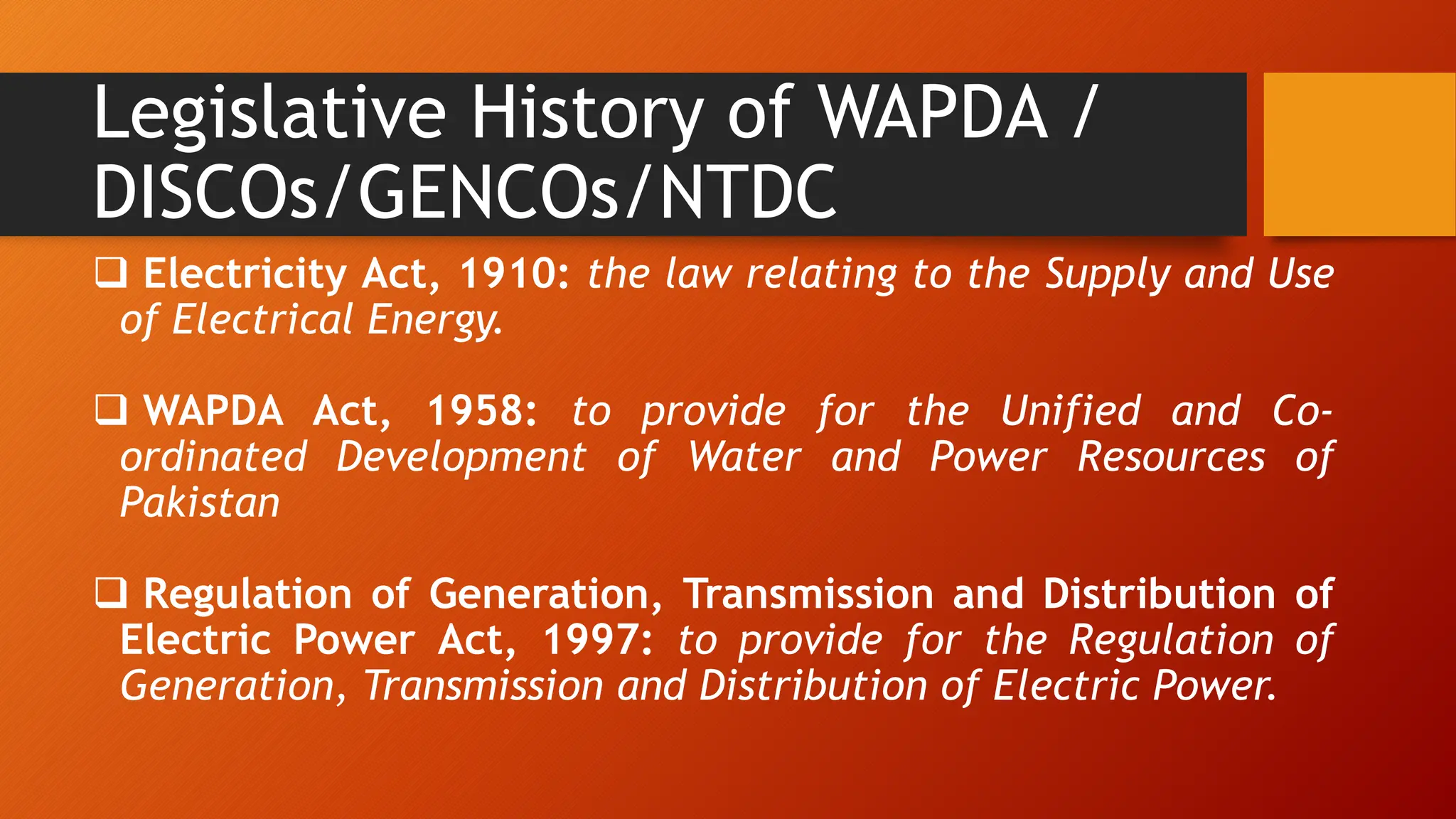
Legislative History of WAPDA /
DISCOs/GENCOs/NTDC
 Electricity Act, 1910: the law relating to the Supply and Use
of Electrical Energy.
 WAPDA Act, 1958: to provide for the Unified and Co-
ordinated Development of Water and Power Resources of
Pakistan
 Regulation of Generation, Transmission and Distribution of
Electric Power Act, 1997: to provide for the Regulation of
Generation, Transmission and Distribution of Electric Power.
Legislative History of WAPDA /
DISCOs/GENCOs/NTDC
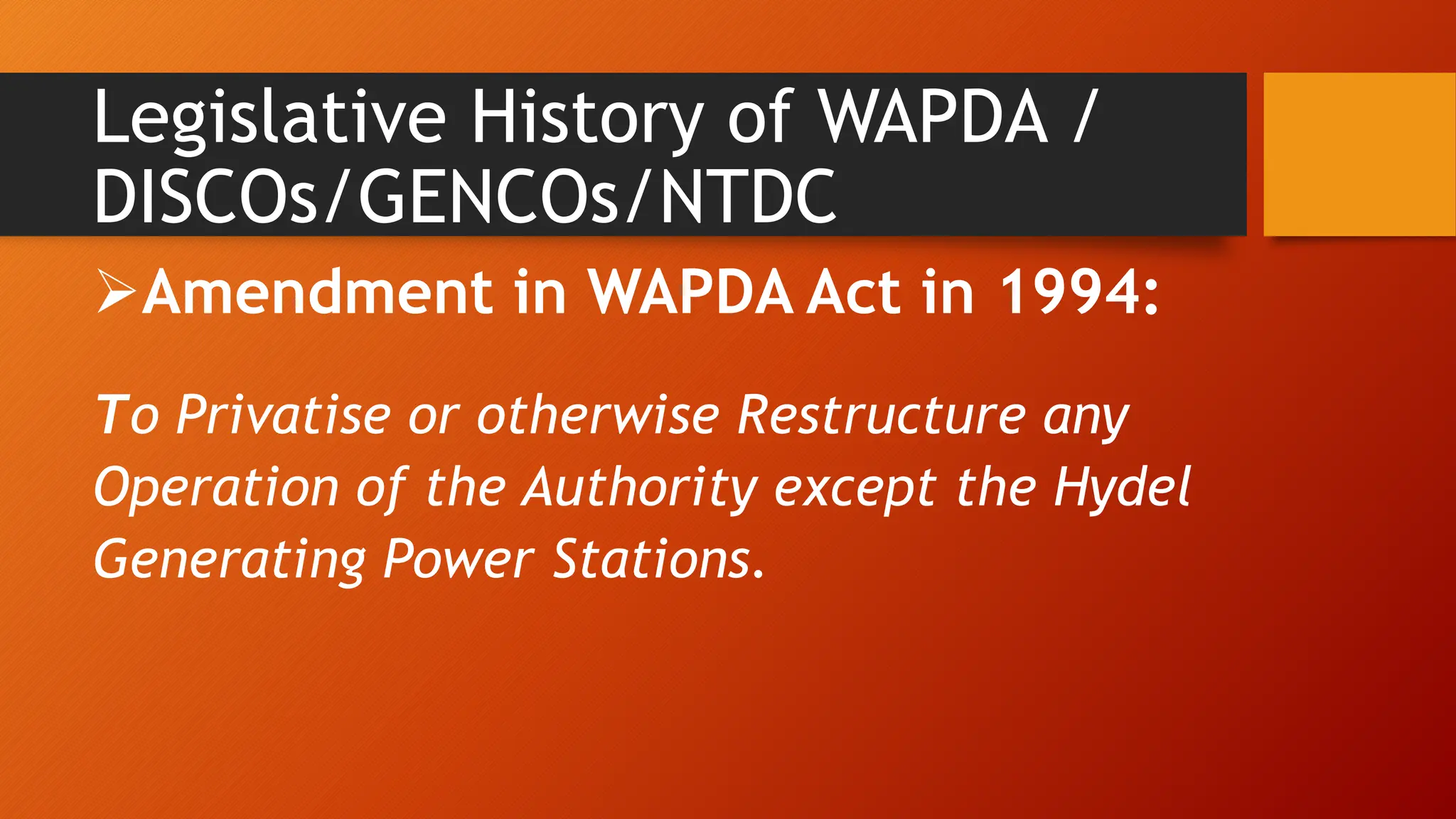
Amendment in WAPDA Act in 1994:
To Privatise or otherwise Restructure any
Operation of the Authority except the Hydel
Generating Power Stations.
Legislative History of WAPDA /
DISCOs/GENCOs/NTDC
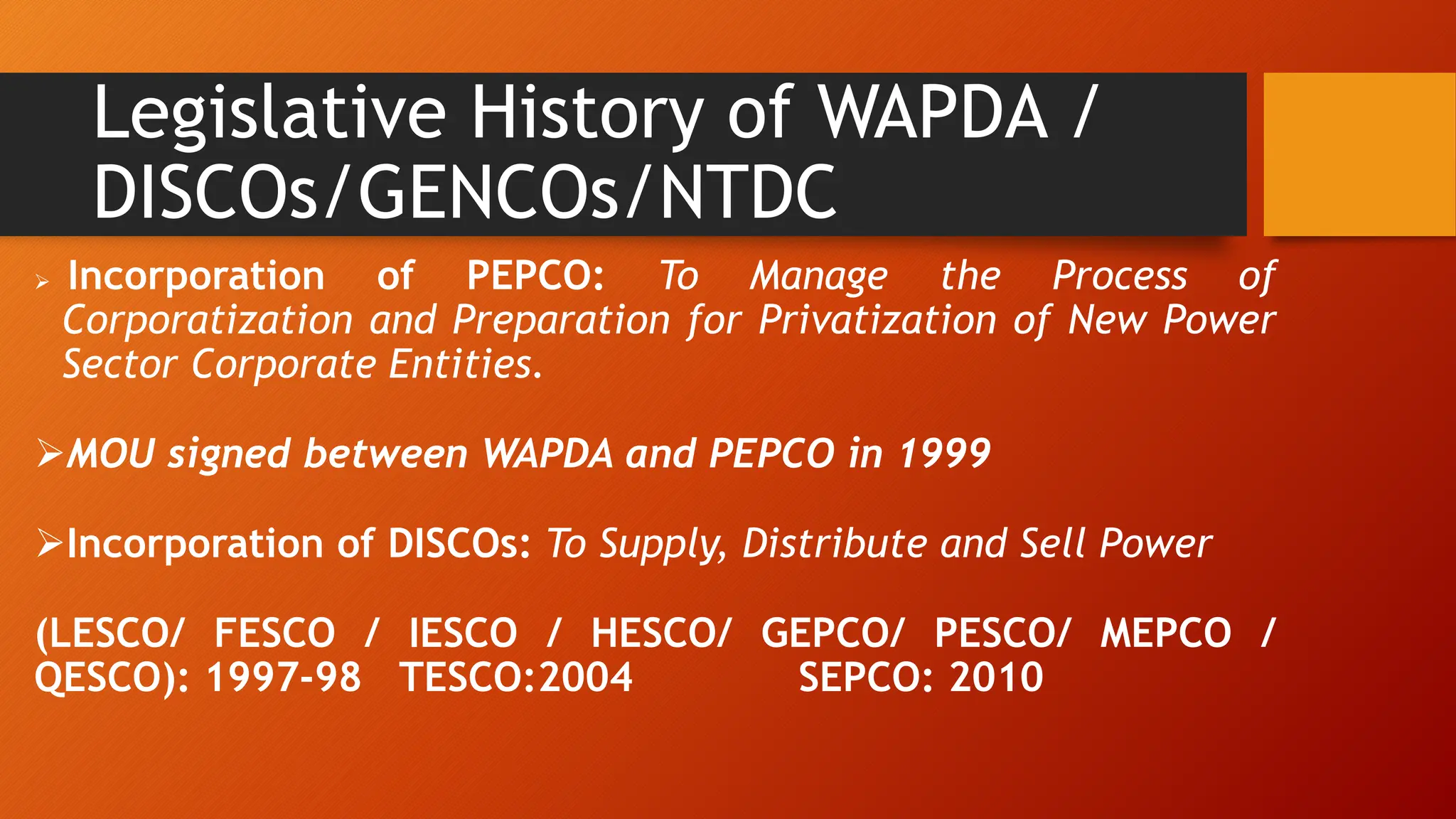
 Incorporation of PEPCO: To Manage the Process of
Corporatization and Preparation for Privatization of New Power
Sector Corporate Entities.
MOU signed between WAPDA and PEPCO in 1999
Incorporation of DISCOs: To Supply, Distribute and Sell Power
(LESCO/ FESCO / IESCO / HESCO/ GEPCO/ PESCO/ MEPCO /
QESCO): 1997-98 TESCO:2004 SEPCO: 2010
Legislative History of WAPDA /
DISCOs / GENCOs / NTDC
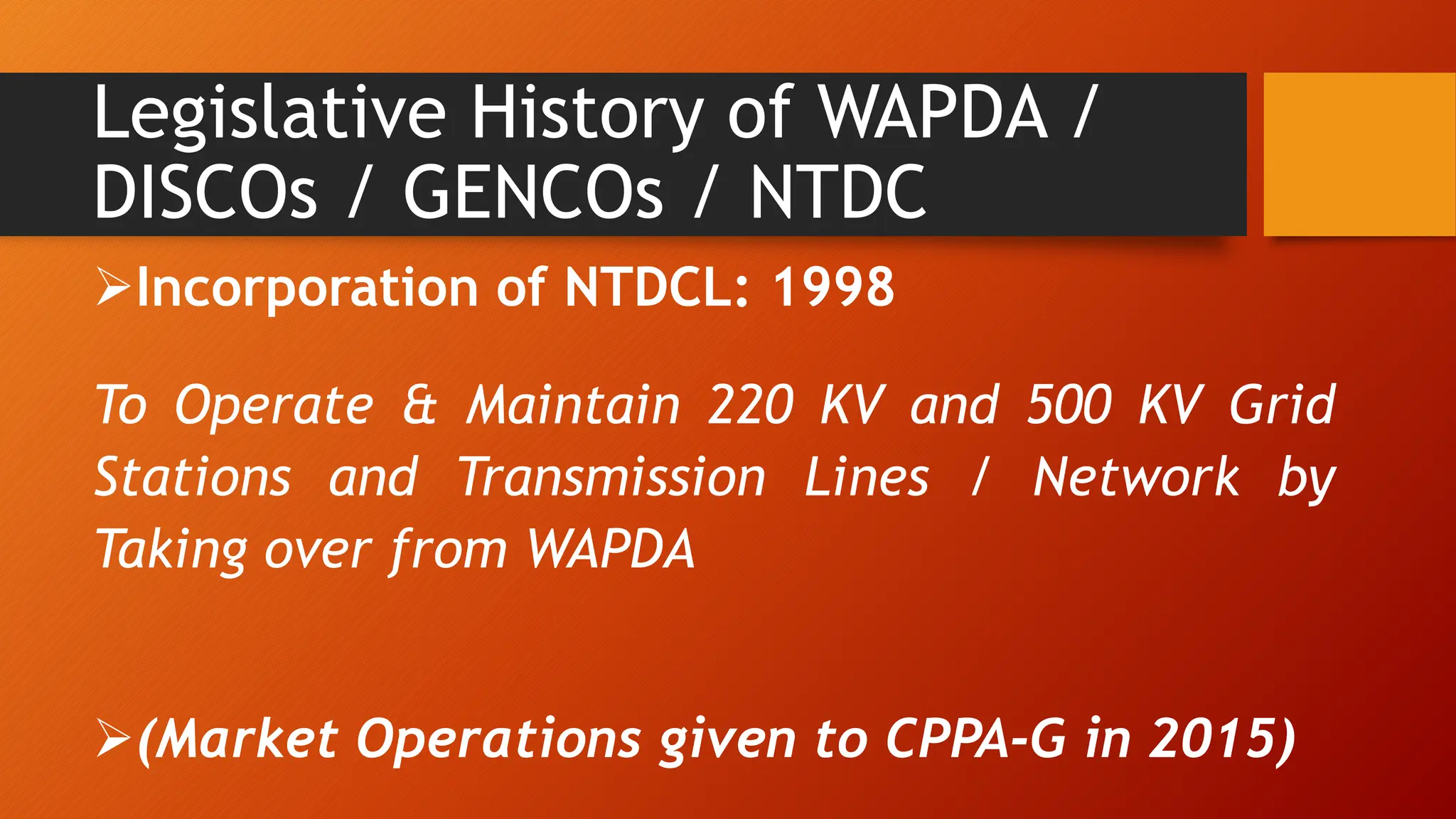
Incorporation of NTDCL: 1998
To Operate & Maintain 220 KV and 500 KV Grid
Stations and Transmission Lines / Network by
Taking over from WAPDA
(Market Operations given to CPPA-G in 2015)
Legislative History of WAPDA /
DISCOs / GENCOs / NTDC
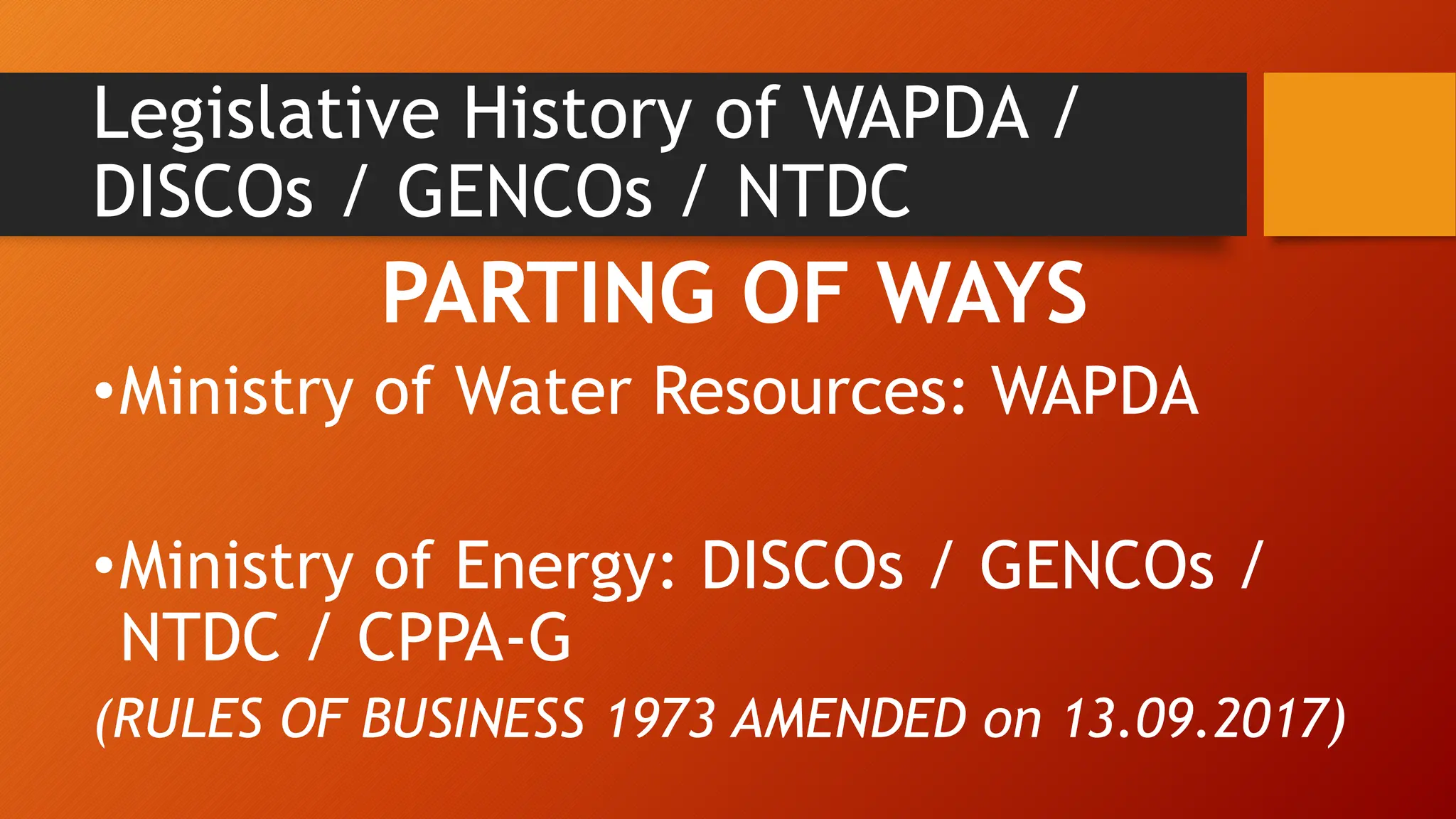
PARTING OF WAYS
•Ministry of Water Resources: WAPDA
•Ministry of Energy: DISCOs / GENCOs /
NTDC / CPPA-G
(RULES OF BUSINESS 1973 AMENDED on 13.09.2017)
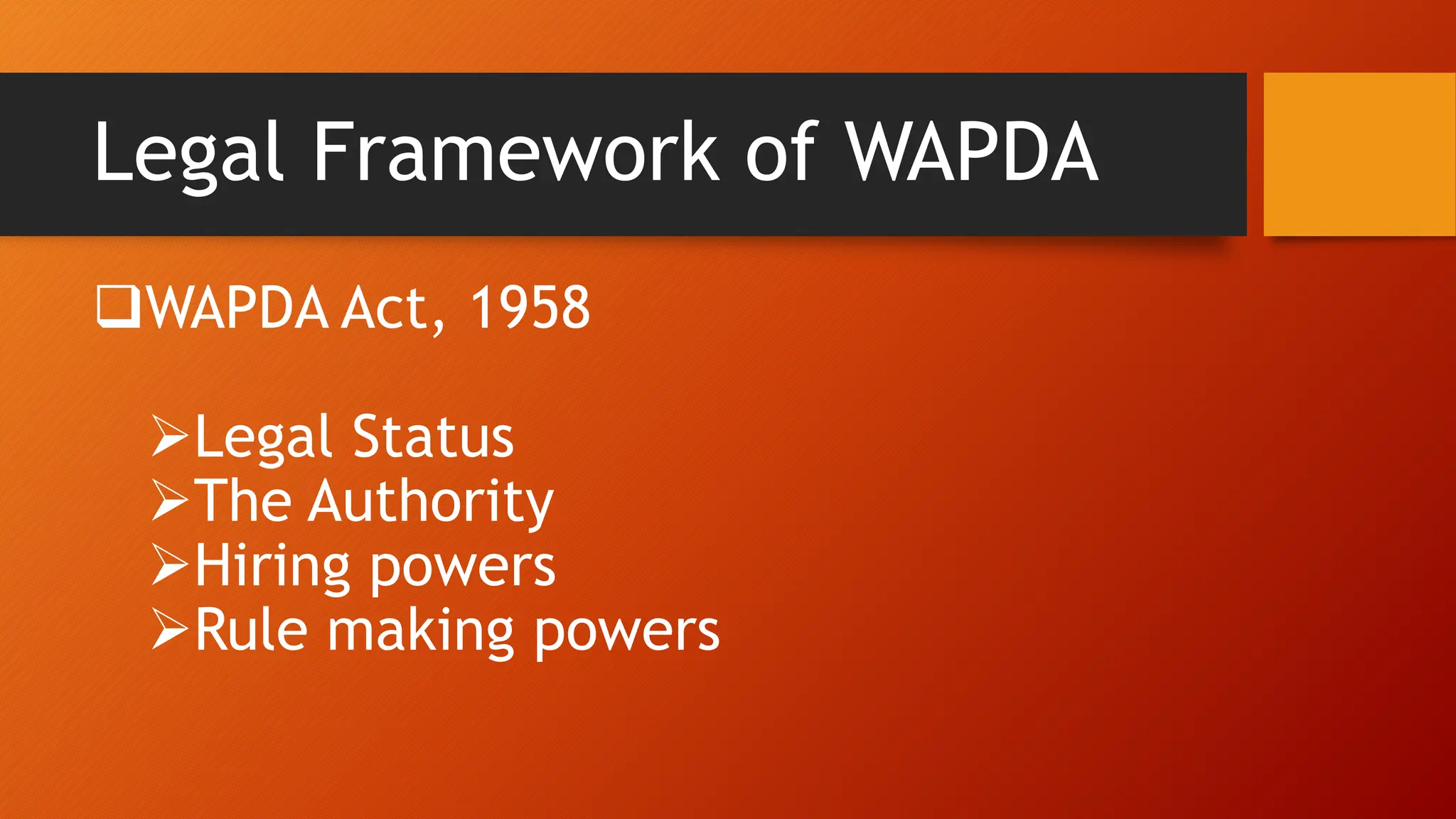
Legal Framework of WAPDA
WAPDA Act, 1958
Legal Status
The Authority
Hiring powers
Rule making powers
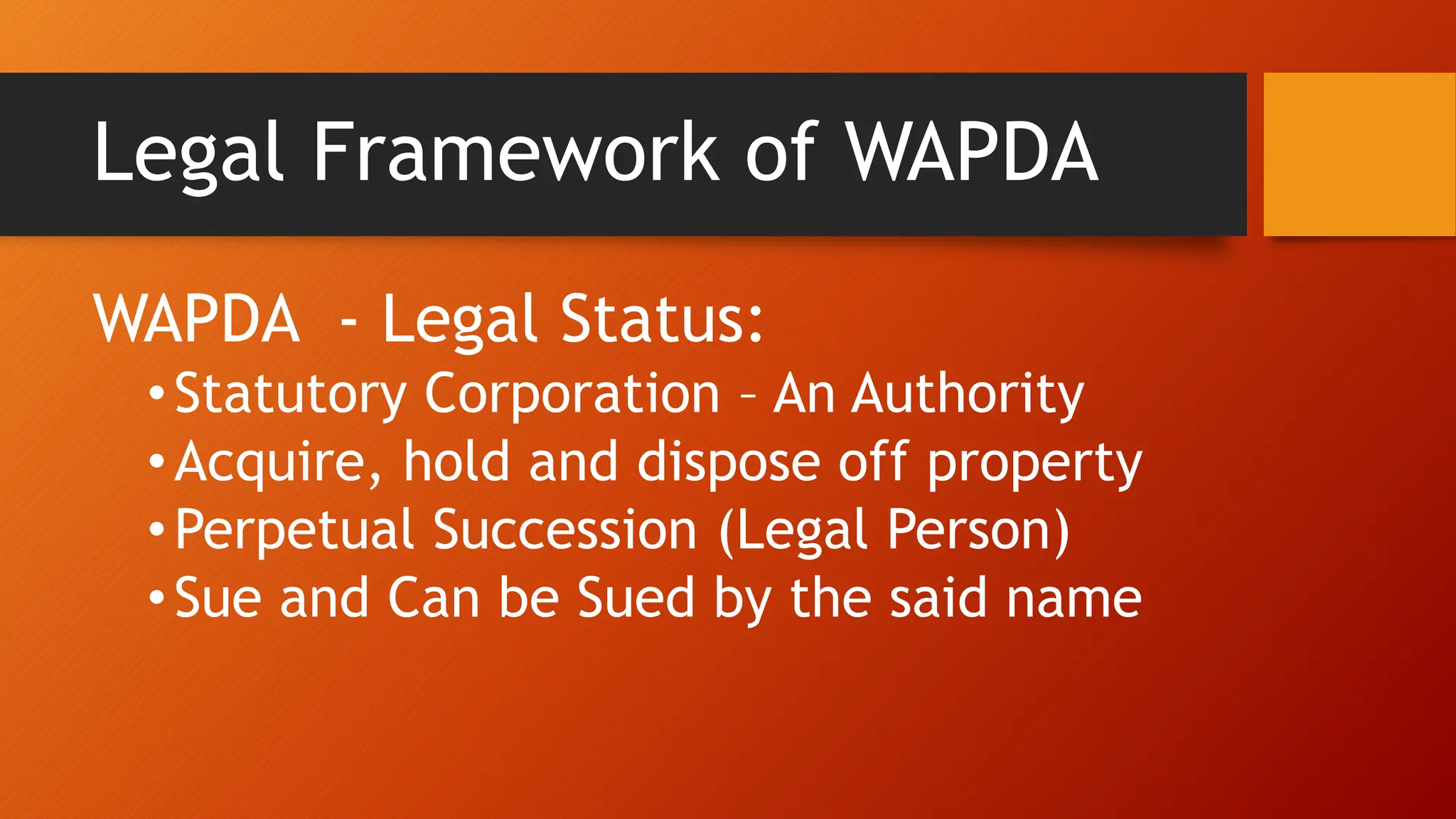
Legal Framework of WAPDA
WAPDA - Legal Status:
•Statutory Corporation – An Authority
•Acquire, hold and dispose off property
•Perpetual Succession (Legal Person)
•Sue and Can be Sued by the said name
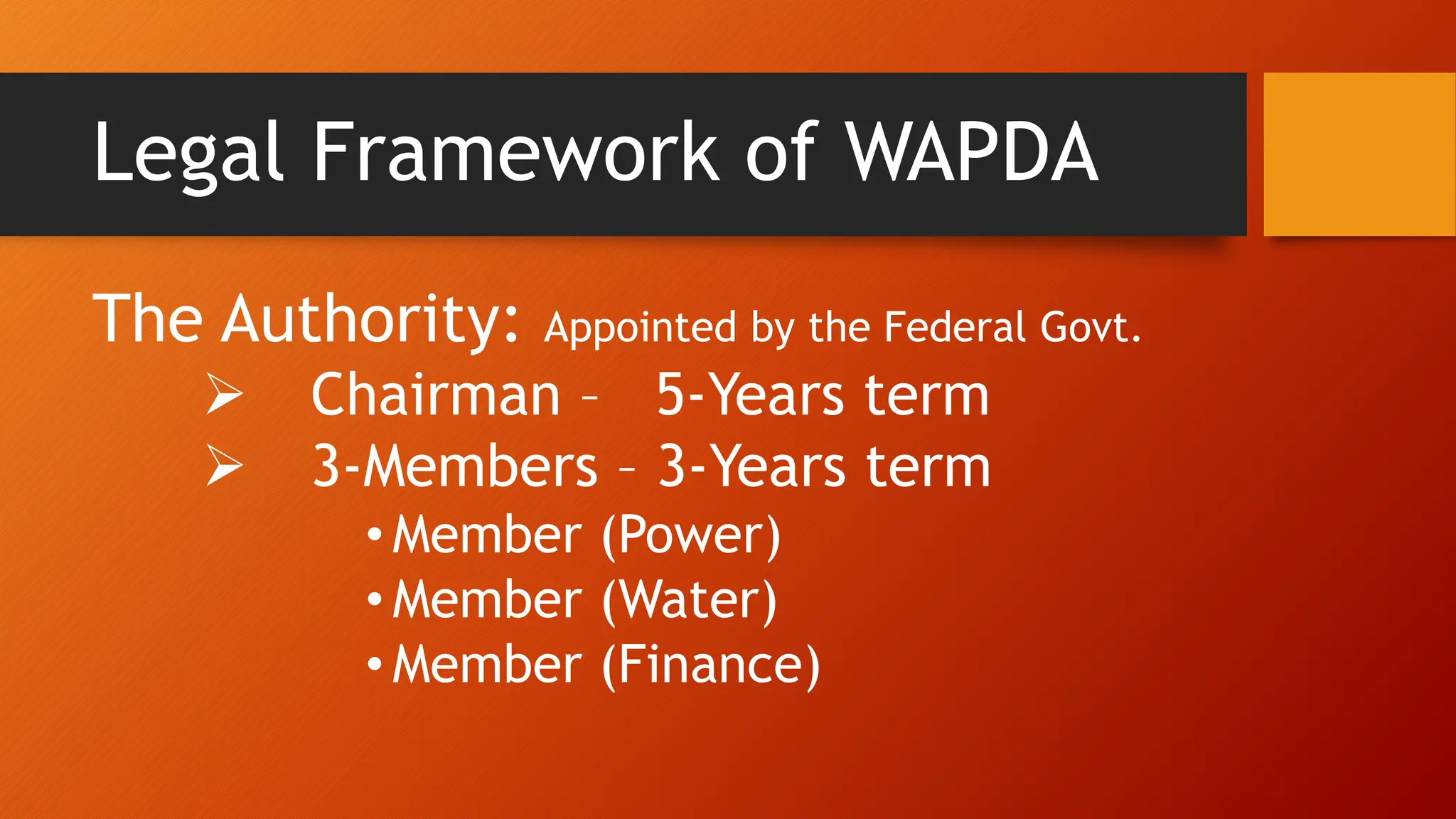
Legal Framework of WAPDA
The Authority: Appointed by the Federal Govt.
 Chairman – 5-Years term
 3-Members – 3-Years term
• Member (Power)
• Member (Water)
• Member (Finance)
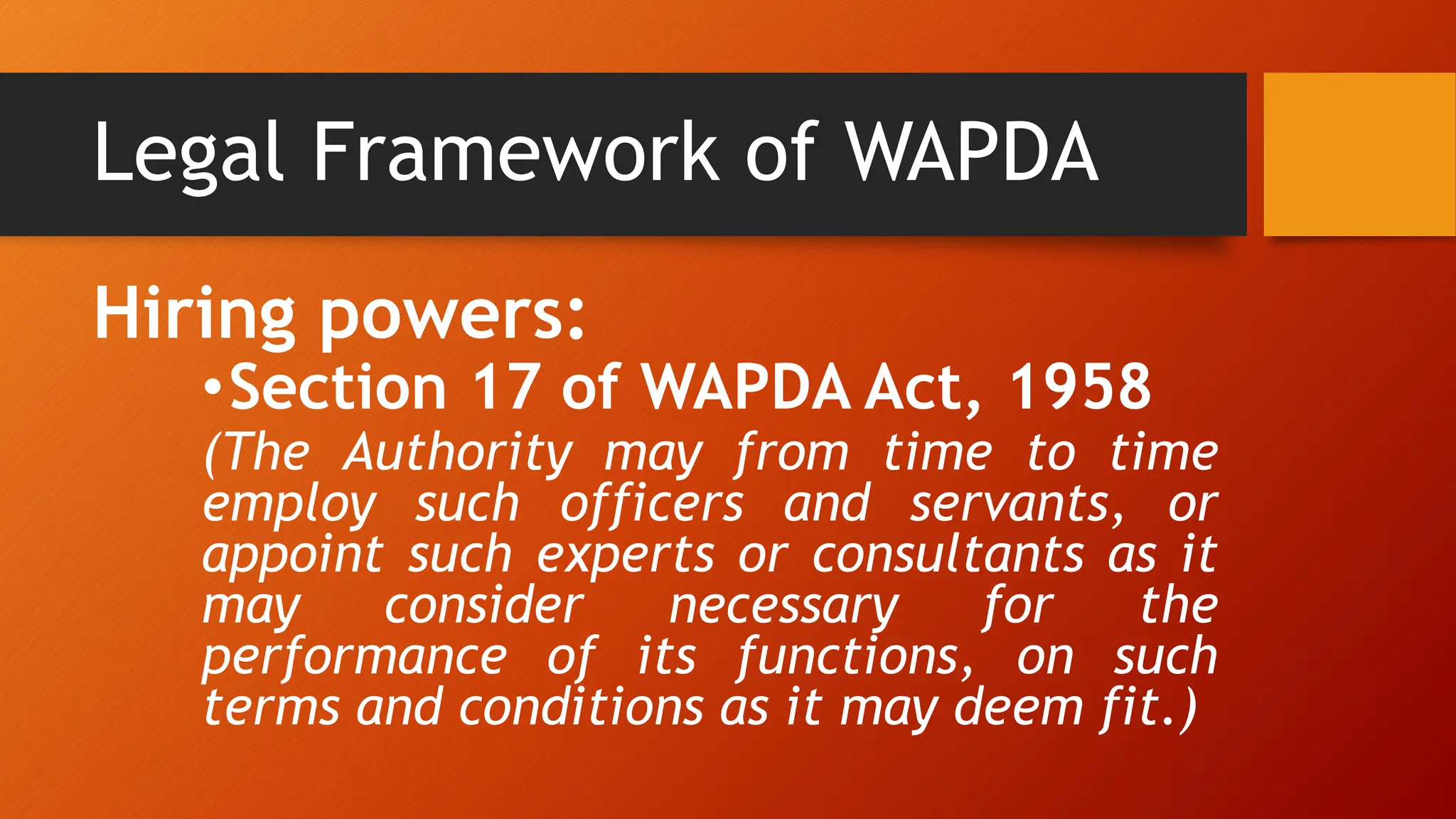
Legal Framework of WAPDA
Hiring powers:
•Section 17 of WAPDA Act, 1958
(The Authority may from time to time
employ such officers and servants, or
appoint such experts or consultants as it
may consider necessary for the
performance of its functions, on such
terms and conditions as it may deem fit.)
Legal Framework of WAPDA
Rule making powers:
•Section 18 of WAPDA Act, 1958
(The Authority shall prescribe the
procedure for appointment and terms
& conditions of service of its officers
and servants, and shall be competent
to take disciplinary action against the
said officers and servants.)
Legal Framework of
DISCOs/GENCOs/NTDC
Public Sector Companies
 means a company, whether public or private, which is
directly or indirectly controlled, beneficially owned by
the Government
 Created / Incorporated under Company law
 Regulated by Security Exchange Commission of
Pakistan (SECP)
 Through Public Sector Companies (Corporate
Governance) Rules, 2013
Legal Framework of
DISCOs/GENCOs/NTDC
Managed by Board of Directors through
Memorandum of Association –
External Management
Articles of Association –
Internal Management
E & D Rules
Employees Management
Dealing with Legal Issues /
Litigation
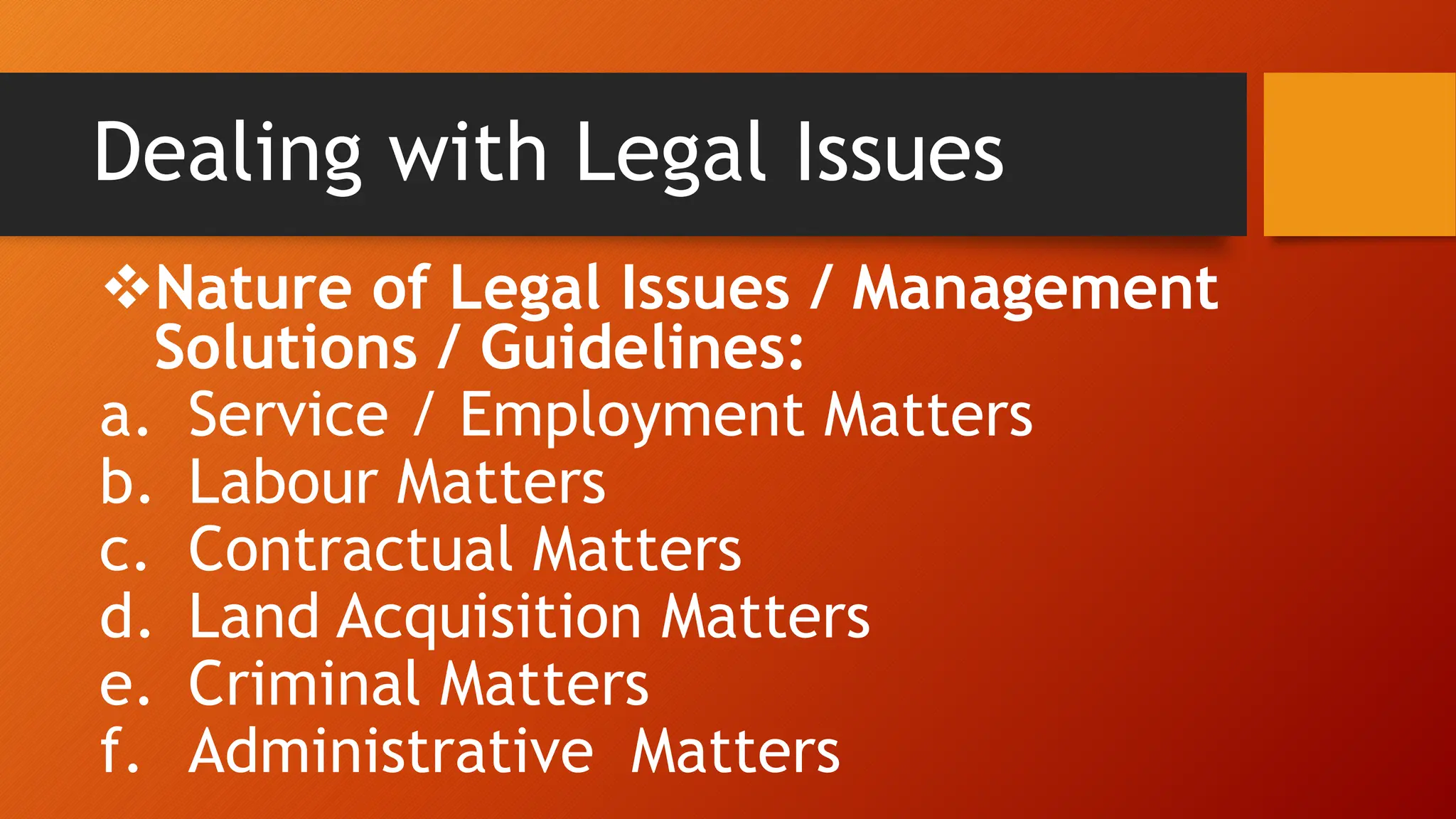
Dealing with Legal Issues
Nature of Legal Issues / Management
Solutions / Guidelines:
a. Service / Employment Matters
b. Labour Matters
c. Contractual Matters
d. Land Acquisition Matters
e. Criminal Matters
f. Administrative Matters
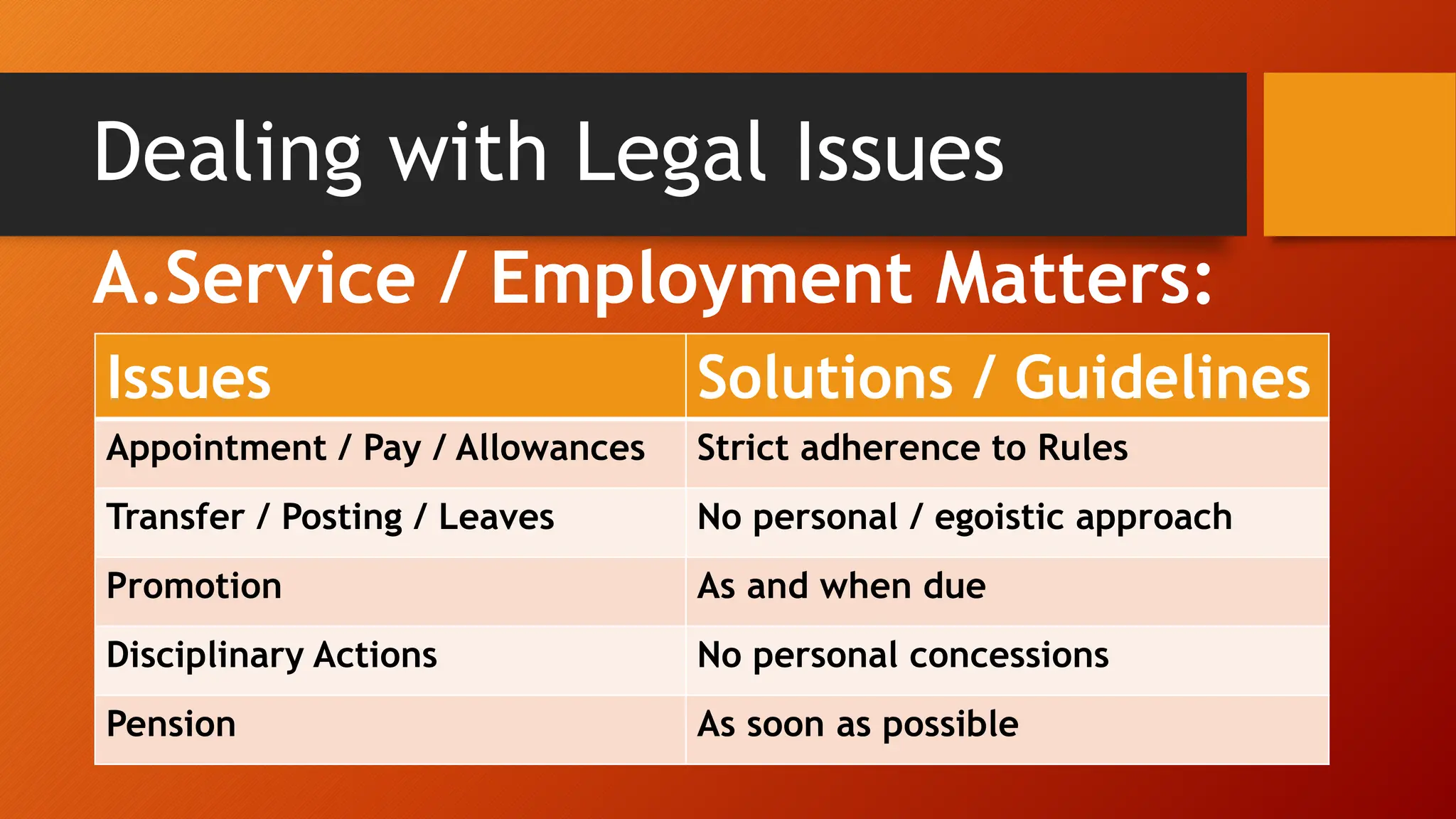
Dealing with Legal Issues
A.Service / Employment Matters:
Issues Solutions / Guidelines
Appointment / Pay / Allowances Strict adherence to Rules
Transfer / Posting / Leaves No personal / egoistic approach
Promotion As and when due
Disciplinary Actions No personal concessions
Pension As soon as possible
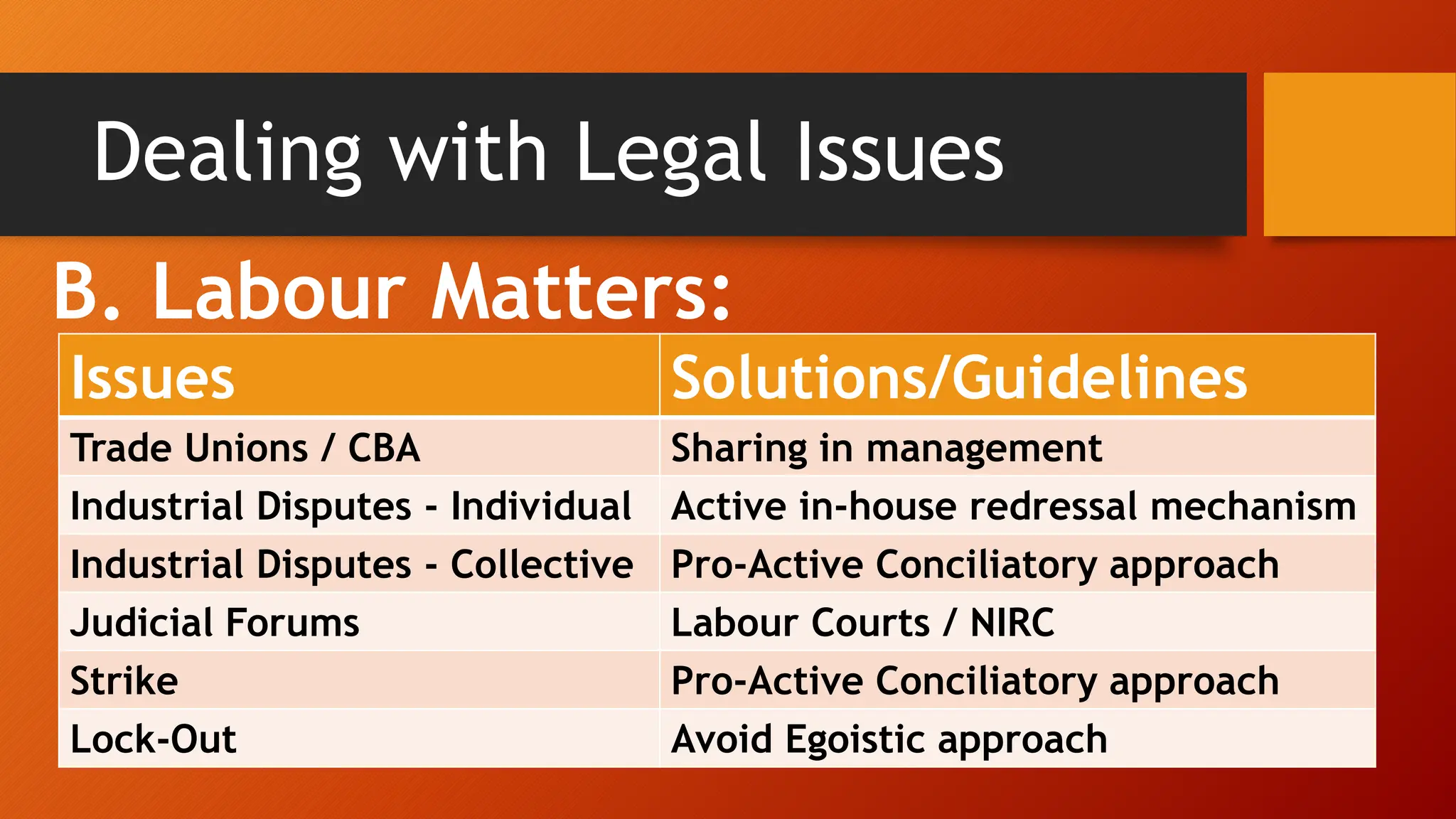
Dealing with Legal Issues
B. Labour Matters:
Issues Solutions/Guidelines
Trade Unions / CBA Sharing in management
Industrial Disputes - Individual Active in-house redressal mechanism
Industrial Disputes - Collective Pro-Active Conciliatory approach
Judicial Forums Labour Courts / NIRC
Strike Pro-Active Conciliatory approach
Lock-Out Avoid Egoistic approach
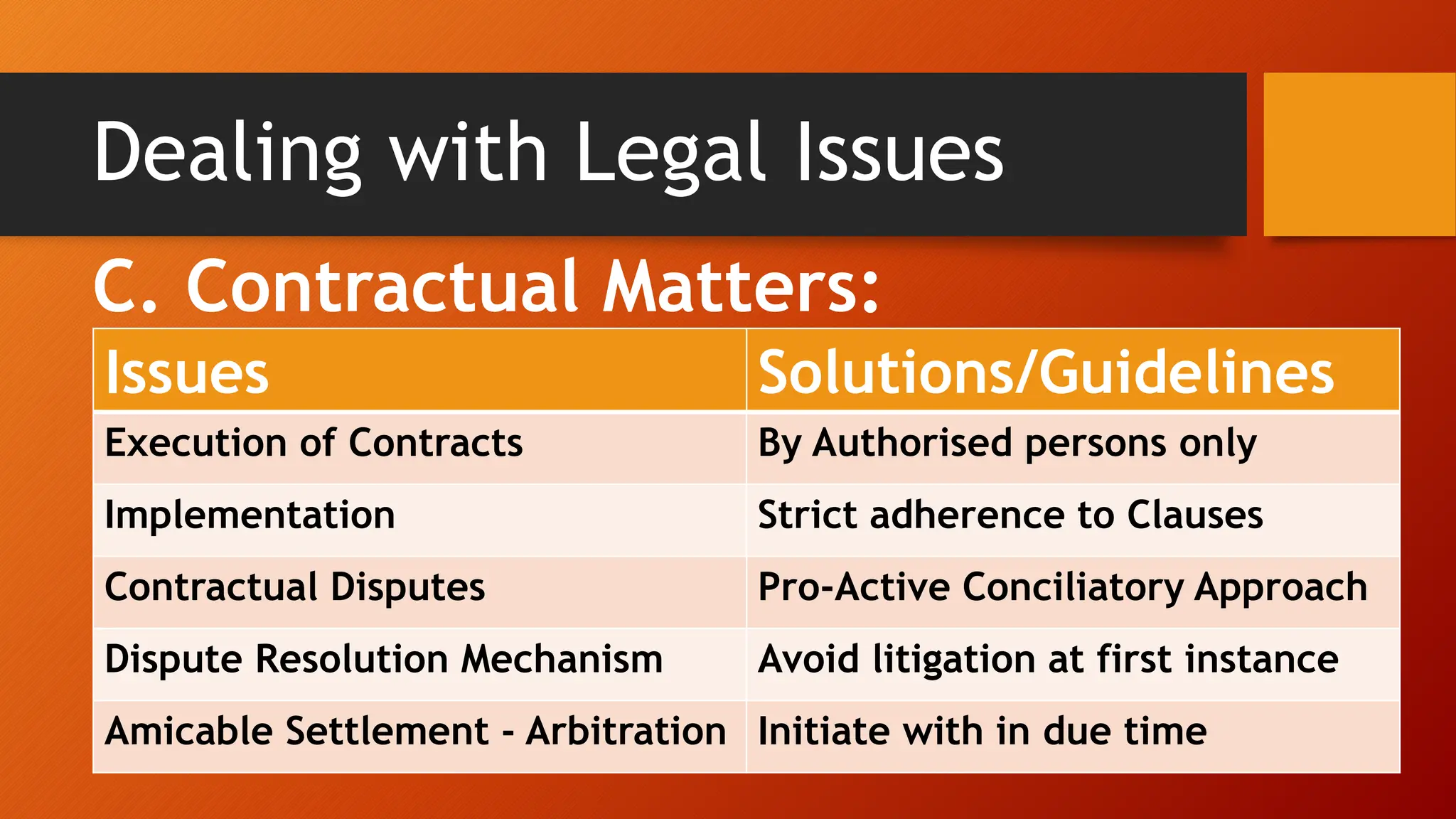
Dealing with Legal Issues
C. Contractual Matters:
Issues Solutions/Guidelines
Execution of Contracts By Authorised persons only
Implementation Strict adherence to Clauses
Contractual Disputes Pro-Active Conciliatory Approach
Dispute Resolution Mechanism Avoid litigation at first instance
Amicable Settlement - Arbitration Initiate with in due time
Dealing with Legal Issues
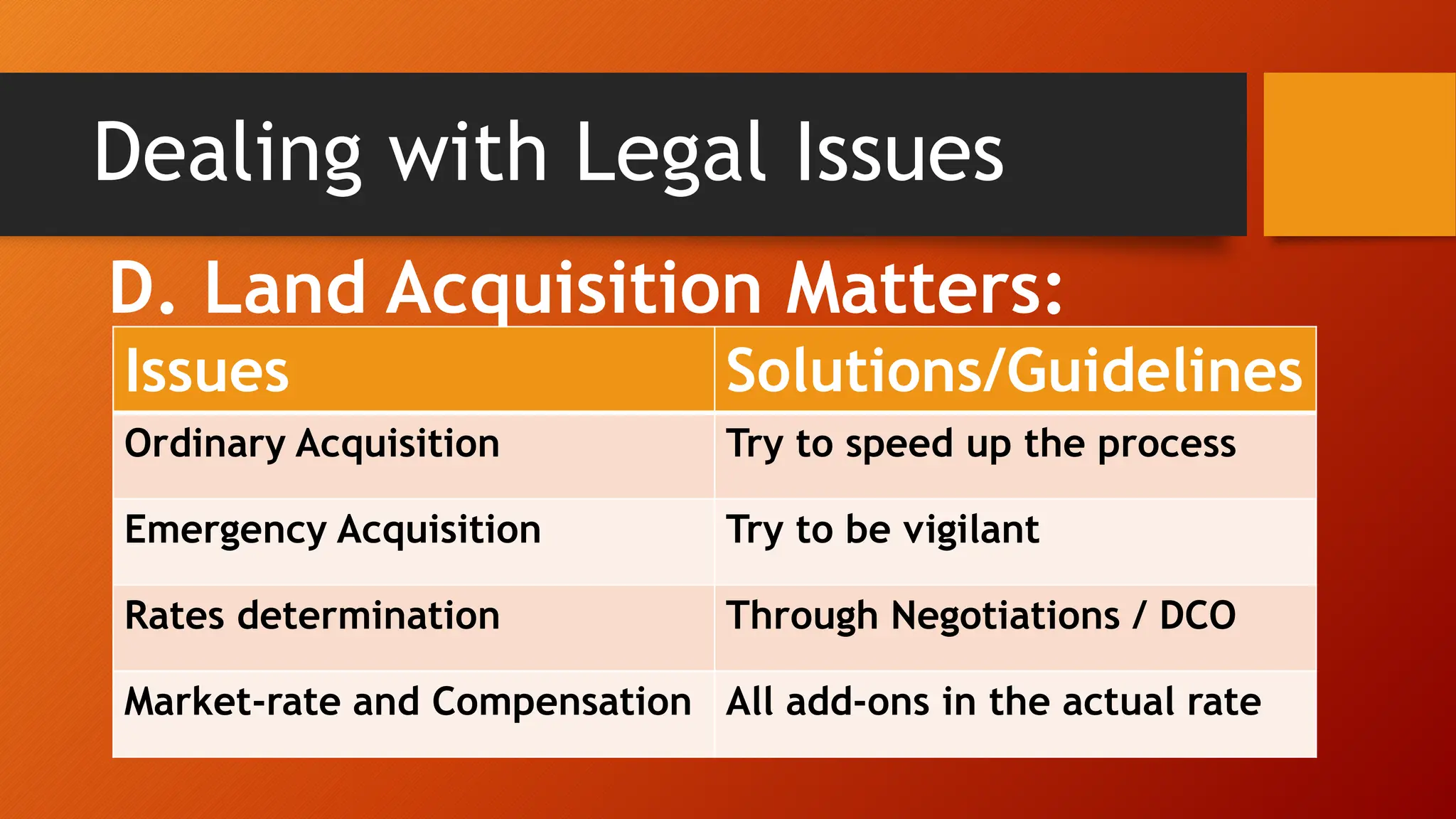
D. Land Acquisition Matters:
Issues Solutions/Guidelines
Ordinary Acquisition Try to speed up the process
Emergency Acquisition Try to be vigilant
Rates determination Through Negotiations / DCO
Market-rate and Compensation All add-ons in the actual rate
Dealing with Legal Issues
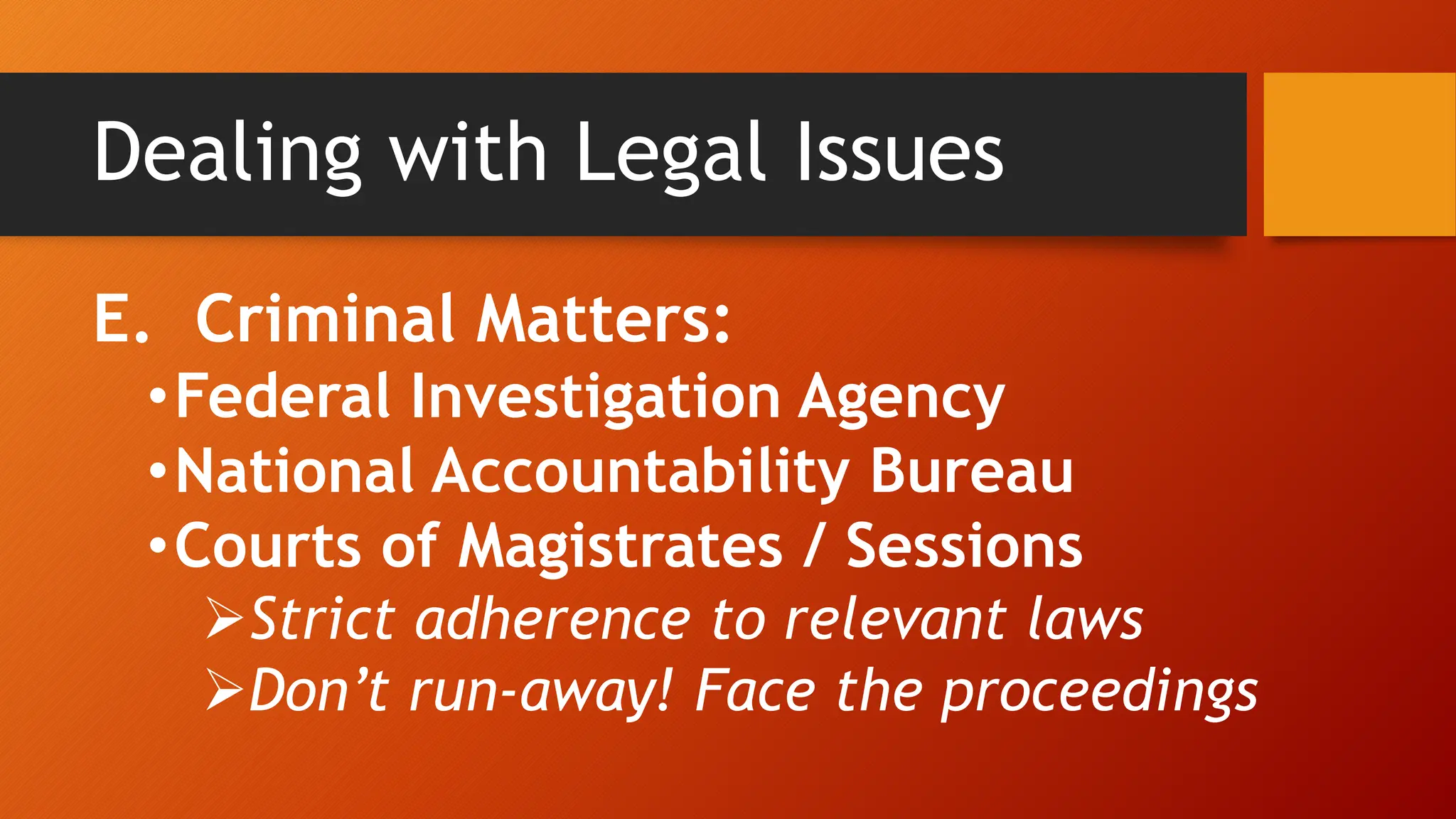
E. Criminal Matters:
•Federal Investigation Agency
•National Accountability Bureau
•Courts of Magistrates / Sessions
Strict adherence to relevant laws
Don’t run-away! Face the proceedings
Dealing with Legal Issues
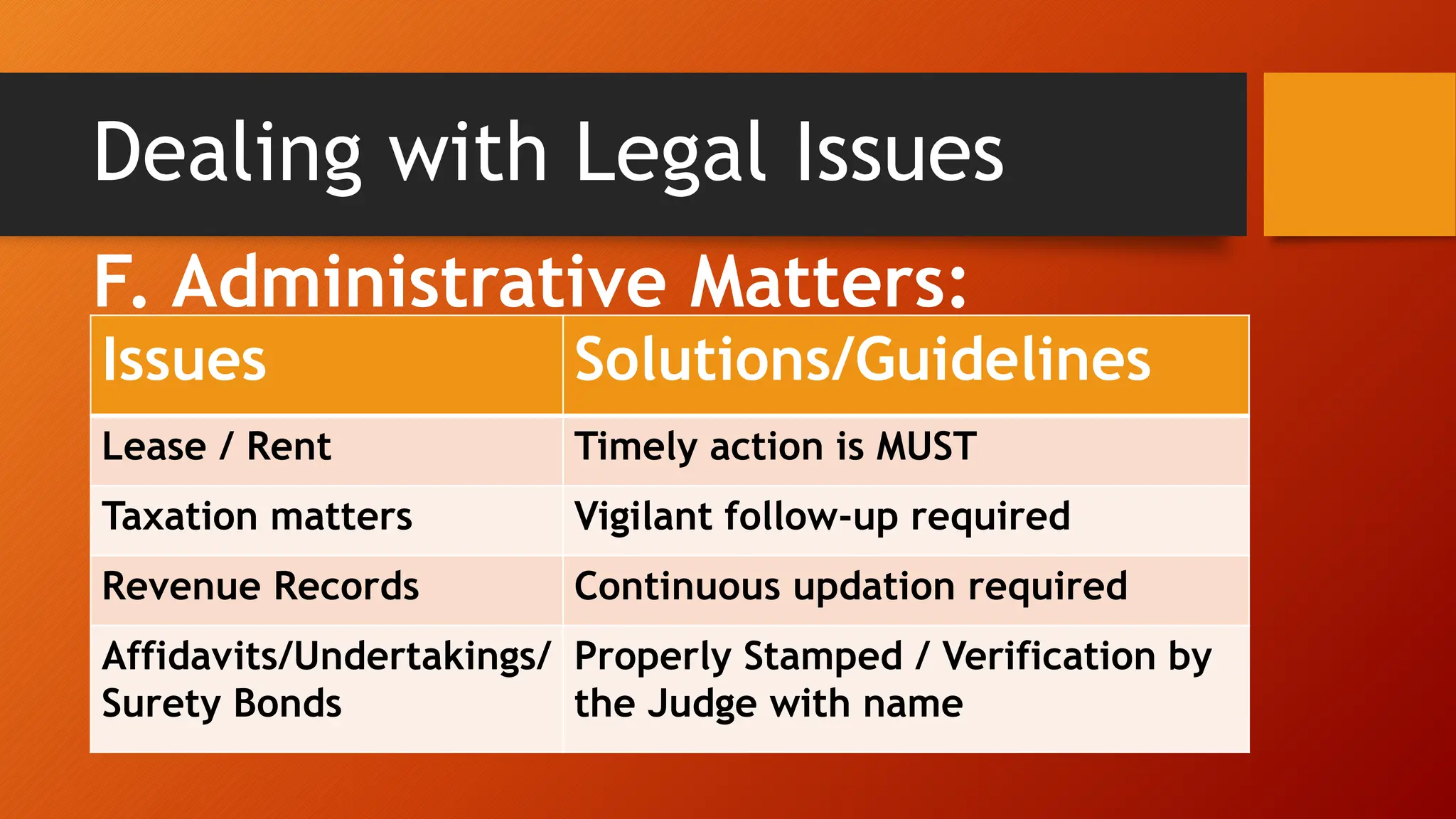
F. Administrative Matters:
Issues Solutions/Guidelines
Lease / Rent Timely action is MUST
Taxation matters Vigilant follow-up required
Revenue Records Continuous updation required
Affidavits/Undertakings/
Surety Bonds
Properly Stamped / Verification by
the Judge with name
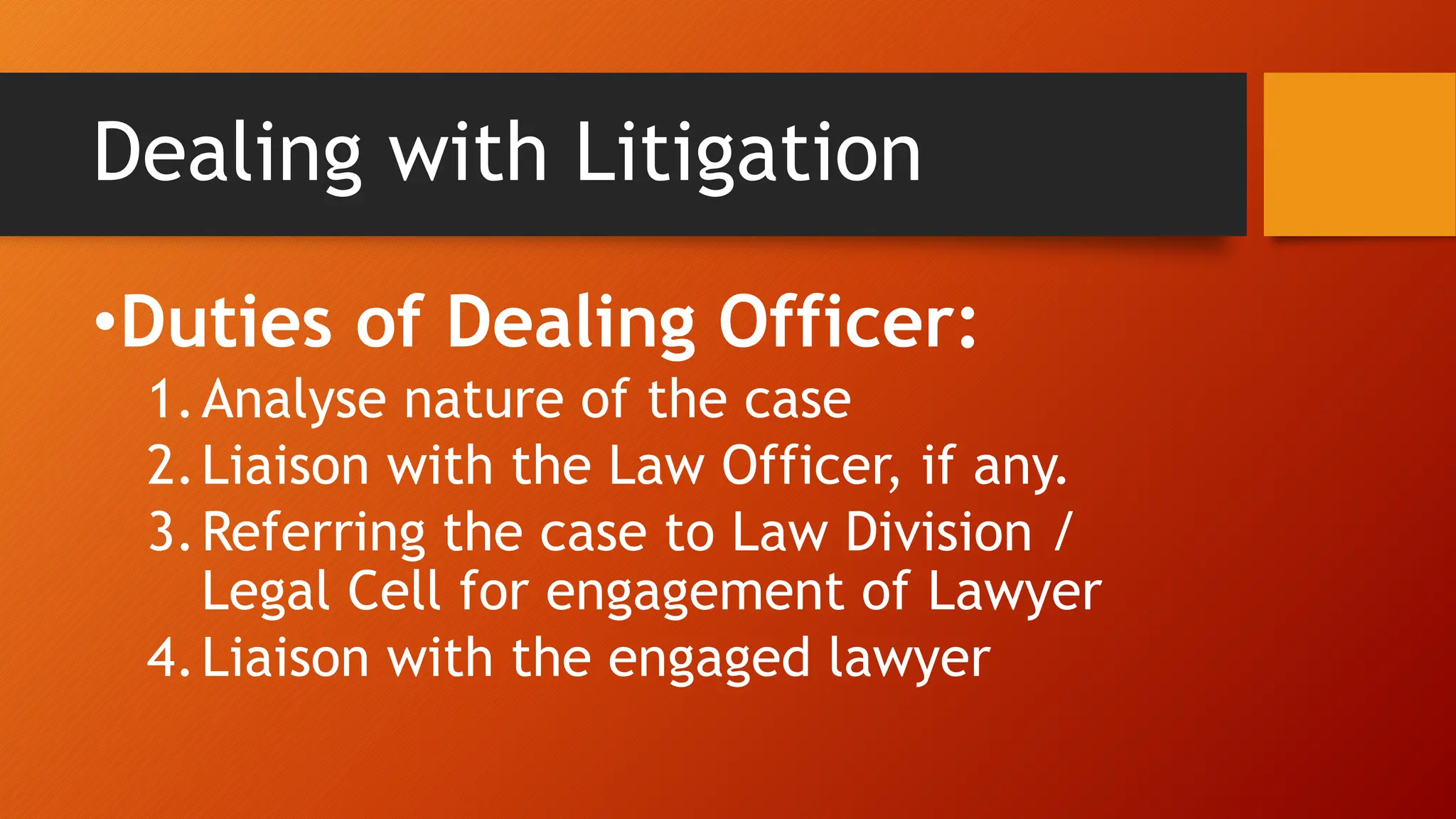
Dealing with Litigation
•Duties of Dealing Officer:
1.Analyse nature of the case
2.Liaison with the Law Officer, if any.
3.Referring the case to Law Division /
Legal Cell for engagement of Lawyer
4.Liaison with the engaged lawyer
Dealing with Litigation
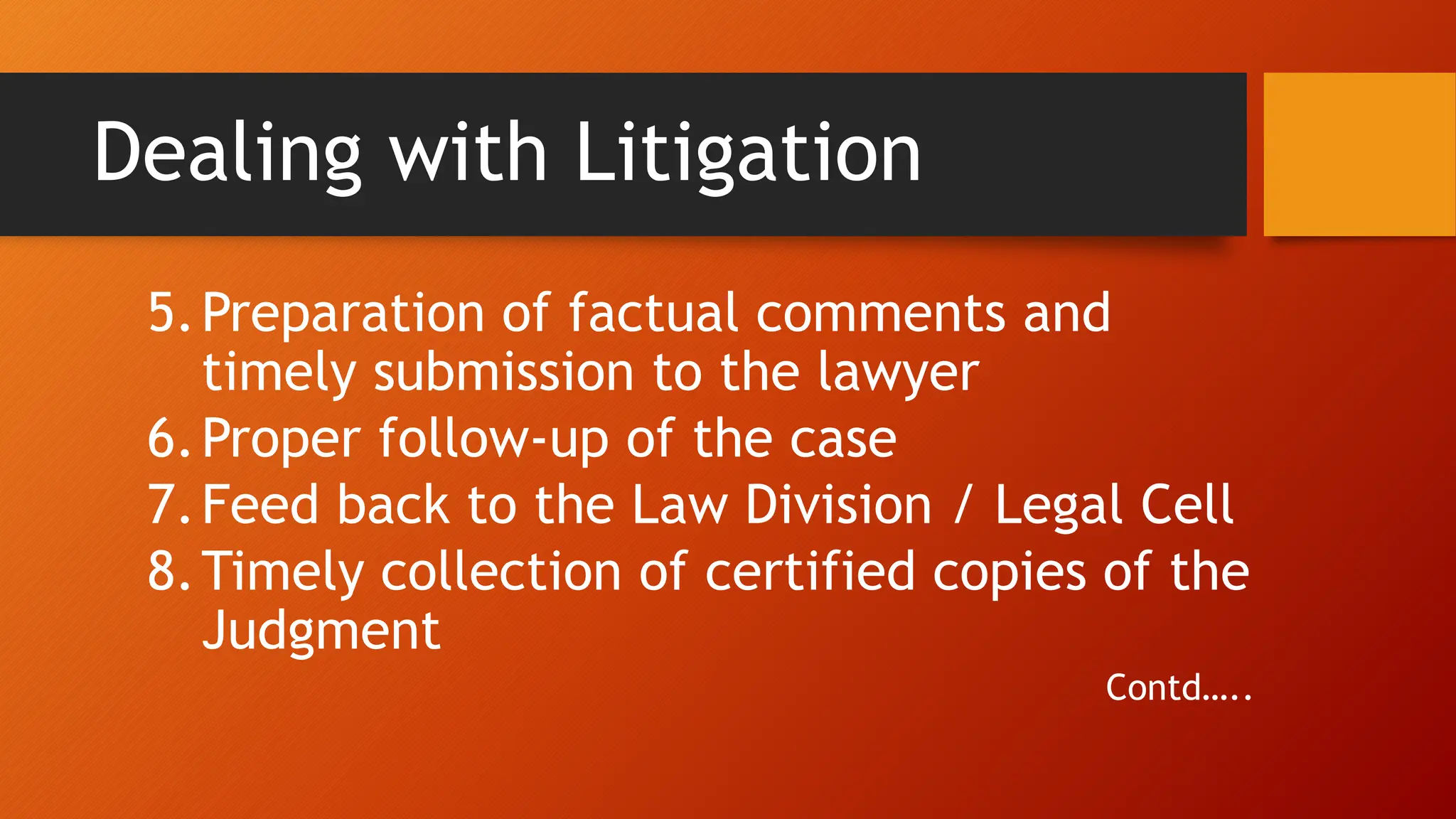
5.Preparation of factual comments and
timely submission to the lawyer
6.Proper follow-up of the case
7.Feed back to the Law Division / Legal Cell
8.Timely collection of certified copies of the
Judgment
Contd…..
Dealing with Litigation
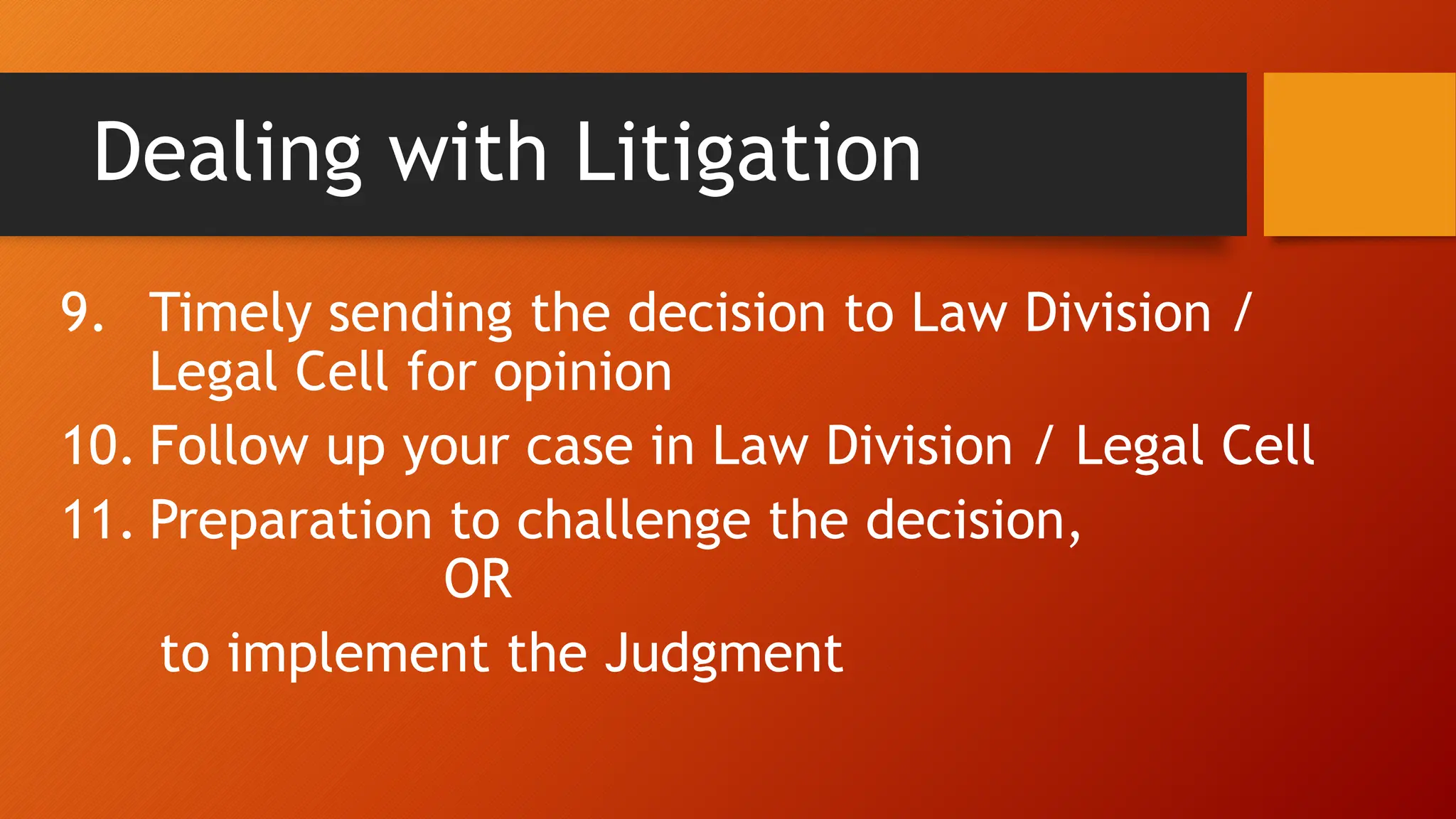
9. Timely sending the decision to Law Division /
Legal Cell for opinion
10. Follow up your case in Law Division / Legal Cell
11. Preparation to challenge the decision,
OR
to implement the Judgment
WISHING YOU ALL
A BRIGHT & PROSPEROUS FUTURE!
Thanks.
MMC lecture dealing with legal matters06.23.pptx

  • 1.
  • 2.
    What is LAW? LetsAcknowledge Wisdom
  • 3.
    Sources of Lawin Pakistan •The Constitution •The Legislature •The Judiciary •The Executive
  • 4.
    The Constitution •Approved in1973 •Consistedof 280 Articles, 6 Schedules •Salient Features: •Fundamental Rights – The Basic Purpose •Legislature – The Law Making Process •Judiciary – The Protector (Rule of Law) •Executive – The Government
  • 5.
    Fundamental Rights Rights toLife, Property, Education, Fair trial, Information, Non-discrimination, Association, Movement, Trade, Business, Profession etc. Protection of Fundamental Rights?
  • 6.
    The Legislature • ParliamentarySystem • Majlis-i-Shoora The National Assembly The Senate •The Provincial Assemblies
  • 7.
    The Judiciary • TheSupreme Court • The High Courts
  • 8.
    The Executive • AdministrativeLaw OR • Delegated Legislation • Administrative Tribunals / Courts
  • 9.
    The Executive (ServiceLaws) Service laws for WAPDA’s Employees WAPDA Rules / Civil Servants Act,1973 Services Tribunal Act, 1973 Master-Servant Rule for Companies’ Employees •Civil Procedure Code, 1908 / Civil Courts •Writ Jurisdiction of High Courts
  • 10.
    The Executive (LabourLaws) For Wapda: NIRC The Industrial Relations Act, 2012 For Companies: Labour Courts / Tribunals •Punjab Industrial Relations Act, 2010 •Sindh Industrial Relations Act, 2010 •KP Industrial Relations Ordinance, 2010 •Balochistan Industrial Relations Act, 2010
  • 11.
    The Executive (LabourLaws) Common Laws for WAPDA / Companies • The Workmen Compensation Act, 1923 • The Industrial & Commercial (Standing Orders) Ordinance, 1968 • The Factories Act, 1934
  • 12.
    The Constitution andWAPDA  Council of Common Interest (CCI) Articles 153-154: • Consisting of PM, CMs and 3 Members from Fed. Govt. • Appointed by the President • Answerable to Parliament • Mandated to formulate & regulate policies in relation to the matters e.g. Oil, gas, electricity, ports etc. And to supervise & exercise control over institutions like WAPDA etc.
  • 13.
    The Constitution andWAPDA  Water Supply Disputes: Article-155  To be resolved by filing complaint in CCI  A Commission shall be constituted by the President  Final decision by CCI.
  • 14.
    The Constitution andWAPDA  Hydro Electric / Thermal Power Stations / Grid Stations: Article-157 • The Federal Government may construct so, with prior consultation of the concerned Provincial Government • Disputes be referred to CCI for Resolution
  • 15.
    The Constitution andWAPDA  Net Hydel Profits: Article-161 • The Net-Profits, earned by the Federal Government or any Undertaking established or administered by the Federal Government, from the bulk generation of power shall be paid to the province in which the hydro- electric station is situated. • The Rate of Net-Profit shall be determined by CCI.
  • 16.
    Legal Framework  WAPDA DISCOs  GENCOs  NTDC
  • 17.
    Legislative History ofWAPDA / DISCOs/GENCOs/NTDC  Electricity Act, 1910: the law relating to the Supply and Use of Electrical Energy.  WAPDA Act, 1958: to provide for the Unified and Co- ordinated Development of Water and Power Resources of Pakistan  Regulation of Generation, Transmission and Distribution of Electric Power Act, 1997: to provide for the Regulation of Generation, Transmission and Distribution of Electric Power.
  • 18.
    Legislative History ofWAPDA / DISCOs/GENCOs/NTDC Amendment in WAPDA Act in 1994: To Privatise or otherwise Restructure any Operation of the Authority except the Hydel Generating Power Stations.
  • 19.
    Legislative History ofWAPDA / DISCOs/GENCOs/NTDC  Incorporation of PEPCO: To Manage the Process of Corporatization and Preparation for Privatization of New Power Sector Corporate Entities. MOU signed between WAPDA and PEPCO in 1999 Incorporation of DISCOs: To Supply, Distribute and Sell Power (LESCO/ FESCO / IESCO / HESCO/ GEPCO/ PESCO/ MEPCO / QESCO): 1997-98 TESCO:2004 SEPCO: 2010
  • 20.
    Legislative History ofWAPDA / DISCOs / GENCOs / NTDC Incorporation of NTDCL: 1998 To Operate & Maintain 220 KV and 500 KV Grid Stations and Transmission Lines / Network by Taking over from WAPDA (Market Operations given to CPPA-G in 2015)
  • 21.
    Legislative History ofWAPDA / DISCOs / GENCOs / NTDC PARTING OF WAYS •Ministry of Water Resources: WAPDA •Ministry of Energy: DISCOs / GENCOs / NTDC / CPPA-G (RULES OF BUSINESS 1973 AMENDED on 13.09.2017)
  • 22.
    Legal Framework ofWAPDA WAPDA Act, 1958 Legal Status The Authority Hiring powers Rule making powers
  • 23.
    Legal Framework ofWAPDA WAPDA - Legal Status: •Statutory Corporation – An Authority •Acquire, hold and dispose off property •Perpetual Succession (Legal Person) •Sue and Can be Sued by the said name
  • 24.
    Legal Framework ofWAPDA The Authority: Appointed by the Federal Govt.  Chairman – 5-Years term  3-Members – 3-Years term • Member (Power) • Member (Water) • Member (Finance)
  • 25.
    Legal Framework ofWAPDA Hiring powers: •Section 17 of WAPDA Act, 1958 (The Authority may from time to time employ such officers and servants, or appoint such experts or consultants as it may consider necessary for the performance of its functions, on such terms and conditions as it may deem fit.)
  • 26.
    Legal Framework ofWAPDA Rule making powers: •Section 18 of WAPDA Act, 1958 (The Authority shall prescribe the procedure for appointment and terms & conditions of service of its officers and servants, and shall be competent to take disciplinary action against the said officers and servants.)
  • 27.
    Legal Framework of DISCOs/GENCOs/NTDC PublicSector Companies  means a company, whether public or private, which is directly or indirectly controlled, beneficially owned by the Government  Created / Incorporated under Company law  Regulated by Security Exchange Commission of Pakistan (SECP)  Through Public Sector Companies (Corporate Governance) Rules, 2013
  • 28.
    Legal Framework of DISCOs/GENCOs/NTDC Managedby Board of Directors through Memorandum of Association – External Management Articles of Association – Internal Management E & D Rules Employees Management
  • 29.
    Dealing with LegalIssues / Litigation
  • 30.
    Dealing with LegalIssues Nature of Legal Issues / Management Solutions / Guidelines: a. Service / Employment Matters b. Labour Matters c. Contractual Matters d. Land Acquisition Matters e. Criminal Matters f. Administrative Matters
  • 31.
    Dealing with LegalIssues A.Service / Employment Matters: Issues Solutions / Guidelines Appointment / Pay / Allowances Strict adherence to Rules Transfer / Posting / Leaves No personal / egoistic approach Promotion As and when due Disciplinary Actions No personal concessions Pension As soon as possible
  • 32.
    Dealing with LegalIssues B. Labour Matters: Issues Solutions/Guidelines Trade Unions / CBA Sharing in management Industrial Disputes - Individual Active in-house redressal mechanism Industrial Disputes - Collective Pro-Active Conciliatory approach Judicial Forums Labour Courts / NIRC Strike Pro-Active Conciliatory approach Lock-Out Avoid Egoistic approach
  • 33.
    Dealing with LegalIssues C. Contractual Matters: Issues Solutions/Guidelines Execution of Contracts By Authorised persons only Implementation Strict adherence to Clauses Contractual Disputes Pro-Active Conciliatory Approach Dispute Resolution Mechanism Avoid litigation at first instance Amicable Settlement - Arbitration Initiate with in due time
  • 34.
    Dealing with LegalIssues D. Land Acquisition Matters: Issues Solutions/Guidelines Ordinary Acquisition Try to speed up the process Emergency Acquisition Try to be vigilant Rates determination Through Negotiations / DCO Market-rate and Compensation All add-ons in the actual rate
  • 35.
    Dealing with LegalIssues E. Criminal Matters: •Federal Investigation Agency •National Accountability Bureau •Courts of Magistrates / Sessions Strict adherence to relevant laws Don’t run-away! Face the proceedings
  • 36.
    Dealing with LegalIssues F. Administrative Matters: Issues Solutions/Guidelines Lease / Rent Timely action is MUST Taxation matters Vigilant follow-up required Revenue Records Continuous updation required Affidavits/Undertakings/ Surety Bonds Properly Stamped / Verification by the Judge with name
  • 37.
    Dealing with Litigation •Dutiesof Dealing Officer: 1.Analyse nature of the case 2.Liaison with the Law Officer, if any. 3.Referring the case to Law Division / Legal Cell for engagement of Lawyer 4.Liaison with the engaged lawyer
  • 38.
    Dealing with Litigation 5.Preparationof factual comments and timely submission to the lawyer 6.Proper follow-up of the case 7.Feed back to the Law Division / Legal Cell 8.Timely collection of certified copies of the Judgment Contd…..
  • 39.
    Dealing with Litigation 9.Timely sending the decision to Law Division / Legal Cell for opinion 10. Follow up your case in Law Division / Legal Cell 11. Preparation to challenge the decision, OR to implement the Judgment
  • 41.
    WISHING YOU ALL ABRIGHT & PROSPEROUS FUTURE! Thanks.