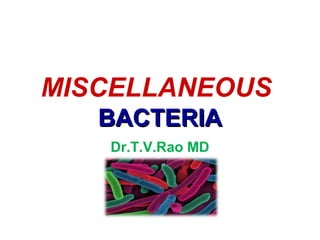
MISCELLANEOUS
BACTERIABACTERIA
Dr.T.V.Rao MD
Listeria
Monocytogenes
What is Listeriosis
• Listeriosis, a serious infection
caused by eating food
contaminated with the bacterium
Listeria Monocytogenes, has
recently been recognized as an
important public health problem in
the United States.
Who get Infected
• The disease affects primarily
persons of advanced age,
pregnant women, new-borns, and
adults with weakened immune
systems. However, persons
without these risk factors can also
rarely be affected.
What is Listeriosis?
• Listeriosis is a serious infection
caused by eating foods
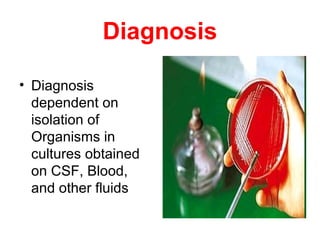
contaminated with the bacterium
Listeria MonocytogenesListeria Monocytogenes..
• This disease affects primarily
pregnant women, newborn, and
adults with weakened immune
systems.
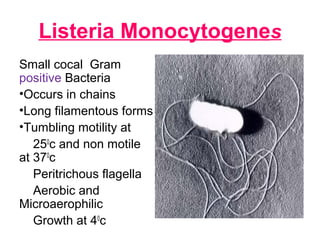
Listeria Monocytogenes
Small cocal Gram
positive Bacteria
•Occurs in chains
•Long filamentous forms
•Tumbling motility at
250
c and non motile
at 370
c
Peritrichous flagella
Aerobic and
Microaerophilic
Growth at 40
c
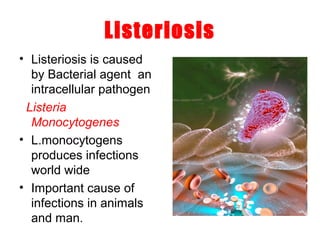
Listeriosis
• Listeriosis is caused
by Bacterial agent an
intracellular pathogen
Listeria
Monocytogenes
• L.monocytogens
produces infections
world wide
• Important cause of
infections in animals
and man.
Culture and Growth
Characteristics
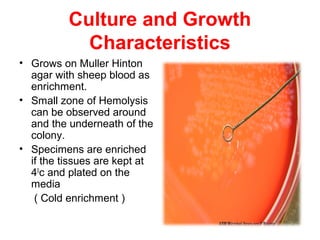
• Grows on Muller Hinton
agar with sheep blood as
enrichment.
• Small zone of Hemolysis
can be observed around
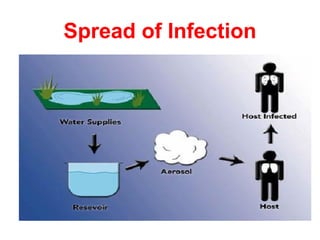
and the underneath of the
colony.
• Specimens are enriched
if the tissues are kept at
40
c and plated on the
media
( Cold enrichment )
Biochemical reactions
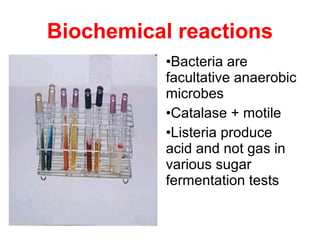
•Bacteria are
facultative anaerobic
microbes
•Catalase + motile
•Listeria produce
acid and not gas in
various sugar
fermentation tests
Who are at risk with Listeriosis
• Pregnant women
• New-borns
• People with weakened immune
systems
• People who are taking immuno-
suppressing medication.
How Humans contact Listeriosis
• Listeria Monocytogenes can be found in a
variety of dairy products, vegetables, fish
and meat products.
• Listeria Monocytogenes, unlike most other
harmful bacteria, will grow slowly on foods
stored in a refrigeratorrefrigerator..
• Listeria Monocytogenes can also be spread
by contact with an infected product or
surface, such as hands or counter tops,
during food preparation.
Pathogenesis and
Pathology
• Listeria Monocytogenes enters through the
Gastro – intestinal tract after infections of
contaminated foods such as cheese or
vegetables,
• The cell wall surface protein called Interanalin
interacts with E –CADHERIN and enters into
epithelial cells
• Bacteria produce Listeriolysin
• L.monocygenes can move from cell to with out
being exposed to
Antibodies,Complement,Polymorphonuclear
cells
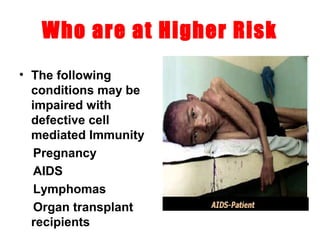
Who are at Higher Risk
• The following
conditions may be
impaired with
defective cell
mediated Immunity
Pregnancy
AIDS
Lymphomas
Organ transplant
recipients
Common presenting
manifestation of
Listeriosis
• Vomiting;
• Nausea;
• Cramps;
• Diarrheal;
• Severe Headache;
• Constipation; or
• Persistent fever.
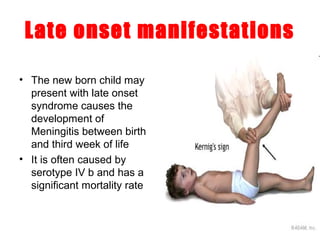
Late onset manifestations
• The new born child may
present with late onset
syndrome causes the
development of
Meningitis between birth
and third week of life
• It is often caused by
serotype IV b and has a
significant mortality rate
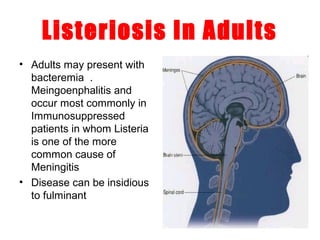
Listeriosis In Adults
• Adults may present with
bacteremia .
Meingoenphalitis and
occur most commonly in
Immunosuppressed
patients in whom Listeria
is one of the more
common cause of
Meningitis
• Disease can be insidious
to fulminant
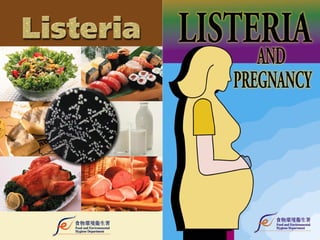
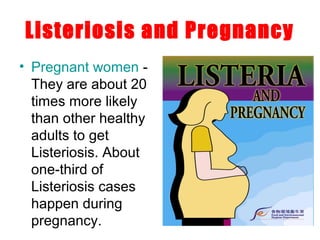
Listeriosis and Pregnancy
• Pregnant women -
They are about 20
times more likely
than other healthy
adults to get
Listeriosis. About
one-third of
Listeriosis cases
happen during
pregnancy.
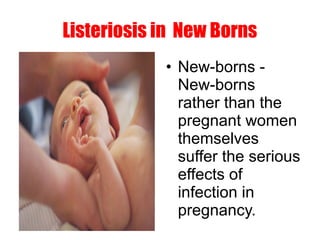
Listeriosis in New Borns
• New-borns -
New-borns
rather than the
pregnant women
themselves
suffer the serious
effects of
infection in
pregnancy.
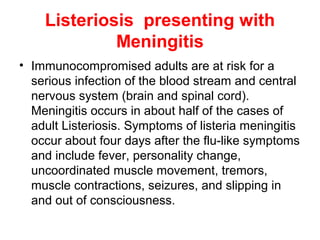
Listeriosis presenting with
Meningitis
• Immunocompromised adults are at risk for a
serious infection of the blood stream and central
nervous system (brain and spinal cord).
Meningitis occurs in about half of the cases of
adult Listeriosis. Symptoms of listeria meningitis
occur about four days after the flu-like symptoms
and include fever, personality change,
uncoordinated muscle movement, tremors,
muscle contractions, seizures, and slipping in
and out of consciousness.
Other Clinical manifestations
• Abscess
• Conjunctivitis
• Pharyngitis
• Urethritis
• Pneumonia
• Endocarditis
• Septicemias
Why important in Human
Infections
• Can cause meningitis and
Meingoenphalitis
• In particularly in neonates and elderly
• Pregnant women - abortions, and still
birth
• Asymptomatic colonization in vagina
produces infertility
Other characters and
Biochemical reactions
• Produces hemolytic colonies
• Ferments Glucose, Maltose, lactose
produces acid but no gas
• Listeria Monocytogenes present in
the environment
• Saprophyte in soil
• Present in water, sewage.
Diagnosis
• Diagnosis
dependent on
isolation of
Organisms in
cultures obtained
on CSF, Blood,
and other fluids
Treatment
• Ampicillin
• Erythromycin
• Intravenous Trimethoprim – Sulphmethoxazole
• Cephalosporins and Fluroquinoles are not
active against l.monocytogens
• A commination of Gentamycin and
Ampicillin on clinical basis
Foods to Avoid
• Hot dogs, especially straight from the
package without further heating. The fluid
within hot dog packages may contain
more Listeria than the hot dogs.
• Avoid spreading fluid from packages onto
other foods, cutting boards, utensils,
dishes and food preparation surfaces.
Wash your hands after handling hot dogs.
Why important in HumanWhy important in Human
InfectionsInfections
• Can cause meningitis and
Meingoenphalitis
• In particularly in neonates and elderly
• Pregnant women - abortions, and still
birth
• Asymptomatic colonization in vagina
produces infertility
Ideal way to prevent Listeriosis
• Completely cook all meats and eggs.
• Carefully wash raw vegetables before
eating.
• Keep raw meat away from raw vegetables
and prepared foods. After cutting raw
meat, wash the cutting board with
detergent before using it for vegetables.
• Avoid drinking unpasteurized milk or foods
made from such milk.
• Wash hands thoroughly after handling raw
meat.
CampylobacterCampylobacter
• Cococid Pleomorphic organisms, slender
spirally curved bacteria.
• Gram negative. 2 x 0.5 microns
• Comma shaped, curved rods
• Non sporing , non motile
• Single unsheathed polar flagella at one or
both ends
• Microaerophilic
Other charactersOther characters
•Microaerophilic
•5 % o2 optimal
•Oxidase +
•Sugars not fermented
•Humans causes Diarrhea
•Vetnary importance
Campylobacter jejuni
• Important cause of Diarrhea world
wide
• Zoonotic importance
• Arises from food and animal origin
• Present in Intestinal tracts of animals
• Surface waters
Pathology and Clinical
Manifestations
• Colonized in Jejunum, Ileum and colon
and rectum
• Involves mesenteric lymph nodes and
cause bacteremia
• Incubation 1 – 7 days
• Present with Fever, abdominal pain and
watery diarrhea
Laboratory Diagnosis
• Isolation of Campylobacters from feces
• Observation by phase contrast
microscopy, Dark field examination
• Present with tumbling motility
• Feces or rectal swabs cultured on
Skirrows mediumSkirrows medium
Butzlers supplementButzlers supplement
Treatment and prevention
•Correction fluid and
electrolyte balance
•Erythromycin is
effective
HELICOBACTER
Helicobacter
( Warren and Marshal )
• Campylobacter like organisms
• Spiral shaped colonizes Gastric mucosa
• Etiological agent in Gastritis and peptic
ulcer
• Most important bacteria.
Helicobacter pylori
Colonizes 50 % of the Individuals
Winners of Nobel Prize in Medicine
-Physiology
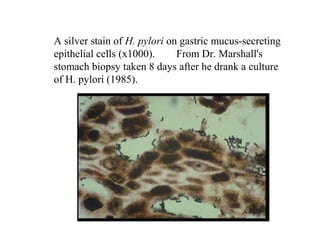
A silver stain of H. pylori on gastric mucus-secreting
epithelial cells (x1000). From Dr. Marshall's
stomach biopsy taken 8 days after he drank a culture
of H. pylori (1985).
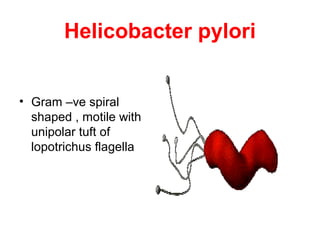
Helicobacter pylori
• Gram –ve spiral
shaped , motile with
unipolar tuft of
lopotrichus flagella
MICROBIOLOGY
1. Gram negative, spiral, flagellated
(motile) bacilli
2. Slow growing, requires complex
media, microaerophilic
3. Oxidase and catalase positive
4. Produces urease
5. Noninvasive; proliferates in
mucus overlying gastric type
mucosa
6. Not cleared by host immune
response
Culturing and BiochemicalCulturing and Biochemical
characterscharacters
• Grows on chocolate agar, Campylobacter
media
• Grows under Microaerophilic conditions
• With presence of 5 – 20% co2
• Oxidase +
• Catalase –
• Urease strongly +++
• H2S
Pathology and pathogenesis
• H.pylori colonizes gastric mucosa
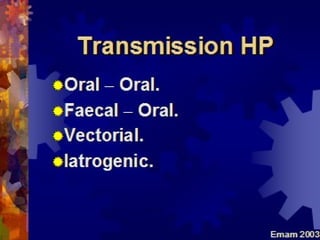
• Spread by oral – oral contact
• Feco oral spread prominent
• Poverty and overcrowding predisposes
• Poor Hygiene
• Causes mild to acute gastritis
• Gastric antrum - causes gastric metaplasia
• Any part of the stomach can be involved
• Colonizes overlying mucosa but do not invade
mucosa
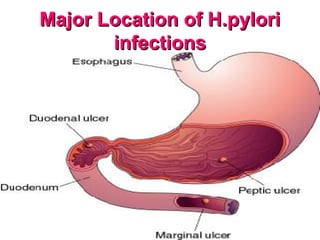
Major Location of H.pyloriMajor Location of H.pylori
infectionsinfections
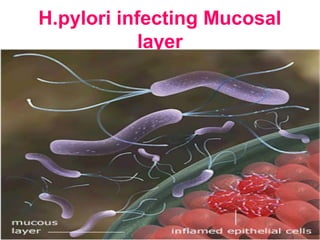
H.pylori infecting Mucosal
layer
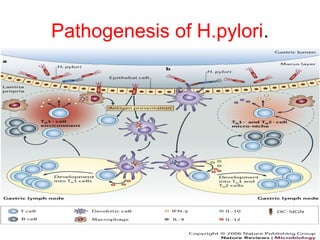
Pathogenesis of H.pylori.
Pathogenesis
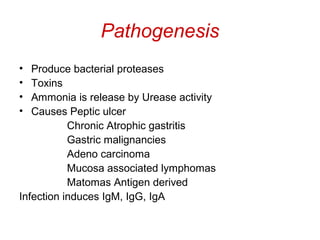
• Produce bacterial proteases
• Toxins
• Ammonia is release by Urease activity
• Causes Peptic ulcer
Chronic Atrophic gastritis
Gastric malignancies
Adeno carcinoma
Mucosa associated lymphomas
Matomas Antigen derived
Infection induces IgM, IgG, IgA
Laboratory Diagnosis
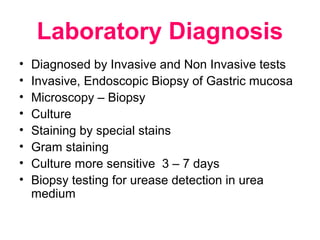
• Diagnosed by Invasive and Non Invasive tests
• Invasive, Endoscopic Biopsy of Gastric mucosa
• Microscopy – Biopsy
• Culture
• Staining by special stains
• Gram staining
• Culture more sensitive 3 – 7 days
• Biopsy testing for urease detection in urea
medium
Diagnosis by Non invasive
methods
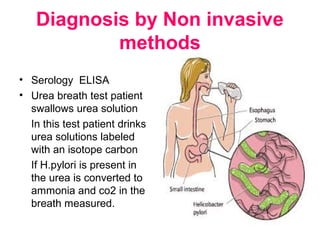
• Serology ELISA
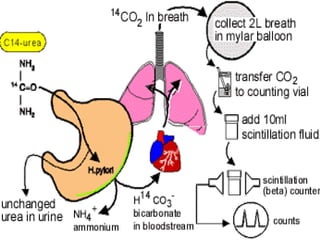
• Urea breath test patient
swallows urea solution
In this test patient drinks
urea solutions labeled
with an isotope carbon
If H.pylori is present in
the urea is converted to
ammonia and co2 in the
breath measured.
TreatmentTreatment
• Use of antibiotics, bismuth salts
• Ingestion of Bismuth subsalicylate
• Antibiotics Teracycles and metronidazole
for two weeks
• Use of Omeprazole
• Clarithromycin
• Donor treat for Asymptomatic colonization
• Drug resistance is a growing problem
Treatment
• Ampicillin
• Cotromoxazole
• Streptomycin
• Cephalosporins not
recommended
Donovania Granulomatis
Calymmatobacterium
Granulomatis
Donovan 1905
A Venereal disease
Common in Tropical countries
Morphology
• Rounded Coco bacilli size is 1 -2 microns
found in cystic spaces in large
mononuclear cells
• Bipolar condensation of chromatin
resembling closed safety pin appearance
• Capsulated and non motile
• Gram negative
• Grown on egg yolk
• Modified Levanthal agar
Clinical Manifestations
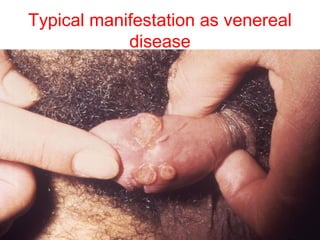
• Produces genital lesions, a
venereal disease
• Incubation 1 – 12 weeks
• Starts as a painless papule on
Genitalia, progress to ulcers
• May progress to chronic course
Typical manifestation as venereal
disease
Treatment
• Tetracycline
• Cotromoxazole
• Chloramphenicol
• Gentamycin
• Quinolones
• Newer macrocodes
Legionella pneumophila
Causes Legionnaires disease
Manifest two different disease
Legionnaires disease
Pontiac fever
Legionella pneumophila
• Legionella pneumophila is a thin,
aerobic, pleomorphic, flagellated,
non-spore forming, Gram-negative
bacterium of the genus Legionella. L.
pneumophila is the primary human
pathogenic bacterium in this group
and is the causative agent of
legionellosis or Legionnaires' disease
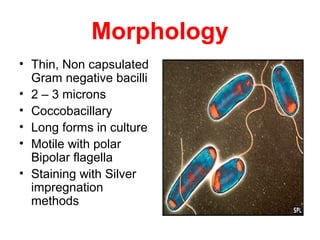
Morphology
• Thin, Non capsulated
Gram negative bacilli
• 2 – 3 microns
• Coccobacillary
• Long forms in culture
• Motile with polar
Bipolar flagella
• Staining with Silver
impregnation
methods
Culture
• Grown on Buffered charcoal yeast
extract agar with L cystine with
antibiotics
• When observed under microscope
appear as cut glass
• L.pneumphila catalase +
Bacterial spread
• Legionella are present in stagnant water mud
and hot springs
• Live also in free living ameba
• Human infection is typically by inhalation of
aerosols provided by cooling towers and air
conditioners
• Shower heads
• Out come of infection depends on size of
infective dose
Predisposing factors
• Smoking
• Alcohol
• Age,
• Hospitalization
• Immunodeficiency status
• Can be Community acquired or
Hospital acquired
Transmission
• Legionella come from natural fresh water
reservoirs, such as lakes, ponds, and
puddles, where they parasitize on a broad
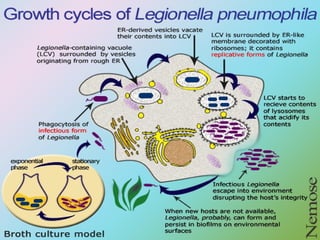
range of protozoan species as hosts. The
availability of the hosts plays a major role
in the reproduction and mass release of
highly infectious Legionella forms into
environments where they can be spread
by airborn water caplets and inhaled by
people
Pathogenesis
• Bacteria enter through alveoli
• Legionella multiply inside the
Monocytes and Macrophages
• CMI effective
Spread of Infection
Clinically Manifest
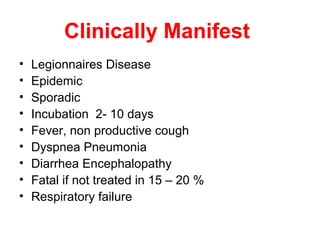
• Legionnaires Disease
• Epidemic
• Sporadic
• Incubation 2- 10 days
• Fever, non productive cough
• Dyspnea Pneumonia
• Diarrhea Encephalopathy
• Fatal if not treated in 15 – 20 %
• Respiratory failure
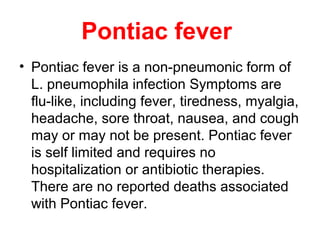
Pontiac fever
• Pontiac fever is a non-pneumonic form of
L. pneumophila infection Symptoms are
flu-like, including fever, tiredness, myalgia,
headache, sore throat, nausea, and cough
may or may not be present. Pontiac fever
is self limited and requires no
hospitalization or antibiotic therapies.
There are no reported deaths associated
with Pontiac fever.
Clinically
• Pontiac fever is Mild non fatal, influenza
like fever
Detection
• Sera have been used both for slide agglutination
studies as well as for direct detection of bacteria
in tissues using fluorescent-labelled antibody.
Specific antibody in patients can be determined
by the indirect fluorescent antibody test. ELISA
and micro agglutination tests have also been
successfully applied
• Legionella stains poorly with gram stain, stains
positive with silver, and is cultured on charcoal
yeast extract with iron and cysteine.
Laboratory Diagnosis
• Specimens
Sputum
Bronchial aspirate
Lung biopsy
Florescent methods
Serology ELISA
Treatment
• Respiratory fluoroquinolones and the
newer macrolides are used to treat L.
pneumophila pneumonia. Treatment
typically lasts 7-10 days or in the case
of immunosuppressed patients, 21
days. Pontiac fever usually does not
require antimicrobial therapy.
Treatment
• Macrolides
• Ciprofloxacin
• Tetracycline's
• Rifampicin
AcinetobacterAcinetobacter
• Two important species
A baumannii
A lowffi
Present as soil saprophytes in sewage
An opportunistic pathogen
Morphology
• Gram – ve 1-5 to 2.5 microns in size
• Aerobic grows on ordinary media
• Oxidase –ve
• Nitrate reducing
• Pink colonies on Mac conkey
• Non acid utilizes
Clinical Manifestations
• Identified as Important
opportunistic infection
• Sensitive to Broad spectrum
antibiotics
Rat Bite Fever
Two types of bacteria
1 Streptobacilli moniliforms
2 Spirillum minus
Spirillum Minus
• Short Gram negative spiral organism
• 3 – 5 microns
• Stains with Giemsa stain
• Dark field microscope useful
• Not cultured- Can be isolated by
inoculating the specimen Intraperitoneally
into Mic
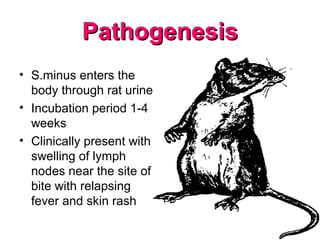
PathogenesisPathogenesis
• S.minus enters the
body through rat urine
• Incubation period 1-4
weeks
• Clinically present with
swelling of lymph
nodes near the site of
bite with relapsing
fever and skin rash
Treatment
• Highly susceptible to
Penicillin and Tetracycline's.
Erysipeothrix rhusiopathiae
• Causes Erysipleoid in Humans
• Contaminated fish meat produce disease
Morphology
• Thin, Non motile, Non sporing Non
capsulated Gram + ve bacilli, long
filaments,
• Aerobic organisms
• Grows on ordinary media
• Ferments glucose, lactose
• Black colonies on Tellurite medium
• H2 S producer
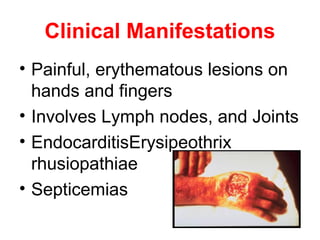
Clinical Manifestations
• Painful, erythematous lesions on
hands and fingers
• Involves Lymph nodes, and Joints
• EndocarditisErysipeothrix
rhusiopathiae
• Septicemias
Culturing
• Skin Biopsy can put in
appropriate medium
• Grows in ordinary medium
Treatment
•Ampicillin
•Erythromycin
•Ciprofloxacin
Gardenerella Vaginalis
Causes Bacterial vaginosis
An emerging infection
Morphology
• Small, Gram
negative, on motile
• Pleomorphic rod
which shows
metachromatic
granules
• Presence of Clue
cells
Culturing
• Grows on Blood and Chocolate
Agar
• Hemolytic colonies on Human and
Rabbit blood agar,
• Catalase –
• Oxidase -
Clue Cells
• Vaginal secretions shows Clue
cells
• Which are epithelial cell with
surface studded with small
bacteria
Treatment
• Metronidazole
• The Program Created by
Dr.T.V.Rao MD for Medical
and Paramedical Students
• Email ;
doctortvrao@gmail.com

MISCELLANEOUS BACTERIA

  • 1.
  • 2.
  • 3.
    What is Listeriosis •Listeriosis, a serious infection caused by eating food contaminated with the bacterium Listeria Monocytogenes, has recently been recognized as an important public health problem in the United States.
  • 4.
    Who get Infected •The disease affects primarily persons of advanced age, pregnant women, new-borns, and adults with weakened immune systems. However, persons without these risk factors can also rarely be affected.
  • 6.
    What is Listeriosis? •Listeriosis is a serious infection caused by eating foods contaminated with the bacterium Listeria MonocytogenesListeria Monocytogenes.. • This disease affects primarily pregnant women, newborn, and adults with weakened immune systems.
  • 7.
    Listeria Monocytogenes Small cocalGram positive Bacteria •Occurs in chains •Long filamentous forms •Tumbling motility at 250 c and non motile at 370 c Peritrichous flagella Aerobic and Microaerophilic Growth at 40 c
  • 8.
    Listeriosis • Listeriosis iscaused by Bacterial agent an intracellular pathogen Listeria Monocytogenes • L.monocytogens produces infections world wide • Important cause of infections in animals and man.
  • 9.
    Culture and Growth Characteristics •Grows on Muller Hinton agar with sheep blood as enrichment. • Small zone of Hemolysis can be observed around and the underneath of the colony. • Specimens are enriched if the tissues are kept at 40 c and plated on the media ( Cold enrichment )
  • 10.
    Biochemical reactions •Bacteria are facultativeanaerobic microbes •Catalase + motile •Listeria produce acid and not gas in various sugar fermentation tests
  • 11.
    Who are atrisk with Listeriosis • Pregnant women • New-borns • People with weakened immune systems • People who are taking immuno- suppressing medication.
  • 12.
    How Humans contactListeriosis • Listeria Monocytogenes can be found in a variety of dairy products, vegetables, fish and meat products. • Listeria Monocytogenes, unlike most other harmful bacteria, will grow slowly on foods stored in a refrigeratorrefrigerator.. • Listeria Monocytogenes can also be spread by contact with an infected product or surface, such as hands or counter tops, during food preparation.
  • 13.
    Pathogenesis and Pathology • ListeriaMonocytogenes enters through the Gastro – intestinal tract after infections of contaminated foods such as cheese or vegetables, • The cell wall surface protein called Interanalin interacts with E –CADHERIN and enters into epithelial cells • Bacteria produce Listeriolysin • L.monocygenes can move from cell to with out being exposed to Antibodies,Complement,Polymorphonuclear cells
  • 14.
    Who are atHigher Risk • The following conditions may be impaired with defective cell mediated Immunity Pregnancy AIDS Lymphomas Organ transplant recipients
  • 15.
    Common presenting manifestation of Listeriosis •Vomiting; • Nausea; • Cramps; • Diarrheal; • Severe Headache; • Constipation; or • Persistent fever.
  • 16.
    Late onset manifestations •The new born child may present with late onset syndrome causes the development of Meningitis between birth and third week of life • It is often caused by serotype IV b and has a significant mortality rate
  • 17.
    Listeriosis In Adults •Adults may present with bacteremia . Meingoenphalitis and occur most commonly in Immunosuppressed patients in whom Listeria is one of the more common cause of Meningitis • Disease can be insidious to fulminant
  • 18.
    Listeriosis and Pregnancy •Pregnant women - They are about 20 times more likely than other healthy adults to get Listeriosis. About one-third of Listeriosis cases happen during pregnancy.
  • 19.
    Listeriosis in NewBorns • New-borns - New-borns rather than the pregnant women themselves suffer the serious effects of infection in pregnancy.

  • 20.
    Listeriosis presenting with Meningitis •Immunocompromised adults are at risk for a serious infection of the blood stream and central nervous system (brain and spinal cord). Meningitis occurs in about half of the cases of adult Listeriosis. Symptoms of listeria meningitis occur about four days after the flu-like symptoms and include fever, personality change, uncoordinated muscle movement, tremors, muscle contractions, seizures, and slipping in and out of consciousness.
  • 21.
    Other Clinical manifestations •Abscess • Conjunctivitis • Pharyngitis • Urethritis • Pneumonia • Endocarditis • Septicemias
  • 22.
    Why important inHuman Infections • Can cause meningitis and Meingoenphalitis • In particularly in neonates and elderly • Pregnant women - abortions, and still birth • Asymptomatic colonization in vagina produces infertility
  • 23.
    Other characters and Biochemicalreactions • Produces hemolytic colonies • Ferments Glucose, Maltose, lactose produces acid but no gas • Listeria Monocytogenes present in the environment • Saprophyte in soil • Present in water, sewage.
  • 24.
    Diagnosis • Diagnosis dependent on isolationof Organisms in cultures obtained on CSF, Blood, and other fluids
  • 25.
    Treatment • Ampicillin • Erythromycin •Intravenous Trimethoprim – Sulphmethoxazole • Cephalosporins and Fluroquinoles are not active against l.monocytogens • A commination of Gentamycin and Ampicillin on clinical basis
  • 27.
    Foods to Avoid •Hot dogs, especially straight from the package without further heating. The fluid within hot dog packages may contain more Listeria than the hot dogs. • Avoid spreading fluid from packages onto other foods, cutting boards, utensils, dishes and food preparation surfaces. Wash your hands after handling hot dogs.
  • 28.
    Why important inHumanWhy important in Human InfectionsInfections • Can cause meningitis and Meingoenphalitis • In particularly in neonates and elderly • Pregnant women - abortions, and still birth • Asymptomatic colonization in vagina produces infertility
  • 29.
    Ideal way toprevent Listeriosis • Completely cook all meats and eggs. • Carefully wash raw vegetables before eating. • Keep raw meat away from raw vegetables and prepared foods. After cutting raw meat, wash the cutting board with detergent before using it for vegetables. • Avoid drinking unpasteurized milk or foods made from such milk. • Wash hands thoroughly after handling raw meat.
  • 30.
  • 31.
    CampylobacterCampylobacter • Cococid Pleomorphicorganisms, slender spirally curved bacteria. • Gram negative. 2 x 0.5 microns • Comma shaped, curved rods • Non sporing , non motile • Single unsheathed polar flagella at one or both ends • Microaerophilic
  • 32.
    Other charactersOther characters •Microaerophilic •5% o2 optimal •Oxidase + •Sugars not fermented •Humans causes Diarrhea •Vetnary importance
  • 33.
    Campylobacter jejuni • Importantcause of Diarrhea world wide • Zoonotic importance • Arises from food and animal origin • Present in Intestinal tracts of animals • Surface waters
  • 34.
    Pathology and Clinical Manifestations •Colonized in Jejunum, Ileum and colon and rectum • Involves mesenteric lymph nodes and cause bacteremia • Incubation 1 – 7 days • Present with Fever, abdominal pain and watery diarrhea
  • 35.
    Laboratory Diagnosis • Isolationof Campylobacters from feces • Observation by phase contrast microscopy, Dark field examination • Present with tumbling motility • Feces or rectal swabs cultured on Skirrows mediumSkirrows medium Butzlers supplementButzlers supplement
  • 36.
    Treatment and prevention •Correctionfluid and electrolyte balance •Erythromycin is effective
  • 37.
  • 38.
    Helicobacter ( Warren andMarshal ) • Campylobacter like organisms • Spiral shaped colonizes Gastric mucosa • Etiological agent in Gastritis and peptic ulcer • Most important bacteria. Helicobacter pylori Colonizes 50 % of the Individuals
  • 39.
    Winners of NobelPrize in Medicine -Physiology
  • 40.
    A silver stainof H. pylori on gastric mucus-secreting epithelial cells (x1000). From Dr. Marshall's stomach biopsy taken 8 days after he drank a culture of H. pylori (1985).
  • 41.
    Helicobacter pylori • Gram–ve spiral shaped , motile with unipolar tuft of lopotrichus flagella
  • 42.
    MICROBIOLOGY 1. Gram negative,spiral, flagellated (motile) bacilli 2. Slow growing, requires complex media, microaerophilic 3. Oxidase and catalase positive 4. Produces urease 5. Noninvasive; proliferates in mucus overlying gastric type mucosa 6. Not cleared by host immune response
  • 43.
    Culturing and BiochemicalCulturingand Biochemical characterscharacters • Grows on chocolate agar, Campylobacter media • Grows under Microaerophilic conditions • With presence of 5 – 20% co2 • Oxidase + • Catalase – • Urease strongly +++ • H2S
  • 44.
    Pathology and pathogenesis •H.pylori colonizes gastric mucosa • Spread by oral – oral contact • Feco oral spread prominent • Poverty and overcrowding predisposes • Poor Hygiene • Causes mild to acute gastritis • Gastric antrum - causes gastric metaplasia • Any part of the stomach can be involved • Colonizes overlying mucosa but do not invade mucosa
  • 45.
    Major Location ofH.pyloriMajor Location of H.pylori infectionsinfections
  • 46.
  • 47.
  • 49.
    Pathogenesis • Produce bacterialproteases • Toxins • Ammonia is release by Urease activity • Causes Peptic ulcer Chronic Atrophic gastritis Gastric malignancies Adeno carcinoma Mucosa associated lymphomas Matomas Antigen derived Infection induces IgM, IgG, IgA
  • 50.
    Laboratory Diagnosis • Diagnosedby Invasive and Non Invasive tests • Invasive, Endoscopic Biopsy of Gastric mucosa • Microscopy – Biopsy • Culture • Staining by special stains • Gram staining • Culture more sensitive 3 – 7 days • Biopsy testing for urease detection in urea medium
  • 51.
    Diagnosis by Noninvasive methods • Serology ELISA • Urea breath test patient swallows urea solution In this test patient drinks urea solutions labeled with an isotope carbon If H.pylori is present in the urea is converted to ammonia and co2 in the breath measured.
  • 53.
    TreatmentTreatment • Use ofantibiotics, bismuth salts • Ingestion of Bismuth subsalicylate • Antibiotics Teracycles and metronidazole for two weeks • Use of Omeprazole • Clarithromycin • Donor treat for Asymptomatic colonization • Drug resistance is a growing problem
  • 54.
    Treatment • Ampicillin • Cotromoxazole •Streptomycin • Cephalosporins not recommended
  • 55.
    Donovania Granulomatis Calymmatobacterium Granulomatis Donovan 1905 AVenereal disease Common in Tropical countries
  • 56.
    Morphology • Rounded Cocobacilli size is 1 -2 microns found in cystic spaces in large mononuclear cells • Bipolar condensation of chromatin resembling closed safety pin appearance • Capsulated and non motile • Gram negative • Grown on egg yolk • Modified Levanthal agar
  • 57.
    Clinical Manifestations • Producesgenital lesions, a venereal disease • Incubation 1 – 12 weeks • Starts as a painless papule on Genitalia, progress to ulcers • May progress to chronic course
  • 58.
    Typical manifestation asvenereal disease
  • 59.
    Treatment • Tetracycline • Cotromoxazole •Chloramphenicol • Gentamycin • Quinolones • Newer macrocodes
  • 60.
    Legionella pneumophila Causes Legionnairesdisease Manifest two different disease Legionnaires disease Pontiac fever
  • 61.
    Legionella pneumophila • Legionellapneumophila is a thin, aerobic, pleomorphic, flagellated, non-spore forming, Gram-negative bacterium of the genus Legionella. L. pneumophila is the primary human pathogenic bacterium in this group and is the causative agent of legionellosis or Legionnaires' disease
  • 62.
    Morphology • Thin, Noncapsulated Gram negative bacilli • 2 – 3 microns • Coccobacillary • Long forms in culture • Motile with polar Bipolar flagella • Staining with Silver impregnation methods
  • 63.
    Culture • Grown onBuffered charcoal yeast extract agar with L cystine with antibiotics • When observed under microscope appear as cut glass • L.pneumphila catalase +
  • 64.
    Bacterial spread • Legionellaare present in stagnant water mud and hot springs • Live also in free living ameba • Human infection is typically by inhalation of aerosols provided by cooling towers and air conditioners • Shower heads • Out come of infection depends on size of infective dose
  • 65.
    Predisposing factors • Smoking •Alcohol • Age, • Hospitalization • Immunodeficiency status • Can be Community acquired or Hospital acquired
  • 66.
    Transmission • Legionella comefrom natural fresh water reservoirs, such as lakes, ponds, and puddles, where they parasitize on a broad range of protozoan species as hosts. The availability of the hosts plays a major role in the reproduction and mass release of highly infectious Legionella forms into environments where they can be spread by airborn water caplets and inhaled by people
  • 67.
    Pathogenesis • Bacteria enterthrough alveoli • Legionella multiply inside the Monocytes and Macrophages • CMI effective
  • 68.
  • 69.
    Clinically Manifest • LegionnairesDisease • Epidemic • Sporadic • Incubation 2- 10 days • Fever, non productive cough • Dyspnea Pneumonia • Diarrhea Encephalopathy • Fatal if not treated in 15 – 20 % • Respiratory failure
  • 70.
    Pontiac fever • Pontiacfever is a non-pneumonic form of L. pneumophila infection Symptoms are flu-like, including fever, tiredness, myalgia, headache, sore throat, nausea, and cough may or may not be present. Pontiac fever is self limited and requires no hospitalization or antibiotic therapies. There are no reported deaths associated with Pontiac fever.
  • 72.
    Clinically • Pontiac feveris Mild non fatal, influenza like fever
  • 73.
    Detection • Sera havebeen used both for slide agglutination studies as well as for direct detection of bacteria in tissues using fluorescent-labelled antibody. Specific antibody in patients can be determined by the indirect fluorescent antibody test. ELISA and micro agglutination tests have also been successfully applied • Legionella stains poorly with gram stain, stains positive with silver, and is cultured on charcoal yeast extract with iron and cysteine.
  • 74.
    Laboratory Diagnosis • Specimens Sputum Bronchialaspirate Lung biopsy Florescent methods Serology ELISA
  • 75.
    Treatment • Respiratory fluoroquinolonesand the newer macrolides are used to treat L. pneumophila pneumonia. Treatment typically lasts 7-10 days or in the case of immunosuppressed patients, 21 days. Pontiac fever usually does not require antimicrobial therapy.
  • 76.
  • 77.
    AcinetobacterAcinetobacter • Two importantspecies A baumannii A lowffi Present as soil saprophytes in sewage An opportunistic pathogen
  • 78.
    Morphology • Gram –ve 1-5 to 2.5 microns in size • Aerobic grows on ordinary media • Oxidase –ve • Nitrate reducing • Pink colonies on Mac conkey • Non acid utilizes
  • 79.
    Clinical Manifestations • Identifiedas Important opportunistic infection • Sensitive to Broad spectrum antibiotics
  • 80.
    Rat Bite Fever Twotypes of bacteria 1 Streptobacilli moniliforms 2 Spirillum minus
  • 81.
    Spirillum Minus • ShortGram negative spiral organism • 3 – 5 microns • Stains with Giemsa stain • Dark field microscope useful • Not cultured- Can be isolated by inoculating the specimen Intraperitoneally into Mic
  • 82.
    PathogenesisPathogenesis • S.minus entersthe body through rat urine • Incubation period 1-4 weeks • Clinically present with swelling of lymph nodes near the site of bite with relapsing fever and skin rash
  • 83.
    Treatment • Highly susceptibleto Penicillin and Tetracycline's.
  • 84.
    Erysipeothrix rhusiopathiae • CausesErysipleoid in Humans • Contaminated fish meat produce disease
  • 85.
    Morphology • Thin, Nonmotile, Non sporing Non capsulated Gram + ve bacilli, long filaments, • Aerobic organisms • Grows on ordinary media • Ferments glucose, lactose • Black colonies on Tellurite medium • H2 S producer
  • 86.
    Clinical Manifestations • Painful,erythematous lesions on hands and fingers • Involves Lymph nodes, and Joints • EndocarditisErysipeothrix rhusiopathiae • Septicemias
  • 87.
    Culturing • Skin Biopsycan put in appropriate medium • Grows in ordinary medium
  • 88.
  • 89.
    Gardenerella Vaginalis Causes Bacterialvaginosis An emerging infection
  • 90.
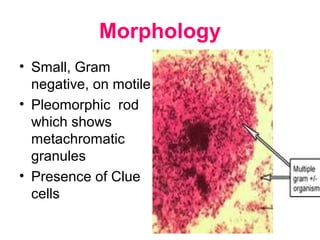
    Morphology • Small, Gram negative,on motile • Pleomorphic rod which shows metachromatic granules • Presence of Clue cells
  • 91.
    Culturing • Grows onBlood and Chocolate Agar • Hemolytic colonies on Human and Rabbit blood agar, • Catalase – • Oxidase -
  • 92.
    Clue Cells • Vaginalsecretions shows Clue cells • Which are epithelial cell with surface studded with small bacteria
  • 93.
  • 94.
    • The ProgramCreated by Dr.T.V.Rao MD for Medical and Paramedical Students • Email ; doctortvrao@gmail.com