ETHICAL AND
SOCIAL ISSUES
IN
INFORMATION
SYSTEMS
Ms. Imeshika Dilrukshi
Learning Outcomes
 At the end of this module, you will be
able to Define;
1. Trends in computer hardware platforms
2. Trends in software platforms
3. Ethical, social, and political issues of information
systems
4. Contemporary information systems technology and
the challenges of Internet to the protection of
individual privacy and intellectual property
Trends in computer
hardware platforms
1. Emergence of Mobile Digital Platforms
 Emergence of mobile, alternatives to PCs and larger
computers
 Functions of the mobile digital Platforms
 Transmission of data
 Surfing the Web
 Transmitting e-mail and instant messages
 Displaying digital content, and exchanging data
with internal corporate systems
Ex: e iPads, smart phones, digital e-book readers
such as Amazon’s Kindle with Web access
capabilities
(Activity 1: Identify what is Chromebook and where
shouldn’t we use it?)
https://www.youtube.com/watch?v=c-1zMFp1iCY
2. CONSUMERIZATION OF IT AND BYOD
Consumerization of IT is: the cycle of technology emerging first in the consumer market
and then spreading to business and government organizations
Ex: Business uses of software services such as Google and Yahoo search, Gmail, Google
Apps, Facebook and Twitter that originated in the consumer marketplace
BYOD → Allowing employees to use their personal mobile devices in the workplace,
called “bring your own device” (BYOD)
Benefits of BYOD : Cost Saving
: Employee Comfort
: Productivity
: Access and Connectivity
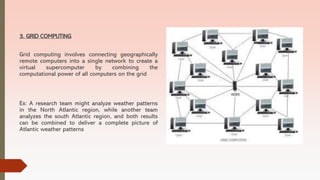
3. GRID COMPUTING
Grid computing involves connecting geographically
remote computers into a single network to create a
virtual supercomputer by combining the
computational power of all computers on the grid
Ex: A research team might analyze weather patterns
in the North Atlantic region, while another team
analyzes the south Atlantic region, and both results
can be combined to deliver a complete picture of
Atlantic weather patterns
4. VIRTUALIZATION
Virtualization enables a single physical resource (such as a server or a
storage device) to appear to the user as multiple logical resources
Virtualization is technology that lets you create
 useful IT services using resources that are traditionally bound to
hardware.
 It allows you to use a physical machine’s full capacity by distributing its
capabilities among many users or environments.
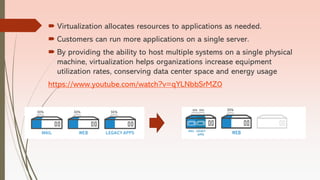
 Virtualization allocates resources to applications as needed.
 Customers can run more applications on a single server.
 By providing the ability to host multiple systems on a single physical
machine, virtualization helps organizations increase equipment
utilization rates, conserving data center space and energy usage
https://www.youtube.com/watch?v=qYLNbbSrMZ0
5. Cloud Computing
Cloud computing is the act of running workloads within clouds—which are IT
environments that abstract, pool, and share scalable resources across a
network.
Cloud computing consists of three different types of services:
1. Cloud infrastructure as a service: Customers use processing, storage,
networking, and other computing resources from cloud service providers
to run their information systems.
Ex: Amazon uses the spare capacity of its IT infrastructure to provide a
broadly based cloud environment selling IT infrastructure services
2. Cloud platform as a service: Customers use infrastructure and
programming tools supported by the cloud service provider to develop
their own applications.
This is a model where a third-party provider delivers hardware and
software tools to users over the internet. Usually, these tools are
needed for application development.
Ex: IBM offers a Smart Business Application Development & Test service
for software development and testing on the IBM Cloud.
3. Cloud software as a service:
Customers use software hosted by the vendor on the vendor’s
cloud infrastructure and delivered over a network. Leading
examples are Google Apps, which provides common business
applications online and Salesforce.com
• Owned and maintained by a cloud service
provider
• Ex: Amazon Web Services
Public
Clouds
• Operated solely for an organization.
• It may be managed by the organization or a third
party and may exist on premise or off premises
Private
Clouds
6. Green Computing
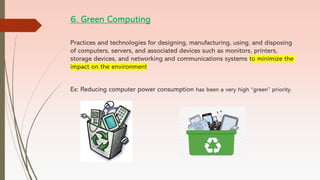
Practices and technologies for designing, manufacturing, using, and disposing
of computers, servers, and associated devices such as monitors, printers,
storage devices, and networking and communications systems to minimize the
impact on the environment
Ex: Reducing computer power consumption has been a very high “green” priority.
2. Trends in software platforms
1. OPEN-SOURCE SOFTWARE
 Software with source code that anyone can inspect, modify, and enhance.
 "Source code" is the part of software that most computer users don't ever see; it's the code
computer programmers can manipulate to change how a piece of software—a "program" or
"application"—works.
 Popular open-source software tools include the Linux operating system, the Apache HTTP Web
server, the Mozilla Firefox Web browser
2. SOFTWARE OUTSOURCING AND CLOUD SERVICES
Companies will purchase or rent most of their new software applications from external
sources
There are three external sources for software:
1. Software packages from a commercial software vendor
2. Outsourcing custom application development to an external vendor (which may or
may not be offshore)
3. Cloud-based software services and tools.
1. Software packages from a commercial software vendor
Prewritten commercially available set of software programs that eliminates the need
for a firm to write its own software programs for certain functions
Ex: SAP and Oracle-PeopleSoft.
Developed for customer relationship management, and supply chain management, to
finance and human resources
2. Software Outsourcing
Enables a firm to contract custom software development or maintenance of existing
legacy programs to outside firms, which often operate offshore in low-wage areas of
the world.
Ex: Cemex, Mexico's largest cement manufacturer, signed a 10-year $1 billion
outsourcing deal with IBM in July 2012 for application development and maintenance
as well as IT infrastructure management, finance and HR
3. Cloud-Based Software Services and Tools
Cloud-based computing (also called Software as a Service, or SaaS) allows users
access to software applications that run on shared computing resources (for
example, processing power, memory, and disk storage) via the Internet.
These computing resources are maintained in remote data centers dedicated to
hosting various applications on multiple platforms.
Ex: Cloud ERP is Software as a Service - that allows users to access Enterprise
Resource Planning (ERP) software over the Internet.
ETHICAL AND
SOCIAL ISSUES
IN
INFORMATION
SYSTEMS
What are ethics?
Ethics refers to the principles of right and wrong that individuals,
acting as free moral agents, use to make choices to guide their
behaviors.
Why is ethics an important aspect of information systems???
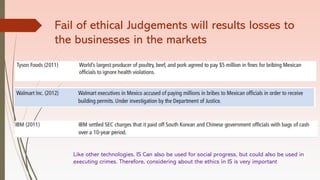
Fail of ethical Judgements will results losses to
the businesses in the markets
Like other technologies, IS Can also be used for social progress, but could also be used in
executing crimes. Therefore, considering about the ethics in IS is very important
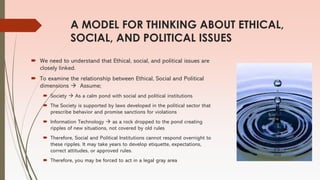
A MODEL FOR THINKING ABOUT ETHICAL,
SOCIAL, AND POLITICAL ISSUES
 We need to understand that Ethical, social, and political issues are
closely linked.
 To examine the relationship between Ethical, Social and Political
dimensions → Assume;
 Society → As a calm pond with social and political institutions
 The Society is supported by laws developed in the political sector that
prescribe behavior and promise sanctions for violations
 Information Technology → as a rock dropped to the pond creating
ripples of new situations, not covered by old rules
 Therefore, Social and Political Institutions cannot respond overnight to
these ripples. It may take years to develop etiquette, expectations,
correct attitudes, or approved rules.
 Therefore, you may be forced to act in a legal gray area
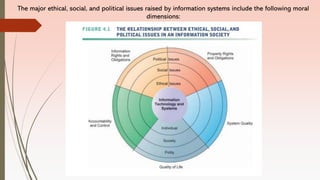
The major ethical, social, and political issues raised by information systems include the following moral
dimensions:
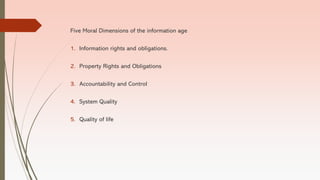
Five Moral Dimensions of the information age
1. Information rights and obligations.
2. Property Rights and Obligations
3. Accountability and Control
4. System Quality
5. Quality of life
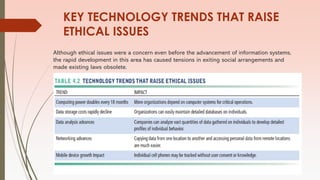
KEY TECHNOLOGY TRENDS THAT RAISE
ETHICAL ISSUES
Although ethical issues were a concern even before the advancement of information systems,
the rapid development in this area has caused tensions in exiting social arrangements and
made existing laws obsolete.
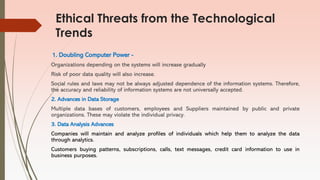
Ethical Threats from the Technological
Trends
1. Doubling Computer Power -
Organizations depending on the systems will increase gradually
Risk of poor data quality will also increase.
Social rules and laws may not be always adjusted dependence of the information systems. Therefore,
the accuracy and reliability of information systems are not universally accepted.
2. Advances in Data Storage
Multiple data bases of customers, employees and Suppliers maintained by public and private
organizations. These may violate the individual privacy.
3. Data Analysis Advances
Companies will maintain and analyze profiles of individuals which help them to analyze the data
through analytics.
Customers buying patterns, subscriptions, calls, text messages, credit card information to use in
business purposes.
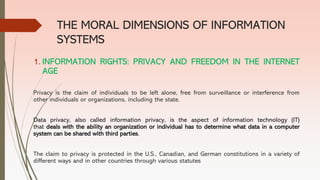
THE MORAL DIMENSIONS OF INFORMATION
SYSTEMS
1. INFORMATION RIGHTS: PRIVACY AND FREEDOM IN THE INTERNET
AGE
Privacy is the claim of individuals to be left alone, free from surveillance or interference from
other individuals or organizations, including the state.
Data privacy, also called information privacy, is the aspect of information technology (IT)
that deals with the ability an organization or individual has to determine what data in a computer
system can be shared with third parties.
The claim to privacy is protected in the U.S., Canadian, and German constitutions in a variety of
different ways and in other countries through various statutes
 In Europe, privacy protection is much more stringent than in the United States. Unlike
the United States, European countries do not allow businesses to use personally
identifiable information without consumers’ prior consent
 On October 25, 1998, the European Commission’s Directive on Data Protection went
into effect, broadening privacy protection in the European Union (EU) nations.
 Customers must provide their informed consent before any company can legally use
data about them, and they have the right to access that information, correct it, and
request that no further data be collected.
 Ex: companies like Amazon, Facebook, Apple, Google, and others to obtain explicit
consent from consumers about the use of their personal data
Cookies ………….
Cookies are;
✓ Small text files deposited on a computer hard drive when a user visits Web sites.
✓ Cookies identify the visitor’s Web browser software and track visits to the Web site.
✓ When the visitor returns to a site that has stored a cookie, the Web site software will search
the visitor’s computer, find the cookie, and know what that person has done in the past. It
may also update the cookie, depending on the activity during the visit.
✓ In this way, the site can customize its content for each visitor’s interests.
✓ For example, if you purchase a book on Amazon.com and return later from the same
browser, the site will welcome you by name and recommend other books of interest based
on your past purchases.
Web beacons or Web Bugs
✓ Web Beacons are tiny software programs that keep a record of users’ online
clickstream and report this data back to whomever owns the tracking file.
✓ Web beacons are placed on popular Web sites by third-party firms who pay
the Web sites a fee for access to their audience
✓ Wall Street Journal in 2010 and 2011, researchers examined the tracking
files on 50 of the most popular U.S Web sites.
✓ On the 50 sites, they discovered 3,180 tracking files installed on visitor
computers. Only one site, Wikipedia, had no tracking files.
✓ The biggest trackers were Google, Microsoft, and Quantcast, all of whom are
in the business of selling ads to advertising firms and marketers
Spyware
 Secretly install itself on an Internet user’s computer by piggybacking on larger
applications.
 Once installed, the spyware calls out to Web sites to send banner ads and other
unsolicited material to the user, and it can report the user’s movements on the
Internet to other computers.
 May reset your web home page, redirect website requests, randomly flood your
screen with advertising, and perform other irritating acts.
 A recent study found that 88 percent of 400,000 Web sites had at least one Google
tracking bug.
Ex: Google’s AdSense program enables Google to help advertisers select keywords and
design ads for various market segments based on search histories, such as helping a
clothing Web site create and test ads targeted at teenage females
 Most Internet businesses do little to protect the privacy of their customers, and
consumers do not do as much as they should to protect themselves.
 The majority of online customers claim they are concerned about online privacy, but
less than half read the privacy statements on Web sites.
Solutions Available:
1. Many browsers have Do Not Track options.
For users who have selected the Do Not Track browser option, their browser will send a
request to Web sites requesting the user’s behavior not be tracked.
Ex: Internet Explorer 9 and Mozilla’s Firefox browsers
2. Property Rights : Intellectual Property
Intellectual Property
* Intellectual property is considered to be intangible property created by individuals or corporations.
They are creations of the mind, such as inventions; literary and artistic works; designs; and symbols,
names and images used in commerce.
Ex: An author's copyright on a book or article
: A distinctive logo design representing a soft drink company and its products
: Unique design elements of a web site, or a patent on a particular process
* Computerized information can be so easily copied or distributed on networks
* Intellectual property is subject to a variety of protections under three different legal traditions: trade
secrets, copyright, and patent law
 Trade Secret
* Any intellectual work product—a formula, device, pattern, or compilation of data — used for a
business purpose can be classified as a trade secret, provided it is not based on information in
the public domain
* This can be any commercially important Information
Ex: How to produce a product, Tricks in production process
* The limitation of trade secret protection: Software Programs
Examples for Trade Secrets: …………………………………………
https://www.youtube.com/watch?v=necoc_W6uM8
Copyright
* A Statutory grant that protects creators of intellectual property from having their work copied by
others for any purpose during the life of the author plus an additional 70 years after the author’s
death
* For corporate-owned works, copyright protection lasts for 95 years after their initial creation.
* These are established to encourage creativity and authorship by ensuring that creative people
receive the financial and other benefits of their work.
* Copyright protection are given to: to books, periodicals, lectures, dramas, musical compositions,
maps, drawings, artwork of any kind
* Copyrights are unique to each country
Ex - Part II of the Intellectual Property Act, No. 36 of 2003 in Sri Lanka
 Patents
A patent grants the owner an exclusive monopoly on the ideas behind an invention for 20 years
Ex: Patents are a right granted to an inventor that allows them to exclude all others from making,
using, or selling their invention for 20 years.
The key concepts in patent law are originality, novelty, and invention
Ex: Software with patents
Airbnb: Automated determination of booking availability for accommodation listings. (Patent
#US1005315B2)
Coinbase: Instant Exchange. (Patent #US10614430B2)
https://www.youtube.com/watch?v=64GhiDvem4o
Violating Paten Rights could cause massive damages:
Ex: Apple sued Samsung for violating its patents for iPhones, iPads, and iPods and claimed $1
billion for damages
Challenges to Intellectual Property Rights
 Digital media differ from books, periodicals, and other media in terms
of ease of replication
 Ease of transmission; ease of alteration; difficulty in classifying a
software work as a program, book, or even music; compactness—
making theft easy; and difficulties in establishing uniqueness
 Rate of global software piracy climbed to 42 percent in 2011,
representing $63 billion in global losses from software piracy.
Worldwide, for every $100 worth of legitimate software sold that year,
an additional $75 worth was obtained illegally.
 Individuals have been illegally copying and distributing digitized MP3
music files on the Internet for a number of years.
3. Accountability, Liability and Control
 People come to depend on services essentially based on software
Ex: ATM Machines - are a service provided to bank customers. Should this service fail?
customers will be inconvenienced and perhaps harmed economically if they cannot access
their funds in a timely manner
 Blackberry Mobile Phones – Problem in accessing the emails on Time
Who is liable for any economic harm caused to individuals or businesses that could not
access their e-mail during this three-day period?
The software companies should be accountable to make sure the software functions well,
perform the task since it is more difficult to compare with other software products for
quality
4. SYSTEM QUALITY: DATA QUALITY AND
SYSTEM ERRORS
 Three principal sources of poor system performance are
(1) Software bugs and errors
(2) Hardware or facility failures caused by natural or other causes
(3) Poor input data quality.
 Organizations may be held responsible for avoidable and foreseeable consequences, which they
have a duty to perceive and correct
 However, certain perfections are not feasible economically because no one could afford the
product and fixing all minor errors would prevent these products from ever being released
5. QUALITY OF LIFE: EQUITY, ACCESS, AND
BOUNDARIES
 Use of computer information systems can advance the workflows as
well as create negative consequences.
 These negative consequences can be extremely harmful to
individuals, societies, and political institutions.
 It can destroy valuable elements of our culture and society even
while they bring us benefits.
 Some of the negative consequences are discussed below:
 Balancing Power: Center Versus Periphery
Lower-level employees may be empowered to make minor decisions, but the key policy decisions may
be as centralized as in the past.
Corporate Internet behemoths like Google, Apple, Yahoo, Amazon, and Microsoft have come to
dominate the collection and analysis of personal private information of all citizens.
Therefore, power has become more centralized into the hands of a few private oligopolies
 Rapidity to Change: : Reduced Response Time to Competition
The business you work for may not have enough time to respond to global competitors and may be
wiped out in a year, along with your job.
Creating a “just-in-time society” with “just-in-time jobs” and “just-in-time” workplaces, families, and
vacations.
 Maintaining Boundaries: Family, Work, and Leisure
The “do anything anywhere” computing environment is that it is actually coming true.
The traditional boundaries that separate work from family and just plain leisure have been
weakened.
The work umbrella now extends far beyond the eight-hour day into commuting time, vacation time,
and leisure time.
 Dependence and Vulnerability
The current businesses, governments, schools, and private associations, such as churches, are
incredibly dependent on information systems and are, therefore, highly vulnerable if these system
fail.
If these systems were to shut down, there is no backup educational structure or content that can
make up for the loss of the system.
 Computer Crime and Abuse
Computers or computer systems can be the object of the crime ( destroying a company’s computer
center or a company’s computer files), as well as the instrument of a crime.
Simply accessing a computer system without authorization or with intent to do harm, even by
accident, is now a federal crime.
Commonly seen computer attacks are:
Malware infection
Phishing fraud
Laptop and mobile hardware theft
Attacks by botnets
Thank You !!!

MIS Notes For University Students.MANAGEMENT INFORMATION SYSTEM

  • 1.
  • 2.
    Learning Outcomes  Atthe end of this module, you will be able to Define; 1. Trends in computer hardware platforms 2. Trends in software platforms 3. Ethical, social, and political issues of information systems 4. Contemporary information systems technology and the challenges of Internet to the protection of individual privacy and intellectual property
  • 3.
    Trends in computer hardwareplatforms 1. Emergence of Mobile Digital Platforms  Emergence of mobile, alternatives to PCs and larger computers  Functions of the mobile digital Platforms  Transmission of data  Surfing the Web  Transmitting e-mail and instant messages  Displaying digital content, and exchanging data with internal corporate systems Ex: e iPads, smart phones, digital e-book readers such as Amazon’s Kindle with Web access capabilities (Activity 1: Identify what is Chromebook and where shouldn’t we use it?) https://www.youtube.com/watch?v=c-1zMFp1iCY
  • 4.
    2. CONSUMERIZATION OFIT AND BYOD Consumerization of IT is: the cycle of technology emerging first in the consumer market and then spreading to business and government organizations Ex: Business uses of software services such as Google and Yahoo search, Gmail, Google Apps, Facebook and Twitter that originated in the consumer marketplace BYOD → Allowing employees to use their personal mobile devices in the workplace, called “bring your own device” (BYOD) Benefits of BYOD : Cost Saving : Employee Comfort : Productivity : Access and Connectivity
  • 5.
    3. GRID COMPUTING Gridcomputing involves connecting geographically remote computers into a single network to create a virtual supercomputer by combining the computational power of all computers on the grid Ex: A research team might analyze weather patterns in the North Atlantic region, while another team analyzes the south Atlantic region, and both results can be combined to deliver a complete picture of Atlantic weather patterns
  • 6.
    4. VIRTUALIZATION Virtualization enablesa single physical resource (such as a server or a storage device) to appear to the user as multiple logical resources Virtualization is technology that lets you create  useful IT services using resources that are traditionally bound to hardware.  It allows you to use a physical machine’s full capacity by distributing its capabilities among many users or environments.
  • 7.
     Virtualization allocatesresources to applications as needed.  Customers can run more applications on a single server.  By providing the ability to host multiple systems on a single physical machine, virtualization helps organizations increase equipment utilization rates, conserving data center space and energy usage https://www.youtube.com/watch?v=qYLNbbSrMZ0
  • 8.
    5. Cloud Computing Cloudcomputing is the act of running workloads within clouds—which are IT environments that abstract, pool, and share scalable resources across a network. Cloud computing consists of three different types of services: 1. Cloud infrastructure as a service: Customers use processing, storage, networking, and other computing resources from cloud service providers to run their information systems. Ex: Amazon uses the spare capacity of its IT infrastructure to provide a broadly based cloud environment selling IT infrastructure services
  • 9.
    2. Cloud platformas a service: Customers use infrastructure and programming tools supported by the cloud service provider to develop their own applications. This is a model where a third-party provider delivers hardware and software tools to users over the internet. Usually, these tools are needed for application development. Ex: IBM offers a Smart Business Application Development & Test service for software development and testing on the IBM Cloud.
  • 10.
    3. Cloud softwareas a service: Customers use software hosted by the vendor on the vendor’s cloud infrastructure and delivered over a network. Leading examples are Google Apps, which provides common business applications online and Salesforce.com • Owned and maintained by a cloud service provider • Ex: Amazon Web Services Public Clouds • Operated solely for an organization. • It may be managed by the organization or a third party and may exist on premise or off premises Private Clouds
  • 11.
    6. Green Computing Practicesand technologies for designing, manufacturing, using, and disposing of computers, servers, and associated devices such as monitors, printers, storage devices, and networking and communications systems to minimize the impact on the environment Ex: Reducing computer power consumption has been a very high “green” priority.
  • 12.
    2. Trends insoftware platforms 1. OPEN-SOURCE SOFTWARE  Software with source code that anyone can inspect, modify, and enhance.  "Source code" is the part of software that most computer users don't ever see; it's the code computer programmers can manipulate to change how a piece of software—a "program" or "application"—works.  Popular open-source software tools include the Linux operating system, the Apache HTTP Web server, the Mozilla Firefox Web browser
  • 13.
    2. SOFTWARE OUTSOURCINGAND CLOUD SERVICES Companies will purchase or rent most of their new software applications from external sources There are three external sources for software: 1. Software packages from a commercial software vendor 2. Outsourcing custom application development to an external vendor (which may or may not be offshore) 3. Cloud-based software services and tools.
  • 14.
    1. Software packagesfrom a commercial software vendor Prewritten commercially available set of software programs that eliminates the need for a firm to write its own software programs for certain functions Ex: SAP and Oracle-PeopleSoft. Developed for customer relationship management, and supply chain management, to finance and human resources 2. Software Outsourcing Enables a firm to contract custom software development or maintenance of existing legacy programs to outside firms, which often operate offshore in low-wage areas of the world. Ex: Cemex, Mexico's largest cement manufacturer, signed a 10-year $1 billion outsourcing deal with IBM in July 2012 for application development and maintenance as well as IT infrastructure management, finance and HR
  • 15.
    3. Cloud-Based SoftwareServices and Tools Cloud-based computing (also called Software as a Service, or SaaS) allows users access to software applications that run on shared computing resources (for example, processing power, memory, and disk storage) via the Internet. These computing resources are maintained in remote data centers dedicated to hosting various applications on multiple platforms. Ex: Cloud ERP is Software as a Service - that allows users to access Enterprise Resource Planning (ERP) software over the Internet.
  • 16.
  • 17.
    What are ethics? Ethicsrefers to the principles of right and wrong that individuals, acting as free moral agents, use to make choices to guide their behaviors. Why is ethics an important aspect of information systems???
  • 18.
    Fail of ethicalJudgements will results losses to the businesses in the markets Like other technologies, IS Can also be used for social progress, but could also be used in executing crimes. Therefore, considering about the ethics in IS is very important
  • 19.
    A MODEL FORTHINKING ABOUT ETHICAL, SOCIAL, AND POLITICAL ISSUES  We need to understand that Ethical, social, and political issues are closely linked.  To examine the relationship between Ethical, Social and Political dimensions → Assume;  Society → As a calm pond with social and political institutions  The Society is supported by laws developed in the political sector that prescribe behavior and promise sanctions for violations  Information Technology → as a rock dropped to the pond creating ripples of new situations, not covered by old rules  Therefore, Social and Political Institutions cannot respond overnight to these ripples. It may take years to develop etiquette, expectations, correct attitudes, or approved rules.  Therefore, you may be forced to act in a legal gray area
  • 20.
    The major ethical,social, and political issues raised by information systems include the following moral dimensions:
  • 21.
    Five Moral Dimensionsof the information age 1. Information rights and obligations. 2. Property Rights and Obligations 3. Accountability and Control 4. System Quality 5. Quality of life
  • 22.
    KEY TECHNOLOGY TRENDSTHAT RAISE ETHICAL ISSUES Although ethical issues were a concern even before the advancement of information systems, the rapid development in this area has caused tensions in exiting social arrangements and made existing laws obsolete.
  • 23.
    Ethical Threats fromthe Technological Trends 1. Doubling Computer Power - Organizations depending on the systems will increase gradually Risk of poor data quality will also increase. Social rules and laws may not be always adjusted dependence of the information systems. Therefore, the accuracy and reliability of information systems are not universally accepted. 2. Advances in Data Storage Multiple data bases of customers, employees and Suppliers maintained by public and private organizations. These may violate the individual privacy. 3. Data Analysis Advances Companies will maintain and analyze profiles of individuals which help them to analyze the data through analytics. Customers buying patterns, subscriptions, calls, text messages, credit card information to use in business purposes.
  • 24.
    THE MORAL DIMENSIONSOF INFORMATION SYSTEMS 1. INFORMATION RIGHTS: PRIVACY AND FREEDOM IN THE INTERNET AGE Privacy is the claim of individuals to be left alone, free from surveillance or interference from other individuals or organizations, including the state. Data privacy, also called information privacy, is the aspect of information technology (IT) that deals with the ability an organization or individual has to determine what data in a computer system can be shared with third parties. The claim to privacy is protected in the U.S., Canadian, and German constitutions in a variety of different ways and in other countries through various statutes
  • 25.
     In Europe,privacy protection is much more stringent than in the United States. Unlike the United States, European countries do not allow businesses to use personally identifiable information without consumers’ prior consent  On October 25, 1998, the European Commission’s Directive on Data Protection went into effect, broadening privacy protection in the European Union (EU) nations.  Customers must provide their informed consent before any company can legally use data about them, and they have the right to access that information, correct it, and request that no further data be collected.  Ex: companies like Amazon, Facebook, Apple, Google, and others to obtain explicit consent from consumers about the use of their personal data
  • 26.
    Cookies …………. Cookies are; ✓Small text files deposited on a computer hard drive when a user visits Web sites. ✓ Cookies identify the visitor’s Web browser software and track visits to the Web site. ✓ When the visitor returns to a site that has stored a cookie, the Web site software will search the visitor’s computer, find the cookie, and know what that person has done in the past. It may also update the cookie, depending on the activity during the visit. ✓ In this way, the site can customize its content for each visitor’s interests. ✓ For example, if you purchase a book on Amazon.com and return later from the same browser, the site will welcome you by name and recommend other books of interest based on your past purchases.
  • 27.
    Web beacons orWeb Bugs ✓ Web Beacons are tiny software programs that keep a record of users’ online clickstream and report this data back to whomever owns the tracking file. ✓ Web beacons are placed on popular Web sites by third-party firms who pay the Web sites a fee for access to their audience ✓ Wall Street Journal in 2010 and 2011, researchers examined the tracking files on 50 of the most popular U.S Web sites. ✓ On the 50 sites, they discovered 3,180 tracking files installed on visitor computers. Only one site, Wikipedia, had no tracking files. ✓ The biggest trackers were Google, Microsoft, and Quantcast, all of whom are in the business of selling ads to advertising firms and marketers
  • 28.
    Spyware  Secretly installitself on an Internet user’s computer by piggybacking on larger applications.  Once installed, the spyware calls out to Web sites to send banner ads and other unsolicited material to the user, and it can report the user’s movements on the Internet to other computers.  May reset your web home page, redirect website requests, randomly flood your screen with advertising, and perform other irritating acts.  A recent study found that 88 percent of 400,000 Web sites had at least one Google tracking bug. Ex: Google’s AdSense program enables Google to help advertisers select keywords and design ads for various market segments based on search histories, such as helping a clothing Web site create and test ads targeted at teenage females
  • 29.
     Most Internetbusinesses do little to protect the privacy of their customers, and consumers do not do as much as they should to protect themselves.  The majority of online customers claim they are concerned about online privacy, but less than half read the privacy statements on Web sites. Solutions Available: 1. Many browsers have Do Not Track options. For users who have selected the Do Not Track browser option, their browser will send a request to Web sites requesting the user’s behavior not be tracked. Ex: Internet Explorer 9 and Mozilla’s Firefox browsers
  • 30.
    2. Property Rights: Intellectual Property Intellectual Property * Intellectual property is considered to be intangible property created by individuals or corporations. They are creations of the mind, such as inventions; literary and artistic works; designs; and symbols, names and images used in commerce. Ex: An author's copyright on a book or article : A distinctive logo design representing a soft drink company and its products : Unique design elements of a web site, or a patent on a particular process * Computerized information can be so easily copied or distributed on networks * Intellectual property is subject to a variety of protections under three different legal traditions: trade secrets, copyright, and patent law
  • 31.
     Trade Secret *Any intellectual work product—a formula, device, pattern, or compilation of data — used for a business purpose can be classified as a trade secret, provided it is not based on information in the public domain * This can be any commercially important Information Ex: How to produce a product, Tricks in production process * The limitation of trade secret protection: Software Programs Examples for Trade Secrets: ………………………………………… https://www.youtube.com/watch?v=necoc_W6uM8
  • 32.
    Copyright * A Statutorygrant that protects creators of intellectual property from having their work copied by others for any purpose during the life of the author plus an additional 70 years after the author’s death * For corporate-owned works, copyright protection lasts for 95 years after their initial creation. * These are established to encourage creativity and authorship by ensuring that creative people receive the financial and other benefits of their work. * Copyright protection are given to: to books, periodicals, lectures, dramas, musical compositions, maps, drawings, artwork of any kind * Copyrights are unique to each country Ex - Part II of the Intellectual Property Act, No. 36 of 2003 in Sri Lanka
  • 33.
     Patents A patentgrants the owner an exclusive monopoly on the ideas behind an invention for 20 years Ex: Patents are a right granted to an inventor that allows them to exclude all others from making, using, or selling their invention for 20 years. The key concepts in patent law are originality, novelty, and invention Ex: Software with patents Airbnb: Automated determination of booking availability for accommodation listings. (Patent #US1005315B2) Coinbase: Instant Exchange. (Patent #US10614430B2) https://www.youtube.com/watch?v=64GhiDvem4o Violating Paten Rights could cause massive damages: Ex: Apple sued Samsung for violating its patents for iPhones, iPads, and iPods and claimed $1 billion for damages
  • 34.
    Challenges to IntellectualProperty Rights  Digital media differ from books, periodicals, and other media in terms of ease of replication  Ease of transmission; ease of alteration; difficulty in classifying a software work as a program, book, or even music; compactness— making theft easy; and difficulties in establishing uniqueness  Rate of global software piracy climbed to 42 percent in 2011, representing $63 billion in global losses from software piracy. Worldwide, for every $100 worth of legitimate software sold that year, an additional $75 worth was obtained illegally.  Individuals have been illegally copying and distributing digitized MP3 music files on the Internet for a number of years.
  • 35.
    3. Accountability, Liabilityand Control  People come to depend on services essentially based on software Ex: ATM Machines - are a service provided to bank customers. Should this service fail? customers will be inconvenienced and perhaps harmed economically if they cannot access their funds in a timely manner  Blackberry Mobile Phones – Problem in accessing the emails on Time Who is liable for any economic harm caused to individuals or businesses that could not access their e-mail during this three-day period? The software companies should be accountable to make sure the software functions well, perform the task since it is more difficult to compare with other software products for quality
  • 36.
    4. SYSTEM QUALITY:DATA QUALITY AND SYSTEM ERRORS  Three principal sources of poor system performance are (1) Software bugs and errors (2) Hardware or facility failures caused by natural or other causes (3) Poor input data quality.  Organizations may be held responsible for avoidable and foreseeable consequences, which they have a duty to perceive and correct  However, certain perfections are not feasible economically because no one could afford the product and fixing all minor errors would prevent these products from ever being released
  • 37.
    5. QUALITY OFLIFE: EQUITY, ACCESS, AND BOUNDARIES  Use of computer information systems can advance the workflows as well as create negative consequences.  These negative consequences can be extremely harmful to individuals, societies, and political institutions.  It can destroy valuable elements of our culture and society even while they bring us benefits.  Some of the negative consequences are discussed below:
  • 38.
     Balancing Power:Center Versus Periphery Lower-level employees may be empowered to make minor decisions, but the key policy decisions may be as centralized as in the past. Corporate Internet behemoths like Google, Apple, Yahoo, Amazon, and Microsoft have come to dominate the collection and analysis of personal private information of all citizens. Therefore, power has become more centralized into the hands of a few private oligopolies  Rapidity to Change: : Reduced Response Time to Competition The business you work for may not have enough time to respond to global competitors and may be wiped out in a year, along with your job. Creating a “just-in-time society” with “just-in-time jobs” and “just-in-time” workplaces, families, and vacations.
  • 39.
     Maintaining Boundaries:Family, Work, and Leisure The “do anything anywhere” computing environment is that it is actually coming true. The traditional boundaries that separate work from family and just plain leisure have been weakened. The work umbrella now extends far beyond the eight-hour day into commuting time, vacation time, and leisure time.  Dependence and Vulnerability The current businesses, governments, schools, and private associations, such as churches, are incredibly dependent on information systems and are, therefore, highly vulnerable if these system fail. If these systems were to shut down, there is no backup educational structure or content that can make up for the loss of the system.
  • 40.
     Computer Crimeand Abuse Computers or computer systems can be the object of the crime ( destroying a company’s computer center or a company’s computer files), as well as the instrument of a crime. Simply accessing a computer system without authorization or with intent to do harm, even by accident, is now a federal crime. Commonly seen computer attacks are: Malware infection Phishing fraud Laptop and mobile hardware theft Attacks by botnets
  • 41.