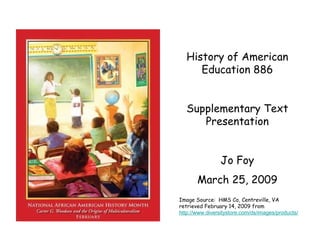
History of American Education 886 Supplementary Text Presentation Jo Foy March 25, 2009 Image Source:  HMS Co, Centreville, VA retrieved February 14, 2009 from  http://www.diversitystore.com/ds/images/products/B08CLASSL.jpg
The Mis-Education of the Negro Image source:  AdCRC, UC-Santa Barbara, retrieved February 14, 2009 from  http://www.sa.ucsb.edu/eop/adcrc/BlackHistoryMonth/images/CarterG.WoodsonFatherofBlackHistory.jpg Woodson, C. G.  2008.  The mis-education of the Negro.  Wilder Publications, Radford, VA.  99p.  (originally published in 1933)
Part Three The Mis-Education of the Negro
The New Program “ It seems only a reasonable proposition, then, that, if under the present system which produced our leadership in religion, politics, and business we have gone backward toward serfdom or have at least been kept from advancing to real freedom, it is high time to develop another sort of leadership with a different educational system. . . .“
“ . . . . In the first place, we must bear in mind that the Negro has never been educated. He has merely been informed about other things which he has not been permitted to do.  The Negroes have been shoved out of the regular schools through the rear door into the obscurity of the backyard and told to imitate others whom they see from afar, . . .” The New Program
“ . . . or they have been permitted in some places to come into the public schools to see how others educate themselves.  The program for the uplift of the Negro in this country must be based upon a scientific study of the Negro  from within  to develop in him the power to do for himself what his oppressors will never do to elevate him to the level of others.”  (p. 71) The New Program
The Jim Crow era
“ We have very few teachers because most of those with whom we are afflicted know nothing about the children whom they teach or about their parents who influence the pupils more than the teachers themselves.  When a boy comes to school without knowing the lesson, he should be studied instead of being punished.  The boy who does well in the beginning of the year and lags behind near the end of the term should not always be censured or ridiculed.”  (p. 71) The New Program
To what is Woodson referring in the previous slide? The New Program, p. 71 Suggested Question for Classroom Discussion
“ But can you expect teachers to revolutionize the social order for the good of the community?  Indeed we must expect this very thing.  The educational system of a country is worthless unless it accomplishes this task.  Men of scholarship and consequently of prophetic insight must show us the right way and lead us into the light which shines brighter and brighter.”  (p. 71) The New Program
Do you think teachers should ‘revolutionize the social order’ for the good of the community? How would that work?  Is it even possible?  The New Program, p. 71 Suggested Question for Classroom Discussion
“ After Negro students have mastered the fundamentals of English, the principles of composition, and the leading facts in the development of its literature, they should not spend all their time in advanced work on Shakespeare, Chaucer and Anglo-Saxon.  They should direct their attention also to the folklore of the African, to the philosophy in his proverbs, to the development of the Negro in the use of modern language, and to the works of Negro writers.” (p. 73) The New Program
“ Why not study the African background from the point of view of anthropology and history, and then take up sociology as it concerns the Negro peasant or proletarian who is suffering from sufficient ills to supply laboratory work for the most advanced students of the social order?  Why not take up economics as reflected by the Negroes of today and work out some remedy for their lack of capital, the absence of cooperative enterprise, and the short life of their establishments?” (p. 73) The New Program
Phillis Wheatley was the first Black woman poet.  She was born in Gambia but purchased by the Boston Wheatleys at age 7.  She died in poverty in 1784 writing her 2nd book of poems which are now lost.
“ We would not neglect to appreciate the unusual contribution of Thomas Jefferson to freedom and democracy; but we would invite attention also to two of his outstanding contemporaries, Phillis Wheatley, the writer of interesting verse, and Benjamin Banneker, the mathematician, astronomer, and advocate of a world peace plan set forth in 1793 with the vital principles of Woodrow Wilson’s League of Nations.”  (p. 75) The New Program
Benjamin Banneker was a farmer, a surveyor, a clockmaker, a mathematician, an astronomer and an author.  He was a free Black man living in the late 18th century.
“ We would not cease to pay tribute to Abraham Lincoln as the “Savior of the Country”; but we would ascribe praise also to the one hundred and seventy-eight thousand Negroes who had to be mustered into the service of the Union before it could be preserved, and who by their heroism demonstrated that they were entitled to freedom and citizenship.” (p. 76) The New Program
How much do you know about the Emancipation Proclamation?  Follow the link below to learn more http://www.archives.gov/exhibits/featured_documents/emancipation_proclamation/ The New Program, p. 75 Suggested Classroom Activity
Vocational Guidance “ But how can the Negro in this new system learn to make a living, the most important task to which all people must give attention?  In view of the Negro’s economic plight most of the schools are now worked up over what is called ‘vocational guidance’ in an effort to answer this very question. . . .”
“ . . . . To what, however, are they to guide their Negro students?  Most Negroes now employed are going down blind alleys, and unfortunately some schools seem to do no more than to stimulate their going in that direction.”  (p. 77) Vocational Guidance
“ If the schools really mean to take a part in necessary uplift they must first supply themselves with teachers.  Unfortunately we have very few such workers.  The large majority of persons supposedly teaching Negroes never carry to the schoolroom any thought as to improving their condition. . . .” Vocational Guidance
“ . . . . From the point of view of these so-called teachers they have done their duty when in automaton fashion they impart in the schoolroom the particular facts which they wrote out in the examination when they ‘qualified’ for their respective positions.”  (p. 78) Vocational Guidance
“ To what, then, can a Negro while despising the enterprise of his fellows guide the youth of his race; and where do you figure out that the youth thus guided will be by 1950?  The whites are daily informing Negroes that they need not come to them for opportunities. . . .” Vocational Guidance
“ . . . . Can the Negro youth, mis-educated by persons who depreciate their efforts, learn to make, opportunities for themselves?  This is the real problem which the Negroes must solve; and he who is not interested in it and makes no effort to solve it is worthless in the present struggle.”  (p. 79) Vocational Guidance
Thomas Day, Milton, North Carolina
To learn more about Thomas Day, follow the link below http://webpages.charter.net/ljeffress/ThomasDaydoc.htm Vocational Guidance, p. 79 Suggested Classroom Activity
“ The Negro community, in a sense, is composed of those around you, but it functions in a different way.  You cannot see it by merely looking out of the windows of the schoolroom.  This community requires scientific investigation. . . .” Vocational Guidance
What do you think Woodson means by ‘scientific investigation’? Vocational Guidance, p. 79 Suggested Question for Classroom Discussion
“ . . . . While persons of African blood are compelled to sustain closer relation to their own people than to other elements in society, they are otherwise influenced socially and economically. The Negro community suffers for lack of delimitation because of the various ramifications of life in the United States. . . .” Vocational Guidance
“ . . . . For example, there may be a Negro grocer in the neighborhood, but the Negro chauffeur for a rich man down town and the washerwoman for an aristocratic family in ‘quality row’ will be more than apt to buy their food and clothing at the larger establishment with which their employers have connections, . . .” Vocational Guidance
“ . . . . although they may be insulted there.  Negroes of the District of Columbia have millions of dollars deposited in banks down town, where Negro women are not allowed in the ladies’ rest rooms.”  (p. 79) Vocational Guidance
Thanks so much  to the Readers!
Mary Ray is a K-State alumni in psychology; she is currently finishing her MSW at Washburn University in Topeka. Jerrick Hornbeak is a Langston University alumni; he is currently finishing his Ph.D. in Student Affairs here at K-State.
Grizelda Bazier MacDonald is a University of Cape Town alumni; she is currently working on her Masters here at K-State. Joelyn K Foy will soon be a K-State alumni; she is finishing her 2nd undergraduate degree in Applied Math and waiting to hear if she has been accepted into a Ph.D. program.

III. History of American Education Interactive Classroom Activity

  • 1.
    History of AmericanEducation 886 Supplementary Text Presentation Jo Foy March 25, 2009 Image Source: HMS Co, Centreville, VA retrieved February 14, 2009 from http://www.diversitystore.com/ds/images/products/B08CLASSL.jpg
  • 2.
    The Mis-Education ofthe Negro Image source: AdCRC, UC-Santa Barbara, retrieved February 14, 2009 from http://www.sa.ucsb.edu/eop/adcrc/BlackHistoryMonth/images/CarterG.WoodsonFatherofBlackHistory.jpg Woodson, C. G. 2008. The mis-education of the Negro. Wilder Publications, Radford, VA. 99p. (originally published in 1933)
  • 3.
    Part Three TheMis-Education of the Negro
  • 4.
    The New Program“ It seems only a reasonable proposition, then, that, if under the present system which produced our leadership in religion, politics, and business we have gone backward toward serfdom or have at least been kept from advancing to real freedom, it is high time to develop another sort of leadership with a different educational system. . . .“
  • 5.
    “ . .. . In the first place, we must bear in mind that the Negro has never been educated. He has merely been informed about other things which he has not been permitted to do. The Negroes have been shoved out of the regular schools through the rear door into the obscurity of the backyard and told to imitate others whom they see from afar, . . .” The New Program
  • 6.
    “ . .. or they have been permitted in some places to come into the public schools to see how others educate themselves. The program for the uplift of the Negro in this country must be based upon a scientific study of the Negro from within to develop in him the power to do for himself what his oppressors will never do to elevate him to the level of others.” (p. 71) The New Program
  • 7.
  • 8.
    “ We havevery few teachers because most of those with whom we are afflicted know nothing about the children whom they teach or about their parents who influence the pupils more than the teachers themselves. When a boy comes to school without knowing the lesson, he should be studied instead of being punished. The boy who does well in the beginning of the year and lags behind near the end of the term should not always be censured or ridiculed.” (p. 71) The New Program
  • 9.
    To what isWoodson referring in the previous slide? The New Program, p. 71 Suggested Question for Classroom Discussion
  • 10.
    “ But canyou expect teachers to revolutionize the social order for the good of the community? Indeed we must expect this very thing. The educational system of a country is worthless unless it accomplishes this task. Men of scholarship and consequently of prophetic insight must show us the right way and lead us into the light which shines brighter and brighter.” (p. 71) The New Program
  • 11.
    Do you thinkteachers should ‘revolutionize the social order’ for the good of the community? How would that work? Is it even possible? The New Program, p. 71 Suggested Question for Classroom Discussion
  • 12.
    “ After Negrostudents have mastered the fundamentals of English, the principles of composition, and the leading facts in the development of its literature, they should not spend all their time in advanced work on Shakespeare, Chaucer and Anglo-Saxon. They should direct their attention also to the folklore of the African, to the philosophy in his proverbs, to the development of the Negro in the use of modern language, and to the works of Negro writers.” (p. 73) The New Program
  • 13.
    “ Why notstudy the African background from the point of view of anthropology and history, and then take up sociology as it concerns the Negro peasant or proletarian who is suffering from sufficient ills to supply laboratory work for the most advanced students of the social order? Why not take up economics as reflected by the Negroes of today and work out some remedy for their lack of capital, the absence of cooperative enterprise, and the short life of their establishments?” (p. 73) The New Program
  • 14.
    Phillis Wheatley wasthe first Black woman poet. She was born in Gambia but purchased by the Boston Wheatleys at age 7. She died in poverty in 1784 writing her 2nd book of poems which are now lost.
  • 15.
    “ We wouldnot neglect to appreciate the unusual contribution of Thomas Jefferson to freedom and democracy; but we would invite attention also to two of his outstanding contemporaries, Phillis Wheatley, the writer of interesting verse, and Benjamin Banneker, the mathematician, astronomer, and advocate of a world peace plan set forth in 1793 with the vital principles of Woodrow Wilson’s League of Nations.” (p. 75) The New Program
  • 16.
    Benjamin Banneker wasa farmer, a surveyor, a clockmaker, a mathematician, an astronomer and an author. He was a free Black man living in the late 18th century.
  • 17.
    “ We wouldnot cease to pay tribute to Abraham Lincoln as the “Savior of the Country”; but we would ascribe praise also to the one hundred and seventy-eight thousand Negroes who had to be mustered into the service of the Union before it could be preserved, and who by their heroism demonstrated that they were entitled to freedom and citizenship.” (p. 76) The New Program
  • 18.
    How much doyou know about the Emancipation Proclamation? Follow the link below to learn more http://www.archives.gov/exhibits/featured_documents/emancipation_proclamation/ The New Program, p. 75 Suggested Classroom Activity
  • 19.
    Vocational Guidance “But how can the Negro in this new system learn to make a living, the most important task to which all people must give attention? In view of the Negro’s economic plight most of the schools are now worked up over what is called ‘vocational guidance’ in an effort to answer this very question. . . .”
  • 20.
    “ . .. . To what, however, are they to guide their Negro students? Most Negroes now employed are going down blind alleys, and unfortunately some schools seem to do no more than to stimulate their going in that direction.” (p. 77) Vocational Guidance
  • 21.
    “ If theschools really mean to take a part in necessary uplift they must first supply themselves with teachers. Unfortunately we have very few such workers. The large majority of persons supposedly teaching Negroes never carry to the schoolroom any thought as to improving their condition. . . .” Vocational Guidance
  • 22.
    “ . .. . From the point of view of these so-called teachers they have done their duty when in automaton fashion they impart in the schoolroom the particular facts which they wrote out in the examination when they ‘qualified’ for their respective positions.” (p. 78) Vocational Guidance
  • 23.
    “ To what,then, can a Negro while despising the enterprise of his fellows guide the youth of his race; and where do you figure out that the youth thus guided will be by 1950? The whites are daily informing Negroes that they need not come to them for opportunities. . . .” Vocational Guidance
  • 24.
    “ . .. . Can the Negro youth, mis-educated by persons who depreciate their efforts, learn to make, opportunities for themselves? This is the real problem which the Negroes must solve; and he who is not interested in it and makes no effort to solve it is worthless in the present struggle.” (p. 79) Vocational Guidance
  • 25.
    Thomas Day, Milton,North Carolina
  • 26.
    To learn moreabout Thomas Day, follow the link below http://webpages.charter.net/ljeffress/ThomasDaydoc.htm Vocational Guidance, p. 79 Suggested Classroom Activity
  • 27.
    “ The Negrocommunity, in a sense, is composed of those around you, but it functions in a different way. You cannot see it by merely looking out of the windows of the schoolroom. This community requires scientific investigation. . . .” Vocational Guidance
  • 28.
    What do youthink Woodson means by ‘scientific investigation’? Vocational Guidance, p. 79 Suggested Question for Classroom Discussion
  • 29.
    “ . .. . While persons of African blood are compelled to sustain closer relation to their own people than to other elements in society, they are otherwise influenced socially and economically. The Negro community suffers for lack of delimitation because of the various ramifications of life in the United States. . . .” Vocational Guidance
  • 30.
    “ . .. . For example, there may be a Negro grocer in the neighborhood, but the Negro chauffeur for a rich man down town and the washerwoman for an aristocratic family in ‘quality row’ will be more than apt to buy their food and clothing at the larger establishment with which their employers have connections, . . .” Vocational Guidance
  • 31.
    “ . .. . although they may be insulted there. Negroes of the District of Columbia have millions of dollars deposited in banks down town, where Negro women are not allowed in the ladies’ rest rooms.” (p. 79) Vocational Guidance
  • 32.
    Thanks so much to the Readers!
  • 33.
    Mary Ray isa K-State alumni in psychology; she is currently finishing her MSW at Washburn University in Topeka. Jerrick Hornbeak is a Langston University alumni; he is currently finishing his Ph.D. in Student Affairs here at K-State.
  • 34.
    Grizelda Bazier MacDonaldis a University of Cape Town alumni; she is currently working on her Masters here at K-State. Joelyn K Foy will soon be a K-State alumni; she is finishing her 2nd undergraduate degree in Applied Math and waiting to hear if she has been accepted into a Ph.D. program.