Explosive Ideas in Education Culture, Class, & Evolution by Theodore Brameld
1920’s - 1930’s Progressivism Dewey (1859-1952) Booker T. Washington has already passed on W. E. B. DuBois Pan-African Congress Atlanta University Image retrieved from http://www.notablebiographies.com/images/uewb_04_img0233.jpg John Dewey
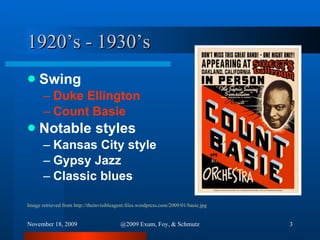
1920’s - 1930’s Swing Duke Ellington Count  Basie Notable styles Kansas City style Gypsy Jazz Classic blues Image retrieved from http://theinvisibleagent.files.wordpress.com/2009/01/basie.jpg
1920’s - 1930’s Versailles Treaty (1919) League of Nations (1919) 19th Amendment (1920) gives women the vote Indian Citizenship Act (1924) Coolidge & Hoover Republicans (1925-1933) Image retrieved from http://www.marxist.com/images/stories/history/treaty_of_versailles_7.jpg
1920’s - 1930’s Image retrieved from http://online.wsj.com/media/Suffrage_ssh_20080818184421.jpg
1920’s - 1930’s Wall Street crash (1929) Depression begins (1930) Dust Bowl (1930-1936) Franklin D. Roosevelt Democrat-served 3 terms The New Deal (1933) TVA formed (1933) Civilian Conservation Corps (1933-1942) Most of the information on this slide retrieved from http://www.animatedatlas.com/timeline.html CCC pillow image retrieved from http://www.michigan.gov/images/mhc_mhm_ccc_pillowcover_46099_7.gif
1920’s - 1930’s Black Sunday image retrieved from http://www.weru.ksu.edu/new_weru/multimedia/dustbowl/dustbowlpics.html Map image retrieved from http://www.weru.ksu.edu/new_weru/multimedia/dustbowl/dustbowlpics.html Black Sunday, April 14, 1935
1920’s - 1930’s Image retrieved from http://www.nchgs.org/history/ccc/ccc.jpg
1920’s - 1930’s Progressivism Kilpatrick Teachers College Project method Progressive Education Association Laboratory schools Image retrieved from http://heilernet.de/prog_ed/Pr%E4sentation/Images/Kilpatrick2.jpg William Heard Kilpatrick
1920’s - 1930’s Cardinal Principles of Secondary Education Although published in 1918, begin to have a greater influence in the 1930’s Franklin Bobbitt “social efficiency” Image retrieved from http://img.flipkart.com/bk_imgs/498/9788130706498.jpg 1918, “The Curriculum”
1920’s - 1930’s “ modern” school system is complete Kindergarten Elementary school Junior high High school Junior college College Graduate school Image retrieved from http://jimgrey.files.wordpress.com/2007/10/monroe1.jpg James Monroe School, South Bend, IN built in 1931
1920’s - 1930’s Image retrieved from http://www.amazon.com/gp/product/images/079283710X/ref=dp_image_text_0?ie=UTF8&n=404272&s=video Our “teacher movie” for this time period is the original “Goodbye Mr. Chips” starring Robert Donat and Greer Garson.  This movie came out in 1939 at the end of what we are calling the “progressive” era.
What were the major cultural characteristics of this era? What were the primary class characteristics of this era? Where did evolution play a role? What educational practices were evident during this period? 1920’s - 1930’s
http://www.animatedatlas.com/timeline.html American History timeline:  1750-2005 http://www.legacy98.org/timeline.html Timeline of Legal History of Women in the United States http://www.pbs.org/wnet/aaworld/timeline/building_03.html African-American World Timeline (hosted by PBS) 1920’s - 1930’s links

Brameld I (1920's-1930's)

  • 1.
    Explosive Ideas inEducation Culture, Class, & Evolution by Theodore Brameld
  • 2.
    1920’s - 1930’sProgressivism Dewey (1859-1952) Booker T. Washington has already passed on W. E. B. DuBois Pan-African Congress Atlanta University Image retrieved from http://www.notablebiographies.com/images/uewb_04_img0233.jpg John Dewey
  • 3.
    1920’s - 1930’sSwing Duke Ellington Count Basie Notable styles Kansas City style Gypsy Jazz Classic blues Image retrieved from http://theinvisibleagent.files.wordpress.com/2009/01/basie.jpg
  • 4.
    1920’s - 1930’sVersailles Treaty (1919) League of Nations (1919) 19th Amendment (1920) gives women the vote Indian Citizenship Act (1924) Coolidge & Hoover Republicans (1925-1933) Image retrieved from http://www.marxist.com/images/stories/history/treaty_of_versailles_7.jpg
  • 5.
    1920’s - 1930’sImage retrieved from http://online.wsj.com/media/Suffrage_ssh_20080818184421.jpg
  • 6.
    1920’s - 1930’sWall Street crash (1929) Depression begins (1930) Dust Bowl (1930-1936) Franklin D. Roosevelt Democrat-served 3 terms The New Deal (1933) TVA formed (1933) Civilian Conservation Corps (1933-1942) Most of the information on this slide retrieved from http://www.animatedatlas.com/timeline.html CCC pillow image retrieved from http://www.michigan.gov/images/mhc_mhm_ccc_pillowcover_46099_7.gif
  • 7.
    1920’s - 1930’sBlack Sunday image retrieved from http://www.weru.ksu.edu/new_weru/multimedia/dustbowl/dustbowlpics.html Map image retrieved from http://www.weru.ksu.edu/new_weru/multimedia/dustbowl/dustbowlpics.html Black Sunday, April 14, 1935
  • 8.
    1920’s - 1930’sImage retrieved from http://www.nchgs.org/history/ccc/ccc.jpg
  • 9.
    1920’s - 1930’sProgressivism Kilpatrick Teachers College Project method Progressive Education Association Laboratory schools Image retrieved from http://heilernet.de/prog_ed/Pr%E4sentation/Images/Kilpatrick2.jpg William Heard Kilpatrick
  • 10.
    1920’s - 1930’sCardinal Principles of Secondary Education Although published in 1918, begin to have a greater influence in the 1930’s Franklin Bobbitt “social efficiency” Image retrieved from http://img.flipkart.com/bk_imgs/498/9788130706498.jpg 1918, “The Curriculum”
  • 11.
    1920’s - 1930’s“ modern” school system is complete Kindergarten Elementary school Junior high High school Junior college College Graduate school Image retrieved from http://jimgrey.files.wordpress.com/2007/10/monroe1.jpg James Monroe School, South Bend, IN built in 1931
  • 12.
    1920’s - 1930’sImage retrieved from http://www.amazon.com/gp/product/images/079283710X/ref=dp_image_text_0?ie=UTF8&n=404272&s=video Our “teacher movie” for this time period is the original “Goodbye Mr. Chips” starring Robert Donat and Greer Garson. This movie came out in 1939 at the end of what we are calling the “progressive” era.
  • 13.
    What were themajor cultural characteristics of this era? What were the primary class characteristics of this era? Where did evolution play a role? What educational practices were evident during this period? 1920’s - 1930’s
  • 14.
    http://www.animatedatlas.com/timeline.html American Historytimeline: 1750-2005 http://www.legacy98.org/timeline.html Timeline of Legal History of Women in the United States http://www.pbs.org/wnet/aaworld/timeline/building_03.html African-American World Timeline (hosted by PBS) 1920’s - 1930’s links

Editor's Notes

  • #2 Click on the button in the middle to preview. OR you can just click on the right arrow and advance one slide at a time.
  • #3 EDCI 886 authors and concepts: Booker T. Washington died in 1915 and was buried at Tuskegee. W.E.B. DuBois organizes a Pan-African Congress in 1923, but spends most of the rest of this period teaching at Atlanta University. Other interesting facts: The Harlem Renaissance is in full swing.
  • #4 Click on one or both musicians (red text) to listen to their music in YouTube. Fine arts influences: Music is swinging! The first jazz concert at Aeolian Hall in New York City is in 1925. Langston Hughes and Jean Toomer are publishing. Eugene O’Neil’s plays are on Broadway.
  • #5 Political events and influences: World War I has just ended. Women are given the vote through the passage of the 19th Amendment. Native American tribal members are given citizenship. The 1920’s start off with Warren Harding who is replaced by Calvin Coolidge. Herbert Hoover is elected to office after Coolidge’s term.
  • #6 The 19th Amendment gives women the right to vote. What do we notice about the clothing of the women? Are these poor women? Wealthy women? What about the man?
  • #7 Economic influences and one additional Political event: Wall Street crashes in 1929 and a worldwide depression begins in 1930. Franklin Delano Roosevelt was elected President in 1933; he served until his death in office in 1945. As part of FDR’s “new deal”, the Tennessee Valley Authority was formed (a wholly government owned corporation), and the Civilian Conservation Corps provided work for millions out of work.
  • #8 The Dust Bowl lasted from 1930 to 1936 (and in some areas until 1940). What would life in western Kansas have been like?
  • #9 Who is the Civilian Conservation Corps benefiting?
  • #10 Educational practices: During the 1920’s progressivism advanced, especially in specific areas of the country like Chicago and New York. William Heard Kilpatrick was at Teachers College (Columbia University, New York City) while John Dewey was at the University of Chicago. The Progressive Education Association became “the major institutional voice for child-centered pedagogy” (Urban & Wagoner, 2004, p. 246). Other Educational influences: B. F. Skinner pubishes “The Behavior of Organisms” (1938); Tennessee vs. John Scopes (the “monkey” trial) (1925); SAT administered for the first time (1926); Piaget publishes “The Child’s Conception of the World” (1929) (1) Source: http://www.cehd.umn.edu/History/Timeline/1920s.html,College of Education and Human Development, University of Minnesota
  • #11 More educational influences: Franklin Bobbitt wrote “The Curriculum” in 1918. He is considered the “father” of the social efficiency movement. “For social efficiency educators, the multitrack comprehensive high school was an appropriate arena in which to implement their social engineering principles” (Urban & Wagoner, 2004, p. 235).
  • #12 (Urban & Wagoner, 2004, p. 235-240).
  • #13 Click on the image to view the movie trailer on YouTube. What do you notice about culture and class? What do you notice about educational practices?
  • #14 Discuss among yourselves and be prepared to report out in a few minutes.
  • #15 Discuss among yourselves and be prepared to report out in a few minutes.