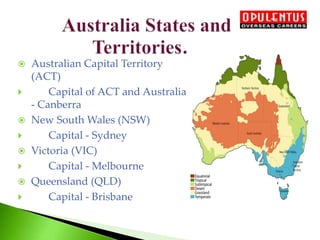
 Australian Capital Territory
(ACT)
 Capital of ACT and Australia
- Canberra
 New South Wales (NSW)
 Capital - Sydney
 Victoria (VIC)
 Capital - Melbourne
 Queensland (QLD)
 Capital - Brisbane
 South Australia(SA)
Capital – Adelaide
 Western Australia(WA)
Capital – Perth
 Northern Territory(NT)
Capital - Darwin
 Tasmania (TAS)
Capital - Hobart
 Australia being one of the fastest growing countries, it is catching
attention of many aspirants who want to settle abroad.
 This Visa allows the applicant and his dependents (Spouse and un-
married children are considered as dependents in immigration) to
settle in Australia, and enjoy the benefits from the Country.
 Australia is accepting applications from the eligible applicants who
possess the skills, wherein Australia is currently facing shortage.
 Australia is issuing two types of Permanent Resident (PR) visa’s.
◦ Subclass 189 – Skilled Independent Visa - https://goo.gl/TG9mhC
◦ Subclass 190 – Skilled Nominated Visa - https://goo.gl/Ycpgd2
 Australia have issued a list of occupations, and will accept the
applications only from the professionals working from that
occupation list.
 There are two types of occupation list:
◦ SOL – Skilled Occupation List
◦ CSOL – Consolidated Sponsored Occupation List
 SOL – The occupations mentioned in this list are in demand in all the
states and territories in Australia.
 The applicant’s occupation mentioned in SOL can apply for Subclass
189 visa.
 http://www.immi.gov.au/Work/Pages/skilled-occupations-
lists/sol.aspx
 CSOL – The occupations mentioned in this list are in demand in one
or more states but not in all the states. The applicant’s occupation
mentioned in CSOL can apply for Subclass 190 visa. Client’s
occupation mentioned in SOL can also apply for subclass – 190 visa.
 http://www.immi.gov.au/Work/Pages/skilled-occupations-
lists/csol.aspx
 Every country have their own eligibility criteria to accept the visa
applications, however there are four (4) factors which play major role in
determining the applicants eligibility.
◦ Age
◦ Qualification
◦ Work Experience
◦ Language proficiency
 Every applicant should achieve minimum 60 points to qualify for the visa
process and these points will be awarded for the above four factors. The
eligibility factors may increase but the major share of the points will be
awarded for the above mentioned factors.
 As discussed the primary eligibility criteria is to have and been working in
one of the occupation mentioned in either SOL or CSOL. Then comes the
points test wherein client have to achieve the required points.
The next slide will describe the points awarded for the eligibility factors.
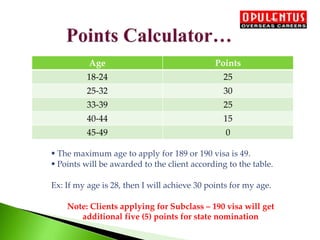
Age Points
18-24 25
25-32 30
33-39 25
40-44 15
45-49 0
 The maximum age to apply for 189 or 190 visa is 49.
 Points will be awarded to the client according to the table.
Ex: If my age is 28, then I will achieve 30 points for my age.
Note: Clients applying for Subclass – 190 visa will get
additional five (5) points for state nomination
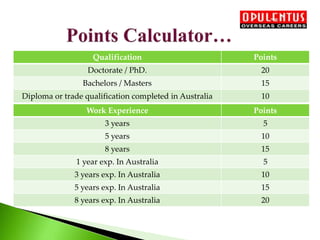
Qualification Points
Doctorate / PhD. 20
Bachelors / Masters 15
Diploma or trade qualification completed in Australia 10
Work Experience Points
3 years 5
5 years 10
8 years 15
1 year exp. In Australia 5
3 years exp. In Australia 10
5 years exp. In Australia 15
8 years exp. In Australia 20
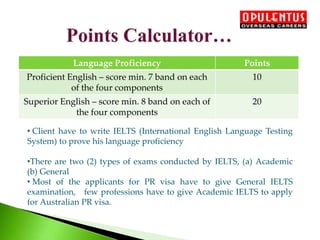
Language Proficiency Points
Proficient English – score min. 7 band on each
of the four components
10
Superior English – score min. 8 band on each of
the four components
20
• Client have to write IELTS (International English Language Testing
System) to prove his language proficiency
•There are two (2) types of exams conducted by IELTS, (a) Academic
(b) General
• Most of the applicants for PR visa have to give General IELTS
examination, few professions have to give Academic IELTS to apply
for Australian PR visa.
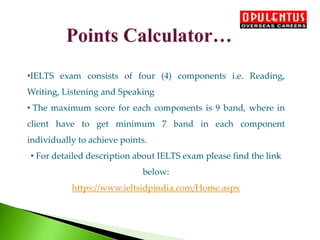
•IELTS exam consists of four (4) components i.e. Reading,
Writing, Listening and Speaking
• The maximum score for each components is 9 band, where in
client have to get minimum 7 band in each component
individually to achieve points.
• For detailed description about IELTS exam please find the link
below:
https://www.ieltsidpindia.com/Home.aspx
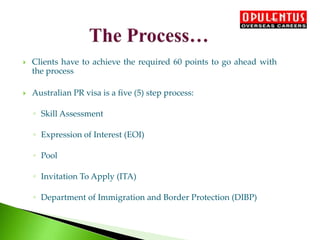
 Clients have to achieve the required 60 points to go ahead with
the process
 Australian PR visa is a five (5) step process:
◦ Skill Assessment
◦ Expression of Interest (EOI)
◦ Pool
◦ Invitation To Apply (ITA)
◦ Department of Immigration and Border Protection (DIBP)
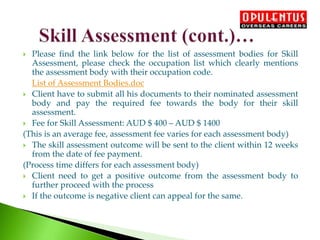
 This is the first stage in the Australian Immigration process
 Australian Immigration will assess the applicants in two (2) factors i.e.
◦ Education Qualification (they assess the equivalence of the clients
qualification towards Australian qualification)
◦ Work experience (they check weather the employment roles and
responsibilities of the client are in accordance with the Australian
standards to work in the profession applied for)
 Australia Immigration have appointed 28 assessment bodies to assess
the skills of the applicants
 Every assessment body will assess the skills of a particular profession
and occupations related to that profession
(Ex: Australian computer society (ACS) will complete the skill
assessment for all IT professions, Certified professional Accountants
(CPA) will assess the skills of accountants)
 Please find the link below for the list of assessment bodies for Skill
Assessment, please check the occupation list which clearly mentions
the assessment body with their occupation code.
List of Assessment Bodies.doc
 Client have to submit all his documents to their nominated assessment
body and pay the required fee towards the body for their skill
assessment.
 Fee for Skill Assessment: AUD $ 400 – AUD $ 1400
(This is an average fee, assessment fee varies for each assessment body)
 The skill assessment outcome will be sent to the client within 12 weeks
from the date of fee payment.
(Process time differs for each assessment body)
 Client need to get a positive outcome from the assessment body to
further proceed with the process
 If the outcome is negative client can appeal for the same.
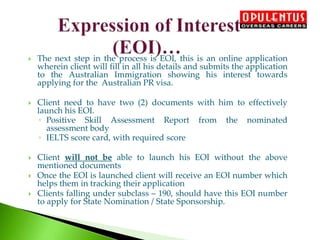
 The next step in the process is EOI, this is an online application
wherein client will fill in all his details and submits the application
to the Australian Immigration showing his interest towards
applying for the Australian PR visa.
 Client need to have two (2) documents with him to effectively
launch his EOI.
◦ Positive Skill Assessment Report from the nominated
assessment body
◦ IELTS score card, with required score
 Client will not be able to launch his EOI without the above
mentioned documents
 Once the EOI is launched client will receive an EOI number which
helps them in tracking their application
 Clients falling under subclass – 190, should have this EOI number
to apply for State Nomination / State Sponsorship.
 All the EOI launched applications will go into Pool (set of
applications)
 An application will be in Pool for a maximum of 2 years,
within this time frame the application have to be picked up for
the next process.
 There are two (2) possibilities of being picked up from the pool
◦ Department of Immigration
◦ State or Territories
 The eligible applicants who applied for Subclass – 189, will be
picked up by the Department of Immigration.
 Clients falling under Subclass – 190, have to apply for State
Sponsorship at this stage
 The applications accepted by the state or territories for
sponsorship will be picked up from the pool and forwarded for
the next step.
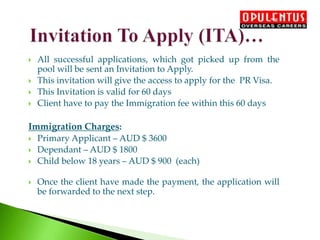
 All successful applications, which got picked up from the
pool will be sent an Invitation to Apply.
 This invitation will give the access to apply for the PR Visa.
 This Invitation is valid for 60 days
 Client have to pay the Immigration fee within this 60 days
Immigration Charges:
 Primary Applicant – AUD $ 3600
 Dependant – AUD $ 1800
 Child below 18 years – AUD $ 900 (each)
 Once the client have made the payment, the application will
be forwarded to the next step.
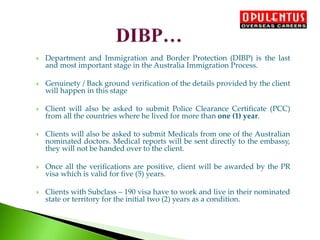
 Department and Immigration and Border Protection (DIBP) is the last
and most important stage in the Australia Immigration Process.
 Genuinety / Back ground verification of the details provided by the client
will happen in this stage
 Client will also be asked to submit Police Clearance Certificate (PCC)
from all the countries where he lived for more than one (1) year.
 Clients will also be asked to submit Medicals from one of the Australian
nominated doctors. Medical reports will be sent directly to the embassy,
they will not be handed over to the client.
 Once all the verifications are positive, client will be awarded by the PR
visa which is valid for five (5) years.
 Clients with Subclass – 190 visa have to work and live in their nominated
state or territory for the initial two (2) years as a condition.
 The time taken for the complete process will be around 8 – 12 month
(Process time varies for each application)
 The important assessment bodies ACS and VETASSESS does not require
IELTS score at the time of assessment
 Australian Immigration is also accepting TOFEL iBT and PET from
November 2014, to determine their applicants language proficiency. Please
find the link below to understand the difference and requirement for both
the examinations.
http://www.anzscosearch.com/ielts-vs-toefl/
 Client have to make port of entry (first visit) in Australia with in the date
mentioned in the Visa. (ideally within 9 months from the issuance of the
visa). Dependent cannot make port of entry prior to the primary applicant,
either they can go together or the dependent can visit after the primary
applicant made the port of entry
Migrate to Australia From India - Australia Visa Process

Migrate to Australia From India - Australia Visa Process

  • 2.
     Australian CapitalTerritory (ACT)  Capital of ACT and Australia - Canberra  New South Wales (NSW)  Capital - Sydney  Victoria (VIC)  Capital - Melbourne  Queensland (QLD)  Capital - Brisbane
  • 3.
     South Australia(SA) Capital– Adelaide  Western Australia(WA) Capital – Perth  Northern Territory(NT) Capital - Darwin  Tasmania (TAS) Capital - Hobart
  • 4.
     Australia beingone of the fastest growing countries, it is catching attention of many aspirants who want to settle abroad.  This Visa allows the applicant and his dependents (Spouse and un- married children are considered as dependents in immigration) to settle in Australia, and enjoy the benefits from the Country.  Australia is accepting applications from the eligible applicants who possess the skills, wherein Australia is currently facing shortage.  Australia is issuing two types of Permanent Resident (PR) visa’s. ◦ Subclass 189 – Skilled Independent Visa - https://goo.gl/TG9mhC ◦ Subclass 190 – Skilled Nominated Visa - https://goo.gl/Ycpgd2
  • 5.
     Australia haveissued a list of occupations, and will accept the applications only from the professionals working from that occupation list.  There are two types of occupation list: ◦ SOL – Skilled Occupation List ◦ CSOL – Consolidated Sponsored Occupation List  SOL – The occupations mentioned in this list are in demand in all the states and territories in Australia.
  • 6.
     The applicant’soccupation mentioned in SOL can apply for Subclass 189 visa.  http://www.immi.gov.au/Work/Pages/skilled-occupations- lists/sol.aspx  CSOL – The occupations mentioned in this list are in demand in one or more states but not in all the states. The applicant’s occupation mentioned in CSOL can apply for Subclass 190 visa. Client’s occupation mentioned in SOL can also apply for subclass – 190 visa.  http://www.immi.gov.au/Work/Pages/skilled-occupations- lists/csol.aspx
  • 7.
     Every countryhave their own eligibility criteria to accept the visa applications, however there are four (4) factors which play major role in determining the applicants eligibility. ◦ Age ◦ Qualification ◦ Work Experience ◦ Language proficiency  Every applicant should achieve minimum 60 points to qualify for the visa process and these points will be awarded for the above four factors. The eligibility factors may increase but the major share of the points will be awarded for the above mentioned factors.  As discussed the primary eligibility criteria is to have and been working in one of the occupation mentioned in either SOL or CSOL. Then comes the points test wherein client have to achieve the required points. The next slide will describe the points awarded for the eligibility factors.
  • 8.
    Age Points 18-24 25 25-3230 33-39 25 40-44 15 45-49 0  The maximum age to apply for 189 or 190 visa is 49.  Points will be awarded to the client according to the table. Ex: If my age is 28, then I will achieve 30 points for my age. Note: Clients applying for Subclass – 190 visa will get additional five (5) points for state nomination
  • 9.
    Qualification Points Doctorate /PhD. 20 Bachelors / Masters 15 Diploma or trade qualification completed in Australia 10 Work Experience Points 3 years 5 5 years 10 8 years 15 1 year exp. In Australia 5 3 years exp. In Australia 10 5 years exp. In Australia 15 8 years exp. In Australia 20
  • 10.
    Language Proficiency Points ProficientEnglish – score min. 7 band on each of the four components 10 Superior English – score min. 8 band on each of the four components 20 • Client have to write IELTS (International English Language Testing System) to prove his language proficiency •There are two (2) types of exams conducted by IELTS, (a) Academic (b) General • Most of the applicants for PR visa have to give General IELTS examination, few professions have to give Academic IELTS to apply for Australian PR visa.
  • 11.
    •IELTS exam consistsof four (4) components i.e. Reading, Writing, Listening and Speaking • The maximum score for each components is 9 band, where in client have to get minimum 7 band in each component individually to achieve points. • For detailed description about IELTS exam please find the link below: https://www.ieltsidpindia.com/Home.aspx
  • 12.
     Clients haveto achieve the required 60 points to go ahead with the process  Australian PR visa is a five (5) step process: ◦ Skill Assessment ◦ Expression of Interest (EOI) ◦ Pool ◦ Invitation To Apply (ITA) ◦ Department of Immigration and Border Protection (DIBP)
  • 13.
     This isthe first stage in the Australian Immigration process  Australian Immigration will assess the applicants in two (2) factors i.e. ◦ Education Qualification (they assess the equivalence of the clients qualification towards Australian qualification) ◦ Work experience (they check weather the employment roles and responsibilities of the client are in accordance with the Australian standards to work in the profession applied for)  Australia Immigration have appointed 28 assessment bodies to assess the skills of the applicants  Every assessment body will assess the skills of a particular profession and occupations related to that profession (Ex: Australian computer society (ACS) will complete the skill assessment for all IT professions, Certified professional Accountants (CPA) will assess the skills of accountants)
  • 14.
     Please findthe link below for the list of assessment bodies for Skill Assessment, please check the occupation list which clearly mentions the assessment body with their occupation code. List of Assessment Bodies.doc  Client have to submit all his documents to their nominated assessment body and pay the required fee towards the body for their skill assessment.  Fee for Skill Assessment: AUD $ 400 – AUD $ 1400 (This is an average fee, assessment fee varies for each assessment body)  The skill assessment outcome will be sent to the client within 12 weeks from the date of fee payment. (Process time differs for each assessment body)  Client need to get a positive outcome from the assessment body to further proceed with the process  If the outcome is negative client can appeal for the same.
  • 15.
     The nextstep in the process is EOI, this is an online application wherein client will fill in all his details and submits the application to the Australian Immigration showing his interest towards applying for the Australian PR visa.  Client need to have two (2) documents with him to effectively launch his EOI. ◦ Positive Skill Assessment Report from the nominated assessment body ◦ IELTS score card, with required score  Client will not be able to launch his EOI without the above mentioned documents  Once the EOI is launched client will receive an EOI number which helps them in tracking their application  Clients falling under subclass – 190, should have this EOI number to apply for State Nomination / State Sponsorship.
  • 16.
     All theEOI launched applications will go into Pool (set of applications)  An application will be in Pool for a maximum of 2 years, within this time frame the application have to be picked up for the next process.  There are two (2) possibilities of being picked up from the pool ◦ Department of Immigration ◦ State or Territories  The eligible applicants who applied for Subclass – 189, will be picked up by the Department of Immigration.  Clients falling under Subclass – 190, have to apply for State Sponsorship at this stage  The applications accepted by the state or territories for sponsorship will be picked up from the pool and forwarded for the next step.
  • 17.
     All successfulapplications, which got picked up from the pool will be sent an Invitation to Apply.  This invitation will give the access to apply for the PR Visa.  This Invitation is valid for 60 days  Client have to pay the Immigration fee within this 60 days Immigration Charges:  Primary Applicant – AUD $ 3600  Dependant – AUD $ 1800  Child below 18 years – AUD $ 900 (each)  Once the client have made the payment, the application will be forwarded to the next step.
  • 18.
     Department andImmigration and Border Protection (DIBP) is the last and most important stage in the Australia Immigration Process.  Genuinety / Back ground verification of the details provided by the client will happen in this stage  Client will also be asked to submit Police Clearance Certificate (PCC) from all the countries where he lived for more than one (1) year.  Clients will also be asked to submit Medicals from one of the Australian nominated doctors. Medical reports will be sent directly to the embassy, they will not be handed over to the client.  Once all the verifications are positive, client will be awarded by the PR visa which is valid for five (5) years.  Clients with Subclass – 190 visa have to work and live in their nominated state or territory for the initial two (2) years as a condition.
  • 19.
     The timetaken for the complete process will be around 8 – 12 month (Process time varies for each application)  The important assessment bodies ACS and VETASSESS does not require IELTS score at the time of assessment  Australian Immigration is also accepting TOFEL iBT and PET from November 2014, to determine their applicants language proficiency. Please find the link below to understand the difference and requirement for both the examinations. http://www.anzscosearch.com/ielts-vs-toefl/  Client have to make port of entry (first visit) in Australia with in the date mentioned in the Visa. (ideally within 9 months from the issuance of the visa). Dependent cannot make port of entry prior to the primary applicant, either they can go together or the dependent can visit after the primary applicant made the port of entry