Agenda
• Overview ofMicrosoft Fabric
• Why Microsoft Fabric?
• Architecture
• Key Components
• Use Cases
• Real-World Scenarios
• Setup/Integration
• Q&A
• Thank You
3.
Overview of MicrosoftFabric
• Microsoft Fabric is an end-to-end SaaS data
platform.
• Combines Data Engineering, Warehousing, BI,
Real-time Analytics, and Data Science.
• Unifies collaboration across data professionals
and business users.
4.
Why Microsoft Fabric?
•Unified analytics platform (Data Factory +
Synapse + Power BI)
• Built-in data governance and security
• Lake-centric and open by design
• Integrated with Microsoft 365
• Low-code and pro-code environments
• No infrastructure management
5.
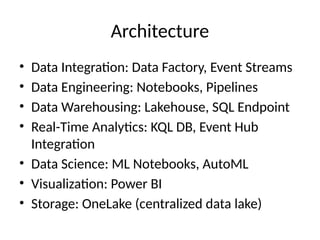
Architecture
• Data Integration:Data Factory, Event Streams
• Data Engineering: Notebooks, Pipelines
• Data Warehousing: Lakehouse, SQL Endpoint
• Real-Time Analytics: KQL DB, Event Hub
Integration
• Data Science: ML Notebooks, AutoML
• Visualization: Power BI
• Storage: OneLake (centralized data lake)
6.
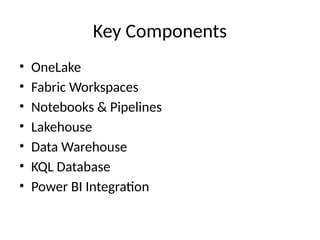
Key Components
• OneLake
•Fabric Workspaces
• Notebooks & Pipelines
• Lakehouse
• Data Warehouse
• KQL Database
• Power BI Integration
7.
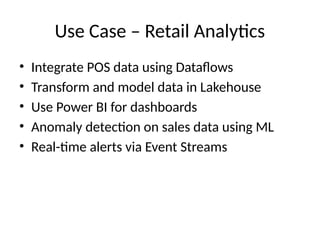
Use Case –Retail Analytics
• Integrate POS data using Dataflows
• Transform and model data in Lakehouse
• Use Power BI for dashboards
• Anomaly detection on sales data using ML
• Real-time alerts via Event Streams
Setup/Integration
• Create MicrosoftFabric workspace
• Link with OneLake
• Add Data Pipeline or Lakehouse
• Use Dataflow Gen2 for ingestion
• Enable Power BI for visualization