Microsoft Access 2013 Comprehensive 1st Edition
Pratt Solutions Manual download
https://testbankdeal.com/product/microsoft-
access-2013-comprehensive-1st-edition-pratt-solutions-manual/
Explore and download more test bank or solution manual
at testbankdeal.com
Here are some recommended products for you. Click the link to
download, or explore more at testbankdeal.com
Microsoft Access 2013 Comprehensive 1st Edition Pratt Test
Bank
https://testbankdeal.com/product/microsoft-
access-2013-comprehensive-1st-edition-pratt-test-bank/
Enhanced Microsoft Access 2013 Comprehensive 1st Edition
Pratt Test Bank
https://testbankdeal.com/product/enhanced-microsoft-
access-2013-comprehensive-1st-edition-pratt-test-bank/
New Perspectives on Microsoft Access 2013 Comprehensive
1st Edition Adamski Solutions Manual
https://testbankdeal.com/product/new-perspectives-on-microsoft-
access-2013-comprehensive-1st-edition-adamski-solutions-manual/
Entrepreneurial Finance 5th Edition Leach Solutions Manual
https://testbankdeal.com/product/entrepreneurial-finance-5th-edition-
leach-solutions-manual/
Basic Technical Mathematics with Calculus SI Version
Canadian 10th Edition Washington Test Bank
https://testbankdeal.com/product/basic-technical-mathematics-with-
calculus-si-version-canadian-10th-edition-washington-test-bank/
Psychiatric Mental Health Nursing 6th Edition Mary
Townsend Test Bank
https://testbankdeal.com/product/psychiatric-mental-health-
nursing-6th-edition-mary-townsend-test-bank/
Fundamentals of Anatomy and Physiology 4th Edition Rizzo
Test Bank
https://testbankdeal.com/product/fundamentals-of-anatomy-and-
physiology-4th-edition-rizzo-test-bank/
Thinking About Women 10th Edition Andersen Test Bank
https://testbankdeal.com/product/thinking-about-women-10th-edition-
andersen-test-bank/
Power System Analysis and Design 6th Edition Glover Test
Bank
https://testbankdeal.com/product/power-system-analysis-and-design-6th-
edition-glover-test-bank/
Marketing Research Asia-Pacific 4th Edition Zikmund Test
Bank
https://testbankdeal.com/product/marketing-research-asia-pacific-4th-
edition-zikmund-test-bank/
Access 2013 Instructor’s Manual Page 1 of 13
Microsoft Access 2013
Chapter Five: Multiple-Table Forms
A Guide to this Instructor’s Manual:
We have designed this Instructor’s Manual to supplement and enhance your teaching experience through classroom
activities and a cohesive chapter summary.
This document is organized chronologically, using the same heading in red that you see in the textbook. Under each
heading you will find (in order): Lecture Notes that summarize the section, Figures and Boxes found in the section, if
any, Teacher Tips, Classroom Activities, and Lab Activities. Pay special attention to teaching tips, and activities geared
towards quizzing your students, enhancing their critical thinking skills, and encouraging experimentation within the
software.
In addition to this Instructor’s Manual, our Instructor’s Resources also contain PowerPoint Presentations, Test Banks,
and other supplements to aid in your teaching experience.
For your students:
Our latest online feature, CourseCasts, is a library of weekly podcasts designed to keep your students up to date with
the latest in technology news. Direct your students to http://coursecasts.course.com, where they can download the
most recent CourseCast onto their mp3 player. Ken Baldauf, host of CourseCasts, is a faculty member of the Florida
State University Computer Science Department where he is responsible for teaching technology classes to thousands of
FSU students each year. Ken is an expert in the latest technology and sorts through and aggregates the most pertinent
news and information for CourseCasts so your students can spend their time enjoying technology, rather than trying to
figure it out. Open or close your lecture with a discussion based on the latest CourseCast.
SAM:
This text is available with SAM 2013 Assessment, Training, and Projects that map directly to the learning objectives
covered in each chapter. SAM's active, hands-on training and skill-based assessment help you master Microsoft Office
skills. SAM Projects let you apply skills in real-world scenarios using the actual Microsoft Office applications.
Immediate feedback and comprehensive study guides give you the practice and support you need to succeed.
If you have a SAM account, login at www.cengage.com/sam2013. To obtain a SAM account, visit
www.cengagebrain.com or contact your instructor or bookstore for additional information.
Table of Contents
Chapter Objectives
AC 266: Introduction
AC 266: Project — Multiple-Table Forms
AC 269: Adding Special Fields
AC 274: Updating the New Fields
AC 283: Multiple-Table Form Techniques
AC 307: Object Dependencies
AC 309: Date/Time, Long Text, and Yes/No Fields in Queries
Access 2013 Instructor’s Manual Page 2 of 13
AC 312: Datasheets in Forms
AC 314: Creating a Multiple-Table Form Based on the Many Table
AC 316: Chapter Summary
End of Chapter Materials
Glossary of Key Terms
Chapter Objectives
Students will have mastered the material in Chapter Five when they can:
 Add Yes/No, Long Text, OLE Object, and
Attachment fields
 Use the Input Mask Wizard
 Update fields and enter data
 Change row and column size
 Create a form with a subform in Design
view
 Modify a subform and form design
 Enhance the form title
 Change tab stops and tab order
 Use the form to view data and attachments
 View object dependencies
 Use Date/Time, Long Text, and Yes/No
fields in a query
 Create a form with a datasheet
AC 266: Introduction
LECTURE NOTES
• Discuss the one-to-many relationship between the Book Rep and Customer tables
BOXES:
1. BTW: Q&As. Point out the link to the complete listing of Q&As on the web. Information in Q&As is
included in the test bank.
TEACHER TIP
Use this introduction to review the concept of referential integrity (discussed in Chapter 3) with
students.
AC 266: Project – Multiple-Table Forms
LECTURE NOTES
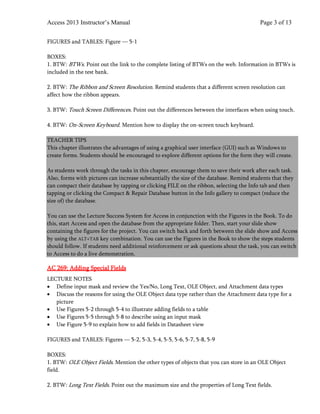
• Use Figure 5-1 to illustrate a multiple-table form that includes several new fields
• Review the general activities that will be performed in this chapter
o Add fields to the Book Rep table
o Enter data into the new fields
o Create a form for the Book Rep table
o Add controls to the form
o Add a subform to the form
o Modify the subform
o Enhance the form
o Create queries with the new fields
• Review the steps to run Access
• Review the steps to open a database
Access 2013 Instructor’s Manual Page 3 of 13
FIGURES and TABLES: Figure — 5-1
BOXES:
1. BTW: BTWs. Point out the link to the complete listing of BTWs on the web. Information in BTWs is
included in the test bank.
2. BTW: The Ribbon and Screen Resolution. Remind students that a different screen resolution can
affect how the ribbon appears.
3. BTW: Touch Screen Differences. Point out the differences between the interfaces when using touch.
4. BTW: On-Screen Keyboard. Mention how to display the on-screen touch keyboard.
TEACHER TIPS
This chapter illustrates the advantages of using a graphical user interface (GUI) such as Windows to
create forms. Students should be encouraged to explore different options for the form they will create.
As students work through the tasks in this chapter, encourage them to save their work after each task.
Also, forms with pictures can increase substantially the size of the database. Remind students that they
can compact their database by tapping or clicking FILE on the ribbon, selecting the Info tab and then
tapping or clicking the Compact & Repair Database button in the Info gallery to compact (reduce the
size of) the database.
You can use the Lecture Success System for Access in conjunction with the Figures in the Book. To do
this, start Access and open the database from the appropriate folder. Then, start your slide show
containing the figures for the project. You can switch back and forth between the slide show and Access
by using the ALT+TAB key combination. You can use the Figures in the Book to show the steps students
should follow. If students need additional reinforcement or ask questions about the task, you can switch
to Access to do a live demonstration.
AC 269: Adding Special Fields
LECTURE NOTES
• Define input mask and review the Yes/No, Long Text, OLE Object, and Attachment data types
• Discuss the reasons for using the OLE Object data type rather than the Attachment data type for a
picture
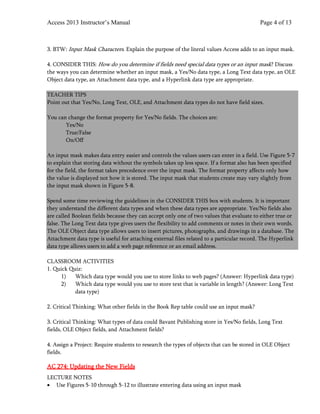
• Use Figures 5-2 through 5-4 to illustrate adding fields to a table
• Use Figures 5-5 through 5-8 to describe using an input mask
• Use Figure 5-9 to explain how to add fields in Datasheet view
FIGURES and TABLES: Figures — 5-2, 5-3, 5-4, 5-5, 5-6, 5-7, 5-8, 5-9
BOXES:
1. BTW: OLE Object Fields. Mention the other types of objects that you can store in an OLE Object
field.
2. BTW: Long Text Fields. Point out the maximum size and the properties of Long Text fields.
Access 2013 Instructor’s Manual Page 4 of 13
3. BTW: Input Mask Characters. Explain the purpose of the literal values Access adds to an input mask.
4. CONSIDER THIS: How do you determine if fields need special data types or an input mask? Discuss
the ways you can determine whether an input mask, a Yes/No data type, a Long Text data type, an OLE
Object data type, an Attachment data type, and a Hyperlink data type are appropriate.
TEACHER TIPS
Point out that Yes/No, Long Text, OLE, and Attachment data types do not have field sizes.
You can change the format property for Yes/No fields. The choices are:
Yes/No
True/False
On/Off
An input mask makes data entry easier and controls the values users can enter in a field. Use Figure 5-7
to explain that storing data without the symbols takes up less space. If a format also has been specified
for the field, the format takes precedence over the input mask. The format property affects only how
the value is displayed not how it is stored. The input mask that students create may vary slightly from
the input mask shown in Figure 5-8.
Spend some time reviewing the guidelines in the CONSIDER THIS box with students. It is important
they understand the different data types and when these data types are appropriate. Yes/No fields also
are called Boolean fields because they can accept only one of two values that evaluate to either true or
false. The Long Text data type gives users the flexibility to add comments or notes in their own words.
The OLE Object data type allows users to insert pictures, photographs, and drawings in a database. The
Attachment data type is useful for attaching external files related to a particular record. The Hyperlink
data type allows users to add a web page reference or an email address.
CLASSROOM ACTIVITIES
1. Quick Quiz:
1) Which data type would you use to store links to web pages? (Answer: Hyperlink data type)
2) Which data type would you use to store text that is variable in length? (Answer: Long Text
data type)
2. Critical Thinking: What other fields in the Book Rep table could use an input mask?
3. Critical Thinking: What types of data could Bavant Publishing store in Yes/No fields, Long Text
fields, OLE Object fields, and Attachment fields?
4. Assign a Project: Require students to research the types of objects that can be stored in OLE Object
fields.
AC 274: Updating the New Fields
LECTURE NOTES
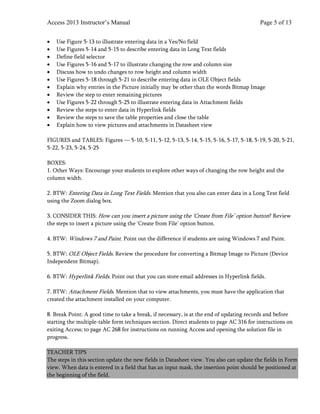
• Use Figures 5-10 through 5-12 to illustrate entering data using an input mask
Access 2013 Instructor’s Manual Page 5 of 13
• Use Figure 5-13 to illustrate entering data in a Yes/No field
• Use Figures 5-14 and 5-15 to describe entering data in Long Text fields
• Define field selector
• Use Figures 5-16 and 5-17 to illustrate changing the row and column size
• Discuss how to undo changes to row height and column width
• Use Figures 5-18 through 5-21 to describe entering data in OLE Object fields
• Explain why entries in the Picture initially may be other than the words Bitmap Image
• Review the step to enter remaining pictures
• Use Figures 5-22 through 5-25 to illustrate entering data in Attachment fields
• Review the steps to enter data in Hyperlink fields
• Review the steps to save the table properties and close the table
• Explain how to view pictures and attachments in Datasheet view
FIGURES and TABLES: Figures — 5-10, 5-11, 5-12, 5-13, 5-14, 5-15, 5-16, 5-17, 5-18, 5-19, 5-20, 5-21,
5-22, 5-23, 5-24, 5-25
BOXES:
1. Other Ways: Encourage your students to explore other ways of changing the row height and the
column width.
2. BTW: Entering Data in Long Text Fields. Mention that you also can enter data in a Long Text field
using the Zoom dialog box.
3. CONSIDER THIS: How can you insert a picture using the ‘Create from File’ option button? Review
the steps to insert a picture using the ‘Create from File’ option button.
4. BTW: Windows 7 and Paint. Point out the difference if students are using Windows 7 and Paint.
5. BTW: OLE Object Fields. Review the procedure for converting a Bitmap Image to Picture (Device
Independent Bitmap).
6. BTW: Hyperlink Fields. Point out that you can store email addresses in Hyperlink fields.
7. BTW: Attachment Fields. Mention that to view attachments, you must have the application that
created the attachment installed on your computer.
8. Break Point: A good time to take a break, if necessary, is at the end of updating records and before
starting the multiple-table form techniques section. Direct students to page AC 316 for instructions on
exiting Access; to page AC 268 for instructions on running Access and opening the solution file in
progress.
TEACHER TIPS
The steps in this section update the new fields in Datasheet view. You also can update the fields in Form
view. When data is entered in a field that has an input mask, the insertion point should be positioned at
the beginning of the field.
Access 2013 Instructor’s Manual Page 6 of 13
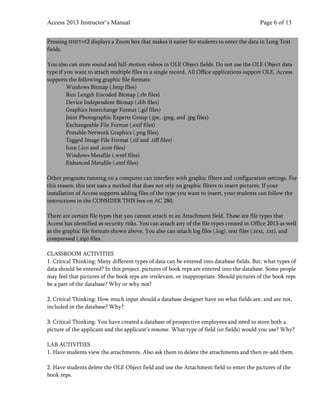
Pressing SHIFT+F2 displays a Zoom box that makes it easier for students to enter the data in Long Text
fields.
You also can store sound and full-motion videos in OLE Object fields. Do not use the OLE Object data
type if you want to attach multiple files to a single record. All Office applications support OLE. Access
supports the following graphic file formats:
Windows Bitmap (.bmp files)
Run Length Encoded Bitmap (.rle files)
Device Independent Bitmap (.dib files)
Graphics Interchange Format (.gif files)
Joint Photographic Experts Group (.jpe, .jpeg, and .jpg files)
Exchangeable File Format (.exif files)
Portable Network Graphics (.png files)
Tagged Image File Format (.tif and .tiff files)
Icon (.ico and .icon files)
Windows Metafile (.wmf files)
Enhanced Metafile (.emf files)
Other programs running on a computer can interfere with graphic filters and configuration settings. For
this reason, this text uses a method that does not rely on graphic filters to insert pictures. If your
installation of Access supports adding files of the type you want to insert, your students can follow the
instructions in the CONSIDER THIS box on AC 280.
There are certain file types that you cannot attach to an Attachment field. These are file types that
Access has identified as security risks. You can attach any of the file types created in Office 2013 as well
as the graphic file formats shown above. You also can attach log files (.log), text files (.text, .txt), and
compressed (.zip) files.
CLASSROOM ACTIVITIES
1. Critical Thinking: Many different types of data can be entered into database fields. But, what types of
data should be entered? In this project, pictures of book reps are entered into the database. Some people
may feel that pictures of the book reps are irrelevant, or inappropriate. Should pictures of the book reps
be a part of the database? Why or why not?
2. Critical Thinking: How much input should a database designer have on what fields are, and are not,
included in the database? Why?
3. Critical Thinking: You have created a database of prospective employees and need to store both a
picture of the applicant and the applicant’s resume. What type of field (or fields) would you use? Why?
LAB ACTIVITIES
1. Have students view the attachments. Also ask them to delete the attachments and then re-add them.
2. Have students delete the OLE Object field and use the Attachment field to enter the pictures of the
book reps.
Access 2013 Instructor’s Manual Page 7 of 13
AC 283: Multiple-Table Form Techniques
LECTURE NOTES
• Review the one-to-many relationship between the Book Rep and the Customer tables; remind
students of the referential integrity rule created previously
• Define subform and main form and explain the difference between the two
• Use Figures 5-26 and 5-27 to describe creating a form in Design view
• Use Figures 5-28 and 5-29 to illustrate adding a control for a field to the form design
• Review the steps to save the form
• Use Figure 5-30 to illustrate adding controls for additional fields
• Use Figures 5-31 and 5-32 to describe aligning controls on the left
• Use Figures 5-33 and 5-34 to describe aligning controls on the top and adjust vertical spacing
• Use Figures 5-35 through 5-38 to describe adding controls for the remaining fields
• Use Figures 5-39 and 5-40 to illustrate using a shortcut menu to change the fill/back color
• Use Figure 5-41 to illustrate adding a title
• Use Figures 5-42 through 5-48 to describe placing a subform
• Use Figure 5-49 to describe viewing the form
• Review the steps to close and save a form
• Use Figures 5-50 through 5-53 to illustrate modifying a subform
• Use Figures 5-54 and 5-55 to illustrate changing a label
• Define size mode and review the steps to change the size mode
• Use Figures 5-56 through 5-61 to illustrate changing label effects and colors
• Use Figures 5-62 through 5-64 to describe modifying the appearance of a form title
• Use Figure 5-65 to illustrate changing a tab stop
• Use Figure 5-66 to illustrate changing the tab order
• Use Figures 5-67 through 5-70 to describe using the form
• Discuss the various actions you can take to navigate within a form
FIGURES and TABLES: Figures — 5-26, 5-27, 5-28, 5-29, 5-30, 5-31, 5-32, 5-33, 5-34, 5-35, 5-36, 5-37,
5-38, 5-39, 5-40, 5-41, 5-42, 5-43, 5-44, 5-45, 5-46, 5-47, 5-48, 5-49, 5-50, 5-51, 5-52, 5-53, 5-54, 5-55,
5-56, 5-57, 5-58, 5-59, 5-60, 5-61, 5-62, 5-63, 5-64, 5-65, 5-66, 5-67, 5-68, 5-69, 5-70
BOXES:
1. BTW: Touch and Pointers. Remind students that when you use touch, you do not see the pointer.
2. CONSIDER THIS: When a form includes data from multiple tables, how do you relate the tables?
Discuss how to determine the main table and the additional table for a form.
3. Other Ways: Encourage your students to explore other ways to align controls on the left.
4. BTW: Moving Controls: Discuss how to make small movements using arrow keys when moving
controls.
5. Other Ways: Encourage your students to explore other ways to add controls for the remaining fields.
6. Break Point: A good time to take a break, if necessary, is at the end of creating the main form with
subform and before starting the section to modify the subform. Direct students to page AC 316 for
Access 2013 Instructor’s Manual Page 8 of 13
instructions on exiting Access; to page AC 268 for instructions on running Access and opening the
solution file in progress.
7. CONSIDER THIS: Is there any way to determine the way pictures fit within the control? Discuss the
different size modes for pictures.
8. Other Ways: Encourage your students to explore other ways to modify the appearance of a form title.
9. Break Point: A good time to take a break, if necessary, is at the end of changing the tab stop property
and before starting the changing order section. Direct students to page AC 316 for instructions on
exiting Access; to page AC 268 for instructions on running Access and opening the solution file in
progress.
10. BTW: Auto Order Button. Explain the purpose of the Auto Order button.
11. Other Ways: Encourage your students to explore other ways of using the form.
12. BTW: Navigation: Discuss how to navigate to a specific record in the main form and in the subform.
13. BTW: Distributing a Document. Discuss alternate ways for distributing a document.
TEACHER TIPS
Encourage students to save after each task. Students do not need to place objects in the exact locations
shown in the text.
Emphasize that the main form and the subform are two different objects within the database.
The Etched special effect may not show on some computers. You can have students select one of the
other choices, such as Solid with a Border Width of 3.
This section is lengthy. There are at least two points where students can take a break. One break point
is after they add the subform but before they modify it. The second break point is after changing the tab
stop and before changing the tab order.
CLASSROOM ACTIVITIES
Access 2013 Instructor’s Manual Page 9 of 13
1. Critical Thinking: Ergonomics is the study of workplace design and the physical and psychological
impact it has on workers. How does a well-designed form improve working conditions and efficiency?
2. Critical Thinking: When a form contains a subform, the subform is a separate object in the database.
What are the advantages of having the subform be a separate object? What are the disadvantages?
3. Critical Thinking: You have been asked to recommend a standard background color and a font color
to use on all forms. Which colors would you recommend and why?
4. Quick Quiz:
1) Which size mode does the best job of fitting a picture to the allocated space without
changing the look of the picture? (Answer: Zoom)
2) Which tool do you use to place a subform on a form? (Answer: Subform/Subreport tool on
the FORM DESIGN TOOLS DESIGN tab)
LAB ACTIVITIES
1. Have the students experiment with the different size modes and record their reactions to the results.
2. Have students experiment with the different alignment and spacing options.
AC 307: Object Dependencies
LECTURE NOTES
• Use Figure 5-71 to describe how to view object dependencies
FIGURES and TABLES: Figure — 5-71
TEACHER TIP
Viewing a list of objects that use a specific object helps in the maintenance of a database and avoids
errors when changes are made to the objects involved in the dependency.
AC 309: Date/Time, Long Text, and Yes/No Fields in Queries
LECTURE NOTES
• Use Figures 5-72 through 5-77 to illustrate using Date/Time, Long Text, and Yes/No fields in a
query
FIGURES and TABLES: Figures — 5-72, 5-73, 5-74, 5-75, 5-76, 5-77
BOXES:
1. BTW: Long Text Fields in Queries. Remind students that comments are free-form and they should
consider alternative spellings and phrases.
2. BTW: Date Fields in Queries. Have students read the information on using date fields in queries.
CLASSROOM ACTIVITIES
Access 2013 Instructor’s Manual Page 10 of 13
1. Critical Thinking: You need to search the Long Text field for all records where the book rep has a
knowledge of Spanish. What criteria would you use in your query?
2. Critical Thinking: You need to search the Book Rep table to find out how long each book rep has
worked for Bavant. What criteria would you use in your query?
LAB ACTIVITIES
1. Have students create and run other queries that use Date, Long Text, and Yes/No fields.
AC 312: Datasheets in Forms
LECTURE NOTES
• Use Figure 5-78 to describe a simple form with a datasheet
• Review the steps to create a simple form with a datasheet
• Use Figures 5-79 through 5-81 to discuss how to create a form with a datasheet in Layout view
• Review the steps to create a form with a datasheet in Layout view
FIGURES and TABLES: Figures — 5-78, 5-79, 5-80, 5-81
BOXES:
1. BTW: Date Formats. Point out how to change the format for a date.
2. CONSIDER THIS: Can you modify the form so that the complete labels for the book rep fields
appear? Discuss how to resize the labels in the form.
3. BTW: Placing Fields on a Datasheet. Stress that you need to select the datasheet before adding
additional fields.
AC 314: Creating a Multiple-Table Form Based on the Many Table
LECTURE NOTES
• Use Figure 5-82 to describe a form based on the many table in a one-to-many relationship
• Review the steps to create a multi-table form based on the “many” table
• Review the steps to sign out of a Microsoft account
• Review the steps to exit Access
FIGURES and TABLES: Figure — 5-82
BOXES:
1. BTW: Quick Reference. Point out the location of the Quick Reference and the Quick Reference
resource on the Student Companion Site.
2. BTW: Certification. For more information on the Microsoft Office Specialist (MOS) program, visit
the Certification resource on the Student Companion Site.
AC 316: Chapter Summary
LECTURE NOTES
• Review the skills learned in this chapter
Visit https://testbankdead.com
now to explore a rich
collection of testbank,
solution manual and enjoy
exciting offers!
Access 2013 Instructor’s Manual Page 11 of 13
BOXES:
1. CONSIDER THIS: What decisions will you need to make when creating your own forms? Discuss
with students the guidelines needed to create their own reports and forms.
• Determine the purpose of the fields to see if they need special data types
• Determine whether the form requires data from more than one table
• If the form requires data from more than one table, determine the relationship between the
tables
• If the form requires data from more than one table, determine on which of the tables the form is
to be based
• Determine the fields from each table that need to be on the form
• When changing the structure of a table or query, examine object dependencies to see if any
report or form might be impacted by the change
• Determine the tab order for form controls
2. CONSIDER THIS: How should you submit solutions to questions in the assignments identified with a
“Consider This” symbol? Let students know the instructor determines how the solutions are submitted
depending on the assignment.
End of Chapter Material
 Apply Your Knowledge is an assignment that helps students reinforce their skills and apply the
concepts learned in this chapter.
 Extend Your Knowledge is an assignment that challenges students to extend the skills learned in
this chapter and to experiment with new skills. Students may need to use Help to complete the
assignment.
 Analyze, Correct, Improve is an assignment that asks students to analyze a database, correct all
errors and improve the design.
 In the Labs is a series of assignments that ask students to design and/or format a database using
the guidelines, concepts, and skills presented in this chapter.
 Consider This: Your Turn is a series of assignments in which students apply creative thinking
and problem-solving skills to design and implement solutions.
 Learn Online is a series of online exercises that test students’ knowledge of chapter content and
key terms.
TEACHER TIPS
Encourage students to personalize the forms created in these exercises. Students can replace the pictures
with their own pictures and modify Long Text fields to add their own comments. In In the Lab 3,
students use the web to find images and experiment with using both the OLE Object and the
Attachment data type to store images.
Access 2013 Instructor’s Manual Page 12 of 13
In the Lab 2 requires students to open an Excel attachment and change a previous cost.
Access 2013 Instructor’s Manual Page 13 of 13
Glossary of Key Terms
• field selector (AC 276)
• input mask (AC 269)
• main form (AC 283)
• size mode (AC 299)
• subform (AC 283)
Top of Document
Other documents randomly have
different content
"How is it Dick, do you feel better?" he asked.
"Yes," I whispered, "are you hurt too?"
"No, why?"
"What are you lying there for?" Then I suddenly remembered.
"Where's Harrison?" I asked faintly, as the affair came back to me.
Will looked thoughtfully at me without speaking, and the expression
of deep sadness came over his face again.
"Where is he?" I whispered.
"His body was thrown into a trench with some others outside the
town," answered Will.
"Then you killed him? Or was it a dream, what?" I gasped.
"Don't try to talk, Dick. You remember you shot him, don't you? Hit
him through the body. I knocked your first pistol away, for your
sister's sake, but you fired again before I could stop you. Don't talk
any more and you will come out all right.
"There's not much dream about the whole business, I only wish
there was."
CHAPTER XII
The evacuation of Norfolk by the British practically ended the war for
a time in Virginia, and Dunmore soon sailed away never to return.
In a couple of weeks I was on my feet again, very little the worse for
the wound Harrison had given me.
Will had been with me all the time and Barron and the Major spent
nearly all their spare hours in the hospital.
The companies had now begun to disband, that is all except those
who volunteered to join Washington's army at the north.
Colonel Woodford gave over his command to Colonel Howe, of North
Carolina, and after that he did little else than receive the praise he
had so well earned. Everywhere he was feted and applauded, until
even the tories began to come over to his way of thinking.
My company broke up and the men either went home or joined
other commands, and I was given indefinite leave on account of my
wound. Will, who held no commission, made ready to go with me to
Judkins' Hall.
Now that the fighting was over, Major Bullbeggor appeared to suffer
acutely, and I made up my mind that the only thing that would save
the old soldier's life would be for him to join the army in the north.
"It's no use, Dick, my boy," said he, the day before I left him. "I
have these pains a'shooting all through me and a vertigris in the
skull. Why, I wouldn't be able to stand anything in that cold climate.
This twitching of the nerves and numbing of the bones certainly
means disintegration, sir; yes, sir, it certainly does mean something.
Go and get married, Dick, and try to get Will to join the army in the
north. He will make a splendid soldier, for there's nothing so
desperate and dangerous in a fight as a man crossed in love."
"But, Major," I said, "you know the army needs just such men as you
to guide them in military affairs. It's your duty to go where your
country calls for you when you are a soldier."
"I have a wife and six young children, Dick, all of them mostly ailing.
I've tried Miranda Jones' spring medicine, and all of them have had
Dr. McGuire bleed them until they could stand it no longer, but it
didn't do any good. They are all dependent on me. Who would pay
for their medicines if I should happen to fall ill and die?"
"They would probably be much better off if such an accident did
happen to you," I answered, laughing. "It's about time you let them
alone. I certainly think you ought to volunteer, or better still, raise a
company with Will and myself in it. Then, with Sam and Snake to
look out for us, we might operate to some advantage."
"I'll think of it, Dick. I'll think of it, but I must go now to
headquarters. Good-bye!" And his lean hand closed upon mine with
a hearty grip. Then he took the bridle of his mare from Snake and
vaulted lightly into the saddle. In a moment he and his servant had
disappeared around the corner of the street.
I wended my way to the house where Will and I were stopping and
made ready for our journey.
The next day about dusk we landed at the Hall.
Of course it is needless for me to say much about our welcome, but
my poor mother's joy at seeing us again was nothing to her sorrow
when Will had told the painful details of my affair with Harrison.
After Miss Carter heard the details of the fight she appeared to
regard me with secret horror for a few days, but then I knew all
women were much set against violence.
"But where is Mary now?" my mother asked of Will, after she had
regained herself.
"Nothing could induce her to remain in sight of Dick," said Will, "so
she sailed for England on one of Dunmore's vessels the day we
entered Norfolk." And that was the last time I ever heard him
mention my sister's name for years.
Rose was not a very joyous bride a couple of weeks later, but her
tenderness and thoughtfulness made up for the lack of passionate
love, which I felt sure she would develop as the years went by, and
the memory of Harrison faded from her mind.
One day, about a month after we were married, I went to the
stables to see about my horses getting their salt properly. As I stood
at the stable window, looking out towards the slave quarters, I saw
Will Byrd standing at the curve of the carriage drive, gazing steadily
at a slave woman who held a shining black pickaninny in her arms.
The slave woman sat under a tree and dangled some plaything over
the child's face and crooned to it. The day was cold, and I thought it
strange that the woman should sit there with the child, even though
the little thing was carefully wrapped up in a shawl.
Will was evidently to my way of thinking, for he gazed steadily at the
child, and that strange look of deep sadness came over his face like
I had noticed before in the hospital at Norfolk. Then he turned and
walked slowly away, with his eyes cast upon the ground in front of
him. Rose, who always looks after the people, then came out of the
house and went straight toward the slave woman. She was evidently
much upset at her carelessness in exposing the child so long to the
weather, for she bent tenderly over it and kissed it, and then sent
the woman away.
Ten minutes later, while I was walking through the grounds,
attending to some necessary repairs, I saw the woman again, sitting
now on the low stone fence that separated mine from the now
deserted Harrison plantation. I walked up to her and reproved her
sharply for keeping a year old child out so long in such cold weather.
"What is its name?" I asked.
"Marse Berk Harrison," she answered.
"Let me see him," I said, and I took hold of the child's arm to see if
he was good and fat. It was a common practice to name slave
children after the families to whom they belonged. Then I pinched
the child's fat cheeks and a lot of black stuff, like burnt cork, came
off on my hand, showing a white skin beneath it.
"Is he white?" I asked in astonishment.
"Oh, yes, Marse Judkins, he's white, but we keeps him black, 'cause
I has to take him so much with me to the quarters at the Hall."
"Who is his mother?"
"'Deed I don't know, Marse Judkins. Poor Miss Jude Berry over to the
forks, I believe, but she's daid now this year gone—no two, last
month—but her folks give him to me to raise, 'cause I lives at his
uncles, an' they tole me to keep him black till he able to shift for
hisself."
"Don't bring him to my quarters again," I said, and I handed her two
pieces of gold. That is all. Perhaps it is enough. The whole horrible
truth dawned upon me and I staggered away.
A week later Will insisted that he had stayed out his visit at the Hall,
and would join the army for the campaign against the British on
Long Island, near New York. The same day Major Bullbeggor sent
me an express that he would stop at the Hall and get Will and
myself to help organize a company for Washington's army. He and
Barron rode in a little later, accompanied by Snake in the Grass. The
Major's face was most peculiarity marked and tattooed by the
explosion of the grenadier's musket at the Great Bridge fight, and
my mother hardly recognized him.
We made our preparations for departure within a few hours, and,
accompanied by Sam and Snake, rode away from the Hall.
All the field hands were grouped at the end of the carriage drive to
wish us good-bye, while my sweet wife Rose and poor mother stood
on the verandah and bade us a tearful farewell. God knows how my
heart went out to that dear wife, as I saw her standing there with
the sunshine playing on her hair and her eyes moist. But she smiled
bravely and waved her handkerchief to us, and Snake nodded
furiously in return until we rode slowly out of sight.
Transcriber's Note:
Obvious typographic errors have been
corrected.
A Table of Contents has been added.
*** END OF THE PROJECT GUTENBERG EBOOK RICHARD JUDKINS'
WOOING: A TALE OF VIRGINIA IN THE REVOLUTION ***
Updated editions will replace the previous one—the old editions
will be renamed.
Creating the works from print editions not protected by U.S.
copyright law means that no one owns a United States
copyright in these works, so the Foundation (and you!) can copy
and distribute it in the United States without permission and
without paying copyright royalties. Special rules, set forth in the
General Terms of Use part of this license, apply to copying and
distributing Project Gutenberg™ electronic works to protect the
PROJECT GUTENBERG™ concept and trademark. Project
Gutenberg is a registered trademark, and may not be used if
you charge for an eBook, except by following the terms of the
trademark license, including paying royalties for use of the
Project Gutenberg trademark. If you do not charge anything for
copies of this eBook, complying with the trademark license is
very easy. You may use this eBook for nearly any purpose such
as creation of derivative works, reports, performances and
research. Project Gutenberg eBooks may be modified and
printed and given away—you may do practically ANYTHING in
the United States with eBooks not protected by U.S. copyright
law. Redistribution is subject to the trademark license, especially
commercial redistribution.
START: FULL LICENSE
THE FULL PROJECT GUTENBERG LICENSE
PLEASE READ THIS BEFORE YOU DISTRIBUTE OR USE THIS WORK
To protect the Project Gutenberg™ mission of promoting the
free distribution of electronic works, by using or distributing this
work (or any other work associated in any way with the phrase
“Project Gutenberg”), you agree to comply with all the terms of
the Full Project Gutenberg™ License available with this file or
online at www.gutenberg.org/license.
Section 1. General Terms of Use and
Redistributing Project Gutenberg™
electronic works
1.A. By reading or using any part of this Project Gutenberg™
electronic work, you indicate that you have read, understand,
agree to and accept all the terms of this license and intellectual
property (trademark/copyright) agreement. If you do not agree
to abide by all the terms of this agreement, you must cease
using and return or destroy all copies of Project Gutenberg™
electronic works in your possession. If you paid a fee for
obtaining a copy of or access to a Project Gutenberg™
electronic work and you do not agree to be bound by the terms
of this agreement, you may obtain a refund from the person or
entity to whom you paid the fee as set forth in paragraph 1.E.8.
1.B. “Project Gutenberg” is a registered trademark. It may only
be used on or associated in any way with an electronic work by
people who agree to be bound by the terms of this agreement.
There are a few things that you can do with most Project
Gutenberg™ electronic works even without complying with the
full terms of this agreement. See paragraph 1.C below. There
are a lot of things you can do with Project Gutenberg™
electronic works if you follow the terms of this agreement and
help preserve free future access to Project Gutenberg™
electronic works. See paragraph 1.E below.
1.C. The Project Gutenberg Literary Archive Foundation (“the
Foundation” or PGLAF), owns a compilation copyright in the
collection of Project Gutenberg™ electronic works. Nearly all the
individual works in the collection are in the public domain in the
United States. If an individual work is unprotected by copyright
law in the United States and you are located in the United
States, we do not claim a right to prevent you from copying,
distributing, performing, displaying or creating derivative works
based on the work as long as all references to Project
Gutenberg are removed. Of course, we hope that you will
support the Project Gutenberg™ mission of promoting free
access to electronic works by freely sharing Project Gutenberg™
works in compliance with the terms of this agreement for
keeping the Project Gutenberg™ name associated with the
work. You can easily comply with the terms of this agreement
by keeping this work in the same format with its attached full
Project Gutenberg™ License when you share it without charge
with others.
1.D. The copyright laws of the place where you are located also
govern what you can do with this work. Copyright laws in most
countries are in a constant state of change. If you are outside
the United States, check the laws of your country in addition to
the terms of this agreement before downloading, copying,
displaying, performing, distributing or creating derivative works
based on this work or any other Project Gutenberg™ work. The
Foundation makes no representations concerning the copyright
status of any work in any country other than the United States.
1.E. Unless you have removed all references to Project
Gutenberg:
1.E.1. The following sentence, with active links to, or other
immediate access to, the full Project Gutenberg™ License must
appear prominently whenever any copy of a Project
Gutenberg™ work (any work on which the phrase “Project
Gutenberg” appears, or with which the phrase “Project
Gutenberg” is associated) is accessed, displayed, performed,
viewed, copied or distributed:
This eBook is for the use of anyone anywhere in the United
States and most other parts of the world at no cost and
with almost no restrictions whatsoever. You may copy it,
give it away or re-use it under the terms of the Project
Gutenberg License included with this eBook or online at
www.gutenberg.org. If you are not located in the United
States, you will have to check the laws of the country
where you are located before using this eBook.
1.E.2. If an individual Project Gutenberg™ electronic work is
derived from texts not protected by U.S. copyright law (does not
contain a notice indicating that it is posted with permission of
the copyright holder), the work can be copied and distributed to
anyone in the United States without paying any fees or charges.
If you are redistributing or providing access to a work with the
phrase “Project Gutenberg” associated with or appearing on the
work, you must comply either with the requirements of
paragraphs 1.E.1 through 1.E.7 or obtain permission for the use
of the work and the Project Gutenberg™ trademark as set forth
in paragraphs 1.E.8 or 1.E.9.
1.E.3. If an individual Project Gutenberg™ electronic work is
posted with the permission of the copyright holder, your use and
distribution must comply with both paragraphs 1.E.1 through
1.E.7 and any additional terms imposed by the copyright holder.
Additional terms will be linked to the Project Gutenberg™
License for all works posted with the permission of the copyright
holder found at the beginning of this work.
1.E.4. Do not unlink or detach or remove the full Project
Gutenberg™ License terms from this work, or any files
containing a part of this work or any other work associated with
Project Gutenberg™.
1.E.5. Do not copy, display, perform, distribute or redistribute
this electronic work, or any part of this electronic work, without
prominently displaying the sentence set forth in paragraph 1.E.1
with active links or immediate access to the full terms of the
Project Gutenberg™ License.
1.E.6. You may convert to and distribute this work in any binary,
compressed, marked up, nonproprietary or proprietary form,
including any word processing or hypertext form. However, if
you provide access to or distribute copies of a Project
Gutenberg™ work in a format other than “Plain Vanilla ASCII” or
other format used in the official version posted on the official
Project Gutenberg™ website (www.gutenberg.org), you must,
at no additional cost, fee or expense to the user, provide a copy,
a means of exporting a copy, or a means of obtaining a copy
upon request, of the work in its original “Plain Vanilla ASCII” or
other form. Any alternate format must include the full Project
Gutenberg™ License as specified in paragraph 1.E.1.
1.E.7. Do not charge a fee for access to, viewing, displaying,
performing, copying or distributing any Project Gutenberg™
works unless you comply with paragraph 1.E.8 or 1.E.9.
1.E.8. You may charge a reasonable fee for copies of or
providing access to or distributing Project Gutenberg™
electronic works provided that:
• You pay a royalty fee of 20% of the gross profits you derive
from the use of Project Gutenberg™ works calculated using the
method you already use to calculate your applicable taxes. The
fee is owed to the owner of the Project Gutenberg™ trademark,
but he has agreed to donate royalties under this paragraph to
the Project Gutenberg Literary Archive Foundation. Royalty
payments must be paid within 60 days following each date on
which you prepare (or are legally required to prepare) your
periodic tax returns. Royalty payments should be clearly marked
as such and sent to the Project Gutenberg Literary Archive
Foundation at the address specified in Section 4, “Information
about donations to the Project Gutenberg Literary Archive
Foundation.”
• You provide a full refund of any money paid by a user who
notifies you in writing (or by e-mail) within 30 days of receipt
that s/he does not agree to the terms of the full Project
Gutenberg™ License. You must require such a user to return or
destroy all copies of the works possessed in a physical medium
and discontinue all use of and all access to other copies of
Project Gutenberg™ works.
• You provide, in accordance with paragraph 1.F.3, a full refund of
any money paid for a work or a replacement copy, if a defect in
the electronic work is discovered and reported to you within 90
days of receipt of the work.
• You comply with all other terms of this agreement for free
distribution of Project Gutenberg™ works.
1.E.9. If you wish to charge a fee or distribute a Project
Gutenberg™ electronic work or group of works on different
terms than are set forth in this agreement, you must obtain
permission in writing from the Project Gutenberg Literary
Archive Foundation, the manager of the Project Gutenberg™
trademark. Contact the Foundation as set forth in Section 3
below.
1.F.
1.F.1. Project Gutenberg volunteers and employees expend
considerable effort to identify, do copyright research on,
transcribe and proofread works not protected by U.S. copyright
law in creating the Project Gutenberg™ collection. Despite these
efforts, Project Gutenberg™ electronic works, and the medium
on which they may be stored, may contain “Defects,” such as,
but not limited to, incomplete, inaccurate or corrupt data,
transcription errors, a copyright or other intellectual property
infringement, a defective or damaged disk or other medium, a
computer virus, or computer codes that damage or cannot be
read by your equipment.
1.F.2. LIMITED WARRANTY, DISCLAIMER OF DAMAGES - Except
for the “Right of Replacement or Refund” described in
paragraph 1.F.3, the Project Gutenberg Literary Archive
Foundation, the owner of the Project Gutenberg™ trademark,
and any other party distributing a Project Gutenberg™ electronic
work under this agreement, disclaim all liability to you for
damages, costs and expenses, including legal fees. YOU AGREE
THAT YOU HAVE NO REMEDIES FOR NEGLIGENCE, STRICT
LIABILITY, BREACH OF WARRANTY OR BREACH OF CONTRACT
EXCEPT THOSE PROVIDED IN PARAGRAPH 1.F.3. YOU AGREE
THAT THE FOUNDATION, THE TRADEMARK OWNER, AND ANY
DISTRIBUTOR UNDER THIS AGREEMENT WILL NOT BE LIABLE
TO YOU FOR ACTUAL, DIRECT, INDIRECT, CONSEQUENTIAL,
PUNITIVE OR INCIDENTAL DAMAGES EVEN IF YOU GIVE
NOTICE OF THE POSSIBILITY OF SUCH DAMAGE.
1.F.3. LIMITED RIGHT OF REPLACEMENT OR REFUND - If you
discover a defect in this electronic work within 90 days of
receiving it, you can receive a refund of the money (if any) you
paid for it by sending a written explanation to the person you
received the work from. If you received the work on a physical
medium, you must return the medium with your written
explanation. The person or entity that provided you with the
defective work may elect to provide a replacement copy in lieu
of a refund. If you received the work electronically, the person
or entity providing it to you may choose to give you a second
opportunity to receive the work electronically in lieu of a refund.
If the second copy is also defective, you may demand a refund
in writing without further opportunities to fix the problem.
1.F.4. Except for the limited right of replacement or refund set
forth in paragraph 1.F.3, this work is provided to you ‘AS-IS’,
WITH NO OTHER WARRANTIES OF ANY KIND, EXPRESS OR
IMPLIED, INCLUDING BUT NOT LIMITED TO WARRANTIES OF
MERCHANTABILITY OR FITNESS FOR ANY PURPOSE.
1.F.5. Some states do not allow disclaimers of certain implied
warranties or the exclusion or limitation of certain types of
damages. If any disclaimer or limitation set forth in this
agreement violates the law of the state applicable to this
agreement, the agreement shall be interpreted to make the
maximum disclaimer or limitation permitted by the applicable
state law. The invalidity or unenforceability of any provision of
this agreement shall not void the remaining provisions.
1.F.6. INDEMNITY - You agree to indemnify and hold the
Foundation, the trademark owner, any agent or employee of the
Foundation, anyone providing copies of Project Gutenberg™
electronic works in accordance with this agreement, and any
volunteers associated with the production, promotion and
distribution of Project Gutenberg™ electronic works, harmless
from all liability, costs and expenses, including legal fees, that
arise directly or indirectly from any of the following which you
do or cause to occur: (a) distribution of this or any Project
Gutenberg™ work, (b) alteration, modification, or additions or
deletions to any Project Gutenberg™ work, and (c) any Defect
you cause.
Section 2. Information about the Mission
of Project Gutenberg™
Project Gutenberg™ is synonymous with the free distribution of
electronic works in formats readable by the widest variety of
computers including obsolete, old, middle-aged and new
computers. It exists because of the efforts of hundreds of
volunteers and donations from people in all walks of life.
Volunteers and financial support to provide volunteers with the
assistance they need are critical to reaching Project
Gutenberg™’s goals and ensuring that the Project Gutenberg™
collection will remain freely available for generations to come. In
2001, the Project Gutenberg Literary Archive Foundation was
created to provide a secure and permanent future for Project
Gutenberg™ and future generations. To learn more about the
Project Gutenberg Literary Archive Foundation and how your
efforts and donations can help, see Sections 3 and 4 and the
Foundation information page at www.gutenberg.org.
Section 3. Information about the Project
Gutenberg Literary Archive Foundation
The Project Gutenberg Literary Archive Foundation is a non-
profit 501(c)(3) educational corporation organized under the
laws of the state of Mississippi and granted tax exempt status
by the Internal Revenue Service. The Foundation’s EIN or
federal tax identification number is 64-6221541. Contributions
to the Project Gutenberg Literary Archive Foundation are tax
deductible to the full extent permitted by U.S. federal laws and
your state’s laws.
The Foundation’s business office is located at 809 North 1500
West, Salt Lake City, UT 84116, (801) 596-1887. Email contact
links and up to date contact information can be found at the
Foundation’s website and official page at
www.gutenberg.org/contact
Section 4. Information about Donations to
the Project Gutenberg Literary Archive
Foundation
Project Gutenberg™ depends upon and cannot survive without
widespread public support and donations to carry out its mission
of increasing the number of public domain and licensed works
that can be freely distributed in machine-readable form
accessible by the widest array of equipment including outdated
equipment. Many small donations ($1 to $5,000) are particularly
important to maintaining tax exempt status with the IRS.
The Foundation is committed to complying with the laws
regulating charities and charitable donations in all 50 states of
the United States. Compliance requirements are not uniform
and it takes a considerable effort, much paperwork and many
fees to meet and keep up with these requirements. We do not
solicit donations in locations where we have not received written
confirmation of compliance. To SEND DONATIONS or determine
the status of compliance for any particular state visit
www.gutenberg.org/donate.
While we cannot and do not solicit contributions from states
where we have not met the solicitation requirements, we know
of no prohibition against accepting unsolicited donations from
donors in such states who approach us with offers to donate.
International donations are gratefully accepted, but we cannot
make any statements concerning tax treatment of donations
received from outside the United States. U.S. laws alone swamp
our small staff.
Please check the Project Gutenberg web pages for current
donation methods and addresses. Donations are accepted in a
number of other ways including checks, online payments and
credit card donations. To donate, please visit:
www.gutenberg.org/donate.
Section 5. General Information About
Project Gutenberg™ electronic works
Professor Michael S. Hart was the originator of the Project
Gutenberg™ concept of a library of electronic works that could
be freely shared with anyone. For forty years, he produced and
distributed Project Gutenberg™ eBooks with only a loose
network of volunteer support.
Project Gutenberg™ eBooks are often created from several
printed editions, all of which are confirmed as not protected by
copyright in the U.S. unless a copyright notice is included. Thus,
we do not necessarily keep eBooks in compliance with any
particular paper edition.
Most people start at our website which has the main PG search
facility: www.gutenberg.org.
This website includes information about Project Gutenberg™,
including how to make donations to the Project Gutenberg
Literary Archive Foundation, how to help produce our new
eBooks, and how to subscribe to our email newsletter to hear
about new eBooks.
Welcome to our website – the perfect destination for book lovers and
knowledge seekers. We believe that every book holds a new world,
offering opportunities for learning, discovery, and personal growth.
That’s why we are dedicated to bringing you a diverse collection of
books, ranging from classic literature and specialized publications to
self-development guides and children's books.
More than just a book-buying platform, we strive to be a bridge
connecting you with timeless cultural and intellectual values. With an
elegant, user-friendly interface and a smart search system, you can
quickly find the books that best suit your interests. Additionally,
our special promotions and home delivery services help you save time
and fully enjoy the joy of reading.
Join us on a journey of knowledge exploration, passion nurturing, and
personal growth every day!
testbankdeal.com


Microsoft Access 2013 Comprehensive 1st Edition Pratt Solutions Manual

  • 1.
    Microsoft Access 2013Comprehensive 1st Edition Pratt Solutions Manual download https://testbankdeal.com/product/microsoft- access-2013-comprehensive-1st-edition-pratt-solutions-manual/ Explore and download more test bank or solution manual at testbankdeal.com
  • 2.
    Here are somerecommended products for you. Click the link to download, or explore more at testbankdeal.com Microsoft Access 2013 Comprehensive 1st Edition Pratt Test Bank https://testbankdeal.com/product/microsoft- access-2013-comprehensive-1st-edition-pratt-test-bank/ Enhanced Microsoft Access 2013 Comprehensive 1st Edition Pratt Test Bank https://testbankdeal.com/product/enhanced-microsoft- access-2013-comprehensive-1st-edition-pratt-test-bank/ New Perspectives on Microsoft Access 2013 Comprehensive 1st Edition Adamski Solutions Manual https://testbankdeal.com/product/new-perspectives-on-microsoft- access-2013-comprehensive-1st-edition-adamski-solutions-manual/ Entrepreneurial Finance 5th Edition Leach Solutions Manual https://testbankdeal.com/product/entrepreneurial-finance-5th-edition- leach-solutions-manual/
  • 3.
    Basic Technical Mathematicswith Calculus SI Version Canadian 10th Edition Washington Test Bank https://testbankdeal.com/product/basic-technical-mathematics-with- calculus-si-version-canadian-10th-edition-washington-test-bank/ Psychiatric Mental Health Nursing 6th Edition Mary Townsend Test Bank https://testbankdeal.com/product/psychiatric-mental-health- nursing-6th-edition-mary-townsend-test-bank/ Fundamentals of Anatomy and Physiology 4th Edition Rizzo Test Bank https://testbankdeal.com/product/fundamentals-of-anatomy-and- physiology-4th-edition-rizzo-test-bank/ Thinking About Women 10th Edition Andersen Test Bank https://testbankdeal.com/product/thinking-about-women-10th-edition- andersen-test-bank/ Power System Analysis and Design 6th Edition Glover Test Bank https://testbankdeal.com/product/power-system-analysis-and-design-6th- edition-glover-test-bank/
  • 4.
    Marketing Research Asia-Pacific4th Edition Zikmund Test Bank https://testbankdeal.com/product/marketing-research-asia-pacific-4th- edition-zikmund-test-bank/
  • 5.
    Access 2013 Instructor’sManual Page 1 of 13 Microsoft Access 2013 Chapter Five: Multiple-Table Forms A Guide to this Instructor’s Manual: We have designed this Instructor’s Manual to supplement and enhance your teaching experience through classroom activities and a cohesive chapter summary. This document is organized chronologically, using the same heading in red that you see in the textbook. Under each heading you will find (in order): Lecture Notes that summarize the section, Figures and Boxes found in the section, if any, Teacher Tips, Classroom Activities, and Lab Activities. Pay special attention to teaching tips, and activities geared towards quizzing your students, enhancing their critical thinking skills, and encouraging experimentation within the software. In addition to this Instructor’s Manual, our Instructor’s Resources also contain PowerPoint Presentations, Test Banks, and other supplements to aid in your teaching experience. For your students: Our latest online feature, CourseCasts, is a library of weekly podcasts designed to keep your students up to date with the latest in technology news. Direct your students to http://coursecasts.course.com, where they can download the most recent CourseCast onto their mp3 player. Ken Baldauf, host of CourseCasts, is a faculty member of the Florida State University Computer Science Department where he is responsible for teaching technology classes to thousands of FSU students each year. Ken is an expert in the latest technology and sorts through and aggregates the most pertinent news and information for CourseCasts so your students can spend their time enjoying technology, rather than trying to figure it out. Open or close your lecture with a discussion based on the latest CourseCast. SAM: This text is available with SAM 2013 Assessment, Training, and Projects that map directly to the learning objectives covered in each chapter. SAM's active, hands-on training and skill-based assessment help you master Microsoft Office skills. SAM Projects let you apply skills in real-world scenarios using the actual Microsoft Office applications. Immediate feedback and comprehensive study guides give you the practice and support you need to succeed. If you have a SAM account, login at www.cengage.com/sam2013. To obtain a SAM account, visit www.cengagebrain.com or contact your instructor or bookstore for additional information. Table of Contents Chapter Objectives AC 266: Introduction AC 266: Project — Multiple-Table Forms AC 269: Adding Special Fields AC 274: Updating the New Fields AC 283: Multiple-Table Form Techniques AC 307: Object Dependencies AC 309: Date/Time, Long Text, and Yes/No Fields in Queries
  • 6.
    Access 2013 Instructor’sManual Page 2 of 13 AC 312: Datasheets in Forms AC 314: Creating a Multiple-Table Form Based on the Many Table AC 316: Chapter Summary End of Chapter Materials Glossary of Key Terms Chapter Objectives Students will have mastered the material in Chapter Five when they can:  Add Yes/No, Long Text, OLE Object, and Attachment fields  Use the Input Mask Wizard  Update fields and enter data  Change row and column size  Create a form with a subform in Design view  Modify a subform and form design  Enhance the form title  Change tab stops and tab order  Use the form to view data and attachments  View object dependencies  Use Date/Time, Long Text, and Yes/No fields in a query  Create a form with a datasheet AC 266: Introduction LECTURE NOTES • Discuss the one-to-many relationship between the Book Rep and Customer tables BOXES: 1. BTW: Q&As. Point out the link to the complete listing of Q&As on the web. Information in Q&As is included in the test bank. TEACHER TIP Use this introduction to review the concept of referential integrity (discussed in Chapter 3) with students. AC 266: Project – Multiple-Table Forms LECTURE NOTES • Use Figure 5-1 to illustrate a multiple-table form that includes several new fields • Review the general activities that will be performed in this chapter o Add fields to the Book Rep table o Enter data into the new fields o Create a form for the Book Rep table o Add controls to the form o Add a subform to the form o Modify the subform o Enhance the form o Create queries with the new fields • Review the steps to run Access • Review the steps to open a database
  • 7.
    Access 2013 Instructor’sManual Page 3 of 13 FIGURES and TABLES: Figure — 5-1 BOXES: 1. BTW: BTWs. Point out the link to the complete listing of BTWs on the web. Information in BTWs is included in the test bank. 2. BTW: The Ribbon and Screen Resolution. Remind students that a different screen resolution can affect how the ribbon appears. 3. BTW: Touch Screen Differences. Point out the differences between the interfaces when using touch. 4. BTW: On-Screen Keyboard. Mention how to display the on-screen touch keyboard. TEACHER TIPS This chapter illustrates the advantages of using a graphical user interface (GUI) such as Windows to create forms. Students should be encouraged to explore different options for the form they will create. As students work through the tasks in this chapter, encourage them to save their work after each task. Also, forms with pictures can increase substantially the size of the database. Remind students that they can compact their database by tapping or clicking FILE on the ribbon, selecting the Info tab and then tapping or clicking the Compact & Repair Database button in the Info gallery to compact (reduce the size of) the database. You can use the Lecture Success System for Access in conjunction with the Figures in the Book. To do this, start Access and open the database from the appropriate folder. Then, start your slide show containing the figures for the project. You can switch back and forth between the slide show and Access by using the ALT+TAB key combination. You can use the Figures in the Book to show the steps students should follow. If students need additional reinforcement or ask questions about the task, you can switch to Access to do a live demonstration. AC 269: Adding Special Fields LECTURE NOTES • Define input mask and review the Yes/No, Long Text, OLE Object, and Attachment data types • Discuss the reasons for using the OLE Object data type rather than the Attachment data type for a picture • Use Figures 5-2 through 5-4 to illustrate adding fields to a table • Use Figures 5-5 through 5-8 to describe using an input mask • Use Figure 5-9 to explain how to add fields in Datasheet view FIGURES and TABLES: Figures — 5-2, 5-3, 5-4, 5-5, 5-6, 5-7, 5-8, 5-9 BOXES: 1. BTW: OLE Object Fields. Mention the other types of objects that you can store in an OLE Object field. 2. BTW: Long Text Fields. Point out the maximum size and the properties of Long Text fields.
  • 8.
    Access 2013 Instructor’sManual Page 4 of 13 3. BTW: Input Mask Characters. Explain the purpose of the literal values Access adds to an input mask. 4. CONSIDER THIS: How do you determine if fields need special data types or an input mask? Discuss the ways you can determine whether an input mask, a Yes/No data type, a Long Text data type, an OLE Object data type, an Attachment data type, and a Hyperlink data type are appropriate. TEACHER TIPS Point out that Yes/No, Long Text, OLE, and Attachment data types do not have field sizes. You can change the format property for Yes/No fields. The choices are: Yes/No True/False On/Off An input mask makes data entry easier and controls the values users can enter in a field. Use Figure 5-7 to explain that storing data without the symbols takes up less space. If a format also has been specified for the field, the format takes precedence over the input mask. The format property affects only how the value is displayed not how it is stored. The input mask that students create may vary slightly from the input mask shown in Figure 5-8. Spend some time reviewing the guidelines in the CONSIDER THIS box with students. It is important they understand the different data types and when these data types are appropriate. Yes/No fields also are called Boolean fields because they can accept only one of two values that evaluate to either true or false. The Long Text data type gives users the flexibility to add comments or notes in their own words. The OLE Object data type allows users to insert pictures, photographs, and drawings in a database. The Attachment data type is useful for attaching external files related to a particular record. The Hyperlink data type allows users to add a web page reference or an email address. CLASSROOM ACTIVITIES 1. Quick Quiz: 1) Which data type would you use to store links to web pages? (Answer: Hyperlink data type) 2) Which data type would you use to store text that is variable in length? (Answer: Long Text data type) 2. Critical Thinking: What other fields in the Book Rep table could use an input mask? 3. Critical Thinking: What types of data could Bavant Publishing store in Yes/No fields, Long Text fields, OLE Object fields, and Attachment fields? 4. Assign a Project: Require students to research the types of objects that can be stored in OLE Object fields. AC 274: Updating the New Fields LECTURE NOTES • Use Figures 5-10 through 5-12 to illustrate entering data using an input mask
  • 9.
    Access 2013 Instructor’sManual Page 5 of 13 • Use Figure 5-13 to illustrate entering data in a Yes/No field • Use Figures 5-14 and 5-15 to describe entering data in Long Text fields • Define field selector • Use Figures 5-16 and 5-17 to illustrate changing the row and column size • Discuss how to undo changes to row height and column width • Use Figures 5-18 through 5-21 to describe entering data in OLE Object fields • Explain why entries in the Picture initially may be other than the words Bitmap Image • Review the step to enter remaining pictures • Use Figures 5-22 through 5-25 to illustrate entering data in Attachment fields • Review the steps to enter data in Hyperlink fields • Review the steps to save the table properties and close the table • Explain how to view pictures and attachments in Datasheet view FIGURES and TABLES: Figures — 5-10, 5-11, 5-12, 5-13, 5-14, 5-15, 5-16, 5-17, 5-18, 5-19, 5-20, 5-21, 5-22, 5-23, 5-24, 5-25 BOXES: 1. Other Ways: Encourage your students to explore other ways of changing the row height and the column width. 2. BTW: Entering Data in Long Text Fields. Mention that you also can enter data in a Long Text field using the Zoom dialog box. 3. CONSIDER THIS: How can you insert a picture using the ‘Create from File’ option button? Review the steps to insert a picture using the ‘Create from File’ option button. 4. BTW: Windows 7 and Paint. Point out the difference if students are using Windows 7 and Paint. 5. BTW: OLE Object Fields. Review the procedure for converting a Bitmap Image to Picture (Device Independent Bitmap). 6. BTW: Hyperlink Fields. Point out that you can store email addresses in Hyperlink fields. 7. BTW: Attachment Fields. Mention that to view attachments, you must have the application that created the attachment installed on your computer. 8. Break Point: A good time to take a break, if necessary, is at the end of updating records and before starting the multiple-table form techniques section. Direct students to page AC 316 for instructions on exiting Access; to page AC 268 for instructions on running Access and opening the solution file in progress. TEACHER TIPS The steps in this section update the new fields in Datasheet view. You also can update the fields in Form view. When data is entered in a field that has an input mask, the insertion point should be positioned at the beginning of the field.
  • 10.
    Access 2013 Instructor’sManual Page 6 of 13 Pressing SHIFT+F2 displays a Zoom box that makes it easier for students to enter the data in Long Text fields. You also can store sound and full-motion videos in OLE Object fields. Do not use the OLE Object data type if you want to attach multiple files to a single record. All Office applications support OLE. Access supports the following graphic file formats: Windows Bitmap (.bmp files) Run Length Encoded Bitmap (.rle files) Device Independent Bitmap (.dib files) Graphics Interchange Format (.gif files) Joint Photographic Experts Group (.jpe, .jpeg, and .jpg files) Exchangeable File Format (.exif files) Portable Network Graphics (.png files) Tagged Image File Format (.tif and .tiff files) Icon (.ico and .icon files) Windows Metafile (.wmf files) Enhanced Metafile (.emf files) Other programs running on a computer can interfere with graphic filters and configuration settings. For this reason, this text uses a method that does not rely on graphic filters to insert pictures. If your installation of Access supports adding files of the type you want to insert, your students can follow the instructions in the CONSIDER THIS box on AC 280. There are certain file types that you cannot attach to an Attachment field. These are file types that Access has identified as security risks. You can attach any of the file types created in Office 2013 as well as the graphic file formats shown above. You also can attach log files (.log), text files (.text, .txt), and compressed (.zip) files. CLASSROOM ACTIVITIES 1. Critical Thinking: Many different types of data can be entered into database fields. But, what types of data should be entered? In this project, pictures of book reps are entered into the database. Some people may feel that pictures of the book reps are irrelevant, or inappropriate. Should pictures of the book reps be a part of the database? Why or why not? 2. Critical Thinking: How much input should a database designer have on what fields are, and are not, included in the database? Why? 3. Critical Thinking: You have created a database of prospective employees and need to store both a picture of the applicant and the applicant’s resume. What type of field (or fields) would you use? Why? LAB ACTIVITIES 1. Have students view the attachments. Also ask them to delete the attachments and then re-add them. 2. Have students delete the OLE Object field and use the Attachment field to enter the pictures of the book reps.
  • 11.
    Access 2013 Instructor’sManual Page 7 of 13 AC 283: Multiple-Table Form Techniques LECTURE NOTES • Review the one-to-many relationship between the Book Rep and the Customer tables; remind students of the referential integrity rule created previously • Define subform and main form and explain the difference between the two • Use Figures 5-26 and 5-27 to describe creating a form in Design view • Use Figures 5-28 and 5-29 to illustrate adding a control for a field to the form design • Review the steps to save the form • Use Figure 5-30 to illustrate adding controls for additional fields • Use Figures 5-31 and 5-32 to describe aligning controls on the left • Use Figures 5-33 and 5-34 to describe aligning controls on the top and adjust vertical spacing • Use Figures 5-35 through 5-38 to describe adding controls for the remaining fields • Use Figures 5-39 and 5-40 to illustrate using a shortcut menu to change the fill/back color • Use Figure 5-41 to illustrate adding a title • Use Figures 5-42 through 5-48 to describe placing a subform • Use Figure 5-49 to describe viewing the form • Review the steps to close and save a form • Use Figures 5-50 through 5-53 to illustrate modifying a subform • Use Figures 5-54 and 5-55 to illustrate changing a label • Define size mode and review the steps to change the size mode • Use Figures 5-56 through 5-61 to illustrate changing label effects and colors • Use Figures 5-62 through 5-64 to describe modifying the appearance of a form title • Use Figure 5-65 to illustrate changing a tab stop • Use Figure 5-66 to illustrate changing the tab order • Use Figures 5-67 through 5-70 to describe using the form • Discuss the various actions you can take to navigate within a form FIGURES and TABLES: Figures — 5-26, 5-27, 5-28, 5-29, 5-30, 5-31, 5-32, 5-33, 5-34, 5-35, 5-36, 5-37, 5-38, 5-39, 5-40, 5-41, 5-42, 5-43, 5-44, 5-45, 5-46, 5-47, 5-48, 5-49, 5-50, 5-51, 5-52, 5-53, 5-54, 5-55, 5-56, 5-57, 5-58, 5-59, 5-60, 5-61, 5-62, 5-63, 5-64, 5-65, 5-66, 5-67, 5-68, 5-69, 5-70 BOXES: 1. BTW: Touch and Pointers. Remind students that when you use touch, you do not see the pointer. 2. CONSIDER THIS: When a form includes data from multiple tables, how do you relate the tables? Discuss how to determine the main table and the additional table for a form. 3. Other Ways: Encourage your students to explore other ways to align controls on the left. 4. BTW: Moving Controls: Discuss how to make small movements using arrow keys when moving controls. 5. Other Ways: Encourage your students to explore other ways to add controls for the remaining fields. 6. Break Point: A good time to take a break, if necessary, is at the end of creating the main form with subform and before starting the section to modify the subform. Direct students to page AC 316 for
  • 12.
    Access 2013 Instructor’sManual Page 8 of 13 instructions on exiting Access; to page AC 268 for instructions on running Access and opening the solution file in progress. 7. CONSIDER THIS: Is there any way to determine the way pictures fit within the control? Discuss the different size modes for pictures. 8. Other Ways: Encourage your students to explore other ways to modify the appearance of a form title. 9. Break Point: A good time to take a break, if necessary, is at the end of changing the tab stop property and before starting the changing order section. Direct students to page AC 316 for instructions on exiting Access; to page AC 268 for instructions on running Access and opening the solution file in progress. 10. BTW: Auto Order Button. Explain the purpose of the Auto Order button. 11. Other Ways: Encourage your students to explore other ways of using the form. 12. BTW: Navigation: Discuss how to navigate to a specific record in the main form and in the subform. 13. BTW: Distributing a Document. Discuss alternate ways for distributing a document. TEACHER TIPS Encourage students to save after each task. Students do not need to place objects in the exact locations shown in the text. Emphasize that the main form and the subform are two different objects within the database. The Etched special effect may not show on some computers. You can have students select one of the other choices, such as Solid with a Border Width of 3. This section is lengthy. There are at least two points where students can take a break. One break point is after they add the subform but before they modify it. The second break point is after changing the tab stop and before changing the tab order. CLASSROOM ACTIVITIES
  • 13.
    Access 2013 Instructor’sManual Page 9 of 13 1. Critical Thinking: Ergonomics is the study of workplace design and the physical and psychological impact it has on workers. How does a well-designed form improve working conditions and efficiency? 2. Critical Thinking: When a form contains a subform, the subform is a separate object in the database. What are the advantages of having the subform be a separate object? What are the disadvantages? 3. Critical Thinking: You have been asked to recommend a standard background color and a font color to use on all forms. Which colors would you recommend and why? 4. Quick Quiz: 1) Which size mode does the best job of fitting a picture to the allocated space without changing the look of the picture? (Answer: Zoom) 2) Which tool do you use to place a subform on a form? (Answer: Subform/Subreport tool on the FORM DESIGN TOOLS DESIGN tab) LAB ACTIVITIES 1. Have the students experiment with the different size modes and record their reactions to the results. 2. Have students experiment with the different alignment and spacing options. AC 307: Object Dependencies LECTURE NOTES • Use Figure 5-71 to describe how to view object dependencies FIGURES and TABLES: Figure — 5-71 TEACHER TIP Viewing a list of objects that use a specific object helps in the maintenance of a database and avoids errors when changes are made to the objects involved in the dependency. AC 309: Date/Time, Long Text, and Yes/No Fields in Queries LECTURE NOTES • Use Figures 5-72 through 5-77 to illustrate using Date/Time, Long Text, and Yes/No fields in a query FIGURES and TABLES: Figures — 5-72, 5-73, 5-74, 5-75, 5-76, 5-77 BOXES: 1. BTW: Long Text Fields in Queries. Remind students that comments are free-form and they should consider alternative spellings and phrases. 2. BTW: Date Fields in Queries. Have students read the information on using date fields in queries. CLASSROOM ACTIVITIES
  • 14.
    Access 2013 Instructor’sManual Page 10 of 13 1. Critical Thinking: You need to search the Long Text field for all records where the book rep has a knowledge of Spanish. What criteria would you use in your query? 2. Critical Thinking: You need to search the Book Rep table to find out how long each book rep has worked for Bavant. What criteria would you use in your query? LAB ACTIVITIES 1. Have students create and run other queries that use Date, Long Text, and Yes/No fields. AC 312: Datasheets in Forms LECTURE NOTES • Use Figure 5-78 to describe a simple form with a datasheet • Review the steps to create a simple form with a datasheet • Use Figures 5-79 through 5-81 to discuss how to create a form with a datasheet in Layout view • Review the steps to create a form with a datasheet in Layout view FIGURES and TABLES: Figures — 5-78, 5-79, 5-80, 5-81 BOXES: 1. BTW: Date Formats. Point out how to change the format for a date. 2. CONSIDER THIS: Can you modify the form so that the complete labels for the book rep fields appear? Discuss how to resize the labels in the form. 3. BTW: Placing Fields on a Datasheet. Stress that you need to select the datasheet before adding additional fields. AC 314: Creating a Multiple-Table Form Based on the Many Table LECTURE NOTES • Use Figure 5-82 to describe a form based on the many table in a one-to-many relationship • Review the steps to create a multi-table form based on the “many” table • Review the steps to sign out of a Microsoft account • Review the steps to exit Access FIGURES and TABLES: Figure — 5-82 BOXES: 1. BTW: Quick Reference. Point out the location of the Quick Reference and the Quick Reference resource on the Student Companion Site. 2. BTW: Certification. For more information on the Microsoft Office Specialist (MOS) program, visit the Certification resource on the Student Companion Site. AC 316: Chapter Summary LECTURE NOTES • Review the skills learned in this chapter
  • 15.
    Visit https://testbankdead.com now toexplore a rich collection of testbank, solution manual and enjoy exciting offers!
  • 16.
    Access 2013 Instructor’sManual Page 11 of 13 BOXES: 1. CONSIDER THIS: What decisions will you need to make when creating your own forms? Discuss with students the guidelines needed to create their own reports and forms. • Determine the purpose of the fields to see if they need special data types • Determine whether the form requires data from more than one table • If the form requires data from more than one table, determine the relationship between the tables • If the form requires data from more than one table, determine on which of the tables the form is to be based • Determine the fields from each table that need to be on the form • When changing the structure of a table or query, examine object dependencies to see if any report or form might be impacted by the change • Determine the tab order for form controls 2. CONSIDER THIS: How should you submit solutions to questions in the assignments identified with a “Consider This” symbol? Let students know the instructor determines how the solutions are submitted depending on the assignment. End of Chapter Material  Apply Your Knowledge is an assignment that helps students reinforce their skills and apply the concepts learned in this chapter.  Extend Your Knowledge is an assignment that challenges students to extend the skills learned in this chapter and to experiment with new skills. Students may need to use Help to complete the assignment.  Analyze, Correct, Improve is an assignment that asks students to analyze a database, correct all errors and improve the design.  In the Labs is a series of assignments that ask students to design and/or format a database using the guidelines, concepts, and skills presented in this chapter.  Consider This: Your Turn is a series of assignments in which students apply creative thinking and problem-solving skills to design and implement solutions.  Learn Online is a series of online exercises that test students’ knowledge of chapter content and key terms. TEACHER TIPS Encourage students to personalize the forms created in these exercises. Students can replace the pictures with their own pictures and modify Long Text fields to add their own comments. In In the Lab 3, students use the web to find images and experiment with using both the OLE Object and the Attachment data type to store images.

  • 17.
    Access 2013 Instructor’sManual Page 12 of 13 In the Lab 2 requires students to open an Excel attachment and change a previous cost.
  • 18.
    Access 2013 Instructor’sManual Page 13 of 13 Glossary of Key Terms • field selector (AC 276) • input mask (AC 269) • main form (AC 283) • size mode (AC 299) • subform (AC 283) Top of Document
  • 19.
    Other documents randomlyhave different content
  • 20.
    "How is itDick, do you feel better?" he asked. "Yes," I whispered, "are you hurt too?" "No, why?" "What are you lying there for?" Then I suddenly remembered. "Where's Harrison?" I asked faintly, as the affair came back to me. Will looked thoughtfully at me without speaking, and the expression of deep sadness came over his face again. "Where is he?" I whispered. "His body was thrown into a trench with some others outside the town," answered Will. "Then you killed him? Or was it a dream, what?" I gasped. "Don't try to talk, Dick. You remember you shot him, don't you? Hit him through the body. I knocked your first pistol away, for your sister's sake, but you fired again before I could stop you. Don't talk any more and you will come out all right. "There's not much dream about the whole business, I only wish there was."
  • 21.
    CHAPTER XII The evacuationof Norfolk by the British practically ended the war for a time in Virginia, and Dunmore soon sailed away never to return. In a couple of weeks I was on my feet again, very little the worse for the wound Harrison had given me. Will had been with me all the time and Barron and the Major spent nearly all their spare hours in the hospital. The companies had now begun to disband, that is all except those who volunteered to join Washington's army at the north. Colonel Woodford gave over his command to Colonel Howe, of North Carolina, and after that he did little else than receive the praise he had so well earned. Everywhere he was feted and applauded, until even the tories began to come over to his way of thinking. My company broke up and the men either went home or joined other commands, and I was given indefinite leave on account of my wound. Will, who held no commission, made ready to go with me to Judkins' Hall. Now that the fighting was over, Major Bullbeggor appeared to suffer acutely, and I made up my mind that the only thing that would save the old soldier's life would be for him to join the army in the north. "It's no use, Dick, my boy," said he, the day before I left him. "I have these pains a'shooting all through me and a vertigris in the skull. Why, I wouldn't be able to stand anything in that cold climate. This twitching of the nerves and numbing of the bones certainly means disintegration, sir; yes, sir, it certainly does mean something. Go and get married, Dick, and try to get Will to join the army in the
  • 22.
    north. He willmake a splendid soldier, for there's nothing so desperate and dangerous in a fight as a man crossed in love." "But, Major," I said, "you know the army needs just such men as you to guide them in military affairs. It's your duty to go where your country calls for you when you are a soldier." "I have a wife and six young children, Dick, all of them mostly ailing. I've tried Miranda Jones' spring medicine, and all of them have had Dr. McGuire bleed them until they could stand it no longer, but it didn't do any good. They are all dependent on me. Who would pay for their medicines if I should happen to fall ill and die?" "They would probably be much better off if such an accident did happen to you," I answered, laughing. "It's about time you let them alone. I certainly think you ought to volunteer, or better still, raise a company with Will and myself in it. Then, with Sam and Snake to look out for us, we might operate to some advantage." "I'll think of it, Dick. I'll think of it, but I must go now to headquarters. Good-bye!" And his lean hand closed upon mine with a hearty grip. Then he took the bridle of his mare from Snake and vaulted lightly into the saddle. In a moment he and his servant had disappeared around the corner of the street. I wended my way to the house where Will and I were stopping and made ready for our journey. The next day about dusk we landed at the Hall. Of course it is needless for me to say much about our welcome, but my poor mother's joy at seeing us again was nothing to her sorrow when Will had told the painful details of my affair with Harrison. After Miss Carter heard the details of the fight she appeared to regard me with secret horror for a few days, but then I knew all women were much set against violence. "But where is Mary now?" my mother asked of Will, after she had regained herself.
  • 23.
    "Nothing could induceher to remain in sight of Dick," said Will, "so she sailed for England on one of Dunmore's vessels the day we entered Norfolk." And that was the last time I ever heard him mention my sister's name for years. Rose was not a very joyous bride a couple of weeks later, but her tenderness and thoughtfulness made up for the lack of passionate love, which I felt sure she would develop as the years went by, and the memory of Harrison faded from her mind. One day, about a month after we were married, I went to the stables to see about my horses getting their salt properly. As I stood at the stable window, looking out towards the slave quarters, I saw Will Byrd standing at the curve of the carriage drive, gazing steadily at a slave woman who held a shining black pickaninny in her arms. The slave woman sat under a tree and dangled some plaything over the child's face and crooned to it. The day was cold, and I thought it strange that the woman should sit there with the child, even though the little thing was carefully wrapped up in a shawl. Will was evidently to my way of thinking, for he gazed steadily at the child, and that strange look of deep sadness came over his face like I had noticed before in the hospital at Norfolk. Then he turned and walked slowly away, with his eyes cast upon the ground in front of him. Rose, who always looks after the people, then came out of the house and went straight toward the slave woman. She was evidently much upset at her carelessness in exposing the child so long to the weather, for she bent tenderly over it and kissed it, and then sent the woman away. Ten minutes later, while I was walking through the grounds, attending to some necessary repairs, I saw the woman again, sitting now on the low stone fence that separated mine from the now deserted Harrison plantation. I walked up to her and reproved her sharply for keeping a year old child out so long in such cold weather. "What is its name?" I asked.
  • 24.
    "Marse Berk Harrison,"she answered. "Let me see him," I said, and I took hold of the child's arm to see if he was good and fat. It was a common practice to name slave children after the families to whom they belonged. Then I pinched the child's fat cheeks and a lot of black stuff, like burnt cork, came off on my hand, showing a white skin beneath it. "Is he white?" I asked in astonishment. "Oh, yes, Marse Judkins, he's white, but we keeps him black, 'cause I has to take him so much with me to the quarters at the Hall." "Who is his mother?" "'Deed I don't know, Marse Judkins. Poor Miss Jude Berry over to the forks, I believe, but she's daid now this year gone—no two, last month—but her folks give him to me to raise, 'cause I lives at his uncles, an' they tole me to keep him black till he able to shift for hisself." "Don't bring him to my quarters again," I said, and I handed her two pieces of gold. That is all. Perhaps it is enough. The whole horrible truth dawned upon me and I staggered away. A week later Will insisted that he had stayed out his visit at the Hall, and would join the army for the campaign against the British on Long Island, near New York. The same day Major Bullbeggor sent me an express that he would stop at the Hall and get Will and myself to help organize a company for Washington's army. He and Barron rode in a little later, accompanied by Snake in the Grass. The Major's face was most peculiarity marked and tattooed by the explosion of the grenadier's musket at the Great Bridge fight, and my mother hardly recognized him. We made our preparations for departure within a few hours, and, accompanied by Sam and Snake, rode away from the Hall.
  • 25.
    All the fieldhands were grouped at the end of the carriage drive to wish us good-bye, while my sweet wife Rose and poor mother stood on the verandah and bade us a tearful farewell. God knows how my heart went out to that dear wife, as I saw her standing there with the sunshine playing on her hair and her eyes moist. But she smiled bravely and waved her handkerchief to us, and Snake nodded furiously in return until we rode slowly out of sight. Transcriber's Note: Obvious typographic errors have been corrected. A Table of Contents has been added.
  • 26.
    *** END OFTHE PROJECT GUTENBERG EBOOK RICHARD JUDKINS' WOOING: A TALE OF VIRGINIA IN THE REVOLUTION *** Updated editions will replace the previous one—the old editions will be renamed. Creating the works from print editions not protected by U.S. copyright law means that no one owns a United States copyright in these works, so the Foundation (and you!) can copy and distribute it in the United States without permission and without paying copyright royalties. Special rules, set forth in the General Terms of Use part of this license, apply to copying and distributing Project Gutenberg™ electronic works to protect the PROJECT GUTENBERG™ concept and trademark. Project Gutenberg is a registered trademark, and may not be used if you charge for an eBook, except by following the terms of the trademark license, including paying royalties for use of the Project Gutenberg trademark. If you do not charge anything for copies of this eBook, complying with the trademark license is very easy. You may use this eBook for nearly any purpose such as creation of derivative works, reports, performances and research. Project Gutenberg eBooks may be modified and printed and given away—you may do practically ANYTHING in the United States with eBooks not protected by U.S. copyright law. Redistribution is subject to the trademark license, especially commercial redistribution. START: FULL LICENSE
  • 27.
    THE FULL PROJECTGUTENBERG LICENSE
  • 28.
    PLEASE READ THISBEFORE YOU DISTRIBUTE OR USE THIS WORK To protect the Project Gutenberg™ mission of promoting the free distribution of electronic works, by using or distributing this work (or any other work associated in any way with the phrase “Project Gutenberg”), you agree to comply with all the terms of the Full Project Gutenberg™ License available with this file or online at www.gutenberg.org/license. Section 1. General Terms of Use and Redistributing Project Gutenberg™ electronic works 1.A. By reading or using any part of this Project Gutenberg™ electronic work, you indicate that you have read, understand, agree to and accept all the terms of this license and intellectual property (trademark/copyright) agreement. If you do not agree to abide by all the terms of this agreement, you must cease using and return or destroy all copies of Project Gutenberg™ electronic works in your possession. If you paid a fee for obtaining a copy of or access to a Project Gutenberg™ electronic work and you do not agree to be bound by the terms of this agreement, you may obtain a refund from the person or entity to whom you paid the fee as set forth in paragraph 1.E.8. 1.B. “Project Gutenberg” is a registered trademark. It may only be used on or associated in any way with an electronic work by people who agree to be bound by the terms of this agreement. There are a few things that you can do with most Project Gutenberg™ electronic works even without complying with the full terms of this agreement. See paragraph 1.C below. There are a lot of things you can do with Project Gutenberg™ electronic works if you follow the terms of this agreement and help preserve free future access to Project Gutenberg™ electronic works. See paragraph 1.E below.
  • 29.
    1.C. The ProjectGutenberg Literary Archive Foundation (“the Foundation” or PGLAF), owns a compilation copyright in the collection of Project Gutenberg™ electronic works. Nearly all the individual works in the collection are in the public domain in the United States. If an individual work is unprotected by copyright law in the United States and you are located in the United States, we do not claim a right to prevent you from copying, distributing, performing, displaying or creating derivative works based on the work as long as all references to Project Gutenberg are removed. Of course, we hope that you will support the Project Gutenberg™ mission of promoting free access to electronic works by freely sharing Project Gutenberg™ works in compliance with the terms of this agreement for keeping the Project Gutenberg™ name associated with the work. You can easily comply with the terms of this agreement by keeping this work in the same format with its attached full Project Gutenberg™ License when you share it without charge with others. 1.D. The copyright laws of the place where you are located also govern what you can do with this work. Copyright laws in most countries are in a constant state of change. If you are outside the United States, check the laws of your country in addition to the terms of this agreement before downloading, copying, displaying, performing, distributing or creating derivative works based on this work or any other Project Gutenberg™ work. The Foundation makes no representations concerning the copyright status of any work in any country other than the United States. 1.E. Unless you have removed all references to Project Gutenberg: 1.E.1. The following sentence, with active links to, or other immediate access to, the full Project Gutenberg™ License must appear prominently whenever any copy of a Project Gutenberg™ work (any work on which the phrase “Project
  • 30.
    Gutenberg” appears, orwith which the phrase “Project Gutenberg” is associated) is accessed, displayed, performed, viewed, copied or distributed: This eBook is for the use of anyone anywhere in the United States and most other parts of the world at no cost and with almost no restrictions whatsoever. You may copy it, give it away or re-use it under the terms of the Project Gutenberg License included with this eBook or online at www.gutenberg.org. If you are not located in the United States, you will have to check the laws of the country where you are located before using this eBook. 1.E.2. If an individual Project Gutenberg™ electronic work is derived from texts not protected by U.S. copyright law (does not contain a notice indicating that it is posted with permission of the copyright holder), the work can be copied and distributed to anyone in the United States without paying any fees or charges. If you are redistributing or providing access to a work with the phrase “Project Gutenberg” associated with or appearing on the work, you must comply either with the requirements of paragraphs 1.E.1 through 1.E.7 or obtain permission for the use of the work and the Project Gutenberg™ trademark as set forth in paragraphs 1.E.8 or 1.E.9. 1.E.3. If an individual Project Gutenberg™ electronic work is posted with the permission of the copyright holder, your use and distribution must comply with both paragraphs 1.E.1 through 1.E.7 and any additional terms imposed by the copyright holder. Additional terms will be linked to the Project Gutenberg™ License for all works posted with the permission of the copyright holder found at the beginning of this work. 1.E.4. Do not unlink or detach or remove the full Project Gutenberg™ License terms from this work, or any files
  • 31.
    containing a partof this work or any other work associated with Project Gutenberg™. 1.E.5. Do not copy, display, perform, distribute or redistribute this electronic work, or any part of this electronic work, without prominently displaying the sentence set forth in paragraph 1.E.1 with active links or immediate access to the full terms of the Project Gutenberg™ License. 1.E.6. You may convert to and distribute this work in any binary, compressed, marked up, nonproprietary or proprietary form, including any word processing or hypertext form. However, if you provide access to or distribute copies of a Project Gutenberg™ work in a format other than “Plain Vanilla ASCII” or other format used in the official version posted on the official Project Gutenberg™ website (www.gutenberg.org), you must, at no additional cost, fee or expense to the user, provide a copy, a means of exporting a copy, or a means of obtaining a copy upon request, of the work in its original “Plain Vanilla ASCII” or other form. Any alternate format must include the full Project Gutenberg™ License as specified in paragraph 1.E.1. 1.E.7. Do not charge a fee for access to, viewing, displaying, performing, copying or distributing any Project Gutenberg™ works unless you comply with paragraph 1.E.8 or 1.E.9. 1.E.8. You may charge a reasonable fee for copies of or providing access to or distributing Project Gutenberg™ electronic works provided that: • You pay a royalty fee of 20% of the gross profits you derive from the use of Project Gutenberg™ works calculated using the method you already use to calculate your applicable taxes. The fee is owed to the owner of the Project Gutenberg™ trademark, but he has agreed to donate royalties under this paragraph to the Project Gutenberg Literary Archive Foundation. Royalty
  • 32.
    payments must bepaid within 60 days following each date on which you prepare (or are legally required to prepare) your periodic tax returns. Royalty payments should be clearly marked as such and sent to the Project Gutenberg Literary Archive Foundation at the address specified in Section 4, “Information about donations to the Project Gutenberg Literary Archive Foundation.” • You provide a full refund of any money paid by a user who notifies you in writing (or by e-mail) within 30 days of receipt that s/he does not agree to the terms of the full Project Gutenberg™ License. You must require such a user to return or destroy all copies of the works possessed in a physical medium and discontinue all use of and all access to other copies of Project Gutenberg™ works. • You provide, in accordance with paragraph 1.F.3, a full refund of any money paid for a work or a replacement copy, if a defect in the electronic work is discovered and reported to you within 90 days of receipt of the work. • You comply with all other terms of this agreement for free distribution of Project Gutenberg™ works. 1.E.9. If you wish to charge a fee or distribute a Project Gutenberg™ electronic work or group of works on different terms than are set forth in this agreement, you must obtain permission in writing from the Project Gutenberg Literary Archive Foundation, the manager of the Project Gutenberg™ trademark. Contact the Foundation as set forth in Section 3 below. 1.F. 1.F.1. Project Gutenberg volunteers and employees expend considerable effort to identify, do copyright research on, transcribe and proofread works not protected by U.S. copyright
  • 33.
    law in creatingthe Project Gutenberg™ collection. Despite these efforts, Project Gutenberg™ electronic works, and the medium on which they may be stored, may contain “Defects,” such as, but not limited to, incomplete, inaccurate or corrupt data, transcription errors, a copyright or other intellectual property infringement, a defective or damaged disk or other medium, a computer virus, or computer codes that damage or cannot be read by your equipment. 1.F.2. LIMITED WARRANTY, DISCLAIMER OF DAMAGES - Except for the “Right of Replacement or Refund” described in paragraph 1.F.3, the Project Gutenberg Literary Archive Foundation, the owner of the Project Gutenberg™ trademark, and any other party distributing a Project Gutenberg™ electronic work under this agreement, disclaim all liability to you for damages, costs and expenses, including legal fees. YOU AGREE THAT YOU HAVE NO REMEDIES FOR NEGLIGENCE, STRICT LIABILITY, BREACH OF WARRANTY OR BREACH OF CONTRACT EXCEPT THOSE PROVIDED IN PARAGRAPH 1.F.3. YOU AGREE THAT THE FOUNDATION, THE TRADEMARK OWNER, AND ANY DISTRIBUTOR UNDER THIS AGREEMENT WILL NOT BE LIABLE TO YOU FOR ACTUAL, DIRECT, INDIRECT, CONSEQUENTIAL, PUNITIVE OR INCIDENTAL DAMAGES EVEN IF YOU GIVE NOTICE OF THE POSSIBILITY OF SUCH DAMAGE. 1.F.3. LIMITED RIGHT OF REPLACEMENT OR REFUND - If you discover a defect in this electronic work within 90 days of receiving it, you can receive a refund of the money (if any) you paid for it by sending a written explanation to the person you received the work from. If you received the work on a physical medium, you must return the medium with your written explanation. The person or entity that provided you with the defective work may elect to provide a replacement copy in lieu of a refund. If you received the work electronically, the person or entity providing it to you may choose to give you a second opportunity to receive the work electronically in lieu of a refund.
  • 34.
    If the secondcopy is also defective, you may demand a refund in writing without further opportunities to fix the problem. 1.F.4. Except for the limited right of replacement or refund set forth in paragraph 1.F.3, this work is provided to you ‘AS-IS’, WITH NO OTHER WARRANTIES OF ANY KIND, EXPRESS OR IMPLIED, INCLUDING BUT NOT LIMITED TO WARRANTIES OF MERCHANTABILITY OR FITNESS FOR ANY PURPOSE. 1.F.5. Some states do not allow disclaimers of certain implied warranties or the exclusion or limitation of certain types of damages. If any disclaimer or limitation set forth in this agreement violates the law of the state applicable to this agreement, the agreement shall be interpreted to make the maximum disclaimer or limitation permitted by the applicable state law. The invalidity or unenforceability of any provision of this agreement shall not void the remaining provisions. 1.F.6. INDEMNITY - You agree to indemnify and hold the Foundation, the trademark owner, any agent or employee of the Foundation, anyone providing copies of Project Gutenberg™ electronic works in accordance with this agreement, and any volunteers associated with the production, promotion and distribution of Project Gutenberg™ electronic works, harmless from all liability, costs and expenses, including legal fees, that arise directly or indirectly from any of the following which you do or cause to occur: (a) distribution of this or any Project Gutenberg™ work, (b) alteration, modification, or additions or deletions to any Project Gutenberg™ work, and (c) any Defect you cause. Section 2. Information about the Mission of Project Gutenberg™
  • 35.
    Project Gutenberg™ issynonymous with the free distribution of electronic works in formats readable by the widest variety of computers including obsolete, old, middle-aged and new computers. It exists because of the efforts of hundreds of volunteers and donations from people in all walks of life. Volunteers and financial support to provide volunteers with the assistance they need are critical to reaching Project Gutenberg™’s goals and ensuring that the Project Gutenberg™ collection will remain freely available for generations to come. In 2001, the Project Gutenberg Literary Archive Foundation was created to provide a secure and permanent future for Project Gutenberg™ and future generations. To learn more about the Project Gutenberg Literary Archive Foundation and how your efforts and donations can help, see Sections 3 and 4 and the Foundation information page at www.gutenberg.org. Section 3. Information about the Project Gutenberg Literary Archive Foundation The Project Gutenberg Literary Archive Foundation is a non- profit 501(c)(3) educational corporation organized under the laws of the state of Mississippi and granted tax exempt status by the Internal Revenue Service. The Foundation’s EIN or federal tax identification number is 64-6221541. Contributions to the Project Gutenberg Literary Archive Foundation are tax deductible to the full extent permitted by U.S. federal laws and your state’s laws. The Foundation’s business office is located at 809 North 1500 West, Salt Lake City, UT 84116, (801) 596-1887. Email contact links and up to date contact information can be found at the Foundation’s website and official page at www.gutenberg.org/contact
  • 36.
    Section 4. Informationabout Donations to the Project Gutenberg Literary Archive Foundation Project Gutenberg™ depends upon and cannot survive without widespread public support and donations to carry out its mission of increasing the number of public domain and licensed works that can be freely distributed in machine-readable form accessible by the widest array of equipment including outdated equipment. Many small donations ($1 to $5,000) are particularly important to maintaining tax exempt status with the IRS. The Foundation is committed to complying with the laws regulating charities and charitable donations in all 50 states of the United States. Compliance requirements are not uniform and it takes a considerable effort, much paperwork and many fees to meet and keep up with these requirements. We do not solicit donations in locations where we have not received written confirmation of compliance. To SEND DONATIONS or determine the status of compliance for any particular state visit www.gutenberg.org/donate. While we cannot and do not solicit contributions from states where we have not met the solicitation requirements, we know of no prohibition against accepting unsolicited donations from donors in such states who approach us with offers to donate. International donations are gratefully accepted, but we cannot make any statements concerning tax treatment of donations received from outside the United States. U.S. laws alone swamp our small staff. Please check the Project Gutenberg web pages for current donation methods and addresses. Donations are accepted in a number of other ways including checks, online payments and
  • 37.
    credit card donations.To donate, please visit: www.gutenberg.org/donate. Section 5. General Information About Project Gutenberg™ electronic works Professor Michael S. Hart was the originator of the Project Gutenberg™ concept of a library of electronic works that could be freely shared with anyone. For forty years, he produced and distributed Project Gutenberg™ eBooks with only a loose network of volunteer support. Project Gutenberg™ eBooks are often created from several printed editions, all of which are confirmed as not protected by copyright in the U.S. unless a copyright notice is included. Thus, we do not necessarily keep eBooks in compliance with any particular paper edition. Most people start at our website which has the main PG search facility: www.gutenberg.org. This website includes information about Project Gutenberg™, including how to make donations to the Project Gutenberg Literary Archive Foundation, how to help produce our new eBooks, and how to subscribe to our email newsletter to hear about new eBooks.
  • 38.
    Welcome to ourwebsite – the perfect destination for book lovers and knowledge seekers. We believe that every book holds a new world, offering opportunities for learning, discovery, and personal growth. That’s why we are dedicated to bringing you a diverse collection of books, ranging from classic literature and specialized publications to self-development guides and children's books. More than just a book-buying platform, we strive to be a bridge connecting you with timeless cultural and intellectual values. With an elegant, user-friendly interface and a smart search system, you can quickly find the books that best suit your interests. Additionally, our special promotions and home delivery services help you save time and fully enjoy the joy of reading. Join us on a journey of knowledge exploration, passion nurturing, and personal growth every day! testbankdeal.com