Microsoft Access 2013 Comprehensive 1st Edition Pratt Solutions Manual
1.
Microsoft Access 2013Comprehensive 1st Edition
Pratt Solutions Manual download
https://testbankfan.com/product/microsoft-
access-2013-comprehensive-1st-edition-pratt-solutions-manual/
Find test banks or solution manuals at testbankfan.com today!
2.
Here are somerecommended products for you. Click the link to
download, or explore more at testbankfan.com
Microsoft Access 2013 Comprehensive 1st Edition Pratt Test
Bank
https://testbankfan.com/product/microsoft-
access-2013-comprehensive-1st-edition-pratt-test-bank/
Enhanced Microsoft Access 2013 Comprehensive 1st Edition
Pratt Test Bank
https://testbankfan.com/product/enhanced-microsoft-
access-2013-comprehensive-1st-edition-pratt-test-bank/
New Perspectives on Microsoft Access 2013 Comprehensive
1st Edition Adamski Solutions Manual
https://testbankfan.com/product/new-perspectives-on-microsoft-
access-2013-comprehensive-1st-edition-adamski-solutions-manual/
Essentials of Business Law and the Legal Environment 12th
Edition Mann Test Bank
https://testbankfan.com/product/essentials-of-business-law-and-the-
legal-environment-12th-edition-mann-test-bank/
3.
Managerial Economics 7thEdition Samuelson Solutions
Manual
https://testbankfan.com/product/managerial-economics-7th-edition-
samuelson-solutions-manual/
Illustrated Microsoft Office 365 and Office 2016
Intermediate 1st Edition Beskeen Test Bank
https://testbankfan.com/product/illustrated-microsoft-office-365-and-
office-2016-intermediate-1st-edition-beskeen-test-bank/
Mathematical Statistics with Applications 7th Edition
Miller Solutions Manual
https://testbankfan.com/product/mathematical-statistics-with-
applications-7th-edition-miller-solutions-manual/
International Politics Concepts Theories and Issues 2nd
Edition Basu Solutions Manual
https://testbankfan.com/product/international-politics-concepts-
theories-and-issues-2nd-edition-basu-solutions-manual/
Introductory Chemistry An Active Learning Approach 5th
Edition Cracolice Test Bank
https://testbankfan.com/product/introductory-chemistry-an-active-
learning-approach-5th-edition-cracolice-test-bank/
4.
College Physics 10thEdition Young Test Bank
https://testbankfan.com/product/college-physics-10th-edition-young-
test-bank/
5.
Access 2013 Instructor’sManual Page 1 of 13
Microsoft Access 2013
Chapter Five: Multiple-Table Forms
A Guide to this Instructor’s Manual:
We have designed this Instructor’s Manual to supplement and enhance your teaching experience through classroom
activities and a cohesive chapter summary.
This document is organized chronologically, using the same heading in red that you see in the textbook. Under each
heading you will find (in order): Lecture Notes that summarize the section, Figures and Boxes found in the section, if
any, Teacher Tips, Classroom Activities, and Lab Activities. Pay special attention to teaching tips, and activities geared
towards quizzing your students, enhancing their critical thinking skills, and encouraging experimentation within the
software.
In addition to this Instructor’s Manual, our Instructor’s Resources also contain PowerPoint Presentations, Test Banks,
and other supplements to aid in your teaching experience.
For your students:
Our latest online feature, CourseCasts, is a library of weekly podcasts designed to keep your students up to date with
the latest in technology news. Direct your students to http://coursecasts.course.com, where they can download the
most recent CourseCast onto their mp3 player. Ken Baldauf, host of CourseCasts, is a faculty member of the Florida
State University Computer Science Department where he is responsible for teaching technology classes to thousands of
FSU students each year. Ken is an expert in the latest technology and sorts through and aggregates the most pertinent
news and information for CourseCasts so your students can spend their time enjoying technology, rather than trying to
figure it out. Open or close your lecture with a discussion based on the latest CourseCast.
SAM:
This text is available with SAM 2013 Assessment, Training, and Projects that map directly to the learning objectives
covered in each chapter. SAM's active, hands-on training and skill-based assessment help you master Microsoft Office
skills. SAM Projects let you apply skills in real-world scenarios using the actual Microsoft Office applications.
Immediate feedback and comprehensive study guides give you the practice and support you need to succeed.
If you have a SAM account, login at www.cengage.com/sam2013. To obtain a SAM account, visit
www.cengagebrain.com or contact your instructor or bookstore for additional information.
Table of Contents
Chapter Objectives
AC 266: Introduction
AC 266: Project — Multiple-Table Forms
AC 269: Adding Special Fields
AC 274: Updating the New Fields
AC 283: Multiple-Table Form Techniques
AC 307: Object Dependencies
AC 309: Date/Time, Long Text, and Yes/No Fields in Queries
6.
Access 2013 Instructor’sManual Page 2 of 13
AC 312: Datasheets in Forms
AC 314: Creating a Multiple-Table Form Based on the Many Table
AC 316: Chapter Summary
End of Chapter Materials
Glossary of Key Terms
Chapter Objectives
Students will have mastered the material in Chapter Five when they can:
Add Yes/No, Long Text, OLE Object, and
Attachment fields
Use the Input Mask Wizard
Update fields and enter data
Change row and column size
Create a form with a subform in Design
view
Modify a subform and form design
Enhance the form title
Change tab stops and tab order
Use the form to view data and attachments
View object dependencies
Use Date/Time, Long Text, and Yes/No
fields in a query
Create a form with a datasheet
AC 266: Introduction
LECTURE NOTES
• Discuss the one-to-many relationship between the Book Rep and Customer tables
BOXES:
1. BTW: Q&As. Point out the link to the complete listing of Q&As on the web. Information in Q&As is
included in the test bank.
TEACHER TIP
Use this introduction to review the concept of referential integrity (discussed in Chapter 3) with
students.
AC 266: Project – Multiple-Table Forms
LECTURE NOTES
• Use Figure 5-1 to illustrate a multiple-table form that includes several new fields
• Review the general activities that will be performed in this chapter
o Add fields to the Book Rep table
o Enter data into the new fields
o Create a form for the Book Rep table
o Add controls to the form
o Add a subform to the form
o Modify the subform
o Enhance the form
o Create queries with the new fields
• Review the steps to run Access
• Review the steps to open a database
7.
Access 2013 Instructor’sManual Page 3 of 13
FIGURES and TABLES: Figure — 5-1
BOXES:
1. BTW: BTWs. Point out the link to the complete listing of BTWs on the web. Information in BTWs is
included in the test bank.
2. BTW: The Ribbon and Screen Resolution. Remind students that a different screen resolution can
affect how the ribbon appears.
3. BTW: Touch Screen Differences. Point out the differences between the interfaces when using touch.
4. BTW: On-Screen Keyboard. Mention how to display the on-screen touch keyboard.
TEACHER TIPS
This chapter illustrates the advantages of using a graphical user interface (GUI) such as Windows to
create forms. Students should be encouraged to explore different options for the form they will create.
As students work through the tasks in this chapter, encourage them to save their work after each task.
Also, forms with pictures can increase substantially the size of the database. Remind students that they
can compact their database by tapping or clicking FILE on the ribbon, selecting the Info tab and then
tapping or clicking the Compact & Repair Database button in the Info gallery to compact (reduce the
size of) the database.
You can use the Lecture Success System for Access in conjunction with the Figures in the Book. To do
this, start Access and open the database from the appropriate folder. Then, start your slide show
containing the figures for the project. You can switch back and forth between the slide show and Access
by using the ALT+TAB key combination. You can use the Figures in the Book to show the steps students
should follow. If students need additional reinforcement or ask questions about the task, you can switch
to Access to do a live demonstration.
AC 269: Adding Special Fields
LECTURE NOTES
• Define input mask and review the Yes/No, Long Text, OLE Object, and Attachment data types
• Discuss the reasons for using the OLE Object data type rather than the Attachment data type for a
picture
• Use Figures 5-2 through 5-4 to illustrate adding fields to a table
• Use Figures 5-5 through 5-8 to describe using an input mask
• Use Figure 5-9 to explain how to add fields in Datasheet view
FIGURES and TABLES: Figures — 5-2, 5-3, 5-4, 5-5, 5-6, 5-7, 5-8, 5-9
BOXES:
1. BTW: OLE Object Fields. Mention the other types of objects that you can store in an OLE Object
field.
2. BTW: Long Text Fields. Point out the maximum size and the properties of Long Text fields.
8.
Access 2013 Instructor’sManual Page 4 of 13
3. BTW: Input Mask Characters. Explain the purpose of the literal values Access adds to an input mask.
4. CONSIDER THIS: How do you determine if fields need special data types or an input mask? Discuss
the ways you can determine whether an input mask, a Yes/No data type, a Long Text data type, an OLE
Object data type, an Attachment data type, and a Hyperlink data type are appropriate.
TEACHER TIPS
Point out that Yes/No, Long Text, OLE, and Attachment data types do not have field sizes.
You can change the format property for Yes/No fields. The choices are:
Yes/No
True/False
On/Off
An input mask makes data entry easier and controls the values users can enter in a field. Use Figure 5-7
to explain that storing data without the symbols takes up less space. If a format also has been specified
for the field, the format takes precedence over the input mask. The format property affects only how
the value is displayed not how it is stored. The input mask that students create may vary slightly from
the input mask shown in Figure 5-8.
Spend some time reviewing the guidelines in the CONSIDER THIS box with students. It is important
they understand the different data types and when these data types are appropriate. Yes/No fields also
are called Boolean fields because they can accept only one of two values that evaluate to either true or
false. The Long Text data type gives users the flexibility to add comments or notes in their own words.
The OLE Object data type allows users to insert pictures, photographs, and drawings in a database. The
Attachment data type is useful for attaching external files related to a particular record. The Hyperlink
data type allows users to add a web page reference or an email address.
CLASSROOM ACTIVITIES
1. Quick Quiz:
1) Which data type would you use to store links to web pages? (Answer: Hyperlink data type)
2) Which data type would you use to store text that is variable in length? (Answer: Long Text
data type)
2. Critical Thinking: What other fields in the Book Rep table could use an input mask?
3. Critical Thinking: What types of data could Bavant Publishing store in Yes/No fields, Long Text
fields, OLE Object fields, and Attachment fields?
4. Assign a Project: Require students to research the types of objects that can be stored in OLE Object
fields.
AC 274: Updating the New Fields
LECTURE NOTES
• Use Figures 5-10 through 5-12 to illustrate entering data using an input mask
9.
Access 2013 Instructor’sManual Page 5 of 13
• Use Figure 5-13 to illustrate entering data in a Yes/No field
• Use Figures 5-14 and 5-15 to describe entering data in Long Text fields
• Define field selector
• Use Figures 5-16 and 5-17 to illustrate changing the row and column size
• Discuss how to undo changes to row height and column width
• Use Figures 5-18 through 5-21 to describe entering data in OLE Object fields
• Explain why entries in the Picture initially may be other than the words Bitmap Image
• Review the step to enter remaining pictures
• Use Figures 5-22 through 5-25 to illustrate entering data in Attachment fields
• Review the steps to enter data in Hyperlink fields
• Review the steps to save the table properties and close the table
• Explain how to view pictures and attachments in Datasheet view
FIGURES and TABLES: Figures — 5-10, 5-11, 5-12, 5-13, 5-14, 5-15, 5-16, 5-17, 5-18, 5-19, 5-20, 5-21,
5-22, 5-23, 5-24, 5-25
BOXES:
1. Other Ways: Encourage your students to explore other ways of changing the row height and the
column width.
2. BTW: Entering Data in Long Text Fields. Mention that you also can enter data in a Long Text field
using the Zoom dialog box.
3. CONSIDER THIS: How can you insert a picture using the ‘Create from File’ option button? Review
the steps to insert a picture using the ‘Create from File’ option button.
4. BTW: Windows 7 and Paint. Point out the difference if students are using Windows 7 and Paint.
5. BTW: OLE Object Fields. Review the procedure for converting a Bitmap Image to Picture (Device
Independent Bitmap).
6. BTW: Hyperlink Fields. Point out that you can store email addresses in Hyperlink fields.
7. BTW: Attachment Fields. Mention that to view attachments, you must have the application that
created the attachment installed on your computer.
8. Break Point: A good time to take a break, if necessary, is at the end of updating records and before
starting the multiple-table form techniques section. Direct students to page AC 316 for instructions on
exiting Access; to page AC 268 for instructions on running Access and opening the solution file in
progress.
TEACHER TIPS
The steps in this section update the new fields in Datasheet view. You also can update the fields in Form
view. When data is entered in a field that has an input mask, the insertion point should be positioned at
the beginning of the field.
10.
Access 2013 Instructor’sManual Page 6 of 13
Pressing SHIFT+F2 displays a Zoom box that makes it easier for students to enter the data in Long Text
fields.
You also can store sound and full-motion videos in OLE Object fields. Do not use the OLE Object data
type if you want to attach multiple files to a single record. All Office applications support OLE. Access
supports the following graphic file formats:
Windows Bitmap (.bmp files)
Run Length Encoded Bitmap (.rle files)
Device Independent Bitmap (.dib files)
Graphics Interchange Format (.gif files)
Joint Photographic Experts Group (.jpe, .jpeg, and .jpg files)
Exchangeable File Format (.exif files)
Portable Network Graphics (.png files)
Tagged Image File Format (.tif and .tiff files)
Icon (.ico and .icon files)
Windows Metafile (.wmf files)
Enhanced Metafile (.emf files)
Other programs running on a computer can interfere with graphic filters and configuration settings. For
this reason, this text uses a method that does not rely on graphic filters to insert pictures. If your
installation of Access supports adding files of the type you want to insert, your students can follow the
instructions in the CONSIDER THIS box on AC 280.
There are certain file types that you cannot attach to an Attachment field. These are file types that
Access has identified as security risks. You can attach any of the file types created in Office 2013 as well
as the graphic file formats shown above. You also can attach log files (.log), text files (.text, .txt), and
compressed (.zip) files.
CLASSROOM ACTIVITIES
1. Critical Thinking: Many different types of data can be entered into database fields. But, what types of
data should be entered? In this project, pictures of book reps are entered into the database. Some people
may feel that pictures of the book reps are irrelevant, or inappropriate. Should pictures of the book reps
be a part of the database? Why or why not?
2. Critical Thinking: How much input should a database designer have on what fields are, and are not,
included in the database? Why?
3. Critical Thinking: You have created a database of prospective employees and need to store both a
picture of the applicant and the applicant’s resume. What type of field (or fields) would you use? Why?
LAB ACTIVITIES
1. Have students view the attachments. Also ask them to delete the attachments and then re-add them.
2. Have students delete the OLE Object field and use the Attachment field to enter the pictures of the
book reps.
11.
Access 2013 Instructor’sManual Page 7 of 13
AC 283: Multiple-Table Form Techniques
LECTURE NOTES
• Review the one-to-many relationship between the Book Rep and the Customer tables; remind
students of the referential integrity rule created previously
• Define subform and main form and explain the difference between the two
• Use Figures 5-26 and 5-27 to describe creating a form in Design view
• Use Figures 5-28 and 5-29 to illustrate adding a control for a field to the form design
• Review the steps to save the form
• Use Figure 5-30 to illustrate adding controls for additional fields
• Use Figures 5-31 and 5-32 to describe aligning controls on the left
• Use Figures 5-33 and 5-34 to describe aligning controls on the top and adjust vertical spacing
• Use Figures 5-35 through 5-38 to describe adding controls for the remaining fields
• Use Figures 5-39 and 5-40 to illustrate using a shortcut menu to change the fill/back color
• Use Figure 5-41 to illustrate adding a title
• Use Figures 5-42 through 5-48 to describe placing a subform
• Use Figure 5-49 to describe viewing the form
• Review the steps to close and save a form
• Use Figures 5-50 through 5-53 to illustrate modifying a subform
• Use Figures 5-54 and 5-55 to illustrate changing a label
• Define size mode and review the steps to change the size mode
• Use Figures 5-56 through 5-61 to illustrate changing label effects and colors
• Use Figures 5-62 through 5-64 to describe modifying the appearance of a form title
• Use Figure 5-65 to illustrate changing a tab stop
• Use Figure 5-66 to illustrate changing the tab order
• Use Figures 5-67 through 5-70 to describe using the form
• Discuss the various actions you can take to navigate within a form
FIGURES and TABLES: Figures — 5-26, 5-27, 5-28, 5-29, 5-30, 5-31, 5-32, 5-33, 5-34, 5-35, 5-36, 5-37,
5-38, 5-39, 5-40, 5-41, 5-42, 5-43, 5-44, 5-45, 5-46, 5-47, 5-48, 5-49, 5-50, 5-51, 5-52, 5-53, 5-54, 5-55,
5-56, 5-57, 5-58, 5-59, 5-60, 5-61, 5-62, 5-63, 5-64, 5-65, 5-66, 5-67, 5-68, 5-69, 5-70
BOXES:
1. BTW: Touch and Pointers. Remind students that when you use touch, you do not see the pointer.
2. CONSIDER THIS: When a form includes data from multiple tables, how do you relate the tables?
Discuss how to determine the main table and the additional table for a form.
3. Other Ways: Encourage your students to explore other ways to align controls on the left.
4. BTW: Moving Controls: Discuss how to make small movements using arrow keys when moving
controls.
5. Other Ways: Encourage your students to explore other ways to add controls for the remaining fields.
6. Break Point: A good time to take a break, if necessary, is at the end of creating the main form with
subform and before starting the section to modify the subform. Direct students to page AC 316 for
12.
Access 2013 Instructor’sManual Page 8 of 13
instructions on exiting Access; to page AC 268 for instructions on running Access and opening the
solution file in progress.
7. CONSIDER THIS: Is there any way to determine the way pictures fit within the control? Discuss the
different size modes for pictures.
8. Other Ways: Encourage your students to explore other ways to modify the appearance of a form title.
9. Break Point: A good time to take a break, if necessary, is at the end of changing the tab stop property
and before starting the changing order section. Direct students to page AC 316 for instructions on
exiting Access; to page AC 268 for instructions on running Access and opening the solution file in
progress.
10. BTW: Auto Order Button. Explain the purpose of the Auto Order button.
11. Other Ways: Encourage your students to explore other ways of using the form.
12. BTW: Navigation: Discuss how to navigate to a specific record in the main form and in the subform.
13. BTW: Distributing a Document. Discuss alternate ways for distributing a document.
TEACHER TIPS
Encourage students to save after each task. Students do not need to place objects in the exact locations
shown in the text.
Emphasize that the main form and the subform are two different objects within the database.
The Etched special effect may not show on some computers. You can have students select one of the
other choices, such as Solid with a Border Width of 3.
This section is lengthy. There are at least two points where students can take a break. One break point
is after they add the subform but before they modify it. The second break point is after changing the tab
stop and before changing the tab order.
CLASSROOM ACTIVITIES
13.
Access 2013 Instructor’sManual Page 9 of 13
1. Critical Thinking: Ergonomics is the study of workplace design and the physical and psychological
impact it has on workers. How does a well-designed form improve working conditions and efficiency?
2. Critical Thinking: When a form contains a subform, the subform is a separate object in the database.
What are the advantages of having the subform be a separate object? What are the disadvantages?
3. Critical Thinking: You have been asked to recommend a standard background color and a font color
to use on all forms. Which colors would you recommend and why?
4. Quick Quiz:
1) Which size mode does the best job of fitting a picture to the allocated space without
changing the look of the picture? (Answer: Zoom)
2) Which tool do you use to place a subform on a form? (Answer: Subform/Subreport tool on
the FORM DESIGN TOOLS DESIGN tab)
LAB ACTIVITIES
1. Have the students experiment with the different size modes and record their reactions to the results.
2. Have students experiment with the different alignment and spacing options.
AC 307: Object Dependencies
LECTURE NOTES
• Use Figure 5-71 to describe how to view object dependencies
FIGURES and TABLES: Figure — 5-71
TEACHER TIP
Viewing a list of objects that use a specific object helps in the maintenance of a database and avoids
errors when changes are made to the objects involved in the dependency.
AC 309: Date/Time, Long Text, and Yes/No Fields in Queries
LECTURE NOTES
• Use Figures 5-72 through 5-77 to illustrate using Date/Time, Long Text, and Yes/No fields in a
query
FIGURES and TABLES: Figures — 5-72, 5-73, 5-74, 5-75, 5-76, 5-77
BOXES:
1. BTW: Long Text Fields in Queries. Remind students that comments are free-form and they should
consider alternative spellings and phrases.
2. BTW: Date Fields in Queries. Have students read the information on using date fields in queries.
CLASSROOM ACTIVITIES
14.
Access 2013 Instructor’sManual Page 10 of 13
1. Critical Thinking: You need to search the Long Text field for all records where the book rep has a
knowledge of Spanish. What criteria would you use in your query?
2. Critical Thinking: You need to search the Book Rep table to find out how long each book rep has
worked for Bavant. What criteria would you use in your query?
LAB ACTIVITIES
1. Have students create and run other queries that use Date, Long Text, and Yes/No fields.
AC 312: Datasheets in Forms
LECTURE NOTES
• Use Figure 5-78 to describe a simple form with a datasheet
• Review the steps to create a simple form with a datasheet
• Use Figures 5-79 through 5-81 to discuss how to create a form with a datasheet in Layout view
• Review the steps to create a form with a datasheet in Layout view
FIGURES and TABLES: Figures — 5-78, 5-79, 5-80, 5-81
BOXES:
1. BTW: Date Formats. Point out how to change the format for a date.
2. CONSIDER THIS: Can you modify the form so that the complete labels for the book rep fields
appear? Discuss how to resize the labels in the form.
3. BTW: Placing Fields on a Datasheet. Stress that you need to select the datasheet before adding
additional fields.
AC 314: Creating a Multiple-Table Form Based on the Many Table
LECTURE NOTES
• Use Figure 5-82 to describe a form based on the many table in a one-to-many relationship
• Review the steps to create a multi-table form based on the “many” table
• Review the steps to sign out of a Microsoft account
• Review the steps to exit Access
FIGURES and TABLES: Figure — 5-82
BOXES:
1. BTW: Quick Reference. Point out the location of the Quick Reference and the Quick Reference
resource on the Student Companion Site.
2. BTW: Certification. For more information on the Microsoft Office Specialist (MOS) program, visit
the Certification resource on the Student Companion Site.
AC 316: Chapter Summary
LECTURE NOTES
• Review the skills learned in this chapter
15.
Access 2013 Instructor’sManual Page 11 of 13
BOXES:
1. CONSIDER THIS: What decisions will you need to make when creating your own forms? Discuss
with students the guidelines needed to create their own reports and forms.
• Determine the purpose of the fields to see if they need special data types
• Determine whether the form requires data from more than one table
• If the form requires data from more than one table, determine the relationship between the
tables
• If the form requires data from more than one table, determine on which of the tables the form is
to be based
• Determine the fields from each table that need to be on the form
• When changing the structure of a table or query, examine object dependencies to see if any
report or form might be impacted by the change
• Determine the tab order for form controls
2. CONSIDER THIS: How should you submit solutions to questions in the assignments identified with a
“Consider This” symbol? Let students know the instructor determines how the solutions are submitted
depending on the assignment.
End of Chapter Material
Apply Your Knowledge is an assignment that helps students reinforce their skills and apply the
concepts learned in this chapter.
Extend Your Knowledge is an assignment that challenges students to extend the skills learned in
this chapter and to experiment with new skills. Students may need to use Help to complete the
assignment.
Analyze, Correct, Improve is an assignment that asks students to analyze a database, correct all
errors and improve the design.
In the Labs is a series of assignments that ask students to design and/or format a database using
the guidelines, concepts, and skills presented in this chapter.
Consider This: Your Turn is a series of assignments in which students apply creative thinking
and problem-solving skills to design and implement solutions.
Learn Online is a series of online exercises that test students’ knowledge of chapter content and
key terms.
TEACHER TIPS
Encourage students to personalize the forms created in these exercises. Students can replace the pictures
with their own pictures and modify Long Text fields to add their own comments. In In the Lab 3,
students use the web to find images and experiment with using both the OLE Object and the
Attachment data type to store images.
16.
Access 2013 Instructor’sManual Page 12 of 13
In the Lab 2 requires students to open an Excel attachment and change a previous cost.
17.
Access 2013 Instructor’sManual Page 13 of 13
Glossary of Key Terms
• field selector (AC 276)
• input mask (AC 269)
• main form (AC 283)
• size mode (AC 299)
• subform (AC 283)
Top of Document
the clock. Tythesof corn-mills are due in all parishes except
demesnes.
“Taken 14 March, 1710. Jeremy Taylor, vicar. John Stringer and
William Wood, churchwardens.”
It would appear from this that the dead were sometimes buried
without a coffin, in which case a coarse cloth was, we believe
substituted. The “smoke penny” was a penny collected for every
chimney emitting smoke, or rather a tithe paid to the vicar upon the
wood burnt. A dispute having arisen in the earlier part of the last
century between the vicar and impropriator, respecting the right of
the former to tithe on woods, a parish meeting was called and a
case got up by the vicar and churchwardens for the opinion of
counsel, in which the payment of the smoke-penny was quoted to
establish the vicar’s claim. We give the queries put and counsel’s
replies in the Appendix.
Tithe and Easter offerings were occasionally paid in kind, as appears
from the churchwardens’ accounts. In one case two heifers are
mentioned, which it is added, produced forty shillings.
In the churchwarden’s accounts of Easter offerings to the vicar of
Madeley, in 1693, we get an insight of the household of the Court.
The sums given are not stated, but the entry is as follows:—
“Basil Brooke and wife gave —, John Brooke gave —, John
Bowdler gave —, John the butler gave —, Dennis — gave —,
Joseph Littlehales gave —, Thomas gave — Francis, — gave —,
Anthony — gave —, Edward — gave —, Mrs. Lawson gave —,
Margaret — gave —.”
We have already referred to this distinguished family in connection
with Madeley and Claverley, where one branch continued to reside
for many generations, whilst another was seated at Blacklands, in
the neighbouring parish of Bobbington. Dukes says:—
20.
“The family ofBrooke, formerly of Lapley, in Staffordshire, and
afterwards of Bobbington, and subsequently of Haughton, in
Shropshire, had possessions in this parish, in whose family it
continued until 1800, when the capital mansion and estates
belonging thereto were sold by George Brooke, Esq. to different
purchasers.”
In Claverley the name of John de la Broke occurs in 1242, and that
of Thomas de la Bruche, in 1260, both of whom are supposed to
have resided there. In 1268 a Geoffrey de la Broke is mentioned as
having been on an inquest at Kinver. From 1299 to 1338 Richard de
Broke, of Claverley, is sometimes called Richard atte [35]
Broke, in
connection with juries on which he sat, and in attesting deeds at
Claverley, Bridgnorth, and elsewhere. In 1316 he was a grantee of
land at Beobridge, whilst his son Richard is mentioned as a clerk in
1318, and the same son is again mentioned with his father in 1324.
In 1342 and 1343 this succession, Mr. Eyton thinks, continues in
Thomas atte Broke, of Claverley; but Randolf atte Broke, who was at
Enville, in 1347, he takes to have been an ancestor of Brooke of
Blacklands, one of whom (deceased in 1385) seems to have married
a co-heiress of the Gravenors.
We have already noticed the very magnificent alabaster tomb, in the
N.E. corner of the Gatacre chancel, on which are the recumbent
figures of Lord Chief Justice Brooke, in his official robes, and his two
wives, one on each side; and a subsequent visit enables us to add
some additional particulars. The female-figures have ornamental
head-gear, flowing mantles, single ruffs round their necks, three
rows of chain necklaces hanging loose, and ruffles with braid at the
hands. On the three sides of the tomb are figures of their eighteen
children, in the dresses of the time. This tomb must have been a
gorgeous one, for a close inspection shows traces of gold and colour,
which once adorned the principal figures. It is to be regretted that
the arms of this distinguished family, like those of the Gatacre, the
Beauchamp, the Talbot, the Ferrers, and some others, which, about
the end of the seventeenth century adorned this church, have
21.
disappeared. Among othersMr. Eyton, in his “Antiquities of
Shropshire,” gives the following:—
“Quarterly—first and fourth, Chequy * *, and * *, a crescent for
difference; second and third, * * a Cross Flory * *. (‘Thomas
Broke’ written over this Coat.)
“Quarterly—first and fourth, Chequy * * and * *, on a Chief * *,
a Brock * *; second and third, Arg, a Cross Flory Sa.
“Brooke (quarterly) empaling—Paly of six, Or and Az, a Canton
Erm.
“Quarterly—first and four, Chequy Arg and Sa; second and third,
Arg a Cross Flory Sa.”
Over each of the doors, forming an entrance to, or egress from, the
gardens, at the old Court House, Madeley, are massive stones, with
the arms of the Brooke family, but without the crest. These
correspond, too, with the arms of the Rev. John Brooke, of
Haughton, near Shifnal, who represents another branch of the family
of the Brookes, of Claverley. They are as follows:—
Parted per pale first Chequy * * and * *, second, Paly of six * *
and * *, a Canton Ermine.
Parted per pale first Chequy * * and * *, second * * a Chevron,
* * between three Helmets.
Arms on Ceiling of Chapel.—Quarterly—first and fourth, Chequy *
* and * *, second and third, * * a cross Flory * *.
Shield of Arms in what was originally the large Dining Hall below.—
Quarterly—first Chequy, * * and * *, second * *, a cross Flory *
*, third * *, a fess Chequy * * and * *, between ten Billets * *,
fourth * *, a fess * *, thereon three Bugle Horns * *, stringed *
*, garnished * *, between three Bucks’ Heads cabossed * *.
Crest: Ostrich.
22.
There are alsocoats of arms over the gatehouse of the Brooke
family, [37]
those over the window and doorway being—
Party per pale. First Chequy * * * and * * *. Second paly of
Six, and a Canton Ermine.
On the right tower—
Paly of Six * * * and * * * with Canton Ermine.
On this tower also is an heraldic rose, and on the left * *, a
Cross Pommee, * *.
The first entry of an interment in the register at Claverley, the vicar
tells us, is that of a Brooke, and the second entry in the register at
Madeley is also the interment of a member of the same family.
Subsequent and more detailed examinations of the arms in various
parts of the Court House and adjacent buildings throw a doubt upon
the statement in a previous page, as to the proprietorship or
occupation at one time of the Ferrers family. These arms differ, it
will be seen, as may be expected, from marriages and inter-
marriages, but we are not sufficiently acquainted with the arms of
other old families of the time to say with what or whose arms they
were incorporated, and it would be overloading our pages with
genealogical lore to go into details. A family, some of the members
of which had two wives and eighteen children, would naturally soon
spread itself about the country.
The Rev. C. Brooke, of Brackley, Northants, as these pages are going
through the press, writes to say:—
“From the similiarity in the arms it would seem that there was a
connection between Robert Brooke of Madeley Court, and
Brooke of Blacklands, whose arms are given by Dr. Plot, in his
‘History of Staffordshire,’ as ‘Chequy, arg. and sable;’ but it does
not appear to be so by the pedigree in the Visitation taken
1623, or by the pedigree of Brooke of Blacklands, compiled by
23.
Mr. Eyton, forthe Rev. J. Brooke, from original deeds at
Haughton, which he did as well as the scanty records would
allow.”
A contributor to “Salopian Shreds and Patches” (Feb. 9, 1876) says
one of the bells of Church Stretton church has the following
inscription:—
“Donatum pro avi Edwardo Brooke de Stretton Generoso.
1711.”
And adds—
“Assuming that this is a correct reading of the abbreviated
words on the bell, the following is a literal translation:—‘Given
for luck by Edward Brooke, of Stretton, gentleman. 1711.’”
The Rev. John Brooke, of Haughton, unwilling that one of the family
should have been supposed to have associated the word “luck” with
things so sacred, writes to say:—
“On referring to the copies of the Claverley registers, as I have,
I find that ‘Avis’ was the Christian name of one of his wives,
1636; therefore, after all, Edward Brooke probably gave the bell
in memory of either his wife or a daughter of that name.”
One of the Brookes, residing or having property, or both, at
Coalbrookdale, went to Ireland, taking the name of the place with
him, and calling it “Colebrook.”
In a work published on distinguished Shropshire families is the
following, which is interesting from its bearing upon an important
historical fact:—
“Robert Brooke Miles married three wives; one, Anne, d. and
heir of Michael Warringe de Salop. He died 1558.
↓
24.
John B. died1598, aged 60. + Anne, d. of Francis Shirley, of
Staniton, co. Leicester.
↓
Sir Basil Brooke Miles, 1623, died 1646. + Etheldreda, d. and
sole heir of Edmund Boudendil.”
Sir Basil was one of the sporting friends whom Giffard of Chillington
drew around him at his housewarming on the border of Brewood
Forest, a house which subsequently gave shelter to the Earl of Derby
and King Charles the First. It was built nominally as a hunting-seat,
but really for purposes of concealment; and the site on the bolder of
two counties, deep in the recesses of woods, traversed by no public
roads, was exceedingly suitable. It is said that on the completion of
the building the owner invited a few friends to dinner, to celebrate
the occasion, and amongst them Sir Basil Brooke, of the Court
House, Madeley, who had recently returned from Italy, and who on
being requested by his host to supply a name for the place,
suggested Boscobel, or Bos co Bello; and this was considered so
appropriate, from the prospect it commanded of the beautiful woods
around, that it is said to have been at once adopted.
It will be seen from what we have previously stated that the family
of Brooke continued to reside at Madeley till 1706, when, according
to the benefaction-table in the church, Basil Brooke by will
bequeathed the sum of £40, and for a further sum of £30, paid him
by Audley Bowdler and eight other parties, sold three several
cottages or tenements, with gardens and yards, at Madeley Wood,
for the use of the poor. [40]
The next tenant of the Court appears to have been the first Abraham
Darby, for we find that he died there, after which time we find no
tenants of more importance than the Purtons and the Triggers, who
were farmers, and held the land around.
Thus early, even in Madeley, did the great owners of the soil—who
merely tilled the surface, and scarcely that—give place to miners and
25.
ironmakers who knewhow to win wealth from beneath.
With regard to this fine old mansion itself, having about it the
symbols of ancient and distinguished Shropshire families, and
associated at still earlier periods with the history of the wealthy
monastery of St. Milburgh, it is fast going to decay. The last of the
long and distinguished line of Wenlock priors lived and died here, as
did the first great Shropshire ironmaster, the first Abraham Darby,
afterwards, and one almost regrets that the wish of the late James
Foster, who purchased the property, to repair and restore it, was not
carried out. The temptation to get the mines underneath it,
however, proved too strong: the whole has been undermined, and
from attacks below and above, with all the usual elements of decay
at work, must ere long disappear, rich as it is in associations of the
past.
It is one of that class of buildings the country can ill afford to spare,
for it speaks not to the antiquarian or the historian merely, but to all
who take an interest in the manners, customs, and domestic
arrangements of the past. It is difficult to say which are the original
portions, but the vaults and cellaring, and some other parts appear
to have belonged to a building which has undergone many changes.
The windows, walls, and doorways of that portion of the building
occupied by Mr. Round, and the substantial foundations that
gentleman found beneath the surface in cutting a drain in the same
direction, with a well 15 yards deep, indicate pretty clearly an
extension of the buildings formerly on that side.
On going inside, and descending a spiral stone staircase to the
basement story of the building, visitors will have opportunities of
seeing how substantially the walls are built. They are a yard and a
half in thickness, and have narrow openings, each growing narrower
towards the outside, every two converging towards a point similar to
what the reader has witnessed in many a fortress of byegone times,
and designed no doubt for the same purpose, for defence. This
staircase did not then as now terminate in what was the large hall,
but in the adjoining apartment, now used as a brewhouse. The
26.
partition, too, whichshuts off the entrance to another pair of stairs
near the coat of arms on the north did not exist, nor the stairs
either. The room is now 38½ feet long; then it would be 40, by 22
feet wide, and 14 feet high. Beneath these arms, on a daias,
probably, the head of the house would sit dispensing hospitality.
The chief staircase was near the other end of the hall, and
composed of immense blocks of solid oak. The spiral stone staircase
from the base of the building to the chapel at the top of the house
was for the use, it is supposed, either of the dependents or the
officiating priest. A further examination of the arms on the ceiling
and a comparison with those in other parts of the building show
them to be those of the Brooke family. An oak screen divides the
chapel, which is wainscoted to the ceiling with oak. On the eastern
side of this screen is a piscina, which has been cut out of the solid
brickwork, and which at a subsequent period must have been
concealed by the wainscoating. In the western division, behind the
wainscoating, is a secret chamber, a yard square; probably for
concealment in times of danger. It is communicated with by a panel
in the wainscoat just large enough to admit a man, who, once
inside, had the means of bolting and barring himself in behind the
oak panel, which would look in no respect different to the others.
This is called king Charles’s hole, but there is no evidence or well-
founded tradition that he occupied it. There are a number of other
curious nooks and small chambers which might have served
purposes of concealment in troubled times, and probably did so,
when the votaries of the two dominant religions, fired with a zeal
inspired by their positions, alternately persecuted each other, as in
the times of James, Mary, and Elizabeth. It is an error however, and
one which Harrison Ainsworth among others appears to have fallen
into, to suppose that the unfortunate king Charles either came to the
Court House or was secreted in it. It is probable enough that, from
the well known loyalty of the owner, the house would be searched
by the Parliamentarians for the king, and the fact that they were
likely to do so would lead to more discretion in selecting a place of
concealment. The fine old wainscoating is falling from the rooms,
and the whole place presents a scene of utter desolation.
27.
From the upperportion of the building a pit, said to be without a
bottom, and leading to a subterranean passage to Buildwas Abbey,
may be seen. There is of course no ground for either tradition: a
house which belonged to the priors of Wenlock would want no
communication with a rival monastery, which was looked upon with
jealousy, and the more abstemious habits of the inmates of which
were in some measure a reflection upon their own. The pit or well
has no bottom, inasmuch as it slants when it gets below the building
in the direction of the pool in which it terminates.
Outside the building are some of the grotesque, nondescript stone
figures which builders of the Gothic age indulged in. On this side,
too, is a handsome stone porch, which, like some other portions of
the same building is more modern than others. The gate-house, like
the porch, is both more modern, and more Elizabethan than the
other. It is a well-proportioned and beautiful building, exciting the
admiration of all who see it. It possesses several heraldic
embellishments, relating to the Brooke family.
It is a pity that the memorials of a family so ancient and
distinguished, and so connected with the early history of Madeley,
have not been better preserved. There must, one would think, have
been mural monuments of a costly kind in the old church, seeing
that the family lived at the Court for two centuries and a half at the
least.
The stone of which the house was built was quarried near the spot,
but the shelly limestone covering for the roof must have been
brought from Acton Burnell, or somewhere near. It is from the
pentamerous beds of the Caradoc sandstone. The house is supplied
with spring-water by pipes from an ancient reservoir on the high
ground near where the stone used was probably quarried.
King Charles’s Visit to, and Concealment at,
Madeley.
28.
The first indicationwe find at Madeley of the troubled times which
ushered in the most remarkable episode in the history of the 17th
century is an entry in the church register, under date of April 14,
1645, informing us that on the above date one William Caroloso was
buried, the church at the time being garrisoned by a Parliamentary
regiment, commanded by Captain Harrington. A page of history was
being written which in all future times would be read with interest;
agencies, the growth of centuries, had been developed; struggles for
political and polemical equality had disturbed the stagnation of
ages. The injustice of the courts, the persecutions, pillorings, and
beheadings of reformers and standard-bearers of truth, and the
weakness and insincerity of monarchs, had culminated in revolution,
and six years later the weak vacillating monarch, Charles II., after
the battle of Worcester, where 3,000 of his army had been left upon
the field, came a fugitive to Madeley. The story of his flight, his
disguise, and of his lodging in “Wolfe’s bam,” is an episode in history
that illustrates the vicissitudes of life, affords a startling lesson to
royalty, and brings into relief the devotion and faithfulness of those
in humble spheres to others when in misfortune. Having ridden in
hot haste from Worcester, and fallen in with the Earls Buckingham,
Derby, Wilmot, and others, “I strove,” he tells us, “as soon as it was
dark, to get them to stand by me against the enemy, I could not get
rid of them now I had a mind to it, having, afterwards slipt away
from them by a by-road when it was dark.”
The story of his retreat through Kidderminster, where Richard Baxter
describes the balls flying all night, and the hurried northward flight
under the trusty scout, Master Walker; then the second pause of
terror on Kinver Heath; the stolen and breathless flight through
Stourbridge; the short and poor refreshment at Kingswinford; and
the long gallop to the White Ladies;—the whole flight being certainly
forty miles—has been so often told as to be familiar to the reader.
These and other incidents of the flight have been worked up in a
drama, in five acts, by Mr. George Griffiths, of Bewdley. Scene 2 is
29.
laid at theWhite Ladies (nine miles from Wolverhampton and one
from Brewood, now occupied by Mr. Wilson).
“Enter Col. Roscarrock, Richard Penderell, of Hobbal Grange,
Edward Martin, a servant, and Bartholemew Martin, a boy in the
house.
“Col. Roscarrock (to the boy Martin):
Come hither, boy, canst thou do an errand,
And speak to no one on the road to Boscobel?
“Boy.—That I can, Sir, without reward or fee;
Trust me, I will not say one word
To any he or she, so tell me what’s my duty.
“Col. Roscarrock.—Go off to Boscobel the nearest road,
And one that fewest folks do travel by.
Tell William Penderell to hasten hither,
Without a minute’s stopping,
And should he ask thee why and wherefore,
Tell him Good Master Giffard wants him here
Without delay, and see thou com’st back with him;
And shouldst thou meet or pass folks on the road,
Say nought unto them as to where thou’rt going
Or what thy errand is. Haste, and some coin
Shall warm thy pocket if thou mind’st my words.
“Boy.—Aye, aye, sir, humble boys have sharpish wits.
Because their simple food keeps them in health;
I’se warrant the Squire’s son, though so well fed,
Cannot leap gates like I, or ride a horse
Barebacked across the hedges of our farm.
Aye, aye, sir, I can keep my counsel, too;
I know a hay-fork from a noble’s sword,
And I do feel that with my harvest fork
I could defend a king as stoutly
As those who carry golden-handled swords.
30.
I go, andno man, no, nor woman either,
Shall coax one word from off my faithful tongue.
[Exit.
“Col. Roscarrock.—See now, how this young varlet guesses all,
His eye alone told all I thought unknown;
Well, trusty friends dwell oft in rustic hearts
With more sincerity than in the breasts
Of those who fill the highest offices.”
Boscobel was selected upon the suggestion of the Earl of Derby,
who, defeated and wounded on the 25th of August, 1651, at the
battle of Wigan, by the Parliamentary forces under Colonel Lilburn,
found his way hither whilst seeking to join Charles at Worcester, and
who, after four or five days rest here, went on, and reached
Worcester on the eve of the famous battle.
Boscobel, so named, as we have seen, by Sir Basil Brooke, of the
Court House, Madeley, on account of its beautiful and well-wooded
situation, and built ostensibly as a hunting-lodge, but in reality as a
hiding-place for priests, amid the sombre forest of Brewood, was
often used for the purpose for which it was designed, as well as a
shelter for distressed Cavaliers.
The story of the disfigurement of Charles, and his crouching wet and
weary in the woods, has been often told in prose and verse. We
quote Griffiths again:—
“W. Penderell (to the King).—Sire, disguise is your first need,
henceforth your title must not pass
Our lips; here in this chimney rub your hands
And then transfer the blackness to your face.
We must in, and clothe you in a rustic suit
Of green, with leathern doublet and a noggain shirt
For we have heard that troops have come to Codsall
But three miles off, under the traitor Ashenhurst.
31.
Haste! Haste! andwhen your rough disguise is donned
We must take shelter in the thick Spring Coppice,
The darkest covert Boscobel doth claim.
“Scene 4. Richard Penderell’s house at Hobbal Grange. Enter
the King, old Mrs. Penderell, and her son Richard.
“The King.—We must not stop here long, the air is full of spies,
The night now favours us; no moon nor stars
Shine out to show us to our enemies.
Let’s hence to Wales, fidelity lives there
More than on English soil. Oft have I read
Of their unvarying faith to those they served,
What straits and stratagems they felt and wrought,
To save misfortune’s sons from grievous fates.
“R. Penderell.—We must disguise you more;
Rub well your hands in the wet dirt,
Here, take this bill, a woodman you must be,
And for a name let William Jones suffice;
Shew no dread, but speak few words,
For fear they should betray your better teaching.
Come, let’s away, I have a friend at Madeley,
Wolfe by name, faithful and trusty.”
William Penderell acting as barber, the king was eased of his royal
locks, his hands and face were toned down to that of a country
labourer, and he sallied forth, wood-bill in hand, in the direction of
Madeley, with “a country-fellow,” whose borrowed suit he travelled
in. To understand his majesty’s toilet the reader must conceive the
royal person in a pair of ordinary grey cloth breeches—“more holy
than the wearer”—rather roomy in the slack; a leathern doublet,
greasy about the collar; hose much darned; shoes that let in dirt and
wet to the royal feet—ventilators in their way; and above all a sugar-
loaf hat, rain proof by reason of grease, turned up at the sides, the
corners acting as water-spouts. Thus disguised, the rain pouring in
torrents, on a dark night, along a rough by-road, “guided by the
32.
rustling sound ofRichard’s calf-skin breeches,” through mud and
mire, over ruts, plunging now and then into swollen streams, the
king and his guide travelled in the direction of Madeley. Slamming
the gate at Evelyth bridge, in the middle of the night, brought out
the miller, who ordered them to stand, and raised an outcry of
“Rogues, rogues.” Foot-sore and weary, resolving sometimes to go
no farther, then plucking up their spirits and trudging on, the house
of Mr. Wolfe, who had “hiding holes for priests,” was reached, where
the king slept in a barn.
Hearing from Mr. Wolfe’s son, who had escaped from Shrewsbury,
that every bridge and boat were in the possession of the
Roundheads, so that escape in that direction was hopeless, it was
decided to advise his majesty to return. Mr. Wolfe, according to
Pepys, persuaded the king to put on “a pair of old green yarn
stockings, all worn and darned at the knees, with their feet cut off,
to hide his white ones, for fear of being observed;” and Mrs. Wolfe
having again had recourse to walnut-juice for the purpose of
deepening the tone upon the royal face, he again set out in the
direction of Boscobel. The king, in the diary above quoted, is made
to say:—
“So we set out as soon as it was dark. But, as we came by the
mill again, we had no mind to be questioned a second time
there; and therefore asking Richard Penderell whether he could
swim or no, and how deep the river was, he told me it was a
scurvy river, not easy to be past in all places, and that he could
not swim. So I told him, that the river being a little one, I
would undertake to help him over. Upon which we went over
some closes to the river side, and I, entering the river first, to
see whether I could myself go over, who knew how to swim,
found it was but a little above my middle; and thereupon taking
Richard Penderell by the hand, I helped him over.”
They reached Boscobel at five o’clock on the morning of Saturday,
September 6th. Penderell, leaving the king in the wood, went to the
33.
house to reconnoitre.All was secure, and he found Colonel Carless,
who was also hiding at Boscobel. He had been an active soldier
throughout the war. His presence cheered the tired and wandering
monarch, who now for the first time was brought into the house,
and sitting by the fire was refreshed with bread and cheese and a
warm posset of beer, prepared by W. Penderell’s wife, Joan, who
also brought him warm water to bathe his feet, and dried his shoes
by placing in them hot embers. After a short slumber the king was
aroused by his anxious attendants, he not being safe in the house in
the daylight. With Colonel Carless he then climbed into an oak tree
that stood a few yards from the house, at some distance from the
other trees. It had been lopped or pollarded, some years before,
and in consequence had grown very bushy, and afforded a good
hiding-place. They took provisions for the day with them. Screened
from view, the king, resting his head on the knees of Carless, slept
soundly for some time. The king, in his narrative, as recorded by
Pepys, says:—“While we were in the tree we saw soldiers going up
and down in the thickets of the wood, searching for persons
escaped, we seeing them now and then peeping out of the wood.”
Saturday evening brought darkness, of which the fugitives availed
themselves by going into the house, and Penderell’s wife, Dame
Joan, provided a dainty dish of roast chickens for the king’s supper.
That being over, the king retired to a hiding-hole at the top of the
stairs, where a pallet was laid ready, and there he passed the night.
On Sunday morning the king arose refreshed, and passed the day
partly at his devotions, partly in watching, and partly reading in the
garden. We must not forget to mention that he cooked his meat,
frying some collops of mutton. Meanwhile, John Penderell had gone
in search of Lord Wilmot, whom he found at Moseley Hall with Mr.
Whitgreave, and in the evening he returned, bringing tidings that the
king could be received at Moseley. Whereupon Charles, taking leave
of Carless, set out on Humphrey Penderell’s (the miller’s) horse,
attended by the five Penderells and their brother-in-law, Yates, well
armed with bills and pike-staves, as well as pistols. The king
complained of the rough motion of the horse. “Can you blame the
34.
horse, my liege,”said the honest miller, “to go heavily, when he has
the weight of three kingdoms on his back?” At Moseley Hall the king
remained from Sunday night till Tuesday evening, when Colonel Lane
came from Bentley, bringing a horse for him. Being dressed in a suit
of grey hose, and with the name of Jackson, he acted as serving-
man to Miss Jane Lane, rode before her, and eventually embarked
for France, which country after many narrow escapes, he reached
safely on the 16th of October.
To Mr. Wolfe, of Madeley, the king presented a very handsome silver
tankard with the inscription, “Given by Charles the Second, at the
Restoration, to F. Wolfe, of Madeley, in whose barn he was secreted
after the defeat at Worcester, 1651.” The tankard is now in the
possession of W. Rathbone, Esq., of Liverpool, but a print of it hangs
in the old house. The tankard has upon the cover a coat of arms:
the crest is a demi-wolf supporting a crown. In the hall there is an
old panel, which was cut out of the wainscoating of the dining-room,
with the initials, thus:—
F. W. M.
1621.
In the church register we find the burial of Barbara Wolfe, January
13th, 1660; of Ann Wolfe, September 19th, 1672; of Francis Wolfe,
December 7th, 1665; and of Sarah Wolfe, late wife of Francis Wolfe,
January 10th, 1698.
The house is a very old one, and Mr. Joseph Yate, of the Hall, close
by, says he remembers his father telling him that in former times it
was “a house of entertainment.” The barn which is not more than
twenty feet from the house, afterwards became the Market House,
the butchers’ shambles being still discernible. The upper portion
was rebuilt, or cased, a few years ago, but the old timber skeleton
remains.
It is pleasant to find that Charles, at the restoration, further
remembered his preservers, and settled pensions on their survivors;
35.
but not till1675 was permanent provision made. Certain rents from
estates in Stafford, Salop, Hereford, &c., were intrusted to Sir Walter
Wollesley, John Giffard, of Black Ladies, and Richard Congreve, of
Congreve, to pay the yearly proceeds to the Penderell family, the
sum amounting to about £450 per annum, thus:—
£100 a-year to Richard Penderell or his heirs,
£100 a-year to William or his heirs.
100 marks, or £66 13s. 4d. a-year to Humphrey or his heirs.
100 marks to John or his heirs.
100 marks to George or his heirs.
£50 a-year to Elizabeth Yates or her heirs.
The surviving trustee is John Giffard, of Black Ladies, and his lineal
descendants, the present squire of Chillington, who is now sole
trustee. [54]
The Great Fire of London.
Another notable event noticed by an old book in the vestry of
Madeley Church already quoted, is the Great Fire of London,
September, 1666, sixteen years subsequent to the stirring drama
previously recorded. It comes before us in a house-to-house
visitation, by the vicar and churchwardens, for the purpose of raising
subscriptions “in aid of a fund to relieve the sufferings by the Great
Fire.”
In this account nine sugar-refiners are said to have lost £20,000;
but, notwithstanding the house-to-house visitation, only £1 2s. 10d.
was raised, which speaks little for the sympathy or wealth of the
inhabitants at that time.
36.
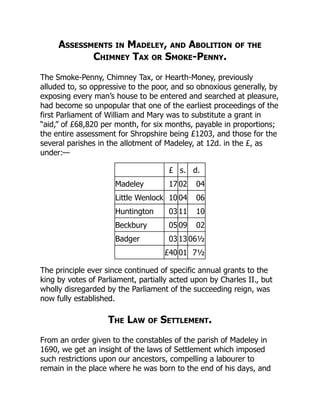
Assessments in Madeley,and Abolition of the
Chimney Tax or Smoke-Penny.
The Smoke-Penny, Chimney Tax, or Hearth-Money, previously
alluded to, so oppressive to the poor, and so obnoxious generally, by
exposing every man’s house to be entered and searched at pleasure,
had become so unpopular that one of the earliest proceedings of the
first Parliament of William and Mary was to substitute a grant in
“aid,” of £68,820 per month, for six months, payable in proportions;
the entire assessment for Shropshire being £1203, and those for the
several parishes in the allotment of Madeley, at 12d. in the £, as
under:—
£ s. d.
Madeley 17 02 04
Little Wenlock 10 04 06
Huntington 03 11 10
Beckbury 05 09 02
Badger 03 13 06½
£40 01 7½
The principle ever since continued of specific annual grants to the
king by votes of Parliament, partially acted upon by Charles II., but
wholly disregarded by the Parliament of the succeeding reign, was
now fully established.
The Law of Settlement.
From an order given to the constables of the parish of Madeley in
1690, we get an insight of the laws of Settlement which imposed
such restrictions upon our ancestors, compelling a labourer to
remain in the place where he was born to the end of his days, and
37.
preventing him betteringhis condition. The order was that whereas
Thomas Richardson had endeavoured to make a settlement in
Madeley contrary to the law, &c., that they, the constables, bring his
body to the serjeant’s house, Much Wenlock, to answer all matters
brought against him by the overseers of the poor of the parish of
Madeley. The constables were also to bring John York, smith, before
some justice of the peace to give sureties for his own and his wife’s
good behaviour.
Vagrants and Sturdy Beggars.
Paupers having been created by restraints preventing them seeking
employ where work was to be had, of course became troublesome.
Hence the serjeant-at-mace orders the constables at Madeley upon
oath to report what felonies have been committed, and what
vagrants and sturdy beggars have passed through.
The same constables were to ascertain how many persons of the
age of sixteen absented themselves from church, and for how many
Sabbaths. Also who destroyed hawks, hares, pheasants, &c.; and
who bought by greater and sold by lesser weights.
The Oaths of Supremacy.
In the fifth year of William and Mary (1691) constables were to give
notice to all above sixteen and under sixty, whom they believed to
be disaffected, to appear before the serjeant-at-mace to take the
oaths, &c.: but a goodly number of the Madeley and Little Wenlock
allotment appear to have been guilty of contempt, and were ordered
to pay the sum of 40s. by them forfeited. Having been guilty of
further contempt, the constables are ordered to seize and bring the
bodies of the delinquents. (See Appendix.)
The Poll Tax.
38.
In the sameyear, 1692, constables are instructed to look-up all loose
seamen and watermen, and bring them before one of the justices of
the peace; and to collect 4s. in the £, towards carrying on a vigorous
war with France. An order (September, 1693), signed “George Weld,
Bart.,” addressed to Mr. Brooke, of Madeley, calls upon the
constables to summons the Militia to appear at Shrewsbury &c., &c.
Under the act passed for collecting 4s. in the £, for carrying on the
war, constables were instructed to charge papists and all who had
not taken the oaths of supremacy double.
Assessment for carrying on a Vigorous War.
The assessment for Madeley for three months, on the allotment of
Little Wenlock by the commissioners, towards the raising of
£1,651,702, as granted by Parliament to the king for carrying on a
vigorous war against France, was £8 2s.
Press Laws.
In the same year constables were commanded to make diligent
search for all straggling seamen and watermen who were of able
bodies, fit for service at sea, and, to impress them, giving them one
shilling. The assessment in Madeley of 4s. in the £, for 1694,
produced, on land, works, &c., £149 1s. 4d., “one pound having
been abated on the lime-works.”
Tax upon Marriages, Births, Burials, &c.
In 1695 the Madeley constables were to collect duties upon
“marriages, births, and burials, and upon bachelors and widows,” for
carrying on the war with France, according to the rank of the
individuals.
In 1696, and 1697, we find constables have various duties assigned
them; and in 1698, they are required to carry out an act for
39.
preventing frauds andabuses in the charging and collecting, and
paying of duties upon marriages, births, and burials, bachelors and
widows. Also for collecting a quarterly poll for the year.
In 1702 instructions are given to constables to present all papists,
Jesuits, and all others that have received orders from the see of
Rome. Also all popish recusants and others that do not come to
their several parish churches within the divisions.
In 1703 they were to collect subsides for her majesty (Queen Anne),
for carrying on the war with France and Spain, and to charge those
who had not taken the oath of allegiance double.
In 1708 constables were to ascertain what masters or servants gave
or took greater wages than were allowed by law.
Our account of instructions to constables continues to 1714, but
nothing to merit comment occurs. Many names of old Madeley
families occur, which we shall notice hereafter.
Rent and Value of Lands in the Lordship of Madeley,
in 1702.
Demesne lands in Madeley, (537a. 3r. 33p.) or those attached to the
Court House, with the 770 trees upon it, valued at twenty years
purchase, was said to be £6,459 10s. 4d.; yearly rent, £289 13s. 6d.
The whole acreage of Madeley, including the above, was 2073 acres,
the yearly value of which was £1,021; trees, 3369; loads of wood,
160; purchase, £17,366 9s. 4d. For names of proprietors, see
Appendix.
We find from a survey of the lordship of Madeley, that the demesne
lands of the Court in 1786, belonged to Richard Dyett, Esq., one of
an old Shropshire family, from whom it was purchased by William
Orme Foster, Esq., about the year 1830.
40.
The Coal andIron Industries of Madeley.
During the period events previously recorded were being enacted,
the coal and iron industries now employing so many hands, and
which have brought so much wealth to individual proprietors, were
being developed. Francis Wolfe, who gave shelter to King Charles, is
supposed to have been a shareholder in some ironworks at Leighton,
and probably at Coalbrookdale, from the fact that an iron plate,
bearing date 1609, has the initials “T.R.W.,” and another with the
date 1658 (the latter removed here from Leighton), also bears a “W”
among other initials. We read also of a clerk of a Shropshire
ironworks being the first to convey the news of the disastrous defeat
of the royal army at Worcester. We find, too, that as early as 1332
Walter de Caldbroke obtained from the Wenlock monks license to dig
for coals at the outcrop at the Brockholes. We also learn from Fuller,
who lived and wrote in the seventeenth century, that what he calls
“fresh-water coal” was dug out at such a distance from the Severn
as to be easily ported by boat into other shires.
Iron, too, was made as we have seen from the Patent Roll, 36 Henry
VIII., part v., where the grant of the manor of Madeley to Robert
Brooke, Esq. is expressly said to include “the rights attached to the
whole of the place and buildings that go under the one name of the
Smithy Place, and Newhouse called Caldbrooke Smithy, with its
patronages in the aforesaid Madeley.”
The First Ironworks.—The Reynoldses.
The first ironworks were of course of a very humble description; the
outcrop of the mines did not then determine the situation so much
as the presence of a powerful stream which supplied a force to work
the leathern bellows which blew the fires. The first Abraham Darby
came to the Dale in 1709, and in 1713 the make was but from five
to ten tons per week. In 1712 he used coal in smelting iron. He
died at the Court House, Madeley, in 1717, and was succeeded by
41.
his son, thesecond Abraham Darby, who in 1760 is said to have laid
the first rails of iron for carriages with axles having fixed wheels.
The third Abraham Darby effected another great achievement, the
casting and erecting the first iron bridge, for which he obtained the
medal of the Society of Arts. The credit of having laid the first iron
rails is claimed for Richard Reynolds, who succeeded the second
Abraham Darby in the management of these works in 1763, and
who, according to Sir Robert Stephenson, who examined the books
of the works, cast six tons of iron rails for the use of the works in
1767. It was at these works, too, that the brothers Cranege
anticipated Henry Cort by seventeen years by the discovery of the
process of puddling in a reverberatory furnace, by the use of pit-
coal, in 1766, under the management of Mr. Reynolds.
Mr. Reynolds also took a warm interest in the success and
introduction of the steam engine, which he adopted in 1778. “For
no one,” observes his daughter, “did he entertain sentiments of more
affectionate esteem than for James Watt,” with whom, as well as
with Wedgwood and Wilkinson, he was associated in several public
movements of the time. Being a Friend he was opposed to war and
refused Government orders for cannon; and he was stung to the
quick when Pitt’s ministry proposed to lay a war tax upon coal. The
country had been carrying on wars—wars everywhere, and with
everybody, and to meet the lavish expenditure, the popular minister
of the day, on whom Walpole tells us, “it rained gold boxes” for
weeks running, “the pilot that weathered the storm,” sought to
replenish the exchequer by a tax of 2s. per ton, to be paid on all
coal without exception raised to the pit’s mouth. The iron-masters
of Shropshire, Staffordshire and Yorkshire, as well as those of other
English and Scottish counties were alarmed; it was felt to be an
important crisis in the history of the trade. Deputations and
petitions were sent up, but the wily premier had so carefully yet
quietly surrounded himself with facts, that he knew of every pound
of iron made and of every ton of coal that was raised. Pitt received
the gentlemen connected with the trade with the greatest freedom
and affability; bowed them in and out; appointed hours and places
42.
to meet theirconvenience, and left them dumbfounded at his
knowledge of details of their own business. Mr. Reynolds entered
the field in opposition to the tax, gave evidence before the Privy
Council, and by petitions to the House and letters to members of the
Cabinet, materially aided in defeating the attempt. The gravity of
the occasion is, perhaps, even more evident to us, on whom the
advantages of a cheap and plentiful supply of iron have fallen. We
can better measure the consequences that must have followed. A
tax upon coal at that period would have paralysed the trade,
checked its development in this country, and thrown into the lap of
others benefits we ourselves have derived; would have disendowed
the island of advantages in which it is peculiarly rich,—upon which it
is mainly dependent for its wealth, its progress, and its civilization.
A tax upon coal would have been a tax upon iron, upon the
manufacture of iron, upon its consumption, and its use in the arts
and manufactures of the kingdom,—a tax upon spinning, weaving,
and printing,—a tax upon the genius of Watt and Arkwright, whose
improvements it would have thrown back and thwarted,—upon the
extension of commerce at home and abroad. The immense
advantages possessed by the manufacturers of the New World would
then have given them the lead in a race in which, even now, it is as
much as we can do to keep up. Our energies, just at a time when
the iron nerves of England were put to their greatest strain, would
have been paralysed, and we should have been deprived of our
railways, our locomotives, our steam-fleets, and much of our
commerce, and prosperity. Mr. Reynolds saw the evil in prospective,
and in a letter to Earl Gower, President of the Council, dated the 7th
month, 1784, takes a very just review of the past history of the
trade and the improvements then about to be adopted. He says:—
“The advancement of the iron trade within these few years have
been prodigious; it was thought, and justly, that the making of
pig iron with pit coal was a great acquisition to the nation by
saving the woods and supplying a material to manufactories,
the make of which, by the consumption of all the wood the
country produced, was unequal to the demand; and the nail
43.
trade, perhaps themost considerable of any one article of
manufactured iron, would have been lost to this country, had it
not been found practicable to make nails of iron made with pit
coal; and it is for that purpose we have made, or rather are
making, the alterations at Donnington-Wood, Ketley, &c., which
we expect to complete in the present year, but not at a less
expense than twenty thousand pounds, which will be lost to us
and gained by nobody if this tax is laid on our coals. The only
chance we have of making iron as cheap as it can be imported
from Russia, is the low price of our fuel, and unless we can do
that there will not be consumption equal to half the quantity
that can be made, and when we consider how many people are
employed on a ton of iron, and the several trades dependent
thereupon, we shall be convinced the Revenue is much more
benefited even by the consumption of excisable articles, &c.,
than by the duty on a ton of foreign iron; nor will it, I believe,
escape observation that the iron trade, so fatally affected by this
absurd tax, is only of the second, if indeed, on some account, it
is not of the first importance to the nation. The preference I
know is given, and I believe justly, as to the number of hands
employed, to the woollen manufactory; but when it is
remembered that all that is produced by making of iron with pit
coal is absolutely so much gained to the nation, and which,
without its being so applied, would be perfectly useless, it will
evince its superior importance, for the land grazed by sheep
might be converted with whatever loss to other purposes of
agriculture or pasturage; but coal and iron stone have no value
in their natural state, produce nothing till they are consumed or
manufactured, and a tax upon coal, which, as I said, is the only
article that in any degree compensates for our high price of
labour, &c., or can be substituted in the stead of water for our
wheels, and bellows, would entirely ruin this very populous
country, and throw its labouring poor upon the parishes, till the
emigration of those of them who are able to work shall
strengthen our opponents, and leave the desolated wastes, at
present occupied by their cottages, to the lords of the soil.”
44.
In the yearfollowing (1785) the interests of the iron trade were
again considered to be endangered from commercial arrangements
proposed by the Irish House of Commons for the consideration of
Parliament. Mr. Reynolds, Messrs. Boulton, Watt, Wedgwood,
Wilkinson, and others, united in forming an association for the
protection of the trade, under the title of “The United Chamber of
Manufacturers of Great Britain.” The Shropshire iron and coal
masters petitioned the House, and Mr. Reynolds again wielded the
pen in defence of the trade. We extract sufficient to show the
extent of the works. He says, addressing Earl Gower, under date
28th of the third month, 1785,—
“We solicit thy effectual interposition against a measure so
injurious to us and to the many hundreds of poor people
employed by us in working and carrying on mines, &c., for the
supply of a large sale of coals by land and water, and of coals
and mine for sixteen fire-engines, eight blast furnaces, and nine
forges, besides the air furnaces, mills, &c., at the foundry at
Coalbrookdale, and which, with the levels, roads, and more than
twenty miles of railways, &c., still employs a capital of upwards
of £100,000, though the declension of our trade has, as stated
in a former letter, obliged us to stop two blast furnaces, which
are not included in the number before mentioned. Nor have we
ever considered ourselves as the first of many others employed
in iron or coal works in this kingdom.”
We have considered the subject of our present sketch chiefly under
one aspect only—as a man of action—and that mainly in connection
with the iron trade, and in providing against those reverses to which
not only that but other branches of industry were peculiarly liable,
more particularly during the latter end of the last and the
commencement of the present centuries. Mr. Reynolds, however,
has claims no less distinguished under a classification beneath which
is frequently found another division of human benefactors. He was
not only a man of action—great in dealing with things tangible,—but
he was a man of thought and of genius—as quick to devise and to
45.
plan as toexecute. What is still more rare, he possessed those
qualities in proportions so finely balanced, that their happy
combination, during a long and active life, gave birth to schemes of
noble enterprise, valuable to the district, and important to the
nation. That which merited, from vulgar shortsightedness, the
epithet of eccentricity, a state of deep and penetrating thought, was
oftentimes the conceiving energy of a vigorous mind mastering in
the mental laboratory of the brain, plans and schemes of which the
noblest movements of the day are the just and legitimate offspring.
The schemes he inaugurated were victories won, the improvements
he effected were triumphs gained to the nation or for humanity.
That quality of mind which too often runs waste or evaporates in
wild impracticable ideality, with him found an object of utility on
which to alight, and under the magic of a more than ordinary genius
difficulties disappeared, formidable obstacles melted into air, and the
useful and the true were fused into one. He never felt the fluttering
of a noble thought but he held it by the skirts, and made it do duty
in this work-day world of ours, if it had relation to the tangible
realities of time. “Though I do not adopt,” he writes to a friend, “all
the notions of Swedenbourg, I have believed that the spiritual world
is nearer to us than many suppose, and that our communication
with it would be more frequent than many of us experience, did we
attain to that degree of purity of heart and abstraction from worldly
thoughts and tempers which qualify for such communion or
intercourse.” He was not a man whose soul ran dry in solitude, or
that grew melancholy the moment the click of money-making
machinery no longer sounded in his ears. He was one of the old
iron-kings, ’tis true, but with a soul in harmony with the silvery
music of the universe. Often with no companion but his pipe, he
retired to some retreat, consecrated perhaps by many a happy
thought, and watched the declining sun, bathing in liquid glory the
Ercall woods, the majestic Wrekin, the Briedden hills, and the still
more distant Cader Idris. A deep vein of genuine religious feeling
often appeared upon the surface, and seemed to penetrate
46.
Welcome to ourwebsite – the perfect destination for book lovers and
knowledge seekers. We believe that every book holds a new world,
offering opportunities for learning, discovery, and personal growth.
That’s why we are dedicated to bringing you a diverse collection of
books, ranging from classic literature and specialized publications to
self-development guides and children's books.
More than just a book-buying platform, we strive to be a bridge
connecting you with timeless cultural and intellectual values. With an
elegant, user-friendly interface and a smart search system, you can
quickly find the books that best suit your interests. Additionally,
our special promotions and home delivery services help you save time
and fully enjoy the joy of reading.
Join us on a journey of knowledge exploration, passion nurturing, and
personal growth every day!
testbankfan.com







![“The family of Brooke, formerly of Lapley, in Staffordshire, and
afterwards of Bobbington, and subsequently of Haughton, in
Shropshire, had possessions in this parish, in whose family it
continued until 1800, when the capital mansion and estates
belonging thereto were sold by George Brooke, Esq. to different
purchasers.”
In Claverley the name of John de la Broke occurs in 1242, and that
of Thomas de la Bruche, in 1260, both of whom are supposed to
have resided there. In 1268 a Geoffrey de la Broke is mentioned as
having been on an inquest at Kinver. From 1299 to 1338 Richard de
Broke, of Claverley, is sometimes called Richard atte [35]
Broke, in
connection with juries on which he sat, and in attesting deeds at
Claverley, Bridgnorth, and elsewhere. In 1316 he was a grantee of
land at Beobridge, whilst his son Richard is mentioned as a clerk in
1318, and the same son is again mentioned with his father in 1324.
In 1342 and 1343 this succession, Mr. Eyton thinks, continues in
Thomas atte Broke, of Claverley; but Randolf atte Broke, who was at
Enville, in 1347, he takes to have been an ancestor of Brooke of
Blacklands, one of whom (deceased in 1385) seems to have married
a co-heiress of the Gravenors.
We have already noticed the very magnificent alabaster tomb, in the
N.E. corner of the Gatacre chancel, on which are the recumbent
figures of Lord Chief Justice Brooke, in his official robes, and his two
wives, one on each side; and a subsequent visit enables us to add
some additional particulars. The female-figures have ornamental
head-gear, flowing mantles, single ruffs round their necks, three
rows of chain necklaces hanging loose, and ruffles with braid at the
hands. On the three sides of the tomb are figures of their eighteen
children, in the dresses of the time. This tomb must have been a
gorgeous one, for a close inspection shows traces of gold and colour,
which once adorned the principal figures. It is to be regretted that
the arms of this distinguished family, like those of the Gatacre, the
Beauchamp, the Talbot, the Ferrers, and some others, which, about
the end of the seventeenth century adorned this church, have](https://image.slidesharecdn.com/4068-250430194715-6254ff87/85/Microsoft-Access-2013-Comprehensive-1st-Edition-Pratt-Solutions-Manual-20-320.jpg)
![There are also coats of arms over the gatehouse of the Brooke
family, [37]
those over the window and doorway being—
Party per pale. First Chequy * * * and * * *. Second paly of
Six, and a Canton Ermine.
On the right tower—
Paly of Six * * * and * * * with Canton Ermine.
On this tower also is an heraldic rose, and on the left * *, a
Cross Pommee, * *.
The first entry of an interment in the register at Claverley, the vicar
tells us, is that of a Brooke, and the second entry in the register at
Madeley is also the interment of a member of the same family.
Subsequent and more detailed examinations of the arms in various
parts of the Court House and adjacent buildings throw a doubt upon
the statement in a previous page, as to the proprietorship or
occupation at one time of the Ferrers family. These arms differ, it
will be seen, as may be expected, from marriages and inter-
marriages, but we are not sufficiently acquainted with the arms of
other old families of the time to say with what or whose arms they
were incorporated, and it would be overloading our pages with
genealogical lore to go into details. A family, some of the members
of which had two wives and eighteen children, would naturally soon
spread itself about the country.
The Rev. C. Brooke, of Brackley, Northants, as these pages are going
through the press, writes to say:—
“From the similiarity in the arms it would seem that there was a
connection between Robert Brooke of Madeley Court, and
Brooke of Blacklands, whose arms are given by Dr. Plot, in his
‘History of Staffordshire,’ as ‘Chequy, arg. and sable;’ but it does
not appear to be so by the pedigree in the Visitation taken
1623, or by the pedigree of Brooke of Blacklands, compiled by](https://image.slidesharecdn.com/4068-250430194715-6254ff87/85/Microsoft-Access-2013-Comprehensive-1st-Edition-Pratt-Solutions-Manual-22-320.jpg)
![John B. died 1598, aged 60. + Anne, d. of Francis Shirley, of
Staniton, co. Leicester.
↓
Sir Basil Brooke Miles, 1623, died 1646. + Etheldreda, d. and
sole heir of Edmund Boudendil.”
Sir Basil was one of the sporting friends whom Giffard of Chillington
drew around him at his housewarming on the border of Brewood
Forest, a house which subsequently gave shelter to the Earl of Derby
and King Charles the First. It was built nominally as a hunting-seat,
but really for purposes of concealment; and the site on the bolder of
two counties, deep in the recesses of woods, traversed by no public
roads, was exceedingly suitable. It is said that on the completion of
the building the owner invited a few friends to dinner, to celebrate
the occasion, and amongst them Sir Basil Brooke, of the Court
House, Madeley, who had recently returned from Italy, and who on
being requested by his host to supply a name for the place,
suggested Boscobel, or Bos co Bello; and this was considered so
appropriate, from the prospect it commanded of the beautiful woods
around, that it is said to have been at once adopted.
It will be seen from what we have previously stated that the family
of Brooke continued to reside at Madeley till 1706, when, according
to the benefaction-table in the church, Basil Brooke by will
bequeathed the sum of £40, and for a further sum of £30, paid him
by Audley Bowdler and eight other parties, sold three several
cottages or tenements, with gardens and yards, at Madeley Wood,
for the use of the poor. [40]
The next tenant of the Court appears to have been the first Abraham
Darby, for we find that he died there, after which time we find no
tenants of more importance than the Purtons and the Triggers, who
were farmers, and held the land around.
Thus early, even in Madeley, did the great owners of the soil—who
merely tilled the surface, and scarcely that—give place to miners and](https://image.slidesharecdn.com/4068-250430194715-6254ff87/85/Microsoft-Access-2013-Comprehensive-1st-Edition-Pratt-Solutions-Manual-24-320.jpg)
![but not till 1675 was permanent provision made. Certain rents from
estates in Stafford, Salop, Hereford, &c., were intrusted to Sir Walter
Wollesley, John Giffard, of Black Ladies, and Richard Congreve, of
Congreve, to pay the yearly proceeds to the Penderell family, the
sum amounting to about £450 per annum, thus:—
£100 a-year to Richard Penderell or his heirs,
£100 a-year to William or his heirs.
100 marks, or £66 13s. 4d. a-year to Humphrey or his heirs.
100 marks to John or his heirs.
100 marks to George or his heirs.
£50 a-year to Elizabeth Yates or her heirs.
The surviving trustee is John Giffard, of Black Ladies, and his lineal
descendants, the present squire of Chillington, who is now sole
trustee. [54]
The Great Fire of London.
Another notable event noticed by an old book in the vestry of
Madeley Church already quoted, is the Great Fire of London,
September, 1666, sixteen years subsequent to the stirring drama
previously recorded. It comes before us in a house-to-house
visitation, by the vicar and churchwardens, for the purpose of raising
subscriptions “in aid of a fund to relieve the sufferings by the Great
Fire.”
In this account nine sugar-refiners are said to have lost £20,000;
but, notwithstanding the house-to-house visitation, only £1 2s. 10d.
was raised, which speaks little for the sympathy or wealth of the
inhabitants at that time.](https://image.slidesharecdn.com/4068-250430194715-6254ff87/85/Microsoft-Access-2013-Comprehensive-1st-Edition-Pratt-Solutions-Manual-35-320.jpg)