Nitish kumar
b.Pharm 7th sem
RCPSR, bhilai
307204118007
Definition
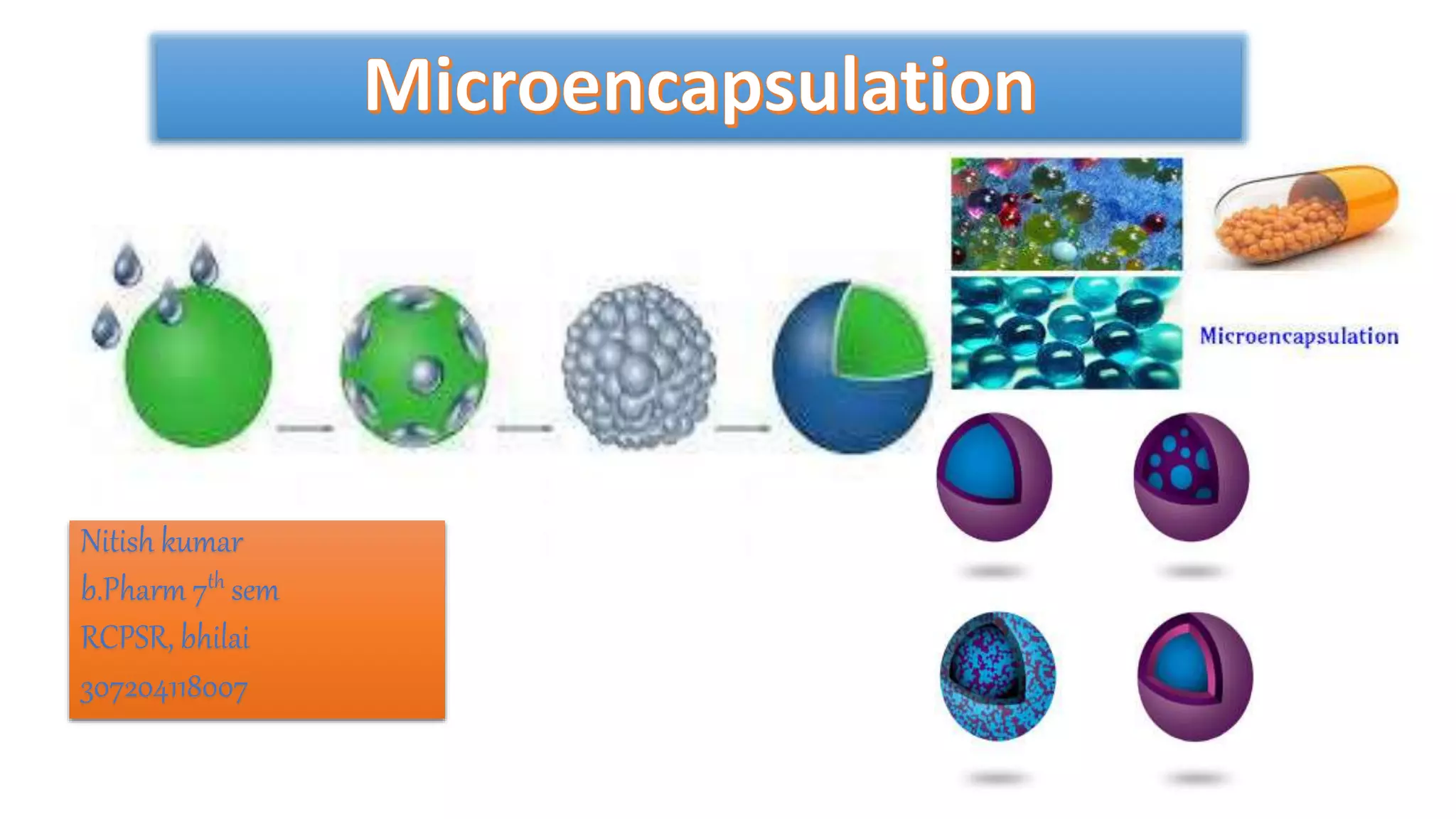
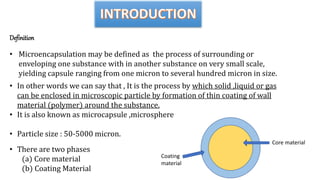
• Microencapsulation may be defined as the process of surrounding or
enveloping one substance with in another substance on very small scale,
yielding capsule ranging from one micron to several hundred micron in size.
• In other words we can say that , It is the process by which solid ,liquid or gas
can be enclosed in microscopic particle by formation of thin coating of wall
material (polymer) around the substance.
• It is also known as microcapsule ,microsphere
• Particle size : 50-5000 micron.
• There are two phases
(a) Core material
(b) Coating Material
Core material
Coating
material
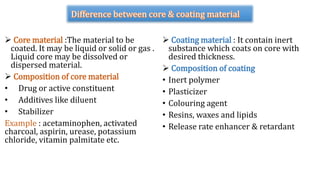
 Core material :The material to be
coated. It may be liquid or solid or gas .
Liquid core may be dissolved or
dispersed material.
 Composition of core material
• Drug or active constituent
• Additives like diluent
• Stabilizer
Example : acetaminophen, activated
charcoal, aspirin, urease, potassium
chloride, vitamin palmitate etc.
 Coating material : It contain inert
substance which coats on core with
desired thickness.
 Composition of coating
• Inert polymer
• Plasticizer
• Colouring agent
• Resins, waxes and lipids
• Release rate enhancer & retardant
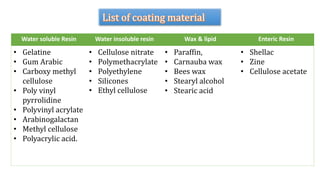
Water soluble Resin Water insoluble resin Wax & lipid Enteric Resin
• Gelatine
• Gum Arabic
• Carboxy methyl
cellulose
• Poly vinyl
pyrrolidine
• Polyvinyl acrylate
• Arabinogalactan
• Methyl cellulose
• Polyacrylic acid.
• Cellulose nitrate
• Polymethacrylate
• Polyethylene
• Silicones
• Ethyl cellulose
• Paraffin,
• Carnauba wax
• Bees wax
• Stearyl alcohol
• Stearic acid
• Shellac
• Zine
• Cellulose acetate
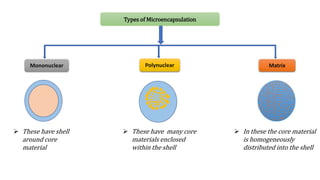
Types of Microencapsulation
Mononuclear Polynuclear Matrix
 These have shell
around core
material
 These have many core
materials enclosed
within the shell
 In these the core material
is homogeneously
distributed into the shell
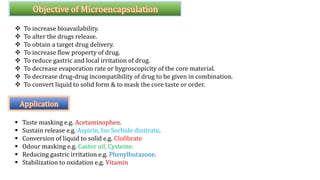
 To increase bioavailability.
 To alter the drugs release.
 To obtain a target drug delivery.
 To increase flow property of drug.
 To reduce gastric and local irritation of drug.
 To decrease evaporation rate or hygroscopicity of the core material.
 To decrease drug-drug incompatibility of drug to be given in combination.
 To convert liquid to solid form & to mask the core taste or order.
 Taste masking e.g. Acetaminophen.
 Sustain release e.g. Aspirin, Iso Sorbide dinitrate.
 Conversion of liquid to solid e.g. Clofibrate
 Odour masking e.g. Castor oil, Cysteine.
 Reducing gastric irritation e.g. Phenylbutazone.
 Stabilization to oxidation e.g. Vitamin
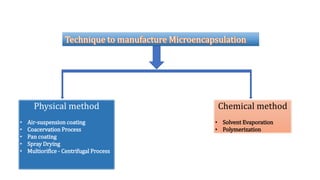
Physical method
• Air-suspension coating
• Coacervation Process
• Pan coating
• Spray Drying
• Multiorifice - Centrifugal Process
Chemical method
• Solvent Evaporation
• Polymerization
Physical method
• Air-suspension coating
• Coacervation Process
• Pan coating
• Spray Drying
• Multiorifice - Centrifugal Process
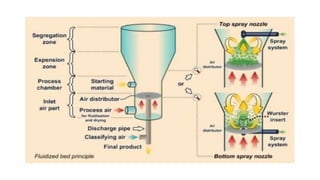
• This technique is limited to encapsulating solid particle or porous
particle into which liquid has been absorbed.
• The solid particulate core material is suspended in a gas stream
• Usually, heated air ,and a liquid coating material is sprayed on these
air –suspended particles.
• The coated particle are cyclized into zones, where the coating is
dried by solvent evaporation.
• This coating and drying sequence is repeated until the desired
thickness of coating has been applied.
Air-suspension coating
[Fluidized Bed Dryer]
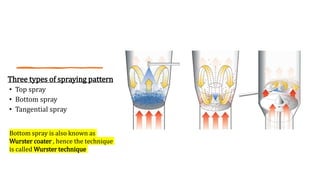
Three types of spraying pattern
• Top spray
• Bottom spray
• Tangential spray
Bottom spray is also known as
Wurster coater , hence the technique
is called Wurster technique
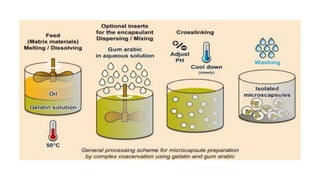
Coacervation
Process
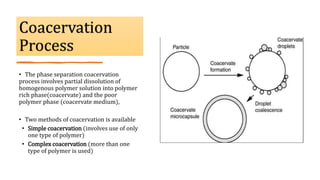
• The phase separation coacervation
process involves partial dissolution of
homogenous polymer solution into polymer
rich phase(coacervate) and the poor
polymer phase (coacervate medium),
• Two methods of coacervation is available
• Simple coacervation (involves use of only
one type of polymer)
• Complex coacervation (more than one
type of polymer is used)
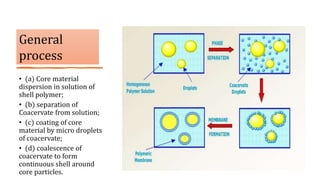
• (a) Core material
dispersion in solution of
shell polymer;
• (b) separation of
Coacervate from solution;
• (c) coating of core
material by micro droplets
of coacervate;
• (d) coalescence of
coacervate to form
continuous shell around
core particles.
General
process
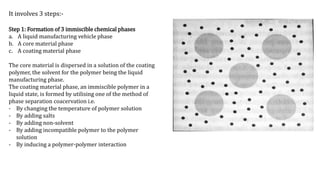
It involves 3 steps:-
Step 1: Formation of 3 immiscible chemical phases
a. A liquid manufacturing vehicle phase
b. A core material phase
c. A coating material phase
The core material is dispersed in a solution of the coating
polymer, the solvent for the polymer being the liquid
manufacturing phase.
The coating material phase, an immiscible polymer in a
liquid state, is formed by utilising one of the method of
phase separation coacervation i.e.
- By changing the temperature of polymer solution
- By adding salts
- By adding non-solvent
- By adding incompatible polymer to the polymer
solution
- By inducing a polymer-polymer interaction
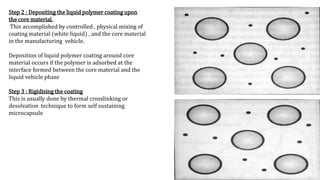
Step 2 : Depositing the liquid polymer coating upon
the core material,
This accomplished by controlled , physical mixing of
coating material (white liquid) , and the core material
in the manufacturing vehicle.
Deposition of liquid polymer coating around core
material occurs if the polymer is adsorbed at the
interface formed between the core material and the
liquid vehicle phase
Step 3 : Rigidising the coating
This is usually done by thermal crosslinking or
desolvation technique to form self sustaining
microcapsule
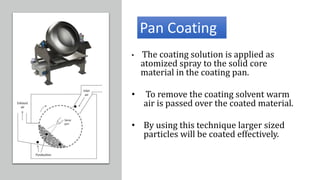
• The coating solution is applied as
atomized spray to the solid core
material in the coating pan.
• To remove the coating solvent warm
air is passed over the coated material.
• By using this technique larger sized
particles will be coated effectively.
Pan Coating
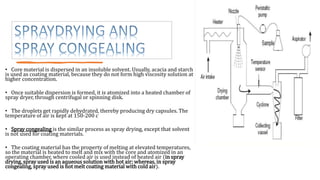
• Core material is dispersed in an insoluble solvent. Usually, acacia and starch
is used as coating material, because they do not form high viscosity solution at
higher concentration.
• Once suitable dispersion is formed, it is atomized into a heated chamber of
spray dryer, through centrifugal or spinning disk.
• The droplets get rapidly dehydrated, thereby producing dry capsules. The
temperature of air is kept at 150-200 c
• Spray congealing is the similar process as spray drying, except that solvent
is not used for coating materials.
• The coating material has the property of melting at elevated temperatures,
so the material is heated to melt and mix with the core and atomized in an
operating chamber, where cooled air is used instead of heated air (in spray
drying, spray used is an aqueous solution with hot air; whereas, in spray
congealing, spray used is hot melt coating material with cold air).
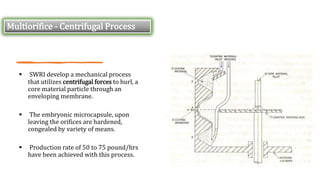
 SWRI develop a mechanical process
that utilizes centrifugal forces to hurl, a
core material particle through an
enveloping membrane.
 The embryonic microcapsule, upon
leaving the orifices are hardened,
congealed by variety of means.
 Production rate of 50 to 75 pound/hrs
have been achieved with this process.
Multiorifice - Centrifugal Process
Chemical method
• Solvent Evaporation
• Polymerization
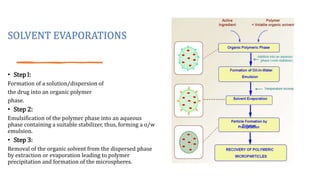
• Step l:
Formation of a solution/dispersion of
the drug into an organic polymer
phase.
• Step 2:
Emulsification of the polymer phase into an aqueous
phase containing a suitable stabilizer, thus, forming a o/w
emulsion.
• Step 3:
Removal of the organic solvent from the dispersed phase
by extraction or evaporation leading to polymer
precipitation and formation of the microspheres.
SOLVENT EVAPORATIONS
 E.g., In the formation of polyamide (Nylon)
polymeric reaction occurring at liquid-liquid
interface existing between aliphatic diamine &
dicarboxylic acid halide.
 This new microencapsulation method utilizes polymerization
technique to form protective microcapsules.
 The method involves the reaction of monomer units located at
the interface between a core material and continuous phase in
which the core material is dispersed.
 A co-reactant is added to the dispersed phase to cause rapid
polymerization. If the process doesn't require a co-reactant for
polymerization, then this method is called in situ polymerization.
POLYMERIZATION/
INTERFACIAL POLYCONDENSATION
Microencapsulation

Microencapsulation

  • 1.
    Nitish kumar b.Pharm 7thsem RCPSR, bhilai 307204118007
  • 2.
    Definition • Microencapsulation maybe defined as the process of surrounding or enveloping one substance with in another substance on very small scale, yielding capsule ranging from one micron to several hundred micron in size. • In other words we can say that , It is the process by which solid ,liquid or gas can be enclosed in microscopic particle by formation of thin coating of wall material (polymer) around the substance. • It is also known as microcapsule ,microsphere • Particle size : 50-5000 micron. • There are two phases (a) Core material (b) Coating Material Core material Coating material
  • 4.
     Core material:The material to be coated. It may be liquid or solid or gas . Liquid core may be dissolved or dispersed material.  Composition of core material • Drug or active constituent • Additives like diluent • Stabilizer Example : acetaminophen, activated charcoal, aspirin, urease, potassium chloride, vitamin palmitate etc.  Coating material : It contain inert substance which coats on core with desired thickness.  Composition of coating • Inert polymer • Plasticizer • Colouring agent • Resins, waxes and lipids • Release rate enhancer & retardant
  • 5.
    Water soluble ResinWater insoluble resin Wax & lipid Enteric Resin • Gelatine • Gum Arabic • Carboxy methyl cellulose • Poly vinyl pyrrolidine • Polyvinyl acrylate • Arabinogalactan • Methyl cellulose • Polyacrylic acid. • Cellulose nitrate • Polymethacrylate • Polyethylene • Silicones • Ethyl cellulose • Paraffin, • Carnauba wax • Bees wax • Stearyl alcohol • Stearic acid • Shellac • Zine • Cellulose acetate
  • 6.
    Types of Microencapsulation MononuclearPolynuclear Matrix  These have shell around core material  These have many core materials enclosed within the shell  In these the core material is homogeneously distributed into the shell
  • 7.
     To increasebioavailability.  To alter the drugs release.  To obtain a target drug delivery.  To increase flow property of drug.  To reduce gastric and local irritation of drug.  To decrease evaporation rate or hygroscopicity of the core material.  To decrease drug-drug incompatibility of drug to be given in combination.  To convert liquid to solid form & to mask the core taste or order.  Taste masking e.g. Acetaminophen.  Sustain release e.g. Aspirin, Iso Sorbide dinitrate.  Conversion of liquid to solid e.g. Clofibrate  Odour masking e.g. Castor oil, Cysteine.  Reducing gastric irritation e.g. Phenylbutazone.  Stabilization to oxidation e.g. Vitamin
  • 8.
    Physical method • Air-suspensioncoating • Coacervation Process • Pan coating • Spray Drying • Multiorifice - Centrifugal Process Chemical method • Solvent Evaporation • Polymerization
  • 9.
    Physical method • Air-suspensioncoating • Coacervation Process • Pan coating • Spray Drying • Multiorifice - Centrifugal Process
  • 10.
    • This techniqueis limited to encapsulating solid particle or porous particle into which liquid has been absorbed. • The solid particulate core material is suspended in a gas stream • Usually, heated air ,and a liquid coating material is sprayed on these air –suspended particles. • The coated particle are cyclized into zones, where the coating is dried by solvent evaporation. • This coating and drying sequence is repeated until the desired thickness of coating has been applied. Air-suspension coating [Fluidized Bed Dryer]
  • 12.
    Three types ofspraying pattern • Top spray • Bottom spray • Tangential spray Bottom spray is also known as Wurster coater , hence the technique is called Wurster technique
  • 14.
    Coacervation Process • The phaseseparation coacervation process involves partial dissolution of homogenous polymer solution into polymer rich phase(coacervate) and the poor polymer phase (coacervate medium), • Two methods of coacervation is available • Simple coacervation (involves use of only one type of polymer) • Complex coacervation (more than one type of polymer is used)
  • 15.
    • (a) Corematerial dispersion in solution of shell polymer; • (b) separation of Coacervate from solution; • (c) coating of core material by micro droplets of coacervate; • (d) coalescence of coacervate to form continuous shell around core particles. General process
  • 16.
    It involves 3steps:- Step 1: Formation of 3 immiscible chemical phases a. A liquid manufacturing vehicle phase b. A core material phase c. A coating material phase The core material is dispersed in a solution of the coating polymer, the solvent for the polymer being the liquid manufacturing phase. The coating material phase, an immiscible polymer in a liquid state, is formed by utilising one of the method of phase separation coacervation i.e. - By changing the temperature of polymer solution - By adding salts - By adding non-solvent - By adding incompatible polymer to the polymer solution - By inducing a polymer-polymer interaction
  • 17.
    Step 2 :Depositing the liquid polymer coating upon the core material, This accomplished by controlled , physical mixing of coating material (white liquid) , and the core material in the manufacturing vehicle. Deposition of liquid polymer coating around core material occurs if the polymer is adsorbed at the interface formed between the core material and the liquid vehicle phase Step 3 : Rigidising the coating This is usually done by thermal crosslinking or desolvation technique to form self sustaining microcapsule
  • 19.
    • The coatingsolution is applied as atomized spray to the solid core material in the coating pan. • To remove the coating solvent warm air is passed over the coated material. • By using this technique larger sized particles will be coated effectively. Pan Coating
  • 20.
    • Core materialis dispersed in an insoluble solvent. Usually, acacia and starch is used as coating material, because they do not form high viscosity solution at higher concentration. • Once suitable dispersion is formed, it is atomized into a heated chamber of spray dryer, through centrifugal or spinning disk. • The droplets get rapidly dehydrated, thereby producing dry capsules. The temperature of air is kept at 150-200 c • Spray congealing is the similar process as spray drying, except that solvent is not used for coating materials. • The coating material has the property of melting at elevated temperatures, so the material is heated to melt and mix with the core and atomized in an operating chamber, where cooled air is used instead of heated air (in spray drying, spray used is an aqueous solution with hot air; whereas, in spray congealing, spray used is hot melt coating material with cold air).
  • 21.
     SWRI developa mechanical process that utilizes centrifugal forces to hurl, a core material particle through an enveloping membrane.  The embryonic microcapsule, upon leaving the orifices are hardened, congealed by variety of means.  Production rate of 50 to 75 pound/hrs have been achieved with this process. Multiorifice - Centrifugal Process
  • 22.
    Chemical method • SolventEvaporation • Polymerization
  • 23.
    • Step l: Formationof a solution/dispersion of the drug into an organic polymer phase. • Step 2: Emulsification of the polymer phase into an aqueous phase containing a suitable stabilizer, thus, forming a o/w emulsion. • Step 3: Removal of the organic solvent from the dispersed phase by extraction or evaporation leading to polymer precipitation and formation of the microspheres. SOLVENT EVAPORATIONS
  • 24.
     E.g., Inthe formation of polyamide (Nylon) polymeric reaction occurring at liquid-liquid interface existing between aliphatic diamine & dicarboxylic acid halide.  This new microencapsulation method utilizes polymerization technique to form protective microcapsules.  The method involves the reaction of monomer units located at the interface between a core material and continuous phase in which the core material is dispersed.  A co-reactant is added to the dispersed phase to cause rapid polymerization. If the process doesn't require a co-reactant for polymerization, then this method is called in situ polymerization. POLYMERIZATION/ INTERFACIAL POLYCONDENSATION