
Bangabandhu Sheikh Mujibur Rahman Science & Technology University
Department of Pharmacy
A Presentation On
Microencapsulation
 Presenting Group: Group C & Group E
Course Title: Pharmaceutical Technology-II
Corse Code: PHR361
Contents
Microencapsulation
Classification of Microcapsules
 Fundamental Consideration of Microencapsulation
Morphology of the Microcapsules
Coating material properties
Reasons for microencapsulation
Release Mechanism of Microencapsulation
 Techniques of Microencapsulation
Evaluation of Microencapsulation
Pharmaceutical Applications
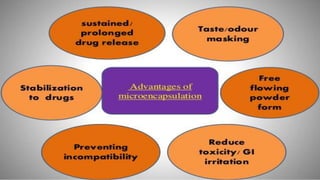
 Advantages of Microencapsulation
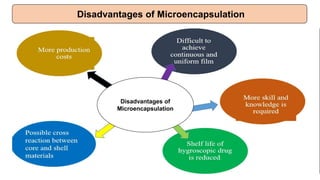
 Disadvantages of Microencapsulation
Microencapsulation
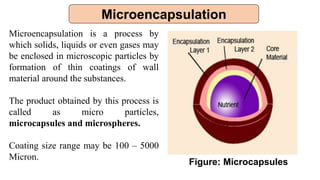
Microencapsulation is a process by
which solids, liquids or even gases may
be enclosed in microscopic particles by
formation of thin coatings of wall
material around the substances.
The product obtained by this process is
called as micro particles,
microcapsules and microspheres.
Coating size range may be 100 – 5000
Micron.
Figure: Microcapsules
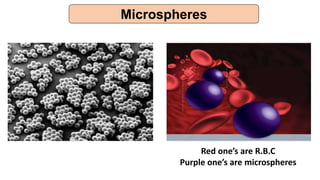
Red one’s are R.B.C
Purple one’s are microspheres
Microspheres
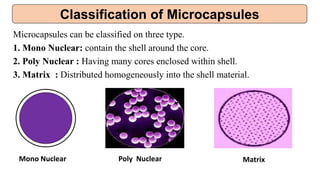
Microcapsules can be classified on three type.
1. Mono Nuclear: contain the shell around the core.
2. Poly Nuclear : Having many cores enclosed within shell.
3. Matrix : Distributed homogeneously into the shell material.
Classification of Microcapsules
Mono Nuclear Poly Nuclear Matrix
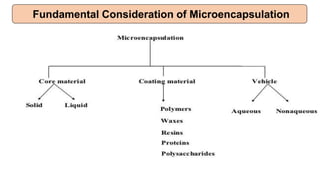
Fundamental Consideration of Microencapsulation
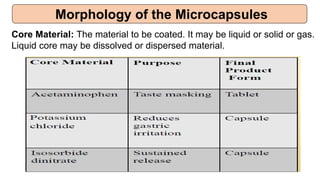
Morphology of the Microcapsules
Micro capsules consist of two components -
a) Core material
b) Coat material
Core
Coat
Morphology of the Microcapsules
Core Material: The material to be coated. It may be liquid or solid or gas.
Liquid core may be dissolved or dispersed material.
Morphology of the Microcapsules
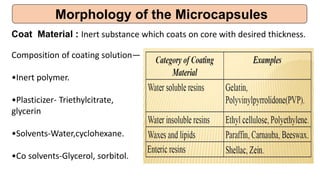
Coat Material : Inert substance which coats on core with desired thickness.
Composition of coating solution—
•Inert polymer.
•Plasticizer- Triethylcitrate,
glycerin
•Solvents-Water,cyclohexane.
•Co solvents-Glycerol, sorbitol.
Coating Material Properties
1. Stabilization of core material.
2. Inert toward active ingredients.
3. Controlled release under specific conditions.
4. Film-forming, pliable, tasteless, stable.
5. Non-hygroscopic, no high viscosity, economical.
6. Soluble in an aqueous media or solvent, or melting.
7. The coating can be flexible, brittle, hard, thin etc.
The drugs, which are sensitive to oxygen, moisture or light, can be stabilized
by microencapsulation.
For masking taste and odor of many drugs to improve patient compliance.
Example-Ofloxacin.
Obtain controlled and target release of the drug substance.
For safe handling of the toxic materials.
To avoid adverse effects like gastric irritation of the drug. Example-
Indomethacin
To increase of bioavailability.
Incompatibility among the drugs can be prevented by microencapsulation.
Example- Aspirin and Chlorpheniramine maleate
Reduction of hygroscopicity. Example- NaCl
To convert liquid active components into a pseudo solid system. Example-
Eprazinone.
Reduction of vaporization of volatile drugs. example- Methyl salicylate.
Reasons for Microencapsulation
Release Mechanism of Microencapsulation
The aim of a microencapsulation is the isolation of the core from its
surrounding, the wall must be ruptured at the time of use. A variety of
release mechanisms have been proposed for microcapsules. These
are—
1. Degradation controlled monolithic system
2. Diffusion controlled monolithic system
3. Diffusion controlled reservoir system
4. Erosion
Release Mechanism of Microencapsulation
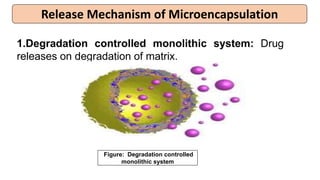
1.Degradation controlled monolithic system: Drug
releases on degradation of matrix.
Figure: Degradation controlled
monolithic system
Release Mechanism of Microencapsulation
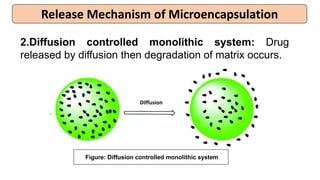
2.Diffusion controlled monolithic system: Drug
released by diffusion then degradation of matrix occurs.
Figure: Diffusion controlled monolithic system
Diffusion
Release Mechanism of Microencapsulation
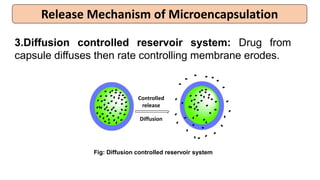
3.Diffusion controlled reservoir system: Drug from
capsule diffuses then rate controlling membrane erodes.
Diffusion
Fig: Diffusion controlled reservoir system
Controlled
release
Release Mechanism of Microencapsulation
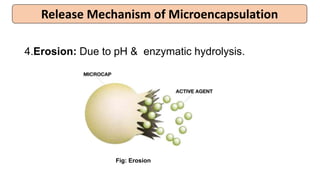
4.Erosion: Due to pH & enzymatic hydrolysis.
Fig: Erosion
Techniques of Microencapsulation
1. Air suspension techniques( Wurster)
2. Coacervation process
3. Pan coating
4. Spray drying & congealing
5. Solvent evaporation
6. Polymerization
There are some techniques for microencapsulation---
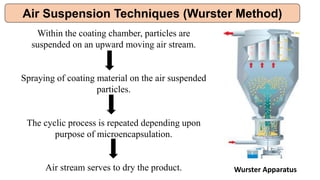
Air Suspension Techniques (Wurster Method)
Within the coating chamber, particles are
suspended on an upward moving air stream.
Spraying of coating material on the air suspended
particles.
The cyclic process is repeated depending upon
purpose of microencapsulation.
Air stream serves to dry the product. Wurster Apparatus
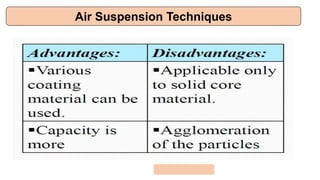
Air Suspension Techniques
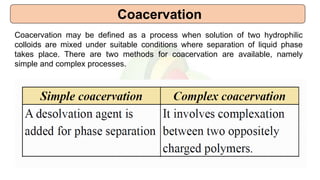
Coacervation
Coacervation may be defined as a process when solution of two hydrophilic
colloids are mixed under suitable conditions where separation of liquid phase
takes place. There are two methods for coacervation are available, namely
simple and complex processes.
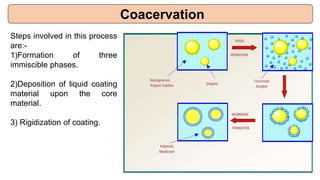
Coacervation
Steps involved in this process
are:-
1)Formation of three
immiscible phases.
2)Deposition of liquid coating
material upon the core
material.
3) Rigidization of coating.
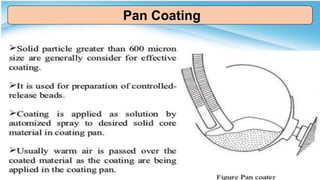
Pan Coating
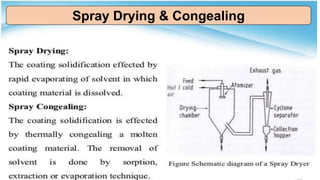
Spray Drying & Congealing
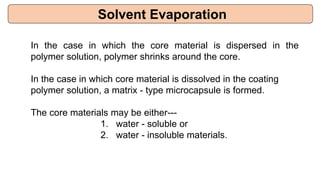
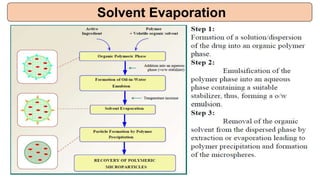
Solvent Evaporation
In the case in which the core material is dispersed in the
polymer solution, polymer shrinks around the core.
In the case in which core material is dissolved in the coating
polymer solution, a matrix - type microcapsule is formed.
The core materials may be either---
1. water - soluble or
2. water - insoluble materials.
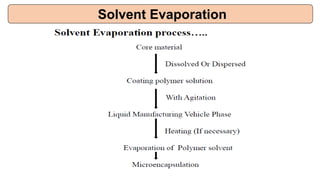
Solvent Evaporation
Solvent Evaporation
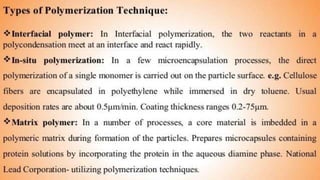
A relatively new microencapsulation method utilizes polymerization
techniques to from protective microcapsule coatings in situ.
The method involve the reaction of monomeric unit located at the
interface existing between a core material substance and continuous
phase in which the core material is disperse.
The core material supporting phase is usually a liquid or gas, and
therefore polymerization reaction occur at liquid-liquid, liquid-gas,
solid-liquid, or solid-gas interface.
E.g. In the formation of polyamide (Nylon) polymeric reaction
occurring at liquid-liquid interface existing between aliphatic
diamine & dicarboxylic acid halide.
Polymerization
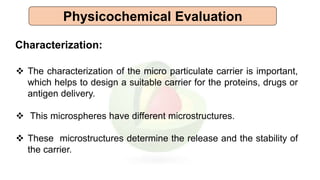
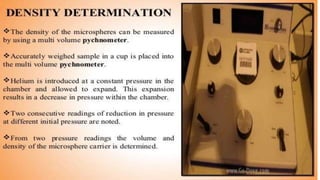
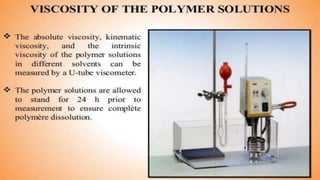
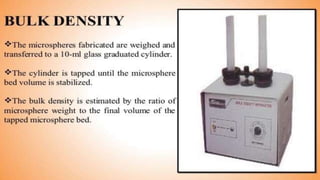
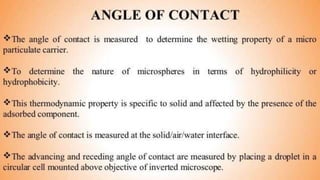
Physicochemical Evaluation
Characterization:
 The characterization of the micro particulate carrier is important,
which helps to design a suitable carrier for the proteins, drugs or
antigen delivery.
 This microspheres have different microstructures.
 These microstructures determine the release and the stability of
the carrier.
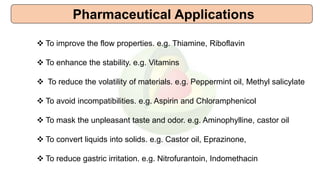
Pharmaceutical Applications
 To improve the flow properties. e.g. Thiamine, Riboflavin
 To enhance the stability. e.g. Vitamins
 To reduce the volatility of materials. e.g. Peppermint oil, Methyl salicylate
 To avoid incompatibilities. e.g. Aspirin and Chloramphenicol
 To mask the unpleasant taste and odor. e.g. Aminophylline, castor oil
 To convert liquids into solids. e.g. Castor oil, Eprazinone,
 To reduce gastric irritation. e.g. Nitrofurantoin, Indomethacin
Disadvantages of Microencapsulation
Disadvantages of
Microencapsulation
Thank You

Microencapsulation

  • 1.
    Bangabandhu Sheikh MujiburRahman Science & Technology University Department of Pharmacy A Presentation On Microencapsulation  Presenting Group: Group C & Group E Course Title: Pharmaceutical Technology-II Corse Code: PHR361
  • 2.
    Contents Microencapsulation Classification of Microcapsules Fundamental Consideration of Microencapsulation Morphology of the Microcapsules Coating material properties Reasons for microencapsulation Release Mechanism of Microencapsulation  Techniques of Microencapsulation Evaluation of Microencapsulation Pharmaceutical Applications  Advantages of Microencapsulation  Disadvantages of Microencapsulation
  • 3.
    Microencapsulation Microencapsulation is aprocess by which solids, liquids or even gases may be enclosed in microscopic particles by formation of thin coatings of wall material around the substances. The product obtained by this process is called as micro particles, microcapsules and microspheres. Coating size range may be 100 – 5000 Micron. Figure: Microcapsules
  • 4.
    Red one’s areR.B.C Purple one’s are microspheres Microspheres
  • 5.
    Microcapsules can beclassified on three type. 1. Mono Nuclear: contain the shell around the core. 2. Poly Nuclear : Having many cores enclosed within shell. 3. Matrix : Distributed homogeneously into the shell material. Classification of Microcapsules Mono Nuclear Poly Nuclear Matrix
  • 6.
    Fundamental Consideration ofMicroencapsulation
  • 7.
    Morphology of theMicrocapsules Micro capsules consist of two components - a) Core material b) Coat material Core Coat
  • 8.
    Morphology of theMicrocapsules Core Material: The material to be coated. It may be liquid or solid or gas. Liquid core may be dissolved or dispersed material.
  • 9.
    Morphology of theMicrocapsules Coat Material : Inert substance which coats on core with desired thickness. Composition of coating solution— •Inert polymer. •Plasticizer- Triethylcitrate, glycerin •Solvents-Water,cyclohexane. •Co solvents-Glycerol, sorbitol.
  • 10.
    Coating Material Properties 1.Stabilization of core material. 2. Inert toward active ingredients. 3. Controlled release under specific conditions. 4. Film-forming, pliable, tasteless, stable. 5. Non-hygroscopic, no high viscosity, economical. 6. Soluble in an aqueous media or solvent, or melting. 7. The coating can be flexible, brittle, hard, thin etc.
  • 11.
    The drugs, whichare sensitive to oxygen, moisture or light, can be stabilized by microencapsulation. For masking taste and odor of many drugs to improve patient compliance. Example-Ofloxacin. Obtain controlled and target release of the drug substance. For safe handling of the toxic materials. To avoid adverse effects like gastric irritation of the drug. Example- Indomethacin To increase of bioavailability. Incompatibility among the drugs can be prevented by microencapsulation. Example- Aspirin and Chlorpheniramine maleate Reduction of hygroscopicity. Example- NaCl To convert liquid active components into a pseudo solid system. Example- Eprazinone. Reduction of vaporization of volatile drugs. example- Methyl salicylate. Reasons for Microencapsulation
  • 12.
    Release Mechanism ofMicroencapsulation The aim of a microencapsulation is the isolation of the core from its surrounding, the wall must be ruptured at the time of use. A variety of release mechanisms have been proposed for microcapsules. These are— 1. Degradation controlled monolithic system 2. Diffusion controlled monolithic system 3. Diffusion controlled reservoir system 4. Erosion
  • 13.
    Release Mechanism ofMicroencapsulation 1.Degradation controlled monolithic system: Drug releases on degradation of matrix. Figure: Degradation controlled monolithic system
  • 14.
    Release Mechanism ofMicroencapsulation 2.Diffusion controlled monolithic system: Drug released by diffusion then degradation of matrix occurs. Figure: Diffusion controlled monolithic system Diffusion
  • 15.
    Release Mechanism ofMicroencapsulation 3.Diffusion controlled reservoir system: Drug from capsule diffuses then rate controlling membrane erodes. Diffusion Fig: Diffusion controlled reservoir system Controlled release
  • 16.
    Release Mechanism ofMicroencapsulation 4.Erosion: Due to pH & enzymatic hydrolysis. Fig: Erosion
  • 17.
    Techniques of Microencapsulation 1.Air suspension techniques( Wurster) 2. Coacervation process 3. Pan coating 4. Spray drying & congealing 5. Solvent evaporation 6. Polymerization There are some techniques for microencapsulation---
  • 18.
    Air Suspension Techniques(Wurster Method) Within the coating chamber, particles are suspended on an upward moving air stream. Spraying of coating material on the air suspended particles. The cyclic process is repeated depending upon purpose of microencapsulation. Air stream serves to dry the product. Wurster Apparatus
  • 19.
  • 20.
    Coacervation Coacervation may bedefined as a process when solution of two hydrophilic colloids are mixed under suitable conditions where separation of liquid phase takes place. There are two methods for coacervation are available, namely simple and complex processes.
  • 21.
    Coacervation Steps involved inthis process are:- 1)Formation of three immiscible phases. 2)Deposition of liquid coating material upon the core material. 3) Rigidization of coating.
  • 22.
  • 23.
    Spray Drying &Congealing
  • 24.
    Solvent Evaporation In thecase in which the core material is dispersed in the polymer solution, polymer shrinks around the core. In the case in which core material is dissolved in the coating polymer solution, a matrix - type microcapsule is formed. The core materials may be either--- 1. water - soluble or 2. water - insoluble materials.
  • 25.
  • 26.
  • 27.
    A relatively newmicroencapsulation method utilizes polymerization techniques to from protective microcapsule coatings in situ. The method involve the reaction of monomeric unit located at the interface existing between a core material substance and continuous phase in which the core material is disperse. The core material supporting phase is usually a liquid or gas, and therefore polymerization reaction occur at liquid-liquid, liquid-gas, solid-liquid, or solid-gas interface. E.g. In the formation of polyamide (Nylon) polymeric reaction occurring at liquid-liquid interface existing between aliphatic diamine & dicarboxylic acid halide. Polymerization
  • 30.
    Physicochemical Evaluation Characterization:  Thecharacterization of the micro particulate carrier is important, which helps to design a suitable carrier for the proteins, drugs or antigen delivery.  This microspheres have different microstructures.  These microstructures determine the release and the stability of the carrier.
  • 39.
    Pharmaceutical Applications  Toimprove the flow properties. e.g. Thiamine, Riboflavin  To enhance the stability. e.g. Vitamins  To reduce the volatility of materials. e.g. Peppermint oil, Methyl salicylate  To avoid incompatibilities. e.g. Aspirin and Chloramphenicol  To mask the unpleasant taste and odor. e.g. Aminophylline, castor oil  To convert liquids into solids. e.g. Castor oil, Eprazinone,  To reduce gastric irritation. e.g. Nitrofurantoin, Indomethacin
  • 41.
  • 42.