OPTIMIZATION TECHNIQUES IN
PHARMACEUTICAL FORMULATION AND
PROCESSING
PRESENTED BY
RESHMA FATHIMA.K
FIRST YEAR M.PHARM
DEPT.OF.PHARMACEUTICS
3/19/2015 1GRACE COLLEGE OF PHARMACY
• Definition
• Terms
• Advantages
• Optimization parameters
• Problem type
• Variables
• Applied optimisation method
• Other application
3/19/2015 GRACE COLLEGE OF PHARMACY 2
CONTENTS
DEFINITION
• The term Optimize is “to make perfect”.
• It is defined as follows: choosing the best element from some set of
available alternatives.
• An art, process, or methodology of making something (a design,
system, or decision) as perfect, as functional, as effective as possible.
3/19/2015 GRACE COLLEGE OF PHARMACY 3
TERMS
• FACTOR
• LEVELS
• RESPONSE
• EFFECTS
• INTERACTION
3/19/2015 GRACE COLLEGE OF PHARMACY 4
WHY OPTIMIZATION IS NECESSARY
• Reduce the cost
• Save the time
• Safety and reduce the error
• Reproducibility
• Innovation and efficacy
3/19/2015 GRACE COLLEGE OF PHARMACY 5
ADVANTAGES
Yield the “best solution” within the domain of study.
Require fewer experiments to achieve an optimum formulation.
Can trace and rectify “problem“ in a remarkably easier manner.
3/19/2015 GRACE COLLEGE OF PHARMACY 6
OPTIMIZATION PARAMETERS
3/19/2015 GRACE COLLEGE OF PHARMACY 7
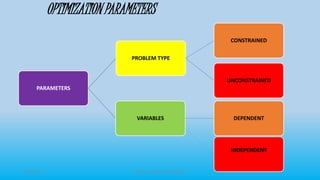
PARAMETERS
PROBLEM TYPE
CONSTRAINED
UNCONSTRAINED
VARIABLES DEPENDENT
INDEPENDENT
PROBLEM TYPE
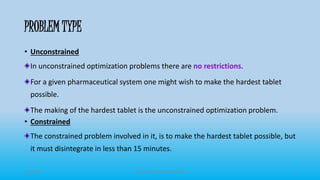
• Unconstrained
In unconstrained optimization problems there are no restrictions.
For a given pharmaceutical system one might wish to make the hardest tablet
possible.
The making of the hardest tablet is the unconstrained optimization problem.
• Constrained
The constrained problem involved in it, is to make the hardest tablet possible, but
it must disintegrate in less than 15 minutes.
3/19/2015 GRACE COLLEGE OF PHARMACY 8
VARIABLES
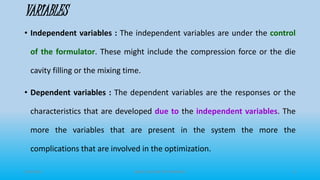
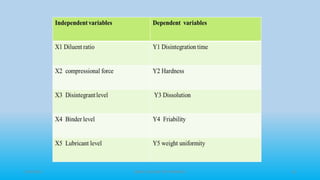
• Independent variables : The independent variables are under the control
of the formulator. These might include the compression force or the die
cavity filling or the mixing time.
• Dependent variables : The dependent variables are the responses or the
characteristics that are developed due to the independent variables. The
more the variables that are present in the system the more the
complications that are involved in the optimization.
3/19/2015 GRACE COLLEGE OF PHARMACY 9
3/19/2015 GRACE COLLEGE OF PHARMACY 10
CLASSICAL OPTIMIZATION
Classical optimization is done by using the calculus to basic problem to find the
maximum and the minimum of a function.
The curve in the fig represents the relationship between the response Y and the single
independent variable X and we can obtain the maximum and the minimum. By using the
calculus the graphical represented can be avoided. If the relationship, the equation
for Y as a function of X, is available [Eq]
Y = f(X)
3/19/2015 GRACE COLLEGE OF PHARMACY 11
Graphic location of optimum (maximum or minimum)
DRAWBACK
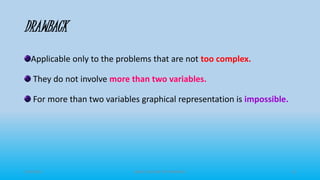
Applicable only to the problems that are not too complex.
They do not involve more than two variables.
For more than two variables graphical representation is impossible.
3/19/2015 GRACE COLLEGE OF PHARMACY 12
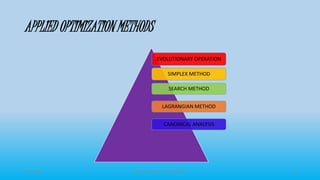
APPLIED OPTIMIZATION METHODS
3/19/2015 GRACE COLLEGE OF PHARMACY 13
EVOLUTIONARY OPERATION
SIMPLEX METHOD
SEARCH METHOD
LAGRANGIAN METHOD
CANONICAL ANALYSIS
EVOLUTIONARY OPERATION
It is the method of experimental optimization
Small changes in the formulation or process are made (i.e. repeats the
experiment so many times) & statistically analyzed whether it is improved.
It continues until no further changes takes place i.e., it has reached
optimum-the peak
The result of changes are statistically analysed.
3/19/2015 GRACE COLLEGE OF PHARMACY 14
3/19/2015 GRACE COLLEGE OF PHARMACY 15
This technique is especially well suited to a production situation
Applied mostly to TABLETS.
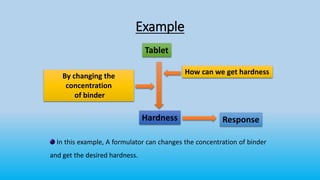
Example
Tablet
Hardness
By changing the
concentration
of binder
How can we get hardness
Response
In this example, A formulator can changes the concentration of binder
and get the desired hardness.
 Advantages
Generates information on product development.
Predict the direction of improvement.
Help formulator to decide optimum conditions for the formulation and
process.
Limitation
More repetition is required
Time consuming
Not efficient to finding true optimum
Expensive to use.
SIMPLEX METHOD
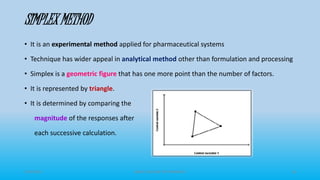
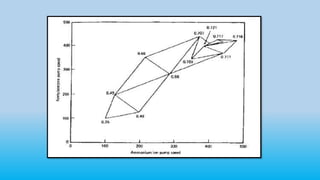
• It is an experimental method applied for pharmaceutical systems
• Technique has wider appeal in analytical method other than formulation and processing
• Simplex is a geometric figure that has one more point than the number of factors.
• It is represented by triangle.
• It is determined by comparing the
magnitude of the responses after
each successive calculation.
3/19/2015 GRACE COLLEGE OF PHARMACY 18
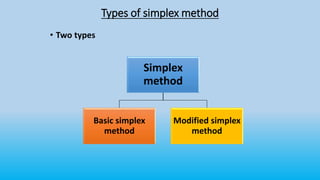
Types of simplex method
• Two types
Simplex
method
Basic simplex
method
Modified simplex
method
Advantages
• This method will find the true optimum of a response with fewer trials
than the non-systematic approaches or the one-variable-at-a-time
method.
Disadvantages
• There are sets of rules for the selection of the sequential vertices in the
procedure.
• Require mathematical knowledge.
• It represents mathematical techniques.
• It is an extension of classic method.
• It is applied to a pharmaceutical formulation and processing.
Lagrangian method
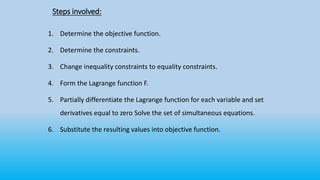
Steps involved:
1. Determine the objective function.
2. Determine the constraints.
3. Change inequality constraints to equality constraints.
4. Form the Lagrange function F.
5. Partially differentiate the Lagrange function for each variable and set
derivatives equal to zero Solve the set of simultaneous equations.
6. Substitute the resulting values into objective function.
Advantages
Lagrangian method was able to handle several responses or
dependent variables.
Disadvantages
Although the lagrangian method was able to handle several responses
or dependent variables, it was generally limited to two independent
variables.
Example
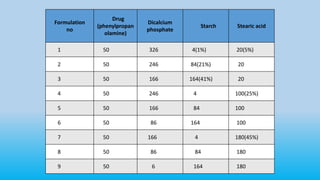
• Optimization of a tablet.
• Phenyl propranolol (active ingredient) -kept constant.
• X1 – disintegrate (corn starch).
• X2 – lubricant (stearic acid).
• X1 & X2 are independent variables.
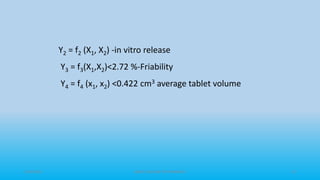
• Dependent variables include tablet hardness, friability volume, in
vitro release rate etc..,
• It is full 32 factorial experimental design.
• Nine formulations were prepared.
Formulation
no
Drug
(phenylpropan
olamine)
Dicalcium
phosphate
Starch Stearic acid
1 50 326 4(1%) 20(5%)
2 50 246 84(21%) 20
3 50 166 164(41%) 20
4 50 246 4 100(25%)
5 50 166 84 100
6 50 86 164 100
7 50 166 4 180(45%)
8 50 86 84 180
9 50 6 164 180
3/19/2015 GRACE COLLEGE OF PHARMACY 27
Y2 = f2 (X1, X2) -in vitro release
Y3 = f3(X1,X2)<2.72 %-Friability
Y4 = f4 (x1, x2) <0.422 cm3 average tablet volume
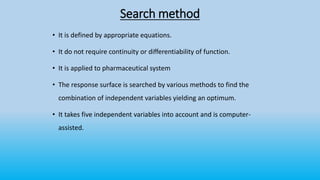
Search method
• It is defined by appropriate equations.
• It do not require continuity or differentiability of function.
• It is applied to pharmaceutical system
• The response surface is searched by various methods to find the
combination of independent variables yielding an optimum.
• It takes five independent variables into account and is computer-
assisted.
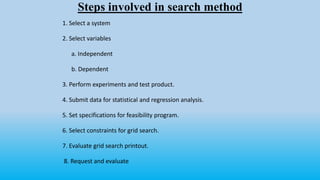
Steps involved in search method
1. Select a system
2. Select variables
a. Independent
b. Dependent
3. Perform experiments and test product.
4. Submit data for statistical and regression analysis.
5. Set specifications for feasibility program.
6. Select constraints for grid search.
7. Evaluate grid search printout.
8. Request and evaluate
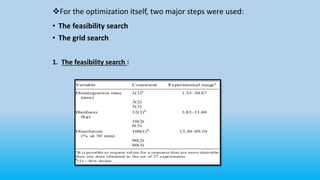
For the optimization itself, two major steps were used:
• The feasibility search
• The grid search
1. The feasibility search :
Canonical analysis
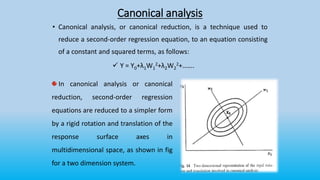
• Canonical analysis, or canonical reduction, is a technique used to
reduce a second-order regression equation, to an equation consisting
of a constant and squared terms, as follows:
 Y = Y0+λ1W1
2+λ2W2
2+…….
In canonical analysis or canonical
reduction, second-order regression
equations are reduced to a simpler form
by a rigid rotation and translation of the
response surface axes in
multidimensional space, as shown in fig
for a two dimension system.
Other applications
• Formulation and processing
• Clinical chemistry
• Medicinal chemistry
• High performance liquid chromatographic analysis
• Formulation of culture medium in virological studies
• Study of pharmacokinetic parameters
3/19/2015 GRACE COLLEGE OF PHARMACY 33
Thank you

Optimization techniques in pharmaceutical formulation and processing

  • 1.
    OPTIMIZATION TECHNIQUES IN PHARMACEUTICALFORMULATION AND PROCESSING PRESENTED BY RESHMA FATHIMA.K FIRST YEAR M.PHARM DEPT.OF.PHARMACEUTICS 3/19/2015 1GRACE COLLEGE OF PHARMACY
  • 2.
    • Definition • Terms •Advantages • Optimization parameters • Problem type • Variables • Applied optimisation method • Other application 3/19/2015 GRACE COLLEGE OF PHARMACY 2 CONTENTS
  • 3.
    DEFINITION • The termOptimize is “to make perfect”. • It is defined as follows: choosing the best element from some set of available alternatives. • An art, process, or methodology of making something (a design, system, or decision) as perfect, as functional, as effective as possible. 3/19/2015 GRACE COLLEGE OF PHARMACY 3
  • 4.
    TERMS • FACTOR • LEVELS •RESPONSE • EFFECTS • INTERACTION 3/19/2015 GRACE COLLEGE OF PHARMACY 4
  • 5.
    WHY OPTIMIZATION ISNECESSARY • Reduce the cost • Save the time • Safety and reduce the error • Reproducibility • Innovation and efficacy 3/19/2015 GRACE COLLEGE OF PHARMACY 5
  • 6.
    ADVANTAGES Yield the “bestsolution” within the domain of study. Require fewer experiments to achieve an optimum formulation. Can trace and rectify “problem“ in a remarkably easier manner. 3/19/2015 GRACE COLLEGE OF PHARMACY 6
  • 7.
    OPTIMIZATION PARAMETERS 3/19/2015 GRACECOLLEGE OF PHARMACY 7 PARAMETERS PROBLEM TYPE CONSTRAINED UNCONSTRAINED VARIABLES DEPENDENT INDEPENDENT
  • 8.
    PROBLEM TYPE • Unconstrained Inunconstrained optimization problems there are no restrictions. For a given pharmaceutical system one might wish to make the hardest tablet possible. The making of the hardest tablet is the unconstrained optimization problem. • Constrained The constrained problem involved in it, is to make the hardest tablet possible, but it must disintegrate in less than 15 minutes. 3/19/2015 GRACE COLLEGE OF PHARMACY 8
  • 9.
    VARIABLES • Independent variables: The independent variables are under the control of the formulator. These might include the compression force or the die cavity filling or the mixing time. • Dependent variables : The dependent variables are the responses or the characteristics that are developed due to the independent variables. The more the variables that are present in the system the more the complications that are involved in the optimization. 3/19/2015 GRACE COLLEGE OF PHARMACY 9
  • 10.
  • 11.
    CLASSICAL OPTIMIZATION Classical optimizationis done by using the calculus to basic problem to find the maximum and the minimum of a function. The curve in the fig represents the relationship between the response Y and the single independent variable X and we can obtain the maximum and the minimum. By using the calculus the graphical represented can be avoided. If the relationship, the equation for Y as a function of X, is available [Eq] Y = f(X) 3/19/2015 GRACE COLLEGE OF PHARMACY 11 Graphic location of optimum (maximum or minimum)
  • 12.
    DRAWBACK Applicable only tothe problems that are not too complex. They do not involve more than two variables. For more than two variables graphical representation is impossible. 3/19/2015 GRACE COLLEGE OF PHARMACY 12
  • 13.
    APPLIED OPTIMIZATION METHODS 3/19/2015GRACE COLLEGE OF PHARMACY 13 EVOLUTIONARY OPERATION SIMPLEX METHOD SEARCH METHOD LAGRANGIAN METHOD CANONICAL ANALYSIS
  • 14.
    EVOLUTIONARY OPERATION It isthe method of experimental optimization Small changes in the formulation or process are made (i.e. repeats the experiment so many times) & statistically analyzed whether it is improved. It continues until no further changes takes place i.e., it has reached optimum-the peak The result of changes are statistically analysed. 3/19/2015 GRACE COLLEGE OF PHARMACY 14
  • 15.
    3/19/2015 GRACE COLLEGEOF PHARMACY 15 This technique is especially well suited to a production situation Applied mostly to TABLETS.
  • 16.
    Example Tablet Hardness By changing the concentration ofbinder How can we get hardness Response In this example, A formulator can changes the concentration of binder and get the desired hardness.
  • 17.
     Advantages Generates informationon product development. Predict the direction of improvement. Help formulator to decide optimum conditions for the formulation and process. Limitation More repetition is required Time consuming Not efficient to finding true optimum Expensive to use.
  • 18.
    SIMPLEX METHOD • Itis an experimental method applied for pharmaceutical systems • Technique has wider appeal in analytical method other than formulation and processing • Simplex is a geometric figure that has one more point than the number of factors. • It is represented by triangle. • It is determined by comparing the magnitude of the responses after each successive calculation. 3/19/2015 GRACE COLLEGE OF PHARMACY 18
  • 19.
    Types of simplexmethod • Two types Simplex method Basic simplex method Modified simplex method
  • 20.
    Advantages • This methodwill find the true optimum of a response with fewer trials than the non-systematic approaches or the one-variable-at-a-time method. Disadvantages • There are sets of rules for the selection of the sequential vertices in the procedure. • Require mathematical knowledge.
  • 22.
    • It representsmathematical techniques. • It is an extension of classic method. • It is applied to a pharmaceutical formulation and processing. Lagrangian method
  • 23.
    Steps involved: 1. Determinethe objective function. 2. Determine the constraints. 3. Change inequality constraints to equality constraints. 4. Form the Lagrange function F. 5. Partially differentiate the Lagrange function for each variable and set derivatives equal to zero Solve the set of simultaneous equations. 6. Substitute the resulting values into objective function.
  • 24.
    Advantages Lagrangian method wasable to handle several responses or dependent variables. Disadvantages Although the lagrangian method was able to handle several responses or dependent variables, it was generally limited to two independent variables.
  • 25.
    Example • Optimization ofa tablet. • Phenyl propranolol (active ingredient) -kept constant. • X1 – disintegrate (corn starch). • X2 – lubricant (stearic acid). • X1 & X2 are independent variables. • Dependent variables include tablet hardness, friability volume, in vitro release rate etc.., • It is full 32 factorial experimental design. • Nine formulations were prepared.
  • 26.
    Formulation no Drug (phenylpropan olamine) Dicalcium phosphate Starch Stearic acid 150 326 4(1%) 20(5%) 2 50 246 84(21%) 20 3 50 166 164(41%) 20 4 50 246 4 100(25%) 5 50 166 84 100 6 50 86 164 100 7 50 166 4 180(45%) 8 50 86 84 180 9 50 6 164 180
  • 27.
    3/19/2015 GRACE COLLEGEOF PHARMACY 27 Y2 = f2 (X1, X2) -in vitro release Y3 = f3(X1,X2)<2.72 %-Friability Y4 = f4 (x1, x2) <0.422 cm3 average tablet volume
  • 28.
    Search method • Itis defined by appropriate equations. • It do not require continuity or differentiability of function. • It is applied to pharmaceutical system • The response surface is searched by various methods to find the combination of independent variables yielding an optimum. • It takes five independent variables into account and is computer- assisted.
  • 29.
    Steps involved insearch method 1. Select a system 2. Select variables a. Independent b. Dependent 3. Perform experiments and test product. 4. Submit data for statistical and regression analysis. 5. Set specifications for feasibility program. 6. Select constraints for grid search. 7. Evaluate grid search printout. 8. Request and evaluate
  • 30.
    For the optimizationitself, two major steps were used: • The feasibility search • The grid search 1. The feasibility search :
  • 31.
    Canonical analysis • Canonicalanalysis, or canonical reduction, is a technique used to reduce a second-order regression equation, to an equation consisting of a constant and squared terms, as follows:  Y = Y0+λ1W1 2+λ2W2 2+……. In canonical analysis or canonical reduction, second-order regression equations are reduced to a simpler form by a rigid rotation and translation of the response surface axes in multidimensional space, as shown in fig for a two dimension system.
  • 32.
    Other applications • Formulationand processing • Clinical chemistry • Medicinal chemistry • High performance liquid chromatographic analysis • Formulation of culture medium in virological studies • Study of pharmacokinetic parameters
  • 33.
    3/19/2015 GRACE COLLEGEOF PHARMACY 33 Thank you