Microbiology Research
Introduction
Bacteriagrow inodd placesandcan grow on differentthings.Lookingatwhetherornotdifferentkinds
of sugarconsumptioncanaffectthe growthof bacteriaisan interestingaspectwhencomparedtothe
hype aboutwhichsugar to use foryour coffee.The questionaskedduringthisresearchwas,how well
doesbacterialike togrowon differentkindsof sugars?Infindinganarticle where anartificial sweetener
showeduptoxicto Drosphiliamelanogasterfruitflies,the curiositycame aboutwithhow dobacteria
like tolive inthe presence of sugarsandsweeteners(O’Donnel2014). Testingwhetherornot bacteria
prefera differentkindof sugaror sweetenerwill give waytopossiblytellingwhichsugarisbetterfor
our body. My hypothesisisthatbothgram positive andgramnegative bacteriawilldie inthe presence
of sugarswithaspartame and be healthyinthe presence of sugarscontainingnoaspartame.
Materials
-6 Sugars: Glucose,Truvia,Sugarinthe Raw, Table sugar,Agave inthe Raw,Splenda
- Nutrientagar,typtone,DIwaterand a flasktomake agar in for each sugar
-36 sterile plates
-3 sterile pippetes
-Hot plate andstirbar
-Stockculture of Staphylococcusaureus,Bacilluscereus,Escherichia coli
-Incubatorsetat 37 DegreesCelsius
Methods
Compared to the Lab Manual for Microbiology in how much of each sugar to use. Formula is as
follows: Control- 72ml DI water, 0.36g Glucose, 1.656g Nutrient agar, 0.72g Tryptone. Each
sugar comparatively was added replacing the control of Glucose. Each sugar had its own flask
labeled as so with the requirements added from the formula. Each flask had a stir bar and was
heated on a hot plate until contents fully mixed. All 6 flasks were put in the autoclave on the
setting for sterilizing liquid. After sterilization was finished, each sugar agar was added to the
correct plate which was labeled per sugar and per bacteria resulting in 6 plates per sugar
allowing for 2 replications of the experiment. Once agar was hardened, all 3 bacteria were
added to their own plate using a complete streak plate method. Staphylococcus aureus had 2
replicates on all 6 sugar plates, Bacillus cereus had 2 replicates on all 6 sugar plates, and
Escherichia coli had 2 replicates on all 6 sugar plates. All plates were flipped agar side up and
placed in the incubator at 37 Degrees Celsius for 72 hours and checked every 24 hours. Each
plate was given a number 1-4 with 1 being little growth and 4 being complete growth. After
experiment they were disposed of properly.
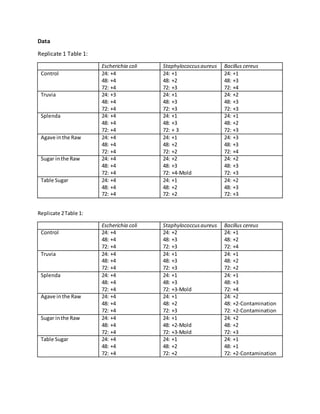
Data
Replicate 1 Table 1:
Escherichia coli Staphylococcusaureus Bacillus cereus
Control 24: +4
48: +4
72: +4
24: +1
48: +2
72: +3
24: +1
48: +3
72: +4
Truvia 24: +3
48: +4
72: +4
24: +1
48: +3
72: +3
24: +2
48: +3
72: +3
Splenda 24: +4
48: +4
72: +4
24: +1
48: +3
72: + 3
24: +1
48: +2
72: +3
Agave inthe Raw 24: +4
48: +4
72: +4
24: +1
48: +2
72: +2
24: +3
48: +3
72: +4
Sugar inthe Raw 24: +4
48: +4
72: +4
24: +2
48: +3
72: +4-Mold
24: +2
48: +3
72: +3
Table Sugar 24: +4
48: +4
72: +4
24: +1
48: +2
72: +2
24: +2
48: +3
72: +3
Replicate 2Table 1:
Escherichia coli Staphylococcusaureus Bacillus cereus
Control 24: +4
48: +4
72: +4
24: +2
48: +3
72: +3
24: +1
48: +2
72: +4
Truvia 24: +4
48: +4
72: +4
24: +1
48: +3
72: +3
24: +1
48: +2
72: +2
Splenda 24: +4
48: +4
72: +4
24: +1
48: +3
72: +3-Mold
24: +1
48: +3
72: +4
Agave inthe Raw 24: +4
48: +4
72: +4
24: +1
48: +2
72: +3
24: +2
48: +2-Contamination
72: +2-Contamination
Sugar inthe Raw 24: +4
48: +4
72: +4
24: +1
48: +2-Mold
72: +3-Mold
24: +2
48: +2
72: +3
Table Sugar 24: +4
48: +4
72: +4
24: +1
48: +2
72: +2
24: +1
48: +1
72: +2-Contamination
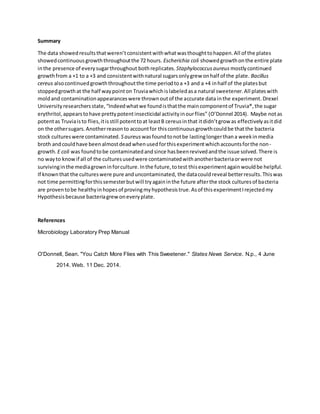
Summary
The data showedresultsthatweren’tconsistentwithwhatwasthoughttohappen.All of the plates
showedcontinuousgrowththroughoutthe 72 hours. Escherichia coli showedgrowthonthe entire plate
inthe presence of everysugarthroughout bothreplicates. Staphylococcusaureus mostlycontinued
growthfrom a +1 to a +3 and consistentwithnatural sugarsonlygrew onhalf of the plate. Bacillus
cereus alsocontinuedgrowththroughoutthe time periodtoa +3 and a +4 inhalf of the platesbut
stoppedgrowthat the half waypointon Truviawhichislabeledasa natural sweetener.All plateswith
moldand contaminationappearanceswere thrownoutof the accurate data inthe experiment. Drexel
Universityresearchersstate,“Indeedwhatwe foundisthatthe maincomponentof Truvia®,the sugar
erythritol,appearstohave prettypotentinsecticidal activityinourflies” (O’Donnel 2014). Maybe notas
potentas Truviaisto flies,itisstill potenttoat leastB cereusinthat itdidn’tgrow as effectivelyasitdid
on the othersugars.Anotherreasonto accountfor thiscontinuousgrowthcouldbe thatthe bacteria
stock cultureswere contaminated. Saureus wasfoundtonotbe lastinglongerthana weekinmedia
broth andcouldhave beenalmostdeadwhenusedforthisexperimentwhichaccountsforthe non-
growth. E coli was foundtobe contaminatedandsince hasbeenrevivedandthe issue solved.There is
no wayto knowif all of the culturesusedwere contaminatedwithanotherbacteriaorwere not
survivinginthe mediagrowninforculture.Inthe future,totest thisexperimentagainwouldbe helpful.
If knownthat the cultureswere pure anduncontaminated, the datacouldreveal betterresults.Thiswas
not time permittingforthissemesterbutwill tryagaininthe future afterthe stock culturesof bacteria
are proventobe healthyinhopesof provingmyhypothesistrue.Asof thisexperimentIrejectedmy
Hypothesisbecause bacteriagrewoneveryplate.
References
Microbiology Laboratory Prep Manual
O'Donnell, Sean. "You Catch More Flies with This Sweetener." States News Service. N.p., 4 June
2014. Web. 11 Dec. 2014.

Microbiology Research Summary

  • 1.
    Microbiology Research Introduction Bacteriagrow inoddplacesandcan grow on differentthings.Lookingatwhetherornotdifferentkinds of sugarconsumptioncanaffectthe growthof bacteriaisan interestingaspectwhencomparedtothe hype aboutwhichsugar to use foryour coffee.The questionaskedduringthisresearchwas,how well doesbacterialike togrowon differentkindsof sugars?Infindinganarticle where anartificial sweetener showeduptoxicto Drosphiliamelanogasterfruitflies,the curiositycame aboutwithhow dobacteria like tolive inthe presence of sugarsandsweeteners(O’Donnel2014). Testingwhetherornot bacteria prefera differentkindof sugaror sweetenerwill give waytopossiblytellingwhichsugarisbetterfor our body. My hypothesisisthatbothgram positive andgramnegative bacteriawilldie inthe presence of sugarswithaspartame and be healthyinthe presence of sugarscontainingnoaspartame. Materials -6 Sugars: Glucose,Truvia,Sugarinthe Raw, Table sugar,Agave inthe Raw,Splenda - Nutrientagar,typtone,DIwaterand a flasktomake agar in for each sugar -36 sterile plates -3 sterile pippetes -Hot plate andstirbar -Stockculture of Staphylococcusaureus,Bacilluscereus,Escherichia coli -Incubatorsetat 37 DegreesCelsius Methods Compared to the Lab Manual for Microbiology in how much of each sugar to use. Formula is as follows: Control- 72ml DI water, 0.36g Glucose, 1.656g Nutrient agar, 0.72g Tryptone. Each sugar comparatively was added replacing the control of Glucose. Each sugar had its own flask labeled as so with the requirements added from the formula. Each flask had a stir bar and was heated on a hot plate until contents fully mixed. All 6 flasks were put in the autoclave on the setting for sterilizing liquid. After sterilization was finished, each sugar agar was added to the correct plate which was labeled per sugar and per bacteria resulting in 6 plates per sugar allowing for 2 replications of the experiment. Once agar was hardened, all 3 bacteria were added to their own plate using a complete streak plate method. Staphylococcus aureus had 2 replicates on all 6 sugar plates, Bacillus cereus had 2 replicates on all 6 sugar plates, and Escherichia coli had 2 replicates on all 6 sugar plates. All plates were flipped agar side up and placed in the incubator at 37 Degrees Celsius for 72 hours and checked every 24 hours. Each plate was given a number 1-4 with 1 being little growth and 4 being complete growth. After experiment they were disposed of properly.
  • 2.
    Data Replicate 1 Table1: Escherichia coli Staphylococcusaureus Bacillus cereus Control 24: +4 48: +4 72: +4 24: +1 48: +2 72: +3 24: +1 48: +3 72: +4 Truvia 24: +3 48: +4 72: +4 24: +1 48: +3 72: +3 24: +2 48: +3 72: +3 Splenda 24: +4 48: +4 72: +4 24: +1 48: +3 72: + 3 24: +1 48: +2 72: +3 Agave inthe Raw 24: +4 48: +4 72: +4 24: +1 48: +2 72: +2 24: +3 48: +3 72: +4 Sugar inthe Raw 24: +4 48: +4 72: +4 24: +2 48: +3 72: +4-Mold 24: +2 48: +3 72: +3 Table Sugar 24: +4 48: +4 72: +4 24: +1 48: +2 72: +2 24: +2 48: +3 72: +3 Replicate 2Table 1: Escherichia coli Staphylococcusaureus Bacillus cereus Control 24: +4 48: +4 72: +4 24: +2 48: +3 72: +3 24: +1 48: +2 72: +4 Truvia 24: +4 48: +4 72: +4 24: +1 48: +3 72: +3 24: +1 48: +2 72: +2 Splenda 24: +4 48: +4 72: +4 24: +1 48: +3 72: +3-Mold 24: +1 48: +3 72: +4 Agave inthe Raw 24: +4 48: +4 72: +4 24: +1 48: +2 72: +3 24: +2 48: +2-Contamination 72: +2-Contamination Sugar inthe Raw 24: +4 48: +4 72: +4 24: +1 48: +2-Mold 72: +3-Mold 24: +2 48: +2 72: +3 Table Sugar 24: +4 48: +4 72: +4 24: +1 48: +2 72: +2 24: +1 48: +1 72: +2-Contamination
  • 3.
    Summary The data showedresultsthatweren’tconsistentwithwhatwasthoughttohappen.Allof the plates showedcontinuousgrowththroughoutthe 72 hours. Escherichia coli showedgrowthonthe entire plate inthe presence of everysugarthroughout bothreplicates. Staphylococcusaureus mostlycontinued growthfrom a +1 to a +3 and consistentwithnatural sugarsonlygrew onhalf of the plate. Bacillus cereus alsocontinuedgrowththroughoutthe time periodtoa +3 and a +4 inhalf of the platesbut stoppedgrowthat the half waypointon Truviawhichislabeledasa natural sweetener.All plateswith moldand contaminationappearanceswere thrownoutof the accurate data inthe experiment. Drexel Universityresearchersstate,“Indeedwhatwe foundisthatthe maincomponentof Truvia®,the sugar erythritol,appearstohave prettypotentinsecticidal activityinourflies” (O’Donnel 2014). Maybe notas potentas Truviaisto flies,itisstill potenttoat leastB cereusinthat itdidn’tgrow as effectivelyasitdid on the othersugars.Anotherreasonto accountfor thiscontinuousgrowthcouldbe thatthe bacteria stock cultureswere contaminated. Saureus wasfoundtonotbe lastinglongerthana weekinmedia broth andcouldhave beenalmostdeadwhenusedforthisexperimentwhichaccountsforthe non- growth. E coli was foundtobe contaminatedandsince hasbeenrevivedandthe issue solved.There is no wayto knowif all of the culturesusedwere contaminatedwithanotherbacteriaorwere not survivinginthe mediagrowninforculture.Inthe future,totest thisexperimentagainwouldbe helpful. If knownthat the cultureswere pure anduncontaminated, the datacouldreveal betterresults.Thiswas not time permittingforthissemesterbutwill tryagaininthe future afterthe stock culturesof bacteria are proventobe healthyinhopesof provingmyhypothesistrue.Asof thisexperimentIrejectedmy Hypothesisbecause bacteriagrewoneveryplate. References Microbiology Laboratory Prep Manual O'Donnell, Sean. "You Catch More Flies with This Sweetener." States News Service. N.p., 4 June 2014. Web. 11 Dec. 2014.