MGMT 7 7th Edition Chuck Williams Solutions Manual
1.
MGMT 7 7thEdition Chuck Williams Solutions
Manual download
https://testbankdeal.com/product/mgmt-7-7th-edition-chuck-
williams-solutions-manual/
Explore and download more test bank or solution manual
at testbankdeal.com
2.
We believe theseproducts will be a great fit for you. Click
the link to download now, or visit testbankdeal.com
to discover even more!
MGMT 7 7th Edition Chuck Williams Test Bank
https://testbankdeal.com/product/mgmt-7-7th-edition-chuck-williams-
test-bank/
Management 7th Edition Chuck Williams Solutions Manual
https://testbankdeal.com/product/management-7th-edition-chuck-
williams-solutions-manual/
Effective Management 7th Edition Chuck Williams Solutions
Manual
https://testbankdeal.com/product/effective-management-7th-edition-
chuck-williams-solutions-manual/
Precalculus 10th Edition Sullivan Solutions Manual
https://testbankdeal.com/product/precalculus-10th-edition-sullivan-
solutions-manual/
3.
Nutrition for HealthFitness and Sport 11th Edition
Williams Test Bank
https://testbankdeal.com/product/nutrition-for-health-fitness-and-
sport-11th-edition-williams-test-bank/
ECON for Macroeconomics 1st Edition McEachern Test Bank
https://testbankdeal.com/product/econ-for-macroeconomics-1st-edition-
mceachern-test-bank/
Advertising and Promotion An Integrated Marketing 6th
Edition Belch Test Bank
https://testbankdeal.com/product/advertising-and-promotion-an-
integrated-marketing-6th-edition-belch-test-bank/
Mathematical Applications for the Management Life and
Social Sciences 12th Edition Harshbarger Test Bank
https://testbankdeal.com/product/mathematical-applications-for-the-
management-life-and-social-sciences-12th-edition-harshbarger-test-
bank/
Ethics for the Information Age 5th Edition Mike Quinn Test
Bank
https://testbankdeal.com/product/ethics-for-the-information-age-5th-
edition-mike-quinn-test-bank/
4.
Management and CostAccounting 6th Edition Bhimani
Solutions Manual
https://testbankdeal.com/product/management-and-cost-accounting-6th-
edition-bhimani-solutions-manual/
5.
Chapter 7: Innovationand Change 154
MGMT7
Chapter 7: Innovation and Change
Pedagogy Map
This chapter begins with the learning outcome summaries and terms covered in the chapter, followed by a
set of lesson plans for you to use to deliver the content in Chapter 7.
• Lesson Plan for Lecture (for large sections)
• Lesson Plan for Group Work (for smaller classes)
• Assignments with Teaching Tips and Solutions
What Would You Do? Case Assignment––3M
Self-Assessment––Mind Benders
Management Decision––Innovation Copycats
Management Team Decision––Face the Future
Practice Being a Manager––Supporting Creativity
Develop Your Career Potential––Spark Your Own Creativity
Reel to Real Video Assignment: Management Workplace––Holden Outerwear
Review Questions
Additional Activities and Assignments
Highlighted Assignments Key Points
What Would You Do? Case
Assignment
3M must return to its roots by sponsoring innovation
throughout its organization.
Self-Assessment The self-assessment gives students insights into how
innovative their attitude is.
Management Decision A company that created an innovative line of shoes needs to
figure out how to deal with competitor companies that are
producing counterfeit products.
Management Team Decision Student groups are asked to consider how oil companies can
innovate to address future energy needs.
Practice Being a Manager Students examine the question of creating versus buying new
ideas.
Develop Your Career Potential Resources are given to help students spark their own
creativity.
Reel to Real Video Assignment:
Management Workplace
Holden Outerwear is a pioneer in active outerwear, as its
products possess features that are inspired by runway brands.
Supplemental Resources Where to Find Them
Course Pre-Assessment IRCD
Course Post-Assessment IRCD
PowerPoint slides with lecture notes IRCD and online
Who Wants to Be a Manager game IRCD and online
6.
Chapter 7: Innovationand Change 155
Test Bank IRCD and online
What Would You Do? Quiz Online
Learning Objectives
7.1 Explain why innovation matters to companies.
Technology cycles typically follow an S-curve pattern of innovation. Early in the cycle, technological
progress is slow, and improvements in technological performance are small. As a technology matures,
however, performance improves quickly. Finally, as the limits of a technology are reached, only small
improvements occur. At this point, significant improvements in performance must come from new
technologies. The best way to protect a competitive advantage is to create a stream of innovative ideas
and products. Innovation streams begin with technological discontinuities that create significant
breakthroughs in performance or function. Technological discontinuities are followed by discontinuous
change, in which customers purchase new technologies and companies compete to establish the new
dominant design. Dominant designs emerge because of critical mass, because they solve a practical
problem, or because of the negotiations of independent standards bodies. Because technological
innovation is both enhances and destroys competence, companies that bet on the wrong design often
struggle, while companies that bet on the eventual dominant design usually prosper. When a dominant
design emerges, companies focus on incremental change, lowering costs, and making small but steady
improvements in the dominant design. This focus continues until the next technological discontinuity
occurs.
7.2 Discuss the different methods that managers can use to manage innovation in their
organizations effectively.
To successfully manage innovation streams, companies must manage the sources of innovation and learn
to manage innovation during both discontinuous and incremental change. Since innovation begins with
creativity, companies can manage the sources of innovation by supporting a work environment in which
creative thoughts and ideas are welcomed, valued, and encouraged. Creative work environments provide
challenging work; offer organizational, supervisory, and work group encouragement; allow significant
freedom; and remove organizational impediments to creativity.
Discontinuous and incremental change require different strategies. Companies that succeed in periods
of discontinuous change typically follow an experiential approach to innovation. The experiential
approach assumes that intuition, flexible options, and hands-on experience can reduce uncertainty and
accelerate learning and understanding. A compression approach to innovation works best during periods
of incremental change. This approach assumes that innovation can be planned using a series of steps and
that compressing the time it takes to complete those steps can speed up innovation.
7.3 Discuss why not changing can lead to organizational decline.
The five-stage process of organizational decline begins when organizations don’t recognize the need for
change. In the blinded stage, managers fail to recognize the changes that threaten their organization’s
survival. In the inaction stage, management recognizes the need to change but doesn’t act, hoping that the
problems will correct themselves. In the faulty action stage, management focuses on cost cutting and
efficiency rather than facing up to the fundamental changes needed to ensure survival. In the crisis stage,
failure is likely unless fundamental reorganization occurs. Finally, in the dissolution stage, the company is
dissolved through bankruptcy proceedings; by selling assets to pay creditors; or through the closing of
stores, offices, and facilities. If companies recognize the need to change early enough, however,
dissolution may be avoided.
7.
Chapter 7: Innovationand Change 156
7.4 Discuss the different methods that managers can use to better manage change as it occurs.
The basic change process is unfreezing, change, and refreezing. Resistance to change stems from self-
interest, misunderstanding and distrust as well as a general intolerance for change. It can be managed
through education and communication, participation, negotiation, top management support, and coercion.
Knowing what not to do is as important as knowing what to do to achieve successful change. Managers
should avoid these errors when leading change: not establishing urgency, not creating a guiding coalition,
lacking a vision, undercommunicating the vision, not removing obstacles to the vision, not creating short-
term wins, declaring victory too soon, and not anchoring changes in the corporation’s culture. Finally,
managers can use a number of change techniques. Results-driven change and the GE workout reduce
resistance to change by getting change efforts off to a fast start. Organizational development is a
collection of planned change interventions (large system, small group, person-focused), guided by a
change agent, that are designed to improve an organization’s long-term health and performance.
Terms
Change agent
Change forces
Change intervention
Coercion
Compression approach to innovation
Creative work environments
Creativity
Design competition
Design iteration
Discontinuous change
Dominant design
Experiential approach to innovation
Flow
General Electric workout
Generational change
Incremental change
Innovation streams
Milestones
Multifunctional teams
Organizational change
Organizational decline
Organizational development
Organizational innovation
Product prototype
Refreezing
Resistance forces
Resistance to change
Results-driven change
S-curve pattern of innovation
Technological discontinuity
Technological lockout
Technological substitution
Technology cycle
Testing
Unfreezing
Lesson Plan for Lecture (for large sections)
Pre-Class Prep for You: Pre-Class Prep for Your Students:
• Review the chapter and determine what
points to cover.
• Bring the PPT slides.
• Bring the book.
Warm Up Begin Chapter 7 by giving your students a brainteaser to solve. The game Mind Trap offers
several, as do any number of Mensa puzzle books on the market.
Content
Delivery
Lecture slides: Make note of where you stop so you can pick up at the next class meeting.
Slides have teaching notes on them to help you as you lecture.
8.
Chapter 7: Innovationand Change 157
Topics PowerPoint Slides Activities
7.1 Why Innovation
Matters
7.1a Technology Cycles
7.1b Innovation Streams
1: Innovation and Change
2: Learning Outcomes
3: Technology Cycles
4: S-Curves and
Technological Innovation
5: Innovation Streams:
Technology Cycles over
Time
6: Emergence of Dominant
Design
Launch your lecture with
your brainteaser and
prompt students to think of
what a brainteaser has to do
with innovation. (New
problems or new ways of
thinking about old
problems lead to innovation
and new technology.)
7.2 Managing
Innovation
7.2a Managing Sources of
Innovation
7.2b Experiential
Approach: Managing
Innovation during
Discontinuous Change
7.2c Compression
Approach: Managing
Innovation during
Incremental Change
7: Managing Innovation
8: Components of Creative
Work Environments
9: Experiential Approach
10: Compression Approach
7.3 Organizational
Decline: The Risk of Not
Changing
11: The Risk of Not
Changing
The text uses General
Motors as an extended
example of organizational
decline. It might be
interesting in class to do an
“intensive care” review of
General Motors’ situation.
7.3 Managing Change
7.4a Managing Resistance
to Change
7.4b What Not to Do
When Leading Change
7.4c Change Tools and
Techniques
12: Forces
13: Resistance to Change
14: Organizational Change
Process
15: Managing Resistance to
Change
16: Mistakes Managers
Make
17: Change Tools and
Techniques
18: General Steps for
Organizational
Development Intervention
19: Different Kinds of
Organizational
Development Interventions
Reel to Real Videos 20: Holden Outerwear Launch the video in slide
20. Questions on the slide
can guide discussion.
9.
Chapter 7: Innovationand Change 158
Adjust the lecture to include the activities in the right column. Some activities should be
done before introducing the concept, some after.
Conclusion
and
Preview
Assignments:
1. Give students some experience in developing their own innovative thinking.
Assign the Develop Your Career Potential exercise, or adapt the Ideation activity
in the Additional Activities and Assignments section for homework. To do so,
require students to assemble the disparate items and create a hat, vehicle, animal,
or other item you determine. Have them submit a photo of their item along with a
written piece on how their innovation process evolved, the challenges of the
assignment, and their reaction to the assignment in general.
2. Assign students to review Chapter 7 and read the next chapter on your syllabus.
Remind students about any upcoming events.
Lesson Plan for Group Work (for smaller classes)
Pre-Class Prep for You: Pre-Class Prep for Your Students:
• Review the material to cover and modify the
lesson plan to meet your needs.
• Set up the classroom so that small groups of
4 to 5 students can sit together.
• Bring the book.
Warm Up Begin Chapter 7 by asking your students to work a brainteaser that you bring to class.
The game MindTrap is full of examples, as are the numerous Mensa and Mensa-style
puzzle books on the market.
Content
Delivery
Lecture on Why Innovation Matters and Managing Innovation (Sections 7.1 and 7.2).
A necessary component of innovation is creativity the creative work environment. To
give your students a break from the traditional tenor of the academic classes they likely
take, use the teaching notes below to do the Develop Your Career Potential in class.
Conversely, break for this group activity:
“Ideation”
Divide the class into small groups of 3 to 4 students and give each group a bag of
disparate items. (Things rescued from the trash like milk jugs and lids, toilet paper
tubes, and broken mechanical items make good resources.) Charge each group with
building something you specify, like a hat or a vehicle, or with first deciding what to
build and then actually doing it. Depending on your resources, consider giving a set
of building materials to each student and even inviting a professor from the industrial
design department (if your university has an engineering and/or design college) to
visit your class that day to help with the activity. After the students have finished, let
them present their design to the class. If time allows, let students critique each design,
making recommendations for improvement or refinement.
Come back together as a class to share results from the group activity.
10.
Chapter 7: Innovationand Change 159
Segue into the next section by asking students “Does change matter?”
Lecture on Organizational Decline: The Risk of Not Changing (Section 7.3).
Introduce the section on Managing Change (Section 7.4) by lecturing on change forces,
resistance forces, and resistance to change.
Break for the following activity:
“What’s Happening”
Divide the class into groups of 3 to 4 students to map what is happening to at least 2
companies facing significant change forces. For each company, students need to list
what they perceive to be the change and resistance forces at work. General Motors,
Saks Fifth Avenue, Walgreens, Sony, and ExxonMobil are some examples. Consider
letting students pick one company to work with in addition to the one you give them.
Also consider giving each group a different set of companies so that when you come
back together as a class to share information, you’ll have a wide range of forces to
discuss.
Segue into the next section by asking students how they feel about change: embrace it,
take wait-and-see attitude, resist it, sabotage it, etc. You’ll probably get the majority of
hands at the “wait-and-see” or “resist it” probes. Ask students to account for the results:
• “Why do you think that is? I mean, why do people tend to be resistant to change?”
• ‘What problems can that tendency create for managers?”
• “What do you think managers can do to reduce that resistance?”
Lecture on Managing Resistance to Change and What Not to Do When Leading Change
(Sections 7.4a and 7.4b).
Segue into the lecture on Change Tools and Techniques (7.4c).
After presenting the various techniques in the book, simulate the GE Workout by doing
the following group activity:
“GE Workout for Campus President”
As an entire class, brainstorm a list of specific problems at your college or university.
Problems can be related to any aspect of the campus (finances, registration, social
activities, sports, etc.). Divide students into medium-sized groups of 8 to 10 students.
Ask 1 student from each group to volunteer to be the campus president for that group.
Have the managers leave the room (or sit together away from their “department
chairs”) for 5 minutes and let them think of possible solutions their teammates might
put before them. Reintegrate the presidents with their management teams and conduct
the GE Workout. Time this part of the exercise to simulate the rapid nature of the
workout. You don’t want to give the presidents too long to decide on any given item
or to get into debates/discussions with department chairs about the topic.
Conclusion
and
Assignments:
1. As an assignment that follows up the Ideation exercise above, have students write
11.
Chapter 7: Innovationand Change 160
Preview a paragraph about their experience with the design process and one about their
response to the critique process.
2. If you have finished covering Chapter 7, assign students to review Chapter 8 and
read the next chapter on your syllabus.
Remind students about any upcoming events.
Assignments with Teaching Tips and Solutions
What Would You Do? Case Assignment
3M
Minneapolis, Minnesota
With 40,000 global patents and patent applications, 3M, maker of Post-it notes, reflective
materials (Scotch lite), and 55,000 products in numerous industries (displays and graphics, electronics and
communications, health care, safety and security, transportation, manufacturing, office products, and
home and leisure), has long been one of the most innovative companies in the world. 3M codified its
focus on innovation into a specific goal, “30/5,” which meant that 30 percent of its sales each year must
come from products no more than five years old. The logic was simple but powerful. Each year, five-
year-old products become six years old and would not be counted toward the 30 percent of sales. Thus,
the 30/5 goal encouraged everyone at 3M to be on the lookout for and open to new ideas and products.
Furthermore, 3M allowed its engineers and scientists to spend 5 percent of their time, roughly a half-day
per week, doing whatever they wanted as long as it was related to innovation and new product
development.
And it worked, for a while. A decade ago, the Boston Consulting Group, one of the premier
consulting companies in the world, ranked 3M as the most innovative company in the world. In
subsequent years, it dropped to second, third, and then seventh. Today, 3M doesn’t even crack the top 50.
Dev Patnaik, of Jump Associates, an innovation consulting firm, says, “People have kind of forgotten
about those guys [3M]. When was the last time you saw something innovative or experimental coming
out of there?” So, what happened?
When your predecessor became CEO ten years ago, he found a struggling, inefficient, oversized
company in need of change. He cut costs by laying off 8,000 people. Marketing, and research and
development funds, which had been allocated to divisions independent of performance (all divisions got
the same increase each year), were now distributed based on past performance and growth potential.
Perform poorly, and your funds would shrink the next year. Likewise, with U.S. sales stagnating and Asia
sales rising, management decreased headcount, hiring, and capital expenditures in the United States,
while significantly increasing all three in fast-growing Asian markets. Six Sigma processes, popularized
at Motorola and GE, were introduced to analyze how things got done, to remove unnecessary steps, and to
change procedures which caused defects. Thousands of 3M managers and employees became trained as
Six Sigma “black belts” and returned to their divisions and departments to root out inefficiencies, reduce
production times, and decrease waste and product errors. And it worked incredibly well, in part. Costs and
capital spending dropped, while profits surged 35 percent to record levels. But, product innovation, as
compared to the 30/5 goal sank dramatically, as only 21 percent of profits were generated by products that
were no more than five years old.
So, what should 3M do? From inception, 3M has been an innovator, bringing a stream of new
products and services to market, creating value for customers, sustainable advantage over competitors,
and sizable returns for investors. Thanks to your predecessor, 3M has lower costs, is highly efficient, and
much more profitable. But it no longer ranks among the most innovative firms in the world. In fact, the
use of Six Sigma procedures appears to be inversely related to product innovation. If that’s the case,
should 3M continue to focus on using Six Sigma procedures to reduce costs and increase efficiencies, or
12.
Chapter 7: Innovationand Change 161
should it strive again to encourage its scientists and managers to focus on innovation? Which will make
3M more competitive in the long run?
When people think of innovation, they tend to think of game-changing advances that render
current products obsolete, for example, comparing the iPhone to text-based “smartphones.” Innovation,
however, also occurs with lots of incremental changes over time. What are the advantages and
disadvantages for 3M of each approach, and when and where would each be more likely to work? Finally,
some companies innovate from within by successfully implementing creative ideas in their products or
services. Sometimes, though, innovation is acquired by purchasing other companies that have made
innovative advances. For example, although Google is generally rated as one of the most innovative
companies in the world, most people have forgotten that Google bought YouTube to combine its search
expertise with YouTube’s online video capabilities. Over time, how much should companies like 3M rely
on acquisitions for innovation? Should 3M acquire half, one-third, 10 percent, or 5 percent of its new
products through acquisitions? What makes the most sense and why?
If you were in charge at 3M, what would you do?
Sources:
“The 50 Most Innovative Companies 2010,” Bloomberg Businessweek,
http://www.businessweek.com/interactive_reports/innovative_companies_2010.html [accessed 4 May 2011]; M.
Arndt & D. Brady, “3M’s Rising Star,” BusinessWeek, 12 April 2004, 62-74; M. Gunther, M. Adamo, & B.
Feldman, “3M'S Innovation Revival,” Fortune, 27 September 2010, 73-76; B. Hindo, “3M: Struggle between
Efficiency and Creativity,” BusinessWeek Online, 17 September 2007, 36.
What Really Happened? Solution
In the opening case, you learned that 3M, once the most innovative company in the world, was no longer
considered innovative. While layoffs, allocating research & development funds based on performance
and potential, and Six Sigma processes – the latter of which rooted out inefficiencies, reduced production
times, and decreased waste and production errors – led to significantly reduced costs and record profits,
product innovation, as measured by the percentage of percentage of profits generated by products that
were no more than five years old, dropped to a record low of 21%, dramatically below the company’s
long-term goal of 30%. Let’s find out what happened at 3M and see what steps CEO George Buckley
took to improve 3M’s ability to introduce innovative products and services.
So, what should 3M do? From inception, 3M has been an innovator, bringing a stream of new products
and services to market, creating value for customers, sustainable advantage over competitors, and sizable
returns for investors. Thanks to your predecessor, 3M has lower costs, is highly efficient, and much more
profitable. But, it no longer ranks among the most innovative firms in the world. In fact, the use of Six
Sigma procedures appears to be inversely related to product innovation. If that’s the case, should 3M
continue to focus on using Six Sigma procedures to reduce costs and increase efficiencies, or should it
strive again to encourage its scientists and managers to focus on innovation? Which will make 3M more
competitive in the long run?
In Chapter 6, we learned that organizations can create competitive advantage for themselves if they
have a distinctive competence that allows them to make, do, or perform something better than their
competitors. A competitive advantage becomes sustainable if other companies cannot duplicate the
benefits obtained from that distinctive competence. Technological innovation, however, can enable
competitors to duplicate the benefits obtained from a company’s distinctive advantage. In other words,
innovation can allow companies that fall behind to catch up. And, sometimes, innovation can be so
disruptive that market leaders become market followers as their competitive advantage turns into a
competitive disadvantage.
Consequently, companies that want to sustain a competitive advantage must understand and protect
themselves from the strategic threats of innovation. Over the long run, the best way for a company to do
13.
Chapter 7: Innovationand Change 162
that is to create a stream of its own innovative ideas and products year after year. When a company does
that, it’s called an innovation stream, that is, a pattern of innovation over time that creates sustainable
competitive advantage. Innovation streams prevent competitors from catching up because new
innovations keep market leaders, one, two, or three-steps ahead of their competition.
While Six Sigma procedures helped make 3M more efficient, reduce costs, and highly profitable, it
also made the company less innovative. In terms of long run competitiveness and profitability, should
3M continue to focus on costs and efficiencies, or should it encourage its managers and scientists to be
more innovative?
In the long run, innovation is likely to be a more profitable strategy than low costs and efficiency.
Why? Because the latter are easier to duplicate, which is another way of saying it’s more difficult to
sustain a competitive advantage based on costs and efficiency. And while innovation is a more profitable
strategy because firms can charge more for innovative, value-added products and services that aren’t
available from competitors, it is difficult, as 3M’s experience has shown, to maintain an innovation
stream, that is, a pattern of innovation over time that creates sustainable competitive advantage.
One sure thing, however, is that while Six Sigma processes increased 3M’s short-run profitability, it
also hurt the company’s ability to innovate. CEO George Buckley observed, “Invention is by its very
nature a disorderly process. You can't put a Six Sigma process into that area and say, well, I'm getting
behind on invention, so I'm going to schedule myself for three good ideas on Wednesday and two on
Friday. That's not how creativity works.” Former 3M employee Michael Mucci said, “We all came to the
conclusion that there was no way in the world that anything like a Post-it note would ever emerge from
this new system [meaning Six Sigma].” Art Fry, the 3M scientist who invented the Post-it Note, one of
3M’s most successful products, said innovation is, “a numbers game. You have to go through 5,000 to
6,000 raw ideas to find one successful business.” Because the point of Six Sigma is to eliminate waste,
that is, all of the ideas it takes to find that one great product or service, Fry believes that Six Sigma was
destroying 3M’s innovation culture. Said Fry, “What's remarkable is how fast a culture can be torn
apart."
When people think of innovation, they tend to think of game-changing advances that render current
products obsolete, for example, such as comparing the iPhone to text-based “smart phones.” Innovation,
however, also occurs with lots of incremental changes over time. What are the advantages and
disadvantages for 3M of each approach, and when and where would each be more likely to work?
“Game-changing advances” in technology are also known as discontinuous change, where old
standards are made obsolete by new technological standards. In other words, new technology displaces
old technology. Discontinuous change is accompanied by uncertainty because no one is sure in periods
of discontinuous change which technological approaches will become the new standard, that is, the new
dominant design. In highly uncertainly environments during periods of discontinuous change, it’s best to
use the experiential approach, which assumes that intuition, flexible options, and hands-on experience can
reduce uncertainty and accelerate learning and understanding. This approach involves frequent design
iterations, frequent testing, regular milestones, creation of multifunctional teams, and use of powerful
leaders to guide the innovation process.
Whereas the experiential approach is used to manage innovation in highly uncertain environments
during periods of discontinuous change, the compression approach is used to manage innovation in more
certain environments during periods of incremental change Whereas the goals of the experiential
approach are significant improvements in performance and the establishment of a new dominant design,
the goals of the compression approach are lower costs and incremental improvements in the performance
and function of the existing dominant design.
With the experiential approach, the general strategy is to build something new, different, and
substantially better. Because there’s so much uncertainty—no one knows which technology will become
the market leader—companies adopt a winner-take-all approach by trying to create the market-leading,
dominant design. With the compression approach, the general strategy is to compress the time and steps
14.
Chapter 7: Innovationand Change 163
needed to bring about small, consistent improvements in performance and functionality. Because a
dominant technology design already exists, the general strategy is to continue improving the existing
technology as rapidly as possible. In short, a compression approach to innovation assumes that innovation
is a predictable process, that incremental innovation can be planned using a series of steps, and that
compressing the time it takes to complete those steps can speed up innovation.
What are the advantages and disadvantages for 3M of each approach, and when and where would
each be more likely to work? Beyond the issues mentioned above, the primary issue is cost and time
frame. It’s generally more expensive and takes longer to use the experiential approach to compete with
other companies to try to establish a new dominant design. After all, only one, or at best, two companies
will “win.” And, if your company’s design isn’t the “winner,” you’ll lose all of your development costs
with few ways to recoup them in the marketplace.
Cost considerations may be why 3M CEO George Buckley has encouraged 3M’s managers and
scientists to focus on innovating around its core products and services in 3M’s largest markets.
Furthermore, Buckley is encouraging his scientists to use the compression approach to innovation where
they focus on “inventing hundreds of next small things,” that is, making current products a little bit better
year after year. Buckley calls this finding innovations “at the bottom of the pyramid.” And not only is he
encouraging incremental improvements in innovation, he’s also pushing 3M’s people to innovate in ways
that reduce product costs. One example is 3M’s low-cost respirator mask. Buckley said, “I didn't drive
the invention of this, but I said the invention of this is necessary. You have to drive out costs to defend
yourself against competition. I wanted the manufacturing process that made these respirators [to have] a
quadrupling in speed and efficiency.” Says Buckley, “We often think innovation is making a
breakthrough at the top of the pyramid. That's often not where the hardest challenges are. The hardest
challenges are often: How do I make a breakthrough for next to nothing?”
Another example of the incremental approach to innovation using the compression method is when
3M scientists can leverage ideas from other products or scientists in the company. 3M was able to do this
with its Cubitron sanding disks. 3M knew that its sanding disks would work better if each tiny piece of
ceramic “sand” on its sanding disks was identical. That would allow the disks to act more like a razor
blade when sanding off layers of materials. But, the reality was that each piece of ceramic “sand” was a
different shape with a slightly different size. That meant that the sanding disks made uneven contact with
sanding surfaces, which produced “bouncing” that made it more difficult to do a quality sanding job.
Scott Culler, a 3M Scientist said, “The big voila happened." And that “big voila” was realizing that 3M’s
micro-replicating technology, used to create identical reflective materials in reflective roads signs, could
also be used to create identical, tiny pieces of ceramic sand. It took 15 months to perfect the process, but
Culler and his fellow scientists were able to do it and produce substantially better Cubitron sanding disks,
sales of which are now up 30%.
Finally, sometimes companies innovate from within by successfully implementing creative ideas in their
products or services. Sometimes, though, innovation is acquired by purchasing other companies that
have made innovative advances. For example, while Google is generally rated as one of the most
innovative companies in the world, most people have forgotten that Google bought YouTube to combine
its search expertise with YouTube’s online video capabilities. Over time, how much should companies
like 3M rely on acquisitions for innovation? Should 3M acquire half, one-third, 10 percent, or 5 percent
of its new products through acquisitions? What makes the most sense and why?
One way to grow a company is through internal or organic growth. And when your strategy is
innovation, like at 3M, that means innovating with new products and services developed from your
existing businesses. Another way to grow is through external growth, or buying other companies. And
when your strategy is innovation, that means acquiring or buying other companies which have developed
innovative products and services. The question is how much should 3M focus on internal growth and
innovation versus external growth and innovation through acquisitions?
Chapter 7: Innovationand Change 164
It’s a difficult question to answer. When innovation is your core competency and your company’s
source of competitive advantage, relying too much on acquisitions for innovation is an admission that
you’re failing to generate enough innovative products and services from your existing businesses. And,
while it’s expensive to develop new products and services internally, it’s more expensive to acquire them
by buying other companies. On the other hand, acquiring other companies is a relatively quick way to fill
holes in product and service offerings, or to bring in a critical, already developed technology that can be
leveraged throughout existing businesses. However, there’s also the risk that acquired companies won’t
succeed. A meta-analysis based on 103 studies and a sample of 25,205 companies indicates that, on
average, acquiring other companies actually hurts the value of the acquiring firm. In other words, there is
only a 45 percent chance that growing a company through external acquisitions will work!
If there’s a less than 50% chance that acquired companies will prosper, is there some way to increase
the odds of success when acquiring companies and their technological innovations? The best approach is
probably related diversification, in which the different business units share similar products,
manufacturing, marketing, technology, or cultures. The key to related diversification is to acquire or
create new companies with core capabilities that complement the core capabilities of businesses already
in the corporate portfolio. While seemingly different, most of 3M’s product divisions are based in some
fashion on its distinctive competencies in adhesives and tape (e.g., wet or dry sandpaper, Post-it notes,
Scotchgard fabric protector, transdermal skin patches, and reflective material used in traffic signs).
Furthermore, all of 3M’s divisions share its strong corporate culture that promotes and encourages risk
taking and innovation. In sum, in contrast to a single, undiversified business or unrelated diversification,
related diversification reduces risk because the different businesses can work as a team, relying on each
other for needed experience, expertise, and support. The improvement of 3M’s Cubitron sanding disks
above is an example of the advantages of related diversification.
To what extent will 3M rely on acquisitions as it executives its innovation strategy? According to
CEO George Buckley, 3M will spend about $1 billion a year to buy 15 to 20 companies. Said Buckley,
“We are using these kind of acquisitions to show the art of the possible when it can be done fast.” For
example, 3M paid $810 million to buy Arizant, a medical company whose products keep anesthetized
patients, who lose the ability to regulate their temperatures, warm. Arizant complements other product
offerings in 3M’s health care division, particularly in its infection prevention division.
How successful has CEO George Buckley been at making 3M an innovative company again? After
restoring the 5% rule, which allows 3M engineers and scientists to spend 5% of their time each week on
anything they want, as long at its related to innovation and new product development, and after
significantly increasing 3M’s research and development spending, and after limiting Six Sigma practices
to factories and removing it from the rest of the company, particularly research labs, 3M has rebounded
strongly. 3M’s organic growth rate from products it develops from existing businesses is a healthy 7-8%
a year. As a result, it is introducing 1,000 new products a year. Finally, after dropping to a low of 23%,
new products that are 5 years old or less, now account for 31% of 3M’s sales, surpassing the company
goal of 30% for the first time in years.
Self-Assessment
MIND BENDERS
Because innovation is a key to corporate success in many industries, companies will often hire outside
consultants to help tap the creativity of their work force. Their goal in doing so is to fill any gaps in their
own creative thinking by looking outside the organization.
For managers, being able to think creatively is an important skill. Creativity should be part of a
manager’s conceptual toolkit. The assessment for this chapter is designed to reveal a person’s openness to
innovation and his or her attitude toward creative endeavors. It is not an assessment or indicator of a
person’s level of creativity.
This survey is based on research presented in J. E. Ettlie and R. D. O’Keefe, “Innovative Attitudes,
Values, and Intentions in Organizations,” Journal of Management Studies 19 (1982): 163–182.
17.
Chapter 7: Innovationand Change 165
In-Class Use
Have students go to cengagebrain.com to access the Self-Assessment activity. Use the Self-Assessment
PowerPoint slides and have students raise their hand as you read off the scoring ranges. Tell students to
keep their hand up until you have counted the responses for each item and entered the count into the
spreadsheet embedded in the PowerPoint presentation. Display the distribution to the class so students can
see where they fit.
Scoring
Add up the numbers associated with your responses to the 20 items. Generally speaking, the higher your
score, the more innovative your attitude. Compare your score to the norm group (consisting of graduate
and undergraduate business school students, all of whom were employed full time) represented in the
table below. Percentile indicates the percent of the people who are expected to score below you.
Score Percentile
39 5
53 16
62 33
71 50
70 68
89 86
97 95
If you are unhappy with your score (meaning you would like to improve it), the Develop Your Career
Potential consists of some fun activities to help you develop your creative side.
Management Decision
Purpose
In this exercise, students are given the opportunity to take on the role of an innovator that is facing serious
competition from counterfeiters. A shoe company that has introduced a novel product line sees
diminished sales because of other companies that are selling unauthorized duplicates. Students must
consider how they are to deal with not only the threat of competitors, but a threat against the company’s
innovation.
Setting It Up
You can introduce this exercise by showing students some recent statistics on the financial impact of
piracy and counterfeiting. For example, a recent article on Dailytech.com shows that shows that
companies around the world lost more than $50 billion due to software and movie piracy. With such a
huge financial impact, then, what steps should a company take to protect its property?
INNOVATION COPYCATS
Until a few years ago, your company, Vibram, was known for making soles for hiking boots. It’s the only
thing your company did for over 75 years. But one day, a member of your design team came up with a
quirky idea—running shoes that look like gloves for your feet. The prototype he showed you was thin,
lightweight, and kind of funny looking, since it had individual sections for each toe. As the designer
18.
Chapter 7: Innovationand Change 166
explained to you, the shoe would give the wearer the feeling of running barefoot, while protecting his or
her feet from dirt and cuts. Seemingly overnight, the shoe, called FiveFingers, became a sensation. It was
praised by professional athletes, amateur runners, journalists, and even the Harvard Medical School.
Scientists wrote about how your shoes promoted a “barefoot” running-style that produces less stress on
the joints and increased leg, ankle, and foot strength. And consumers could not get enough. Sales for the
current year are expected to top $50 million, up from $11 million in the previous year. To meet demand,
Vibram had to double their warehouse space and expand from one factory to five.
Not all is rosy with Vibram, however. First of all, it faces stiff competition from some of the
biggest names in the athletic apparel industry, as Nike, New Balance, and others are planning to release a
similar product. But even more worrisome are counterfeiters. Over the past few months, you’ve
discovered more than 200 websites that sell fake versions of the FiveFingers shoes. And these websites
aren’t just selling shoes that sort of look like yours—they’re almost exact copies. They have the same
styles, colors, logo, and box design. They have a return label that looks just like yours, and has your
company’s address on it! When consumers want to return the fakes, they end up in your offices, and
customers want you to refund them for shoes they bought from a counterfeiter.
Your company, of course, wants to fight back against the counterfeiters. Not only do the fake shoes
reduce your sales, but they could also hurt your reputation of producing high-quality products. But
fighting counterfeiters is expensive. You have to hire and send inspectors to China, where most of the
factories producing copies of your shoes are located. And for every fake website you find, it costs $2,500
to get the World Intellectual Property Organization to shut it down. How should your respond to
companies that take advantage of a product that your company worked so hard to design and create?
Source:
Jennifer Alsever, “Barefoot Shoes Try to Outrace the Black Market,” CNNMoney.com., August 13, 2010, accessed
http://money.cnn.com/2010/08/13/smallbusiness/vibram_fivefingers/index.htm.
Questions
1. As a manager, would you recommend that Vibram keep paying the costs associated with fighting
counterfeiters? Why or why not?
Students’ responses will vary depending on how they view the costs associated with fighting
counterfeiters. Some may argue that the costs are simply part of being an innovator in the market,
while others may feel that the costs are too excessive, and that it is better for the company to
devote its resources elsewhere.
2. Some Virbram employees might be discouraged by counterfeiters, feeling that the innovations
they worked hard to create are being stolen too quickly. How would you nurture the creative
environment at Vibram in spite of counterfeiters?
The text discusses a number of ways in which companies can create creative work environments.
Creative work environments have six components that encourage creativity: challenging work,
organizational encouragement, supervisory encouragement, work group encouragement, freedom,
and a lack of organizational impediments. Students should also note that creative work
environments require three kinds of encouragement: organizational, supervisory, and work group
encouragement. Organizational encouragement of creativity occurs when management
encourages risk taking and new ideas, supports and fairly evaluates new ideas, rewards and
recognizes creativity, and encourages the sharing of new ideas throughout different parts of the
company. Supervisory encouragement of creativity occurs when supervisors provide clear goals,
encourage open interaction with subordinates, and actively support development teams’ work and
ideas. Work group encouragement occurs when group members have diverse experience,
education, and backgrounds and the group fosters mutual openness to ideas; positive, constructive
challenge to ideas; and shared commitment to ideas.
19.
Chapter 7: Innovationand Change 167
Management Team Decision
Purpose
This case gives students an opportunity to think about how a company should position itself within a
changing technological environment.
Setting It Up
To introduce this case, ask students if they are familiar with the following list of companies: Emerson,
Philco, Sylvania, Westinghouse. These are all the names of once dominant American companies that once
manufactured televisions, but which went out of business because of their inability to respond to
technological changes in the market. Thus, you can use this brief exercise to remind students that
companies can quickly fade away if they do not evolve with changing times.
FACE THE FUTURE
Times don’t seem to be much better to be in the oil business. Sure, there have been some bumps in the
road the past few years—the tragic oil spill in the Gulf of Mexico and unstable prices and supply due to
political situations. But there’s one piece of news that makes all those obstacles easier to deal with—
profits are up, and not just a little bit either. Profits are positively soaring. Exxon announced that its
earnings for the most recent quarter were up 69 percent from the previous year, to $10.65 billion. Royal
Dutch Shell posted an increase of 30 percent to $6.29 billion, even while experiencing a 2.5 percent
decrease in production, and Occidental Petroleum’s earnings jumped 46 percent to $1.55 billion.
Times certainly seem to be great, but there are many executives in your company who are
pushing for big changes. Sure, they argue, revenues and earnings and profits are sky-high right now. But
what about the future? Consumers and governments around the world are growing more concerned about
oil—about how it impacts the environment and about whether there will be enough to meet fuel demands.
In response to these concerns, there has been much research and development dedicated to alternative fuel
vehicles, from all-electric cars like the Nissan Leaf, to gas-electric hybrids like the Chevy Volt or
hydrogen-powered cars like the Honda FCX Clarity. And consumers have responded quite favorably. In
just four short months, GM sold over 2,000 Volts and Nissan sold over 1,000 Leafs. What’s even a more
encouraging sign is that nearly 20,000 customers have already paid a deposit to be put on a waiting list for
the Leaf, and almost 54,000 are on the Volt waiting list.
The executives pushing for change point to these figures as a sign that the auto industry will soon
experience a dramatic shift. They’re arguing that the age of the gasoline engine (along with gas stations
and gas companies) will soon be over, replaced by a more environmentally friendly method of fueling
cars. In their view, the company should act now, and quickly, to take advantage of this shift by investing
in a nation-wide network of electric charging stations, where consumers recharge their all-electric or
plug-in hybrid cars. That way, when gas-engine technology is eventually surpassed, your company will be
in prime position to provide recharging infrastructure to the entire country.
There are others in the company, however, who doubt that this is the right step to take. Although
they recognize that gas engines may not last forever, they’re not convinced that it’s a technology in
decline. They recognize as well that sales of electric cars and hybrids are on the rise, but these are still
microscopic compared to the 11.5 million conventional cars sold in the United States or the 18 million
sold in China last year. They are also concerned that all-electric cars are just one choice among many
alternative fuels; there are also hydrogen-powered cars, natural gas–powered cars, biofuels, and who
knows what else will be developed in the future. Their great worry is that the company will spend huge
amounts of time and money to develop a recharging network only to have another alternative fuel rise as
the dominant design.
So what should the company do? Should it look the future right now, even as its earnings from oil
are near record highs? Or should it stay the course?
For this Management Team Decision, form a group with three or four other students and answer
the questions below.
Sources:
20.
Chapter 7: Innovationand Change 168
Nevin Batiwalla, “Nissan's Leaf Sales Spike in April,” Nashville Business Journal, May 3, 2011, accessed May 9,
2011, from www.bizjournals.com/nashville/news/2011/05/03/nissan-leaf-sales-spike.html; “China 2010 Auto Sales
Reach 18 Million, Extend Lead,” Bloomberg Businessweek, January 10, 2011, accessed May 9, 2011, from
www.bloomberg.com/news/2011-01-10/china-2010-auto-sales-reach-18-million-extend-lead-update1-.html; Craig
Trudell “U.S. Auto Sales Probably Rose, Completed 2010 Rebound,” Bloomberg Businessweek, January 3, 2011,
accessed May 9, 2011, from www.bloomberg.com/news/2011-01-03/u-s-auto-sales-may-match-2010-high-
complete-first-annual-gain-in-5-years.html; GM Volt Wait List Data, accessed May 9, 2011, from http://gm-
volt.com/wait-list-data/; Isabel Ordonez, “Exxon, Shell Profits Soar On Higher Oil Prices,” The Wall Street Journal,
April 29, 2011, accessed May 9, 2011, from
http://online.wsj.com/article/SB10001424052748704330404576291350999515650.html; “Sales Update: Nissan
Leaf Hits 573, Chevy Volt at 493 in April,”Autoblog.com, May 3, 2011, accessed May 9, 2011, from
www.autoblog.com/2011/05/03/sales-update-nissan-leaf-hits-573-chevy-volt-at-493-in-april/.
Questions
1. What is your recommendation for how the company should proceed? Should it take action on
developing an alternative fuel network or wait until a dominant design arises?
Students’ responses will vary.
2. What are the advantages and disadvantages of choosing a technology format before a dominant
design arises?
The primary advantage is that the absence of a dominant design means that the company has an
opportunity to establish a significant competitive advantage for itself. The company can act
aggressively to establish itself as the dominant design and thereby establish itself as the
unquestioned leader in alternative fuels. The primary disadvantage is the level of risk involved. If
the oil company develops the “wrong” fuel, or if a competitor’s alternative somehow gains the
upper hand, then the company will have wasted considerable resources, with lithe to show for it.
3. What steps could the company take to help ensure that electric engines become the dominant
design?
Some of the steps that the company could take include: forming alliances or working
relationships with other energy providers; forming alliances with auto manufacturers to insure
that they pursue electric engines as opposed to other alternatives; conducting aggressive
marketing campaigns to highlight the benefits of electric engines; investing in a comprehensive
refueling network so that consumers won’t worry about the difficulty of recharging their cars;
working with government officials to provide manufacturers incentives to produce electric cars
and consumers incentives to buy them.
Practice Being a Manager
SUPPORTING CREATIVITY
Exercise Overview and Objective
This exercise is a basic simulation of the interaction between members of the same organization who
occupy inventor roles, and those who occupy investor roles. Although organizations use cross-functional
teams and other tools to help them synthesize invention and investment perspectives, it is not uncommon
to encounter groups of employees in the same organization who exhibit much greater loyalty to one or the
other of these roles. In such cases, the two groups may find it challenging to work collaboratively. The
purpose of this exercise is to help students feel this basic tension between inventor and investor and then
to discuss its likely impacts on innovation and change.
Preparation
No student preparation is necessary for this exercise. You may wish to ask students to scan the Web site
of a company similar to that described in the exercise—“large clothing and accessories company that
The Project GutenbergeBook of The Mentor: Painters of Western Life,
Vol 3, Num. 9, Serial No. 85, June 15, 1915
26.
This ebook isfor the use of anyone anywhere in the United States and most other parts of the
world at no cost and with almost no restrictions whatsoever. You may copy it, give it away or re-use
it under the terms of the Project Gutenberg License included with this ebook or online at
www.gutenberg.org. If you are not located in the United States, you will have to check the laws of
the country where you are located before using this eBook.
Title: The Mentor: Painters of Western Life, Vol 3, Num. 9, Serial No. 85, June 15, 1915
Author: Arthur Hoeber
Release date: December 31, 2015 [eBook #50803]
Most recently updated: October 22, 2024
Language: English
Credits: Produced by Juliet Sutherland and the Online Distributed
Proofreading Team at http://www.pgdp.net
*** START OF THE PROJECT GUTENBERG EBOOK THE MENTOR: PAINTERS OF WESTERN LIFE, VOL 3,
NUM. 9, SERIAL NO. 85, JUNE 15, 1915 ***
27.
THE MENTOR 1915.06.15,No. 85,
Painters of Western Life
L E A R N O N E T H I N G E V E R Y D A Y
JUNE 15 1915 SERIAL NO. 85
THE
MENTOR
PAINTERS
OF
WESTERN LIFE
By ARTHUR HOEBER
Author and Artist
DEPARTMENT OF
FINE ARTS
VOLUME 3
NUMBER 9
TWENTY CENTS A COPY
28.
Play the Game
“Suppose,”said Thomas Huxley, “it were perfectly certain that the life and
fortune of every one of us would, one day or other, depend upon his winning
or losing a game of chess. Don’t you think that we should all consider it to be
a primary duty to learn at least the names and the moves of the pieces? Do
you not think that we should look with a disapprobation amounting to scorn
upon the father who allowed his son, or the State which allowed its members,
to grow up without knowing a pawn from a knight?”
“Yet it is a very plain and elementary truth that the life, the fortune, and the
happiness of every one of us, and more or less of those who are connected
with us, do depend upon our knowing something of the rules of a game
infinitely more difficult and complicated than chess. It is a game which has
been played for untold ages, every man and woman of us being one of the
two players in a game of his or her own. The chessboard is the world, the
pieces are the phenomena of the universe, the rules of the game are what we
call the laws of Nature.”
“The player on the other side is hidden from us. We know that his play is
always fair, just, and patient. But also we know to our cost that he never
overlooks a mistake or makes the smallest allowance for ignorance. To the
man who plays well the highest stakes are paid, with that sort of overflowing
generosity which with the strong shows delight in strength. And one who plays
ill is checkmated—without haste, but without remorse.”
29.
COURTESY KNOEDLER &CO.
THE LAST STAND. By Frederic Remington
HE LAST STAND,” by Frederic Remington, a strong and
stirring picture of a dramatic incident in army life, is the
subject of one of the intaglio-gravure pictures illustrating
“Painters of Western Life.”
30.
FREDERIC REMINGTON
Monograph NumberOne in The Mentor Reading Course
Remington’s life was as full of vigor and action as his pictures. Outdoor life and athletic sports were
always a hobby of his. When he was at Yale he was on Walter Camp’s original football team, when
Camp was practically inventing the American game, and Remington assisted him.
Frederic Remington was born at Canton, a little village in St. Lawrence County, New York State, in
1861. His father, a newspaper man, wanted to train him to follow the same profession; but Remington’s
taste for dabbing at art was too strong. In the Yale Art School he picked up a little about art and a great
deal about football. He could not accommodate himself to college routine; so he tried life for awhile as
confidential clerk for Governor Cornell at Albany. This job was too quiet for him; so he threw it up and
went out to Montana to “punch cows.” Remington became a downright, genuine cowboy, and his four
years in the saddle brought him the accurate, minute knowledge of horses, Indians, cattle, and life on
the plains that marks his work.
After roughing it as a cowboy, Remington went to Kansas and started a mule ranch, made some
money at it, then wandered south, taking a turn as ranchman, scout, guide, and in fact anything that
offered. When his money was gone his mind turned back to art. As he said, “Now that I was poor I
could gratify my inclination for an artist’s career. In art, to be conventional, one must start out
penniless.” So he made some drawings which the Harpers accepted. The material was fresh and full of
spirit; so Remington got an order to go west and get up illustrations for a series of articles on the life of
the plains. He was lucky enough to strike in on an Indian campaign. His success as an illustrator was so
great that he never after lacked for commissions. He even went as far as Russia in 1892. Gradually
people came to know that a new and vigorous personality had taken his stand in the field of art, and
that his name was Frederic Remington. His sketches and paintings of soldiers, Indians, cowboys, and
trappers were full of character, and came to be known far and wide both as illustrations and as
independent works of art.
Remington brought all his subjects fresh from life straight to his canvas. He lived an active outdoor
life, worked hard, and was ever seeking for new material. It was his dream to go to a real war, and in
1898 he got his chance. The well known playwright, Augustus Thomas, for years a neighbor of
Remington’s, states that he called the artist up early one morning in February, 1898, and told him that
the Maine had been blown up and sunk. The only thanks or comment he got was a shout from
Remington, “Ring off!” As Thomas rang off he could hear Remington call the private telephone number
of his publishers in New York. At that very minute the artist was in his mind already entered for war
service.
The latter years of Remington’s life were spent in various trips and in periods of quiet work in his
home studio at New Rochelle, New York. There anyone could find him—big, simple and good-natured,
modest and plain-spoken, working out his vigorous compositions in a large roomy studio most
appropriately constructed and decorated for his purpose.
His collection of relics of all sorts and from all quarters of the world was unique. Aside from his
painting and modeling, Remington was justly celebrated for his writing. His descriptive powers were
vivid and telling, and his stories, which fill several volumes, are full of living interest.
Remington died very suddenly of pneumonia on December 26, 1909. His place in American art is
unique. There is no one quite like him. He knew his power, and he exercised it with ease and
confidence. His work was his life, and his life was with strong, primitive types of men and with animals,
all of whom he loved. The epitaph he wanted for himself was, “He knew the Horse.”
31.
PREPARED BY THEEDITORIAL STAFF OF THE MENTOR ASSOCIATION
ILLUSTRATION FOR THE MENTOR. VOL. 3. No. 9. SERIAL No. 85
COPYRIGHT, 1915, BY THE MENTOR ASSOCIATION, INC.
IN THE POSSESSION OF THE ARTIST
WILD HORSE HUNTERS. By Charles M. Russell
ILD HORSE HUNTERS,” by Charles M. Russell, a spirited
picture of an episode in the rough life of the plains, is the
subject of one of the intaglio-gravure pictures illustrating
“Painters of Western Life.”
32.
CHARLES M. RUSSELL
MonographNumber Two in The Mentor Reading Course
Mr. Russell belongs to no established school of art. His work is distinctly his own, and he is known as
the “cowboy artist.” This does not mean, however, that there is anything careless or hasty about his art.
He works with great care. His hand is trained to note every detail of his subject, and he has a memory
that never lets go. Several years ago Russell had an exhibit in a gallery in New York City which he called
“Pictures of the West That Has Passed.”
There was fine audacity in this. The man who had never taken a lesson in an art school and had had
very little opportunity to see fine art work, who had no critic more severe than himself, took one of the
big galleries in New York City for a “one-man exhibit.” Russell had the courage of his convictions, and
his convictions were soon shared by art lovers; for he took his place at once among the best painters of
the West.
Charles Russell was born in St. Louis in 1865, and, like Remington, had a deep-seated objection to
the rules and routine of schools. The most interesting thing in the school curriculum to Russell was
“vacation,” and it was his habit to add to his vacation privileges whenever he could by playing hooky.
When he was fifteen he was permitted to leave school and go out to the great wild West, the land of his
heart’s desire, and there he began his real education. He was no delinquent in that greater school, nor
was he ever truant; for when Nature became his teacher and all outdoors his textbook he showed
himself a keen and interested student.
He went to Montana when life on the range was in its glory, and the Indians were part of everyday
existence. For eleven years he rode the range by choice, doing night work that he might have daylight
for painting and modeling. He was ever possessed by a passion to reproduce in color or in clay the
rapidly shifting scenes about him, and so, day after day and year after year, he was laying a splendid
foundation for the great work that was before him. He lived among the Indians and came to know their
inner life, their hopes and aspirations. He learned their sign language and customs, and so is able to
depict Indians as if he were one of them. His great success has come not as a gift of the gods, but as a
well earned reward after years of hard and diligent work and close application.
For several years he was known in the East just for book and magazine illustrations, usually in black
and white. Then he went to New York and made himself known as a painter.
Mr. Russell spends little time in the East. Naturally he was gratified that his work won for him an
immediate and distinguished place; but he was not of the mood nor had he the time to stand in the
limelight. The great West was ever beckoning him back, and every summer would find him at some
Indian reservation or roaming in the wild regions seeking passionately for the subjects that he loved to
paint on canvas or model in clay. Other things interested him little. Russell the man is the same as
Russell the schoolboy,—indifferent to books or academic matters, but eager for the things that have a
living interest for him. The bargain that he used to propose to his schoolmates sounded the keynote of
his life, “You get my lessons for me, and I will make you two Indians.”
PREPARED BY THE EDITORIAL STAFF OF THE MENTOR ASSOCIATION
ILLUSTRATION FOR THE MENTOR. VOL. 3. No. 9. SERIAL No. 85
COPYRIGHT, 1915, BY THE MENTOR ASSOCIATION, INC.
33.
COPYRIGHT, 1901, BYCHARLES SCHREYVOGEL
MY BUNKIE. By Charles Schreyvogel
Y BUNKIE,” by Charles Schreyvogel, a picture that made a
great sensation and brought the artist sudden fame, is the
subject of one of the intaglio-gravure pictures illustrating
“Painters of Western Life.”
34.
CHARLES SCHREYVOGEL
Monograph NumberThree in The Mentor Reading Course
“Famous overnight.” In those words Charles Schreyvogel was hailed in 1900. The sound of the words
was good and cheery; but Charles Schreyvogel knew well enough that his fame had been much longer
than “overnight” in coming. It was only after many vicissitudes and disheartening struggles that he
came into the recognition of his colleagues and the general public. When he did win out, however, his
victory was so complete and so enduring that he will remain always one of the most distinguished
painters of American frontier life.
Charles Schreyvogel was a New York City boy, born in 1861, and was educated in the public schools.
He began life apprenticed to a gold-beater, and later on was apprenticed in turn to a die-sinker and
lithographer. His pronounced artistic talents could not be denied, and his private studies finally led up to
an opportunity to go to Munich, where at the age of twenty-five he studied for three years under Frank
Kirschbach and Carl Marr. On his return to America he went west, and there lived for awhile the life of
the plains, the mountains, the Indian agencies, and the army barracks. He was fascinated with the wild
life of the frontier, and devoted himself eagerly to the study of horses, Indians, and troopers in full
action.
Then began the story of “My Bunkie.” While engaged in painting Schreyvogel was in the habit of
making sketches for lithographers as a matter of bread winning. Being sadly in need of funds, he
offered one of his paintings to a lithographer who needed a subject for a calendar. The painting was
“My Bunkie,” and Schreyvogel set great store by it. The lithographer rejected it because it would not cut
down well to the dimensions of his calendar. Then the artist tried it out in one place and another, and
failing to get it published, he sought permission to hang it in an East Side restaurant in New York, in the
hope that someone might become interested in it and buy it for at least a moderate sum. To his utter
discouragement he found a short time after that his picture was not even hung in the restaurant.
He was about to take it home and lay it away when a friend induced him to send it to the exhibition
of the National Academy of Design which was then approaching. He did this very reluctantly; for he had
no hope in it. On the day after the exhibition Schreyvogel rubbed his eyes and read what seemed to
him a fairy tale. His picture “My Bunkie” had not only been accepted, but was hung in the place of
honor and received the Thomas B. Clarke prize, the most important one that the National Academy has
to bestow. And so Schreyvogel became “famous overnight.”
Schreyvogel made his home at Hoboken, New Jersey, and during the years from 1900 until his death
he painted and published many vigorous pictures of Indian and army life on the frontier, all of them fine
in action and full of sentiment. He made an arrangement with a photographer near his home by which
his paintings were issued in fine platinum prints. In this form, as displayed in art-store windows, they
have become familiar to the public all over the world.
Schreyvogel died at his home in Hoboken on January 27, 1912, and in the spring exhibition of that
year the National Academy of Design, New York, hung once again his celebrated painting of “My
Bunkie” in a place of honor as an affectionate memorial to the artist.
PREPARED BY THE EDITORIAL STAFF OF THE MENTOR ASSOCIATION
ILLUSTRATION FOR THE MENTOR. VOL. 3. No. 9. SERIAL No. 85
COPYRIGHT, 1915, BY THE MENTOR ASSOCIATION, INC.
35.
IN THE NATIONALARTS CLUB. NEW YORK CITY
THE CALL OF THE FLUTE. By E. Irving Couse
HE CALL OF THE FLUTE,” by E. Irving
Couse, an idyl of Indian life, is the
subject of one of the intaglio-gravure
pictures illustrating “Painters of Western
Life.”
36.
E. IRVING COUSE
MonographNumber Four in The Mentor Reading Course
Scattered here and there throughout the Southwest in unfrequented valleys along the Rio Grande and
on almost inaccessible mesa (may´-sah) tops, buried in the sandy and waterless Painted Desert, are
found the villages and fields of a people whom the early Spaniards called Pueblos (pooeb´-lo), to
distinguish them from their roving neighbors, the plains Indians, who had neither fields nor fixed abode
of any kind. These peaceful, home-loving people lived in great houses which they occupied in common
—terraced pyramids of sun-dried bricks—and which were both fortress and dwelling.
It is among this interesting tribe of Indians that E. Irving Couse has spent much of his life. He is not a
native of the Far West. He was born at Saginaw, Michigan, September 3, 1866, and went to New York
for art study in the National Academy of Design. From there he went to Paris, and took a course in art
in the Julian Academy and the School of Fine Arts, where his masters were the great French painter
Bouguereau, T. Robert Fleury, Ferrier, and others. He returned to America and established his studio in
New York City, where he soon made himself known. In the years from 1900 to 1902 he was elected to
the American Water Color Society, the New York Water Color Club, and the National Academy of Design.
About this time Mr. Couse’s interest became directed toward the life of the Great Southwest, and he
made a trip there which so fascinated him that he continued for years to visit and study the race of the
Pueblos. These were most interesting and impressionable years. He found a life new and full of
fascination among the Pueblos of Taos (tah´-ose).
Taos is the northernmost of the Pueblos, and consequently became the “buffer state” between the
fierce Apaches and the no less warlike plains tribes. Warrior bands from either side, returning from a
raid into the other’s country, were sure to fall upon the inoffensive Pueblos of Taos, either to remove the
sting of defeat or to increase the glory of victory. As a result the Indians of Taos became the most
warlike of the Pueblo tribes, and when the Mokis (mo´-ki) of northern Arizona, long before the coming
of the Spaniards under Coronado in 1640, found even their rocky mesa tops to be insufficient protection
against the marauding Navajos (nav´-a-ho) and Apaches, it was to Taos they sent for aid. Taos planted
a colony on a mesa top near them and called it Tewa (tay´-wah). This colony exists today, and speaks
the Taos language, not that of its Moki neighbors.
But for all that the barbaric chant of the happy worker in the cornfields, or at evening the low flute
note of the love call springs more easily to his lips than the harsh war cry; for the Taos Indian’s heart is
in his fields and his home tucked away in a canyon of the Sangre de Christo (sahn´-gray day kris´-to)
Mountains not far from the Rio Grande in northern New Mexico.
Mr. Couse has followed the Indians in their hunts through the mountains they loved so well. He has
listened to the call of the flute in some mountain glade or the player’s prayer to the god of the waters
beside some rushing stream. He has learned the Pueblos’ ways of thought and action, and has recorded
much of it on canvas. Living in such close touch with the Pueblos, gaining and holding their faith and
confidence, watching with deep understanding the growth of his models from boyhood to manhood, he
has come as close to the spirit of the Indian as white man ever can.
PREPARED BY THE EDITORIAL STAFF OF THE MENTOR ASSOCIATION
ILLUSTRATION FOR THE MENTOR. VOL. 3. No. 9. SERIAL No. 85
COPYRIGHT, 1915, BY THE MENTOR ASSOCIATION, INC.
FROM THE PAINTING IN THE COLLECTION OF DR WALTER B.
JAMES
37.
COURTESY KNOEDLER &CO.
THE SILENCE BROKEN By George De F. Brush
HE SILENCE BROKEN,” by George de
Forest Brush, which pictures the poetry
of the primitive Indian nature, is the
subject of one of the intaglio-gravure
pictures illustrating “Painters of Western Life.”
38.
GEORGE DE FORESTBRUSH
Monograph Number Five in The Mentor Reading Course
Mr. Brush is known as a painter of other subjects than those to be found in the Far West. His portraits
have great distinction. It is, however, as one of the painters of the Great West that he is considered
here, and in that field of art he ranks among the very first.
He was born at Shelbyville, Tennessee, in September, 1855. He studied in Paris, and was a pupil of
the great Gérôme. Some say that his work shows the influence of his master, especially in the trim finish
of his technic and in his fondness for embodying a story in his pictures. Unlike Gérôme, however, Brush
did not search the classics nor the life of the Far East for subjects. We find no Roman chariot races nor
scenes from Scripture on his canvases. His thoughts were always of his country, and he found his
material in the North American Indians. In doing so he took a position among painters of western life
that is peculiarly his own.
Mr. Brush is a thoughtful student, with a fine, poetic imagination. Interest drew him to the Indians.
His desire was to discover “in their present condition a clue to their past.” As one appreciative critic has
put it, “he attempted to recreate the spacious, empty world in which they lived a life that was truly
primitive, unmixed with any alloy of the white man’s bringing; and to interpret not only the externals of
their life, but its inwardness, as with mingled stolidity and simplicity these men-children looked out upon
the phenomena of nature, fronted the mystery of death, and peered into the stirrings of their own
souls.”
Take the very picture that accompanies this description, “The Silence Broken,” for example. A swan
has burst from a bank of foliage immediately above the head of an Indian in a canoe. We are conscious
of the rush of sound, vibrating through the vast isolation. The Indian looks up, but does not cease his
paddling. He kneels in the boat, “a figure of monumental composure.” It is in pictures like this that
Brush conveys in eloquent terms on canvas an impression of the solemn romance of those primitive
human creatures.
Mr. Brush has his studio in New York City, and usually spends his summer in New Hampshire. His
work will receive attention again in The Mentor when the portrait painters of America are considered.
PREPARED BY THE EDITORIAL STAFF OF THE MENTOR ASSOCIATION
ILLUSTRATION FOR THE MENTOR. VOL. 3. No. 9. SERIAL No. 85
COPYRIGHT, 1915, BY THE MENTOR ASSOCIATION, INC.
39.
COPYRIGHT, 1912 COURTESYTHE SNEDECOR GALLERIES, N. Y.
AN ARGUMENT WITH THE SHERIFF. By W. R. Leigh
N ARGUMENT WITH THE SHERIFF,” by W. R. Leigh, a mortal
encounter between a sheriff and horse thieves, is the
subject of one of the intaglio-gravure pictures illustrating
“Painters of Western Life.”
40.
WILLIAM R. LEIGH
MonographNumber Six in The Mentor Reading Course
As the Irish would say, the best way to tell about a man is to let him tell about himself. Mr. Leigh, who
was born in West Virginia in 1866, has been well known for years as a magazine and book illustrator,
and has lately come into a new renown as a painter of great western pictures. He tells his own story in
a very simple, straightforward way:
“On my father’s plantation my earliest recollections,” he says, “are of drawing animals on slate or
cutting them out of paper. For one of the latter I was awarded a prize of a dollar at a county fair, when
four or five years old. I began drawing from nature at ten, and at twelve was awarded $100 by the
great art collector, Mr. Corcoran, of Washington, after he had seen a drawing I had made of a dog. At
fourteen I went to Baltimore and studied in the Maryland Institute for three years. I got first awards
each year in the school, and in the winter of the third year was appointed teacher of drawing in the
night school. At this time Mr. Corcoran gave me another $100.
“At seventeen I went to Munich, Bavaria, and worked one year under Professor Rouffe in the antique
class, then two years under Professor Gyses in the nature class, and one year in what was called the
‘painting school,’ gaining three bronze medals altogether.
“At this time I was forced to go back to America and start to make my living. I spent a year in
Baltimore, and saved up $300, with which I returned to Munich and the ‘painting school.’ In the middle
of the winter when my funds were exhausted I went out looking for employment. It was not to be had
for months; but during the following spring I was engaged by an artist to help him with some mural
pictures. He did me out of almost everything I had, and left me destitute and in debt.
“However, sometime after this I got work with Philip Fleisch to help him on a cyclorama which
represented the Battle of Waterloo. Fleisch found me useful enough to advance me sufficient money to
get through the year so that I might help him the following season on another cyclorama. I entered the
composition school of the Academy, painted a picture which gained me a silver medal, the highest
award in the Academy, and an honorable mention in the Paris Salon. I sold that picture for $1,000, and
it is now in Denver, Colorado. Five more years were occupied in painting five more cycloramas and some
pictures in between, one of which gained me a second silver medal from the Academy.
“Overwork had by this time got me into bad health, and I returned to New York, where I soon
recovered. I worked for several years in New York, painting many portraits, two of which hang in
Washington Lee University, also many pictures both landscape and figure, and a great deal of magazine
and book illustrating. Latterly I have turned my attention to the Far West in response to a desire that
has been in me since boyhood.”
PREPARED BY THE EDITORIAL STAFF OF THE MENTOR ASSOCIATION
ILLUSTRATION FOR THE MENTOR. VOL. 3. No. 9. SERIAL No. 85
COPYRIGHT, 1915, BY THE MENTOR ASSOCIATION, INC.
41.
Copyright by E.Irving Couse
THE DRUMMER, by E. Irving Couse
MENTOR GRAVURES
THE LAST STAND
By Frederic Remington
WILD HORSE HUNTERS
By Charles M. Russell
MY BUNKIE
By Charles Schreyvogel
THE CALL OF THE FLUTE
By E. Irving Couse
THE SILENCE BROKEN
By George de F. Brush
AN ARGUMENT WITH THE S
By W. R. Leigh
PAINTERS of WESTERN LIFE
By ARTHUR HOEBER
Author and Artist
THE MENTOR · DEPARTMENT OF FINE ARTS · JUNE 15, 1915
Entered at the Post-office at New York, N. Y., as second-class matter. Copyright, 1915, by The Mentor Association, Inc
The present generation has taken its pictures of life in the Far West mainly through the paintings of
such artists as Frederic Remington, Charles M. Russell, Charles Schreyvogel, and others who will be
referred to in this article. And yet two of these men—Remington and Schreyvogel—who were our
contemporaries are already dead, and it was only about eighty-four years ago that the first American
artists went to the land of the setting sun to paint the Indian in his native lair. This artist was a young
Philadelphian named George Catlin, a lawyer by profession, who was born in 1796 and died in 1872.
Though trained for the bar, his artistic tendencies were too strong for him. He set forth in 1830, with
practically no knowledge of the technic of art, going as a guest of Governor Clark of St. Louis, then
United States superintendent of Indian affairs. Governor Clark went for the purpose of arranging
treaties with the Winnebagos, Menominees, Shawanos, Foxes, and others, and the opportunities for
young Catlin were unusual.
CATLIN AND CARY, THE PIONEER PAINTERS
A second trip the next season inspired Catlin to still a third, in 1832, when he ascended the Missouri
on a steamer, to the mouth of the Yellowstone. He returned some two thousand miles in a canoe with a
companion, and on the trip sketches were made of the Crows, Blackfeet, Sioux, and Iowas. It was all a
revelation to Catlin, who made a serious study of the savage as far as his artistic equipment permitted.
Subsequent trips followed, and in 1836 he accompanied a detachment of the first regiment of Mounted
Dragoons to the Comanches and other tribes. These visits of course were at a time when the Indians
were in a primitive and picturesque condition, before the change that was to come subsequently
42.
ONE OF CATLIN’SINDIANS
through association with the whites. The result was an enormous collection of
drawings and paintings, together with many written accounts and descriptions
of manners and customs, and for years Catlin reigned supreme in a field that
no one had hitherto explored.
Catlin, however, was far more interesting from a historical standpoint than
from any artistic conception he gave to his theme. With his indifferent
training, unfortunately, he lacked imagination. He recorded what he saw, then
a great novelty to the public; but his work now arouses little emotion. For
years, however, engravings of his drawings, colored reproductions, and
photographs were the only data for reference, and as the artist was
scrupulously correct in all details of adornment, local color, costume and
implements, manner of life and ceremonials, his work still has considerable
value. The modern men do not by any means scorn taking a hint from him. In
the Centennial Exhibition in 1876, a great showing of Catlin’s work was more
or less in the nature of a sensation.
The next painter of the West was William de la M. Cary, who in 1861 made
a trip across the plains with an army officer. There was still plenty of excitement, and the traveler had to
be prepared against both wild man and beast. Mr. Cary made many sketches in the manner of Catlin,
and sent home illustrations to the magazines, occasionally recording the humorous side of his
adventures. His sketches were well received and appreciated.
GEORGE DE FOREST BRUSH
Some years ago George de Forest Brush gave considerable attention to the life of the Indian, and
signed many pictures that remain classics in American art. Some of the themes were of the early
Aztecs. Among the titles were “The Sculptor and the King” and “Aztec Sculptor.” More modern works
were “The Silence Broken,” “Mourning Her Brave,” “Indian Hunter,” and many more, all of them works of
fine imagination and admirable composition lines. Mr. Brush, who was born in Tennessee in 1855, was a
pupil of the Paris government art school under the late J. L. Gérôme (zhay-romé), and is a distinguished
draftsman as he is a commanding figure in American art. Of recent years, however, he has chosen other
fields in which to exploit his talent; but of all the native painters, he has brought to his work on the
Indian the best artistic equipment of any, and of the dozen subjects of the aborigines all are unusual,
and of the highest excellence.
Copyright by W. de la M. Cary
“FORTY-NINERS” CROSSING THE PLAINS
By William de la M. Cary
REMINGTON AND THE SPIRIT OF THE WEST
43.
Photo by Davis&
Sanford
FREDERIC REMINGTON
The painters of the Great West, however, were yet to come. Men were to arrive who would catch
something of the spirit of the life there, who were to record the romance of the savage, the soldier, the
cowboy; the latter in particular,—a picturesque group of men the outcome of peculiar conditions, men
who rounded up the cattle, and were apparently a race apart, of prodigious recklessness, hardihood,
and bravery, who lived in the saddle almost continuously, save when occasionally they strayed into the
frontier town to squander their pay. These were, as the late Frederic Remington quaintly phrased it,
“Men with the bark on.” Remington (1861-1909) was himself to be the first of the modern group to treat
the West with artistic sympathy, and his name rises instantly when any mention is made of the plains.
First of all, the man himself was a genuine lover of the open, of nature in its wildest aspects. For him
the horse, the prairie, the blue sky! He should have been an army officer. He was, almost; for he
accompanied the troops on many of their campaigns and was as well known to the captains as he was
to the troopers and many of the Indians.
Somewhere about the middle ’80’s he began to send illustrations to the various
periodicals; crude affairs, as he admitted later and himself characterized as “half-
baked.” But they had that vital, convincing touch to them that meant subsequent
success. Somehow, even in his tentative efforts, he had a vim and go that held
the spectator. The man knew his Indian, soldier, cowboy, hunter, from the ground
up. They had in them plenty of red blood, even though the first drawings were
crude. There was that about them which disclosed astonishing feeling, clear
insight into character, distinct sympathy. The public was profoundly interested,
and saw great promise. Nor was there any disappointment; for the man made
rapid progress. His Indian fairly reeked of savagery; his soldier was an epitome
of the hard-working, modest, simple, splendid man of action; his cowboy was a
picturesque and vital character.
It is almost pathetic to realize that so commonplace and commercial an
invention as a wire fence was the means of doing away with the cowboy. This
introduction of a cheap and effective means of coralling the animals at one fell
swoop put the cowboy out of business, destroyed forever the usefulness of this
race of picturesque, hard-riding, reckless youth of the plains. Mr. Cowboy rides
on his raids but seldom now.
Remington knew these cowboys well. He had mingled with them, ridden after the herds, joined in
their boisterous revels, and there came from his brush and pencil a picturesque lot of out-of-door
characters, to the very life. Remington had camped in the open, had ridden hard and long, had been
with the United States cavalry in its expeditions, was the intimate of the officers and men of the then
little army of this nation, and he saw history made. In all this crowd there was no more picturesque
figure, whether cowboy, Indian, or soldier, than Remington himself. He wrote as entertainingly as he
painted, and before his death (he was stricken untimely) was to follow his beloved comrades in the
army as war correspondent to Cuba, in the Spanish War. It is nowise to the disparagement of the men
who followed Remington to say that they were all under an everlasting debt of gratitude to him for his
initial insight into the breezy outlook on life in the Far West, and for his way of presenting his facts.
Remington was an indefatigable worker, constantly filling his sketch-book with notes, and making
mental memoranda of the happenings about him. And he showed steady progress in the technic of his
art, each succeeding picture disclosing genuine advance. Nor was he content simply with painting and
drawing. He sought artistic expression in sculpture too, modeling much during the later years of his life
with great success. Personally, the man was a delight to a host of friends, with his inimitable stories, his
genial manner, and his thorough naturalness. One of the best known of his sculptural works is “The
Broncho Buster,” which has long been a public favorite, and been reproduced in bronze.
RUSSELL, THE COWBOY ARTIST
44.
CHARLES M. RUSSELL
TheCowboy Artist
Copyright by C. M. Russell
A DANGEROUS CRIPPLE
By Charles M. Russell
There followed Remington an artist very distinctive of the soil, one who was of the land in that he had
been a veritable cowboy, knew his West thoroughly, had lived with the Indians, spoke several of the
tribal languages, and, still more useful accomplishment, was familiar with that picturesque, poetic,
universal means of communication among savages of the Great West, the sign language. This was
Charles M. Russell (1865). In Great Falls, Montana, where he lives and has a home and studio, he is one
of the institutions. Few travelers in that part of this country fail to pay him a visit. They call him the
“Cowboy Painter,” and with reason; for during several years he followed that profession. Also he lived
long among the Indians, sharing their camps, their food, riding after game, winter and summer,
dwelling with them as a brother.
Though he always drew pictures, he never saw the inside of an art
school, nor had he ever a teacher. Artistically, like Topsy, he just grew.
He cannot recollect the time when a lead pencil did not seem part of his
equipment, and he filled sketchbooks with notes. Somewhere about 1892
he concluded to take up seriously the profession of artist, and turned his
attention to illustrative work. Among his efforts in this direction were
drawings for Stewart Edward White’s delightful “Arizona Nights,” Emerson
Hough’s “Story of the Outlaw,” and Wheeler’s “Trail of Lewis and Clark.”
Russell went from St. Louis, his birthplace, to Montana when he was
but a lad, so that he learned much of woodcraft and the ways of the
plainsman. Today there are few who excel him in throwing the lariat; he
is an adept with the pistol; horses are second nature to him; buffaloes he
hunted and killed by the hundred in earlier days. So it will be seen that
when Mr. Russell started in to paint the West he was reasonably well
equipped and rendered whereof he knew.
Since some years now stern men in blue and khaki have seen to it that
the Indian is kept on his reservation; business men with the wire fences
now look after the interests of investors in ranch property; life in the West has lost much of its
picturesqueness; civilization and order control affairs. But Russell’s memory of all these earlier
conditions remains. So distinctly were his first illustrations of the soil that they attracted the attention of
some of the English weeklies, which made arrangements for his work. From this to painting was an easy
transition. No one was more surprised at his sudden success than the artist himself, who had drawn
these pictures because of his great love of the work and to whom financial gain was the last
consideration.
So it came about that Mr. Russell turned his attention to compositions of various sorts,—the lassoing
of cattle, the intimate glimpses of Indian life, the ways of the cowboys, and occasionally episodes of
army life. They were all true transcripts, painted with considerable sympathy and enthusiasm. Many of
45.
CHARLES
SCHREYVOGEL
Copyright, 1900, byCharles
Schreyvogel.
A HOT TRAIL
By Charles Schreyvogel
his pictures found favor in England, titled people of that nation hunting in the West regarding these
canvases not only entertaining but as remarkably faithful. He has been spoken of as the painter of the
“West that has Passed.” Like Remington, Mr. Russell has attempted with no little success the task of
representing by sculpture some of the Indians and animals of the plains.
SCHREYVOGEL’S “MY BUNKIE”
During the exhibition at the National Academy of Design in New York in 1900 a
young painter awoke one fine morning to find himself famous. He was a youth of
German extraction by the name of Charles Schreyvogel (1861-1912), and his
painting, “My Bunkie,” was the sensation of the display. It was an episode of the
United States army campaign against the Indians, a cavalryman rescuing his chum,
whom he had drawn up on his horse. Another painter of western life had appeared,
and had made astonishingly good. Schreyvogel followed this picture with many
more of no less excellence. He painted the life of the plains,—the Indian hunting the
buffalo, attacking settlers, at his war dance, the fighting of the American trooper,—in
short, he disclosed a fine pictorial insight in that wild and stirring life that has now
practically passed away.
E. IRVING COUSE
Trained in the Paris schools, E. Irving Couse
(1866-), after doing some decorative work,
devoted his attention entirely to painting the
Indians of the Southwest, depicting rather the intimate life out of
doors, or at the peaceful occupation of weaving, hunting, and other
distractions. He gives these canvases a decorative treatment, and
they disclose an intimate knowledge of his subject. Mr. Couse has a
studio at Taos, New Mexico, and is represented in many public
collections throughout the country. Besides he has had many
medals and honors.
PAINTERS OF PLAIN AND FOREST
Another artist to paint the same sort of subject with distinguished
success is Ernest L. Blumenschein (1874-), who began as an
illustrator, and after work at portraiture became interested in the life
of the Indian. He too went some years ago to Taos, where quite a
colony of painters assembled. His first important picture to attract
attention was his “Wiseman, Warrior, and Youth,” a group of three
characteristic red men. Both Mr. Couse and Mr. Blumenschein may
be said to represent the “tame” Indian; for all their canvases depict
the savages at peaceful occupations.
W. Herbert Dunton is still another of the Taos colony, where he paints much of the year; though he
gives attention to illustrative work as well. He has seized upon the characteristics of the Indian with
artistic fidelity.
In a similar manner N. C. Wyeth, both in painting and in illustrative work, has been no less successful.
Mr. Wyeth was a pupil of the late Howard Pyle, whose influence is felt strongly in his work.
Other pupils of that noted illustrator have attained distinctive positions in portraying varied forms of
Western life. The legends and traditions of the Indian have attracted Remington Schuyler. The pictorial
aspect of his active life in the open, together with his contact with wild animal life, has supplied subjects
46.
E. IRVING COUSE
InHis Studio
THE HOUSE OF E. IRVING
COUSE
At Taos, New Mexico
WISEMAN, WARRIOR, YOUTH
By E. L. Blumenschein
for Philip Goodwin; while the life of the frontiersman and the pioneer has
inspired the sturdy work of Allen True and Harvey Dunn. These five men have
pictured the West in the same large spirit in which their master worked in
rendering the buccaneers of the sea and the continental soldier. Most of the
painters of the West have been illustrators first and painters later.
At Cody, Wyoming, for a large part of the year lives William R. Leigh. He was
born in West Virginia in 1866. He was a pupil of the Munich art schools, and
received medals in Paris. He has painted much of the West that has passed,—of
Indian and soldier, of settler and cowboy, of some of the battles of the ’60’s
between the United States troops and the savages,—and has given some of the
wonderful landscape backgrounds, devoting no less attention to the
extraordinary local color than to the figure.
Edward W. Deming, who has both painted and
modeled the Indian, executed some years ago a large
decoration for the home of Mrs. E. H. Harriman, at
Arden, New York, with the title “The Hunt,” showing
the red men after big game. Similarly Maynard Dixon
has executed decorative work of the Indian for some California homes. His
training was through several years of illustrative work for the magazines, and
in this work he always had a distinctly decorative composition of his subject,
though his rendering was realistic and virile.
Howard McCormack, who studied the
Southwest as far as Mexico, has also
given attention to decorative work with
the Indian for his theme. Another who
began as illustrator is J. N. Marchand,
who now paints the story-telling picture
of the prospector and the cowboy. He
knows well his types and the color of
their setting. The name of De Cost Smith
is frequently signed to strong Indian
pictures. His “Defiance,” a group of Indian warriors on the crest of a
hill, shown a dozen years ago, had great vitality and beauty. Louis
Aitken was one who had much of that vitality and beauty—but he
passed away too early for great fame. Another who is now known
in mural work, W. de Leftwith Dodge, began his career in Paris by
showing in the Salon the “Death of Minnehaha” and “Burial of a
Brave,” subjects novel to that old art center. In recent water color
exhibitions still another illustrator, Frank Tenney Johnson, has had
many distinguished showings of the present day Indian. His oil paintings, too, are full of the poetry of
the open. Moonlight and sun-glare are to him equally alluring. Two painters who glory in showing vast
sketches of the open, who use the human figure, but minimize it in their pictures, are Frank Vincent Du
Mond and Fernand Lungren, both permanent residents of the Southwest.
All painters of the West regard that country and its life with a deep reverence, and this feeling shows
in their work. “God’s Country,” though the familiar phrase of all, expresses their enthusiasm and their
devotion. In subject it is the most distinctly American of all themes, and enthusiasm for the theme will
go on producing the technical skill to render it adequately.
Some of these later men bring to their work a technical skill perhaps not possessed by the earlier
men. Yet with this they lack some of the convincing quality of the pioneers. For remaining traces of the
picturesque the painter of today goes to New Mexico, where he finds even more color than farther
north; but there he has to portray the arts of peace rather than those of war. Who shall say his theme is
47.
E. L. BLUMENSCHEIN
W.H. DUNTON
The Painter of the Plains at Work
no less satisfactory and inspiring? Certainly not we who have lived to
see the art of combat brought up to the nth power!
Copyright, The Knapp Company, N. Y.
CUSTER’S LAST STAND
By W. H. Dunton
THE INDIAN AS AN ART SUBJECT
There is still infinite opportunity to make the subject of the Indian
an important factor in American art. His decorative costume gives
an element of color, while his life of action gives rhythm and
movement, and the background of prairie and mountain provides
dignity and grandeur for the composition. In but little of the mural
work has this opportunity been used, though some of the
decoration of state capitols has included isolated instances—
Douglas Volk in the Minnesota capitol being one. Lawrence C. Earle
has decorated a bank building with scenes of pioneer days. Ralph
Blakelock, one of the most individual of painters, in his best period
pictured the Indian. Elbridge A. Burbank has made many paintings
of types and representatives of various tribes—since 1897 over 125
portraits. H. F. Farny, who did fine illustrative work in the ’80’s, has
been one of the most prolific painters of the Indian subject. Two of
his best are “The Silent Guest” and “Renegade Apaches.” Joseph
Henry Sharp has also been a tremendous producer of the western
48.
CROOKED TRAILS
By FredericRemington
JOHN ERMINE OF THE YELLOWSTONE
By Frederic Remington
MEN WITH THE BARK ON
By Frederic Remington
PONY TRACKS
By Frederic Remington
STORIES OF PEACE AND WAR
By Frederic Remington
SUNDOWN LEFLARE, Short Stories
By Frederic Remington
THE WAY OF AN INDIAN
By Frederic Remington
All of these books are descriptions and
stories of life in the Great West as Remington
saw it. They are all illustrated by the artist and
author.
GOOD HUNTING AND PURSUIT OF BIG
GAME IN THE WEST
By Theodore Roosevelt
HUNTING TRIPS OF A RANCHMAN
By Theodore Roosevelt
RANCH LIFE AND THE HUNTING TRAIL
By Theodore Roosevelt
Illustrated by Frederic Remington
MY BUNKIE AND OTHERS
A volume of pictures by Charles
Schreyvogel
RECOLLECTIONS OF FREDERIC
REMINGTON
By Augustus Thomas
Century Magazine, July, 1913.
life picture. He has painted nearly one hundred portraits of Indians and Indian pictures for the
University of California and eleven Indian portraits for the Smithsonian Institution, Washington.
Sculptors have made ample use of the Indian as a subject. His muscular development, as well as his
stoicism, is a monumental quality akin to certain aspects in the Egyptians.
Copyright, 1914 Courtesy Snedecor &
Co.
THE ROPING
By W. R. Leigh
SUPPLEMENTARY READING
49.
THE OPEN LETTER
BUFFALOHUNT. By George Catlin
In the art of “The Painters of Western Life,” the artist himself plays an important part. Remington,
Schreyvogel, Russell, and the rest were explorers and discoverers. Someone has said that Remington
was essentially a reporter, that he never became a “painter’s painter,” but that he was the people’s
favorite through the subjects he chose. The phrase, “art for art’s sake,” fades into the background as
these vivid pictures of life in the Great West blaze out on the canvas. Every stroke of the brushes of
these men shows that they lived and did things, and that they were more concerned about reporting
results than about methods.
Some of the earlier attempts to picture the West are crude, and scarcely to be classed as art. The
name of Catlin is not even mentioned in two of the leading standard works on American painting. He
was not a professional artist: he was a lawyer, and he set out to explore the West and to report on the
conditions that he found there. His pictures, therefore, though not reckoned with as art productions, are
most valuable records. The accompanying illustration, showing an Indian buffalo hunt, is an example.
The scene itself is now a part of past history. We don’t hunt buffaloes any more: we collect them, and
we regard ourselves as very fortunate today in possessing herds of buffalo gathered and fostered by the
public spirited liberality of Mr. William C. Whitney and Mr. Austin Corbin.
Catlin was followed into the West by men who knew much more about art than he; but the object
they all sought was the same. Each one of them had stories to tell of the Redman and his life and
habits, of the fights and friendships of cavalrymen, of the adventures of cowboys, and in their pictures
these subjects were more to them than the purely artistic qualities displayed in their representation.
There is, of course, much to admire in their art. Their execution is vigorous, direct and sure. But the
historical value of their paintings makes fully as strong an appeal to us as their art interest.
The eminent art critic, Samuel Isham, characterized Remington as an illustrator rather than a painter.
“The authoritative chronicler,” he said, “of the whole western land, from Assiniboine to Mexico, and of all
men and beasts dwelling therein, is Frederic Remington. He, at least, cannot be said to have sacrificed
truth to grace. The raw, crude light, the burning sand, the pitiless blue sky, surround the lank,
sunburned men who ride the rough horses, and fight, or drink, or herd cattle, as the case may be.” Mr.
50.
W. D. Moffat
Editor
Ishampoints out that the work of these men might actually lose something of their force if their
pictures were completer and more finished. Their paintings are bold, brilliant records, and their
assembled works might well be classed under the title that Russell gave to his own collection: “Pictures
of a West That Has Passed.”
Let Your Friends Share the Privilege of
Membership in The Mentor Association
The Course for One Year Provides:
1—A growing library of the world’s knowledge—twenty-
four numbers a year.
2—A beautiful art collection for the home—one hundred
and forty-four art prints in sepia gravure and color.
3—One hundred and forty-four crisp monographs—one to
accompany each Mentor Gravure.
4—A reading course throughout the year.
5—An education for all the family, under the direction of
the foremost educators in this country—in art,
literature, science, history, nature, and travel.
Send the names of three friends whom you wish to nominate for membership,
and to whom you would like to have us send presentation copies of The
Mentor.
THE MENTOR
The Mentor Service
This service covers the needs of those who want to gain knowledge by an easy
and agreeable method.
Send for our booklet descriptive of The Mentor Club Service. It presents many
varied Mentor courses specially planned for the use of reading clubs.
The Mentor Association will supply to its members supplementary reading
courses dealing with any or all of the subjects in The Mentor Courses. These
51.
courses of readingare prepared under the direction of the Advisory Board of
The Mentor—all of them prominent educators.
The Mentor Association will also secure books for members, supplying them
postpaid at publishers’ prices.
The Mentor Inquiry Department gives to its members a full and intelligent
service in answering inquiries concerning books, reading, and all matters of
general information having a bearing on The Mentor Courses.
MANY READERS HAVE COME TO KNOW THE VALUE OF THE MENTOR
SERVICE. IN THE FULLEST SENSE IT SUPPLEMENTS AND ROUNDS OUT THE
PLAN OF THE MENTOR. ALL MEMBERS OF THE ASSOCIATION ARE INVITED
TO TAKE ADVANTAGE OF THIS SERVICE
THE MENTOR BINDER
Every page of The Mentor, cover included, contains matter that readers want
to keep. The Mentor Association is now supplying to its members a binder
which holds twelve or thirteen Mentors and has proved satisfactory in every
way. This binder has been arranged so as to hold The Mentor complete and it
has tapes to which the pictures are attached, so that they swing freely in their
place and the pictures can be enjoyed as well as the text on the back.
The price of these binders is One Dollar each.
MAKE THE SPARE
MOMENT COUNT
53.
Welcome to ourwebsite – the perfect destination for book lovers and
knowledge seekers. We believe that every book holds a new world,
offering opportunities for learning, discovery, and personal growth.
That’s why we are dedicated to bringing you a diverse collection of
books, ranging from classic literature and specialized publications to
self-development guides and children's books.
More than just a book-buying platform, we strive to be a bridge
connecting you with timeless cultural and intellectual values. With an
elegant, user-friendly interface and a smart search system, you can
quickly find the books that best suit your interests. Additionally,
our special promotions and home delivery services help you save time
and fully enjoy the joy of reading.
Join us on a journey of knowledge exploration, passion nurturing, and
personal growth every day!
testbankdeal.com








![Chapter 7: Innovation and Change 160
Preview a paragraph about their experience with the design process and one about their
response to the critique process.
2. If you have finished covering Chapter 7, assign students to review Chapter 8 and
read the next chapter on your syllabus.
Remind students about any upcoming events.
Assignments with Teaching Tips and Solutions
What Would You Do? Case Assignment
3M
Minneapolis, Minnesota
With 40,000 global patents and patent applications, 3M, maker of Post-it notes, reflective
materials (Scotch lite), and 55,000 products in numerous industries (displays and graphics, electronics and
communications, health care, safety and security, transportation, manufacturing, office products, and
home and leisure), has long been one of the most innovative companies in the world. 3M codified its
focus on innovation into a specific goal, “30/5,” which meant that 30 percent of its sales each year must
come from products no more than five years old. The logic was simple but powerful. Each year, five-
year-old products become six years old and would not be counted toward the 30 percent of sales. Thus,
the 30/5 goal encouraged everyone at 3M to be on the lookout for and open to new ideas and products.
Furthermore, 3M allowed its engineers and scientists to spend 5 percent of their time, roughly a half-day
per week, doing whatever they wanted as long as it was related to innovation and new product
development.
And it worked, for a while. A decade ago, the Boston Consulting Group, one of the premier
consulting companies in the world, ranked 3M as the most innovative company in the world. In
subsequent years, it dropped to second, third, and then seventh. Today, 3M doesn’t even crack the top 50.
Dev Patnaik, of Jump Associates, an innovation consulting firm, says, “People have kind of forgotten
about those guys [3M]. When was the last time you saw something innovative or experimental coming
out of there?” So, what happened?
When your predecessor became CEO ten years ago, he found a struggling, inefficient, oversized
company in need of change. He cut costs by laying off 8,000 people. Marketing, and research and
development funds, which had been allocated to divisions independent of performance (all divisions got
the same increase each year), were now distributed based on past performance and growth potential.
Perform poorly, and your funds would shrink the next year. Likewise, with U.S. sales stagnating and Asia
sales rising, management decreased headcount, hiring, and capital expenditures in the United States,
while significantly increasing all three in fast-growing Asian markets. Six Sigma processes, popularized
at Motorola and GE, were introduced to analyze how things got done, to remove unnecessary steps, and to
change procedures which caused defects. Thousands of 3M managers and employees became trained as
Six Sigma “black belts” and returned to their divisions and departments to root out inefficiencies, reduce
production times, and decrease waste and product errors. And it worked incredibly well, in part. Costs and
capital spending dropped, while profits surged 35 percent to record levels. But, product innovation, as
compared to the 30/5 goal sank dramatically, as only 21 percent of profits were generated by products that
were no more than five years old.
So, what should 3M do? From inception, 3M has been an innovator, bringing a stream of new
products and services to market, creating value for customers, sustainable advantage over competitors,
and sizable returns for investors. Thanks to your predecessor, 3M has lower costs, is highly efficient, and
much more profitable. But it no longer ranks among the most innovative firms in the world. In fact, the
use of Six Sigma procedures appears to be inversely related to product innovation. If that’s the case,
should 3M continue to focus on using Six Sigma procedures to reduce costs and increase efficiencies, or](https://image.slidesharecdn.com/17556-250404163734-0b61971e/75/MGMT-7-7th-Edition-Chuck-Williams-Solutions-Manual-11-2048.jpg)
![Chapter 7: Innovation and Change 161
should it strive again to encourage its scientists and managers to focus on innovation? Which will make
3M more competitive in the long run?
When people think of innovation, they tend to think of game-changing advances that render
current products obsolete, for example, comparing the iPhone to text-based “smartphones.” Innovation,
however, also occurs with lots of incremental changes over time. What are the advantages and
disadvantages for 3M of each approach, and when and where would each be more likely to work? Finally,
some companies innovate from within by successfully implementing creative ideas in their products or
services. Sometimes, though, innovation is acquired by purchasing other companies that have made
innovative advances. For example, although Google is generally rated as one of the most innovative
companies in the world, most people have forgotten that Google bought YouTube to combine its search
expertise with YouTube’s online video capabilities. Over time, how much should companies like 3M rely
on acquisitions for innovation? Should 3M acquire half, one-third, 10 percent, or 5 percent of its new
products through acquisitions? What makes the most sense and why?
If you were in charge at 3M, what would you do?
Sources:
“The 50 Most Innovative Companies 2010,” Bloomberg Businessweek,
http://www.businessweek.com/interactive_reports/innovative_companies_2010.html [accessed 4 May 2011]; M.
Arndt & D. Brady, “3M’s Rising Star,” BusinessWeek, 12 April 2004, 62-74; M. Gunther, M. Adamo, & B.
Feldman, “3M'S Innovation Revival,” Fortune, 27 September 2010, 73-76; B. Hindo, “3M: Struggle between
Efficiency and Creativity,” BusinessWeek Online, 17 September 2007, 36.
What Really Happened? Solution
In the opening case, you learned that 3M, once the most innovative company in the world, was no longer
considered innovative. While layoffs, allocating research & development funds based on performance
and potential, and Six Sigma processes – the latter of which rooted out inefficiencies, reduced production
times, and decreased waste and production errors – led to significantly reduced costs and record profits,
product innovation, as measured by the percentage of percentage of profits generated by products that
were no more than five years old, dropped to a record low of 21%, dramatically below the company’s
long-term goal of 30%. Let’s find out what happened at 3M and see what steps CEO George Buckley
took to improve 3M’s ability to introduce innovative products and services.
So, what should 3M do? From inception, 3M has been an innovator, bringing a stream of new products
and services to market, creating value for customers, sustainable advantage over competitors, and sizable
returns for investors. Thanks to your predecessor, 3M has lower costs, is highly efficient, and much more
profitable. But, it no longer ranks among the most innovative firms in the world. In fact, the use of Six
Sigma procedures appears to be inversely related to product innovation. If that’s the case, should 3M
continue to focus on using Six Sigma procedures to reduce costs and increase efficiencies, or should it
strive again to encourage its scientists and managers to focus on innovation? Which will make 3M more
competitive in the long run?
In Chapter 6, we learned that organizations can create competitive advantage for themselves if they
have a distinctive competence that allows them to make, do, or perform something better than their
competitors. A competitive advantage becomes sustainable if other companies cannot duplicate the
benefits obtained from that distinctive competence. Technological innovation, however, can enable
competitors to duplicate the benefits obtained from a company’s distinctive advantage. In other words,
innovation can allow companies that fall behind to catch up. And, sometimes, innovation can be so
disruptive that market leaders become market followers as their competitive advantage turns into a
competitive disadvantage.
Consequently, companies that want to sustain a competitive advantage must understand and protect
themselves from the strategic threats of innovation. Over the long run, the best way for a company to do](https://image.slidesharecdn.com/17556-250404163734-0b61971e/75/MGMT-7-7th-Edition-Chuck-Williams-Solutions-Manual-12-2048.jpg)
![Chapter 7: Innovation and Change 162
that is to create a stream of its own innovative ideas and products year after year. When a company does
that, it’s called an innovation stream, that is, a pattern of innovation over time that creates sustainable
competitive advantage. Innovation streams prevent competitors from catching up because new
innovations keep market leaders, one, two, or three-steps ahead of their competition.
While Six Sigma procedures helped make 3M more efficient, reduce costs, and highly profitable, it
also made the company less innovative. In terms of long run competitiveness and profitability, should
3M continue to focus on costs and efficiencies, or should it encourage its managers and scientists to be
more innovative?
In the long run, innovation is likely to be a more profitable strategy than low costs and efficiency.
Why? Because the latter are easier to duplicate, which is another way of saying it’s more difficult to
sustain a competitive advantage based on costs and efficiency. And while innovation is a more profitable
strategy because firms can charge more for innovative, value-added products and services that aren’t
available from competitors, it is difficult, as 3M’s experience has shown, to maintain an innovation
stream, that is, a pattern of innovation over time that creates sustainable competitive advantage.
One sure thing, however, is that while Six Sigma processes increased 3M’s short-run profitability, it
also hurt the company’s ability to innovate. CEO George Buckley observed, “Invention is by its very
nature a disorderly process. You can't put a Six Sigma process into that area and say, well, I'm getting
behind on invention, so I'm going to schedule myself for three good ideas on Wednesday and two on
Friday. That's not how creativity works.” Former 3M employee Michael Mucci said, “We all came to the
conclusion that there was no way in the world that anything like a Post-it note would ever emerge from
this new system [meaning Six Sigma].” Art Fry, the 3M scientist who invented the Post-it Note, one of
3M’s most successful products, said innovation is, “a numbers game. You have to go through 5,000 to
6,000 raw ideas to find one successful business.” Because the point of Six Sigma is to eliminate waste,
that is, all of the ideas it takes to find that one great product or service, Fry believes that Six Sigma was
destroying 3M’s innovation culture. Said Fry, “What's remarkable is how fast a culture can be torn
apart."
When people think of innovation, they tend to think of game-changing advances that render current
products obsolete, for example, such as comparing the iPhone to text-based “smart phones.” Innovation,
however, also occurs with lots of incremental changes over time. What are the advantages and
disadvantages for 3M of each approach, and when and where would each be more likely to work?
“Game-changing advances” in technology are also known as discontinuous change, where old
standards are made obsolete by new technological standards. In other words, new technology displaces
old technology. Discontinuous change is accompanied by uncertainty because no one is sure in periods
of discontinuous change which technological approaches will become the new standard, that is, the new
dominant design. In highly uncertainly environments during periods of discontinuous change, it’s best to
use the experiential approach, which assumes that intuition, flexible options, and hands-on experience can
reduce uncertainty and accelerate learning and understanding. This approach involves frequent design
iterations, frequent testing, regular milestones, creation of multifunctional teams, and use of powerful
leaders to guide the innovation process.
Whereas the experiential approach is used to manage innovation in highly uncertain environments
during periods of discontinuous change, the compression approach is used to manage innovation in more
certain environments during periods of incremental change Whereas the goals of the experiential
approach are significant improvements in performance and the establishment of a new dominant design,
the goals of the compression approach are lower costs and incremental improvements in the performance
and function of the existing dominant design.
With the experiential approach, the general strategy is to build something new, different, and
substantially better. Because there’s so much uncertainty—no one knows which technology will become
the market leader—companies adopt a winner-take-all approach by trying to create the market-leading,
dominant design. With the compression approach, the general strategy is to compress the time and steps](https://image.slidesharecdn.com/17556-250404163734-0b61971e/75/MGMT-7-7th-Edition-Chuck-Williams-Solutions-Manual-13-2048.jpg)
![Chapter 7: Innovation and Change 163
needed to bring about small, consistent improvements in performance and functionality. Because a
dominant technology design already exists, the general strategy is to continue improving the existing
technology as rapidly as possible. In short, a compression approach to innovation assumes that innovation
is a predictable process, that incremental innovation can be planned using a series of steps, and that
compressing the time it takes to complete those steps can speed up innovation.
What are the advantages and disadvantages for 3M of each approach, and when and where would
each be more likely to work? Beyond the issues mentioned above, the primary issue is cost and time
frame. It’s generally more expensive and takes longer to use the experiential approach to compete with
other companies to try to establish a new dominant design. After all, only one, or at best, two companies
will “win.” And, if your company’s design isn’t the “winner,” you’ll lose all of your development costs
with few ways to recoup them in the marketplace.
Cost considerations may be why 3M CEO George Buckley has encouraged 3M’s managers and
scientists to focus on innovating around its core products and services in 3M’s largest markets.
Furthermore, Buckley is encouraging his scientists to use the compression approach to innovation where
they focus on “inventing hundreds of next small things,” that is, making current products a little bit better
year after year. Buckley calls this finding innovations “at the bottom of the pyramid.” And not only is he
encouraging incremental improvements in innovation, he’s also pushing 3M’s people to innovate in ways
that reduce product costs. One example is 3M’s low-cost respirator mask. Buckley said, “I didn't drive
the invention of this, but I said the invention of this is necessary. You have to drive out costs to defend
yourself against competition. I wanted the manufacturing process that made these respirators [to have] a
quadrupling in speed and efficiency.” Says Buckley, “We often think innovation is making a
breakthrough at the top of the pyramid. That's often not where the hardest challenges are. The hardest
challenges are often: How do I make a breakthrough for next to nothing?”
Another example of the incremental approach to innovation using the compression method is when
3M scientists can leverage ideas from other products or scientists in the company. 3M was able to do this
with its Cubitron sanding disks. 3M knew that its sanding disks would work better if each tiny piece of
ceramic “sand” on its sanding disks was identical. That would allow the disks to act more like a razor
blade when sanding off layers of materials. But, the reality was that each piece of ceramic “sand” was a
different shape with a slightly different size. That meant that the sanding disks made uneven contact with
sanding surfaces, which produced “bouncing” that made it more difficult to do a quality sanding job.
Scott Culler, a 3M Scientist said, “The big voila happened." And that “big voila” was realizing that 3M’s
micro-replicating technology, used to create identical reflective materials in reflective roads signs, could
also be used to create identical, tiny pieces of ceramic sand. It took 15 months to perfect the process, but
Culler and his fellow scientists were able to do it and produce substantially better Cubitron sanding disks,
sales of which are now up 30%.
Finally, sometimes companies innovate from within by successfully implementing creative ideas in their
products or services. Sometimes, though, innovation is acquired by purchasing other companies that
have made innovative advances. For example, while Google is generally rated as one of the most
innovative companies in the world, most people have forgotten that Google bought YouTube to combine
its search expertise with YouTube’s online video capabilities. Over time, how much should companies
like 3M rely on acquisitions for innovation? Should 3M acquire half, one-third, 10 percent, or 5 percent
of its new products through acquisitions? What makes the most sense and why?
One way to grow a company is through internal or organic growth. And when your strategy is
innovation, like at 3M, that means innovating with new products and services developed from your
existing businesses. Another way to grow is through external growth, or buying other companies. And
when your strategy is innovation, that means acquiring or buying other companies which have developed
innovative products and services. The question is how much should 3M focus on internal growth and
innovation versus external growth and innovation through acquisitions?](https://image.slidesharecdn.com/17556-250404163734-0b61971e/75/MGMT-7-7th-Edition-Chuck-Williams-Solutions-Manual-14-2048.jpg)

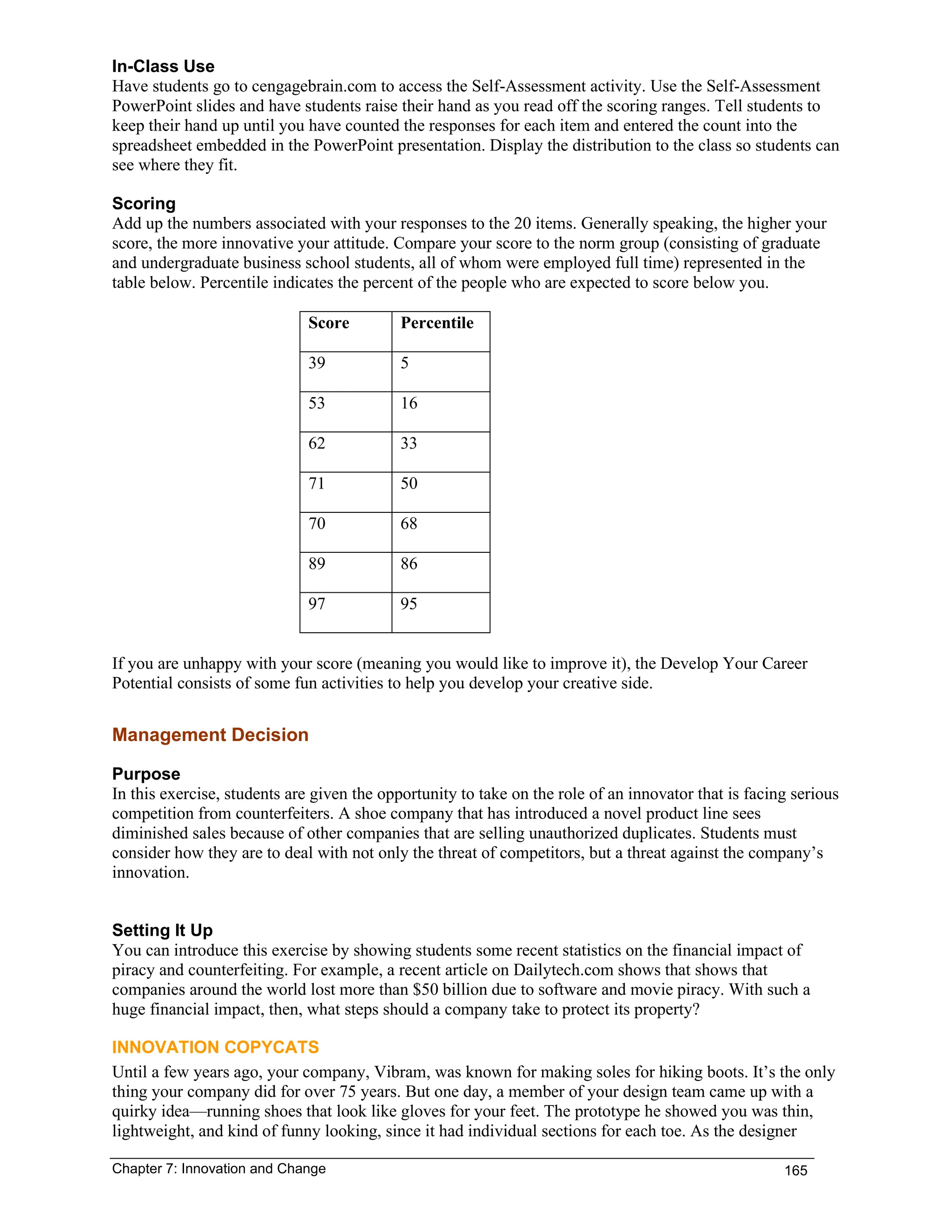




![This ebook is for the use of anyone anywhere in the United States and most other parts of the
world at no cost and with almost no restrictions whatsoever. You may copy it, give it away or re-use
it under the terms of the Project Gutenberg License included with this ebook or online at
www.gutenberg.org. If you are not located in the United States, you will have to check the laws of
the country where you are located before using this eBook.
Title: The Mentor: Painters of Western Life, Vol 3, Num. 9, Serial No. 85, June 15, 1915
Author: Arthur Hoeber
Release date: December 31, 2015 [eBook #50803]
Most recently updated: October 22, 2024
Language: English
Credits: Produced by Juliet Sutherland and the Online Distributed
Proofreading Team at http://www.pgdp.net
*** START OF THE PROJECT GUTENBERG EBOOK THE MENTOR: PAINTERS OF WESTERN LIFE, VOL 3,
NUM. 9, SERIAL NO. 85, JUNE 15, 1915 ***](https://image.slidesharecdn.com/17556-250404163734-0b61971e/75/MGMT-7-7th-Edition-Chuck-Williams-Solutions-Manual-26-2048.jpg)


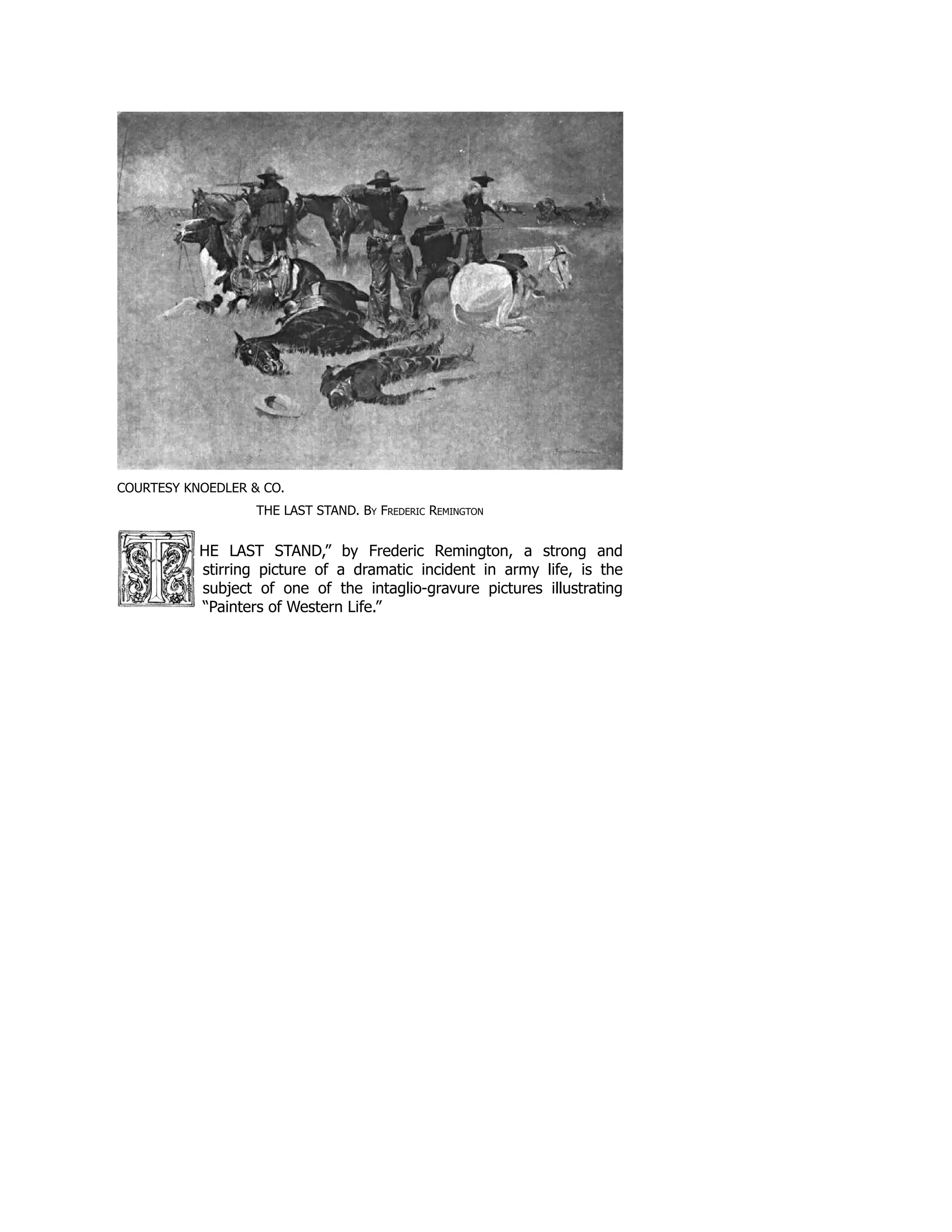
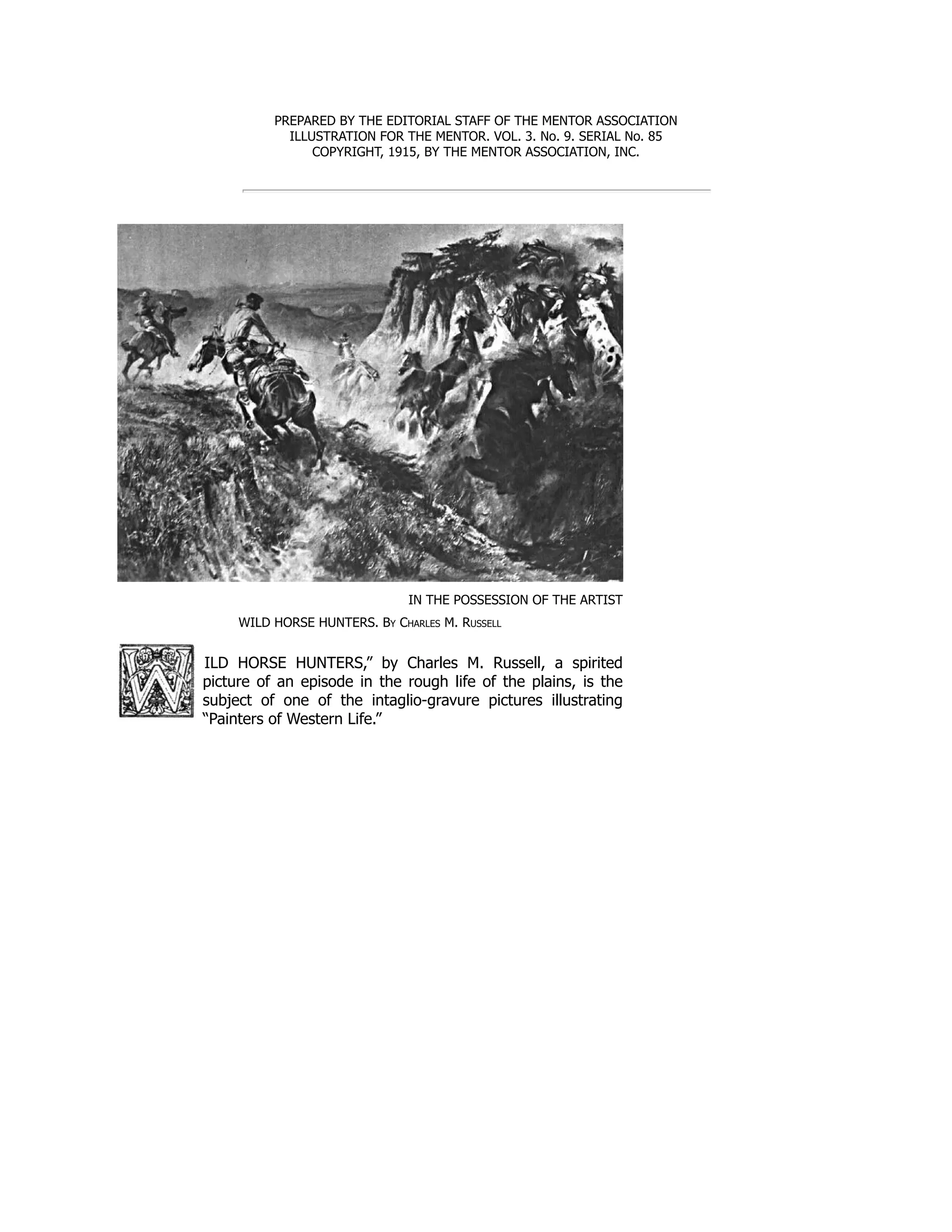


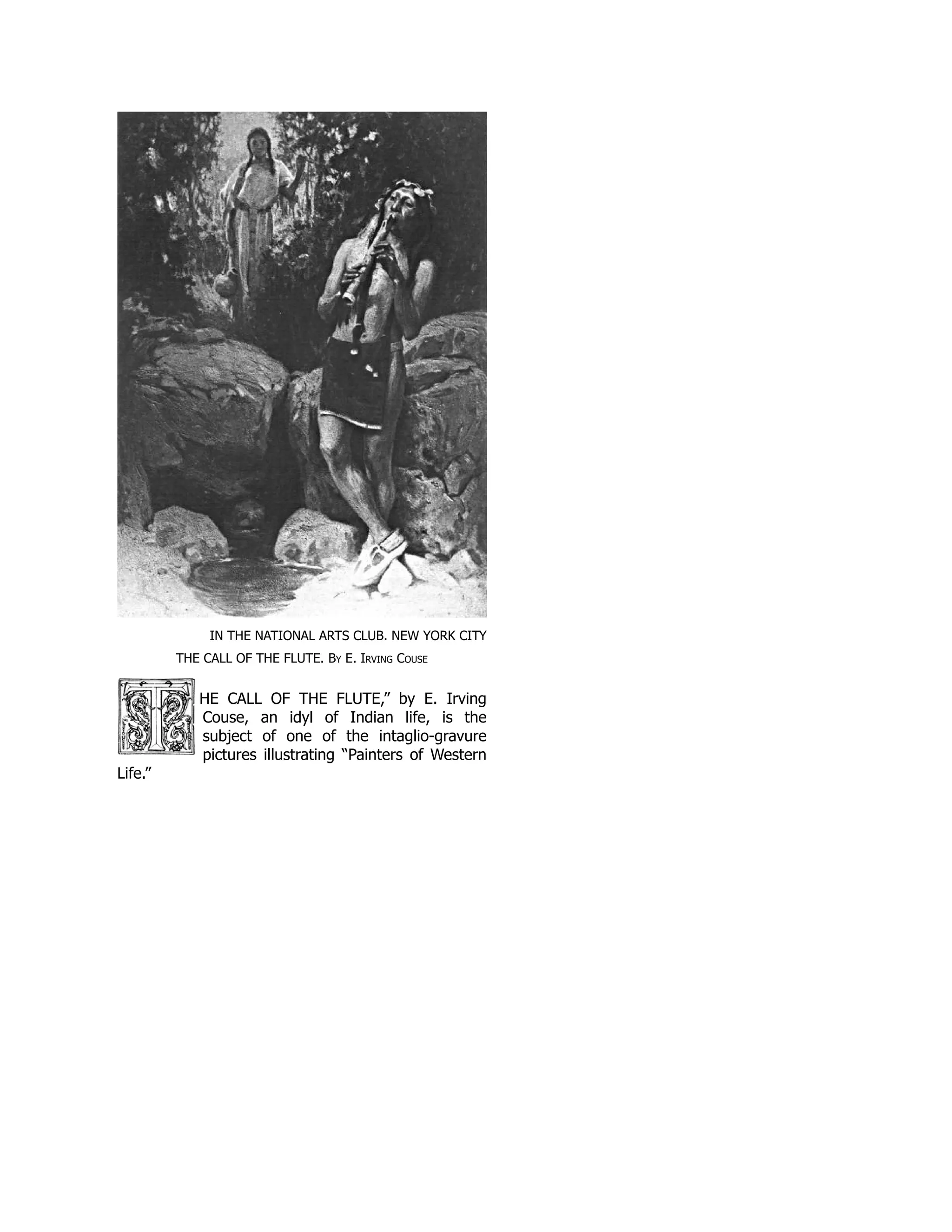

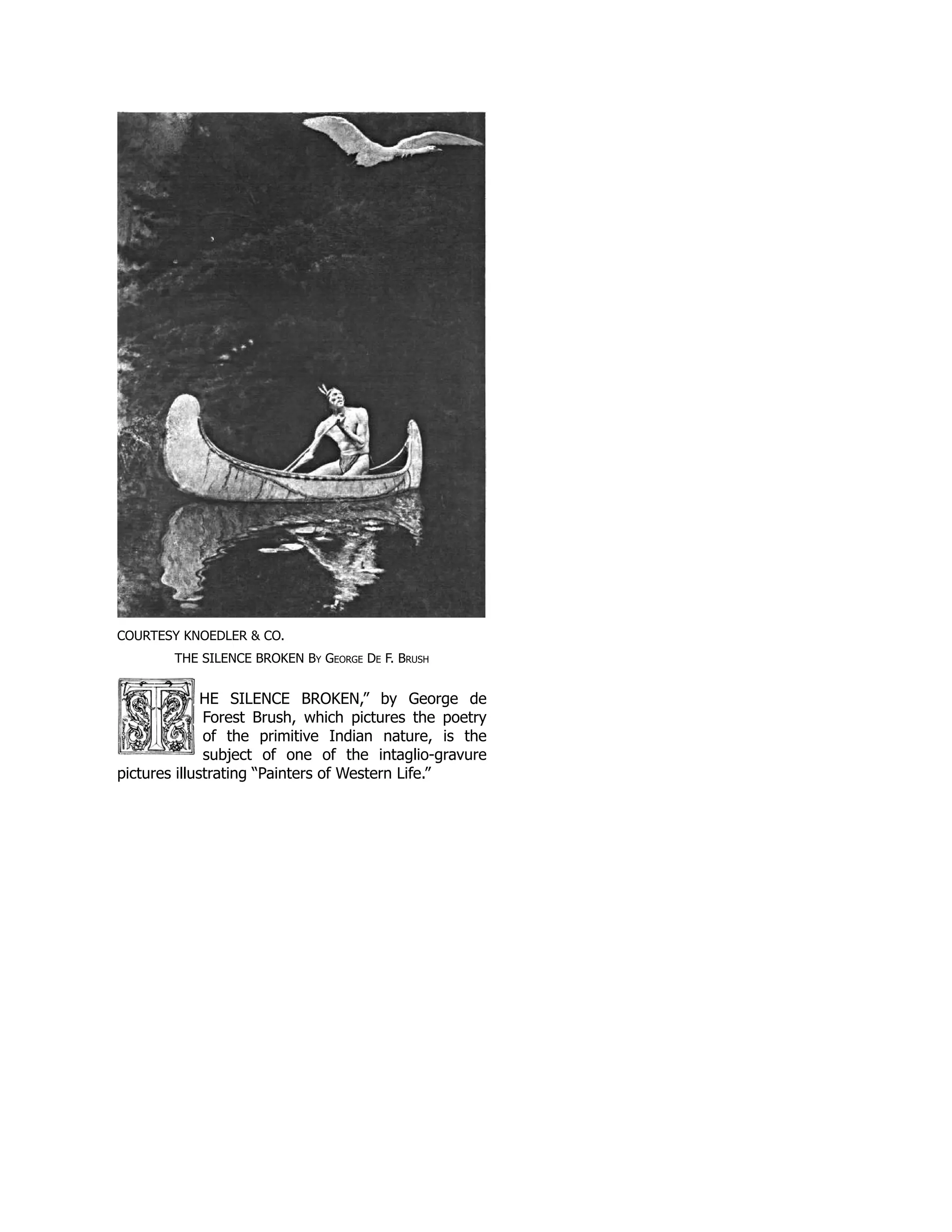


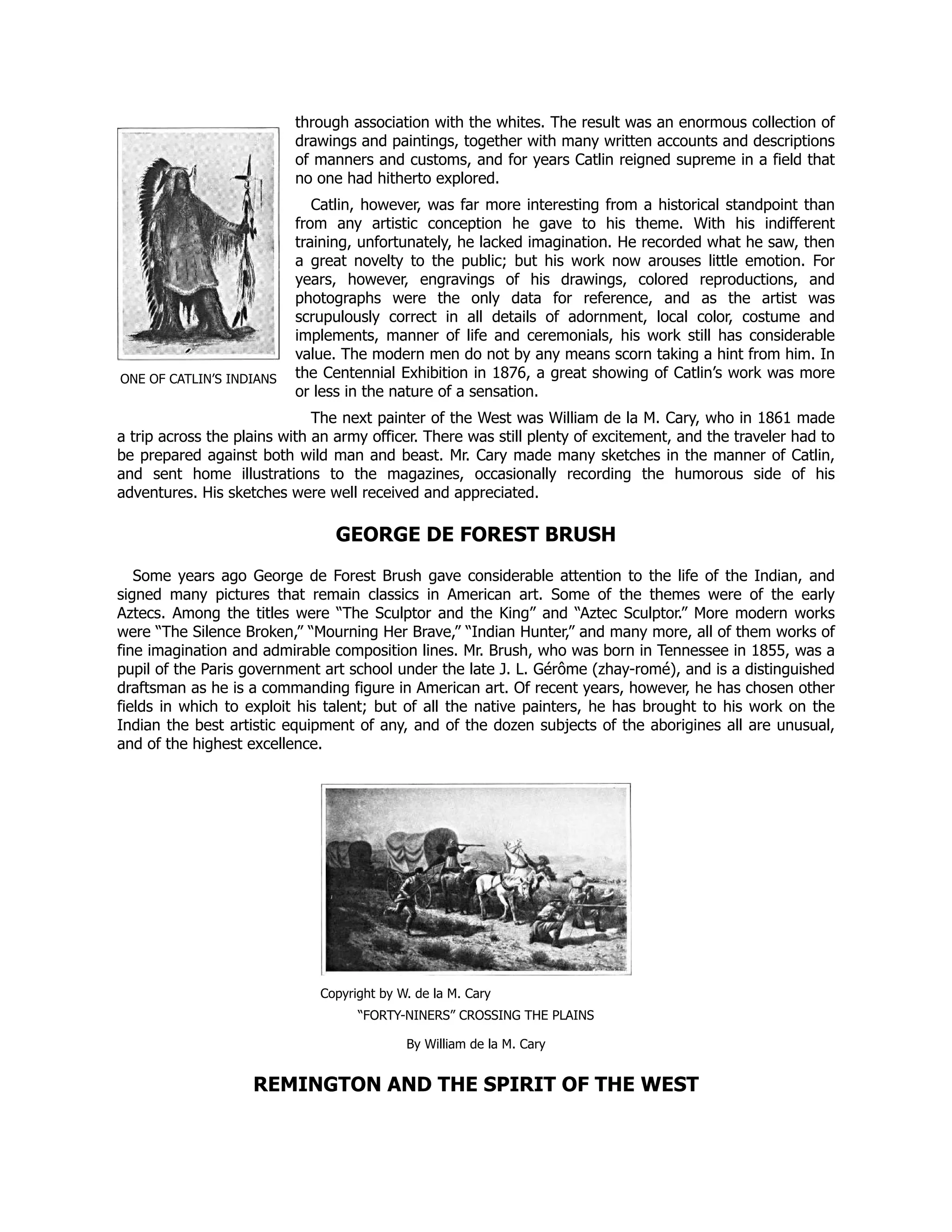


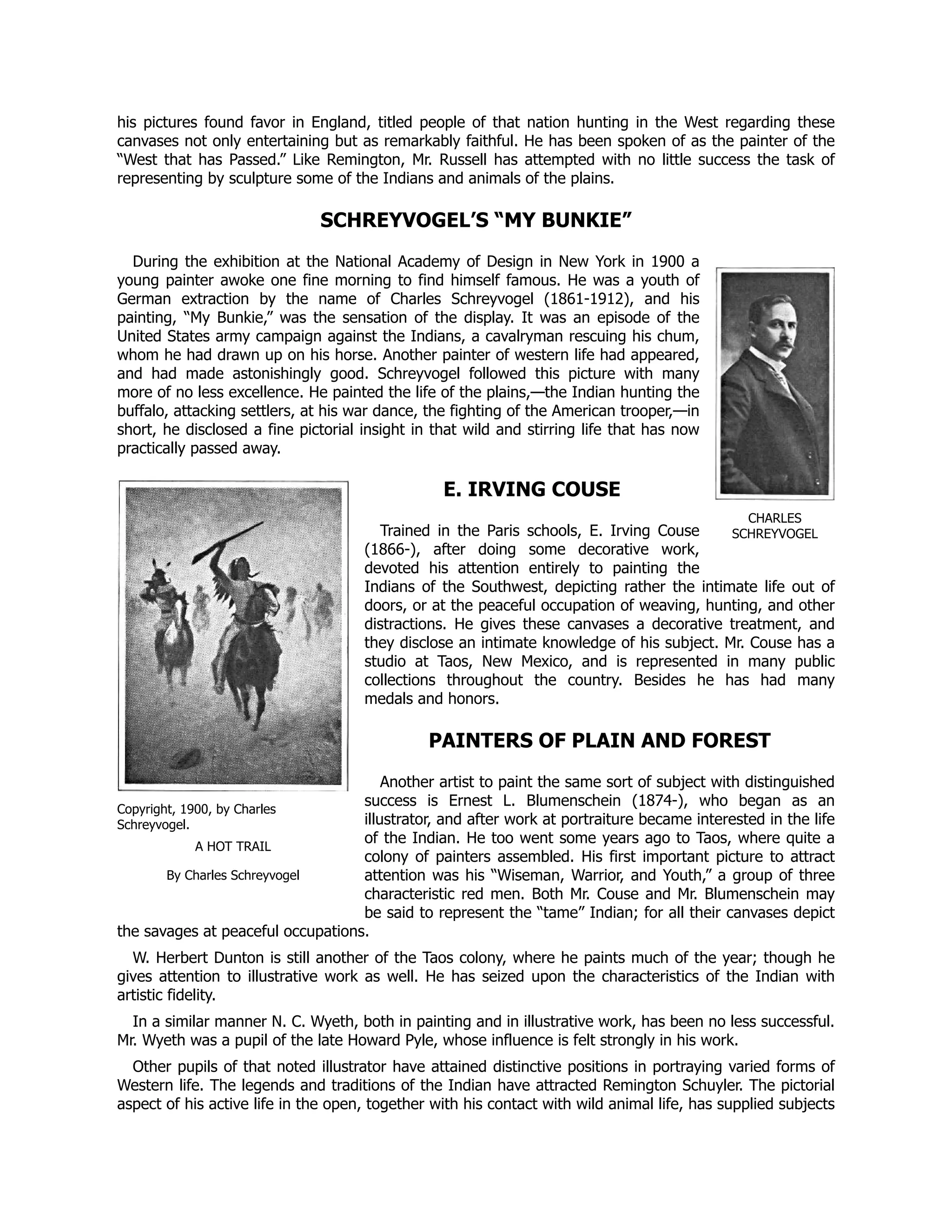

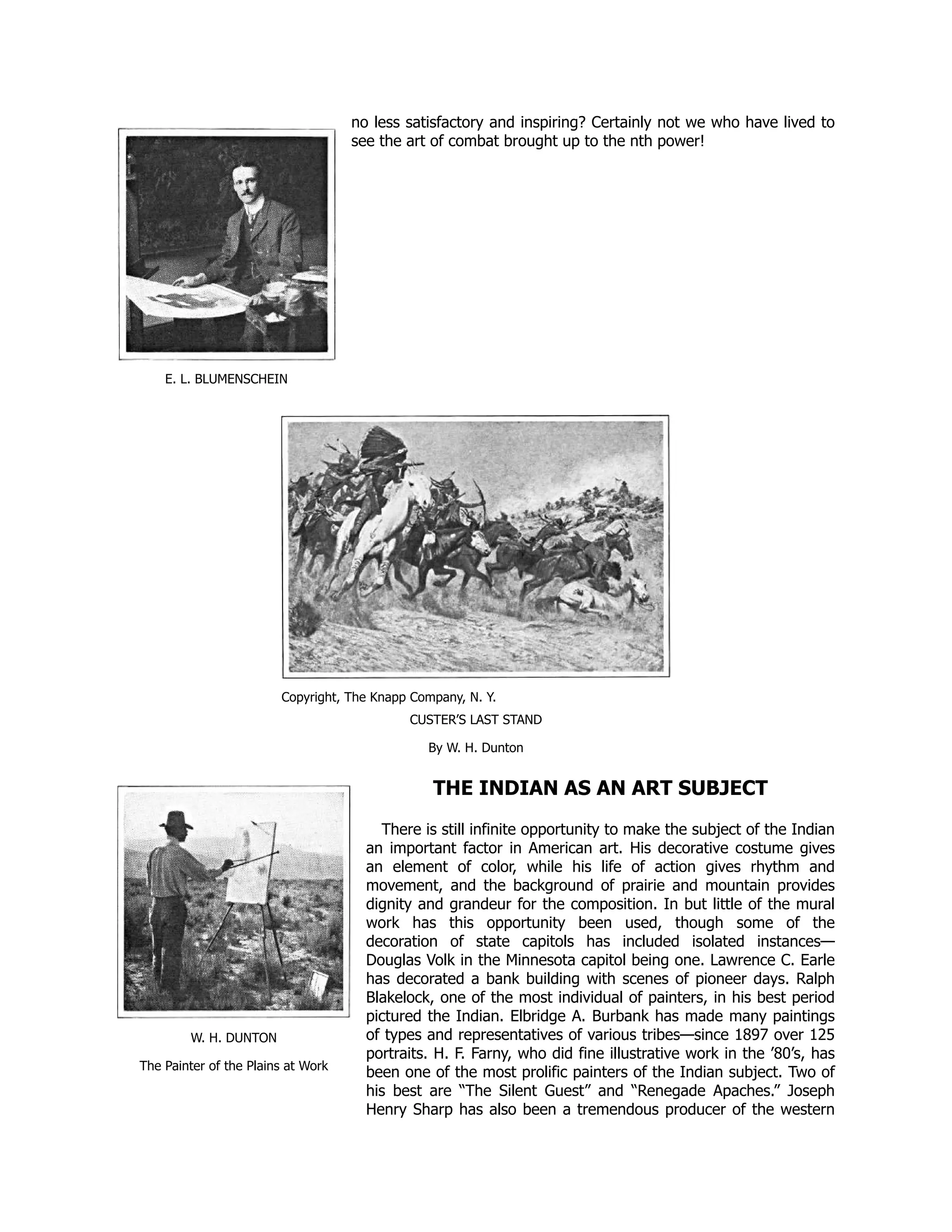






![[FREE PDF sample] Management 13th Edition Robbins Solutions Manual ebooks](https://cdn.slidesharecdn.com/ss_thumbnails/16900-241103075143-5c28df23-thumbnail.jpg?width=640&height=640&fit=bounds)


