S
Methodologies of
software engineering.
Kaya Ota
San Jose State University Fall 2014
CS146-08
Agenda
S Why we need methods of software engineering
S Software development life cycles
S Sequential Approach
S Waterfall model
S Iterative Approach
S Prototype model
S Spiral model
S Agile
Why we need a method of
software engineering
S To manage project with a team
S To make a plane of a project
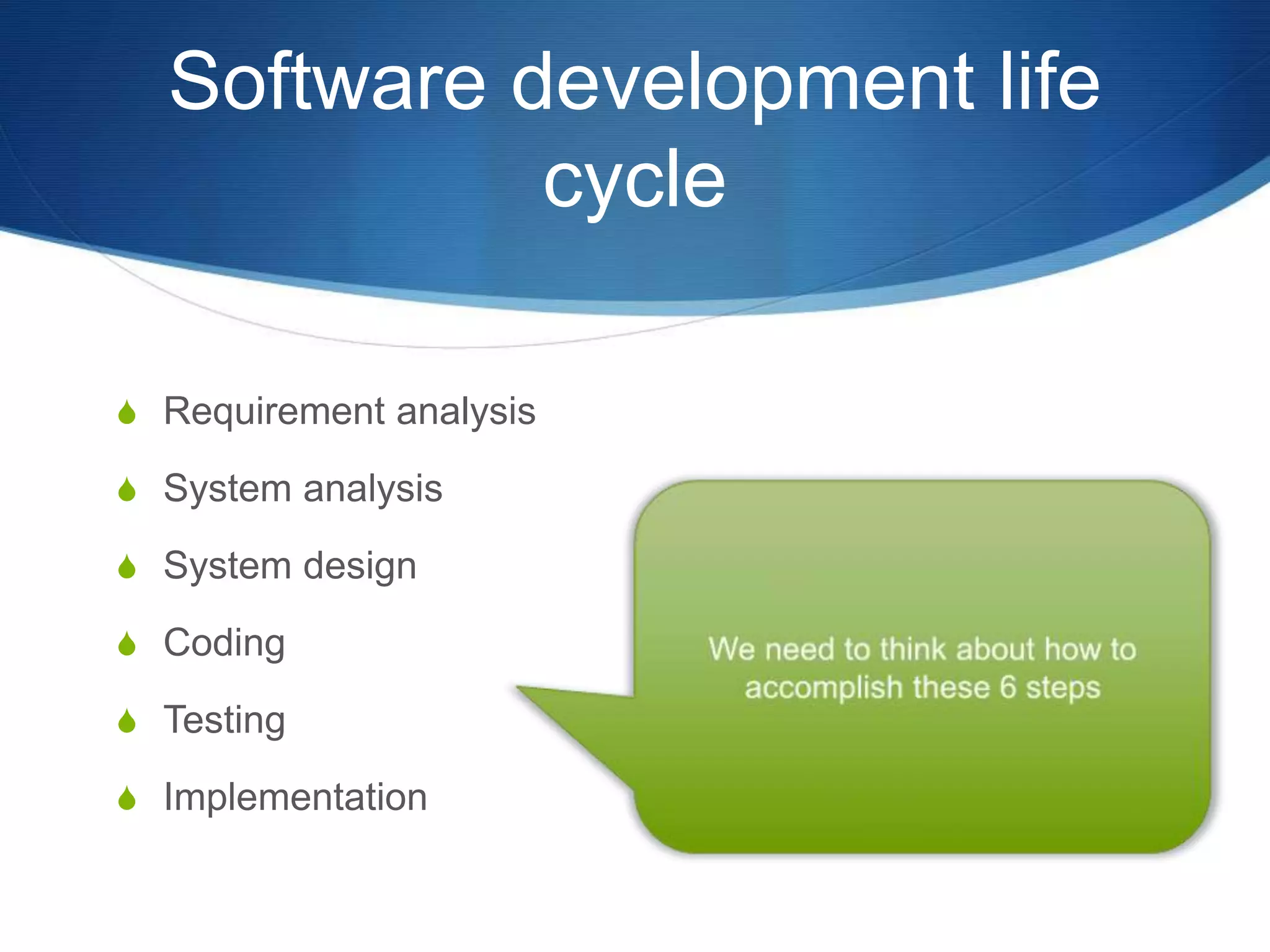
Software development life
cycle
S Requirement analysis
S System analysis
S System design
S Coding
S Testing
S Implementation
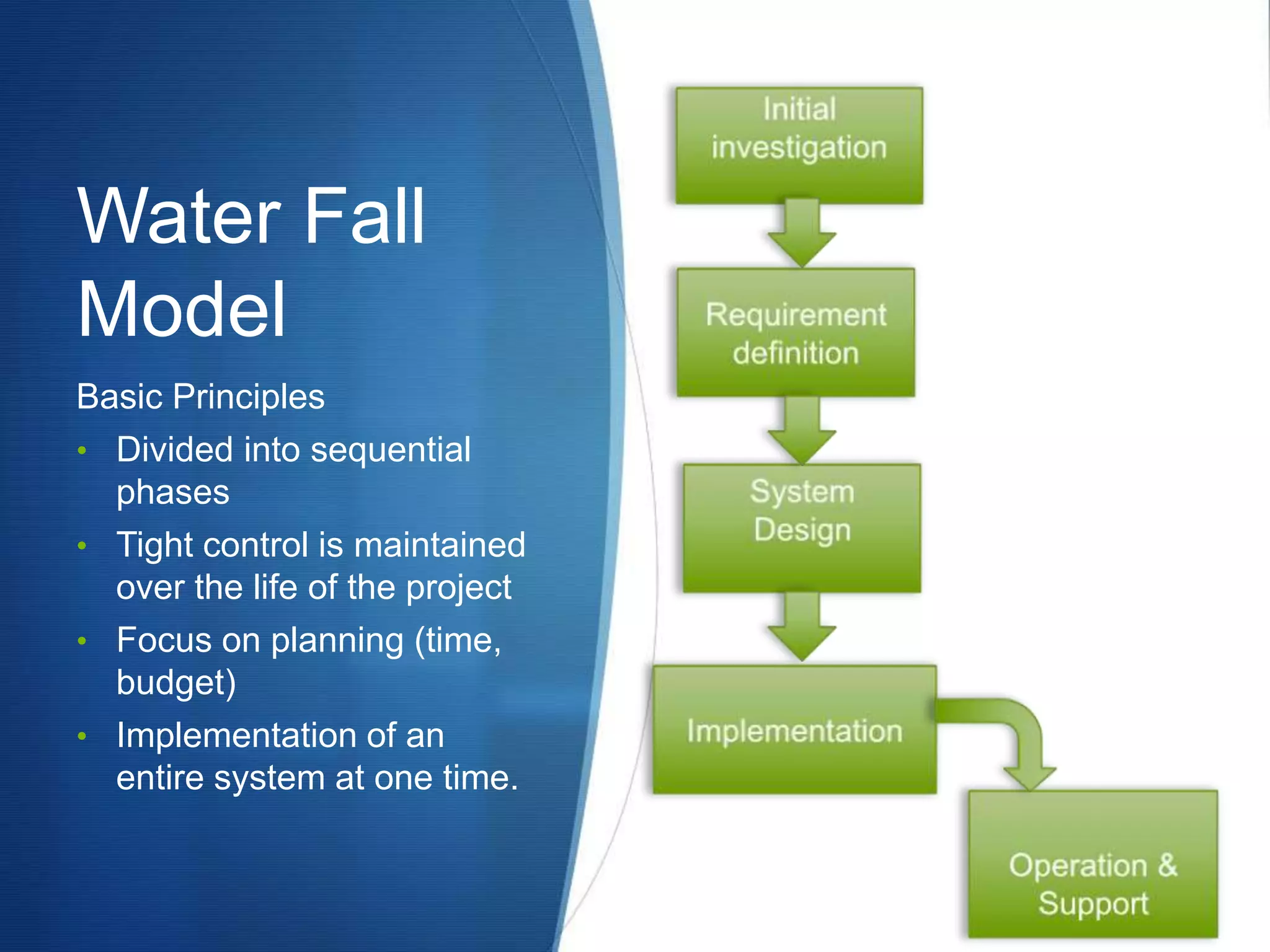
Water Fall
Model
Basic Principles
• Divided into sequential
phases
• Tight control is maintained
over the life of the project
• Focus on planning (time,
budget)
• Implementation of an
entire system at one time.
Features of Water Fall Model
Strength
S Generated high-quality
documentations
S Obtains result at the end of
each phases
S Can measure progress of
development
S Well-structured
Weakness
S Difficulty of adaptation to
uncertainty
S Inflexible to respond to change
S Updating documentation is
time-consuming.
S Can not see the working
version of the product until the
end
Appropriate situation
Most Appropriate
S Project has clear objectives and
solution
S Project is large and complicated
S Project requirements are stable
(unchanging)
S Required for formal approvals
at designated milestone
Least Appropriate
S Large Project where its
requirements are not well-
understood or changing for any
reasons
S Event-driven systems
S Real-time system
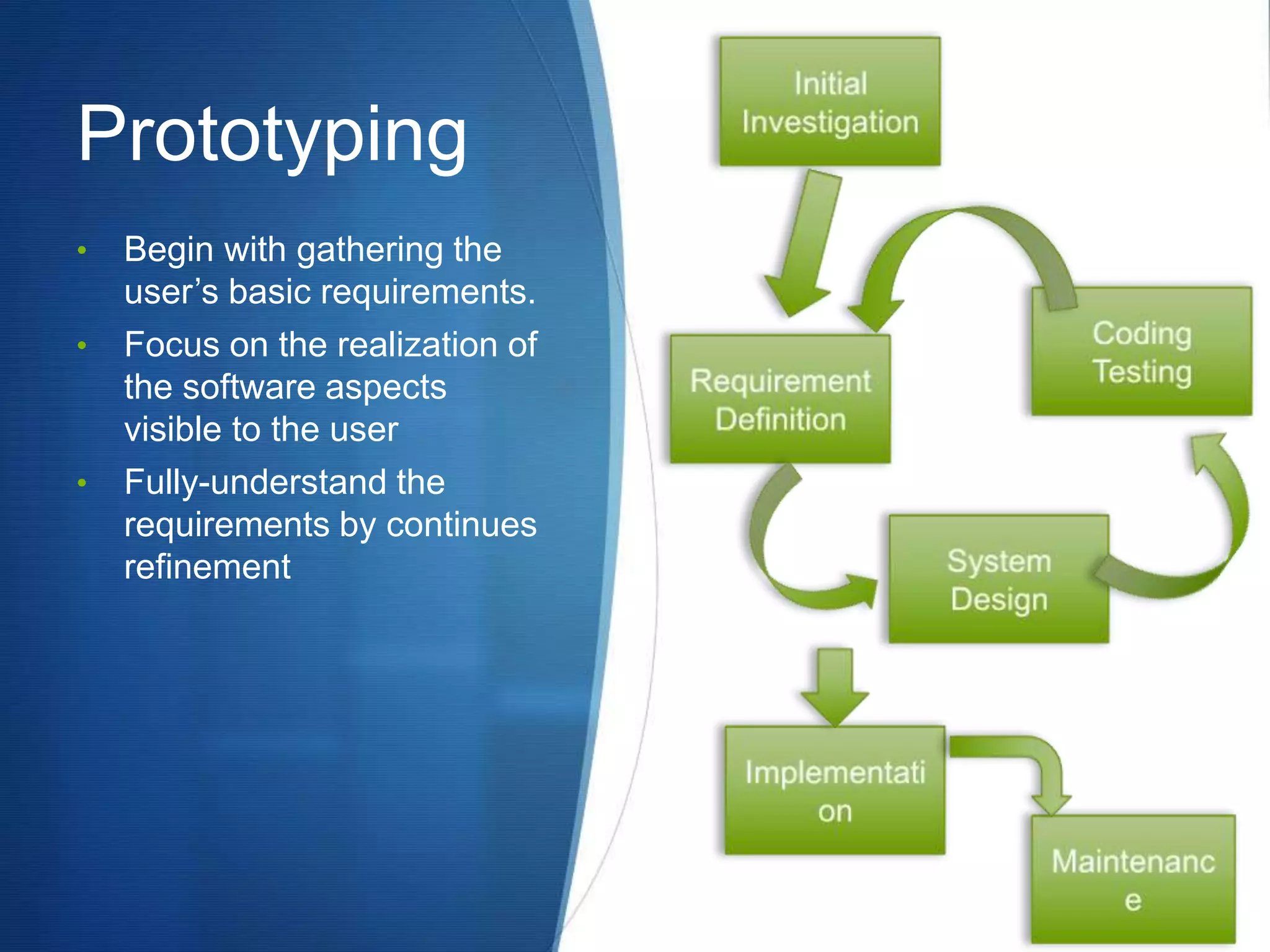
Prototyping
• Begin with gathering the
user’s basic requirements.
• Focus on the realization of
the software aspects
visible to the user
• Fully-understand the
requirements by continues
refinement
Feature of Prototyping Model
Strength
S Resolving unclear objectives
S Help to identify confusing or
difficult functions
S Have a flexible design
S Provide a quick
implementation(to demonstrate)
Weakness
S Can lead poorly designed
system
S Requirement may change
significantly and frequently
S Incomplete or inadequate
problem analysis may occur
Appropriate situation
Most Appropriate
S User is not fully knowledgeable
S Objectives are unclear
S No strict requirement for
approvals at milestone
Least Appropriate
S Transaction-oriented batch
system
S Future scalability of the design
is critical
S Objectives are very clear
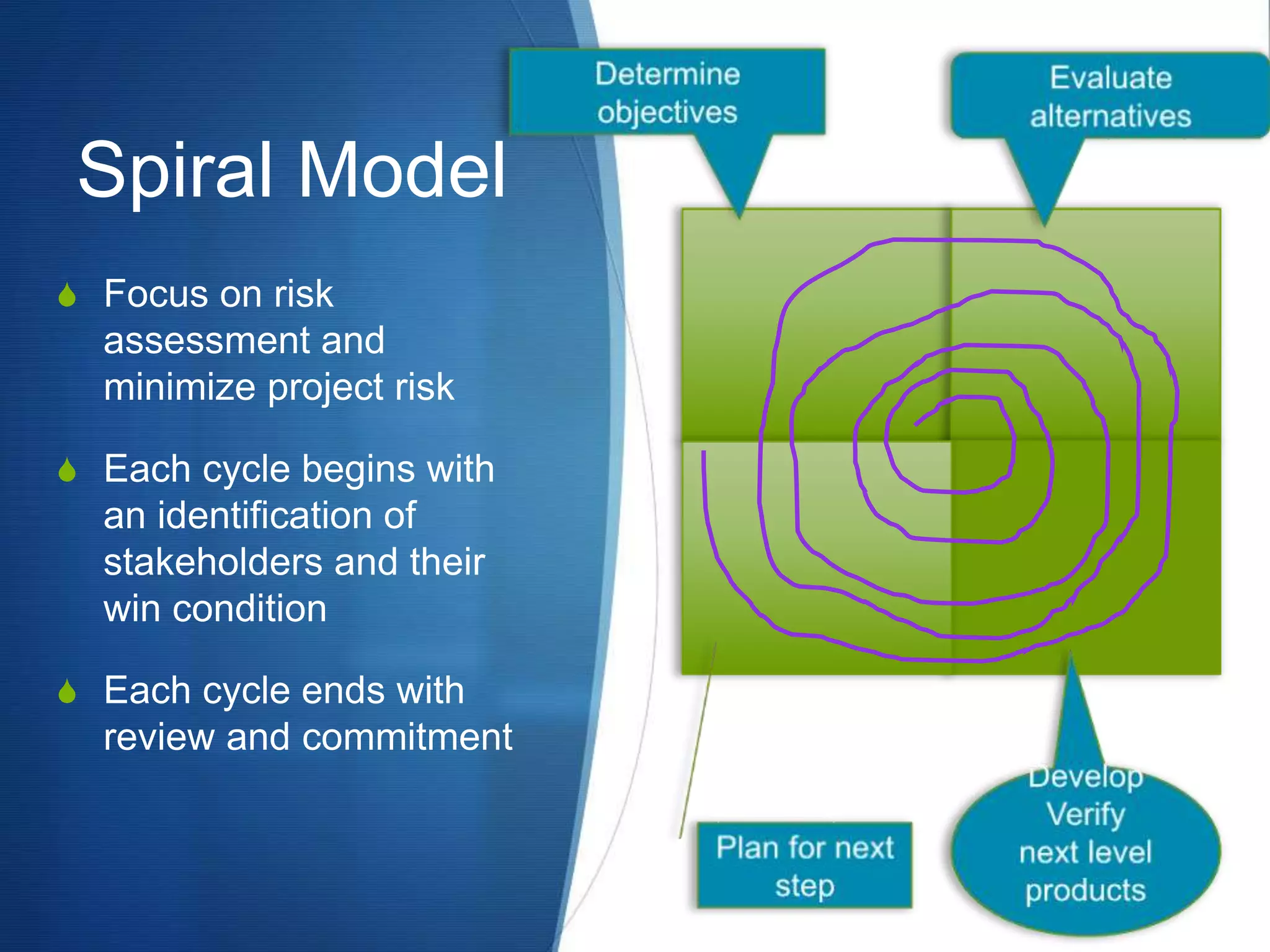
Spiral Model
S Focus on risk
assessment and
minimize project risk
S Each cycle begins with
an identification of
stakeholders and their
win condition
S Each cycle ends with
review and commitment
Feature of Spiral Model
Strength
S Enhances risk avoidance
S Can incorporate waterfall and
prototyping models
Weakness
S No clear termination condition
(so, inherent risk is not meet
time and money)
S Highly customized to each
project => limiting reusability
S No established controls for
moving cycle to cycle
Appropriate Situation
Most Appropriate
S Real time or safety-critical
system
S Risk avoidance is high priority
S Required for strong approval
and documentation control
Least Appropriate
S Minimizing resource
consumption is high priority
S Accuracy is not essential
S Risk avoidance is not essential
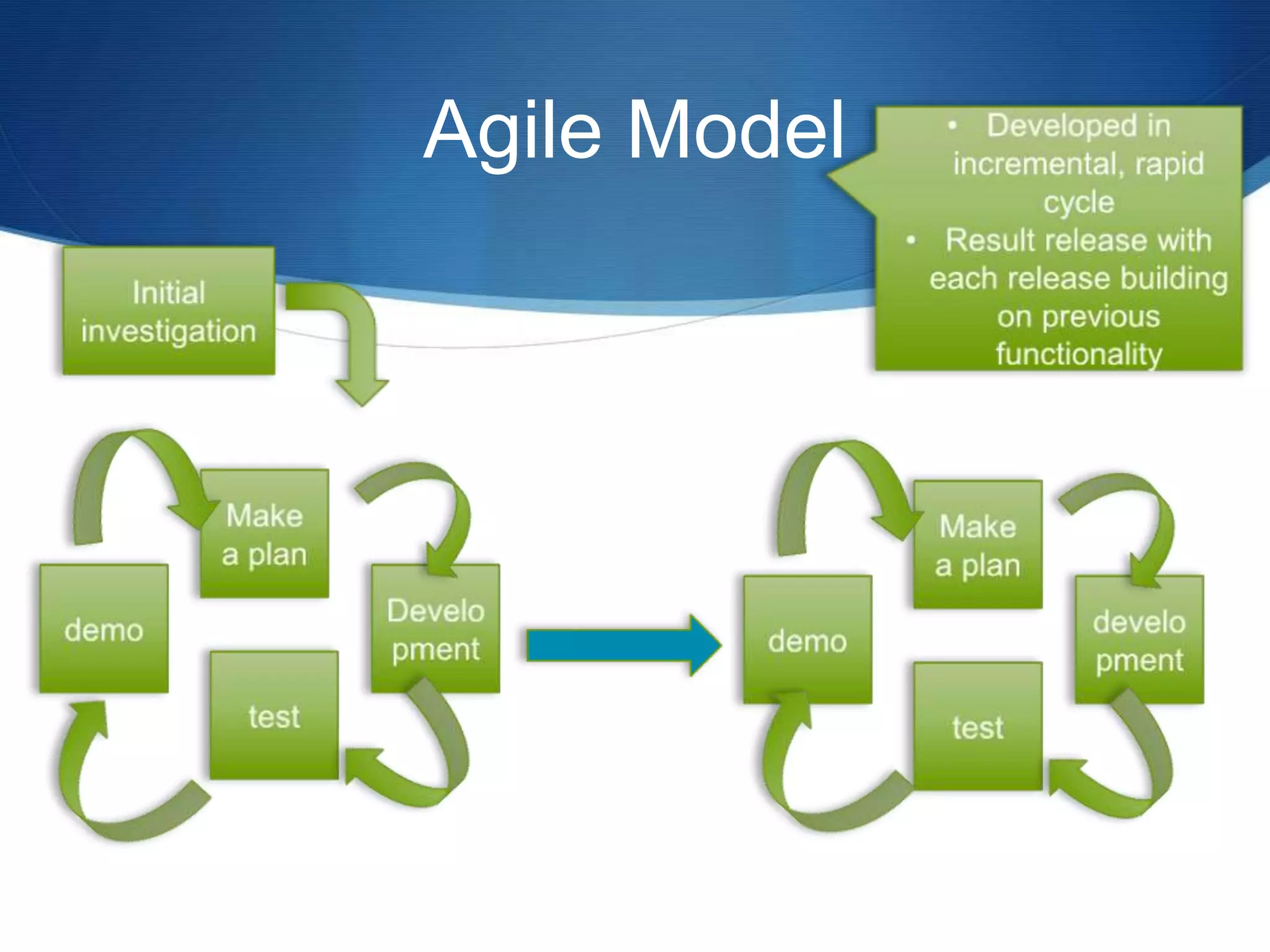
Agile Model
Feature of Agile Model
Strength
S Customer satisfaction by rapid
S Continuously delivered of useful
software
S Late changes in requirements
are welcomed
S Get involved business people
and developers
Weakness
S Lack of emphasis on necessary
designing and documentation
S Can easily get taken off if the
customer’s representative is not
clear about their final outcome
Feature of Agile Model
Most Appropriate
S When new changes are
required to be implemented.
S Good for a software relative to
dynamic changes in business
or IT world
S Clients can have a various
options
Least Appropriate
S Clients and developer teams
need to be very close.
Communicate well.
Methodologies of Software Engineering

Methodologies of Software Engineering

  • 1.
    S Methodologies of software engineering. KayaOta San Jose State University Fall 2014 CS146-08
  • 2.
    Agenda S Why weneed methods of software engineering S Software development life cycles S Sequential Approach S Waterfall model S Iterative Approach S Prototype model S Spiral model S Agile
  • 3.
    Why we needa method of software engineering S To manage project with a team S To make a plane of a project
  • 4.
    Software development life cycle SRequirement analysis S System analysis S System design S Coding S Testing S Implementation
  • 5.
    Water Fall Model Basic Principles •Divided into sequential phases • Tight control is maintained over the life of the project • Focus on planning (time, budget) • Implementation of an entire system at one time.
  • 6.
    Features of WaterFall Model Strength S Generated high-quality documentations S Obtains result at the end of each phases S Can measure progress of development S Well-structured Weakness S Difficulty of adaptation to uncertainty S Inflexible to respond to change S Updating documentation is time-consuming. S Can not see the working version of the product until the end
  • 7.
    Appropriate situation Most Appropriate SProject has clear objectives and solution S Project is large and complicated S Project requirements are stable (unchanging) S Required for formal approvals at designated milestone Least Appropriate S Large Project where its requirements are not well- understood or changing for any reasons S Event-driven systems S Real-time system
  • 8.
    Prototyping • Begin withgathering the user’s basic requirements. • Focus on the realization of the software aspects visible to the user • Fully-understand the requirements by continues refinement
  • 9.
    Feature of PrototypingModel Strength S Resolving unclear objectives S Help to identify confusing or difficult functions S Have a flexible design S Provide a quick implementation(to demonstrate) Weakness S Can lead poorly designed system S Requirement may change significantly and frequently S Incomplete or inadequate problem analysis may occur
  • 10.
    Appropriate situation Most Appropriate SUser is not fully knowledgeable S Objectives are unclear S No strict requirement for approvals at milestone Least Appropriate S Transaction-oriented batch system S Future scalability of the design is critical S Objectives are very clear
  • 11.
    Spiral Model S Focuson risk assessment and minimize project risk S Each cycle begins with an identification of stakeholders and their win condition S Each cycle ends with review and commitment
  • 12.
    Feature of SpiralModel Strength S Enhances risk avoidance S Can incorporate waterfall and prototyping models Weakness S No clear termination condition (so, inherent risk is not meet time and money) S Highly customized to each project => limiting reusability S No established controls for moving cycle to cycle
  • 13.
    Appropriate Situation Most Appropriate SReal time or safety-critical system S Risk avoidance is high priority S Required for strong approval and documentation control Least Appropriate S Minimizing resource consumption is high priority S Accuracy is not essential S Risk avoidance is not essential
  • 14.
  • 15.
    Feature of AgileModel Strength S Customer satisfaction by rapid S Continuously delivered of useful software S Late changes in requirements are welcomed S Get involved business people and developers Weakness S Lack of emphasis on necessary designing and documentation S Can easily get taken off if the customer’s representative is not clear about their final outcome
  • 16.
    Feature of AgileModel Most Appropriate S When new changes are required to be implemented. S Good for a software relative to dynamic changes in business or IT world S Clients can have a various options Least Appropriate S Clients and developer teams need to be very close. Communicate well.