Hard Systems Methodology , SSADM
Nana Kwabena Sarpong
(J-PROMPT PROFESSIONAL INSITITUTEOFTECHNOLOGY )
naksarpong@gmail.com
 A software development methodology or
system development methodology in
software engineering is a framework that is
used to structure, plan, and control the
process of developing an information system.
It is made up of a collection of processes as
well as a modeling language
 A modeling language is any artificial
language that can be used to express
information or knowledge or systems in a
structure that is defined by a consistent set of
rules.The rules are used for interpretation of
the meaning of components in the structure.
In software engineering modeling language
consist of several modeling methods.
 BehaviorTrees
 Unified Modeling Language(UML)
 Object-Role Modeling(ORM)
 Architectural Description Language(ADL)
 Jacksons Structured Programming
 A software process model is an abstract
representation of a process methodology.
Process models outlines things that are done but
not how it is done.
 However, methodologies are a specific way of
conducting a software project.They define
exactly what, when, and/or how various artifacts
are produced and sometimes the tools to be
used.
 Systems thinking is the process of
understanding a system by examining the
linkages and interactions between the
components that comprise the entirety of
that defined system.
 SystemsThinking uses a variety of techniques
that may be divided into hard systems and
soft systems.
 Hard systems (HS) involves simulations, often
using computers and the techniques used in
operations research. Hard systems look at the
“How?” meaning, how to best achieve and test
the selected option of development and
analysis.
 Example of hard system : Payroll system
 Hard Systems Methodology
 Soft Systems Methodology
These are considered as methods which
consist of a clear definition but has a less
user involvement . Hard systems
methodologies are useful for problems that
can justifiably be quantified.
 Structured Methods
 ObjectOriented methods
 SSADM(Structured Systems Analysis and
Design Methodology)
 Yourdon's Structured Methods(YSM)
 OOSE(ObjectOriented Software
Engineering)
 OMT (Object ModelingTechnique)
 Structured Systems Analysis and Design
Methodology (SSADM) is an integrated set of
standards and guides for the analysis and
design of computer systems
 It is a way of formally organizing the
systems analysis and design parts of
computing projects.
 It is an integrated set of standards and guidelines consisting of :
 Structural standards: which define the structure of a
development project in the form of explicitly defined tasks, with
clearly defined interfaces between them, and clearly defined
tangible products;
 Technique guides: which provide development staff with a set of
proven usable techniques and tools, and detailed rules and
guidelines on when and how to use them
 Documentation standards, which provide the means of
recording the products of development activity at a detailed level
 SSADM is a waterfall view approach whereby
there are sequences of events that run in
series and each step leads on from the last.
There are five steps in total, and each step
can be broken down further
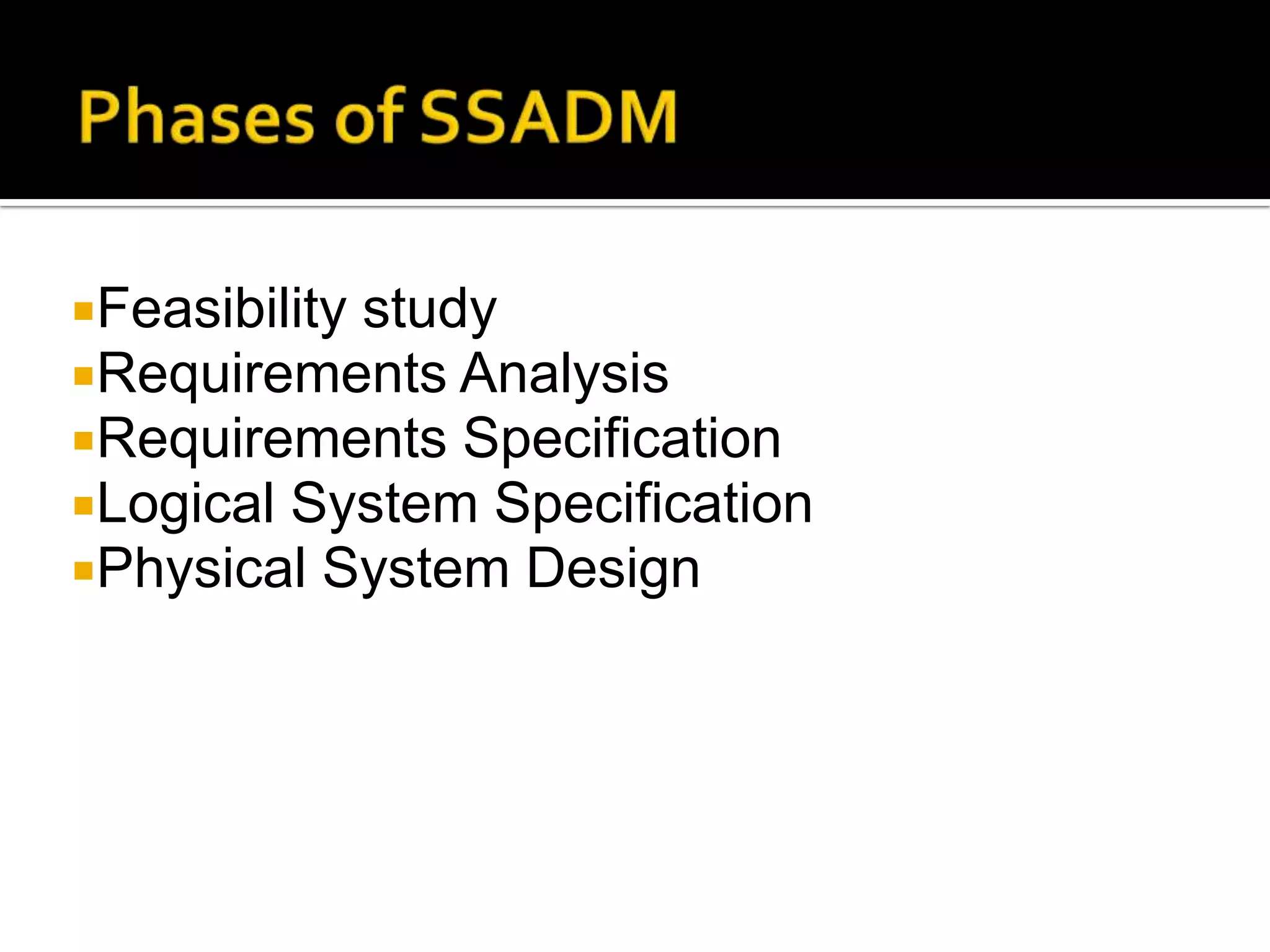
Feasibility study
Requirements Analysis
Requirements Specification
Logical System Specification
Physical System Design
 Module 01 :Feasibility Study
Stage 0 : Feasibility study
 This is where the analyst and users decide if the entire project is
worth pursuing.It involves the analyst considering the problems
faced by the organization and producing a set of options to resolve
them.The users must then decide whether the costs involved in
resolving the problem are worth it.
Identifying of the requirements and needs of the system and
modelling these needs in terms of the processes carried out.
. Stage 01:
 Investigation of Current Environment:
 Establish analysis framework
 Investigate and define requirements
 Investigate current processing/data
 Derive logical view of current services
This needs to be done so that the analyst and the users fully understand what the
current system does. They need to be clear what problems they have and what they
want from the new system
Stage 02:
Business System Options
. A Business System Option (BSO) describes a
suggested new system in terms of its functionality
and its boundary: inputs, outputs, processes and
data are described. The aim is to help the users
choose, from all the listed requirements, just what
they want their new system to do.
Stage 02:
Business System Options
This Stage allows the analyst and users to come
up with some ideas about what the new system
might do. Usually, a range of options, with different
costs and benefits, are considered. Users will need
to be clear about the objectives of the business
before they can choose the option to proceed with.
Having selected a specific BSO a detailed specification of requirements now
begins.The emphasis is on determining the desired system data, functions
and events
Stage 3:
 Definition of Requirements:
 Define required system processing
 Develop required data model
 Derive system functions
 Enhance required data model
Stage 4: Selection ofTechnical options
 By now, the analyst and users will have a reasonable idea of what the
new system will be expected to do.This allows them to consider the
technical options. For example, the key hardware components will
need to be identified.
 Define technical options
 Select technical options
Stage 4: Selection ofTechnical options
The procedure for producing and selectingTechnical System Options
(TSOs) is very similar to that for BSOs. First, draw up an initial list of
approximately six options.The skeletalTSOs should then be expanded
to include details derived from potential suppliers such as:
• Cost;
• Facilities;
• Performance;
• Support etc.

Stage 5: Logical Design
 This involves specifying the new system.What
will the new system do?What might it look like
from a user perspective?
 Define user dialogues
 Define update processes
 Stage 6 :This stage concentrates on the
environment within which the new system will
operate.
Physical Environment Classification Scheme is used
to categorize the physical environment.The
scheme considers factors including:
• Data storage;
• Performance;
• Processing characteristics.
 Stage 6 :
 Prepare for physical design
 Create physical data design
 Create function component
implementation map
 Optimize physical data design

Software Development Methodologies-HSM, SSADM

  • 1.
    Hard Systems Methodology, SSADM Nana Kwabena Sarpong (J-PROMPT PROFESSIONAL INSITITUTEOFTECHNOLOGY ) naksarpong@gmail.com
  • 2.
     A softwaredevelopment methodology or system development methodology in software engineering is a framework that is used to structure, plan, and control the process of developing an information system. It is made up of a collection of processes as well as a modeling language
  • 3.
     A modelinglanguage is any artificial language that can be used to express information or knowledge or systems in a structure that is defined by a consistent set of rules.The rules are used for interpretation of the meaning of components in the structure. In software engineering modeling language consist of several modeling methods.
  • 4.
     BehaviorTrees  UnifiedModeling Language(UML)  Object-Role Modeling(ORM)  Architectural Description Language(ADL)  Jacksons Structured Programming
  • 5.
     A softwareprocess model is an abstract representation of a process methodology. Process models outlines things that are done but not how it is done.  However, methodologies are a specific way of conducting a software project.They define exactly what, when, and/or how various artifacts are produced and sometimes the tools to be used.
  • 6.
     Systems thinkingis the process of understanding a system by examining the linkages and interactions between the components that comprise the entirety of that defined system.  SystemsThinking uses a variety of techniques that may be divided into hard systems and soft systems.
  • 7.
     Hard systems(HS) involves simulations, often using computers and the techniques used in operations research. Hard systems look at the “How?” meaning, how to best achieve and test the selected option of development and analysis.  Example of hard system : Payroll system
  • 8.
     Hard SystemsMethodology  Soft Systems Methodology
  • 9.
    These are consideredas methods which consist of a clear definition but has a less user involvement . Hard systems methodologies are useful for problems that can justifiably be quantified.
  • 10.
     Structured Methods ObjectOriented methods
  • 11.
     SSADM(Structured SystemsAnalysis and Design Methodology)  Yourdon's Structured Methods(YSM)
  • 12.
  • 13.
     Structured SystemsAnalysis and Design Methodology (SSADM) is an integrated set of standards and guides for the analysis and design of computer systems  It is a way of formally organizing the systems analysis and design parts of computing projects.
  • 14.
     It isan integrated set of standards and guidelines consisting of :  Structural standards: which define the structure of a development project in the form of explicitly defined tasks, with clearly defined interfaces between them, and clearly defined tangible products;  Technique guides: which provide development staff with a set of proven usable techniques and tools, and detailed rules and guidelines on when and how to use them  Documentation standards, which provide the means of recording the products of development activity at a detailed level
  • 15.
     SSADM isa waterfall view approach whereby there are sequences of events that run in series and each step leads on from the last. There are five steps in total, and each step can be broken down further
  • 16.
    Feasibility study Requirements Analysis RequirementsSpecification Logical System Specification Physical System Design
  • 17.
     Module 01:Feasibility Study Stage 0 : Feasibility study  This is where the analyst and users decide if the entire project is worth pursuing.It involves the analyst considering the problems faced by the organization and producing a set of options to resolve them.The users must then decide whether the costs involved in resolving the problem are worth it.
  • 18.
    Identifying of therequirements and needs of the system and modelling these needs in terms of the processes carried out. . Stage 01:  Investigation of Current Environment:  Establish analysis framework  Investigate and define requirements  Investigate current processing/data  Derive logical view of current services This needs to be done so that the analyst and the users fully understand what the current system does. They need to be clear what problems they have and what they want from the new system
  • 19.
    Stage 02: Business SystemOptions . A Business System Option (BSO) describes a suggested new system in terms of its functionality and its boundary: inputs, outputs, processes and data are described. The aim is to help the users choose, from all the listed requirements, just what they want their new system to do.
  • 20.
    Stage 02: Business SystemOptions This Stage allows the analyst and users to come up with some ideas about what the new system might do. Usually, a range of options, with different costs and benefits, are considered. Users will need to be clear about the objectives of the business before they can choose the option to proceed with.
  • 21.
    Having selected aspecific BSO a detailed specification of requirements now begins.The emphasis is on determining the desired system data, functions and events Stage 3:  Definition of Requirements:  Define required system processing  Develop required data model  Derive system functions  Enhance required data model
  • 22.
    Stage 4: SelectionofTechnical options  By now, the analyst and users will have a reasonable idea of what the new system will be expected to do.This allows them to consider the technical options. For example, the key hardware components will need to be identified.  Define technical options  Select technical options
  • 23.
    Stage 4: SelectionofTechnical options The procedure for producing and selectingTechnical System Options (TSOs) is very similar to that for BSOs. First, draw up an initial list of approximately six options.The skeletalTSOs should then be expanded to include details derived from potential suppliers such as: • Cost; • Facilities; • Performance; • Support etc. 
  • 24.
    Stage 5: LogicalDesign  This involves specifying the new system.What will the new system do?What might it look like from a user perspective?  Define user dialogues  Define update processes
  • 25.
     Stage 6:This stage concentrates on the environment within which the new system will operate. Physical Environment Classification Scheme is used to categorize the physical environment.The scheme considers factors including: • Data storage; • Performance; • Processing characteristics.
  • 26.
     Stage 6:  Prepare for physical design  Create physical data design  Create function component implementation map  Optimize physical data design