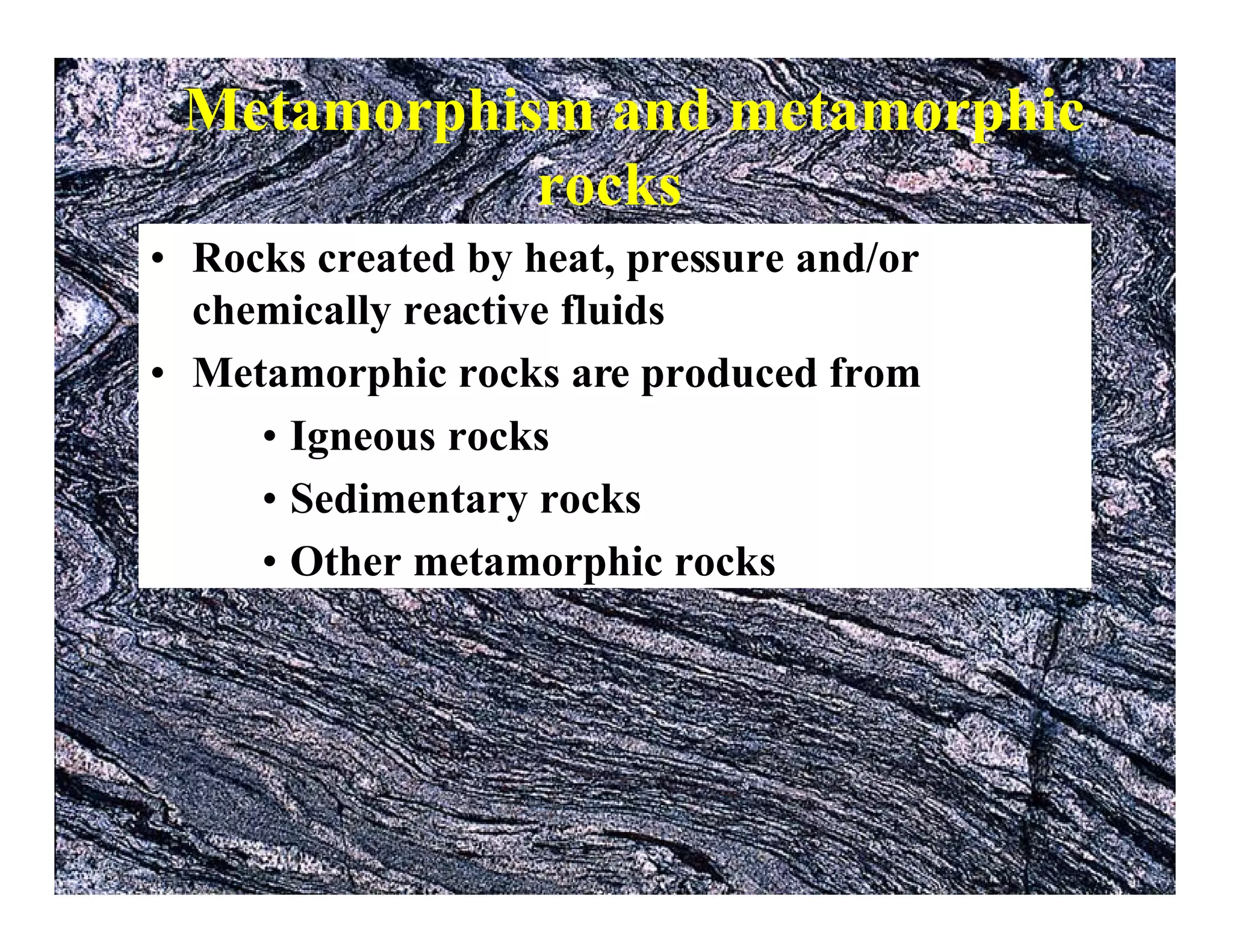
Metamorphism and metamorphic
rocks
• Rocks created by heat, pressure and/or
chemically reactive fluids
• Metamorphic rocks are produced from
• Igneous rocks
• Sedimentary rocks
• Other metamorphic rocks
Metamorphism
• Metamorphism progresses incrementally from lowgrade to high-grade
• During metamorphism (transformation) the rock
remains essentially solid
• Metamorphism characterized by
• Growth of new minerals from pre-existing
minerals through recrystallization
• Deformation of existing minerals
– Change in shape
– Change in orientation
• Metamorphic settings
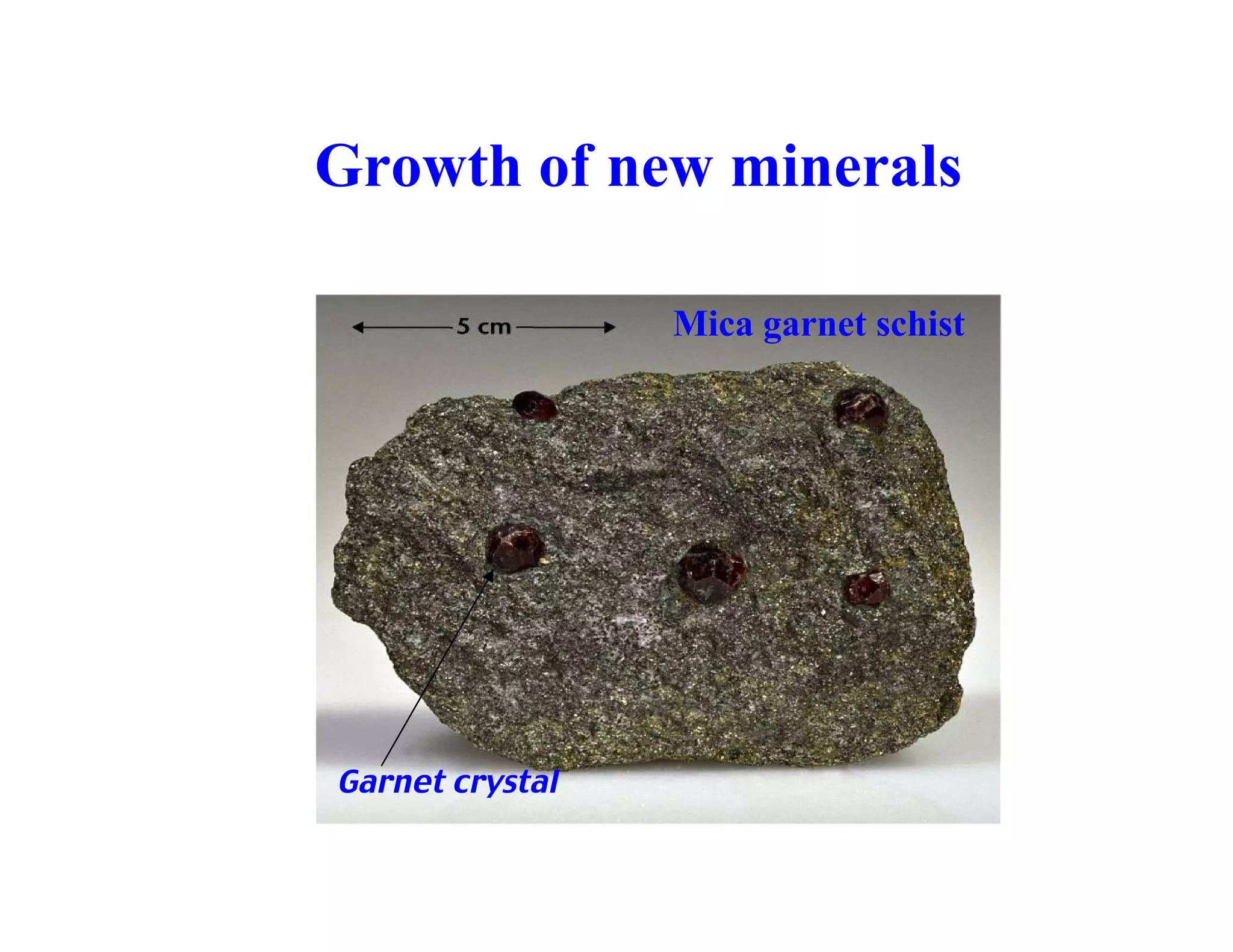
Growth of new minerals
Mica garnet schist

Garnet crystal
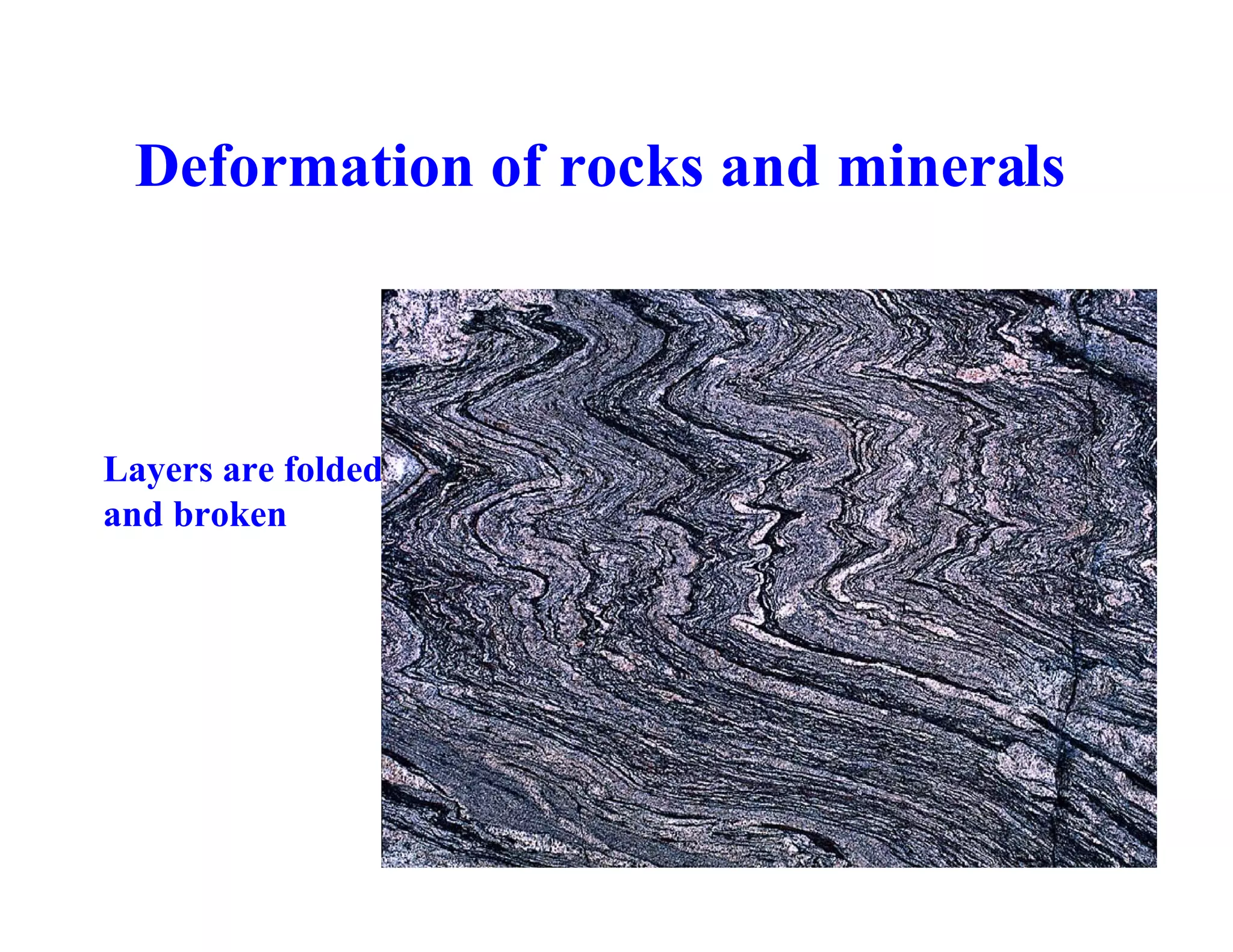
Deformation of rocks and minerals

Layers are folded
and broken
Metamorphism settings
• Contact or thermal metamorphism
• Driven by a rise in temperature within the host
rock
• Regional metamorphism
• Occurs during mountain building
• Produces the greatest volume of metamorphic
rock
• Burial metamorphism
• Occurs at bottom of thick sedimentary rock piles
• Hydrothermal metamorphism
• chemical alterations from hot, ion-rich water
• Others
Agents of metamorphism
• Heat
• The most important agent
• Two sources of heat
– Contact metamorphism – heat from magma
– An increase in temperature with depth due to
the geothermal gradient
• Pressure (stress)
• Increases with depth
• Fluids
• Helps transporting elements from one crystal to a
new metamorphic crystal (enhances migration of
ions0
• Mainly water with other volatile components
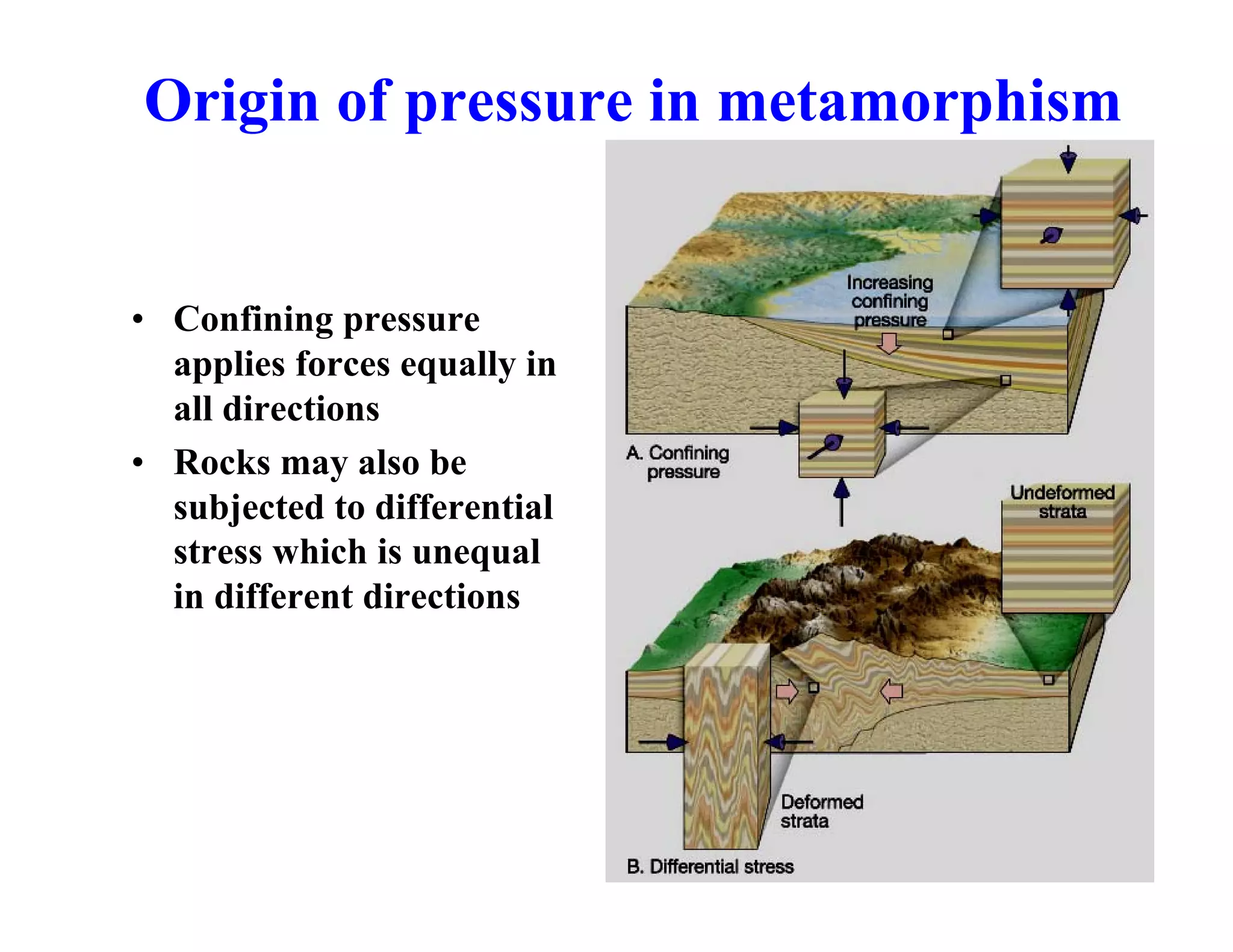
Origin of pressure in metamorphism

• Confining pressure
applies forces equally in
all directions
• Rocks may also be
subjected to differential
stress which is unequal
in different directions
Importance of parent rock
• Most metamorphic rocks have the same overall
chemical composition as the parent rock from which
they formed
• Mineral makeup determines, to a large extent, the
degree to which each metamorphic agent will cause
change
Metamorphic textures
•

Texture refers to the size, shape, and arrangement of grains within a rock

• Foliation – any planar arrangement of mineral grains
or structural features within a rock
• Parallel alignment of platy and/or elongated
minerals
• Foliation can form through:
– Rotation of platy and/or elongated minerals
– Recrystallization of minerals in the direction
of preferred orientation
– Changing the shape of equidimensional
grains into elongated shapes that are aligned
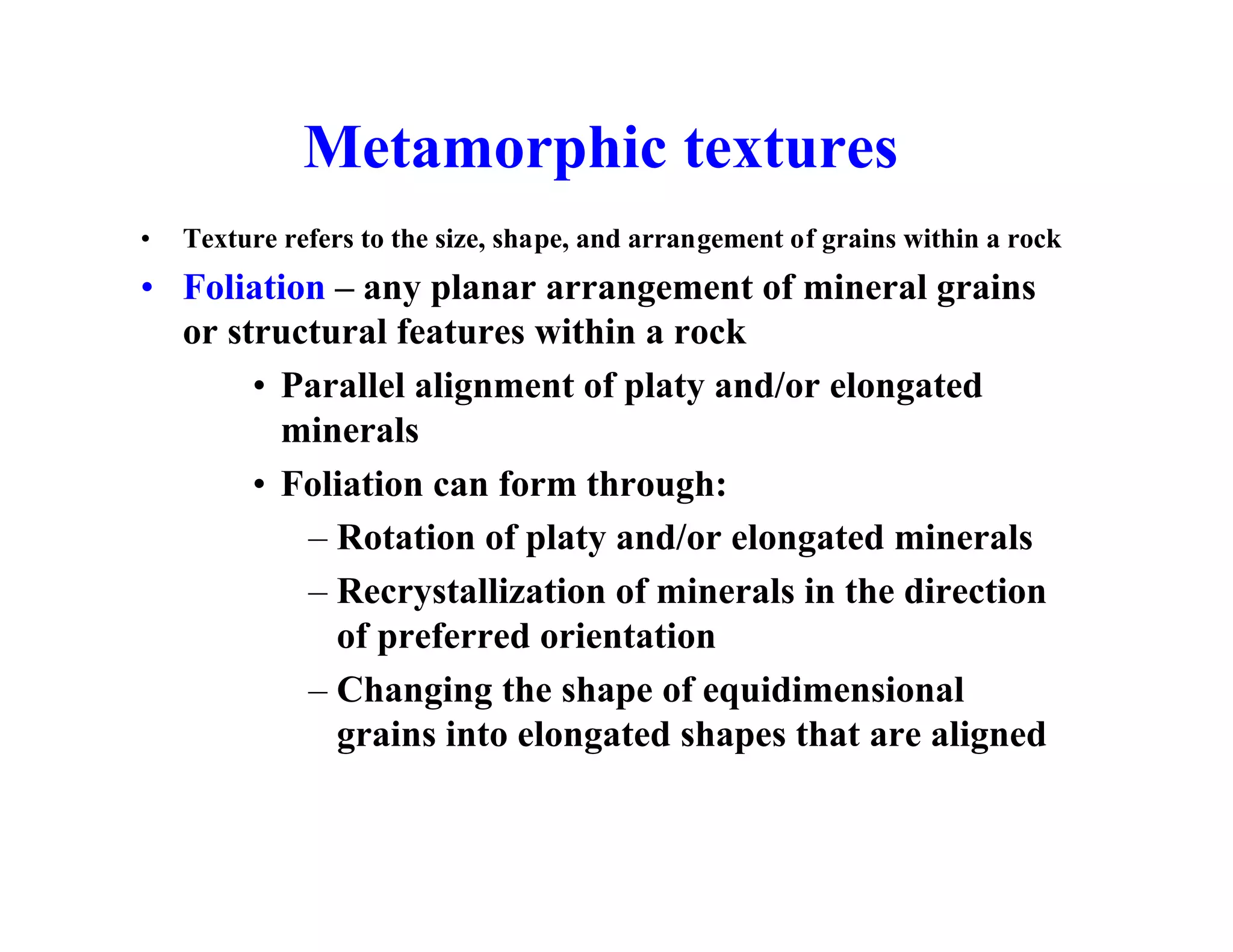
Examples of foliation
• Parallel alignment of flattened mineral grains and
pebbles
• Compositional banding
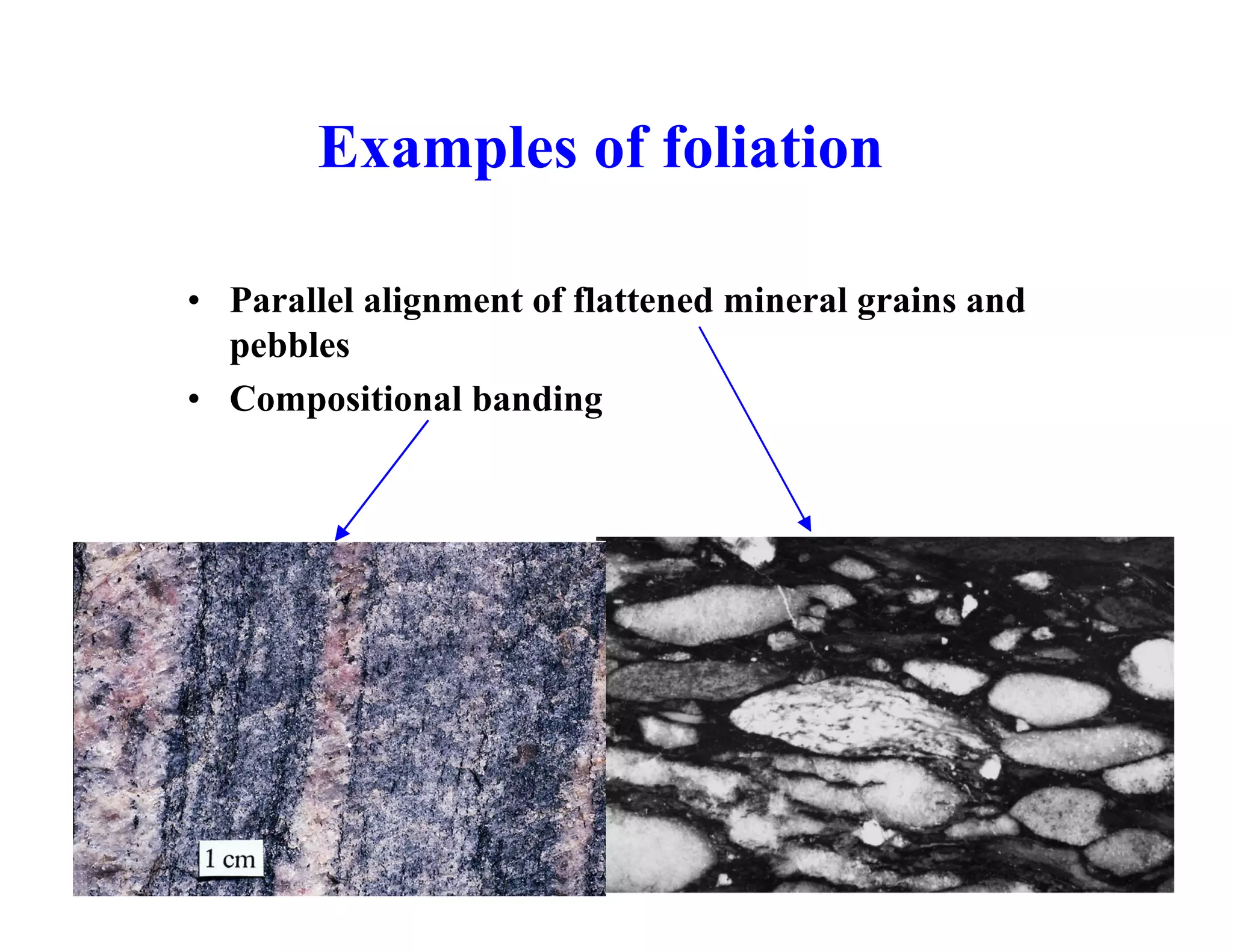
Development of foliation due
to directed pressure (stress)

Granite

Gneiss
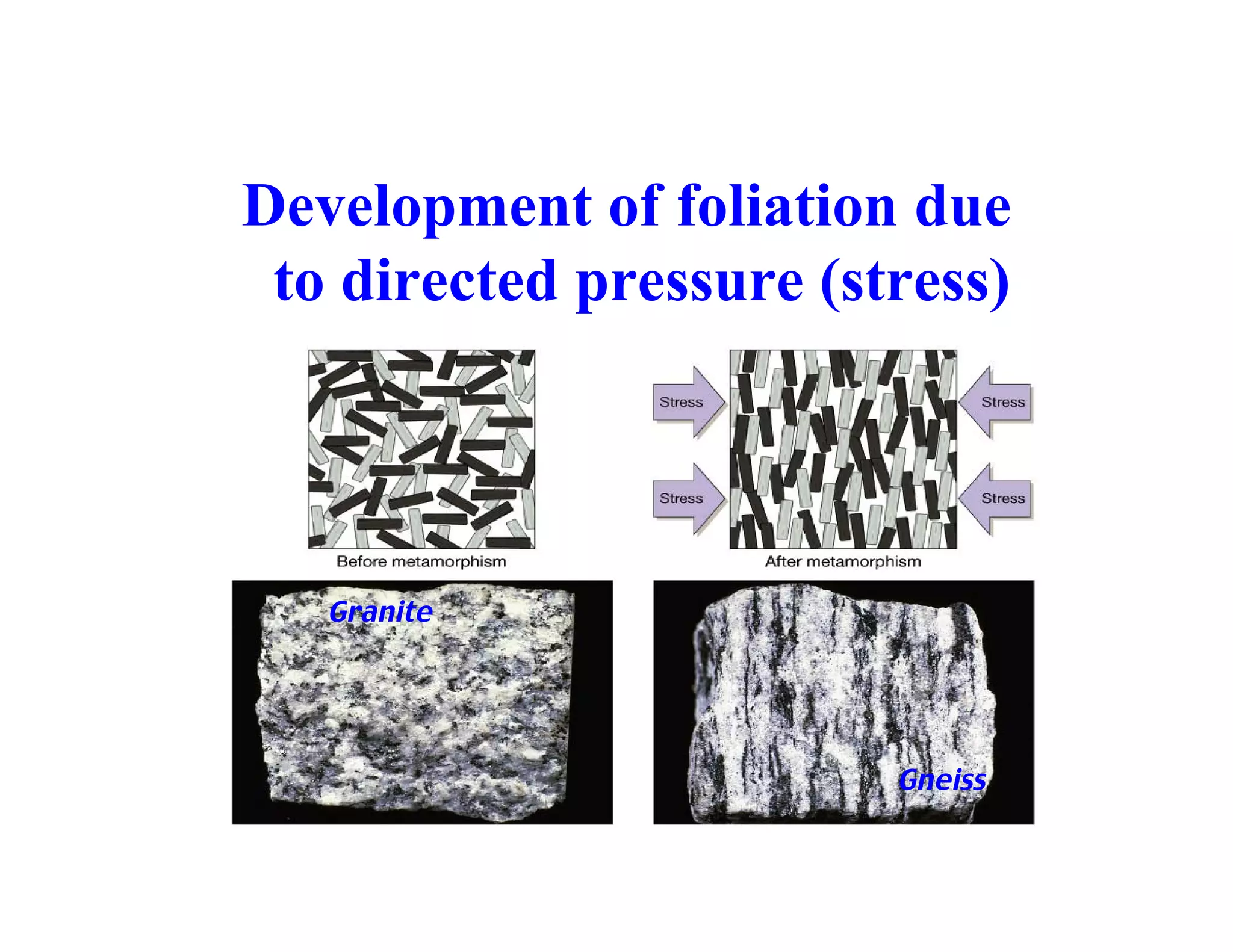
Directed pressure (stress) effects on
minerals
Rotation
Deformation
within
crystal
Dissolution &
precipitation
of crystal

• Rotation
• Deformation within crystal
• Dissolution and precipitation
of crystal
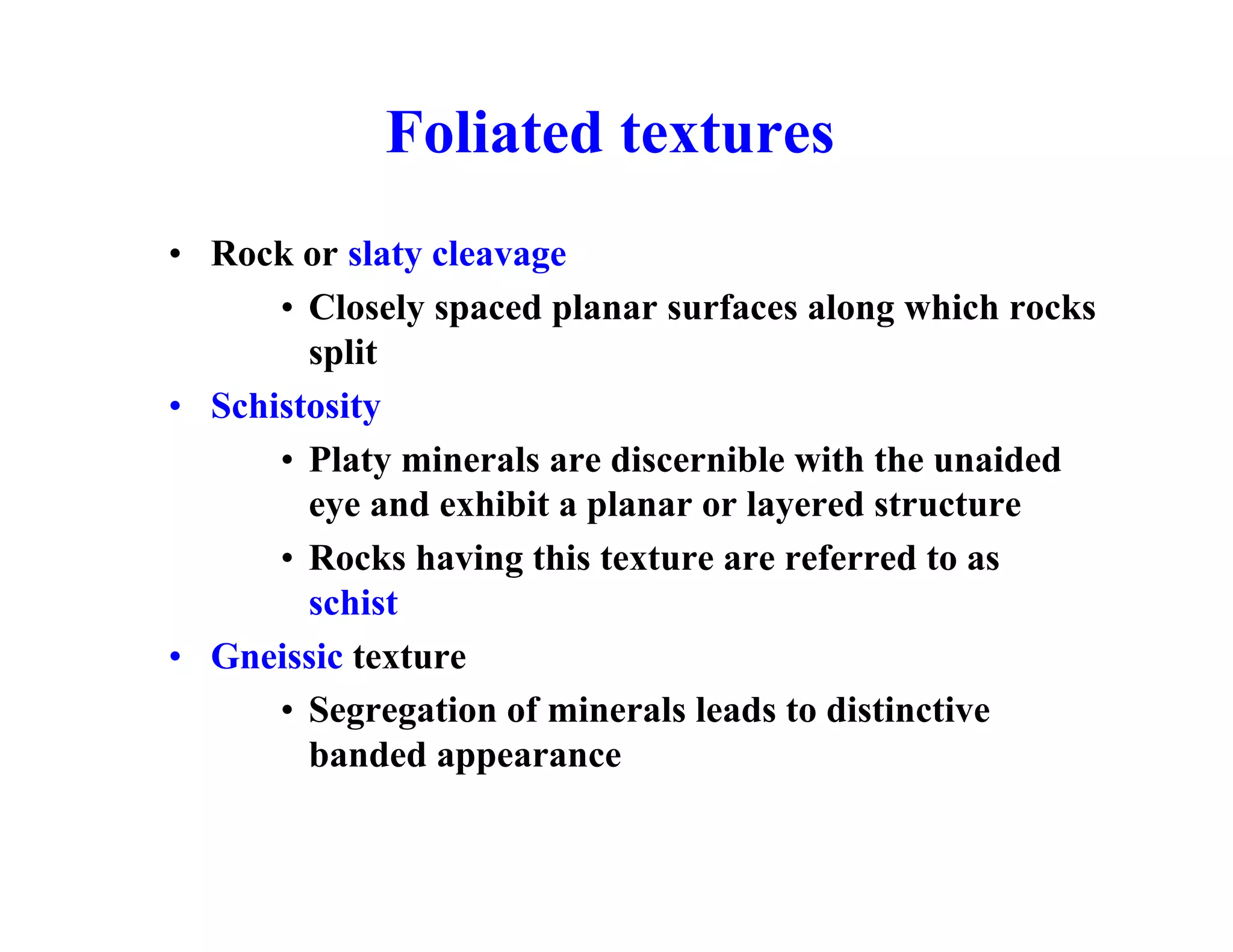
Foliated textures
• Rock or slaty cleavage
• Closely spaced planar surfaces along which rocks
split
• Schistosity
• Platy minerals are discernible with the unaided
eye and exhibit a planar or layered structure
• Rocks having this texture are referred to as
schist
• Gneissic texture
• Segregation of minerals leads to distinctive
banded appearance
Non-foliated textures
• Metamorphic rocks that lack foliation are referred to
as nonfoliated
• Develop in environments where stress (deformation) is
minimal
• Typically composed of minerals that exhibit
equidimensional crystals
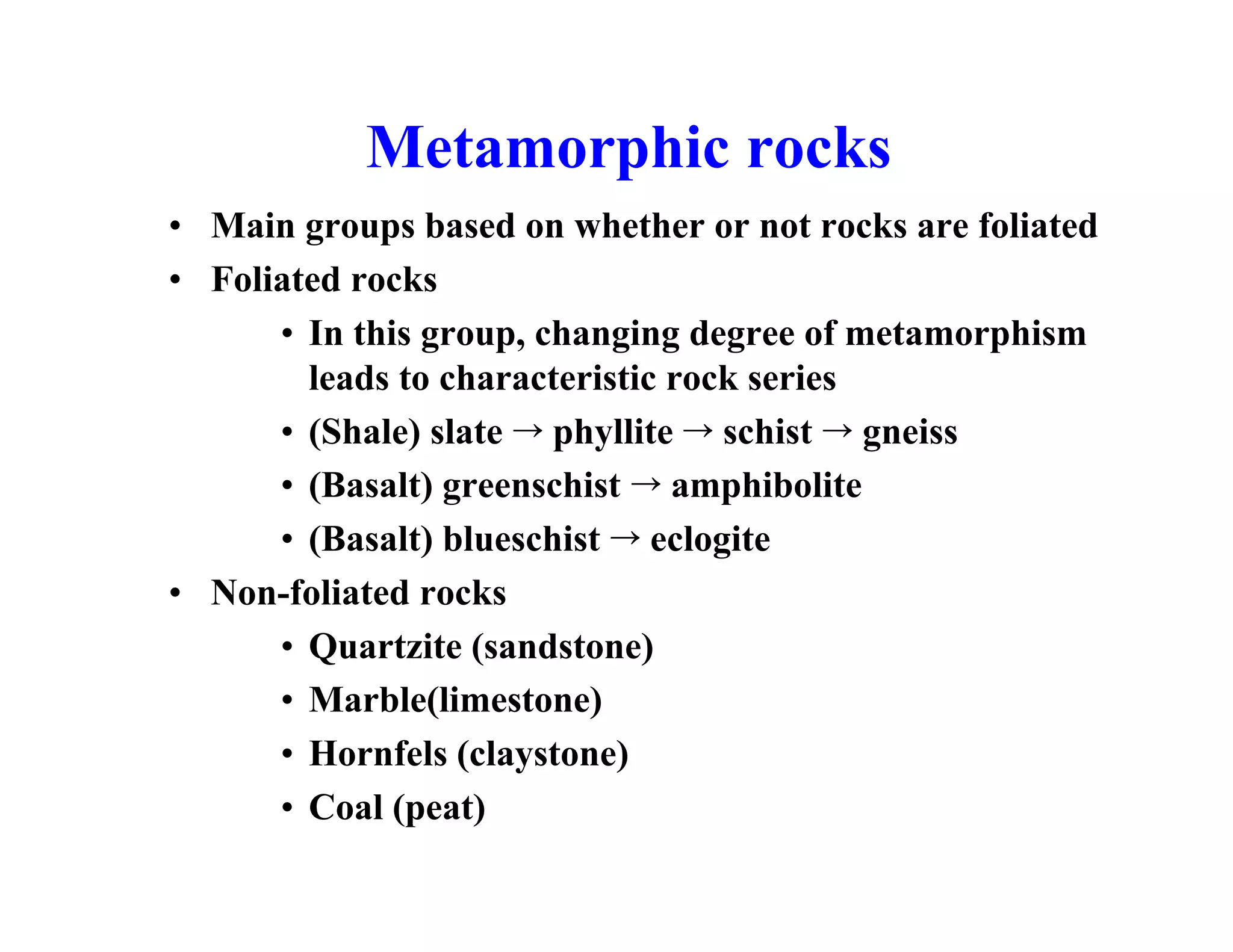
Metamorphic rocks
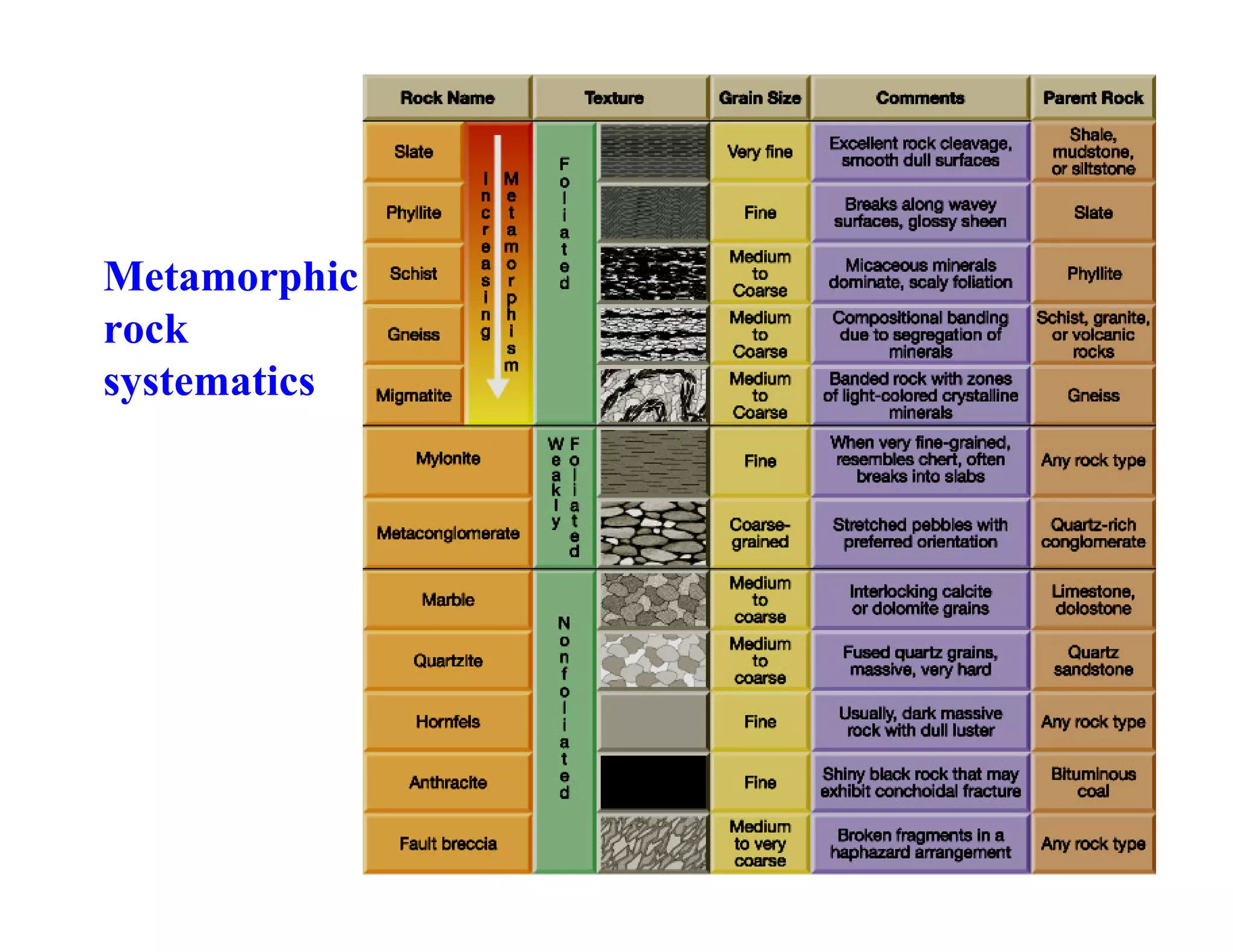
• Main groups based on whether or not rocks are foliated
• Foliated rocks
• In this group, changing degree of metamorphism
leads to characteristic rock series
• (Shale) slate ¡ phyllite ¡ schist ¡ gneiss
• (Basalt) greenschist ¡ amphibolite
• (Basalt) blueschist ¡ eclogite
• Non-foliated rocks
• Quartzite (sandstone)
• Marble(limestone)
• Hornfels (claystone)
• Coal (peat)
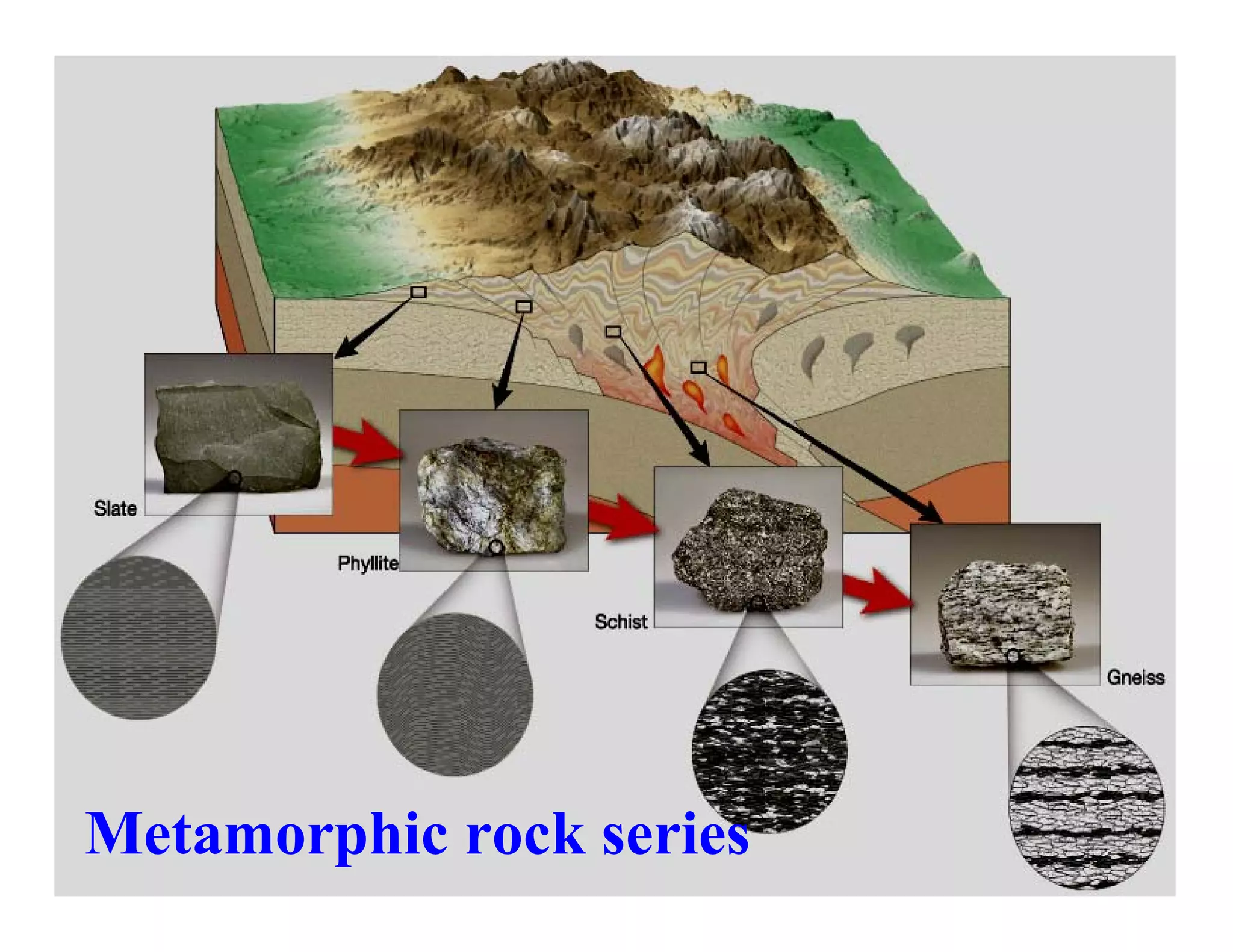
Metamorphic rock series
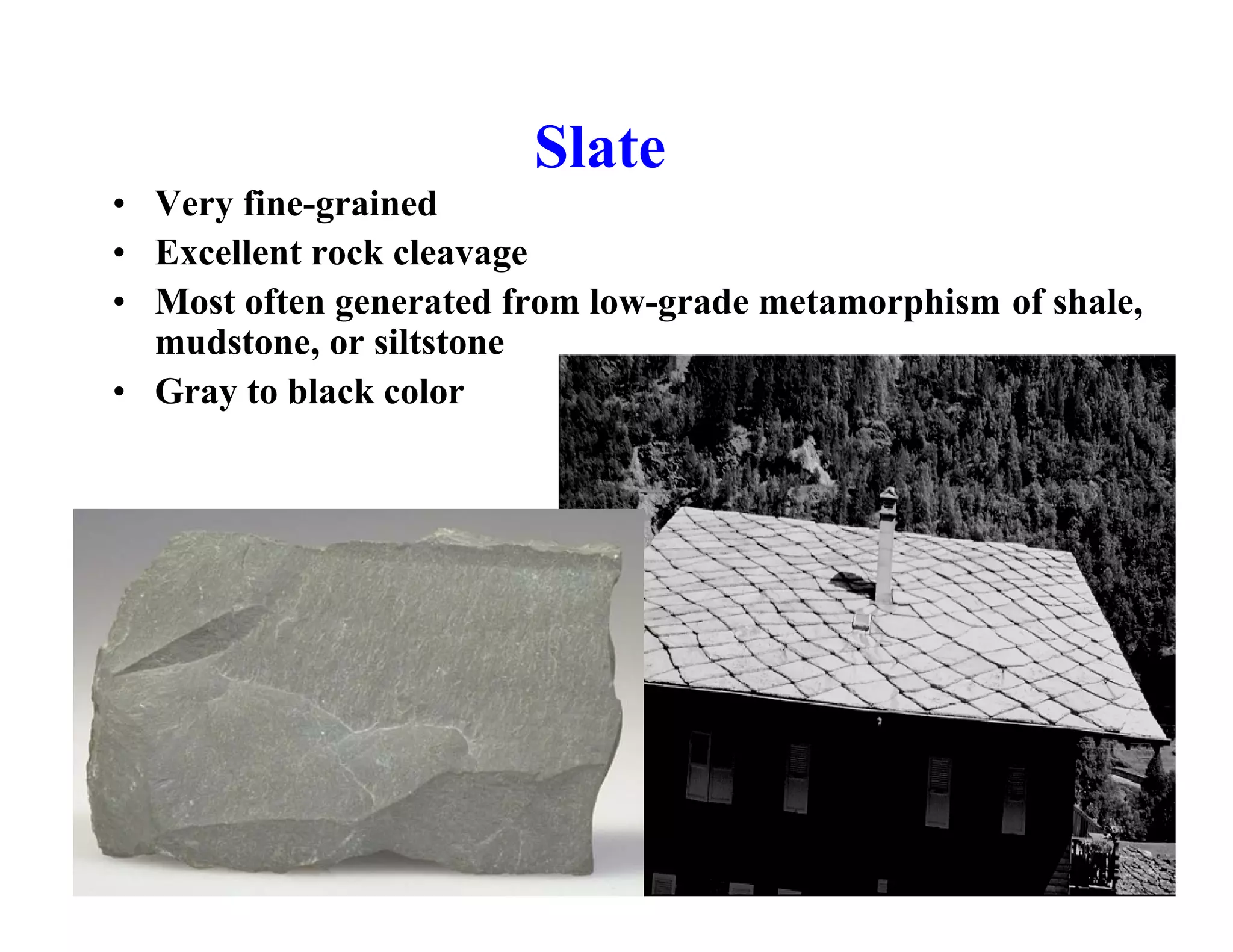
Slate
• Very fine-grained
• Excellent rock cleavage
• Most often generated from low-grade metamorphism of shale,
mudstone, or siltstone
• Gray to black color
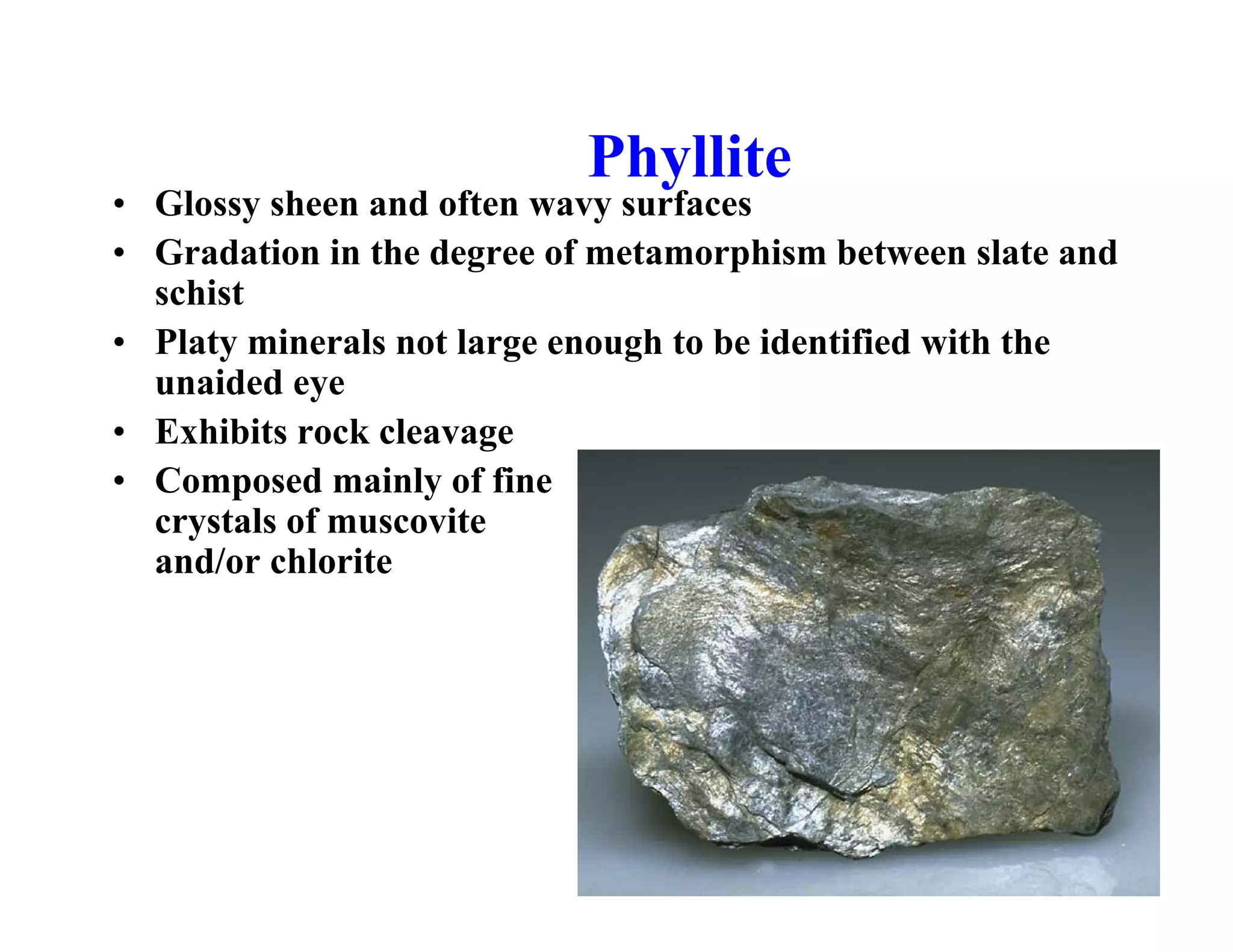
Phyllite

• Glossy sheen and often wavy surfaces
• Gradation in the degree of metamorphism between slate and
schist
• Platy minerals not large enough to be identified with the
unaided eye
• Exhibits rock cleavage
• Composed mainly of fine
crystals of muscovite
and/or chlorite
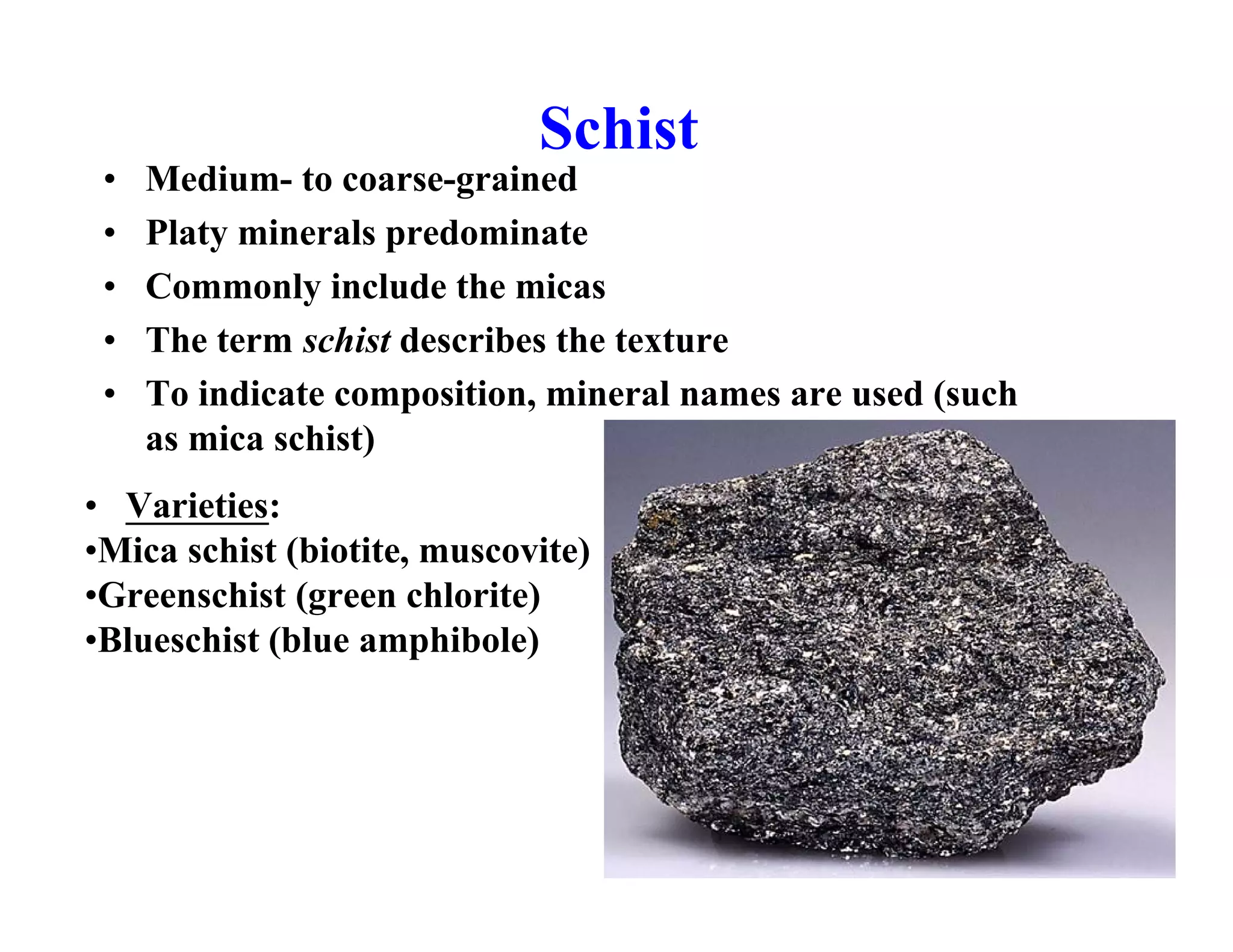
Schist
•
•
•
•
•

Medium- to coarse-grained
Platy minerals predominate
Commonly include the micas
The term schist describes the texture
To indicate composition, mineral names are used (such
as mica schist)

• Varieties:
•Mica schist (biotite, muscovite)
•Greenschist (green chlorite)
•Blueschist (blue amphibole)
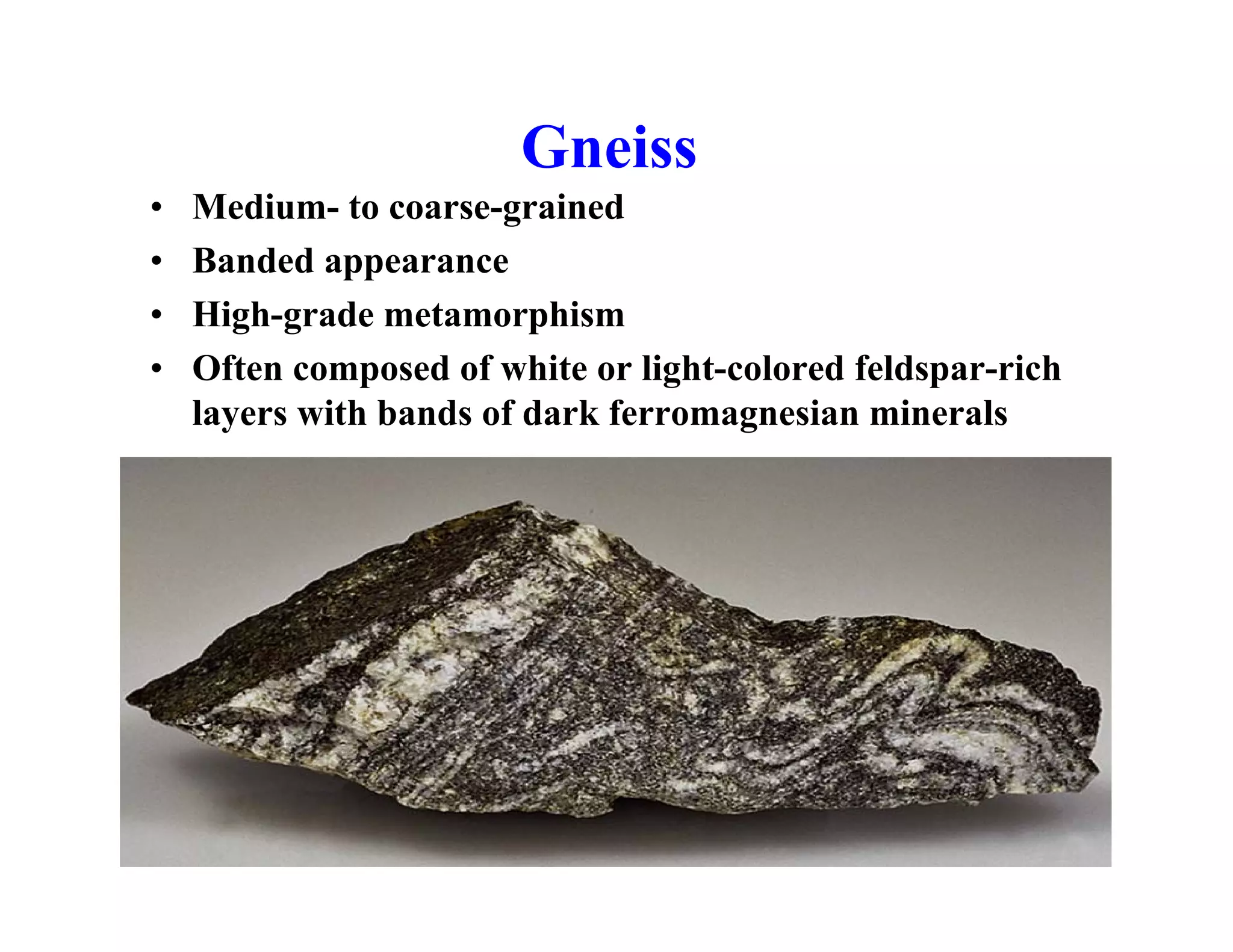
Gneiss
•
•
•
•

Medium- to coarse-grained
Banded appearance
High-grade metamorphism
Often composed of white or light-colored feldspar-rich
layers with bands of dark ferromagnesian minerals
Marble
•
•
•
•
•
•

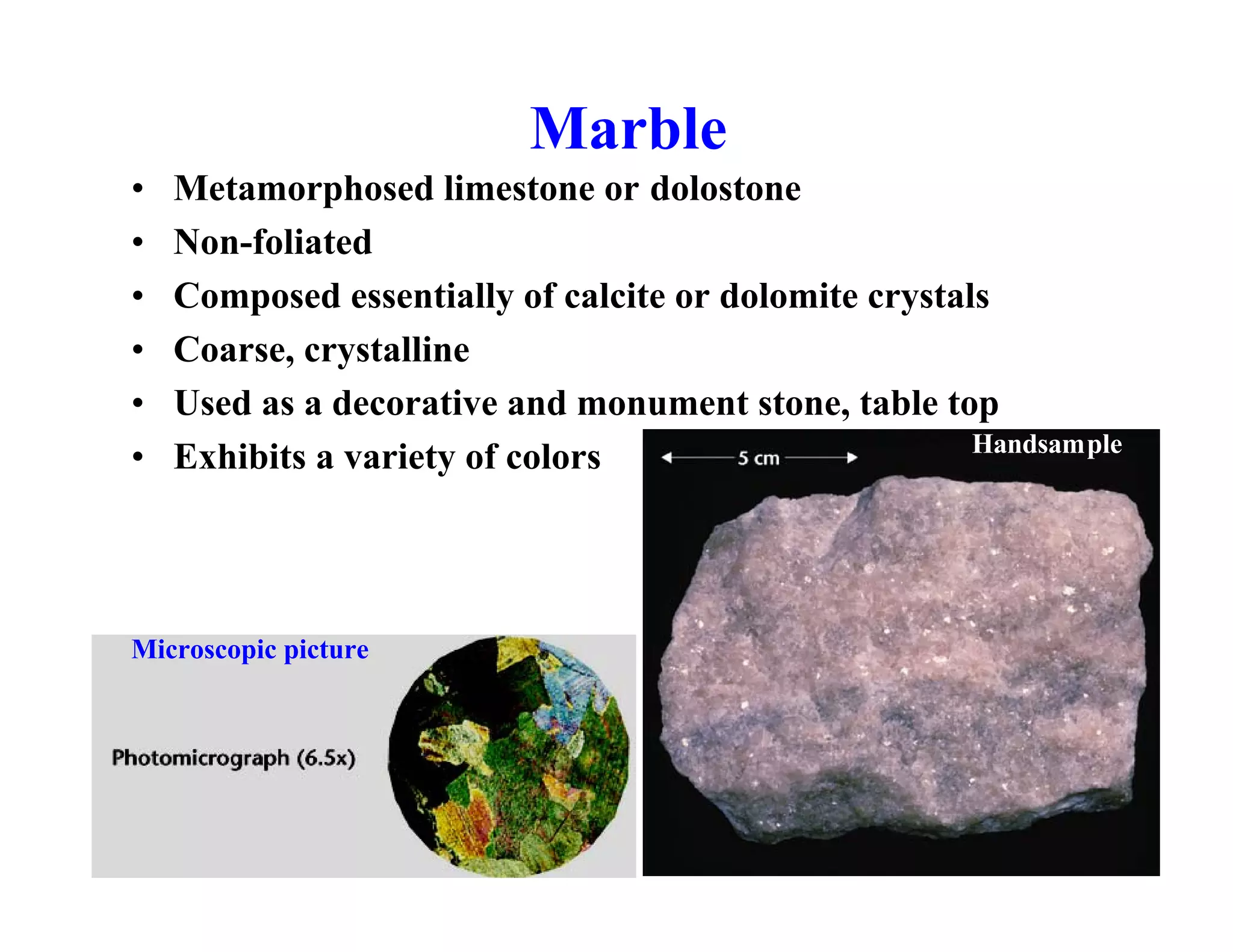
Metamorphosed limestone or dolostone
Non-foliated
Composed essentially of calcite or dolomite crystals
Coarse, crystalline
Used as a decorative and monument stone, table top
Handsample
Exhibits a variety of colors

Microscopic picture
Quartzite
•
•
•
•

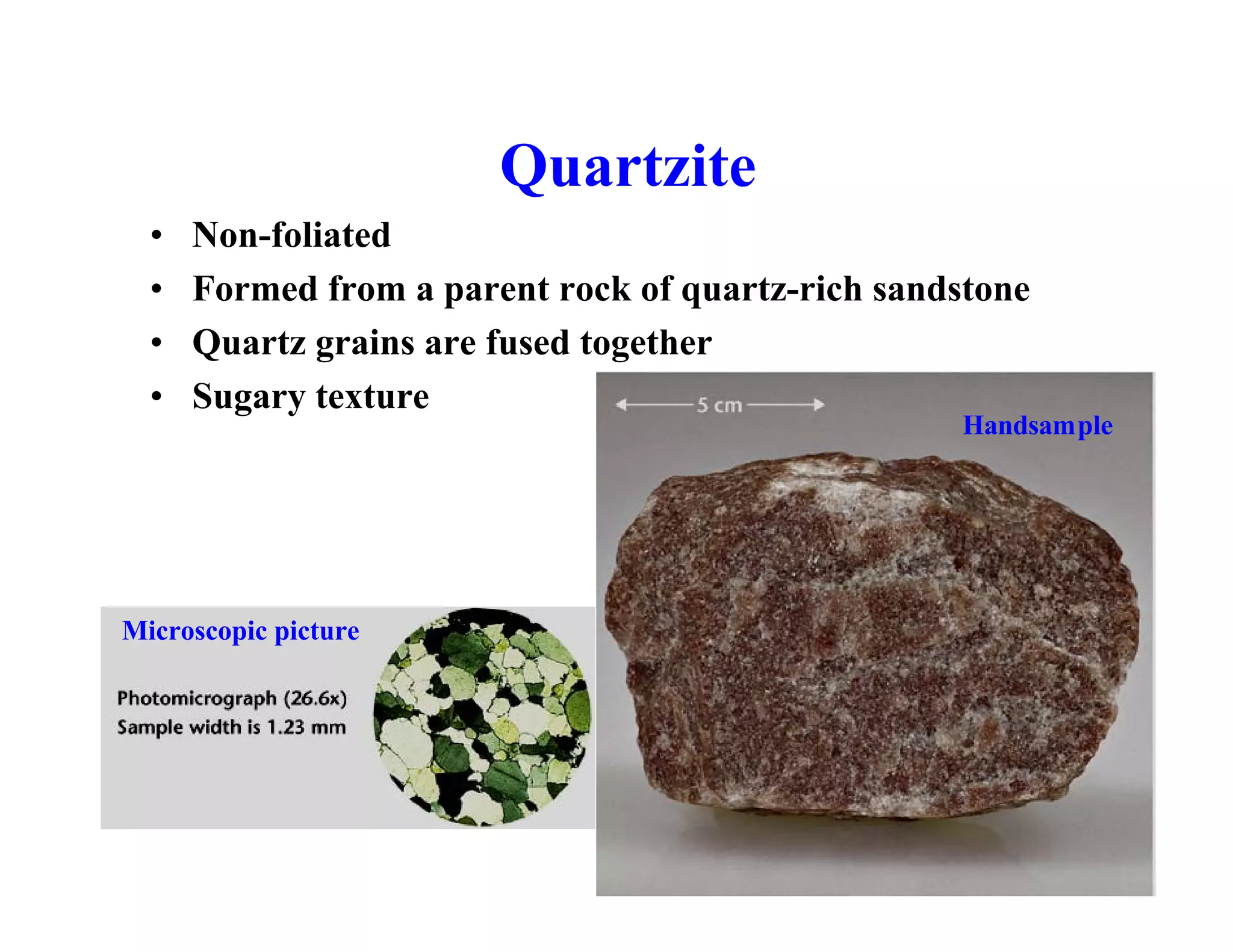
Non-foliated
Formed from a parent rock of quartz-rich sandstone
Quartz grains are fused together
Sugary texture

Microscopic picture

Handsample
Metamorphic
rock
systematics
Metamorphic environments
• Contact or thermal metamorphism (low P, high T)
• Regional metamorphism
• Type A: Pressure and Temperature both
increase comparable
• Type B: Pressure increases relatively faster than
temperature (high P, low T metamorphism)
• Burial metamorphism
• Others
– Hydro-metamrophism
– Shock-metamorphism
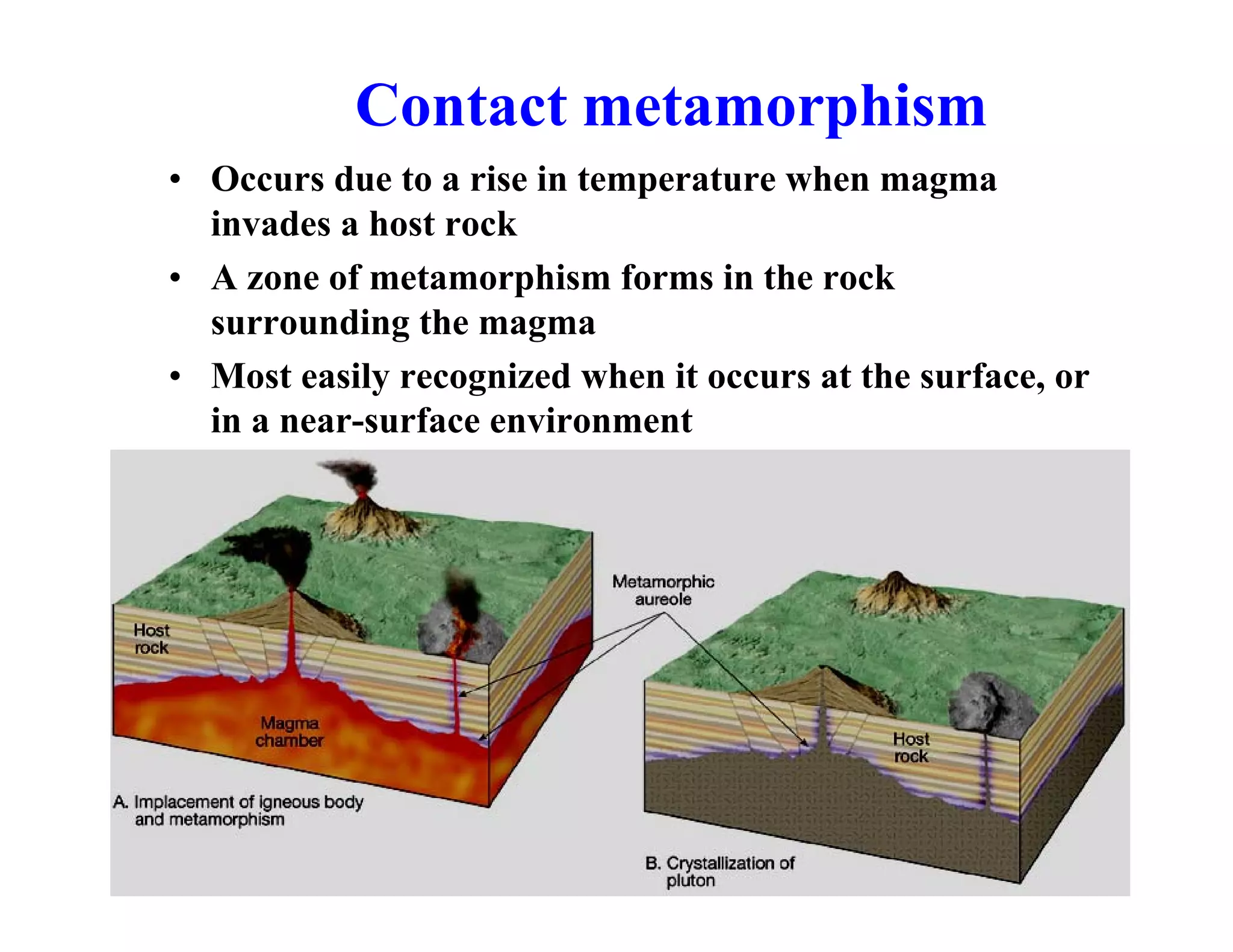
Contact metamorphism
• Occurs due to a rise in temperature when magma
invades a host rock
• A zone of metamorphism forms in the rock
surrounding the magma
• Most easily recognized when it occurs at the surface, or
in a near-surface environment
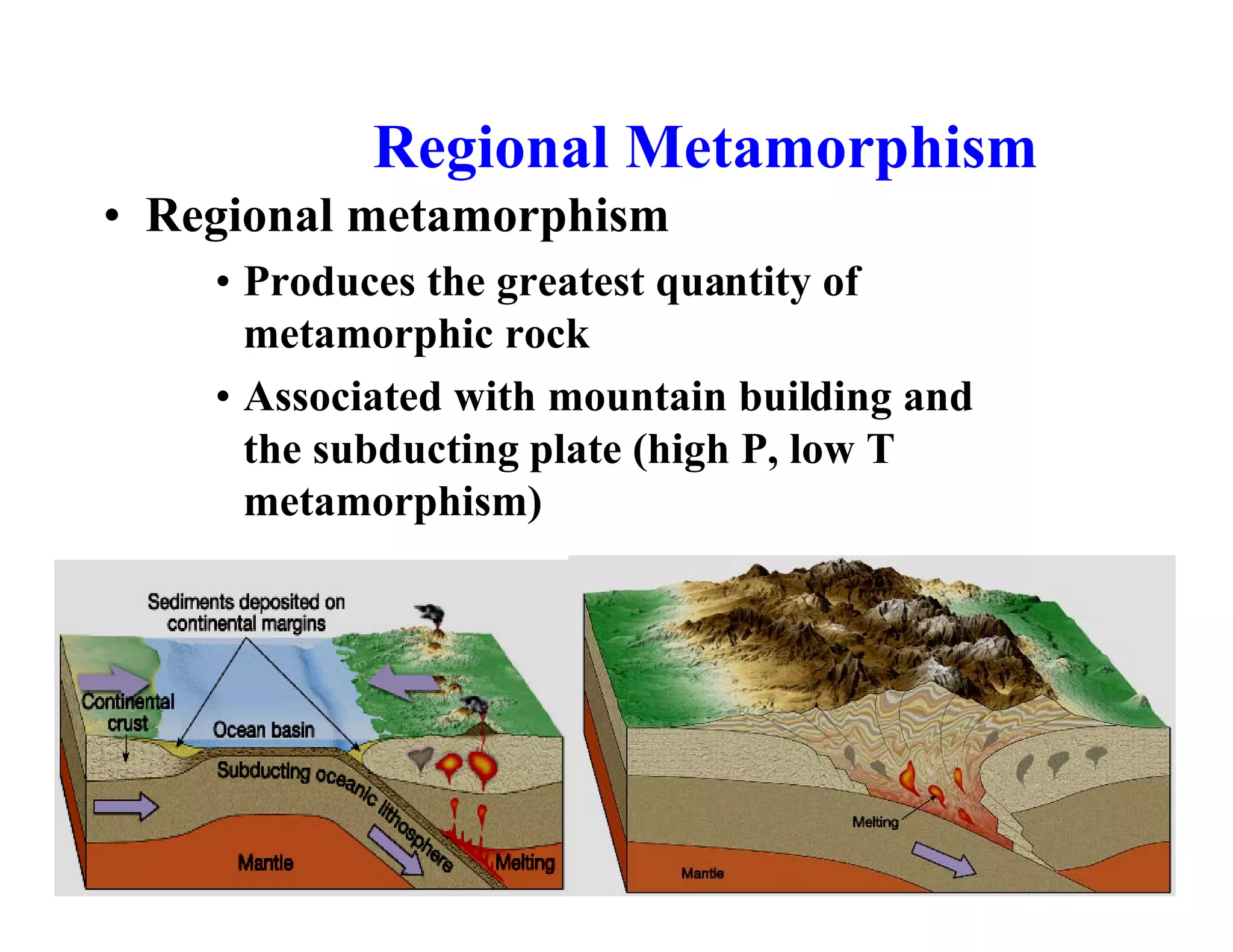
Regional Metamorphism
• Regional metamorphism
• Produces the greatest quantity of
metamorphic rock
• Associated with mountain building and
the subducting plate (high P, low T
metamorphism)
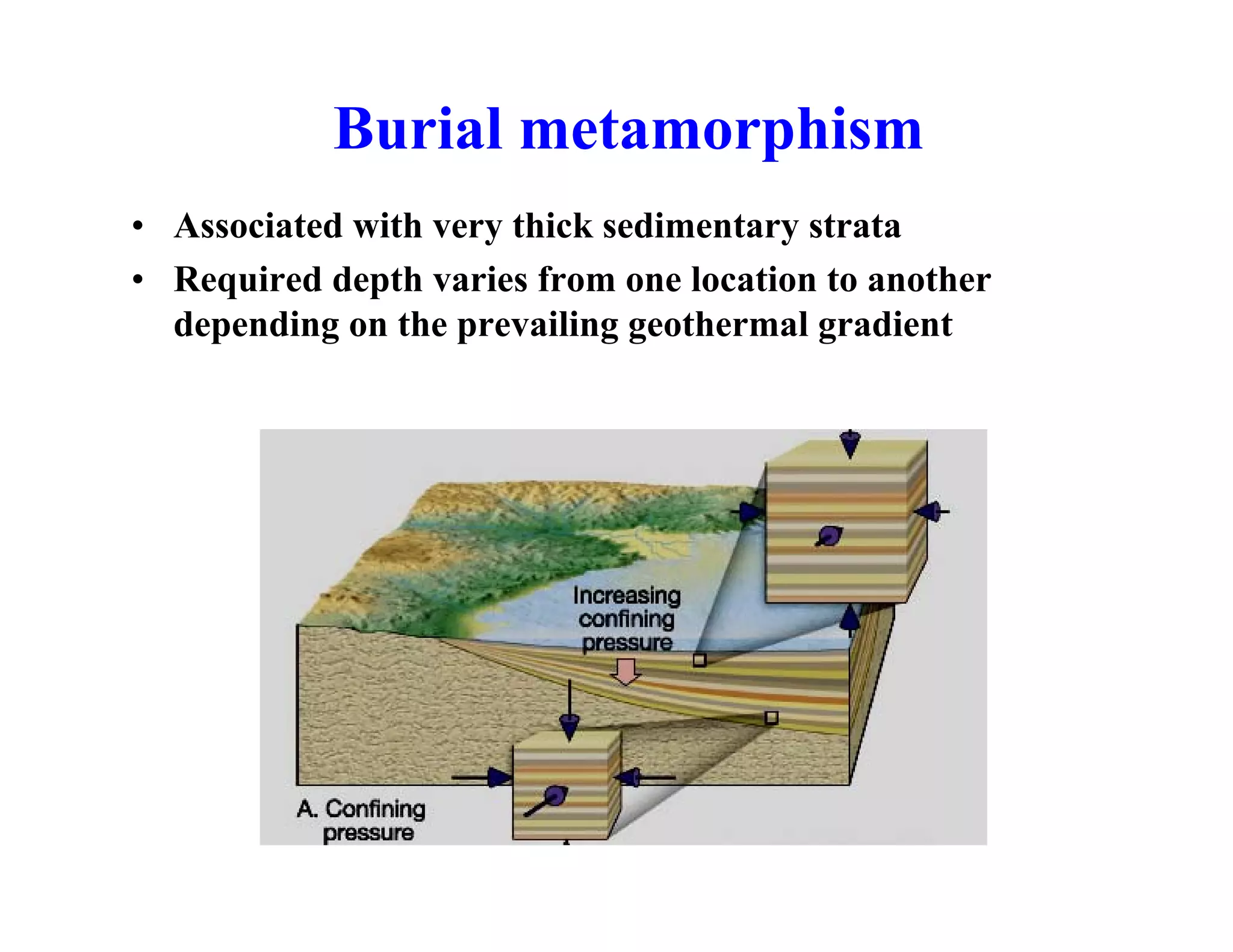
Burial metamorphism
• Associated with very thick sedimentary strata
• Required depth varies from one location to another
depending on the prevailing geothermal gradient
Other types of metamorphism
• Hydrothermal metamorphism
• Chemical alteration caused when hot, ion-rich
fluids, called hydrothermal solutions, circulate
through fissures and cracks that develop in rock
• Most widespread along the axis of the mid-ocean
ridge system
• Impact metamorphism

• Occurs when high speed projectiles called
meteorites strike Earth’s surface
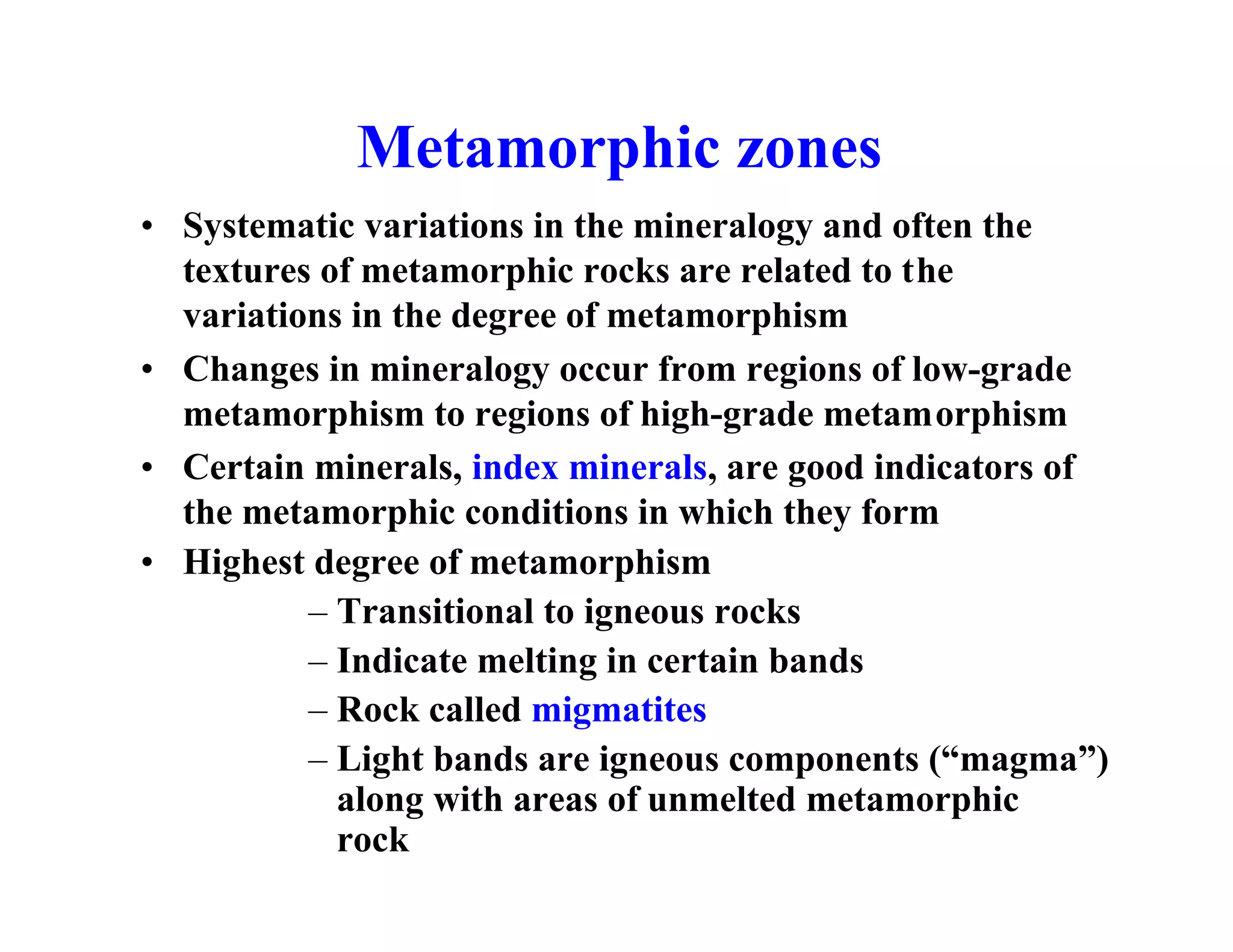
Metamorphic zones
• Systematic variations in the mineralogy and often the
textures of metamorphic rocks are related to the
variations in the degree of metamorphism
• Changes in mineralogy occur from regions of low-grade
metamorphism to regions of high-grade metamorphism
• Certain minerals, index minerals, are good indicators of
the metamorphic conditions in which they form
• Highest degree of metamorphism
– Transitional to igneous rocks
– Indicate melting in certain bands
– Rock called migmatites
– Light bands are igneous components (“magma”)
along with areas of unmelted metamorphic
rock
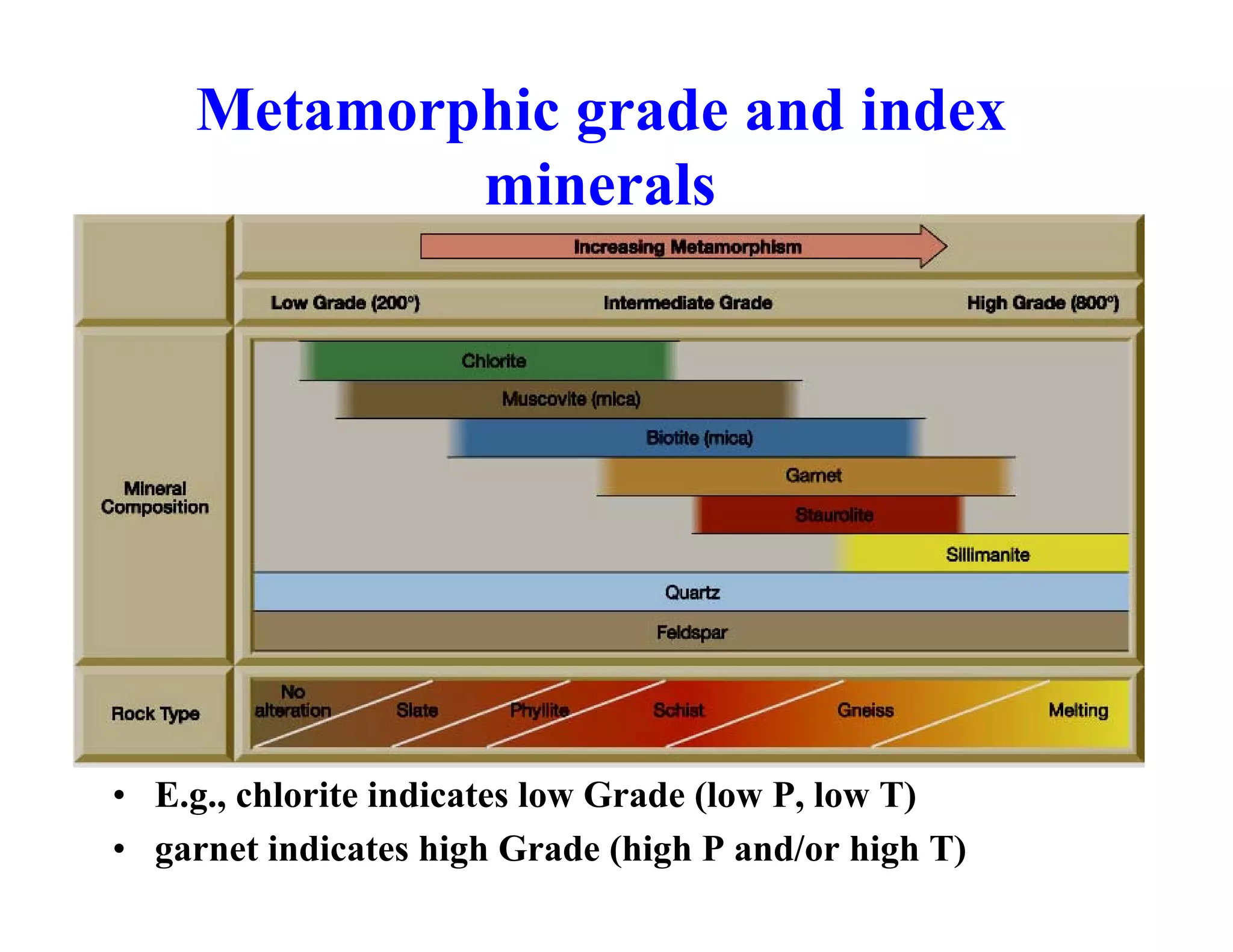
Metamorphic grade and index
minerals

• E.g., chlorite indicates low Grade (low P, low T)
• garnet indicates high Grade (high P and/or high T)
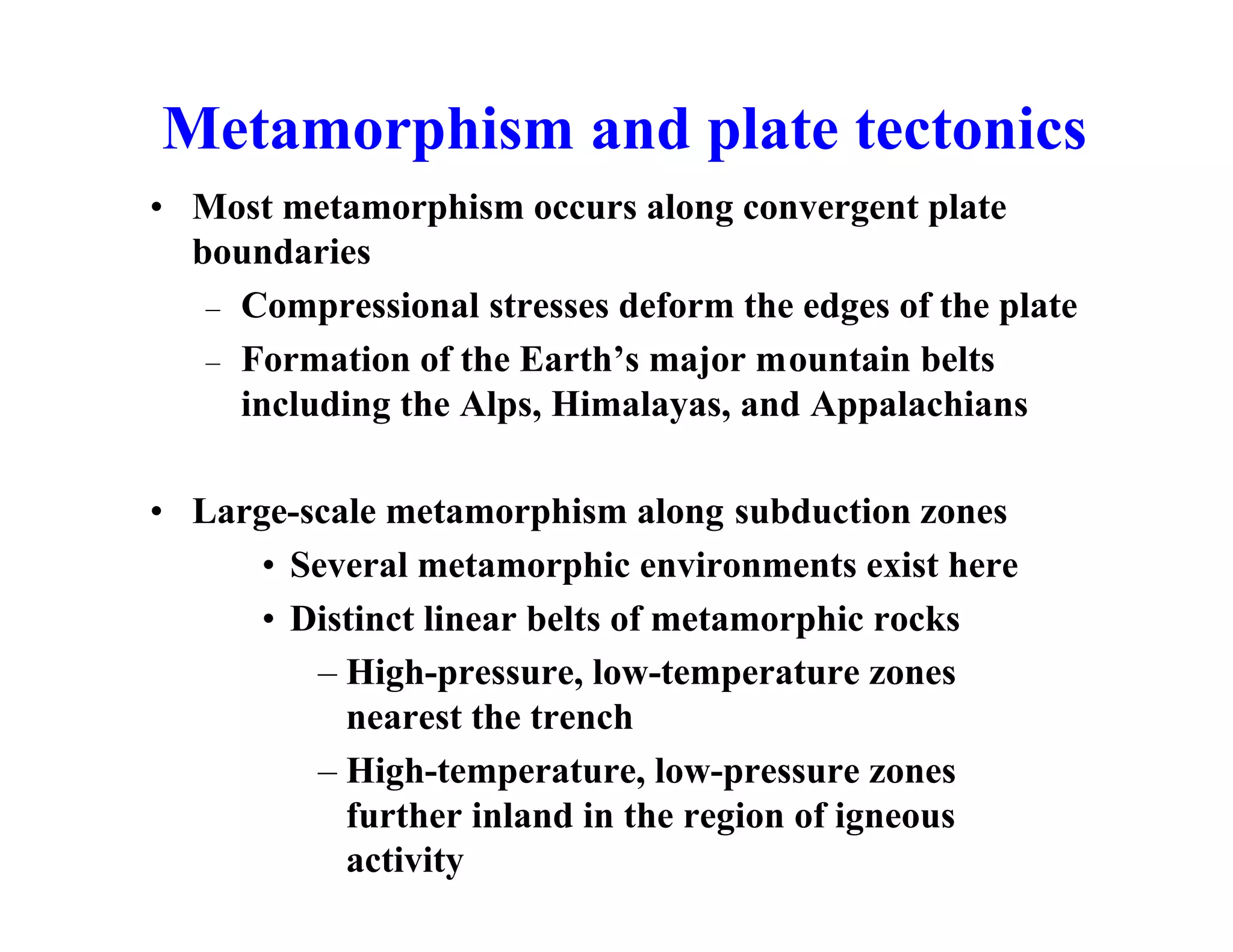
Metamorphism and plate tectonics
• Most metamorphism occurs along convergent plate
boundaries
– Compressional stresses deform the edges of the plate
– Formation of the Earth’s major mountain belts
including the Alps, Himalayas, and Appalachians
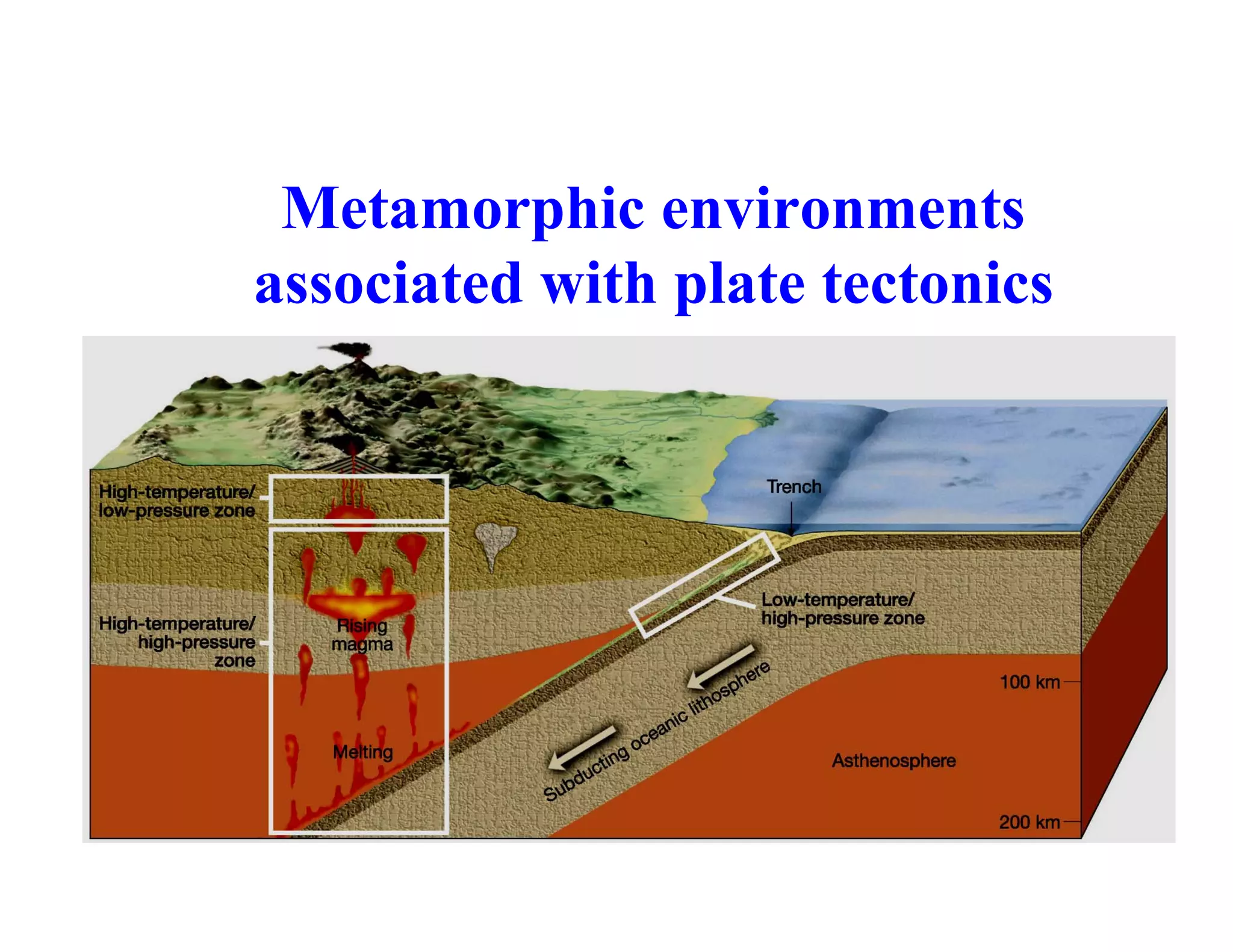
• Large-scale metamorphism along subduction zones
• Several metamorphic environments exist here
• Distinct linear belts of metamorphic rocks
– High-pressure, low-temperature zones
nearest the trench
– High-temperature, low-pressure zones
further inland in the region of igneous
activity
Metamorphic environments
associated with plate tectonics

Metamorphism and metamorphic rocks ppt

  • 1.
    Metamorphism and metamorphic rocks •Rocks created by heat, pressure and/or chemically reactive fluids • Metamorphic rocks are produced from • Igneous rocks • Sedimentary rocks • Other metamorphic rocks
  • 2.
    Metamorphism • Metamorphism progressesincrementally from lowgrade to high-grade • During metamorphism (transformation) the rock remains essentially solid • Metamorphism characterized by • Growth of new minerals from pre-existing minerals through recrystallization • Deformation of existing minerals – Change in shape – Change in orientation • Metamorphic settings
  • 3.
    Growth of newminerals Mica garnet schist Garnet crystal
  • 4.
    Deformation of rocksand minerals Layers are folded and broken
  • 5.
    Metamorphism settings • Contactor thermal metamorphism • Driven by a rise in temperature within the host rock • Regional metamorphism • Occurs during mountain building • Produces the greatest volume of metamorphic rock • Burial metamorphism • Occurs at bottom of thick sedimentary rock piles • Hydrothermal metamorphism • chemical alterations from hot, ion-rich water • Others
  • 6.
    Agents of metamorphism •Heat • The most important agent • Two sources of heat – Contact metamorphism – heat from magma – An increase in temperature with depth due to the geothermal gradient • Pressure (stress) • Increases with depth • Fluids • Helps transporting elements from one crystal to a new metamorphic crystal (enhances migration of ions0 • Mainly water with other volatile components
  • 7.
    Origin of pressurein metamorphism • Confining pressure applies forces equally in all directions • Rocks may also be subjected to differential stress which is unequal in different directions
  • 8.
    Importance of parentrock • Most metamorphic rocks have the same overall chemical composition as the parent rock from which they formed • Mineral makeup determines, to a large extent, the degree to which each metamorphic agent will cause change
  • 9.
    Metamorphic textures • Texture refersto the size, shape, and arrangement of grains within a rock • Foliation – any planar arrangement of mineral grains or structural features within a rock • Parallel alignment of platy and/or elongated minerals • Foliation can form through: – Rotation of platy and/or elongated minerals – Recrystallization of minerals in the direction of preferred orientation – Changing the shape of equidimensional grains into elongated shapes that are aligned
  • 10.
    Examples of foliation •Parallel alignment of flattened mineral grains and pebbles • Compositional banding
  • 11.
    Development of foliationdue to directed pressure (stress) Granite Gneiss
  • 12.
    Directed pressure (stress)effects on minerals Rotation Deformation within crystal Dissolution & precipitation of crystal • Rotation • Deformation within crystal • Dissolution and precipitation of crystal
  • 13.
    Foliated textures • Rockor slaty cleavage • Closely spaced planar surfaces along which rocks split • Schistosity • Platy minerals are discernible with the unaided eye and exhibit a planar or layered structure • Rocks having this texture are referred to as schist • Gneissic texture • Segregation of minerals leads to distinctive banded appearance
  • 14.
    Non-foliated textures • Metamorphicrocks that lack foliation are referred to as nonfoliated • Develop in environments where stress (deformation) is minimal • Typically composed of minerals that exhibit equidimensional crystals
  • 15.
    Metamorphic rocks • Maingroups based on whether or not rocks are foliated • Foliated rocks • In this group, changing degree of metamorphism leads to characteristic rock series • (Shale) slate ¡ phyllite ¡ schist ¡ gneiss • (Basalt) greenschist ¡ amphibolite • (Basalt) blueschist ¡ eclogite • Non-foliated rocks • Quartzite (sandstone) • Marble(limestone) • Hornfels (claystone) • Coal (peat)
  • 16.
  • 17.
    Slate • Very fine-grained •Excellent rock cleavage • Most often generated from low-grade metamorphism of shale, mudstone, or siltstone • Gray to black color
  • 18.
    Phyllite • Glossy sheenand often wavy surfaces • Gradation in the degree of metamorphism between slate and schist • Platy minerals not large enough to be identified with the unaided eye • Exhibits rock cleavage • Composed mainly of fine crystals of muscovite and/or chlorite
  • 19.
    Schist • • • • • Medium- to coarse-grained Platyminerals predominate Commonly include the micas The term schist describes the texture To indicate composition, mineral names are used (such as mica schist) • Varieties: •Mica schist (biotite, muscovite) •Greenschist (green chlorite) •Blueschist (blue amphibole)
  • 20.
    Gneiss • • • • Medium- to coarse-grained Bandedappearance High-grade metamorphism Often composed of white or light-colored feldspar-rich layers with bands of dark ferromagnesian minerals
  • 21.
    Marble • • • • • • Metamorphosed limestone ordolostone Non-foliated Composed essentially of calcite or dolomite crystals Coarse, crystalline Used as a decorative and monument stone, table top Handsample Exhibits a variety of colors Microscopic picture
  • 22.
    Quartzite • • • • Non-foliated Formed from aparent rock of quartz-rich sandstone Quartz grains are fused together Sugary texture Microscopic picture Handsample
  • 23.
  • 24.
    Metamorphic environments • Contactor thermal metamorphism (low P, high T) • Regional metamorphism • Type A: Pressure and Temperature both increase comparable • Type B: Pressure increases relatively faster than temperature (high P, low T metamorphism) • Burial metamorphism • Others – Hydro-metamrophism – Shock-metamorphism
  • 25.
    Contact metamorphism • Occursdue to a rise in temperature when magma invades a host rock • A zone of metamorphism forms in the rock surrounding the magma • Most easily recognized when it occurs at the surface, or in a near-surface environment
  • 26.
    Regional Metamorphism • Regionalmetamorphism • Produces the greatest quantity of metamorphic rock • Associated with mountain building and the subducting plate (high P, low T metamorphism)
  • 27.
    Burial metamorphism • Associatedwith very thick sedimentary strata • Required depth varies from one location to another depending on the prevailing geothermal gradient
  • 28.
    Other types ofmetamorphism • Hydrothermal metamorphism • Chemical alteration caused when hot, ion-rich fluids, called hydrothermal solutions, circulate through fissures and cracks that develop in rock • Most widespread along the axis of the mid-ocean ridge system • Impact metamorphism • Occurs when high speed projectiles called meteorites strike Earth’s surface
  • 29.
    Metamorphic zones • Systematicvariations in the mineralogy and often the textures of metamorphic rocks are related to the variations in the degree of metamorphism • Changes in mineralogy occur from regions of low-grade metamorphism to regions of high-grade metamorphism • Certain minerals, index minerals, are good indicators of the metamorphic conditions in which they form • Highest degree of metamorphism – Transitional to igneous rocks – Indicate melting in certain bands – Rock called migmatites – Light bands are igneous components (“magma”) along with areas of unmelted metamorphic rock
  • 30.
    Metamorphic grade andindex minerals • E.g., chlorite indicates low Grade (low P, low T) • garnet indicates high Grade (high P and/or high T)
  • 31.
    Metamorphism and platetectonics • Most metamorphism occurs along convergent plate boundaries – Compressional stresses deform the edges of the plate – Formation of the Earth’s major mountain belts including the Alps, Himalayas, and Appalachians • Large-scale metamorphism along subduction zones • Several metamorphic environments exist here • Distinct linear belts of metamorphic rocks – High-pressure, low-temperature zones nearest the trench – High-temperature, low-pressure zones further inland in the region of igneous activity
  • 32.