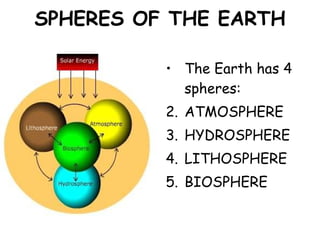
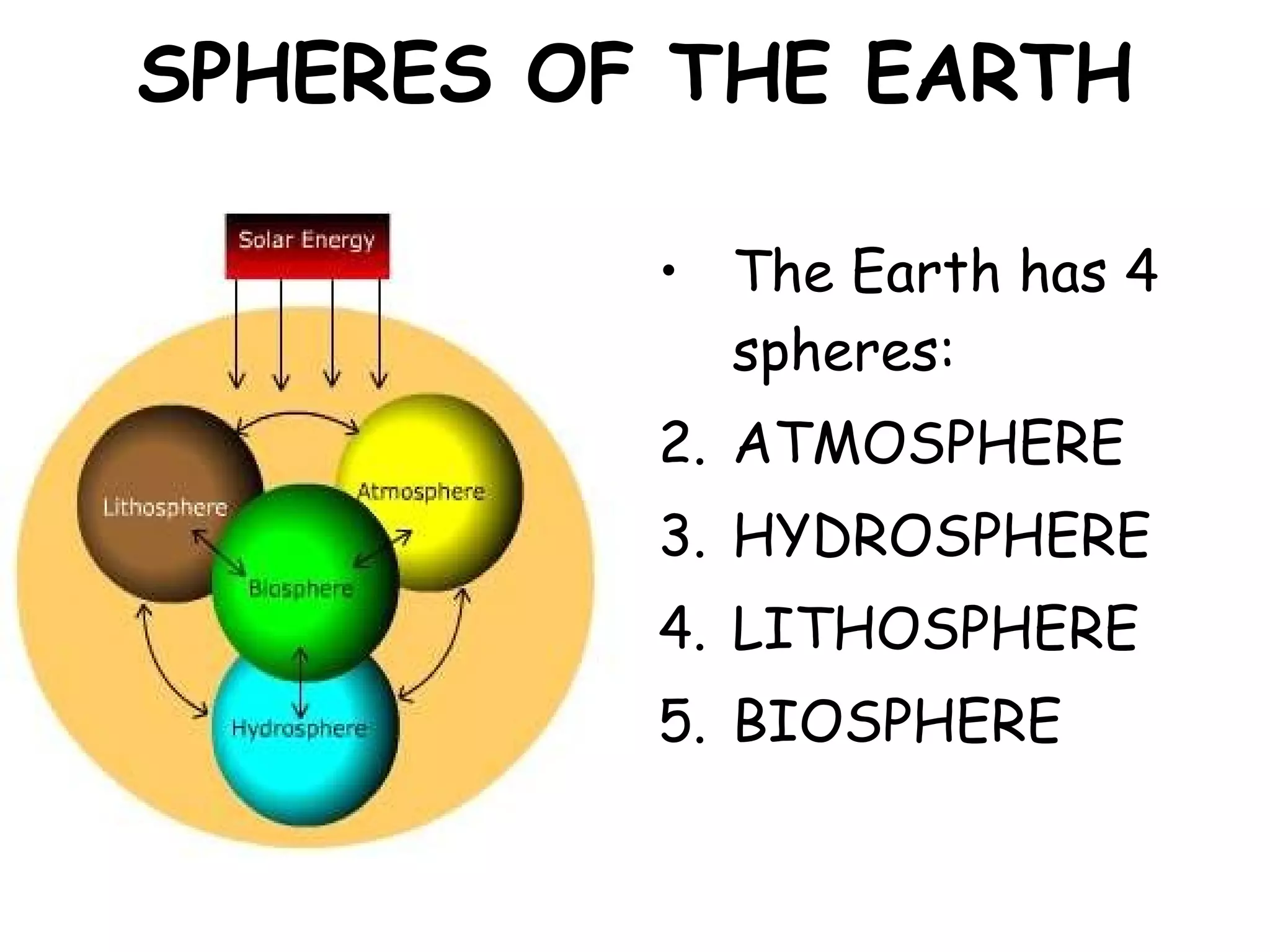
SPHERES OF THE EARTH The Earth has 4 spheres: ATMOSPHERE HYDROSPHERE LITHOSPHERE BIOSPHERE
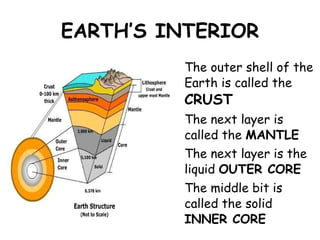
EARTH’S INTERIOR The outer shell of the Earth is called the  CRUST         The next layer is called the  MANTLE       The next layer is the liquid  OUTER CORE      The middle bit is called the solid  INNER CORE      
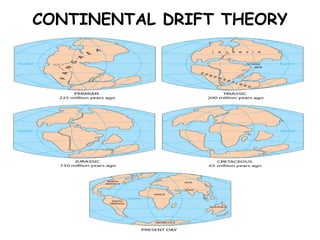
CONTINENTAL DRIFT THEORY
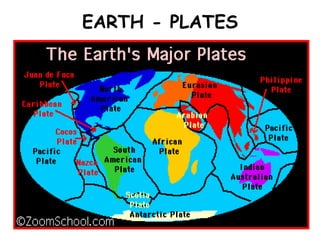
EARTH - PLATES
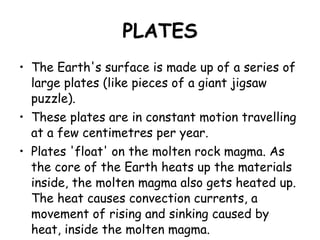
PLATES The Earth's surface is made up of a series of large plates (like pieces of a giant jigsaw puzzle).  These plates are in constant motion travelling at a few centimetres per year.  Plates 'float' on the molten rock magma. As the core of the Earth heats up the materials inside, the molten magma also gets heated up. The heat causes convection currents, a movement of rising and sinking caused by heat, inside the molten magma.
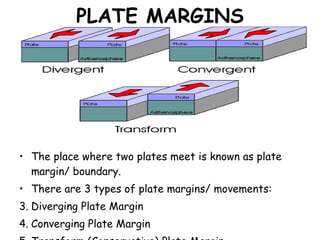
PLATE MARGINS The place where two plates meet is known as plate margin/ boundary. There are 3 types of plate margins/ movements: Diverging Plate Margin Converging Plate Margin Transform (Conservative) Plate Margin
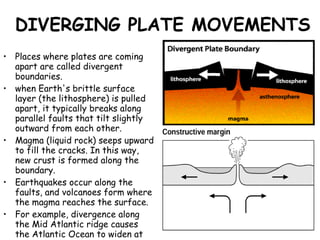
DIVERGING PLATE MOVEMENTS Places where plates are coming apart are called divergent boundaries. when Earth's brittle surface layer (the lithosphere) is pulled apart, it typically breaks along parallel faults that tilt slightly outward from each other.  Magma (liquid rock) seeps upward to fill the cracks. In this way, new crust is formed along the boundary.  Earthquakes occur along the faults, and volcanoes form where the magma reaches the surface.  For example, divergence along the Mid Atlantic ridge causes the Atlantic Ocean to widen at only about 2 centimeters per year.
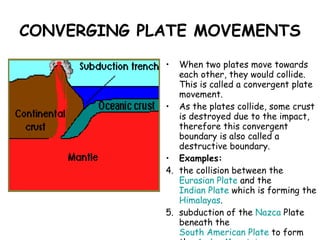
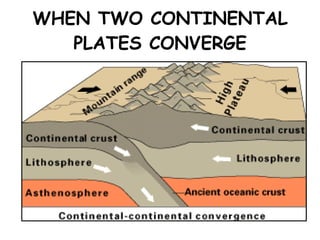
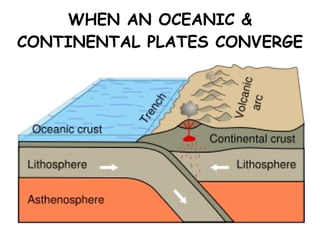
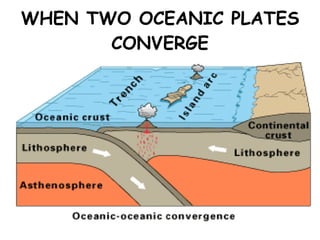
CONVERGING PLATE MOVEMENTS When two plates move towards each other, they would collide. This is called a convergent plate movement.  As the plates collide, some crust is destroyed due to the impact, therefore this convergent boundary is also called a destructive boundary.  Examples: the collision between the  Eurasian Plate  and the  Indian Plate  which is forming the  Himalayas .  subduction of the  Nazca  Plate  beneath the  South American Plate  to form the  Andes Mountains .
WHEN TWO CONTINENTAL PLATES CONVERGE
WHEN AN OCEANIC & CONTINENTAL PLATES CONVERGE
WHEN TWO OCEANIC PLATES CONVERGE
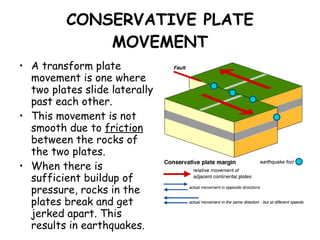
CONSERVATIVE PLATE MOVEMENT A transform plate movement is one where two plates slide laterally past each other.  This movement is not smooth due to  friction  between the rocks of the two plates.  When there is sufficient buildup of pressure, rocks in the plates break and get jerked apart. This   results in earthquakes.
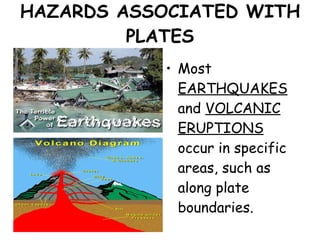
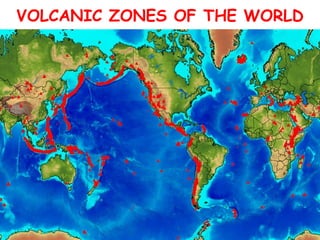
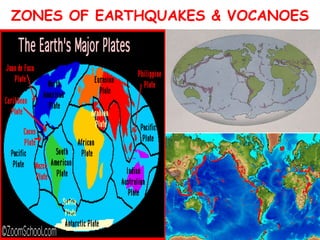
HAZARDS ASSOCIATED WITH PLATES Most  EARTHQUAKES  and  VOLCANIC ERUPTIONS  occur in specific areas, such as along plate boundaries.
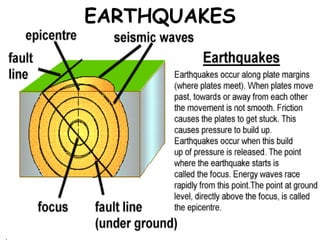
EARTHQUAKES
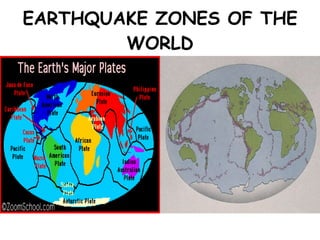
EARTHQUAKE ZONES OF THE WORLD
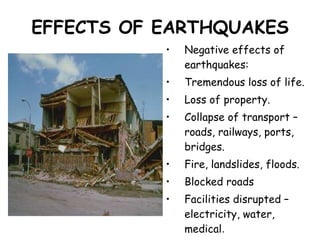
EFFECTS OF EARTHQUAKES Negative effects of earthquakes: Tremendous loss of life. Loss of property. Collapse of transport – roads, railways, ports, bridges. Fire, landslides, floods. Blocked roads Facilities disrupted – electricity, water, medical . Tsunamis
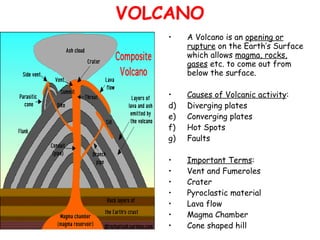
VOLCANO A Volcano is an  opening or rupture  on the Earth’s Surface which allows  magma, rocks, gases  etc. to come out from below the surface. Causes of Volcanic activity : Diverging plates Converging plates Hot Spots Faults Important Terms : Vent and Fumeroles Crater Pyroclastic material Lava flow Magma Chamber Cone shaped hill
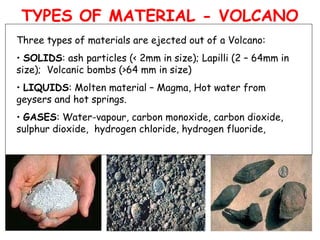
TYPES OF MATERIAL - VOLCANO Three types of materials are ejected out of a Volcano: SOLIDS : ash particles (< 2mm in size); Lapilli (2 – 64mm in size);  Volcanic bombs (>64 mm in size) LIQUIDS : Molten material – Magma, Hot water from geysers and hot springs. GASES : Water-vapour, carbon monoxide, carbon dioxide, sulphur dioxide,  hydrogen chloride, hydrogen fluoride,
TYPES OF VOLCANOES On the basis of frequency : Active Volcano:  which erupt frequently & can erupt any time. Eg. Mt. Mauna Loa, Hawaii. Dormant Volcano:  which have erupted in history but have not erupted since then. Eg. Mt. Rainier, USA  Extinct Volcano:  which may have erupted earlier but is now almost dead (>1000 yrs.) Eg. Mt. Kilimanjaro, Tanzania On the basis of shape and material they are made of: Shield Volcano:  Gentle slopes, basaltic lava, low viscosity. Eg. Mt. Mauna Loa, Hawaii Cinder Volcano:  Steep slopes, > 300 meters in height, made of pyroclastic material. Eg. Mt. Paracutin, Mexico   Composite / Strato Volcano:  Steep upper slopes & then gentle, Alternate layers of lava & ash. Eg. Mt. Vesuvius, Italy
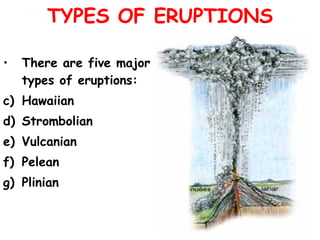
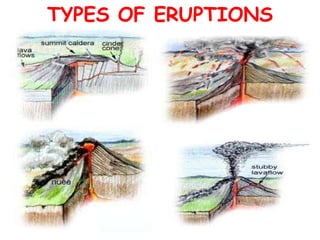
TYPES OF ERUPTIONS There are five major types of eruptions: Hawaiian Strombolian Vulcanian Pelean Plinian
TYPES OF ERUPTIONS
VOLCANIC ZONES OF THE WORLD
EFFECTS OF VOLCANO Positive Effects: Ash add to the soil fertility – farming New minerals may be discovered Promotes Tourism  Research and education purposes. Geothermal Energy – renewable energy. Negative effects Loss of life Loss of property (economic loss) Air Pollution (ash, smoke, gases, acid rain etc) Water pollution Lahars (mudflows with water) Earthquakes Increase in temperature of the area
ZONES OF EARTHQUAKES & VOCANOES

Plate Movements Ppt

  • 1.
    SPHERES OF THEEARTH The Earth has 4 spheres: ATMOSPHERE HYDROSPHERE LITHOSPHERE BIOSPHERE
  • 2.
    EARTH’S INTERIOR Theouter shell of the Earth is called the CRUST       The next layer is called the MANTLE     The next layer is the liquid OUTER CORE     The middle bit is called the solid INNER CORE     
  • 3.
  • 4.
  • 5.
    PLATES The Earth'ssurface is made up of a series of large plates (like pieces of a giant jigsaw puzzle). These plates are in constant motion travelling at a few centimetres per year. Plates 'float' on the molten rock magma. As the core of the Earth heats up the materials inside, the molten magma also gets heated up. The heat causes convection currents, a movement of rising and sinking caused by heat, inside the molten magma.
  • 6.
    PLATE MARGINS Theplace where two plates meet is known as plate margin/ boundary. There are 3 types of plate margins/ movements: Diverging Plate Margin Converging Plate Margin Transform (Conservative) Plate Margin
  • 7.
    DIVERGING PLATE MOVEMENTSPlaces where plates are coming apart are called divergent boundaries. when Earth's brittle surface layer (the lithosphere) is pulled apart, it typically breaks along parallel faults that tilt slightly outward from each other. Magma (liquid rock) seeps upward to fill the cracks. In this way, new crust is formed along the boundary. Earthquakes occur along the faults, and volcanoes form where the magma reaches the surface. For example, divergence along the Mid Atlantic ridge causes the Atlantic Ocean to widen at only about 2 centimeters per year.
  • 8.
    CONVERGING PLATE MOVEMENTSWhen two plates move towards each other, they would collide. This is called a convergent plate movement. As the plates collide, some crust is destroyed due to the impact, therefore this convergent boundary is also called a destructive boundary. Examples: the collision between the Eurasian Plate and the Indian Plate which is forming the Himalayas . subduction of the Nazca Plate beneath the South American Plate to form the Andes Mountains .
  • 9.
    WHEN TWO CONTINENTALPLATES CONVERGE
  • 10.
    WHEN AN OCEANIC& CONTINENTAL PLATES CONVERGE
  • 11.
    WHEN TWO OCEANICPLATES CONVERGE
  • 12.
    CONSERVATIVE PLATE MOVEMENTA transform plate movement is one where two plates slide laterally past each other. This movement is not smooth due to friction between the rocks of the two plates. When there is sufficient buildup of pressure, rocks in the plates break and get jerked apart. This results in earthquakes.
  • 13.
    HAZARDS ASSOCIATED WITHPLATES Most EARTHQUAKES and VOLCANIC ERUPTIONS occur in specific areas, such as along plate boundaries.
  • 14.
  • 15.
  • 16.
    EFFECTS OF EARTHQUAKESNegative effects of earthquakes: Tremendous loss of life. Loss of property. Collapse of transport – roads, railways, ports, bridges. Fire, landslides, floods. Blocked roads Facilities disrupted – electricity, water, medical . Tsunamis
  • 17.
    VOLCANO A Volcanois an opening or rupture on the Earth’s Surface which allows magma, rocks, gases etc. to come out from below the surface. Causes of Volcanic activity : Diverging plates Converging plates Hot Spots Faults Important Terms : Vent and Fumeroles Crater Pyroclastic material Lava flow Magma Chamber Cone shaped hill
  • 18.
    TYPES OF MATERIAL- VOLCANO Three types of materials are ejected out of a Volcano: SOLIDS : ash particles (< 2mm in size); Lapilli (2 – 64mm in size); Volcanic bombs (>64 mm in size) LIQUIDS : Molten material – Magma, Hot water from geysers and hot springs. GASES : Water-vapour, carbon monoxide, carbon dioxide, sulphur dioxide, hydrogen chloride, hydrogen fluoride,
  • 19.
    TYPES OF VOLCANOESOn the basis of frequency : Active Volcano: which erupt frequently & can erupt any time. Eg. Mt. Mauna Loa, Hawaii. Dormant Volcano: which have erupted in history but have not erupted since then. Eg. Mt. Rainier, USA Extinct Volcano: which may have erupted earlier but is now almost dead (>1000 yrs.) Eg. Mt. Kilimanjaro, Tanzania On the basis of shape and material they are made of: Shield Volcano: Gentle slopes, basaltic lava, low viscosity. Eg. Mt. Mauna Loa, Hawaii Cinder Volcano: Steep slopes, > 300 meters in height, made of pyroclastic material. Eg. Mt. Paracutin, Mexico Composite / Strato Volcano: Steep upper slopes & then gentle, Alternate layers of lava & ash. Eg. Mt. Vesuvius, Italy
  • 20.
    TYPES OF ERUPTIONSThere are five major types of eruptions: Hawaiian Strombolian Vulcanian Pelean Plinian
  • 21.
  • 22.
  • 23.
    EFFECTS OF VOLCANOPositive Effects: Ash add to the soil fertility – farming New minerals may be discovered Promotes Tourism Research and education purposes. Geothermal Energy – renewable energy. Negative effects Loss of life Loss of property (economic loss) Air Pollution (ash, smoke, gases, acid rain etc) Water pollution Lahars (mudflows with water) Earthquakes Increase in temperature of the area
  • 24.