DefinitionsDefinitions
• Metamorphic Rock
- "Meta"= Change (Grk)
- "Morph"= form (Grk)
• Metamorphic Rock
- "Meta"= Change (Grk)
- "Morph"= form (Grk)
- a rock that has been changed
from its original form ( parent ) by
heat , pressure , and fluid activity
into a new rock ( daughter ).
- a rock that has been changed
from its original form ( parent ) by
heat , pressure , and fluid activity
into a new rock ( daughter ).
Metamorphic RocksMetamorphic Rocks
HeatHeat
• Magma
- temperature of magma
- composition of magma
• Magma
- temperature of magma
- composition of magma
• Geothermal gradient
- temperature increases with depth of burial
- core of Earth is warmer than outer crust
• Geothermal gradient
- temperature increases with depth of burial
- core of Earth is warmer than outer crust
Sources Include.....Sources Include.....
Uniform PressureUniform Pressure vs Directed Pressure
• Lithostatic
- "Lithos"= rock, static= unchanged (pressure)
- uniform (aka non-directed)
- equal intensity from all directions by rocks
• Lithostatic
- "Lithos"= rock, static= unchanged (pressure)
- uniform (aka non-directed)
- equal intensity from all directions by rocks
Directed Pressure
one direction of squeezing is much stronger
than the others
Minerals align themselves to reduce stress.
Types of MetamorphismTypes of Metamorphism
• Contact
- caused by igneous activity
• Dynamic
- aka cataclastic
- associated with faults & earthquake zones
• Regional
- caused by tremendous pressures
associated with tectonic plate activity
• Contact
- caused by igneous activity
• Dynamic
- aka cataclastic
- associated with faults & earthquake zones
• Regional
- caused by tremendous pressures
associated with tectonic plate activity
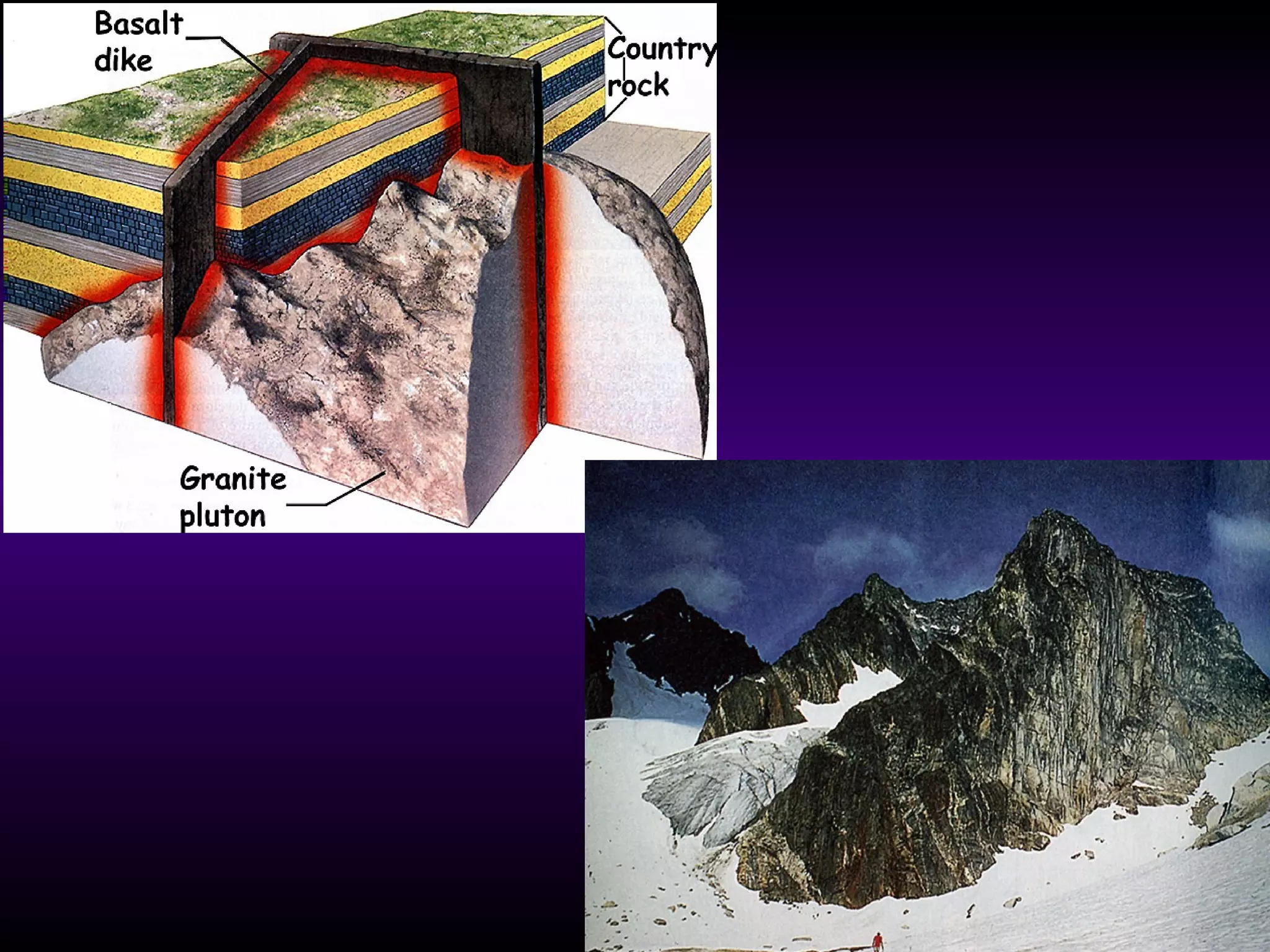
Contact MetamorphismContact Metamorphism
• Igneous Intrusions
- size and type of magma important
> mafic magma hotter than felsic
- heat decreases away from magma
> forms a zone of altered country rocks called Aureoles
• Igneous Intrusions
- size and type of magma important
> mafic magma hotter than felsic
- heat decreases away from magma
> forms a zone of altered country rocks called Aureoles
Sometimes creates a metamorphic rock called a
hornfels -in essence a “cooked” rock
Dynamic MetamorphismDynamic Metamorphism
• aka Cataclastic Metamorphism
• associated with Fault Zones
- Places where the Earth's crust ruptured
- Rock pulverized
> heat and pressure come from movement along the
Fault
• resultant rock is known as a Mylonite
• aka Cataclastic Metamorphism
• associated with Fault Zones
- Places where the Earth's crust ruptured
- Rock pulverized
> heat and pressure come from movement along the
Fault
• resultant rock is known as a Mylonite
Regional MetamorphismRegional Metamorphism
• Most common form of metamorphism
• caused by large scale forces
- lithospheric plate collision
• covers very large areas
- metamorphic belts or zones
- Zones are characterized by Index Minerals
> form under specific temperatures and pressures
> metamorphic facies
• commonly associated with
- shields: stable areas of crystalline rocks
• Most common form of metamorphism
• caused by large scale forces
- lithospheric plate collision
• covers very large areas
- metamorphic belts or zones
- Zones are characterized by Index Minerals
> form under specific temperatures and pressures
> metamorphic facies
• commonly associated with
-
Shields and Mountains: areas of crystalline rocks
Shields of the WorldShields of the World
Metamorphic TexturesMetamorphic Textures
• Foliated
- Folios = page or leaf-like
- rock has distinct banding or layering
> often not smooth like in sedimentary rocks
- formed under directed pressure
• Non-foliated
- no distinct layering character
- often a massive crystalline texture
- formed under uniform pressures
• Foliated
- Folios = page or leaf-like
- rock has distinct banding or layering
> often not smooth like in sedimentary rocks
- formed under directed pressure
• Non-foliated
- no distinct layering character
- often a massive crystalline texture
- formed under uniform pressures
Foliated TextureFoliated Texture
Foliated TexturesFoliated Textures
• Slatey
- looks like blackboard
> dull surface
- smooth, thin layering
- breaks into flat slabs
> referred to as slatey cleavage
- no mineral grains visible
• Phyllitic
- looks like waxed surface
> has a "sheen" to it
- may have little "waves" on
surface
> referred to as crenulations
- some small grains visible
• Slatey
- looks like blackboard
> dull surface
- smooth, thin layering
- breaks into flat slabs
> referred to as slatey cleavage
- no mineral grains visible
• Phyllitic
- looks like waxed surface
> has a "sheen" to it
- may have little "waves" on
surface
> referred to as crenulations
- some small grains visible
• Schistose
-
- visible grains
> garnets, staurolites
- may have shiny
> due to mica minerals
• Gneissic
- larger grains
- may look like igneous rock
- may have crude banding
> intensely distorted
- different minerals than
schistose
• Schistose
- distinct bands of minerals
- visible mineral grains
> garnets, staurolites
- may have shiny
appearance
> due to mica minerals
• Gneissic
- larger grains
- may look like igneous rock
- may have crude banding
> intensely distorted
- different minerals than
schistose
Foliated MM RocksFoliated MM Rocks
slateslate
schistschist gneissgneiss
phyllitephyllite
MM Rocks that could form as a shale (sedimentary) parent rock isMM Rocks that could form as a shale (sedimentary) parent rock is
exposed to increasing directed pressure and temperature
• Marble:
- metamorphosed
limestone
• Quartzite:
- metamorphosed
quartz sandstone
• Quartzite:
- metamorphosed
quartz sandstone
Non-foliated RocksNon-foliated Rocks
Environment of Formation- EOF
look for specific minerals
Map out where those minerals are found
reconstruct T & P for given minerals
Find a modern setting that has similar T & P
using Uniformitarianism
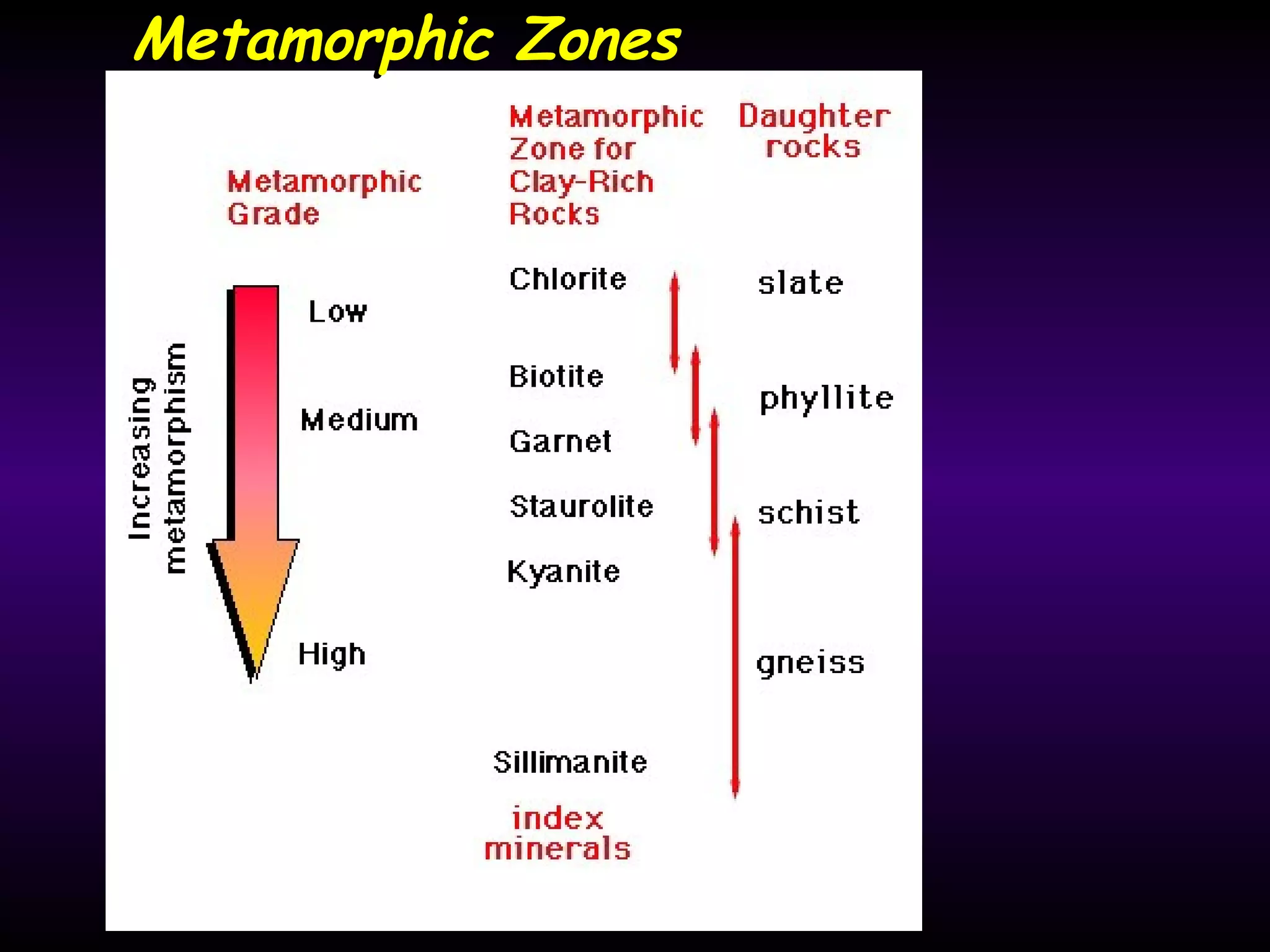
Metamorphic ZonesMetamorphic Zones
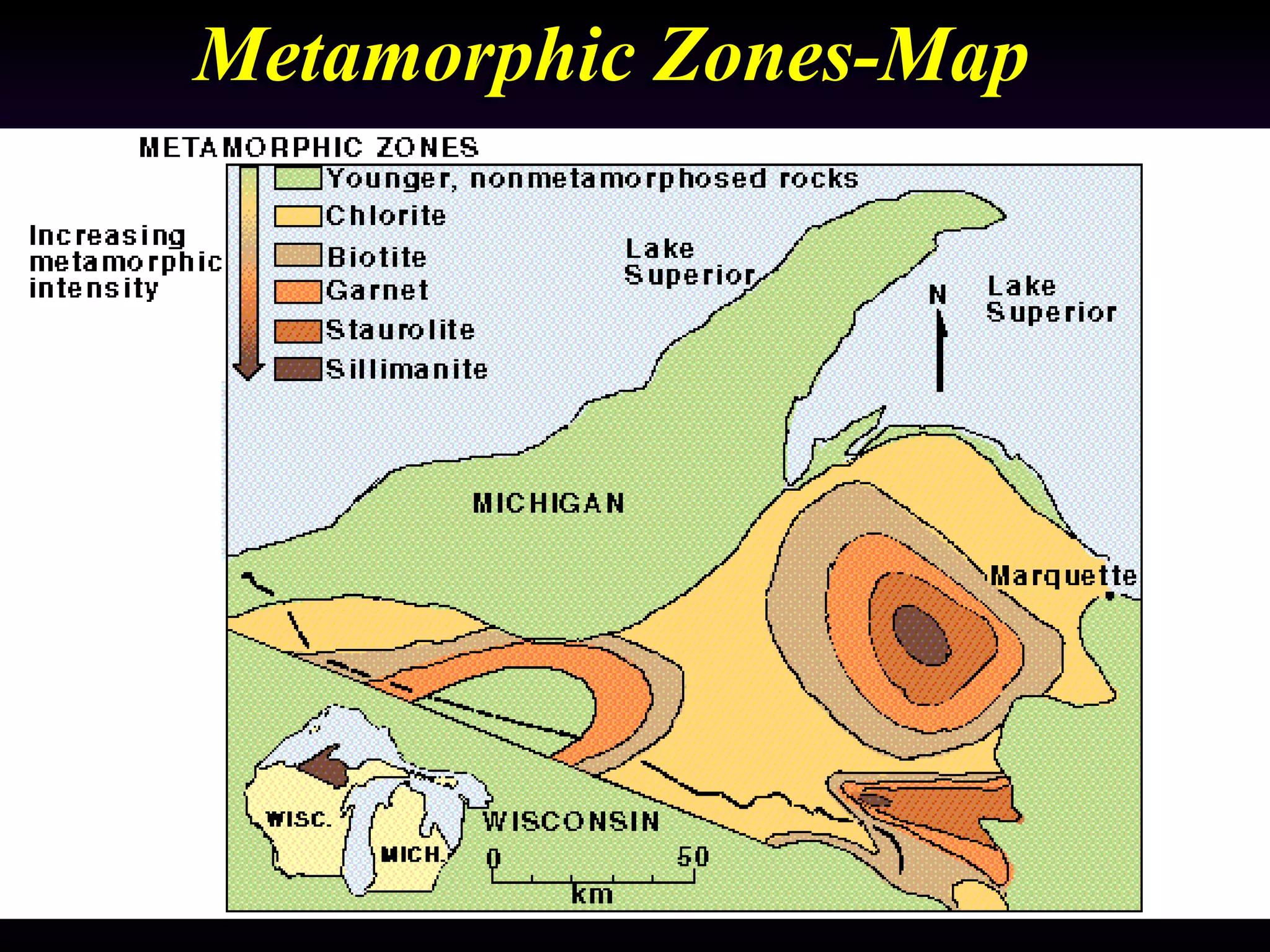
Metamorphic Zones-MapMetamorphic Zones-Map
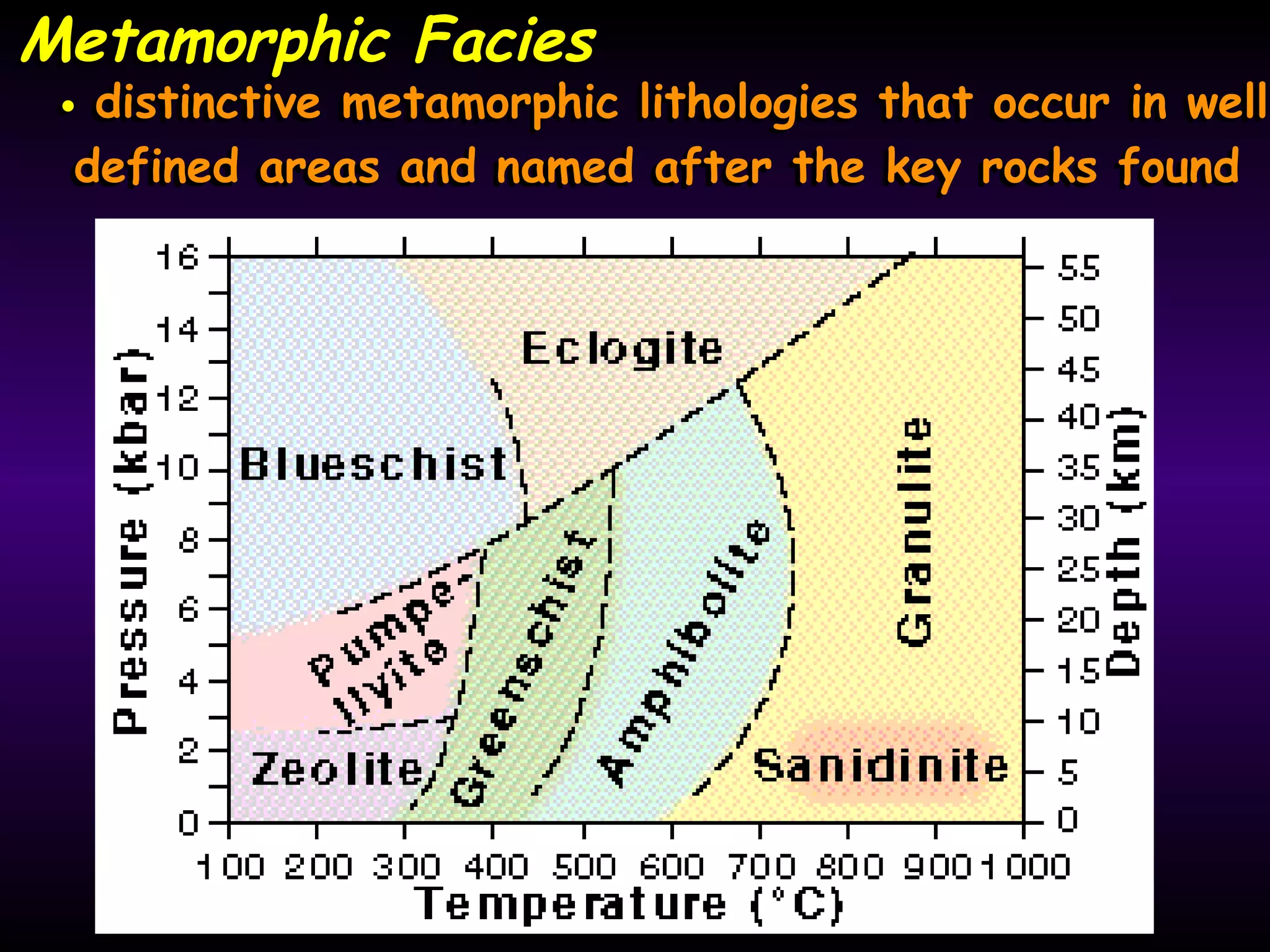
Metamorphic FaciesMetamorphic Facies
• distinctive metamorphic lithologies that occur in well
defined areas and named after the key rocks found
• distinctive metamorphic lithologies that occur in well
defined areas and named after the key rocks found
• Metamorphism is common along most plate boundaries like this.
Metamorphic ZonesMetamorphic Zones

metamorphic Rocks

  • 2.
    DefinitionsDefinitions • Metamorphic Rock -"Meta"= Change (Grk) - "Morph"= form (Grk) • Metamorphic Rock - "Meta"= Change (Grk) - "Morph"= form (Grk) - a rock that has been changed from its original form ( parent ) by heat , pressure , and fluid activity into a new rock ( daughter ). - a rock that has been changed from its original form ( parent ) by heat , pressure , and fluid activity into a new rock ( daughter ). Metamorphic RocksMetamorphic Rocks
  • 3.
    HeatHeat • Magma - temperatureof magma - composition of magma • Magma - temperature of magma - composition of magma • Geothermal gradient - temperature increases with depth of burial - core of Earth is warmer than outer crust • Geothermal gradient - temperature increases with depth of burial - core of Earth is warmer than outer crust Sources Include.....Sources Include.....
  • 4.
    Uniform PressureUniform Pressurevs Directed Pressure • Lithostatic - "Lithos"= rock, static= unchanged (pressure) - uniform (aka non-directed) - equal intensity from all directions by rocks • Lithostatic - "Lithos"= rock, static= unchanged (pressure) - uniform (aka non-directed) - equal intensity from all directions by rocks
  • 5.
    Directed Pressure one directionof squeezing is much stronger than the others Minerals align themselves to reduce stress.
  • 6.
    Types of MetamorphismTypesof Metamorphism • Contact - caused by igneous activity • Dynamic - aka cataclastic - associated with faults & earthquake zones • Regional - caused by tremendous pressures associated with tectonic plate activity • Contact - caused by igneous activity • Dynamic - aka cataclastic - associated with faults & earthquake zones • Regional - caused by tremendous pressures associated with tectonic plate activity
  • 7.
    Contact MetamorphismContact Metamorphism •Igneous Intrusions - size and type of magma important > mafic magma hotter than felsic - heat decreases away from magma > forms a zone of altered country rocks called Aureoles • Igneous Intrusions - size and type of magma important > mafic magma hotter than felsic - heat decreases away from magma > forms a zone of altered country rocks called Aureoles Sometimes creates a metamorphic rock called a hornfels -in essence a “cooked” rock
  • 9.
    Dynamic MetamorphismDynamic Metamorphism •aka Cataclastic Metamorphism • associated with Fault Zones - Places where the Earth's crust ruptured - Rock pulverized > heat and pressure come from movement along the Fault • resultant rock is known as a Mylonite • aka Cataclastic Metamorphism • associated with Fault Zones - Places where the Earth's crust ruptured - Rock pulverized > heat and pressure come from movement along the Fault • resultant rock is known as a Mylonite
  • 10.
    Regional MetamorphismRegional Metamorphism •Most common form of metamorphism • caused by large scale forces - lithospheric plate collision • covers very large areas - metamorphic belts or zones - Zones are characterized by Index Minerals > form under specific temperatures and pressures > metamorphic facies • commonly associated with - shields: stable areas of crystalline rocks • Most common form of metamorphism • caused by large scale forces - lithospheric plate collision • covers very large areas - metamorphic belts or zones - Zones are characterized by Index Minerals > form under specific temperatures and pressures > metamorphic facies • commonly associated with - Shields and Mountains: areas of crystalline rocks
  • 11.
    Shields of theWorldShields of the World
  • 12.
    Metamorphic TexturesMetamorphic Textures •Foliated - Folios = page or leaf-like - rock has distinct banding or layering > often not smooth like in sedimentary rocks - formed under directed pressure • Non-foliated - no distinct layering character - often a massive crystalline texture - formed under uniform pressures • Foliated - Folios = page or leaf-like - rock has distinct banding or layering > often not smooth like in sedimentary rocks - formed under directed pressure • Non-foliated - no distinct layering character - often a massive crystalline texture - formed under uniform pressures
  • 13.
  • 14.
    Foliated TexturesFoliated Textures •Slatey - looks like blackboard > dull surface - smooth, thin layering - breaks into flat slabs > referred to as slatey cleavage - no mineral grains visible • Phyllitic - looks like waxed surface > has a "sheen" to it - may have little "waves" on surface > referred to as crenulations - some small grains visible • Slatey - looks like blackboard > dull surface - smooth, thin layering - breaks into flat slabs > referred to as slatey cleavage - no mineral grains visible • Phyllitic - looks like waxed surface > has a "sheen" to it - may have little "waves" on surface > referred to as crenulations - some small grains visible • Schistose - - visible grains > garnets, staurolites - may have shiny > due to mica minerals • Gneissic - larger grains - may look like igneous rock - may have crude banding > intensely distorted - different minerals than schistose • Schistose - distinct bands of minerals - visible mineral grains > garnets, staurolites - may have shiny appearance > due to mica minerals • Gneissic - larger grains - may look like igneous rock - may have crude banding > intensely distorted - different minerals than schistose
  • 15.
    Foliated MM RocksFoliatedMM Rocks slateslate schistschist gneissgneiss phyllitephyllite MM Rocks that could form as a shale (sedimentary) parent rock isMM Rocks that could form as a shale (sedimentary) parent rock is exposed to increasing directed pressure and temperature
  • 16.
    • Marble: - metamorphosed limestone •Quartzite: - metamorphosed quartz sandstone • Quartzite: - metamorphosed quartz sandstone Non-foliated RocksNon-foliated Rocks
  • 17.
    Environment of Formation-EOF look for specific minerals Map out where those minerals are found reconstruct T & P for given minerals Find a modern setting that has similar T & P using Uniformitarianism
  • 18.
  • 19.
  • 20.
    Metamorphic FaciesMetamorphic Facies •distinctive metamorphic lithologies that occur in well defined areas and named after the key rocks found • distinctive metamorphic lithologies that occur in well defined areas and named after the key rocks found
  • 21.
    • Metamorphism iscommon along most plate boundaries like this. Metamorphic ZonesMetamorphic Zones