Metaheuristic Algorithm
Presented by:
Lames Alhilali
Supervisor:
Dr. wedad Alsorori
• Optimization Problems
• Strategies for Solving NP-hard Optimization Problems
(Non-deterministic Polynomial)
• What is a Metaheuristic Method?
• Trajectory Methods
• The Applications of Metaheuristic Methods
REFERENCES
• Talbi E.-G., 2009. Metaheuristics: from design to
implementation, Vol. 74, John Wiley & Sons
• Blum C. and Roli A., 2003. Metaheuristics in
combinatorial optimization: Overview and conceptual
comparison, ACM Computing Surveys, 35(3):268-308
• Back T., Hammel U. and Schwefel H.-P., 2002.
Evolutionary computation: comments on the history
and current state, IEEE Transactions on Evolutionary
Computation, 1(1):3-17
Optimization Problems
Computer Science:
 Traveling Salesman Problem
Operational Research (OR):
• P-Median Problem (location selection)
Many optimization problems are NP-hard.
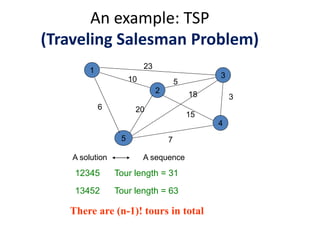
An example: TSP
(Traveling Salesman Problem)
18
1
2
3
5
4
23
10 5
3
7
15
20
6
A solution A sequence
12345 Tour length = 31
13452 Tour length = 63
There are (n-1)! tours in total
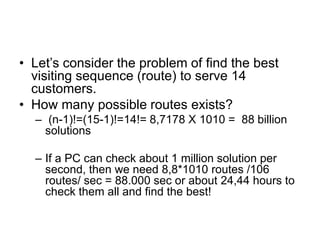
• Let’s consider the problem of find the best
visiting sequence (route) to serve 14
customers.
• How many possible routes exists?
– (n-1)!=(15-1)!=14!= 8,7178 X 1010 = 88 billion
solutions
– If a PC can check about 1 million solution per
second, then we need 8,8*1010 routes /106
routes/ sec = 88.000 sec or about 24,44 hours to
check them all and find the best!
COMBINATORIAL EXPLOSION
• What type of algorithm would you pick to solve a
problem with 1049,933 feasible solutions?
13,509-city TSP
19,982.859 mi.
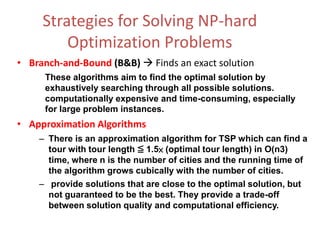
Strategies for Solving NP-hard
Optimization Problems
• Branch-and-Bound (B&B)  Finds an exact solution
These algorithms aim to find the optimal solution by
exhaustively searching through all possible solutions.
computationally expensive and time-consuming, especially
for large problem instances.
• Approximation Algorithms
– There is an approximation algorithm for TSP which can find a
tour with tour length ≦ 1.5× (optimal tour length) in O(n3)
time, where n is the number of cities and the running time of
the algorithm grows cubically with the number of cities.
– provide solutions that are close to the optimal solution, but
not guaranteed to be the best. They provide a trade-off
between solution quality and computational efficiency.
Strategies for Solving NP-hard
Optimization Problems
• Heuristic Methods  Deterministic
- are designed to quickly find good solutions, although
they may not guarantee finding the absolute best solution. These
algorithms use rules of problem-specific knowledge to guide the
search for a good solution.
• Metaheuristic Methods  Heuristic + Randomization
– are higher-level strategies that guide the search process by using more
general techniques.
What is a Metaheruistic Method?
• Meta : in an upper level
• Heuristic : to find
A metaheuristic is formally defined as an iterative generation
process which guides a subordinate heuristic by combining
intelligently different concepts for exploring and exploiting the
search space, learning strategies are used to structure
information in order to find efficiently near-optimal solutions.
Fundamental Properties of Metaheuristics
• Metaheuristics are strategies that “guide” the search
process.
• The goal: is to efficiently explore the search space in
order to find (near-)optimal solutions.
• Techniques which constitute metaheuristic algorithms
range from simple local search procedures to complex
learning processes.
• Metaheuristic algorithms are approximate and usually
non-deterministic.
Fundamental Properties of Metaheuristics
• Metaheuristics are not problem-specific.
• Today’s more advanced metaheuristics use search
experience (embodied in some form of memory) to guide
the search.
Types of metahuristic algorithms:
 Genetic Algorithms (GA)
Particle Swarm Optimization (PSO)
Ant Colony Optimization (ACO)
Simulated Annealing (SA)
Tabu Search (TS)
Variable Neighborhood Search (VNS)
TABU SEARCH
• Taboo (English): prohibited, disallowed,
forbidden
• Tabu (Fijian): forbidden to use due to being
sacred and/or of supernatural powers
• …related to similar Polynesian words
tapu (Tongan), tapu (Maori), kapu (Hawaiian)
TABU SEARCH
• Used mainly for discrete problems
• The tabu list constitutes “short-term memory”
• Size of tabu list (“tenure”) is finite
• Since solutions in tabu list are off-limits, it helps
– escape local minima by forcing uphill moves (if no improving
move available)
– avoid cycling (up to the period induced by tabu list size)
• Solutions enter and leave the list in a FIFO order (usually)
TABU SEARCH
• Small tenure localizes search (intensification)
• Large tenure forces exploration of wider space
(diversification)
• Tenure can change dynamically during search
• Size of tenure is a form of “long-term
memory”
TABU SEARCH
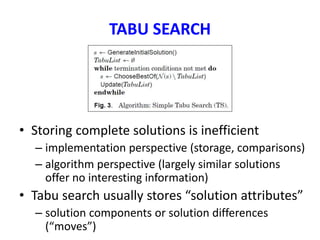
• Storing complete solutions is inefficient
– implementation perspective (storage, comparisons)
– algorithm perspective (largely similar solutions
offer no interesting information)
• Tabu search usually stores “solution attributes”
– solution components or solution differences
(“moves”)
TABU SEARCH
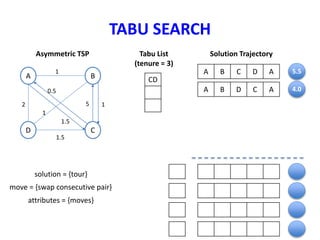
Asymmetric TSP
A B C D A
Solution Trajectory
5.5
Tabu List
(tenure = 3)
attributes = {moves}
solution = {tour}
move = {swap consecutive pair}
A B
D C
1
1
1
2
1.5
5
0.5
1.5
TABU SEARCH
Asymmetric TSP
A B C D A
Solution Trajectory
5.5
attributes = {moves}
solution = {tour}
move = {swap consecutive pair}
B A C D B 5.0
A C B D A 9.5
A B D C A 4.0
D B C A D 4.5
Tabu List
(tenure = 3)
AB
BC
CD
DA
A B
D C
1
1
1
2
1.5
5
0.5
1.5
TABU SEARCH
Asymmetric TSP
A B C D A
Solution Trajectory
5.5
attributes = {moves}
solution = {tour}
move = {swap consecutive pair}
B A C D B 5.0
A C B D A 9.5
A B D C A 4.0
D B C A D 4.5
Tabu List
(tenure = 3)
AB
BC
CD
DA
A B D C A 4.0
A B
D C
1
1
1
2
1.5
5
0.5
1.5
TABU SEARCH
Asymmetric TSP
A B C D A
Solution Trajectory
5.5
attributes = {moves}
solution = {tour}
move = {swap consecutive pair}
Tabu List
(tenure = 3)
CD
A B D C A 4.0
A B
D C
1
1
1
2
1.5
5
0.5
1.5
TABU SEARCH
A B
D C
1
1
1
2
1.5
5
0.5
1.5
Asymmetric TSP
A B C D A
Solution Trajectory
5.5
attributes = {moves}
solution = {tour}
move = {swap consecutive pair}
Tabu List
(tenure = 3)
CD
A B D C A 4.0
B A D C A 5.0
A D B C A 4.5
A B C D A
C B D A C 9.5
AB
BD
DC
CA
5.5
TABU SEARCH
A B
D C
1
1
1
2
1.5
5
0.5
1.5
Asymmetric TSP
A B C D A
Solution Trajectory
5.5
attributes = {moves}
solution = {tour}
move = {swap consecutive pair}
Tabu List
(tenure = 3)
BD
CD A B D C A 4.0
B A D C A 5.0
A D B C A 4.5
A B C D A
C B D A C 9.5
AB
BD
DC
CA
5.5
A D B C A 4.5
TABU SEARCH
A B
D C
1
1
1
2
1.5
5
0.5
1.5
Asymmetric TSP
A B C D A
Solution Trajectory
5.5
attributes = {moves}
solution = {tour}
move = {swap consecutive pair}
Tabu List
(tenure = 3)
BD
CD A B D C A 4.0
D A B C D
A B D C A
A D C B A
C D B A C
AD
DB
BC
CA
A D B C A 4.5
5.5
4.0
5.0
9.5
TABU SEARCH
A B
D C
1
1
1
2
1.5
5
0.5
1.5
Asymmetric TSP
A B C D A
Solution Trajectory
5.5
attributes = {moves}
solution = {tour}
move = {swap consecutive pair}
Tabu List
(tenure = 3)
BD
CD A B D C A 4.0
D A B C D
A B D C A
A D C B A
C D B A C
AD
DB
BC
CA
A D B C A 4.5
5.5
4.0
5.0
9.5
TABU SEARCH
A B
D C
1
1
1
2
1.5
5
0.5
1.5
Asymmetric TSP
A B C D A
Solution Trajectory
5.5
attributes = {moves}
solution = {tour}
move = {swap consecutive pair}
Tabu List
(tenure = 3)
CA
BD
CD
A B D C A 4.0
D C B A D
C B D A C
C D A B C
A D B C A
CD
DB
BA
AC
A D B C A 4.5
9.5
9.5
4.5
5.5
C D B A C 5.0
TABU SEARCH
A B
D C
1
1
1
2
1.5
5
0.5
1.5
Asymmetric TSP
A B C D A
Solution Trajectory
5.5
attributes = {moves}
solution = {tour}
move = {swap consecutive pair}
Tabu List
(tenure = 3)
CA
BD
CD
A B D C A 4.0
D C B A D
C B D A C
C D A B C
A D B C A
CD
DB
BA
AC
A D B C A 4.5
9.5
9.5
4.5
5.5
C D B A C 5.0
TABU SEARCH
A B
D C
1
1
1
2
1.5
5
0.5
1.5
Asymmetric TSP
A B C D A
Solution Trajectory
5.5
attributes = {moves}
solution = {tour}
move = {swap consecutive pair}
Tabu List
(tenure = 3)
BA
CA
BD
A B D C A 4.0
D C A B D
C A D B C
C D B A C
B D A C B
CD
DA
AB
BC
A D B C A 4.5
4.0
4.5
9.5
5.0
C D B A C 5.0
C D A B C 5.5
TABU SEARCH
Asymmetric TSP
A B C D A
Solution Trajectory
11
Tabu List
(tenure = 3)
attributes = {moves}
solution = {tour}
move = {swap consecutive pair}
A B
D C
2
2
2
4
3
10
1
3
What could happen if tenure
were 2 instead of 3?
What could happen if tenure
were 4 instead of 3?
TABU SEARCH
A B
D C
1
1
1
2
1.5
5
0.5
1.5
Asymmetric TSP
A B C D A
Solution Trajectory
5.5
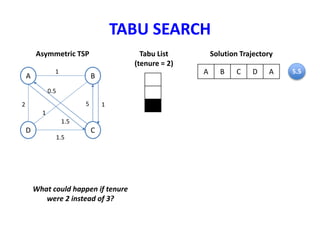
Tabu List
(tenure = 2)
What could happen if tenure
were 2 instead of 3?
TABU SEARCH
A B
D C
1
1
1
2
1.5
5
0.5
1.5
Asymmetric TSP
A B C D A
Solution Trajectory
5.5
Tabu List
(tenure = 4)
What could happen if tenure
were 4 instead of 3?
TABU SEARCH
• Decreasing tenure provides for intensification,
though encourages cycling
• Increasing tenure provides for diversification
by encouraging uphill moves
• How would you design a good TS algorithm?
TABU SEARCH
• Forbidding “attributes” may be overly restrictive
– aspiration conditions are introduced as “wild-cards”
for certain solutions, e.g., new incumbents are always
accepted, even if they possess taboo attributes
Comparison between heuristic and
metaheuristic algorithms
Research used this Algorithm
• Metaheuristic algorithms for a sustainable agri-food
supply chain considering marketing practices under
uncertainty.
• Year: Oct, 2022.
• Researcher: Fatemeh Gholian-Jouybari , Omid Hashemi-
Amiri, Behzad Mosallanezhad, Mostafa Hajiaghaei-Keshteli.
• Objectives :
– To develop and propose metaheuristic algorithms for optimizing
the agri-food supply chain.
– To consider marketing practices within the optimization
framework.
– To evaluate the performance and effectiveness of the proposed
algorithms.
• Link of study: https://www.sciencedirect.com/science/ar
• ticle/abs/pii/S095741742201898X
Research used this Algorithm
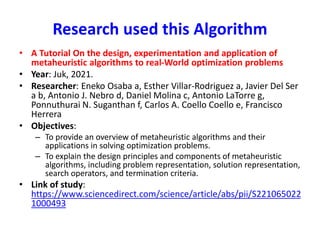
• A Tutorial On the design, experimentation and application of
metaheuristic algorithms to real-World optimization problems
• Year: Juk, 2021.
• Researcher: Eneko Osaba a, Esther Villar-Rodriguez a, Javier Del Ser
a b, Antonio J. Nebro d, Daniel Molina c, Antonio LaTorre g,
Ponnuthurai N. Suganthan f, Carlos A. Coello Coello e, Francisco
Herrera
• Objectives:
– To provide an overview of metaheuristic algorithms and their
applications in solving optimization problems.
– To explain the design principles and components of metaheuristic
algorithms, including problem representation, solution representation,
search operators, and termination criteria.
• Link of study:
https://www.sciencedirect.com/science/article/abs/pii/S221065022
1000493
Research used this Algorithm
• Solar energy forecasting based on hybrid neural network and
improved metaheuristic algorithm
• Year: Oct, 2017.
• Researcher: Oveis Abedinia, Nima Amjady, Noradin Ghadimi
• Objectives:
– To design and implement a hybrid forecasting model that combines
the strengths of a neural network and a metaheuristic algorithm.
– To improve the performance of the metaheuristic algorithm by
proposing novel enhancements or modifications.
– To evaluate and validate the proposed forecasting model using real-
world data.
– To contribute to the field of renewable energy management and grid
integration. Accurate solar energy forecasting is crucial for optimizing
the integration of solar power into the electrical grid.
• Link of study:
https://onlinelibrary.wiley.com/doi/abs/10.1111/coin.12145
Question
There is many types of metahuristic algorithms.
Mention three of them.
Genetic Algorithms (GA)
Tabu Search (TS)
Particle Swarm Optimization (PSO)
Ant Colony Optimization (ACO)
Simulated Annealing (SA)
Variable Neighborhood Search (VNS)
THANK YOU
Presented by:
LAMES ALHILALI

Metahuristic Algorithm Presentation

  • 1.
    Metaheuristic Algorithm Presented by: LamesAlhilali Supervisor: Dr. wedad Alsorori
  • 2.
    • Optimization Problems •Strategies for Solving NP-hard Optimization Problems (Non-deterministic Polynomial) • What is a Metaheuristic Method? • Trajectory Methods • The Applications of Metaheuristic Methods
  • 3.
    REFERENCES • Talbi E.-G.,2009. Metaheuristics: from design to implementation, Vol. 74, John Wiley & Sons • Blum C. and Roli A., 2003. Metaheuristics in combinatorial optimization: Overview and conceptual comparison, ACM Computing Surveys, 35(3):268-308 • Back T., Hammel U. and Schwefel H.-P., 2002. Evolutionary computation: comments on the history and current state, IEEE Transactions on Evolutionary Computation, 1(1):3-17
  • 4.
    Optimization Problems Computer Science: Traveling Salesman Problem Operational Research (OR): • P-Median Problem (location selection) Many optimization problems are NP-hard.
  • 5.
    An example: TSP (TravelingSalesman Problem) 18 1 2 3 5 4 23 10 5 3 7 15 20 6 A solution A sequence 12345 Tour length = 31 13452 Tour length = 63 There are (n-1)! tours in total
  • 6.
    • Let’s considerthe problem of find the best visiting sequence (route) to serve 14 customers. • How many possible routes exists? – (n-1)!=(15-1)!=14!= 8,7178 X 1010 = 88 billion solutions – If a PC can check about 1 million solution per second, then we need 8,8*1010 routes /106 routes/ sec = 88.000 sec or about 24,44 hours to check them all and find the best!
  • 7.
    COMBINATORIAL EXPLOSION • Whattype of algorithm would you pick to solve a problem with 1049,933 feasible solutions? 13,509-city TSP 19,982.859 mi.
  • 8.
    Strategies for SolvingNP-hard Optimization Problems • Branch-and-Bound (B&B)  Finds an exact solution These algorithms aim to find the optimal solution by exhaustively searching through all possible solutions. computationally expensive and time-consuming, especially for large problem instances. • Approximation Algorithms – There is an approximation algorithm for TSP which can find a tour with tour length ≦ 1.5× (optimal tour length) in O(n3) time, where n is the number of cities and the running time of the algorithm grows cubically with the number of cities. – provide solutions that are close to the optimal solution, but not guaranteed to be the best. They provide a trade-off between solution quality and computational efficiency.
  • 9.
    Strategies for SolvingNP-hard Optimization Problems • Heuristic Methods  Deterministic - are designed to quickly find good solutions, although they may not guarantee finding the absolute best solution. These algorithms use rules of problem-specific knowledge to guide the search for a good solution. • Metaheuristic Methods  Heuristic + Randomization – are higher-level strategies that guide the search process by using more general techniques.
  • 10.
    What is aMetaheruistic Method? • Meta : in an upper level • Heuristic : to find A metaheuristic is formally defined as an iterative generation process which guides a subordinate heuristic by combining intelligently different concepts for exploring and exploiting the search space, learning strategies are used to structure information in order to find efficiently near-optimal solutions.
  • 11.
    Fundamental Properties ofMetaheuristics • Metaheuristics are strategies that “guide” the search process. • The goal: is to efficiently explore the search space in order to find (near-)optimal solutions. • Techniques which constitute metaheuristic algorithms range from simple local search procedures to complex learning processes. • Metaheuristic algorithms are approximate and usually non-deterministic.
  • 12.
    Fundamental Properties ofMetaheuristics • Metaheuristics are not problem-specific. • Today’s more advanced metaheuristics use search experience (embodied in some form of memory) to guide the search. Types of metahuristic algorithms:  Genetic Algorithms (GA) Particle Swarm Optimization (PSO) Ant Colony Optimization (ACO) Simulated Annealing (SA) Tabu Search (TS) Variable Neighborhood Search (VNS)
  • 13.
    TABU SEARCH • Taboo(English): prohibited, disallowed, forbidden • Tabu (Fijian): forbidden to use due to being sacred and/or of supernatural powers • …related to similar Polynesian words tapu (Tongan), tapu (Maori), kapu (Hawaiian)
  • 14.
    TABU SEARCH • Usedmainly for discrete problems • The tabu list constitutes “short-term memory” • Size of tabu list (“tenure”) is finite • Since solutions in tabu list are off-limits, it helps – escape local minima by forcing uphill moves (if no improving move available) – avoid cycling (up to the period induced by tabu list size) • Solutions enter and leave the list in a FIFO order (usually)
  • 15.
    TABU SEARCH • Smalltenure localizes search (intensification) • Large tenure forces exploration of wider space (diversification) • Tenure can change dynamically during search • Size of tenure is a form of “long-term memory”
  • 16.
    TABU SEARCH • Storingcomplete solutions is inefficient – implementation perspective (storage, comparisons) – algorithm perspective (largely similar solutions offer no interesting information) • Tabu search usually stores “solution attributes” – solution components or solution differences (“moves”)
  • 17.
    TABU SEARCH Asymmetric TSP AB C D A Solution Trajectory 5.5 Tabu List (tenure = 3) attributes = {moves} solution = {tour} move = {swap consecutive pair} A B D C 1 1 1 2 1.5 5 0.5 1.5
  • 18.
    TABU SEARCH Asymmetric TSP AB C D A Solution Trajectory 5.5 attributes = {moves} solution = {tour} move = {swap consecutive pair} B A C D B 5.0 A C B D A 9.5 A B D C A 4.0 D B C A D 4.5 Tabu List (tenure = 3) AB BC CD DA A B D C 1 1 1 2 1.5 5 0.5 1.5
  • 19.
    TABU SEARCH Asymmetric TSP AB C D A Solution Trajectory 5.5 attributes = {moves} solution = {tour} move = {swap consecutive pair} B A C D B 5.0 A C B D A 9.5 A B D C A 4.0 D B C A D 4.5 Tabu List (tenure = 3) AB BC CD DA A B D C A 4.0 A B D C 1 1 1 2 1.5 5 0.5 1.5
  • 20.
    TABU SEARCH Asymmetric TSP AB C D A Solution Trajectory 5.5 attributes = {moves} solution = {tour} move = {swap consecutive pair} Tabu List (tenure = 3) CD A B D C A 4.0 A B D C 1 1 1 2 1.5 5 0.5 1.5
  • 21.
    TABU SEARCH A B DC 1 1 1 2 1.5 5 0.5 1.5 Asymmetric TSP A B C D A Solution Trajectory 5.5 attributes = {moves} solution = {tour} move = {swap consecutive pair} Tabu List (tenure = 3) CD A B D C A 4.0 B A D C A 5.0 A D B C A 4.5 A B C D A C B D A C 9.5 AB BD DC CA 5.5
  • 22.
    TABU SEARCH A B DC 1 1 1 2 1.5 5 0.5 1.5 Asymmetric TSP A B C D A Solution Trajectory 5.5 attributes = {moves} solution = {tour} move = {swap consecutive pair} Tabu List (tenure = 3) BD CD A B D C A 4.0 B A D C A 5.0 A D B C A 4.5 A B C D A C B D A C 9.5 AB BD DC CA 5.5 A D B C A 4.5
  • 23.
    TABU SEARCH A B DC 1 1 1 2 1.5 5 0.5 1.5 Asymmetric TSP A B C D A Solution Trajectory 5.5 attributes = {moves} solution = {tour} move = {swap consecutive pair} Tabu List (tenure = 3) BD CD A B D C A 4.0 D A B C D A B D C A A D C B A C D B A C AD DB BC CA A D B C A 4.5 5.5 4.0 5.0 9.5
  • 24.
    TABU SEARCH A B DC 1 1 1 2 1.5 5 0.5 1.5 Asymmetric TSP A B C D A Solution Trajectory 5.5 attributes = {moves} solution = {tour} move = {swap consecutive pair} Tabu List (tenure = 3) BD CD A B D C A 4.0 D A B C D A B D C A A D C B A C D B A C AD DB BC CA A D B C A 4.5 5.5 4.0 5.0 9.5
  • 25.
    TABU SEARCH A B DC 1 1 1 2 1.5 5 0.5 1.5 Asymmetric TSP A B C D A Solution Trajectory 5.5 attributes = {moves} solution = {tour} move = {swap consecutive pair} Tabu List (tenure = 3) CA BD CD A B D C A 4.0 D C B A D C B D A C C D A B C A D B C A CD DB BA AC A D B C A 4.5 9.5 9.5 4.5 5.5 C D B A C 5.0
  • 26.
    TABU SEARCH A B DC 1 1 1 2 1.5 5 0.5 1.5 Asymmetric TSP A B C D A Solution Trajectory 5.5 attributes = {moves} solution = {tour} move = {swap consecutive pair} Tabu List (tenure = 3) CA BD CD A B D C A 4.0 D C B A D C B D A C C D A B C A D B C A CD DB BA AC A D B C A 4.5 9.5 9.5 4.5 5.5 C D B A C 5.0
  • 27.
    TABU SEARCH A B DC 1 1 1 2 1.5 5 0.5 1.5 Asymmetric TSP A B C D A Solution Trajectory 5.5 attributes = {moves} solution = {tour} move = {swap consecutive pair} Tabu List (tenure = 3) BA CA BD A B D C A 4.0 D C A B D C A D B C C D B A C B D A C B CD DA AB BC A D B C A 4.5 4.0 4.5 9.5 5.0 C D B A C 5.0 C D A B C 5.5
  • 28.
    TABU SEARCH Asymmetric TSP AB C D A Solution Trajectory 11 Tabu List (tenure = 3) attributes = {moves} solution = {tour} move = {swap consecutive pair} A B D C 2 2 2 4 3 10 1 3 What could happen if tenure were 2 instead of 3? What could happen if tenure were 4 instead of 3?
  • 29.
    TABU SEARCH A B DC 1 1 1 2 1.5 5 0.5 1.5 Asymmetric TSP A B C D A Solution Trajectory 5.5 Tabu List (tenure = 2) What could happen if tenure were 2 instead of 3?
  • 30.
    TABU SEARCH A B DC 1 1 1 2 1.5 5 0.5 1.5 Asymmetric TSP A B C D A Solution Trajectory 5.5 Tabu List (tenure = 4) What could happen if tenure were 4 instead of 3?
  • 31.
    TABU SEARCH • Decreasingtenure provides for intensification, though encourages cycling • Increasing tenure provides for diversification by encouraging uphill moves • How would you design a good TS algorithm?
  • 32.
    TABU SEARCH • Forbidding“attributes” may be overly restrictive – aspiration conditions are introduced as “wild-cards” for certain solutions, e.g., new incumbents are always accepted, even if they possess taboo attributes
  • 33.
    Comparison between heuristicand metaheuristic algorithms
  • 34.
    Research used thisAlgorithm • Metaheuristic algorithms for a sustainable agri-food supply chain considering marketing practices under uncertainty. • Year: Oct, 2022. • Researcher: Fatemeh Gholian-Jouybari , Omid Hashemi- Amiri, Behzad Mosallanezhad, Mostafa Hajiaghaei-Keshteli. • Objectives : – To develop and propose metaheuristic algorithms for optimizing the agri-food supply chain. – To consider marketing practices within the optimization framework. – To evaluate the performance and effectiveness of the proposed algorithms. • Link of study: https://www.sciencedirect.com/science/ar • ticle/abs/pii/S095741742201898X
  • 35.
    Research used thisAlgorithm • A Tutorial On the design, experimentation and application of metaheuristic algorithms to real-World optimization problems • Year: Juk, 2021. • Researcher: Eneko Osaba a, Esther Villar-Rodriguez a, Javier Del Ser a b, Antonio J. Nebro d, Daniel Molina c, Antonio LaTorre g, Ponnuthurai N. Suganthan f, Carlos A. Coello Coello e, Francisco Herrera • Objectives: – To provide an overview of metaheuristic algorithms and their applications in solving optimization problems. – To explain the design principles and components of metaheuristic algorithms, including problem representation, solution representation, search operators, and termination criteria. • Link of study: https://www.sciencedirect.com/science/article/abs/pii/S221065022 1000493
  • 36.
    Research used thisAlgorithm • Solar energy forecasting based on hybrid neural network and improved metaheuristic algorithm • Year: Oct, 2017. • Researcher: Oveis Abedinia, Nima Amjady, Noradin Ghadimi • Objectives: – To design and implement a hybrid forecasting model that combines the strengths of a neural network and a metaheuristic algorithm. – To improve the performance of the metaheuristic algorithm by proposing novel enhancements or modifications. – To evaluate and validate the proposed forecasting model using real- world data. – To contribute to the field of renewable energy management and grid integration. Accurate solar energy forecasting is crucial for optimizing the integration of solar power into the electrical grid. • Link of study: https://onlinelibrary.wiley.com/doi/abs/10.1111/coin.12145
  • 37.
    Question There is manytypes of metahuristic algorithms. Mention three of them. Genetic Algorithms (GA) Tabu Search (TS) Particle Swarm Optimization (PSO) Ant Colony Optimization (ACO) Simulated Annealing (SA) Variable Neighborhood Search (VNS)
  • 38.