Messaging API(MAPI)
Messaging API (MAPI)
 Messaging API is a composition of common Application
Programming Interface (API) and dynamic-link libraries (
dll ).
 Interface is used to create and access diverse
messaging applications and messaging
systems, providing true independence for both.
 dll contains MAPI sub system, which interacts between
the front-end messaging applications and Back-end
messaging system.
Features & Overview
 It is an pen programming interface.
 Developers can use this interface and customize it as they
want to use it like word processing application or work group
application.
 MAPI provides separation between the programming
interface used by front-end client applications and back-end
messaging systems.
 So that it can support various messaging systems.
 Every component works with a common Microsoft Windows–
based user interface.
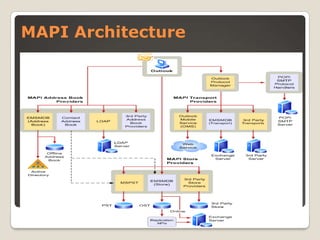
MAPI Architecture
MAPI Address Book Provider
 MAPI Address Book Provider handle access to directory
information.
 Directory information consists of data for 2 types of
message recipients:
a)Individual Messaging users
b) group of messaging users.
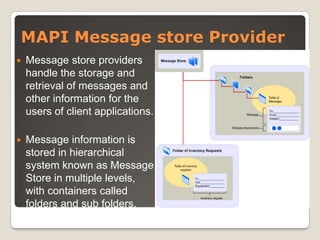
MAPI Message store Provider
 Message store providers
handle the storage and
retrieval of messages and
other information for the
users of client applications.
 Message information is
stored in hierarchical
system known as Message
Store in multiple levels,
with containers called
folders and sub folders.
MAPI Transport Provider Overview
 Transport providers handle message transmission and
reception and implement security, if necessary.
 Client applications communicate with the transport
provider through a message store provider.
 When a message is ready to be sent, MAPI must
determine which transport provider should handle the
transmission.
 This checks the security permission (valid credentials)
before sending it to recipient, to avoid security issues
MAPI Message Service Overview
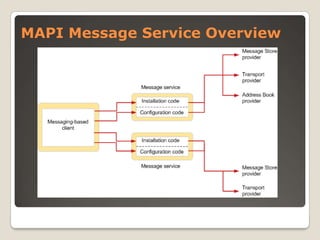
 Message services perform the work of interfacing between
the user and service providers that work with a common
messaging system.
 Message service completely handles the installation and
configuration of each of the service providers that belong to
the service.
 When a message service is installed, its installation program
copies necessary files from the installation source to the
user's local disk and updates a configuration file.
 This file contains list of service providers installed in local
machine and links to the providers in hierarchical system.
MAPI Message Service Overview

Messaging API (MAPI)

  • 1.
  • 2.
    Messaging API (MAPI) Messaging API is a composition of common Application Programming Interface (API) and dynamic-link libraries ( dll ).  Interface is used to create and access diverse messaging applications and messaging systems, providing true independence for both.  dll contains MAPI sub system, which interacts between the front-end messaging applications and Back-end messaging system.
  • 3.
    Features & Overview It is an pen programming interface.  Developers can use this interface and customize it as they want to use it like word processing application or work group application.  MAPI provides separation between the programming interface used by front-end client applications and back-end messaging systems.  So that it can support various messaging systems.  Every component works with a common Microsoft Windows– based user interface.
  • 4.
  • 5.
    MAPI Address BookProvider  MAPI Address Book Provider handle access to directory information.  Directory information consists of data for 2 types of message recipients: a)Individual Messaging users b) group of messaging users.
  • 6.
    MAPI Message storeProvider  Message store providers handle the storage and retrieval of messages and other information for the users of client applications.  Message information is stored in hierarchical system known as Message Store in multiple levels, with containers called folders and sub folders.
  • 7.
    MAPI Transport ProviderOverview  Transport providers handle message transmission and reception and implement security, if necessary.  Client applications communicate with the transport provider through a message store provider.  When a message is ready to be sent, MAPI must determine which transport provider should handle the transmission.  This checks the security permission (valid credentials) before sending it to recipient, to avoid security issues
  • 8.
    MAPI Message ServiceOverview  Message services perform the work of interfacing between the user and service providers that work with a common messaging system.  Message service completely handles the installation and configuration of each of the service providers that belong to the service.  When a message service is installed, its installation program copies necessary files from the installation source to the user's local disk and updates a configuration file.  This file contains list of service providers installed in local machine and links to the providers in hierarchical system.
  • 9.