MERGERS &
ACQUISITIONS
Unit 3
• Overview of the Mergers and Acquisition Market
• Mergers and Amalgamation: Key Corporate and Security Law Considerations
• Acquisitions: Key Corporate and Security Law Considerations
• A merger is an arrangement that combines two current businesses into a single new business.
• There are various merger types, and businesses merge for a variety of reasons.
• Mergers and acquisitions are frequently carried out to broaden a company's clientele, enter new
markets, or increase market share. A merger is the consensual union of two businesses into one
new legal entity on largely equal terms.
• The businesses that agree to join are about similar in size, customer base, and operational scope.
• The phrase "union of equals" is sometimes used to describe this situation. Contrary to mergers,
acquisitions typically entail one firm aggressively purchasing another.
• When two or more individual businesses consolidate to form a new enterprise, it
is known as a merger.
• An acquisition entails one organization acquiring the business of another.
• Both mergers and acquisitions are aimed at achieving better synergies within the
organization in order to increase their competence and efficiency.
• Types
• Mergers: Two companies combine to form a new company.
• Acquisitions: One company purchases another company and takes control of its operations.
• Consolidations: Two or more companies merge to form a larger company.
• Tender Offers: One company makes an offer to buy the shares of another company directly from
its shareholders.
• Hostile Takeovers: A company attempts to acquire another company without the target company’s
consent.
• Acquisition of Assets: One company acquires the assets of another company, typically during
bankruptcy proceedings.
• Management Acquisitions: Company executives purchase a controlling stake in another company,
taking it private. This is often financed with debt and requires shareholder approval.
• There are many reasons why companies engage in Merger & Acquisition activity. Some
of the most common motives include:
• To grow: Merger & Acquisition can be a quick and efficient way to grow a company’s
size and reach new markets.
• To gain new capabilities: Merger & Acquisition can help a company acquire new
technologies, products, or services that it would not be able to develop on its own.
• To reduce costs: Merger & Acquisition can help a company achieve economies of scale
by combining operations or eliminating duplicate jobs.
• To improve shareholder value: Merger & Acquisition can be used to create value for
shareholders by increasing the target company’s profitability or by unlocking hidden
value.
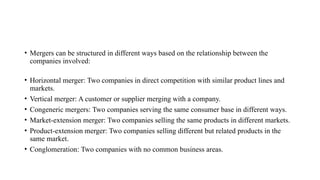
• Mergers can be structured in different ways based on the relationship between the
companies involved:
• Horizontal merger: Two companies in direct competition with similar product lines and
markets.
• Vertical merger: A customer or supplier merging with a company.
• Congeneric mergers: Two companies serving the same consumer base in different ways.
• Market-extension merger: Two companies selling the same products in different markets.
• Product-extension merger: Two companies selling different but related products in the
same market.
• Conglomeration: Two companies with no common business areas.
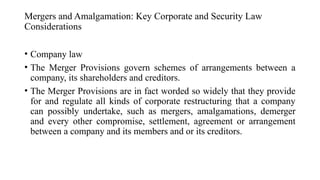
Mergers and Amalgamation: Key Corporate and Security Law
Considerations
• Company law
• The Merger Provisions govern schemes of arrangements between a
company, its shareholders and creditors.
• The Merger Provisions are in fact worded so widely that they provide
for and regulate all kinds of corporate restructuring that a company
can possibly undertake, such as mergers, amalgamations, demerger
and every other compromise, settlement, agreement or arrangement
between a company and its members and or its creditors.
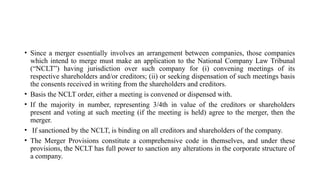
• Since a merger essentially involves an arrangement between companies, those companies
which intend to merge must make an application to the National Company Law Tribunal
(“NCLT”) having jurisdiction over such company for (i) convening meetings of its
respective shareholders and/or creditors; (ii) or seeking dispensation of such meetings basis
the consents received in writing from the shareholders and creditors.
• Basis the NCLT order, either a meeting is convened or dispensed with.
• If the majority in number, representing 3/4th in value of the creditors or shareholders
present and voting at such meeting (if the meeting is held) agree to the merger, then the
merger.
• If sanctioned by the NCLT, is binding on all creditors and shareholders of the company.
• The Merger Provisions constitute a comprehensive code in themselves, and under these
provisions, the NCLT has full power to sanction any alterations in the corporate structure of
a company.
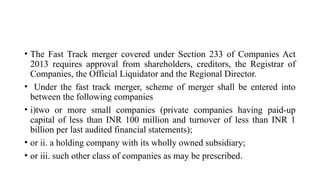
• The Fast Track merger covered under Section 233 of Companies Act
2013 requires approval from shareholders, creditors, the Registrar of
Companies, the Official Liquidator and the Regional Director.
• Under the fast track merger, scheme of merger shall be entered into
between the following companies
• i)two or more small companies (private companies having paid-up
capital of less than INR 100 million and turnover of less than INR 1
billion per last audited financial statements);
• or ii. a holding company with its wholly owned subsidiary;
• or iii. such other class of companies as may be prescribed.
• The scheme, after incorporating any suggestions made by the Registrar
of Companies and the Official Liquidator, must be approved by
shareholders holding at least 90% of the total number of shares, and
creditors representing 9/10th in value, before it is presented to the
Regional Director and the Official Liquidator for approval.
• Thereafter, if the Regional Director/ Official Liquidator has any
objections, they should convey the same to the central government.
• The central government upon receipt of comments can either direct
NCLT to take up the scheme under Section 232 (general process) or pass
the final order confirming the scheme under the Fast Track process.
• Section 234 of the Companies Act 2013 permits mergers between Indian and foreign
companies with prior approval of the Reserve Bank of India (“RBI”).
• A foreign company means any company or body corporate incorporated outside India,
whether having a place of business in India or not.
• The following conditions must be fulfilled for a cross border merger:
• i. The foreign company should be incorporated in a permitted jurisdiction which meets
certain conditions.
• ii. The transferee company is to ensure that the valuation is done by a recognized
professional body in its jurisdiction and is in accordance with internationally accepted
principles of accounting and valuation.
• iii. The procedure prescribed under Companies Act 2013 for undertaking mergers must
be followed
• The Securities and Exchange Board of India (the “SEBI”) is the nodal authority regulating entities that are
listed or to be listed on stock exchanges in India.
• The SEBI (Substantial Acquisition of Shares and Takeovers) Regulations, 2011 (the “Takeover Code”)
restricts and regulates the acquisition of shares, voting rights and control in listed companies.
• Acquisition of shares or voting rights of a listed company, entitling the acquirer to exercise 25% or more of
the voting rights in the target company or acquisition of control, obligates the acquirer to make an offer to the
remaining shareholders of the target company.
• The offer must be to further acquire at least 26% of the voting capital of the company
• Further, if the acquirer already holds 25% or more but less than 75% of the target company and acquires at
least 5% shares or voting rights in the target company within a financial year, it shall be obligated to make an
open offer. However, this obligation is subject to the exemptions provided under the Takeover Code.
• Exemptions from open offer requirement under the Takeover Code include inter alia acquisition pursuant to a
scheme of arrangement approved by the NCLT.
• Further, SEBI has the power to grant exemption or relaxation from the requirements of the open offer under
the Takeover Code in the interest of investors and the securities market. Such relaxations or exemptions can
be sought by the acquirer by making an application to SEBI.
• The SEBI (Listing Obligations and Disclosure Requirements) Regulations, 2015
(“Listing Regulations”) provides for a comprehensive framework governing
various types of listed securities.
• Under the Listing Regulations, SEBI has laid down conditions to be followed by
a listed company while making an application before the NCLT, for approval of a
schemes of merger/ amalgamation / reconstruction.
• Certain key provisions under the Listing Regulations applicable in case of a
scheme involving a listed company are as follows:
• Filing of scheme with stock exchanges
• Compliance with securities law
• Change in shareholding pattern etc.
• Acquisitions may be by acquisition of existing shares or by subscription to
new shares issued by the target.
• Transferability of Shares
• Private company and public company.
• A restriction on transferability of shares is inherent to a private company,
such restrictions are contained in its articles of association (the byelaws of
the company) and are usually in the form of a pre-emptive right in favor of
the other shareholders. With the introduction of Companies Act 2013,
although shares of a public company are freely transferable, share transfer
restrictions for even public companies shares have been granted statutory
sanction.
• Squeeze-out provision
• Provisions of the Companies Act 2013 read with Rule 3 of the Companies
(Compromises, Arrangements and Amalgamations) Rules, 2016 made effective
from February 7, 2020, permits the shareholders of unlisted companies holding at
least 75% of the securities (including depository receipts) with voting rights to
make an offer for acquisition of any part of the remaining shares in such company,
pursuant to an application of compromise or arrangement to be filed before the
NCLT.
• Once NCLT approves such offer for acquisition, the minority shareholders would
mandatorily be required to sell their shares to the acquiring shareholder.
• This method of squeeze-out is only available to unlisted companies and listed
companies will be subject to the regulations prescribed by SEBI in this regard.
• Scheme of capital reduction
• Must be approved by,
• (i) the shareholders of the company vide a special resolution; and
• (ii) by the NCLT by an order approving the reduction.
• When the company applies to the NCLT forits approval, the creditors of the company would be
entitled to object to the scheme of capital reduction.
• The NCLT will approve the reduction only if the debt owed to the objecting creditors is
safeguarded/provided for.
• In addition, the NCLT is also required to give notice of application of reduction of capital to the
Central Government and SEBI (in case of a listed company) who will have a period of 3 (three)
months to file any objections.
• Companies will have to mandatorily publish the NCLT order sanctioning the scheme of capital
reduction
• New share issuance
• Companies law prescribe the requirements for any new issuance of shares on a preferential basis
• Some of the important requirements under these provisions are described below:
• The company must engage a registered valuer to arrive at a fair market value of the shares
proposed to be issued.
• The issuance must be authorized by the articles of association of the company and approved by
a special resolution passed by shareholders in a general meeting, authorizing the board of
directors of the company to issue the shares.
• A special resolution is one that is passed by at least 3/4th of the shareholders present and voting
at a meeting of the shareholders.
• If shares are not issued within 12 months from date of passing of such special resolution, the
resolution will lapse and a fresh resolution will be required for the issuance.
• Issue of shares with differential voting rights
• The Companies Act 2013 also allows for issuance of equity shares with differential voting rights as to
dividend, voting or otherwise, provided that the company complies with the rules prescribed in this
regard,which require that:
• The articles of association of the company authorizes issue of shares with differential voting rights;
• The issue of shares is authorized by an ordinary resolution passed at a general meeting of the shareholders;
• The voting power in respect of the shares with differential rights shall not exceed 74% of the total voting
power including voting power in respect of equity shares with differential rights issued at any point in time;
• The company shall not have defaulted in filing financial statements and annual returns for 3 financial years
immediately preceding the financial year in which it has decided to issue shares with differential voting
rights.
• Private companies may be exempt from these requirements if their memorandum and articles of
association so provide.
• Asset/ Business Purchase
• Besides share acquisition, the acquirer may also decide to acquire the
business of the target which could typically entail acquisitions of all or
specific assets and liabilities of the business for a pre-determined
consideration. Therefore, depending upon the commercial objective
and considerations, an acquirer may opt for (i) an asset purchase,
whereby one company purchases all of part of the assets of the other
company; or (ii) a slump sale, whereby one company acquires the
‘business undertaking’ of the other company on a going concern basis
i.e., acquiring all assets and liabilities of such business
• Securities and Exchange Board of India (Issue of Capital and
Disclosure Requirements) Regulations, 2018 (“ICDR Regulations”) If
the acquisition of an Indian listed company involves the issue of new
equity shares or securities convertible into equity shares(“Specified
Securities”) by the target (issuer) to the acquirer, the provisions of
Chapter V (“Preferential Issue Regulations”) contained in ICDR
Regulations will apply (in addition to company law requirements).
• Securities and Exchange Board of India (Substantial Acquisition of Shares and
Takeovers) Regulations, 2011 (the “Takeover Code”)
• If an acquisition is contemplated by way of issue of new shares, or the acquisition
of existing shares or voting rights, of a listed company, to or by an acquirer, the
provisions of the Takeover Code are applicable.
• The key objectives of the Takeover Code are to provide the shareholders of a
listed company with adequate information about an impending change in control
of the company or substantial acquisition by an acquirer and provide them with an
exit option in case they do not wish to retain their shareholding in the company
MERGERS & ACQUISITIONS.pptx allied laws.

MERGERS & ACQUISITIONS.pptx allied laws.

  • 1.
  • 2.
    • Overview ofthe Mergers and Acquisition Market • Mergers and Amalgamation: Key Corporate and Security Law Considerations • Acquisitions: Key Corporate and Security Law Considerations
  • 3.
    • A mergeris an arrangement that combines two current businesses into a single new business. • There are various merger types, and businesses merge for a variety of reasons. • Mergers and acquisitions are frequently carried out to broaden a company's clientele, enter new markets, or increase market share. A merger is the consensual union of two businesses into one new legal entity on largely equal terms. • The businesses that agree to join are about similar in size, customer base, and operational scope. • The phrase "union of equals" is sometimes used to describe this situation. Contrary to mergers, acquisitions typically entail one firm aggressively purchasing another.
  • 4.
    • When twoor more individual businesses consolidate to form a new enterprise, it is known as a merger. • An acquisition entails one organization acquiring the business of another. • Both mergers and acquisitions are aimed at achieving better synergies within the organization in order to increase their competence and efficiency.
  • 5.
    • Types • Mergers:Two companies combine to form a new company. • Acquisitions: One company purchases another company and takes control of its operations. • Consolidations: Two or more companies merge to form a larger company. • Tender Offers: One company makes an offer to buy the shares of another company directly from its shareholders. • Hostile Takeovers: A company attempts to acquire another company without the target company’s consent. • Acquisition of Assets: One company acquires the assets of another company, typically during bankruptcy proceedings. • Management Acquisitions: Company executives purchase a controlling stake in another company, taking it private. This is often financed with debt and requires shareholder approval.
  • 6.
    • There aremany reasons why companies engage in Merger & Acquisition activity. Some of the most common motives include: • To grow: Merger & Acquisition can be a quick and efficient way to grow a company’s size and reach new markets. • To gain new capabilities: Merger & Acquisition can help a company acquire new technologies, products, or services that it would not be able to develop on its own. • To reduce costs: Merger & Acquisition can help a company achieve economies of scale by combining operations or eliminating duplicate jobs. • To improve shareholder value: Merger & Acquisition can be used to create value for shareholders by increasing the target company’s profitability or by unlocking hidden value.
  • 7.
    • Mergers canbe structured in different ways based on the relationship between the companies involved: • Horizontal merger: Two companies in direct competition with similar product lines and markets. • Vertical merger: A customer or supplier merging with a company. • Congeneric mergers: Two companies serving the same consumer base in different ways. • Market-extension merger: Two companies selling the same products in different markets. • Product-extension merger: Two companies selling different but related products in the same market. • Conglomeration: Two companies with no common business areas.
  • 8.
    Mergers and Amalgamation:Key Corporate and Security Law Considerations • Company law • The Merger Provisions govern schemes of arrangements between a company, its shareholders and creditors. • The Merger Provisions are in fact worded so widely that they provide for and regulate all kinds of corporate restructuring that a company can possibly undertake, such as mergers, amalgamations, demerger and every other compromise, settlement, agreement or arrangement between a company and its members and or its creditors.
  • 9.
    • Since amerger essentially involves an arrangement between companies, those companies which intend to merge must make an application to the National Company Law Tribunal (“NCLT”) having jurisdiction over such company for (i) convening meetings of its respective shareholders and/or creditors; (ii) or seeking dispensation of such meetings basis the consents received in writing from the shareholders and creditors. • Basis the NCLT order, either a meeting is convened or dispensed with. • If the majority in number, representing 3/4th in value of the creditors or shareholders present and voting at such meeting (if the meeting is held) agree to the merger, then the merger. • If sanctioned by the NCLT, is binding on all creditors and shareholders of the company. • The Merger Provisions constitute a comprehensive code in themselves, and under these provisions, the NCLT has full power to sanction any alterations in the corporate structure of a company.
  • 10.
    • The FastTrack merger covered under Section 233 of Companies Act 2013 requires approval from shareholders, creditors, the Registrar of Companies, the Official Liquidator and the Regional Director. • Under the fast track merger, scheme of merger shall be entered into between the following companies • i)two or more small companies (private companies having paid-up capital of less than INR 100 million and turnover of less than INR 1 billion per last audited financial statements); • or ii. a holding company with its wholly owned subsidiary; • or iii. such other class of companies as may be prescribed.
  • 11.
    • The scheme,after incorporating any suggestions made by the Registrar of Companies and the Official Liquidator, must be approved by shareholders holding at least 90% of the total number of shares, and creditors representing 9/10th in value, before it is presented to the Regional Director and the Official Liquidator for approval. • Thereafter, if the Regional Director/ Official Liquidator has any objections, they should convey the same to the central government. • The central government upon receipt of comments can either direct NCLT to take up the scheme under Section 232 (general process) or pass the final order confirming the scheme under the Fast Track process.
  • 12.
    • Section 234of the Companies Act 2013 permits mergers between Indian and foreign companies with prior approval of the Reserve Bank of India (“RBI”). • A foreign company means any company or body corporate incorporated outside India, whether having a place of business in India or not. • The following conditions must be fulfilled for a cross border merger: • i. The foreign company should be incorporated in a permitted jurisdiction which meets certain conditions. • ii. The transferee company is to ensure that the valuation is done by a recognized professional body in its jurisdiction and is in accordance with internationally accepted principles of accounting and valuation. • iii. The procedure prescribed under Companies Act 2013 for undertaking mergers must be followed
  • 13.
    • The Securitiesand Exchange Board of India (the “SEBI”) is the nodal authority regulating entities that are listed or to be listed on stock exchanges in India. • The SEBI (Substantial Acquisition of Shares and Takeovers) Regulations, 2011 (the “Takeover Code”) restricts and regulates the acquisition of shares, voting rights and control in listed companies. • Acquisition of shares or voting rights of a listed company, entitling the acquirer to exercise 25% or more of the voting rights in the target company or acquisition of control, obligates the acquirer to make an offer to the remaining shareholders of the target company. • The offer must be to further acquire at least 26% of the voting capital of the company • Further, if the acquirer already holds 25% or more but less than 75% of the target company and acquires at least 5% shares or voting rights in the target company within a financial year, it shall be obligated to make an open offer. However, this obligation is subject to the exemptions provided under the Takeover Code. • Exemptions from open offer requirement under the Takeover Code include inter alia acquisition pursuant to a scheme of arrangement approved by the NCLT. • Further, SEBI has the power to grant exemption or relaxation from the requirements of the open offer under the Takeover Code in the interest of investors and the securities market. Such relaxations or exemptions can be sought by the acquirer by making an application to SEBI.
  • 14.
    • The SEBI(Listing Obligations and Disclosure Requirements) Regulations, 2015 (“Listing Regulations”) provides for a comprehensive framework governing various types of listed securities. • Under the Listing Regulations, SEBI has laid down conditions to be followed by a listed company while making an application before the NCLT, for approval of a schemes of merger/ amalgamation / reconstruction. • Certain key provisions under the Listing Regulations applicable in case of a scheme involving a listed company are as follows: • Filing of scheme with stock exchanges • Compliance with securities law • Change in shareholding pattern etc.
  • 15.
    • Acquisitions maybe by acquisition of existing shares or by subscription to new shares issued by the target. • Transferability of Shares • Private company and public company. • A restriction on transferability of shares is inherent to a private company, such restrictions are contained in its articles of association (the byelaws of the company) and are usually in the form of a pre-emptive right in favor of the other shareholders. With the introduction of Companies Act 2013, although shares of a public company are freely transferable, share transfer restrictions for even public companies shares have been granted statutory sanction.
  • 16.
    • Squeeze-out provision •Provisions of the Companies Act 2013 read with Rule 3 of the Companies (Compromises, Arrangements and Amalgamations) Rules, 2016 made effective from February 7, 2020, permits the shareholders of unlisted companies holding at least 75% of the securities (including depository receipts) with voting rights to make an offer for acquisition of any part of the remaining shares in such company, pursuant to an application of compromise or arrangement to be filed before the NCLT. • Once NCLT approves such offer for acquisition, the minority shareholders would mandatorily be required to sell their shares to the acquiring shareholder. • This method of squeeze-out is only available to unlisted companies and listed companies will be subject to the regulations prescribed by SEBI in this regard.
  • 17.
    • Scheme ofcapital reduction • Must be approved by, • (i) the shareholders of the company vide a special resolution; and • (ii) by the NCLT by an order approving the reduction. • When the company applies to the NCLT forits approval, the creditors of the company would be entitled to object to the scheme of capital reduction. • The NCLT will approve the reduction only if the debt owed to the objecting creditors is safeguarded/provided for. • In addition, the NCLT is also required to give notice of application of reduction of capital to the Central Government and SEBI (in case of a listed company) who will have a period of 3 (three) months to file any objections. • Companies will have to mandatorily publish the NCLT order sanctioning the scheme of capital reduction
  • 18.
    • New shareissuance • Companies law prescribe the requirements for any new issuance of shares on a preferential basis • Some of the important requirements under these provisions are described below: • The company must engage a registered valuer to arrive at a fair market value of the shares proposed to be issued. • The issuance must be authorized by the articles of association of the company and approved by a special resolution passed by shareholders in a general meeting, authorizing the board of directors of the company to issue the shares. • A special resolution is one that is passed by at least 3/4th of the shareholders present and voting at a meeting of the shareholders. • If shares are not issued within 12 months from date of passing of such special resolution, the resolution will lapse and a fresh resolution will be required for the issuance.
  • 19.
    • Issue ofshares with differential voting rights • The Companies Act 2013 also allows for issuance of equity shares with differential voting rights as to dividend, voting or otherwise, provided that the company complies with the rules prescribed in this regard,which require that: • The articles of association of the company authorizes issue of shares with differential voting rights; • The issue of shares is authorized by an ordinary resolution passed at a general meeting of the shareholders; • The voting power in respect of the shares with differential rights shall not exceed 74% of the total voting power including voting power in respect of equity shares with differential rights issued at any point in time; • The company shall not have defaulted in filing financial statements and annual returns for 3 financial years immediately preceding the financial year in which it has decided to issue shares with differential voting rights. • Private companies may be exempt from these requirements if their memorandum and articles of association so provide.
  • 20.
    • Asset/ BusinessPurchase • Besides share acquisition, the acquirer may also decide to acquire the business of the target which could typically entail acquisitions of all or specific assets and liabilities of the business for a pre-determined consideration. Therefore, depending upon the commercial objective and considerations, an acquirer may opt for (i) an asset purchase, whereby one company purchases all of part of the assets of the other company; or (ii) a slump sale, whereby one company acquires the ‘business undertaking’ of the other company on a going concern basis i.e., acquiring all assets and liabilities of such business
  • 21.
    • Securities andExchange Board of India (Issue of Capital and Disclosure Requirements) Regulations, 2018 (“ICDR Regulations”) If the acquisition of an Indian listed company involves the issue of new equity shares or securities convertible into equity shares(“Specified Securities”) by the target (issuer) to the acquirer, the provisions of Chapter V (“Preferential Issue Regulations”) contained in ICDR Regulations will apply (in addition to company law requirements).
  • 22.
    • Securities andExchange Board of India (Substantial Acquisition of Shares and Takeovers) Regulations, 2011 (the “Takeover Code”) • If an acquisition is contemplated by way of issue of new shares, or the acquisition of existing shares or voting rights, of a listed company, to or by an acquirer, the provisions of the Takeover Code are applicable. • The key objectives of the Takeover Code are to provide the shareholders of a listed company with adequate information about an impending change in control of the company or substantial acquisition by an acquirer and provide them with an exit option in case they do not wish to retain their shareholding in the company