VALUE FOCUS
Construction & Building Materials
Second Quarter 2020 | Sector Focus: Building Materials
Executive Industry Trends
•	 Strong economic fundamentals entering 2020 were overshadowed by the spread of COVID-19.
Government actions taken to counteract the virus dramatically lowered economic activity as the country
suffered the largest annualized GDP decline in U.S. history in the second quarter of 2020.
•	 Construction designated as an “essential” sector throughout most of the country, allowing construction
companies to continue to work although in the face of a multitude of disruptions.
•	 Signs of economic fallout started to appear in late 1Q20 data but 2Q20 demonstrated a more
comprehensive picture of the effects of the virus on economic barometers. Most metrics suffered their
steepest declines in April and showed some improvement through June.
BUSINESS VALUATION &
FINANCIAL ADVISORY SERVICES
In This Issue
Construction Overview	 1
Sector Focus:
Building Materials	 4
Sector Round-up	 9
Bellweather Stocks and
Industry Participants 13
About Mercer Capital	 16
www.mercercapital.com
© 2020 Mercer Capital // www.mercercapital.com 1
Mercer Capital’s Value Focus: Construction  Building Materials Second Quarter 2020
$0
$100
$200
$300
$400
$500
$600
$700
-5.0%
-4.0%
-3.0%
-2.0%
-1.0%
0.0%
1.0%
2.0%
3.0%
4.0%
2010 2011 2012 2013 2014 2015 2016 2017 2018 2019 2020
GDP($Billions)
AnnualizedRealGrowthRate
Quarterly Growth Average Quarterly Growth GDP (Current Dollars)
Source: Trading Economics
-14%
-10%
-6%
-2%
2%
6%
Q
2-2010
Q
2-2011
Q
2-2012
Q
2-2013
Q
2-2014
Q
2-2015
Q
2-2016
Q
2-2017
Q
2-2018
Q
2-2019
Q
2-2020
National Construction
Source: Trading Economics, U.S. Bureau of Economic Analysis
Construction
Overview
Construction 
National GDP
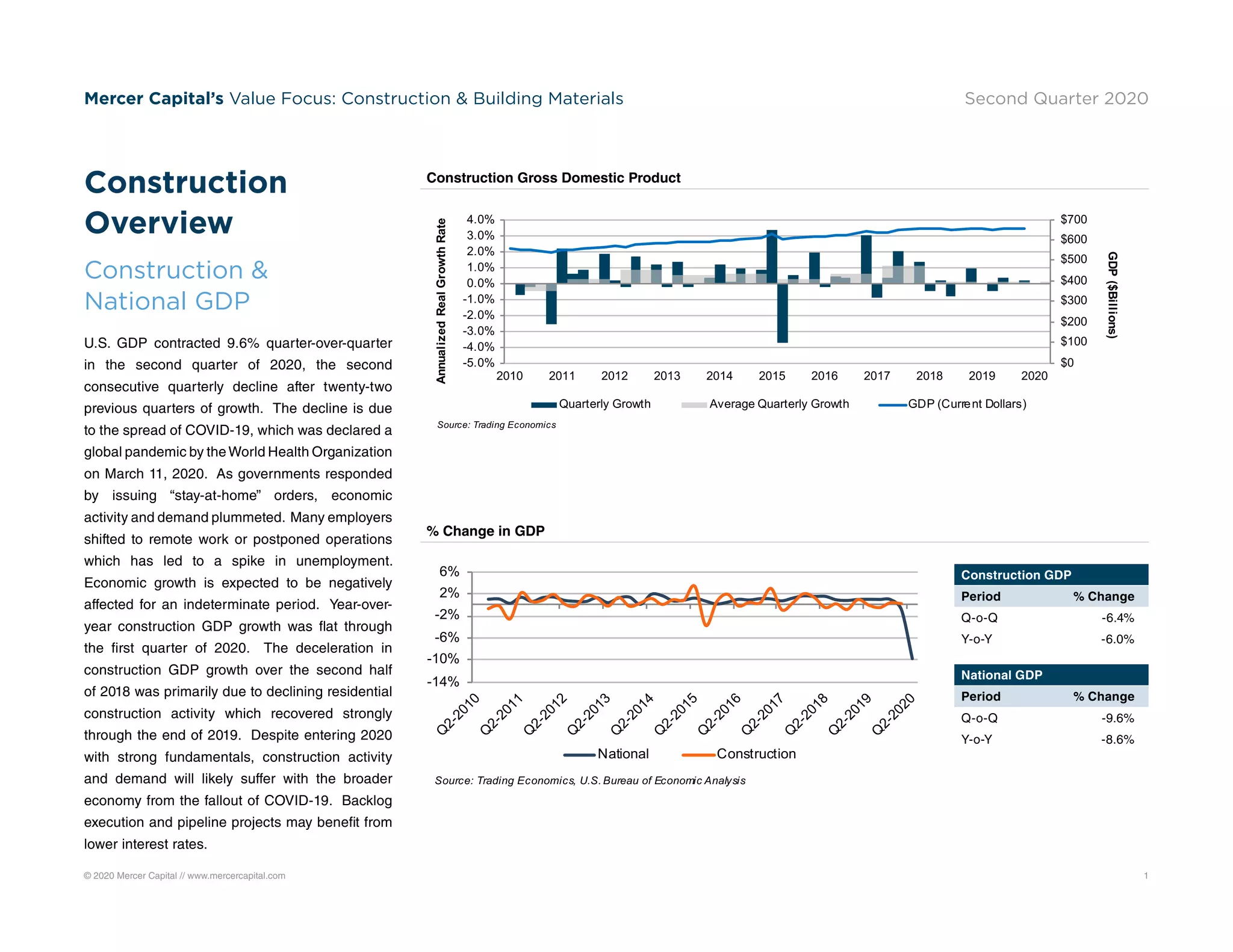
U.S. GDP contracted 9.6% quarter-over-quarter
in the second quarter of 2020, the second
consecutive quarterly decline after twenty-two
previous quarters of growth. The decline is due
to the spread of COVID-19, which was declared a
global pandemic by the World Health Organization
on March 11, 2020. As governments responded
by issuing “stay-at-home” orders, economic
activity and demand plummeted. Many employers
shifted to remote work or postponed operations
which has led to a spike in unemployment.
Economic growth is expected to be negatively
affected for an indeterminate period. Year-over-
year construction GDP growth was flat through
the first quarter of 2020. The deceleration in
construction GDP growth over the second half
of 2018 was primarily due to declining residential
construction activity which recovered strongly
through the end of 2019. Despite entering 2020
with strong fundamentals, construction activity
and demand will likely suffer with the broader
economy from the fallout of COVID-19. Backlog
execution and pipeline projects may benefit from
lower interest rates.
Construction Gross Domestic Product
% Change in GDP
Construction GDP
Period % Change
Q-o-Q -6.4%
Y-o-Y -6.0%
National GDP
Period % Change
Q-o-Q -9.6%
Y-o-Y -8.6%
© 2020 Mercer Capital // www.mercercapital.com 2
Mercer Capital’s Value Focus: Construction  Building Materials Second Quarter 2020
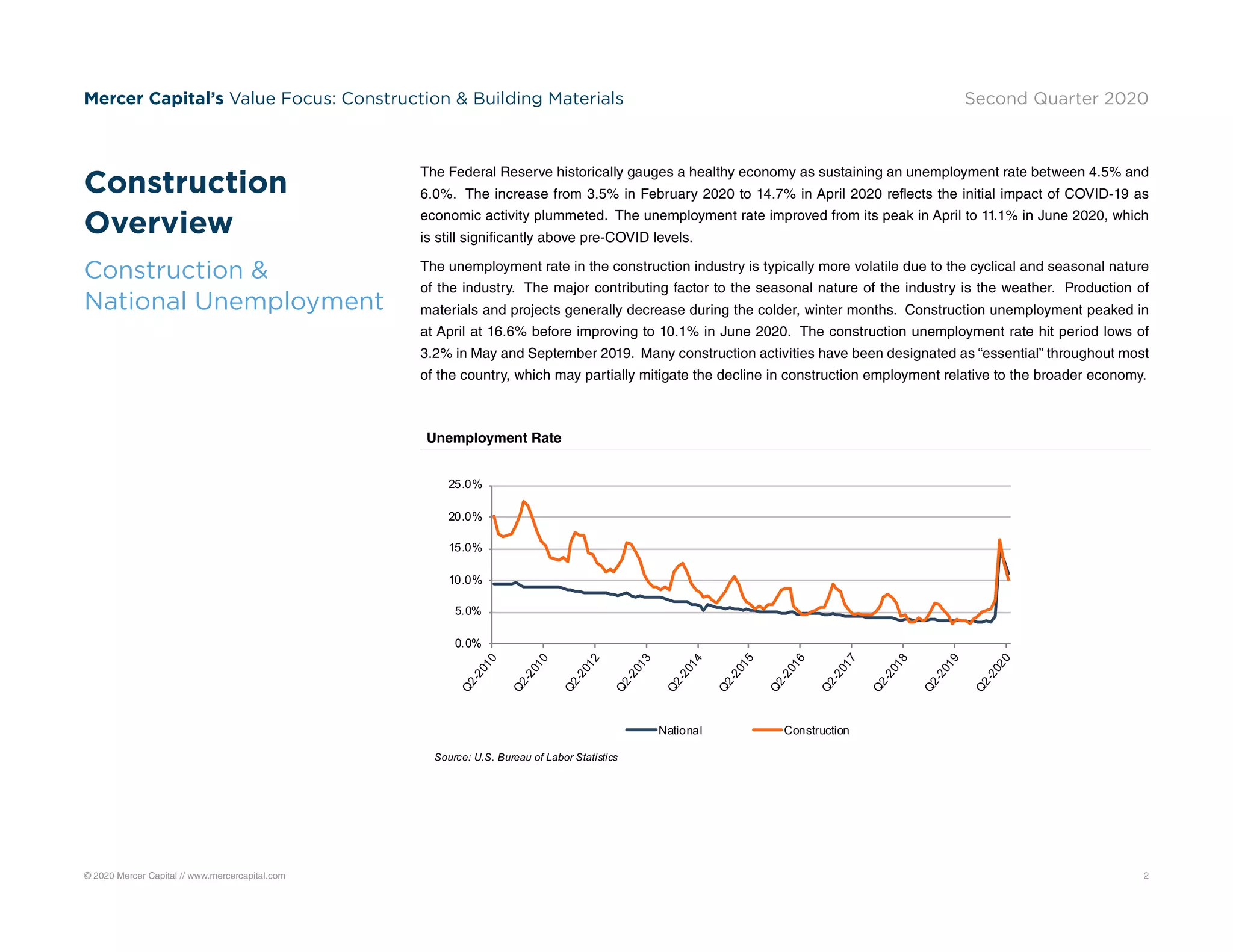
The Federal Reserve historically gauges a healthy economy as sustaining an unemployment rate between 4.5% and
6.0%. The increase from 3.5% in February 2020 to 14.7% in April 2020 reflects the initial impact of COVID-19 as
economic activity plummeted. The unemployment rate improved from its peak in April to 11.1% in June 2020, which
is still significantly above pre-COVID levels.
The unemployment rate in the construction industry is typically more volatile due to the cyclical and seasonal nature
of the industry. The major contributing factor to the seasonal nature of the industry is the weather. Production of
materials and projects generally decrease during the colder, winter months. Construction unemployment peaked in
at April at 16.6% before improving to 10.1% in June 2020. The construction unemployment rate hit period lows of
3.2% in May and September 2019. Many construction activities have been designated as “essential” throughout most
of the country, which may partially mitigate the decline in construction employment relative to the broader economy.
0.0%
5.0%
10.0%
15.0%
20.0%
25.0%
Q2-2010
Q2-2010
Q2-2012
Q2-2013
Q2-2014
Q2-2015
Q2-2016
Q2-2017
Q2-2018
Q2-2019
Q2-2020
National Construction
Source: U.S. Bureau of Labor Statistics
Construction
Overview
Construction 
National Unemployment
Unemployment Rate
© 2020 Mercer Capital // www.mercercapital.com 3
Mercer Capital’s Value Focus: Construction  Building Materials Second Quarter 2020
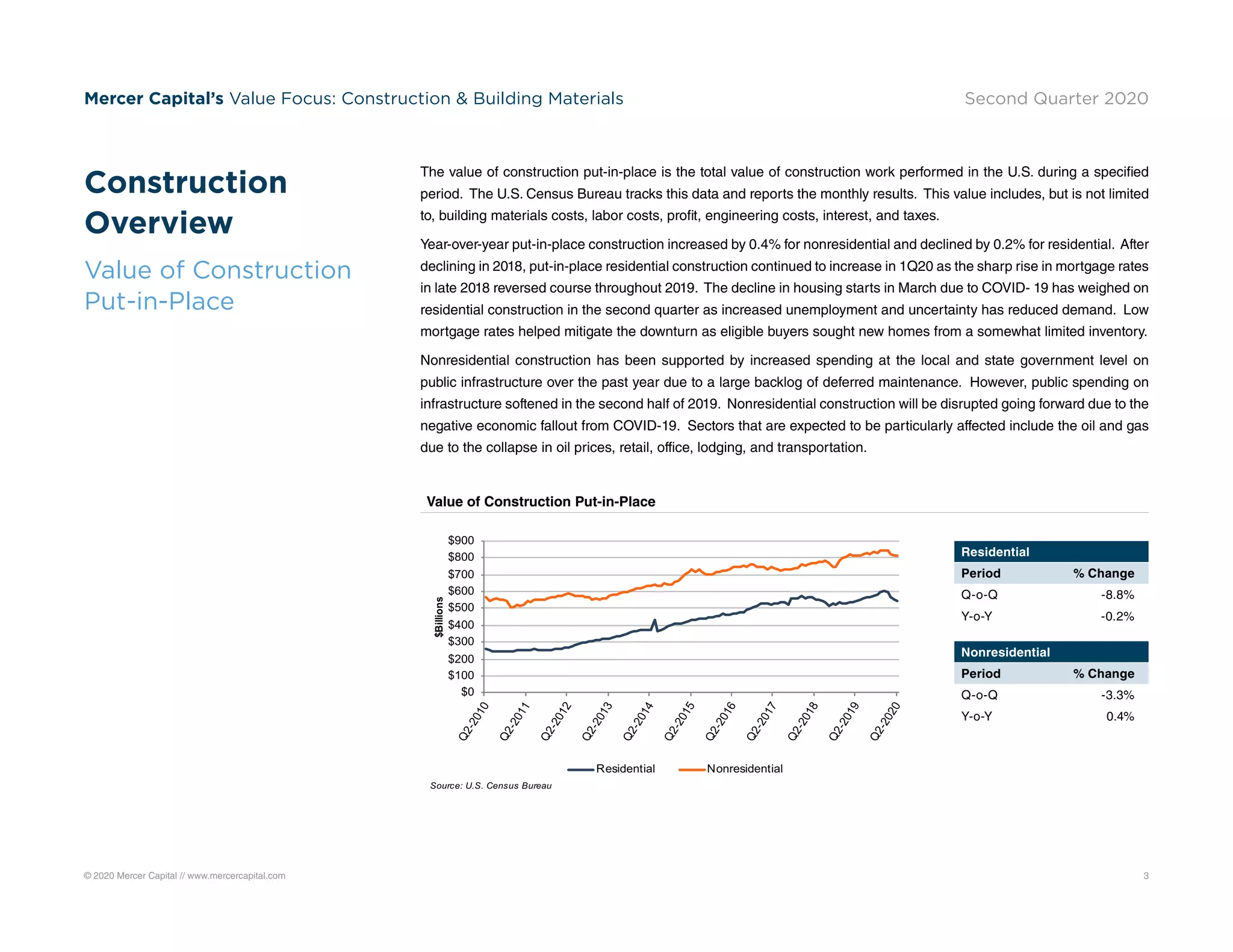
The value of construction put-in-place is the total value of construction work performed in the U.S. during a specified
period. The U.S. Census Bureau tracks this data and reports the monthly results. This value includes, but is not limited
to, building materials costs, labor costs, profit, engineering costs, interest, and taxes.
Year-over-year put-in-place construction increased by 0.4% for nonresidential and declined by 0.2% for residential. After
declining in 2018, put-in-place residential construction continued to increase in 1Q20 as the sharp rise in mortgage rates
in late 2018 reversed course throughout 2019. The decline in housing starts in March due to COVID- 19 has weighed on
residential construction in the second quarter as increased unemployment and uncertainty has reduced demand. Low
mortgage rates helped mitigate the downturn as eligible buyers sought new homes from a somewhat limited inventory.
Nonresidential construction has been supported by increased spending at the local and state government level on
public infrastructure over the past year due to a large backlog of deferred maintenance. However, public spending on
infrastructure softened in the second half of 2019. Nonresidential construction will be disrupted going forward due to the
negative economic fallout from COVID-19. Sectors that are expected to be particularly affected include the oil and gas
due to the collapse in oil prices, retail, office, lodging, and transportation.
Construction
Overview
Value of Construction
Put-in-Place
$0
$100
$200
$300
$400
$500
$600
$700
$800
$900
Q2-2010
Q2-2011
Q2-2012
Q2-2013
Q2-2014
Q2-2015
Q2-2016
Q2-2017
Q2-2018
Q2-2019
Q2-2020
$Billions
Residential Nonresidential
Source: U.S. Census Bureau
Value of Construction Put-in-Place
Residential
Period % Change
Q-o-Q -8.8%
Y-o-Y -0.2%
Nonresidential
Period % Change
Q-o-Q -3.3%
Y-o-Y 0.4%
© 2020 Mercer Capital // www.mercercapital.com 4
Mercer Capital’s Value Focus: Construction  Building Materials Second Quarter 2020
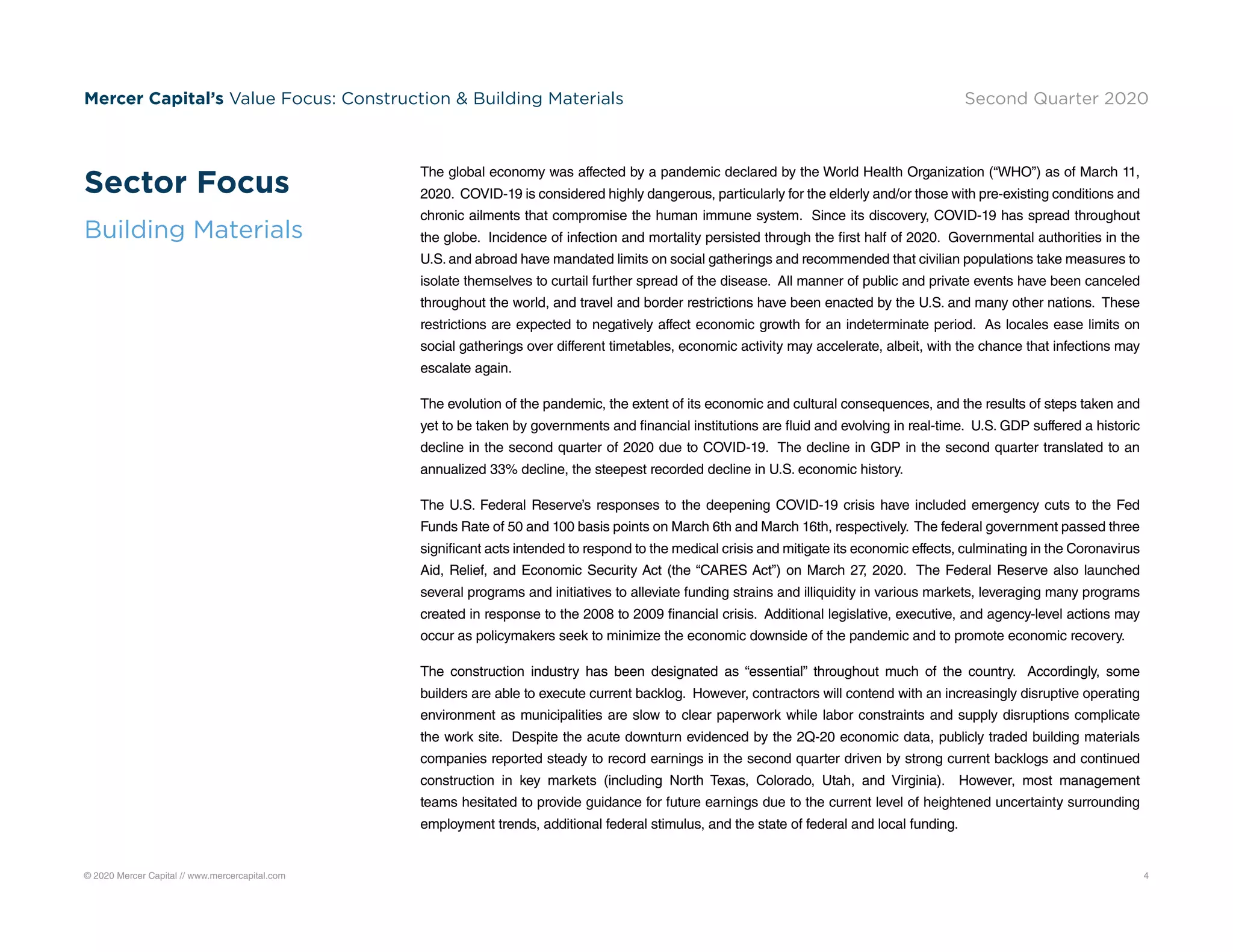
The global economy was affected by a pandemic declared by the World Health Organization (“WHO”) as of March 11,
2020. COVID-19 is considered highly dangerous, particularly for the elderly and/or those with pre-existing conditions and
chronic ailments that compromise the human immune system. Since its discovery, COVID-19 has spread throughout
the globe. Incidence of infection and mortality persisted through the first half of 2020. Governmental authorities in the
U.S. and abroad have mandated limits on social gatherings and recommended that civilian populations take measures to
isolate themselves to curtail further spread of the disease. All manner of public and private events have been canceled
throughout the world, and travel and border restrictions have been enacted by the U.S. and many other nations. These
restrictions are expected to negatively affect economic growth for an indeterminate period. As locales ease limits on
social gatherings over different timetables, economic activity may accelerate, albeit, with the chance that infections may
escalate again.
The evolution of the pandemic, the extent of its economic and cultural consequences, and the results of steps taken and
yet to be taken by governments and financial institutions are fluid and evolving in real-time. U.S. GDP suffered a historic
decline in the second quarter of 2020 due to COVID-19. The decline in GDP in the second quarter translated to an
annualized 33% decline, the steepest recorded decline in U.S. economic history.
The U.S. Federal Reserve’s responses to the deepening COVID-19 crisis have included emergency cuts to the Fed
Funds Rate of 50 and 100 basis points on March 6th and March 16th, respectively. The federal government passed three
significant acts intended to respond to the medical crisis and mitigate its economic effects, culminating in the Coronavirus
Aid, Relief, and Economic Security Act (the “CARES Act”) on March 27, 2020. The Federal Reserve also launched
several programs and initiatives to alleviate funding strains and illiquidity in various markets, leveraging many programs
created in response to the 2008 to 2009 financial crisis. Additional legislative, executive, and agency-level actions may
occur as policymakers seek to minimize the economic downside of the pandemic and to promote economic recovery.
The construction industry has been designated as “essential” throughout much of the country. Accordingly, some
builders are able to execute current backlog. However, contractors will contend with an increasingly disruptive operating
environment as municipalities are slow to clear paperwork while labor constraints and supply disruptions complicate
the work site. Despite the acute downturn evidenced by the 2Q-20 economic data, publicly traded building materials
companies reported steady to record earnings in the second quarter driven by strong current backlogs and continued
construction in key markets (including North Texas, Colorado, Utah, and Virginia). However, most management
teams hesitated to provide guidance for future earnings due to the current level of heightened uncertainty surrounding
employment trends, additional federal stimulus, and the state of federal and local funding.
Sector Focus
Building Materials
© 2020 Mercer Capital // www.mercercapital.com 5
Mercer Capital’s Value Focus: Construction  Building Materials Second Quarter 2020
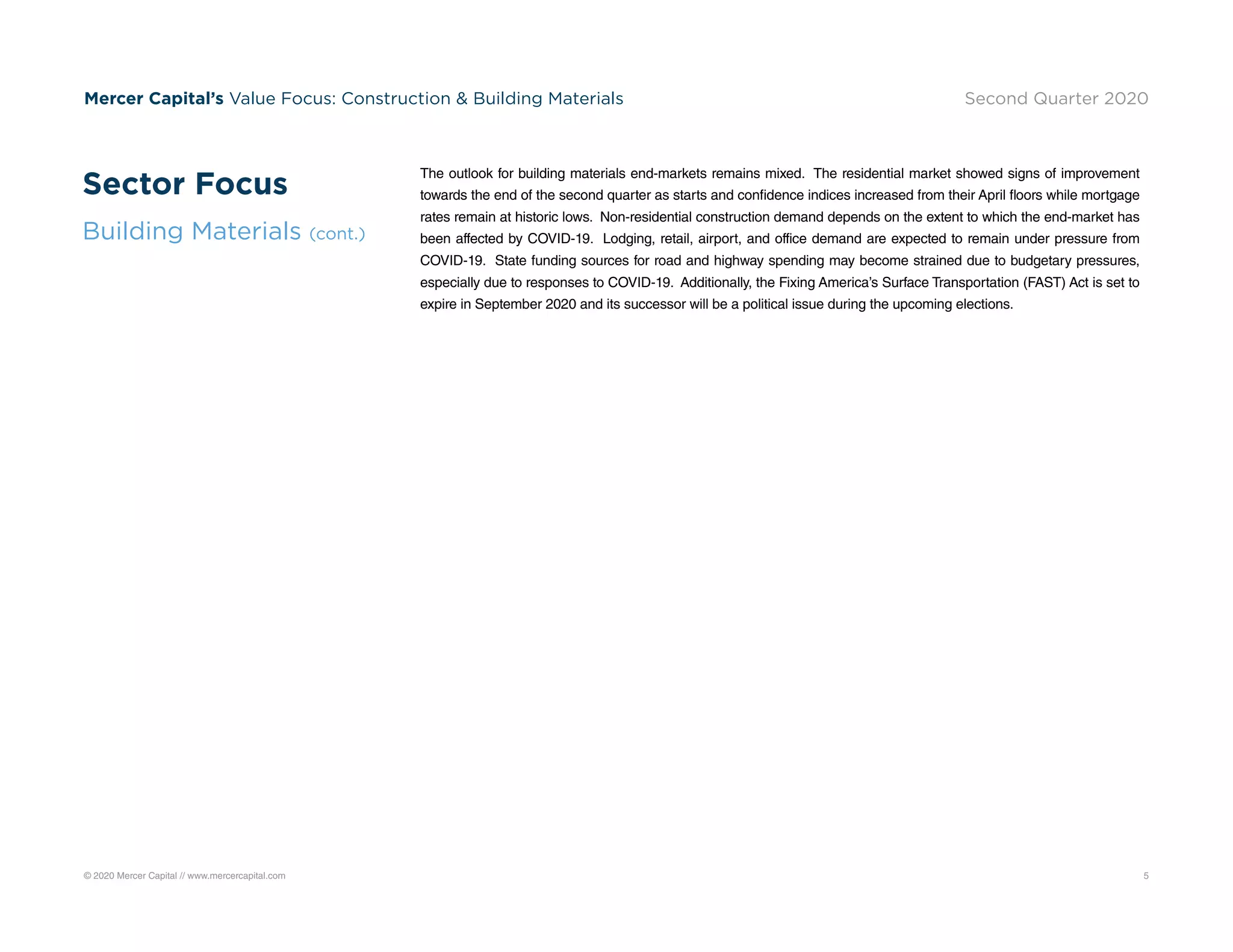
The outlook for building materials end-markets remains mixed. The residential market showed signs of improvement
towards the end of the second quarter as starts and confidence indices increased from their April floors while mortgage
rates remain at historic lows. Non-residential construction demand depends on the extent to which the end-market has
been affected by COVID-19. Lodging, retail, airport, and office demand are expected to remain under pressure from
COVID-19. State funding sources for road and highway spending may become strained due to budgetary pressures,
especially due to responses to COVID-19. Additionally, the Fixing America’s Surface Transportation (FAST) Act is set to
expire in September 2020 and its successor will be a political issue during the upcoming elections.
Sector Focus
Building Materials (cont.)
© 2020 Mercer Capital // www.mercercapital.com 6
Mercer Capital’s Value Focus: Construction  Building Materials Second Quarter 2020
Government Consumption and Investment
$2,800
$2,900
$3,000
$3,100
$3,200
$3,300
$3,400
Q
2-2010
Q
2-2011
Q
2-2012
Q
2-2013
Q
2-2014
Q
2-2015
Q
2-2016
Q
2-2017
Q
2-2018
Q
2-2019
Q
2-2020
$Billions
Source: St. Louis Fed | U.S. Bureau of Economic Analysis
Government Consumption and
Investment
Period % Change
Q-o-Q 1.0%
Y-o-Y 2.2%
Building Materials
Government
Consumption and
Investment
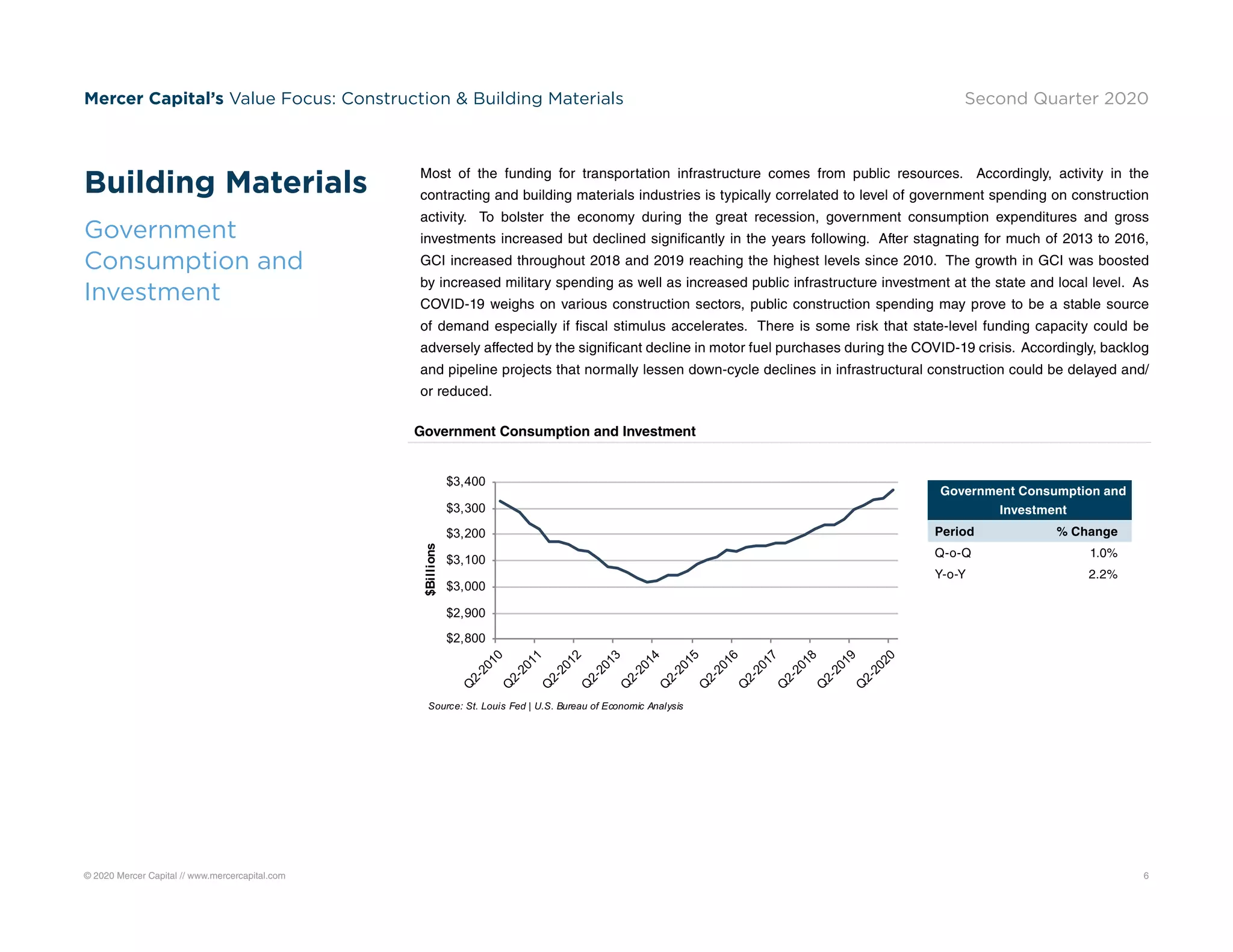
Most of the funding for transportation infrastructure comes from public resources. Accordingly, activity in the
contracting and building materials industries is typically correlated to level of government spending on construction
activity. To bolster the economy during the great recession, government consumption expenditures and gross
investments increased but declined significantly in the years following. After stagnating for much of 2013 to 2016,
GCI increased throughout 2018 and 2019 reaching the highest levels since 2010. The growth in GCI was boosted
by increased military spending as well as increased public infrastructure investment at the state and local level. As
COVID-19 weighs on various construction sectors, public construction spending may prove to be a stable source
of demand especially if fiscal stimulus accelerates. There is some risk that state-level funding capacity could be
adversely affected by the significant decline in motor fuel purchases during the COVID-19 crisis. Accordingly, backlog
and pipeline projects that normally lessen down-cycle declines in infrastructural construction could be delayed and/
or reduced.
© 2020 Mercer Capital // www.mercercapital.com 7
Mercer Capital’s Value Focus: Construction  Building Materials Second Quarter 2020
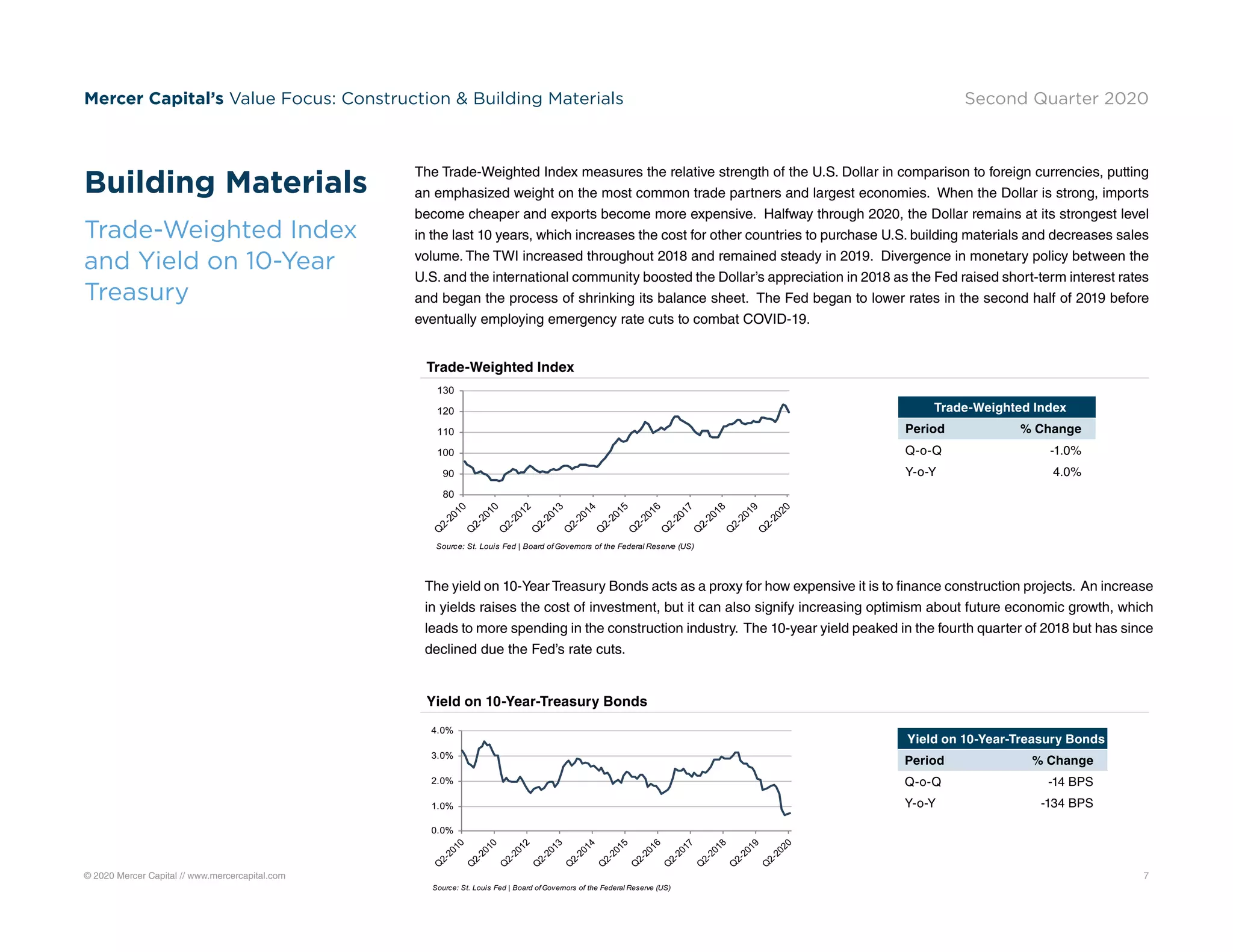
The Trade-Weighted Index measures the relative strength of the U.S. Dollar in comparison to foreign currencies, putting
an emphasized weight on the most common trade partners and largest economies. When the Dollar is strong, imports
become cheaper and exports become more expensive. Halfway through 2020, the Dollar remains at its strongest level
in the last 10 years, which increases the cost for other countries to purchase U.S. building materials and decreases sales
volume. The TWI increased throughout 2018 and remained steady in 2019. Divergence in monetary policy between the
U.S. and the international community boosted the Dollar’s appreciation in 2018 as the Fed raised short-term interest rates
and began the process of shrinking its balance sheet. The Fed began to lower rates in the second half of 2019 before
eventually employing emergency rate cuts to combat COVID-19.
The yield on 10-Year Treasury Bonds acts as a proxy for how expensive it is to finance construction projects. An increase
in yields raises the cost of investment, but it can also signify increasing optimism about future economic growth, which
leads to more spending in the construction industry. The 10-year yield peaked in the fourth quarter of 2018 but has since
declined due the Fed’s rate cuts.
Building Materials
Trade-Weighted Index
and Yield on 10-Year
Treasury
Yield on 10-Year-Treasury Bonds
Trade-Weighted Index
Yield on 10-Year-Treasury Bonds
Period % Change
Q-o-Q -14 BPS
Y-o-Y -134 BPS
Trade-Weighted Index
Period % Change
Q-o-Q -1.0%
Y-o-Y 4.0%
80
90
100
110
120
130
Q
2-2010
Q
2-2010
Q
2-2012
Q
2-2013
Q
2-2014
Q
2-2015
Q
2-2016
Q
2-2017
Q
2-2018
Q
2-2019
Q
2-2020
Source: St. Louis Fed | Board of Governors of the Federal Reserve (US)
0.0%
1.0%
2.0%
3.0%
4.0%
Q
2-2010
Q
2-2010
Q
2-2012
Q
2-2013
Q
2-2014
Q
2-2015
Q
2-2016
Q
2-2017
Q
2-2018
Q
2-2019
Q
2-2020
Source: St. Louis Fed | Board of Governors of the Federal Reserve (US)
© 2020 Mercer Capital // www.mercercapital.com 8
Mercer Capital’s Value Focus: Construction  Building Materials Second Quarter 2020
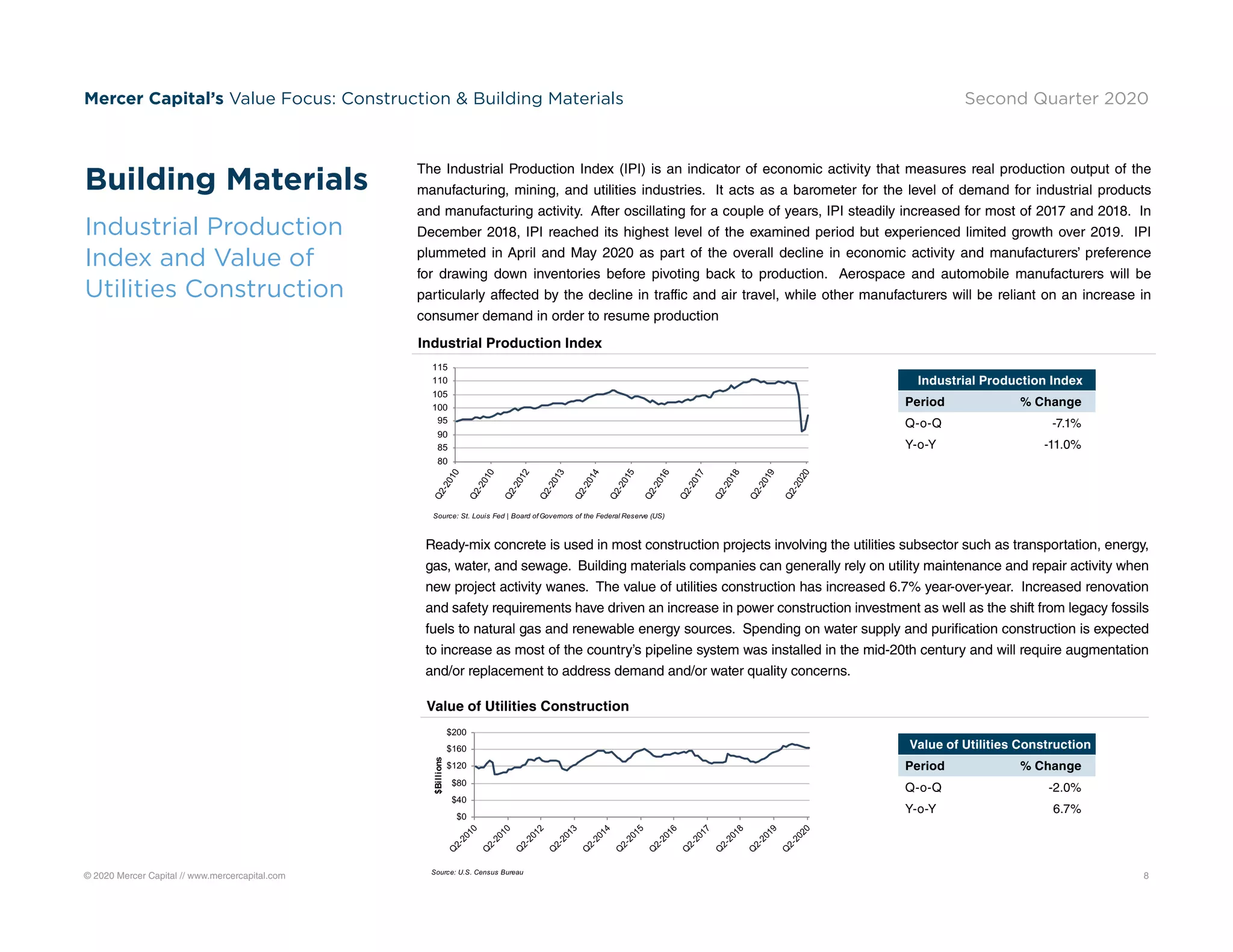
The Industrial Production Index (IPI) is an indicator of economic activity that measures real production output of the
manufacturing, mining, and utilities industries. It acts as a barometer for the level of demand for industrial products
and manufacturing activity. After oscillating for a couple of years, IPI steadily increased for most of 2017 and 2018. In
December 2018, IPI reached its highest level of the examined period but experienced limited growth over 2019. IPI
plummeted in April and May 2020 as part of the overall decline in economic activity and manufacturers’ preference
for drawing down inventories before pivoting back to production. Aerospace and automobile manufacturers will be
particularly affected by the decline in traffic and air travel, while other manufacturers will be reliant on an increase in
consumer demand in order to resume production
Ready-mix concrete is used in most construction projects involving the utilities subsector such as transportation, energy,
gas, water, and sewage. Building materials companies can generally rely on utility maintenance and repair activity when
new project activity wanes. The value of utilities construction has increased 6.7% year-over-year. Increased renovation
and safety requirements have driven an increase in power construction investment as well as the shift from legacy fossils
fuels to natural gas and renewable energy sources. Spending on water supply and purification construction is expected
to increase as most of the country’s pipeline system was installed in the mid-20th century and will require augmentation
and/or replacement to address demand and/or water quality concerns.
Building Materials
Industrial Production
Index and Value of
Utilities Construction
Value of Utilities Construction
Industrial Production Index
Value of Utilities Construction
Period % Change
Q-o-Q -2.0%
Y-o-Y 6.7%
Industrial Production Index
Period % Change
Q-o-Q -7.1%
Y-o-Y -11.0%
80
85
90
95
100
105
110
115
Q2-2010
Q2-2010
Q2-2012
Q2-2013
Q2-2014
Q2-2015
Q2-2016
Q2-2017
Q2-2018
Q2-2019
Q2-2020
Source: St. Louis Fed | Board of Governors of the Federal Reserve (US)
$0
$40
$80
$120
$160
$200
Q
2-2010
Q
2-2010
Q
2-2012
Q
2-2013
Q
2-2014
Q
2-2015
Q
2-2016
Q
2-2017
Q
2-2018
Q
2-2019
Q
2-2020
$Billions
Source: U.S. Census Bureau
© 2020 Mercer Capital // www.mercercapital.com 9
Mercer Capital’s Value Focus: Construction  Building Materials Second Quarter 2020
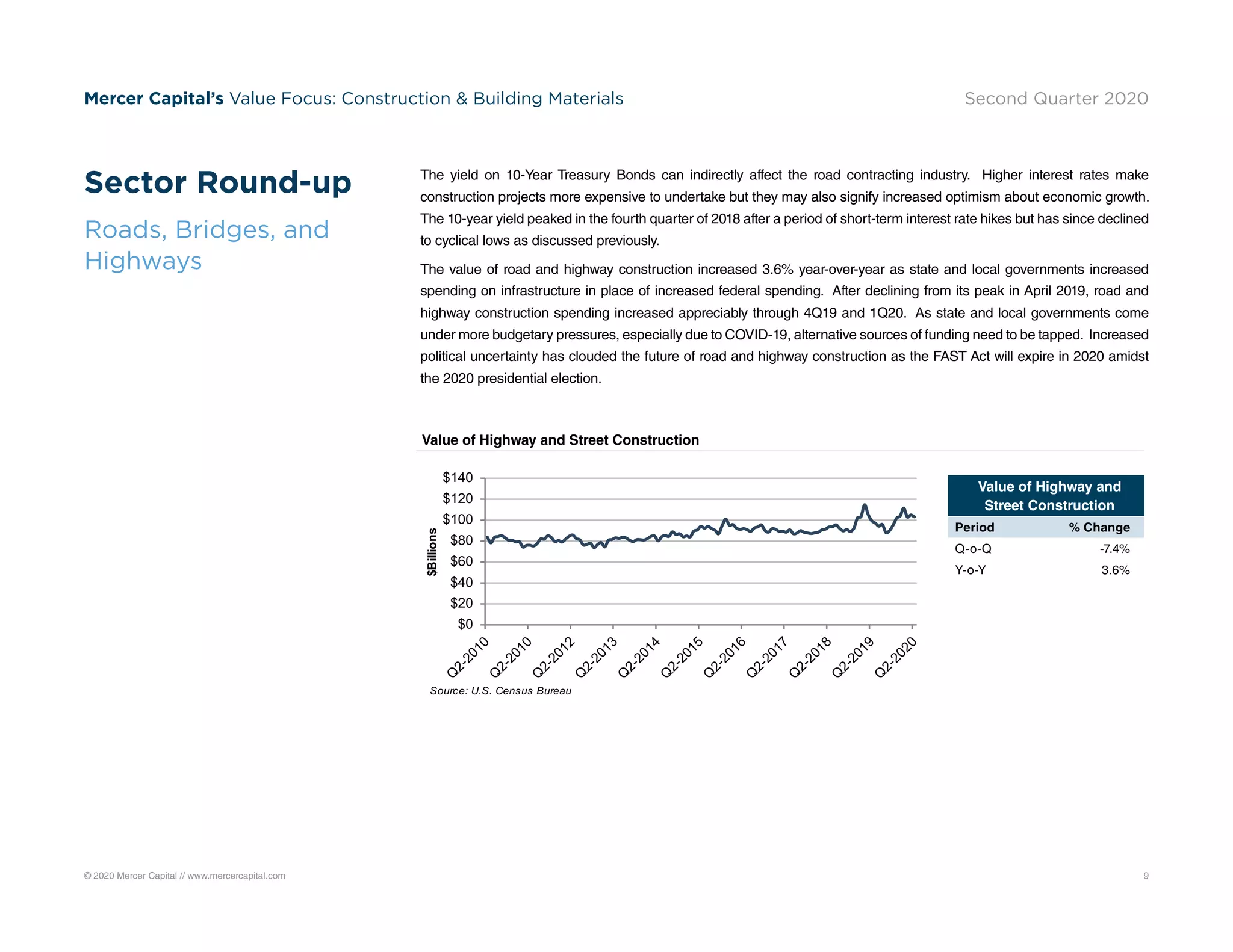
The yield on 10-Year Treasury Bonds can indirectly affect the road contracting industry. Higher interest rates make
construction projects more expensive to undertake but they may also signify increased optimism about economic growth.
The 10-year yield peaked in the fourth quarter of 2018 after a period of short-term interest rate hikes but has since declined
to cyclical lows as discussed previously.
The value of road and highway construction increased 3.6% year-over-year as state and local governments increased
spending on infrastructure in place of increased federal spending. After declining from its peak in April 2019, road and
highway construction spending increased appreciably through 4Q19 and 1Q20. As state and local governments come
under more budgetary pressures, especially due to COVID-19, alternative sources of funding need to be tapped. Increased
political uncertainty has clouded the future of road and highway construction as the FAST Act will expire in 2020 amidst
the 2020 presidential election.
$0
$20
$40
$60
$80
$100
$120
$140
Q
2-2010
Q
2-2010
Q
2-2012
Q
2-2013
Q
2-2014
Q
2-2015
Q
2-2016
Q
2-2017
Q
2-2018
Q
2-2019
Q
2-2020
$Billions
Source: U.S. Census Bureau
Sector Round-up
Roads, Bridges, and
Highways
Value of Highway and Street Construction
Value of Highway and
Street Construction
Period % Change
Q-o-Q -7.4%
Y-o-Y 3.6%
© 2020 Mercer Capital // www.mercercapital.com 10
Mercer Capital’s Value Focus: Construction  Building Materials Second Quarter 2020
Nonresidential
Construction
$0
$500
$1,000
$1,500
$2,000
$2,500
Q
2-2010
Q
2-2011
Q
2-2012
Q
2-2013
Q
2-2014
Q
2-2015
Q
2-2016
Q
2-2017
Q
2-2018
Q
2-2019
Q
2-2020
$Billions
Source: St. Louis Federal Reserve
Corporate Profit
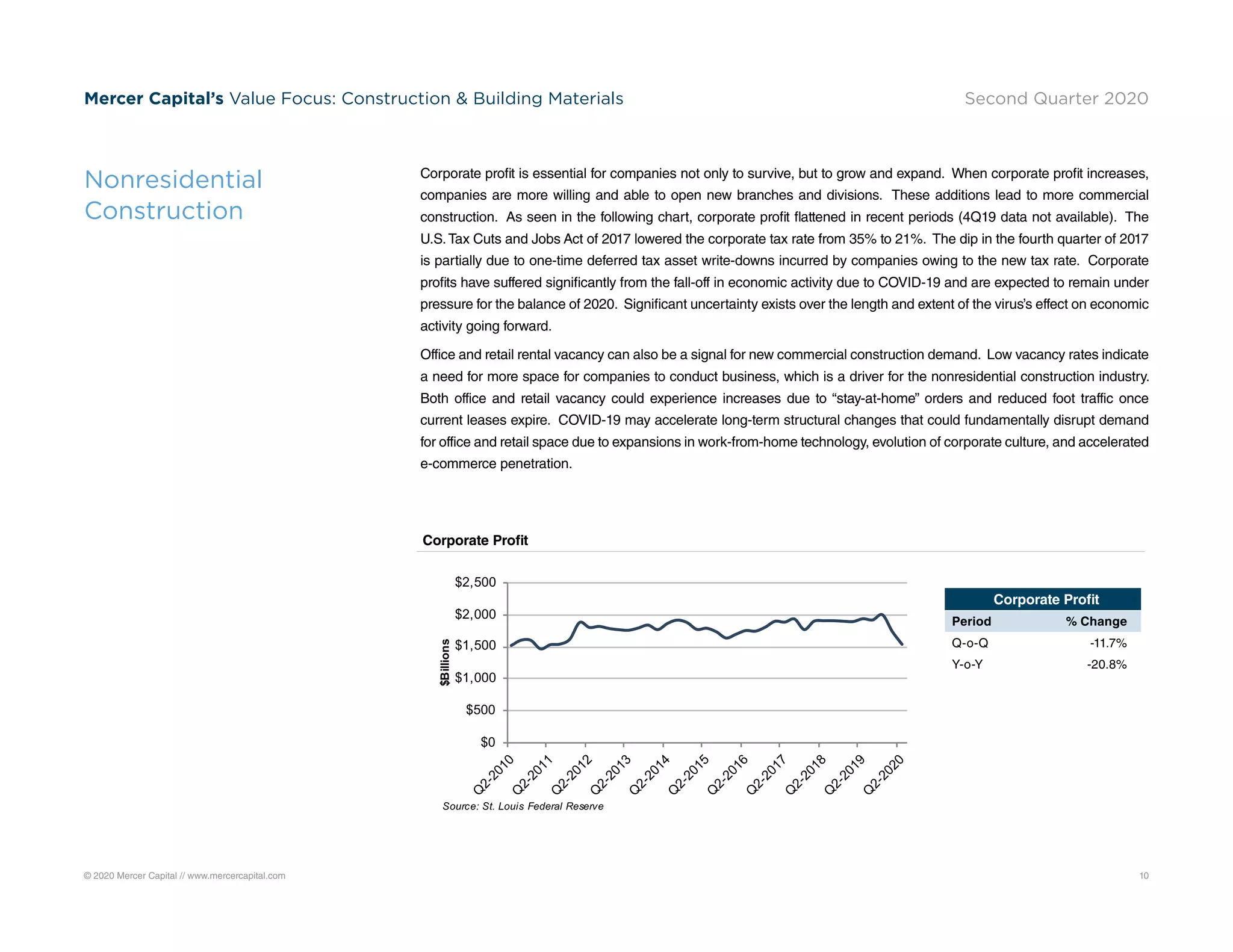
Corporate profit is essential for companies not only to survive, but to grow and expand. When corporate profit increases,
companies are more willing and able to open new branches and divisions. These additions lead to more commercial
construction. As seen in the following chart, corporate profit flattened in recent periods (4Q19 data not available). The
U.S.Tax Cuts and Jobs Act of 2017 lowered the corporate tax rate from 35% to 21%. The dip in the fourth quarter of 2017
is partially due to one-time deferred tax asset write-downs incurred by companies owing to the new tax rate. Corporate
profits have suffered significantly from the fall-off in economic activity due to COVID-19 and are expected to remain under
pressure for the balance of 2020. Significant uncertainty exists over the length and extent of the virus’s effect on economic
activity going forward.
Office and retail rental vacancy can also be a signal for new commercial construction demand. Low vacancy rates indicate
a need for more space for companies to conduct business, which is a driver for the nonresidential construction industry.
Both office and retail vacancy could experience increases due to “stay-at-home” orders and reduced foot traffic once
current leases expire. COVID-19 may accelerate long-term structural changes that could fundamentally disrupt demand
for office and retail space due to expansions in work-from-home technology, evolution of corporate culture, and accelerated
e-commerce penetration.
Corporate Profit
Period % Change
Q-o-Q -11.7%
Y-o-Y -20.8%
© 2020 Mercer Capital // www.mercercapital.com 11
Mercer Capital’s Value Focus: Construction  Building Materials Second Quarter 2020
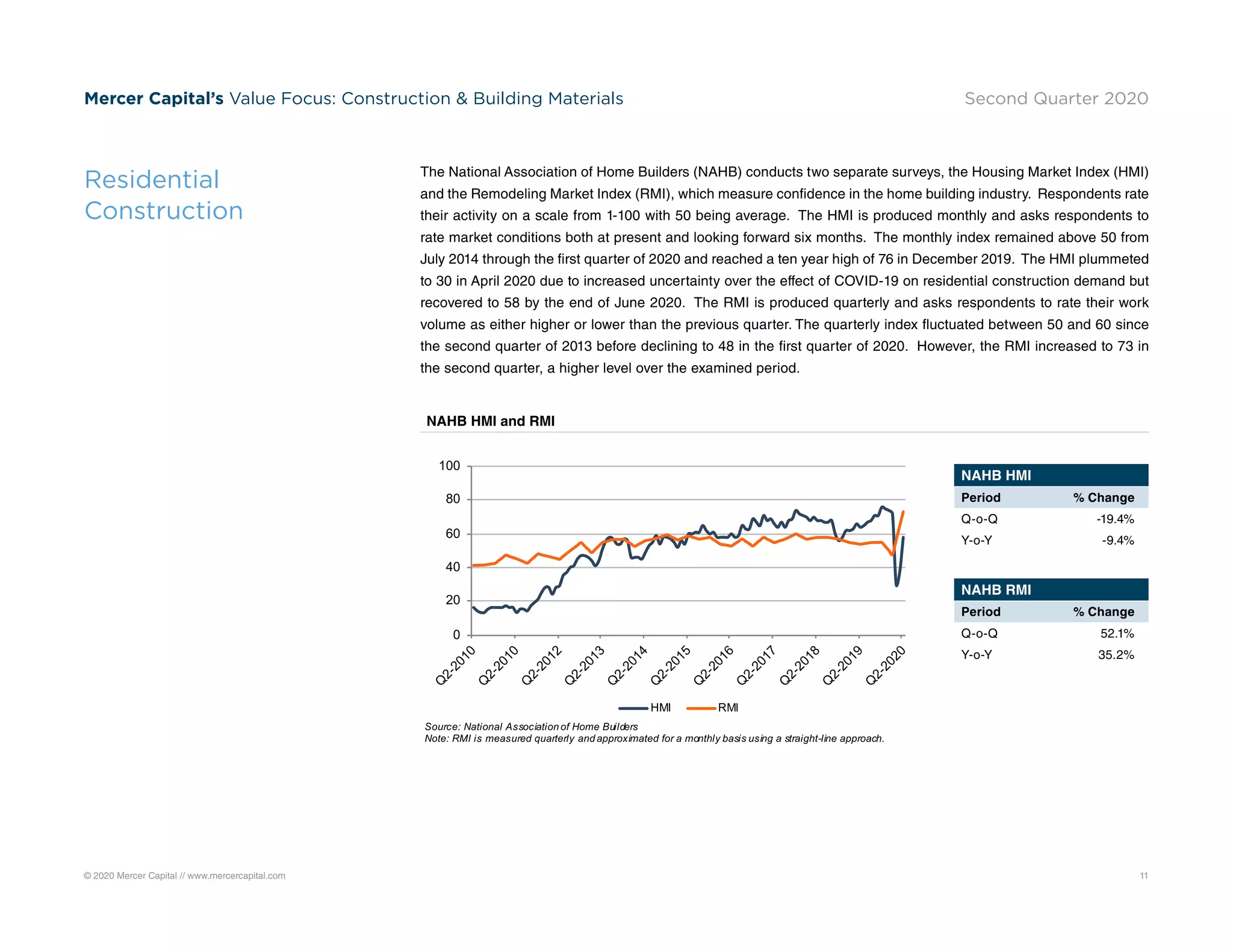
The National Association of Home Builders (NAHB) conducts two separate surveys, the Housing Market Index (HMI)
and the Remodeling Market Index (RMI), which measure confidence in the home building industry. Respondents rate
their activity on a scale from 1-100 with 50 being average. The HMI is produced monthly and asks respondents to
rate market conditions both at present and looking forward six months. The monthly index remained above 50 from
July 2014 through the first quarter of 2020 and reached a ten year high of 76 in December 2019. The HMI plummeted
to 30 in April 2020 due to increased uncertainty over the effect of COVID-19 on residential construction demand but
recovered to 58 by the end of June 2020. The RMI is produced quarterly and asks respondents to rate their work
volume as either higher or lower than the previous quarter. The quarterly index fluctuated between 50 and 60 since
the second quarter of 2013 before declining to 48 in the first quarter of 2020. However, the RMI increased to 73 in
the second quarter, a higher level over the examined period.
Residential
Construction
NAHB HMI and RMI
0
20
40
60
80
100
Q
2-2010
Q
2-2010
Q
2-2012
Q
2-2013
Q
2-2014
Q
2-2015
Q
2-2016
Q
2-2017
Q
2-2018
Q
2-2019
Q
2-2020
HMI RMI
Source: National Association of Home Builders
Note: RMI is measured quarterly and approximated for a monthly basis using a straight-line approach.
NAHB HMI
Period % Change
Q-o-Q -19.4%
Y-o-Y -9.4%
NAHB RMI
Period % Change
Q-o-Q 52.1%
Y-o-Y 35.2%
© 2020 Mercer Capital // www.mercercapital.com 12
Mercer Capital’s Value Focus: Construction  Building Materials Second Quarter 2020
0.2
0.3
0.4
0.5
0.6
0.7
0.8
0.9
1.0
1.1
1.2
1.3
1.4
1.5
1.6
1.7
1.8
1.9
2.0
2.1
2.2
2.3
2.4
Jun-08
Sep-08
Dec-08
Mar-09
Jun-09
Sep-09
Dec-09
Mar-10
Jun-10
Sep-10
Dec-10
Mar-11
Jun-11
Sep-11
Dec-11
Mar-12
Jun-12
Sep-12
Dec-12
Mar-13
Jun-13
Sep-13
Dec-13
Mar-14
Jun-14
Sep-14
Dec-14
Mar-15
Jun-15
Sep-15
Dec-15
Mar-16
Jun-16
Sep-16
Dec-16
Mar-17
Jun-17
Sep-17
Dec-17
Mar-18
Jun-18
Sep-18
Dec-18
Mar-19
Jun-19
Sep-19
Dec-19
Mar-20
Jun-20
Private Housing Starts Single Family Starts Private Building Permits Single Family Building Permits
Source: U.S. Census Bureau
Note: Permits at a given date are generally a leading indicator of future starts. Beginning with January 2014, building permit data reflects the change to the 20,000 place series.
Private Housing
Single Family Housing
Seasonally Adjusted Annualized Rates of New Housing Starts and Building Permits
Private Housing Stats
Period % Change
Q-o-Q -6.5%
Y-o-Y -4.0%
Private Building Permits
Period % Change
Q-o-Q -7.2%
Y-o-Y -1.2%
Single Family Stats
Period % Change
Q-o-Q -5.6%
Y-o-Y -3.9%
Single Family Building Permits
Period % Change
Q-o-Q -5.0%
Y-o-Y -0.4%
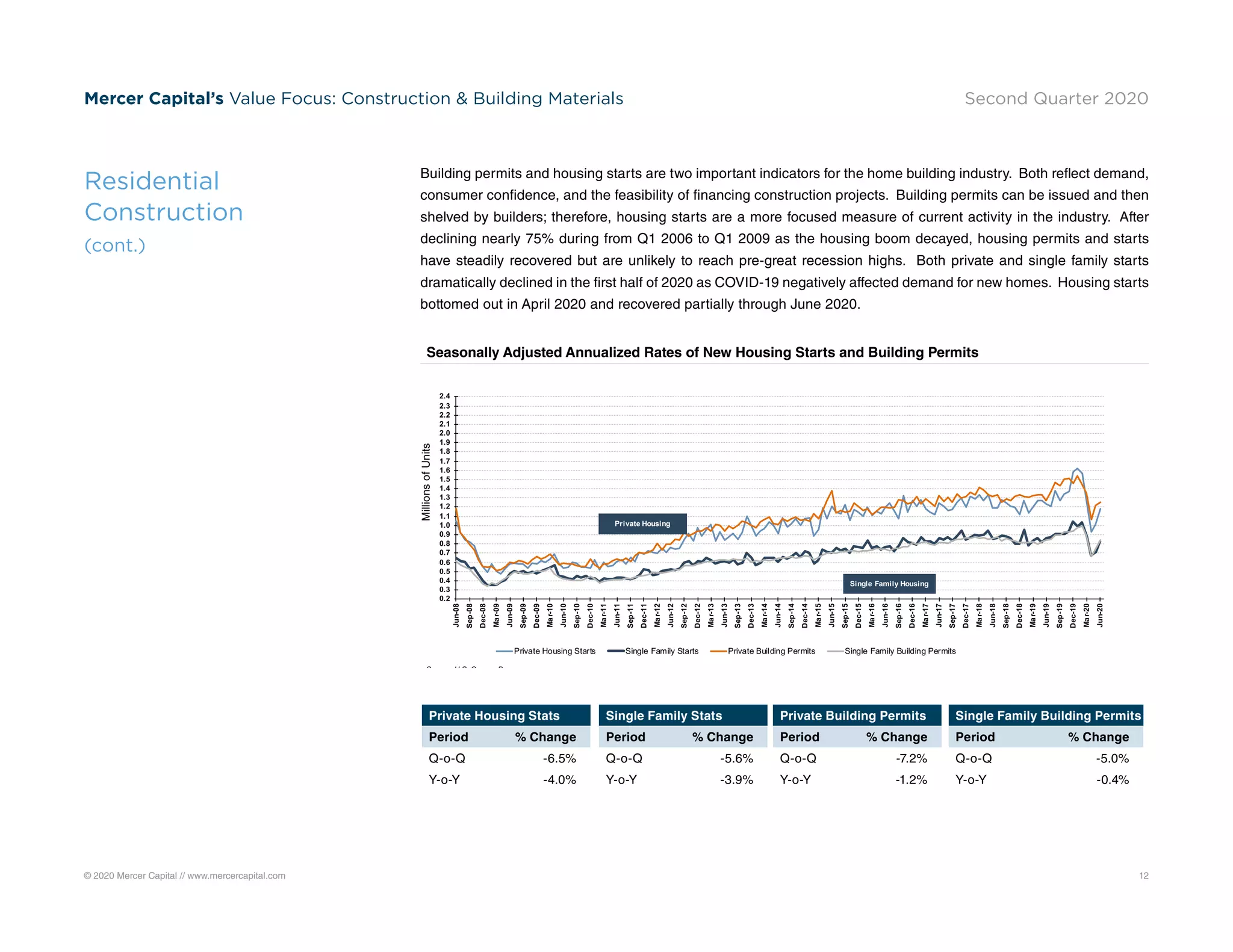
Building permits and housing starts are two important indicators for the home building industry. Both reflect demand,
consumer confidence, and the feasibility of financing construction projects. Building permits can be issued and then
shelved by builders; therefore, housing starts are a more focused measure of current activity in the industry. After
declining nearly 75% during from Q1 2006 to Q1 2009 as the housing boom decayed, housing permits and starts
have steadily recovered but are unlikely to reach pre-great recession highs. Both private and single family starts
dramatically declined in the first half of 2020 as COVID-19 negatively affected demand for new homes. Housing starts
bottomed out in April 2020 and recovered partially through June 2020.
MillionsofUnits
Residential
Construction
(cont.)
© 2020 Mercer Capital // www.mercercapital.com 13
Mercer Capital’s Value Focus: Construction  Building Materials Second Quarter 2020
Ticker
Price at
6/30/20
52-Week
Perf.
LTM
Revenue
Enterprise
Value Debt / MVTC
EBITDA
Margin
EV / EBITDA
(x)
TEV / Next Yr
EBITDA (x)
Price / LTM
Earnings
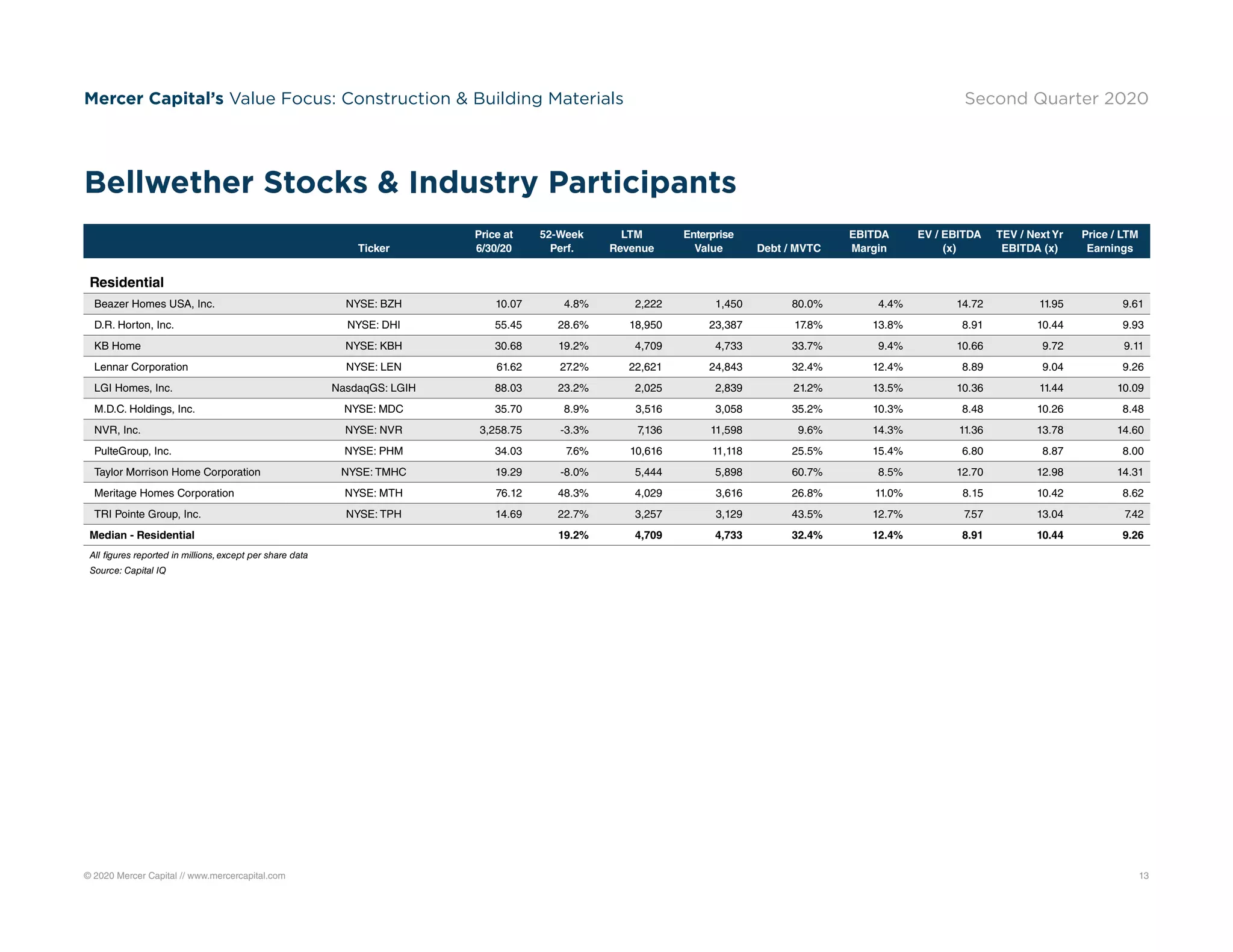
Residential
Beazer Homes USA, Inc. NYSE: BZH 10.07 4.8% 2,222 1,450 80.0% 4.4% 14.72 11.95 9.61
D.R. Horton, Inc. NYSE: DHI 55.45 28.6% 18,950 23,387 17.8% 13.8% 8.91 10.44 9.93
KB Home NYSE: KBH 30.68 19.2% 4,709 4,733 33.7% 9.4% 10.66 9.72 9.11
Lennar Corporation NYSE: LEN 61.62 27.2% 22,621 24,843 32.4% 12.4% 8.89 9.04 9.26
LGI Homes, Inc. NasdaqGS: LGIH 88.03 23.2% 2,025 2,839 21.2% 13.5% 10.36 11.44 10.09
M.D.C. Holdings, Inc. NYSE: MDC 35.70 8.9% 3,516 3,058 35.2% 10.3% 8.48 10.26 8.48
NVR, Inc. NYSE: NVR 3,258.75 -3.3% 7,136 11,598 9.6% 14.3% 11.36 13.78 14.60
PulteGroup, Inc. NYSE: PHM 34.03 7.6% 10,616 11,118 25.5% 15.4% 6.80 8.87 8.00
Taylor Morrison Home Corporation NYSE: TMHC 19.29 -8.0% 5,444 5,898 60.7% 8.5% 12.70 12.98 14.31
Meritage Homes Corporation NYSE: MTH 76.12 48.3% 4,029 3,616 26.8% 11.0% 8.15 10.42 8.62
TRI Pointe Group, Inc. NYSE: TPH 14.69 22.7% 3,257 3,129 43.5% 12.7% 7.57 13.04 7.42
Median - Residential 19.2% 4,709 4,733 32.4% 12.4% 8.91 10.44 9.26
All figures reported in millions, except per share data
Source: Capital IQ
Bellwether Stocks  Industry Participants
© 2020 Mercer Capital // www.mercercapital.com 14
Mercer Capital’s Value Focus: Construction  Building Materials Second Quarter 2020
Ticker
Price at
6/30/20
52-Week
Perf.
LTM
Revenue
Enterprise
Value Debt / MVTC
EBITDA
Margin
EV / EBITDA
(x)
TEV / Next Yr
EBITDA (x)
Price / LTM
Earnings
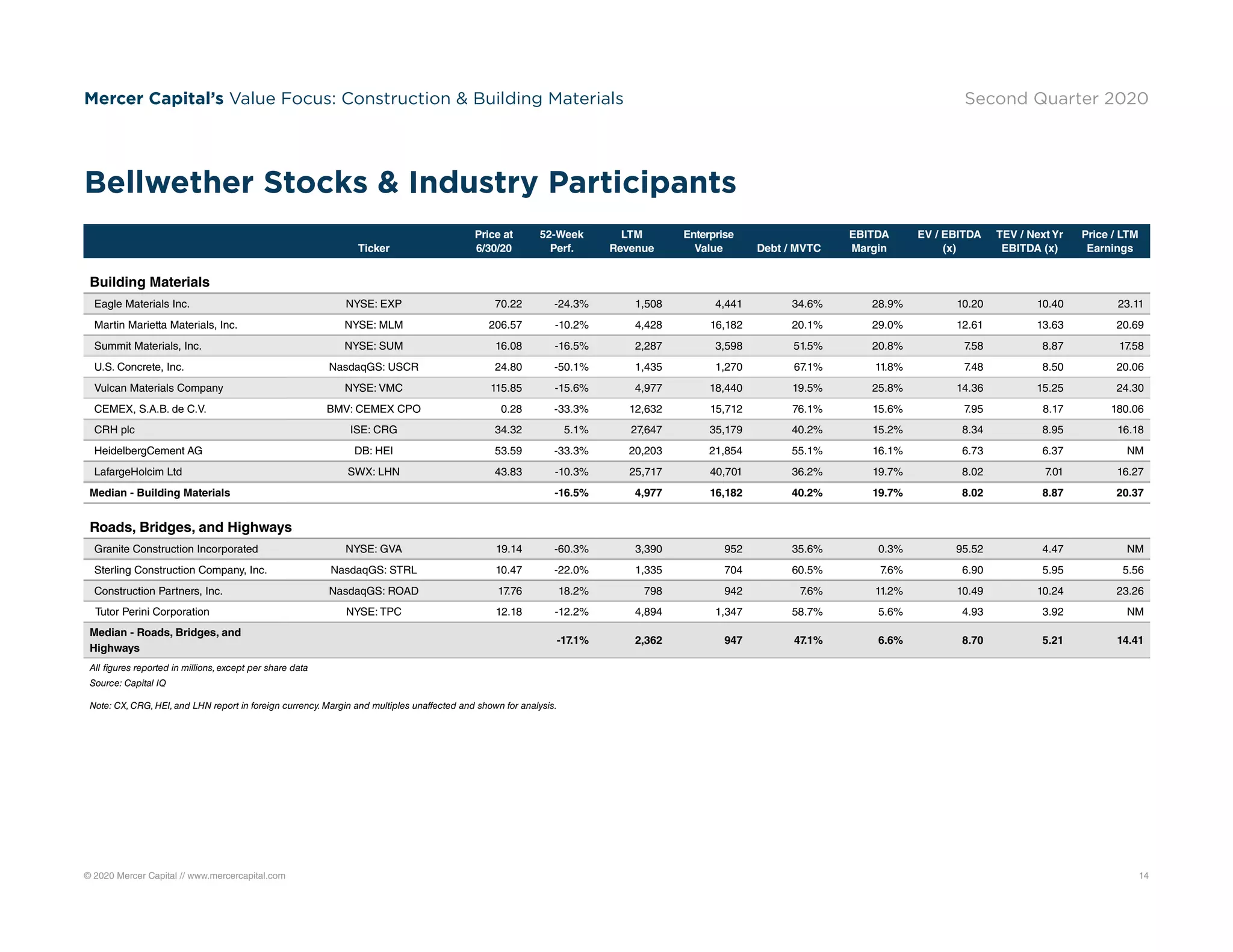
Building Materials
Eagle Materials Inc. NYSE: EXP 70.22 -24.3% 1,508 4,441 34.6% 28.9% 10.20 10.40 23.11
Martin Marietta Materials, Inc. NYSE: MLM 206.57 -10.2% 4,428 16,182 20.1% 29.0% 12.61 13.63 20.69
Summit Materials, Inc. NYSE: SUM 16.08 -16.5% 2,287 3,598 51.5% 20.8% 7.58 8.87 17.58
U.S. Concrete, Inc. NasdaqGS: USCR 24.80 -50.1% 1,435 1,270 67.1% 11.8% 7.48 8.50 20.06
Vulcan Materials Company NYSE: VMC 115.85 -15.6% 4,977 18,440 19.5% 25.8% 14.36 15.25 24.30
CEMEX, S.A.B. de C.V. BMV: CEMEX CPO 0.28 -33.3% 12,632 15,712 76.1% 15.6% 7.95 8.17 180.06
CRH plc ISE: CRG 34.32 5.1% 27,647 35,179 40.2% 15.2% 8.34 8.95 16.18
HeidelbergCement AG DB: HEI 53.59 -33.3% 20,203 21,854 55.1% 16.1% 6.73 6.37 NM
LafargeHolcim Ltd SWX: LHN 43.83 -10.3% 25,717 40,701 36.2% 19.7% 8.02 7.01 16.27
Median - Building Materials -16.5% 4,977 16,182 40.2% 19.7% 8.02 8.87 20.37
Roads, Bridges, and Highways
Granite Construction Incorporated NYSE: GVA 19.14 -60.3% 3,390 952 35.6% 0.3% 95.52 4.47 NM
Sterling Construction Company, Inc. NasdaqGS: STRL 10.47 -22.0% 1,335 704 60.5% 7.6% 6.90 5.95 5.56
Construction Partners, Inc. NasdaqGS: ROAD 17.76 18.2% 798 942 7.6% 11.2% 10.49 10.24 23.26
Tutor Perini Corporation NYSE: TPC 12.18 -12.2% 4,894 1,347 58.7% 5.6% 4.93 3.92 NM
Median - Roads, Bridges, and
Highways
-17.1% 2,362 947 47.1% 6.6% 8.70 5.21 14.41
All figures reported in millions, except per share data
Source: Capital IQ
Bellwether Stocks  Industry Participants
Note: CX, CRG, HEI, and LHN report in foreign currency. Margin and multiples unaffected and shown for analysis.
© 2020 Mercer Capital // www.mercercapital.com 15
Mercer Capital’s Value Focus: Construction  Building Materials Second Quarter 2020
Ticker
Price at
6/30/20
52-Week
Perf.
LTM
Revenue
Enterprise
Value Debt / MVTC
EBITDA
Margin
EV / EBITDA
(x)
TEV / Next Yr
EBITDA (x)
Price / LTM
Earnings
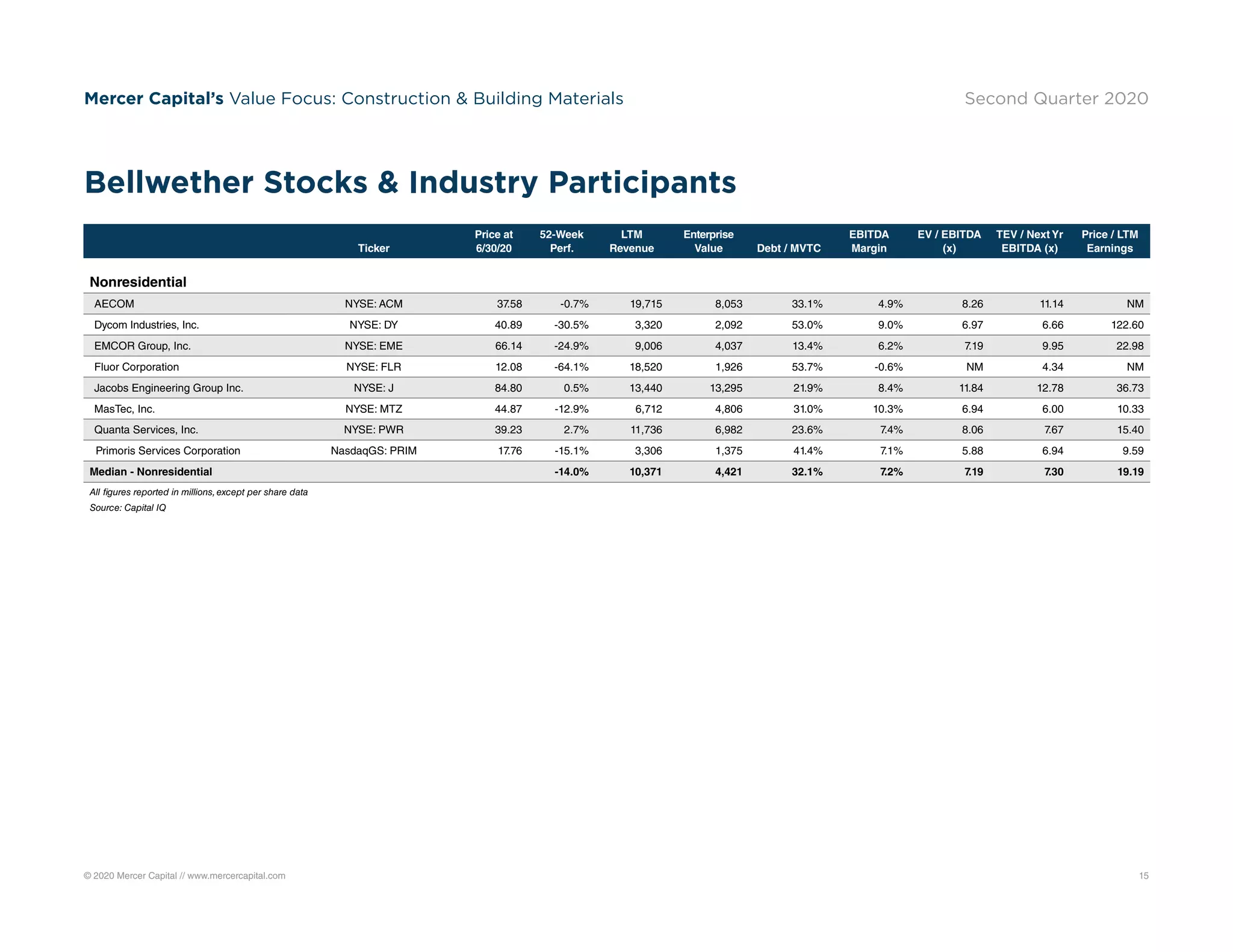
Nonresidential
AECOM NYSE: ACM 37.58 -0.7% 19,715 8,053 33.1% 4.9% 8.26 11.14 NM
Dycom Industries, Inc. NYSE: DY 40.89 -30.5% 3,320 2,092 53.0% 9.0% 6.97 6.66 122.60
EMCOR Group, Inc. NYSE: EME 66.14 -24.9% 9,006 4,037 13.4% 6.2% 7.19 9.95 22.98
Fluor Corporation NYSE: FLR 12.08 -64.1% 18,520 1,926 53.7% -0.6% NM 4.34 NM
Jacobs Engineering Group Inc. NYSE: J 84.80 0.5% 13,440 13,295 21.9% 8.4% 11.84 12.78 36.73
MasTec, Inc. NYSE: MTZ 44.87 -12.9% 6,712 4,806 31.0% 10.3% 6.94 6.00 10.33
Quanta Services, Inc. NYSE: PWR 39.23 2.7% 11,736 6,982 23.6% 7.4% 8.06 7.67 15.40
Primoris Services Corporation NasdaqGS: PRIM 17.76 -15.1% 3,306 1,375 41.4% 7.1% 5.88 6.94 9.59
Median - Nonresidential -14.0% 10,371 4,421 32.1% 7.2% 7.19 7.30 19.19
All figures reported in millions, except per share data
Source: Capital IQ
Bellwether Stocks  Industry Participants
Mercer
Capital
Construction 
Building Materials
Industry Services
Contact Us
Copyright © 2020 Mercer Capital Management, Inc. All rights reserved. It is illegal under Federal law to reproduce this publication or any portion of its contents without the publisher’s permission. Media quotations with source attribution are encouraged.
Reporters requesting additional information or editorial comment should contact Barbara Walters Price at 901.685.2120. Mercer Capital’s Industry Focus is published quarterly and does not constitute legal or financial consulting advice. It is offered as an
information service to our clients and friends. Those interested in specific guidance for legal or accounting matters should seek competent professional advice. Inquiries to discuss specific valuation matters are welcomed. To add your name to our mailing list
to receive this complimentary publication, visit our website at www.mercercapital.com.
Mercer Capital provides valuation and transaction advisory
services to the construction and building materials industries.
Industry Segments
Mercer Capital serves construction industry segments from to commercial and civil to residential.We also serve the
building materials sector from aluminum and steel to brick, glass, and lumber.
Mercer Capital Experience
•	 Family and management succession planning
•	 Buy-side and sell-side transaction advisory assistance
•	 Conflict resolution and litigation support
•	 Trust and estate planning
•	 Buy-sell agreement valuation, design, and funding advisory
Contact a Mercer Capital professional to discuss your needs in confidence.
Timothy R. Lee, ASA
901.322.9740
leet@mercercapital.com
Nicholas J. Heinz, ASA
901.685.2120
heinzn@mercercapital.com
Brian F. Adams
901.322.9706
adamsb@mercercapital.com
MERCER CAPITAL
www.mercercapital.com
BUSINESS VALUATION 
FINANCIAL ADVISORY SERVICES
Mercer Capital
www.mercercapital.com

Mercer Capital's Value Focus: Construction and Building Materials | Q2 2020 | Segment Focus: Building Materials

  • 1.
    VALUE FOCUS Construction &Building Materials Second Quarter 2020 | Sector Focus: Building Materials Executive Industry Trends • Strong economic fundamentals entering 2020 were overshadowed by the spread of COVID-19. Government actions taken to counteract the virus dramatically lowered economic activity as the country suffered the largest annualized GDP decline in U.S. history in the second quarter of 2020. • Construction designated as an “essential” sector throughout most of the country, allowing construction companies to continue to work although in the face of a multitude of disruptions. • Signs of economic fallout started to appear in late 1Q20 data but 2Q20 demonstrated a more comprehensive picture of the effects of the virus on economic barometers. Most metrics suffered their steepest declines in April and showed some improvement through June. BUSINESS VALUATION & FINANCIAL ADVISORY SERVICES In This Issue Construction Overview 1 Sector Focus: Building Materials 4 Sector Round-up 9 Bellweather Stocks and Industry Participants 13 About Mercer Capital 16 www.mercercapital.com
  • 2.
    © 2020 MercerCapital // www.mercercapital.com 1 Mercer Capital’s Value Focus: Construction Building Materials Second Quarter 2020 $0 $100 $200 $300 $400 $500 $600 $700 -5.0% -4.0% -3.0% -2.0% -1.0% 0.0% 1.0% 2.0% 3.0% 4.0% 2010 2011 2012 2013 2014 2015 2016 2017 2018 2019 2020 GDP($Billions) AnnualizedRealGrowthRate Quarterly Growth Average Quarterly Growth GDP (Current Dollars) Source: Trading Economics -14% -10% -6% -2% 2% 6% Q 2-2010 Q 2-2011 Q 2-2012 Q 2-2013 Q 2-2014 Q 2-2015 Q 2-2016 Q 2-2017 Q 2-2018 Q 2-2019 Q 2-2020 National Construction Source: Trading Economics, U.S. Bureau of Economic Analysis Construction Overview Construction National GDP U.S. GDP contracted 9.6% quarter-over-quarter in the second quarter of 2020, the second consecutive quarterly decline after twenty-two previous quarters of growth. The decline is due to the spread of COVID-19, which was declared a global pandemic by the World Health Organization on March 11, 2020. As governments responded by issuing “stay-at-home” orders, economic activity and demand plummeted. Many employers shifted to remote work or postponed operations which has led to a spike in unemployment. Economic growth is expected to be negatively affected for an indeterminate period. Year-over- year construction GDP growth was flat through the first quarter of 2020. The deceleration in construction GDP growth over the second half of 2018 was primarily due to declining residential construction activity which recovered strongly through the end of 2019. Despite entering 2020 with strong fundamentals, construction activity and demand will likely suffer with the broader economy from the fallout of COVID-19. Backlog execution and pipeline projects may benefit from lower interest rates. Construction Gross Domestic Product % Change in GDP Construction GDP Period % Change Q-o-Q -6.4% Y-o-Y -6.0% National GDP Period % Change Q-o-Q -9.6% Y-o-Y -8.6%
  • 3.
    © 2020 MercerCapital // www.mercercapital.com 2 Mercer Capital’s Value Focus: Construction Building Materials Second Quarter 2020 The Federal Reserve historically gauges a healthy economy as sustaining an unemployment rate between 4.5% and 6.0%. The increase from 3.5% in February 2020 to 14.7% in April 2020 reflects the initial impact of COVID-19 as economic activity plummeted. The unemployment rate improved from its peak in April to 11.1% in June 2020, which is still significantly above pre-COVID levels. The unemployment rate in the construction industry is typically more volatile due to the cyclical and seasonal nature of the industry. The major contributing factor to the seasonal nature of the industry is the weather. Production of materials and projects generally decrease during the colder, winter months. Construction unemployment peaked in at April at 16.6% before improving to 10.1% in June 2020. The construction unemployment rate hit period lows of 3.2% in May and September 2019. Many construction activities have been designated as “essential” throughout most of the country, which may partially mitigate the decline in construction employment relative to the broader economy. 0.0% 5.0% 10.0% 15.0% 20.0% 25.0% Q2-2010 Q2-2010 Q2-2012 Q2-2013 Q2-2014 Q2-2015 Q2-2016 Q2-2017 Q2-2018 Q2-2019 Q2-2020 National Construction Source: U.S. Bureau of Labor Statistics Construction Overview Construction National Unemployment Unemployment Rate
  • 4.
    © 2020 MercerCapital // www.mercercapital.com 3 Mercer Capital’s Value Focus: Construction Building Materials Second Quarter 2020 The value of construction put-in-place is the total value of construction work performed in the U.S. during a specified period. The U.S. Census Bureau tracks this data and reports the monthly results. This value includes, but is not limited to, building materials costs, labor costs, profit, engineering costs, interest, and taxes. Year-over-year put-in-place construction increased by 0.4% for nonresidential and declined by 0.2% for residential. After declining in 2018, put-in-place residential construction continued to increase in 1Q20 as the sharp rise in mortgage rates in late 2018 reversed course throughout 2019. The decline in housing starts in March due to COVID- 19 has weighed on residential construction in the second quarter as increased unemployment and uncertainty has reduced demand. Low mortgage rates helped mitigate the downturn as eligible buyers sought new homes from a somewhat limited inventory. Nonresidential construction has been supported by increased spending at the local and state government level on public infrastructure over the past year due to a large backlog of deferred maintenance. However, public spending on infrastructure softened in the second half of 2019. Nonresidential construction will be disrupted going forward due to the negative economic fallout from COVID-19. Sectors that are expected to be particularly affected include the oil and gas due to the collapse in oil prices, retail, office, lodging, and transportation. Construction Overview Value of Construction Put-in-Place $0 $100 $200 $300 $400 $500 $600 $700 $800 $900 Q2-2010 Q2-2011 Q2-2012 Q2-2013 Q2-2014 Q2-2015 Q2-2016 Q2-2017 Q2-2018 Q2-2019 Q2-2020 $Billions Residential Nonresidential Source: U.S. Census Bureau Value of Construction Put-in-Place Residential Period % Change Q-o-Q -8.8% Y-o-Y -0.2% Nonresidential Period % Change Q-o-Q -3.3% Y-o-Y 0.4%
  • 5.
    © 2020 MercerCapital // www.mercercapital.com 4 Mercer Capital’s Value Focus: Construction Building Materials Second Quarter 2020 The global economy was affected by a pandemic declared by the World Health Organization (“WHO”) as of March 11, 2020. COVID-19 is considered highly dangerous, particularly for the elderly and/or those with pre-existing conditions and chronic ailments that compromise the human immune system. Since its discovery, COVID-19 has spread throughout the globe. Incidence of infection and mortality persisted through the first half of 2020. Governmental authorities in the U.S. and abroad have mandated limits on social gatherings and recommended that civilian populations take measures to isolate themselves to curtail further spread of the disease. All manner of public and private events have been canceled throughout the world, and travel and border restrictions have been enacted by the U.S. and many other nations. These restrictions are expected to negatively affect economic growth for an indeterminate period. As locales ease limits on social gatherings over different timetables, economic activity may accelerate, albeit, with the chance that infections may escalate again. The evolution of the pandemic, the extent of its economic and cultural consequences, and the results of steps taken and yet to be taken by governments and financial institutions are fluid and evolving in real-time. U.S. GDP suffered a historic decline in the second quarter of 2020 due to COVID-19. The decline in GDP in the second quarter translated to an annualized 33% decline, the steepest recorded decline in U.S. economic history. The U.S. Federal Reserve’s responses to the deepening COVID-19 crisis have included emergency cuts to the Fed Funds Rate of 50 and 100 basis points on March 6th and March 16th, respectively. The federal government passed three significant acts intended to respond to the medical crisis and mitigate its economic effects, culminating in the Coronavirus Aid, Relief, and Economic Security Act (the “CARES Act”) on March 27, 2020. The Federal Reserve also launched several programs and initiatives to alleviate funding strains and illiquidity in various markets, leveraging many programs created in response to the 2008 to 2009 financial crisis. Additional legislative, executive, and agency-level actions may occur as policymakers seek to minimize the economic downside of the pandemic and to promote economic recovery. The construction industry has been designated as “essential” throughout much of the country. Accordingly, some builders are able to execute current backlog. However, contractors will contend with an increasingly disruptive operating environment as municipalities are slow to clear paperwork while labor constraints and supply disruptions complicate the work site. Despite the acute downturn evidenced by the 2Q-20 economic data, publicly traded building materials companies reported steady to record earnings in the second quarter driven by strong current backlogs and continued construction in key markets (including North Texas, Colorado, Utah, and Virginia). However, most management teams hesitated to provide guidance for future earnings due to the current level of heightened uncertainty surrounding employment trends, additional federal stimulus, and the state of federal and local funding. Sector Focus Building Materials
  • 6.
    © 2020 MercerCapital // www.mercercapital.com 5 Mercer Capital’s Value Focus: Construction Building Materials Second Quarter 2020 The outlook for building materials end-markets remains mixed. The residential market showed signs of improvement towards the end of the second quarter as starts and confidence indices increased from their April floors while mortgage rates remain at historic lows. Non-residential construction demand depends on the extent to which the end-market has been affected by COVID-19. Lodging, retail, airport, and office demand are expected to remain under pressure from COVID-19. State funding sources for road and highway spending may become strained due to budgetary pressures, especially due to responses to COVID-19. Additionally, the Fixing America’s Surface Transportation (FAST) Act is set to expire in September 2020 and its successor will be a political issue during the upcoming elections. Sector Focus Building Materials (cont.)
  • 7.
    © 2020 MercerCapital // www.mercercapital.com 6 Mercer Capital’s Value Focus: Construction Building Materials Second Quarter 2020 Government Consumption and Investment $2,800 $2,900 $3,000 $3,100 $3,200 $3,300 $3,400 Q 2-2010 Q 2-2011 Q 2-2012 Q 2-2013 Q 2-2014 Q 2-2015 Q 2-2016 Q 2-2017 Q 2-2018 Q 2-2019 Q 2-2020 $Billions Source: St. Louis Fed | U.S. Bureau of Economic Analysis Government Consumption and Investment Period % Change Q-o-Q 1.0% Y-o-Y 2.2% Building Materials Government Consumption and Investment Most of the funding for transportation infrastructure comes from public resources. Accordingly, activity in the contracting and building materials industries is typically correlated to level of government spending on construction activity. To bolster the economy during the great recession, government consumption expenditures and gross investments increased but declined significantly in the years following. After stagnating for much of 2013 to 2016, GCI increased throughout 2018 and 2019 reaching the highest levels since 2010. The growth in GCI was boosted by increased military spending as well as increased public infrastructure investment at the state and local level. As COVID-19 weighs on various construction sectors, public construction spending may prove to be a stable source of demand especially if fiscal stimulus accelerates. There is some risk that state-level funding capacity could be adversely affected by the significant decline in motor fuel purchases during the COVID-19 crisis. Accordingly, backlog and pipeline projects that normally lessen down-cycle declines in infrastructural construction could be delayed and/ or reduced.
  • 8.
    © 2020 MercerCapital // www.mercercapital.com 7 Mercer Capital’s Value Focus: Construction Building Materials Second Quarter 2020 The Trade-Weighted Index measures the relative strength of the U.S. Dollar in comparison to foreign currencies, putting an emphasized weight on the most common trade partners and largest economies. When the Dollar is strong, imports become cheaper and exports become more expensive. Halfway through 2020, the Dollar remains at its strongest level in the last 10 years, which increases the cost for other countries to purchase U.S. building materials and decreases sales volume. The TWI increased throughout 2018 and remained steady in 2019. Divergence in monetary policy between the U.S. and the international community boosted the Dollar’s appreciation in 2018 as the Fed raised short-term interest rates and began the process of shrinking its balance sheet. The Fed began to lower rates in the second half of 2019 before eventually employing emergency rate cuts to combat COVID-19. The yield on 10-Year Treasury Bonds acts as a proxy for how expensive it is to finance construction projects. An increase in yields raises the cost of investment, but it can also signify increasing optimism about future economic growth, which leads to more spending in the construction industry. The 10-year yield peaked in the fourth quarter of 2018 but has since declined due the Fed’s rate cuts. Building Materials Trade-Weighted Index and Yield on 10-Year Treasury Yield on 10-Year-Treasury Bonds Trade-Weighted Index Yield on 10-Year-Treasury Bonds Period % Change Q-o-Q -14 BPS Y-o-Y -134 BPS Trade-Weighted Index Period % Change Q-o-Q -1.0% Y-o-Y 4.0% 80 90 100 110 120 130 Q 2-2010 Q 2-2010 Q 2-2012 Q 2-2013 Q 2-2014 Q 2-2015 Q 2-2016 Q 2-2017 Q 2-2018 Q 2-2019 Q 2-2020 Source: St. Louis Fed | Board of Governors of the Federal Reserve (US) 0.0% 1.0% 2.0% 3.0% 4.0% Q 2-2010 Q 2-2010 Q 2-2012 Q 2-2013 Q 2-2014 Q 2-2015 Q 2-2016 Q 2-2017 Q 2-2018 Q 2-2019 Q 2-2020 Source: St. Louis Fed | Board of Governors of the Federal Reserve (US)
  • 9.
    © 2020 MercerCapital // www.mercercapital.com 8 Mercer Capital’s Value Focus: Construction Building Materials Second Quarter 2020 The Industrial Production Index (IPI) is an indicator of economic activity that measures real production output of the manufacturing, mining, and utilities industries. It acts as a barometer for the level of demand for industrial products and manufacturing activity. After oscillating for a couple of years, IPI steadily increased for most of 2017 and 2018. In December 2018, IPI reached its highest level of the examined period but experienced limited growth over 2019. IPI plummeted in April and May 2020 as part of the overall decline in economic activity and manufacturers’ preference for drawing down inventories before pivoting back to production. Aerospace and automobile manufacturers will be particularly affected by the decline in traffic and air travel, while other manufacturers will be reliant on an increase in consumer demand in order to resume production Ready-mix concrete is used in most construction projects involving the utilities subsector such as transportation, energy, gas, water, and sewage. Building materials companies can generally rely on utility maintenance and repair activity when new project activity wanes. The value of utilities construction has increased 6.7% year-over-year. Increased renovation and safety requirements have driven an increase in power construction investment as well as the shift from legacy fossils fuels to natural gas and renewable energy sources. Spending on water supply and purification construction is expected to increase as most of the country’s pipeline system was installed in the mid-20th century and will require augmentation and/or replacement to address demand and/or water quality concerns. Building Materials Industrial Production Index and Value of Utilities Construction Value of Utilities Construction Industrial Production Index Value of Utilities Construction Period % Change Q-o-Q -2.0% Y-o-Y 6.7% Industrial Production Index Period % Change Q-o-Q -7.1% Y-o-Y -11.0% 80 85 90 95 100 105 110 115 Q2-2010 Q2-2010 Q2-2012 Q2-2013 Q2-2014 Q2-2015 Q2-2016 Q2-2017 Q2-2018 Q2-2019 Q2-2020 Source: St. Louis Fed | Board of Governors of the Federal Reserve (US) $0 $40 $80 $120 $160 $200 Q 2-2010 Q 2-2010 Q 2-2012 Q 2-2013 Q 2-2014 Q 2-2015 Q 2-2016 Q 2-2017 Q 2-2018 Q 2-2019 Q 2-2020 $Billions Source: U.S. Census Bureau
  • 10.
    © 2020 MercerCapital // www.mercercapital.com 9 Mercer Capital’s Value Focus: Construction Building Materials Second Quarter 2020 The yield on 10-Year Treasury Bonds can indirectly affect the road contracting industry. Higher interest rates make construction projects more expensive to undertake but they may also signify increased optimism about economic growth. The 10-year yield peaked in the fourth quarter of 2018 after a period of short-term interest rate hikes but has since declined to cyclical lows as discussed previously. The value of road and highway construction increased 3.6% year-over-year as state and local governments increased spending on infrastructure in place of increased federal spending. After declining from its peak in April 2019, road and highway construction spending increased appreciably through 4Q19 and 1Q20. As state and local governments come under more budgetary pressures, especially due to COVID-19, alternative sources of funding need to be tapped. Increased political uncertainty has clouded the future of road and highway construction as the FAST Act will expire in 2020 amidst the 2020 presidential election. $0 $20 $40 $60 $80 $100 $120 $140 Q 2-2010 Q 2-2010 Q 2-2012 Q 2-2013 Q 2-2014 Q 2-2015 Q 2-2016 Q 2-2017 Q 2-2018 Q 2-2019 Q 2-2020 $Billions Source: U.S. Census Bureau Sector Round-up Roads, Bridges, and Highways Value of Highway and Street Construction Value of Highway and Street Construction Period % Change Q-o-Q -7.4% Y-o-Y 3.6%
  • 11.
    © 2020 MercerCapital // www.mercercapital.com 10 Mercer Capital’s Value Focus: Construction Building Materials Second Quarter 2020 Nonresidential Construction $0 $500 $1,000 $1,500 $2,000 $2,500 Q 2-2010 Q 2-2011 Q 2-2012 Q 2-2013 Q 2-2014 Q 2-2015 Q 2-2016 Q 2-2017 Q 2-2018 Q 2-2019 Q 2-2020 $Billions Source: St. Louis Federal Reserve Corporate Profit Corporate profit is essential for companies not only to survive, but to grow and expand. When corporate profit increases, companies are more willing and able to open new branches and divisions. These additions lead to more commercial construction. As seen in the following chart, corporate profit flattened in recent periods (4Q19 data not available). The U.S.Tax Cuts and Jobs Act of 2017 lowered the corporate tax rate from 35% to 21%. The dip in the fourth quarter of 2017 is partially due to one-time deferred tax asset write-downs incurred by companies owing to the new tax rate. Corporate profits have suffered significantly from the fall-off in economic activity due to COVID-19 and are expected to remain under pressure for the balance of 2020. Significant uncertainty exists over the length and extent of the virus’s effect on economic activity going forward. Office and retail rental vacancy can also be a signal for new commercial construction demand. Low vacancy rates indicate a need for more space for companies to conduct business, which is a driver for the nonresidential construction industry. Both office and retail vacancy could experience increases due to “stay-at-home” orders and reduced foot traffic once current leases expire. COVID-19 may accelerate long-term structural changes that could fundamentally disrupt demand for office and retail space due to expansions in work-from-home technology, evolution of corporate culture, and accelerated e-commerce penetration. Corporate Profit Period % Change Q-o-Q -11.7% Y-o-Y -20.8%
  • 12.
    © 2020 MercerCapital // www.mercercapital.com 11 Mercer Capital’s Value Focus: Construction Building Materials Second Quarter 2020 The National Association of Home Builders (NAHB) conducts two separate surveys, the Housing Market Index (HMI) and the Remodeling Market Index (RMI), which measure confidence in the home building industry. Respondents rate their activity on a scale from 1-100 with 50 being average. The HMI is produced monthly and asks respondents to rate market conditions both at present and looking forward six months. The monthly index remained above 50 from July 2014 through the first quarter of 2020 and reached a ten year high of 76 in December 2019. The HMI plummeted to 30 in April 2020 due to increased uncertainty over the effect of COVID-19 on residential construction demand but recovered to 58 by the end of June 2020. The RMI is produced quarterly and asks respondents to rate their work volume as either higher or lower than the previous quarter. The quarterly index fluctuated between 50 and 60 since the second quarter of 2013 before declining to 48 in the first quarter of 2020. However, the RMI increased to 73 in the second quarter, a higher level over the examined period. Residential Construction NAHB HMI and RMI 0 20 40 60 80 100 Q 2-2010 Q 2-2010 Q 2-2012 Q 2-2013 Q 2-2014 Q 2-2015 Q 2-2016 Q 2-2017 Q 2-2018 Q 2-2019 Q 2-2020 HMI RMI Source: National Association of Home Builders Note: RMI is measured quarterly and approximated for a monthly basis using a straight-line approach. NAHB HMI Period % Change Q-o-Q -19.4% Y-o-Y -9.4% NAHB RMI Period % Change Q-o-Q 52.1% Y-o-Y 35.2%
  • 13.
    © 2020 MercerCapital // www.mercercapital.com 12 Mercer Capital’s Value Focus: Construction Building Materials Second Quarter 2020 0.2 0.3 0.4 0.5 0.6 0.7 0.8 0.9 1.0 1.1 1.2 1.3 1.4 1.5 1.6 1.7 1.8 1.9 2.0 2.1 2.2 2.3 2.4 Jun-08 Sep-08 Dec-08 Mar-09 Jun-09 Sep-09 Dec-09 Mar-10 Jun-10 Sep-10 Dec-10 Mar-11 Jun-11 Sep-11 Dec-11 Mar-12 Jun-12 Sep-12 Dec-12 Mar-13 Jun-13 Sep-13 Dec-13 Mar-14 Jun-14 Sep-14 Dec-14 Mar-15 Jun-15 Sep-15 Dec-15 Mar-16 Jun-16 Sep-16 Dec-16 Mar-17 Jun-17 Sep-17 Dec-17 Mar-18 Jun-18 Sep-18 Dec-18 Mar-19 Jun-19 Sep-19 Dec-19 Mar-20 Jun-20 Private Housing Starts Single Family Starts Private Building Permits Single Family Building Permits Source: U.S. Census Bureau Note: Permits at a given date are generally a leading indicator of future starts. Beginning with January 2014, building permit data reflects the change to the 20,000 place series. Private Housing Single Family Housing Seasonally Adjusted Annualized Rates of New Housing Starts and Building Permits Private Housing Stats Period % Change Q-o-Q -6.5% Y-o-Y -4.0% Private Building Permits Period % Change Q-o-Q -7.2% Y-o-Y -1.2% Single Family Stats Period % Change Q-o-Q -5.6% Y-o-Y -3.9% Single Family Building Permits Period % Change Q-o-Q -5.0% Y-o-Y -0.4% Building permits and housing starts are two important indicators for the home building industry. Both reflect demand, consumer confidence, and the feasibility of financing construction projects. Building permits can be issued and then shelved by builders; therefore, housing starts are a more focused measure of current activity in the industry. After declining nearly 75% during from Q1 2006 to Q1 2009 as the housing boom decayed, housing permits and starts have steadily recovered but are unlikely to reach pre-great recession highs. Both private and single family starts dramatically declined in the first half of 2020 as COVID-19 negatively affected demand for new homes. Housing starts bottomed out in April 2020 and recovered partially through June 2020. MillionsofUnits Residential Construction (cont.)
  • 14.
    © 2020 MercerCapital // www.mercercapital.com 13 Mercer Capital’s Value Focus: Construction Building Materials Second Quarter 2020 Ticker Price at 6/30/20 52-Week Perf. LTM Revenue Enterprise Value Debt / MVTC EBITDA Margin EV / EBITDA (x) TEV / Next Yr EBITDA (x) Price / LTM Earnings Residential Beazer Homes USA, Inc. NYSE: BZH 10.07 4.8% 2,222 1,450 80.0% 4.4% 14.72 11.95 9.61 D.R. Horton, Inc. NYSE: DHI 55.45 28.6% 18,950 23,387 17.8% 13.8% 8.91 10.44 9.93 KB Home NYSE: KBH 30.68 19.2% 4,709 4,733 33.7% 9.4% 10.66 9.72 9.11 Lennar Corporation NYSE: LEN 61.62 27.2% 22,621 24,843 32.4% 12.4% 8.89 9.04 9.26 LGI Homes, Inc. NasdaqGS: LGIH 88.03 23.2% 2,025 2,839 21.2% 13.5% 10.36 11.44 10.09 M.D.C. Holdings, Inc. NYSE: MDC 35.70 8.9% 3,516 3,058 35.2% 10.3% 8.48 10.26 8.48 NVR, Inc. NYSE: NVR 3,258.75 -3.3% 7,136 11,598 9.6% 14.3% 11.36 13.78 14.60 PulteGroup, Inc. NYSE: PHM 34.03 7.6% 10,616 11,118 25.5% 15.4% 6.80 8.87 8.00 Taylor Morrison Home Corporation NYSE: TMHC 19.29 -8.0% 5,444 5,898 60.7% 8.5% 12.70 12.98 14.31 Meritage Homes Corporation NYSE: MTH 76.12 48.3% 4,029 3,616 26.8% 11.0% 8.15 10.42 8.62 TRI Pointe Group, Inc. NYSE: TPH 14.69 22.7% 3,257 3,129 43.5% 12.7% 7.57 13.04 7.42 Median - Residential 19.2% 4,709 4,733 32.4% 12.4% 8.91 10.44 9.26 All figures reported in millions, except per share data Source: Capital IQ Bellwether Stocks Industry Participants
  • 15.
    © 2020 MercerCapital // www.mercercapital.com 14 Mercer Capital’s Value Focus: Construction Building Materials Second Quarter 2020 Ticker Price at 6/30/20 52-Week Perf. LTM Revenue Enterprise Value Debt / MVTC EBITDA Margin EV / EBITDA (x) TEV / Next Yr EBITDA (x) Price / LTM Earnings Building Materials Eagle Materials Inc. NYSE: EXP 70.22 -24.3% 1,508 4,441 34.6% 28.9% 10.20 10.40 23.11 Martin Marietta Materials, Inc. NYSE: MLM 206.57 -10.2% 4,428 16,182 20.1% 29.0% 12.61 13.63 20.69 Summit Materials, Inc. NYSE: SUM 16.08 -16.5% 2,287 3,598 51.5% 20.8% 7.58 8.87 17.58 U.S. Concrete, Inc. NasdaqGS: USCR 24.80 -50.1% 1,435 1,270 67.1% 11.8% 7.48 8.50 20.06 Vulcan Materials Company NYSE: VMC 115.85 -15.6% 4,977 18,440 19.5% 25.8% 14.36 15.25 24.30 CEMEX, S.A.B. de C.V. BMV: CEMEX CPO 0.28 -33.3% 12,632 15,712 76.1% 15.6% 7.95 8.17 180.06 CRH plc ISE: CRG 34.32 5.1% 27,647 35,179 40.2% 15.2% 8.34 8.95 16.18 HeidelbergCement AG DB: HEI 53.59 -33.3% 20,203 21,854 55.1% 16.1% 6.73 6.37 NM LafargeHolcim Ltd SWX: LHN 43.83 -10.3% 25,717 40,701 36.2% 19.7% 8.02 7.01 16.27 Median - Building Materials -16.5% 4,977 16,182 40.2% 19.7% 8.02 8.87 20.37 Roads, Bridges, and Highways Granite Construction Incorporated NYSE: GVA 19.14 -60.3% 3,390 952 35.6% 0.3% 95.52 4.47 NM Sterling Construction Company, Inc. NasdaqGS: STRL 10.47 -22.0% 1,335 704 60.5% 7.6% 6.90 5.95 5.56 Construction Partners, Inc. NasdaqGS: ROAD 17.76 18.2% 798 942 7.6% 11.2% 10.49 10.24 23.26 Tutor Perini Corporation NYSE: TPC 12.18 -12.2% 4,894 1,347 58.7% 5.6% 4.93 3.92 NM Median - Roads, Bridges, and Highways -17.1% 2,362 947 47.1% 6.6% 8.70 5.21 14.41 All figures reported in millions, except per share data Source: Capital IQ Bellwether Stocks Industry Participants Note: CX, CRG, HEI, and LHN report in foreign currency. Margin and multiples unaffected and shown for analysis.
  • 16.
    © 2020 MercerCapital // www.mercercapital.com 15 Mercer Capital’s Value Focus: Construction Building Materials Second Quarter 2020 Ticker Price at 6/30/20 52-Week Perf. LTM Revenue Enterprise Value Debt / MVTC EBITDA Margin EV / EBITDA (x) TEV / Next Yr EBITDA (x) Price / LTM Earnings Nonresidential AECOM NYSE: ACM 37.58 -0.7% 19,715 8,053 33.1% 4.9% 8.26 11.14 NM Dycom Industries, Inc. NYSE: DY 40.89 -30.5% 3,320 2,092 53.0% 9.0% 6.97 6.66 122.60 EMCOR Group, Inc. NYSE: EME 66.14 -24.9% 9,006 4,037 13.4% 6.2% 7.19 9.95 22.98 Fluor Corporation NYSE: FLR 12.08 -64.1% 18,520 1,926 53.7% -0.6% NM 4.34 NM Jacobs Engineering Group Inc. NYSE: J 84.80 0.5% 13,440 13,295 21.9% 8.4% 11.84 12.78 36.73 MasTec, Inc. NYSE: MTZ 44.87 -12.9% 6,712 4,806 31.0% 10.3% 6.94 6.00 10.33 Quanta Services, Inc. NYSE: PWR 39.23 2.7% 11,736 6,982 23.6% 7.4% 8.06 7.67 15.40 Primoris Services Corporation NasdaqGS: PRIM 17.76 -15.1% 3,306 1,375 41.4% 7.1% 5.88 6.94 9.59 Median - Nonresidential -14.0% 10,371 4,421 32.1% 7.2% 7.19 7.30 19.19 All figures reported in millions, except per share data Source: Capital IQ Bellwether Stocks Industry Participants
  • 17.
    Mercer Capital Construction Building Materials IndustryServices Contact Us Copyright © 2020 Mercer Capital Management, Inc. All rights reserved. It is illegal under Federal law to reproduce this publication or any portion of its contents without the publisher’s permission. Media quotations with source attribution are encouraged. Reporters requesting additional information or editorial comment should contact Barbara Walters Price at 901.685.2120. Mercer Capital’s Industry Focus is published quarterly and does not constitute legal or financial consulting advice. It is offered as an information service to our clients and friends. Those interested in specific guidance for legal or accounting matters should seek competent professional advice. Inquiries to discuss specific valuation matters are welcomed. To add your name to our mailing list to receive this complimentary publication, visit our website at www.mercercapital.com. Mercer Capital provides valuation and transaction advisory services to the construction and building materials industries. Industry Segments Mercer Capital serves construction industry segments from to commercial and civil to residential.We also serve the building materials sector from aluminum and steel to brick, glass, and lumber. Mercer Capital Experience • Family and management succession planning • Buy-side and sell-side transaction advisory assistance • Conflict resolution and litigation support • Trust and estate planning • Buy-sell agreement valuation, design, and funding advisory Contact a Mercer Capital professional to discuss your needs in confidence. Timothy R. Lee, ASA 901.322.9740 leet@mercercapital.com Nicholas J. Heinz, ASA 901.685.2120 heinzn@mercercapital.com Brian F. Adams 901.322.9706 adamsb@mercercapital.com MERCER CAPITAL www.mercercapital.com BUSINESS VALUATION FINANCIAL ADVISORY SERVICES
  • 18.