IFIs Financing for Ukraine
Annotation
Since the full-scale invasion, the IFIs’ role shifted toward emergency response and
resilience. They became even more important partners for Ukraine’s resilience and
emergency recovery, providing financial resources, policy advice, and technical
assistance.
This report synthesizes findings on the role of international financial institutions (IFIs)
in Ukraine’s recovery - World Bank Group (WBG), EBRD, EIB, and KfW/DEG - prepared
by the RRR4U consortium. The introductory chapter distills how IFI instruments
operate in Ukraine, why investment flows are slower than needed, and what must
change to accelerate priority financing, especially for resilient infrastructure and
private sector growth. It is based on the four separate essays on IFIs, which are
presented in full in this report. They map mandates, procedures, portfolios, and
constraints; identify bottlenecks and blockers for financing allocation and
disbursement. The report also makes note on policy recommendations for different
stakeholders, including Ukraine’s government, the European Commission, and IFIs.
The RRR4U (Resilience, Reconstruction and Relief for Ukraine) consortium is a partnership
of four Ukrainian civil society organizations with financial support from the Open Society
Foundations and the International Renaissance Foundation. The consortium members are
the Institute for Economic Research and Policy Consulting, Center for Economic Strategy,
the Institute for Analytics and Advocacy, and the DiXi Group.
IFIs Financing for Ukraine
— 3 —
Abbreviations
ARISE Agriculture Recovery Inclusive Support Emergency
BDF Business Development Fund
BII British International Investment
BMZ Federal Ministry for Economic Cooperation and Development (Germany)
BSS Business Support Services
CPF Country Partnership Framework (WBG document)
DEG German Investment Corporation (KfW subsidiary)
DPL/DPO Development Policy Loans / Development Policy Operations
EBRD European Bank for Reconstruction and Development
ECA Export Credit Agency
EFSE European Fund for Southeast Europe
EIB European Investment Bank
EIF European Investment Fund
EESCR Eastern Europe, Southern Caucasus, and Russia (EIB mandate region)
ELM External Lending Mandate
ERA Economic Resilience Action Program (IFC’s Program)
ESG Environmental, Social, and Governance
ESIA Environmental and Social Impact Assessment
ESMP Environmental and Social Management Plan
ESRS Environmental and Social Review Summary (WBG document)
FREE Financing of Recovery from Economic Emergency
GGF Green for Growth Fund
HEAL Health Enhancement and Lifesaving
HOPE Housing Repair for People's Empowerment
IBRD International Bank for Reconstruction and Development (part of WBG)
ICSID International Centre for Settlement of Investment Disputes (part of WBG)
ICT Information and Communications Technology
IDA International Development Association
IEG Independent Evaluation Group (WBG)
IFC International Finance Corporation
IFIs International Financial Institutions
ILO International Labour Organization
IOM International Organization for Migration
KfW Kreditanstalt für Wiederaufbau (German state-owned bank)
MDB Multilateral Development Bank
MDTF Multi-Donor Trust Fund
MIGA Multilateral Investment Guarantee Agency (part of WBG)
MoU Memorandum of Understanding
NBU National Bank of Ukraine
NEURC National Energy and Utilities Regulatory Commission
NRC Norwegian Refugee Council
OECD Organisation for Economic Co-operation and Development
PEACE Public Expenditures for Administrative Capacity Endurance
PPP Public-Private Partnership (Agency)
RDNA Rapid Damage and Needs Assessments
RELINC Repairing Essential Logistics Infrastructure and Network Connectivity
REPOWER Restoration Project of Winterization and Energy Resources Ukraine
SMEs Small and Medium-sized Enterprises
SOEs State-Owned Enterprises
SPUR Strategic Program for Ukraine’s Resilience (implied program)
WBG World Bank Group
IFIs Financing for Ukraine
— 4 —
Content
IFIs Financing for Ukraine: Summary of Four Surveys ........................................................................... 5
Introduction ................................................................................................................................. 5
Role of IFIs during full-scale war ..................................................................................................... 5
Key figures for the IFIs financing..................................................................................................... 6
Sectoral Priorities and Financial Instruments ................................................................................... 9
Recommendations for IFIs and the EU........................................................................................... 11
Recommendations for Ukraine..................................................................................................... 11
EBRD financing in Ukraine: key characteristics and challenges ............................................................ 13
Introduction ............................................................................................................................... 13
EBRD in general........................................................................................................................... 13
EBRD policies and procedures ...................................................................................................... 14
EBRD in Ukraine.......................................................................................................................... 15
EBRD projects in Ukraine ............................................................................................................. 16
Key challenges on the way towards EBRD financing ....................................................................... 18
Conclusions and key changes required .......................................................................................... 19
Anex .......................................................................................................................................... 21
EIB financing in Ukraine................................................................................................................... 23
Executive summary ..................................................................................................................... 23
Introduction ............................................................................................................................... 23
Overview of EIB financing in Ukraine............................................................................................. 24
Financing private sector projects............................................................................................... 27
SME loans through intermediary banks ..................................................................................... 29
Lending to the public sector (state-owned and municipal enterprises) .......................................... 29
EIB operations in other countries.................................................................................................. 31
Conclusions ................................................................................................................................ 35
WBG role in Ukraine ....................................................................................................................... 36
The role of the WBG in Ukraine .................................................................................................... 36
The procedures of the WBG ......................................................................................................... 45
KfW financing role in Ukraine .......................................................................................................... 47
KfW Group Structure ................................................................................................................... 47
The role of KfW Group in Ukraine ................................................................................................. 48
DEG activities in Ukraine.............................................................................................................. 51
The procedures of the KfW........................................................................................................... 53
Lessons learned and key changes required .................................................................................... 54
IFIs Financing for Ukraine
— 5 —
IFIs Financing for Ukraine:
Summary of Four Essays
Introduction
Since the full-scale invasion, the role of international financial institutions (IFIs) shifted from
developmental finance toward emergency response and resilience. They provided financial
resources, policy advice, and technical assistance.
While Ukraine also receives important support from other IFIs this section focuses on four key
institutions – the World Bank Group (WBG), EBRD, EIB, and KfW – and synthesizes findings from four
essays on their role in Ukraine’s recovery prepared by members of the RRR4U Coalition (see
following sections). In the essays authors primarily concentrated at the IFIs financing to business,
though with references to the public sector as well.
Across institutions, we observe a wartime shift toward sovereign and municipal projects, cautious
private-sector engagement, and procedures that remain calibrated for peacetime risk and capacity.
There is a mismatch between Ukraine’s emergency reality and the operating models of IFIs. Projects
are delayed by heavy due diligence and fragmented procurement rules, private lending is
constrained by war and currency risks, and SMEs face documentation burdens they cannot
realistically meet during wartime. At the same time, temporary fast-track solutions introduced since
2022 have helped.
There is a need for a set of practical adjustments for IFIs and the EU: institutionalize wartime
flexibilities, expand risk-sharing guarantees to unlock private lending, introduce hryvnia-
denominated instruments, simplify SME access through lighter templates and training, scale
defense and dual-use financing, unify procurement around Prozorro, and substantially increase
transparency of selection and rejection decisions. These changes are meant to preserve core
safeguards while making access predictable and fast.
Ukraine should implement reforms to accelerate investments. Continued rule-of-law and property-
rights reforms, a stable tax and business environment, and stronger tools to mitigate FX and military
risks would reduce the risk premium embedded in every deal.
If both sides move in parallel, IFI support can shift from essential emergency aid to a long-term
engine for private-sector renewal and critical infrastructure modernization.
Role of IFIs during full-scale war
International Financial Institutions (IFIs) have played an important role in Ukraine’s development
since 1990s, acting as a crucial, long-term source of financing, technical assistance, and policy advice
for the country. Historically, IFIs like the World Bank Group (WBG) have supported economic
growth, institutional reforms, and large-scale infrastructure projects, while the European Bank for
Reconstruction and Development (EBRD) has focused on fostering the transition toward open
market-oriented economies and promoting private and entrepreneurial initiative. For over 15 years,
the European Investment Bank (EIB) has been an important source of financing, particularly for large
public and municipal projects in transport, energy, and urban infrastructure.
IFIs Financing for Ukraine
— 6 —
In the context of war-related destruction, macroeconomic pressures, and growing reconstruction
needs, the role of IFIs has expanded from developmental finance to providing financing, supporting
critical infrastructure, and ensuring the resilience of the economy. The stability of the economy
during wartime relies heavily on the ability of companies (both state-owned, municipal, and private)
to operate and invest, and IFIs remain the only external source of long-term financial resources for
Ukrainian companies against the backdrop of closed capital markets.
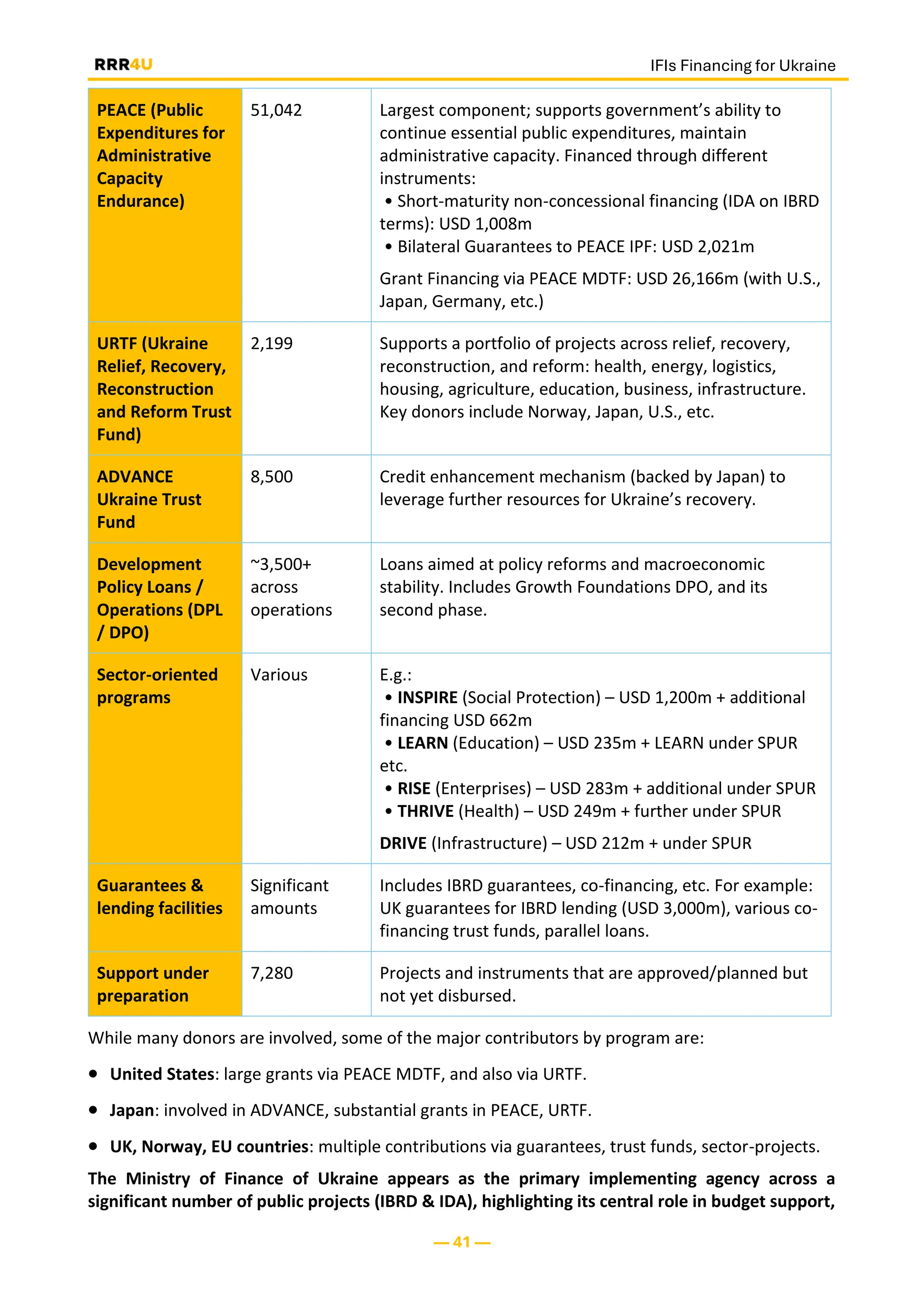
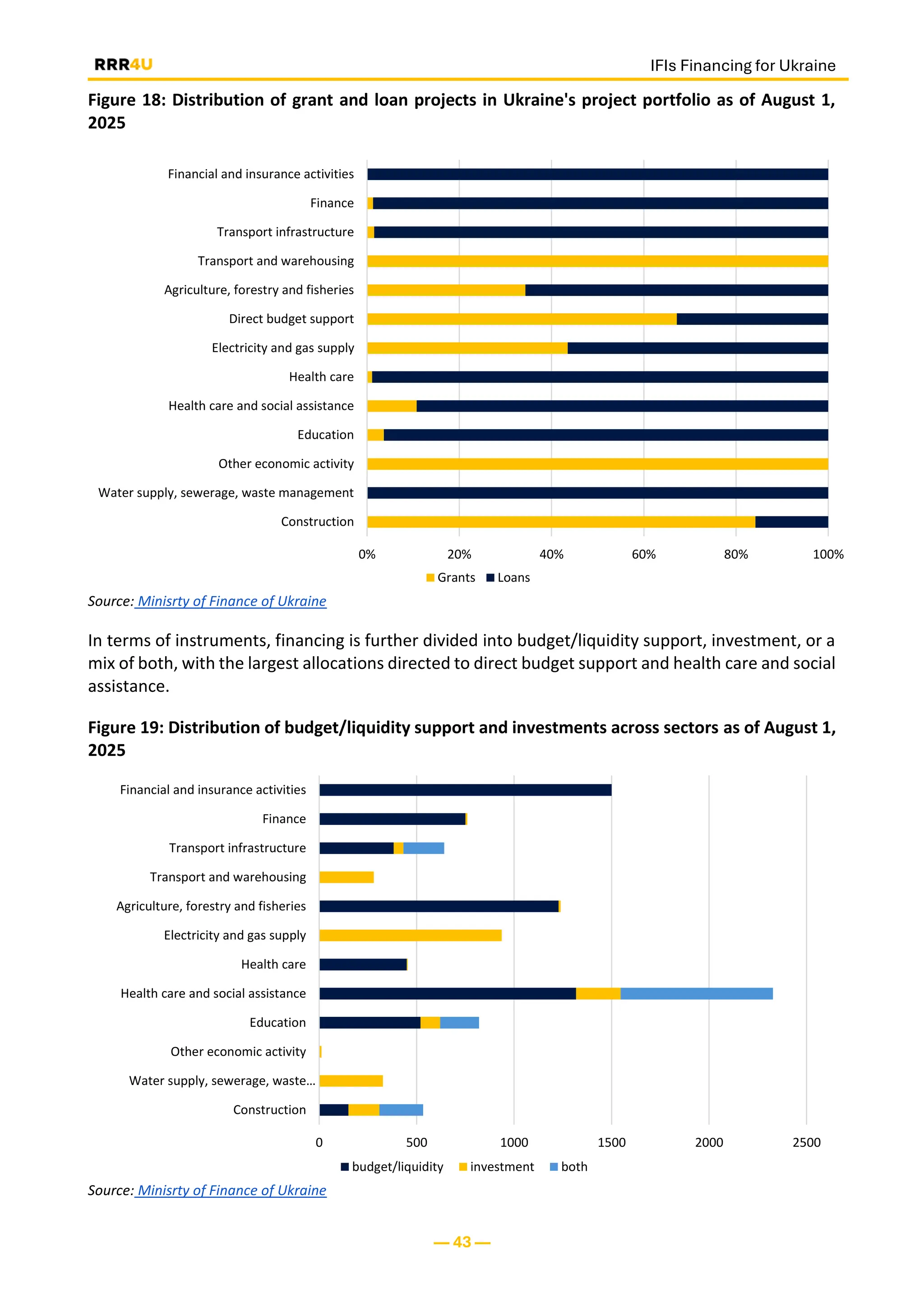
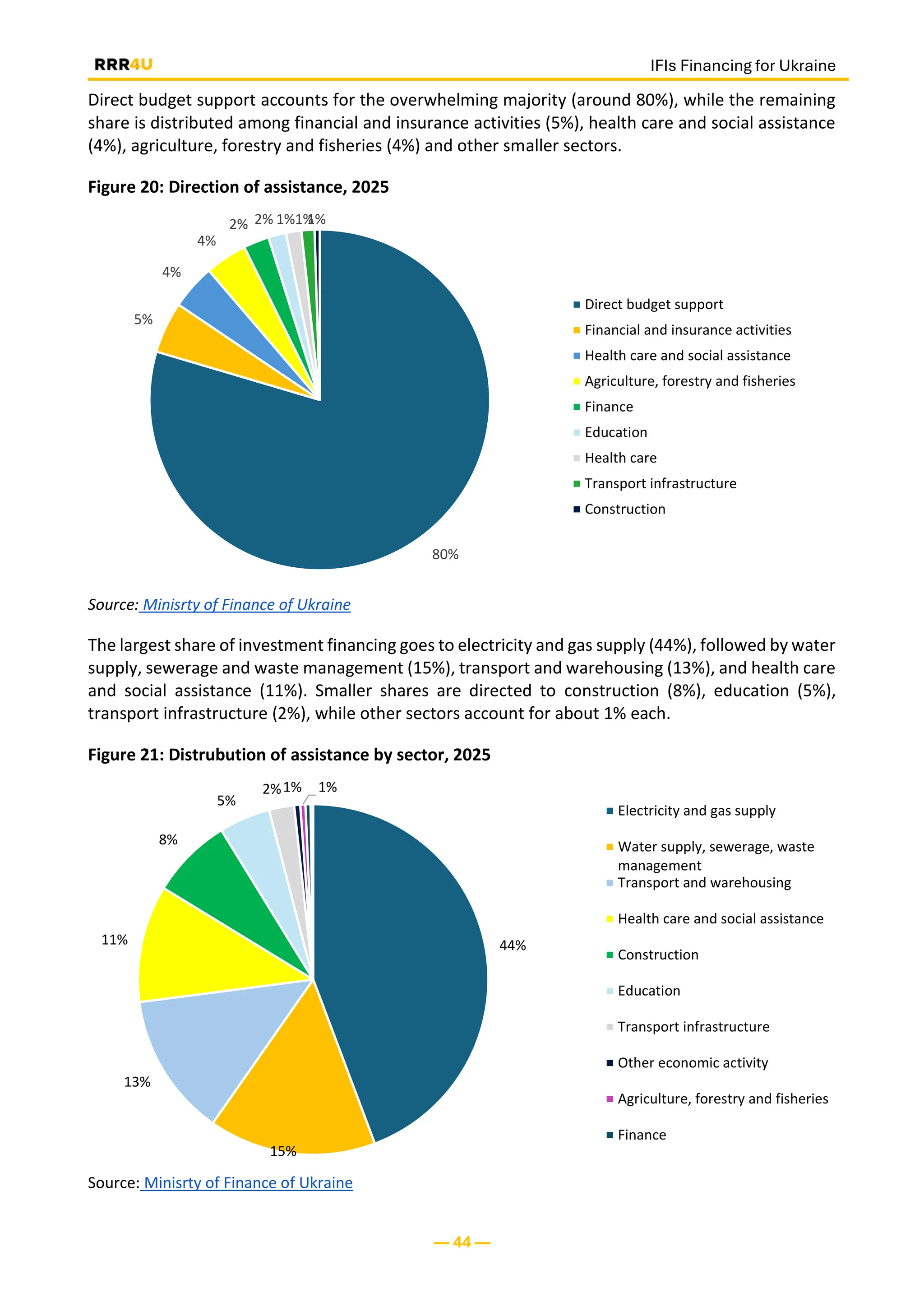
The World Bank Group has mobilized significant financial assistance, exceeding USD 81 bn, a large
portion of which is in the form of grants from the USA, directed toward direct budget support and
sustaining essential public services through large trust funds and mechanisms like the PEACE (Public
Expenditures for Administrative Capacity Endurance) and URTF (Ukraine Relief, Recovery,
Reconstruction and Reform Trust Fund) programs. The WBG, through MIGA, also plays a unique role
in offering political risk insurance (guarantees) to facilitate foreign direct investment.
The EBRD has made support to Ukraine its highest priority, deploying substantial resources,
including mobilizing EUR 7 bn between 2022 and 2024, largely through its Resilience and Livelihoods
Framework (RLF). Similarly, the EIB and KfW have significantly expanded their portfolios, focusing
on infrastructure resilience and social recovery, often acting as channels for German and EU funds.
The framework for large share of the current EIB, EBRD, and KfW engagement lies within EUR 50 bn
of Ukraine Facility from the EU. Specifically, its Pillar 2 ‘Ukraine Investment Framework’ is designed
to channel blended and loan finance and guarantees through pillar-assessed IFIs, including the
EBRD, EIB, and KfW, to accelerate up to EUR 40 bn in public and private investment. However,
despite the urgency, the pace of disbursements and deal closure across these institutions is
consistently slower than expected.
The scale of Ukraine’s post-war recovery needs is immense, estimated by the World Bank at over
EUR 500 bn. Given that official bilateral lending and grants will not be sufficient to cover this
requirement, IFIs are essential partners in mobilizing investment at speed and scale. Their role is
not only to provide capital but also to act as a crucial stabilizing force, demonstrating that risks are
manageable, thereby catalyzing the future return of extensive foreign investors.
Key figures for the IFIs financing
The World Bank Group, comprising institutions such as IBRD, IDA, IFC, and MIGA, has been a pivotal
partner for Ukraine since the early 1990s, offering funding, policy advice, and extensive technical
assistance. Since the full-scale invasion, the WBG has focused on emergency response and
sustaining core government functions through large mechanisms like the PEACE (Public
Expenditures for Administrative Capacity Endurance) and URTF (Ukraine Relief, Recovery,
Reconstruction and Reform Trust Fund) programs, mobilizing over USD 81 bn in total assistance,
more than half of which came in the form of grants from the USA. While the primary focus during
wartime has been on direct budget support and public services, the Group's private sector arms, IFC
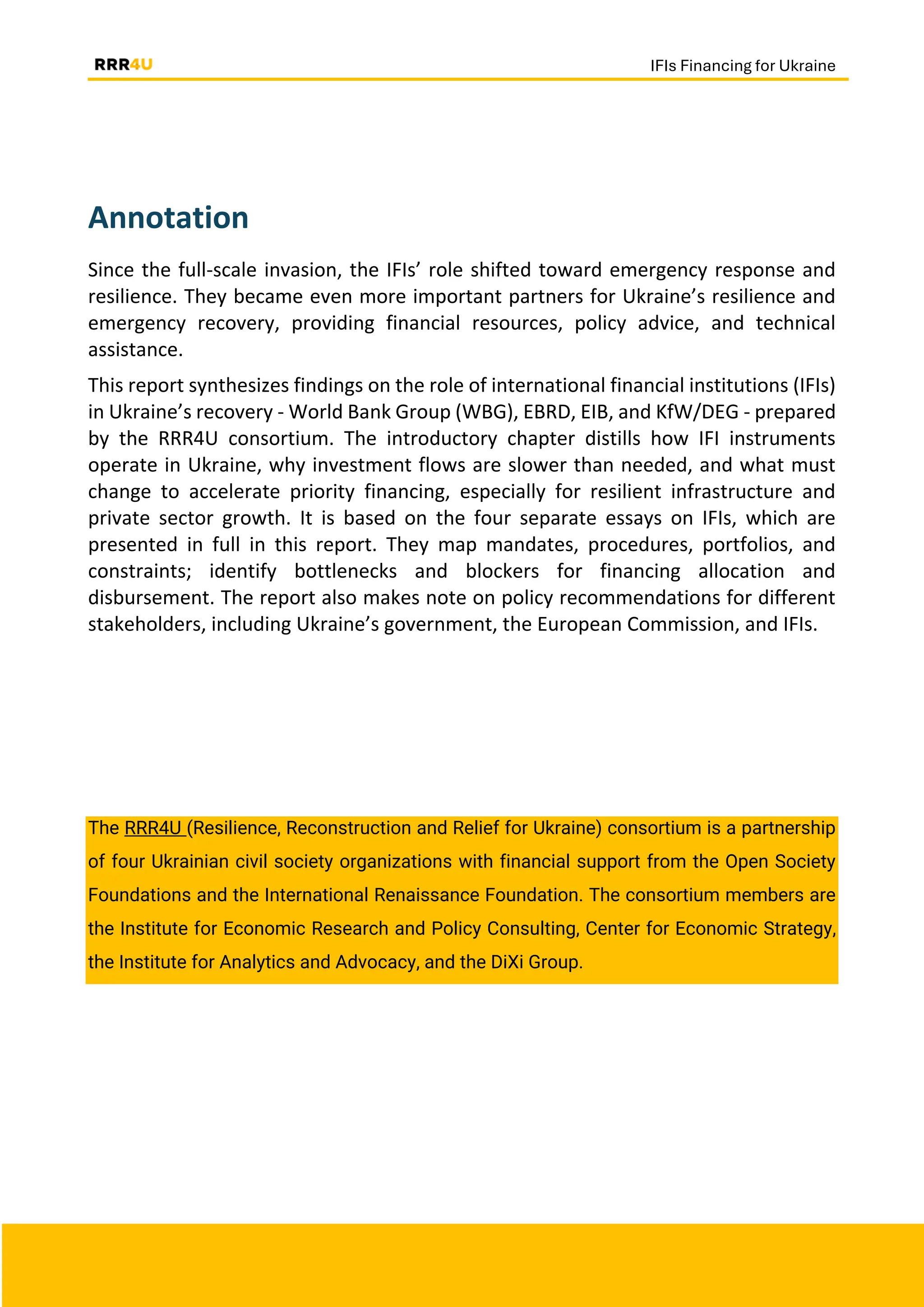
and MIGA, are crucial for catalyzing private investment and providing political risk insurance. Over
the years of cooperation, the WBG has provided USD 29.7 bn in public financing (IBRD/IDA) and USD
4.8 bn in private investment and guarantees (IFC/MIGA).
IFIs Financing for Ukraine
— 7 —
Figure 1: WBG financing, USD bn
Source: World Bank
The EBRD is one of the most important providers of investment financing for both Ukraine’s public
and private companies, having made support to Ukraine its highest priority since 2022. The Bank’s
role expanded significantly to support critical infrastructure, particularly state-owned enterprises
(SOEs) like Ukrenergo, Ukrzaliznytsia, and Naftogaz, through instruments like the Resilience and
Livelihoods Framework (RLF). The EBRD is active in energy, municipal services, and transport. It
maintains a focus on private sector transition and market principles, though it generally supports
small and medium enterprises (SMEs) indirectly through local commercial banks. The EBRD is also a
key implementing partner for the Ukraine Investment Framework (Pillar 2 of the Ukraine Facility).
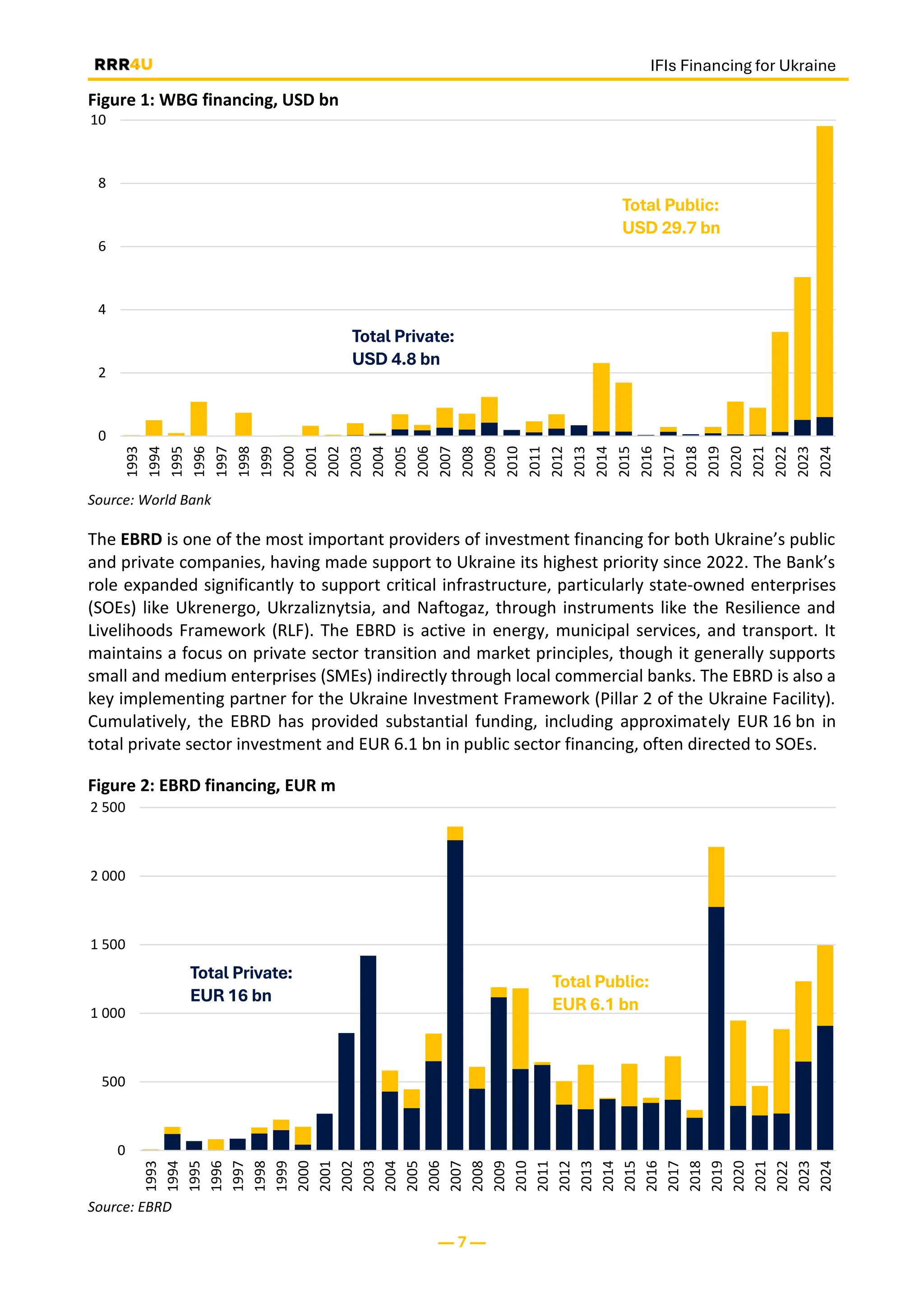
Cumulatively, the EBRD has provided substantial funding, including approximately EUR 16 bn in
total private sector investment and EUR 6.1 bn in public sector financing, often directed to SOEs.
Figure 2: EBRD financing, EUR m
Source: EBRD
0
2
4
6
8
10
1993
1994
1995
1996
1997
1998
1999
2000
2001
2002
2003
2004
2005
2006
2007
2008
2009
2010
2011
2012
2013
2014
2015
2016
2017
2018
2019
2020
2021
2022
2023
2024
Total Public:
USD 29.7 bn
Total Private:
USD 4.8 bn
0
500
1 000
1 500
2 000
2 500
1993
1994
1995
1996
1997
1998
1999
2000
2001
2002
2003
2004
2005
2006
2007
2008
2009
2010
2011
2012
2013
2014
2015
2016
2017
2018
2019
2020
2021
2022
2023
2024
Total Public:
EUR 6.1 bn
Total Private:
EUR 16 bn
IFIs Financing for Ukraine
— 8 —
The EIB provides loans that support the European Union’s policies, focusing on the green transition,
security, and defence. Since the start of its cooperation, EIB financing has predominantly targeted
the public sector (state-owned and municipal enterprises) in key areas such as transport, energy,
and urban infrastructure. Direct lending to the private sector has historically been limited. Since the
full-scale invastion, the EIB has largely suspended new direct private loans due to war risks,
preferring to channel support to SMEs through safer credit lines with intermediary Ukrainian banks.
At the same time, it provided budget financing for the recovery and reconstruction projects in
hromadas. Overall, the EIB has provided approximately EUR 6.6 bn in public financing and EUR 2.9
bn in private sector financing (including loans to SMEs via banks).
Figure 3: EIB financing, EUR m
Source: EIB
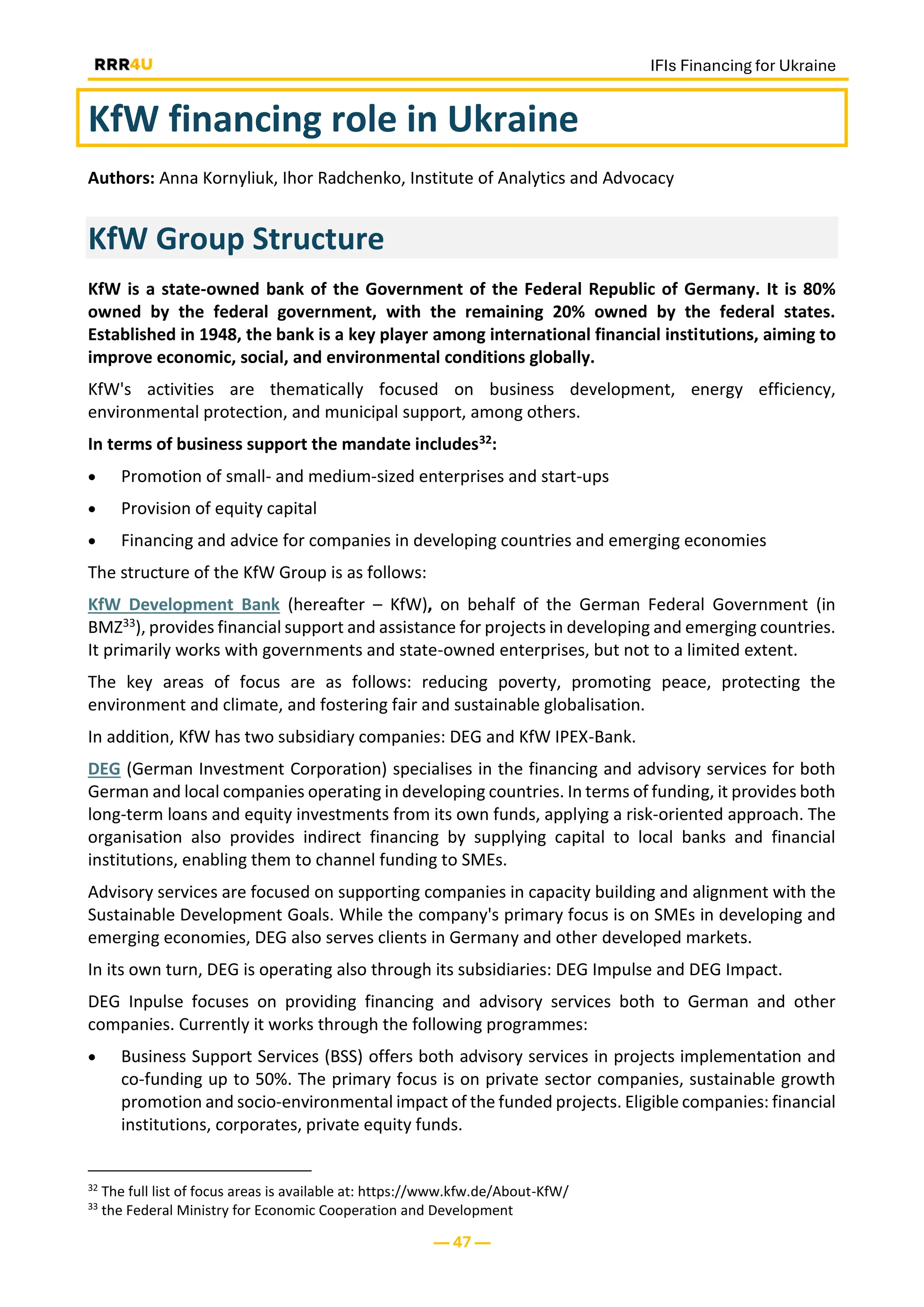
The KfW Group, acting as the state-owned German development bank, channels financial support
on behalf of the German Federal Government (BMZ) and the European Union. KfW’s portfolio in
Ukraine is highly concentrated in two key areas: energy and social infrastructure (housing, water
supply, and municipal services), reflecting both long-term strategic goals and urgent reconstruction
needs. Most of its commercial sector support is provided indirectly through financial intermediaries.
KfW partners closely with the Business Development Fund (BDF), which became the main channel
for state-backed debt financing to businesses during the war. This institutional partnership is
strategically aimed at building a robust local development bank modeled after KfW itself. The total
portfolio mobilized by KfW in Ukraine amounts to approximately EUR 2.4 bn.
0
200
400
600
800
1 000
1 200
2007 2008 2009 2010 2011 2012 2013 2014 2015 2016 2017 2018 2019 2020 2021 2022 2023 2024 2025
Total Public:
EUR 6.6 bn
Total Private:
EUR 2.9 bn
IFIs Financing for Ukraine
— 9 —
Figure 4: KfW financing, EUR m
Source: KfW
Sectoral Priorities and Financial Instruments
Four IFIs that we have considered for the analysis have their particular roles that correspond to their
strategies and priorities. Still the have some similarities as well.
Most IFIs show a clear preference for large public sector and quasi-sovereign projects (state-owned
and municipal entities) over direct private sector lending. Previously it was explained by the absence
of sufficient number of bankable projects and little exposure of the IFIs’ to Ukraine. Currently, this
is also due to the high war-related risks, which make sovereign guarantees safer for the lending
institutions. Still, the latter challenge should be somewhat eased due to the possibility to receive
guarantee under Pillar II of Ukraine facility.
So, overall, key sectors are:
● Energy and transport: These sectors have received substantial, often emergency, funding. EBRD
has been a key supporter of state-owned enterprises such as Ukrenergo, Ukrzaliznytsia, and
Naftogaz. KfW's active portfolio is concentrated mainly in energy and climate protection and
social infrastructure. The WBG’s investment portfolio also directs the largest share toward
electricity and gas supply. The EIB prioritizes transport, energy, and public space/infrastructure.
● Municipal services: Reconstruction and modernization of municipal infrastructure, including
district heating, water supply, and transport, are major areas for EBRD, EIB, and KfW, often
financing specific projects in cities.
Direct financing to the private sector remains limited, and when it occurs, it is highly selective.
● Intermediated lending: All considered IFIs, with some exception for WBG, rely heavily on
Ukrainian commercial banks to channel financing to SMEs. The EBRD provides loans and
guarantees through Ukrainian banks under programs like the RLF. The EIB allocates significant
funds via credit lines to intermediary banks, noting that this is a less risky instrument than direct
lending. At the same time, KfW largely supports the commercial sector indirectly through the
Business Development Fund (BDF), which played a crucial role in implementing the state-
0
200
400
600
800
2007 2008 2009 2010 2011 2012 2013 2014 2015 2016 2017 2018 2019 2020 2021 2022 2023 2024
Total:
EUR 2.4 bn
IFIs Financing for Ukraine
— 10 —
supported "Affordable Loans 5-7-9%" program during the war, becoming an important channel
for business credit financing.
● Direct private lending: Historically, the most successful and largest direct private sector loans,
particularly from the EIB and International Financial Corporation (IFC, which is part of WBG), were
concentrated in the Agribusiness sector. This is explained by the fact that large agricultural
holdings often generate stable export revenues in hard currency, minimizing the currency and
transfer risks for the IFIs. While EIB had a large direct private loans to agribusiness it has
terminated new direct private loans since full-scale invasion due to sharp increased war risks.
Despite the clear mandates and availability of funds under frameworks like the Ukraine Facility,
financing flows are slower than anticipated, hampered by systemic constraints and bottlenecks.
● Lack of bankable projects: IFIs often state that Ukrainian projects are not "bankable," meaning
they fail to meet the necessary rules and standards. While large companies can afford external
expertise to prepare good projects, many applicants struggle to pass comprehensive due
diligence and compliance checks, leading to slow deal closure.
● War and currency risk: The sharp increase in war risk led to the suspension of direct private
sector lending by some institutions. KfW’s strict risk procedures mean that direct funding to
Ukrainian enterprises is almost entirely conditional on 100% government guarantees due to
Ukraine’s low credit rating. Furthermore, foreign currency restrictions imposed by the National
Bank of Ukraine (NBU), e.g. the prohibition on exchanging hryvnia for foreign currency for
payments abroad, create a high currency transfer and convertibility risk, which discourages
investment. At the same time, IFIs continue lending money in foreign currency (respectively, USD
or EUR), which brings FX risks taking into account high risk of hryvnia depreciation. Taking into
account such currency risks, the interest on the loans for municipalities and many companies is
rather high. At the same time, the hedging instruments are absent.
● Burdensome requirements for SME: The core standards for due diligence and documentation
processes maintained by IFIs, even when channeled through partner banks, are often too
complex and burdensome for SMEs, particularly for the economy under full-scale war. Many
small companies have limited administrative capacity.
● Law enforcement deficiencies: Weaknesses in the Ukrainian law enforcement system mean that
many companies, particularly those in public procurement, have open criminal cases that
complicate the integrity and compliance checks required by IFIs, regardless of the ultimate
outcome of these cases.
● Restricted areas for the investments: The EBRD also avoids investment in gas infrastructure due
to environmental sustainability requirements, despite the urgent need for gas generation
capacity to compensate for destroyed electricity infrastructure. But, fortunately, it provides
financing for purchases of natural gas for the Naftogaz’s needs.
Even though IFIs often advocate for higher transparency they still do not often meet high standards.
The data for the projects, financed by the IFIs, is rather limited. The interest rate and maturity are
rarely published, which does not allow companies and municipalities in Ukraine to better
understanding the terms of loans. So, the EBRD’s Access to Information Policy limits the disclosure
of financial, commercial, and proprietary information, and explicitly forbids the release of signed
contracts, hindering accountability and public understanding of project selection criteria, which is
explained by the fact that EBRD is indeed a bank.
Moreover, there is insufficient public information regarding the progress of the Ukraine Facility,
including how many projects have been supported. Therefore, there is a need for more information
about opportunities to receive financing from IFIs, including the support under the Pillar II of Ukraine
Facility.
IFIs Financing for Ukraine
— 11 —
All these bottlenecks indicate that there is a need for comprehensive and systemic actions by IFIs,
the EU and the Ukrainian Government. This would make IFIs financing faster and more impactful for
resilience, recovery and growth in Ukraine.
Recommendations for IFIs and the EU
There is a clear need for changes in the IFIs policies to enable better access to financing for Ukrainian
stakeholders and speed up the procedures.
● Systematize flexibility: The temporary flexibilities introduced during wartime (such as phased
environmental and social action plans or expedited processing for critical infrastructure,
envisaged by the EBRD) should be formalized and institutionalized rather than applied on an ad
hoc basis. This would ensure predictable and fairer access for a broader range of Ukrainian
companies.
● Expand risk guarantees: The EU should expand the guarantee package for private sector
lending. Institutions like the EIB are currently operating at the limits of their risk capacity outside
the EU, necessitating broader risk-sharing instruments to unlock larger loans for businesses.
The risk insurance instruments are needed for Ukrainian companies and joint ventures, not only
for business from the EU.
● Introduce local currency instruments: Mechanisms for offering hryvnia-denominated loans
must be created for Ukrainian borrowers who lack sufficient foreign currency earnings (such as
hromadas, and municipal entities or firms operating domestically). This is critical for mitigating
currency risk for recipients and diversifying lending away from the heavily concentrated
agricultural sector.
● Simplify SME access: Introduce simplified, sector-specific due diligence templates and
documentation requirements for SMEs applying for IFI funding through Ukrainian partner
banks, acknowledging their limited administrative capacity during wartime. There is also a need
for technical assistance, e.g. trainings and seminars for the SMEs to improve their capacities to
receive financing from IFIs.
● Expand defense financing: The EIB and the EBRD should scale its new mandate on security and
defense to include the Ukrainian defense industry, starting with dual-use goods, recognizing it
as an essential part of the European security architecture.
● Unify procurement procedures: Currently, all IFIs have own requests and approaches for public
procurement under their financing. Only WB allowed to use modified Prozorro e-procurement
system. At the same time, EIB and EBRD still have their own policies. Therefore, it would be
beneficial to unify the approaches and allow for the use of Prozorro.
● Increase transparency: IFIs must increase transparency regarding project selection, scoring
criteria, and reasons for rejection to improve accountability and empower local stakeholders.
The clear publication of supported projects would also enable other companies to learn from
experience of current borrowers.
Recommendations for Ukraine
There is also some actions to be taken by the Government to enable Ukrainian stakeholders with
better access to IFIs financing:
● Strengthen governance: The Government should continue transformational reforms aimed at
protecting property rights, which includes judicial and law enforcement reforms. The
predictable tax policy and improving the broader business environment should be ensured.
IFIs Financing for Ukraine
— 12 —
These reforms are essential for reducing the risk profile of Ukrainian companies and boosting
investor confidence. The corporate governance reform at SOEs is urgent: appointment of
capable and professional supervisory boards are required.
● Reduce risks: Implement policies to reduce currency and military risks, including expanding
military risk insurance mechanisms. The NBU should work with the IFIs to develop the
instruments to mitigate FX risks (e.g. swaps). The Export Crediting Agency should receive
additional capital to expand programs for war risk insurance of companies.
● Harmonize procurement: Adapt the Prozorro e-procurement system for projects financed by
IFIs if the IFIs will not be ready to fully use the current system. This would lower transaction
costs and improve implementation efficiency.
● Strengthen Business Development Fund: Accelerate the transformation of the BDF and
advocate for its recognition as an accredited institution for managing EU funds under the Pillar
Assessment. This would reduce bureaucratic barriers and enable more direct engagement with
Ukrainian banks. Investment in building the institutional capacity of the BDF is critical.
The implementation of these actions will be key to transforming IFI support from essential
emergency aid into a strategic, long-term engine for the restoration and modernization of the
Ukrainian private sector and critical infrastructure.
IFIs Financing for Ukraine
— 13 —
EBRD financing in Ukraine: key
characteristics and challenges
Authors: Oleksandra Betliy, Vitaliy Kravchuk, Institute for Economic Research and Policy Consulting
Introduction
The European Bank for Reconstruction and Development (EBRD) has become one of the most
important providers of investment financing for Ukrainian companies, both public and private. In
the context of war-related destruction, macroeconomic pressures, and growing reconstruction
needs, the role of EBRD in providing financing, supporting critical infrastructure, and enabling
private sector activities expanded. As one of the largest institutional investors in Ukraine, the EBRD
has not only provided direct financing but also played a catalytic role in mobilizing private capital
and donor support, while maintaining a strong focus on market-based principles and environmental,
social, and governance (ESG) standards.
Since the start of the full-scale russian invasion in February 2022, the EBRD has redirected a
substantial share of its resources to Ukraine. Between 2022 and the end of 2024, the Bank disbursed
or mobilized more than EUR 7 bn in support of Ukraine’s economy. These efforts were channeled
through instruments such as the Resilience and Livelihoods Framework (RLF), as well as through
targeted support for energy security, food systems, municipal services, and private sector resilience.
Public sector enterprises such as Ukrenergo, Ukrzaliznytsia, and Naftogaz have been among the key
recipients of emergency and recovery funding, while a growing number of financial institutions
received financing and guarantees. The SMEs received support through commercial banks.
The relevance of EBRD financing is further reinforced by the second pillar of the Ukraine Facility,
which overall envisages the EU support to Ukraine at EUR 50 bn with the second pillar – investment
mechanism – of EUR 7 bn to be channeled through international financial institutions (IFIs), including
the EBRD. Therefore, a sound understanding of EBRD’s financing policies, procedures, and decision-
making processes becomes essential for Ukrainian stakeholders, including the government,
companies, and civil society. Moreover, given the scale of recovery needs and the urgency of
financing, it is equally important to assess the key challenges and systemic constraints that may
hinder greater and more effective access to EBRD funding in Ukraine.
This paper presents an overview of EBRD’s institutional mandate and operating procedures,
followed by a detailed analysis of its activities in Ukraine and specific financing projects in recent
years. The final sections identify key implementation challenges and propose changes that could
enhance the effectiveness and accessibility of EBRD financing for Ukrainian companies.
EBRD in general
The EBRD was created in 1990 and started its work in 1991 to help Central and Eastern European
countries on their way to market economy, Over the years its shareholder roster expanded to
include 75 countries on all continents. The EU and EIB are also shareholders of the EBRD. The EBRD
over the years expanded its investing operations to cover Central Asia as well as southern and
IFIs Financing for Ukraine
— 14 —
eastern Mediterranean (SEMED) countries. EBRD shareholders in 2025 approved its expansion to
Sub-Saharan Africa1. Overall, it now invests in over 30 countries.
EBRD’s key mandate is to “foster the transition towards open market‑oriented economies and to
promote private and entrepreneurial initiative”2 remains the same since its founding. Other
commitments include support to SMEs, connectivity between economies, capital markets
development and fostering productive investment. EBRD assistance is aimed at “environmentally
sound and sustainable development” that expanded to Green Economy Transition in line with Paris
Agreement. To that purpose the EBRD invested over EUR 210 bn in over 7400 projects. Therefore,
the EBRD invests into countries that comply with open market principles and projects, that ensure
competition and enhance ESG approach.
EBRD policies and procedures
The EBRD's procedures are close to those of commercial banks, with a focus on due diligence and
risk management. So, clients with experience negotiating loan terms with commercial banks can
expect similar experience when applying for EBRD loan, The balance between due diligence and
bureaucracy is maintained through sublending/guarantee programs, which help widen the reach of
the EBRD financing. However, in addition to the usual “bankability” factors such as ensuring the cash
flow of the project that will allow repayment and receiving adequate security for a loan EBRD
operates under a set of policies and procedures designed to ensure transparency, accountability,
and effectiveness of its projects.
• Additionality: Ensuring that the EBRD's involvement brings added value to projects beyond what
market lending can provide such as taking on risks that commercial banks are not prepared to
take longer maturity or ensuring that project is performed to the higher standard .
• Transition Impact: Focusing on projects that contribute to the transition of a country to a market
economy.
• Environmental and social Impact: Prioritizing projects that promote environmental and social
sustainability. The EBRD has an extensive Environmental and Social Policy3 which applies to all
projects financed by the EBRD. So, all EBRD clients must conform their projects to this policy
‘Additionality’ means that EBRD can provide added value that commercial lenders or other investors
cannot. The primary option for added value is providing financing where commercial lenders cannot
or will not do it on reasonable terms. Other justifications of EBRD participation include:4
● innovative financing structure;
● resource mobilization (i.e. EBRD leads syndication or serves as anchor investor mobilizing
private investment);
● risk mitigation (i.e. reducing political risk by investing as a MDB);
● policy change (i.e. investment to test viability of the new regulatory framework);
● standard setting (i.e. support in meeting ESG or procurement best practices) thus enabling
project to proceed at higher standards than possible commercially.
1
https://www.ebrd.com/home/news-and-events/news/2025/ebrd-shareholders-take-further-step-towards-
geographical-expansi.html
2
Article 1 of the EBRD Agreement
3
https://www.ebrd.com/home/news-and-events/publications/institutional-documents/environmental-and-social-
policy-2024.html
4
MDB’s Harmonized Framework on Additionality
https://www.ebrd.com/content/dam/ebrd_dxp/assets/pdfs/additionality/Harmonised-Framework-Additionality.pdf
IFIs Financing for Ukraine
— 15 —
Transition impact is assessed at inception and evaluated for delivery. EBRD assesses impact across
six key qualities of a modern market economy:
● Competitive: Encouraging market structures that promote innovation and value creation.
● Well-Governed: Strengthening corporate governance and legal frameworks.
● Resilient: Supporting financial and energy sector stability.
● Integrated: Enhancing openness to trade and cross-border investment.
● Inclusive: Addressing gender gaps, youth opportunities, and regional disparities.
● Green: Promoting climate change mitigation and adaptation.
To assess the transition impact of the project the EBRD uses Transition Objective Measurement
System (TOMS5) to generate Expected Transition impact scores (ETI scores) with values from 0 to
100. However, 70% of EBRD projects that are part of larger framework projects are not evaluated
for transition impact directly but instead receive framework project score regardless of how they
contribute individually to transition goals of the larger project6.
The EBRD also assesses the environmental impact of the proposed projects and works to ensure
that its investment is in line with environmentally sound and sustainable development. After the
EBRD negotiated terms of the loan or other EBRD product (such as equity investment or guarantee)
with the project’s sponsor and reviewed project for compliance with its policies the deal is subject
to final review by the EBRD management. Project is then submitted to the EBRD Board for approval
unless board delegated its authority to approve the management.
The EBRD generally releases summaries of its additionality, transition impact and environmental
impact assessments but deal terms are not usually released. EBRD’s Access to Information Policy7
(AIP) includes broad exceptions related to disclosure of “financial, commercial and proprietary
information” as well as “information associated with deliberation and decision-making”. Limited
transparency on EBRD deliberations is justified by the need to protect “frank exchanges of views,
ideas and analysis”. Release of financial information would ”in the EBRD’s view, be detrimental to
the legitimate financial or commercial interests of the EBRD or EBRD counterparties if disclosed”.
AIP explicitly prohibits the disclosure of the contracts signed by the EBRD.
EBRD in Ukraine
Ukraine was always significant country for the EBRD operations with the EBRD investment that
started soon after Ukraine gained its independence. However, the EBRD increased its investment
following approval of its most recent country strategy for Ukraine in 2018 and expanded it further
following full-scale invasion in Ukraine. In 2023 the EBRD governors (representing shareholder
countries) affirmed that support to Ukraine should be bank’s highest priority.
Most of the EBRD investments in 2022-2025 were done under the Resilience and Livelihoods
Framework (RLF)8. It initially covered EUR 2 bn in investment9 in Ukraine and countries affected by
5
https://www.ebrd.com/home/who-we-are/ebrd-values/ebrd-transition/transition-impact.html
6
https://www.ebrd.com/content/dam/ebrd_dxp/assets/pdfs/evaluation/Long-Journey-EBRD-Transition-Impact-
Report.pdf
7
EBRD’s Access to information policy https://www.ebrd.com/content/dam/ebrd_dxp/assets/pdfs/access-to-
information-policy/Access-to-Information-Policy-2024.pdf
8
https://www.ebrd.com/home/work-with-us/projects/psd/53662.html
9
https://www.ebrd.com/content/dam/ebrd_dxp/documents/project/53662/resilience-and-livelihoods-framework-
board-report.pdf
IFIs Financing for Ukraine
— 16 —
Ukrainian refugees. Over time EBRD finance was expanded to EUR 6 bn and in 2023 the RLF was
focused on lending to Ukraine alone. As of May 31, 2025, according to the EBRD its cumulative
investment in Ukraine was EUR 21.7 bn and its cumulative disbursements and guarantees EUR 19,7
bn over 641 projects. EBRD also stated10 that it deployed EUR 7 bn in investment between February
2022 and end of 2024 though year-by-year breakdown of EBRD investments11 adds up to EUR 4.8
bn over 2022-2024. The difference may be due to EUR 2.5 bn that were mobilized for Ukraine by
EBRD from other donors.
To support investment in Ukraine EBRD management requested and was granted capital increase
from its shareholders of EUR 4 bn. Thus, EBRD paid-in capital increased from EUR 30 bn to EUR 34
bn12. The capital increase is intended to support EUR 1.5 bn per year EBRD investment in Ukraine
during wartime and planned expansion to EUR 3 bn per year for Ukraine’s reconstruction.
EBRD projects in Ukraine
The analysis in this sub-section is based on the data from EBRD web-site on projects marked as
operating in Ukraine and disclosed by the EBRD until March 2025. The information includes the sum
of EBRD financing, project description and sector where it operated. Full data is available for the
projects disclosed from the second half of 2019 when EBRD moved to the project disclosure format
that was current in March 202513. Overall, the analysis includes 136 projects in 2020-2025 with
disclosed sum of EBRD financing. A few projects did not have this information. They included several
equity investments and a few EBRD guarantees that did not involve upfront financing. They add up
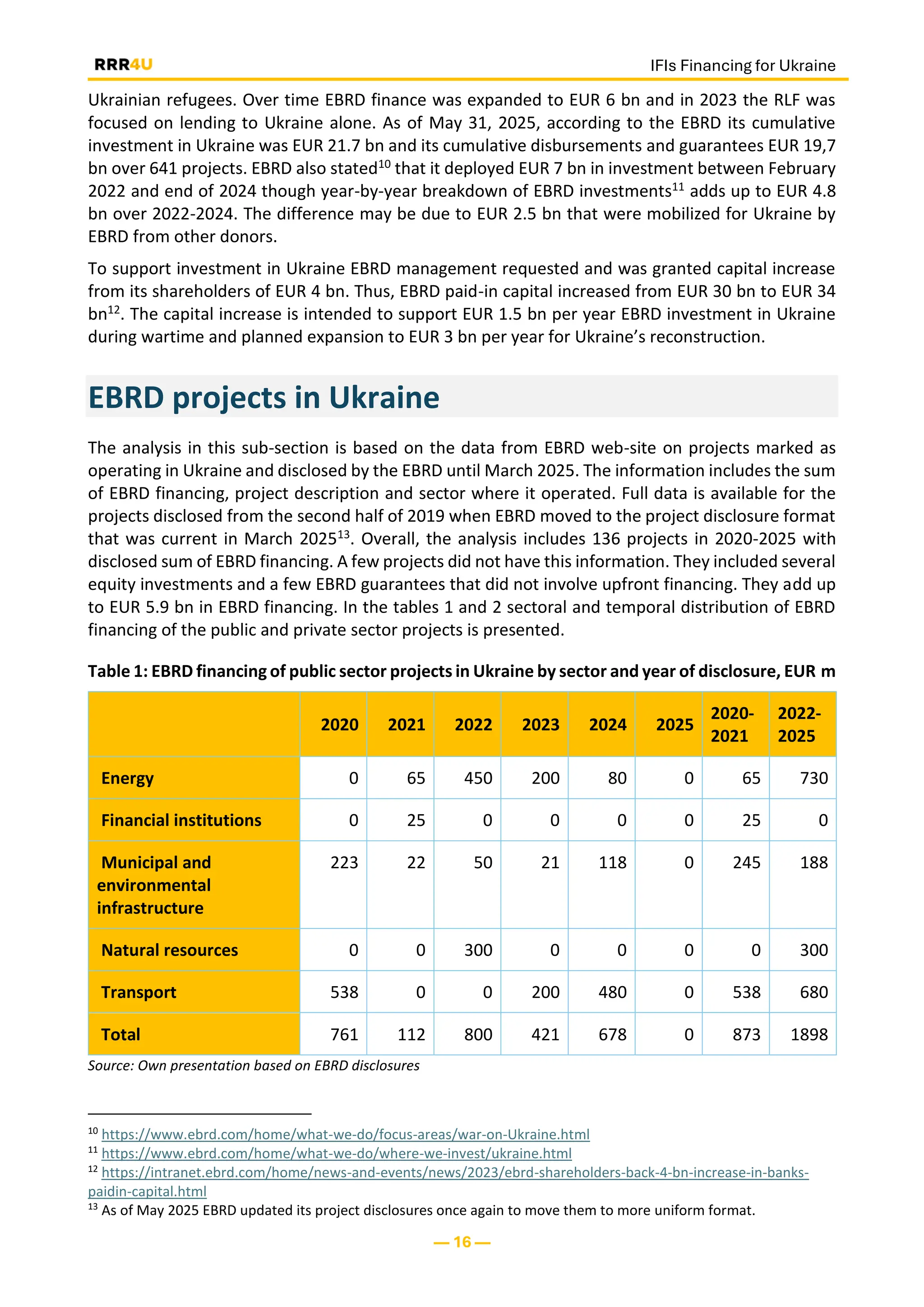
to EUR 5.9 bn in EBRD financing. In the tables 1 and 2 sectoral and temporal distribution of EBRD
financing of the public and private sector projects is presented.
Table 1: EBRD financing of public sector projects in Ukraine by sector and year of disclosure, EUR m
2020 2021 2022 2023 2024 2025
2020-
2021
2022-
2025
Energy 0 65 450 200 80 0 65 730
Financial institutions 0 25 0 0 0 0 25 0
Municipal and
environmental
infrastructure
223 22 50 21 118 0 245 188
Natural resources 0 0 300 0 0 0 0 300
Transport 538 0 0 200 480 0 538 680
Total 761 112 800 421 678 0 873 1898
Source: Own presentation based on EBRD disclosures
10
https://www.ebrd.com/home/what-we-do/focus-areas/war-on-Ukraine.html
11
https://www.ebrd.com/home/what-we-do/where-we-invest/ukraine.html
12
https://intranet.ebrd.com/home/news-and-events/news/2023/ebrd-shareholders-back-4-bn-increase-in-banks-
paidin-capital.html
13
As of May 2025 EBRD updated its project disclosures once again to move them to more uniform format.
IFIs Financing for Ukraine
— 17 —
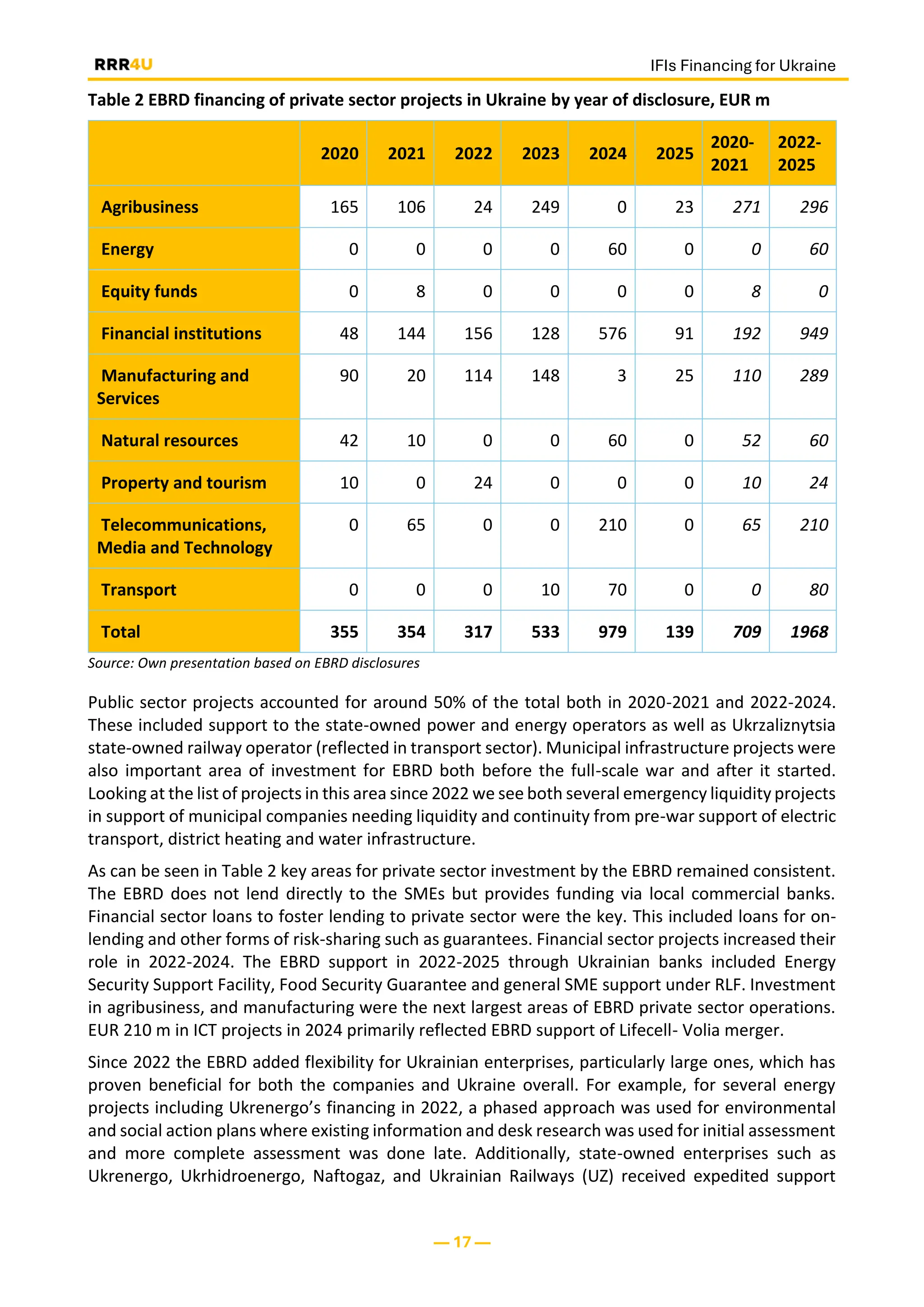
Table 2 EBRD financing of private sector projects in Ukraine by year of disclosure, EUR m
2020 2021 2022 2023 2024 2025
2020-
2021
2022-
2025
Agribusiness 165 106 24 249 0 23 271 296
Energy 0 0 0 0 60 0 0 60
Equity funds 0 8 0 0 0 0 8 0
Financial institutions 48 144 156 128 576 91 192 949
Manufacturing and
Services
90 20 114 148 3 25 110 289
Natural resources 42 10 0 0 60 0 52 60
Property and tourism 10 0 24 0 0 0 10 24
Telecommunications,
Media and Technology
0 65 0 0 210 0 65 210
Transport 0 0 0 10 70 0 0 80
Total 355 354 317 533 979 139 709 1968
Source: Own presentation based on EBRD disclosures
Public sector projects accounted for around 50% of the total both in 2020-2021 and 2022-2024.
These included support to the state-owned power and energy operators as well as Ukrzaliznytsia
state-owned railway operator (reflected in transport sector). Municipal infrastructure projects were
also important area of investment for EBRD both before the full-scale war and after it started.
Looking at the list of projects in this area since 2022 we see both several emergency liquidity projects
in support of municipal companies needing liquidity and continuity from pre-war support of electric
transport, district heating and water infrastructure.
As can be seen in Table 2 key areas for private sector investment by the EBRD remained consistent.
The EBRD does not lend directly to the SMEs but provides funding via local commercial banks.
Financial sector loans to foster lending to private sector were the key. This included loans for on-
lending and other forms of risk-sharing such as guarantees. Financial sector projects increased their
role in 2022-2024. The EBRD support in 2022-2025 through Ukrainian banks included Energy
Security Support Facility, Food Security Guarantee and general SME support under RLF. Investment
in agribusiness, and manufacturing were the next largest areas of EBRD private sector operations.
EUR 210 m in ICT projects in 2024 primarily reflected EBRD support of Lifecell- Volia merger.
Since 2022 the EBRD added flexibility for Ukrainian enterprises, particularly large ones, which has
proven beneficial for both the companies and Ukraine overall. For example, for several energy
projects including Ukrenergo’s financing in 2022, a phased approach was used for environmental
and social action plans where existing information and desk research was used for initial assessment
and more complete assessment was done late. Additionally, state-owned enterprises such as
Ukrenergo, Ukrhidroenergo, Naftogaz, and Ukrainian Railways (UZ) received expedited support
IFIs Financing for Ukraine
— 18 —
between 2022 and 2023. However, such decisions are rather ad hoc, than approved as a joint
strategy towards all Ukrainian companies.
In 2024, the EU approved Ukraine Facility of total support of EUR 50 bn, which envisages the second
pillar of Ukraine Investment Framework (see Box). The EBRD is one of the key implementing
partners of the Ukraine Investment Framework. As a pillar-assessed international financial
institution, the EBRD channels EU guarantees and blended finance instruments to support
investments in both the public and private sectors. This includes energy resilience, municipal
infrastructure, connectivity, and private sector recovery through risk-sharing and co-financing
instruments. The EBRD plays an important role in mobilising additional capital, including from
institutional investors, while ensuring that supported projects align with Ukraine’s strategic
priorities and the broader objectives of the Ukraine Plan. Overall, there is a lack of information, how
many projects were already supported through Ukraine Facility by the EBRD as reporting is made in
general terms. However, from what is known the EBRD has already provided portfolio risk-sharing
facility to several banks exactly under the Ukraine Investment Framework.
Box: Ukraine Investment Framework
The Ukraine Investment Framework is part of the EUR 50 bn Ukraine Facility, which was approved
by the EU in 2024. It channels EUR 9.3 bn in EU guarantees and blended finance through
international financial institutions, including EBRD, EIB, KfW, etc., to mobilise up to EUR 40 bn in
public and private investments.
The Ukraine Investment Framework supports recovery, reconstruction, and modernisation across
strategic sectors. Priority areas include critical infrastructure, energy, connectivity, and support for
SMEs. Investments are aligned with the Ukraine Plan, which was approved by the Cabinet of
Ministers of Ukraine, and national strategies. They should follow the governance principles and
sectoral targets defined by the Ukraine Facility Regulation.
The EBRD continuously increases its support to Ukraine with more agreements signed during the
Ukraine Recovery Conference in Rome, on 10-11 July, 2025 (URC-2025). As Anex indicates, the
projects include both financial and advisory support to business as well as support to local
municipalities. Moreover, the EU agreed to provide within Ukraine Investment Framework through
the EBRD EUR 540 m. This money will help to boost lending to SMEs and increase investments into
renewable energy.
Key challenges on the way towards EBRD financing
The European Bank for Reconstruction and Development (EBRD) and other international financial
institutions (IFIs) face challenges in identifying bankable projects. The same problem is named by
some Ukrainian banks for explanation of low lending. This issue is not necessarily due to inadequate
project preparation, as large companies often possess the necessary resources or can engage
external expertise to develop well-structured proposals. Rather, the difficulty lies with companies
applying for financing, as many fail to pass due diligence and compliance checks.
The EBRD implements consistent core standards across all clients and projects, ensuring uniform
principles and policies related to due diligence, compliance, integrity, environmental, and social
standards. However, given the impact of the ongoing full-scale war of russia against Ukraine, there
is a need to consider the temporary introduction of more practical standards for integrity and
compliance checks.
IFIs Financing for Ukraine
— 19 —
Another reason for unbankable projects, but rather for unbankable companies, is the law
enforcement approaches in Ukraine. Notably, deficiencies within the Ukrainian law enforcement
system mean that many companies especially those involved in public procurement have open
criminal cases even if most of them do not result in convictions. Moreover Ukrainian companies can
divide their assets and activities between different companies to reduce the risk of liability or frozen
activities in case of cases opened or investigations started. Though, of course, in some cases
companies just do not want to show good financial balances to avoid or minimize taxation.
Additionally, the EBRD does not engage with companies owned by oligarchs. Consequently, the
DTEK, owned by Rinat Akhmetov, is unable to secure EBRD loans despite its potential bankability.
While Mr. Akhmetov’s political influence has significantly diminished, DTEK’s operations remain
critical for Ukrainians, as it is the sole provider of electricity and heating in certain regions, which
suffered substantially from russian drones and missile attacks. In light of these circumstances, there
is a need to discuss the approaches on the definition of oligarchs and possibilities to invest in
companies involved in critical infrastructure.
Moreover, the EBRD does not invest into gas infrastructure due to sustainability requirements.
However, taking into account heavy damages caused by russian drones and missiles on electricity
generation, Ukraine will need to rely on gas infrastructure to generate electricity and heating for
quite some time. Therefore, it would be beneficial if the EBRD will be flexible in these terms and
provide financing for gas infrastructural projects.
The EBRD does not work with smaller companies directly, but provides financing or guarantees
though commercial banks. However, SMEs often lack capacities to prepare good projects and go
through all compliance checks, which are required by commercial banks according to the EBRD
procedures.
Given the urgent need for financing among Ukrainian companies due to the exceptional
circumstances caused by the russian war against Ukraine, greater flexibility in financing provisions
is warranted. This includes accelerating processes for Ukrainian firms, offering technical assistance
to help them meet EBRD requirements, and providing more leniency in project timelines. To some
degree it is already provided by the EBRD through policy derogations, ad hoc decisions and existing
flexibility in rules but consistent approach using publicly set rules would be optimal. However, this
flexibility is mostly introduced for the war time, while it would be also required for quite a period
after the war.
Conclusions and key changes required
The EBRD has played a critical role in supporting Ukraine during wartime and contributing to
essential resilience and reconstruction projects. Its financing tools became more flexible especially
for SOEs. The Bank also showed the ability to mobilize donor co-financing. At the same time, the
focus on market-based principles allowed it to act quickly in response to urgent needs while
maintaining a high standard of financial discipline and governance.
Since the beginning of the full-scale invasion, the EBRD demonstrated adaptability in its operations
in Ukraine, including the introduction of streamlined procedures, policy derogations, and targeted
technical assistance. The scale of financing and commitment to Ukraine was reflected in capital
increase and strategic prioritization.
At the same time, experience over the past three years has revealed several persistent bottlenecks
and structural constraints that limit the accessibility of EBRD financing for Ukrainian companies and
restrict the speed of project launching and financing. While the Bank maintains a uniform set of
IFIs Financing for Ukraine
— 20 —
standards and policies across all countries of operation, the context of war and post-war recovery
in Ukraine necessitates more consistent and predictable adjustments to its operating model. Many
of the flexibilities introduced since 2022, including phased environmental and social action plans
or expedited processing for critical infrastructure projects, have proven effective and it would be
beneficial to systematize then rather than apply on an ad hoc basis. This would ensure fairer access
for a broader range of Ukrainian applicants while preserving EBRD’s integrity and risk management
principles.
A major area requiring some simplifications is access for SMEs. Current due diligence requirements
and documentation processes are often too burdensome and difficult for SMEs, particularly in a
wartime economy with limited administrative capacity and uncertain operational outlook.
Currently, SME lack friendly due diligence checks for EBRD projects with Ukrainian banks,
considering the limited capacities of these companies in Ukraine. Simplified sector-specific
templates for SMEs and advisors within partner banks could help address this challenge.
Given the complexity of Ukraine’s reconstruction and rebuilding, coordination with other donors is
essential. The creation of the Ukraine Facility for Infrastructure Reconstruction (Ukraine FIRST
cooperation fund), which was announced during the URC-2025, will create a single pool for
investment projects, which is a good step in the right direction. In particular, it is envisaged to
streamline the planning, financing and implementation of large-scale infrastructure projects, which
will be financed by the EBRD and other donors. Such efforts should be expanded.
Procedural adjustments in procurement should be also considered. It would be advantageous to
allow the use of Prozorro for procurement within EBRD-financed projects, as the bank’s
procurement regulations are often overly complex for Ukrainian companies. Prozorro has already
demonstrated high levels of transparency, competition, and cost-efficiency in Ukraine and is widely
used by national institutions and donors. Aligning EBRD practices with this system would not only
lower transaction costs but also improve implementation efficiency for local beneficiaries.
Furthermore, there is a need to reinstate the option of UAH-denominated loans for Ukrainian
firms, particularly municipal entities. Local currency lending would help reduce currency risks for
borrowers and support broader financial sector stability.
Enhanced transparency in EBRD financing is necessary, going beyond the currently published project
summaries. Greater disclosure and clarity regarding EBRD decision making would contribute to
increased accountability and improved access for Ukrainian companies. Publishing more
information on project selection, scoring criteria, and reasons for rejection would also empower
local stakeholders and ensure a more inclusive recovery process.
Overall, while the EBRD has made significant efforts in supporting Ukraine, scaling its impact in the
years ahead will require further changes, like expanding SME access, simplifying procedures, and
deepening coordination with Ukraine’s reconstruction ecosystem.
IFIs Financing for Ukraine
— 21 —
Anex
According to the EBRD press release, the Bank signed numerous agreements with businesses and
local municipalities. Below, we present the abstract from the press release of the Bank.
“In the business recovery category, the EBRD extended a substantial package of new financial and
advisory support:
● EUR 160 m loan to Ukrainian state-owned oil and gas company Ukrnafta to finance 250 MW of
small-scale gas-fired distributed power generation capacity around the country and boost the
power sector’s resilience in the face of heavy russian attacks.
● Two transactions with local banks – EUR 185 m portfolio risk-sharing facility with Privatbank and
EUR 89.2 m portfolio risk-sharing facility with Ukrgasbank – that will together unlock up to EUR
900 m of new lending by the banks to businesses and households.
● EUR 100 m financial package to agribusiness products producer MHP with British International
Investment and Sweden’s Swedfund, of which the EBRD is lending EUR 40 m.
● EUR 50 m loan to Ukrainian postal and courier operator Nova Post to finance its 2025-26
investment plans and continued growth.
● USD 25 m loan to Ukrainian food retailer Varus to finance its sustainable, energy-efficient
expansion.
● EUR 6.5 m equity investment in FlyerOne Ventures Fund V – a venture capital fund that will invest
in early-stage tech companies from Ukraine and across central and eastern Europe. Together
with the International Finance Corporation, the EBRD plans to further develop investable private
equity initiatives with Ukrainian fund managers to mobilise capital.
● To unlock new renewable energy capacity in Ukraine, the EBRD and development partners are
creating a mechanism that will incentivise investments in renewable energy by stabilising
revenues for developers. Named the Ukraine Renewable Energy Risk Mitigation Mechanism, it is
expected to support up to 1.5 GW of new renewable energy projects, potentially mobilising EUR
2 bn in investments. The Bank also intends to lend EUR 60 m to Galnaftogaz to develop wind
energy projects, having signed a mandate letter with the developer at the URC.
● To advance the development of capital markets, the EBRD signed a memorandum of
understanding (MoU) with the National Bank of Ukraine, Ukraine’s Ministry of Economy and
Ministry of Finance, and the National Securities and Stock Market Commission supporting the
creation of a more effective, vertically integrated capital market infrastructure.
To help Ukraine’s cities maintain the provision of essential services amid the ongoing war, the EBRD
signed new commitments with local municipalities under the conference’s regional umbrella:
● EUR 25 m loan to the city of Dnipro to finance energy-saving measures in public buildings. To
complement this, the EBRD intends to support the opening of a new Superhumans clinic in the
city, which will deliver comprehensive medical and rehabilitation care to war-affected military
personnel and civilians. The Bank’s investment is expected to benefit from donor support from
the Netherlands.
● EUR 10 m loan to Lviv to rehabilitate two wastewater plants, and EUR 10 m emergency liquidity
loan to Kharkiv to mitigate the effects of the war on the city’s financial position and ensure
uninterrupted essential municipal services.
IFIs Financing for Ukraine
— 22 —
● A pre-financing agreement with the city of Kyiv that consolidates plans for EUR 150 m loan for
new metro trains.
● Agreements to finance new trolleybuses in Ternopil and Mykolaiv, which are benefiting from
donor support from the EU, Spain, Canada, Italy and the United States.
● MoUs with the Ministry for Development to cooperate on creating a pipeline of priority road
infrastructure projects and with the Ministry of Agrarian Policy and Food to invest in sustainable
irrigated agriculture to boost crop production. The EBRD is exploring restoring two old irrigation
systems near Odessa to support food security for Ukraine’s future reconstruction.
IFIs Financing for Ukraine
— 23 —
EIB financing in Ukraine
Authors: Andrii Akymenko, Maria Repko, Maksym Samoiliuk, Center for Economic Strategy
Executive summary
Since the beginning of its cooperation with Ukraine in 2007 and until October 2025, the European
Investment Bank (EIB) has provided Ukraine with loans totalling almost EUR 9.6 bn.
The EIB's priority areas for financing are, in descending order: transport, energy, public space and
infrastructure (public projects), and the agricultural industry (private projects).
Lending to the private sector is less frequent and smaller in volume than to the public sector –
together with credit lines to support small and medium-sized enterprises (SMEs), approximately
EUR 2.9 bn was directed to the private sector, while a total of EUR 6.7 bn was attracted to public
projects.
The Bank's direct loans to Ukrainian private companies (approximately EUR 650 m in total) were
largely directed to agricultural holdings (Astarta, MHP, Nibulon, Kernel), as the agricultural sector
generates stable foreign currency revenues and large holdings have transparent reporting. Export
revenues in hard currency allow for the safe servicing of euro loans, which minimizes currency and
transfer risk for the EIB. At the same time, new direct loans have not been approved since 2021, as
war risks have risen sharply, and the EIB's limited capital and conservative risk limit force the bank
to work only through safer credit lines from intermediary banks. The EIB is more willing to lend to
countries with a strong banking infrastructure, such as Turkey, which until 2018 had political
stability, a professional bureaucracy, and a diversified private sector.
Against the backdrop of changes in the security situation in Europe, the EIB is gradually expanding
its lending opportunities for defence projects. Previously only non-lethal projects with a mandatory
civilian purpose were eligible for financing. Now, the EIB is gradually easing these restrictions,
opening more opportunities for lending to defence projects. For Ukraine, this opens additional
prospects for attracting funds for the development of private companies in the defence-industrial
complex, combining the urgent need to strengthen defence capabilities with the long-term goal of
supporting private business.
To unlock larger loans for businesses, Ukraine needs to reduce currency and military risks (hedging,
insurance, lifting restrictions on conversion), expand the range of banking services, and deepen
European integration reforms. In return, the EIB and the EU should provide broader guarantees,
launch hryvnia instruments, simplify procedures in wartime conditions, strengthen the local team,
and extend defence programs to Ukrainian companies.
Introduction
The stability of the economy during wartime depends not only on stable public finances, but also on
the ability of companies to operate and invest. At the same time, a healthy mix of companies – state-
owned, municipal, and private; large, medium, and small; eastern and western – is important for
balance. Their investments are what allow the economy to grow or, at least, not to shrink
(maintenance cost).
IFIs Financing for Ukraine
— 24 —
One of the challenges facing companies today is access to financing, especially investment financing.
While only 10-12% of companies are aware of the problem of working capital shortages14, the lack
of investment in the economy means a significant slowdown in development and a widening gap
with neighbouring countries. International financial organizations (IFOs) that were active in Ukraine
before the war remained the only external source of long-term financial resources for Ukrainian
companies during the war, against the backdrop of closed capital markets.
However, IFIs often prefer quasi-sovereign projects (state-owned or municipally owned companies)
or joint projects with banks to support SMEs. In contrast, large and medium-sized private companies
– which are key to employment, exports, and innovation – are often left out.
At the political level, Ukraine and the European Union are committed to supporting the growth and
sustainability of the private sector. The Ukrainian Investment Framework – the second pillar of the
major European project «Ukraine Facility» – uses IFI financing to support European companies in
their investments in Ukrainian private projects. A competitive private sector is one of the
prerequisites for any country's accession to the EU.15 However, we see that agreements in the
private sector are still few and far between. Businesses complain about the inaccessibility of funds
due to complex procedures, while IFIs complain that Ukrainian projects are unbankable, i.e., they
do not comply with their rules and standards.
The European Investment Bank16 – the «EU bank» established in 1958 under the Treaty of Rome,
owned by member states and designed to support balanced and sustainable development by
financing projects that implement Union policies – accelerate the green transition, enhancing
technological innovation, strengthening security and defence, promoting regional cohesion, and
developing social infrastructure. Outside the EU, the EIB mainly operates under mandates granted
by the European Parliament and the Council of the EU (with an EU budget guarantee). Between
2007 and 2013, the External Lending Mandate (ELM) for Eastern Europe, Southern Caucasus, and
Russia (EESCR) allowed for up to EUR 3.7 bn.17 In 2014–2020, the new ELM for the EU's Eastern
Neighbourhood (including Ukraine as one of the priority recipients of funding in the region) has up
to EUR 6.65 bn.18 Since 2021, the classic ELM has been replaced by the NDICI–Global Europe
framework with the EFSD+ / External Action Guarantee instrument.19 A separate EIB Guarantee of
EUR 26.7 bn (2021–2027) has been concluded for the EIB; no fixed ceiling has been set for the
Eastern Neighbourhood, but there is currently a separate EUR 2 bn guarantee window for Ukraine
under the Ukraine Facility.
This report analyses cases from the European Investment Bank to determine whether there is
indeed a problem with investing in the private sector and to propose possible solutions.
Overview of EIB financing in Ukraine
For ten years prior to the full-scale invasion, the EIB provided financing equivalent to
approximately 4% of Ukraine's total capital investments.20 However, since 2022, the bank's
14
The Institute for Economic Research survey on business sentiment in May
15
The existence of a functioning market economy as well as the capacity to cope with competitive pressure and
market forces within the Union; Copenhagen criteria.
16
EIB Group. Corporate Governance Report for 2024
17
Decision No 633/2009/EC of The European Parliament and The Council of 13 July 2009
18
Decision No 466/2014/EU of The European Parliament and The Council of 16 April 2014
19
«NDICI - Global Europe» (2021-2027)
20
State Statistics Service of Ukraine. Capital investments by sources of financing: 2007-2009 annual data, 2010-2019
annual data, 2020-2024 quarterly data with annual Jan.-Dec. total
IFIs Financing for Ukraine
— 25 —
operations have declined significantly due to high risks. At the same time, by 2025, the EIB had
already resumed its pre-war lending volumes – in ten months, it had received almost EUR 1.2 b,
which is the second-largest annual figure. Over the entire period of cooperation between Ukraine
and the EIB, less than a third of the financing was directed to the private sector, while the rest
went to state or municipal projects. During the war, the situation became even more unbalanced,
with the public sector accounting for 86% of the total. At the same time, the selection of funds in
the public sector is lower than in the private sector.
For the first four years, the Bank's activities in Ukraine were mainly exploratory and preparatory in
nature, with only one major project signed each year and volumes gradually declining. However,
between 2011 and 2021, cooperation became much more productive and relatively stable (Figure
1). After the full implementation of the EUR 3 bn Action Plan for Ukraine (2014–2016), new lending
slowed significantly in 2017, with a subsequent recovery until the start of the full-scale invasion. The
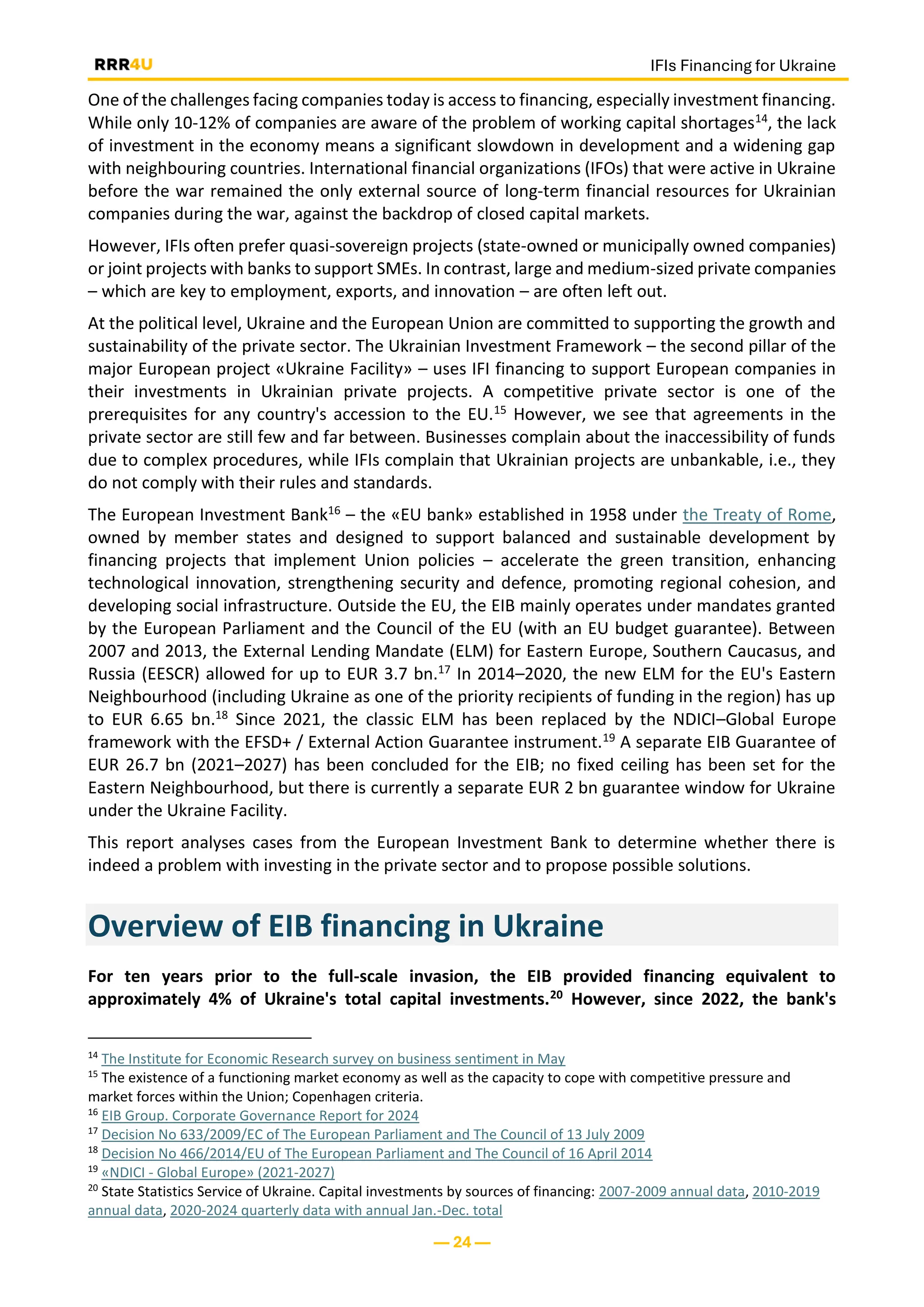
importance of the EIB for Ukraine is clear when compared to capital investments from the state and
local budgets (Figure 2). In 2014–2015, EIB loans even exceeded total budgetary capital
expenditures, and overall, in the ten years before the war, the Bank provided about 4% of all capital
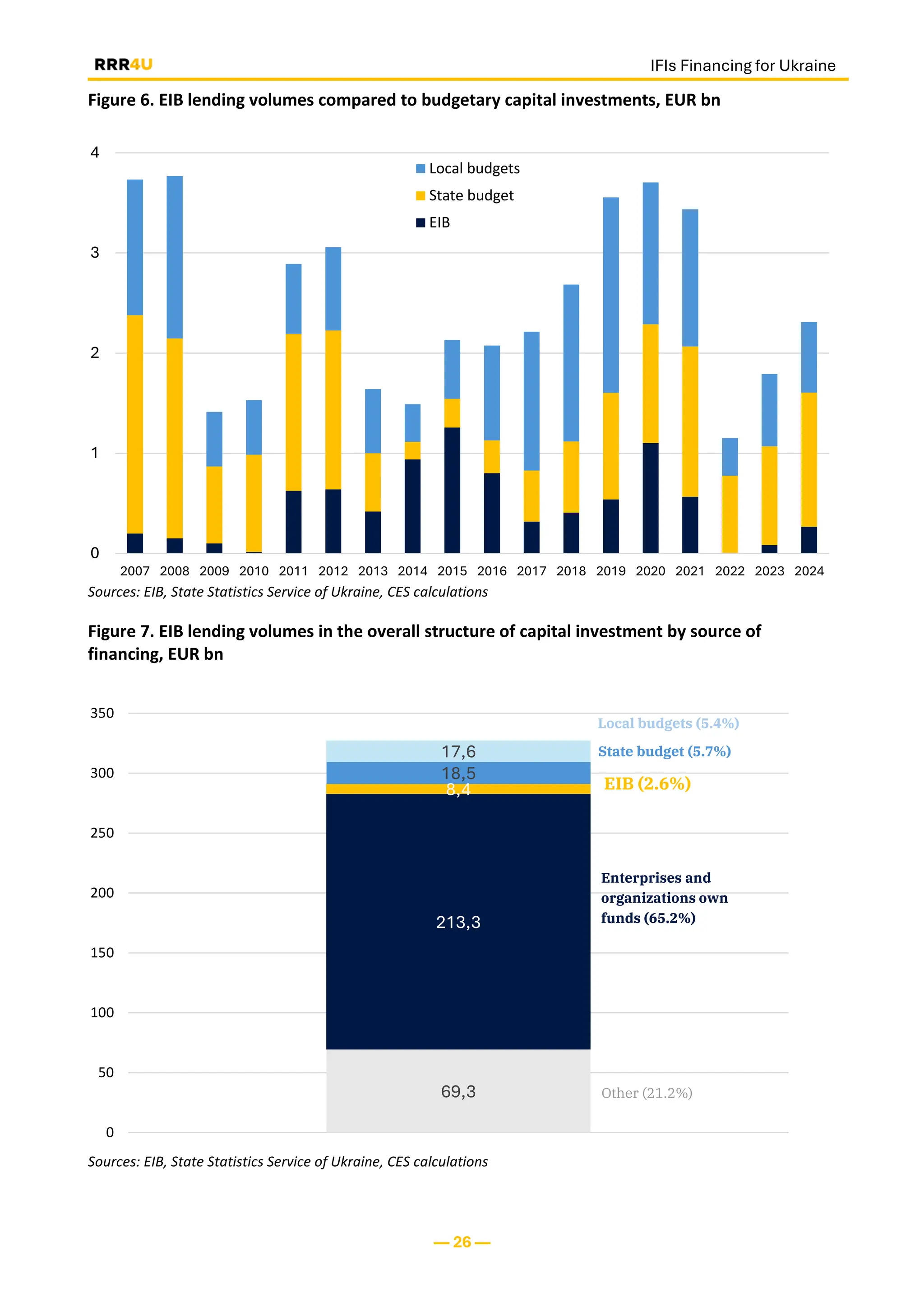
investments in the country. For the entire period from 2007 to 2024, this share is 2.6% (Figure 3)
due to limited activity in the early years of the war period from 2022 to 2024, when the Bank's
contribution to capital investments fell to 1.2%.
Figure 5. EIB credit loans by year for the Public and Private sectors, EUR m
Source: CES calculations based on EIB data as of October 2025
Note: Ukraine received EUR 2.15 bn in loans from the EIB between 2007 and 2013, EUR 5.37 bn between 2014 and 2020,
and EUR 2.11 bn between 2021 and July 2025.
For convenience, we will use the designations «Public», «SMEs», and «Private» for the three respective
groups.
135
71 58
132 89 50
106
100
440
220
400
400 260
100 75
20
25
116
70
200
150
16
625
200
193
405
858
470
160
276
450
978
439
0
57
150
694
0
200
400
600
800
1000
1200
2007 2008 2009 2010 2011 2012 2013 2014 2015 2016 2017 2018 2019 2020 2021 2022 2023 2024 2025
Public projects
Support to SMEs
Individual private projects
IFIs Financing for Ukraine
— 26 —
Figure 6. EIB lending volumes compared to budgetary capital investments, EUR bn
Sources: EIB, State Statistics Service of Ukraine, CES calculations
Figure 7. EIB lending volumes in the overall structure of capital investment by source of
financing, EUR bn
Sources: EIB, State Statistics Service of Ukraine, CES calculations
0
1
2
3
4
2007 2008 2009 2010 2011 2012 2013 2014 2015 2016 2017 2018 2019 2020 2021 2022 2023 2024
Local budgets
State budget
EIB
69,3
213,3
8,4
18,5
17,6
0
50
100
150
200
250
300
350
EIB (2.6%)
Enterprises and
organizations own
funds (65.2%)
Other (21.2%)
State budget (5.7%)
Local budgets (5.4%)
IFIs Financing for Ukraine
— 27 —
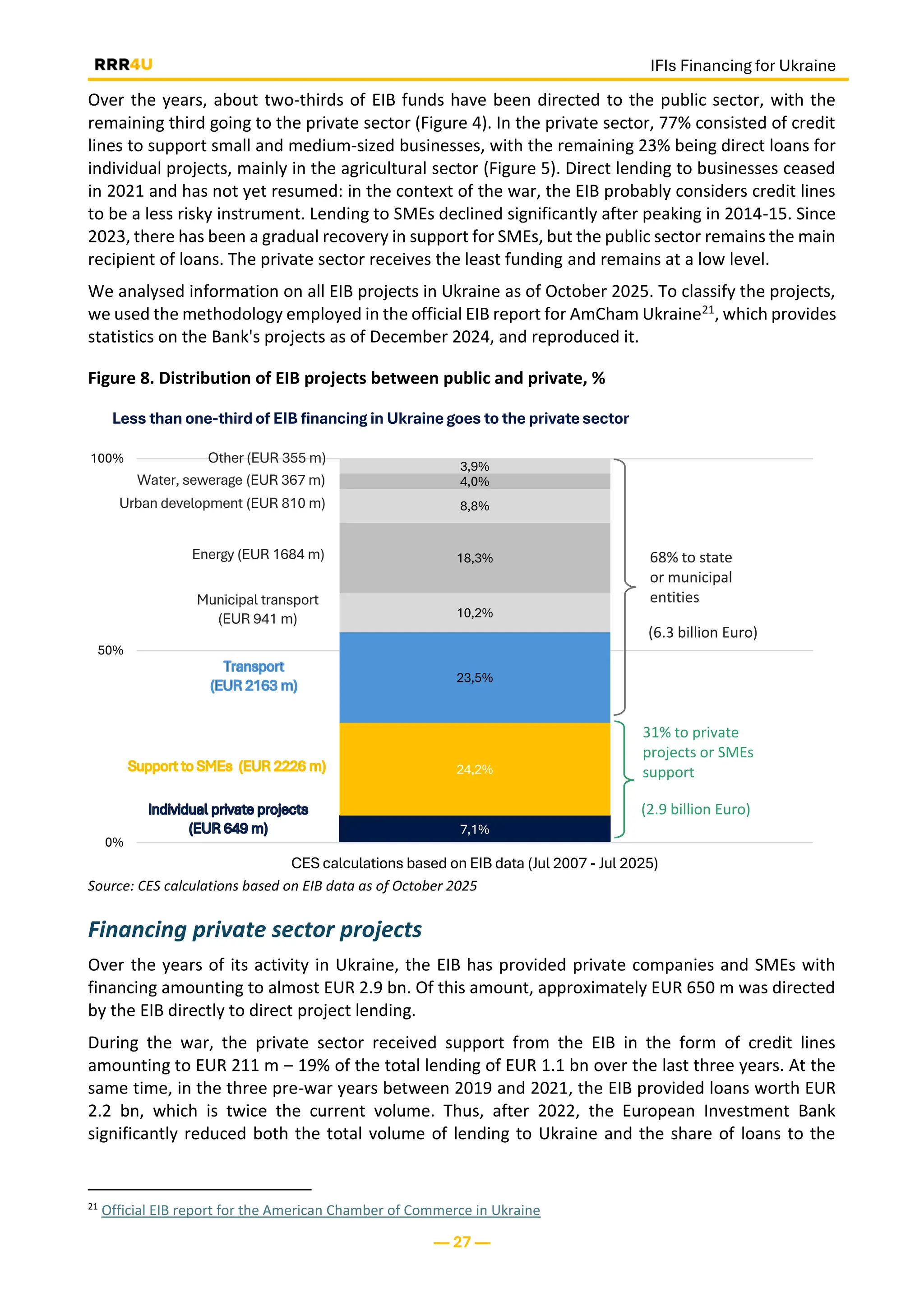
Over the years, about two-thirds of EIB funds have been directed to the public sector, with the
remaining third going to the private sector (Figure 4). In the private sector, 77% consisted of credit
lines to support small and medium-sized businesses, with the remaining 23% being direct loans for
individual projects, mainly in the agricultural sector (Figure 5). Direct lending to businesses ceased
in 2021 and has not yet resumed: in the context of the war, the EIB probably considers credit lines
to be a less risky instrument. Lending to SMEs declined significantly after peaking in 2014-15. Since
2023, there has been a gradual recovery in support for SMEs, but the public sector remains the main
recipient of loans. The private sector receives the least funding and remains at a low level.
We analysed information on all EIB projects in Ukraine as of October 2025. To classify the projects,
we used the methodology employed in the official EIB report for AmCham Ukraine21, which provides
statistics on the Bank's projects as of December 2024, and reproduced it.
Figure 8. Distribution of EIB projects between public and private, %
Source: CES calculations based on EIB data as of October 2025
Financing private sector projects
Over the years of its activity in Ukraine, the EIB has provided private companies and SMEs with
financing amounting to almost EUR 2.9 bn. Of this amount, approximately EUR 650 m was directed
by the EIB directly to direct project lending.
During the war, the private sector received support from the EIB in the form of credit lines
amounting to EUR 211 m – 19% of the total lending of EUR 1.1 bn over the last three years. At the
same time, in the three pre-war years between 2019 and 2021, the EIB provided loans worth EUR
2.2 bn, which is twice the current volume. Thus, after 2022, the European Investment Bank
significantly reduced both the total volume of lending to Ukraine and the share of loans to the
21
Official EIB report for the American Chamber of Commerce in Ukraine
7,1%
24,2%
23,5%
10,2%
18,3%
8,8%
4,0%
3,9%
0%
50%
100%
CES calculations based on EIB data (Jul 2007 - Jul 2025)
Less than one-third of EIB financing in Ukraine goes to the private sector
Individual private projects
(EUR 649 m)
Support to SMEs (EUR 2226 m)
Municipal transport
(EUR 941 m)
Transport
(EUR 2163 m)
Energy (EUR 1684 m)
Urban development (EUR 810 m)
31% to private
projects or SMEs
support
68% to state
or municipal
entities
Water, sewerage (EUR 367 m)
Other (EUR 355 m)
(2.9 billion Euro)
(6.3 billion Euro)
IFIs Financing for Ukraine
— 28 —
private sector, while becoming an intermediary in providing financial assistance to Ukraine through
several EU support programs.22
Figure 9. Direct lending to private projects by the EIB by sector in 2007-2025, share of all projects
Source: CES calculations based on EIB data as of July 2025 with refined Agriculture classification according to detailed
loan description
Most direct lending (83%) is concentrated in the agricultural sector: Astarta (EUR 50 m in 2014 and
EUR 36.5 m in 2017), MHP (EUR 85 m in 2014), Nibulon (EUR 71 m in 2016), Inagro (EUR 23.5 m in
2017), Kernel (EUR 221 m in 2018), Epicenter Agro (EUR 106 m in 2021). All the above transactions,
except for Astarta, were one-off deals.
The largest share in private lending is occupied by Agro-industry, followed by Agro-transport, and
the smallest share is occupied by Agriculture itself.23 Other private sector industries receive
significantly less funding than agricultural sectors.
In total, the EIB issued nearly EUR 650 m in loans to private companies, but direct lending to private
projects has ceased since 2021.
The most successful private projects during the period of private lending (from 2014 to 2021) were
initiatives by MHP, Nibulon, and Inagro, which reported the complete and successful completion of
22
EU for Ukraine Fund
23
Agro Industry – industry in the agricultural sector (e.g., production, installation, or expansion of grain silos or elevators,
construction of grain processing and storage terminals, construction and operation of a new agricultural production
plant, etc.); Agro Transport – purchase, modernization, or repair of transport for the transportation of agricultural
products (e.g., purchase of tractors or vessels for the transition from road to water transportation of grain); Agriculture
– other loans aimed at investments in the agricultural industry (e.g., monitoring and supporting a sustainable flow of
products, testing grain quality, etc.). Classification by the Center for Economic Strategy.
4,5%
0,9%
0,7%
1,3%
0%
8%
CES calculations based on EIB data (Jul 2007 - Jul 2025)
Private sector financing is mainly Agro
Agro Industry (EUR 393 m)
Agriculture (EUR 63 m)
Energy, Services and
other (EUR 110 m)
Agro Transport (EUR 82 m)
83%
of private loans
(EUR 538 m)
IFIs Financing for Ukraine
— 29 —
their work. In total, they received EUR 179.5 m in financing, which represents 2.1% of all loans
provided by the EIB to Ukraine over the past 18 years, or about 28% of the total volume of private
lending. The last major private project financed by the EIB was Grain Storage and Equipment for
Epicenter Agro in 2021, worth EUR 106 m. The project involved the construction of grain storage
facilities and the purchase of modern agricultural machinery and equipment.24
At the end of June, it became known that the European Investment Bank and the European Bank
for Reconstruction and Development plan to invest EUR 40 m and EUR 60 m, respectively, in the
new Amber Dragon infrastructure fund.25 The funds should be directed primarily toward renewable
energy, sustainable transport, and digital infrastructure. Despite the positive fact of the EIB's
cooperation with a private investment group, the announced amount is insignificant – less than
0.5% of the Bank's loan portfolio over 18 years – and is not expected to drive Ukraine's economic
growth, unlike potential loans to the private defence sector.
SME loans through intermediary banks
About EUR 2.2 bn was allocated to support small and medium-sized businesses through microloans
(to companies with up to 10 employees, including through the European Investment Fund26),
lending to domestic small and medium-sized enterprises (up to 250 employees), mid-cap companies
(250 to 3,000 employees), and large corporate clients through Ukrainian intermediary banks.27 The
EIB assures that these loans will give private businesses access to financing on favourable terms.28
The most active lending to small and medium-sized businesses through intermediary banks took
place in 2012–2017, when this sector accounted for almost 42% of all loans issued. In 2018–2021,
the share of SME lending decreased significantly, accounting for less than 4%. However, SME lending
recovered in 2023 (most significantly in December 2024), and since then, the volume of financing
for this segment has accounted for approximately 14% of the total loan portfolio.
In total, through financing bank lending to SMEs, the EIB has issued almost EUR 2.23 bn in loans, of
which EUR 211 m during the war. Currently, the EIB works with five banks in Ukraine – Ukreximbank,
ProCredit Bank, Ukrgasbank, Oschadbank, and Raiffeisen Bank Ukraine – three of which are state-
owned.
Lending to the public sector (state-owned and municipal enterprises)
All but one of the public projects in Ukraine are classified by the EIB as large loans (over EUR 25 m).
Only the project “Development of the water supply and sanitation system in the city of Mykolaiv”
(2010) received a small loan of EUR 15.5 m. The average loan size for the remaining 32 public
projects was approximately EUR 185 m. Loans provided to intermediary banks for SMEs are mainly
small loans, although total loans to banks may have been larger. For the eleven largest credit lines,
the average total loans to intermediary banks amounted to EUR 186 m, and for the remaining eight
credit lines – approximately EUR 10 m.
During the war, the Bank provided loans to the public sector under the Ukraine Recovery III program
(rapid restoration of critical social infrastructure in affected communities), Ukraine Digital
Emergency Response Services (creation of a national emergency number 112 system and
accompanying IT infrastructure), Ukraine Water Recovery (repair and modernization of water
supply and sewage networks), Ukraine District Heating (loans through Ukreximbank, Oschadbank
24
Currently, there is no information about the completion or current stage of implementation of this project.
25
EBRD and EIB to Invest EUR100 M in Amber Dragon Ukraine Infrastructure Fund I
26
European Investment Fund for SMEs
27
List of EIB intermediary banks in Ukraine
28
Intermediated loans for SMEs, mid-caps and other priorities
IFIs Financing for Ukraine
— 30 —
and Ukrgasbank to municipalities for the restoration and improvement of heating systems),
Improvement Road Networks (reconstruction and development of Trans-European Transport
Network roads M-06 and M-09), Support Of Ukrhydroenergo Stability and Recovery (rehabilitation
and modernisation of three key hydropower plants – Kaniv, Kremenchuk and Dnipro), and Ukraine
Emergency and Decarbonisation Support (acquisition of long-term gas reserves and sustainable
energy and decarbonisation projects).
In total, the EIB issued approximately EUR 6.7 bn in loans to the public sector, including about EUR
1.3 b during the war.
Although the public sector is far ahead of the private sector in terms of lending volumes, the
disbursement of funds for these projects lags significantly behind. According to the Ministry of
Finance's data on the use of EIB funds in the public sector, as of October this year, only three out of
27 projects have been fully funded (Figures 6 and 7). In total, the Ministry of Finance's report lists
public projects worth around EUR 4.6 bn, of which exactly half – EUR 2.3 bn – has been drawn down.
Figure 10. EIB loans reported by the Ministry of Finance of Ukraine (shaded) in the Bank's total
lending volume, EUR m
Source: CES calculations based on EIB data and the Ministry of Finance report for October 2025
The graph in Figure 6 shows that the Ministry of Finance reports only part of the public sector loans,
so the information on the share of funds selected for this sector is incomplete.
0
200
400
600
800
1000
1200
2007 2008 2009 2010 2011 2012 2013 2014 2015 2016 2017 2018 2019 2020 2021 2022 2023 2024 2025
EIB credit loans by year for the Public and Private sectors, EUR m
Public
Public (MinFin)
SMEs (MinFin)
SMEs
Private
IFIs Financing for Ukraine
— 31 —
Figure 11. Amount of funds selected for EIB loans for certain public projects (Ministry of Finance,
July 2025), EUR m
Source: CES calculations based on EIB data and the Ministry of Finance report for October 2025
* The Ministry of Finance publishes information only on a portion of public sector loans
EIB operations in other countries
The EIB prefers to work actively in countries with developed banking systems, such as Turkey. This
simplifies the provision of loans and the use of various financial instruments that are not always
available in Ukraine. Ukraine lags other countries in terms of both per capita financing and the
share of the private sector.
Ukraine belongs to two EIB regional groups simultaneously and is closest to Serbia in terms of
lending structure and volume (Figure 8), while Turkey stands out in terms of the scale of funds
raised, although its cooperation with the EIB has practically ceased since 2018.
According to its regional classification, the EIB places Ukraine in two groups of countries: the EU
Eastern Neighbourhood (former Soviet republics) and EU Enlargement countries (countries that
have or had intentions to join the EU).
The country most similar to Ukraine in terms of the volume and structure of EIB loans is Serbia,
which has managed to attract approximately EUR 8.2 bn over a period significantly longer than
Ukraine (more than 30 years). However, unlike Ukraine, Serbia has a larger share of private lending
(42%) in its overall structure.
Turkey stands out most clearly in both groups, having received almost EUR 31 bn in loans from the
EIB – more than all other countries combined – with a share of private lending of around 55%. Its
developed banking system and strong private sector, combined with long-term political stability,
allowed the bank to assess the country's risks as moderate compared to Ukraine and, accordingly,
to lend more actively to Turkish companies. At the same time, after the suspension of negotiations
on Turkey's accession to the EU in 2018, the EIB's activities almost completely ceased, limiting itself
to providing loans for the reconstruction of Turkish cities affected by the earthquake.
0
200
400
600
800
1000
1200
2007 2008 2009 2010 2011 2012 2013 2014 2015 2016 2017 2018 2019 2020 2021 2022 2023 2024 2025
Selected credit funds for certain government projects
(Ministry of Finance, July 2025), EUR m
Selected Non-selected
IFIs Financing for Ukraine
— 32 —
Figure 12. Distribution of loans for groups of EU Eastern Neighbourhood and EU enlargement
countries, EUR bn
Source: CES calculations based on EIB data as of 2025
Figure 13. Distribution of loans for groups of EU Eastern Neighbourhood and EU Enlargement
countries, euros per person
Source: CES calculations based on EIB data as of 2025. Population figures for all countries are based on the latest
available data from open sources; for Ukraine, migration outflows after 2022 are taken into account.
0
5
10
15
20
25
30
Azerbaijan Armenia Moldova Georgia Ukraine Serbia Turkiye BiH North
Macedonia
Montenegro Albania Kosovo
EIB activity in Ukraine's neighbouring countries, € bn
Public
SMEs
Private
EU Eastern Neighbourhood
EU Enlargement countries
0
400
800
1200
1600
2000
Azerbaijan
Armenia
Moldova
Georgia
Ukraine
Serbia
Turkiye
BiH
North
Macedonia
Montenegr
o
Albania
Kosovo
EIB activity in Ukraine's neighbouring countries, Euro per capita
Private SMEs Public
IFIs Financing for Ukraine
— 33 —
Figure 14. Distribution of loans to the public and private sectors for the EU Eastern
Neighbourhood and EU Enlargement countries, share of total lending
Source: CES calculations based on EIB data as of 2025. The top five countries in terms of total lending in both groups are
highlighted in red.
In terms of total lending volumes, Ukraine ranks among the regional leaders. However, in terms of
per capita lending, Ukraine ranks only ninth out of twelve countries – credit resources are
distributed much less densely than in neighbouring countries (Figure 9).
As in Ukraine, loans aimed at supporting the public sector account for the bulk of the loan portfolio
in most countries in the region, but the percentage of the public sector in Ukraine is above average
(Figure 10).
Barriers to the bank's work with the private sector and ways to overcome them
These barriers are divided into elements that can be addressed either within Ukraine or by the EU.
Local Ukrainian policies that can help strengthen private sector lending should address the
following issues:
1) Reduce the riskiness of private sector lending operations for the Bank, since the Bank is
essentially a financial institution that is guided, among other things, by risk assessment. These
may include policies to reduce currency risk (in particular, through swaps with the NBU), access
to military risk insurance for large projects (currently unavailable or highly complicated), and
elimination of currency transfer and convertibility risk, when the NBU prohibits companies from
exchanging hryvnia for foreign currency or making payments abroad.
2) Expanding access to complex banking services – those required for a particular transaction.
Separate research is needed on banking sector development policies that can be implemented
by the NBU as the central bank and the Ministry of Finance as the owner of banks that hold
approximately half of the banking sector's assets.
3) Improve the operating environment for companies and their counterparties, including
essentially the widest possible range of reforms relating to centralized measures for maximum
physical security (from strengthening air defence protection and clear protocols for action in the
event of «hits» to providing relocation opportunities, reservation policies, etc.), political stability,
0%
10%
20%
30%
40%
50%
60%
70%
80%
90%
100%
Azerbaijan
Armenia
Moldova
Georgia
Ukraine
Serbia
Turkiye
BiH
North
Macedonia
Montenegro
Albania
Kosovo
EIB activity in Ukraine's neighbouring countries, % of total credits
Private SMEs Public
IFIs Financing for Ukraine
— 34 —
the establishment of property rights protection, predictable tax policy, priority guarantees for
export contracts through the ECA to facilitate international cooperation, and other measures to
increase exports – in short, the transformational reforms that should lead to the creation of a
competitive and strong private sector in Ukraine.
4) Reforms aimed at integration with the EU. These will not only create the right environment
within the country but will also help the bank attract more guarantees and support mechanisms
from its shareholders – EU member states – and other donors. Comparing Ukraine with Poland,
lenders expect that EU accession could significantly improve the economic situation and are
therefore more optimistic about projects in Ukraine.
Policies at the level of EIB management and its shareholders (EU member states) that could help
strengthen lending to the private sector should address the following issues:
1) Expansion of the EU's guarantee package for private sector lending. Due to limited capital and
relatively high leverage (with a “moderate” capital-to-asset ratio of 14% at the end of 2024,
according to Fitch Ratings), the EIB is operating at the limits of its risk capacity, especially outside
the EU. Therefore, the structure of its loan portfolio is largely determined not only by
management priorities, but also by the availability of risk-sharing instruments and guarantees,
which have traditionally focused on the public sector.
2) At the EU level, establish mechanisms for lending in hryvnia to borrowers in Ukraine who do
not have sufficient foreign currency earnings. This applies, for example, to technology-based
industries that operate in the domestic market. Such a policy would allow the EIB to move away
from lending practices focused solely on the agricultural sector.
3) With the support of shareholders, significantly strengthen the bank's team working with
candidate countries. The fact is that the revenue volumes of companies in Ukraine, Moldova, and
the Western Balkan countries do not allow for the attraction of loan volumes that are standard
for EU countries, which have a much larger market (in fact, the entire EU common market) and
turnover. The EIB cannot effectively process many small loans, and working through intermediary
banks within the framework of SME lending projects does not always allow for the effective
coverage of the needs of medium and large companies.
4) Create the possibility of waivers for bank procedures and requirements related to the
implementation of environmental, inclusive, and other requirements for countries in emergency
situations. The fact is that during wartime, a shortage of human resources forces businesses to
focus on tasks that they would not face in peacetime. Accordingly, the managerial resources that
could be directed toward achieving climate or gender goals are extremely limited. Although the
EIB provides technical assistance to enable borrowers to meet its due diligence and compliance
procedures, in wartime it is advisable to provide for exceptions or simplifications to these
procedures, which must be agreed at the level of the bank's shareholders.
5) Expand defence projects to Ukraine. In Europe, starting in 2022, the EIB is implementing projects
to guarantee and strengthen European strategic security. And since June 2023, in response to
significant geopolitical changes and the growing need to increase European defence spending,
the EIB has increased its own security and defence fund to EUR 8 bn (including EUR 2 bn for
projects in 2025) and has also begun providing SME loans for innovative start-ups in the defence
sector. In early March 2025, the EIB agreed to revise its policy on providing funds for the
European defence industry. It is extremely important to involve the EIB in financing the Ukrainian
defence industry, initially for companies focused on dual-use goods, and in the future for the
defence industry. Due to the war, the Ukrainian defence sector has become one of the strongest
IFIs Financing for Ukraine
— 35 —
and most innovative in Europe, and as an important and integral part of the European security
architecture, it will benefit from the scaling up of projects financed by the EIB.
Conclusions
The European Investment Bank (EIB) has been an important source of financing for Ukraine for over
15 years, but its support for the private sector remains limited. Of the total EUR 9.6 bn in financing
provided since 2007, the bulk has gone to public and municipal projects. In the private sector, the
EIB's focus is on supporting SMEs through Ukrainian banks and financing agricultural initiatives.
Despite the war, the EIB is gradually resuming its activities in Ukraine, and although total lending
volumes during the war remain lower than before the war, 2025 has already seen a significant
increase in the volume of loans raised, primarily due to public transport and energy projects.
In the first year of the full-scale invasion, the bank completely suspended new lending, focusing on
its intermediary role in aiding. It was not until June 2023 that lending tranches were resumed, and
over the past three years, new lending amounted to EUR 1.5 bn, of which only EUR 211 m (14%)
was directed toward supporting SMEs.
Compared to other EU enlargement countries, Ukraine receives less private financing from the EIB,
although the overall support structure is similar. The only exception is Turkey, which has attracted
significantly larger volumes of loans, primarily due to its developed banking system, strong private
sector, and long-term political stability until 2018, which distinguished the country as a convenient
and reliable partner in terms of lending. This demonstrates the potential for scaling up support to
Ukraine, provided there is the necessary political will and structural reforms.
There is now a window of opportunity to review the EIB's mandate on financing the defence sector,
and Ukraine should become its key beneficiary.
To expand the Bank's participation in business financing, mirror steps are needed on both sides.
Ukraine must reduce currency and military risks (swaps with the NBU, insurance, lifting restrictions
on payments), develop complex banking products, and improve the business environment through
property rights protection, predictable tax policy, and further European integration. The European
Investment Bank and the EU, in turn, must expand guarantees for private loans, launch hryvnia
instruments, strengthen the Bank's team in candidate countries, simplify procedures in wartime
conditions, and scale new defence programs to Ukrainian companies. The synchronized
implementation of these actions will transform the EIB into a key long-term investor in the
restoration and modernization of the Ukrainian private sector.
Ukraine should also engage in systematic external communication with its European partners and
emphasize the macroeconomic impact of the private sector, as well as its role as a key security
player in the region. This will lay the foundation for a shift in the Bank's policy toward greater
flexibility and risk orientation.
IFIs Financing for Ukraine
— 36 —
WBG role in Ukraine
Authors: Alona Korohod, Roman Nitsovych, DiXi Group
The role of the WBG in Ukraine
Table 3: Key Contacts (Ukraine & Europe Region)
Institution Regional Contact Email
World Bank Ukraine
Office
Bob Saum, Regional Country Director
for Eastern Europe
ukraine@worldbank.org
IFC
Lisa Kaestner, IFC Regional Manager,
Ukraine
ukrcomms@ifc.org
MIGA
Olga Sclovscaia, Regional Head, Eastern
Europe and Central Asia
osclovscaia@worldbank.
org
The World Bank Group (WBG) is a global financial institution that provides funding, policy advice,
and technical assistance to governments and private sector entities. WBG has been a pivotal partner
in Ukraine's development since the early 1990s, providing financial resources, technical expertise,
and policy advice to support the country's economic growth, infrastructure development, and
institutional reforms. WBG consists of five institutions:
• IBRD (International Bank for Reconstruction and Development). Provides financial products
and policy advice to help middle-income and creditworthy low-income countries reduce poverty
and respond to regional and global challenges. Ukraine officially became a member of IBRD on
September 3, 1992, marking the beginning of its collaboration with the WBG. This membership
allowed Ukraine to receive financial and policy support for large-scale infrastructure projects,
governance improvements, and economic stabilization efforts.
• IDA (International Development Association). Offers grants and low-interest loans help low-
income countries invest in their futures, improve lives, and create safer, more prosperous
communities around the world. On May 27, 2004, Ukraine joined IDA, which provides
concessional financing and grants to support sustainable development and poverty reduction.
This membership expanded Ukraine’s access to more flexible funding mechanisms, particularly
in times of economic difficulty.
• IFC (International Finance Corporation). Advances economic development and improves the
lives of people by encouraging the growth of the private sector in developing countries. Ukraine
became a member of IFC on October 18, 1993, enhancing its ability to attract private sector
investment. Since then, IFC has played a crucial role in financing businesses, fostering
entrepreneurship, and supporting market-oriented reforms.
• MIGA (Multilateral Investment Guarantee Agency). Provides political risk insurance
(guarantees) for projects in a broad range of sectors in developing member countries, covering
all regions of the world. On July 19, 1994, Ukraine joined MIGA, which provides political risk
insurance and credit enhancement to facilitate foreign direct investment. MIGA's guarantees
IFIs Financing for Ukraine
— 37 —
have helped attract international capital to Ukraine, particularly in key sectors such as energy,
infrastructure, and manufacturing.
• ICSID (International Centre for Settlement of Investment Disputes). The world’s leading
institution devoted to international investment dispute settlement. Ukraine became a member
of ICSID on July 7, 2000, strengthening its legal framework for resolving disputes between foreign
investors and the state. This membership has enhanced investor confidence by ensuring access
to an impartial arbitration mechanism.
According to the available data, as of the end of September 2025, the total amount of financing
provided to Ukraine by the World Bank Group amounts to approximately USD 34,5 bn, including
USD 29,7 bn in public financing from IBRD and IDA, and USD 4,8 bn in private financing from IFC and
MIGA.
Figure 15: World Bank Group Financing in Ukraine, USD bn
Source: World Bank Group data29
From 1996 to mid-2025, Ukraine received a total of USD 4,78 bn in private-sector financing through
IFC and MIGA. Of this amount, more than USD 3,5 bn was provided by IFC across 84 projects
approved by the Board.
Despite accounting for only about 14% of total World Bank Group financing to Ukraine, private-
sector support through IFC and MIGA has played a pivotal role in catalyzing investment, supporting
local enterprises, and strengthening economic resilience. The timeline of IFC and MIGA financing in
29
For all the data the fiscal year begins on July 1st of the previous year and runs through June 30th of the designated
year.
For IBRD and IDA: Based on unaudited data. Data presented does not include Trust Funds, Financial Intermediary
Funds (FIFs) commitments, or loans to IFC.
For IFC: Based on unaudited data, as disclosed by IFC. Projects for which no disbursements have occurred are not
included. For Investment projects, all figures are indicative and represent only total amounts as approved by the
Board. For Advisory Services projects, estimated budgets include all project-funded activities.
For MIGA: Based on unaudited data. Data presented does not include guarantees issued on behalf of MIGA-
administered Trust Funds.
0
2
4
6
8
10
1993
1994
1995
1996
1997
1998
1999
2000
2001
2002
2003
2004
2005
2006
2007
2008
2009
2010
2011
2012
2013
2014
2015
2016
2017
2018
2019
2020
2021
2022
2023
2024
Total Public:
USD 29.7 bn
Total Private:
USD 4.8 bn
IFIs Financing for Ukraine
— 38 —
Ukraine demonstrates consistent private-sector engagement over nearly three decades, with
notable surges during periods of economic reform and recovery. As shown in the chart, IFC
maintained a steady flow of investments since the mid-2000s, while MIGA’s guarantee operations
became more prominent starting from 2009, providing risk insurance for foreign investors in key
infrastructure and financial projects. The recent sharp increase in both IFC and MIGA commitments
in 2023–2025 reflects the international community’s growing confidence in Ukraine’s private sector
and the institutions’ strategic focus on supporting business resilience, post-war reconstruction, and
sustainable growth.
Figure 16: Timeline of IFC and MIGA financing, USD bn
Source: World Bank Group data30
The sectoral breakdown of IFC financing, as illustrated in the chart, shows that the agribusiness and
forestry sector accounts for the largest share (42%), followed by financial institutions (15%) and
manufacturing (12%). Smaller shares were directed toward telecommunications, media, and
technology (9%), infrastructure (7%), and others reflecting IFC’s diversified support for Ukraine’s
private-sector growth and resilience.
30
For IFC: Based on unaudited data, as disclosed by IFC. Projects for which no disbursements have occurred are not
included. For Investment projects, all figures are indicative and represent only total amounts as approved by the
Board. For Advisory Services projects, estimated budgets include all project-funded activities.
For MIGA: Based on unaudited data. Data presented does not include guarantees issued on behalf of MIGA-
administered Trust Funds.
0,00
0,10
0,20
0,30
0,40
0,50
0,60
0,70
1996
1997
2000
2003
2004
2005
2006
2007
2008
2009
2010
2011
2012
2013
2014
2015
2016
2017
2018
2019
2020
2021
2022
2023
2024
mid-2025
IFC MIGA
Total Private (IFC & MIGA):
USD 4,8 billion
IFIs Financing for Ukraine
— 39 —
Figure 17: IFC Investment by industry as approved by Board, %
Source: World Bank Group data31
Since the full-scale invasion, the World Bank Group offers a range of trust funds, financial
intermediaries, guarantees, co- and parallel financing, and other financial instruments to help the
Government of Ukraine sustain essential public services, rebuild critical infrastructure, support the
private sector, and more with needs identified in the Rapid Damage and Needs Assessments for
Ukraine.
WBG financing mechanisms for supporting Ukraine since RF full-scale invasion:
• Multi-Donor Resources for Institutions and Infrastructure (MRII) Facility. In 2022, WBG
established the Multi-Donor Resources for Institutions and Infrastructure (MRII) Facility to
support Ukraine with a coordinated effort among the IBRD, IFC, and MIGA. The MRII takes a
phased and multi-pronged approach to mobilizing financing and coordinating sources of support
through guarantees, co- and-parallel financing, and other financial instruments.
• Ukraine Relief, Recovery, Reconstruction and Reform Trust Fund (URTF). The URTF is a
coordinated financing and support mechanism that helps Ukraine sustain governance, deliver
services, and conduct relief efforts while advancing recovery, reconstruction, and reforms. It
funds Framework Projects –flexible, scalable emergency operations aligned with Ukraine’s relief
needs in the RDNAs. Additionally, the trust fund supports key reforms outlined in the
Government’s Reforms Matrix, including through the LEARN program for results. URTF is
supporting the following projects:
○ Agriculture Recovery Inclusive Support Emergency (ARISE)
○ Health Enhancement and Lifesaving (HEAL)
○ Housing Repair for People's Empowerment (HOPE)
31
For IFC: Based on unaudited data, as disclosed by IFC. Projects for which no disbursements have occurred are not
included. For Investment projects, all figures are indicative and represent only total amounts as approved by the
Board. For Advisory Services projects, estimated budgets include all project-funded activities.
42%
15%
12%
9%
7%
6%
5%
4%
Agribusiness and Forestry
Financial Institutions
Manufacturing
Telecommunications, Media,
and Technology
Infrastructure
other
Tourism, Retail, and Property
Funds
Health and Education
IFIs Financing for Ukraine
— 40 —
○ Lifting Education Access and Resilience in Times of Need (LEARN)
○ Repairing Essential Logistics Infrastructure and Network Connectivity (RELINC)
○ Restoration Project of Winterization and Energy Resources Ukraine (REPOWER)
• Public Expenditures for Administrative Capacity Endurance (PEACE). The PEACE in Ukraine
project helps sustain Ukraine’s governance, essential services, and core functions by covering
government, education, and healthcare expenditures, first responders' wages, and social
assistance payments. It is funded through a dedicated MDTF, IBRD/IDA financing, and donor
guarantees.
• Advancing Needed Credit Enhancement for Ukraine Trust Fund (ADVANCE Ukraine TF). The
ADVANCE Ukraine TF enhances IBRD lending for projects in Ukraine under the World Bank’s
bilateral shareholder guarantee framework. Financed through promissory notes, it has received
USD 7 bn from Japan.
• Facilitation of Resources to Invest in Strengthening Ukraine Financial Intermediary Fund
(F.O.R.T.I.S. Ukraine FIF). The F.O.R.T.I.S. Ukraine FIF serves as a common platform for disbursing
funds to Ukraine, supporting non-military projects, budget needs, IMF engagements, and
recovery efforts. Its establishment documents were approved by the Governing Committee on
December 2, 2024.
• Ukraine Economic Resilience Action Program (ERA). IFC’s Ukraine ERA Program supports
projects during the war and early reconstruction, focusing on (1) sustaining economic activity and
essential goods supply, (2) strengthening economic infrastructure, and (3) aiding displaced
people and affected municipalities.
• Support to Ukraine’s Reconstruction and Economy Trust Fund (SURE TF). The SURE TF supports
MIGA’s strategy in Ukraine by (1) enabling private investment through guarantees (political risk
insurance and credit enhancement) and (2) ensuring projects meet global integrity,
environmental, social, and climate standards.
Between 2022 and 2025, the World Bank’s active project portfolio in Ukraine has reached its largest
volume in the history of bilateral cooperation. Since February 2022, Ukraine has received over USD
81 bn in financial assistance mobilized by the World Bank, and more than half of this assistance is in
the form of grants. Overall, large share of this financing came from the USA, which transferred
money to Ukraine through specifically created World Bank account.
Table 4: Major programs and the amount mobilized
Program /
Instrument
Amount
mobilized
(USD m)
Purpose / Highlights
FREE Ukraine
(Financing of
Recovery from
Economic
Emergency)
2,252 Central budget support and immediate economic
emergency recovery. Includes:
• Supplemental Budget Support (FREE SDPL) – IBRD: USD
350m
• Bilateral Guarantees via IBRD: USD 134m
• Grant funding via the FREE Multi-Donor Trust Fund:
USD 1,168m
IFIs Financing for Ukraine
— 41 —
PEACE (Public
Expenditures for
Administrative
Capacity
Endurance)
51,042 Largest component; supports government’s ability to
continue essential public expenditures, maintain
administrative capacity. Financed through different
instruments:
• Short-maturity non-concessional financing (IDA on IBRD
terms): USD 1,008m
• Bilateral Guarantees to PEACE IPF: USD 2,021m
Grant Financing via PEACE MDTF: USD 26,166m (with U.S.,
Japan, Germany, etc.)
URTF (Ukraine
Relief, Recovery,
Reconstruction
and Reform Trust
Fund)
2,199 Supports a portfolio of projects across relief, recovery,
reconstruction, and reform: health, energy, logistics,
housing, agriculture, education, business, infrastructure.
Key donors include Norway, Japan, U.S., etc.
ADVANCE
Ukraine Trust
Fund
8,500 Credit enhancement mechanism (backed by Japan) to
leverage further resources for Ukraine’s recovery.
Development
Policy Loans /
Operations (DPL
/ DPO)
~3,500+
across
operations
Loans aimed at policy reforms and macroeconomic
stability. Includes Growth Foundations DPO, and its
second phase.
Sector-oriented
programs
Various E.g.:
• INSPIRE (Social Protection) – USD 1,200m + additional
financing USD 662m
• LEARN (Education) – USD 235m + LEARN under SPUR
etc.
• RISE (Enterprises) – USD 283m + additional under SPUR
• THRIVE (Health) – USD 249m + further under SPUR
DRIVE (Infrastructure) – USD 212m + under SPUR
Guarantees &
lending facilities
Significant
amounts
Includes IBRD guarantees, co-financing, etc. For example:
UK guarantees for IBRD lending (USD 3,000m), various co-
financing trust funds, parallel loans.
Support under
preparation
7,280 Projects and instruments that are approved/planned but
not yet disbursed.
While many donors are involved, some of the major contributors by program are:
• United States: large grants via PEACE MDTF, and also via URTF.
• Japan: involved in ADVANCE, substantial grants in PEACE, URTF.
• UK, Norway, EU countries: multiple contributions via guarantees, trust funds, sector-projects.
The Ministry of Finance of Ukraine appears as the primary implementing agency across a
significant number of public projects (IBRD & IDA), highlighting its central role in budget support,
IFIs Financing for Ukraine
— 42 —
financial instruments, and coordination with the World Bank across sectors. At the same time, the
diversity of implementing agencies reflects a multi-layered approach to project delivery, where core
ministries, specialized agencies, state-owned enterprises, banks, academia, and civil society jointly
contribute to the implementation landscape.
Table 5: Categories of implementing agencies of IBRD & IDA progects:
Category Implementing agencies Role/Notes
Central
Government
Ministries
Ministry of Finance, Ministry of Health,
Ministry of Communities, Territories and
Infrastructure Development, Ministry of
Energy, Ministry of Education and Science,
Ministry of Agrarian Policy and Food,
Ministry of Social Policy etc.
Strategic coordination,
policy design, budget
allocation
State Agencies
and Communal
Services
Ukravtodor, State Agency for Restoration
and Development of Infrastructure,
Ukrainian State Ports Authority, National
Agency of Civil Service, State Statistics
Service of Ukraine, Kyivpastrans, PPP Agency
etc.
Sector-specific
implementation,
technical oversight
State-Owned
Enterprises (SOEs)
Ukrenergo, Ukrhydroenergo, Ukrzaliznytsia,
Ukrtransgaz, Prozorro, NEURC etc.
Operational execution of
large infrastructure and
energy projects
Banks and
Financial
Institutions
Eximbank, Ukreximbank, State Export Import
Bank of Ukraine etc.
Financial intermediation,
project financing
Academic /
Research
Institutions
Kyiv School of Economics, Institute of
Educational Analytics etc.
Analytical support,
capacity building
Civil Society Anti-Corruption Action Center, Ukraine EITI
MSG etc.
Oversight, transparency,
accountability
As of August 1, 2025, the World Bank’s active public portfolio in Ukraine comprises 22 projects (32
agreements), including 16 investment projects (21 agreements) and 6 development policy
operations (11 agreements), with a total value of USD 13,70 bn and EUR 1,05 bn. In addition, 17
grant-funded projects (18 agreements) are under implementation, amounting to USD 17,96 bn and
EUR 0,05 bn.
According to the project portfolio provided by the Ministry of Finance as of early August 2025,
financing is delivered in the form of grants (slightly over 53%) and loans (almost 47%). Grant
financing is mainly directed to the sectors of Transport and warehousing, Other economic activity,
Construction, and Direct budget support, while other sectors receive support predominantly in the
form of loans.
IFIs Financing for Ukraine
— 43 —
Figure 18: Distribution of grant and loan projects in Ukraine's project portfolio as of August 1,
2025
Source: Minisrty of Finance of Ukraine
In terms of instruments, financing is further divided into budget/liquidity support, investment, or a
mix of both, with the largest allocations directed to direct budget support and health care and social
assistance.
Figure 19: Distribution of budget/liquidity support and investments across sectors as of August 1,
2025
Source: Minisrty of Finance of Ukraine
0% 20% 40% 60% 80% 100%
Construction
Water supply, sewerage, waste management
Other economic activity
Education
Health care and social assistance
Health care
Electricity and gas supply
Direct budget support
Agriculture, forestry and fisheries
Transport and warehousing
Transport infrastructure
Finance
Financial and insurance activities
Grants Loans
0 500 1000 1500 2000 2500
Construction
Water supply, sewerage, waste…
Other economic activity
Education
Health care and social assistance
Health care
Electricity and gas supply
Agriculture, forestry and fisheries
Transport and warehousing
Transport infrastructure
Finance
Financial and insurance activities
budget/liquidity investment both
IFIs Financing for Ukraine
— 44 —
Direct budget support accounts for the overwhelming majority (around 80%), while the remaining
share is distributed among financial and insurance activities (5%), health care and social assistance
(4%), agriculture, forestry and fisheries (4%) and other smaller sectors.
Figure 20: Direction of assistance, 2025
Source: Minisrty of Finance of Ukraine
The largest share of investment financing goes to electricity and gas supply (44%), followed by water
supply, sewerage and waste management (15%), transport and warehousing (13%), and health care
and social assistance (11%). Smaller shares are directed to construction (8%), education (5%),
transport infrastructure (2%), while other sectors account for about 1% each.
Figure 21: Distrubution of assistance by sector, 2025
Source: Minisrty of Finance of Ukraine
80%
5%
4%
4%
2% 2% 1%1%
1%
Direct budget support
Financial and insurance activities
Health care and social assistance
Agriculture, forestry and fisheries
Finance
Education
Health care
Transport infrastructure
Construction
44%
15%
13%
11%
8%
5%
2%1% 1%
Electricity and gas supply
Water supply, sewerage, waste
management
Transport and warehousing
Health care and social assistance
Construction
Education
Transport infrastructure
Other economic activity
Agriculture, forestry and fisheries
Finance
IFIs Financing for Ukraine
— 45 —
The procedures of the WBG
Since opening its doors in 1946, the World Bank Procedure has not changed a lot. The World Bank’s
project cycle consists of six key stages through which investment, development policy, and program-
for-results financing are designed and delivered in collaboration with borrowing countries.
1. Identification. Projects are proposed primarily by the Borrower, based on national priorities
outlined in the Country Partnership Framework (CPF) and informed by the Systematic Country
Diagnostic (SCD).
At this stage:
• An initial concept and intended beneficiaries are defined in the Project Concept Note.
• Two key documents are disclosed: the Project Information Document (PID) and the
Environmental and Social Review Summary (ESRS) for projects under the Environmental and
Social Framework (ESF).
• Older projects may still use the Integrated Safeguards Data Sheet under legacy safeguard
policies.
2. Preparation. The Borrower leads this phase, with technical and advisory support from the World
Bank.
Activities include:
• Feasibility studies, technical designs, and environmental/social assessments.
• Stakeholder engagement and attention to cross-cutting issues like gender, climate, and
grievance redress.
• The Bank conducts due diligence and assesses the Borrower’s capacity in procurement, financial
management, and safeguards.
• For Investment Project Financing (IPF), the ESF applies, outlining 10 Environmental and Social
Standards (ESS1–ESS10).
• Key documents: Environmental Assessment, Procurement Plan, Environmental Action Plan,
Indigenous Peoples Plan (as applicable).
3. Appraisal. The Bank and Borrower jointly finalize the project design and confirm:
• Development objectives, implementation readiness, and risk mitigation.
• Institutional capacity for execution.
• Compliance with Bank policies and safeguards. Updated versions of the PID and ESRS (for IPF)
are disclosed during this phase.
4. Negotiation and Approval. Once technical and financial terms are finalized key documents such
as the Project Appraisal Document (PAD), Loan Agreements, and Program Documents are
submitted for approval by the World Bank’s Board of Executive Directors.
5. Implementation. The Borrower is responsible for implementing the project, while the Bank:
• Provides supervision and technical support.
• Monitors procurement, financial management, and safeguards.
• Adjusts project design if needed (e.g., restructuring).
IFIs Financing for Ukraine
— 46 —
• Documents progress through Implementation Status and Results Reports (ISR) and biannual
reviews with the Borrower.
6. Completion, Validation, and Evaluation. When the project concludes:
• An Implementation Completion and Results Report (ICR) is prepared to evaluate outcomes,
performance, and lessons learned.
• The Independent Evaluation Group (IEG) validates all ICRs and conducts selected Project
Performance Assessment Reports (PPARs) to assess effectiveness, impact, and sustainability.
Figure 22: Country partnership framework
Source: World Bank Group
IFIs Financing for Ukraine
— 47 —
KfW financing role in Ukraine
Authors: Anna Kornyliuk, Ihor Radchenko, Institute of Analytics and Advocacy
KfW Group Structure
KfW is a state-owned bank of the Government of the Federal Republic of Germany. It is 80%
owned by the federal government, with the remaining 20% owned by the federal states.
Established in 1948, the bank is a key player among international financial institutions, aiming to
improve economic, social, and environmental conditions globally.
KfW's activities are thematically focused on business development, energy efficiency,
environmental protection, and municipal support, among others.
In terms of business support the mandate includes32:
• Promotion of small- and medium-sized enterprises and start-ups
• Provision of equity capital
• Financing and advice for companies in developing countries and emerging economies
The structure of the KfW Group is as follows:
KfW Development Bank (hereafter – KfW), on behalf of the German Federal Government (in
BMZ33), provides financial support and assistance for projects in developing and emerging countries.
It primarily works with governments and state-owned enterprises, but not to a limited extent.
The key areas of focus are as follows: reducing poverty, promoting peace, protecting the
environment and climate, and fostering fair and sustainable globalisation.
In addition, KfW has two subsidiary companies: DEG and KfW IPEX-Bank.
DEG (German Investment Corporation) specialises in the financing and advisory services for both
German and local companies operating in developing countries. In terms of funding, it provides both
long-term loans and equity investments from its own funds, applying a risk-oriented approach. The
organisation also provides indirect financing by supplying capital to local banks and financial
institutions, enabling them to channel funding to SMEs.
Advisory services are focused on supporting companies in capacity building and alignment with the
Sustainable Development Goals. While the company's primary focus is on SMEs in developing and
emerging economies, DEG also serves clients in Germany and other developed markets.
In its own turn, DEG is operating also through its subsidiaries: DEG Impulse and DEG Impact.
DEG Inpulse focuses on providing financing and advisory services both to German and other
companies. Currently it works through the following programmes:
• Business Support Services (BSS) offers both advisory services in projects implementation and
co-funding up to 50%. The primary focus is on private sector companies, sustainable growth
promotion and socio-environmental impact of the funded projects. Eligible companies: financial
institutions, corporates, private equity funds.
32
The full list of focus areas is available at: https://www.kfw.de/About-KfW/
33
the Federal Ministry for Economic Cooperation and Development
IFIs Financing for Ukraine
— 48 —
• develoPPP Classic is designed to provide support for companies based in Germany and the EU,
helping them to develop business operations within emerging markets.
• However, it is important to note that funding opportunities are not limited to companies from
these regions, as local market entities can also be eligible for support. The primary focus is on
establishing long-term, sustainable operations. The programme also covers up to 50% of project
costs, with a limit of EUR 2 m34
• develoPPP Ventures -supports young companies in selected African countries and offers non-
equity financing of EUR 100,000 for scaling up plus technical assistance.
Besides, Agency for Business and Economic Development, a part of DEG Impulse, has its own
supporting German companies on their way to enter and pursue activities on the Ukrainian market,
including B2B partners finding among other services.
In addition, the Agency for Business and Economic Development, which is part of DEG Impulse,
operates its own UkraineInfoDesk, which provides support to German companies looking to enter
and pursue activities in the Ukrainian market, including the identification of B2B partners.
DEG Impact mainly focuses on providing tailored advisory and investment services for companies
operating in developing and emerging markets, with expertise spanning market access, due
diligence, portfolio building, and impact measurement. It also supports clients in designing high-
yield, sustainable investment strategies backed by monitoring and risk management.
KfW IPEX-Bank, a wholly-owned subsidiary of KfW, functions as an independent financial institution
that operates under competitive conditions in the market. The organisation provides financial
support for projects initiated by German and European companies in order to facilitate their
presence on global markets, with a particular emphasis on the areas of export and project financing.
The primary areas of interest are energy, mobility, infrastructure, metal and mining, commodity
trading, financial institutions, the automotive industry and retaill35.
The role of KfW Group in Ukraine
The KfW Group is financing projects in Ukraine through a number of institutions and funds. These
are either subsidiaries of the KfW Group or in which it is a shareholder.
The KfW Development Bank is the main contributor and has maintained cooperation with Ukraine
since the 1990s, financing development projects on behalf of the German government, particularly
BMZ, as well as the European Union.
As of June 2025, KfW reported an active financial portfolio in Ukraine of EUR 1.4 bn across three
main general areas of cooperation:
1. Energy and Climate (EUR 729 m) – protection of energy infrastructure from physical damage and
integration of Ukraine into the EU energy network. Main partners: Ministry of Energy, Ministry
of Environmental Protection and Natural Resources, Ukrenergo, Ukraine Energy Support Fund.
2. Housing, (social) infrastructure and services (EUR 529 m) – reconstruction and modernization of
social infrastructure (water supply systems, schools, hospitals), and financing of housing
construction for IDPs. Main partners: Ministry for Development of Communities and Territories,
34
https://www.degimpulse.de/en/program/developpp-classic
35
https://www.kfw-ipex-bank.de/Business-sectors/Industry-Commerce/
IFIs Financing for Ukraine
— 49 —
Municipalities of Chernivtsi, Zhytomyr, Zaporizhzhia, Ukraine Social Investment Fund (USIF),
State Fund for Support of Youth Housing (SFYH), IOM, UNICEF, Norwegian Refugee Council (NRC).
3. Sustainable Economic Development (EUR 156 m) – support for small and medium-sized
enterprises (SMEs), improved access to finance for businesses, and support for vocational
education and training. Main partners: Ministry of Finance, Business Development Fund (BDF),
Green for Growth Fund (GGF), European Fund for Southeast Europe (EFSE), IOM, USIF.
This distribution clearly shows that KfW’s funding areas in Ukraine are primarily concentrated on
energy and social infrastructure, which together present the vast majority of the portfolio. These
areas reflect both urgent reconstruction needs and long-term strategic priorities such as securing
energy resilience and restoring essential housing and public services for affected communities. By
comparison, support for SMEs and broader economic development, while important, represents a
smaller share of the portfolio and does not form its main focus.
This is also supported by the dynamics and structure of the funding provided (Figures 1, 2)
Figure 23: Sectoral Dynamics of KfW Financing in Ukraine, 2007–2024, EUR m
Source: KfW data
KfW significantly increased its support to Ukraine after the full-scale invasion, expanding funding
more than ten times. A similar, albeit smaller, increase occurred in 2015. In the subsequent years
(2023–2024), Ukraine continued to receive substantial support, but 2022 remained a record year.
The structure of aid has also evolved. Historically, KfW focused on the banking sector, government,
and civil society. However, starting from the COVID-19 crisis and intensifying with the full-scale
invasion, the areas of support expanded to include education and social infrastructure services. A
0
100
200
300
400
500
600
700
800
900
2007
2008
2009
2010
2011
2012
2013
2014
2015
2016
2017
2018
2019
2020
2021
2022
2023
2024
Other multisector
Other social infrastructure
and services
Industry, mineral resources,
mining and construction
Water and sanitation
Reconstruction relief and
rehabilitation
Education
Energy generation
General environmental
protection
Transport and storage
Banking and financial
services
Government and civil society
IFIs Financing for Ukraine
— 50 —
notable trend in 2023–2024 has been the focus on energy generation, which became the main area
of funding. For instance, the Ukrainian energy grid operator Ukrenergo is a major corporate
recipient of KfW support. As of now, KfW’s current portfolio with Ukrenergo amounts to
approximately EUR 450 m, including contracts of around EUR 209 m on behalf of the German
Federal Government (represented by BMZ) and EUR 115 m on behalf of the EU since the start of the
war in 202236.
Figure 24. Sectoral Structure of KfW Financing in Ukraine, 2007–2024, %
Source: KfW data
In terms of SME financing, KfW primarily relies on indirect support, providing funds to banks, which
then lend to SMEs, or channeling financing through the Business Development Fund (BDF).
Established in 1999 as the “German-Ukrainian Fund” by KfW on behalf of the German Federal
Government, the Ministry of Finance of Ukraine, and the National Bank of Ukraine, the Fund became
particularly crucial following the full-scale invasion.
During 2022–2023, the state program “Affordable Loans 5–7–9%”, overseen by the Fund, played a
pivotal role in providing debt financing to companies amid a slowdown in market-based bank
lending. By December 2023, approximately 40% of the net hryvnia loan portfolio of Ukrainian banks
consisted of subsidized loans under the Program, and according to the Chairman of the
Entrepreneurship Development Fund, 90% of new business loans during the war were issued
through this Program.
As for now, KfW supports several targeted programmes of BDF, including:
• Programme to Support SME Investment in Priority Sectoral Areas
• Programme to support energy efficient investment of SME “Bring Energy to Your Business”
(launched at 2022)
The main goal of KfW, alongside providing funding to the Fund, is to strengthen its institutional
capacity and develop it into an independent player, modeled on KfW itself. Іщ in addition to
36
https://www.kfw-entwicklungsbank.de/PDF/Entwicklungsfinanzierung/%C3%9Cber-uns/Factsheet-Ukrenergo-2.pdf
0%
10%
20%
30%
40%
50%
60%
70%
80%
90%
100%
2007
2008
2009
2010
2011
2012
2013
2014
2015
2016
2017
2018
2019
2020
2021
2022
2023
2024
Other multisector
Other social infrastructure and
services
Industry, mineral resources, mining
and construction
Water and sanitation
Reconstruction relief and
rehabilitation
Education
Energy generation
General environmental protection
Transport and storage
Banking and financial services
Government and civil society
IFIs Financing for Ukraine
— 51 —
channeling financial resources, KfW aims to build the Fund’s organizational structure, internal
procedures, and technical expertise so that it can operate autonomously in the future. The approach
is based on KfW’s own experience as a development bank, emphasizing transparency, efficiency,
and adherence to international best practices in supporting SMEs.
Moreover, KfW is one of five IFI's that receive financing through the Ukraine Facility Pillar 2.
According to the MinEconomy, the financing of Ukrainian companies is being provided by those
institutions, either directly (for projects exceeding EUR 10 m)37 or through banks (for projects up to
EUR 3 m). However, according to KfW’s official communication, direct financing is generally not
provided to Ukrainian companies, with only a few exceptions. This approach reflects the bank’s risk
policy, which takes into account Ukraine’s low credit rating.
DEG activities in Ukraine
Despite the fact that the main channel of support is through the BDF, several Ukrainian companies
also receive funding through DEG. As mentioned in a previous section, DEG currently operates
several programs, some of which are accessible to Ukrainian companies.
Under the develoPPP Classic programme, the Ukrainian agricultural company Nibulon received a
grant in 2023 for demining activities. The grant, amounting to EUR 4.8 m from BMZ funds, was used
to purchase Swiss demining equipment. The equipment is expected to be used not only on Nibulon’s
own land bank but also to assist other farmers. Previously, in 2019, Nibulon had received an
investment loan from DEG totaling USD 20 m, which was restructured earlier in 2023.
Another example is the solar power project for Ukrainian agriculture and critical infrastructure,
which finances the joint Ukrainian-German company RSN Trade LLC. The solar station will provide
energy to local farmers and the community in the Rivne region, with any surplus electricity fed into
the national power grid. In emergencies, the solar panels can be mobilized to power critical
infrastructure facilities, such as hospitals. The companies involved will also conduct training on
energy efficiency for community members.
Regarding DEG’s equity investments, since 2020, DEG has provided only one equity investment to a
Ukrainian company: Horizon Capital in 2023, amounting to USD 20 m. DEG co-invested with other
international financial institutions (IFIs), acting as the lead investor. The first-close investors in HCGF
IV included IFC, EBRD, FMO, SIFEM, Western NIS Enterprise Fund, and Zero Gap Fund. The
investment fund announced that its initial investments will target IT companies.
Under the ImpactConnect programme in 2020-2025 (basically in 2023-2024) only 5 Ukrainian
companies received funding, every of them has EU registration or is a subsidiary of a German
company (that is the requirement of the programme)38. The amount of financing for each was 5 m
EUR. As for sectors - two companies are from the agriculture sector, the rest from solar energy,
automotive and building materials. It is worth mentioning that the Programme finances mainly
African countries, and also Indian, South American and Serbian companies.
37
https://me.gov.ua/News/Detail/94dadb57-1563-4986-addd-09a018c3535c?isSpecial=true
38
https://www.deginvest.de/Unsere-L%C3%B6sungen/ImpactConnect/ImpactConnect-Zusagen.html
IFIs Financing for Ukraine
— 52 —
Figure 25: DEG Funding for Countries by Year and Economic Sector, EUR m
Source: DEG
Figure 26: Total DEG Funding for Countries for 2020-2025 (as of June), EUR m
Source: DEG data
39
13 32
114
95
11
34
30
60
94
6
10
20
20,354 50
3,7812
50
33,5
80
12,1
22
70 20
0
50
100
150
200
Georgia
Serbia
Armenia
Georgia
Serbia
Turkey
Bosnia-Herzegovina
Georgia
Ukraine
Serbia
Turkey
Serbia
Georgia
Serbia
Turkey
North
Macedonia
Georgia
Turkey
2020 2021 2022 2023 2024 2025
Infrastructure Financial Sector Services Agribusiness Industry
12
13
20
80
199
256
341
0 50 100 150 200 250 300 350
Bosnia-Herzegovina
Armenia
Ukraine
North Macedonia
Georgia
Serbia
Turkey
IFIs Financing for Ukraine
— 53 —
Peer countries received substantially more DEG funding than Ukraine between 2020 and 2025.
Turkey, for example, received EUR 340.87 m, or 37% of total funding, while Ukraine received only
EUR 20.35 m in 2022, representing just 2% of total funding among the sample countries (Diagram
1). Infrastructure projects were the largest area of investment, totaling EUR 293.38 m. Turkey was
the main beneficiary, receiving EUR 209.20 m in 2024–2025 (71.3% of sector funding), likely
reflecting reconstruction efforts after the 2023 earthquake. Georgia and Armenia also received
infrastructure funding (EUR 71.54 m and EUR 12.65 m, respectively).
The services sector was the second-largest area of funding, totaling EUR 267.64 m, but Ukraine’s
share remained limited. Serbia received EUR 143.50 m (53.6%) and North Macedonia EUR 80.00 m
(29.9%), while Ukraine received EUR 20.35 m (7.6%) in 2022. In the financial sector, funding was
concentrated in Georgia (EUR 107.00 m, 45.6% in 2021–2025) and Turkey (EUR 127.90 m, 54.4% in
2021 and 2024). Industrial and agricultural sectors received comparatively lower allocations: Serbia
received EUR 90.00 m for industrial projects (2020 and 2023), and the agricultural sector funding
was mostly directed to Bosnia and Herzegovina (EUR 12.10 m, 35.5%) and Serbia (EUR 22.00 m,
64.5%).
Besides, KfW is financing Ukrainian SMEs through other funds. For example, through European Fund
for SouthEast Europe39. But this fund is not very active in Ukraine as its share in the outstanding
investment portfolio accounts only to 2%.40, which is less than peer countries of the Eastern
Neighborhood41.
As for IPEX-Bank, it currently does not have active projects in Ukraine and the most recent available
information indicates that its previous engagement has concluded.42
The procedures of the KfW
The Bank does not publicly disclose detailed requirements for the obtaining financing by the clients.
At the same time KfW states that its mission in developing countries is focused on social
development, environmental and climate protection, climate change adaptation, and the
conservation of natural resources. Basically, we clearly see this according to the statistics that was
shown above the main focus even in corporate sector fundings is on energy and sustainability.
Therefore, the key documents that govern KfW's financing procedures are as follows.
The KfW Group's Exclusion List excludes areas that can be financed by the group. These include
transport and storage infrastructure for crude oil, prospecting, exploration, and mining extraction
of coal, etc. In addition, in non-EU and non-OECD countries, the production of palm oil or wood
must be certified in accordance with international standards.
According to the Sustainability Guideline sustainability assessment is carried out for the entire
project, even if the bank finances only part of it. Among other things, each project falls into one of
the following categories: A - if the project is expected to have a significant impact on the
environment. In such circumstances, additional procedures must be followed: an independent
Environmental and Social Impact Assessment (ESIA) study including an Environmental and Social
Management Plan (ESMP).
39
https://www.efse.lu/about
40
https://p693672.mittwaldserver.info/sites/default/files/2025-06/EFSE_KEYFIGURES%20%283%29.pdf
41
https://p693672.mittwaldserver.info/sites/default/files/2025-07/EFSE_Country_Factsheets_Q4_2024.pdf#page=1
42
https://www.kfw-ipex-bank.de/Presse/News/News-Details_485568-2.html
IFIs Financing for Ukraine
— 54 —
Category B - the impact of the project is expected only within a specific limited area, and the need
for in-depth analysis is determined on a case-by-case basis.
Category C - projects are not expected to have a significant negative impact on the environment,
and therefore no in-depth checks are required.
In the case of financing through intermediaries (which is typical for Ukraine), intermediaries must
apply the same procedures and requirements that are consistent with KfW's requirements for direct
financing. In addition, in the case of sub-loans for Category A projects, the Bank reserves the right
to reject such sub-loan.
Protection of human rights: all projects must comply with the Policy Statement of KfW and its
subsidiaries on human rights and on its human rights strategy.
In addition, there is the DEG Guideline for environmental and social sustainability, which is based
on the following principles:
protecting human life, health, and the environment;
the sustainable use of natural resources and compliance with social principles;
alignment with international environmental and social standards (such as IFC Performance
Standards, EU environmental law, and ILO Conventions);
promoting the implementation of these standards in partner countries;
mandatory consideration of the ecological and social impacts on affected populations during project
assessment.
Financial requirements are not disclosed, but some of the financing conditions for certain projects
are listed in Annex 1.
Lessons learned and key changes required
KfW operates in Ukraine as a national development bank, financing projects through German
government funds, its own resources, and also acting as a channel for EU funds. Since KfW functions
as a fund manager, the design of programs and the requirements for recipients are often
determined by the funding providers themselves, in particular BMZ and the EU. This arrangement
has a significant impact on the assessment of country credit risk. Given Ukraine’s low credit rating,
it is difficult for local companies to access financing without a 100% guarantee from the German or
Ukrainian government. As a result, KfW’s main activities in Ukraine are focused on social
infrastructure and energy, alongside the development of the Business Development Fund (BDF),
with the long-term goal of creating a local equivalent of KfW capable of independently managing
development resources.
Most of KfW’s support to the commercial sector is provided indirectly, either through partner banks
or via the BDF. This approach reflects the strict risk management procedures applied by the bank,
including compliance with Basel III standards, which limit direct credit operations in high-risk
countries. For instance, direct funding to Ukrainian enterprises is almost entirely conditional on
100% government guarantees, as demonstrated by the support provided to Ukrenergo. Despite
these constraints, KfW played a crucial role in supporting SMEs during the full-scale invasion. The
“5-7-9” state program, effectively funded through KfW via the BDF, became the main channel for
debt financing, providing nearly all new business loans in 2023 amid a slowdown in market-based
bank lending.
IFIs Financing for Ukraine
— 55 —
While KfW’s subsidiary DEG also operates in Ukraine, its engagement is more selective and project-
specific, often based on case-by-case decisions. DEG programs, such as develoPPP Classic and
ImpactConnect, generally support companies with German or European ownership or registration.
IPEX-Bank, another subsidiary, currently does not have active projects in Ukraine, highlighting the
limited scope of direct corporate financing by the KfW Group in the country. These limitations are
closely tied to the bank’s risk policies and the country’s credit profile.
Given the existing framework, several strategic recommendations can be made to enhance the
effectiveness of KfW’s support in Ukraine. First, accelerating the transformation of the BDF and
advocating for its recognition as an accredited institution for managing EU funds under the Pillar
Assessment would reduce bureaucratic barriers and enable more direct engagement with Ukrainian
banks. Second, relaxing the strict risk assessment requirements for projects that demonstrate high
net present value could allow capable Ukrainian companies to access financing even in a high-risk
environment. Third, expanding the scope of DEG programs to actively include Ukrainian companies
alongside German counterparts would help channel private investment into key sectors such as
energy, agriculture, and industrial production.
In addition, continued investment in building the institutional capacity of the BDF is critical. KfW’s
support should focus not only on providing financial resources but also on strengthening the fund’s
organizational structure, internal procedures, and technical expertise so that it can eventually
operate autonomously as a Ukrainian development bank modeled after KfW. Lastly, maintaining
support to partner banks through subordinated financing remains an effective mechanism to
enhance their capital base and ensure a robust lending channel for SMEs. Collectively, these
measures could improve the accessibility and impact of development finance in Ukraine, while
balancing risk management with the urgent need for economic reconstruction and growth.
Фінансування МФО для України: як зробити це швидше та простіше?

Фінансування МФО для України: як зробити це швидше та простіше?

  • 2.
    IFIs Financing forUkraine Annotation Since the full-scale invasion, the IFIs’ role shifted toward emergency response and resilience. They became even more important partners for Ukraine’s resilience and emergency recovery, providing financial resources, policy advice, and technical assistance. This report synthesizes findings on the role of international financial institutions (IFIs) in Ukraine’s recovery - World Bank Group (WBG), EBRD, EIB, and KfW/DEG - prepared by the RRR4U consortium. The introductory chapter distills how IFI instruments operate in Ukraine, why investment flows are slower than needed, and what must change to accelerate priority financing, especially for resilient infrastructure and private sector growth. It is based on the four separate essays on IFIs, which are presented in full in this report. They map mandates, procedures, portfolios, and constraints; identify bottlenecks and blockers for financing allocation and disbursement. The report also makes note on policy recommendations for different stakeholders, including Ukraine’s government, the European Commission, and IFIs. The RRR4U (Resilience, Reconstruction and Relief for Ukraine) consortium is a partnership of four Ukrainian civil society organizations with financial support from the Open Society Foundations and the International Renaissance Foundation. The consortium members are the Institute for Economic Research and Policy Consulting, Center for Economic Strategy, the Institute for Analytics and Advocacy, and the DiXi Group.
  • 3.
    IFIs Financing forUkraine — 3 — Abbreviations ARISE Agriculture Recovery Inclusive Support Emergency BDF Business Development Fund BII British International Investment BMZ Federal Ministry for Economic Cooperation and Development (Germany) BSS Business Support Services CPF Country Partnership Framework (WBG document) DEG German Investment Corporation (KfW subsidiary) DPL/DPO Development Policy Loans / Development Policy Operations EBRD European Bank for Reconstruction and Development ECA Export Credit Agency EFSE European Fund for Southeast Europe EIB European Investment Bank EIF European Investment Fund EESCR Eastern Europe, Southern Caucasus, and Russia (EIB mandate region) ELM External Lending Mandate ERA Economic Resilience Action Program (IFC’s Program) ESG Environmental, Social, and Governance ESIA Environmental and Social Impact Assessment ESMP Environmental and Social Management Plan ESRS Environmental and Social Review Summary (WBG document) FREE Financing of Recovery from Economic Emergency GGF Green for Growth Fund HEAL Health Enhancement and Lifesaving HOPE Housing Repair for People's Empowerment IBRD International Bank for Reconstruction and Development (part of WBG) ICSID International Centre for Settlement of Investment Disputes (part of WBG) ICT Information and Communications Technology IDA International Development Association IEG Independent Evaluation Group (WBG) IFC International Finance Corporation IFIs International Financial Institutions ILO International Labour Organization IOM International Organization for Migration KfW Kreditanstalt für Wiederaufbau (German state-owned bank) MDB Multilateral Development Bank MDTF Multi-Donor Trust Fund MIGA Multilateral Investment Guarantee Agency (part of WBG) MoU Memorandum of Understanding NBU National Bank of Ukraine NEURC National Energy and Utilities Regulatory Commission NRC Norwegian Refugee Council OECD Organisation for Economic Co-operation and Development PEACE Public Expenditures for Administrative Capacity Endurance PPP Public-Private Partnership (Agency) RDNA Rapid Damage and Needs Assessments RELINC Repairing Essential Logistics Infrastructure and Network Connectivity REPOWER Restoration Project of Winterization and Energy Resources Ukraine SMEs Small and Medium-sized Enterprises SOEs State-Owned Enterprises SPUR Strategic Program for Ukraine’s Resilience (implied program) WBG World Bank Group
  • 4.
    IFIs Financing forUkraine — 4 — Content IFIs Financing for Ukraine: Summary of Four Surveys ........................................................................... 5 Introduction ................................................................................................................................. 5 Role of IFIs during full-scale war ..................................................................................................... 5 Key figures for the IFIs financing..................................................................................................... 6 Sectoral Priorities and Financial Instruments ................................................................................... 9 Recommendations for IFIs and the EU........................................................................................... 11 Recommendations for Ukraine..................................................................................................... 11 EBRD financing in Ukraine: key characteristics and challenges ............................................................ 13 Introduction ............................................................................................................................... 13 EBRD in general........................................................................................................................... 13 EBRD policies and procedures ...................................................................................................... 14 EBRD in Ukraine.......................................................................................................................... 15 EBRD projects in Ukraine ............................................................................................................. 16 Key challenges on the way towards EBRD financing ....................................................................... 18 Conclusions and key changes required .......................................................................................... 19 Anex .......................................................................................................................................... 21 EIB financing in Ukraine................................................................................................................... 23 Executive summary ..................................................................................................................... 23 Introduction ............................................................................................................................... 23 Overview of EIB financing in Ukraine............................................................................................. 24 Financing private sector projects............................................................................................... 27 SME loans through intermediary banks ..................................................................................... 29 Lending to the public sector (state-owned and municipal enterprises) .......................................... 29 EIB operations in other countries.................................................................................................. 31 Conclusions ................................................................................................................................ 35 WBG role in Ukraine ....................................................................................................................... 36 The role of the WBG in Ukraine .................................................................................................... 36 The procedures of the WBG ......................................................................................................... 45 KfW financing role in Ukraine .......................................................................................................... 47 KfW Group Structure ................................................................................................................... 47 The role of KfW Group in Ukraine ................................................................................................. 48 DEG activities in Ukraine.............................................................................................................. 51 The procedures of the KfW........................................................................................................... 53 Lessons learned and key changes required .................................................................................... 54
  • 5.
    IFIs Financing forUkraine — 5 — IFIs Financing for Ukraine: Summary of Four Essays Introduction Since the full-scale invasion, the role of international financial institutions (IFIs) shifted from developmental finance toward emergency response and resilience. They provided financial resources, policy advice, and technical assistance. While Ukraine also receives important support from other IFIs this section focuses on four key institutions – the World Bank Group (WBG), EBRD, EIB, and KfW – and synthesizes findings from four essays on their role in Ukraine’s recovery prepared by members of the RRR4U Coalition (see following sections). In the essays authors primarily concentrated at the IFIs financing to business, though with references to the public sector as well. Across institutions, we observe a wartime shift toward sovereign and municipal projects, cautious private-sector engagement, and procedures that remain calibrated for peacetime risk and capacity. There is a mismatch between Ukraine’s emergency reality and the operating models of IFIs. Projects are delayed by heavy due diligence and fragmented procurement rules, private lending is constrained by war and currency risks, and SMEs face documentation burdens they cannot realistically meet during wartime. At the same time, temporary fast-track solutions introduced since 2022 have helped. There is a need for a set of practical adjustments for IFIs and the EU: institutionalize wartime flexibilities, expand risk-sharing guarantees to unlock private lending, introduce hryvnia- denominated instruments, simplify SME access through lighter templates and training, scale defense and dual-use financing, unify procurement around Prozorro, and substantially increase transparency of selection and rejection decisions. These changes are meant to preserve core safeguards while making access predictable and fast. Ukraine should implement reforms to accelerate investments. Continued rule-of-law and property- rights reforms, a stable tax and business environment, and stronger tools to mitigate FX and military risks would reduce the risk premium embedded in every deal. If both sides move in parallel, IFI support can shift from essential emergency aid to a long-term engine for private-sector renewal and critical infrastructure modernization. Role of IFIs during full-scale war International Financial Institutions (IFIs) have played an important role in Ukraine’s development since 1990s, acting as a crucial, long-term source of financing, technical assistance, and policy advice for the country. Historically, IFIs like the World Bank Group (WBG) have supported economic growth, institutional reforms, and large-scale infrastructure projects, while the European Bank for Reconstruction and Development (EBRD) has focused on fostering the transition toward open market-oriented economies and promoting private and entrepreneurial initiative. For over 15 years, the European Investment Bank (EIB) has been an important source of financing, particularly for large public and municipal projects in transport, energy, and urban infrastructure.
  • 6.
    IFIs Financing forUkraine — 6 — In the context of war-related destruction, macroeconomic pressures, and growing reconstruction needs, the role of IFIs has expanded from developmental finance to providing financing, supporting critical infrastructure, and ensuring the resilience of the economy. The stability of the economy during wartime relies heavily on the ability of companies (both state-owned, municipal, and private) to operate and invest, and IFIs remain the only external source of long-term financial resources for Ukrainian companies against the backdrop of closed capital markets. The World Bank Group has mobilized significant financial assistance, exceeding USD 81 bn, a large portion of which is in the form of grants from the USA, directed toward direct budget support and sustaining essential public services through large trust funds and mechanisms like the PEACE (Public Expenditures for Administrative Capacity Endurance) and URTF (Ukraine Relief, Recovery, Reconstruction and Reform Trust Fund) programs. The WBG, through MIGA, also plays a unique role in offering political risk insurance (guarantees) to facilitate foreign direct investment. The EBRD has made support to Ukraine its highest priority, deploying substantial resources, including mobilizing EUR 7 bn between 2022 and 2024, largely through its Resilience and Livelihoods Framework (RLF). Similarly, the EIB and KfW have significantly expanded their portfolios, focusing on infrastructure resilience and social recovery, often acting as channels for German and EU funds. The framework for large share of the current EIB, EBRD, and KfW engagement lies within EUR 50 bn of Ukraine Facility from the EU. Specifically, its Pillar 2 ‘Ukraine Investment Framework’ is designed to channel blended and loan finance and guarantees through pillar-assessed IFIs, including the EBRD, EIB, and KfW, to accelerate up to EUR 40 bn in public and private investment. However, despite the urgency, the pace of disbursements and deal closure across these institutions is consistently slower than expected. The scale of Ukraine’s post-war recovery needs is immense, estimated by the World Bank at over EUR 500 bn. Given that official bilateral lending and grants will not be sufficient to cover this requirement, IFIs are essential partners in mobilizing investment at speed and scale. Their role is not only to provide capital but also to act as a crucial stabilizing force, demonstrating that risks are manageable, thereby catalyzing the future return of extensive foreign investors. Key figures for the IFIs financing The World Bank Group, comprising institutions such as IBRD, IDA, IFC, and MIGA, has been a pivotal partner for Ukraine since the early 1990s, offering funding, policy advice, and extensive technical assistance. Since the full-scale invasion, the WBG has focused on emergency response and sustaining core government functions through large mechanisms like the PEACE (Public Expenditures for Administrative Capacity Endurance) and URTF (Ukraine Relief, Recovery, Reconstruction and Reform Trust Fund) programs, mobilizing over USD 81 bn in total assistance, more than half of which came in the form of grants from the USA. While the primary focus during wartime has been on direct budget support and public services, the Group's private sector arms, IFC and MIGA, are crucial for catalyzing private investment and providing political risk insurance. Over the years of cooperation, the WBG has provided USD 29.7 bn in public financing (IBRD/IDA) and USD 4.8 bn in private investment and guarantees (IFC/MIGA).
  • 7.
    IFIs Financing forUkraine — 7 — Figure 1: WBG financing, USD bn Source: World Bank The EBRD is one of the most important providers of investment financing for both Ukraine’s public and private companies, having made support to Ukraine its highest priority since 2022. The Bank’s role expanded significantly to support critical infrastructure, particularly state-owned enterprises (SOEs) like Ukrenergo, Ukrzaliznytsia, and Naftogaz, through instruments like the Resilience and Livelihoods Framework (RLF). The EBRD is active in energy, municipal services, and transport. It maintains a focus on private sector transition and market principles, though it generally supports small and medium enterprises (SMEs) indirectly through local commercial banks. The EBRD is also a key implementing partner for the Ukraine Investment Framework (Pillar 2 of the Ukraine Facility). Cumulatively, the EBRD has provided substantial funding, including approximately EUR 16 bn in total private sector investment and EUR 6.1 bn in public sector financing, often directed to SOEs. Figure 2: EBRD financing, EUR m Source: EBRD 0 2 4 6 8 10 1993 1994 1995 1996 1997 1998 1999 2000 2001 2002 2003 2004 2005 2006 2007 2008 2009 2010 2011 2012 2013 2014 2015 2016 2017 2018 2019 2020 2021 2022 2023 2024 Total Public: USD 29.7 bn Total Private: USD 4.8 bn 0 500 1 000 1 500 2 000 2 500 1993 1994 1995 1996 1997 1998 1999 2000 2001 2002 2003 2004 2005 2006 2007 2008 2009 2010 2011 2012 2013 2014 2015 2016 2017 2018 2019 2020 2021 2022 2023 2024 Total Public: EUR 6.1 bn Total Private: EUR 16 bn
  • 8.
    IFIs Financing forUkraine — 8 — The EIB provides loans that support the European Union’s policies, focusing on the green transition, security, and defence. Since the start of its cooperation, EIB financing has predominantly targeted the public sector (state-owned and municipal enterprises) in key areas such as transport, energy, and urban infrastructure. Direct lending to the private sector has historically been limited. Since the full-scale invastion, the EIB has largely suspended new direct private loans due to war risks, preferring to channel support to SMEs through safer credit lines with intermediary Ukrainian banks. At the same time, it provided budget financing for the recovery and reconstruction projects in hromadas. Overall, the EIB has provided approximately EUR 6.6 bn in public financing and EUR 2.9 bn in private sector financing (including loans to SMEs via banks). Figure 3: EIB financing, EUR m Source: EIB The KfW Group, acting as the state-owned German development bank, channels financial support on behalf of the German Federal Government (BMZ) and the European Union. KfW’s portfolio in Ukraine is highly concentrated in two key areas: energy and social infrastructure (housing, water supply, and municipal services), reflecting both long-term strategic goals and urgent reconstruction needs. Most of its commercial sector support is provided indirectly through financial intermediaries. KfW partners closely with the Business Development Fund (BDF), which became the main channel for state-backed debt financing to businesses during the war. This institutional partnership is strategically aimed at building a robust local development bank modeled after KfW itself. The total portfolio mobilized by KfW in Ukraine amounts to approximately EUR 2.4 bn. 0 200 400 600 800 1 000 1 200 2007 2008 2009 2010 2011 2012 2013 2014 2015 2016 2017 2018 2019 2020 2021 2022 2023 2024 2025 Total Public: EUR 6.6 bn Total Private: EUR 2.9 bn
  • 9.
    IFIs Financing forUkraine — 9 — Figure 4: KfW financing, EUR m Source: KfW Sectoral Priorities and Financial Instruments Four IFIs that we have considered for the analysis have their particular roles that correspond to their strategies and priorities. Still the have some similarities as well. Most IFIs show a clear preference for large public sector and quasi-sovereign projects (state-owned and municipal entities) over direct private sector lending. Previously it was explained by the absence of sufficient number of bankable projects and little exposure of the IFIs’ to Ukraine. Currently, this is also due to the high war-related risks, which make sovereign guarantees safer for the lending institutions. Still, the latter challenge should be somewhat eased due to the possibility to receive guarantee under Pillar II of Ukraine facility. So, overall, key sectors are: ● Energy and transport: These sectors have received substantial, often emergency, funding. EBRD has been a key supporter of state-owned enterprises such as Ukrenergo, Ukrzaliznytsia, and Naftogaz. KfW's active portfolio is concentrated mainly in energy and climate protection and social infrastructure. The WBG’s investment portfolio also directs the largest share toward electricity and gas supply. The EIB prioritizes transport, energy, and public space/infrastructure. ● Municipal services: Reconstruction and modernization of municipal infrastructure, including district heating, water supply, and transport, are major areas for EBRD, EIB, and KfW, often financing specific projects in cities. Direct financing to the private sector remains limited, and when it occurs, it is highly selective. ● Intermediated lending: All considered IFIs, with some exception for WBG, rely heavily on Ukrainian commercial banks to channel financing to SMEs. The EBRD provides loans and guarantees through Ukrainian banks under programs like the RLF. The EIB allocates significant funds via credit lines to intermediary banks, noting that this is a less risky instrument than direct lending. At the same time, KfW largely supports the commercial sector indirectly through the Business Development Fund (BDF), which played a crucial role in implementing the state- 0 200 400 600 800 2007 2008 2009 2010 2011 2012 2013 2014 2015 2016 2017 2018 2019 2020 2021 2022 2023 2024 Total: EUR 2.4 bn
  • 10.
    IFIs Financing forUkraine — 10 — supported "Affordable Loans 5-7-9%" program during the war, becoming an important channel for business credit financing. ● Direct private lending: Historically, the most successful and largest direct private sector loans, particularly from the EIB and International Financial Corporation (IFC, which is part of WBG), were concentrated in the Agribusiness sector. This is explained by the fact that large agricultural holdings often generate stable export revenues in hard currency, minimizing the currency and transfer risks for the IFIs. While EIB had a large direct private loans to agribusiness it has terminated new direct private loans since full-scale invasion due to sharp increased war risks. Despite the clear mandates and availability of funds under frameworks like the Ukraine Facility, financing flows are slower than anticipated, hampered by systemic constraints and bottlenecks. ● Lack of bankable projects: IFIs often state that Ukrainian projects are not "bankable," meaning they fail to meet the necessary rules and standards. While large companies can afford external expertise to prepare good projects, many applicants struggle to pass comprehensive due diligence and compliance checks, leading to slow deal closure. ● War and currency risk: The sharp increase in war risk led to the suspension of direct private sector lending by some institutions. KfW’s strict risk procedures mean that direct funding to Ukrainian enterprises is almost entirely conditional on 100% government guarantees due to Ukraine’s low credit rating. Furthermore, foreign currency restrictions imposed by the National Bank of Ukraine (NBU), e.g. the prohibition on exchanging hryvnia for foreign currency for payments abroad, create a high currency transfer and convertibility risk, which discourages investment. At the same time, IFIs continue lending money in foreign currency (respectively, USD or EUR), which brings FX risks taking into account high risk of hryvnia depreciation. Taking into account such currency risks, the interest on the loans for municipalities and many companies is rather high. At the same time, the hedging instruments are absent. ● Burdensome requirements for SME: The core standards for due diligence and documentation processes maintained by IFIs, even when channeled through partner banks, are often too complex and burdensome for SMEs, particularly for the economy under full-scale war. Many small companies have limited administrative capacity. ● Law enforcement deficiencies: Weaknesses in the Ukrainian law enforcement system mean that many companies, particularly those in public procurement, have open criminal cases that complicate the integrity and compliance checks required by IFIs, regardless of the ultimate outcome of these cases. ● Restricted areas for the investments: The EBRD also avoids investment in gas infrastructure due to environmental sustainability requirements, despite the urgent need for gas generation capacity to compensate for destroyed electricity infrastructure. But, fortunately, it provides financing for purchases of natural gas for the Naftogaz’s needs. Even though IFIs often advocate for higher transparency they still do not often meet high standards. The data for the projects, financed by the IFIs, is rather limited. The interest rate and maturity are rarely published, which does not allow companies and municipalities in Ukraine to better understanding the terms of loans. So, the EBRD’s Access to Information Policy limits the disclosure of financial, commercial, and proprietary information, and explicitly forbids the release of signed contracts, hindering accountability and public understanding of project selection criteria, which is explained by the fact that EBRD is indeed a bank. Moreover, there is insufficient public information regarding the progress of the Ukraine Facility, including how many projects have been supported. Therefore, there is a need for more information about opportunities to receive financing from IFIs, including the support under the Pillar II of Ukraine Facility.
  • 11.
    IFIs Financing forUkraine — 11 — All these bottlenecks indicate that there is a need for comprehensive and systemic actions by IFIs, the EU and the Ukrainian Government. This would make IFIs financing faster and more impactful for resilience, recovery and growth in Ukraine. Recommendations for IFIs and the EU There is a clear need for changes in the IFIs policies to enable better access to financing for Ukrainian stakeholders and speed up the procedures. ● Systematize flexibility: The temporary flexibilities introduced during wartime (such as phased environmental and social action plans or expedited processing for critical infrastructure, envisaged by the EBRD) should be formalized and institutionalized rather than applied on an ad hoc basis. This would ensure predictable and fairer access for a broader range of Ukrainian companies. ● Expand risk guarantees: The EU should expand the guarantee package for private sector lending. Institutions like the EIB are currently operating at the limits of their risk capacity outside the EU, necessitating broader risk-sharing instruments to unlock larger loans for businesses. The risk insurance instruments are needed for Ukrainian companies and joint ventures, not only for business from the EU. ● Introduce local currency instruments: Mechanisms for offering hryvnia-denominated loans must be created for Ukrainian borrowers who lack sufficient foreign currency earnings (such as hromadas, and municipal entities or firms operating domestically). This is critical for mitigating currency risk for recipients and diversifying lending away from the heavily concentrated agricultural sector. ● Simplify SME access: Introduce simplified, sector-specific due diligence templates and documentation requirements for SMEs applying for IFI funding through Ukrainian partner banks, acknowledging their limited administrative capacity during wartime. There is also a need for technical assistance, e.g. trainings and seminars for the SMEs to improve their capacities to receive financing from IFIs. ● Expand defense financing: The EIB and the EBRD should scale its new mandate on security and defense to include the Ukrainian defense industry, starting with dual-use goods, recognizing it as an essential part of the European security architecture. ● Unify procurement procedures: Currently, all IFIs have own requests and approaches for public procurement under their financing. Only WB allowed to use modified Prozorro e-procurement system. At the same time, EIB and EBRD still have their own policies. Therefore, it would be beneficial to unify the approaches and allow for the use of Prozorro. ● Increase transparency: IFIs must increase transparency regarding project selection, scoring criteria, and reasons for rejection to improve accountability and empower local stakeholders. The clear publication of supported projects would also enable other companies to learn from experience of current borrowers. Recommendations for Ukraine There is also some actions to be taken by the Government to enable Ukrainian stakeholders with better access to IFIs financing: ● Strengthen governance: The Government should continue transformational reforms aimed at protecting property rights, which includes judicial and law enforcement reforms. The predictable tax policy and improving the broader business environment should be ensured.
  • 12.
    IFIs Financing forUkraine — 12 — These reforms are essential for reducing the risk profile of Ukrainian companies and boosting investor confidence. The corporate governance reform at SOEs is urgent: appointment of capable and professional supervisory boards are required. ● Reduce risks: Implement policies to reduce currency and military risks, including expanding military risk insurance mechanisms. The NBU should work with the IFIs to develop the instruments to mitigate FX risks (e.g. swaps). The Export Crediting Agency should receive additional capital to expand programs for war risk insurance of companies. ● Harmonize procurement: Adapt the Prozorro e-procurement system for projects financed by IFIs if the IFIs will not be ready to fully use the current system. This would lower transaction costs and improve implementation efficiency. ● Strengthen Business Development Fund: Accelerate the transformation of the BDF and advocate for its recognition as an accredited institution for managing EU funds under the Pillar Assessment. This would reduce bureaucratic barriers and enable more direct engagement with Ukrainian banks. Investment in building the institutional capacity of the BDF is critical. The implementation of these actions will be key to transforming IFI support from essential emergency aid into a strategic, long-term engine for the restoration and modernization of the Ukrainian private sector and critical infrastructure.
  • 13.
    IFIs Financing forUkraine — 13 — EBRD financing in Ukraine: key characteristics and challenges Authors: Oleksandra Betliy, Vitaliy Kravchuk, Institute for Economic Research and Policy Consulting Introduction The European Bank for Reconstruction and Development (EBRD) has become one of the most important providers of investment financing for Ukrainian companies, both public and private. In the context of war-related destruction, macroeconomic pressures, and growing reconstruction needs, the role of EBRD in providing financing, supporting critical infrastructure, and enabling private sector activities expanded. As one of the largest institutional investors in Ukraine, the EBRD has not only provided direct financing but also played a catalytic role in mobilizing private capital and donor support, while maintaining a strong focus on market-based principles and environmental, social, and governance (ESG) standards. Since the start of the full-scale russian invasion in February 2022, the EBRD has redirected a substantial share of its resources to Ukraine. Between 2022 and the end of 2024, the Bank disbursed or mobilized more than EUR 7 bn in support of Ukraine’s economy. These efforts were channeled through instruments such as the Resilience and Livelihoods Framework (RLF), as well as through targeted support for energy security, food systems, municipal services, and private sector resilience. Public sector enterprises such as Ukrenergo, Ukrzaliznytsia, and Naftogaz have been among the key recipients of emergency and recovery funding, while a growing number of financial institutions received financing and guarantees. The SMEs received support through commercial banks. The relevance of EBRD financing is further reinforced by the second pillar of the Ukraine Facility, which overall envisages the EU support to Ukraine at EUR 50 bn with the second pillar – investment mechanism – of EUR 7 bn to be channeled through international financial institutions (IFIs), including the EBRD. Therefore, a sound understanding of EBRD’s financing policies, procedures, and decision- making processes becomes essential for Ukrainian stakeholders, including the government, companies, and civil society. Moreover, given the scale of recovery needs and the urgency of financing, it is equally important to assess the key challenges and systemic constraints that may hinder greater and more effective access to EBRD funding in Ukraine. This paper presents an overview of EBRD’s institutional mandate and operating procedures, followed by a detailed analysis of its activities in Ukraine and specific financing projects in recent years. The final sections identify key implementation challenges and propose changes that could enhance the effectiveness and accessibility of EBRD financing for Ukrainian companies. EBRD in general The EBRD was created in 1990 and started its work in 1991 to help Central and Eastern European countries on their way to market economy, Over the years its shareholder roster expanded to include 75 countries on all continents. The EU and EIB are also shareholders of the EBRD. The EBRD over the years expanded its investing operations to cover Central Asia as well as southern and
  • 14.
    IFIs Financing forUkraine — 14 — eastern Mediterranean (SEMED) countries. EBRD shareholders in 2025 approved its expansion to Sub-Saharan Africa1. Overall, it now invests in over 30 countries. EBRD’s key mandate is to “foster the transition towards open market‑oriented economies and to promote private and entrepreneurial initiative”2 remains the same since its founding. Other commitments include support to SMEs, connectivity between economies, capital markets development and fostering productive investment. EBRD assistance is aimed at “environmentally sound and sustainable development” that expanded to Green Economy Transition in line with Paris Agreement. To that purpose the EBRD invested over EUR 210 bn in over 7400 projects. Therefore, the EBRD invests into countries that comply with open market principles and projects, that ensure competition and enhance ESG approach. EBRD policies and procedures The EBRD's procedures are close to those of commercial banks, with a focus on due diligence and risk management. So, clients with experience negotiating loan terms with commercial banks can expect similar experience when applying for EBRD loan, The balance between due diligence and bureaucracy is maintained through sublending/guarantee programs, which help widen the reach of the EBRD financing. However, in addition to the usual “bankability” factors such as ensuring the cash flow of the project that will allow repayment and receiving adequate security for a loan EBRD operates under a set of policies and procedures designed to ensure transparency, accountability, and effectiveness of its projects. • Additionality: Ensuring that the EBRD's involvement brings added value to projects beyond what market lending can provide such as taking on risks that commercial banks are not prepared to take longer maturity or ensuring that project is performed to the higher standard . • Transition Impact: Focusing on projects that contribute to the transition of a country to a market economy. • Environmental and social Impact: Prioritizing projects that promote environmental and social sustainability. The EBRD has an extensive Environmental and Social Policy3 which applies to all projects financed by the EBRD. So, all EBRD clients must conform their projects to this policy ‘Additionality’ means that EBRD can provide added value that commercial lenders or other investors cannot. The primary option for added value is providing financing where commercial lenders cannot or will not do it on reasonable terms. Other justifications of EBRD participation include:4 ● innovative financing structure; ● resource mobilization (i.e. EBRD leads syndication or serves as anchor investor mobilizing private investment); ● risk mitigation (i.e. reducing political risk by investing as a MDB); ● policy change (i.e. investment to test viability of the new regulatory framework); ● standard setting (i.e. support in meeting ESG or procurement best practices) thus enabling project to proceed at higher standards than possible commercially. 1 https://www.ebrd.com/home/news-and-events/news/2025/ebrd-shareholders-take-further-step-towards- geographical-expansi.html 2 Article 1 of the EBRD Agreement 3 https://www.ebrd.com/home/news-and-events/publications/institutional-documents/environmental-and-social- policy-2024.html 4 MDB’s Harmonized Framework on Additionality https://www.ebrd.com/content/dam/ebrd_dxp/assets/pdfs/additionality/Harmonised-Framework-Additionality.pdf
  • 15.
    IFIs Financing forUkraine — 15 — Transition impact is assessed at inception and evaluated for delivery. EBRD assesses impact across six key qualities of a modern market economy: ● Competitive: Encouraging market structures that promote innovation and value creation. ● Well-Governed: Strengthening corporate governance and legal frameworks. ● Resilient: Supporting financial and energy sector stability. ● Integrated: Enhancing openness to trade and cross-border investment. ● Inclusive: Addressing gender gaps, youth opportunities, and regional disparities. ● Green: Promoting climate change mitigation and adaptation. To assess the transition impact of the project the EBRD uses Transition Objective Measurement System (TOMS5) to generate Expected Transition impact scores (ETI scores) with values from 0 to 100. However, 70% of EBRD projects that are part of larger framework projects are not evaluated for transition impact directly but instead receive framework project score regardless of how they contribute individually to transition goals of the larger project6. The EBRD also assesses the environmental impact of the proposed projects and works to ensure that its investment is in line with environmentally sound and sustainable development. After the EBRD negotiated terms of the loan or other EBRD product (such as equity investment or guarantee) with the project’s sponsor and reviewed project for compliance with its policies the deal is subject to final review by the EBRD management. Project is then submitted to the EBRD Board for approval unless board delegated its authority to approve the management. The EBRD generally releases summaries of its additionality, transition impact and environmental impact assessments but deal terms are not usually released. EBRD’s Access to Information Policy7 (AIP) includes broad exceptions related to disclosure of “financial, commercial and proprietary information” as well as “information associated with deliberation and decision-making”. Limited transparency on EBRD deliberations is justified by the need to protect “frank exchanges of views, ideas and analysis”. Release of financial information would ”in the EBRD’s view, be detrimental to the legitimate financial or commercial interests of the EBRD or EBRD counterparties if disclosed”. AIP explicitly prohibits the disclosure of the contracts signed by the EBRD. EBRD in Ukraine Ukraine was always significant country for the EBRD operations with the EBRD investment that started soon after Ukraine gained its independence. However, the EBRD increased its investment following approval of its most recent country strategy for Ukraine in 2018 and expanded it further following full-scale invasion in Ukraine. In 2023 the EBRD governors (representing shareholder countries) affirmed that support to Ukraine should be bank’s highest priority. Most of the EBRD investments in 2022-2025 were done under the Resilience and Livelihoods Framework (RLF)8. It initially covered EUR 2 bn in investment9 in Ukraine and countries affected by 5 https://www.ebrd.com/home/who-we-are/ebrd-values/ebrd-transition/transition-impact.html 6 https://www.ebrd.com/content/dam/ebrd_dxp/assets/pdfs/evaluation/Long-Journey-EBRD-Transition-Impact- Report.pdf 7 EBRD’s Access to information policy https://www.ebrd.com/content/dam/ebrd_dxp/assets/pdfs/access-to- information-policy/Access-to-Information-Policy-2024.pdf 8 https://www.ebrd.com/home/work-with-us/projects/psd/53662.html 9 https://www.ebrd.com/content/dam/ebrd_dxp/documents/project/53662/resilience-and-livelihoods-framework- board-report.pdf
  • 16.
    IFIs Financing forUkraine — 16 — Ukrainian refugees. Over time EBRD finance was expanded to EUR 6 bn and in 2023 the RLF was focused on lending to Ukraine alone. As of May 31, 2025, according to the EBRD its cumulative investment in Ukraine was EUR 21.7 bn and its cumulative disbursements and guarantees EUR 19,7 bn over 641 projects. EBRD also stated10 that it deployed EUR 7 bn in investment between February 2022 and end of 2024 though year-by-year breakdown of EBRD investments11 adds up to EUR 4.8 bn over 2022-2024. The difference may be due to EUR 2.5 bn that were mobilized for Ukraine by EBRD from other donors. To support investment in Ukraine EBRD management requested and was granted capital increase from its shareholders of EUR 4 bn. Thus, EBRD paid-in capital increased from EUR 30 bn to EUR 34 bn12. The capital increase is intended to support EUR 1.5 bn per year EBRD investment in Ukraine during wartime and planned expansion to EUR 3 bn per year for Ukraine’s reconstruction. EBRD projects in Ukraine The analysis in this sub-section is based on the data from EBRD web-site on projects marked as operating in Ukraine and disclosed by the EBRD until March 2025. The information includes the sum of EBRD financing, project description and sector where it operated. Full data is available for the projects disclosed from the second half of 2019 when EBRD moved to the project disclosure format that was current in March 202513. Overall, the analysis includes 136 projects in 2020-2025 with disclosed sum of EBRD financing. A few projects did not have this information. They included several equity investments and a few EBRD guarantees that did not involve upfront financing. They add up to EUR 5.9 bn in EBRD financing. In the tables 1 and 2 sectoral and temporal distribution of EBRD financing of the public and private sector projects is presented. Table 1: EBRD financing of public sector projects in Ukraine by sector and year of disclosure, EUR m 2020 2021 2022 2023 2024 2025 2020- 2021 2022- 2025 Energy 0 65 450 200 80 0 65 730 Financial institutions 0 25 0 0 0 0 25 0 Municipal and environmental infrastructure 223 22 50 21 118 0 245 188 Natural resources 0 0 300 0 0 0 0 300 Transport 538 0 0 200 480 0 538 680 Total 761 112 800 421 678 0 873 1898 Source: Own presentation based on EBRD disclosures 10 https://www.ebrd.com/home/what-we-do/focus-areas/war-on-Ukraine.html 11 https://www.ebrd.com/home/what-we-do/where-we-invest/ukraine.html 12 https://intranet.ebrd.com/home/news-and-events/news/2023/ebrd-shareholders-back-4-bn-increase-in-banks- paidin-capital.html 13 As of May 2025 EBRD updated its project disclosures once again to move them to more uniform format.
  • 17.
    IFIs Financing forUkraine — 17 — Table 2 EBRD financing of private sector projects in Ukraine by year of disclosure, EUR m 2020 2021 2022 2023 2024 2025 2020- 2021 2022- 2025 Agribusiness 165 106 24 249 0 23 271 296 Energy 0 0 0 0 60 0 0 60 Equity funds 0 8 0 0 0 0 8 0 Financial institutions 48 144 156 128 576 91 192 949 Manufacturing and Services 90 20 114 148 3 25 110 289 Natural resources 42 10 0 0 60 0 52 60 Property and tourism 10 0 24 0 0 0 10 24 Telecommunications, Media and Technology 0 65 0 0 210 0 65 210 Transport 0 0 0 10 70 0 0 80 Total 355 354 317 533 979 139 709 1968 Source: Own presentation based on EBRD disclosures Public sector projects accounted for around 50% of the total both in 2020-2021 and 2022-2024. These included support to the state-owned power and energy operators as well as Ukrzaliznytsia state-owned railway operator (reflected in transport sector). Municipal infrastructure projects were also important area of investment for EBRD both before the full-scale war and after it started. Looking at the list of projects in this area since 2022 we see both several emergency liquidity projects in support of municipal companies needing liquidity and continuity from pre-war support of electric transport, district heating and water infrastructure. As can be seen in Table 2 key areas for private sector investment by the EBRD remained consistent. The EBRD does not lend directly to the SMEs but provides funding via local commercial banks. Financial sector loans to foster lending to private sector were the key. This included loans for on- lending and other forms of risk-sharing such as guarantees. Financial sector projects increased their role in 2022-2024. The EBRD support in 2022-2025 through Ukrainian banks included Energy Security Support Facility, Food Security Guarantee and general SME support under RLF. Investment in agribusiness, and manufacturing were the next largest areas of EBRD private sector operations. EUR 210 m in ICT projects in 2024 primarily reflected EBRD support of Lifecell- Volia merger. Since 2022 the EBRD added flexibility for Ukrainian enterprises, particularly large ones, which has proven beneficial for both the companies and Ukraine overall. For example, for several energy projects including Ukrenergo’s financing in 2022, a phased approach was used for environmental and social action plans where existing information and desk research was used for initial assessment and more complete assessment was done late. Additionally, state-owned enterprises such as Ukrenergo, Ukrhidroenergo, Naftogaz, and Ukrainian Railways (UZ) received expedited support
  • 18.
    IFIs Financing forUkraine — 18 — between 2022 and 2023. However, such decisions are rather ad hoc, than approved as a joint strategy towards all Ukrainian companies. In 2024, the EU approved Ukraine Facility of total support of EUR 50 bn, which envisages the second pillar of Ukraine Investment Framework (see Box). The EBRD is one of the key implementing partners of the Ukraine Investment Framework. As a pillar-assessed international financial institution, the EBRD channels EU guarantees and blended finance instruments to support investments in both the public and private sectors. This includes energy resilience, municipal infrastructure, connectivity, and private sector recovery through risk-sharing and co-financing instruments. The EBRD plays an important role in mobilising additional capital, including from institutional investors, while ensuring that supported projects align with Ukraine’s strategic priorities and the broader objectives of the Ukraine Plan. Overall, there is a lack of information, how many projects were already supported through Ukraine Facility by the EBRD as reporting is made in general terms. However, from what is known the EBRD has already provided portfolio risk-sharing facility to several banks exactly under the Ukraine Investment Framework. Box: Ukraine Investment Framework The Ukraine Investment Framework is part of the EUR 50 bn Ukraine Facility, which was approved by the EU in 2024. It channels EUR 9.3 bn in EU guarantees and blended finance through international financial institutions, including EBRD, EIB, KfW, etc., to mobilise up to EUR 40 bn in public and private investments. The Ukraine Investment Framework supports recovery, reconstruction, and modernisation across strategic sectors. Priority areas include critical infrastructure, energy, connectivity, and support for SMEs. Investments are aligned with the Ukraine Plan, which was approved by the Cabinet of Ministers of Ukraine, and national strategies. They should follow the governance principles and sectoral targets defined by the Ukraine Facility Regulation. The EBRD continuously increases its support to Ukraine with more agreements signed during the Ukraine Recovery Conference in Rome, on 10-11 July, 2025 (URC-2025). As Anex indicates, the projects include both financial and advisory support to business as well as support to local municipalities. Moreover, the EU agreed to provide within Ukraine Investment Framework through the EBRD EUR 540 m. This money will help to boost lending to SMEs and increase investments into renewable energy. Key challenges on the way towards EBRD financing The European Bank for Reconstruction and Development (EBRD) and other international financial institutions (IFIs) face challenges in identifying bankable projects. The same problem is named by some Ukrainian banks for explanation of low lending. This issue is not necessarily due to inadequate project preparation, as large companies often possess the necessary resources or can engage external expertise to develop well-structured proposals. Rather, the difficulty lies with companies applying for financing, as many fail to pass due diligence and compliance checks. The EBRD implements consistent core standards across all clients and projects, ensuring uniform principles and policies related to due diligence, compliance, integrity, environmental, and social standards. However, given the impact of the ongoing full-scale war of russia against Ukraine, there is a need to consider the temporary introduction of more practical standards for integrity and compliance checks.
  • 19.
    IFIs Financing forUkraine — 19 — Another reason for unbankable projects, but rather for unbankable companies, is the law enforcement approaches in Ukraine. Notably, deficiencies within the Ukrainian law enforcement system mean that many companies especially those involved in public procurement have open criminal cases even if most of them do not result in convictions. Moreover Ukrainian companies can divide their assets and activities between different companies to reduce the risk of liability or frozen activities in case of cases opened or investigations started. Though, of course, in some cases companies just do not want to show good financial balances to avoid or minimize taxation. Additionally, the EBRD does not engage with companies owned by oligarchs. Consequently, the DTEK, owned by Rinat Akhmetov, is unable to secure EBRD loans despite its potential bankability. While Mr. Akhmetov’s political influence has significantly diminished, DTEK’s operations remain critical for Ukrainians, as it is the sole provider of electricity and heating in certain regions, which suffered substantially from russian drones and missile attacks. In light of these circumstances, there is a need to discuss the approaches on the definition of oligarchs and possibilities to invest in companies involved in critical infrastructure. Moreover, the EBRD does not invest into gas infrastructure due to sustainability requirements. However, taking into account heavy damages caused by russian drones and missiles on electricity generation, Ukraine will need to rely on gas infrastructure to generate electricity and heating for quite some time. Therefore, it would be beneficial if the EBRD will be flexible in these terms and provide financing for gas infrastructural projects. The EBRD does not work with smaller companies directly, but provides financing or guarantees though commercial banks. However, SMEs often lack capacities to prepare good projects and go through all compliance checks, which are required by commercial banks according to the EBRD procedures. Given the urgent need for financing among Ukrainian companies due to the exceptional circumstances caused by the russian war against Ukraine, greater flexibility in financing provisions is warranted. This includes accelerating processes for Ukrainian firms, offering technical assistance to help them meet EBRD requirements, and providing more leniency in project timelines. To some degree it is already provided by the EBRD through policy derogations, ad hoc decisions and existing flexibility in rules but consistent approach using publicly set rules would be optimal. However, this flexibility is mostly introduced for the war time, while it would be also required for quite a period after the war. Conclusions and key changes required The EBRD has played a critical role in supporting Ukraine during wartime and contributing to essential resilience and reconstruction projects. Its financing tools became more flexible especially for SOEs. The Bank also showed the ability to mobilize donor co-financing. At the same time, the focus on market-based principles allowed it to act quickly in response to urgent needs while maintaining a high standard of financial discipline and governance. Since the beginning of the full-scale invasion, the EBRD demonstrated adaptability in its operations in Ukraine, including the introduction of streamlined procedures, policy derogations, and targeted technical assistance. The scale of financing and commitment to Ukraine was reflected in capital increase and strategic prioritization. At the same time, experience over the past three years has revealed several persistent bottlenecks and structural constraints that limit the accessibility of EBRD financing for Ukrainian companies and restrict the speed of project launching and financing. While the Bank maintains a uniform set of
  • 20.
    IFIs Financing forUkraine — 20 — standards and policies across all countries of operation, the context of war and post-war recovery in Ukraine necessitates more consistent and predictable adjustments to its operating model. Many of the flexibilities introduced since 2022, including phased environmental and social action plans or expedited processing for critical infrastructure projects, have proven effective and it would be beneficial to systematize then rather than apply on an ad hoc basis. This would ensure fairer access for a broader range of Ukrainian applicants while preserving EBRD’s integrity and risk management principles. A major area requiring some simplifications is access for SMEs. Current due diligence requirements and documentation processes are often too burdensome and difficult for SMEs, particularly in a wartime economy with limited administrative capacity and uncertain operational outlook. Currently, SME lack friendly due diligence checks for EBRD projects with Ukrainian banks, considering the limited capacities of these companies in Ukraine. Simplified sector-specific templates for SMEs and advisors within partner banks could help address this challenge. Given the complexity of Ukraine’s reconstruction and rebuilding, coordination with other donors is essential. The creation of the Ukraine Facility for Infrastructure Reconstruction (Ukraine FIRST cooperation fund), which was announced during the URC-2025, will create a single pool for investment projects, which is a good step in the right direction. In particular, it is envisaged to streamline the planning, financing and implementation of large-scale infrastructure projects, which will be financed by the EBRD and other donors. Such efforts should be expanded. Procedural adjustments in procurement should be also considered. It would be advantageous to allow the use of Prozorro for procurement within EBRD-financed projects, as the bank’s procurement regulations are often overly complex for Ukrainian companies. Prozorro has already demonstrated high levels of transparency, competition, and cost-efficiency in Ukraine and is widely used by national institutions and donors. Aligning EBRD practices with this system would not only lower transaction costs but also improve implementation efficiency for local beneficiaries. Furthermore, there is a need to reinstate the option of UAH-denominated loans for Ukrainian firms, particularly municipal entities. Local currency lending would help reduce currency risks for borrowers and support broader financial sector stability. Enhanced transparency in EBRD financing is necessary, going beyond the currently published project summaries. Greater disclosure and clarity regarding EBRD decision making would contribute to increased accountability and improved access for Ukrainian companies. Publishing more information on project selection, scoring criteria, and reasons for rejection would also empower local stakeholders and ensure a more inclusive recovery process. Overall, while the EBRD has made significant efforts in supporting Ukraine, scaling its impact in the years ahead will require further changes, like expanding SME access, simplifying procedures, and deepening coordination with Ukraine’s reconstruction ecosystem.
  • 21.
    IFIs Financing forUkraine — 21 — Anex According to the EBRD press release, the Bank signed numerous agreements with businesses and local municipalities. Below, we present the abstract from the press release of the Bank. “In the business recovery category, the EBRD extended a substantial package of new financial and advisory support: ● EUR 160 m loan to Ukrainian state-owned oil and gas company Ukrnafta to finance 250 MW of small-scale gas-fired distributed power generation capacity around the country and boost the power sector’s resilience in the face of heavy russian attacks. ● Two transactions with local banks – EUR 185 m portfolio risk-sharing facility with Privatbank and EUR 89.2 m portfolio risk-sharing facility with Ukrgasbank – that will together unlock up to EUR 900 m of new lending by the banks to businesses and households. ● EUR 100 m financial package to agribusiness products producer MHP with British International Investment and Sweden’s Swedfund, of which the EBRD is lending EUR 40 m. ● EUR 50 m loan to Ukrainian postal and courier operator Nova Post to finance its 2025-26 investment plans and continued growth. ● USD 25 m loan to Ukrainian food retailer Varus to finance its sustainable, energy-efficient expansion. ● EUR 6.5 m equity investment in FlyerOne Ventures Fund V – a venture capital fund that will invest in early-stage tech companies from Ukraine and across central and eastern Europe. Together with the International Finance Corporation, the EBRD plans to further develop investable private equity initiatives with Ukrainian fund managers to mobilise capital. ● To unlock new renewable energy capacity in Ukraine, the EBRD and development partners are creating a mechanism that will incentivise investments in renewable energy by stabilising revenues for developers. Named the Ukraine Renewable Energy Risk Mitigation Mechanism, it is expected to support up to 1.5 GW of new renewable energy projects, potentially mobilising EUR 2 bn in investments. The Bank also intends to lend EUR 60 m to Galnaftogaz to develop wind energy projects, having signed a mandate letter with the developer at the URC. ● To advance the development of capital markets, the EBRD signed a memorandum of understanding (MoU) with the National Bank of Ukraine, Ukraine’s Ministry of Economy and Ministry of Finance, and the National Securities and Stock Market Commission supporting the creation of a more effective, vertically integrated capital market infrastructure. To help Ukraine’s cities maintain the provision of essential services amid the ongoing war, the EBRD signed new commitments with local municipalities under the conference’s regional umbrella: ● EUR 25 m loan to the city of Dnipro to finance energy-saving measures in public buildings. To complement this, the EBRD intends to support the opening of a new Superhumans clinic in the city, which will deliver comprehensive medical and rehabilitation care to war-affected military personnel and civilians. The Bank’s investment is expected to benefit from donor support from the Netherlands. ● EUR 10 m loan to Lviv to rehabilitate two wastewater plants, and EUR 10 m emergency liquidity loan to Kharkiv to mitigate the effects of the war on the city’s financial position and ensure uninterrupted essential municipal services.
  • 22.
    IFIs Financing forUkraine — 22 — ● A pre-financing agreement with the city of Kyiv that consolidates plans for EUR 150 m loan for new metro trains. ● Agreements to finance new trolleybuses in Ternopil and Mykolaiv, which are benefiting from donor support from the EU, Spain, Canada, Italy and the United States. ● MoUs with the Ministry for Development to cooperate on creating a pipeline of priority road infrastructure projects and with the Ministry of Agrarian Policy and Food to invest in sustainable irrigated agriculture to boost crop production. The EBRD is exploring restoring two old irrigation systems near Odessa to support food security for Ukraine’s future reconstruction.
  • 23.
    IFIs Financing forUkraine — 23 — EIB financing in Ukraine Authors: Andrii Akymenko, Maria Repko, Maksym Samoiliuk, Center for Economic Strategy Executive summary Since the beginning of its cooperation with Ukraine in 2007 and until October 2025, the European Investment Bank (EIB) has provided Ukraine with loans totalling almost EUR 9.6 bn. The EIB's priority areas for financing are, in descending order: transport, energy, public space and infrastructure (public projects), and the agricultural industry (private projects). Lending to the private sector is less frequent and smaller in volume than to the public sector – together with credit lines to support small and medium-sized enterprises (SMEs), approximately EUR 2.9 bn was directed to the private sector, while a total of EUR 6.7 bn was attracted to public projects. The Bank's direct loans to Ukrainian private companies (approximately EUR 650 m in total) were largely directed to agricultural holdings (Astarta, MHP, Nibulon, Kernel), as the agricultural sector generates stable foreign currency revenues and large holdings have transparent reporting. Export revenues in hard currency allow for the safe servicing of euro loans, which minimizes currency and transfer risk for the EIB. At the same time, new direct loans have not been approved since 2021, as war risks have risen sharply, and the EIB's limited capital and conservative risk limit force the bank to work only through safer credit lines from intermediary banks. The EIB is more willing to lend to countries with a strong banking infrastructure, such as Turkey, which until 2018 had political stability, a professional bureaucracy, and a diversified private sector. Against the backdrop of changes in the security situation in Europe, the EIB is gradually expanding its lending opportunities for defence projects. Previously only non-lethal projects with a mandatory civilian purpose were eligible for financing. Now, the EIB is gradually easing these restrictions, opening more opportunities for lending to defence projects. For Ukraine, this opens additional prospects for attracting funds for the development of private companies in the defence-industrial complex, combining the urgent need to strengthen defence capabilities with the long-term goal of supporting private business. To unlock larger loans for businesses, Ukraine needs to reduce currency and military risks (hedging, insurance, lifting restrictions on conversion), expand the range of banking services, and deepen European integration reforms. In return, the EIB and the EU should provide broader guarantees, launch hryvnia instruments, simplify procedures in wartime conditions, strengthen the local team, and extend defence programs to Ukrainian companies. Introduction The stability of the economy during wartime depends not only on stable public finances, but also on the ability of companies to operate and invest. At the same time, a healthy mix of companies – state- owned, municipal, and private; large, medium, and small; eastern and western – is important for balance. Their investments are what allow the economy to grow or, at least, not to shrink (maintenance cost).
  • 24.
    IFIs Financing forUkraine — 24 — One of the challenges facing companies today is access to financing, especially investment financing. While only 10-12% of companies are aware of the problem of working capital shortages14, the lack of investment in the economy means a significant slowdown in development and a widening gap with neighbouring countries. International financial organizations (IFOs) that were active in Ukraine before the war remained the only external source of long-term financial resources for Ukrainian companies during the war, against the backdrop of closed capital markets. However, IFIs often prefer quasi-sovereign projects (state-owned or municipally owned companies) or joint projects with banks to support SMEs. In contrast, large and medium-sized private companies – which are key to employment, exports, and innovation – are often left out. At the political level, Ukraine and the European Union are committed to supporting the growth and sustainability of the private sector. The Ukrainian Investment Framework – the second pillar of the major European project «Ukraine Facility» – uses IFI financing to support European companies in their investments in Ukrainian private projects. A competitive private sector is one of the prerequisites for any country's accession to the EU.15 However, we see that agreements in the private sector are still few and far between. Businesses complain about the inaccessibility of funds due to complex procedures, while IFIs complain that Ukrainian projects are unbankable, i.e., they do not comply with their rules and standards. The European Investment Bank16 – the «EU bank» established in 1958 under the Treaty of Rome, owned by member states and designed to support balanced and sustainable development by financing projects that implement Union policies – accelerate the green transition, enhancing technological innovation, strengthening security and defence, promoting regional cohesion, and developing social infrastructure. Outside the EU, the EIB mainly operates under mandates granted by the European Parliament and the Council of the EU (with an EU budget guarantee). Between 2007 and 2013, the External Lending Mandate (ELM) for Eastern Europe, Southern Caucasus, and Russia (EESCR) allowed for up to EUR 3.7 bn.17 In 2014–2020, the new ELM for the EU's Eastern Neighbourhood (including Ukraine as one of the priority recipients of funding in the region) has up to EUR 6.65 bn.18 Since 2021, the classic ELM has been replaced by the NDICI–Global Europe framework with the EFSD+ / External Action Guarantee instrument.19 A separate EIB Guarantee of EUR 26.7 bn (2021–2027) has been concluded for the EIB; no fixed ceiling has been set for the Eastern Neighbourhood, but there is currently a separate EUR 2 bn guarantee window for Ukraine under the Ukraine Facility. This report analyses cases from the European Investment Bank to determine whether there is indeed a problem with investing in the private sector and to propose possible solutions. Overview of EIB financing in Ukraine For ten years prior to the full-scale invasion, the EIB provided financing equivalent to approximately 4% of Ukraine's total capital investments.20 However, since 2022, the bank's 14 The Institute for Economic Research survey on business sentiment in May 15 The existence of a functioning market economy as well as the capacity to cope with competitive pressure and market forces within the Union; Copenhagen criteria. 16 EIB Group. Corporate Governance Report for 2024 17 Decision No 633/2009/EC of The European Parliament and The Council of 13 July 2009 18 Decision No 466/2014/EU of The European Parliament and The Council of 16 April 2014 19 «NDICI - Global Europe» (2021-2027) 20 State Statistics Service of Ukraine. Capital investments by sources of financing: 2007-2009 annual data, 2010-2019 annual data, 2020-2024 quarterly data with annual Jan.-Dec. total
  • 25.
    IFIs Financing forUkraine — 25 — operations have declined significantly due to high risks. At the same time, by 2025, the EIB had already resumed its pre-war lending volumes – in ten months, it had received almost EUR 1.2 b, which is the second-largest annual figure. Over the entire period of cooperation between Ukraine and the EIB, less than a third of the financing was directed to the private sector, while the rest went to state or municipal projects. During the war, the situation became even more unbalanced, with the public sector accounting for 86% of the total. At the same time, the selection of funds in the public sector is lower than in the private sector. For the first four years, the Bank's activities in Ukraine were mainly exploratory and preparatory in nature, with only one major project signed each year and volumes gradually declining. However, between 2011 and 2021, cooperation became much more productive and relatively stable (Figure 1). After the full implementation of the EUR 3 bn Action Plan for Ukraine (2014–2016), new lending slowed significantly in 2017, with a subsequent recovery until the start of the full-scale invasion. The importance of the EIB for Ukraine is clear when compared to capital investments from the state and local budgets (Figure 2). In 2014–2015, EIB loans even exceeded total budgetary capital expenditures, and overall, in the ten years before the war, the Bank provided about 4% of all capital investments in the country. For the entire period from 2007 to 2024, this share is 2.6% (Figure 3) due to limited activity in the early years of the war period from 2022 to 2024, when the Bank's contribution to capital investments fell to 1.2%. Figure 5. EIB credit loans by year for the Public and Private sectors, EUR m Source: CES calculations based on EIB data as of October 2025 Note: Ukraine received EUR 2.15 bn in loans from the EIB between 2007 and 2013, EUR 5.37 bn between 2014 and 2020, and EUR 2.11 bn between 2021 and July 2025. For convenience, we will use the designations «Public», «SMEs», and «Private» for the three respective groups. 135 71 58 132 89 50 106 100 440 220 400 400 260 100 75 20 25 116 70 200 150 16 625 200 193 405 858 470 160 276 450 978 439 0 57 150 694 0 200 400 600 800 1000 1200 2007 2008 2009 2010 2011 2012 2013 2014 2015 2016 2017 2018 2019 2020 2021 2022 2023 2024 2025 Public projects Support to SMEs Individual private projects
  • 26.
    IFIs Financing forUkraine — 26 — Figure 6. EIB lending volumes compared to budgetary capital investments, EUR bn Sources: EIB, State Statistics Service of Ukraine, CES calculations Figure 7. EIB lending volumes in the overall structure of capital investment by source of financing, EUR bn Sources: EIB, State Statistics Service of Ukraine, CES calculations 0 1 2 3 4 2007 2008 2009 2010 2011 2012 2013 2014 2015 2016 2017 2018 2019 2020 2021 2022 2023 2024 Local budgets State budget EIB 69,3 213,3 8,4 18,5 17,6 0 50 100 150 200 250 300 350 EIB (2.6%) Enterprises and organizations own funds (65.2%) Other (21.2%) State budget (5.7%) Local budgets (5.4%)
  • 27.
    IFIs Financing forUkraine — 27 — Over the years, about two-thirds of EIB funds have been directed to the public sector, with the remaining third going to the private sector (Figure 4). In the private sector, 77% consisted of credit lines to support small and medium-sized businesses, with the remaining 23% being direct loans for individual projects, mainly in the agricultural sector (Figure 5). Direct lending to businesses ceased in 2021 and has not yet resumed: in the context of the war, the EIB probably considers credit lines to be a less risky instrument. Lending to SMEs declined significantly after peaking in 2014-15. Since 2023, there has been a gradual recovery in support for SMEs, but the public sector remains the main recipient of loans. The private sector receives the least funding and remains at a low level. We analysed information on all EIB projects in Ukraine as of October 2025. To classify the projects, we used the methodology employed in the official EIB report for AmCham Ukraine21, which provides statistics on the Bank's projects as of December 2024, and reproduced it. Figure 8. Distribution of EIB projects between public and private, % Source: CES calculations based on EIB data as of October 2025 Financing private sector projects Over the years of its activity in Ukraine, the EIB has provided private companies and SMEs with financing amounting to almost EUR 2.9 bn. Of this amount, approximately EUR 650 m was directed by the EIB directly to direct project lending. During the war, the private sector received support from the EIB in the form of credit lines amounting to EUR 211 m – 19% of the total lending of EUR 1.1 bn over the last three years. At the same time, in the three pre-war years between 2019 and 2021, the EIB provided loans worth EUR 2.2 bn, which is twice the current volume. Thus, after 2022, the European Investment Bank significantly reduced both the total volume of lending to Ukraine and the share of loans to the 21 Official EIB report for the American Chamber of Commerce in Ukraine 7,1% 24,2% 23,5% 10,2% 18,3% 8,8% 4,0% 3,9% 0% 50% 100% CES calculations based on EIB data (Jul 2007 - Jul 2025) Less than one-third of EIB financing in Ukraine goes to the private sector Individual private projects (EUR 649 m) Support to SMEs (EUR 2226 m) Municipal transport (EUR 941 m) Transport (EUR 2163 m) Energy (EUR 1684 m) Urban development (EUR 810 m) 31% to private projects or SMEs support 68% to state or municipal entities Water, sewerage (EUR 367 m) Other (EUR 355 m) (2.9 billion Euro) (6.3 billion Euro)
  • 28.
    IFIs Financing forUkraine — 28 — private sector, while becoming an intermediary in providing financial assistance to Ukraine through several EU support programs.22 Figure 9. Direct lending to private projects by the EIB by sector in 2007-2025, share of all projects Source: CES calculations based on EIB data as of July 2025 with refined Agriculture classification according to detailed loan description Most direct lending (83%) is concentrated in the agricultural sector: Astarta (EUR 50 m in 2014 and EUR 36.5 m in 2017), MHP (EUR 85 m in 2014), Nibulon (EUR 71 m in 2016), Inagro (EUR 23.5 m in 2017), Kernel (EUR 221 m in 2018), Epicenter Agro (EUR 106 m in 2021). All the above transactions, except for Astarta, were one-off deals. The largest share in private lending is occupied by Agro-industry, followed by Agro-transport, and the smallest share is occupied by Agriculture itself.23 Other private sector industries receive significantly less funding than agricultural sectors. In total, the EIB issued nearly EUR 650 m in loans to private companies, but direct lending to private projects has ceased since 2021. The most successful private projects during the period of private lending (from 2014 to 2021) were initiatives by MHP, Nibulon, and Inagro, which reported the complete and successful completion of 22 EU for Ukraine Fund 23 Agro Industry – industry in the agricultural sector (e.g., production, installation, or expansion of grain silos or elevators, construction of grain processing and storage terminals, construction and operation of a new agricultural production plant, etc.); Agro Transport – purchase, modernization, or repair of transport for the transportation of agricultural products (e.g., purchase of tractors or vessels for the transition from road to water transportation of grain); Agriculture – other loans aimed at investments in the agricultural industry (e.g., monitoring and supporting a sustainable flow of products, testing grain quality, etc.). Classification by the Center for Economic Strategy. 4,5% 0,9% 0,7% 1,3% 0% 8% CES calculations based on EIB data (Jul 2007 - Jul 2025) Private sector financing is mainly Agro Agro Industry (EUR 393 m) Agriculture (EUR 63 m) Energy, Services and other (EUR 110 m) Agro Transport (EUR 82 m) 83% of private loans (EUR 538 m)
  • 29.
    IFIs Financing forUkraine — 29 — their work. In total, they received EUR 179.5 m in financing, which represents 2.1% of all loans provided by the EIB to Ukraine over the past 18 years, or about 28% of the total volume of private lending. The last major private project financed by the EIB was Grain Storage and Equipment for Epicenter Agro in 2021, worth EUR 106 m. The project involved the construction of grain storage facilities and the purchase of modern agricultural machinery and equipment.24 At the end of June, it became known that the European Investment Bank and the European Bank for Reconstruction and Development plan to invest EUR 40 m and EUR 60 m, respectively, in the new Amber Dragon infrastructure fund.25 The funds should be directed primarily toward renewable energy, sustainable transport, and digital infrastructure. Despite the positive fact of the EIB's cooperation with a private investment group, the announced amount is insignificant – less than 0.5% of the Bank's loan portfolio over 18 years – and is not expected to drive Ukraine's economic growth, unlike potential loans to the private defence sector. SME loans through intermediary banks About EUR 2.2 bn was allocated to support small and medium-sized businesses through microloans (to companies with up to 10 employees, including through the European Investment Fund26), lending to domestic small and medium-sized enterprises (up to 250 employees), mid-cap companies (250 to 3,000 employees), and large corporate clients through Ukrainian intermediary banks.27 The EIB assures that these loans will give private businesses access to financing on favourable terms.28 The most active lending to small and medium-sized businesses through intermediary banks took place in 2012–2017, when this sector accounted for almost 42% of all loans issued. In 2018–2021, the share of SME lending decreased significantly, accounting for less than 4%. However, SME lending recovered in 2023 (most significantly in December 2024), and since then, the volume of financing for this segment has accounted for approximately 14% of the total loan portfolio. In total, through financing bank lending to SMEs, the EIB has issued almost EUR 2.23 bn in loans, of which EUR 211 m during the war. Currently, the EIB works with five banks in Ukraine – Ukreximbank, ProCredit Bank, Ukrgasbank, Oschadbank, and Raiffeisen Bank Ukraine – three of which are state- owned. Lending to the public sector (state-owned and municipal enterprises) All but one of the public projects in Ukraine are classified by the EIB as large loans (over EUR 25 m). Only the project “Development of the water supply and sanitation system in the city of Mykolaiv” (2010) received a small loan of EUR 15.5 m. The average loan size for the remaining 32 public projects was approximately EUR 185 m. Loans provided to intermediary banks for SMEs are mainly small loans, although total loans to banks may have been larger. For the eleven largest credit lines, the average total loans to intermediary banks amounted to EUR 186 m, and for the remaining eight credit lines – approximately EUR 10 m. During the war, the Bank provided loans to the public sector under the Ukraine Recovery III program (rapid restoration of critical social infrastructure in affected communities), Ukraine Digital Emergency Response Services (creation of a national emergency number 112 system and accompanying IT infrastructure), Ukraine Water Recovery (repair and modernization of water supply and sewage networks), Ukraine District Heating (loans through Ukreximbank, Oschadbank 24 Currently, there is no information about the completion or current stage of implementation of this project. 25 EBRD and EIB to Invest EUR100 M in Amber Dragon Ukraine Infrastructure Fund I 26 European Investment Fund for SMEs 27 List of EIB intermediary banks in Ukraine 28 Intermediated loans for SMEs, mid-caps and other priorities
  • 30.
    IFIs Financing forUkraine — 30 — and Ukrgasbank to municipalities for the restoration and improvement of heating systems), Improvement Road Networks (reconstruction and development of Trans-European Transport Network roads M-06 and M-09), Support Of Ukrhydroenergo Stability and Recovery (rehabilitation and modernisation of three key hydropower plants – Kaniv, Kremenchuk and Dnipro), and Ukraine Emergency and Decarbonisation Support (acquisition of long-term gas reserves and sustainable energy and decarbonisation projects). In total, the EIB issued approximately EUR 6.7 bn in loans to the public sector, including about EUR 1.3 b during the war. Although the public sector is far ahead of the private sector in terms of lending volumes, the disbursement of funds for these projects lags significantly behind. According to the Ministry of Finance's data on the use of EIB funds in the public sector, as of October this year, only three out of 27 projects have been fully funded (Figures 6 and 7). In total, the Ministry of Finance's report lists public projects worth around EUR 4.6 bn, of which exactly half – EUR 2.3 bn – has been drawn down. Figure 10. EIB loans reported by the Ministry of Finance of Ukraine (shaded) in the Bank's total lending volume, EUR m Source: CES calculations based on EIB data and the Ministry of Finance report for October 2025 The graph in Figure 6 shows that the Ministry of Finance reports only part of the public sector loans, so the information on the share of funds selected for this sector is incomplete. 0 200 400 600 800 1000 1200 2007 2008 2009 2010 2011 2012 2013 2014 2015 2016 2017 2018 2019 2020 2021 2022 2023 2024 2025 EIB credit loans by year for the Public and Private sectors, EUR m Public Public (MinFin) SMEs (MinFin) SMEs Private
  • 31.
    IFIs Financing forUkraine — 31 — Figure 11. Amount of funds selected for EIB loans for certain public projects (Ministry of Finance, July 2025), EUR m Source: CES calculations based on EIB data and the Ministry of Finance report for October 2025 * The Ministry of Finance publishes information only on a portion of public sector loans EIB operations in other countries The EIB prefers to work actively in countries with developed banking systems, such as Turkey. This simplifies the provision of loans and the use of various financial instruments that are not always available in Ukraine. Ukraine lags other countries in terms of both per capita financing and the share of the private sector. Ukraine belongs to two EIB regional groups simultaneously and is closest to Serbia in terms of lending structure and volume (Figure 8), while Turkey stands out in terms of the scale of funds raised, although its cooperation with the EIB has practically ceased since 2018. According to its regional classification, the EIB places Ukraine in two groups of countries: the EU Eastern Neighbourhood (former Soviet republics) and EU Enlargement countries (countries that have or had intentions to join the EU). The country most similar to Ukraine in terms of the volume and structure of EIB loans is Serbia, which has managed to attract approximately EUR 8.2 bn over a period significantly longer than Ukraine (more than 30 years). However, unlike Ukraine, Serbia has a larger share of private lending (42%) in its overall structure. Turkey stands out most clearly in both groups, having received almost EUR 31 bn in loans from the EIB – more than all other countries combined – with a share of private lending of around 55%. Its developed banking system and strong private sector, combined with long-term political stability, allowed the bank to assess the country's risks as moderate compared to Ukraine and, accordingly, to lend more actively to Turkish companies. At the same time, after the suspension of negotiations on Turkey's accession to the EU in 2018, the EIB's activities almost completely ceased, limiting itself to providing loans for the reconstruction of Turkish cities affected by the earthquake. 0 200 400 600 800 1000 1200 2007 2008 2009 2010 2011 2012 2013 2014 2015 2016 2017 2018 2019 2020 2021 2022 2023 2024 2025 Selected credit funds for certain government projects (Ministry of Finance, July 2025), EUR m Selected Non-selected
  • 32.
    IFIs Financing forUkraine — 32 — Figure 12. Distribution of loans for groups of EU Eastern Neighbourhood and EU enlargement countries, EUR bn Source: CES calculations based on EIB data as of 2025 Figure 13. Distribution of loans for groups of EU Eastern Neighbourhood and EU Enlargement countries, euros per person Source: CES calculations based on EIB data as of 2025. Population figures for all countries are based on the latest available data from open sources; for Ukraine, migration outflows after 2022 are taken into account. 0 5 10 15 20 25 30 Azerbaijan Armenia Moldova Georgia Ukraine Serbia Turkiye BiH North Macedonia Montenegro Albania Kosovo EIB activity in Ukraine's neighbouring countries, € bn Public SMEs Private EU Eastern Neighbourhood EU Enlargement countries 0 400 800 1200 1600 2000 Azerbaijan Armenia Moldova Georgia Ukraine Serbia Turkiye BiH North Macedonia Montenegr o Albania Kosovo EIB activity in Ukraine's neighbouring countries, Euro per capita Private SMEs Public
  • 33.
    IFIs Financing forUkraine — 33 — Figure 14. Distribution of loans to the public and private sectors for the EU Eastern Neighbourhood and EU Enlargement countries, share of total lending Source: CES calculations based on EIB data as of 2025. The top five countries in terms of total lending in both groups are highlighted in red. In terms of total lending volumes, Ukraine ranks among the regional leaders. However, in terms of per capita lending, Ukraine ranks only ninth out of twelve countries – credit resources are distributed much less densely than in neighbouring countries (Figure 9). As in Ukraine, loans aimed at supporting the public sector account for the bulk of the loan portfolio in most countries in the region, but the percentage of the public sector in Ukraine is above average (Figure 10). Barriers to the bank's work with the private sector and ways to overcome them These barriers are divided into elements that can be addressed either within Ukraine or by the EU. Local Ukrainian policies that can help strengthen private sector lending should address the following issues: 1) Reduce the riskiness of private sector lending operations for the Bank, since the Bank is essentially a financial institution that is guided, among other things, by risk assessment. These may include policies to reduce currency risk (in particular, through swaps with the NBU), access to military risk insurance for large projects (currently unavailable or highly complicated), and elimination of currency transfer and convertibility risk, when the NBU prohibits companies from exchanging hryvnia for foreign currency or making payments abroad. 2) Expanding access to complex banking services – those required for a particular transaction. Separate research is needed on banking sector development policies that can be implemented by the NBU as the central bank and the Ministry of Finance as the owner of banks that hold approximately half of the banking sector's assets. 3) Improve the operating environment for companies and their counterparties, including essentially the widest possible range of reforms relating to centralized measures for maximum physical security (from strengthening air defence protection and clear protocols for action in the event of «hits» to providing relocation opportunities, reservation policies, etc.), political stability, 0% 10% 20% 30% 40% 50% 60% 70% 80% 90% 100% Azerbaijan Armenia Moldova Georgia Ukraine Serbia Turkiye BiH North Macedonia Montenegro Albania Kosovo EIB activity in Ukraine's neighbouring countries, % of total credits Private SMEs Public
  • 34.
    IFIs Financing forUkraine — 34 — the establishment of property rights protection, predictable tax policy, priority guarantees for export contracts through the ECA to facilitate international cooperation, and other measures to increase exports – in short, the transformational reforms that should lead to the creation of a competitive and strong private sector in Ukraine. 4) Reforms aimed at integration with the EU. These will not only create the right environment within the country but will also help the bank attract more guarantees and support mechanisms from its shareholders – EU member states – and other donors. Comparing Ukraine with Poland, lenders expect that EU accession could significantly improve the economic situation and are therefore more optimistic about projects in Ukraine. Policies at the level of EIB management and its shareholders (EU member states) that could help strengthen lending to the private sector should address the following issues: 1) Expansion of the EU's guarantee package for private sector lending. Due to limited capital and relatively high leverage (with a “moderate” capital-to-asset ratio of 14% at the end of 2024, according to Fitch Ratings), the EIB is operating at the limits of its risk capacity, especially outside the EU. Therefore, the structure of its loan portfolio is largely determined not only by management priorities, but also by the availability of risk-sharing instruments and guarantees, which have traditionally focused on the public sector. 2) At the EU level, establish mechanisms for lending in hryvnia to borrowers in Ukraine who do not have sufficient foreign currency earnings. This applies, for example, to technology-based industries that operate in the domestic market. Such a policy would allow the EIB to move away from lending practices focused solely on the agricultural sector. 3) With the support of shareholders, significantly strengthen the bank's team working with candidate countries. The fact is that the revenue volumes of companies in Ukraine, Moldova, and the Western Balkan countries do not allow for the attraction of loan volumes that are standard for EU countries, which have a much larger market (in fact, the entire EU common market) and turnover. The EIB cannot effectively process many small loans, and working through intermediary banks within the framework of SME lending projects does not always allow for the effective coverage of the needs of medium and large companies. 4) Create the possibility of waivers for bank procedures and requirements related to the implementation of environmental, inclusive, and other requirements for countries in emergency situations. The fact is that during wartime, a shortage of human resources forces businesses to focus on tasks that they would not face in peacetime. Accordingly, the managerial resources that could be directed toward achieving climate or gender goals are extremely limited. Although the EIB provides technical assistance to enable borrowers to meet its due diligence and compliance procedures, in wartime it is advisable to provide for exceptions or simplifications to these procedures, which must be agreed at the level of the bank's shareholders. 5) Expand defence projects to Ukraine. In Europe, starting in 2022, the EIB is implementing projects to guarantee and strengthen European strategic security. And since June 2023, in response to significant geopolitical changes and the growing need to increase European defence spending, the EIB has increased its own security and defence fund to EUR 8 bn (including EUR 2 bn for projects in 2025) and has also begun providing SME loans for innovative start-ups in the defence sector. In early March 2025, the EIB agreed to revise its policy on providing funds for the European defence industry. It is extremely important to involve the EIB in financing the Ukrainian defence industry, initially for companies focused on dual-use goods, and in the future for the defence industry. Due to the war, the Ukrainian defence sector has become one of the strongest
  • 35.
    IFIs Financing forUkraine — 35 — and most innovative in Europe, and as an important and integral part of the European security architecture, it will benefit from the scaling up of projects financed by the EIB. Conclusions The European Investment Bank (EIB) has been an important source of financing for Ukraine for over 15 years, but its support for the private sector remains limited. Of the total EUR 9.6 bn in financing provided since 2007, the bulk has gone to public and municipal projects. In the private sector, the EIB's focus is on supporting SMEs through Ukrainian banks and financing agricultural initiatives. Despite the war, the EIB is gradually resuming its activities in Ukraine, and although total lending volumes during the war remain lower than before the war, 2025 has already seen a significant increase in the volume of loans raised, primarily due to public transport and energy projects. In the first year of the full-scale invasion, the bank completely suspended new lending, focusing on its intermediary role in aiding. It was not until June 2023 that lending tranches were resumed, and over the past three years, new lending amounted to EUR 1.5 bn, of which only EUR 211 m (14%) was directed toward supporting SMEs. Compared to other EU enlargement countries, Ukraine receives less private financing from the EIB, although the overall support structure is similar. The only exception is Turkey, which has attracted significantly larger volumes of loans, primarily due to its developed banking system, strong private sector, and long-term political stability until 2018, which distinguished the country as a convenient and reliable partner in terms of lending. This demonstrates the potential for scaling up support to Ukraine, provided there is the necessary political will and structural reforms. There is now a window of opportunity to review the EIB's mandate on financing the defence sector, and Ukraine should become its key beneficiary. To expand the Bank's participation in business financing, mirror steps are needed on both sides. Ukraine must reduce currency and military risks (swaps with the NBU, insurance, lifting restrictions on payments), develop complex banking products, and improve the business environment through property rights protection, predictable tax policy, and further European integration. The European Investment Bank and the EU, in turn, must expand guarantees for private loans, launch hryvnia instruments, strengthen the Bank's team in candidate countries, simplify procedures in wartime conditions, and scale new defence programs to Ukrainian companies. The synchronized implementation of these actions will transform the EIB into a key long-term investor in the restoration and modernization of the Ukrainian private sector. Ukraine should also engage in systematic external communication with its European partners and emphasize the macroeconomic impact of the private sector, as well as its role as a key security player in the region. This will lay the foundation for a shift in the Bank's policy toward greater flexibility and risk orientation.
  • 36.
    IFIs Financing forUkraine — 36 — WBG role in Ukraine Authors: Alona Korohod, Roman Nitsovych, DiXi Group The role of the WBG in Ukraine Table 3: Key Contacts (Ukraine & Europe Region) Institution Regional Contact Email World Bank Ukraine Office Bob Saum, Regional Country Director for Eastern Europe ukraine@worldbank.org IFC Lisa Kaestner, IFC Regional Manager, Ukraine ukrcomms@ifc.org MIGA Olga Sclovscaia, Regional Head, Eastern Europe and Central Asia osclovscaia@worldbank. org The World Bank Group (WBG) is a global financial institution that provides funding, policy advice, and technical assistance to governments and private sector entities. WBG has been a pivotal partner in Ukraine's development since the early 1990s, providing financial resources, technical expertise, and policy advice to support the country's economic growth, infrastructure development, and institutional reforms. WBG consists of five institutions: • IBRD (International Bank for Reconstruction and Development). Provides financial products and policy advice to help middle-income and creditworthy low-income countries reduce poverty and respond to regional and global challenges. Ukraine officially became a member of IBRD on September 3, 1992, marking the beginning of its collaboration with the WBG. This membership allowed Ukraine to receive financial and policy support for large-scale infrastructure projects, governance improvements, and economic stabilization efforts. • IDA (International Development Association). Offers grants and low-interest loans help low- income countries invest in their futures, improve lives, and create safer, more prosperous communities around the world. On May 27, 2004, Ukraine joined IDA, which provides concessional financing and grants to support sustainable development and poverty reduction. This membership expanded Ukraine’s access to more flexible funding mechanisms, particularly in times of economic difficulty. • IFC (International Finance Corporation). Advances economic development and improves the lives of people by encouraging the growth of the private sector in developing countries. Ukraine became a member of IFC on October 18, 1993, enhancing its ability to attract private sector investment. Since then, IFC has played a crucial role in financing businesses, fostering entrepreneurship, and supporting market-oriented reforms. • MIGA (Multilateral Investment Guarantee Agency). Provides political risk insurance (guarantees) for projects in a broad range of sectors in developing member countries, covering all regions of the world. On July 19, 1994, Ukraine joined MIGA, which provides political risk insurance and credit enhancement to facilitate foreign direct investment. MIGA's guarantees
  • 37.
    IFIs Financing forUkraine — 37 — have helped attract international capital to Ukraine, particularly in key sectors such as energy, infrastructure, and manufacturing. • ICSID (International Centre for Settlement of Investment Disputes). The world’s leading institution devoted to international investment dispute settlement. Ukraine became a member of ICSID on July 7, 2000, strengthening its legal framework for resolving disputes between foreign investors and the state. This membership has enhanced investor confidence by ensuring access to an impartial arbitration mechanism. According to the available data, as of the end of September 2025, the total amount of financing provided to Ukraine by the World Bank Group amounts to approximately USD 34,5 bn, including USD 29,7 bn in public financing from IBRD and IDA, and USD 4,8 bn in private financing from IFC and MIGA. Figure 15: World Bank Group Financing in Ukraine, USD bn Source: World Bank Group data29 From 1996 to mid-2025, Ukraine received a total of USD 4,78 bn in private-sector financing through IFC and MIGA. Of this amount, more than USD 3,5 bn was provided by IFC across 84 projects approved by the Board. Despite accounting for only about 14% of total World Bank Group financing to Ukraine, private- sector support through IFC and MIGA has played a pivotal role in catalyzing investment, supporting local enterprises, and strengthening economic resilience. The timeline of IFC and MIGA financing in 29 For all the data the fiscal year begins on July 1st of the previous year and runs through June 30th of the designated year. For IBRD and IDA: Based on unaudited data. Data presented does not include Trust Funds, Financial Intermediary Funds (FIFs) commitments, or loans to IFC. For IFC: Based on unaudited data, as disclosed by IFC. Projects for which no disbursements have occurred are not included. For Investment projects, all figures are indicative and represent only total amounts as approved by the Board. For Advisory Services projects, estimated budgets include all project-funded activities. For MIGA: Based on unaudited data. Data presented does not include guarantees issued on behalf of MIGA- administered Trust Funds. 0 2 4 6 8 10 1993 1994 1995 1996 1997 1998 1999 2000 2001 2002 2003 2004 2005 2006 2007 2008 2009 2010 2011 2012 2013 2014 2015 2016 2017 2018 2019 2020 2021 2022 2023 2024 Total Public: USD 29.7 bn Total Private: USD 4.8 bn
  • 38.
    IFIs Financing forUkraine — 38 — Ukraine demonstrates consistent private-sector engagement over nearly three decades, with notable surges during periods of economic reform and recovery. As shown in the chart, IFC maintained a steady flow of investments since the mid-2000s, while MIGA’s guarantee operations became more prominent starting from 2009, providing risk insurance for foreign investors in key infrastructure and financial projects. The recent sharp increase in both IFC and MIGA commitments in 2023–2025 reflects the international community’s growing confidence in Ukraine’s private sector and the institutions’ strategic focus on supporting business resilience, post-war reconstruction, and sustainable growth. Figure 16: Timeline of IFC and MIGA financing, USD bn Source: World Bank Group data30 The sectoral breakdown of IFC financing, as illustrated in the chart, shows that the agribusiness and forestry sector accounts for the largest share (42%), followed by financial institutions (15%) and manufacturing (12%). Smaller shares were directed toward telecommunications, media, and technology (9%), infrastructure (7%), and others reflecting IFC’s diversified support for Ukraine’s private-sector growth and resilience. 30 For IFC: Based on unaudited data, as disclosed by IFC. Projects for which no disbursements have occurred are not included. For Investment projects, all figures are indicative and represent only total amounts as approved by the Board. For Advisory Services projects, estimated budgets include all project-funded activities. For MIGA: Based on unaudited data. Data presented does not include guarantees issued on behalf of MIGA- administered Trust Funds. 0,00 0,10 0,20 0,30 0,40 0,50 0,60 0,70 1996 1997 2000 2003 2004 2005 2006 2007 2008 2009 2010 2011 2012 2013 2014 2015 2016 2017 2018 2019 2020 2021 2022 2023 2024 mid-2025 IFC MIGA Total Private (IFC & MIGA): USD 4,8 billion
  • 39.
    IFIs Financing forUkraine — 39 — Figure 17: IFC Investment by industry as approved by Board, % Source: World Bank Group data31 Since the full-scale invasion, the World Bank Group offers a range of trust funds, financial intermediaries, guarantees, co- and parallel financing, and other financial instruments to help the Government of Ukraine sustain essential public services, rebuild critical infrastructure, support the private sector, and more with needs identified in the Rapid Damage and Needs Assessments for Ukraine. WBG financing mechanisms for supporting Ukraine since RF full-scale invasion: • Multi-Donor Resources for Institutions and Infrastructure (MRII) Facility. In 2022, WBG established the Multi-Donor Resources for Institutions and Infrastructure (MRII) Facility to support Ukraine with a coordinated effort among the IBRD, IFC, and MIGA. The MRII takes a phased and multi-pronged approach to mobilizing financing and coordinating sources of support through guarantees, co- and-parallel financing, and other financial instruments. • Ukraine Relief, Recovery, Reconstruction and Reform Trust Fund (URTF). The URTF is a coordinated financing and support mechanism that helps Ukraine sustain governance, deliver services, and conduct relief efforts while advancing recovery, reconstruction, and reforms. It funds Framework Projects –flexible, scalable emergency operations aligned with Ukraine’s relief needs in the RDNAs. Additionally, the trust fund supports key reforms outlined in the Government’s Reforms Matrix, including through the LEARN program for results. URTF is supporting the following projects: ○ Agriculture Recovery Inclusive Support Emergency (ARISE) ○ Health Enhancement and Lifesaving (HEAL) ○ Housing Repair for People's Empowerment (HOPE) 31 For IFC: Based on unaudited data, as disclosed by IFC. Projects for which no disbursements have occurred are not included. For Investment projects, all figures are indicative and represent only total amounts as approved by the Board. For Advisory Services projects, estimated budgets include all project-funded activities. 42% 15% 12% 9% 7% 6% 5% 4% Agribusiness and Forestry Financial Institutions Manufacturing Telecommunications, Media, and Technology Infrastructure other Tourism, Retail, and Property Funds Health and Education
  • 40.
    IFIs Financing forUkraine — 40 — ○ Lifting Education Access and Resilience in Times of Need (LEARN) ○ Repairing Essential Logistics Infrastructure and Network Connectivity (RELINC) ○ Restoration Project of Winterization and Energy Resources Ukraine (REPOWER) • Public Expenditures for Administrative Capacity Endurance (PEACE). The PEACE in Ukraine project helps sustain Ukraine’s governance, essential services, and core functions by covering government, education, and healthcare expenditures, first responders' wages, and social assistance payments. It is funded through a dedicated MDTF, IBRD/IDA financing, and donor guarantees. • Advancing Needed Credit Enhancement for Ukraine Trust Fund (ADVANCE Ukraine TF). The ADVANCE Ukraine TF enhances IBRD lending for projects in Ukraine under the World Bank’s bilateral shareholder guarantee framework. Financed through promissory notes, it has received USD 7 bn from Japan. • Facilitation of Resources to Invest in Strengthening Ukraine Financial Intermediary Fund (F.O.R.T.I.S. Ukraine FIF). The F.O.R.T.I.S. Ukraine FIF serves as a common platform for disbursing funds to Ukraine, supporting non-military projects, budget needs, IMF engagements, and recovery efforts. Its establishment documents were approved by the Governing Committee on December 2, 2024. • Ukraine Economic Resilience Action Program (ERA). IFC’s Ukraine ERA Program supports projects during the war and early reconstruction, focusing on (1) sustaining economic activity and essential goods supply, (2) strengthening economic infrastructure, and (3) aiding displaced people and affected municipalities. • Support to Ukraine’s Reconstruction and Economy Trust Fund (SURE TF). The SURE TF supports MIGA’s strategy in Ukraine by (1) enabling private investment through guarantees (political risk insurance and credit enhancement) and (2) ensuring projects meet global integrity, environmental, social, and climate standards. Between 2022 and 2025, the World Bank’s active project portfolio in Ukraine has reached its largest volume in the history of bilateral cooperation. Since February 2022, Ukraine has received over USD 81 bn in financial assistance mobilized by the World Bank, and more than half of this assistance is in the form of grants. Overall, large share of this financing came from the USA, which transferred money to Ukraine through specifically created World Bank account. Table 4: Major programs and the amount mobilized Program / Instrument Amount mobilized (USD m) Purpose / Highlights FREE Ukraine (Financing of Recovery from Economic Emergency) 2,252 Central budget support and immediate economic emergency recovery. Includes: • Supplemental Budget Support (FREE SDPL) – IBRD: USD 350m • Bilateral Guarantees via IBRD: USD 134m • Grant funding via the FREE Multi-Donor Trust Fund: USD 1,168m
  • 41.
    IFIs Financing forUkraine — 41 — PEACE (Public Expenditures for Administrative Capacity Endurance) 51,042 Largest component; supports government’s ability to continue essential public expenditures, maintain administrative capacity. Financed through different instruments: • Short-maturity non-concessional financing (IDA on IBRD terms): USD 1,008m • Bilateral Guarantees to PEACE IPF: USD 2,021m Grant Financing via PEACE MDTF: USD 26,166m (with U.S., Japan, Germany, etc.) URTF (Ukraine Relief, Recovery, Reconstruction and Reform Trust Fund) 2,199 Supports a portfolio of projects across relief, recovery, reconstruction, and reform: health, energy, logistics, housing, agriculture, education, business, infrastructure. Key donors include Norway, Japan, U.S., etc. ADVANCE Ukraine Trust Fund 8,500 Credit enhancement mechanism (backed by Japan) to leverage further resources for Ukraine’s recovery. Development Policy Loans / Operations (DPL / DPO) ~3,500+ across operations Loans aimed at policy reforms and macroeconomic stability. Includes Growth Foundations DPO, and its second phase. Sector-oriented programs Various E.g.: • INSPIRE (Social Protection) – USD 1,200m + additional financing USD 662m • LEARN (Education) – USD 235m + LEARN under SPUR etc. • RISE (Enterprises) – USD 283m + additional under SPUR • THRIVE (Health) – USD 249m + further under SPUR DRIVE (Infrastructure) – USD 212m + under SPUR Guarantees & lending facilities Significant amounts Includes IBRD guarantees, co-financing, etc. For example: UK guarantees for IBRD lending (USD 3,000m), various co- financing trust funds, parallel loans. Support under preparation 7,280 Projects and instruments that are approved/planned but not yet disbursed. While many donors are involved, some of the major contributors by program are: • United States: large grants via PEACE MDTF, and also via URTF. • Japan: involved in ADVANCE, substantial grants in PEACE, URTF. • UK, Norway, EU countries: multiple contributions via guarantees, trust funds, sector-projects. The Ministry of Finance of Ukraine appears as the primary implementing agency across a significant number of public projects (IBRD & IDA), highlighting its central role in budget support,
  • 42.
    IFIs Financing forUkraine — 42 — financial instruments, and coordination with the World Bank across sectors. At the same time, the diversity of implementing agencies reflects a multi-layered approach to project delivery, where core ministries, specialized agencies, state-owned enterprises, banks, academia, and civil society jointly contribute to the implementation landscape. Table 5: Categories of implementing agencies of IBRD & IDA progects: Category Implementing agencies Role/Notes Central Government Ministries Ministry of Finance, Ministry of Health, Ministry of Communities, Territories and Infrastructure Development, Ministry of Energy, Ministry of Education and Science, Ministry of Agrarian Policy and Food, Ministry of Social Policy etc. Strategic coordination, policy design, budget allocation State Agencies and Communal Services Ukravtodor, State Agency for Restoration and Development of Infrastructure, Ukrainian State Ports Authority, National Agency of Civil Service, State Statistics Service of Ukraine, Kyivpastrans, PPP Agency etc. Sector-specific implementation, technical oversight State-Owned Enterprises (SOEs) Ukrenergo, Ukrhydroenergo, Ukrzaliznytsia, Ukrtransgaz, Prozorro, NEURC etc. Operational execution of large infrastructure and energy projects Banks and Financial Institutions Eximbank, Ukreximbank, State Export Import Bank of Ukraine etc. Financial intermediation, project financing Academic / Research Institutions Kyiv School of Economics, Institute of Educational Analytics etc. Analytical support, capacity building Civil Society Anti-Corruption Action Center, Ukraine EITI MSG etc. Oversight, transparency, accountability As of August 1, 2025, the World Bank’s active public portfolio in Ukraine comprises 22 projects (32 agreements), including 16 investment projects (21 agreements) and 6 development policy operations (11 agreements), with a total value of USD 13,70 bn and EUR 1,05 bn. In addition, 17 grant-funded projects (18 agreements) are under implementation, amounting to USD 17,96 bn and EUR 0,05 bn. According to the project portfolio provided by the Ministry of Finance as of early August 2025, financing is delivered in the form of grants (slightly over 53%) and loans (almost 47%). Grant financing is mainly directed to the sectors of Transport and warehousing, Other economic activity, Construction, and Direct budget support, while other sectors receive support predominantly in the form of loans.
  • 43.
    IFIs Financing forUkraine — 43 — Figure 18: Distribution of grant and loan projects in Ukraine's project portfolio as of August 1, 2025 Source: Minisrty of Finance of Ukraine In terms of instruments, financing is further divided into budget/liquidity support, investment, or a mix of both, with the largest allocations directed to direct budget support and health care and social assistance. Figure 19: Distribution of budget/liquidity support and investments across sectors as of August 1, 2025 Source: Minisrty of Finance of Ukraine 0% 20% 40% 60% 80% 100% Construction Water supply, sewerage, waste management Other economic activity Education Health care and social assistance Health care Electricity and gas supply Direct budget support Agriculture, forestry and fisheries Transport and warehousing Transport infrastructure Finance Financial and insurance activities Grants Loans 0 500 1000 1500 2000 2500 Construction Water supply, sewerage, waste… Other economic activity Education Health care and social assistance Health care Electricity and gas supply Agriculture, forestry and fisheries Transport and warehousing Transport infrastructure Finance Financial and insurance activities budget/liquidity investment both
  • 44.
    IFIs Financing forUkraine — 44 — Direct budget support accounts for the overwhelming majority (around 80%), while the remaining share is distributed among financial and insurance activities (5%), health care and social assistance (4%), agriculture, forestry and fisheries (4%) and other smaller sectors. Figure 20: Direction of assistance, 2025 Source: Minisrty of Finance of Ukraine The largest share of investment financing goes to electricity and gas supply (44%), followed by water supply, sewerage and waste management (15%), transport and warehousing (13%), and health care and social assistance (11%). Smaller shares are directed to construction (8%), education (5%), transport infrastructure (2%), while other sectors account for about 1% each. Figure 21: Distrubution of assistance by sector, 2025 Source: Minisrty of Finance of Ukraine 80% 5% 4% 4% 2% 2% 1%1% 1% Direct budget support Financial and insurance activities Health care and social assistance Agriculture, forestry and fisheries Finance Education Health care Transport infrastructure Construction 44% 15% 13% 11% 8% 5% 2%1% 1% Electricity and gas supply Water supply, sewerage, waste management Transport and warehousing Health care and social assistance Construction Education Transport infrastructure Other economic activity Agriculture, forestry and fisheries Finance
  • 45.
    IFIs Financing forUkraine — 45 — The procedures of the WBG Since opening its doors in 1946, the World Bank Procedure has not changed a lot. The World Bank’s project cycle consists of six key stages through which investment, development policy, and program- for-results financing are designed and delivered in collaboration with borrowing countries. 1. Identification. Projects are proposed primarily by the Borrower, based on national priorities outlined in the Country Partnership Framework (CPF) and informed by the Systematic Country Diagnostic (SCD). At this stage: • An initial concept and intended beneficiaries are defined in the Project Concept Note. • Two key documents are disclosed: the Project Information Document (PID) and the Environmental and Social Review Summary (ESRS) for projects under the Environmental and Social Framework (ESF). • Older projects may still use the Integrated Safeguards Data Sheet under legacy safeguard policies. 2. Preparation. The Borrower leads this phase, with technical and advisory support from the World Bank. Activities include: • Feasibility studies, technical designs, and environmental/social assessments. • Stakeholder engagement and attention to cross-cutting issues like gender, climate, and grievance redress. • The Bank conducts due diligence and assesses the Borrower’s capacity in procurement, financial management, and safeguards. • For Investment Project Financing (IPF), the ESF applies, outlining 10 Environmental and Social Standards (ESS1–ESS10). • Key documents: Environmental Assessment, Procurement Plan, Environmental Action Plan, Indigenous Peoples Plan (as applicable). 3. Appraisal. The Bank and Borrower jointly finalize the project design and confirm: • Development objectives, implementation readiness, and risk mitigation. • Institutional capacity for execution. • Compliance with Bank policies and safeguards. Updated versions of the PID and ESRS (for IPF) are disclosed during this phase. 4. Negotiation and Approval. Once technical and financial terms are finalized key documents such as the Project Appraisal Document (PAD), Loan Agreements, and Program Documents are submitted for approval by the World Bank’s Board of Executive Directors. 5. Implementation. The Borrower is responsible for implementing the project, while the Bank: • Provides supervision and technical support. • Monitors procurement, financial management, and safeguards. • Adjusts project design if needed (e.g., restructuring).
  • 46.
    IFIs Financing forUkraine — 46 — • Documents progress through Implementation Status and Results Reports (ISR) and biannual reviews with the Borrower. 6. Completion, Validation, and Evaluation. When the project concludes: • An Implementation Completion and Results Report (ICR) is prepared to evaluate outcomes, performance, and lessons learned. • The Independent Evaluation Group (IEG) validates all ICRs and conducts selected Project Performance Assessment Reports (PPARs) to assess effectiveness, impact, and sustainability. Figure 22: Country partnership framework Source: World Bank Group
  • 47.
    IFIs Financing forUkraine — 47 — KfW financing role in Ukraine Authors: Anna Kornyliuk, Ihor Radchenko, Institute of Analytics and Advocacy KfW Group Structure KfW is a state-owned bank of the Government of the Federal Republic of Germany. It is 80% owned by the federal government, with the remaining 20% owned by the federal states. Established in 1948, the bank is a key player among international financial institutions, aiming to improve economic, social, and environmental conditions globally. KfW's activities are thematically focused on business development, energy efficiency, environmental protection, and municipal support, among others. In terms of business support the mandate includes32: • Promotion of small- and medium-sized enterprises and start-ups • Provision of equity capital • Financing and advice for companies in developing countries and emerging economies The structure of the KfW Group is as follows: KfW Development Bank (hereafter – KfW), on behalf of the German Federal Government (in BMZ33), provides financial support and assistance for projects in developing and emerging countries. It primarily works with governments and state-owned enterprises, but not to a limited extent. The key areas of focus are as follows: reducing poverty, promoting peace, protecting the environment and climate, and fostering fair and sustainable globalisation. In addition, KfW has two subsidiary companies: DEG and KfW IPEX-Bank. DEG (German Investment Corporation) specialises in the financing and advisory services for both German and local companies operating in developing countries. In terms of funding, it provides both long-term loans and equity investments from its own funds, applying a risk-oriented approach. The organisation also provides indirect financing by supplying capital to local banks and financial institutions, enabling them to channel funding to SMEs. Advisory services are focused on supporting companies in capacity building and alignment with the Sustainable Development Goals. While the company's primary focus is on SMEs in developing and emerging economies, DEG also serves clients in Germany and other developed markets. In its own turn, DEG is operating also through its subsidiaries: DEG Impulse and DEG Impact. DEG Inpulse focuses on providing financing and advisory services both to German and other companies. Currently it works through the following programmes: • Business Support Services (BSS) offers both advisory services in projects implementation and co-funding up to 50%. The primary focus is on private sector companies, sustainable growth promotion and socio-environmental impact of the funded projects. Eligible companies: financial institutions, corporates, private equity funds. 32 The full list of focus areas is available at: https://www.kfw.de/About-KfW/ 33 the Federal Ministry for Economic Cooperation and Development
  • 48.
    IFIs Financing forUkraine — 48 — • develoPPP Classic is designed to provide support for companies based in Germany and the EU, helping them to develop business operations within emerging markets. • However, it is important to note that funding opportunities are not limited to companies from these regions, as local market entities can also be eligible for support. The primary focus is on establishing long-term, sustainable operations. The programme also covers up to 50% of project costs, with a limit of EUR 2 m34 • develoPPP Ventures -supports young companies in selected African countries and offers non- equity financing of EUR 100,000 for scaling up plus technical assistance. Besides, Agency for Business and Economic Development, a part of DEG Impulse, has its own supporting German companies on their way to enter and pursue activities on the Ukrainian market, including B2B partners finding among other services. In addition, the Agency for Business and Economic Development, which is part of DEG Impulse, operates its own UkraineInfoDesk, which provides support to German companies looking to enter and pursue activities in the Ukrainian market, including the identification of B2B partners. DEG Impact mainly focuses on providing tailored advisory and investment services for companies operating in developing and emerging markets, with expertise spanning market access, due diligence, portfolio building, and impact measurement. It also supports clients in designing high- yield, sustainable investment strategies backed by monitoring and risk management. KfW IPEX-Bank, a wholly-owned subsidiary of KfW, functions as an independent financial institution that operates under competitive conditions in the market. The organisation provides financial support for projects initiated by German and European companies in order to facilitate their presence on global markets, with a particular emphasis on the areas of export and project financing. The primary areas of interest are energy, mobility, infrastructure, metal and mining, commodity trading, financial institutions, the automotive industry and retaill35. The role of KfW Group in Ukraine The KfW Group is financing projects in Ukraine through a number of institutions and funds. These are either subsidiaries of the KfW Group or in which it is a shareholder. The KfW Development Bank is the main contributor and has maintained cooperation with Ukraine since the 1990s, financing development projects on behalf of the German government, particularly BMZ, as well as the European Union. As of June 2025, KfW reported an active financial portfolio in Ukraine of EUR 1.4 bn across three main general areas of cooperation: 1. Energy and Climate (EUR 729 m) – protection of energy infrastructure from physical damage and integration of Ukraine into the EU energy network. Main partners: Ministry of Energy, Ministry of Environmental Protection and Natural Resources, Ukrenergo, Ukraine Energy Support Fund. 2. Housing, (social) infrastructure and services (EUR 529 m) – reconstruction and modernization of social infrastructure (water supply systems, schools, hospitals), and financing of housing construction for IDPs. Main partners: Ministry for Development of Communities and Territories, 34 https://www.degimpulse.de/en/program/developpp-classic 35 https://www.kfw-ipex-bank.de/Business-sectors/Industry-Commerce/
  • 49.
    IFIs Financing forUkraine — 49 — Municipalities of Chernivtsi, Zhytomyr, Zaporizhzhia, Ukraine Social Investment Fund (USIF), State Fund for Support of Youth Housing (SFYH), IOM, UNICEF, Norwegian Refugee Council (NRC). 3. Sustainable Economic Development (EUR 156 m) – support for small and medium-sized enterprises (SMEs), improved access to finance for businesses, and support for vocational education and training. Main partners: Ministry of Finance, Business Development Fund (BDF), Green for Growth Fund (GGF), European Fund for Southeast Europe (EFSE), IOM, USIF. This distribution clearly shows that KfW’s funding areas in Ukraine are primarily concentrated on energy and social infrastructure, which together present the vast majority of the portfolio. These areas reflect both urgent reconstruction needs and long-term strategic priorities such as securing energy resilience and restoring essential housing and public services for affected communities. By comparison, support for SMEs and broader economic development, while important, represents a smaller share of the portfolio and does not form its main focus. This is also supported by the dynamics and structure of the funding provided (Figures 1, 2) Figure 23: Sectoral Dynamics of KfW Financing in Ukraine, 2007–2024, EUR m Source: KfW data KfW significantly increased its support to Ukraine after the full-scale invasion, expanding funding more than ten times. A similar, albeit smaller, increase occurred in 2015. In the subsequent years (2023–2024), Ukraine continued to receive substantial support, but 2022 remained a record year. The structure of aid has also evolved. Historically, KfW focused on the banking sector, government, and civil society. However, starting from the COVID-19 crisis and intensifying with the full-scale invasion, the areas of support expanded to include education and social infrastructure services. A 0 100 200 300 400 500 600 700 800 900 2007 2008 2009 2010 2011 2012 2013 2014 2015 2016 2017 2018 2019 2020 2021 2022 2023 2024 Other multisector Other social infrastructure and services Industry, mineral resources, mining and construction Water and sanitation Reconstruction relief and rehabilitation Education Energy generation General environmental protection Transport and storage Banking and financial services Government and civil society
  • 50.
    IFIs Financing forUkraine — 50 — notable trend in 2023–2024 has been the focus on energy generation, which became the main area of funding. For instance, the Ukrainian energy grid operator Ukrenergo is a major corporate recipient of KfW support. As of now, KfW’s current portfolio with Ukrenergo amounts to approximately EUR 450 m, including contracts of around EUR 209 m on behalf of the German Federal Government (represented by BMZ) and EUR 115 m on behalf of the EU since the start of the war in 202236. Figure 24. Sectoral Structure of KfW Financing in Ukraine, 2007–2024, % Source: KfW data In terms of SME financing, KfW primarily relies on indirect support, providing funds to banks, which then lend to SMEs, or channeling financing through the Business Development Fund (BDF). Established in 1999 as the “German-Ukrainian Fund” by KfW on behalf of the German Federal Government, the Ministry of Finance of Ukraine, and the National Bank of Ukraine, the Fund became particularly crucial following the full-scale invasion. During 2022–2023, the state program “Affordable Loans 5–7–9%”, overseen by the Fund, played a pivotal role in providing debt financing to companies amid a slowdown in market-based bank lending. By December 2023, approximately 40% of the net hryvnia loan portfolio of Ukrainian banks consisted of subsidized loans under the Program, and according to the Chairman of the Entrepreneurship Development Fund, 90% of new business loans during the war were issued through this Program. As for now, KfW supports several targeted programmes of BDF, including: • Programme to Support SME Investment in Priority Sectoral Areas • Programme to support energy efficient investment of SME “Bring Energy to Your Business” (launched at 2022) The main goal of KfW, alongside providing funding to the Fund, is to strengthen its institutional capacity and develop it into an independent player, modeled on KfW itself. Іщ in addition to 36 https://www.kfw-entwicklungsbank.de/PDF/Entwicklungsfinanzierung/%C3%9Cber-uns/Factsheet-Ukrenergo-2.pdf 0% 10% 20% 30% 40% 50% 60% 70% 80% 90% 100% 2007 2008 2009 2010 2011 2012 2013 2014 2015 2016 2017 2018 2019 2020 2021 2022 2023 2024 Other multisector Other social infrastructure and services Industry, mineral resources, mining and construction Water and sanitation Reconstruction relief and rehabilitation Education Energy generation General environmental protection Transport and storage Banking and financial services Government and civil society
  • 51.
    IFIs Financing forUkraine — 51 — channeling financial resources, KfW aims to build the Fund’s organizational structure, internal procedures, and technical expertise so that it can operate autonomously in the future. The approach is based on KfW’s own experience as a development bank, emphasizing transparency, efficiency, and adherence to international best practices in supporting SMEs. Moreover, KfW is one of five IFI's that receive financing through the Ukraine Facility Pillar 2. According to the MinEconomy, the financing of Ukrainian companies is being provided by those institutions, either directly (for projects exceeding EUR 10 m)37 or through banks (for projects up to EUR 3 m). However, according to KfW’s official communication, direct financing is generally not provided to Ukrainian companies, with only a few exceptions. This approach reflects the bank’s risk policy, which takes into account Ukraine’s low credit rating. DEG activities in Ukraine Despite the fact that the main channel of support is through the BDF, several Ukrainian companies also receive funding through DEG. As mentioned in a previous section, DEG currently operates several programs, some of which are accessible to Ukrainian companies. Under the develoPPP Classic programme, the Ukrainian agricultural company Nibulon received a grant in 2023 for demining activities. The grant, amounting to EUR 4.8 m from BMZ funds, was used to purchase Swiss demining equipment. The equipment is expected to be used not only on Nibulon’s own land bank but also to assist other farmers. Previously, in 2019, Nibulon had received an investment loan from DEG totaling USD 20 m, which was restructured earlier in 2023. Another example is the solar power project for Ukrainian agriculture and critical infrastructure, which finances the joint Ukrainian-German company RSN Trade LLC. The solar station will provide energy to local farmers and the community in the Rivne region, with any surplus electricity fed into the national power grid. In emergencies, the solar panels can be mobilized to power critical infrastructure facilities, such as hospitals. The companies involved will also conduct training on energy efficiency for community members. Regarding DEG’s equity investments, since 2020, DEG has provided only one equity investment to a Ukrainian company: Horizon Capital in 2023, amounting to USD 20 m. DEG co-invested with other international financial institutions (IFIs), acting as the lead investor. The first-close investors in HCGF IV included IFC, EBRD, FMO, SIFEM, Western NIS Enterprise Fund, and Zero Gap Fund. The investment fund announced that its initial investments will target IT companies. Under the ImpactConnect programme in 2020-2025 (basically in 2023-2024) only 5 Ukrainian companies received funding, every of them has EU registration or is a subsidiary of a German company (that is the requirement of the programme)38. The amount of financing for each was 5 m EUR. As for sectors - two companies are from the agriculture sector, the rest from solar energy, automotive and building materials. It is worth mentioning that the Programme finances mainly African countries, and also Indian, South American and Serbian companies. 37 https://me.gov.ua/News/Detail/94dadb57-1563-4986-addd-09a018c3535c?isSpecial=true 38 https://www.deginvest.de/Unsere-L%C3%B6sungen/ImpactConnect/ImpactConnect-Zusagen.html
  • 52.
    IFIs Financing forUkraine — 52 — Figure 25: DEG Funding for Countries by Year and Economic Sector, EUR m Source: DEG Figure 26: Total DEG Funding for Countries for 2020-2025 (as of June), EUR m Source: DEG data 39 13 32 114 95 11 34 30 60 94 6 10 20 20,354 50 3,7812 50 33,5 80 12,1 22 70 20 0 50 100 150 200 Georgia Serbia Armenia Georgia Serbia Turkey Bosnia-Herzegovina Georgia Ukraine Serbia Turkey Serbia Georgia Serbia Turkey North Macedonia Georgia Turkey 2020 2021 2022 2023 2024 2025 Infrastructure Financial Sector Services Agribusiness Industry 12 13 20 80 199 256 341 0 50 100 150 200 250 300 350 Bosnia-Herzegovina Armenia Ukraine North Macedonia Georgia Serbia Turkey
  • 53.
    IFIs Financing forUkraine — 53 — Peer countries received substantially more DEG funding than Ukraine between 2020 and 2025. Turkey, for example, received EUR 340.87 m, or 37% of total funding, while Ukraine received only EUR 20.35 m in 2022, representing just 2% of total funding among the sample countries (Diagram 1). Infrastructure projects were the largest area of investment, totaling EUR 293.38 m. Turkey was the main beneficiary, receiving EUR 209.20 m in 2024–2025 (71.3% of sector funding), likely reflecting reconstruction efforts after the 2023 earthquake. Georgia and Armenia also received infrastructure funding (EUR 71.54 m and EUR 12.65 m, respectively). The services sector was the second-largest area of funding, totaling EUR 267.64 m, but Ukraine’s share remained limited. Serbia received EUR 143.50 m (53.6%) and North Macedonia EUR 80.00 m (29.9%), while Ukraine received EUR 20.35 m (7.6%) in 2022. In the financial sector, funding was concentrated in Georgia (EUR 107.00 m, 45.6% in 2021–2025) and Turkey (EUR 127.90 m, 54.4% in 2021 and 2024). Industrial and agricultural sectors received comparatively lower allocations: Serbia received EUR 90.00 m for industrial projects (2020 and 2023), and the agricultural sector funding was mostly directed to Bosnia and Herzegovina (EUR 12.10 m, 35.5%) and Serbia (EUR 22.00 m, 64.5%). Besides, KfW is financing Ukrainian SMEs through other funds. For example, through European Fund for SouthEast Europe39. But this fund is not very active in Ukraine as its share in the outstanding investment portfolio accounts only to 2%.40, which is less than peer countries of the Eastern Neighborhood41. As for IPEX-Bank, it currently does not have active projects in Ukraine and the most recent available information indicates that its previous engagement has concluded.42 The procedures of the KfW The Bank does not publicly disclose detailed requirements for the obtaining financing by the clients. At the same time KfW states that its mission in developing countries is focused on social development, environmental and climate protection, climate change adaptation, and the conservation of natural resources. Basically, we clearly see this according to the statistics that was shown above the main focus even in corporate sector fundings is on energy and sustainability. Therefore, the key documents that govern KfW's financing procedures are as follows. The KfW Group's Exclusion List excludes areas that can be financed by the group. These include transport and storage infrastructure for crude oil, prospecting, exploration, and mining extraction of coal, etc. In addition, in non-EU and non-OECD countries, the production of palm oil or wood must be certified in accordance with international standards. According to the Sustainability Guideline sustainability assessment is carried out for the entire project, even if the bank finances only part of it. Among other things, each project falls into one of the following categories: A - if the project is expected to have a significant impact on the environment. In such circumstances, additional procedures must be followed: an independent Environmental and Social Impact Assessment (ESIA) study including an Environmental and Social Management Plan (ESMP). 39 https://www.efse.lu/about 40 https://p693672.mittwaldserver.info/sites/default/files/2025-06/EFSE_KEYFIGURES%20%283%29.pdf 41 https://p693672.mittwaldserver.info/sites/default/files/2025-07/EFSE_Country_Factsheets_Q4_2024.pdf#page=1 42 https://www.kfw-ipex-bank.de/Presse/News/News-Details_485568-2.html
  • 54.
    IFIs Financing forUkraine — 54 — Category B - the impact of the project is expected only within a specific limited area, and the need for in-depth analysis is determined on a case-by-case basis. Category C - projects are not expected to have a significant negative impact on the environment, and therefore no in-depth checks are required. In the case of financing through intermediaries (which is typical for Ukraine), intermediaries must apply the same procedures and requirements that are consistent with KfW's requirements for direct financing. In addition, in the case of sub-loans for Category A projects, the Bank reserves the right to reject such sub-loan. Protection of human rights: all projects must comply with the Policy Statement of KfW and its subsidiaries on human rights and on its human rights strategy. In addition, there is the DEG Guideline for environmental and social sustainability, which is based on the following principles: protecting human life, health, and the environment; the sustainable use of natural resources and compliance with social principles; alignment with international environmental and social standards (such as IFC Performance Standards, EU environmental law, and ILO Conventions); promoting the implementation of these standards in partner countries; mandatory consideration of the ecological and social impacts on affected populations during project assessment. Financial requirements are not disclosed, but some of the financing conditions for certain projects are listed in Annex 1. Lessons learned and key changes required KfW operates in Ukraine as a national development bank, financing projects through German government funds, its own resources, and also acting as a channel for EU funds. Since KfW functions as a fund manager, the design of programs and the requirements for recipients are often determined by the funding providers themselves, in particular BMZ and the EU. This arrangement has a significant impact on the assessment of country credit risk. Given Ukraine’s low credit rating, it is difficult for local companies to access financing without a 100% guarantee from the German or Ukrainian government. As a result, KfW’s main activities in Ukraine are focused on social infrastructure and energy, alongside the development of the Business Development Fund (BDF), with the long-term goal of creating a local equivalent of KfW capable of independently managing development resources. Most of KfW’s support to the commercial sector is provided indirectly, either through partner banks or via the BDF. This approach reflects the strict risk management procedures applied by the bank, including compliance with Basel III standards, which limit direct credit operations in high-risk countries. For instance, direct funding to Ukrainian enterprises is almost entirely conditional on 100% government guarantees, as demonstrated by the support provided to Ukrenergo. Despite these constraints, KfW played a crucial role in supporting SMEs during the full-scale invasion. The “5-7-9” state program, effectively funded through KfW via the BDF, became the main channel for debt financing, providing nearly all new business loans in 2023 amid a slowdown in market-based bank lending.
  • 55.
    IFIs Financing forUkraine — 55 — While KfW’s subsidiary DEG also operates in Ukraine, its engagement is more selective and project- specific, often based on case-by-case decisions. DEG programs, such as develoPPP Classic and ImpactConnect, generally support companies with German or European ownership or registration. IPEX-Bank, another subsidiary, currently does not have active projects in Ukraine, highlighting the limited scope of direct corporate financing by the KfW Group in the country. These limitations are closely tied to the bank’s risk policies and the country’s credit profile. Given the existing framework, several strategic recommendations can be made to enhance the effectiveness of KfW’s support in Ukraine. First, accelerating the transformation of the BDF and advocating for its recognition as an accredited institution for managing EU funds under the Pillar Assessment would reduce bureaucratic barriers and enable more direct engagement with Ukrainian banks. Second, relaxing the strict risk assessment requirements for projects that demonstrate high net present value could allow capable Ukrainian companies to access financing even in a high-risk environment. Third, expanding the scope of DEG programs to actively include Ukrainian companies alongside German counterparts would help channel private investment into key sectors such as energy, agriculture, and industrial production. In addition, continued investment in building the institutional capacity of the BDF is critical. KfW’s support should focus not only on providing financial resources but also on strengthening the fund’s organizational structure, internal procedures, and technical expertise so that it can eventually operate autonomously as a Ukrainian development bank modeled after KfW. Lastly, maintaining support to partner banks through subordinated financing remains an effective mechanism to enhance their capital base and ensure a robust lending channel for SMEs. Collectively, these measures could improve the accessibility and impact of development finance in Ukraine, while balancing risk management with the urgent need for economic reconstruction and growth.