VALUE FOCUS
Construction & Building Materials
Second Quarter 2019 | Segment Focus: Building Materials
Executive Industry Trends
•	 Residential construction has begun to rebound out of its trough after declining through the second half
of 2018. Mortgage rates have declined to multi-year lows.
•	 State and local governments have increased spending on much-needed infrastructure projects.
•	 Ongoing trade tensions and uncertainty have cast a cloud over future business investment.
•	 The shrinking 10-2 year treasury yield spread signifies an increased likelihood that the Fed will lower
short-term interest rates.
BUSINESS VALUATION &
FINANCIAL ADVISORY SERVICES
In This Issue
Construction Overview	 1
Segment Focus:
Building Materials	 4
Sector Round-up	 10
Bellweather Stocks and
Industry Participants 12
About Mercer Capital	 15
www.mercercapital.com
© 2019 Mercer Capital // www.mercercapital.com 1
Mercer Capital’s Value Focus: Construction  Building Materials Second Quarter 2019
Construction
Overview
Construction 
National GDP
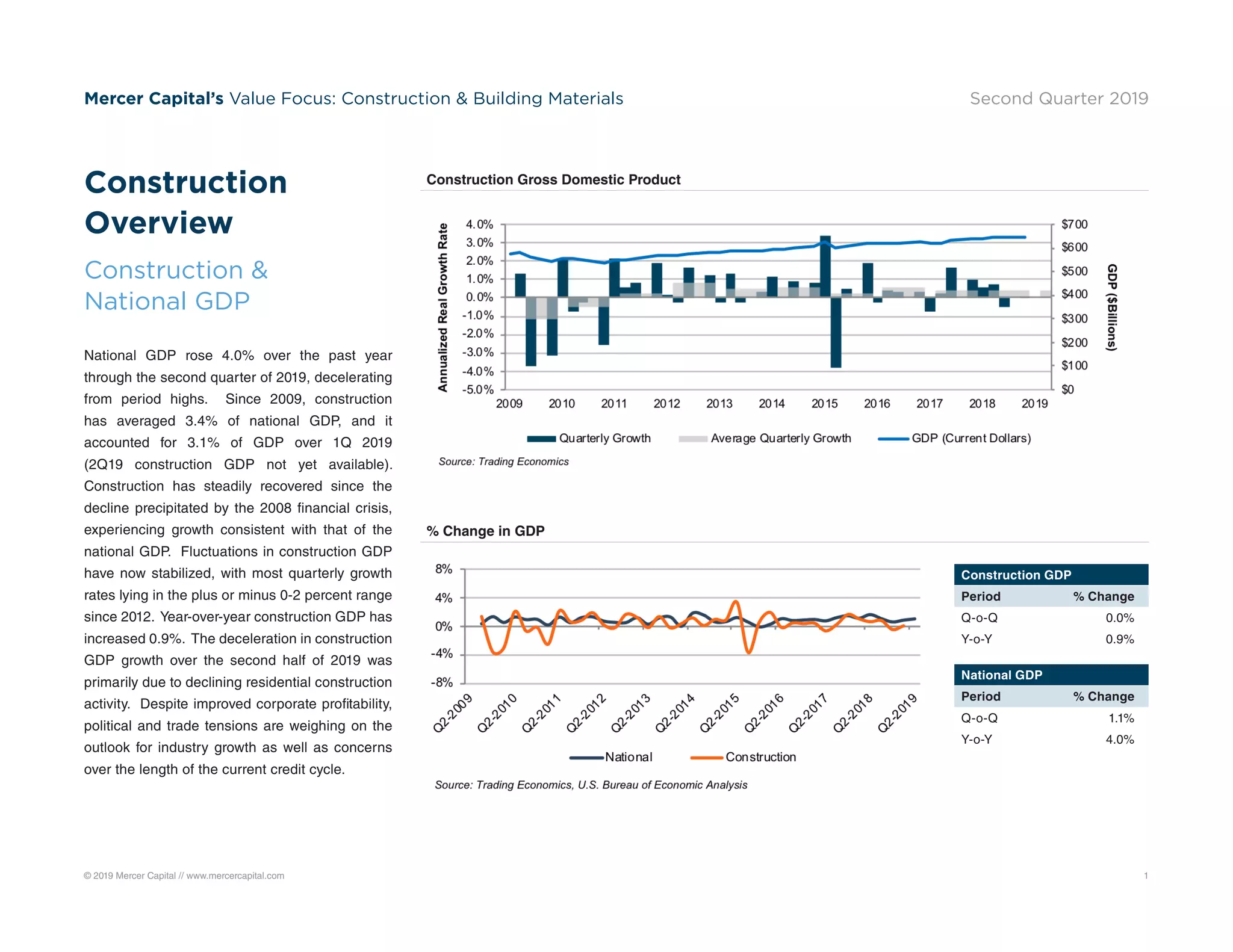
National GDP rose 4.0% over the past year
through the second quarter of 2019, decelerating
from period highs. Since 2009, construction
has averaged 3.4% of national GDP, and it
accounted for 3.1% of GDP over 1Q 2019
(2Q19 construction GDP not yet available).
Construction has steadily recovered since the
decline precipitated by the 2008 financial crisis,
experiencing growth consistent with that of the
national GDP. Fluctuations in construction GDP
have now stabilized, with most quarterly growth
rates lying in the plus or minus 0-2 percent range
since 2012. Year-over-year construction GDP has
increased 0.9%. The deceleration in construction
GDP growth over the second half of 2019 was
primarily due to declining residential construction
activity. Despite improved corporate profitability,
political and trade tensions are weighing on the
outlook for industry growth as well as concerns
over the length of the current credit cycle.
Construction Gross Domestic Product
% Change in GDP
Construction GDP
Period % Change
Q-o-Q 0.0%
Y-o-Y 0.9%
National GDP
Period % Change
Q-o-Q 1.1%
Y-o-Y 4.0%
© 2019 Mercer Capital // www.mercercapital.com 2
Mercer Capital’s Value Focus: Construction  Building Materials Second Quarter 2019
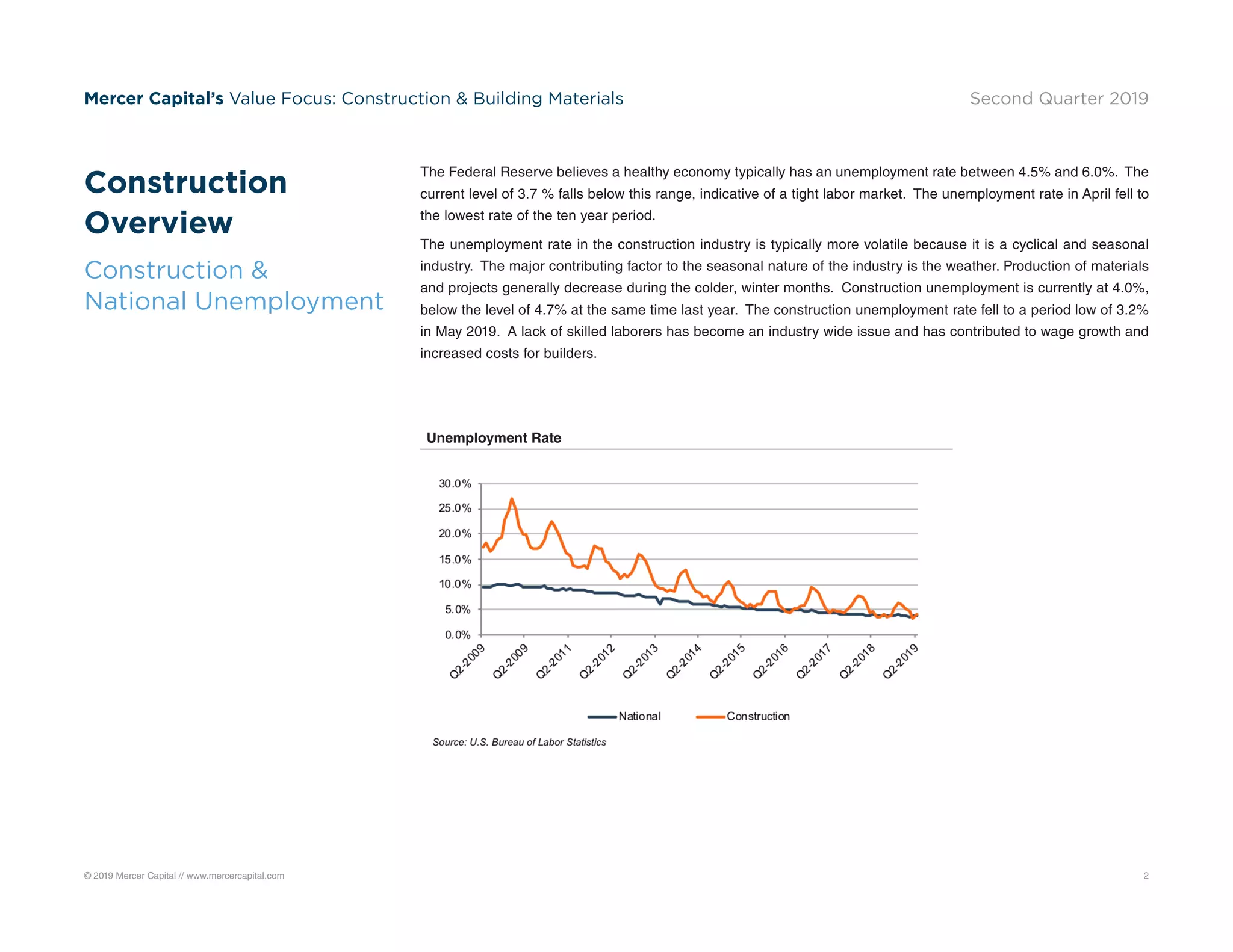
The Federal Reserve believes a healthy economy typically has an unemployment rate between 4.5% and 6.0%. The
current level of 3.7 % falls below this range, indicative of a tight labor market. The unemployment rate in April fell to
the lowest rate of the ten year period.
The unemployment rate in the construction industry is typically more volatile because it is a cyclical and seasonal
industry. The major contributing factor to the seasonal nature of the industry is the weather. Production of materials
and projects generally decrease during the colder, winter months. Construction unemployment is currently at 4.0%,
below the level of 4.7% at the same time last year. The construction unemployment rate fell to a period low of 3.2%
in May 2019. A lack of skilled laborers has become an industry wide issue and has contributed to wage growth and
increased costs for builders.
Construction
Overview
Construction 
National Unemployment
Unemployment Rate
© 2019 Mercer Capital // www.mercercapital.com 3
Mercer Capital’s Value Focus: Construction  Building Materials Second Quarter 2019
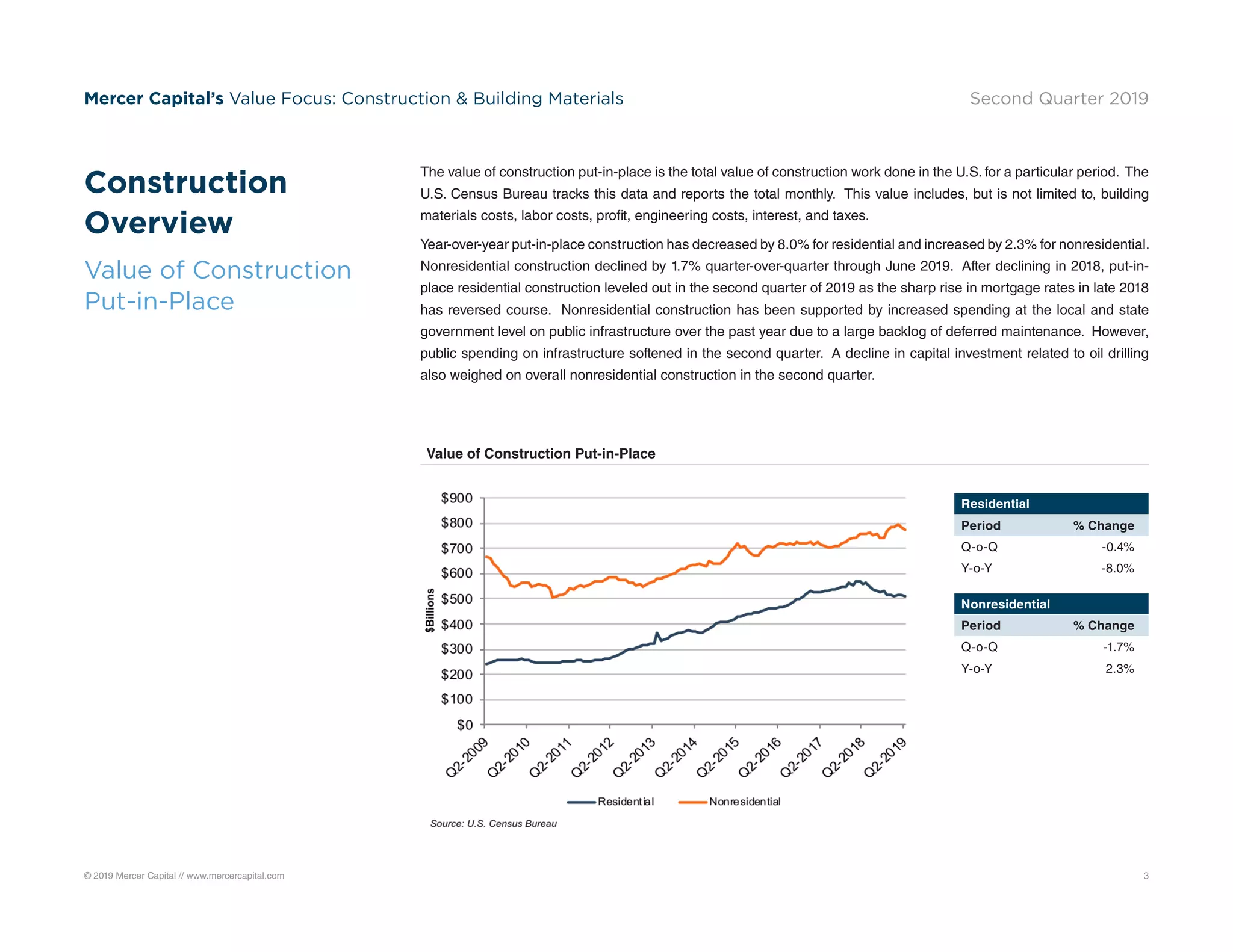
The value of construction put-in-place is the total value of construction work done in the U.S. for a particular period. The
U.S. Census Bureau tracks this data and reports the total monthly. This value includes, but is not limited to, building
materials costs, labor costs, profit, engineering costs, interest, and taxes.
Year-over-year put-in-place construction has decreased by 8.0% for residential and increased by 2.3% for nonresidential.
Nonresidential construction declined by 1.7% quarter-over-quarter through June 2019. After declining in 2018, put-in-
place residential construction leveled out in the second quarter of 2019 as the sharp rise in mortgage rates in late 2018
has reversed course. Nonresidential construction has been supported by increased spending at the local and state
government level on public infrastructure over the past year due to a large backlog of deferred maintenance. However,
public spending on infrastructure softened in the second quarter. A decline in capital investment related to oil drilling
also weighed on overall nonresidential construction in the second quarter.
Construction
Overview
Value of Construction
Put-in-Place
Value of Construction Put-in-Place
Residential
Period % Change
Q-o-Q -0.4%
Y-o-Y -8.0%
Nonresidential
Period % Change
Q-o-Q -1.7%
Y-o-Y 2.3%
© 2019 Mercer Capital // www.mercercapital.com 4
Mercer Capital’s Value Focus: Construction  Building Materials Second Quarter 2019
State and local governments are typically in charge of their construction projects, but they rely on federal funding to
complete many projects. State and local governments have increased much-needed spending on infrastructure projects
as the prospects of the President’s infrastructure plan have continuously diminished. After a period of fiscal restraint,
state and local governments have begun to work through a backlog of deferred maintenance with growth being led
by several of the largest states such as California’s SB1 Bill. However, analysts are concerned the current trend is
unsustainable and other fixes, such as more public-private partnerships (PPPs), infrastructure funds, and improving the
tax system, are in order. The Fixing America’s Surface Transportation (FAST) Act is set to expire in 2020 and funds will
need to be reauthorized.
Ongoing trade tensions between the United States and China have led to increased costs for imported steel and aluminum
while cement prices have been less exposed to current trade disruptions. Rising steel and aluminum costs should filter
through to higher construction costs for the industry as a whole and companies tied to the construction industry. Analysts
are concerned these rising prices will particularly affect infrastructure projects as local budgets are already strained with
increased spending. Geopolitical and trade tensions have weighed on U.S. nonresidential construction stock prices so
far in 2019 despite underlying strong fundamentals and opportunities for growth. Uncertainty over trade negotiations may
continue to weigh on industrial production and investment
After declining through the end of 2018, residential construction appears to be rebounding out of its trough as housing
starts and permits have begun to increase again. After peaking in late 2018, the decline in real mortgage rates in the
first half of 2019 to multi-year lows helped thaw frozen demand. Although high prices and affordability remain a concern,
the recovery in home building should bolster demand for building materials going forward especially in stronger home
building markets such as the Southeast (especially Florida) and the Southwest.
Sector Focus
Building Materials
© 2019 Mercer Capital // www.mercercapital.com 5
Mercer Capital’s Value Focus: Construction  Building Materials Second Quarter 2019
Government Consumption and Investment
Period % Change
Q-o-Q 1.2%
Y-o-Y 2.4%
Building Materials
Government
Consumption and
Investment
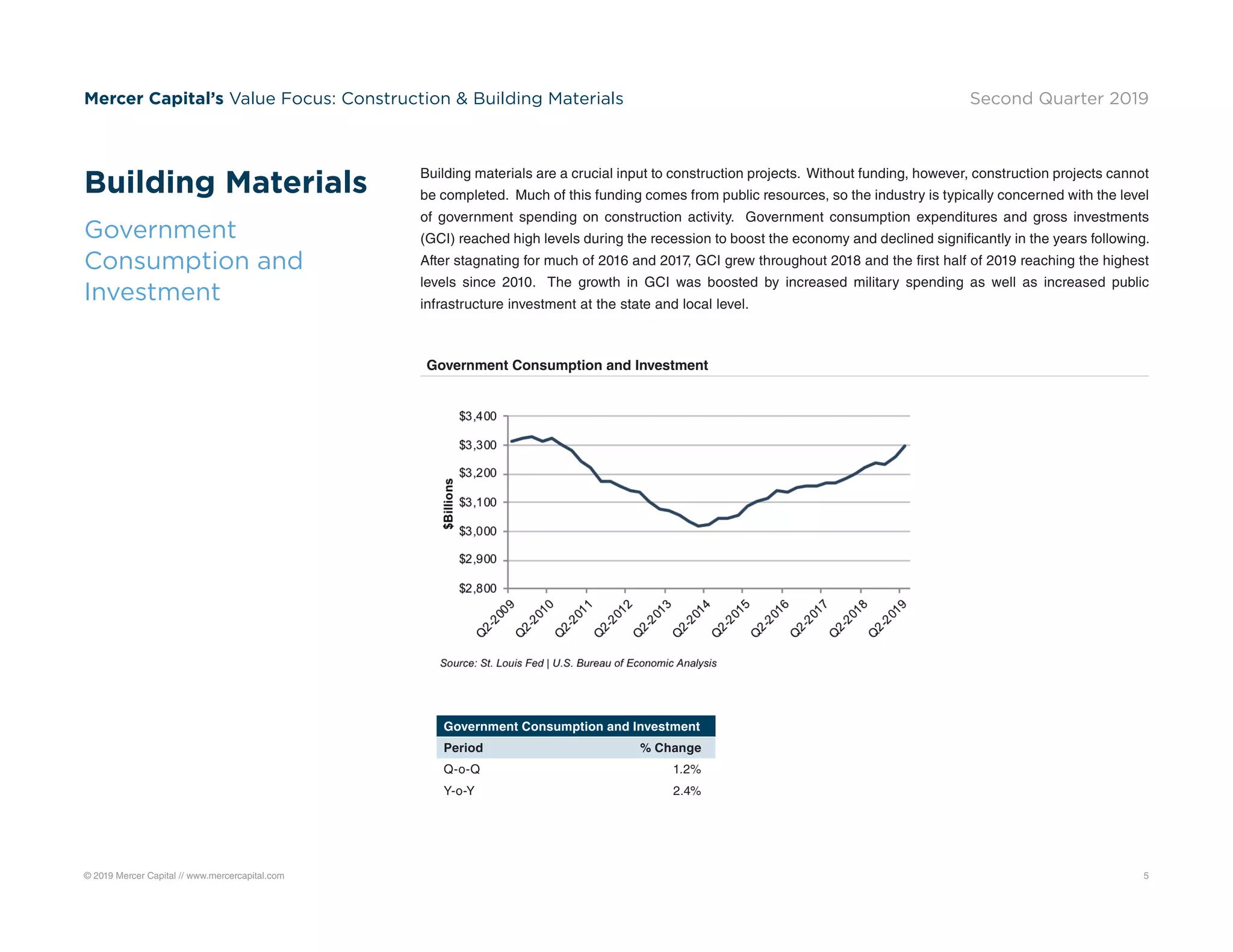
Building materials are a crucial input to construction projects. Without funding, however, construction projects cannot
be completed. Much of this funding comes from public resources, so the industry is typically concerned with the level
of government spending on construction activity. Government consumption expenditures and gross investments
(GCI) reached high levels during the recession to boost the economy and declined significantly in the years following.
After stagnating for much of 2016 and 2017, GCI grew throughout 2018 and the first half of 2019 reaching the highest
levels since 2010. The growth in GCI was boosted by increased military spending as well as increased public
infrastructure investment at the state and local level.
© 2019 Mercer Capital // www.mercercapital.com 6
Mercer Capital’s Value Focus: Construction  Building Materials Second Quarter 2019
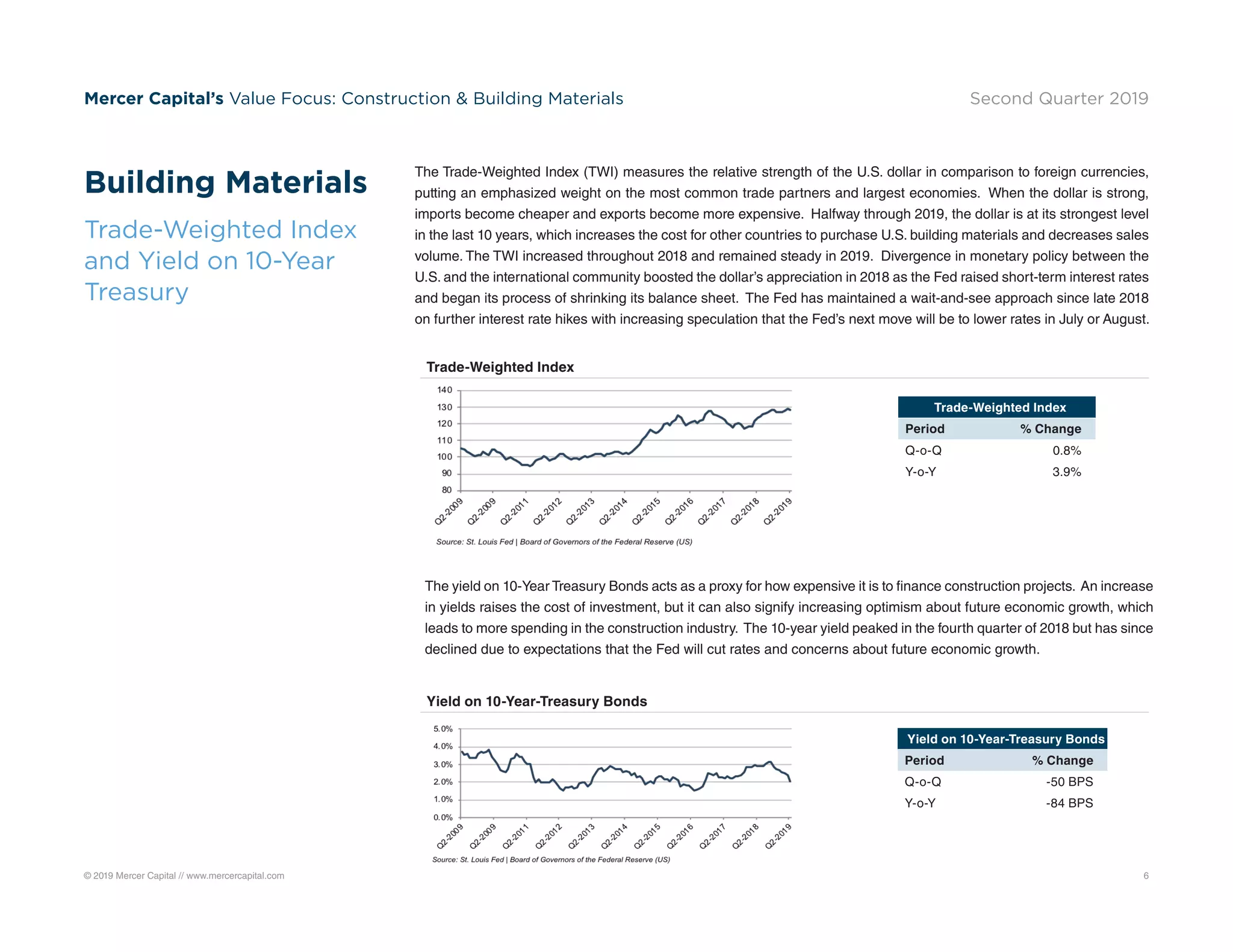
The Trade-Weighted Index (TWI) measures the relative strength of the U.S. dollar in comparison to foreign currencies,
putting an emphasized weight on the most common trade partners and largest economies. When the dollar is strong,
imports become cheaper and exports become more expensive. Halfway through 2019, the dollar is at its strongest level
in the last 10 years, which increases the cost for other countries to purchase U.S. building materials and decreases sales
volume. The TWI increased throughout 2018 and remained steady in 2019. Divergence in monetary policy between the
U.S. and the international community boosted the dollar’s appreciation in 2018 as the Fed raised short-term interest rates
and began its process of shrinking its balance sheet. The Fed has maintained a wait-and-see approach since late 2018
on further interest rate hikes with increasing speculation that the Fed’s next move will be to lower rates in July or August.
The yield on 10-Year Treasury Bonds acts as a proxy for how expensive it is to finance construction projects. An increase
in yields raises the cost of investment, but it can also signify increasing optimism about future economic growth, which
leads to more spending in the construction industry. The 10-year yield peaked in the fourth quarter of 2018 but has since
declined due to expectations that the Fed will cut rates and concerns about future economic growth.
Building Materials
Trade-Weighted Index
and Yield on 10-Year
Treasury
Yield on 10-Year-Treasury Bonds
Trade-Weighted Index
Yield on 10-Year-Treasury Bonds
Period % Change
Q-o-Q -50 BPS
Y-o-Y -84 BPS
Trade-Weighted Index
Period % Change
Q-o-Q 0.8%
Y-o-Y 3.9%
© 2019 Mercer Capital // www.mercercapital.com 7
Mercer Capital’s Value Focus: Construction  Building Materials Second Quarter 2019
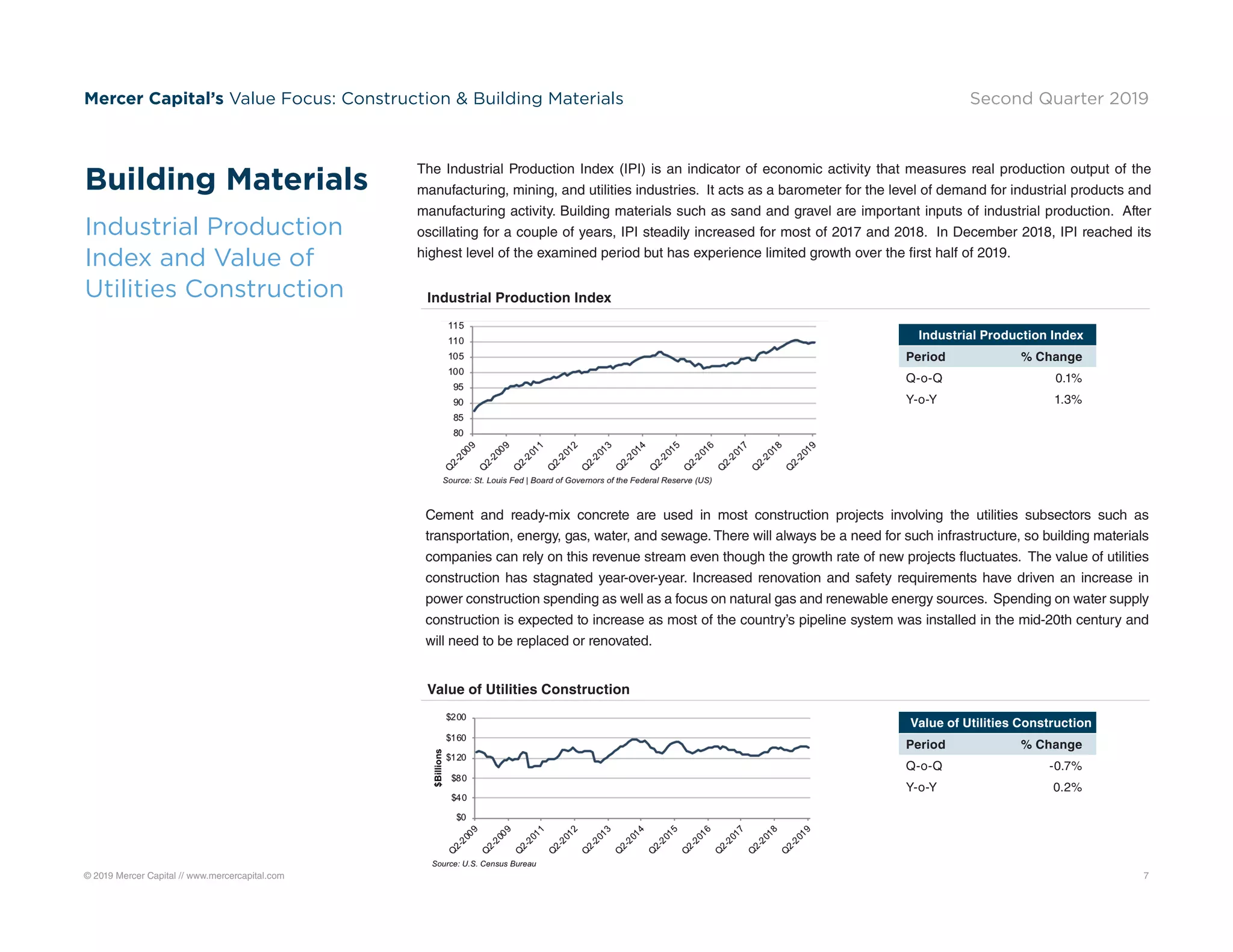
The Industrial Production Index (IPI) is an indicator of economic activity that measures real production output of the
manufacturing, mining, and utilities industries. It acts as a barometer for the level of demand for industrial products and
manufacturing activity. Building materials such as sand and gravel are important inputs of industrial production. After
oscillating for a couple of years, IPI steadily increased for most of 2017 and 2018. In December 2018, IPI reached its
highest level of the examined period but has experience limited growth over the first half of 2019.
Cement and ready-mix concrete are used in most construction projects involving the utilities subsectors such as
transportation, energy, gas, water, and sewage. There will always be a need for such infrastructure, so building materials
companies can rely on this revenue stream even though the growth rate of new projects fluctuates. The value of utilities
construction has stagnated year-over-year. Increased renovation and safety requirements have driven an increase in
power construction spending as well as a focus on natural gas and renewable energy sources. Spending on water supply
construction is expected to increase as most of the country’s pipeline system was installed in the mid-20th century and
will need to be replaced or renovated.
Building Materials
Industrial Production
Index and Value of
Utilities Construction
Value of Utilities Construction
Industrial Production Index
Value of Utilities Construction
Period % Change
Q-o-Q -0.7%
Y-o-Y 0.2%
Industrial Production Index
Period % Change
Q-o-Q 0.1%
Y-o-Y 1.3%
© 2019 Mercer Capital // www.mercercapital.com 8
Mercer Capital’s Value Focus: Construction  Building Materials Second Quarter 2019
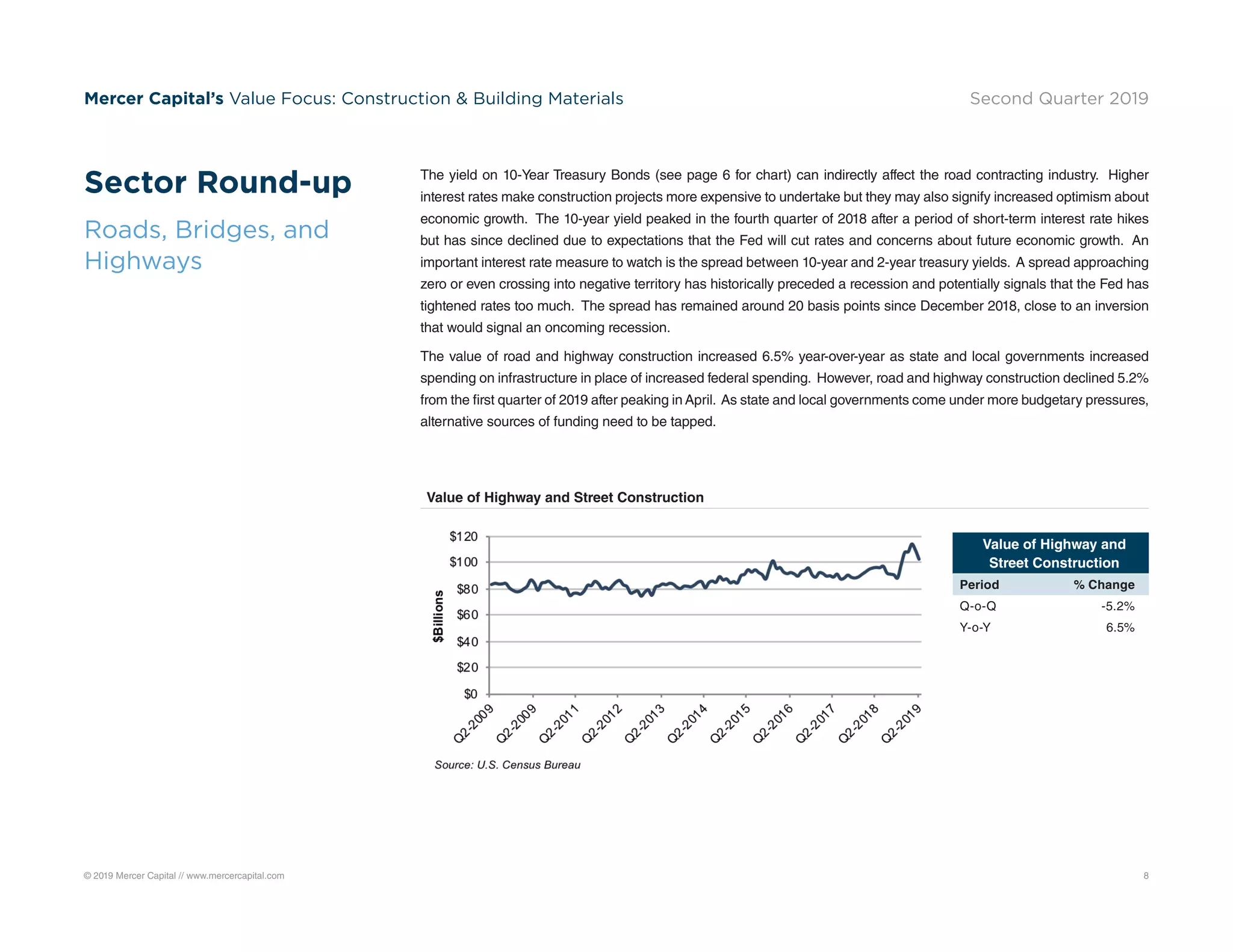
The yield on 10-Year Treasury Bonds (see page 6 for chart) can indirectly affect the road contracting industry. Higher
interest rates make construction projects more expensive to undertake but they may also signify increased optimism about
economic growth. The 10-year yield peaked in the fourth quarter of 2018 after a period of short-term interest rate hikes
but has since declined due to expectations that the Fed will cut rates and concerns about future economic growth. An
important interest rate measure to watch is the spread between 10-year and 2-year treasury yields. A spread approaching
zero or even crossing into negative territory has historically preceded a recession and potentially signals that the Fed has
tightened rates too much. The spread has remained around 20 basis points since December 2018, close to an inversion
that would signal an oncoming recession.
The value of road and highway construction increased 6.5% year-over-year as state and local governments increased
spending on infrastructure in place of increased federal spending. However, road and highway construction declined 5.2%
from the first quarter of 2019 after peaking in April. As state and local governments come under more budgetary pressures,
alternative sources of funding need to be tapped.
Sector Round-up
Roads, Bridges, and
Highways
Value of Highway and Street Construction
Value of Highway and
Street Construction
Period % Change
Q-o-Q -5.2%
Y-o-Y 6.5%
© 2019 Mercer Capital // www.mercercapital.com 9
Mercer Capital’s Value Focus: Construction  Building Materials Second Quarter 2019
Nonresidential
Construction
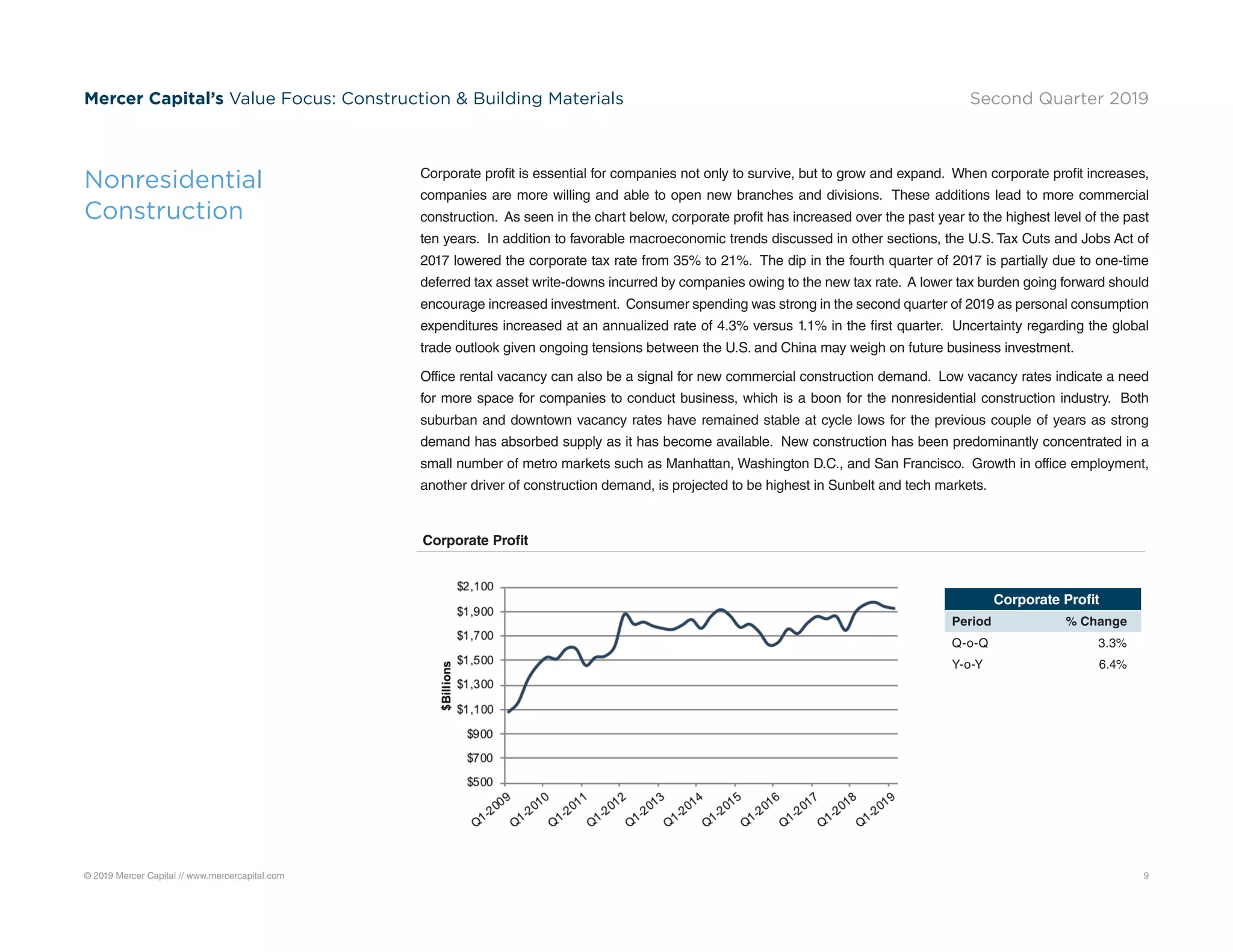
Corporate Profit
Corporate profit is essential for companies not only to survive, but to grow and expand. When corporate profit increases,
companies are more willing and able to open new branches and divisions. These additions lead to more commercial
construction. As seen in the chart below, corporate profit has increased over the past year to the highest level of the past
ten years. In addition to favorable macroeconomic trends discussed in other sections, the U.S. Tax Cuts and Jobs Act of
2017 lowered the corporate tax rate from 35% to 21%. The dip in the fourth quarter of 2017 is partially due to one-time
deferred tax asset write-downs incurred by companies owing to the new tax rate. A lower tax burden going forward should
encourage increased investment. Consumer spending was strong in the second quarter of 2019 as personal consumption
expenditures increased at an annualized rate of 4.3% versus 1.1% in the first quarter. Uncertainty regarding the global
trade outlook given ongoing tensions between the U.S. and China may weigh on future business investment.
Office rental vacancy can also be a signal for new commercial construction demand. Low vacancy rates indicate a need
for more space for companies to conduct business, which is a boon for the nonresidential construction industry. Both
suburban and downtown vacancy rates have remained stable at cycle lows for the previous couple of years as strong
demand has absorbed supply as it has become available. New construction has been predominantly concentrated in a
small number of metro markets such as Manhattan, Washington D.C., and San Francisco. Growth in office employment,
another driver of construction demand, is projected to be highest in Sunbelt and tech markets.
Corporate Profit
Period % Change
Q-o-Q 3.3%
Y-o-Y 6.4%
© 2019 Mercer Capital // www.mercercapital.com 10
Mercer Capital’s Value Focus: Construction  Building Materials Second Quarter 2019
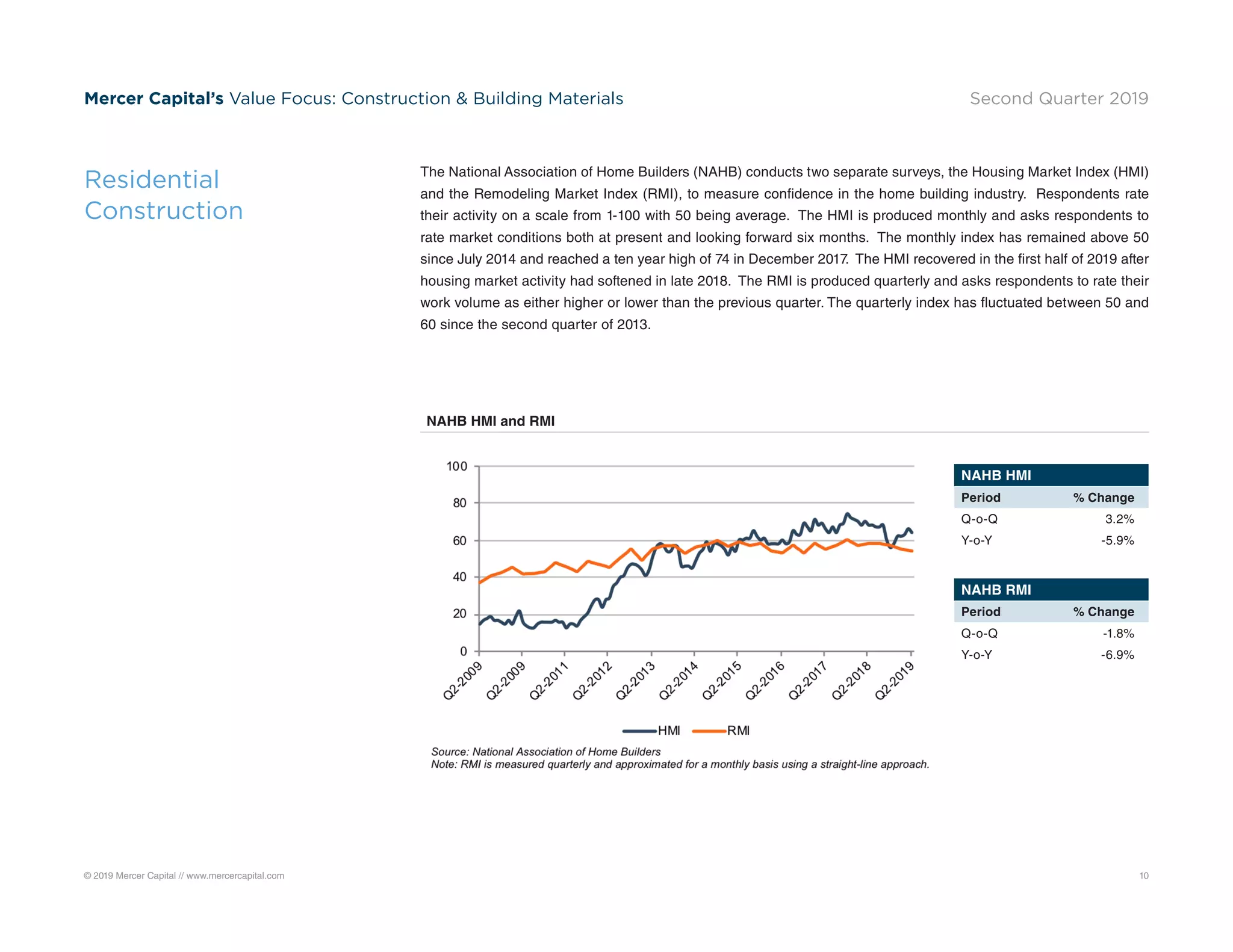
The National Association of Home Builders (NAHB) conducts two separate surveys, the Housing Market Index (HMI)
and the Remodeling Market Index (RMI), to measure confidence in the home building industry. Respondents rate
their activity on a scale from 1-100 with 50 being average. The HMI is produced monthly and asks respondents to
rate market conditions both at present and looking forward six months. The monthly index has remained above 50
since July 2014 and reached a ten year high of 74 in December 2017. The HMI recovered in the first half of 2019 after
housing market activity had softened in late 2018. The RMI is produced quarterly and asks respondents to rate their
work volume as either higher or lower than the previous quarter. The quarterly index has fluctuated between 50 and
60 since the second quarter of 2013.
Residential
Construction
NAHB HMI and RMI
NAHB HMI
Period % Change
Q-o-Q 3.2%
Y-o-Y -5.9%
NAHB RMI
Period % Change
Q-o-Q -1.8%
Y-o-Y -6.9%
© 2019 Mercer Capital // www.mercercapital.com 11
Mercer Capital’s Value Focus: Construction  Building Materials Second Quarter 2019
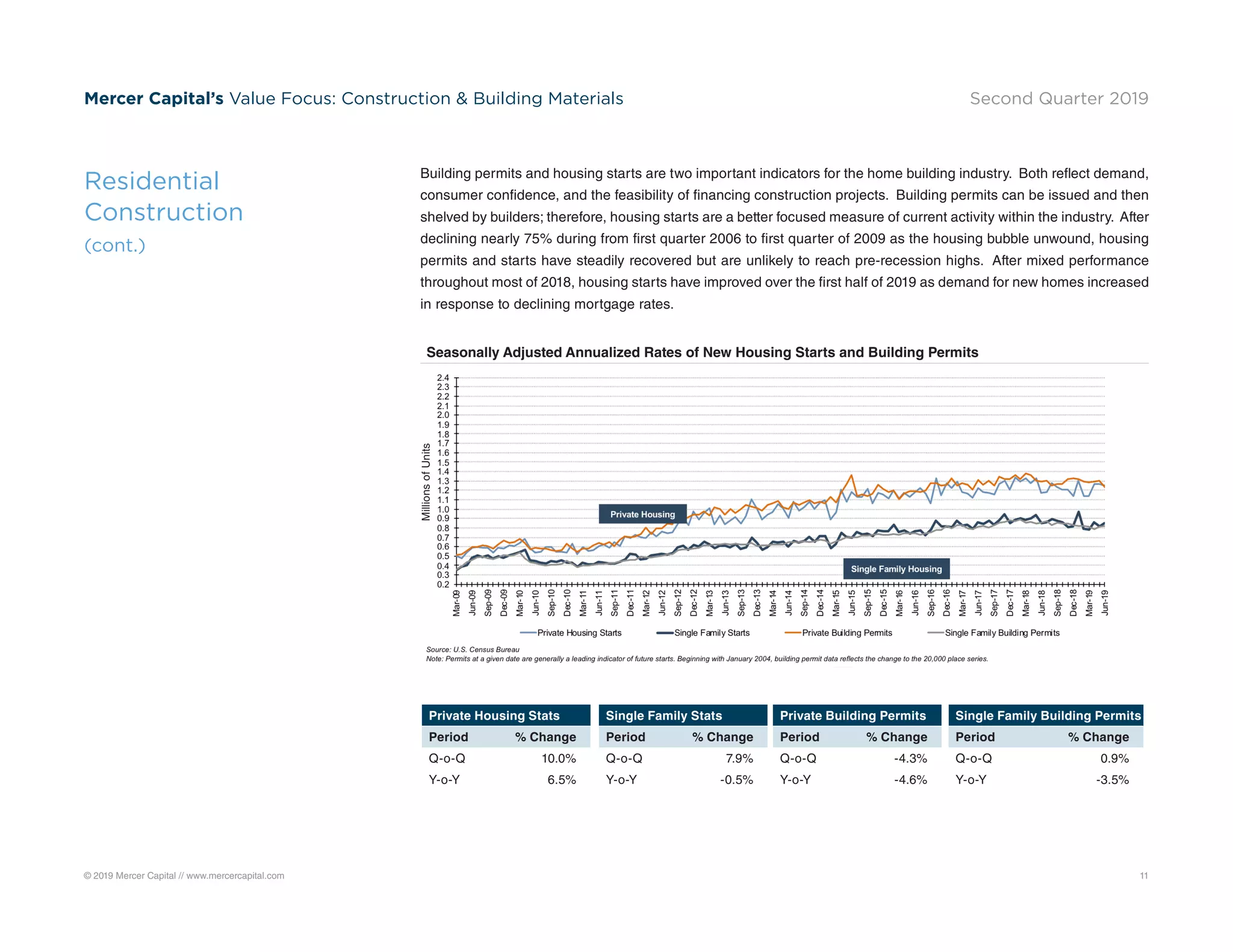
Seasonally Adjusted Annualized Rates of New Housing Starts and Building Permits
Private Housing Stats
Period % Change
Q-o-Q 10.0%
Y-o-Y 6.5%
Private Building Permits
Period % Change
Q-o-Q -4.3%
Y-o-Y -4.6%
Single Family Stats
Period % Change
Q-o-Q 7.9%
Y-o-Y -0.5%
Single Family Building Permits
Period % Change
Q-o-Q 0.9%
Y-o-Y -3.5%
Building permits and housing starts are two important indicators for the home building industry. Both reflect demand,
consumer confidence, and the feasibility of financing construction projects. Building permits can be issued and then
shelved by builders; therefore, housing starts are a better focused measure of current activity within the industry. After
declining nearly 75% during from first quarter 2006 to first quarter of 2009 as the housing bubble unwound, housing
permits and starts have steadily recovered but are unlikely to reach pre-recession highs. After mixed performance
throughout most of 2018, housing starts have improved over the first half of 2019 as demand for new homes increased
in response to declining mortgage rates.
MillionsofUnits
Residential
Construction
(cont.)
© 2019 Mercer Capital // www.mercercapital.com 12
Mercer Capital’s Value Focus: Construction  Building Materials Second Quarter 2019
Ticker
Price at
6/30/19
52-Week
Perf.
LTM
Revenue
Enterprise
Value Debt / MVTC
EBITDA
Margin
EV / EBITDA
(x)
TEV / Next Yr
EBITDA (x)
Price / LTM
Earnings
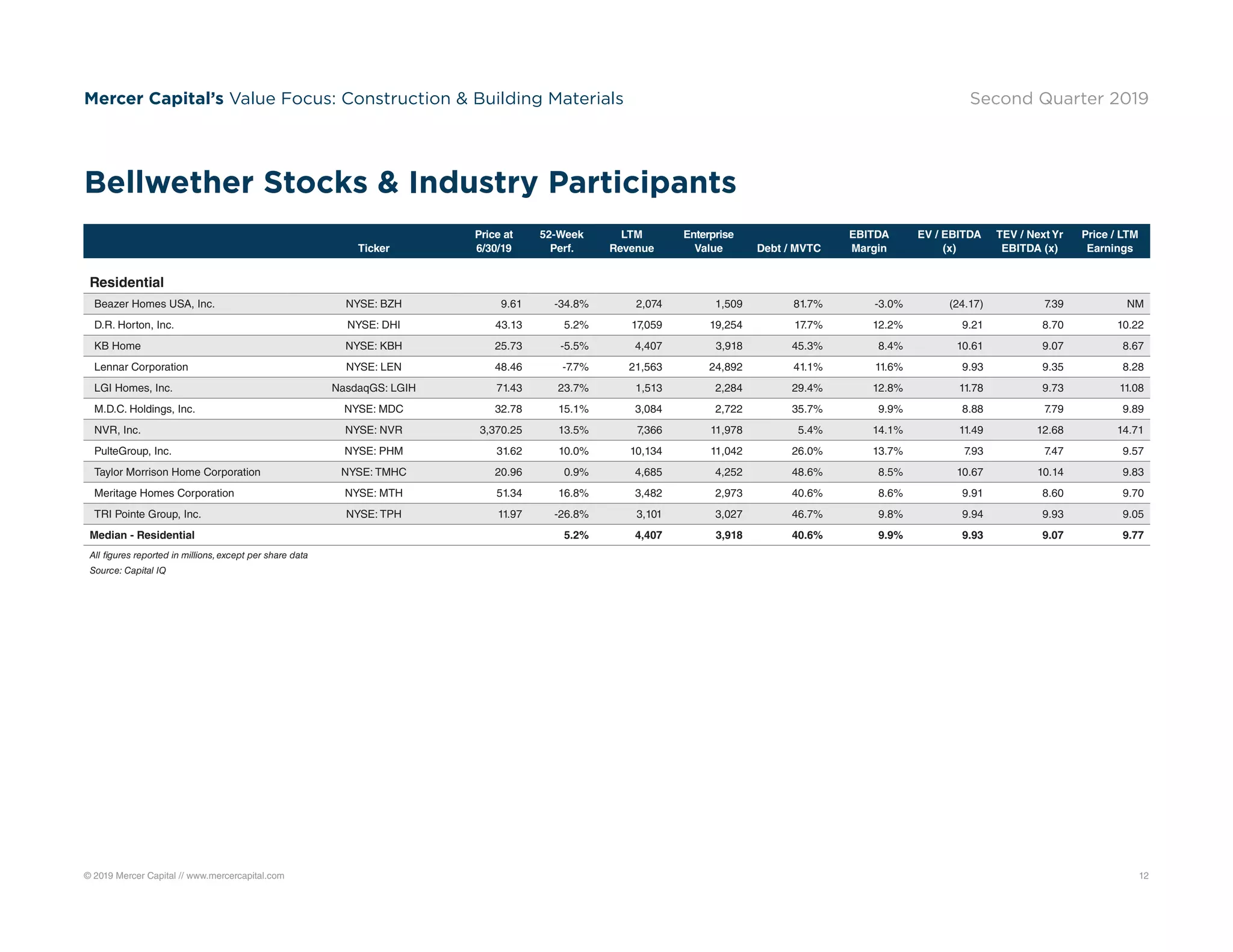
Residential
Beazer Homes USA, Inc. NYSE: BZH 9.61 -34.8% 2,074 1,509 81.7% -3.0% (24.17) 7.39 NM
D.R. Horton, Inc. NYSE: DHI 43.13 5.2% 17,059 19,254 17.7% 12.2% 9.21 8.70 10.22
KB Home NYSE: KBH 25.73 -5.5% 4,407 3,918 45.3% 8.4% 10.61 9.07 8.67
Lennar Corporation NYSE: LEN 48.46 -7.7% 21,563 24,892 41.1% 11.6% 9.93 9.35 8.28
LGI Homes, Inc. NasdaqGS: LGIH 71.43 23.7% 1,513 2,284 29.4% 12.8% 11.78 9.73 11.08
M.D.C. Holdings, Inc. NYSE: MDC 32.78 15.1% 3,084 2,722 35.7% 9.9% 8.88 7.79 9.89
NVR, Inc. NYSE: NVR 3,370.25 13.5% 7,366 11,978 5.4% 14.1% 11.49 12.68 14.71
PulteGroup, Inc. NYSE: PHM 31.62 10.0% 10,134 11,042 26.0% 13.7% 7.93 7.47 9.57
Taylor Morrison Home Corporation NYSE: TMHC 20.96 0.9% 4,685 4,252 48.6% 8.5% 10.67 10.14 9.83
Meritage Homes Corporation NYSE: MTH 51.34 16.8% 3,482 2,973 40.6% 8.6% 9.91 8.60 9.70
TRI Pointe Group, Inc. NYSE: TPH 11.97 -26.8% 3,101 3,027 46.7% 9.8% 9.94 9.93 9.05
Median - Residential 5.2% 4,407 3,918 40.6% 9.9% 9.93 9.07 9.77
All figures reported in millions, except per share data
Source: Capital IQ
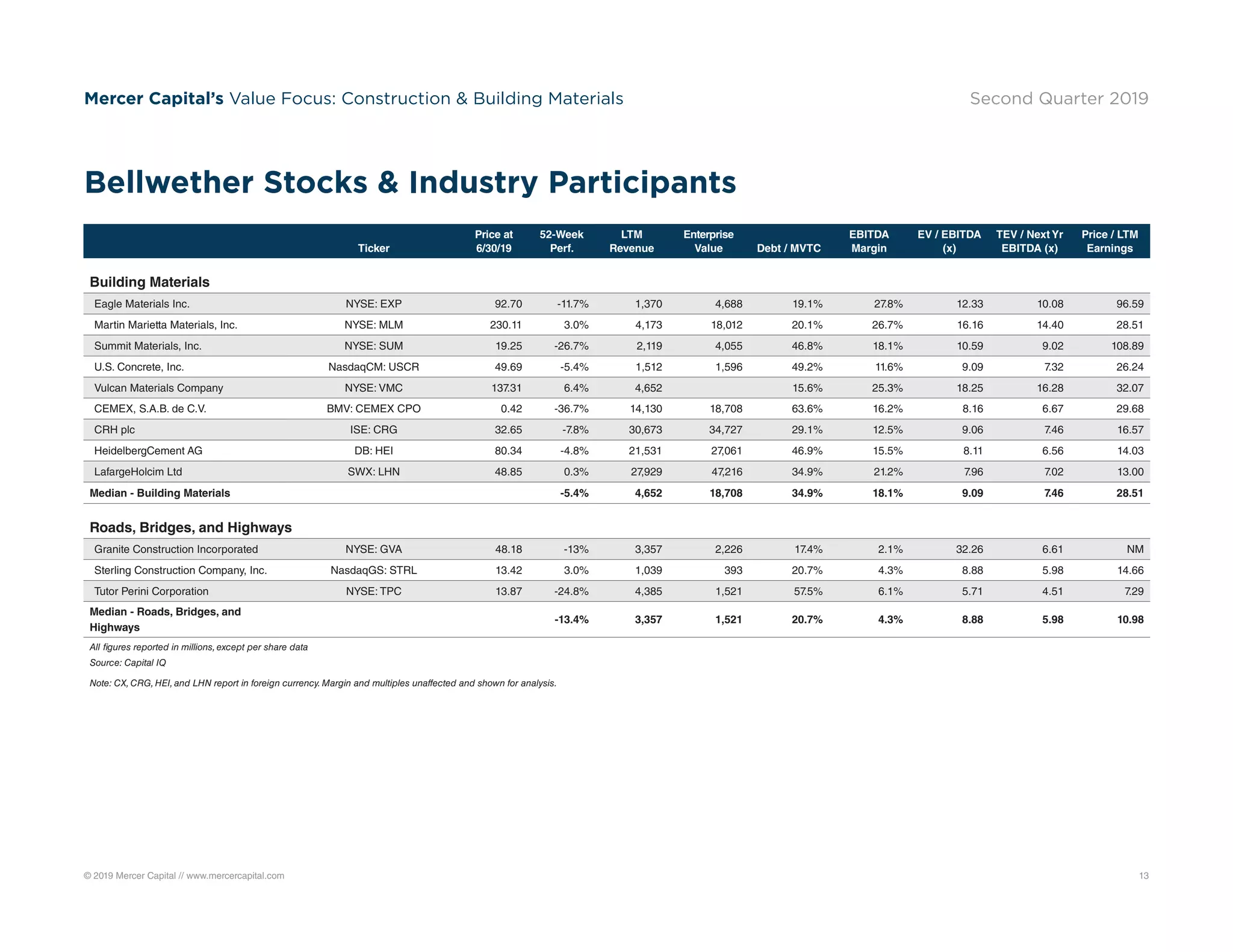
Bellwether Stocks  Industry Participants
© 2019 Mercer Capital // www.mercercapital.com 13
Mercer Capital’s Value Focus: Construction  Building Materials Second Quarter 2019
Ticker
Price at
6/30/19
52-Week
Perf.
LTM
Revenue
Enterprise
Value Debt / MVTC
EBITDA
Margin
EV / EBITDA
(x)
TEV / Next Yr
EBITDA (x)
Price / LTM
Earnings
Building Materials
Eagle Materials Inc. NYSE: EXP 92.70 -11.7% 1,370 4,688 19.1% 27.8% 12.33 10.08 96.59
Martin Marietta Materials, Inc. NYSE: MLM 230.11 3.0% 4,173 18,012 20.1% 26.7% 16.16 14.40 28.51
Summit Materials, Inc. NYSE: SUM 19.25 -26.7% 2,119 4,055 46.8% 18.1% 10.59 9.02 108.89
U.S. Concrete, Inc. NasdaqCM: USCR 49.69 -5.4% 1,512 1,596 49.2% 11.6% 9.09 7.32 26.24
Vulcan Materials Company NYSE: VMC 137.31 6.4% 4,652 15.6% 25.3% 18.25 16.28 32.07
CEMEX, S.A.B. de C.V. BMV: CEMEX CPO 0.42 -36.7% 14,130 18,708 63.6% 16.2% 8.16 6.67 29.68
CRH plc ISE: CRG 32.65 -7.8% 30,673 34,727 29.1% 12.5% 9.06 7.46 16.57
HeidelbergCement AG DB: HEI 80.34 -4.8% 21,531 27,061 46.9% 15.5% 8.11 6.56 14.03
LafargeHolcim Ltd SWX: LHN 48.85 0.3% 27,929 47,216 34.9% 21.2% 7.96 7.02 13.00
Median - Building Materials -5.4% 4,652 18,708 34.9% 18.1% 9.09 7.46 28.51
Roads, Bridges, and Highways
Granite Construction Incorporated NYSE: GVA 48.18 -13% 3,357 2,226 17.4% 2.1% 32.26 6.61 NM
Sterling Construction Company, Inc. NasdaqGS: STRL 13.42 3.0% 1,039 393 20.7% 4.3% 8.88 5.98 14.66
Tutor Perini Corporation NYSE: TPC 13.87 -24.8% 4,385 1,521 57.5% 6.1% 5.71 4.51 7.29
Median - Roads, Bridges, and
Highways
-13.4% 3,357 1,521 20.7% 4.3% 8.88 5.98 10.98
All figures reported in millions, except per share data
Source: Capital IQ
Bellwether Stocks  Industry Participants
Note: CX, CRG, HEI, and LHN report in foreign currency. Margin and multiples unaffected and shown for analysis.
© 2019 Mercer Capital // www.mercercapital.com 14
Mercer Capital’s Value Focus: Construction  Building Materials Second Quarter 2019
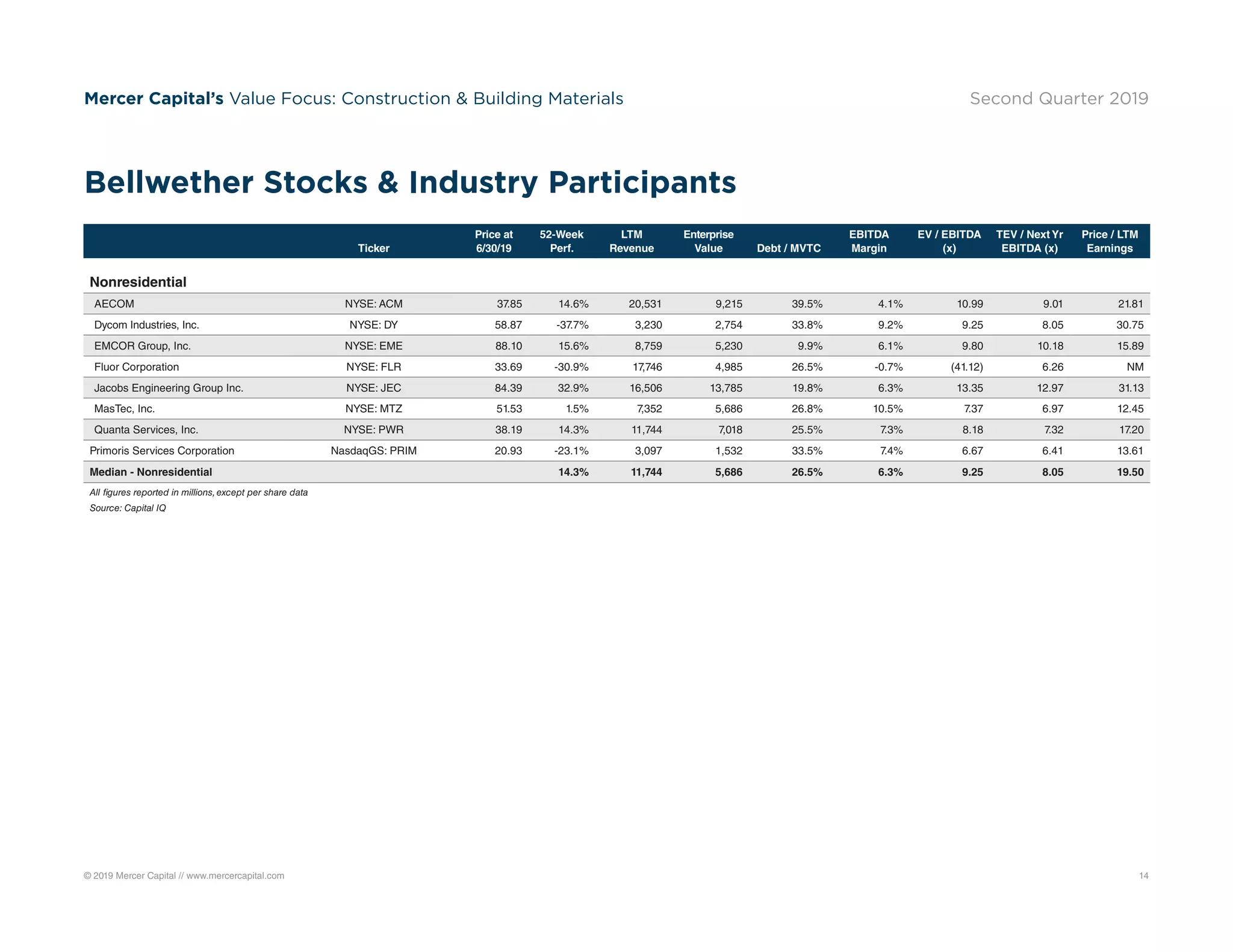
Ticker
Price at
6/30/19
52-Week
Perf.
LTM
Revenue
Enterprise
Value Debt / MVTC
EBITDA
Margin
EV / EBITDA
(x)
TEV / Next Yr
EBITDA (x)
Price / LTM
Earnings
Nonresidential
AECOM NYSE: ACM 37.85 14.6% 20,531 9,215 39.5% 4.1% 10.99 9.01 21.81
Dycom Industries, Inc. NYSE: DY 58.87 -37.7% 3,230 2,754 33.8% 9.2% 9.25 8.05 30.75
EMCOR Group, Inc. NYSE: EME 88.10 15.6% 8,759 5,230 9.9% 6.1% 9.80 10.18 15.89
Fluor Corporation NYSE: FLR 33.69 -30.9% 17,746 4,985 26.5% -0.7% (41.12) 6.26 NM
Jacobs Engineering Group Inc. NYSE: JEC 84.39 32.9% 16,506 13,785 19.8% 6.3% 13.35 12.97 31.13
MasTec, Inc. NYSE: MTZ 51.53 1.5% 7,352 5,686 26.8% 10.5% 7.37 6.97 12.45
Quanta Services, Inc. NYSE: PWR 38.19 14.3% 11,744 7,018 25.5% 7.3% 8.18 7.32 17.20
Primoris Services Corporation NasdaqGS: PRIM 20.93 -23.1% 3,097 1,532 33.5% 7.4% 6.67 6.41 13.61
Median - Nonresidential 14.3% 11,744 5,686 26.5% 6.3% 9.25 8.05 19.50
All figures reported in millions, except per share data
Source: Capital IQ
Bellwether Stocks  Industry Participants
Mercer
Capital
Construction 
Building Materials
Industry Services
Contact Us
Copyright © 2019 Mercer Capital Management, Inc. All rights reserved. It is illegal under Federal law to reproduce this publication or any portion of its contents without the publisher’s permission. Media quotations with source attribution are encouraged.
Reporters requesting additional information or editorial comment should contact Barbara Walters Price at 901.685.2120. Mercer Capital’s Industry Focus is published quarterly and does not constitute legal or financial consulting advice. It is offered as an
information service to our clients and friends. Those interested in specific guidance for legal or accounting matters should seek competent professional advice. Inquiries to discuss specific valuation matters are welcomed. To add your name to our mailing list
to receive this complimentary publication, visit our website at www.mercercapital.com.
Mercer Capital provides valuation and transaction advisory
services to the construction and building materials industries.
Industry Segments
Mercer Capital serves construction industry segments from to commercial and civil to residential.We also serve the
building materials sector from aluminum and steel to brick, glass, and lumber.
Mercer Capital Experience
•	 Family and management succession planning
•	 Buy-side and sell-side transaction advisory assistance
•	 Conflict resolution and litigation support
•	 Trust and estate planning
•	 Buy-sell agreement valuation, design, and funding advisory
Contact a Mercer Capital professional to discuss your needs in confidence.
Timothy R. Lee, ASA
901.322.9740
leet@mercercapital.com
Nicholas J. Heinz, ASA
901.685.2120
heinzn@mercercapital.com
Brian F. Adams
901.322.9706
adamsb@mercercapital.com
MERCER CAPITAL
www.mercercapital.com
BUSINESS VALUATION 
FINANCIAL ADVISORY SERVICES
Mercer Capital
www.mercercapital.com

Mercer Capital's Value Focus: Construction and Building Materials | Q2 2019 | Segment Focus: Building Materials

  • 1.
    VALUE FOCUS Construction &Building Materials Second Quarter 2019 | Segment Focus: Building Materials Executive Industry Trends • Residential construction has begun to rebound out of its trough after declining through the second half of 2018. Mortgage rates have declined to multi-year lows. • State and local governments have increased spending on much-needed infrastructure projects. • Ongoing trade tensions and uncertainty have cast a cloud over future business investment. • The shrinking 10-2 year treasury yield spread signifies an increased likelihood that the Fed will lower short-term interest rates. BUSINESS VALUATION & FINANCIAL ADVISORY SERVICES In This Issue Construction Overview 1 Segment Focus: Building Materials 4 Sector Round-up 10 Bellweather Stocks and Industry Participants 12 About Mercer Capital 15 www.mercercapital.com
  • 2.
    © 2019 MercerCapital // www.mercercapital.com 1 Mercer Capital’s Value Focus: Construction Building Materials Second Quarter 2019 Construction Overview Construction National GDP National GDP rose 4.0% over the past year through the second quarter of 2019, decelerating from period highs. Since 2009, construction has averaged 3.4% of national GDP, and it accounted for 3.1% of GDP over 1Q 2019 (2Q19 construction GDP not yet available). Construction has steadily recovered since the decline precipitated by the 2008 financial crisis, experiencing growth consistent with that of the national GDP. Fluctuations in construction GDP have now stabilized, with most quarterly growth rates lying in the plus or minus 0-2 percent range since 2012. Year-over-year construction GDP has increased 0.9%. The deceleration in construction GDP growth over the second half of 2019 was primarily due to declining residential construction activity. Despite improved corporate profitability, political and trade tensions are weighing on the outlook for industry growth as well as concerns over the length of the current credit cycle. Construction Gross Domestic Product % Change in GDP Construction GDP Period % Change Q-o-Q 0.0% Y-o-Y 0.9% National GDP Period % Change Q-o-Q 1.1% Y-o-Y 4.0%
  • 3.
    © 2019 MercerCapital // www.mercercapital.com 2 Mercer Capital’s Value Focus: Construction Building Materials Second Quarter 2019 The Federal Reserve believes a healthy economy typically has an unemployment rate between 4.5% and 6.0%. The current level of 3.7 % falls below this range, indicative of a tight labor market. The unemployment rate in April fell to the lowest rate of the ten year period. The unemployment rate in the construction industry is typically more volatile because it is a cyclical and seasonal industry. The major contributing factor to the seasonal nature of the industry is the weather. Production of materials and projects generally decrease during the colder, winter months. Construction unemployment is currently at 4.0%, below the level of 4.7% at the same time last year. The construction unemployment rate fell to a period low of 3.2% in May 2019. A lack of skilled laborers has become an industry wide issue and has contributed to wage growth and increased costs for builders. Construction Overview Construction National Unemployment Unemployment Rate
  • 4.
    © 2019 MercerCapital // www.mercercapital.com 3 Mercer Capital’s Value Focus: Construction Building Materials Second Quarter 2019 The value of construction put-in-place is the total value of construction work done in the U.S. for a particular period. The U.S. Census Bureau tracks this data and reports the total monthly. This value includes, but is not limited to, building materials costs, labor costs, profit, engineering costs, interest, and taxes. Year-over-year put-in-place construction has decreased by 8.0% for residential and increased by 2.3% for nonresidential. Nonresidential construction declined by 1.7% quarter-over-quarter through June 2019. After declining in 2018, put-in- place residential construction leveled out in the second quarter of 2019 as the sharp rise in mortgage rates in late 2018 has reversed course. Nonresidential construction has been supported by increased spending at the local and state government level on public infrastructure over the past year due to a large backlog of deferred maintenance. However, public spending on infrastructure softened in the second quarter. A decline in capital investment related to oil drilling also weighed on overall nonresidential construction in the second quarter. Construction Overview Value of Construction Put-in-Place Value of Construction Put-in-Place Residential Period % Change Q-o-Q -0.4% Y-o-Y -8.0% Nonresidential Period % Change Q-o-Q -1.7% Y-o-Y 2.3%
  • 5.
    © 2019 MercerCapital // www.mercercapital.com 4 Mercer Capital’s Value Focus: Construction Building Materials Second Quarter 2019 State and local governments are typically in charge of their construction projects, but they rely on federal funding to complete many projects. State and local governments have increased much-needed spending on infrastructure projects as the prospects of the President’s infrastructure plan have continuously diminished. After a period of fiscal restraint, state and local governments have begun to work through a backlog of deferred maintenance with growth being led by several of the largest states such as California’s SB1 Bill. However, analysts are concerned the current trend is unsustainable and other fixes, such as more public-private partnerships (PPPs), infrastructure funds, and improving the tax system, are in order. The Fixing America’s Surface Transportation (FAST) Act is set to expire in 2020 and funds will need to be reauthorized. Ongoing trade tensions between the United States and China have led to increased costs for imported steel and aluminum while cement prices have been less exposed to current trade disruptions. Rising steel and aluminum costs should filter through to higher construction costs for the industry as a whole and companies tied to the construction industry. Analysts are concerned these rising prices will particularly affect infrastructure projects as local budgets are already strained with increased spending. Geopolitical and trade tensions have weighed on U.S. nonresidential construction stock prices so far in 2019 despite underlying strong fundamentals and opportunities for growth. Uncertainty over trade negotiations may continue to weigh on industrial production and investment After declining through the end of 2018, residential construction appears to be rebounding out of its trough as housing starts and permits have begun to increase again. After peaking in late 2018, the decline in real mortgage rates in the first half of 2019 to multi-year lows helped thaw frozen demand. Although high prices and affordability remain a concern, the recovery in home building should bolster demand for building materials going forward especially in stronger home building markets such as the Southeast (especially Florida) and the Southwest. Sector Focus Building Materials
  • 6.
    © 2019 MercerCapital // www.mercercapital.com 5 Mercer Capital’s Value Focus: Construction Building Materials Second Quarter 2019 Government Consumption and Investment Government Consumption and Investment Period % Change Q-o-Q 1.2% Y-o-Y 2.4% Building Materials Government Consumption and Investment Building materials are a crucial input to construction projects. Without funding, however, construction projects cannot be completed. Much of this funding comes from public resources, so the industry is typically concerned with the level of government spending on construction activity. Government consumption expenditures and gross investments (GCI) reached high levels during the recession to boost the economy and declined significantly in the years following. After stagnating for much of 2016 and 2017, GCI grew throughout 2018 and the first half of 2019 reaching the highest levels since 2010. The growth in GCI was boosted by increased military spending as well as increased public infrastructure investment at the state and local level.
  • 7.
    © 2019 MercerCapital // www.mercercapital.com 6 Mercer Capital’s Value Focus: Construction Building Materials Second Quarter 2019 The Trade-Weighted Index (TWI) measures the relative strength of the U.S. dollar in comparison to foreign currencies, putting an emphasized weight on the most common trade partners and largest economies. When the dollar is strong, imports become cheaper and exports become more expensive. Halfway through 2019, the dollar is at its strongest level in the last 10 years, which increases the cost for other countries to purchase U.S. building materials and decreases sales volume. The TWI increased throughout 2018 and remained steady in 2019. Divergence in monetary policy between the U.S. and the international community boosted the dollar’s appreciation in 2018 as the Fed raised short-term interest rates and began its process of shrinking its balance sheet. The Fed has maintained a wait-and-see approach since late 2018 on further interest rate hikes with increasing speculation that the Fed’s next move will be to lower rates in July or August. The yield on 10-Year Treasury Bonds acts as a proxy for how expensive it is to finance construction projects. An increase in yields raises the cost of investment, but it can also signify increasing optimism about future economic growth, which leads to more spending in the construction industry. The 10-year yield peaked in the fourth quarter of 2018 but has since declined due to expectations that the Fed will cut rates and concerns about future economic growth. Building Materials Trade-Weighted Index and Yield on 10-Year Treasury Yield on 10-Year-Treasury Bonds Trade-Weighted Index Yield on 10-Year-Treasury Bonds Period % Change Q-o-Q -50 BPS Y-o-Y -84 BPS Trade-Weighted Index Period % Change Q-o-Q 0.8% Y-o-Y 3.9%
  • 8.
    © 2019 MercerCapital // www.mercercapital.com 7 Mercer Capital’s Value Focus: Construction Building Materials Second Quarter 2019 The Industrial Production Index (IPI) is an indicator of economic activity that measures real production output of the manufacturing, mining, and utilities industries. It acts as a barometer for the level of demand for industrial products and manufacturing activity. Building materials such as sand and gravel are important inputs of industrial production. After oscillating for a couple of years, IPI steadily increased for most of 2017 and 2018. In December 2018, IPI reached its highest level of the examined period but has experience limited growth over the first half of 2019. Cement and ready-mix concrete are used in most construction projects involving the utilities subsectors such as transportation, energy, gas, water, and sewage. There will always be a need for such infrastructure, so building materials companies can rely on this revenue stream even though the growth rate of new projects fluctuates. The value of utilities construction has stagnated year-over-year. Increased renovation and safety requirements have driven an increase in power construction spending as well as a focus on natural gas and renewable energy sources. Spending on water supply construction is expected to increase as most of the country’s pipeline system was installed in the mid-20th century and will need to be replaced or renovated. Building Materials Industrial Production Index and Value of Utilities Construction Value of Utilities Construction Industrial Production Index Value of Utilities Construction Period % Change Q-o-Q -0.7% Y-o-Y 0.2% Industrial Production Index Period % Change Q-o-Q 0.1% Y-o-Y 1.3%
  • 9.
    © 2019 MercerCapital // www.mercercapital.com 8 Mercer Capital’s Value Focus: Construction Building Materials Second Quarter 2019 The yield on 10-Year Treasury Bonds (see page 6 for chart) can indirectly affect the road contracting industry. Higher interest rates make construction projects more expensive to undertake but they may also signify increased optimism about economic growth. The 10-year yield peaked in the fourth quarter of 2018 after a period of short-term interest rate hikes but has since declined due to expectations that the Fed will cut rates and concerns about future economic growth. An important interest rate measure to watch is the spread between 10-year and 2-year treasury yields. A spread approaching zero or even crossing into negative territory has historically preceded a recession and potentially signals that the Fed has tightened rates too much. The spread has remained around 20 basis points since December 2018, close to an inversion that would signal an oncoming recession. The value of road and highway construction increased 6.5% year-over-year as state and local governments increased spending on infrastructure in place of increased federal spending. However, road and highway construction declined 5.2% from the first quarter of 2019 after peaking in April. As state and local governments come under more budgetary pressures, alternative sources of funding need to be tapped. Sector Round-up Roads, Bridges, and Highways Value of Highway and Street Construction Value of Highway and Street Construction Period % Change Q-o-Q -5.2% Y-o-Y 6.5%
  • 10.
    © 2019 MercerCapital // www.mercercapital.com 9 Mercer Capital’s Value Focus: Construction Building Materials Second Quarter 2019 Nonresidential Construction Corporate Profit Corporate profit is essential for companies not only to survive, but to grow and expand. When corporate profit increases, companies are more willing and able to open new branches and divisions. These additions lead to more commercial construction. As seen in the chart below, corporate profit has increased over the past year to the highest level of the past ten years. In addition to favorable macroeconomic trends discussed in other sections, the U.S. Tax Cuts and Jobs Act of 2017 lowered the corporate tax rate from 35% to 21%. The dip in the fourth quarter of 2017 is partially due to one-time deferred tax asset write-downs incurred by companies owing to the new tax rate. A lower tax burden going forward should encourage increased investment. Consumer spending was strong in the second quarter of 2019 as personal consumption expenditures increased at an annualized rate of 4.3% versus 1.1% in the first quarter. Uncertainty regarding the global trade outlook given ongoing tensions between the U.S. and China may weigh on future business investment. Office rental vacancy can also be a signal for new commercial construction demand. Low vacancy rates indicate a need for more space for companies to conduct business, which is a boon for the nonresidential construction industry. Both suburban and downtown vacancy rates have remained stable at cycle lows for the previous couple of years as strong demand has absorbed supply as it has become available. New construction has been predominantly concentrated in a small number of metro markets such as Manhattan, Washington D.C., and San Francisco. Growth in office employment, another driver of construction demand, is projected to be highest in Sunbelt and tech markets. Corporate Profit Period % Change Q-o-Q 3.3% Y-o-Y 6.4%
  • 11.
    © 2019 MercerCapital // www.mercercapital.com 10 Mercer Capital’s Value Focus: Construction Building Materials Second Quarter 2019 The National Association of Home Builders (NAHB) conducts two separate surveys, the Housing Market Index (HMI) and the Remodeling Market Index (RMI), to measure confidence in the home building industry. Respondents rate their activity on a scale from 1-100 with 50 being average. The HMI is produced monthly and asks respondents to rate market conditions both at present and looking forward six months. The monthly index has remained above 50 since July 2014 and reached a ten year high of 74 in December 2017. The HMI recovered in the first half of 2019 after housing market activity had softened in late 2018. The RMI is produced quarterly and asks respondents to rate their work volume as either higher or lower than the previous quarter. The quarterly index has fluctuated between 50 and 60 since the second quarter of 2013. Residential Construction NAHB HMI and RMI NAHB HMI Period % Change Q-o-Q 3.2% Y-o-Y -5.9% NAHB RMI Period % Change Q-o-Q -1.8% Y-o-Y -6.9%
  • 12.
    © 2019 MercerCapital // www.mercercapital.com 11 Mercer Capital’s Value Focus: Construction Building Materials Second Quarter 2019 Seasonally Adjusted Annualized Rates of New Housing Starts and Building Permits Private Housing Stats Period % Change Q-o-Q 10.0% Y-o-Y 6.5% Private Building Permits Period % Change Q-o-Q -4.3% Y-o-Y -4.6% Single Family Stats Period % Change Q-o-Q 7.9% Y-o-Y -0.5% Single Family Building Permits Period % Change Q-o-Q 0.9% Y-o-Y -3.5% Building permits and housing starts are two important indicators for the home building industry. Both reflect demand, consumer confidence, and the feasibility of financing construction projects. Building permits can be issued and then shelved by builders; therefore, housing starts are a better focused measure of current activity within the industry. After declining nearly 75% during from first quarter 2006 to first quarter of 2009 as the housing bubble unwound, housing permits and starts have steadily recovered but are unlikely to reach pre-recession highs. After mixed performance throughout most of 2018, housing starts have improved over the first half of 2019 as demand for new homes increased in response to declining mortgage rates. MillionsofUnits Residential Construction (cont.)
  • 13.
    © 2019 MercerCapital // www.mercercapital.com 12 Mercer Capital’s Value Focus: Construction Building Materials Second Quarter 2019 Ticker Price at 6/30/19 52-Week Perf. LTM Revenue Enterprise Value Debt / MVTC EBITDA Margin EV / EBITDA (x) TEV / Next Yr EBITDA (x) Price / LTM Earnings Residential Beazer Homes USA, Inc. NYSE: BZH 9.61 -34.8% 2,074 1,509 81.7% -3.0% (24.17) 7.39 NM D.R. Horton, Inc. NYSE: DHI 43.13 5.2% 17,059 19,254 17.7% 12.2% 9.21 8.70 10.22 KB Home NYSE: KBH 25.73 -5.5% 4,407 3,918 45.3% 8.4% 10.61 9.07 8.67 Lennar Corporation NYSE: LEN 48.46 -7.7% 21,563 24,892 41.1% 11.6% 9.93 9.35 8.28 LGI Homes, Inc. NasdaqGS: LGIH 71.43 23.7% 1,513 2,284 29.4% 12.8% 11.78 9.73 11.08 M.D.C. Holdings, Inc. NYSE: MDC 32.78 15.1% 3,084 2,722 35.7% 9.9% 8.88 7.79 9.89 NVR, Inc. NYSE: NVR 3,370.25 13.5% 7,366 11,978 5.4% 14.1% 11.49 12.68 14.71 PulteGroup, Inc. NYSE: PHM 31.62 10.0% 10,134 11,042 26.0% 13.7% 7.93 7.47 9.57 Taylor Morrison Home Corporation NYSE: TMHC 20.96 0.9% 4,685 4,252 48.6% 8.5% 10.67 10.14 9.83 Meritage Homes Corporation NYSE: MTH 51.34 16.8% 3,482 2,973 40.6% 8.6% 9.91 8.60 9.70 TRI Pointe Group, Inc. NYSE: TPH 11.97 -26.8% 3,101 3,027 46.7% 9.8% 9.94 9.93 9.05 Median - Residential 5.2% 4,407 3,918 40.6% 9.9% 9.93 9.07 9.77 All figures reported in millions, except per share data Source: Capital IQ Bellwether Stocks Industry Participants
  • 14.
    © 2019 MercerCapital // www.mercercapital.com 13 Mercer Capital’s Value Focus: Construction Building Materials Second Quarter 2019 Ticker Price at 6/30/19 52-Week Perf. LTM Revenue Enterprise Value Debt / MVTC EBITDA Margin EV / EBITDA (x) TEV / Next Yr EBITDA (x) Price / LTM Earnings Building Materials Eagle Materials Inc. NYSE: EXP 92.70 -11.7% 1,370 4,688 19.1% 27.8% 12.33 10.08 96.59 Martin Marietta Materials, Inc. NYSE: MLM 230.11 3.0% 4,173 18,012 20.1% 26.7% 16.16 14.40 28.51 Summit Materials, Inc. NYSE: SUM 19.25 -26.7% 2,119 4,055 46.8% 18.1% 10.59 9.02 108.89 U.S. Concrete, Inc. NasdaqCM: USCR 49.69 -5.4% 1,512 1,596 49.2% 11.6% 9.09 7.32 26.24 Vulcan Materials Company NYSE: VMC 137.31 6.4% 4,652 15.6% 25.3% 18.25 16.28 32.07 CEMEX, S.A.B. de C.V. BMV: CEMEX CPO 0.42 -36.7% 14,130 18,708 63.6% 16.2% 8.16 6.67 29.68 CRH plc ISE: CRG 32.65 -7.8% 30,673 34,727 29.1% 12.5% 9.06 7.46 16.57 HeidelbergCement AG DB: HEI 80.34 -4.8% 21,531 27,061 46.9% 15.5% 8.11 6.56 14.03 LafargeHolcim Ltd SWX: LHN 48.85 0.3% 27,929 47,216 34.9% 21.2% 7.96 7.02 13.00 Median - Building Materials -5.4% 4,652 18,708 34.9% 18.1% 9.09 7.46 28.51 Roads, Bridges, and Highways Granite Construction Incorporated NYSE: GVA 48.18 -13% 3,357 2,226 17.4% 2.1% 32.26 6.61 NM Sterling Construction Company, Inc. NasdaqGS: STRL 13.42 3.0% 1,039 393 20.7% 4.3% 8.88 5.98 14.66 Tutor Perini Corporation NYSE: TPC 13.87 -24.8% 4,385 1,521 57.5% 6.1% 5.71 4.51 7.29 Median - Roads, Bridges, and Highways -13.4% 3,357 1,521 20.7% 4.3% 8.88 5.98 10.98 All figures reported in millions, except per share data Source: Capital IQ Bellwether Stocks Industry Participants Note: CX, CRG, HEI, and LHN report in foreign currency. Margin and multiples unaffected and shown for analysis.
  • 15.
    © 2019 MercerCapital // www.mercercapital.com 14 Mercer Capital’s Value Focus: Construction Building Materials Second Quarter 2019 Ticker Price at 6/30/19 52-Week Perf. LTM Revenue Enterprise Value Debt / MVTC EBITDA Margin EV / EBITDA (x) TEV / Next Yr EBITDA (x) Price / LTM Earnings Nonresidential AECOM NYSE: ACM 37.85 14.6% 20,531 9,215 39.5% 4.1% 10.99 9.01 21.81 Dycom Industries, Inc. NYSE: DY 58.87 -37.7% 3,230 2,754 33.8% 9.2% 9.25 8.05 30.75 EMCOR Group, Inc. NYSE: EME 88.10 15.6% 8,759 5,230 9.9% 6.1% 9.80 10.18 15.89 Fluor Corporation NYSE: FLR 33.69 -30.9% 17,746 4,985 26.5% -0.7% (41.12) 6.26 NM Jacobs Engineering Group Inc. NYSE: JEC 84.39 32.9% 16,506 13,785 19.8% 6.3% 13.35 12.97 31.13 MasTec, Inc. NYSE: MTZ 51.53 1.5% 7,352 5,686 26.8% 10.5% 7.37 6.97 12.45 Quanta Services, Inc. NYSE: PWR 38.19 14.3% 11,744 7,018 25.5% 7.3% 8.18 7.32 17.20 Primoris Services Corporation NasdaqGS: PRIM 20.93 -23.1% 3,097 1,532 33.5% 7.4% 6.67 6.41 13.61 Median - Nonresidential 14.3% 11,744 5,686 26.5% 6.3% 9.25 8.05 19.50 All figures reported in millions, except per share data Source: Capital IQ Bellwether Stocks Industry Participants
  • 16.
    Mercer Capital Construction Building Materials IndustryServices Contact Us Copyright © 2019 Mercer Capital Management, Inc. All rights reserved. It is illegal under Federal law to reproduce this publication or any portion of its contents without the publisher’s permission. Media quotations with source attribution are encouraged. Reporters requesting additional information or editorial comment should contact Barbara Walters Price at 901.685.2120. Mercer Capital’s Industry Focus is published quarterly and does not constitute legal or financial consulting advice. It is offered as an information service to our clients and friends. Those interested in specific guidance for legal or accounting matters should seek competent professional advice. Inquiries to discuss specific valuation matters are welcomed. To add your name to our mailing list to receive this complimentary publication, visit our website at www.mercercapital.com. Mercer Capital provides valuation and transaction advisory services to the construction and building materials industries. Industry Segments Mercer Capital serves construction industry segments from to commercial and civil to residential.We also serve the building materials sector from aluminum and steel to brick, glass, and lumber. Mercer Capital Experience • Family and management succession planning • Buy-side and sell-side transaction advisory assistance • Conflict resolution and litigation support • Trust and estate planning • Buy-sell agreement valuation, design, and funding advisory Contact a Mercer Capital professional to discuss your needs in confidence. Timothy R. Lee, ASA 901.322.9740 leet@mercercapital.com Nicholas J. Heinz, ASA 901.685.2120 heinzn@mercercapital.com Brian F. Adams 901.322.9706 adamsb@mercercapital.com MERCER CAPITAL www.mercercapital.com BUSINESS VALUATION FINANCIAL ADVISORY SERVICES
  • 17.