E-LEARNING
1. The Nature of E-Learning
◦ The letter ‘e’ in ‘e-learning’ stands for ‘electronic’
◦ E-Learning is a technology which supports teaching and learning using a computer web
technology. The computer does not need to be the central of element of the activity. However,
the computer and the network must hold a significant involvement in the learning activity
◦ Mostly associated with activities involving computers and interactive network simultaneously.
◦ Student-centered
◦ Students can assess their own progress
2. Benefits of E-learning
◦ Convenient: self-service, on-demand, self-paced, flexible
◦ Media-rich: easier to understand and more engaging
◦ Repeatable: as many times as you like
◦ Easier to monitor the progress: less administrative work, can be more precise
◦ Consistent: central control of content, same quality of content and education for all
• Class work can be scheduled around personal and professional work.
• Reduces travel cost and time to and from school.
• Learners may have the option to select learning materials that meets their level of knowledge and
interest.
• Learners can study wherever they have access to a computer and Internet.
• Different learning styles are addressed and facilitation of learning occurs through varied activities.
• Development of computer and Internet skills that are transferable to other facets of learner's lives.
• Successfully completing online or computer-based courses builds self-knowledge and self-
confidence and encourages students to take responsibility for their learning.
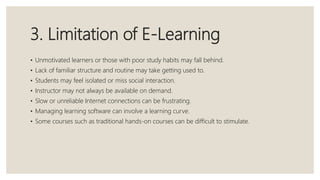
3. Limitation of E-Learning
• Unmotivated learners or those with poor study habits may fall behind.
• Lack of familiar structure and routine may take getting used to.
• Students may feel isolated or miss social interaction.
• Instructor may not always be available on demand.
• Slow or unreliable Internet connections can be frustrating.
• Managing learning software can involve a learning curve.
• Some courses such as traditional hands-on courses can be difficult to stimulate.
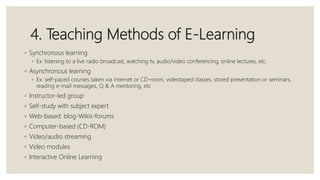
4. Teaching Methods of E-Learning
◦ Synchronous learning
◦ Ex: listening to a live radio broadcast, watching tv, audio/video conferencing, online lectures, etc.
◦ Asynchronous learning
◦ Ex: self-paced courses taken via internet or CD-room, videotaped classes, stored presentation or seminars,
reading e-mail messages, Q & A mentoring, etc
◦ Instructor-led group
◦ Self-study with subject expert
◦ Web-based: blog-Wikis-forums
◦ Computer-based (CD-ROM)
◦ Video/audio streaming
◦ Video modules
◦ Interactive Online Learning
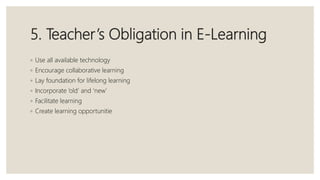
5. Teacher’s Obligation in E-Learning
◦ Use all available technology
◦ Encourage collaborative learning
◦ Lay foundation for lifelong learning
◦ Incorporate ‘old’ and ‘new’
◦ Facilitate learning
◦ Create learning opportunitie
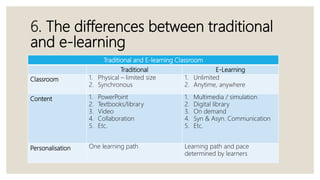
6. The differences between traditional
and e-learning
Traditional and E-learning Classroom
Traditional E-Learning
Classroom 1. Physical – limited size
2. Synchronous
1. Unlimited
2. Anytime, anywhere
Content 1. PowerPoint
2. Textbooks/library
3. Video
4. Collaboration
5. Etc.
1. Multimedia / simulation
2. Digital library
3. On demand
4. Syn & Asyn. Communication
5. Etc.
Personalisation One learning path Learning path and pace
determined by learners
7. E-Learning Tools
◦ E-mail
◦ Audio chat
◦ Online Forum
◦ Web
◦ Video Conference
◦ Learning Management System (LMS)
◦ Open source e-learning application: eFront, Moodle, Dokeos, Claroline, ILIAS, SAKAI project,
etc.
◦ Etc.
8. Blended Learning
• Blended learning combines e-learning tools with traditional classroom learning to ensure
maximum effectiveness.
• It offers :
1.Face to face interaction thereby leading to social benefits.
2. Personalized system of instruction which requires minimum interaction.
3. Improved retention and reinforcement through follow- up mechanism on the
web.
4. Highly flexible based on the learning style and the level of audience
CONVENTIONAL TEACHING METHODS
• The Direct Method
• Grammar-translation
• Audio-lingual
• Suggestopedia
• Total Physical Response (TPR)
• Communicative language teaching (CLT)
• The Silent Way
◦ https://englishpost.org/approaches-and-
methods-in-language-teaching/
• Community Language Learning
• Immersion
• Task-based language learning
• The Natural Approach
• The Lexical Approach
• Content and Integrated Language Learning
(CLIL)
• Etc.
https://www.internationalschooltutors.de/Engl
ish/advice/teachers/info/method.html

MEETING 4 E-LEARNING.pptx

  • 1.
  • 2.
    1. The Natureof E-Learning ◦ The letter ‘e’ in ‘e-learning’ stands for ‘electronic’ ◦ E-Learning is a technology which supports teaching and learning using a computer web technology. The computer does not need to be the central of element of the activity. However, the computer and the network must hold a significant involvement in the learning activity ◦ Mostly associated with activities involving computers and interactive network simultaneously. ◦ Student-centered ◦ Students can assess their own progress
  • 3.
    2. Benefits ofE-learning ◦ Convenient: self-service, on-demand, self-paced, flexible ◦ Media-rich: easier to understand and more engaging ◦ Repeatable: as many times as you like ◦ Easier to monitor the progress: less administrative work, can be more precise ◦ Consistent: central control of content, same quality of content and education for all
  • 4.
    • Class workcan be scheduled around personal and professional work. • Reduces travel cost and time to and from school. • Learners may have the option to select learning materials that meets their level of knowledge and interest. • Learners can study wherever they have access to a computer and Internet. • Different learning styles are addressed and facilitation of learning occurs through varied activities. • Development of computer and Internet skills that are transferable to other facets of learner's lives. • Successfully completing online or computer-based courses builds self-knowledge and self- confidence and encourages students to take responsibility for their learning.
  • 5.
    3. Limitation ofE-Learning • Unmotivated learners or those with poor study habits may fall behind. • Lack of familiar structure and routine may take getting used to. • Students may feel isolated or miss social interaction. • Instructor may not always be available on demand. • Slow or unreliable Internet connections can be frustrating. • Managing learning software can involve a learning curve. • Some courses such as traditional hands-on courses can be difficult to stimulate.
  • 6.
    4. Teaching Methodsof E-Learning ◦ Synchronous learning ◦ Ex: listening to a live radio broadcast, watching tv, audio/video conferencing, online lectures, etc. ◦ Asynchronous learning ◦ Ex: self-paced courses taken via internet or CD-room, videotaped classes, stored presentation or seminars, reading e-mail messages, Q & A mentoring, etc ◦ Instructor-led group ◦ Self-study with subject expert ◦ Web-based: blog-Wikis-forums ◦ Computer-based (CD-ROM) ◦ Video/audio streaming ◦ Video modules ◦ Interactive Online Learning
  • 7.
    5. Teacher’s Obligationin E-Learning ◦ Use all available technology ◦ Encourage collaborative learning ◦ Lay foundation for lifelong learning ◦ Incorporate ‘old’ and ‘new’ ◦ Facilitate learning ◦ Create learning opportunitie
  • 8.
    6. The differencesbetween traditional and e-learning Traditional and E-learning Classroom Traditional E-Learning Classroom 1. Physical – limited size 2. Synchronous 1. Unlimited 2. Anytime, anywhere Content 1. PowerPoint 2. Textbooks/library 3. Video 4. Collaboration 5. Etc. 1. Multimedia / simulation 2. Digital library 3. On demand 4. Syn & Asyn. Communication 5. Etc. Personalisation One learning path Learning path and pace determined by learners
  • 9.
    7. E-Learning Tools ◦E-mail ◦ Audio chat ◦ Online Forum ◦ Web ◦ Video Conference ◦ Learning Management System (LMS) ◦ Open source e-learning application: eFront, Moodle, Dokeos, Claroline, ILIAS, SAKAI project, etc. ◦ Etc.
  • 10.
    8. Blended Learning •Blended learning combines e-learning tools with traditional classroom learning to ensure maximum effectiveness. • It offers : 1.Face to face interaction thereby leading to social benefits. 2. Personalized system of instruction which requires minimum interaction. 3. Improved retention and reinforcement through follow- up mechanism on the web. 4. Highly flexible based on the learning style and the level of audience
  • 11.
    CONVENTIONAL TEACHING METHODS •The Direct Method • Grammar-translation • Audio-lingual • Suggestopedia • Total Physical Response (TPR) • Communicative language teaching (CLT) • The Silent Way ◦ https://englishpost.org/approaches-and- methods-in-language-teaching/ • Community Language Learning • Immersion • Task-based language learning • The Natural Approach • The Lexical Approach • Content and Integrated Language Learning (CLIL) • Etc. https://www.internationalschooltutors.de/Engl ish/advice/teachers/info/method.html