 “The sustainability crisis is a spaghetti junction of cause
and effect. It’s the quintessential ‘system’ problem: you
can’t just pick out one strand and straighten it out. So, to
effectively address it, we need system-based solutions.
Introducing green products and services won’t be enough,
no matter how useful they may be.” - Anna Birney, Head of
the System Innovation Lab at Forum for the Future
Introduction
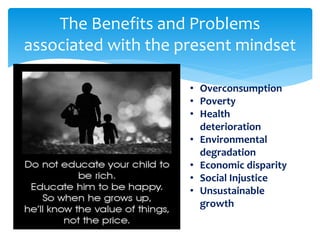
The Benefits and Problems
associated with the present mindset
• Overconsumption
• Poverty
• Health
deterioration
• Environmental
degradation
• Economic disparity
• Social Injustice
• Unsustainable
growth
 A state of being where one gets “familiar” with his/her/its mind in the present state
through calm abiding practice of open awareness of concentration ( shamatha)
technique and sharp insight training through contemplative introspective ( vipassana)
technique.
 “Meditation is very simple. It is simply attending. You can begin by attending to your
breath, and then if a thought comes, attend to it, notice it, be open to it—and it will
pass. Then you can come back to the breath. Your normal response is to react to all
your thoughts, and this keeps you ever busy in a sea of confusion. Meditation teaches
you to attend to what is taking place within without reacting, and this makes all the
difference. It brings you freedom from the mind and its meandering. And in this
freedom you begin to experience who you are, distinct from your mental turmoil. You
experience inner joy and contentment, you experience relief and inner relaxation, and
you find a respite from the tumult of your life. You have given yourself an inner
vacation” – The Art of Joyful Living, Swami Rama
What is Meditation?
Fundamental Principles
4 Laws of Ecology
1) Everything is
connected to
everything
else
2) Everything
must go
somewhere
3) Nature knows
the Best
4) There is no
such thing as
a free lunch
Buddhism
Dependent Origination:
 Everything in the universe, including objects, ideas,
beings, events, and processes, depends on numerous
causes and conditions. Nothing ever exists entirely alone
or independently of others. Because causes and
conditions exist, there are effects. With dependent
origination, “If there is this, then there is that; with the
arising of this, that arises.
 Subatomic particles are always dependently originated.
This can be seen from the way electrons orbit around
protons and neutrons. If someone tries to split up the
nucleus of an atom by fission, the atomic mass will turn
into energy immediately. When we shift our attention
from macroscopic objects to the microscopic world of
atoms, we find a complex web of relationships among
subatomic particles.
Benefits of Meditation
It brings "serenity" or "tranquillity"
(samatha) which steadies, composes,
unifies and concentrates the mind;
"insight" (vipassana) which enables one
to see, explore and discern "formations"
(conditioned phenomena based on the
five aggregates).
5 Aggregates:
• Form or Matter ( external or internal)
• Sensations or feelings (
pleasant/unpleasant/neutral)
• Perceptions (registers whether the object
is recognized or not)
• Mental formations/ impulses ( all types of
mental habits, thoughts, ideas, prejudices,
compulsion and decision triggered by the
object)
• Consciousness or discernment (
cognizance which discern)
"Half of all our cash, we're
spending on our trash"-
Tom Chapin
Benefits of Meditation
• Wisdom and clarity
• Equanimity
• Contentment
• Generosity
• Happiness
• Critical thinking/
discernment
• System innovators
• Compassionate
conscientious
consumers
• Creativity
• Tolerance/ Patience
“We need political leadership that is
not only thoughtful and measured but
also courageous and inspirational. It
is time for clarity and strength in both
vision and action.
The people and the politicians of the
world, community by community,
nation by nation, will now determine
whether we can create and sustain
the international vision, commitment
and collaboration that will allow us to
take this special opportunity and to
rise to the challenge of the planet in
peril.”- Stern and Garbett- Shiels,
“Global Sustainability – A Nobel Cause”
Challenges
Challenges and Opportunities
• Ignorance or lack of awareness/ communication/ fear of
change
• Lack of funding for research, lack of researchers, lack of
trained teachers
• Opposition from profit driven entities ( political and
nonpolitical)
• Technology – mass social media
• Bottom up process/ Contagious/ Empowering
• Mindfulness/ Yoga Research
• Civic responsibility
• http://www.aei-ideas.org/2014/02/happiness-free-enterprise-and-human-flourishing-
a-special-online-event-featuring-his-holiness the-dalai-lama/
• Mind and life
• UW, Emory, UCLA, UVA, etc
• TIME
“The Seahawks believe their kinder, gentler
philosophy is the future of football,” says
Alyssa Roenigk in ESPN The Magazine. So
could mindfulness and meditation be a way
to win the Super Bowl? The Seahawks
obviously believe that it can. They are taught
yoga and sitting meditation as a part of their
training, as it’s difficult to be focused if they
are distracted by a monkey mind jumping
from thought to thought.
Meditation as Mitigation for Sustainable Development (1)

Meditation as Mitigation for Sustainable Development (1)

  • 1.
     “The sustainabilitycrisis is a spaghetti junction of cause and effect. It’s the quintessential ‘system’ problem: you can’t just pick out one strand and straighten it out. So, to effectively address it, we need system-based solutions. Introducing green products and services won’t be enough, no matter how useful they may be.” - Anna Birney, Head of the System Innovation Lab at Forum for the Future Introduction
  • 2.
    The Benefits andProblems associated with the present mindset • Overconsumption • Poverty • Health deterioration • Environmental degradation • Economic disparity • Social Injustice • Unsustainable growth
  • 3.
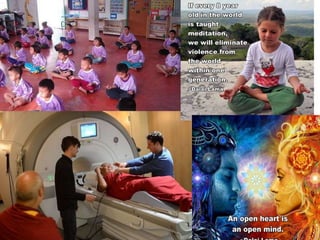
     A stateof being where one gets “familiar” with his/her/its mind in the present state through calm abiding practice of open awareness of concentration ( shamatha) technique and sharp insight training through contemplative introspective ( vipassana) technique.  “Meditation is very simple. It is simply attending. You can begin by attending to your breath, and then if a thought comes, attend to it, notice it, be open to it—and it will pass. Then you can come back to the breath. Your normal response is to react to all your thoughts, and this keeps you ever busy in a sea of confusion. Meditation teaches you to attend to what is taking place within without reacting, and this makes all the difference. It brings you freedom from the mind and its meandering. And in this freedom you begin to experience who you are, distinct from your mental turmoil. You experience inner joy and contentment, you experience relief and inner relaxation, and you find a respite from the tumult of your life. You have given yourself an inner vacation” – The Art of Joyful Living, Swami Rama What is Meditation?
  • 4.
    Fundamental Principles 4 Lawsof Ecology 1) Everything is connected to everything else 2) Everything must go somewhere 3) Nature knows the Best 4) There is no such thing as a free lunch Buddhism Dependent Origination:  Everything in the universe, including objects, ideas, beings, events, and processes, depends on numerous causes and conditions. Nothing ever exists entirely alone or independently of others. Because causes and conditions exist, there are effects. With dependent origination, “If there is this, then there is that; with the arising of this, that arises.  Subatomic particles are always dependently originated. This can be seen from the way electrons orbit around protons and neutrons. If someone tries to split up the nucleus of an atom by fission, the atomic mass will turn into energy immediately. When we shift our attention from macroscopic objects to the microscopic world of atoms, we find a complex web of relationships among subatomic particles.
  • 6.
    Benefits of Meditation Itbrings "serenity" or "tranquillity" (samatha) which steadies, composes, unifies and concentrates the mind; "insight" (vipassana) which enables one to see, explore and discern "formations" (conditioned phenomena based on the five aggregates). 5 Aggregates: • Form or Matter ( external or internal) • Sensations or feelings ( pleasant/unpleasant/neutral) • Perceptions (registers whether the object is recognized or not) • Mental formations/ impulses ( all types of mental habits, thoughts, ideas, prejudices, compulsion and decision triggered by the object) • Consciousness or discernment ( cognizance which discern)
  • 7.
    "Half of allour cash, we're spending on our trash"- Tom Chapin
  • 8.
    Benefits of Meditation •Wisdom and clarity • Equanimity • Contentment • Generosity • Happiness • Critical thinking/ discernment • System innovators • Compassionate conscientious consumers • Creativity • Tolerance/ Patience “We need political leadership that is not only thoughtful and measured but also courageous and inspirational. It is time for clarity and strength in both vision and action. The people and the politicians of the world, community by community, nation by nation, will now determine whether we can create and sustain the international vision, commitment and collaboration that will allow us to take this special opportunity and to rise to the challenge of the planet in peril.”- Stern and Garbett- Shiels, “Global Sustainability – A Nobel Cause”
  • 9.
  • 12.
    Challenges and Opportunities •Ignorance or lack of awareness/ communication/ fear of change • Lack of funding for research, lack of researchers, lack of trained teachers • Opposition from profit driven entities ( political and nonpolitical) • Technology – mass social media • Bottom up process/ Contagious/ Empowering • Mindfulness/ Yoga Research • Civic responsibility • http://www.aei-ideas.org/2014/02/happiness-free-enterprise-and-human-flourishing- a-special-online-event-featuring-his-holiness the-dalai-lama/ • Mind and life • UW, Emory, UCLA, UVA, etc • TIME
  • 13.
    “The Seahawks believetheir kinder, gentler philosophy is the future of football,” says Alyssa Roenigk in ESPN The Magazine. So could mindfulness and meditation be a way to win the Super Bowl? The Seahawks obviously believe that it can. They are taught yoga and sitting meditation as a part of their training, as it’s difficult to be focused if they are distracted by a monkey mind jumping from thought to thought.