Introducing the first three periods of Western Music
History: Medieval Era, Renaissance & Baroque Period.
Also known as the MIDDLE AGES OR “DARK
AGES”
Started with the fall of the Roman Empire
Christian church influenced Europe’s culture &
political affairs.
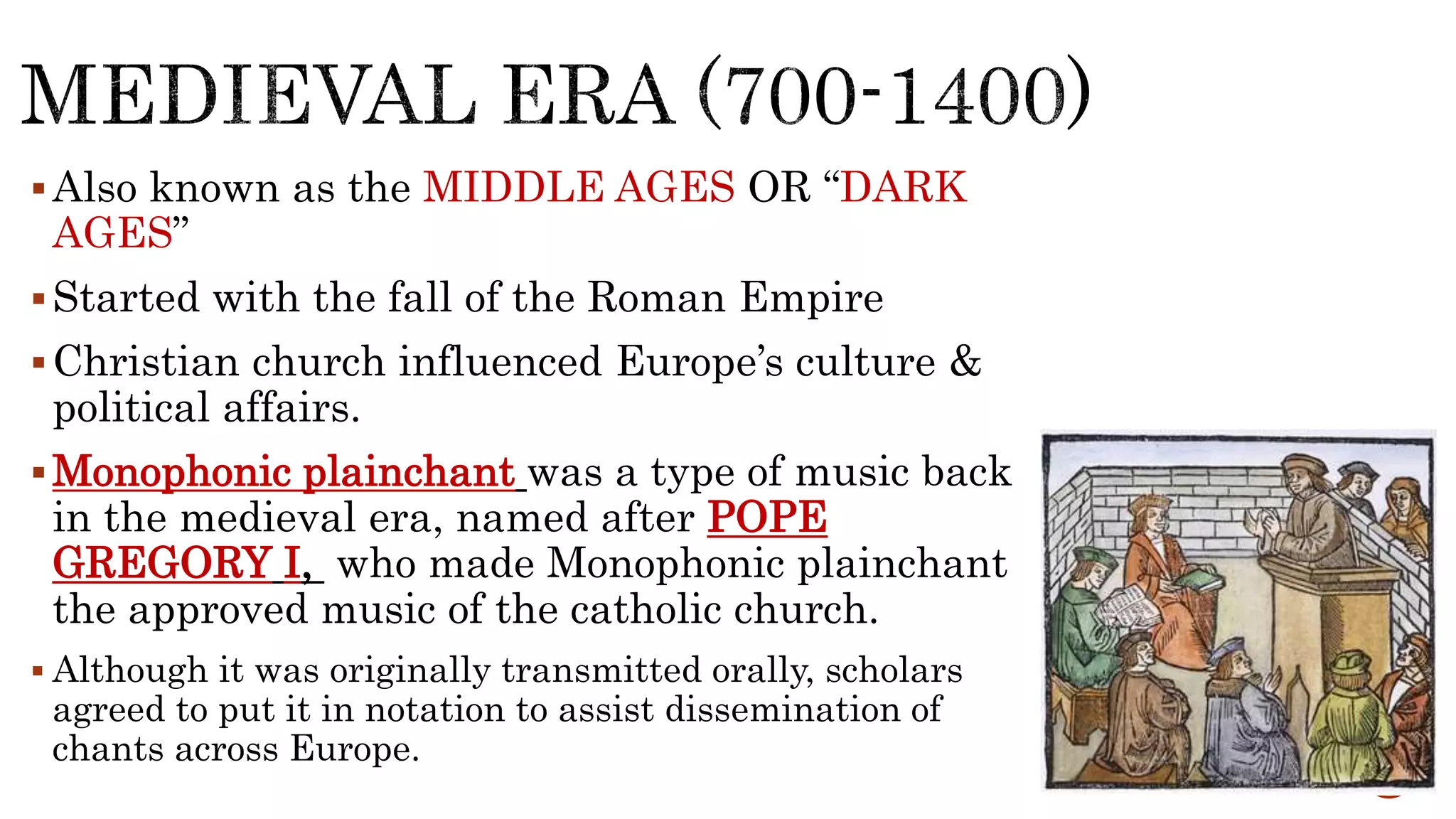
Monophonic plainchant was a type of music back
in the medieval era, named after POPE
GREGORY I, who made Monophonic plainchant
the approved music of the catholic church.
 Although it was originally transmitted orally, scholars
agreed to put it in notation to assist dissemination of
chants across Europe.
NEUMES
 Desciption: The introit Gaudeamus
Omnes scripted in square notation
 Date: 14th – 15th Century
 Listen to an example of Gregorian chant
that your teacher will let you hear.
Afterwards, answer the following
questions:
1. What can you say about the
plainchants? What are their
Characteristics?
2. How can you compare it to modern
music made today? (21st Century Music)
During the later part of the Medieval
Period, secular music (which was not
bound by Catholic Traditions)
emerged!
Most of the songs emerged were
performed across Europe by a group
of musicians called TROUBADOURS.
Usually Monophonic
Sometimes with improvised
accompaniment
Tells of chivalry and courtly love
Originated in France
Written in French language
- Was one of the oldest
composers of secular music
- His literary and musical
works include chansons and
poetic debates
- His musical play, LE JEU
DE ROBIN ET DE
MARION, was considered
the earliest surviving secular
French play with music.
SOME OF HIS WORKS INCLUDE:
1. Le jeu de Robin et de Marion (the game of Robin
and Marion)
2. La Chanson du roi de Sicile (the song of the king
of Sicile)

Medieval Era Music - Grade 9 1st Quarter Western Classical Music

  • 1.
    Introducing the firstthree periods of Western Music History: Medieval Era, Renaissance & Baroque Period.
  • 5.
    Also known asthe MIDDLE AGES OR “DARK AGES” Started with the fall of the Roman Empire Christian church influenced Europe’s culture & political affairs. Monophonic plainchant was a type of music back in the medieval era, named after POPE GREGORY I, who made Monophonic plainchant the approved music of the catholic church.  Although it was originally transmitted orally, scholars agreed to put it in notation to assist dissemination of chants across Europe.
  • 6.
    NEUMES  Desciption: Theintroit Gaudeamus Omnes scripted in square notation  Date: 14th – 15th Century  Listen to an example of Gregorian chant that your teacher will let you hear. Afterwards, answer the following questions: 1. What can you say about the plainchants? What are their Characteristics? 2. How can you compare it to modern music made today? (21st Century Music)
  • 7.
    During the laterpart of the Medieval Period, secular music (which was not bound by Catholic Traditions) emerged! Most of the songs emerged were performed across Europe by a group of musicians called TROUBADOURS.
  • 9.
    Usually Monophonic Sometimes withimprovised accompaniment Tells of chivalry and courtly love Originated in France Written in French language
  • 10.
    - Was oneof the oldest composers of secular music - His literary and musical works include chansons and poetic debates - His musical play, LE JEU DE ROBIN ET DE MARION, was considered the earliest surviving secular French play with music. SOME OF HIS WORKS INCLUDE: 1. Le jeu de Robin et de Marion (the game of Robin and Marion) 2. La Chanson du roi de Sicile (the song of the king of Sicile)