Kitten Behavior
S
etting a kitten up for success takes careful
selection, proper socialization, and suitable
environmental management and enrichment.
PUREBRED OR MIXED-BREED?
Owners should determine which physical (eg,
coat, size) and behavioral traits they find impor-
tant. In cats, genetically related behavior prob-
lems have been kept to a minimum primarily
because of the lack of selective breeding and a
diverse genetic pool.1 Paternal genetics do play a
role in sociability,2 but in most cases knowledge
of paternal personality traits is unlikely.
WHEN IS THE BEST TIME TO ADOPT?
Adoption before 6 weeks of age is not recom-
mended. This important developmental time
accommodates weaning and the early formation
of substrate preferences learned from the queen.3
Kittens taken from their mother before 2 weeks
of age can be markedly fearful and overly aggres-
sive toward humans and other cats.4
However, it is important to get the kitten into
the new home during the sensitive period of
socialization—3 to 9 weeks of age—as research
has indicated that early handling may result in
less fear-based behavior toward humans later in
A p p l i e d B e h a v i o r F E L I N E B E H AV I O R
Applied Behavior / NAVC Clinician’s Brief / July 2012 ...........................................................................................................................................................................21
Debra F. Horwitz, DVM, DACVB, &
Amy L. Pike, DVM
Veterinary Behavior Consultations
St. Louis, Missouri
Peer Reviewed
C O N T I N U E S
Research has
shown that
early handling
of kittens (ie,
3–9 weeks of
age) may result
in less fear-
based behavior
toward humans.
What important information should I provide
to clients who want to add a kitten to
their family?
life5,6 and the kitten is better able to bond with
its new family. Owners should be encouraged to
introduce the kitten to as many different people
and places as possible during this time as well as
during the entire first year.
BRINGING THE KITTEN HOME
A Safe Place
A safe place (with food, water, litter box, toys,
and a bed) should be created to help the kitten
become acclimated to its new home. Daily super-
vised excursions into the rest of the house will
allow gradual investigation of the new surround-
ings. The kitten should be returned frequently to
its safe place for rest and elimination.
Litter Boxes
Litter boxes should be tailored for the kitten,
with lower sides and easy access but away from
busy areas. Litter boxes must be kept clean,
scooped twice daily, and emptied, washed, and
refilled weekly. In larger homes, litter boxes may
need to be placed on all floors. If other cats are
already present in the home, at least one litter
box should be provided for each cat.
MEETING DAILY NEEDS
Play
Play is an important aspect of kitten develop-
ment; it fosters appropriate and strong bonds
between the kitten and owners and meets exer-
cise and enrichment needs. To avoid injury to
people, all play with kittens should occur with
toys, never with human hands or feet.
In multicat households, safe intercat play can be
encouraged by placing a long ribbon with a toy
on each end underneath the closed door to the
kitten’s safe place. The resident cat(s) and new
kitten then have an opportunity to interact
through play activities during the acclimation
period.
Predatory play behavior is an integral part of kit-
ten play, and appropriate outlets can be provided
A p p l i e d B e h a v i o r C O N T I N U E D
using commercial feeder toys that allow a daily
food ration to be dispensed through play and
manipulation, mimicking a more natural feeding
behavior.
DECLAW OR NOT?
It is not necessary to declaw a cat for it to live in
harmony with furnishings; however, training
must start early.
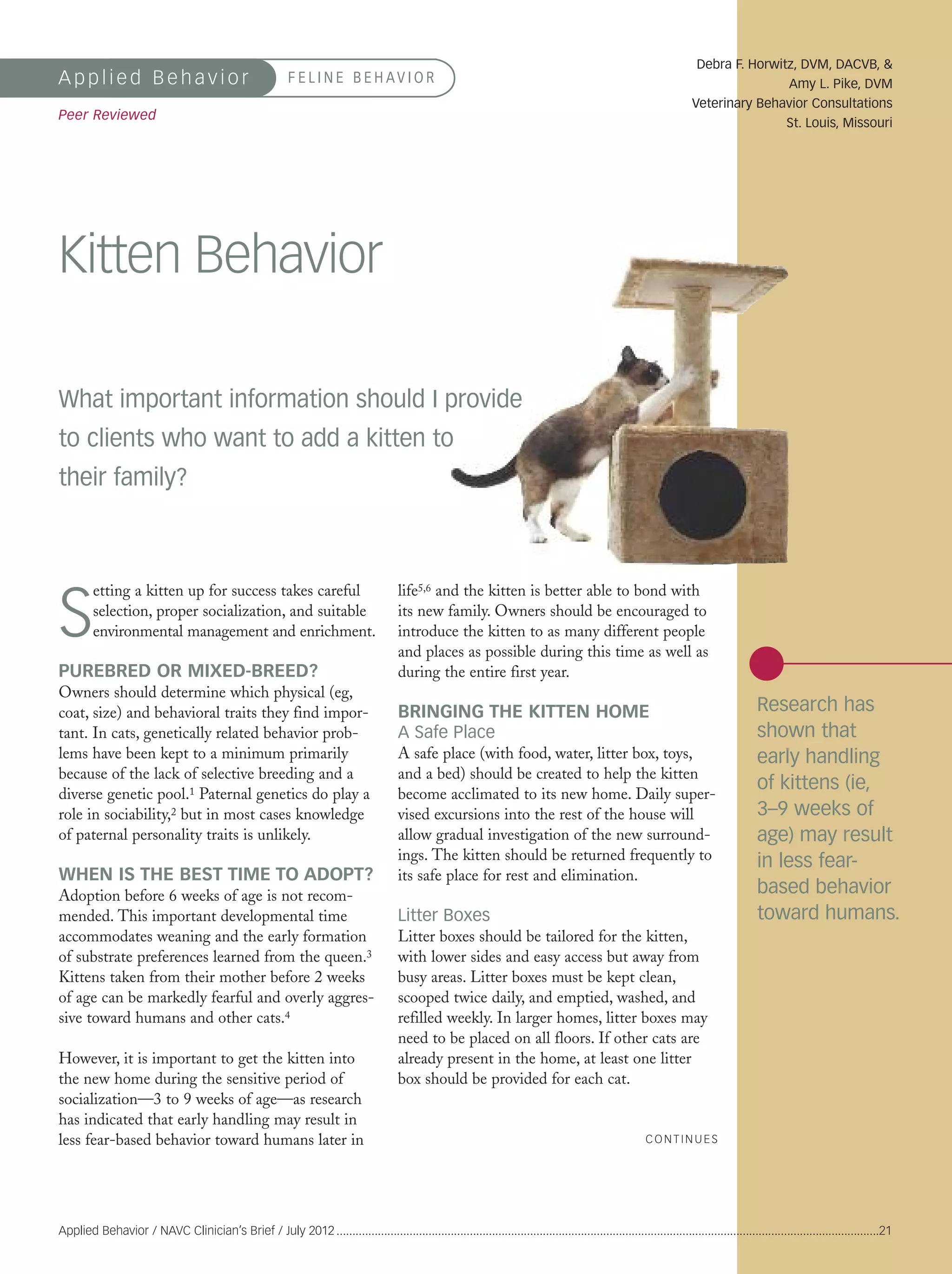
Scratching is a normal behavior that cats use to
mark their territory, stretch, exercise, and condi-
tion their claws. Kittens need a scratching surface
that is appropriately sized and attractive. To
encourage use, owners should offer different
options (horizontal, vertical, sisal, carpet) until
the kitten has decided its preference.
22 ...........................................................................................................................................................................NAVC Clinician’s Brief / July 2012 / Applied Behavior
Tips to Increase Acceptance of a Scratching Post
Location is everything when it comes to getting the kitten to use the provided scratching
material! Place one preferred scratching surface in the kitten’s safe room and another where
it spends family time. Make the scratching surface appealing and fun, integrating perching,
climbing, play, and resting areas. Sprinkling catnip on the post or mat can make it more
attractive.
Making areas where you do not want the kitten to scratch unpleasant can also help. Use
double-sided tape (StickyPaws.com) on plants and furniture and discuss with owners the
role of good supervision in discouraging kittens from scratching in the wrong places.
Early Crate & Harness Training
Kittenhood is the best time to acclimate a kitten to crates and car travel to
make traveling to the veterinary hospital less stressful. While different types
of crates are available, top-opening creates facilitate easier entry and exit.
Once owners obtain a crate, they should leave it out and open in a common
area. Treats and comfortable bedding should be placed inside and the kitten
praised and offered a treat each time the owner sees it in the crate. Kittens
can also be taught to wear a harness and leash for safe outdoor access.
An informative article on crate training is available from the Cat Council
(catcouncil.com/programs/carriertraining.html), and a helpful crate-training
video can be viewed at the Catalyst Council website (catalystcouncil.org/
resources/video/?Id=102).
CREATING LIFELONG BONDS
Handling exercises and introducing the kitten to
different people and places may make later med-
ical treatments and routine care easier to admin-
ister. Encourage owners to use gentle handling
techniques several times a week, such as groom-
ing the kitten with a soft brush, touching its feet
and ears, opening its mouth, and gently trim-
ming 1 or 2 nails. Advise owners to pick a time
when the kitten is quiet and relaxed and keep
handling sessions short. Use delectable food
treats before, during, and after sessions to help
associate them with good things.
KEY POINTS
P o l l i n g P l a c e
GO TO cliniciansbrief.com to weigh in
Applied Behavior / NAVC Clinician’s Brief / July 2012 ...........................................................................................................................................................................23
Do you offer rehabilitation services
for your patients?
Yes, for any debilitated patients
Yes, for postoperative
orthopedic surgery
patients only
No, but we do refer
cases for rehabilitation
elsewhere
No, we do not offer
these services
We asked…
What is your practice protocol for preventing zoonotic disease?
You answered:
Question new clients about immune status of household members
and advise which animals are appropriate companions––0%
Question new clients about immune status of household
members and review the risks associated with species-related
pet ownership––13%
Question clients about immune status of household members
and devise plans for safe pet ownership based on pet(s)
owned––67%
None of the above—I don’t address immune status or
zoonotic disease—20%
This month’s question:
G Kittens need a safe place to become acclimated to their new home.
G Daily needs for enrichment and play need to be met.
G Handling and socializing kittens at an early age are important for behavioral health.
G Scratching behavior is normal, and if proper outlets are provided, there is no need
to declaw.
G Early exposure and training will provide a lifetime of happiness with a kitten.
CLOSING REMARKS
Getting a new kitten is an exciting time filled
with joy and many decisions. Arm your clients
with good and accurate information on kitten
behavior to help them form a lifelong, enjoyable
bond with their kitten that will hopefully last
well into the cat’s senior years.
See Aids & Resources, back page, for references
& suggested reading.

Medicina felina kitten behavior (1)

  • 1.
    Kitten Behavior S etting akitten up for success takes careful selection, proper socialization, and suitable environmental management and enrichment. PUREBRED OR MIXED-BREED? Owners should determine which physical (eg, coat, size) and behavioral traits they find impor- tant. In cats, genetically related behavior prob- lems have been kept to a minimum primarily because of the lack of selective breeding and a diverse genetic pool.1 Paternal genetics do play a role in sociability,2 but in most cases knowledge of paternal personality traits is unlikely. WHEN IS THE BEST TIME TO ADOPT? Adoption before 6 weeks of age is not recom- mended. This important developmental time accommodates weaning and the early formation of substrate preferences learned from the queen.3 Kittens taken from their mother before 2 weeks of age can be markedly fearful and overly aggres- sive toward humans and other cats.4 However, it is important to get the kitten into the new home during the sensitive period of socialization—3 to 9 weeks of age—as research has indicated that early handling may result in less fear-based behavior toward humans later in A p p l i e d B e h a v i o r F E L I N E B E H AV I O R Applied Behavior / NAVC Clinician’s Brief / July 2012 ...........................................................................................................................................................................21 Debra F. Horwitz, DVM, DACVB, & Amy L. Pike, DVM Veterinary Behavior Consultations St. Louis, Missouri Peer Reviewed C O N T I N U E S Research has shown that early handling of kittens (ie, 3–9 weeks of age) may result in less fear- based behavior toward humans. What important information should I provide to clients who want to add a kitten to their family? life5,6 and the kitten is better able to bond with its new family. Owners should be encouraged to introduce the kitten to as many different people and places as possible during this time as well as during the entire first year. BRINGING THE KITTEN HOME A Safe Place A safe place (with food, water, litter box, toys, and a bed) should be created to help the kitten become acclimated to its new home. Daily super- vised excursions into the rest of the house will allow gradual investigation of the new surround- ings. The kitten should be returned frequently to its safe place for rest and elimination. Litter Boxes Litter boxes should be tailored for the kitten, with lower sides and easy access but away from busy areas. Litter boxes must be kept clean, scooped twice daily, and emptied, washed, and refilled weekly. In larger homes, litter boxes may need to be placed on all floors. If other cats are already present in the home, at least one litter box should be provided for each cat.
  • 2.
    MEETING DAILY NEEDS Play Playis an important aspect of kitten develop- ment; it fosters appropriate and strong bonds between the kitten and owners and meets exer- cise and enrichment needs. To avoid injury to people, all play with kittens should occur with toys, never with human hands or feet. In multicat households, safe intercat play can be encouraged by placing a long ribbon with a toy on each end underneath the closed door to the kitten’s safe place. The resident cat(s) and new kitten then have an opportunity to interact through play activities during the acclimation period. Predatory play behavior is an integral part of kit- ten play, and appropriate outlets can be provided A p p l i e d B e h a v i o r C O N T I N U E D using commercial feeder toys that allow a daily food ration to be dispensed through play and manipulation, mimicking a more natural feeding behavior. DECLAW OR NOT? It is not necessary to declaw a cat for it to live in harmony with furnishings; however, training must start early. Scratching is a normal behavior that cats use to mark their territory, stretch, exercise, and condi- tion their claws. Kittens need a scratching surface that is appropriately sized and attractive. To encourage use, owners should offer different options (horizontal, vertical, sisal, carpet) until the kitten has decided its preference. 22 ...........................................................................................................................................................................NAVC Clinician’s Brief / July 2012 / Applied Behavior Tips to Increase Acceptance of a Scratching Post Location is everything when it comes to getting the kitten to use the provided scratching material! Place one preferred scratching surface in the kitten’s safe room and another where it spends family time. Make the scratching surface appealing and fun, integrating perching, climbing, play, and resting areas. Sprinkling catnip on the post or mat can make it more attractive. Making areas where you do not want the kitten to scratch unpleasant can also help. Use double-sided tape (StickyPaws.com) on plants and furniture and discuss with owners the role of good supervision in discouraging kittens from scratching in the wrong places. Early Crate & Harness Training Kittenhood is the best time to acclimate a kitten to crates and car travel to make traveling to the veterinary hospital less stressful. While different types of crates are available, top-opening creates facilitate easier entry and exit. Once owners obtain a crate, they should leave it out and open in a common area. Treats and comfortable bedding should be placed inside and the kitten praised and offered a treat each time the owner sees it in the crate. Kittens can also be taught to wear a harness and leash for safe outdoor access. An informative article on crate training is available from the Cat Council (catcouncil.com/programs/carriertraining.html), and a helpful crate-training video can be viewed at the Catalyst Council website (catalystcouncil.org/ resources/video/?Id=102).
  • 3.
    CREATING LIFELONG BONDS Handlingexercises and introducing the kitten to different people and places may make later med- ical treatments and routine care easier to admin- ister. Encourage owners to use gentle handling techniques several times a week, such as groom- ing the kitten with a soft brush, touching its feet and ears, opening its mouth, and gently trim- ming 1 or 2 nails. Advise owners to pick a time when the kitten is quiet and relaxed and keep handling sessions short. Use delectable food treats before, during, and after sessions to help associate them with good things. KEY POINTS P o l l i n g P l a c e GO TO cliniciansbrief.com to weigh in Applied Behavior / NAVC Clinician’s Brief / July 2012 ...........................................................................................................................................................................23 Do you offer rehabilitation services for your patients? Yes, for any debilitated patients Yes, for postoperative orthopedic surgery patients only No, but we do refer cases for rehabilitation elsewhere No, we do not offer these services We asked… What is your practice protocol for preventing zoonotic disease? You answered: Question new clients about immune status of household members and advise which animals are appropriate companions––0% Question new clients about immune status of household members and review the risks associated with species-related pet ownership––13% Question clients about immune status of household members and devise plans for safe pet ownership based on pet(s) owned––67% None of the above—I don’t address immune status or zoonotic disease—20% This month’s question: G Kittens need a safe place to become acclimated to their new home. G Daily needs for enrichment and play need to be met. G Handling and socializing kittens at an early age are important for behavioral health. G Scratching behavior is normal, and if proper outlets are provided, there is no need to declaw. G Early exposure and training will provide a lifetime of happiness with a kitten. CLOSING REMARKS Getting a new kitten is an exciting time filled with joy and many decisions. Arm your clients with good and accurate information on kitten behavior to help them form a lifelong, enjoyable bond with their kitten that will hopefully last well into the cat’s senior years. See Aids & Resources, back page, for references & suggested reading.