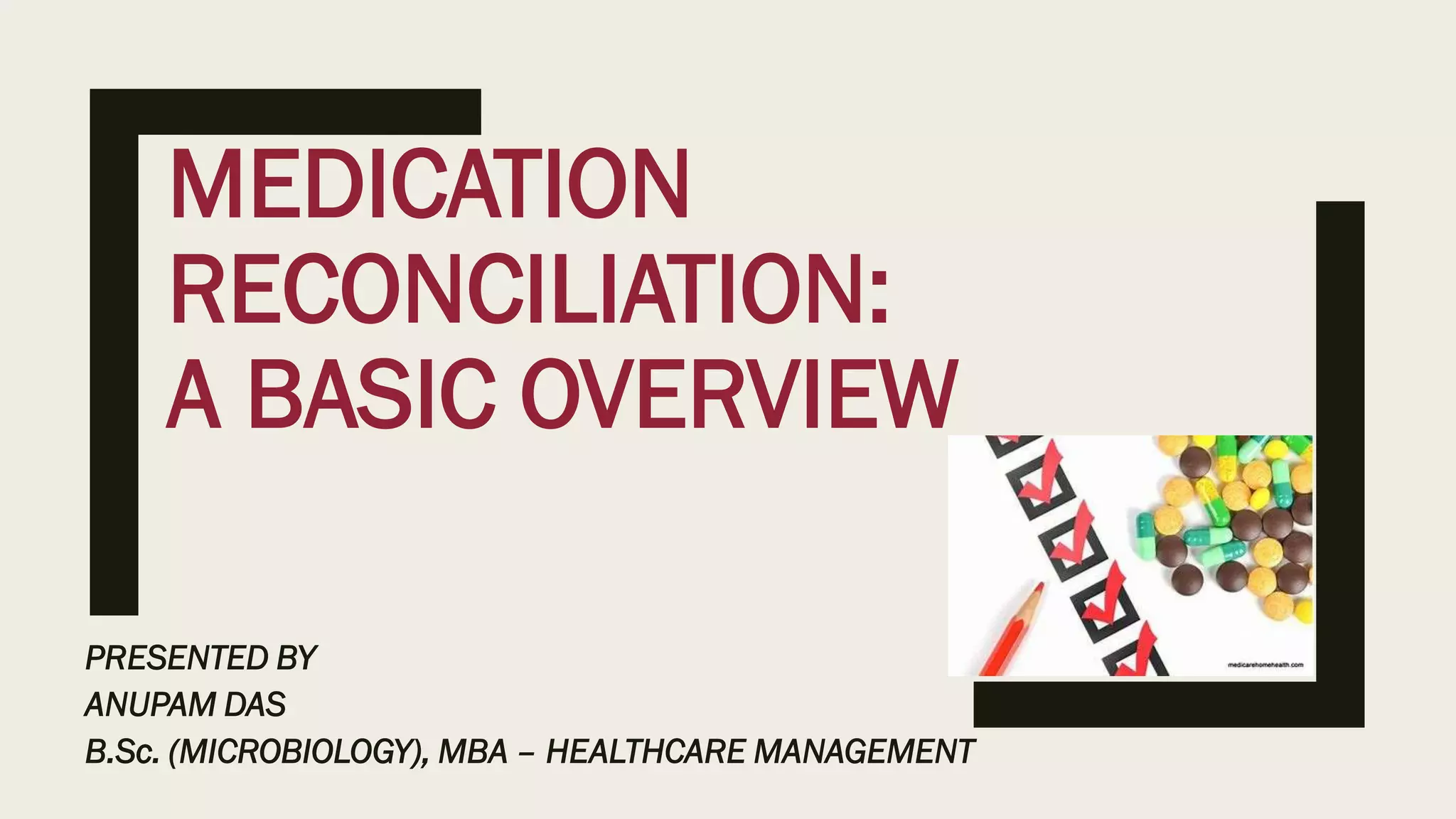
MEDICATION
RECONCILIATION:
A BASIC OVERVIEW
PRESENTED BY
ANUPAM DAS
B.Sc. (MICROBIOLOGY), MBA – HEALTHCARE MANAGEMENT
BACKGROUND
Patients often receive new medications or have changes made to
their existing medications at times of transitions in care upon
hospital admission, transfer from one department/unit to another
during hospitalization, or discharge from the hospital to home or
another facility.
WHAT IS MEDICATION RECONCILIATION
■ Medication reconciliation is a formal process or technique used by
clinical personnel (e.g. doctors, nursing staff and pharmacists) to
gather a complete and accurate list of a patient's prescribed and
home medications to identify discrepancies in drug regimens in
different levels of care, healthcare settings, or points in time and to
use that information to inform prescribing decisions and identify and
prevent medication errors.
■ In short, it is a Process of identifying the most accurate list of all
medications a patient is taking including name, dosage, frequency &
route and to use this list to provide correct medications for patients
anywhere within the health care system and most importantly,
compare the patient's current medication list against the admission,
transfer or discharge orders
GOALS OF MEDICATION RECONCILIATION
■ To prevent adverse drug events (ADEs) at all interfaces of care (admission, transfer and
discharge), for all patients.
■ To improve the safety of using medications.
■ To ensure the safety of all patients against medication error.
■ To eliminate undocumented intentional discrepancies and unintentional discrepancies by
reconciling all medications, at all interfaces of care.
An undocumented intentional discrepancy occurs when the Physician intentionally adds, changes or
discontinues a medication the patient was taking prior to admission but this is not clearly
documented in the patient’s medical record.
An unintentional discrepancy occurs when the physician unintentionally changes, adds or omits a
medication the patient was taking prior to admission.
EXAMPLES OF MEDICAL RECONCILIATION
Example of an Undocumented Intentional Discrepancy
A patient receiving atenolol for hypertension was admitted for surgery. The admitting
resident did not order atenolol on admission due to concerns about perioperative
hypotension. The reason for not ordering atenolol was not documented in the medical
record. The patient was discharged on the third postoperative day and was given a
discharge prescription that did not include atenolol. The patient was unsure whether
to resume treatment with atenolol at home and called her family doctor for advice.
The family doctor called the patient’s surgeon to clarify the discrepancy. The surgeon
did not know why the atenolol was stopped while in hospital and called the hospital
pharmacy. The pharmacy did not have a record of the change so the pharmacist on
the surgical unit tried to contact the admitting resident but the resident was no longer
on the service.
EXAMPLES OF MEDICAL RECONCILIATION
Examples of an Unintentional Discrepancy
An elderly woman was admitted to a general medicine unit with a diagnosis of
community-acquired pneumonia. Antibiotics and symptom management were ordered
and started. Two days later the patient had a myocardial infarction and it was found
that a beta-blocker (cardiac medication) had been unintentionally omitted on
admission.
A patient was admitted for total knee replacement surgery. After four or five days the
patient was not motivated and refused to get out of bed. The family mentioned to the
nurse that the patient had been on an antidepressant medication prior to admission
and it had not been ordered while in hospital. The medication was ordered. It took
approximately one week for the medication to work again, resulting in a prolonged
hospital stay.
STEPS OF MEDICATION RECONCILIATION
There are following basic, but very important steps of Medication
Reconciliation.
■ Verification: Collection of complete and accurate medication list ( including
current & past medication) of patient and other medication information.
■ Clarification: Ensuring the dosage and medications are appropriate for the
patient.
■ Reconciliation: Resolving discrepancies and documenting changes and new
orders.
Although the required steps seem basic, the logistics behind when, where, how, and by whom this is done can be difficult.
BENEFITS OF MEDICATION RECONCILIATION
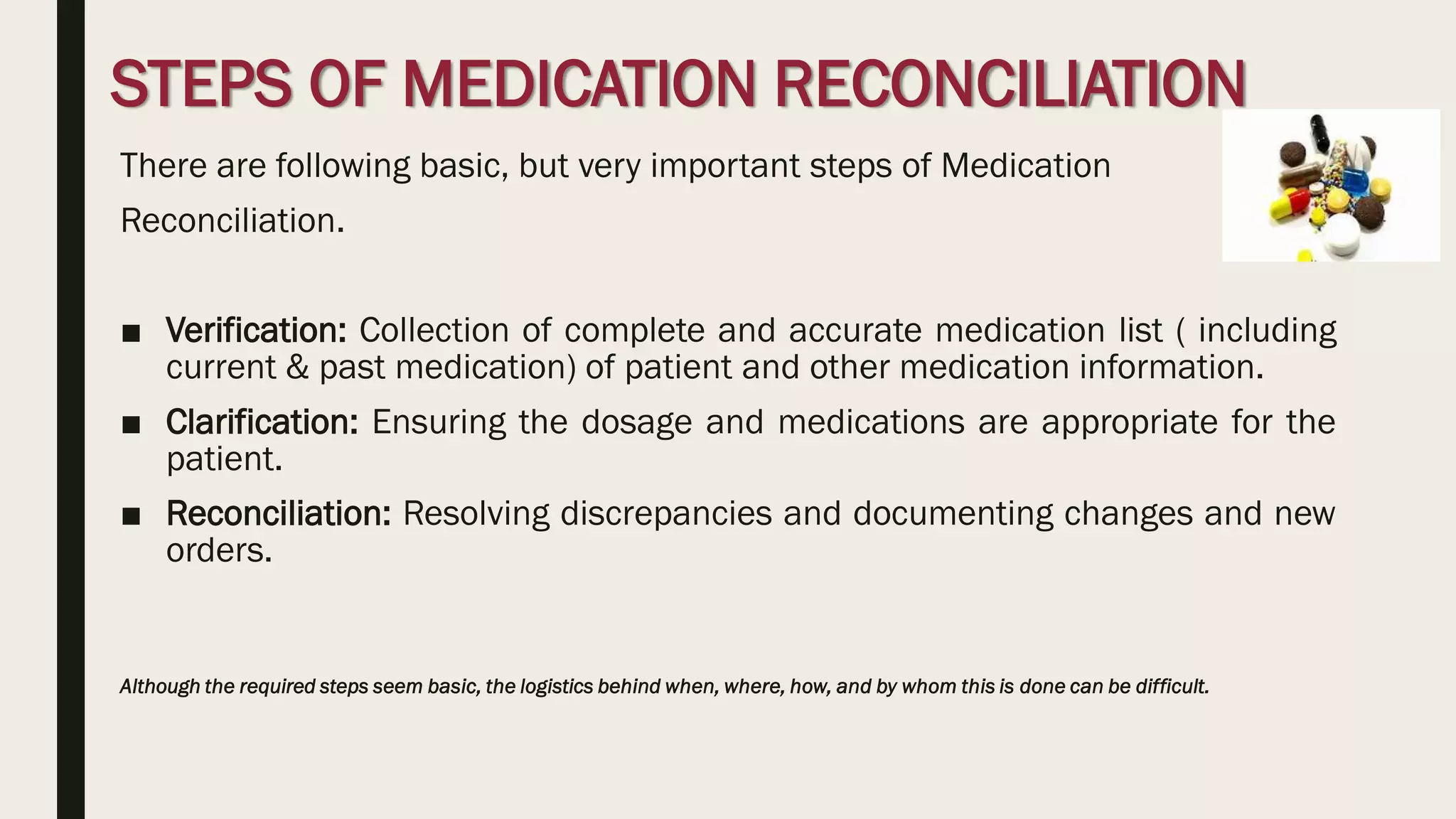
■ Obtain and maintain a complete list of medications
the patient is regularly taking.
■ Reduction in medication error and adverse drug
events.
■ Patients receive appropriate medication.
■ Improve effective communication between clinical
personnel and patients & their family members.
CHALLENGES OF MEDICAL RECONCILIATION
■ TIME TIME TIME..!! – Biggest Challenge.
■ Patient’s inability to recall medications, its dosage and
frequency.
■ Unreliable sources of medication information
■ Skill level of interviewer of patients.
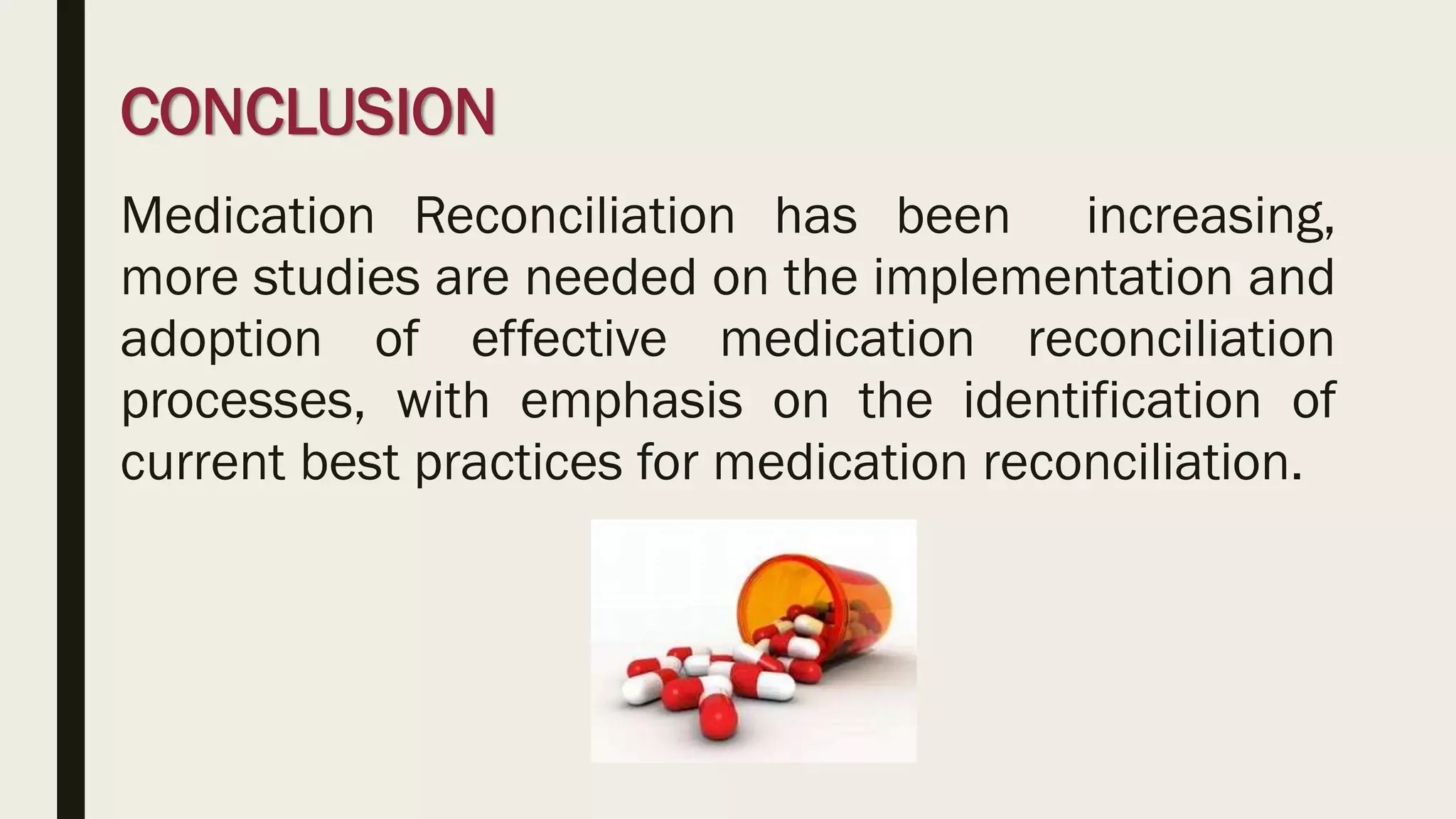
CONCLUSION
Medication Reconciliation has been increasing,
more studies are needed on the implementation and
adoption of effective medication reconciliation
processes, with emphasis on the identification of
current best practices for medication reconciliation.
REFERENCES
■ Approach to Improving Safety: Medication Reconciliation (Agency for
Healthcare Research & Quality)
■ Medication Reconciliation According to the Joint Commission, S.
Michael Ross, MD, MHA
■ Medication Reconciliation: A Learning Guide, Queen’s University –
Office of interpersonal Education & Practice
■ Ensuring Medication Reconciliation, By Kristen Georgia, BS; Kristin
Kinney, RN, MSN; Angela Pace, RN, MSN; and Kim Helton, RN, BSN
■ Improving Care Transitions: Optimizing Medication Reconciliation,
Developed by: American Pharmacists Association, American Society
of Health-System Pharmacists
THANK YOU

Medication Reconciliation A Basic Overview

  • 1.
    MEDICATION RECONCILIATION: A BASIC OVERVIEW PRESENTEDBY ANUPAM DAS B.Sc. (MICROBIOLOGY), MBA – HEALTHCARE MANAGEMENT
  • 2.
    BACKGROUND Patients often receivenew medications or have changes made to their existing medications at times of transitions in care upon hospital admission, transfer from one department/unit to another during hospitalization, or discharge from the hospital to home or another facility.
  • 3.
    WHAT IS MEDICATIONRECONCILIATION ■ Medication reconciliation is a formal process or technique used by clinical personnel (e.g. doctors, nursing staff and pharmacists) to gather a complete and accurate list of a patient's prescribed and home medications to identify discrepancies in drug regimens in different levels of care, healthcare settings, or points in time and to use that information to inform prescribing decisions and identify and prevent medication errors. ■ In short, it is a Process of identifying the most accurate list of all medications a patient is taking including name, dosage, frequency & route and to use this list to provide correct medications for patients anywhere within the health care system and most importantly, compare the patient's current medication list against the admission, transfer or discharge orders
  • 4.
    GOALS OF MEDICATIONRECONCILIATION ■ To prevent adverse drug events (ADEs) at all interfaces of care (admission, transfer and discharge), for all patients. ■ To improve the safety of using medications. ■ To ensure the safety of all patients against medication error. ■ To eliminate undocumented intentional discrepancies and unintentional discrepancies by reconciling all medications, at all interfaces of care. An undocumented intentional discrepancy occurs when the Physician intentionally adds, changes or discontinues a medication the patient was taking prior to admission but this is not clearly documented in the patient’s medical record. An unintentional discrepancy occurs when the physician unintentionally changes, adds or omits a medication the patient was taking prior to admission.
  • 5.
    EXAMPLES OF MEDICALRECONCILIATION Example of an Undocumented Intentional Discrepancy A patient receiving atenolol for hypertension was admitted for surgery. The admitting resident did not order atenolol on admission due to concerns about perioperative hypotension. The reason for not ordering atenolol was not documented in the medical record. The patient was discharged on the third postoperative day and was given a discharge prescription that did not include atenolol. The patient was unsure whether to resume treatment with atenolol at home and called her family doctor for advice. The family doctor called the patient’s surgeon to clarify the discrepancy. The surgeon did not know why the atenolol was stopped while in hospital and called the hospital pharmacy. The pharmacy did not have a record of the change so the pharmacist on the surgical unit tried to contact the admitting resident but the resident was no longer on the service.
  • 6.
    EXAMPLES OF MEDICALRECONCILIATION Examples of an Unintentional Discrepancy An elderly woman was admitted to a general medicine unit with a diagnosis of community-acquired pneumonia. Antibiotics and symptom management were ordered and started. Two days later the patient had a myocardial infarction and it was found that a beta-blocker (cardiac medication) had been unintentionally omitted on admission. A patient was admitted for total knee replacement surgery. After four or five days the patient was not motivated and refused to get out of bed. The family mentioned to the nurse that the patient had been on an antidepressant medication prior to admission and it had not been ordered while in hospital. The medication was ordered. It took approximately one week for the medication to work again, resulting in a prolonged hospital stay.
  • 7.
    STEPS OF MEDICATIONRECONCILIATION There are following basic, but very important steps of Medication Reconciliation. ■ Verification: Collection of complete and accurate medication list ( including current & past medication) of patient and other medication information. ■ Clarification: Ensuring the dosage and medications are appropriate for the patient. ■ Reconciliation: Resolving discrepancies and documenting changes and new orders. Although the required steps seem basic, the logistics behind when, where, how, and by whom this is done can be difficult.
  • 8.
    BENEFITS OF MEDICATIONRECONCILIATION ■ Obtain and maintain a complete list of medications the patient is regularly taking. ■ Reduction in medication error and adverse drug events. ■ Patients receive appropriate medication. ■ Improve effective communication between clinical personnel and patients & their family members.
  • 9.
    CHALLENGES OF MEDICALRECONCILIATION ■ TIME TIME TIME..!! – Biggest Challenge. ■ Patient’s inability to recall medications, its dosage and frequency. ■ Unreliable sources of medication information ■ Skill level of interviewer of patients.
  • 10.
    CONCLUSION Medication Reconciliation hasbeen increasing, more studies are needed on the implementation and adoption of effective medication reconciliation processes, with emphasis on the identification of current best practices for medication reconciliation.
  • 11.
    REFERENCES ■ Approach toImproving Safety: Medication Reconciliation (Agency for Healthcare Research & Quality) ■ Medication Reconciliation According to the Joint Commission, S. Michael Ross, MD, MHA ■ Medication Reconciliation: A Learning Guide, Queen’s University – Office of interpersonal Education & Practice ■ Ensuring Medication Reconciliation, By Kristen Georgia, BS; Kristin Kinney, RN, MSN; Angela Pace, RN, MSN; and Kim Helton, RN, BSN ■ Improving Care Transitions: Optimizing Medication Reconciliation, Developed by: American Pharmacists Association, American Society of Health-System Pharmacists
  • 12.