Definition a process by which a practitioner obtains and documents a complete list of a patient‘s pre-admission medications and references this list when he or she writes admission, transfer, and discharge orders What is Medication Reconciliation?
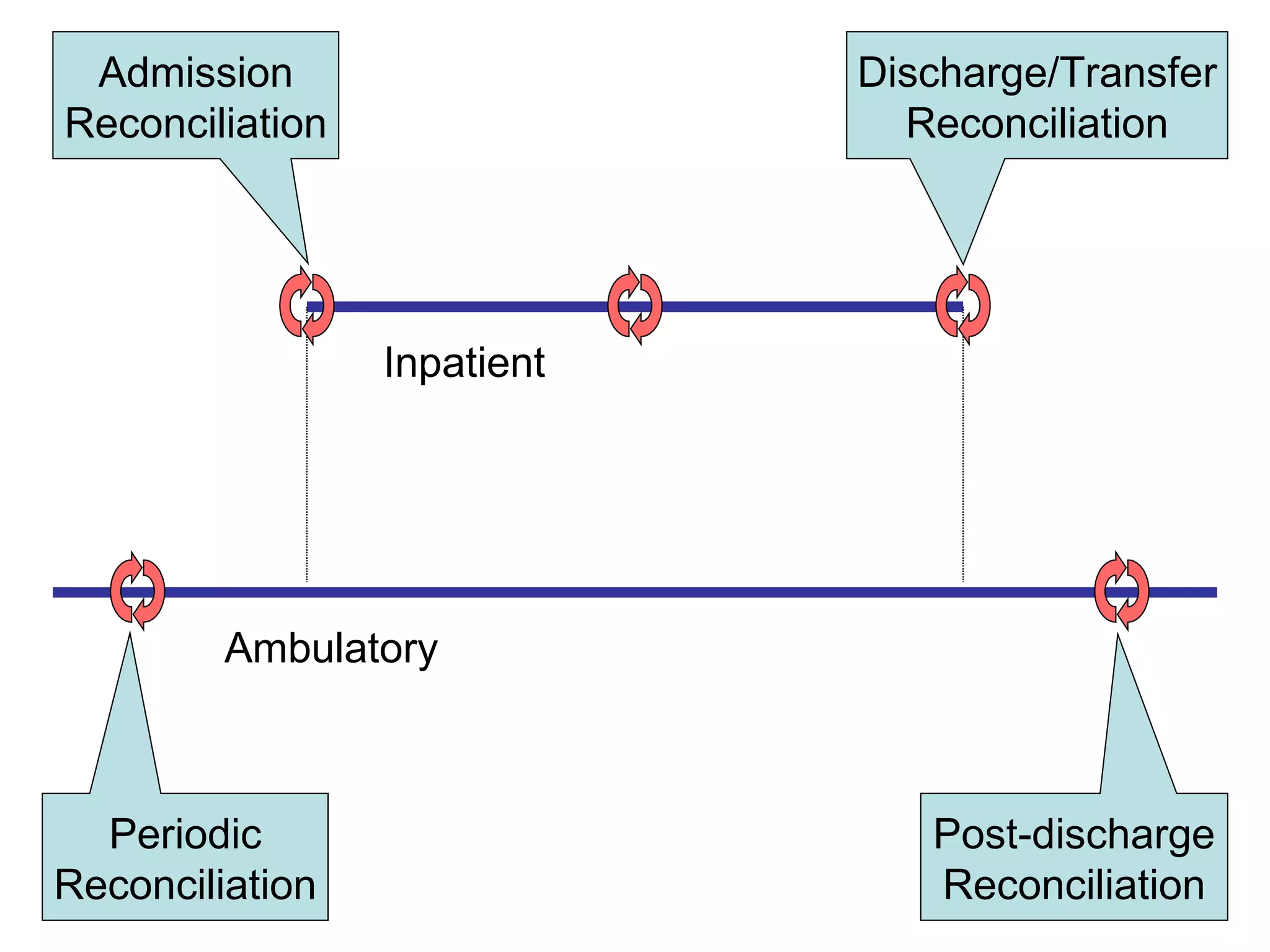
Ambulatory Inpatient Periodic Reconciliation Post-discharge Reconciliation Admission Reconciliation Discharge/Transfer Reconciliation
Background The problem of medical errors and adverse drug events Medication reconciliation practices in general  JCAHO mandate Why is Medication Reconciliation Important?
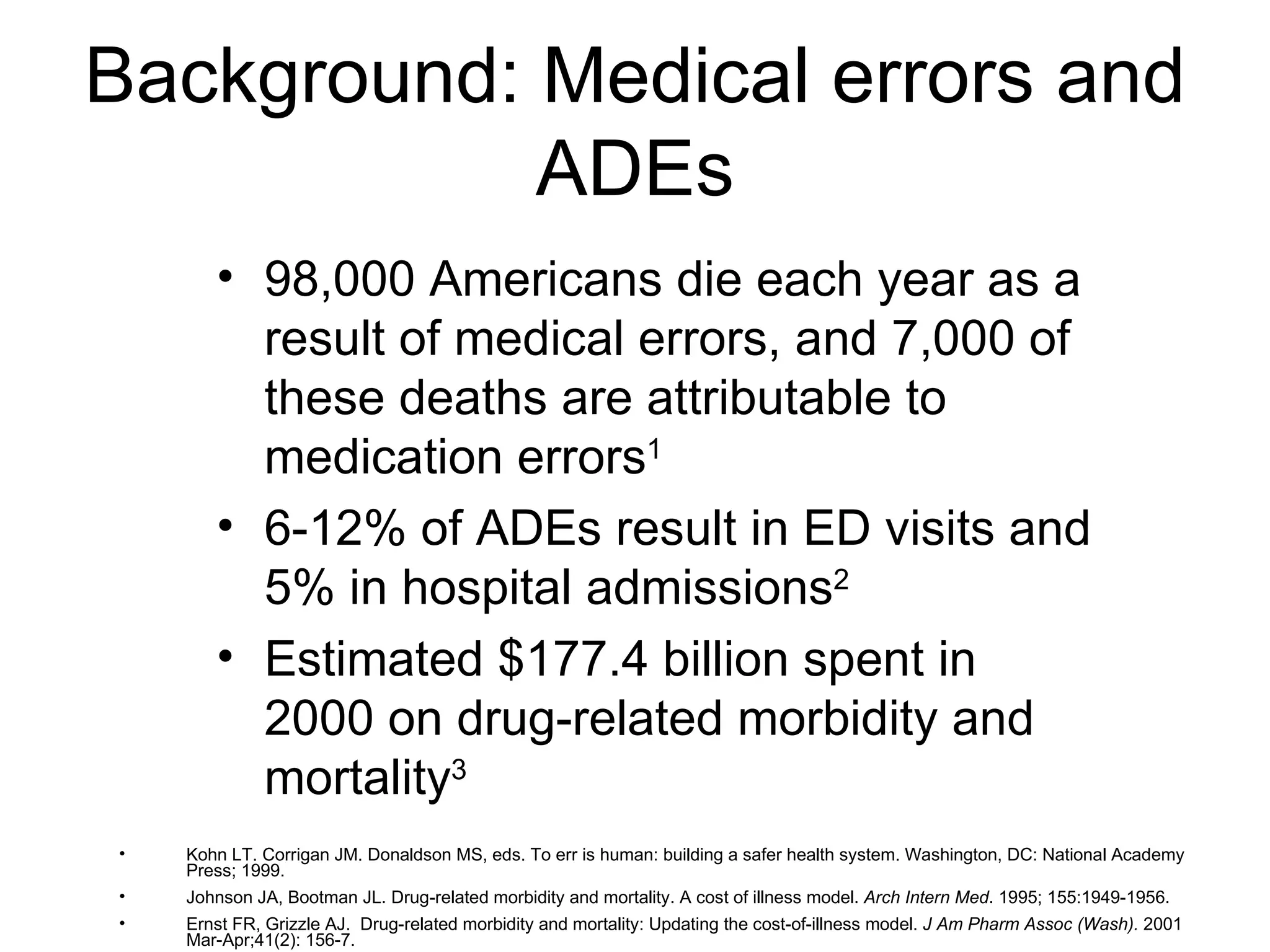
Background: Medical errors and ADEs 98,000 Americans die each year as a result of medical errors, and 7,000 of these deaths are attributable to medication errors 1 6-12% of ADEs result in ED visits and 5% in hospital admissions 2 Estimated $177.4 billion spent in 2000 on drug-related morbidity and mortality 3 Kohn LT. Corrigan JM. Donaldson MS, eds. To err is human: building a safer health system. Washington, DC: National Academy Press; 1999. Johnson JA, Bootman JL. Drug-related morbidity and mortality. A cost of illness model.  Arch Intern Med . 1995; 155:1949-1956. Ernst FR, Grizzle AJ.  Drug-related morbidity and mortality: Updating the cost-of-illness model.  J Am Pharm Assoc (Wash).  2001 Mar-Apr;41(2): 156-7.
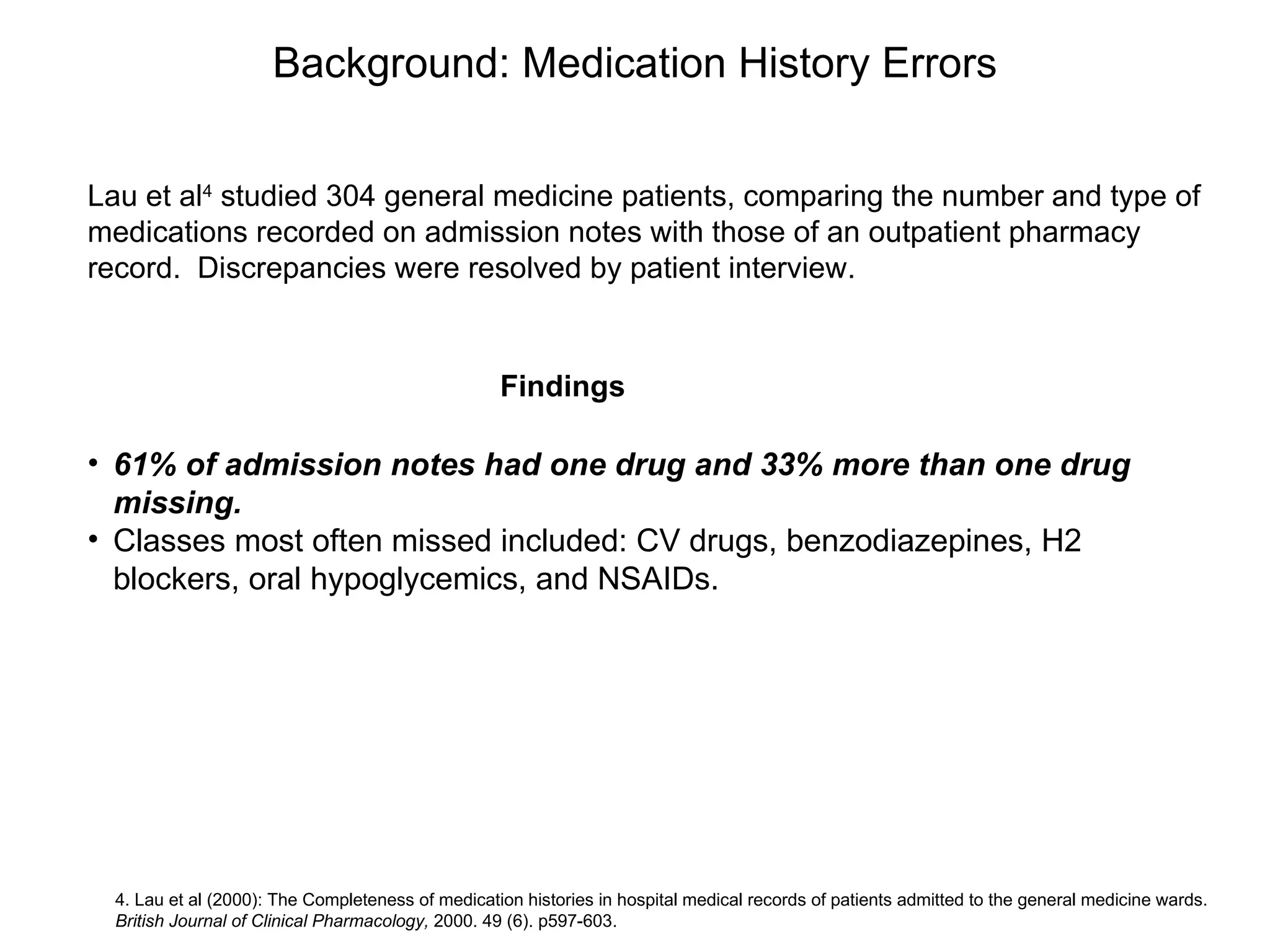
Background: Medication History Errors 61% of admission notes had one drug and 33% more than one drug missing. Classes most often missed included: CV drugs, benzodiazepines, H2 blockers, oral hypoglycemics, and NSAIDs.  4. Lau et al (2000): The Completeness of medication histories in hospital medical records of patients admitted to the general medicine wards.  British Journal of Clinical Pharmacology,  2000. 49 (6). p597-603. Lau et al 4  studied 304 general medicine patients, comparing the number and type of medications recorded on admission notes with those of an outpatient pharmacy record.  Discrepancies were resolved by patient interview. Findings
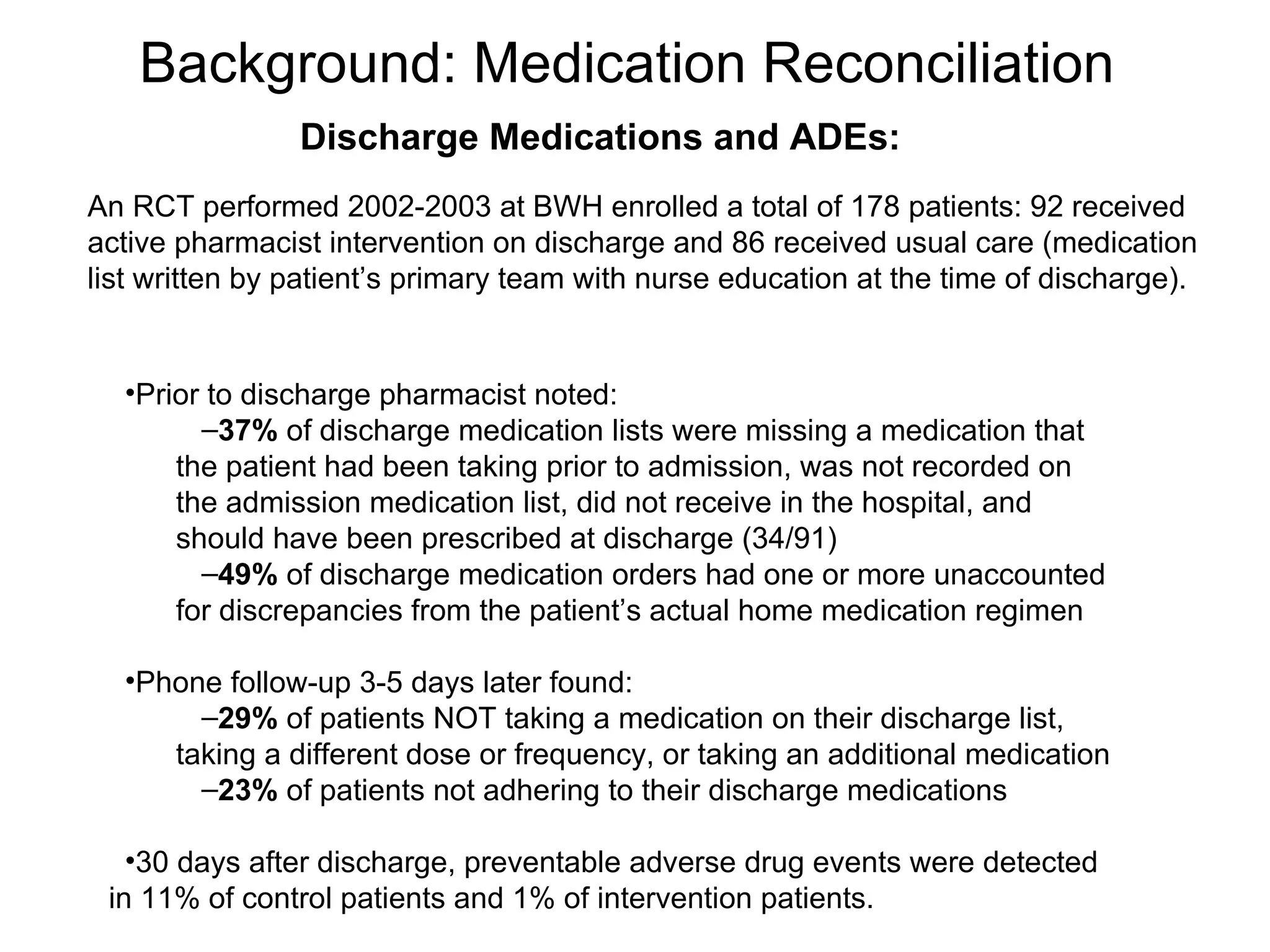
Background: Medication Reconciliation  Prior to discharge pharmacist noted: 37%  of discharge medication lists were missing a medication that the patient had been taking prior to admission, was not recorded on the admission medication list, did not receive in the hospital, and should have been prescribed at discharge (34/91) 49%  of discharge medication orders had one or more unaccounted for discrepancies from the patient’s actual home medication regimen Phone follow-up 3-5 days later found: 29%  of patients NOT taking a medication on their discharge list, taking a different dose or frequency, or taking an additional medication 23%  of patients not adhering to their discharge medications   30 days after discharge, preventable adverse drug events were detected in 11% of control patients and 1% of intervention patients. 5. Draft: Schnipper et al 2004.  Medication Problems During and After Hospitalization:   Findings from a Pilot Study of Pharmacist Interventions Discharge Medications and ADEs:  An RCT performed 2002-2003 at BWH enrolled a total of 178 patients: 92 received active pharmacist intervention on discharge and 86 received usual care (medication list written by patient’s primary team with nurse education at the time of discharge).
Background: National Mandate JCAHO Goal:  Medication Reconciliation of 100% Patients Accurately and completely reconcile medications across the  continuum of care Develop a process for  obtaining and documenting a complete list of the patient's current medications  upon the patient's admission to the organization, with the involvement of the patient, including a  comparison of the medications the organization provides to those on the list Communicate a complete list of the patient's medications to the next provider of service when the patient is referred or transferred to another setting, service, practitioner or level of care within or outside the organization.
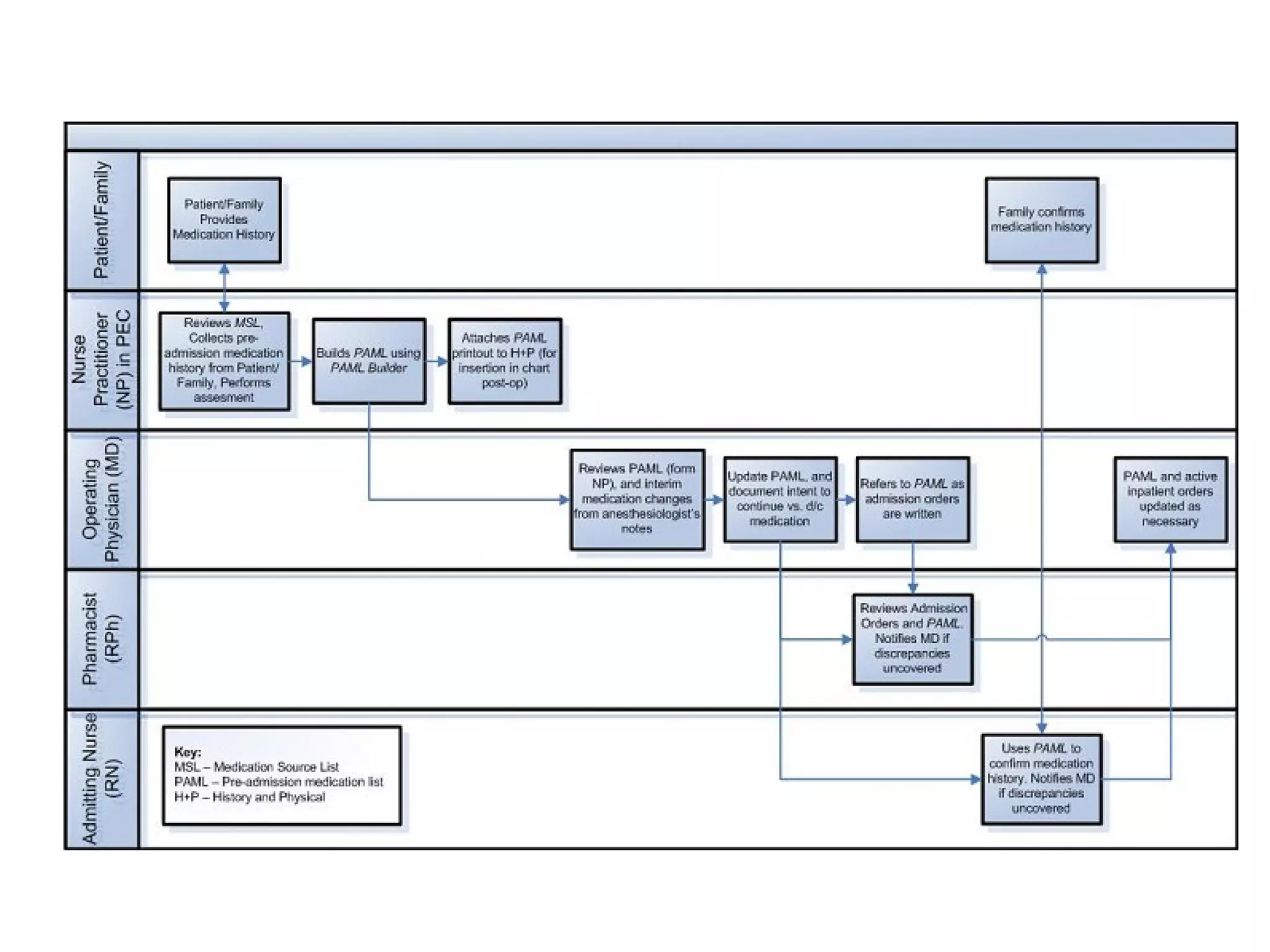
Multidisciplinary Process Roles History Taking Verifier “ Reconciliator” Discipline  Physician  Nurse Pharmacist Settings Inpatient Clinic Office Pharmacy
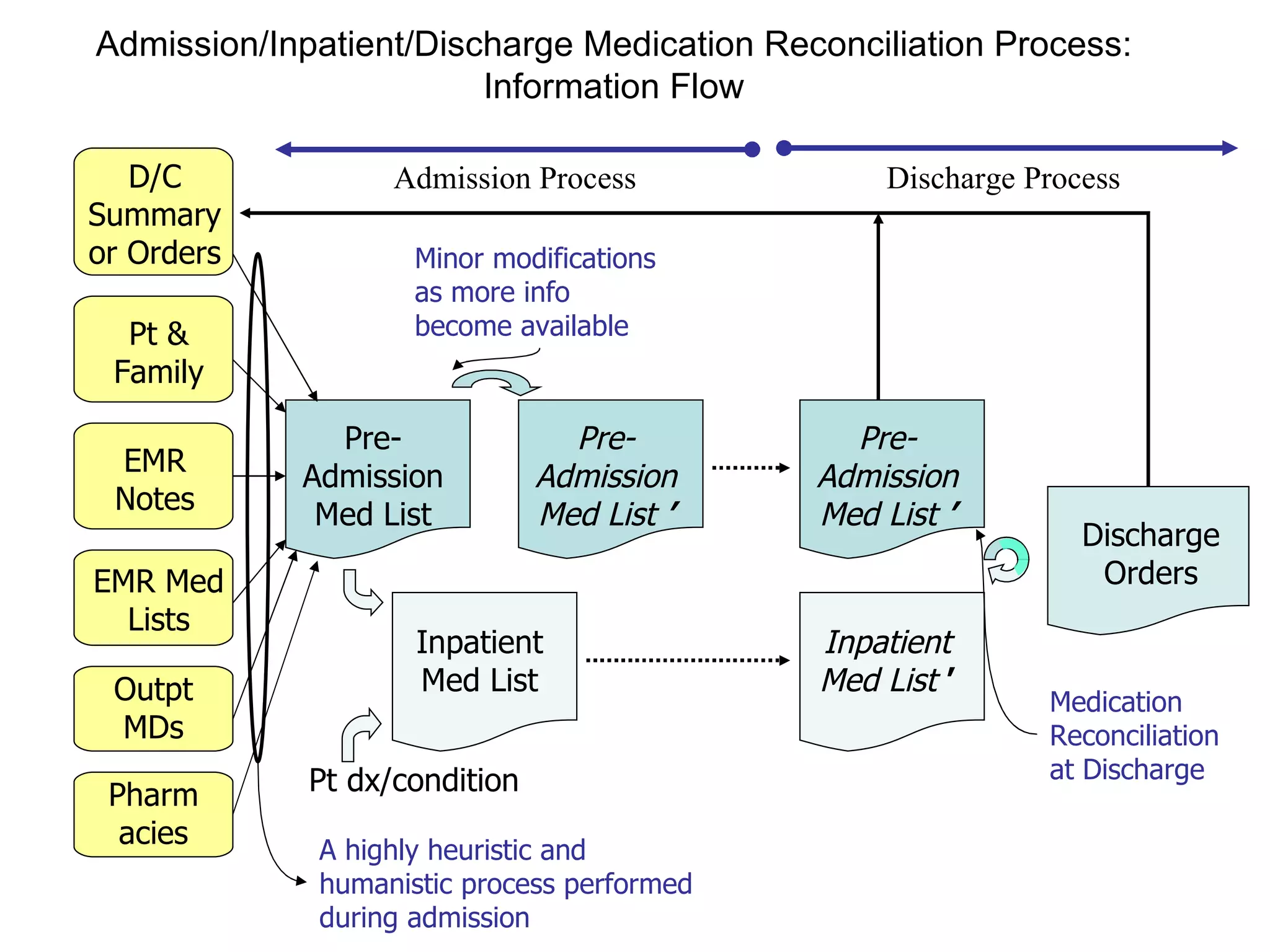
Admission/Inpatient/Discharge Medication Reconciliation Process: Information Flow Inpatient Med List Inpatient Med List   ’ DischargeOrders A highly heuristic and humanistic process performed during admission Minor modifications as more info become available Medication Reconciliation at Discharge Pt dx/condition Discharge Process Admission Process EMR Notes EMR Med Lists D/C Summary or Orders Pt & Family Outpt MDs Pharmacies Pre-Admission Med List Pre-Admission Med List  ’ Pre-Admission Med List  ’
Outline Informatics interventions Pre Admission Med List  Application Development Unified Medication list  Ultimate Goal Data challenges
Development of the PAML


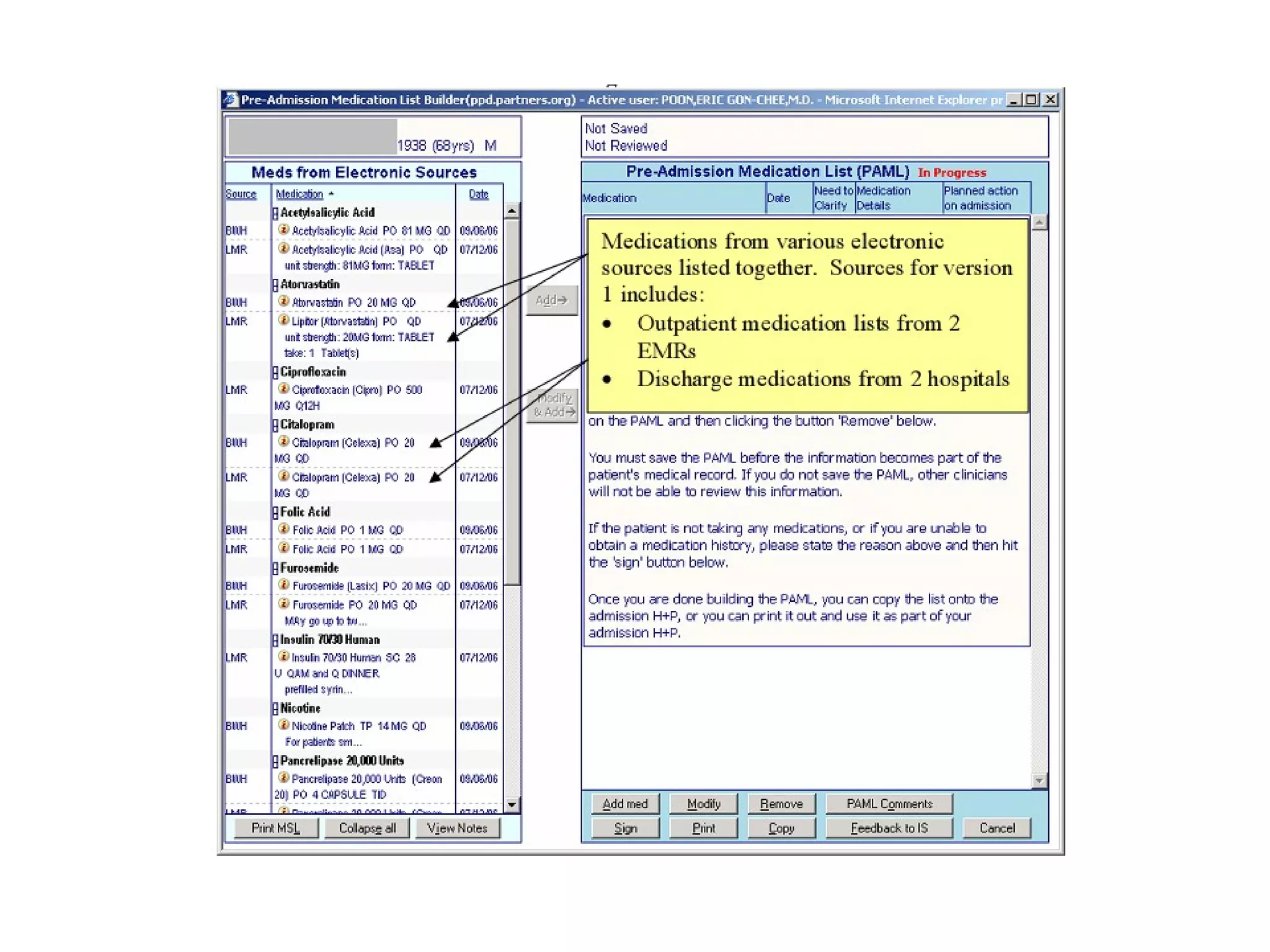
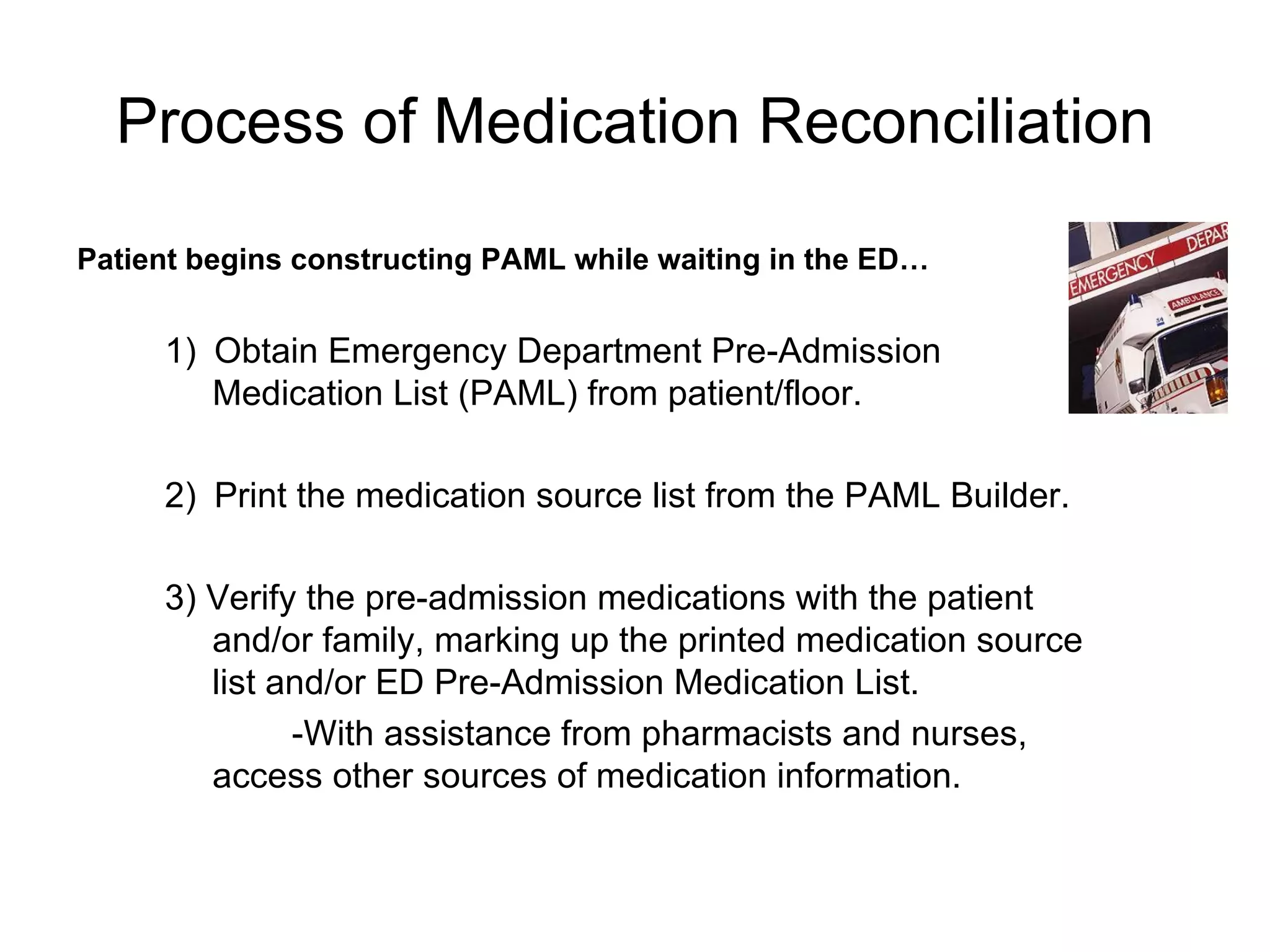
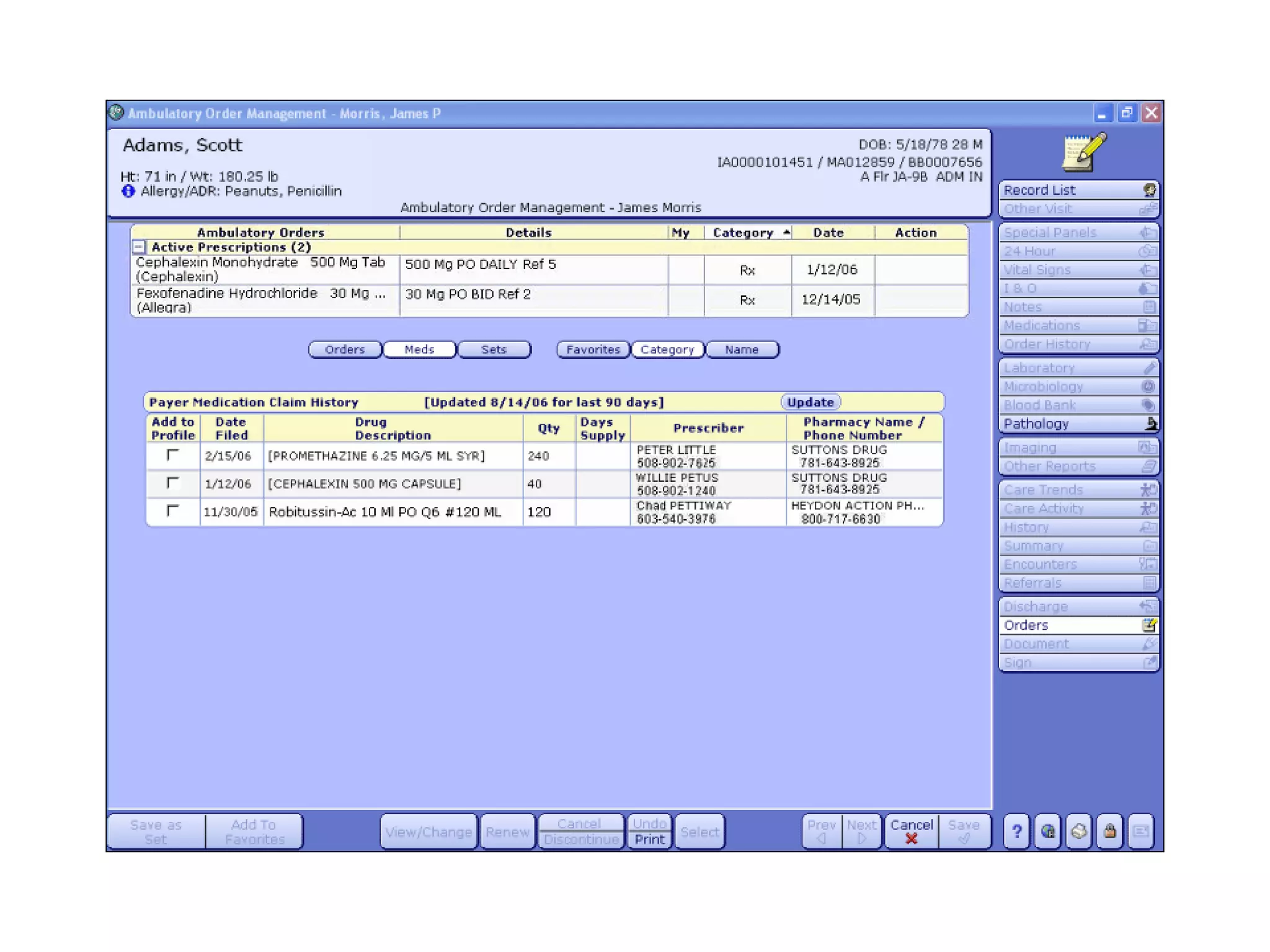
Process of Medication Reconciliation 1)    Obtain Emergency Department Pre-Admission Medication List (PAML) from patient/floor. 2)    Print the medication source list from the PAML Builder. 3) Verify the pre-admission medications with the patient and/or family, marking up the printed medication source list and/or ED Pre-Admission Medication List.  -With assistance from pharmacists and nurses, access other sources of medication information.   Patient begins constructing PAML while waiting in the ED…
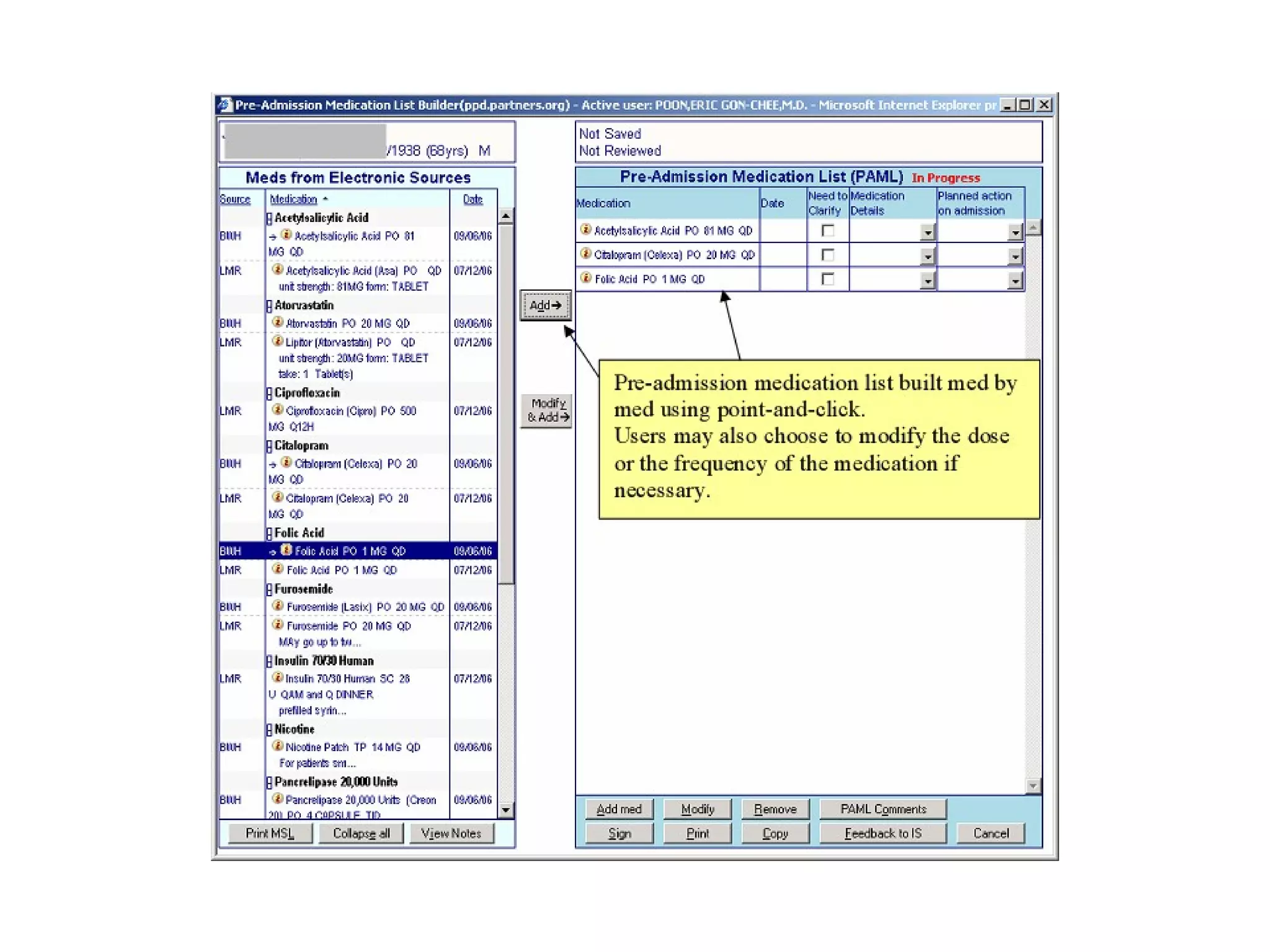
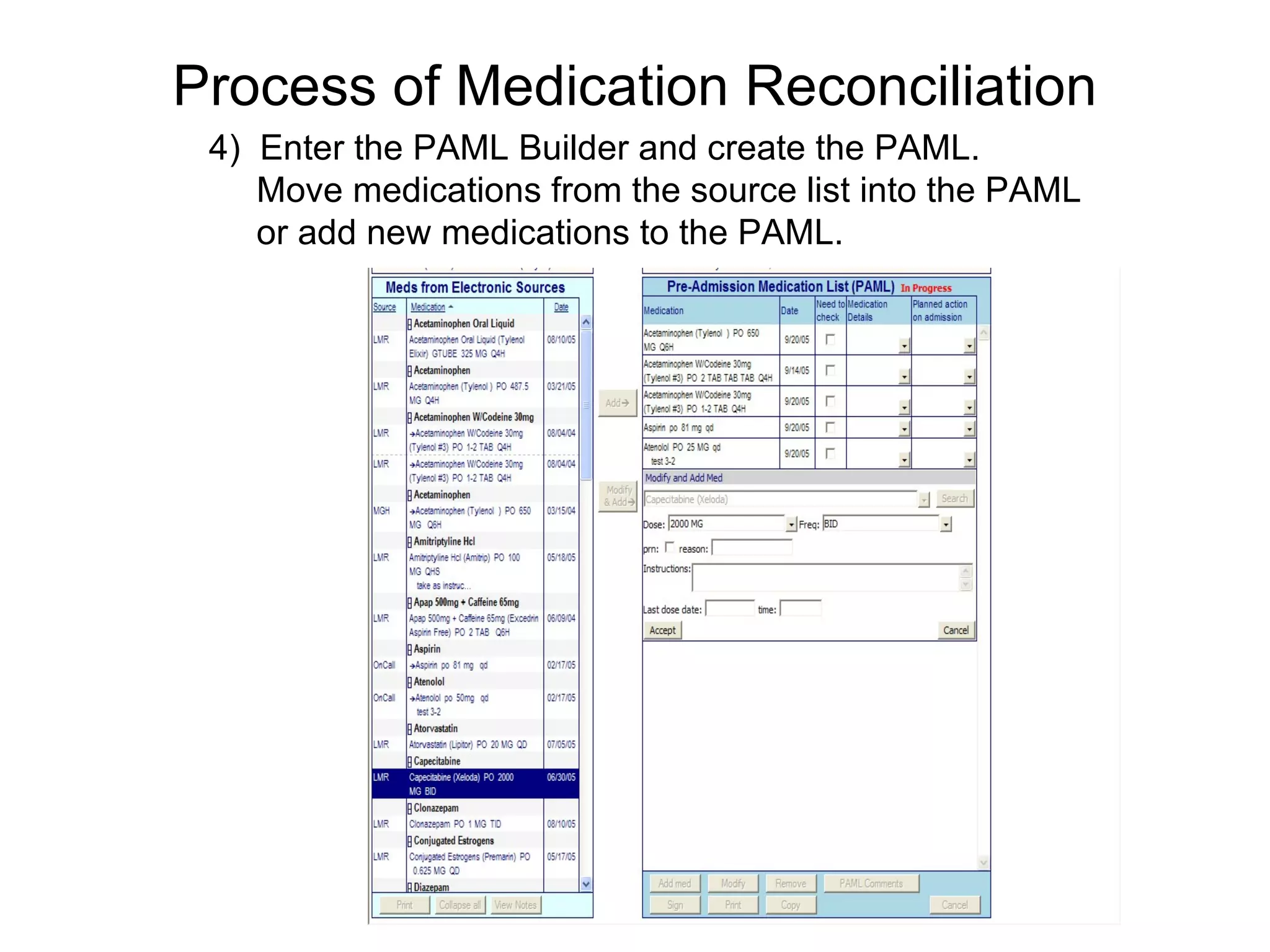
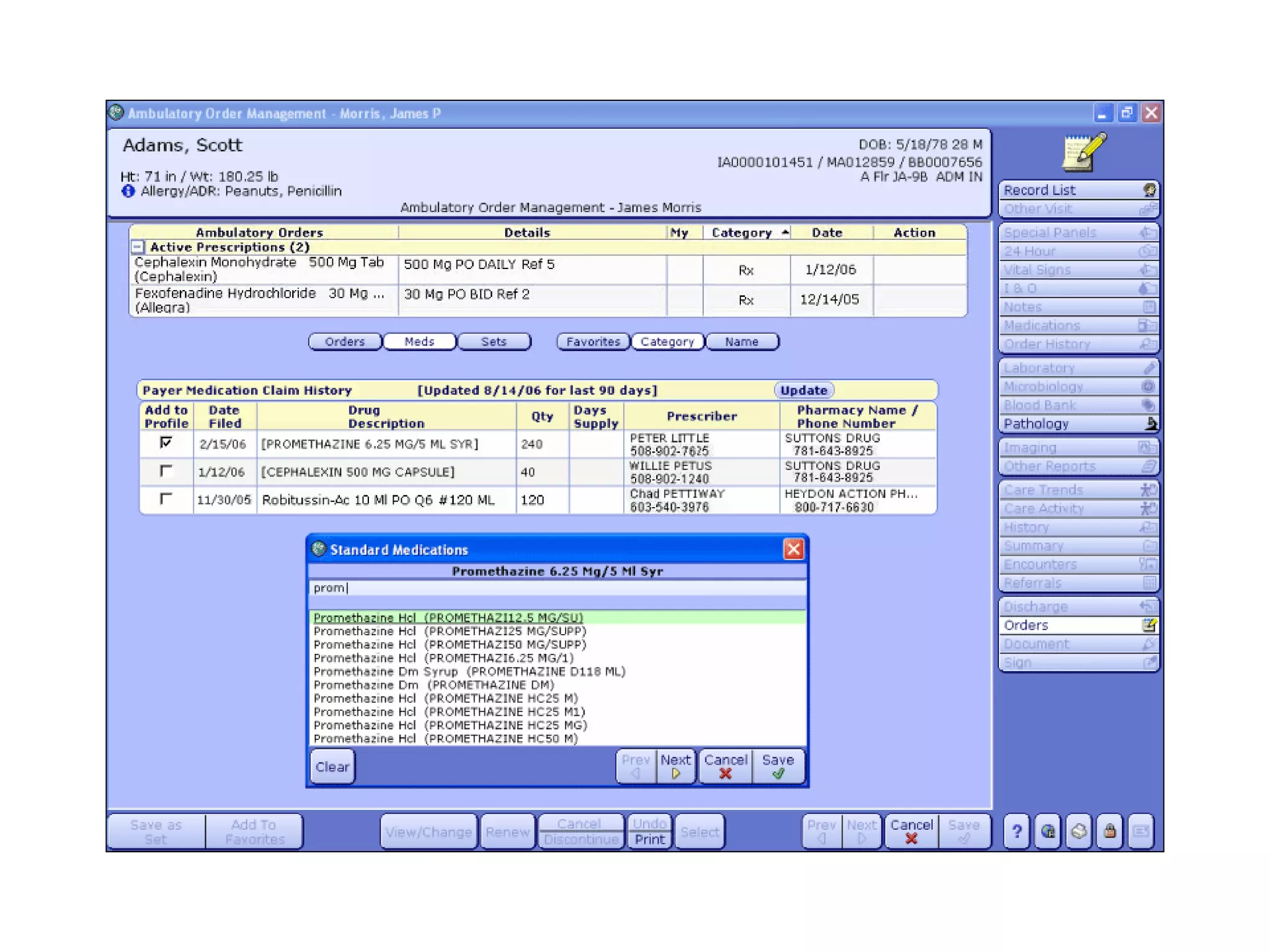
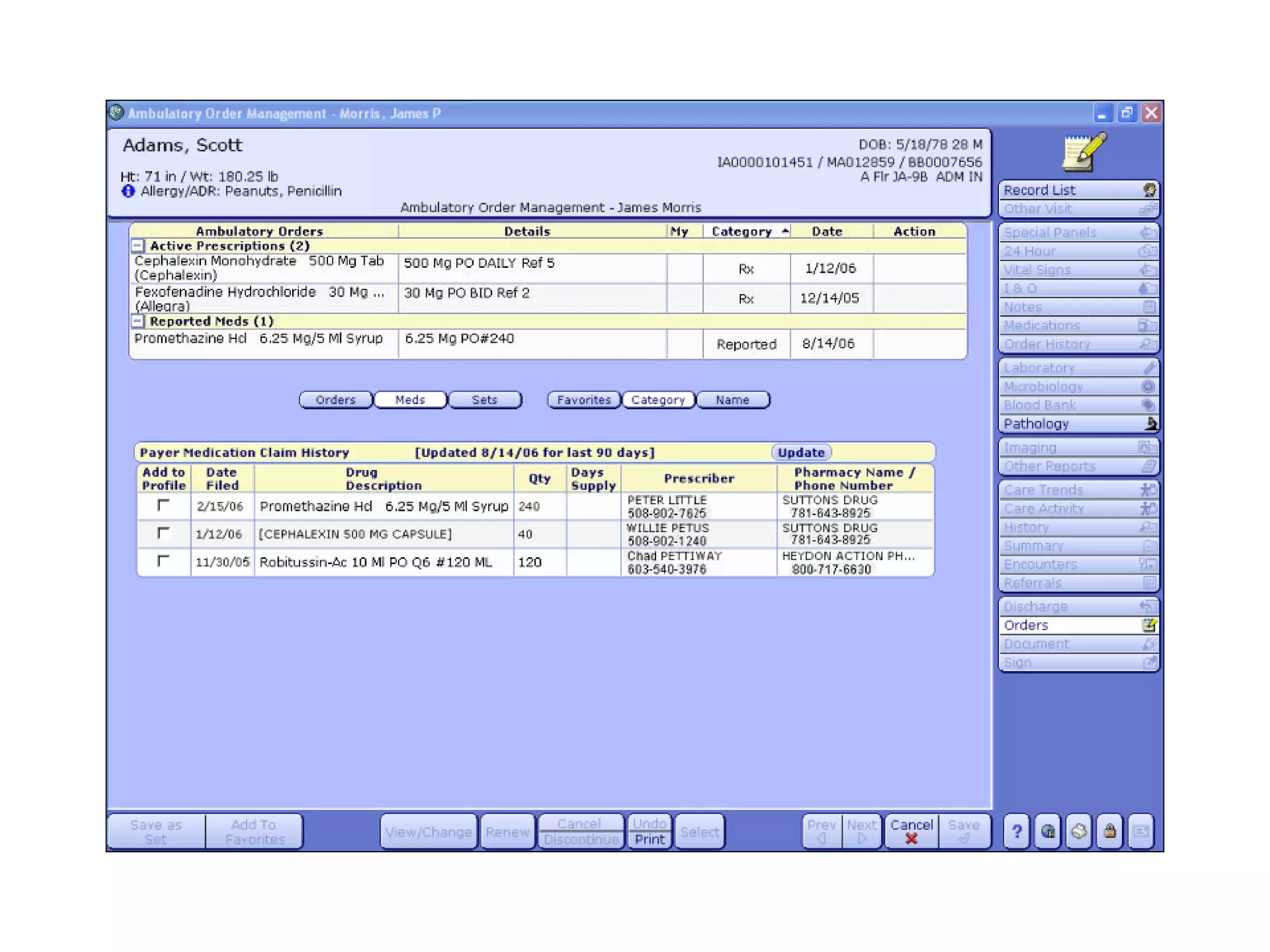
Process of Medication Reconciliation 4)  Enter the PAML Builder and create the PAML.  Move medications from the source list into the PAML or add new medications to the PAML.
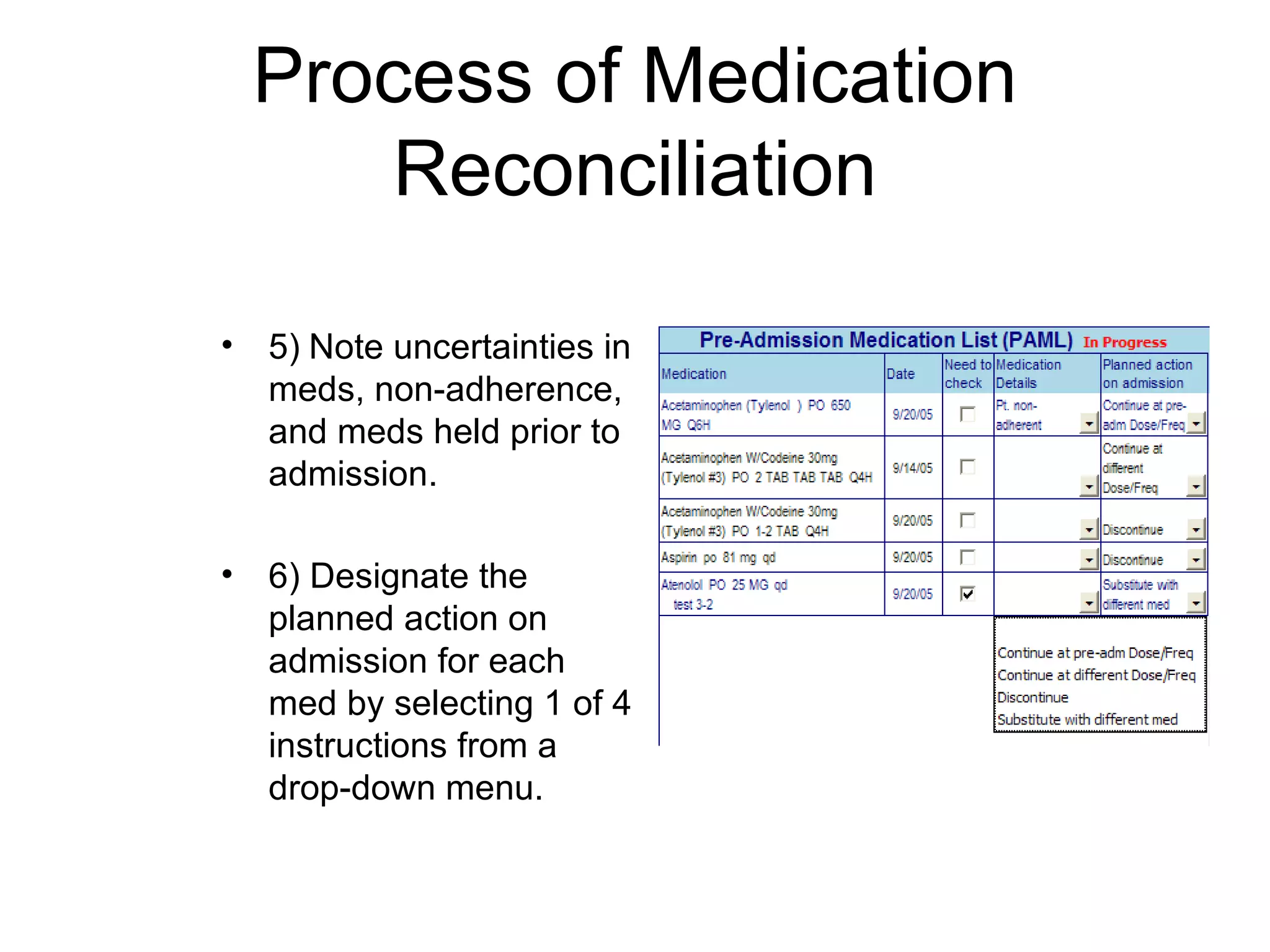
Process of Medication Reconciliation 5)   Note uncertainties in meds, non-adherence, and meds held prior to admission.  6) Designate the planned action on admission for each med by selecting 1 of 4 instructions from a drop-down menu.
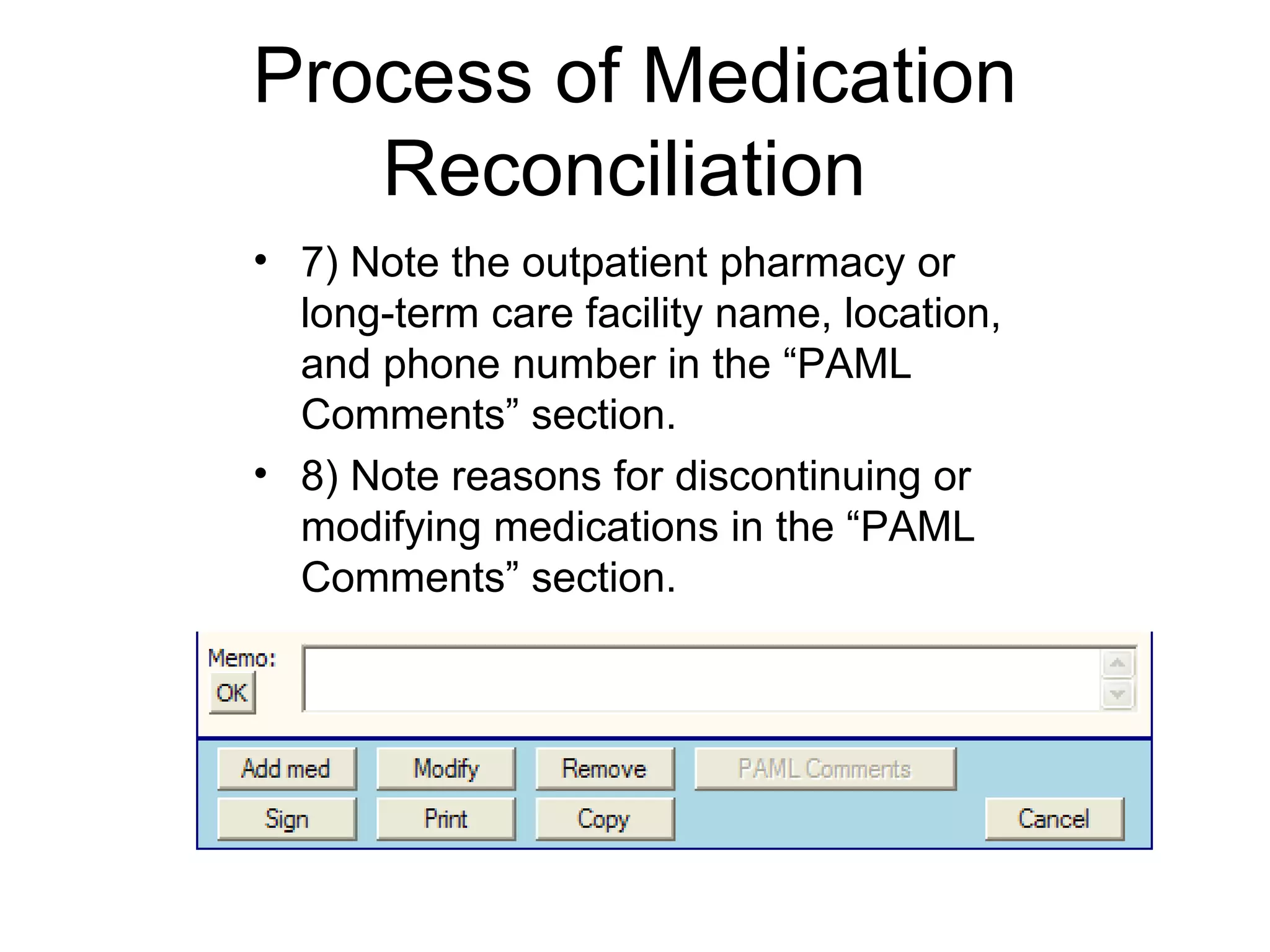
Process of Medication Reconciliation  7) Note the outpatient pharmacy or long-term care facility name, location, and phone number in the “PAML Comments” section. 8) Note reasons for discontinuing or modifying medications in the “PAML Comments” section .
Process of Medication Reconciliation  9)   Complete the PAML and mark it as ready for review within 24 hours of admission.  10) During the course of the admission, update the PAML based on additional input from pharmacists, nurses, patients, and families.
Process of Medication Reconciliation  11) Reconcile the PAML and discharge medications to create a coherent discharge medication regimen, noting reasons for changing or discontinuing pre-admission medications in “PAML Comments.”  Then check a box verifying that the PAML and discharge medications have been reconciled. 12) Copy-and-paste the PAML into the discharge summary or note the exact changes from the PAML to the discharge regimen in the discharge summary. 13) If a medical student or nurse in the CPE builds a patient’s PAML, review it and mark it as ready for 2 nd  review.  If a medical student writes a patient’s discharge orders, verify that the PAML and discharge orders have been reconciled.  Discharge
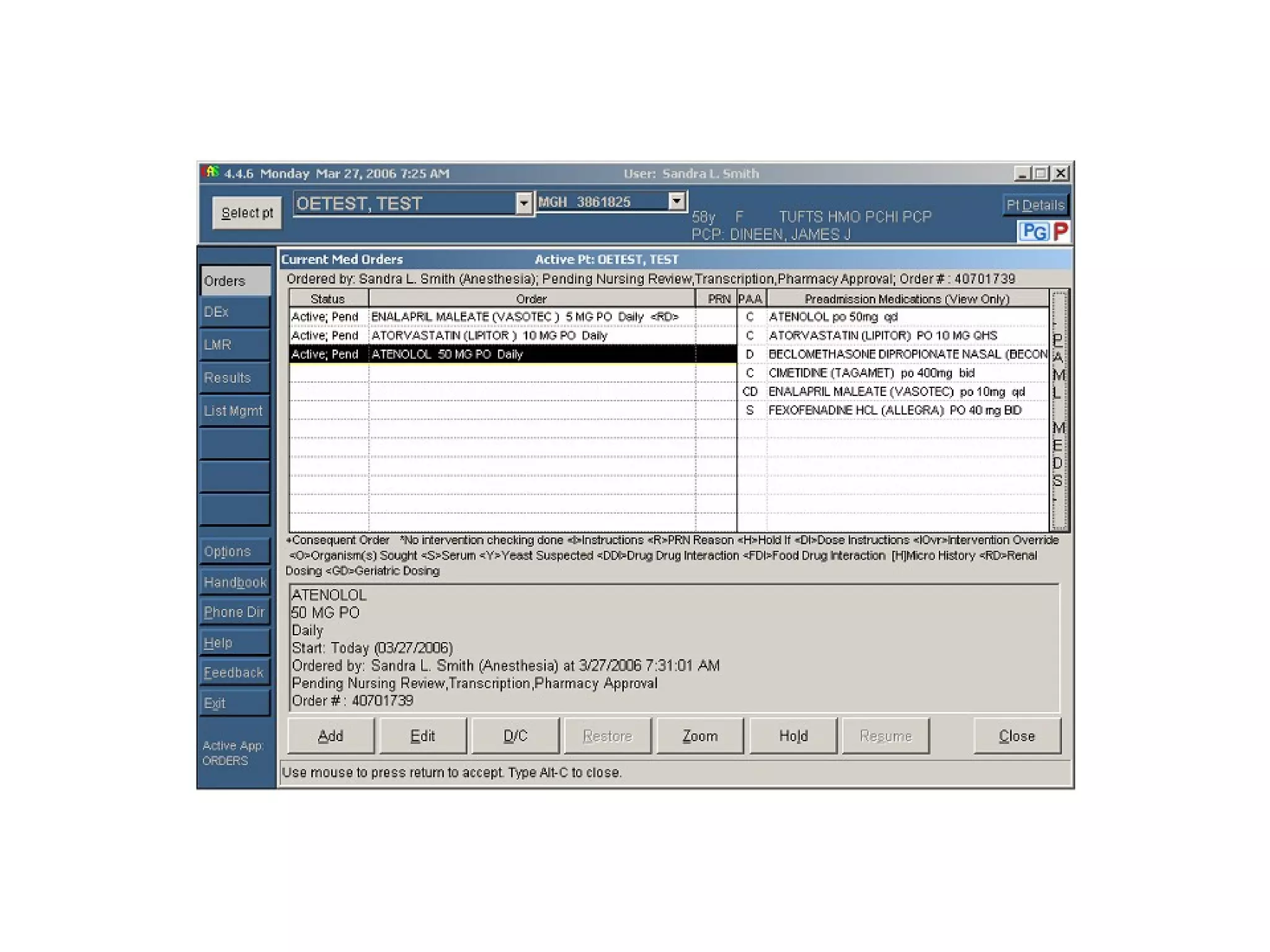
What are the benefits of the PAML? Improves patient safety by decreasing ADEs Improves communication between providers Eliminates redundancy in obtaining medication history Increases compliance with JACHO requirements Technology will eventually allow for more efficient order entry
For the future Content Mapping of Medications Functions Ordering from the Pre Admin Med List Integration of CDS Criteria for pharmacist in-depth review System Integration Retrieval of Medications from additional sources


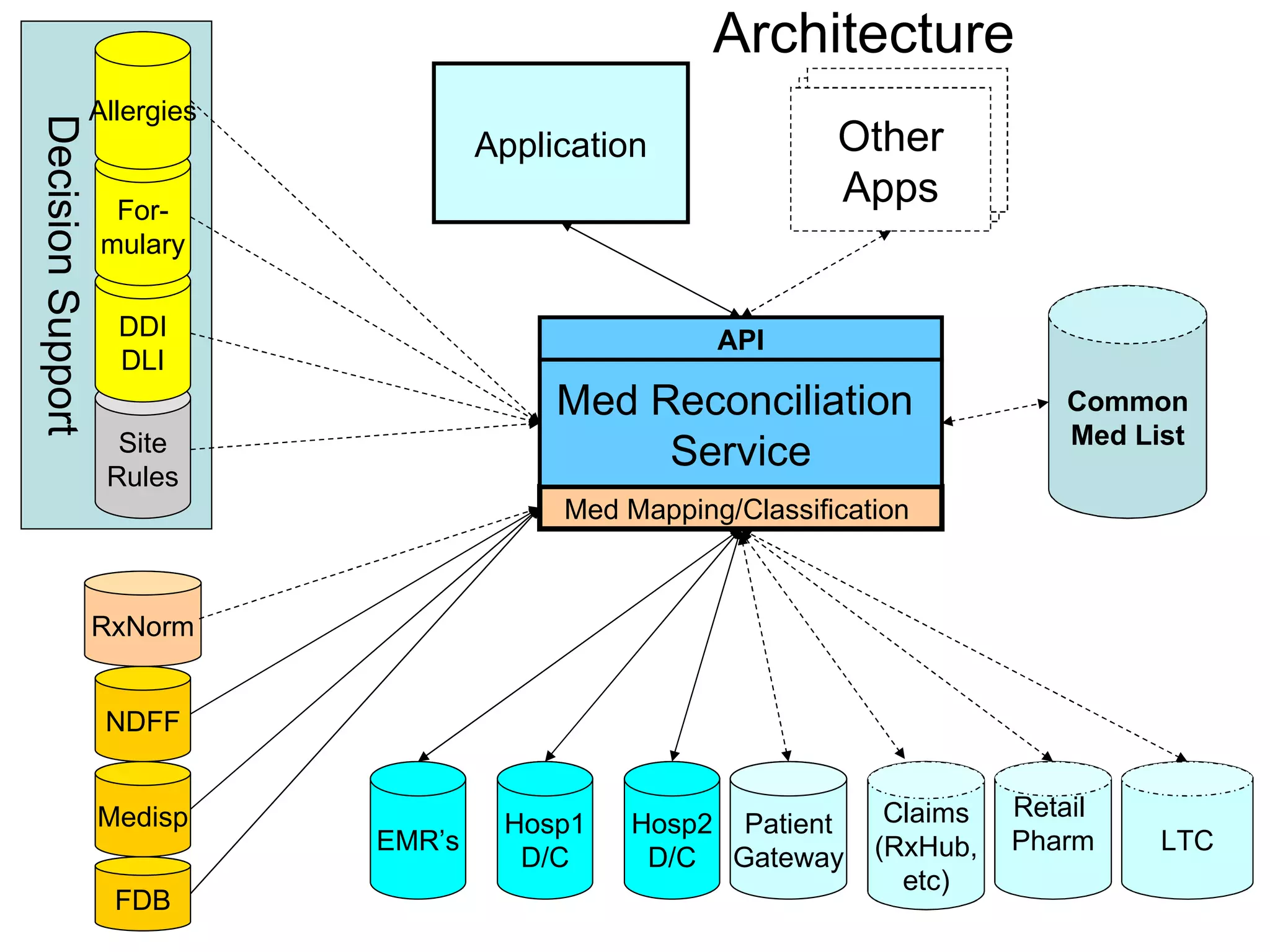
Architecture Med Mapping/Classification  EMR’s Hosp1 D/C Hosp2 D/C Med Reconciliation  Service API Application Common Med List Other Apps Decision Support Site Rules DDI DLI For- mulary Allergies FDB Medisp NDFF RxNorm Patient Gateway Claims (RxHub, etc) Retail  Pharm LTC
Multi-Usage Drug Terminology:  Making Sense of the Tower of Medication Terminology Babble
The Need  The History Definitions and requirements Important concepts A few challenges The Solution? Good Medication Nomenclature Practice Today
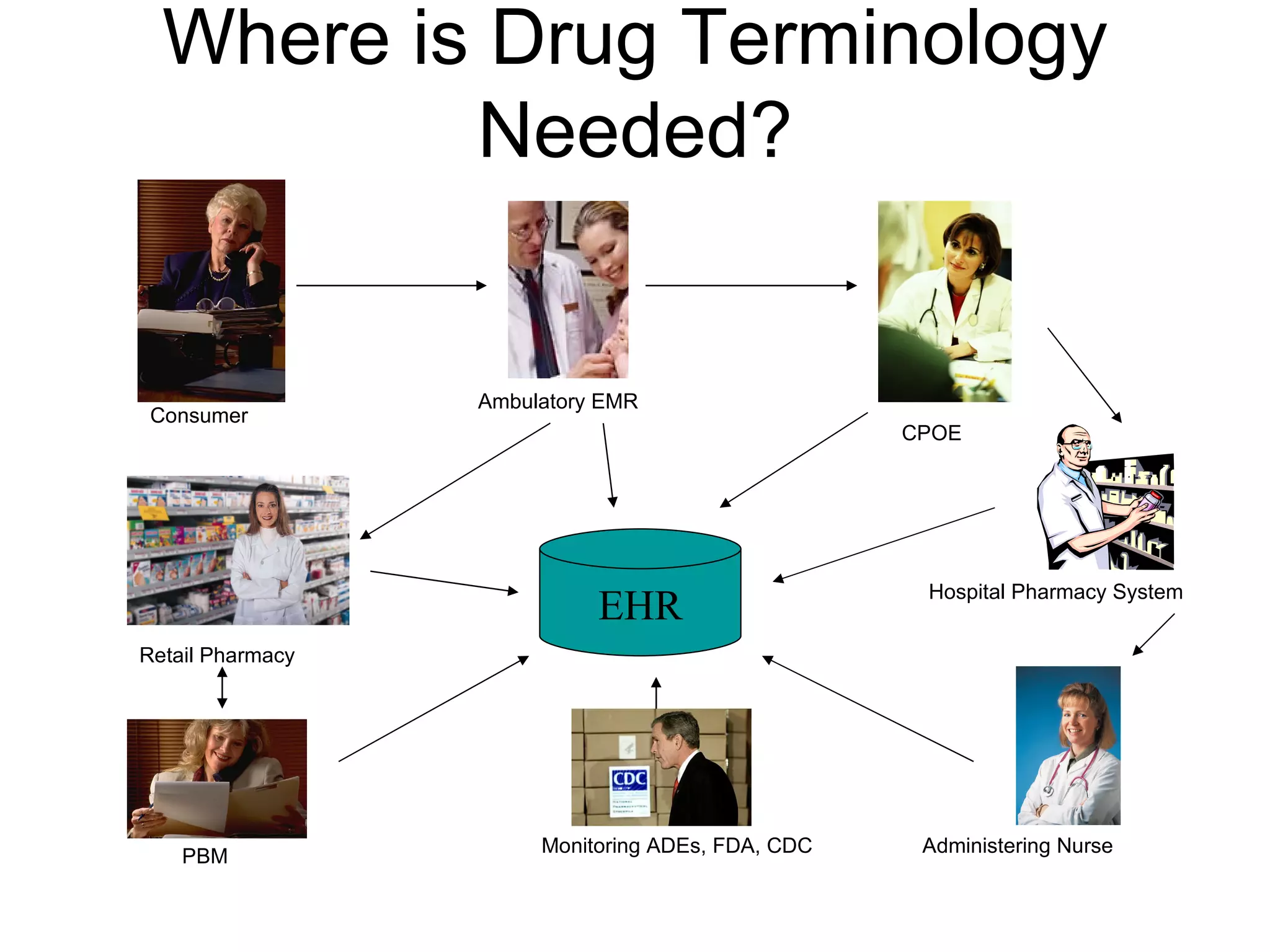
Where is Drug Terminology Needed? EHR Consumer CPOE Ambulatory EMR Retail Pharmacy Hospital Pharmacy System PBM Administering Nurse Monitoring ADEs, FDA, CDC
The Problem Limited ability to exchange drug information  Can  electronically exchange some information about packaged drug products (NDC   0006-0114-68, Lipitor 10mg tablets in bottles of 100)  Cannot  share other clinically useful concepts (atorvastatin [Lipitor] 50mg PO once daily)…due to lack of a standard (coded) terminology for exchange
A bit of history of Drug Databases The big three FDB Medispan Multum Others Micromedex Gold Standard Multimedia Drug Information Technologies
A bit of history of Drug Databases Ninties to early 2000’s Consolidation  FDB purchases Medicom and MediSpan The Enron/HealthSouth Episode of Drug DBs FDB achieved monopoly power in the sale of integratable drug data files in the United States. The effects of the acquisition were drastic price increases to customers, and reductions in product quality and customer service.  FTC disgorgement  Sale of Medispan to WK
Why National Drug Codes Stink Product Package Specific No Central Authority Assigned by Manufacture Multiple Formats Codes reused Assigned to non drug items Some but not all OTCs
The Problem Terminologies exist, but: Most are expensive to license Many are specialized for specific uses or incomplete in some areas They are incompatible
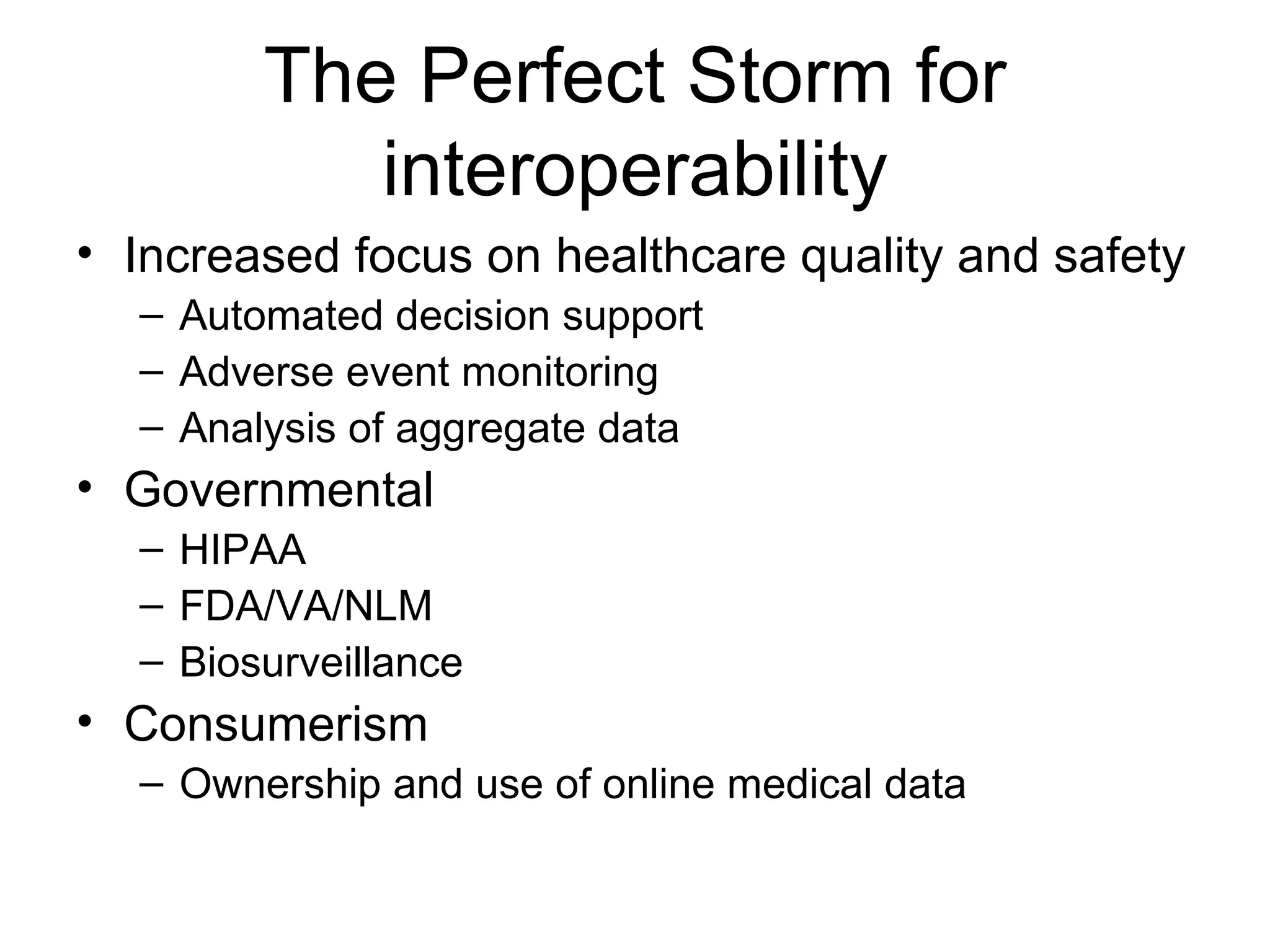
The Perfect Storm for interoperability Increased focus on healthcare quality and safety Automated decision support  Adverse event monitoring Analysis of aggregate data Governmental HIPAA FDA/VA/NLM Biosurveillance Consumerism Ownership and use of online medical data
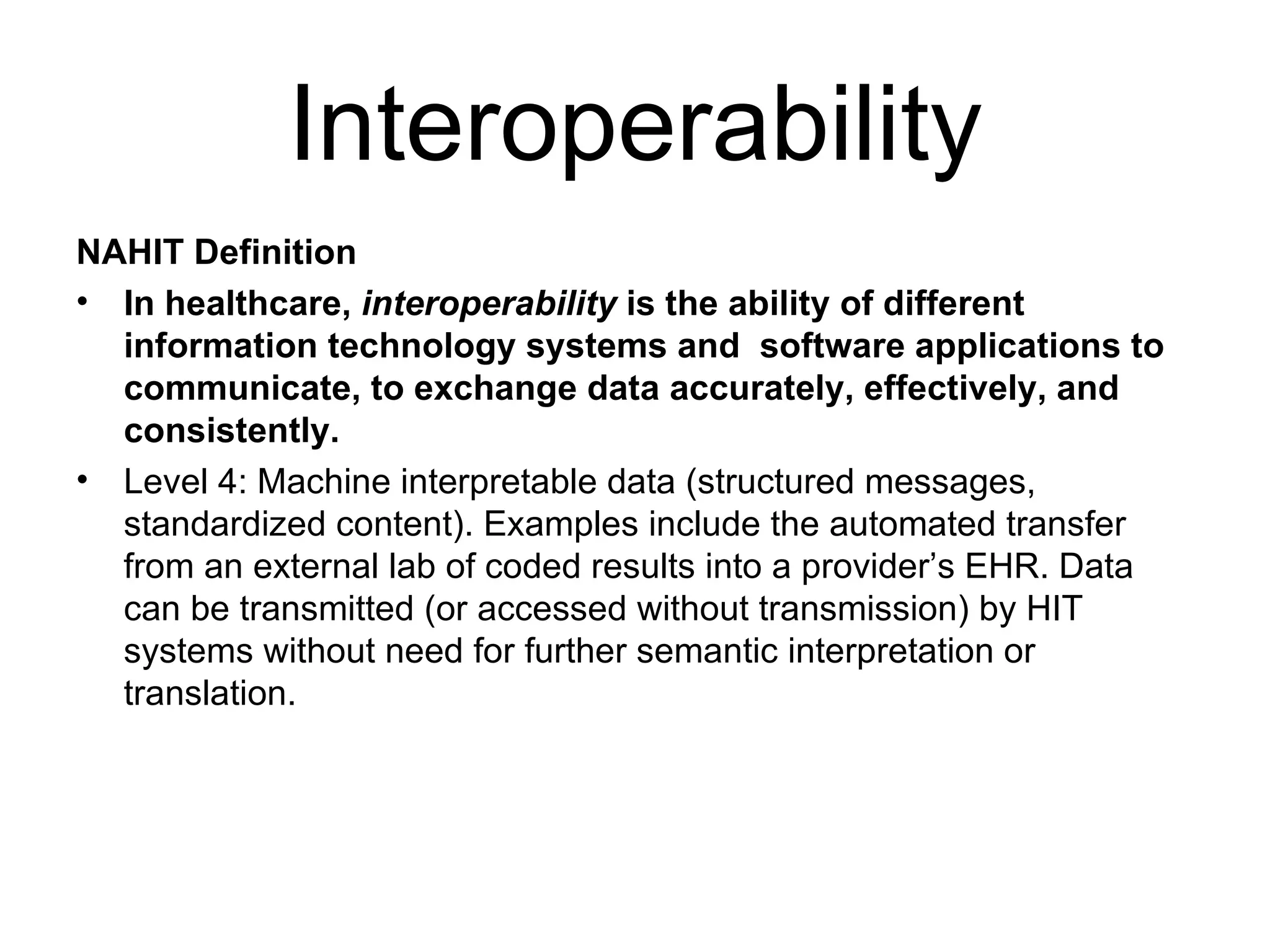
Interoperability NAHIT Definition In healthcare,  interoperability  is the ability of different information technology systems and  software applications to communicate, to exchange data accurately, effectively, and consistently. Level 4: Machine interpretable data (structured messages, standardized content). Examples include the automated transfer from an external lab of coded results into a provider’s EHR. Data can be transmitted (or accessed without transmission) by HIT systems without need for further semantic interpretation or translation.
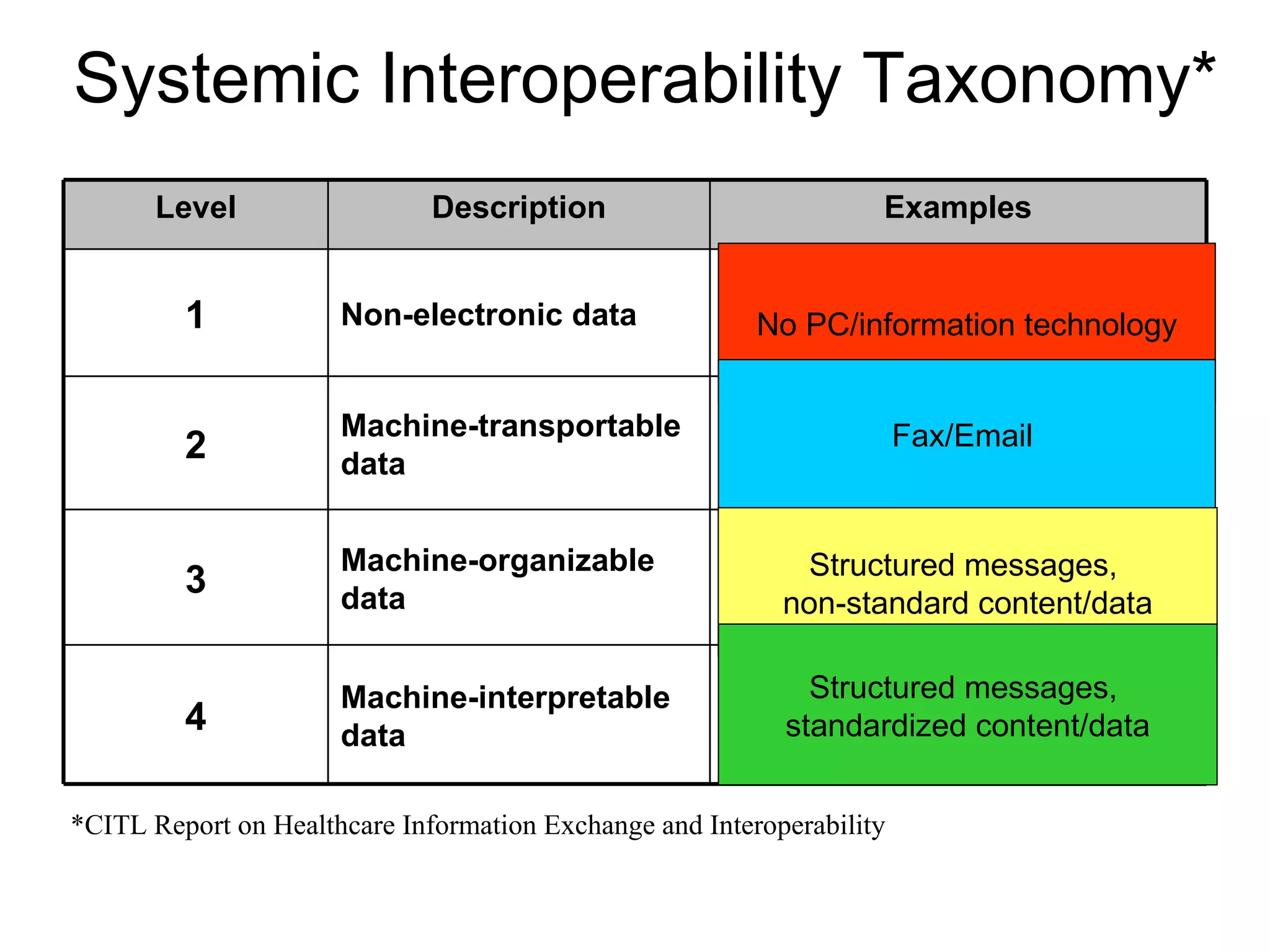
Systemic Interoperability Taxonomy* No PC/information technology Fax/Email  Structured messages,  non-standard content/data Structured messages,  standardized content/data *CITL Report on Healthcare Information Exchange and Interoperability Secure e-mail of free text and incompatible/proprietary structured messages, HL-7 msgs Machine-organizable data 3 PC-based and manual fax, e-mail, or scanned documents Machine-transportable data 2 Mail, phone Non-electronic data 1 EDI of structured messages with controlled terminology Machine-interpretable data 4 Examples Description Level
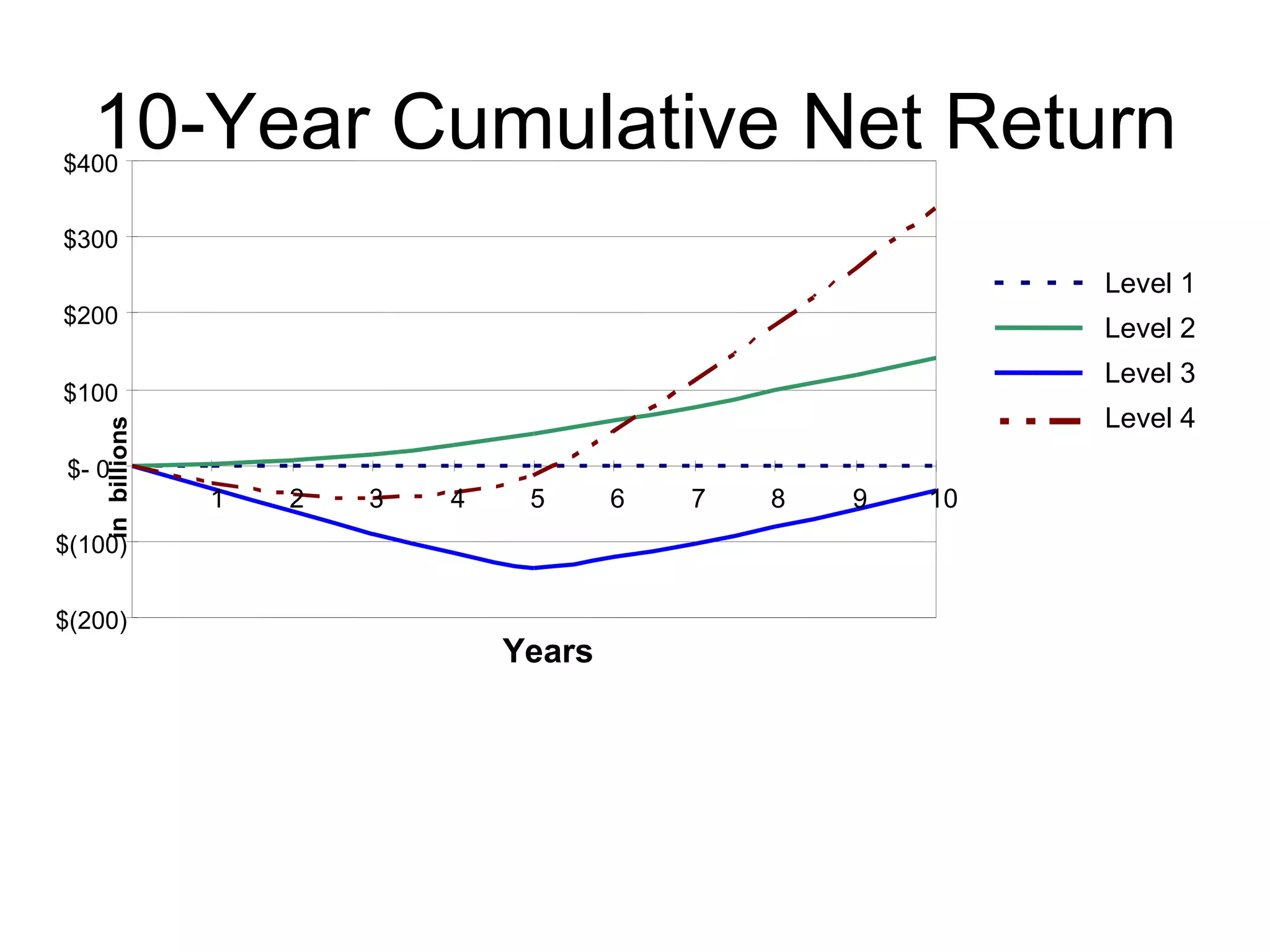
10-Year Cumulative Net Return Level 4 in  billions $(200) $(100) $- 0 $100 $200 $300 $400 1 2 3 4 5 6 7 8 9 10 Years Level 1 Level 2 Level 3
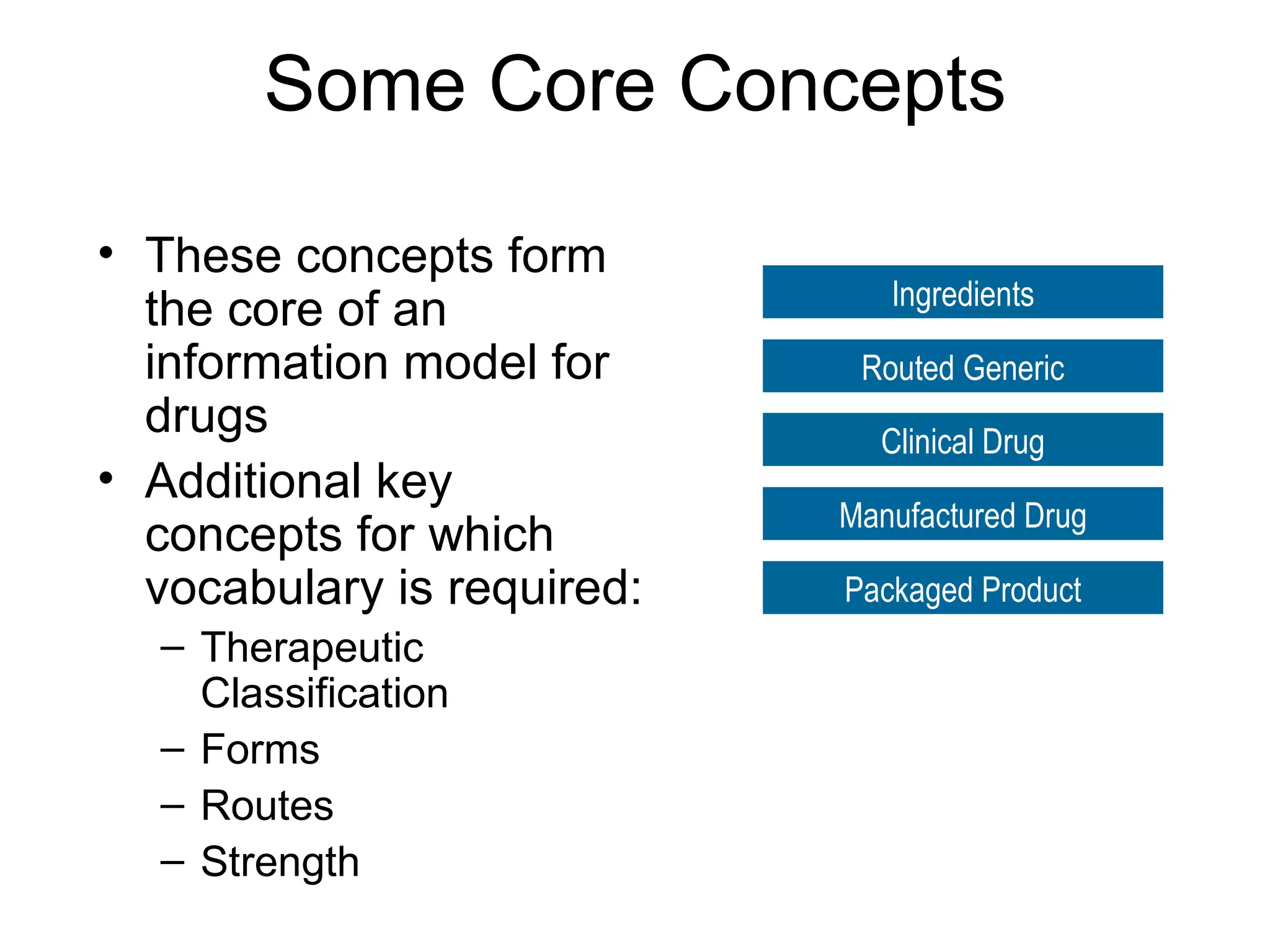
Some Core Concepts Clinical Drug Manufactured Drug Ingredients Packaged Product These concepts form the core of an information model for drugs Additional key concepts for which vocabulary is required: Therapeutic Classification Forms Routes Strength Routed Generic
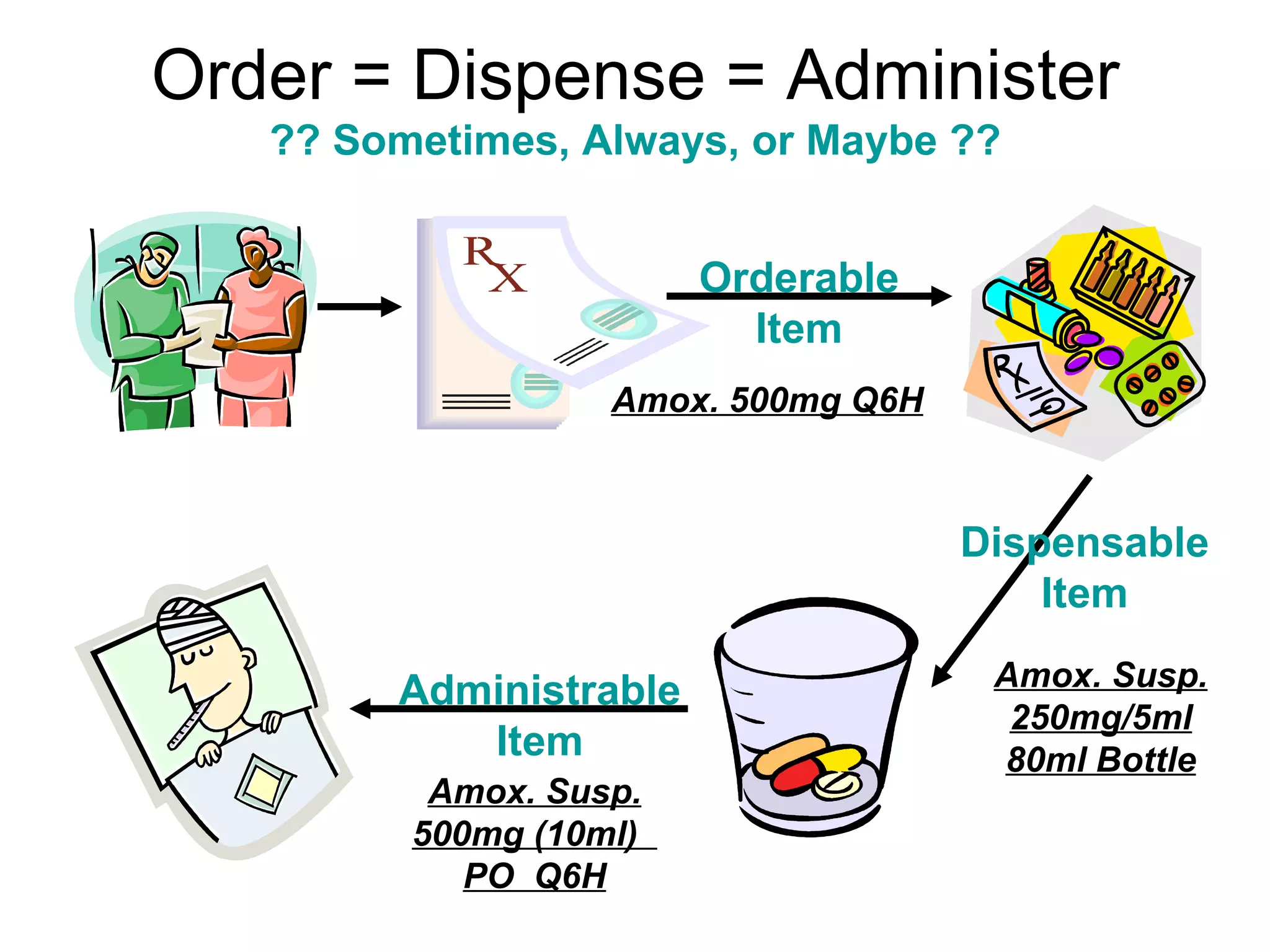
Order = Dispense = Administer Orderable Item Dispensable Item Administrable Item ?? Sometimes, Always, or Maybe ?? Amox. 500mg Q6H Amox. Susp. 250mg/5ml 80ml Bottle Amox. Susp. 500mg (10ml)  PO  Q6H
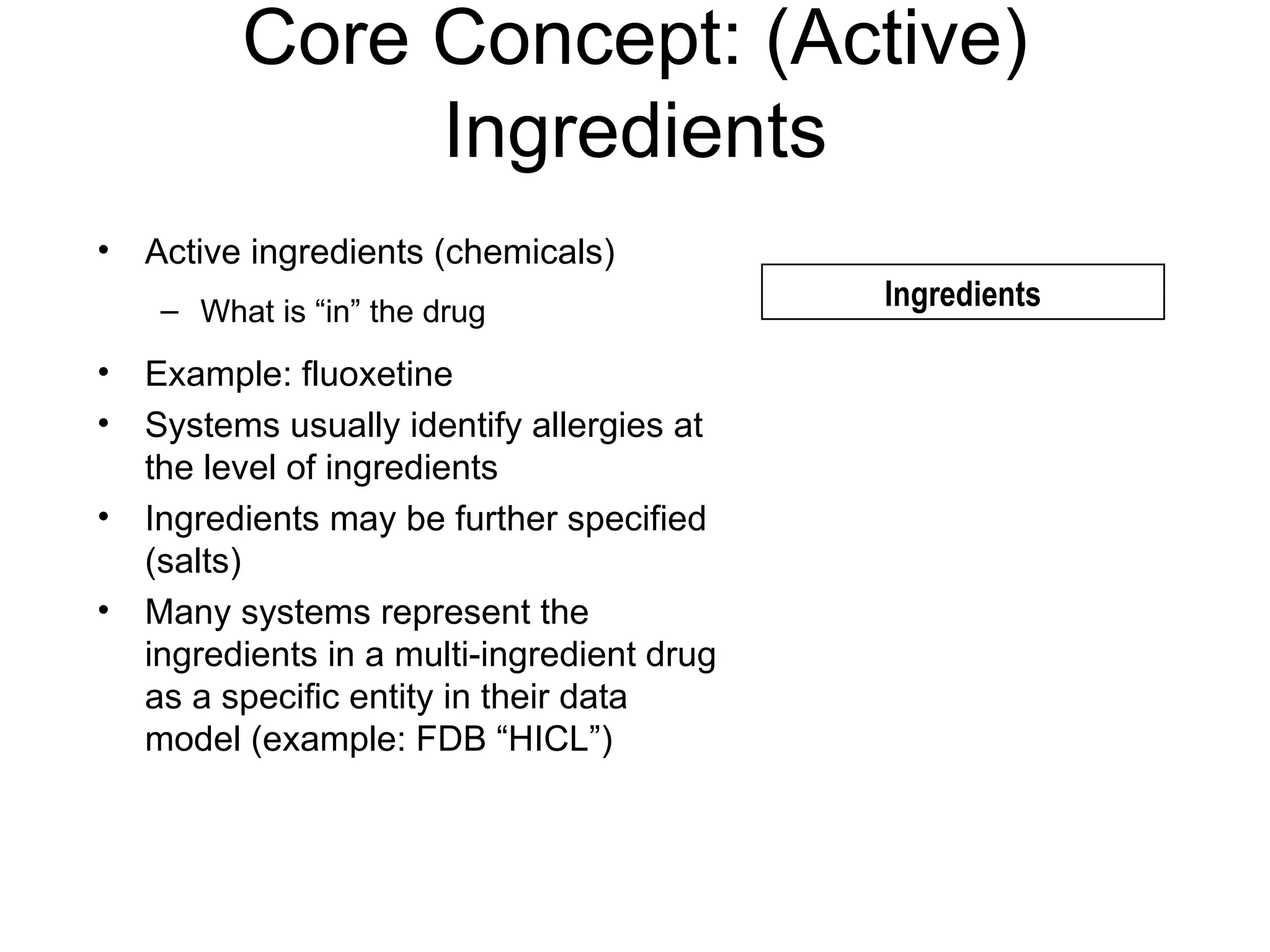
Core Concept: (Active) Ingredients Active ingredients (chemicals) What is “in” the drug Example: fluoxetine Systems usually identify allergies at the level of ingredients Ingredients may be further specified (salts) Many systems represent the ingredients in a multi-ingredient drug as a specific entity in their data model (example: FDB “HICL”) Ingredients
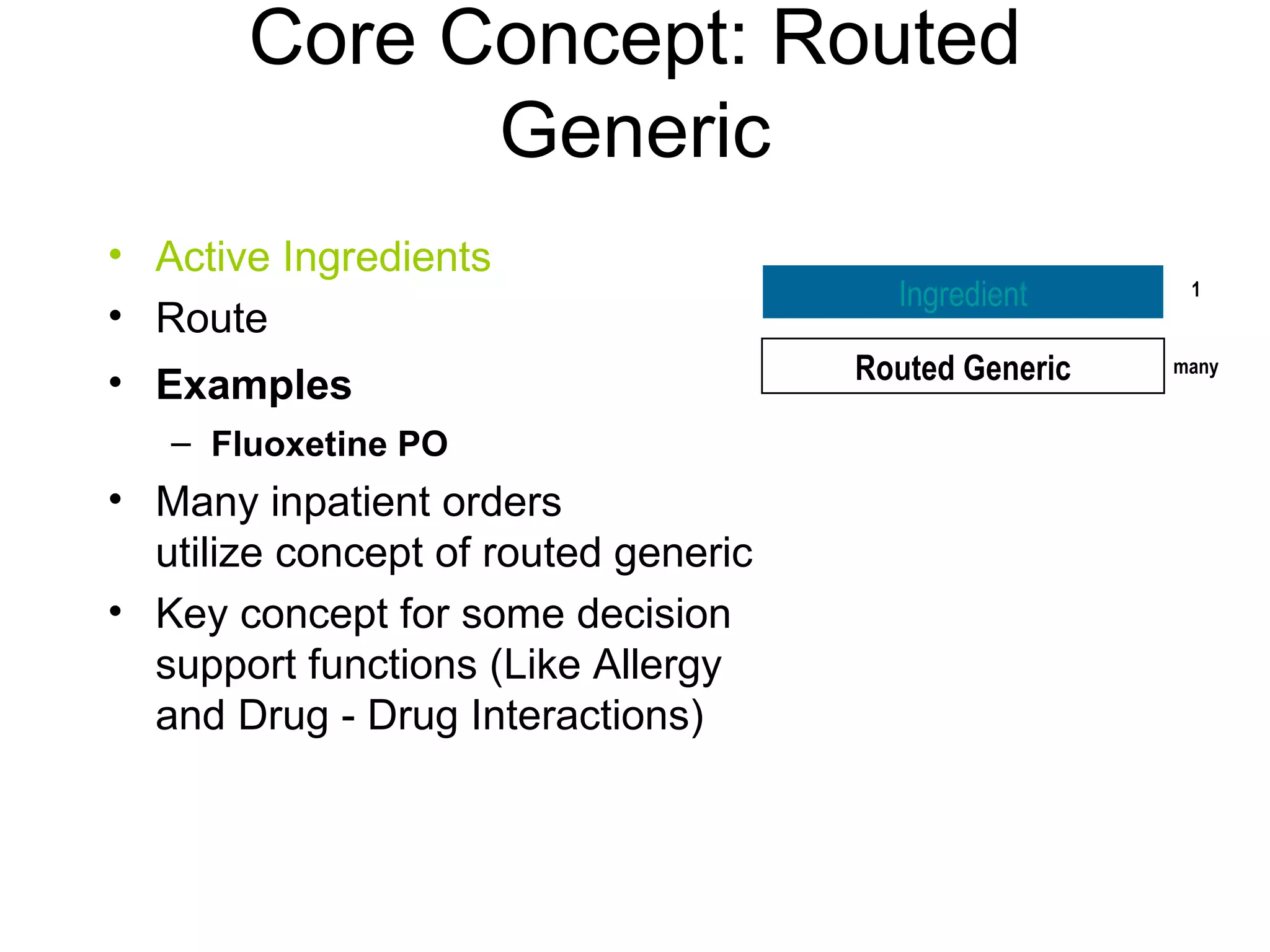
Core Concept: Routed Generic Active Ingredients Route Examples Fluoxetine PO Many inpatient orders  utilize concept of routed generic Key concept for some decision support functions (Like Allergy and Drug - Drug Interactions) Ingredient Routed Generic 1 many
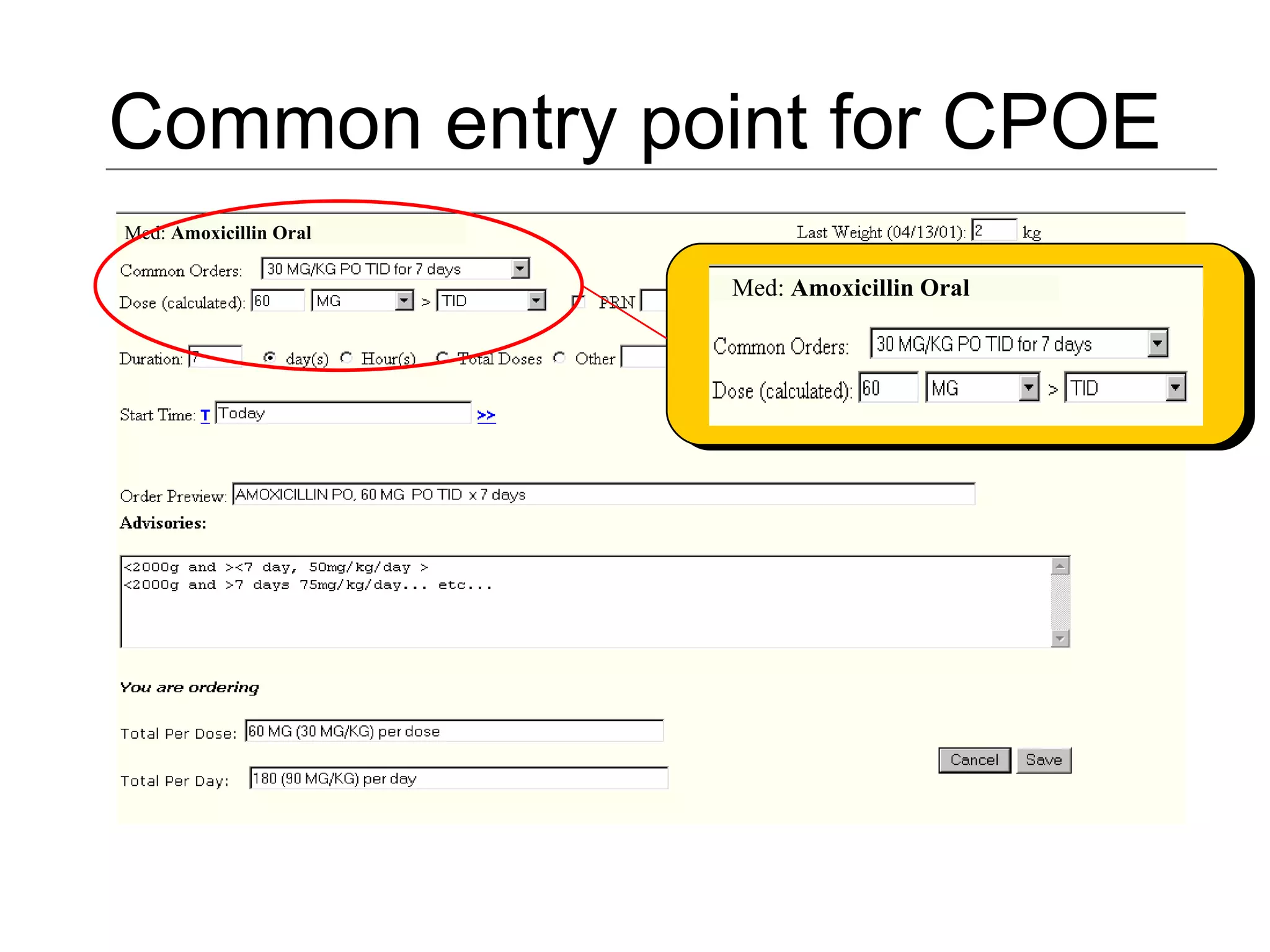
Common entry point for CPOE Med:  Amoxicillin Oral Med:  Amoxicillin Oral
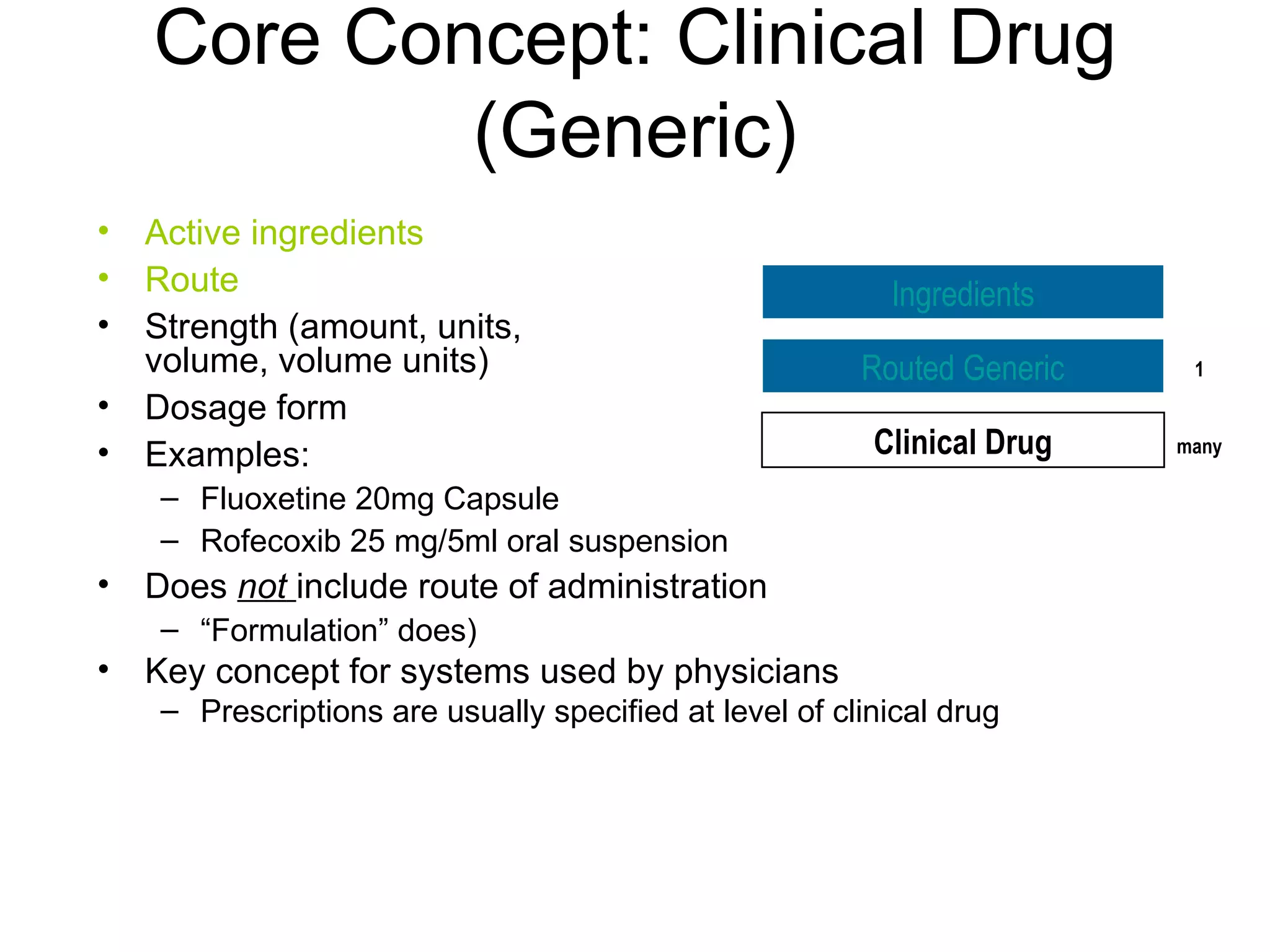
Core Concept: Clinical Drug (Generic) Active ingredients Route Strength (amount, units,  volume, volume units) Dosage form Examples: Fluoxetine 20mg Capsule Rofecoxib 25 mg/5ml oral suspension Does  not   include route of administration “ Formulation” does) Key concept for systems used by physicians  Prescriptions are usually specified at level of clinical drug Clinical Drug Ingredients Routed Generic 1 many
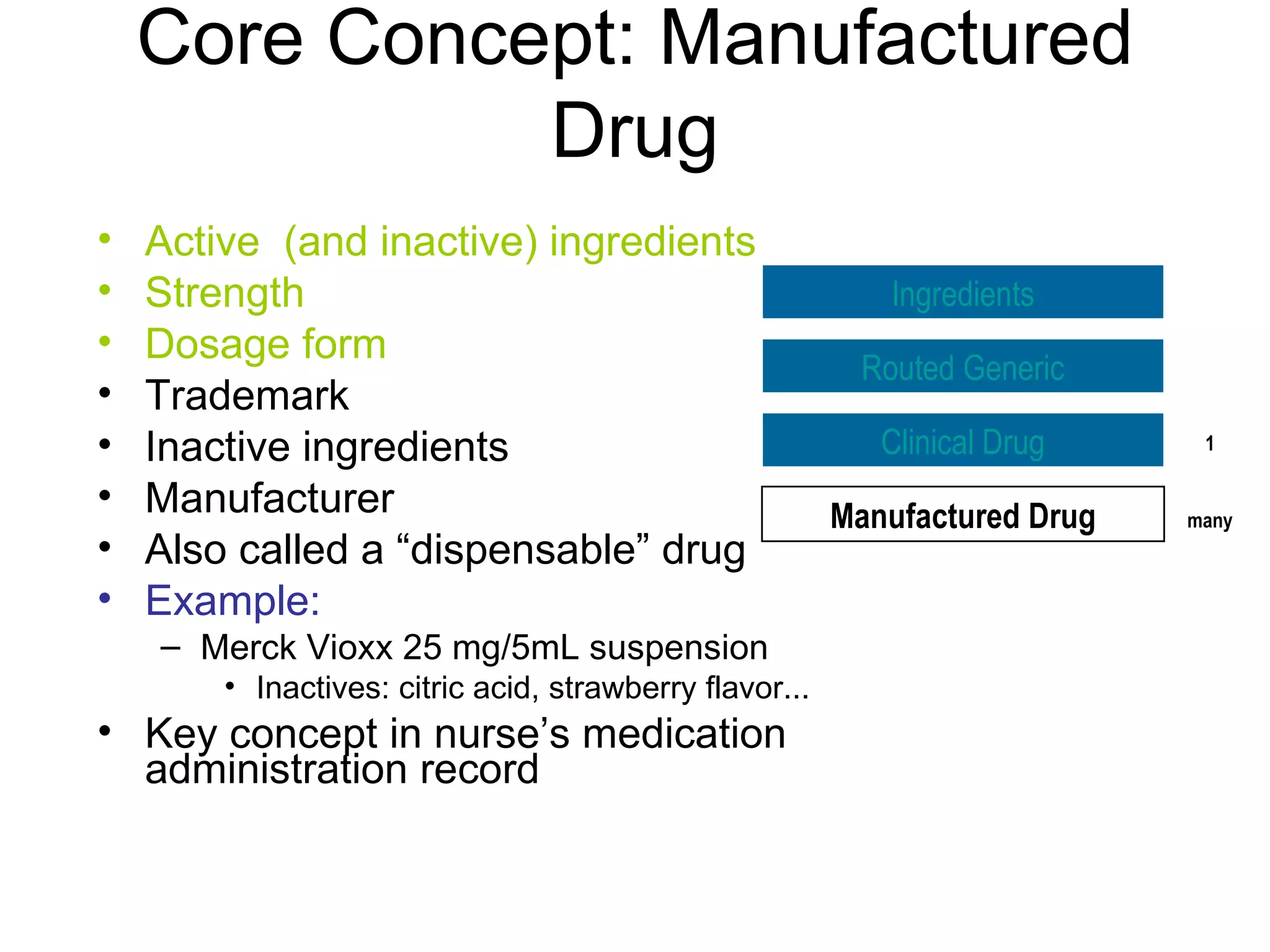
Core Concept: Manufactured Drug Active  (and inactive) ingredients Strength Dosage form Trademark   Inactive ingredients Manufacturer Also called a “dispensable” drug Example: Merck Vioxx 25 mg/5mL suspension Inactives: citric acid, strawberry flavor... Key concept in nurse’s medication administration record Clinical Drug Manufactured Drug Ingredients Routed Generic 1 many
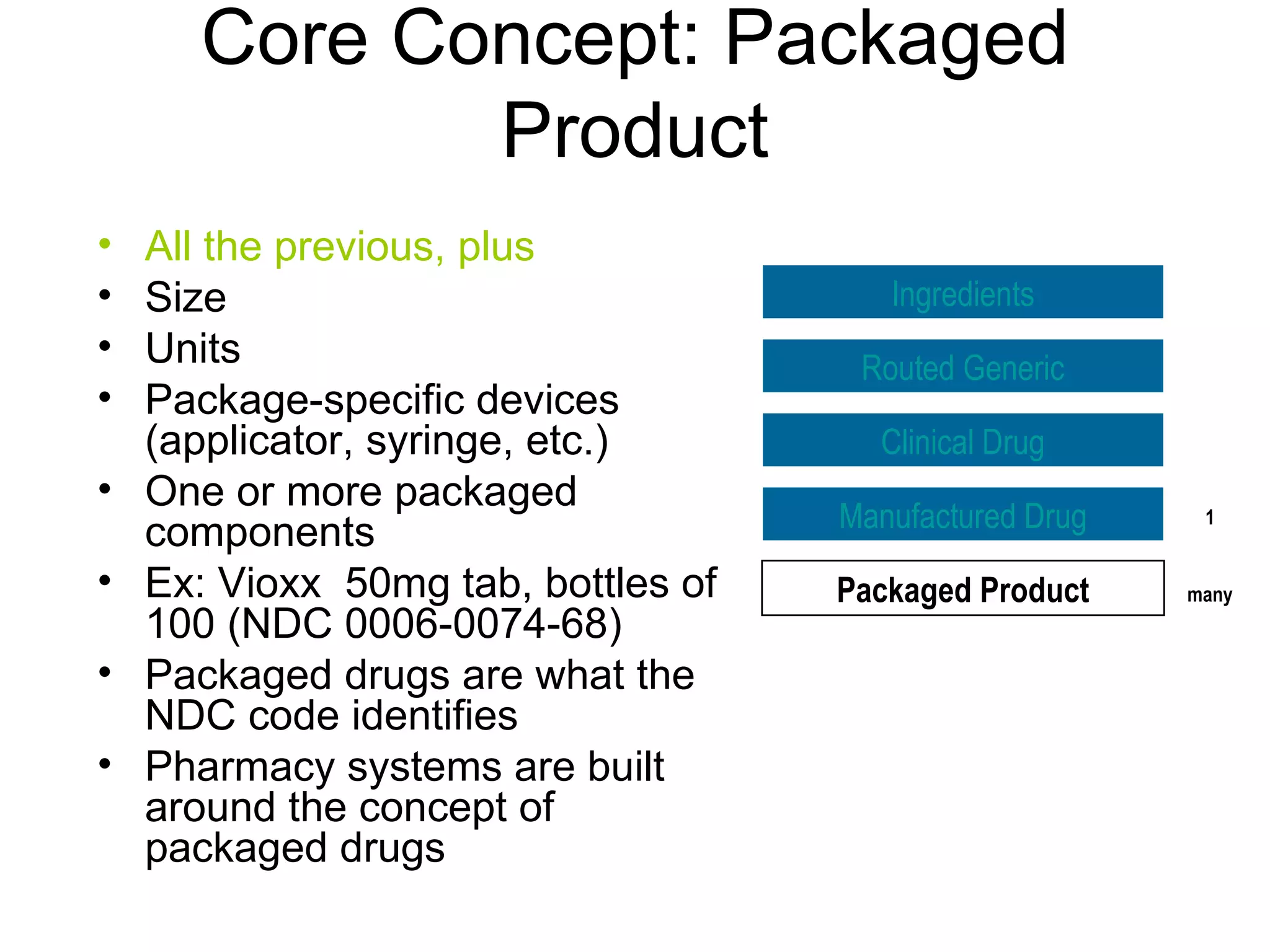
Core Concept: Packaged Product All the previous, plus Size Units Package-specific devices (applicator, syringe, etc.) One or more packaged components Ex: Vioxx  50mg tab, bottles of 100 (NDC 0006-0074-68) Packaged drugs are what the NDC code identifies Pharmacy systems are built around the concept of packaged drugs Clinical Drug Manufactured Drug Ingredients Packaged Product Routed Generic 1 many
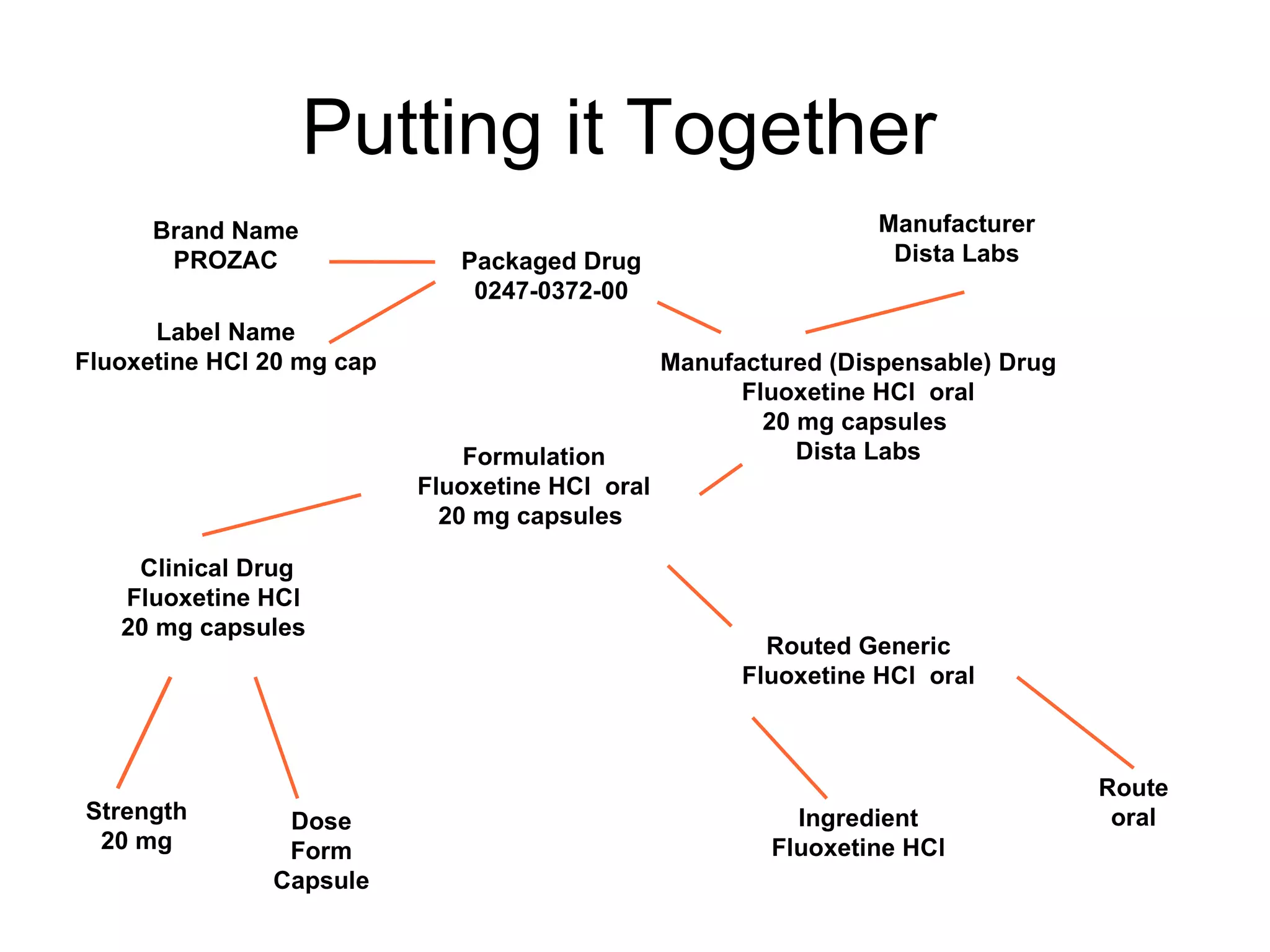
Putting it Together   Packaged Drug 0247-0372-00 Manufactured (Dispensable) Drug Fluoxetine HCl  oral 20 mg capsules  Dista Labs Formulation Fluoxetine HCl  oral 20 mg capsules  Routed Generic Fluoxetine HCl  oral Ingredient Fluoxetine HCl Brand Name PROZAC Label Name Fluoxetine HCl 20 mg cap Manufacturer Dista Labs Dose Form Capsule Strength 20 mg Route oral Clinical Drug Fluoxetine HCl  20 mg capsules
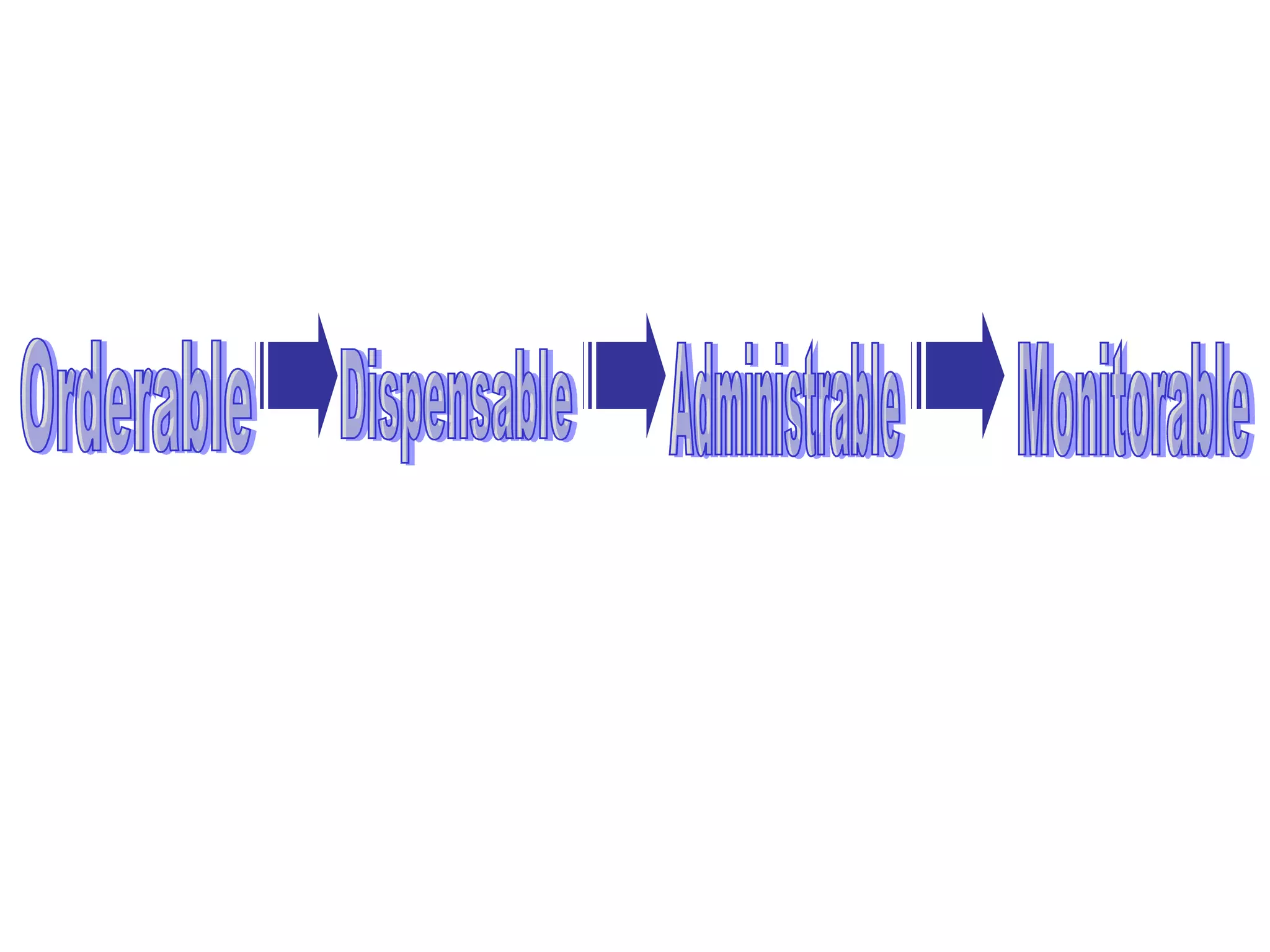
Orderable Dispensable Administrable Monitorable
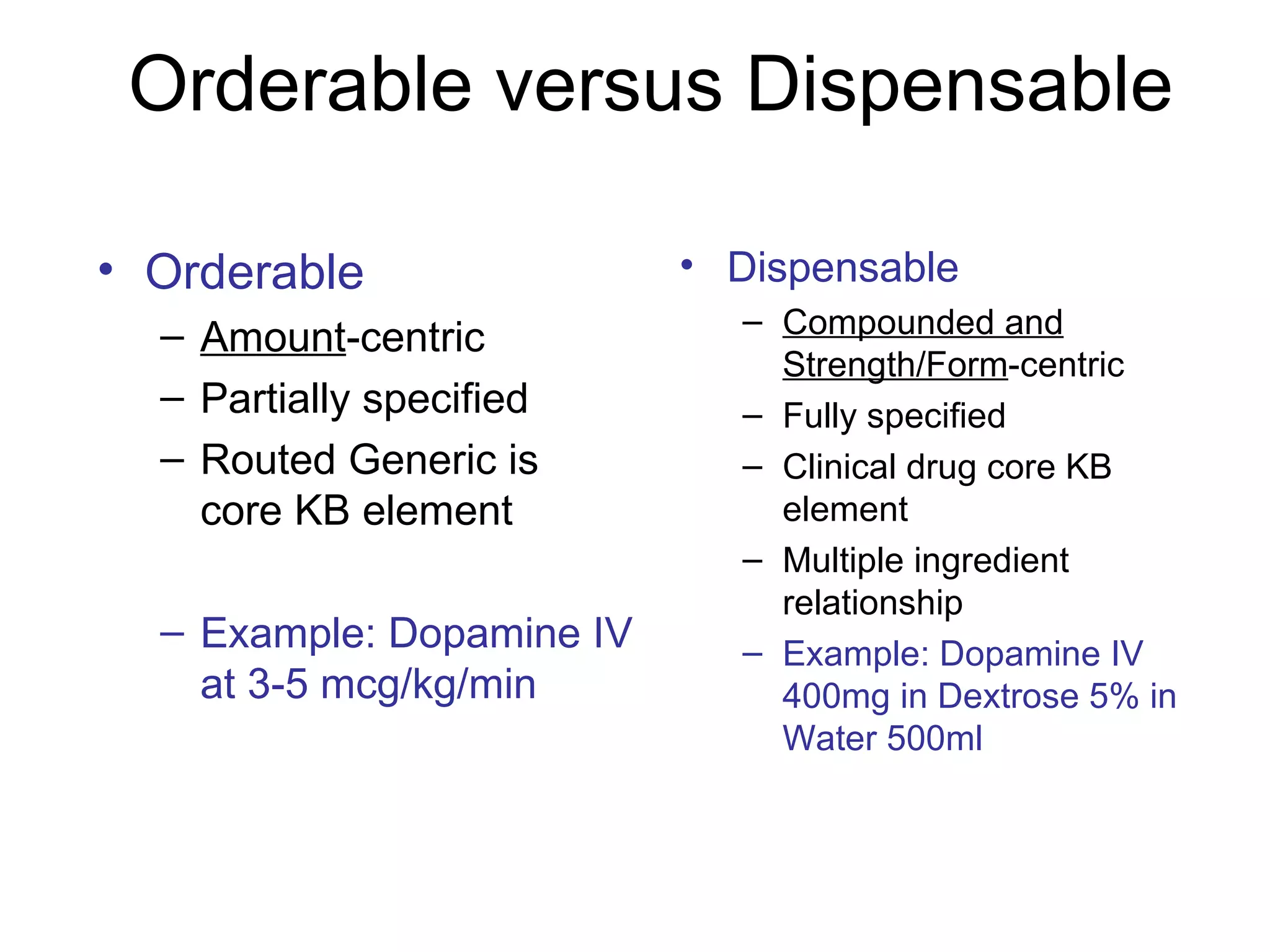
Orderable versus Dispensable  Orderable Amount -centric Partially specified  Routed Generic is core KB element Example: Dopamine IV at 3-5 mcg/kg/min Dispensable Compounded and Strength/Form -centric Fully specified Clinical drug core KB element Multiple ingredient relationship Example: Dopamine IV 400mg in Dextrose 5% in Water 500ml
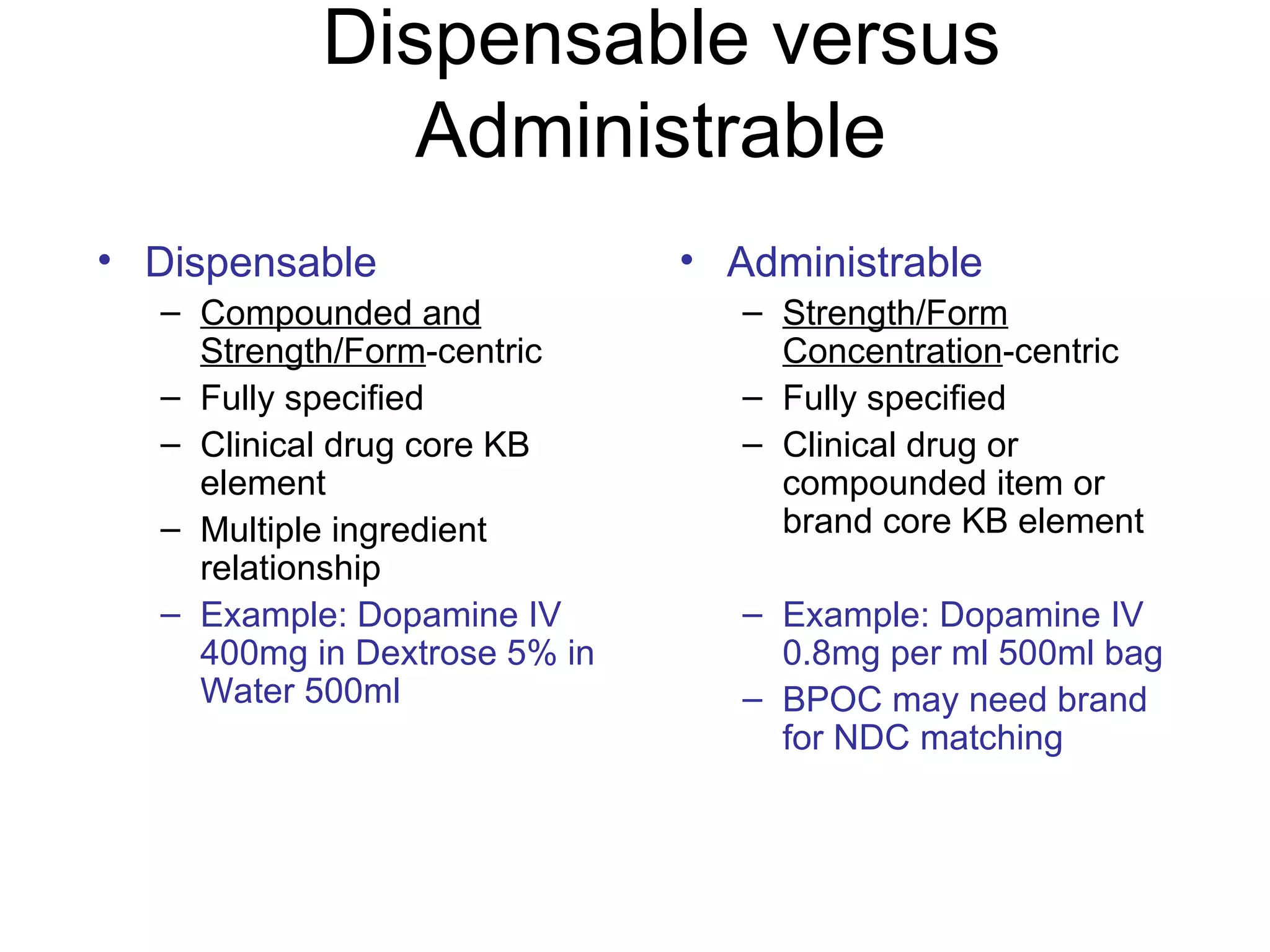
Dispensable versus Administrable  Dispensable Compounded and Strength/Form -centric Fully specified Clinical drug core KB element Multiple ingredient relationship Example: Dopamine IV 400mg in Dextrose 5% in Water 500ml Administrable Strength/Form Concentration -centric Fully specified Clinical drug or compounded item or brand core KB element Example: Dopamine IV 0.8mg per ml 500ml bag BPOC may need brand for NDC matching
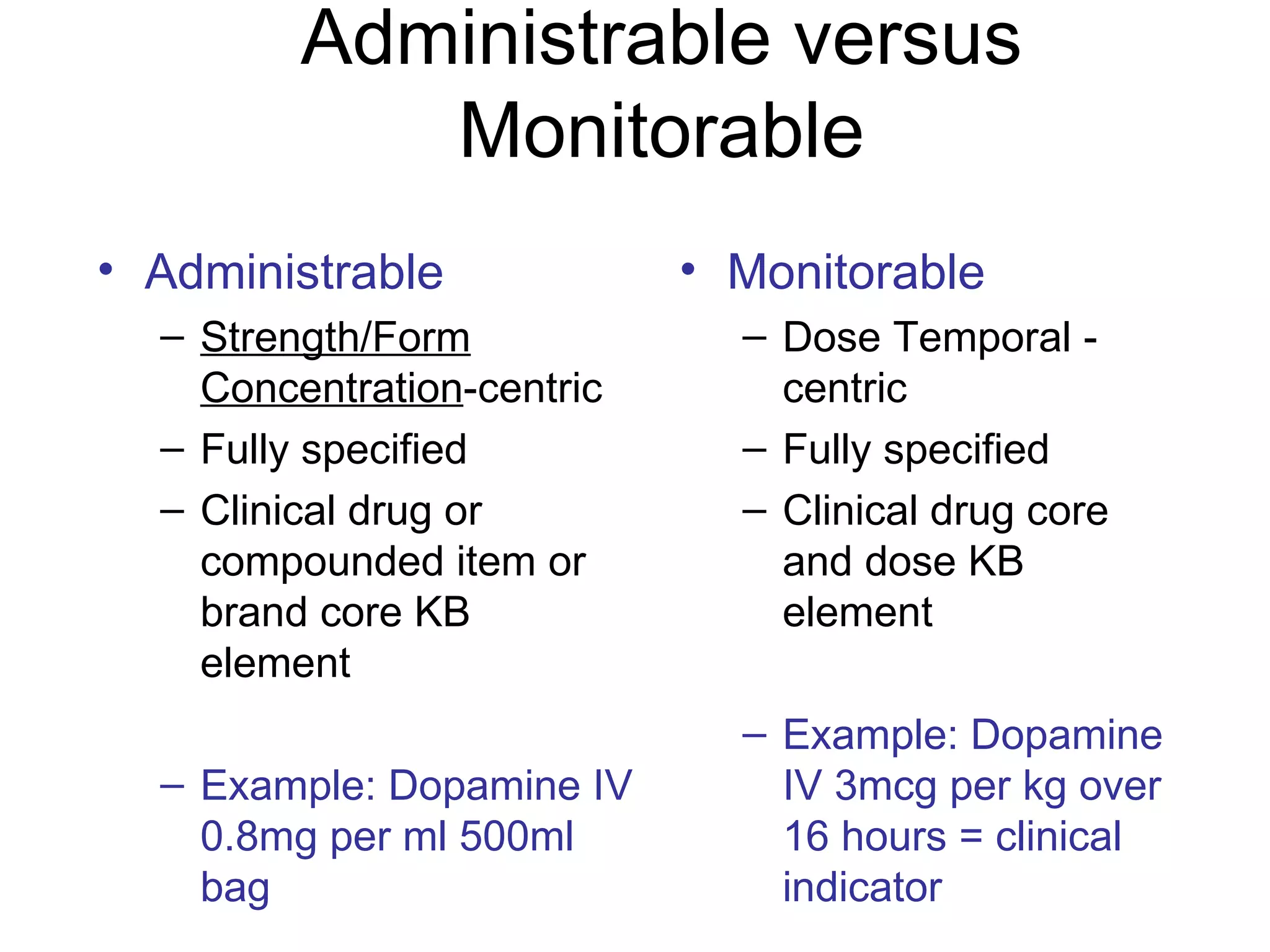
Administrable versus Monitorable Administrable Strength/Form Concentration -centric Fully specified Clinical drug or compounded item or brand core KB element Example: Dopamine IV 0.8mg per ml 500ml bag Monitorable Dose Temporal - centric Fully specified Clinical drug core and dose KB element Example: Dopamine IV 3mcg per kg over 16 hours = clinical indicator
The Scope We are overwhelmed as it is, with an infinite abundance of vaunted medicaments, and here they add a new one. Thomas Sydenham, MD 1624
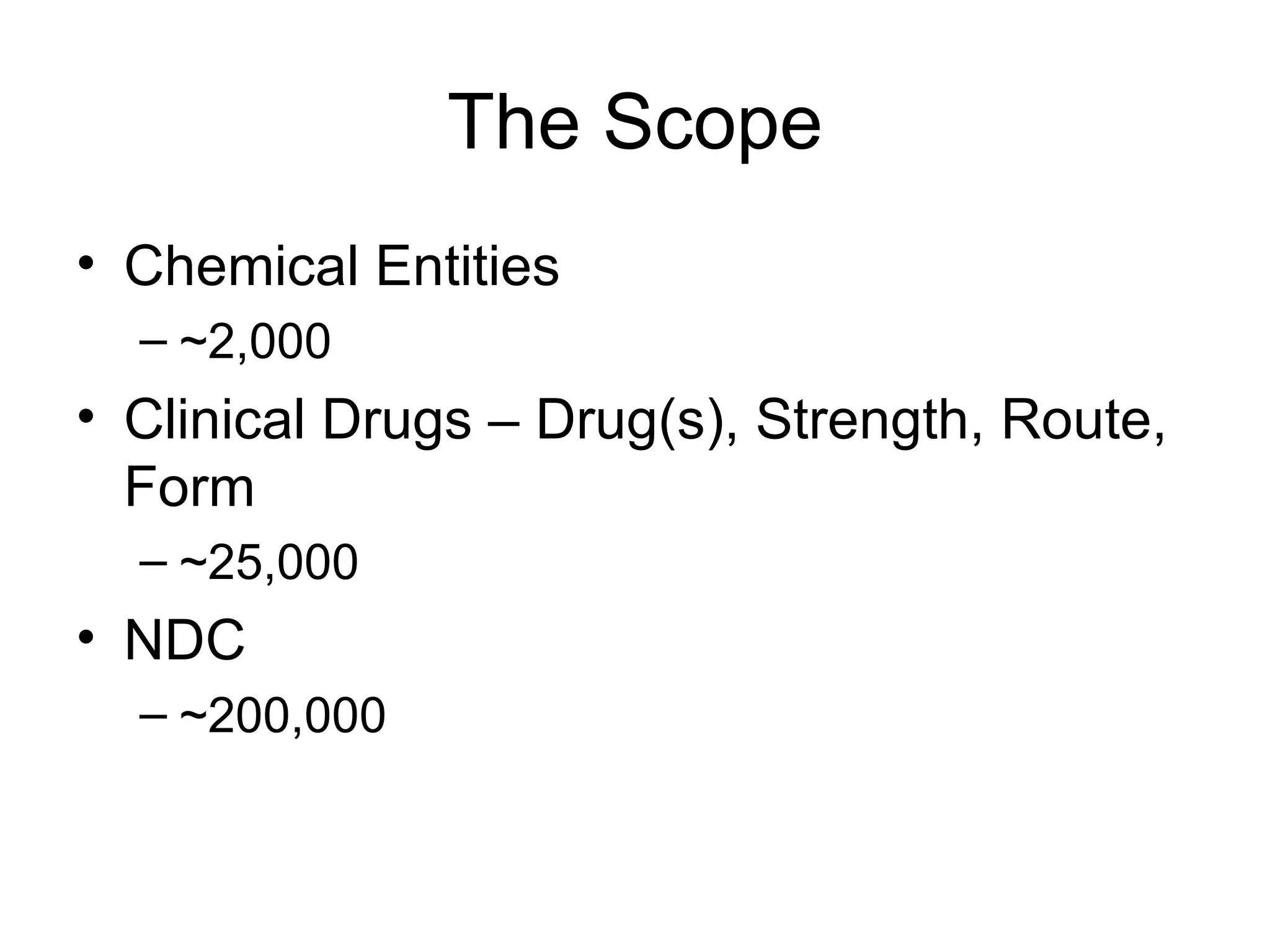
The Scope Chemical Entities ~2,000 Clinical Drugs – Drug(s), Strength, Route, Form ~25,000 NDC ~200,000
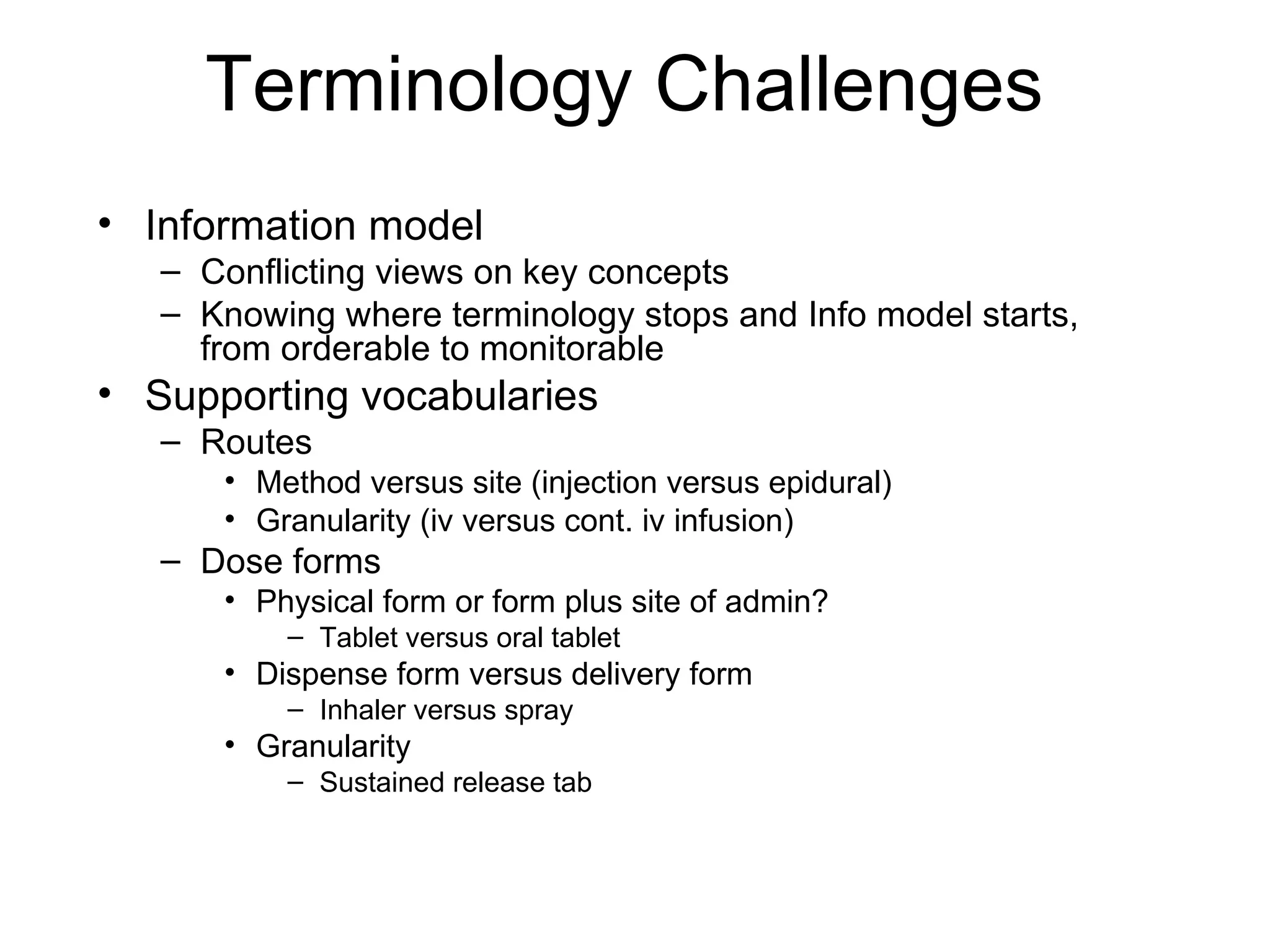
Terminology Challenges  Information model Conflicting views on key concepts Knowing where terminology stops and Info model starts, from orderable to monitorable Supporting vocabularies Routes Method versus site (injection versus epidural) Granularity (iv versus cont. iv infusion) Dose forms Physical form or form plus site of admin? Tablet versus oral tablet Dispense form versus delivery form Inhaler versus spray Granularity Sustained release tab
Operational Challenges Frequent updates Data and database formats, customization  Legacy system support, backward compatibility Multi-platform delivery Customer support
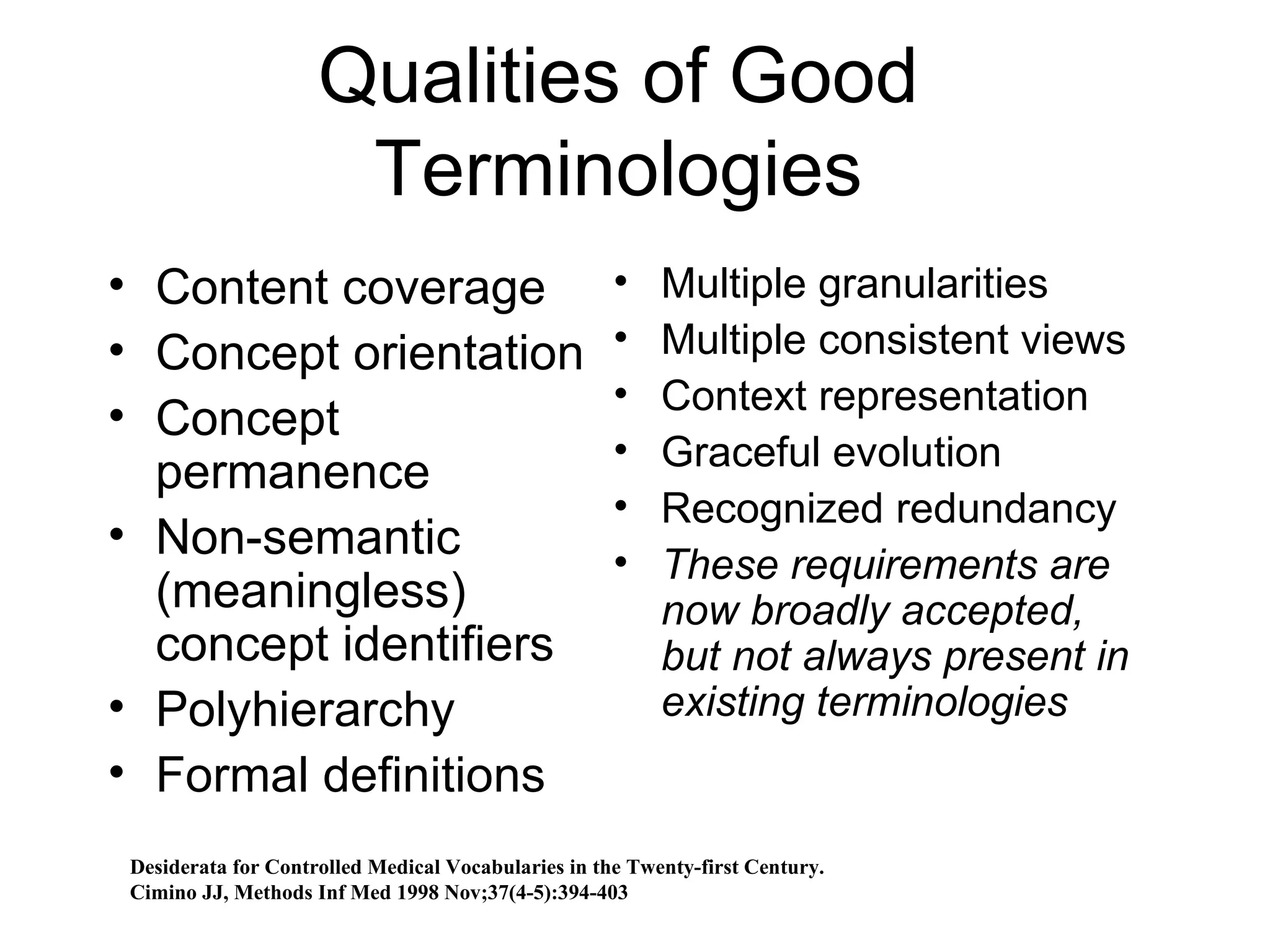
Qualities of Good Terminologies Content coverage Concept orientation Concept permanence Non-semantic (meaningless) concept identifiers Polyhierarchy  Formal definitions  Multiple granularities Multiple consistent views Context representation Graceful evolution Recognized redundancy These requirements are now broadly accepted, but not always present in existing terminologies Desiderata for Controlled Medical Vocabularies in the Twenty-first Century. Cimino JJ, Methods Inf Med 1998 Nov;37(4-5):394-403
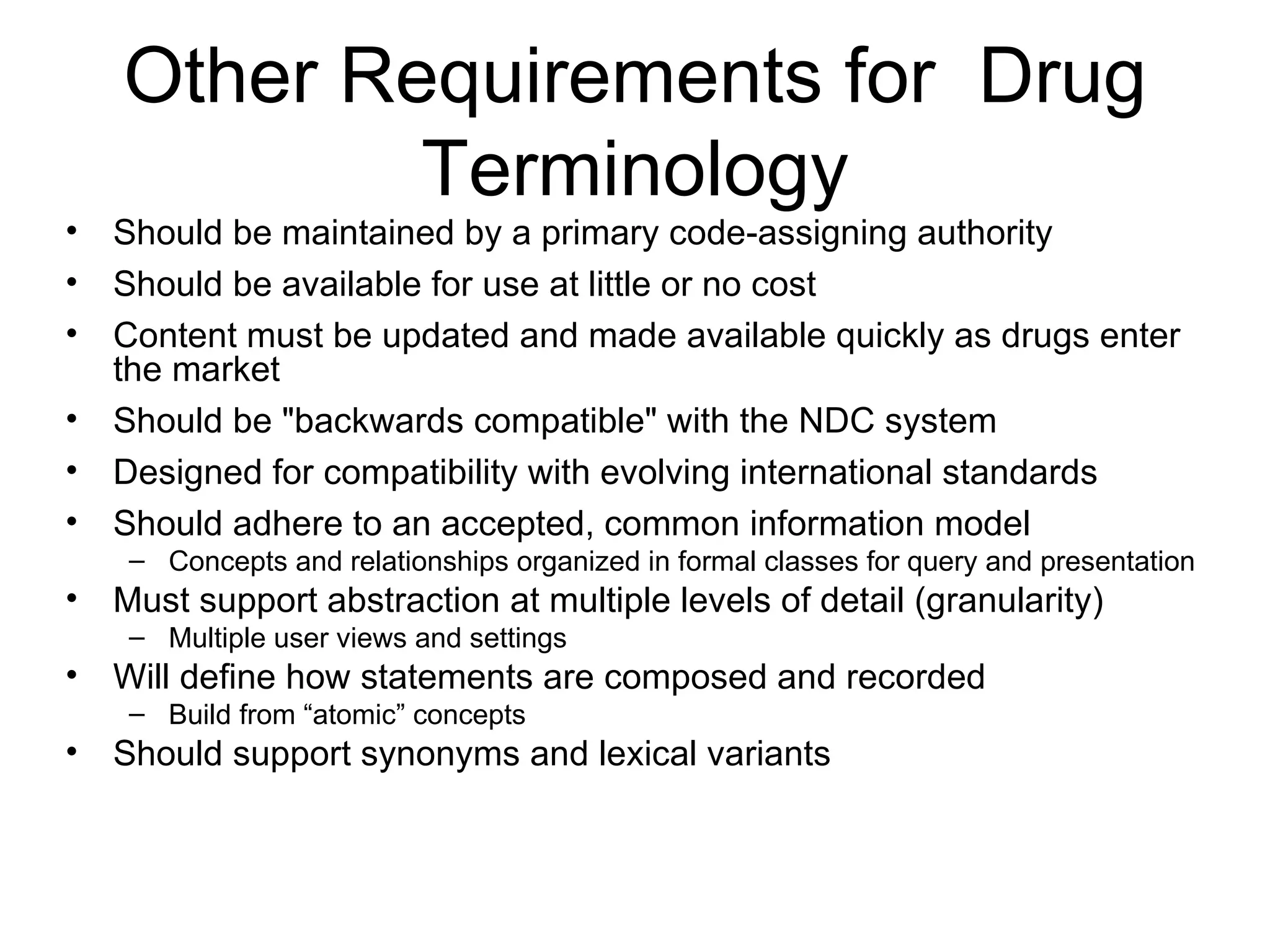
Other Requirements for  Drug Terminology Should be maintained by a primary code-assigning authority Should be available for use at little or no cost Content must be updated and made available quickly as drugs enter the market Should be "backwards compatible" with the NDC system Designed for compatibility with evolving international standards  Should adhere to an accepted, common information model Concepts and relationships organized in formal classes for query and presentation Must support abstraction at multiple levels of detail (granularity)  Multiple user views and settings Will define how statements are composed and recorded Build from “atomic” concepts Should support synonyms and lexical variants
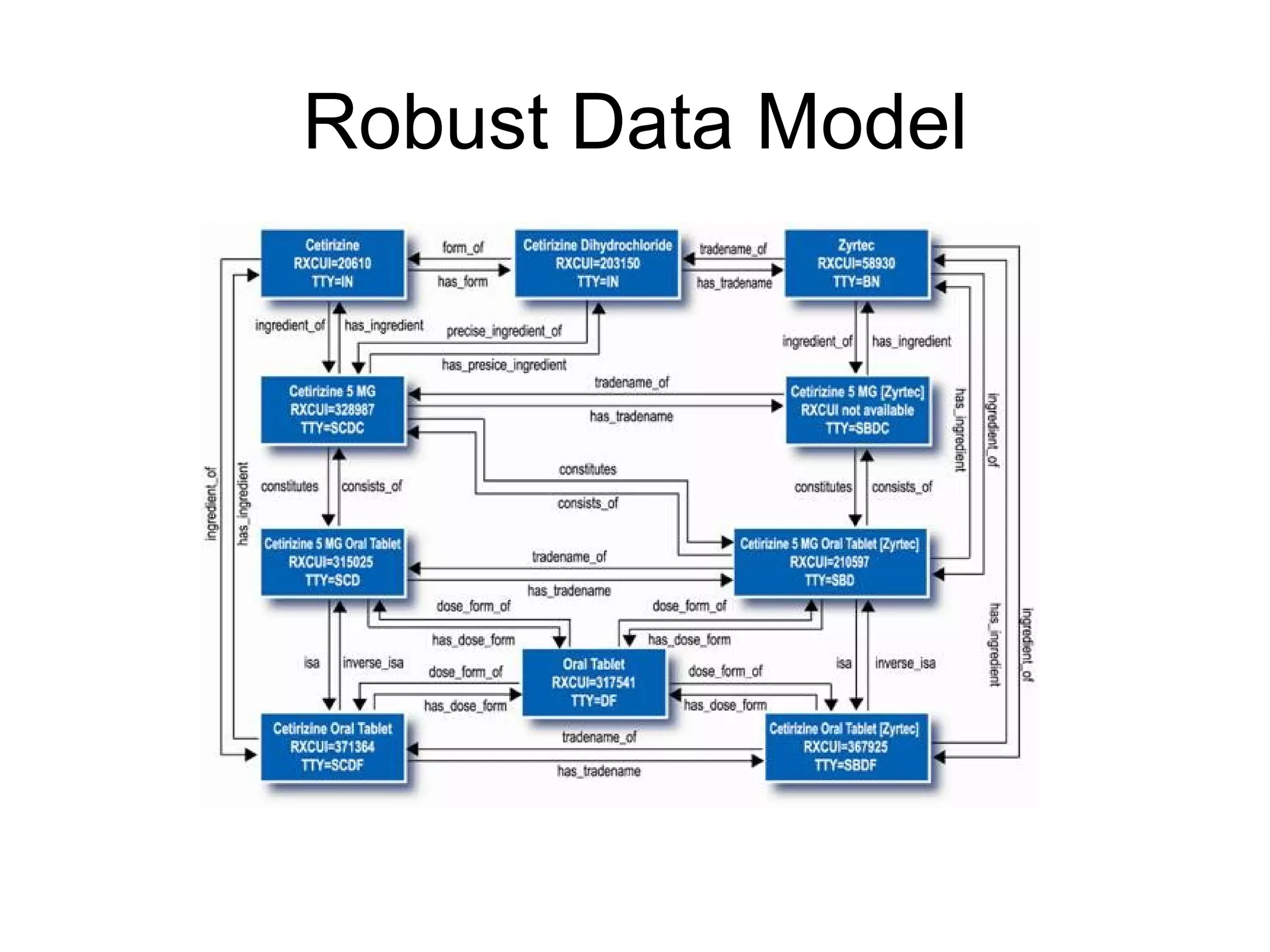
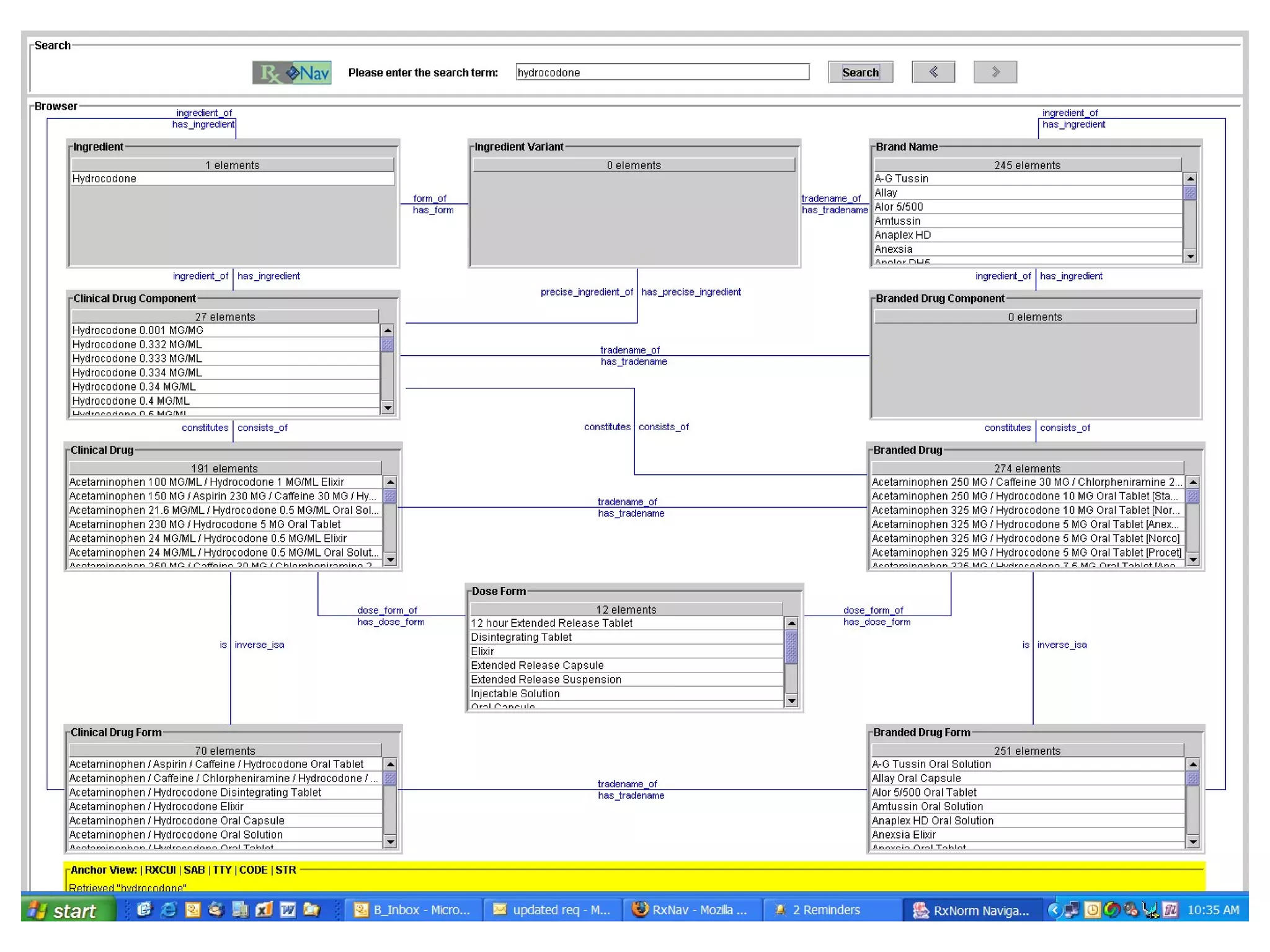
The Solution? RxNorm Formalize/merge  “clinical drugs” in UMLS  “ Semantic normal” form Detail all semantic relationships Utilizing HL7 vocabulary for dose forms, strength Links to FDB, Micromedex, MediSpan, and Multum and VA National Drug File
Robust Data Model
RxNav
Qualities of Good Terminologies Content coverage Concept orientation Concept permanence Non-semantic (meaningless) concept identifiers Polyhierarchy  Formal definitions  Multiple granularities Multiple consistent views Context representation Graceful evolution Recognized redundancy These requirements are now broadly accepted, but not always present in existing terminologies Desiderata for Controlled Medical Vocabularies in the Twenty-first Century. Cimino JJ, Methods Inf Med 1998 Nov;37(4-5):394-403
Other Requirements for  Drug Terminology Should be maintained by a primary code-assigning authority Should be available for use at little or no cost Content must be updated and made available quickly as drugs enter the market Should be "backwards compatible" with the NDC system Designed for compatibility with evolving international standards  Should adhere to an accepted, common information model Concepts and relationships organized in formal classes for query and presentation Must support abstraction at multiple levels of detail (granularity)  Multiple user views and settings Will define how statements are composed and recorded Build from “atomic” concepts Should support synonyms and lexical variants
RxNorm Issues Currently Pulling data from sources in building Future will be feed by FDA codes and labeling information and will be pushing to industry
In Summary Broad recognition of the need for  a national drug terminology RxNorm development activity towards national drug terminology, particularly at the clinical drug level Will require significant continued cooperation between government agencies Still much unknown, and no clear timetables
Good Medication Nomenclature Practices  Routed Generic at the atomic level for orderables Account for Orderable transformation across the medication use process  Insist on RxNorm adoption the good must not get in the way of the perfect Generic data structures even in the face of a proprietary environment Plan for interoperability now!
“ I Don’t Want to Make the Wrong Mistake.” Yogi Berra John Poikonen, Pharm.D.

Med Rec And Terminology To Mcp 2008

  • 1.
    Definition a processby which a practitioner obtains and documents a complete list of a patient‘s pre-admission medications and references this list when he or she writes admission, transfer, and discharge orders What is Medication Reconciliation?
  • 2.
    Ambulatory Inpatient PeriodicReconciliation Post-discharge Reconciliation Admission Reconciliation Discharge/Transfer Reconciliation
  • 3.
    Background The problemof medical errors and adverse drug events Medication reconciliation practices in general JCAHO mandate Why is Medication Reconciliation Important?
  • 4.
    Background: Medical errorsand ADEs 98,000 Americans die each year as a result of medical errors, and 7,000 of these deaths are attributable to medication errors 1 6-12% of ADEs result in ED visits and 5% in hospital admissions 2 Estimated $177.4 billion spent in 2000 on drug-related morbidity and mortality 3 Kohn LT. Corrigan JM. Donaldson MS, eds. To err is human: building a safer health system. Washington, DC: National Academy Press; 1999. Johnson JA, Bootman JL. Drug-related morbidity and mortality. A cost of illness model. Arch Intern Med . 1995; 155:1949-1956. Ernst FR, Grizzle AJ. Drug-related morbidity and mortality: Updating the cost-of-illness model. J Am Pharm Assoc (Wash). 2001 Mar-Apr;41(2): 156-7.
  • 5.
    Background: Medication HistoryErrors 61% of admission notes had one drug and 33% more than one drug missing. Classes most often missed included: CV drugs, benzodiazepines, H2 blockers, oral hypoglycemics, and NSAIDs. 4. Lau et al (2000): The Completeness of medication histories in hospital medical records of patients admitted to the general medicine wards. British Journal of Clinical Pharmacology, 2000. 49 (6). p597-603. Lau et al 4 studied 304 general medicine patients, comparing the number and type of medications recorded on admission notes with those of an outpatient pharmacy record. Discrepancies were resolved by patient interview. Findings
  • 6.
    Background: Medication Reconciliation Prior to discharge pharmacist noted: 37% of discharge medication lists were missing a medication that the patient had been taking prior to admission, was not recorded on the admission medication list, did not receive in the hospital, and should have been prescribed at discharge (34/91) 49% of discharge medication orders had one or more unaccounted for discrepancies from the patient’s actual home medication regimen Phone follow-up 3-5 days later found: 29% of patients NOT taking a medication on their discharge list, taking a different dose or frequency, or taking an additional medication 23% of patients not adhering to their discharge medications 30 days after discharge, preventable adverse drug events were detected in 11% of control patients and 1% of intervention patients. 5. Draft: Schnipper et al 2004. Medication Problems During and After Hospitalization: Findings from a Pilot Study of Pharmacist Interventions Discharge Medications and ADEs: An RCT performed 2002-2003 at BWH enrolled a total of 178 patients: 92 received active pharmacist intervention on discharge and 86 received usual care (medication list written by patient’s primary team with nurse education at the time of discharge).
  • 7.
    Background: National MandateJCAHO Goal: Medication Reconciliation of 100% Patients Accurately and completely reconcile medications across the continuum of care Develop a process for obtaining and documenting a complete list of the patient's current medications upon the patient's admission to the organization, with the involvement of the patient, including a comparison of the medications the organization provides to those on the list Communicate a complete list of the patient's medications to the next provider of service when the patient is referred or transferred to another setting, service, practitioner or level of care within or outside the organization.
  • 8.
    Multidisciplinary Process RolesHistory Taking Verifier “ Reconciliator” Discipline Physician Nurse Pharmacist Settings Inpatient Clinic Office Pharmacy
  • 9.
    Admission/Inpatient/Discharge Medication ReconciliationProcess: Information Flow Inpatient Med List Inpatient Med List ’ DischargeOrders A highly heuristic and humanistic process performed during admission Minor modifications as more info become available Medication Reconciliation at Discharge Pt dx/condition Discharge Process Admission Process EMR Notes EMR Med Lists D/C Summary or Orders Pt & Family Outpt MDs Pharmacies Pre-Admission Med List Pre-Admission Med List ’ Pre-Admission Med List ’
  • 10.
    Outline Informatics interventionsPre Admission Med List Application Development Unified Medication list Ultimate Goal Data challenges
  • 11.
  • 12.
  • 13.
  • 14.
  • 15.
  • 16.
    Process of MedicationReconciliation 1)    Obtain Emergency Department Pre-Admission Medication List (PAML) from patient/floor. 2)    Print the medication source list from the PAML Builder. 3) Verify the pre-admission medications with the patient and/or family, marking up the printed medication source list and/or ED Pre-Admission Medication List. -With assistance from pharmacists and nurses, access other sources of medication information. Patient begins constructing PAML while waiting in the ED…
  • 17.
    Process of MedicationReconciliation 4) Enter the PAML Builder and create the PAML. Move medications from the source list into the PAML or add new medications to the PAML.
  • 18.
    Process of MedicationReconciliation 5) Note uncertainties in meds, non-adherence, and meds held prior to admission. 6) Designate the planned action on admission for each med by selecting 1 of 4 instructions from a drop-down menu.
  • 19.
    Process of MedicationReconciliation 7) Note the outpatient pharmacy or long-term care facility name, location, and phone number in the “PAML Comments” section. 8) Note reasons for discontinuing or modifying medications in the “PAML Comments” section .
  • 20.
    Process of MedicationReconciliation 9) Complete the PAML and mark it as ready for review within 24 hours of admission. 10) During the course of the admission, update the PAML based on additional input from pharmacists, nurses, patients, and families.
  • 21.
    Process of MedicationReconciliation 11) Reconcile the PAML and discharge medications to create a coherent discharge medication regimen, noting reasons for changing or discontinuing pre-admission medications in “PAML Comments.” Then check a box verifying that the PAML and discharge medications have been reconciled. 12) Copy-and-paste the PAML into the discharge summary or note the exact changes from the PAML to the discharge regimen in the discharge summary. 13) If a medical student or nurse in the CPE builds a patient’s PAML, review it and mark it as ready for 2 nd review. If a medical student writes a patient’s discharge orders, verify that the PAML and discharge orders have been reconciled. Discharge
  • 22.
    What are thebenefits of the PAML? Improves patient safety by decreasing ADEs Improves communication between providers Eliminates redundancy in obtaining medication history Increases compliance with JACHO requirements Technology will eventually allow for more efficient order entry
  • 23.
    For the futureContent Mapping of Medications Functions Ordering from the Pre Admin Med List Integration of CDS Criteria for pharmacist in-depth review System Integration Retrieval of Medications from additional sources
  • 24.
  • 25.
  • 26.
  • 27.
    Architecture Med Mapping/Classification EMR’s Hosp1 D/C Hosp2 D/C Med Reconciliation Service API Application Common Med List Other Apps Decision Support Site Rules DDI DLI For- mulary Allergies FDB Medisp NDFF RxNorm Patient Gateway Claims (RxHub, etc) Retail Pharm LTC
  • 28.
    Multi-Usage Drug Terminology: Making Sense of the Tower of Medication Terminology Babble
  • 29.
    The Need The History Definitions and requirements Important concepts A few challenges The Solution? Good Medication Nomenclature Practice Today
  • 30.
    Where is DrugTerminology Needed? EHR Consumer CPOE Ambulatory EMR Retail Pharmacy Hospital Pharmacy System PBM Administering Nurse Monitoring ADEs, FDA, CDC
  • 31.
    The Problem Limitedability to exchange drug information Can electronically exchange some information about packaged drug products (NDC 0006-0114-68, Lipitor 10mg tablets in bottles of 100) Cannot share other clinically useful concepts (atorvastatin [Lipitor] 50mg PO once daily)…due to lack of a standard (coded) terminology for exchange
  • 32.
    A bit ofhistory of Drug Databases The big three FDB Medispan Multum Others Micromedex Gold Standard Multimedia Drug Information Technologies
  • 33.
    A bit ofhistory of Drug Databases Ninties to early 2000’s Consolidation FDB purchases Medicom and MediSpan The Enron/HealthSouth Episode of Drug DBs FDB achieved monopoly power in the sale of integratable drug data files in the United States. The effects of the acquisition were drastic price increases to customers, and reductions in product quality and customer service. FTC disgorgement Sale of Medispan to WK
  • 34.
    Why National DrugCodes Stink Product Package Specific No Central Authority Assigned by Manufacture Multiple Formats Codes reused Assigned to non drug items Some but not all OTCs
  • 35.
    The Problem Terminologiesexist, but: Most are expensive to license Many are specialized for specific uses or incomplete in some areas They are incompatible
  • 36.
    The Perfect Stormfor interoperability Increased focus on healthcare quality and safety Automated decision support Adverse event monitoring Analysis of aggregate data Governmental HIPAA FDA/VA/NLM Biosurveillance Consumerism Ownership and use of online medical data
  • 37.
    Interoperability NAHIT DefinitionIn healthcare, interoperability is the ability of different information technology systems and software applications to communicate, to exchange data accurately, effectively, and consistently. Level 4: Machine interpretable data (structured messages, standardized content). Examples include the automated transfer from an external lab of coded results into a provider’s EHR. Data can be transmitted (or accessed without transmission) by HIT systems without need for further semantic interpretation or translation.
  • 38.
    Systemic Interoperability Taxonomy*No PC/information technology Fax/Email Structured messages, non-standard content/data Structured messages, standardized content/data *CITL Report on Healthcare Information Exchange and Interoperability Secure e-mail of free text and incompatible/proprietary structured messages, HL-7 msgs Machine-organizable data 3 PC-based and manual fax, e-mail, or scanned documents Machine-transportable data 2 Mail, phone Non-electronic data 1 EDI of structured messages with controlled terminology Machine-interpretable data 4 Examples Description Level
  • 39.
    10-Year Cumulative NetReturn Level 4 in billions $(200) $(100) $- 0 $100 $200 $300 $400 1 2 3 4 5 6 7 8 9 10 Years Level 1 Level 2 Level 3
  • 40.
    Some Core ConceptsClinical Drug Manufactured Drug Ingredients Packaged Product These concepts form the core of an information model for drugs Additional key concepts for which vocabulary is required: Therapeutic Classification Forms Routes Strength Routed Generic
  • 41.
    Order = Dispense= Administer Orderable Item Dispensable Item Administrable Item ?? Sometimes, Always, or Maybe ?? Amox. 500mg Q6H Amox. Susp. 250mg/5ml 80ml Bottle Amox. Susp. 500mg (10ml) PO Q6H
  • 42.
    Core Concept: (Active)Ingredients Active ingredients (chemicals) What is “in” the drug Example: fluoxetine Systems usually identify allergies at the level of ingredients Ingredients may be further specified (salts) Many systems represent the ingredients in a multi-ingredient drug as a specific entity in their data model (example: FDB “HICL”) Ingredients
  • 43.
    Core Concept: RoutedGeneric Active Ingredients Route Examples Fluoxetine PO Many inpatient orders utilize concept of routed generic Key concept for some decision support functions (Like Allergy and Drug - Drug Interactions) Ingredient Routed Generic 1 many
  • 44.
    Common entry pointfor CPOE Med: Amoxicillin Oral Med: Amoxicillin Oral
  • 45.
    Core Concept: ClinicalDrug (Generic) Active ingredients Route Strength (amount, units, volume, volume units) Dosage form Examples: Fluoxetine 20mg Capsule Rofecoxib 25 mg/5ml oral suspension Does not include route of administration “ Formulation” does) Key concept for systems used by physicians Prescriptions are usually specified at level of clinical drug Clinical Drug Ingredients Routed Generic 1 many
  • 46.
    Core Concept: ManufacturedDrug Active (and inactive) ingredients Strength Dosage form Trademark Inactive ingredients Manufacturer Also called a “dispensable” drug Example: Merck Vioxx 25 mg/5mL suspension Inactives: citric acid, strawberry flavor... Key concept in nurse’s medication administration record Clinical Drug Manufactured Drug Ingredients Routed Generic 1 many
  • 47.
    Core Concept: PackagedProduct All the previous, plus Size Units Package-specific devices (applicator, syringe, etc.) One or more packaged components Ex: Vioxx 50mg tab, bottles of 100 (NDC 0006-0074-68) Packaged drugs are what the NDC code identifies Pharmacy systems are built around the concept of packaged drugs Clinical Drug Manufactured Drug Ingredients Packaged Product Routed Generic 1 many
  • 48.
    Putting it Together Packaged Drug 0247-0372-00 Manufactured (Dispensable) Drug Fluoxetine HCl oral 20 mg capsules Dista Labs Formulation Fluoxetine HCl oral 20 mg capsules Routed Generic Fluoxetine HCl oral Ingredient Fluoxetine HCl Brand Name PROZAC Label Name Fluoxetine HCl 20 mg cap Manufacturer Dista Labs Dose Form Capsule Strength 20 mg Route oral Clinical Drug Fluoxetine HCl 20 mg capsules
  • 49.
  • 50.
    Orderable versus Dispensable Orderable Amount -centric Partially specified Routed Generic is core KB element Example: Dopamine IV at 3-5 mcg/kg/min Dispensable Compounded and Strength/Form -centric Fully specified Clinical drug core KB element Multiple ingredient relationship Example: Dopamine IV 400mg in Dextrose 5% in Water 500ml
  • 51.
    Dispensable versus Administrable Dispensable Compounded and Strength/Form -centric Fully specified Clinical drug core KB element Multiple ingredient relationship Example: Dopamine IV 400mg in Dextrose 5% in Water 500ml Administrable Strength/Form Concentration -centric Fully specified Clinical drug or compounded item or brand core KB element Example: Dopamine IV 0.8mg per ml 500ml bag BPOC may need brand for NDC matching
  • 52.
    Administrable versus MonitorableAdministrable Strength/Form Concentration -centric Fully specified Clinical drug or compounded item or brand core KB element Example: Dopamine IV 0.8mg per ml 500ml bag Monitorable Dose Temporal - centric Fully specified Clinical drug core and dose KB element Example: Dopamine IV 3mcg per kg over 16 hours = clinical indicator
  • 53.
    The Scope Weare overwhelmed as it is, with an infinite abundance of vaunted medicaments, and here they add a new one. Thomas Sydenham, MD 1624
  • 54.
    The Scope ChemicalEntities ~2,000 Clinical Drugs – Drug(s), Strength, Route, Form ~25,000 NDC ~200,000
  • 55.
    Terminology Challenges Information model Conflicting views on key concepts Knowing where terminology stops and Info model starts, from orderable to monitorable Supporting vocabularies Routes Method versus site (injection versus epidural) Granularity (iv versus cont. iv infusion) Dose forms Physical form or form plus site of admin? Tablet versus oral tablet Dispense form versus delivery form Inhaler versus spray Granularity Sustained release tab
  • 56.
    Operational Challenges Frequentupdates Data and database formats, customization Legacy system support, backward compatibility Multi-platform delivery Customer support
  • 57.
    Qualities of GoodTerminologies Content coverage Concept orientation Concept permanence Non-semantic (meaningless) concept identifiers Polyhierarchy Formal definitions Multiple granularities Multiple consistent views Context representation Graceful evolution Recognized redundancy These requirements are now broadly accepted, but not always present in existing terminologies Desiderata for Controlled Medical Vocabularies in the Twenty-first Century. Cimino JJ, Methods Inf Med 1998 Nov;37(4-5):394-403
  • 58.
    Other Requirements for Drug Terminology Should be maintained by a primary code-assigning authority Should be available for use at little or no cost Content must be updated and made available quickly as drugs enter the market Should be "backwards compatible" with the NDC system Designed for compatibility with evolving international standards Should adhere to an accepted, common information model Concepts and relationships organized in formal classes for query and presentation Must support abstraction at multiple levels of detail (granularity) Multiple user views and settings Will define how statements are composed and recorded Build from “atomic” concepts Should support synonyms and lexical variants
  • 59.
    The Solution? RxNormFormalize/merge “clinical drugs” in UMLS “ Semantic normal” form Detail all semantic relationships Utilizing HL7 vocabulary for dose forms, strength Links to FDB, Micromedex, MediSpan, and Multum and VA National Drug File
  • 60.
  • 61.
  • 62.
    Qualities of GoodTerminologies Content coverage Concept orientation Concept permanence Non-semantic (meaningless) concept identifiers Polyhierarchy Formal definitions Multiple granularities Multiple consistent views Context representation Graceful evolution Recognized redundancy These requirements are now broadly accepted, but not always present in existing terminologies Desiderata for Controlled Medical Vocabularies in the Twenty-first Century. Cimino JJ, Methods Inf Med 1998 Nov;37(4-5):394-403
  • 63.
    Other Requirements for Drug Terminology Should be maintained by a primary code-assigning authority Should be available for use at little or no cost Content must be updated and made available quickly as drugs enter the market Should be "backwards compatible" with the NDC system Designed for compatibility with evolving international standards Should adhere to an accepted, common information model Concepts and relationships organized in formal classes for query and presentation Must support abstraction at multiple levels of detail (granularity) Multiple user views and settings Will define how statements are composed and recorded Build from “atomic” concepts Should support synonyms and lexical variants
  • 64.
    RxNorm Issues CurrentlyPulling data from sources in building Future will be feed by FDA codes and labeling information and will be pushing to industry
  • 65.
    In Summary Broadrecognition of the need for a national drug terminology RxNorm development activity towards national drug terminology, particularly at the clinical drug level Will require significant continued cooperation between government agencies Still much unknown, and no clear timetables
  • 66.
    Good Medication NomenclaturePractices Routed Generic at the atomic level for orderables Account for Orderable transformation across the medication use process Insist on RxNorm adoption the good must not get in the way of the perfect Generic data structures even in the face of a proprietary environment Plan for interoperability now!
  • 67.
    “ I Don’tWant to Make the Wrong Mistake.” Yogi Berra John Poikonen, Pharm.D.