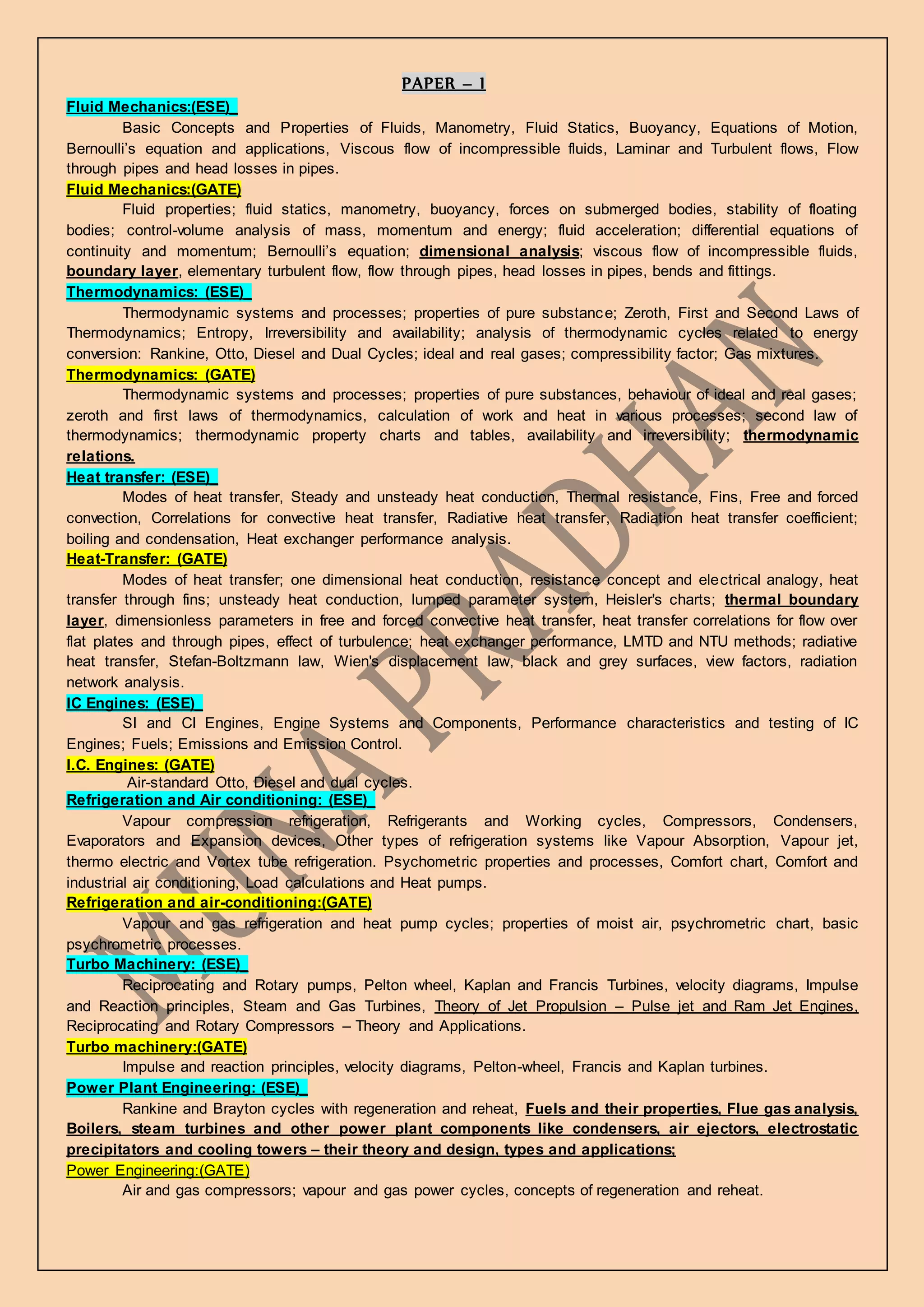
PAPER – I
Fluid Mechanics:(ESE)_
Basic Concepts and Properties of Fluids, Manometry, Fluid Statics, Buoyancy, Equations of Motion,
Bernoulli’s equation and applications, Viscous flow of incompressible fluids, Laminar and Turbulent flows, Flow
through pipes and head losses in pipes.
Fluid Mechanics:(GATE)
Fluid properties; fluid statics, manometry, buoyancy, forces on submerged bodies, stability of floating
bodies; control-volume analysis of mass, momentum and energy; fluid acceleration; differential equations of
continuity and momentum; Bernoulli’s equation; dimensional analysis; viscous flow of incompressible fluids,
boundary layer, elementary turbulent flow, flow through pipes, head losses in pipes, bends and fittings.
Thermodynamics: (ESE)_
Thermodynamic systems and processes; properties of pure substance; Zeroth, First and Second Laws of
Thermodynamics; Entropy, Irreversibility and availability; analysis of thermodynamic cycles related to energy
conversion: Rankine, Otto, Diesel and Dual Cycles; ideal and real gases; compressibility factor; Gas mixtures.
Thermodynamics: (GATE)
Thermodynamic systems and processes; properties of pure substances, behaviour of ideal and real gases;
zeroth and first laws of thermodynamics, calculation of work and heat in various processes; second law of
thermodynamics; thermodynamic property charts and tables, availability and irreversibility; thermodynamic
relations.
Heat transfer: (ESE)_
Modes of heat transfer, Steady and unsteady heat conduction, Thermal resistance, Fins, Free and forced
convection, Correlations for convective heat transfer, Radiative heat transfer, Radiation heat transfer coefficient;
boiling and condensation, Heat exchanger performance analysis.
Heat-Transfer: (GATE)
Modes of heat transfer; one dimensional heat conduction, resistance concept and electrical analogy, heat
transfer through fins; unsteady heat conduction, lumped parameter system, Heisler's charts; thermal boundary
layer, dimensionless parameters in free and forced convective heat transfer, heat transfer correlations for flow over
flat plates and through pipes, effect of turbulence; heat exchanger performance, LMTD and NTU methods; radiative
heat transfer, Stefan-Boltzmann law, Wien's displacement law, black and grey surfaces, view factors, radiation
network analysis.
IC Engines: (ESE)_
SI and CI Engines, Engine Systems and Components, Performance characteristics and testing of IC
Engines; Fuels; Emissions and Emission Control.
I.C. Engines: (GATE)
Air-standard Otto, Diesel and dual cycles.
Refrigeration and Air conditioning: (ESE)_
Vapour compression refrigeration, Refrigerants and Working cycles, Compressors, Condensers,
Evaporators and Expansion devices, Other types of refrigeration systems like Vapour Absorption, Vapour jet,
thermo electric and Vortex tube refrigeration. Psychometric properties and processes, Comfort chart, Comfort and
industrial air conditioning, Load calculations and Heat pumps.
Refrigeration and air-conditioning:(GATE)
Vapour and gas refrigeration and heat pump cycles; properties of moist air, psychrometric chart, basic
psychrometric processes.
Turbo Machinery: (ESE)_
Reciprocating and Rotary pumps, Pelton wheel, Kaplan and Francis Turbines, velocity diagrams, Impulse
and Reaction principles, Steam and Gas Turbines, Theory of Jet Propulsion – Pulse jet and Ram Jet Engines,
Reciprocating and Rotary Compressors – Theory and Applications.
Turbo machinery:(GATE)
Impulse and reaction principles, velocity diagrams, Pelton-wheel, Francis and Kaplan turbines.
Power Plant Engineering: (ESE)_
Rankine and Brayton cycles with regeneration and reheat, Fuels and their properties, Flue gas analysis,
Boilers, steam turbines and other power plant components like condensers, air ejectors, electrostatic
precipitators and cooling towers – their theory and design, types and applications;
Power Engineering:(GATE)
Air and gas compressors; vapour and gas power cycles, concepts of regeneration and reheat.
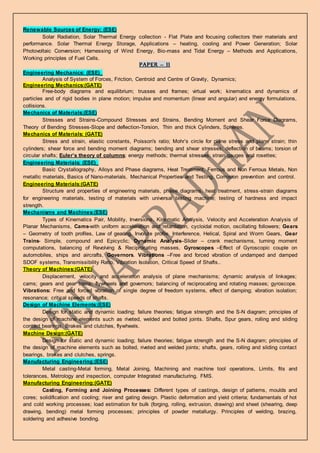
Renewable Sources of Energy: (ESE)
Solar Radiation, Solar Thermal Energy collection - Flat Plate and focusing collectors their materials and
performance. Solar Thermal Energy Storage, Applications – heating, cooling and Power Generation; Solar
Photovoltaic Conversion; Harnessing of Wind Energy, Bio-mass and Tidal Energy – Methods and Applications,
Working principles of Fuel Cells.
PAPER – II
Engineering Mechanics: (ESE)_
Analysis of System of Forces, Friction, Centroid and Centre of Gravity, Dynamics;
Engineering Mechanics:(GATE)
Free-body diagrams and equilibrium; trusses and frames; virtual work; kinematics and dynamics of
particles and of rigid bodies in plane motion; impulse and momentum (linear and angular) and energy formulations,
collisions.
Mechanics of Materials:(ESE)
Stresses and Strains-Compound Stresses and Strains, Bending Moment and Shear Force Diagrams,
Theory of Bending Stresses-Slope and deflection-Torsion, Thin and thick Cylinders, Spheres.
Mechanics of Materials: (GATE)
Stress and strain, elastic constants, Poisson's ratio; Mohr’s circle for plane stress and plane strain; thin
cylinders; shear force and bending moment diagrams; bending and shear stresses; deflection of beams; torsion of
circular shafts; Euler’s theory of columns; energy methods; thermal stresses; strain gauges and rosettes;
Engineering Materials: (ESE)_
Basic Crystallography, Alloys and Phase diagrams, Heat Treatment, Ferrous and Non Ferrous Metals, Non
metallic materials, Basics of Nano-materials, Mechanical Properties and Testing, Corrosion prevention and control.
Engineering Materials:(GATE)
Structure and properties of engineering materials, phase diagrams, heat treatment, stress-strain diagrams
for engineering materials, testing of materials with universal testing machine; testing of hardness and impact
strength.
Mechanisms and Machines:(ESE)
Types of Kinematics Pair, Mobility, Inversions, Kinematic Analysis, Velocity and Acceleration Analysis of
Planar Mechanisms, Cams-with uniform acceleration and retardation, cycloidal motion, oscillating followers; Gears
– Geometry of tooth profiles, Law of gearing, Involute profile, Interference, Helical, Spiral and Worm Gears, Gear
Trains- Simple, compound and Epicyclic; Dynamic Analysis–Slider – crank mechanisms, turning moment
computations, balancing of Revolving & Reciprocating masses, Gyroscopes –Effect of Gyroscopic couple on
automobiles, ships and aircrafts, Governors. Vibrations –Free and forced vibration of undamped and damped
SDOF systems, Transmissibility Ratio, Vibration Isolation, Critical Speed of Shafts..
Theory of Machines:(GATE)
Displacement, velocity and acceleration analysis of plane mechanisms; dynamic analysis of linkages;
cams; gears and gear trains; flywheels and governors; balancing of reciprocating and rotating masses; gyroscope.
Vibrations: Free and forced vibration of single degree of freedom systems, effect of damping; vibration isolation;
resonance; critical speeds of shafts.
Design of Machine Elements:(ESE)
Design for static and dynamic loading; failure theories; fatigue strength and the S-N diagram; principles of
the design of machine elements such as riveted, welded and bolted joints. Shafts, Spur gears, rolling and sliding
contact bearings, Brakes and clutches, flywheels.
Machine Design:(GATE)
Design for static and dynamic loading; failure theories; fatigue strength and the S-N diagram; principles of
the design of machine elements such as bolted, riveted and welded joints; shafts, gears, rolling and sliding contact
bearings, brakes and clutches, springs.
Manufacturing Engineering:(ESE)
Metal casting-Metal forming, Metal Joining, Machining and machine tool operations, Limits, fits and
tolerances, Metrology and inspection, computer Integrated manufacturing, FMS.
Manufacturing Engineering:(GATE)
Casting, Forming and Joining Processes: Different types of castings, design of patterns, moulds and
cores; solidification and cooling; riser and gating design. Plastic deformation and yield criteria; fundamentals of hot
and cold working processes; load estimation for bulk (forging, rolling, extrusion, drawing) and sheet (shearing, deep
drawing, bending) metal forming processes; principles of powder metallurgy. Principles of welding, brazing,
soldering and adhesive bonding.
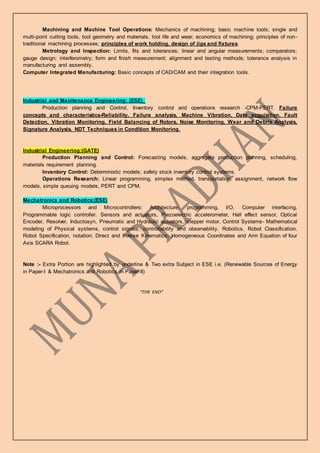
Machining and Machine Tool Operations: Mechanics of machining; basic machine tools; single and
multi-point cutting tools, tool geometry and materials, tool life and wear; economics of machining; principles of non-
traditional machining processes; principles of work holding, design of jigs and fixtures.
Metrology and Inspection: Limits, fits and tolerances; linear and angular measurements; comparators;
gauge design; interferometry; form and finish measurement; alignment and testing methods; tolerance analysis in
manufacturing and assembly.
Computer Integrated Manufacturing: Basic concepts of CAD/CAM and their integration tools.
Industrial and Maintenance Engineering: (ESE)_
Production planning and Control, Inventory control and operations research -CPM-PERT. Failure
concepts and characteristics-Reliability, Failure analysis, Machine Vibration, Data acquisition, Fault
Detection, Vibration Monitoring, Field Balancing of Rotors, Noise Monitoring, Wear and Debris Analysis,
Signature Analysis. NDT Techniques in Condition Monitoring.
Industrial Engineering:(GATE)
Production Planning and Control: Forecasting models, aggregate production planning, scheduling,
materials requirement planning.
Inventory Control: Deterministic models; safety stock inventory control systems.
Operations Research: Linear programming, simplex method, transportation, assignment, network flow
models, simple queuing models, PERT and CPM.
Mechatronics and Robotics:(ESE)
Microprocessors and Microcontrollers: Architecture, programming, I/O, Computer interfacing,
Programmable logic controller. Sensors and actuators, Piezoelectric accelerometer, Hall effect sensor, Optical
Encoder, Resolver, Inductosyn, Pneumatic and Hydraulic actuators, stepper motor, Control Systems- Mathematical
modeling of Physical systems, control signals, controllability and observability. Robotics, Robot Classification,
Robot Specification, notation; Direct and Inverse Kinematics; Homogeneous Coordinates and Arm Equation of four
Axis SCARA Robot.
Note :- Extra Portion are highlighted by underline & Two extra Subject in ESE i.e. (Renewable Sources of Energy
in Paper-I & Mechatronics and Robotics in Paper-II)
*THE END*

Mechanical ese & gate syllabus - 2017

  • 1.
    PAPER – I FluidMechanics:(ESE)_ Basic Concepts and Properties of Fluids, Manometry, Fluid Statics, Buoyancy, Equations of Motion, Bernoulli’s equation and applications, Viscous flow of incompressible fluids, Laminar and Turbulent flows, Flow through pipes and head losses in pipes. Fluid Mechanics:(GATE) Fluid properties; fluid statics, manometry, buoyancy, forces on submerged bodies, stability of floating bodies; control-volume analysis of mass, momentum and energy; fluid acceleration; differential equations of continuity and momentum; Bernoulli’s equation; dimensional analysis; viscous flow of incompressible fluids, boundary layer, elementary turbulent flow, flow through pipes, head losses in pipes, bends and fittings. Thermodynamics: (ESE)_ Thermodynamic systems and processes; properties of pure substance; Zeroth, First and Second Laws of Thermodynamics; Entropy, Irreversibility and availability; analysis of thermodynamic cycles related to energy conversion: Rankine, Otto, Diesel and Dual Cycles; ideal and real gases; compressibility factor; Gas mixtures. Thermodynamics: (GATE) Thermodynamic systems and processes; properties of pure substances, behaviour of ideal and real gases; zeroth and first laws of thermodynamics, calculation of work and heat in various processes; second law of thermodynamics; thermodynamic property charts and tables, availability and irreversibility; thermodynamic relations. Heat transfer: (ESE)_ Modes of heat transfer, Steady and unsteady heat conduction, Thermal resistance, Fins, Free and forced convection, Correlations for convective heat transfer, Radiative heat transfer, Radiation heat transfer coefficient; boiling and condensation, Heat exchanger performance analysis. Heat-Transfer: (GATE) Modes of heat transfer; one dimensional heat conduction, resistance concept and electrical analogy, heat transfer through fins; unsteady heat conduction, lumped parameter system, Heisler's charts; thermal boundary layer, dimensionless parameters in free and forced convective heat transfer, heat transfer correlations for flow over flat plates and through pipes, effect of turbulence; heat exchanger performance, LMTD and NTU methods; radiative heat transfer, Stefan-Boltzmann law, Wien's displacement law, black and grey surfaces, view factors, radiation network analysis. IC Engines: (ESE)_ SI and CI Engines, Engine Systems and Components, Performance characteristics and testing of IC Engines; Fuels; Emissions and Emission Control. I.C. Engines: (GATE) Air-standard Otto, Diesel and dual cycles. Refrigeration and Air conditioning: (ESE)_ Vapour compression refrigeration, Refrigerants and Working cycles, Compressors, Condensers, Evaporators and Expansion devices, Other types of refrigeration systems like Vapour Absorption, Vapour jet, thermo electric and Vortex tube refrigeration. Psychometric properties and processes, Comfort chart, Comfort and industrial air conditioning, Load calculations and Heat pumps. Refrigeration and air-conditioning:(GATE) Vapour and gas refrigeration and heat pump cycles; properties of moist air, psychrometric chart, basic psychrometric processes. Turbo Machinery: (ESE)_ Reciprocating and Rotary pumps, Pelton wheel, Kaplan and Francis Turbines, velocity diagrams, Impulse and Reaction principles, Steam and Gas Turbines, Theory of Jet Propulsion – Pulse jet and Ram Jet Engines, Reciprocating and Rotary Compressors – Theory and Applications. Turbo machinery:(GATE) Impulse and reaction principles, velocity diagrams, Pelton-wheel, Francis and Kaplan turbines. Power Plant Engineering: (ESE)_ Rankine and Brayton cycles with regeneration and reheat, Fuels and their properties, Flue gas analysis, Boilers, steam turbines and other power plant components like condensers, air ejectors, electrostatic precipitators and cooling towers – their theory and design, types and applications; Power Engineering:(GATE) Air and gas compressors; vapour and gas power cycles, concepts of regeneration and reheat.
  • 2.
    Renewable Sources ofEnergy: (ESE) Solar Radiation, Solar Thermal Energy collection - Flat Plate and focusing collectors their materials and performance. Solar Thermal Energy Storage, Applications – heating, cooling and Power Generation; Solar Photovoltaic Conversion; Harnessing of Wind Energy, Bio-mass and Tidal Energy – Methods and Applications, Working principles of Fuel Cells. PAPER – II Engineering Mechanics: (ESE)_ Analysis of System of Forces, Friction, Centroid and Centre of Gravity, Dynamics; Engineering Mechanics:(GATE) Free-body diagrams and equilibrium; trusses and frames; virtual work; kinematics and dynamics of particles and of rigid bodies in plane motion; impulse and momentum (linear and angular) and energy formulations, collisions. Mechanics of Materials:(ESE) Stresses and Strains-Compound Stresses and Strains, Bending Moment and Shear Force Diagrams, Theory of Bending Stresses-Slope and deflection-Torsion, Thin and thick Cylinders, Spheres. Mechanics of Materials: (GATE) Stress and strain, elastic constants, Poisson's ratio; Mohr’s circle for plane stress and plane strain; thin cylinders; shear force and bending moment diagrams; bending and shear stresses; deflection of beams; torsion of circular shafts; Euler’s theory of columns; energy methods; thermal stresses; strain gauges and rosettes; Engineering Materials: (ESE)_ Basic Crystallography, Alloys and Phase diagrams, Heat Treatment, Ferrous and Non Ferrous Metals, Non metallic materials, Basics of Nano-materials, Mechanical Properties and Testing, Corrosion prevention and control. Engineering Materials:(GATE) Structure and properties of engineering materials, phase diagrams, heat treatment, stress-strain diagrams for engineering materials, testing of materials with universal testing machine; testing of hardness and impact strength. Mechanisms and Machines:(ESE) Types of Kinematics Pair, Mobility, Inversions, Kinematic Analysis, Velocity and Acceleration Analysis of Planar Mechanisms, Cams-with uniform acceleration and retardation, cycloidal motion, oscillating followers; Gears – Geometry of tooth profiles, Law of gearing, Involute profile, Interference, Helical, Spiral and Worm Gears, Gear Trains- Simple, compound and Epicyclic; Dynamic Analysis–Slider – crank mechanisms, turning moment computations, balancing of Revolving & Reciprocating masses, Gyroscopes –Effect of Gyroscopic couple on automobiles, ships and aircrafts, Governors. Vibrations –Free and forced vibration of undamped and damped SDOF systems, Transmissibility Ratio, Vibration Isolation, Critical Speed of Shafts.. Theory of Machines:(GATE) Displacement, velocity and acceleration analysis of plane mechanisms; dynamic analysis of linkages; cams; gears and gear trains; flywheels and governors; balancing of reciprocating and rotating masses; gyroscope. Vibrations: Free and forced vibration of single degree of freedom systems, effect of damping; vibration isolation; resonance; critical speeds of shafts. Design of Machine Elements:(ESE) Design for static and dynamic loading; failure theories; fatigue strength and the S-N diagram; principles of the design of machine elements such as riveted, welded and bolted joints. Shafts, Spur gears, rolling and sliding contact bearings, Brakes and clutches, flywheels. Machine Design:(GATE) Design for static and dynamic loading; failure theories; fatigue strength and the S-N diagram; principles of the design of machine elements such as bolted, riveted and welded joints; shafts, gears, rolling and sliding contact bearings, brakes and clutches, springs. Manufacturing Engineering:(ESE) Metal casting-Metal forming, Metal Joining, Machining and machine tool operations, Limits, fits and tolerances, Metrology and inspection, computer Integrated manufacturing, FMS. Manufacturing Engineering:(GATE) Casting, Forming and Joining Processes: Different types of castings, design of patterns, moulds and cores; solidification and cooling; riser and gating design. Plastic deformation and yield criteria; fundamentals of hot and cold working processes; load estimation for bulk (forging, rolling, extrusion, drawing) and sheet (shearing, deep drawing, bending) metal forming processes; principles of powder metallurgy. Principles of welding, brazing, soldering and adhesive bonding.
  • 3.
    Machining and MachineTool Operations: Mechanics of machining; basic machine tools; single and multi-point cutting tools, tool geometry and materials, tool life and wear; economics of machining; principles of non- traditional machining processes; principles of work holding, design of jigs and fixtures. Metrology and Inspection: Limits, fits and tolerances; linear and angular measurements; comparators; gauge design; interferometry; form and finish measurement; alignment and testing methods; tolerance analysis in manufacturing and assembly. Computer Integrated Manufacturing: Basic concepts of CAD/CAM and their integration tools. Industrial and Maintenance Engineering: (ESE)_ Production planning and Control, Inventory control and operations research -CPM-PERT. Failure concepts and characteristics-Reliability, Failure analysis, Machine Vibration, Data acquisition, Fault Detection, Vibration Monitoring, Field Balancing of Rotors, Noise Monitoring, Wear and Debris Analysis, Signature Analysis. NDT Techniques in Condition Monitoring. Industrial Engineering:(GATE) Production Planning and Control: Forecasting models, aggregate production planning, scheduling, materials requirement planning. Inventory Control: Deterministic models; safety stock inventory control systems. Operations Research: Linear programming, simplex method, transportation, assignment, network flow models, simple queuing models, PERT and CPM. Mechatronics and Robotics:(ESE) Microprocessors and Microcontrollers: Architecture, programming, I/O, Computer interfacing, Programmable logic controller. Sensors and actuators, Piezoelectric accelerometer, Hall effect sensor, Optical Encoder, Resolver, Inductosyn, Pneumatic and Hydraulic actuators, stepper motor, Control Systems- Mathematical modeling of Physical systems, control signals, controllability and observability. Robotics, Robot Classification, Robot Specification, notation; Direct and Inverse Kinematics; Homogeneous Coordinates and Arm Equation of four Axis SCARA Robot. Note :- Extra Portion are highlighted by underline & Two extra Subject in ESE i.e. (Renewable Sources of Energy in Paper-I & Mechatronics and Robotics in Paper-II) *THE END*