!
!
!
!
!
!
McHenry Library Material Stream Remediation
University of California, Santa Cruz
!
Haakon Williams, Provost’s Sustainability Intern
Roger Edberg, Sr. Superintendent of Grounds Services
!
June 2014
!
!1
Introduction!
This year at UCSC, the Chancellor’s Sustainability Challenge put the focus on
waste, challenging individuals and campus units to reduce their levels of waste.
Our sustainability goals at UCSC are informed by the UC Office of the President’s
Policy on Sustainable Practices, which sets forth an objective for all UC campuses
to be “zero waste” by the year 2020. Neither UCSC as a whole nor any of its
component units have yet achieved zero waste, which is defined as diversion of
95% of waste material away from the landfill. This project has sought to help one
campus building, McHenry Library, achieve zero waste, as a pilot for the
numerous material stream remediations that will have to happen if UCSC hopes
to achieve its waste goal. As much as possible, this report will use the term
“material” in place of “waste” due to the latter’s connotation that the material has
no value; on the contrary, we are of the opinion that the vast majority of “waste”
material is wasted only in a landfill and has the potential for great value in its
post-consumer life.
!
Background!
The recently-renovated McHenry Library was chosen for assessment and
remediation due to its prominent position at the physical and emotional heart of
campus, a prime position to inspire waste transitions, personal and institutional.
In addition, the library houses the Global Village Cafe (GVC), run by Hoffman’s
Bistro & Patisserie, an independent local contractor. Casual observation of the
material stream indicated that neither the GVC nor the library itself were
anywhere near zero waste. A complete lack of data on the material streams
hampered efforts to remedy them, indicating that a material stream assessment
would be the first step towards zero waste, followed by efforts at material stream
remediation. It is important to note that these issues, wasteful material streams
and lack of data, apply not only to McHenry Library but are general issues in need
of solution in the field of waste.
!
Goals and Desired Outcomes!
Our intention is not to police McHenry Library or the Global Village Cafe; we are
not here to judge and incriminate. Rather, it is our goal to work with the cafe and
the library to help them meet the university’s zero waste goal. To do so, a solid
base of data must be obtained so as to understand and effectively target improper
material disposal. We have developed a statistically sound portrayal of the typical
material output of McHenry Library and the Global Village Cafe, including data
both on the current state of the material streams and on the ideal state that could
be achieved with proper sorting of materials. The ultimate success of this project
!2
will be determined by the results of a follow-up assessment that will measure the
efficacy of our efforts. We hope this assessment will find a facility operating at
zero waste, or at least well on its way there.
!
Assessment Method!
On the morning of Friday October 18th, all the material streams (refuse, compost,
mixed recycle, and paper recycle) were “zeroed out”, which is to say they were
collected at the same time so as to provide a simultaneous starting point for
sampling all the streams. Material was then allowed to accumulate normally
through Monday the 21st. The Grounds Services waste collection teams, headed
by Bill Alderson and Ron Dillehay, were instrumental in maneuvering and
coordinating the material streams so that the sample contained material from a
uniform time period and from all possible material streams coming out of the
facility. They also played a crucial part in gathering all the material at the LPG
Yard at the base of campus so it could be sorted and recorded by a crew of several
students from the Sustainability Office and various Grounds Services staff.
Weights were collected of all the material by category so as to compare the actual
percentages of material categories to the material output as it was categorized by
facility staff and patrons.
!
Notes on Asssessment!
As can be expected, our first run at a material stream assessment did not run
perfectly. Though we believe we acquired quality data, there are areas where
improvements can be made so as to run smoother and quicker next time.
• We originally wanted to separate the material into categories by floor of the
building. This is not necessary. Separating into different material types and
differentiating between material from the library and from the cafe are the
extent of categorization necessary to understand improper material sorting.
• Lacking preconceived notions of the realities involved with sorting and
quantifying large amounts of waste material, we began the process inefficiently.
Since we stumbled a bit in getting an effective system set up for personnel to
quickly sort material, we didn’t use our Sustainability Office student helpers as
much as we could have, and the process took two days instead of just one. Next
time, plan exactly how the sorting and weighing will be structured.
• Grounds Services was very helpful with the resources they provided. However,
we initially lacked enough grabber sticks for all helpers, bin labels to make it
clear which material should go where, and sufficient protective clothing for
helpers.
• A couple categories were not sorted for which, in retrospect, would have been
useful. Specifically, we should: account for cardboard to see how much
!3
additional cardboard could be diverted to the established cardboard stream;
account for soiled paper in the recycle; and differentiate the cafe’s recycle from
that of the rest of the library.
• Weigh the plastic film (primarily bin liners) for each material stream, rather
than all together at the end, to see how much is coming out of each stream.
• Compost was not sorted due to perceived lack of necessity (presumably, people
only compost what they know to be compost) and general aversion of crew to
compost material. However, we found a plastic mustard bottle in the compost.
Perhaps the compost should be sorted to see if the material thrown in the
compost belongs there.
!
!
Notes on Data!
The following charts are meant to give several perspectives on the composition of
the material streams coming out of the facility as a whole, as well as the streams
specific to the Global Village Cafe.
!
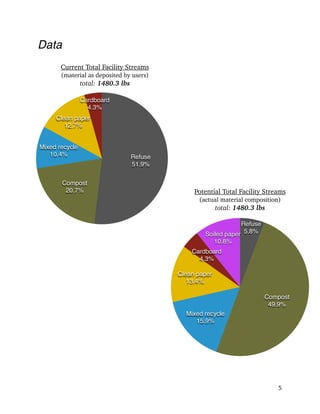
The first two pie charts show us the difference between the material streams in
their current state, with much material improperly sorted (“Current Total Facility
Streams”) and their ideal state, with all materials in their proper stream (Potential
Total Facility Streams”). Each wedge represents how much material a stream
contains relative to the other streams.
!
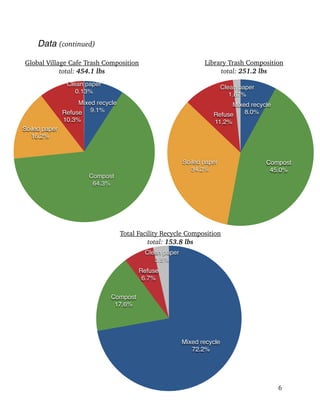
The next three pie charts show how much of a given stream is properly sorted and
how much is material that belongs in a different stream. Specifically, they show
that both of the refuse streams are composed mainly of compostable and
recyclable materials, and that the recycle stream is well sorted, with only 18%
contamination from non-recyclables.
!
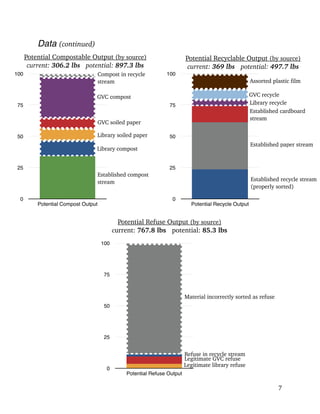
The final three bar charts expand on the idea of showing potential. The first two,
“Potential Compost Output” and “Potential Recycle Output”, showing with the
solid-edged sections how much material there currently is in that stream and with
the wavy-edged sections how much more could be diverted into the stream. The
last chart, “Potential Refuse Output”, shows with the solid-edged sections how
much of the material in the refuse stream is actually refuse and with the wavy-
edged section how much of those materials should not be in the refuse stream.
!
The raw data can be found at the end of this report.

!4
Data 

!5
Potential Total Facility Streams
(actual material composition)
total: 1480.3 lbs
Cardboard!
4.3%
Clean paper!
12.7%
Mixed recycle!
10.4%
Compost!
20.7%
Refuse!
51.9%
Soiled paper!
10.8%
Cardboard!
4.3%
Clean paper!
13.4%
Mixed recycle!
15.9%
Compost!
49.9%
Refuse!
5.8%
Current Total Facility Streams
(material as deposited by users)
total: 1480.3 lbs
Data (continued)


!6
Clean paper!
0.13%
Refuse!
10.3%
Soiled paper!
16.2%
Compost!
64.3%
Mixed recycle!
9.1%
Global Village Cafe Trash Composition
total: 454.1 lbs
Clean paper!
1.67%
Refuse!
11.2%
Soiled paper!
34.2%
Compost!
45.0%
Mixed recycle!
8.0%
Library Trash Composition
total: 251.2 lbs
Clean paper!
3.5%
Refuse!
6.7%
Compost!
17.6%
Mixed recycle!
72.2%
Total Facility Recycle Composition
total: 153.8 lbs
Data (continued)


!7
Potential Compostable Output (by source)
current: 306.2 lbs potential: 897.3 lbs
Potential Recyclable Output (by source)
current: 369 lbs potential: 497.7 lbs
Potential Refuse Output (by source)
current: 767.8 lbs potential: 85.3 lbs
0
25
50
75
100
Potential Compost Output
Established compost
stream
Library compost
Library soiled paper
GVC soiled paper
GVC compost
Compost in recycle
stream
0
25
50
75
100
Potential Recycle Output
Established recycle stream
(properly sorted)
Established paper stream
Established cardboard
stream
Library recycle
GVC recycle
Assorted plastic film
0
25
50
75
100
Potential Refuse Output
Legitimate library refuse
Legitimate GVC refuse
Refuse in recycle stream
Material incorrectly sorted as refuse
Remediation!
Full remediation of the material streams to their ideal state is not presently
possible due to several institutional obstacles currently in the process of being
worked out. For instance, we would increase diversion if there were compost bins
throughout the library instead of only in the cafe; Physical Plant is in the process
of coordinating with the Purchasing Department and the Custodial Union to
implement new bins with a compost option throughout the library, but it is a slow
process. Even if we could get everyone in the library to put all compostables in
the compost, we would have nowhere to take this material, because the facility
we currently take our compost to (Monterey Regional Waste Management District
in Marina, CA) uses an anaerobic digester that can’t accommodate increased
levels of non-organic compostables like paper towels and biodegradable culinary
wares. We could buy an in-vessel composter and process all our compost material
on-site, but this would have to wait until the Recycle & Compost Yard is built (it
just passed the proposal stage). The completion of these projects will bring huge
improvements to material diversion at UCSC and McHenry Library. However, the
work being done on them is on a larger scale than this project, and so I have had
to spin my wheels somewhat, focusing on smaller approaches to increasing
diversion.
!
The most significant thing that has been accomplished towards increasing
diversion at McHenry is coordinating with the cafe to improve their diversion
practices. Specifically, this entailed increasing the number of compost bins behind
the counter, emphasizing to employees the importance and proper methods for
disposing of material, increasing the number of compost bins in the loading dock
available for the cafe, creating a display to educate employees on the waste
protocol for the various items they work with, and connecting the GVC to the
purchase of new and improved bins for the rest of the library.
!
Next steps that could be taken, given the completion of the institutional waste
projects, include: improving the GVC display to make it more permanent and
authoritative; putting a sign on the way from the GVC to the loading dock to
remind employees taking bags of material out where each type of material goes;
transitioning the GVC to recyclable/compostable gloves; promoting the “Bring
Your Own Mug” customer discount at the GVC; holding a program to raise
awareness in library patrons of proper material disposal practices; creating a
presentation of this project and encouraged waste disposal practices; and making
signs to put in the bathroom informing people about the separation of paper
towels and other restroom trash.
!8

McHenry Material Stream Assessment Report

  • 1.
    ! ! ! ! ! ! McHenry Library MaterialStream Remediation University of California, Santa Cruz ! Haakon Williams, Provost’s Sustainability Intern Roger Edberg, Sr. Superintendent of Grounds Services ! June 2014 ! !1
  • 2.
    Introduction! This year atUCSC, the Chancellor’s Sustainability Challenge put the focus on waste, challenging individuals and campus units to reduce their levels of waste. Our sustainability goals at UCSC are informed by the UC Office of the President’s Policy on Sustainable Practices, which sets forth an objective for all UC campuses to be “zero waste” by the year 2020. Neither UCSC as a whole nor any of its component units have yet achieved zero waste, which is defined as diversion of 95% of waste material away from the landfill. This project has sought to help one campus building, McHenry Library, achieve zero waste, as a pilot for the numerous material stream remediations that will have to happen if UCSC hopes to achieve its waste goal. As much as possible, this report will use the term “material” in place of “waste” due to the latter’s connotation that the material has no value; on the contrary, we are of the opinion that the vast majority of “waste” material is wasted only in a landfill and has the potential for great value in its post-consumer life. ! Background! The recently-renovated McHenry Library was chosen for assessment and remediation due to its prominent position at the physical and emotional heart of campus, a prime position to inspire waste transitions, personal and institutional. In addition, the library houses the Global Village Cafe (GVC), run by Hoffman’s Bistro & Patisserie, an independent local contractor. Casual observation of the material stream indicated that neither the GVC nor the library itself were anywhere near zero waste. A complete lack of data on the material streams hampered efforts to remedy them, indicating that a material stream assessment would be the first step towards zero waste, followed by efforts at material stream remediation. It is important to note that these issues, wasteful material streams and lack of data, apply not only to McHenry Library but are general issues in need of solution in the field of waste. ! Goals and Desired Outcomes! Our intention is not to police McHenry Library or the Global Village Cafe; we are not here to judge and incriminate. Rather, it is our goal to work with the cafe and the library to help them meet the university’s zero waste goal. To do so, a solid base of data must be obtained so as to understand and effectively target improper material disposal. We have developed a statistically sound portrayal of the typical material output of McHenry Library and the Global Village Cafe, including data both on the current state of the material streams and on the ideal state that could be achieved with proper sorting of materials. The ultimate success of this project !2
  • 3.
    will be determinedby the results of a follow-up assessment that will measure the efficacy of our efforts. We hope this assessment will find a facility operating at zero waste, or at least well on its way there. ! Assessment Method! On the morning of Friday October 18th, all the material streams (refuse, compost, mixed recycle, and paper recycle) were “zeroed out”, which is to say they were collected at the same time so as to provide a simultaneous starting point for sampling all the streams. Material was then allowed to accumulate normally through Monday the 21st. The Grounds Services waste collection teams, headed by Bill Alderson and Ron Dillehay, were instrumental in maneuvering and coordinating the material streams so that the sample contained material from a uniform time period and from all possible material streams coming out of the facility. They also played a crucial part in gathering all the material at the LPG Yard at the base of campus so it could be sorted and recorded by a crew of several students from the Sustainability Office and various Grounds Services staff. Weights were collected of all the material by category so as to compare the actual percentages of material categories to the material output as it was categorized by facility staff and patrons. ! Notes on Asssessment! As can be expected, our first run at a material stream assessment did not run perfectly. Though we believe we acquired quality data, there are areas where improvements can be made so as to run smoother and quicker next time. • We originally wanted to separate the material into categories by floor of the building. This is not necessary. Separating into different material types and differentiating between material from the library and from the cafe are the extent of categorization necessary to understand improper material sorting. • Lacking preconceived notions of the realities involved with sorting and quantifying large amounts of waste material, we began the process inefficiently. Since we stumbled a bit in getting an effective system set up for personnel to quickly sort material, we didn’t use our Sustainability Office student helpers as much as we could have, and the process took two days instead of just one. Next time, plan exactly how the sorting and weighing will be structured. • Grounds Services was very helpful with the resources they provided. However, we initially lacked enough grabber sticks for all helpers, bin labels to make it clear which material should go where, and sufficient protective clothing for helpers. • A couple categories were not sorted for which, in retrospect, would have been useful. Specifically, we should: account for cardboard to see how much !3
  • 4.
    additional cardboard couldbe diverted to the established cardboard stream; account for soiled paper in the recycle; and differentiate the cafe’s recycle from that of the rest of the library. • Weigh the plastic film (primarily bin liners) for each material stream, rather than all together at the end, to see how much is coming out of each stream. • Compost was not sorted due to perceived lack of necessity (presumably, people only compost what they know to be compost) and general aversion of crew to compost material. However, we found a plastic mustard bottle in the compost. Perhaps the compost should be sorted to see if the material thrown in the compost belongs there. ! ! Notes on Data! The following charts are meant to give several perspectives on the composition of the material streams coming out of the facility as a whole, as well as the streams specific to the Global Village Cafe. ! The first two pie charts show us the difference between the material streams in their current state, with much material improperly sorted (“Current Total Facility Streams”) and their ideal state, with all materials in their proper stream (Potential Total Facility Streams”). Each wedge represents how much material a stream contains relative to the other streams. ! The next three pie charts show how much of a given stream is properly sorted and how much is material that belongs in a different stream. Specifically, they show that both of the refuse streams are composed mainly of compostable and recyclable materials, and that the recycle stream is well sorted, with only 18% contamination from non-recyclables. ! The final three bar charts expand on the idea of showing potential. The first two, “Potential Compost Output” and “Potential Recycle Output”, showing with the solid-edged sections how much material there currently is in that stream and with the wavy-edged sections how much more could be diverted into the stream. The last chart, “Potential Refuse Output”, shows with the solid-edged sections how much of the material in the refuse stream is actually refuse and with the wavy- edged section how much of those materials should not be in the refuse stream. ! The raw data can be found at the end of this report.
 !4
  • 5.
    Data 
 !5 Potential TotalFacility Streams (actual material composition) total: 1480.3 lbs Cardboard! 4.3% Clean paper! 12.7% Mixed recycle! 10.4% Compost! 20.7% Refuse! 51.9% Soiled paper! 10.8% Cardboard! 4.3% Clean paper! 13.4% Mixed recycle! 15.9% Compost! 49.9% Refuse! 5.8% Current Total Facility Streams (material as deposited by users) total: 1480.3 lbs
  • 6.
    Data (continued) 
 !6 Clean paper! 0.13% Refuse! 10.3% Soiledpaper! 16.2% Compost! 64.3% Mixed recycle! 9.1% Global Village Cafe Trash Composition total: 454.1 lbs Clean paper! 1.67% Refuse! 11.2% Soiled paper! 34.2% Compost! 45.0% Mixed recycle! 8.0% Library Trash Composition total: 251.2 lbs Clean paper! 3.5% Refuse! 6.7% Compost! 17.6% Mixed recycle! 72.2% Total Facility Recycle Composition total: 153.8 lbs
  • 7.
    Data (continued) 
 !7 Potential CompostableOutput (by source) current: 306.2 lbs potential: 897.3 lbs Potential Recyclable Output (by source) current: 369 lbs potential: 497.7 lbs Potential Refuse Output (by source) current: 767.8 lbs potential: 85.3 lbs 0 25 50 75 100 Potential Compost Output Established compost stream Library compost Library soiled paper GVC soiled paper GVC compost Compost in recycle stream 0 25 50 75 100 Potential Recycle Output Established recycle stream (properly sorted) Established paper stream Established cardboard stream Library recycle GVC recycle Assorted plastic film 0 25 50 75 100 Potential Refuse Output Legitimate library refuse Legitimate GVC refuse Refuse in recycle stream Material incorrectly sorted as refuse
  • 8.
    Remediation! Full remediation ofthe material streams to their ideal state is not presently possible due to several institutional obstacles currently in the process of being worked out. For instance, we would increase diversion if there were compost bins throughout the library instead of only in the cafe; Physical Plant is in the process of coordinating with the Purchasing Department and the Custodial Union to implement new bins with a compost option throughout the library, but it is a slow process. Even if we could get everyone in the library to put all compostables in the compost, we would have nowhere to take this material, because the facility we currently take our compost to (Monterey Regional Waste Management District in Marina, CA) uses an anaerobic digester that can’t accommodate increased levels of non-organic compostables like paper towels and biodegradable culinary wares. We could buy an in-vessel composter and process all our compost material on-site, but this would have to wait until the Recycle & Compost Yard is built (it just passed the proposal stage). The completion of these projects will bring huge improvements to material diversion at UCSC and McHenry Library. However, the work being done on them is on a larger scale than this project, and so I have had to spin my wheels somewhat, focusing on smaller approaches to increasing diversion. ! The most significant thing that has been accomplished towards increasing diversion at McHenry is coordinating with the cafe to improve their diversion practices. Specifically, this entailed increasing the number of compost bins behind the counter, emphasizing to employees the importance and proper methods for disposing of material, increasing the number of compost bins in the loading dock available for the cafe, creating a display to educate employees on the waste protocol for the various items they work with, and connecting the GVC to the purchase of new and improved bins for the rest of the library. ! Next steps that could be taken, given the completion of the institutional waste projects, include: improving the GVC display to make it more permanent and authoritative; putting a sign on the way from the GVC to the loading dock to remind employees taking bags of material out where each type of material goes; transitioning the GVC to recyclable/compostable gloves; promoting the “Bring Your Own Mug” customer discount at the GVC; holding a program to raise awareness in library patrons of proper material disposal practices; creating a presentation of this project and encouraged waste disposal practices; and making signs to put in the bathroom informing people about the separation of paper towels and other restroom trash. !8