Tiered Pricing Models:  the Effect on Library Budgets  John McDonald Acquisitions Librarian Charleston Conference November 5, 2003
Where are We Coming From Pricing for print journals was the same for every subscriber, resulting in… Some libraries could afford many journals and built great collections, but others could afford selected journals and built average collections.  Collection decisions were based on the (perceived) relative worth of the journal to the institution.
Where are We Going? Ejournals Pricing (c. 1998) Free with print subscriptions Surcharge for online access Package deals Ejournal Pricing (c.2003) Over a dozen new models in place . . .
Tiered Pricing Models 1.  Free with print  with reasonable inflation 2.  Free with print  with unreasonable inflation 3.  Surcharge for online  at a reasonable rate 4.  Surcharge for online  at an unreasonable rate 5.  Package deal  for an institution’s print holdings 6.  Package deal for everything  in the publisher’s portfolio 7. Surcharge based on  Carnegie Classifications 8. Surcharge based on  Institutional FTE 9. Surcharge based on  FTE of specific groups 10. Usage based pricing, based on actual,  Recorded Use 11. Usage based pricing, based on relative  Use Levels 12.  Citation  based pricing 13.  Simultaneous users  or  Sliding Content Based
Issues with Tiered Models Fairness of models Library budgets, publisher revenue, ability to pay, ability to  continue  to pay Equity of models All libraries and users being treated the same?  If not, is that alright with them? Inflation rates Why must they be as high as 12 to 20% per year? Usage rates We don’t yet understand usage or how to collect, compile, and disseminate it.  Or who reports it.  Yet .
The real problem… All libraries have to face a variety of pricing models, which in aggregate,  ALWAYS  favor the pricing that benefits the publisher.  The models are often imposed by the publisher, are non-negotiable, and are based on good faith statements by the seller.
The real affect on the budget… Testing the theory   15 of Caltech’s largest publishers Compiled  Ejournal Use (publisher reported) Citations (from ISI citation indexes) Impact Factor (from JCR) FTE (institute & user group) Inflation rates (5 year average) Print prices  Pricing Model
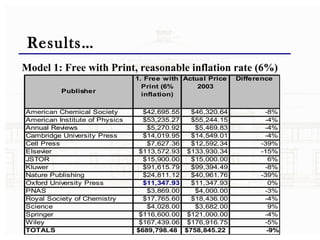
Results… Model 1: Free with Print, reasonable inflation rate (6%)
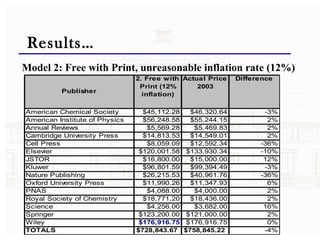
Results… Model 2: Free with Print, unreasonable inflation rate (12%)
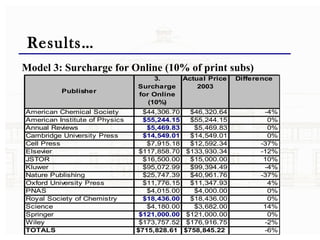
Results… Model 3: Surcharge for Online (10% of print subs)
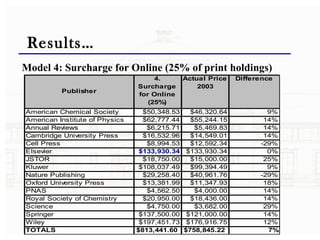
Results… Model 4: Surcharge for Online (25% of print holdings)
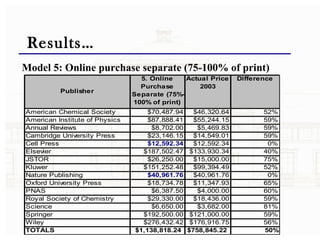
Results… Model 5: Online purchase separate (75-100% of print)
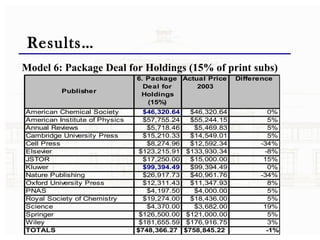
Results… Model 6: Package Deal for Holdings (15% of print subs)
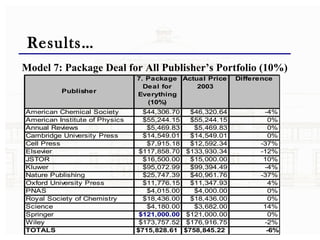
Results… Model 7: Package Deal for All Publisher’s Portfolio (10%)
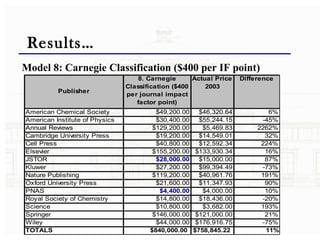
Results… Model 8: Carnegie Classification ($400 per IF point)
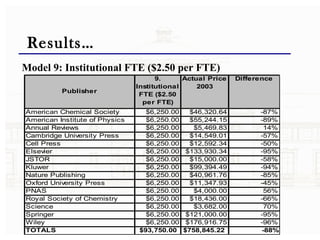
Results… Model 9: Institutional FTE ($2.50 per FTE)
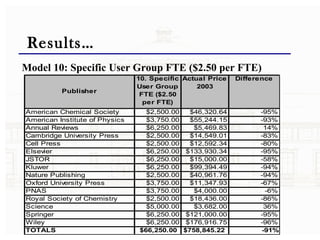
Results… Model 10: Specific User Group FTE ($2.50 per FTE)
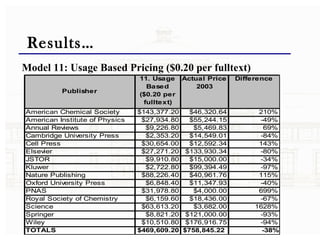
Results… Model 11: Usage Based Pricing ($0.20 per fulltext)
Results… Model 12: Citation Based ($20 per citation [CLS Avg])
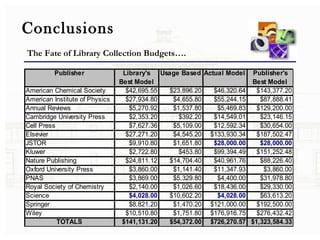
Conclusions                                                                                                                                                                      The Fate of Library Collection Budgets….

Tiered Pricing Models: The Effect on Library Budgets

  • 1.
    Tiered Pricing Models: the Effect on Library Budgets John McDonald Acquisitions Librarian Charleston Conference November 5, 2003
  • 2.
    Where are WeComing From Pricing for print journals was the same for every subscriber, resulting in… Some libraries could afford many journals and built great collections, but others could afford selected journals and built average collections. Collection decisions were based on the (perceived) relative worth of the journal to the institution.
  • 3.
    Where are WeGoing? Ejournals Pricing (c. 1998) Free with print subscriptions Surcharge for online access Package deals Ejournal Pricing (c.2003) Over a dozen new models in place . . .
  • 4.
    Tiered Pricing Models1. Free with print with reasonable inflation 2. Free with print with unreasonable inflation 3. Surcharge for online at a reasonable rate 4. Surcharge for online at an unreasonable rate 5. Package deal for an institution’s print holdings 6. Package deal for everything in the publisher’s portfolio 7. Surcharge based on Carnegie Classifications 8. Surcharge based on Institutional FTE 9. Surcharge based on FTE of specific groups 10. Usage based pricing, based on actual, Recorded Use 11. Usage based pricing, based on relative Use Levels 12. Citation based pricing 13. Simultaneous users or Sliding Content Based
  • 5.
    Issues with TieredModels Fairness of models Library budgets, publisher revenue, ability to pay, ability to continue to pay Equity of models All libraries and users being treated the same? If not, is that alright with them? Inflation rates Why must they be as high as 12 to 20% per year? Usage rates We don’t yet understand usage or how to collect, compile, and disseminate it. Or who reports it. Yet .
  • 6.
    The real problem…All libraries have to face a variety of pricing models, which in aggregate, ALWAYS favor the pricing that benefits the publisher. The models are often imposed by the publisher, are non-negotiable, and are based on good faith statements by the seller.
  • 7.
    The real affecton the budget… Testing the theory 15 of Caltech’s largest publishers Compiled Ejournal Use (publisher reported) Citations (from ISI citation indexes) Impact Factor (from JCR) FTE (institute & user group) Inflation rates (5 year average) Print prices Pricing Model
  • 8.
    Results… Model 1:Free with Print, reasonable inflation rate (6%)
  • 9.
    Results… Model 2:Free with Print, unreasonable inflation rate (12%)
  • 10.
    Results… Model 3:Surcharge for Online (10% of print subs)
  • 11.
    Results… Model 4:Surcharge for Online (25% of print holdings)
  • 12.
    Results… Model 5:Online purchase separate (75-100% of print)
  • 13.
    Results… Model 6:Package Deal for Holdings (15% of print subs)
  • 14.
    Results… Model 7:Package Deal for All Publisher’s Portfolio (10%)
  • 15.
    Results… Model 8:Carnegie Classification ($400 per IF point)
  • 16.
    Results… Model 9:Institutional FTE ($2.50 per FTE)
  • 17.
    Results… Model 10:Specific User Group FTE ($2.50 per FTE)
  • 18.
    Results… Model 11:Usage Based Pricing ($0.20 per fulltext)
  • 19.
    Results… Model 12:Citation Based ($20 per citation [CLS Avg])
  • 20.
    Conclusions                                                                                                                                                                   The Fate of Library Collection Budgets….