SPPU - MBA Revised Curriculum 2024 NEP Pattern
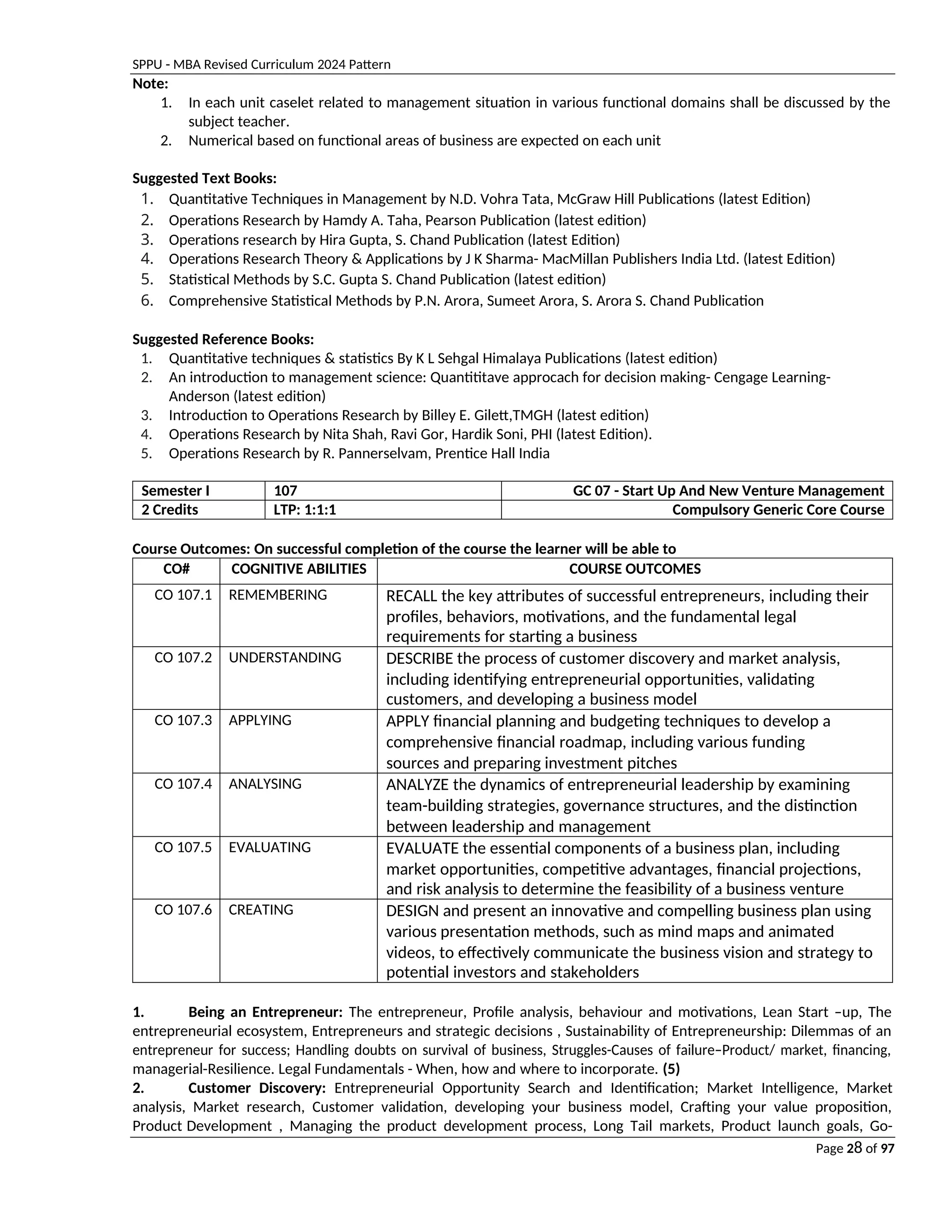
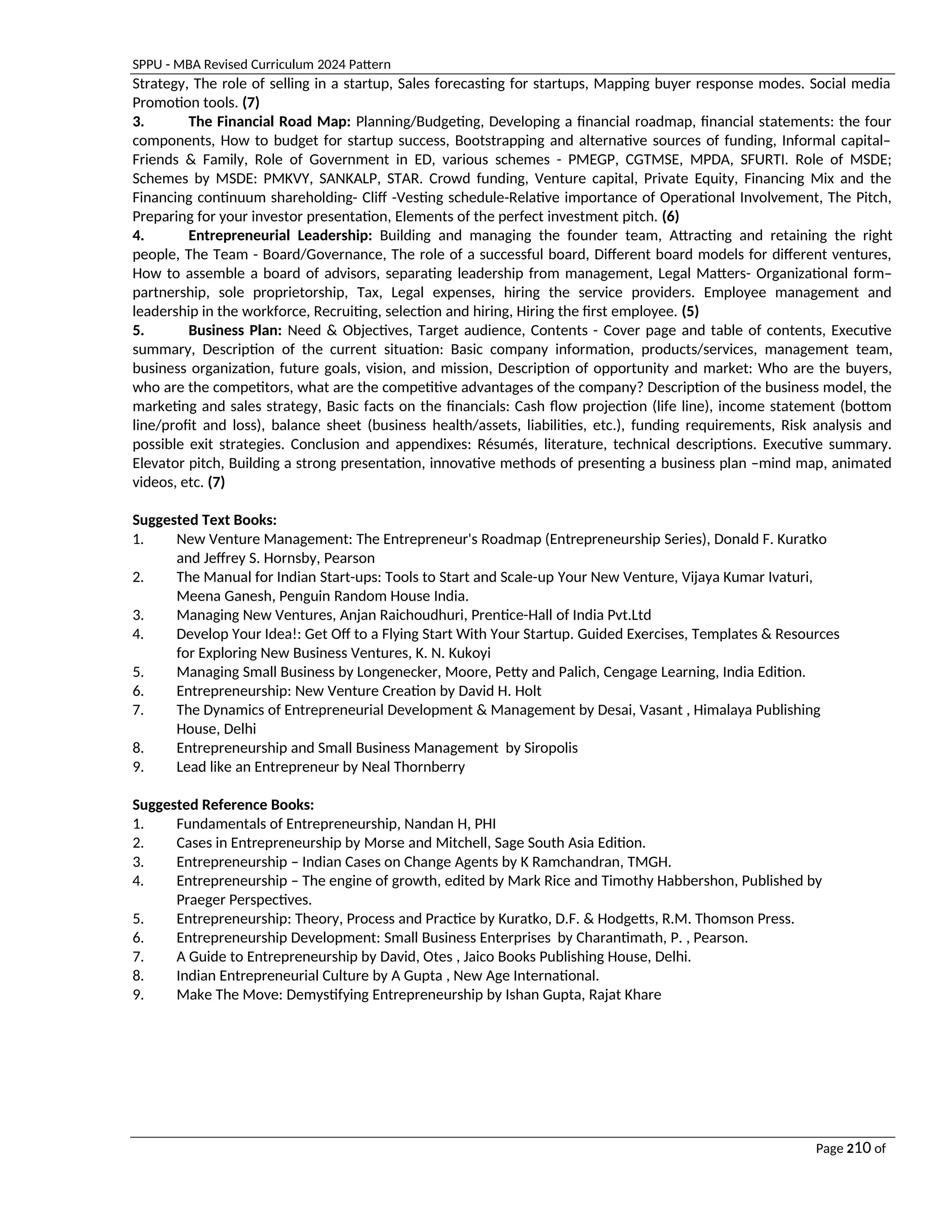
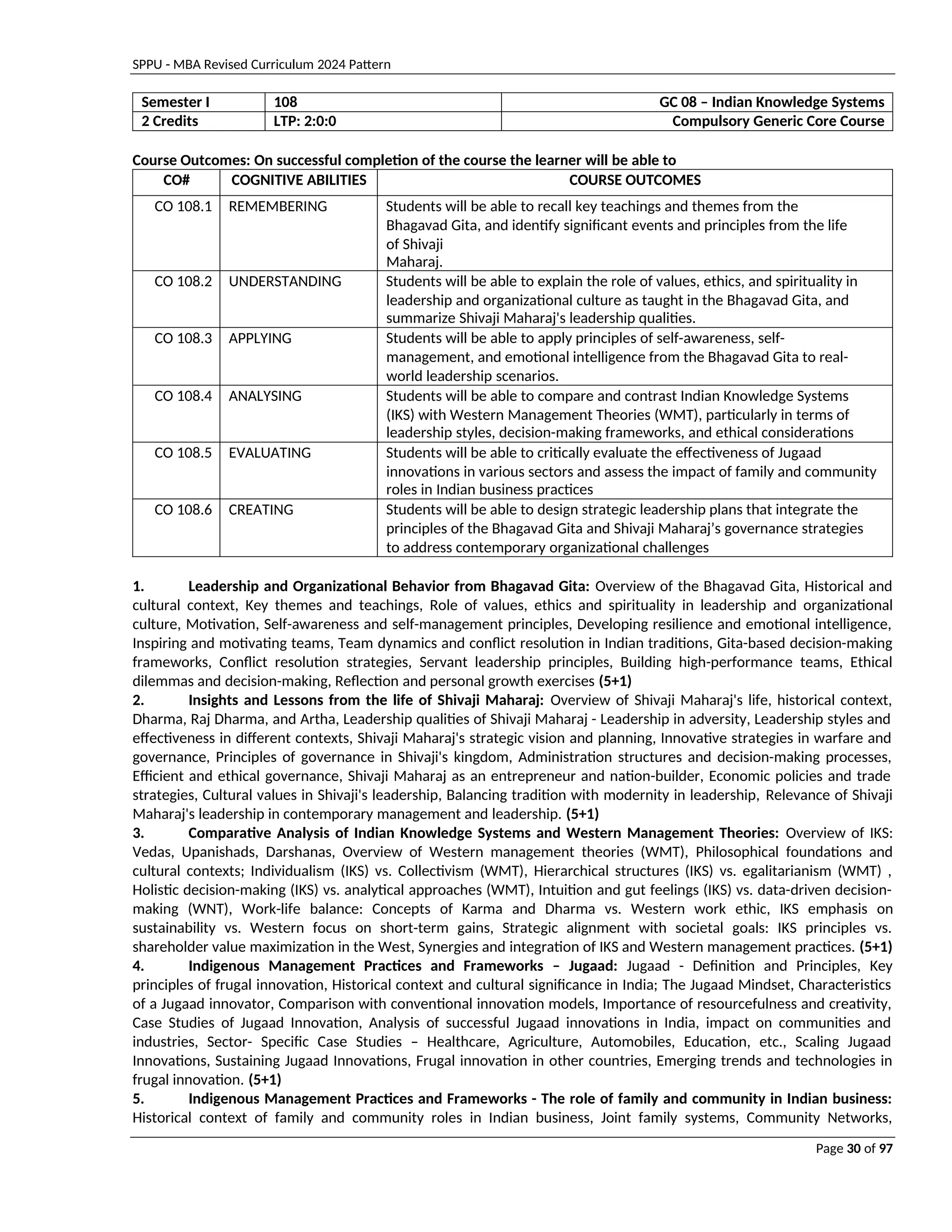
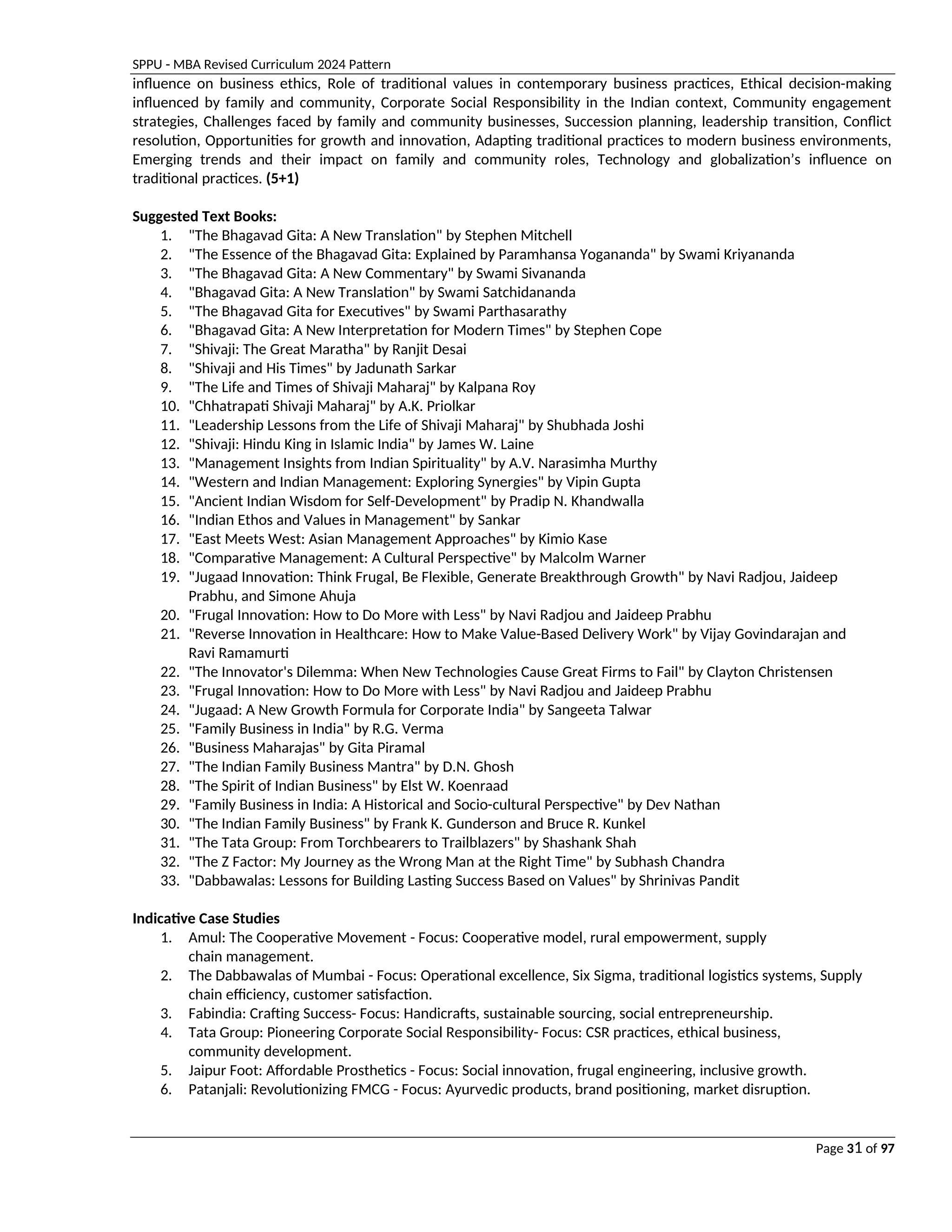
Master of Business Administration (MBA) - Revised
Curriculum 2024 Pattern
2-year, 4 Semester Full time Programme
Choice Based Credit System (CBCS) and Grading System
Outcome Based Education Pattern
Aligned with NEP
MBA I effective from AY 2024-25
MBA II effective from AY 2025-26
1.0 Preamble: The revised MBA Curriculum 2024 integrates the National Education Policy, 2020 ethos with the Choice
Based Credit System (CBCS) and Grading System and Outcomes Based Education (OBE)
2.0 Credit: In terms of credits, for a period of one semester of 15 weeks:
a) every ONE-hour session per week of L amounts to 1 credit per semester
b) a minimum of TWO hours per week of T amounts to 1 credit per semester,
c) a minimum of TWO hours per week of P amounts to 1 credit per semester,
Each credit is a combination of 3 components viz. Lecture (L) + Tutorials (T) + Practice (Practical / Project Work / Self
Study) (P) i.e. LTP Pattern. Indicative LTP, for each course, is documented in the syllabus.
The course teacher may, with the consent of the Director / Head of the Department / Designated academic authority of
the Institute, modify the LTP of the course in view of the course requirements, nature of the course, the level of
learners and the type of pedagogy and assessment tools proposed.
2.1 Session: Each teaching-learning, evaluation session shall be of 60 minutes. However, institutes shall have the
flexibility to define their time slots in a manner as to use their faculty and infrastructure resources in the best
possible way and ensure effective learning & comply with the credit structure of the respective courses
2.2 Course Announcement: The institute shall announce the elective courses and specializations it proposes to offer
the students out of the wider course basket. It is not mandatory to offer all the specializations and all the
electives. However, in the spirit of Choice Based Credit System, institutes should offer choices to the students for the
elective courses and not offer only the minimum number of electives.
2.3 Course Registration: It is mandatory for every student, to register every semester, for the courses opted for that
semester. Each student, on admission shall be assigned to a Faculty Advisor who shall advise her/him about the
academic programs and counsel on the choice of courses considering the student’s profile, career goals and
courses taken in the earlier semesters. With the advice and consent of the Faculty Advisor, the student shall
register for a set of courses he/she plans to take up for the Semester. Students shall have to register for the courses
for the semester within first week of Semester I and immediately after conclusion of the preceding term for
subsequent Semesters II, III and IV.
3.0 MBA Programme Focus:
3.1 Programme Educational Objectives (PEOs):
1. PEO1: Graduates of the MBA program will successfully integrate core, cross-functional and inter-disciplinary
aspects of management theories, models and frameworks with the real world practices and the sector specific
nuances to provide solutions to real world business, policy and social issues in a dynamic and complex world.
2. PEO2: Graduates of the MBA program will possess excellent communication skills, excel in cross-functional, multi-
disciplinary, multi-cultural teams, and have an appreciation for local, domestic and global contexts so as to
manage continuity, change, risk, ambiguity and complexity.
3. PEO3: Graduates of the MBA program will be appreciative of the significance of Indian ethos and values in
managerial decision making and exhibit value centered leadership.
4. PEO4: Graduates of the MBA program will be ready to engage in successful career pursuits covering a broad
spectrum of areas in corporate, non-profit organizations, public policy, entrepreneurial ventures and engage in
life- long learning.
5. PEO5: Graduates of the MBA program will be recognized in their chosen fields for their managerial competence,
creativity & innovation, integrity & sensitivity to local and global issues of social relevance and earn the trust &
SPPU - MBA Revised Curriculum 2024 Pattern
Page 2 of 97
respect of others as inspiring, effective and ethical leaders, managers, entrepreneurs, intrapreneurs and change
agents.
3.2 Programme Outcomes (POs): At the end of the MBA programme the learner will possess the
1. Generic and Domain Knowledge - Ability to articulate, illustrate, analyze, synthesize and apply the knowledge of
principles and frameworks of management and allied domains to the solutions of real-world complex business
issues
2. Problem Solving & Innovation - Ability to Identify, formulate and provide innovative solution frameworks to real
world complex business and social problems by systematically applying modern quantitative and qualitative
problem solving tools and techniques.
3. Critical Thinking - Ability to conduct investigation of multidimensional business problems using research based
knowledge and research methods to arrive at data driven decisions
4. Effective Communication - Ability to effectively communicate in cross-cultural settings, in technology mediated
environments, especially in the business context and with society at large
5. Leadership and Team Work - Ability to collaborate in an organizational context and across organizational
boundaries and lead themselves and others in the achievement of organizational goals and optimize outcomes
for all stakeholders.
6. Global Orientation and Cross-Cultural Appreciation: Ability to approach any relevant business issues from a global
perspective and exhibit an appreciation of Cross Cultural aspects of business and management.
7. Entrepreneurship - Ability to identify entrepreneurial opportunities and leverage managerial & leadership skills
for founding, leading & managing startups as well as professionalizing and growing family businesses.
8. Environment and Sustainability - Ability to demonstrate knowledge of and need for sustainable development
and assess the impact of managerial decisions and business priorities on the societal, economic and
environmental aspects.
9. Social Responsiveness and Ethics - Ability to exhibit a broad appreciation of the ethical and value underpinnings
of managerial choices in a political, cross-cultural, globalized, digitized, socio-economic environment and
distinguish between ethical and unethical behaviors & act with integrity.
10. LifeLong Learning – Ability to operate independently in new environment, acquire new knowledge and skills and
assimilate them into the internalized knowledge and skills.
3.3 Programme Specific Outcomes (PSOs):
A] MARKETING MANAGEMENT
PSO MKT1: Strategic Marketing Analysis and Decision Making : Graduates specializing in Marketing Management for
the MBA programme will be able to Analyze market opportunities and challenges using advanced marketing research
tools and techniques. They will develop strategic marketing plans that align with organizational objectives and respond
effectively to dynamic market conditions.
PSO MKT2: Digital and Social Media Marketing Proficiency: Graduates specializing in Marketing Management for the
MBA programme will be able to demonstrate proficiency in leveraging digital and social media platforms to enhance brand
visibility and customer engagement. They will design and execute integrated digital marketing campaigns that drive
business growth.
PSO MKT3: Customer Relationship Management and Service Excellence: Graduates specializing in Marketing
Management for the MBA programme will be able to excel in building and maintaining strong customer relationships
through effective communication, personalized marketing, and superior customer service. They will implement CRM
systems to enhance customer loyalty and satisfaction.
PSO MKT4: Innovative Product and Brand Management: Graduates specializing in Marketing Management for the
MBA programme will be able to develop innovative product and brand management strategies that address consumer
needs and preferences. They will manage product lifecycles, brand portfolios, and execute branding initiatives that
strengthen brand equity.
SPPU - MBA Revised Curriculum 2024 Pattern
Page 3 of 97
B] FINANCIAL MANAGEMENT
PSO FIN1: Financial Analysis and Reporting: Graduates specializing in Financial Management for the MBA programme
will be able to demonstrate the ability to analyze and interpret financial statements, conduct financial ratio analysis, and
prepare comprehensive financial reports to support decision-making processes.
PSO FIN2: Investment and Portfolio Management: Graduates specializing in Financial Management for the MBA
programme will be able to Apply knowledge of investment theories, financial instruments, and portfolio management
techniques to construct and manage investment portfolios aimed at achieving specific financial goals.
PSO FIN3: Corporate Finance and Risk Management: Graduates specializing in Financial Management for the MBA
programme will be able to Develop expertise in corporate finance principles, including capital structure, cost of capital,
and capital budgeting, while effectively managing financial risks using various risk management tools and techniques.
PSO FIN4: Financial Technology and Innovation: Graduates specializing in Financial Management for the MBA
programme will be able to Leverage emerging financial technologies (FinTech) and innovative financial solutions to
improve financial services delivery, enhance operational efficiency, and support strategic financial planning.
C] HUMAN RESOURCE MANAGEMENT
PSO HRM1: Strategic HR Planning and Implementation: Graduates specializing in Human Resource Management for
the MBA programme will be able to Demonstrate the ability to develop and implement strategic human resource plans
that align with organizational goals, ensuring optimal utilization of human capital.
PSO HRM2: Talent Acquisition and Development: Graduates specializing in Human Resource Management for the MBA
programme will be able to Apply advanced techniques and methodologies for effective talent acquisition, development,
and retention, fostering a culture of continuous learning and professional growth.
PSO HRM3: Employee Relations and Legal Compliances: Graduates specializing in Human Resource Management for the
MBA programme will be able to Ensure compliance with labor laws and ethical standards while managing employee
relations, promoting a positive and legally compliant work environment.
PSO HRM4: HR Analytics and Performance Management: Graduates specializing in Human Resource Management for
the MBA programme will be able to Utilize HR analytics and performance management systems to drive data-driven
decisions, enhance employee performance, and achieve organizational excellence.
D] OPERATIONS & SUPPLY CHAIN MANAGEMENT
PSO OSCM1: Operations Strategy and Process Improvement: Graduates specializing in Operations and Supply Chain
Management for the MBA programme will be able to Develop and implement effective operations strategies to enhance
process efficiency, reduce waste, and improve overall productivity within organizations.
PSO OSCM2: Supply Chain Design and Management: Graduates specializing in Operations and Supply Chain Management
for the MBA programme will be able to Design, analyze, and manage end-to-end supply chains to ensure the seamless
flow of goods, services, and information, while minimizing costs and meeting customer demands.
PSO OSCM3: Data-Driven Decision Making in Operations: Graduates specializing in Operations and Supply Chain
Management for the MBA programme will be able to Utilize quantitative and qualitative data analysis techniques to
make informed decisions in operations and supply chain management, ensuring alignment with business goals and
customer requirements.
SPPU - MBA Revised Curriculum 2024 Pattern
Page 4 of 97
PSO OSCM4: Sustainable and Ethical Supply Chain Practices: Graduates specializing in Operations and Supply Chain
Management for the MBA programme will be able to Promote and implement sustainable and ethical practices within
operations and supply chain management to support environmental sustainability, social responsibility, and ethical
governance.
E] BUSINESS ANALYTICS
PSO BA1: Data-Driven Decision Making: Graduates specializing in Business Analytics for the MBA programme will be
able to apply advanced analytical techniques and tools to collect, process, and interpret large datasets, enabling data-
driven decision making in various business functions such as marketing, finance, operations, and human resources.
PSO BA2: Business Intelligence and Reporting: Graduates specializing in Business Analytics for the MBA programme will
be able to Demonstrate proficiency in using business intelligence tools and software to create comprehensive reports and
dashboards that effectively communicate insights and support business strategies.
PSO BA3: Application of Business Analytics: Graduates specializing in Business Analytics for the MBA programme will be
able to Apply business analytics methodologies to various functional areas such as marketing, finance, operations, and
human resources.
PSO BA4: Integration of Analytics in Business Strategy: Graduates specializing in Business Analytics for the MBA
programme will be able to Integrate business analytics methodologies with strategic management practices to drive
organizational growth and competitive advantage.
F] AGRI-BUSINESS MANAGEMENT
PSO ABM1: Agribusiness Management Expertise: Graduates specializing in Agri-Business Management for the MBA
programme will be able to Demonstrate comprehensive knowledge and understanding of the principles, practices, and
challenges in agribusiness management, including supply chain management, agricultural marketing, and financial
management
PSO ABM2: Sustainable Agricultural Practices: Graduates specializing in Agri-Business Management for the MBA
programme will be able to Apply sustainable agricultural practices and strategies to enhance productivity and
profitability while ensuring environmental sustainability and social responsibility in agribusiness operations.
PSO ABM3: Innovative Solutions and Technology Integration: Graduates specializing in Agri-Business Management for
the MBA programme will be able to Utilize modern technologies and innovative solutions to optimize agribusiness
processes, data analytics, and digital marketing, to improve efficiency and competitiveness.
PSO ABM4: Leadership and Entrepreneurial Skills: Graduates specializing in Agri-Business Management for the MBA
programme will be able to Exhibit strong leadership and entrepreneurial skills to effectively lead teams, manage
projects, and launch and grow agribusiness ventures, fostering innovation and driving economic development in the
agricultural sector.
G] PHARMA & HEALTHCARE MANAGEMENT
PSO PHCM1: Pharma & Healthcare Strategy Development: Graduates specializing in Pharma & Health Care Management
for the MBA programme will be able to Develop and implement strategic plans for pharmaceutical and healthcare
organizations that align with industry regulations, market trends, and organizational goals.
PSO PHCM2: Operational Excellence in Pharma & Healthcare: Graduates specializing in Pharma & Health Care
Management for the MBA programme will be able to Apply best practices in operations management to optimize
processes, enhance efficiency, and ensure quality in pharmaceutical manufacturing and healthcare delivery systems.
SPPU - MBA Revised Curriculum 2024 Pattern
Page 5 of 97
PSO PHCM3: Regulatory and Compliance Expertise: Graduates specializing in Pharma & Health Care Management for
the MBA programme will be able to Understand and navigate the regulatory environment of the pharmaceutical and
healthcare industries to ensure compliance with national and international standards.
PSO PHCM4: Healthcare Innovation and Technology Integration: Graduates specializing in Pharma & Health Care
Management for the MBA programme will be able to Assess and leverage emerging technologies and innovations to
drive advancements in healthcare delivery and pharmaceutical research, enhancing patient care and operational
efficiency.
3.4 Graduate Attributes (GAs): At the end of the MBA programme the learner shall exhibit:
GA1: Managerial competence
GA2: Proficiency in Communication, Collaboration, Teamwork and Leadership
GA3: Competence in Creativity & Innovation
GA4: Research Aptitude, Scholarship & Enquiry
GA5: Global Orientation
GA6: Proficiency in ICT & Digital Literacy
GA7: Entrepreneurship & Intrapreneurship Orientation
GA8: Cross-functional & Inter-disciplinary Orientation
GA9: Results Orientation
GA10: Professionalism, Ethical, Values Oriented & Socially Responsible
behaviour GA11: Life-Long Learning Orientation
4.0 MBA Programme Structure & Evaluation Pattern:
MBA NEP STRUCTURE 2024
Type Semester Course Type Number of Courses Credits Total FA SA Total
Mandatory I Generic Core 6 3 18 300 300 600
Mandatory I Generic Core 2 2 4 0 100 100
Elective I Generic Elective 2 2 4 100 0 100
TOTAL 10 26 400 400 800
Mandatory II Generic Core 4 3 12 200 200 400
Mandatory II Generic Core 1 2 2 0 50 50
Mandatory II BRM 1 3 3 50 50 100
Mandatory II Desk Research 1 2 2 50 0 50
Mandatory II Field Project 1 3 3 50 50 100
Elective II Subject Elective 2 2 4 100 0 100
TOTAL 10 26 450 350 800
Mandatory III Generic Core 1 3 3 50 50 100
Mandatory III Subject Core 1 3 3 50 50 100
Mandatory III OJT (SIP) 1 8 8 100 100 200
Elective III Subject Elective 4 3 12 200 200 400
TOTAL 7 26 400 400 800
Mandatory IV Generic Core 1 3 3 50 50 100
Mandatory IV Generic Core 1 2 2 0 50 50
Mandatory IV Subject Core 1 3 3 50 50 100
Mandatory IV RP 1 6 6 50 100 150
Elective IV Subject Elective 4 3 12 200 200 400
TOTAL 8 26 350 450 800
35 104 1600 1600 3200
SPPU - MBA Revised Curriculum 2024 Pattern
Page 6 of 97
4.1 Course Types
4.1.1 Core courses are the compulsory courses for all the students. Core courses are of two types: Generic Core & Subject
Core.
4.1.2 Generic Core: This is the course which should compulsorily be studied by a candidate as a core requirement to
complete the requirement of a degree in a said discipline of study. Therefore, Generic Core courses are
mandatory and fundamental in nature. These courses cannot be substituted by any other courses. Such courses
are also known as Hard Core Courses.
4.1.3 Subject Core: A Core course may be a Subject Core if there is a choice or an option for the candidate to choose
from a broad category (grouping) of subjects (specializations).

4.1.4 Elective Course: Elective course is a course which can be chosen from a pool of courses. It may be:
a) Very Specialized or advanced course focusing on a specific aspect
b) Supportive to the discipline of study
c) Providing an extended scope
d) Enabling an exposure to some other discipline/domain
e) Nurturing candidate’s proficiency/skills.
4.1.5 Generic Elective: An elective course which is common across disciplines / subjects is called a generic elective.
‘Generic Elective’ courses develop generic proficiencies amongst the students.
4.1.6 Subject Elective: A ‘Discipline (specialization) centric’ elective is called ‘Subject Elective.’ Subject Elective courses,
in the Semester II, III and IV are focused on a specialization.
4.1.7 Research Methodology Courses: These courses are focused on various aspects of Research. They include –
Business Research Methods, Desk Research (DR) and Field Project(FP) in Semester II, On The Job Training (OJT) in
Semester III and Research Project (RP) in Semester IV. DR, FP, OJT and RP shall be specialization specific
compulsory courses (subject core). BRM shall be a generic compulsory course.
4.1.8 Massive Open Online Courses (MOOCs)1
: Massive Open Online Courses (MOOCs) are such online courses which
are developed as per the pedagogy stated in the AICTE regulation (2016) or equiavelent; following the four
quadrant approach and made available on the SWAYAM platform of Government of India. Upto 40% credits are
permitted through MOOCS. Any Course of 2 Credits can be taken in the form of SWAYAM / NPTEL MOOCS
provided the student secures the certificate from SWAYAM / NPTEL. MOOCs from other platforms shall not be
considered valid. MOOCS cannot be opted for in case of a 3 credit course.
5.0 Specializations offered: The following specializations shall be offered:
1. Marketing Management (MKT)
2. Financial Management (FIN)
3. Human Resources Management (HRM)
4. Operations & Supply Chain Management (OSCM)
5. Business Analytics (BA)
6. Agri -Business Management (ABM)
7. Pharma & Healthcare Management (PHM)
Note:
1. There is no provision for MAJOR and MINOR Specialization Combination.
2. Specialization shall be chosen at the BEGINNING of SEM II.
3. Desk Research, Field Project, On-the Job Training & Research Project shall be in the area of specialization only.
i.e. these courses are SUBJECT CORE COURSES.
4. Institutes may offer ONLY SELECT specializations based on industry needs, faculty strength & competencies,
student demands, employability potential, etc.
5. Institutes MAY NOT offer a specialization if a minimum of 20% of students are not registered for that
specialization.
6. The Institute MAY NOT offer an elective course if a minimum of 20% of students are not registered for that
elective course.
1
AICTE (Credit Framework for online learning course through SWAYAM) Regulations, 2016
SPPU - MBA Revised Curriculum 2024 Pattern
Page 7 of 97
6.0 Open Elective(s):
1. There is no provision for Open Electives. Students may pursue additional specializations as per the relevant
provisions.
7.0 Comprehensive Concurrent Evaluation (CCE) / Concurrent Internal Evaluation (CIE):
1. The course teacher shall prepare the scheme of Comprehensive Concurrent Evaluation (Formative Assessment)
before commencement of the term.
2. The scheme of Comprehensive Concurrent Evaluation shall explicitly state the linkages of each CCE with the
Course Outcomes and define the targeted attainment levels for each CO. Graduate Attributes may also be
considered during the design of CCE scheme.
3. The Director / Head of the Department / designated academic authority shall approve the scheme of
Comprehensive Concurrent Evaluation with or without modifications.
4. The course teacher shall communicate to the students, the approved CCE scheme of the course and the same
shall also be hosted on the Institute’s website, not later than the first week of the term.
5. Each CCE item shall be of minimum 25 marks.
6. For a 3 Credit Course there shall be a MINIMUM of three CCE items. The final scores shall be converted to 50,
using an average or best two out of three formula.
7. For 2 Credit Course there shall be a MINIMUM of two CCE items. The final scores shall be converted to 50.
8. CCE shall be spread through the duration of course and shall be conceptualized, executed, assessed and
documented by the course teacher along with student-wise and class-wise attainment levels of the COs and
the attainment levels of the course.
9. The assessment outcome of each CCE shall be duly signed by the course teacher, programme coordinator /
academic head and the Director / Head of the Department / designated academic authority of the Institute.
10. A copy of the duly signed CCE outcome shall be communicated to the students, within a week of the
assessment and course teachers shall guide the students on a need basis.
11. Institute may conduct additional make up / remedial CCE items at its discretion.
12. At the end of the term aggregate CCE scores / grades shall be calculated and the CO attainment levels shall be
calculated by the course teacher. The same shall be communicated to the students within a week.
7.1 Comprehensive Concurrent Evaluation Methods: Course teachers shall opt for a combination of one of more CCE
methods listed below.
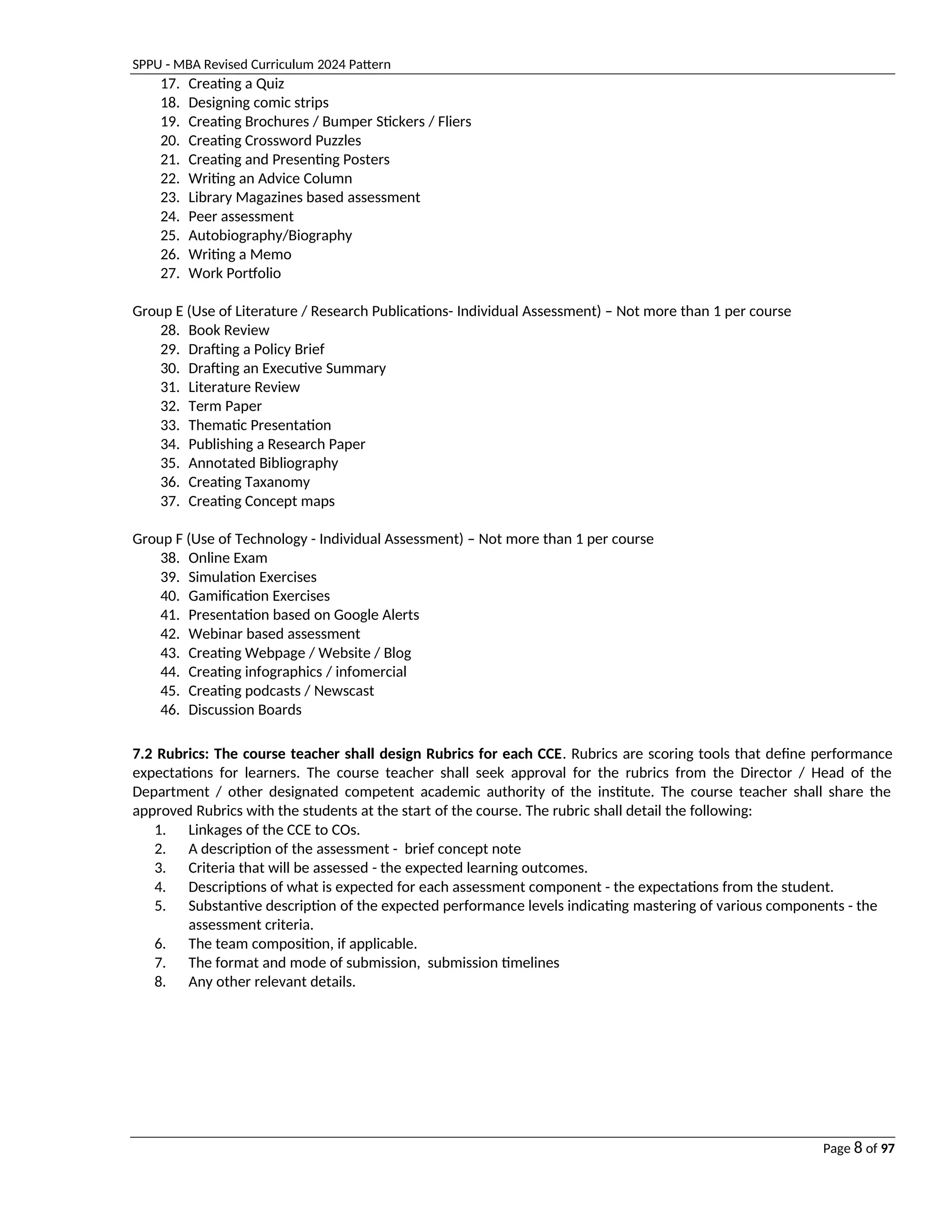
Group A (Individual Assessment) – Not more than 1 per course
1. Class Test
2. Open Book Test
3. Written Home Assignment
4. In-depth Viva-Voce
Group B (Individual Assessment) – Atleast 1 per course
5. Case Study
6. Caselet
7. Situation Analysis
8. Presentations
Group C (Group Assessment) – Not more than 1 per course
9. Field Visit / Study tour and report of the same
10. Small Group Project & Internal Viva-Voce
11. Model Development
12. Role Play
13. Story Telling
14. Fish Bowls
Group D (Creative - Individual Assessment) – Not more than 1 per course
15. Learning Diary
16. Scrap Book / Story of the week / Story of the month
SPPU - MBA Revised Curriculum 2024 Pattern
Page 8 of 97
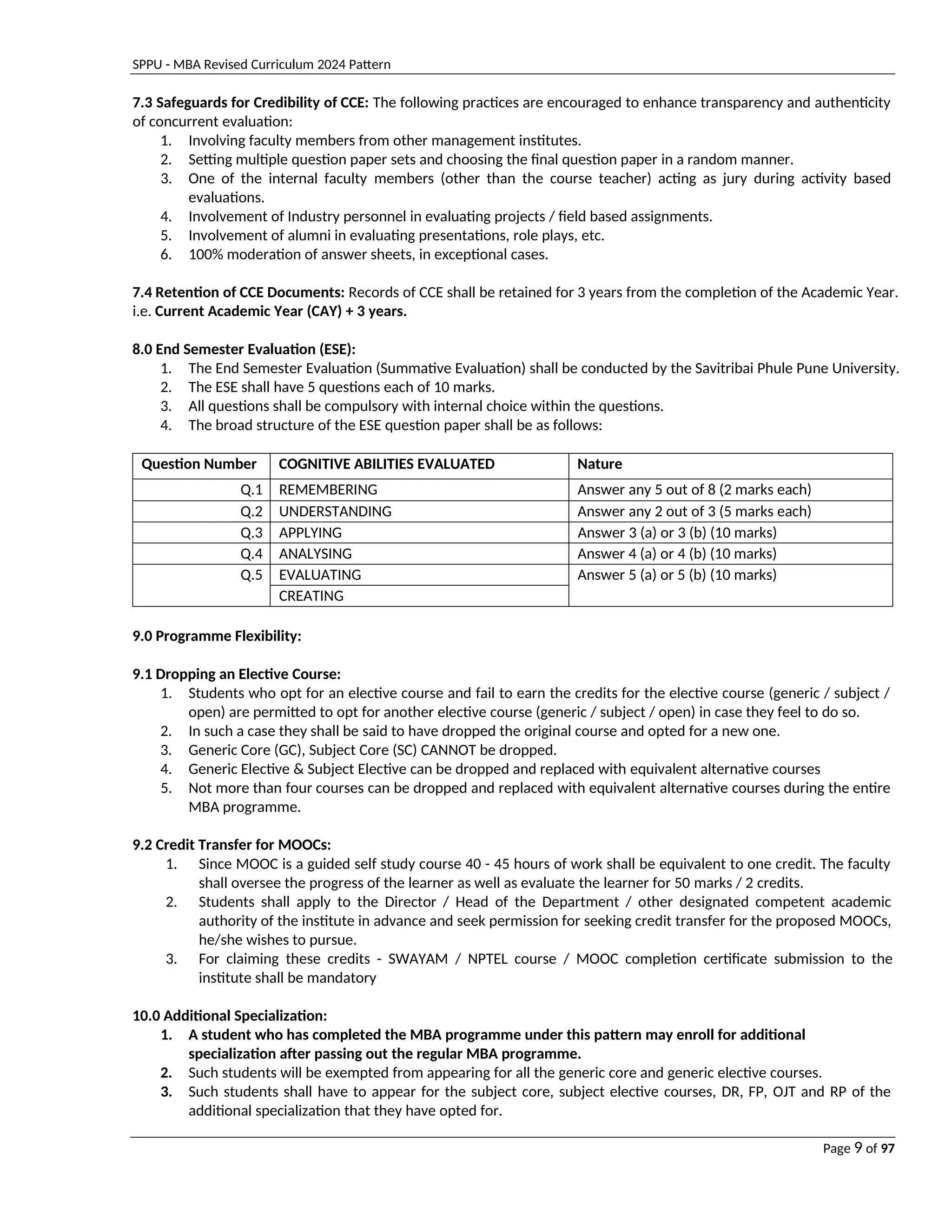
17. Creating a Quiz
18. Designing comic strips
19. Creating Brochures / Bumper Stickers / Fliers
20. Creating Crossword Puzzles
21. Creating and Presenting Posters
22. Writing an Advice Column
23. Library Magazines based assessment
24. Peer assessment
25. Autobiography/Biography
26. Writing a Memo
27. Work Portfolio
Group E (Use of Literature / Research Publications- Individual Assessment) – Not more than 1 per course
28. Book Review
29. Drafting a Policy Brief
30. Drafting an Executive Summary
31. Literature Review
32. Term Paper
33. Thematic Presentation
34. Publishing a Research Paper
35. Annotated Bibliography
36. Creating Taxanomy
37. Creating Concept maps
Group F (Use of Technology - Individual Assessment) – Not more than 1 per course
38. Online Exam
39. Simulation Exercises
40. Gamification Exercises
41. Presentation based on Google Alerts
42. Webinar based assessment
43. Creating Webpage / Website / Blog
44. Creating infographics / infomercial
45. Creating podcasts / Newscast
46. Discussion Boards
7.2 Rubrics: The course teacher shall design Rubrics for each CCE. Rubrics are scoring tools that define performance
expectations for learners. The course teacher shall seek approval for the rubrics from the Director / Head of the
Department / other designated competent academic authority of the institute. The course teacher shall share the
approved Rubrics with the students at the start of the course. The rubric shall detail the following:
1. Linkages of the CCE to COs.
2. A description of the assessment - brief concept note
3. Criteria that will be assessed - the expected learning outcomes.
4. Descriptions of what is expected for each assessment component - the expectations from the student.
5. Substantive description of the expected performance levels indicating mastering of various components - the
assessment criteria.
6. The team composition, if applicable.
7. The format and mode of submission, submission timelines
8. Any other relevant details.
SPPU - MBA Revised Curriculum 2024 Pattern
Page 9 of 97
7.3 Safeguards for Credibility of CCE: The following practices are encouraged to enhance transparency and authenticity
of concurrent evaluation:
1. Involving faculty members from other management institutes.
2. Setting multiple question paper sets and choosing the final question paper in a random manner.
3. One of the internal faculty members (other than the course teacher) acting as jury during activity based
evaluations.
4. Involvement of Industry personnel in evaluating projects / field based assignments.
5. Involvement of alumni in evaluating presentations, role plays, etc.
6. 100% moderation of answer sheets, in exceptional cases.
7.4 Retention of CCE Documents: Records of CCE shall be retained for 3 years from the completion of the Academic Year.
i.e. Current Academic Year (CAY) + 3 years.
8.0 End Semester Evaluation (ESE):
1. The End Semester Evaluation (Summative Evaluation) shall be conducted by the Savitribai Phule Pune University.
2. The ESE shall have 5 questions each of 10 marks.
3. All questions shall be compulsory with internal choice within the questions.
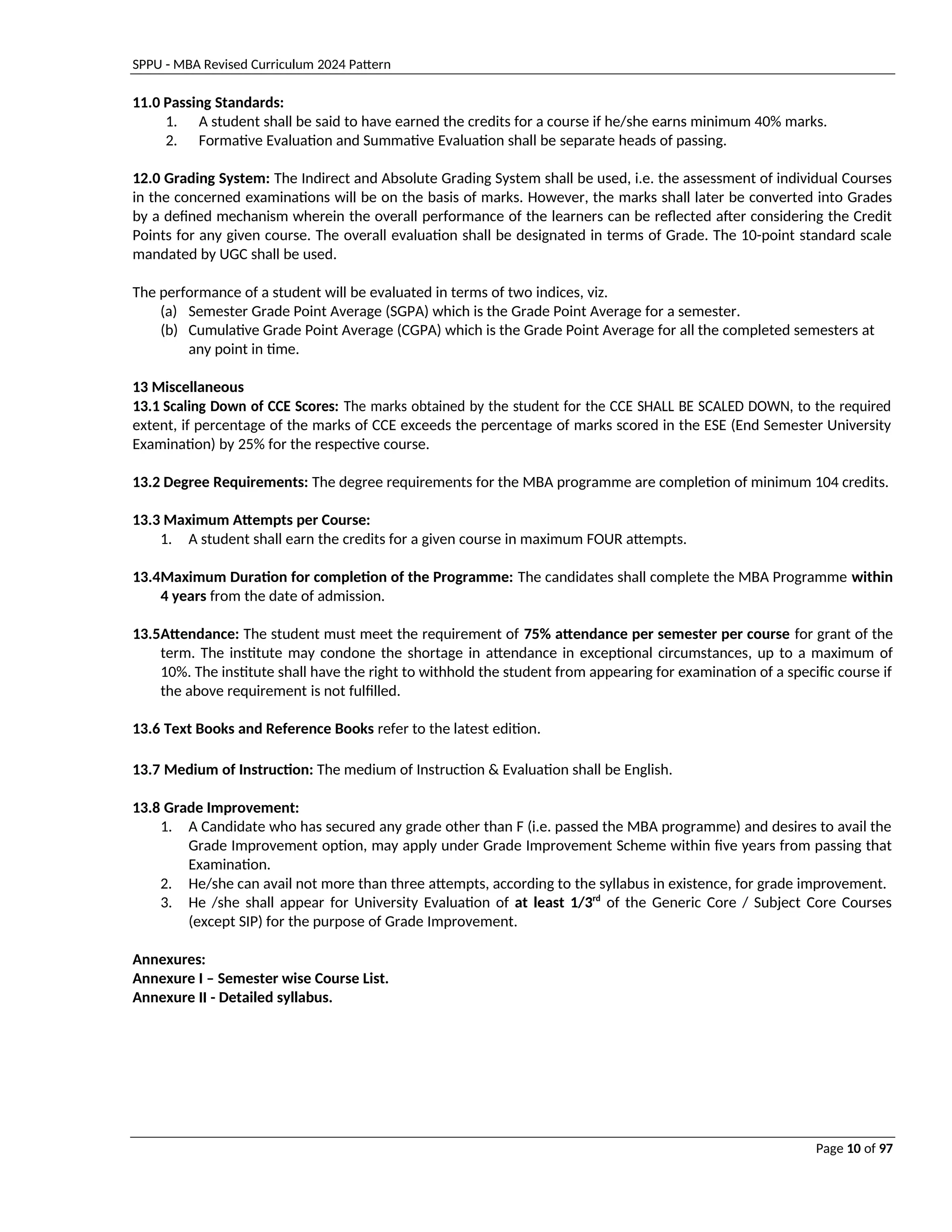
4. The broad structure of the ESE question paper shall be as follows:
Question Number COGNITIVE ABILITIES EVALUATED Nature
Q.1 REMEMBERING Answer any 5 out of 8 (2 marks each)
Q.2 UNDERSTANDING Answer any 2 out of 3 (5 marks each)
Q.3 APPLYING Answer 3 (a) or 3 (b) (10 marks)
Q.4 ANALYSING Answer 4 (a) or 4 (b) (10 marks)
Q.5 EVALUATING Answer 5 (a) or 5 (b) (10 marks)
CREATING
9.0 Programme Flexibility:
9.1 Dropping an Elective Course:
1. Students who opt for an elective course and fail to earn the credits for the elective course (generic / subject /
open) are permitted to opt for another elective course (generic / subject / open) in case they feel to do so.
2. In such a case they shall be said to have dropped the original course and opted for a new one.
3. Generic Core (GC), Subject Core (SC) CANNOT be dropped.
4. Generic Elective & Subject Elective can be dropped and replaced with equivalent alternative courses
5. Not more than four courses can be dropped and replaced with equivalent alternative courses during the entire
MBA programme.
9.2 Credit Transfer for MOOCs:
1. Since MOOC is a guided self study course 40 - 45 hours of work shall be equivalent to one credit. The faculty
shall oversee the progress of the learner as well as evaluate the learner for 50 marks / 2 credits.
2. Students shall apply to the Director / Head of the Department / other designated competent academic
authority of the institute in advance and seek permission for seeking credit transfer for the proposed MOOCs,
he/she wishes to pursue.
3. For claiming these credits - SWAYAM / NPTEL course / MOOC completion certificate submission to the
institute shall be mandatory
10.0 Additional Specialization:
1. A student who has completed the MBA programme under this pattern may enroll for additional
specialization after passing out the regular MBA programme.
2. Such students will be exempted from appearing for all the generic core and generic elective courses.
3. Such students shall have to appear for the subject core, subject elective courses, DR, FP, OJT and RP of the
additional specialization that they have opted for.
SPPU - MBA Revised Curriculum 2024 Pattern
Page 10 of 97
11.0 Passing Standards:
1. A student shall be said to have earned the credits for a course if he/she earns minimum 40% marks.
2. Formative Evaluation and Summative Evaluation shall be separate heads of passing.
12.0 Grading System: The Indirect and Absolute Grading System shall be used, i.e. the assessment of individual Courses
in the concerned examinations will be on the basis of marks. However, the marks shall later be converted into Grades
by a defined mechanism wherein the overall performance of the learners can be reflected after considering the Credit
Points for any given course. The overall evaluation shall be designated in terms of Grade. The 10-point standard scale
mandated by UGC shall be used.
The performance of a student will be evaluated in terms of two indices, viz.
(a) Semester Grade Point Average (SGPA) which is the Grade Point Average for a semester.
(b) Cumulative Grade Point Average (CGPA) which is the Grade Point Average for all the completed semesters at
any point in time.
13 Miscellaneous
13.1 Scaling Down of CCE Scores: The marks obtained by the student for the CCE SHALL BE SCALED DOWN, to the required
extent, if percentage of the marks of CCE exceeds the percentage of marks scored in the ESE (End Semester University
Examination) by 25% for the respective course.
13.2 Degree Requirements: The degree requirements for the MBA programme are completion of minimum 104 credits.
13.3 Maximum Attempts per Course:
1. A student shall earn the credits for a given course in maximum FOUR attempts.
13.4Maximum Duration for completion of the Programme: The candidates shall complete the MBA Programme within
4 years from the date of admission.
13.5Attendance: The student must meet the requirement of 75% attendance per semester per course for grant of the
term. The institute may condone the shortage in attendance in exceptional circumstances, up to a maximum of
10%. The institute shall have the right to withhold the student from appearing for examination of a specific course if
the above requirement is not fulfilled.
13.6 Text Books and Reference Books refer to the latest edition.
13.7 Medium of Instruction: The medium of Instruction & Evaluation shall be English.
13.8 Grade Improvement:
1. A Candidate who has secured any grade other than F (i.e. passed the MBA programme) and desires to avail the
Grade Improvement option, may apply under Grade Improvement Scheme within five years from passing that
Examination.
2. He/she can avail not more than three attempts, according to the syllabus in existence, for grade improvement.
3. He /she shall appear for University Evaluation of at least 1/3rd
of the Generic Core / Subject Core Courses
(except SIP) for the purpose of Grade Improvement.
Annexures:
Annexure I – Semester wise Course List.
Annexure II - Detailed syllabus.
SPPU - MBA Revised Curriculum 2024 Pattern
Page 11 of 97
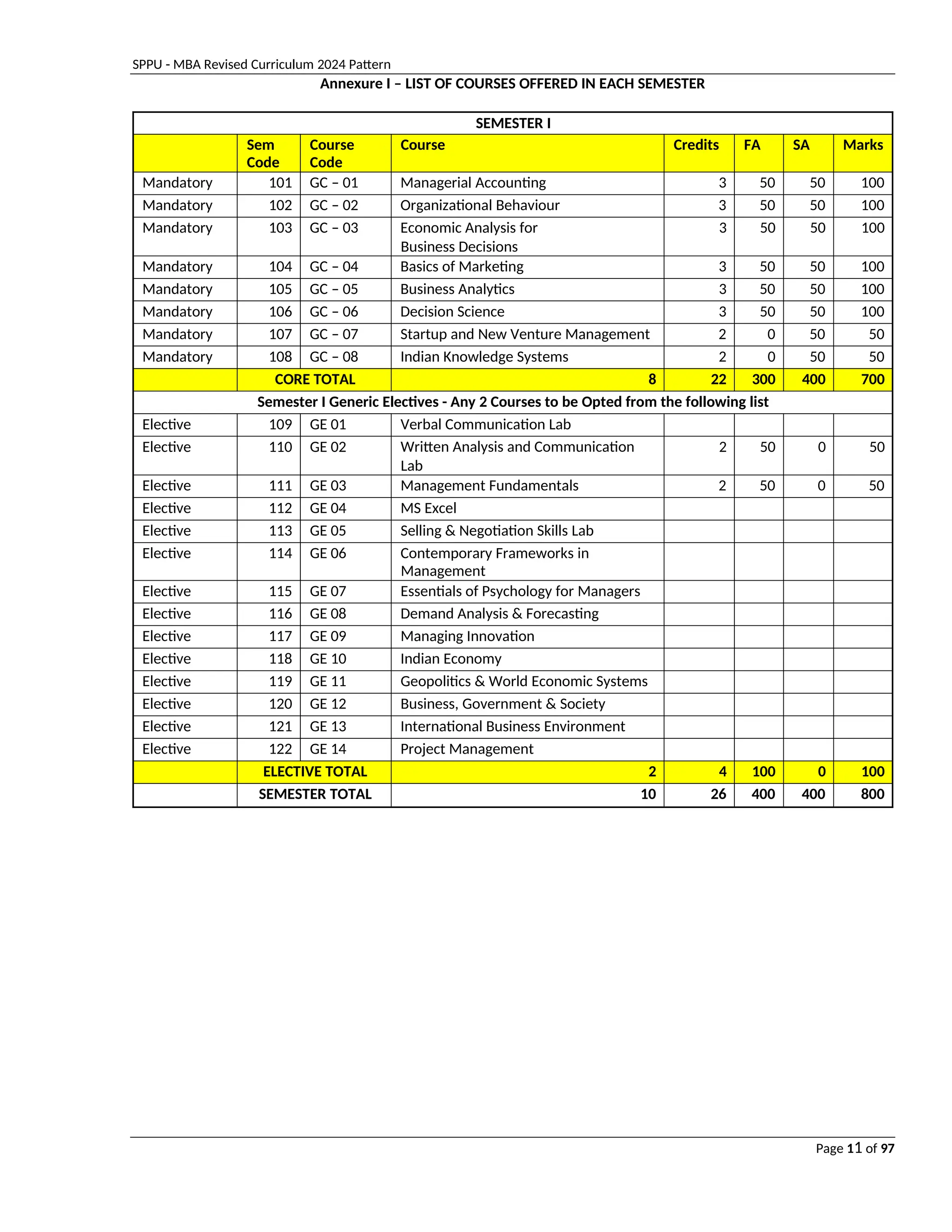
Annexure I – LIST OF COURSES OFFERED IN EACH SEMESTER
SEMESTER I
Sem
Code
Course
Code
Course Credits FA SA Marks
Mandatory 101 GC – 01 Managerial Accounting 3 50 50 100
Mandatory 102 GC – 02 Organizational Behaviour 3 50 50 100
Mandatory 103 GC – 03 Economic Analysis for
Business Decisions
3 50 50 100
Mandatory 104 GC – 04 Basics of Marketing 3 50 50 100
Mandatory 105 GC – 05 Business Analytics 3 50 50 100
Mandatory 106 GC – 06 Decision Science 3 50 50 100
Mandatory 107 GC – 07 Startup and New Venture Management 2 0 50 50
Mandatory 108 GC – 08 Indian Knowledge Systems 2 0 50 50
CORE TOTAL 8 22 300 400 700
Semester I Generic Electives - Any 2 Courses to be Opted from the following list
Elective 109 GE 01 Verbal Communication Lab
Elective 110 GE 02 Written Analysis and Communication
Lab
2 50 0 50
Elective 111 GE 03 Management Fundamentals 2 50 0 50
Elective 112 GE 04 MS Excel
Elective 113 GE 05 Selling & Negotiation Skills Lab
Elective 114 GE 06 Contemporary Frameworks in
Management
Elective 115 GE 07 Essentials of Psychology for Managers
Elective 116 GE 08 Demand Analysis & Forecasting
Elective 117 GE 09 Managing Innovation
Elective 118 GE 10 Indian Economy
Elective 119 GE 11 Geopolitics & World Economic Systems
Elective 120 GE 12 Business, Government & Society
Elective 121 GE 13 International Business Environment
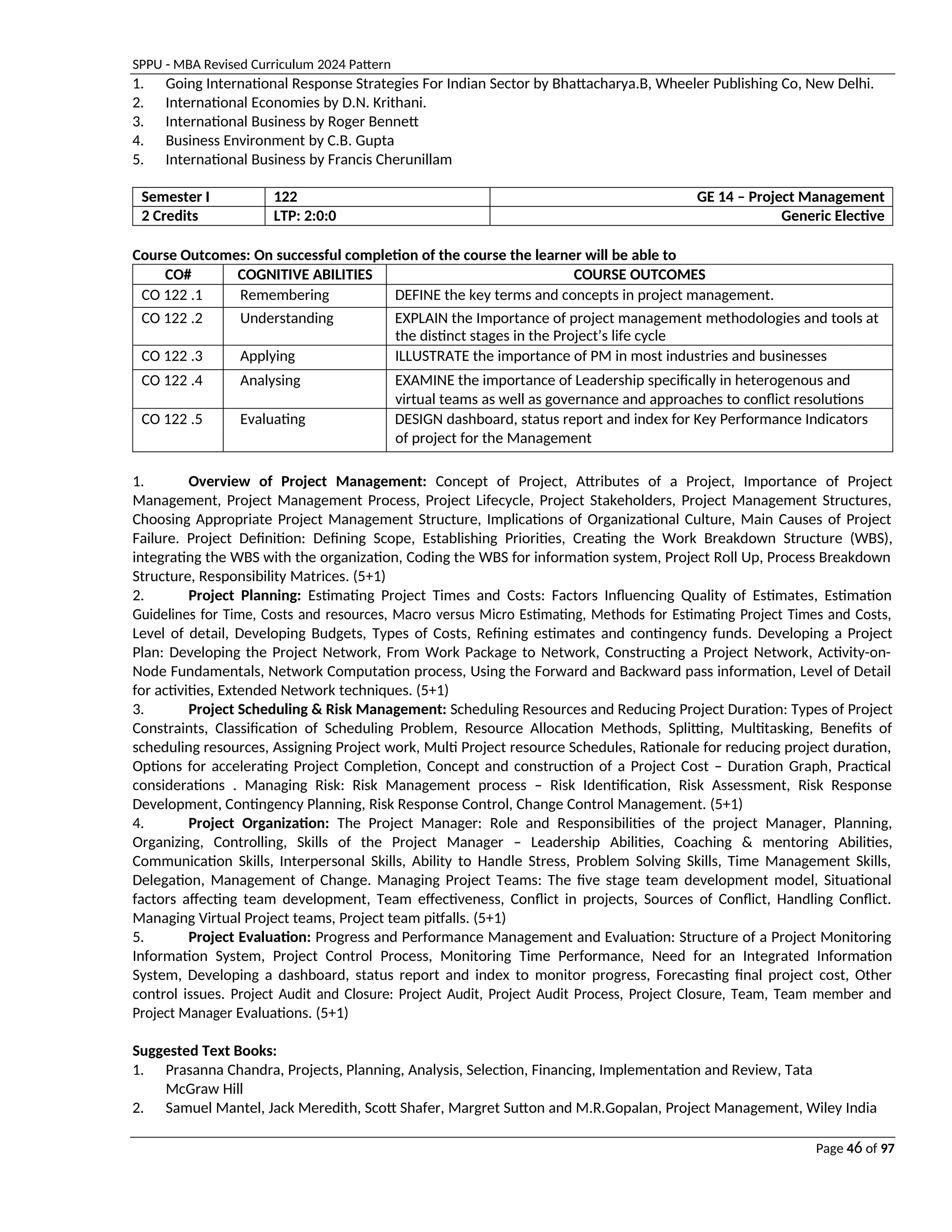
Elective 122 GE 14 Project Management
ELECTIVE TOTAL 2 4 100 0 100
SEMESTER TOTAL 10 26 400 400 800
SPPU - MBA Revised Curriculum 2024 Pattern
Page 12 of 97
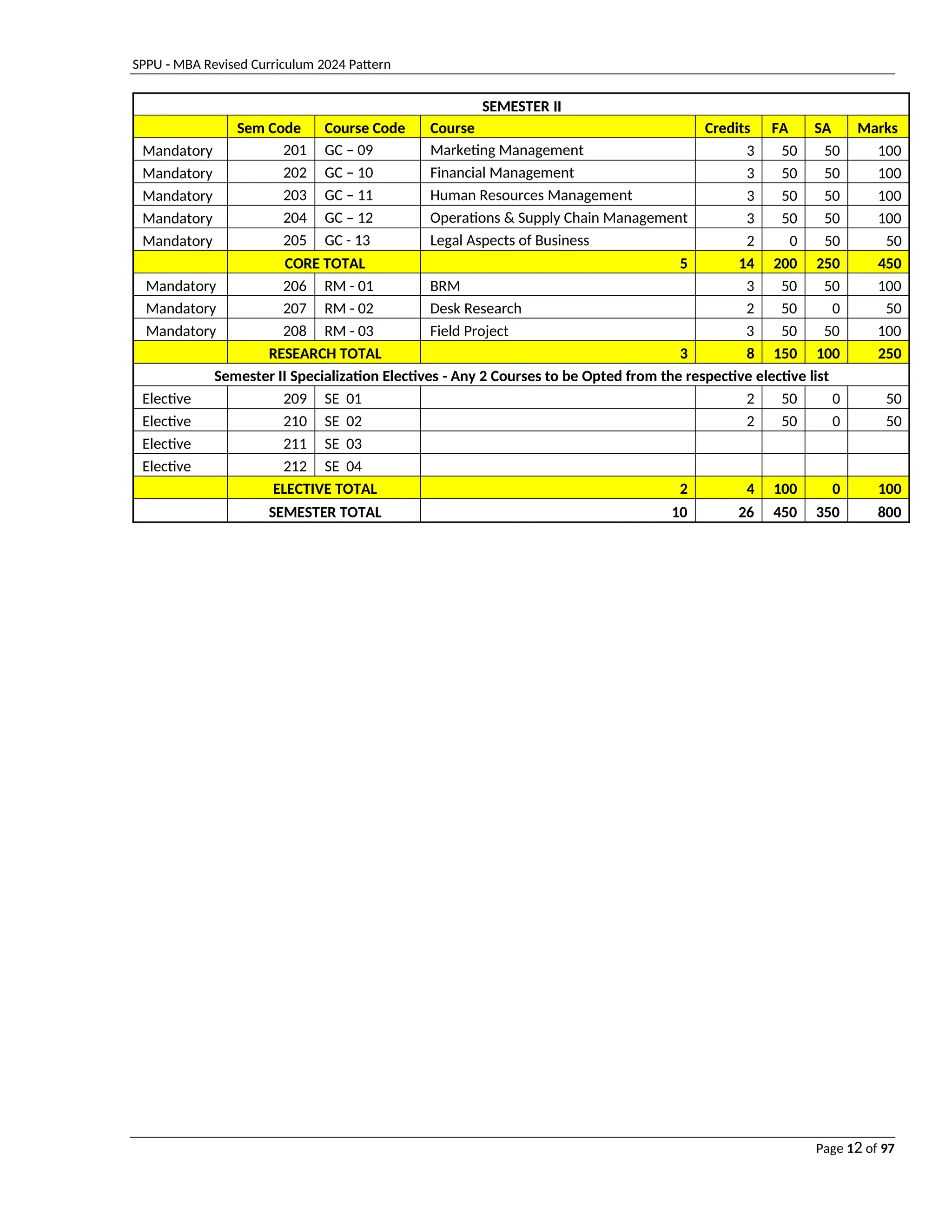
SEMESTER II
Sem Code Course Code Course Credits FA SA Marks
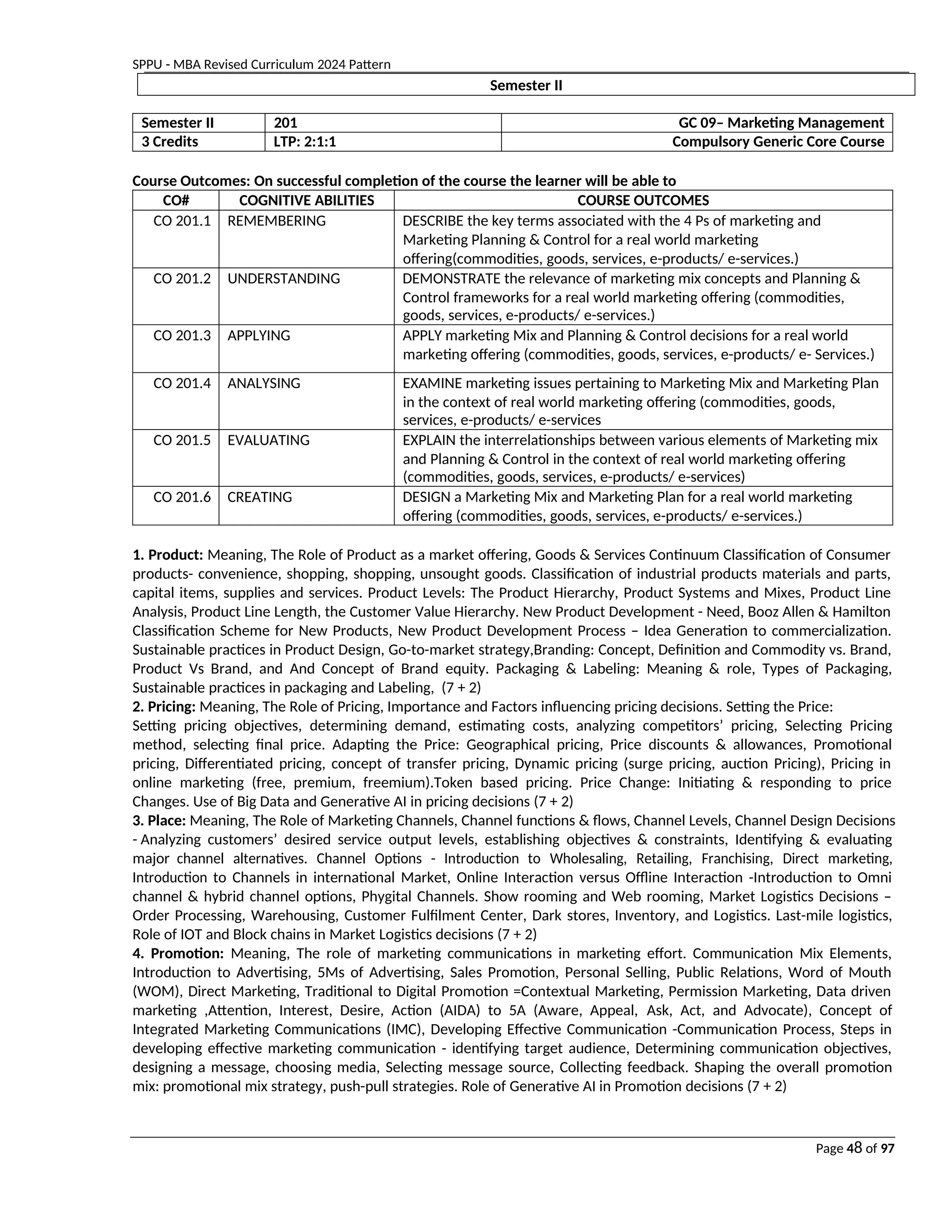
Mandatory 201 GC – 09 Marketing Management 3 50 50 100
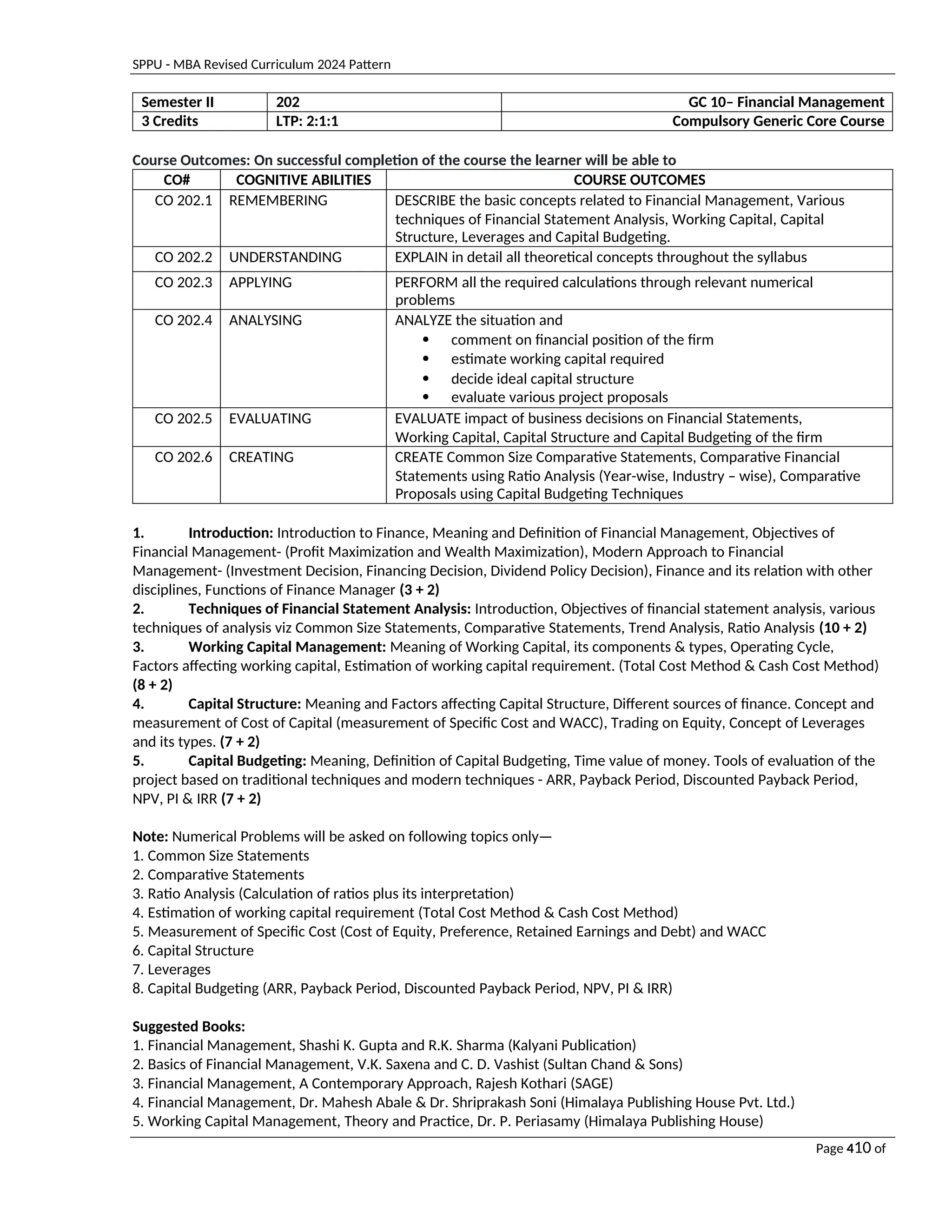
Mandatory 202 GC – 10 Financial Management 3 50 50 100
Mandatory 203 GC – 11 Human Resources Management 3 50 50 100
Mandatory 204 GC – 12 Operations & Supply Chain Management 3 50 50 100
Mandatory 205 GC - 13 Legal Aspects of Business 2 0 50 50
CORE TOTAL 5 14 200 250 450
Mandatory 206 RM - 01 BRM 3 50 50 100
Mandatory 207 RM - 02 Desk Research 2 50 0 50
Mandatory 208 RM - 03 Field Project 3 50 50 100
RESEARCH TOTAL 3 8 150 100 250
Semester II Specialization Electives - Any 2 Courses to be Opted from the respective elective list
Elective 209 SE 01 2 50 0 50
Elective 210 SE 02 2 50 0 50
Elective 211 SE 03
Elective 212 SE 04
ELECTIVE TOTAL 2 4 100 0 100
SEMESTER TOTAL 10 26 450 350 800
SPPU - MBA Revised Curriculum 2024 Pattern
Page 13 of 97
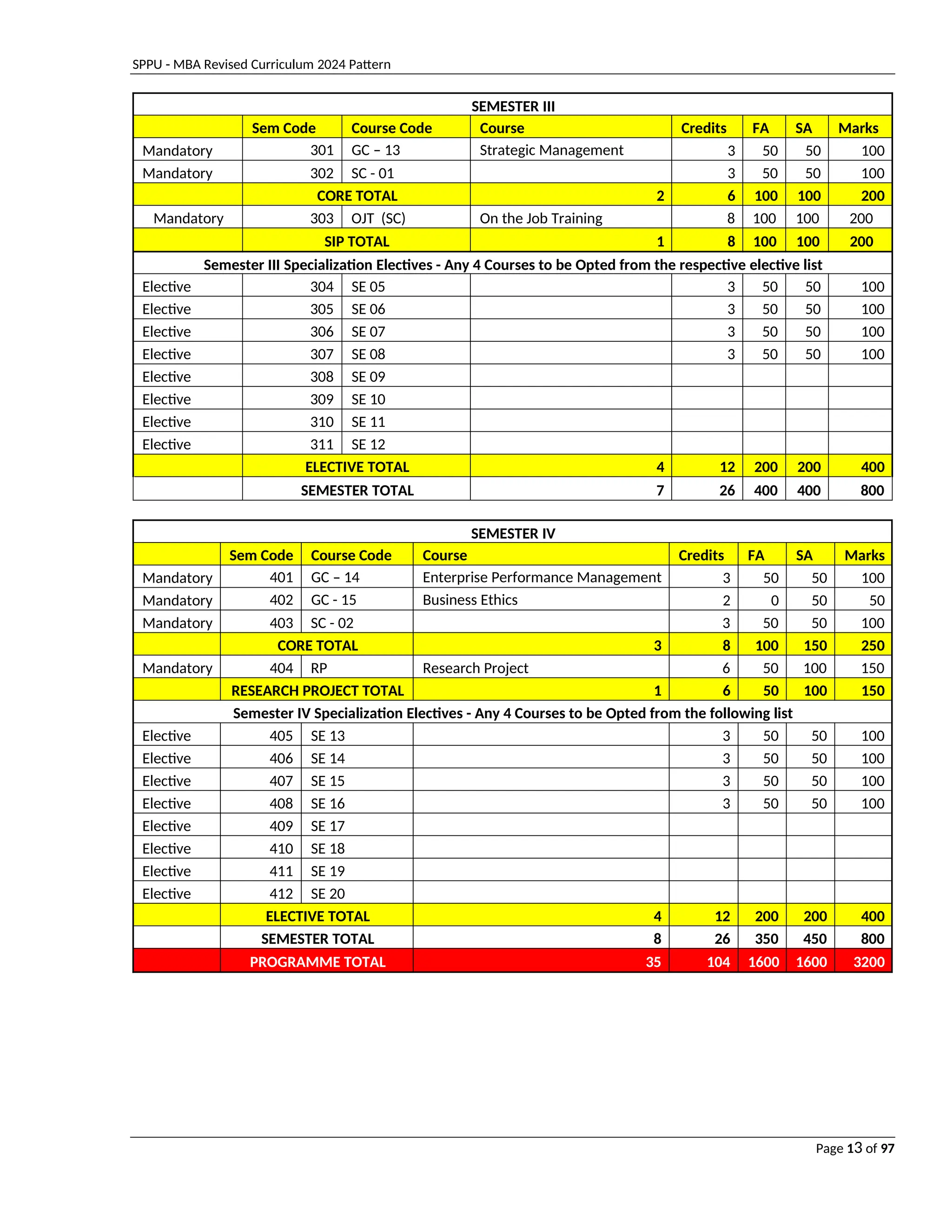
SEMESTER III
Sem Code Course Code Course Credits FA SA Marks
Mandatory 301 GC – 13 Strategic Management 3 50 50 100
Mandatory 302 SC - 01 3 50 50 100
CORE TOTAL 2 6 100 100 200
Mandatory 303 OJT (SC) On the Job Training 8 100 100 200
SIP TOTAL 1 8 100 100 200
Semester III Specialization Electives - Any 4 Courses to be Opted from the respective elective list
Elective 304 SE 05 3 50 50 100
Elective 305 SE 06 3 50 50 100
Elective 306 SE 07 3 50 50 100
Elective 307 SE 08 3 50 50 100
Elective 308 SE 09
Elective 309 SE 10
Elective 310 SE 11
Elective 311 SE 12
ELECTIVE TOTAL 4 12 200 200 400
SEMESTER TOTAL 7 26 400 400 800
SEMESTER IV
Sem Code Course Code Course Credits FA SA Marks
Mandatory 401 GC – 14 Enterprise Performance Management 3 50 50 100
Mandatory 402 GC - 15 Business Ethics 2 0 50 50
Mandatory 403 SC - 02 3 50 50 100
CORE TOTAL 3 8 100 150 250
Mandatory 404 RP Research Project 6 50 100 150
RESEARCH PROJECT TOTAL 1 6 50 100 150
Semester IV Specialization Electives - Any 4 Courses to be Opted from the following list
Elective 405 SE 13 3 50 50 100
Elective 406 SE 14 3 50 50 100
Elective 407 SE 15 3 50 50 100
Elective 408 SE 16 3 50 50 100
Elective 409 SE 17
Elective 410 SE 18
Elective 411 SE 19
Elective 412 SE 20
ELECTIVE TOTAL 4 12 200 200 400
SEMESTER TOTAL 8 26 350 450 800
PROGRAMME TOTAL 35 104 1600 1600 3200
SPPU - MBA Revised Curriculum 2024 Pattern
Page 14 of 97
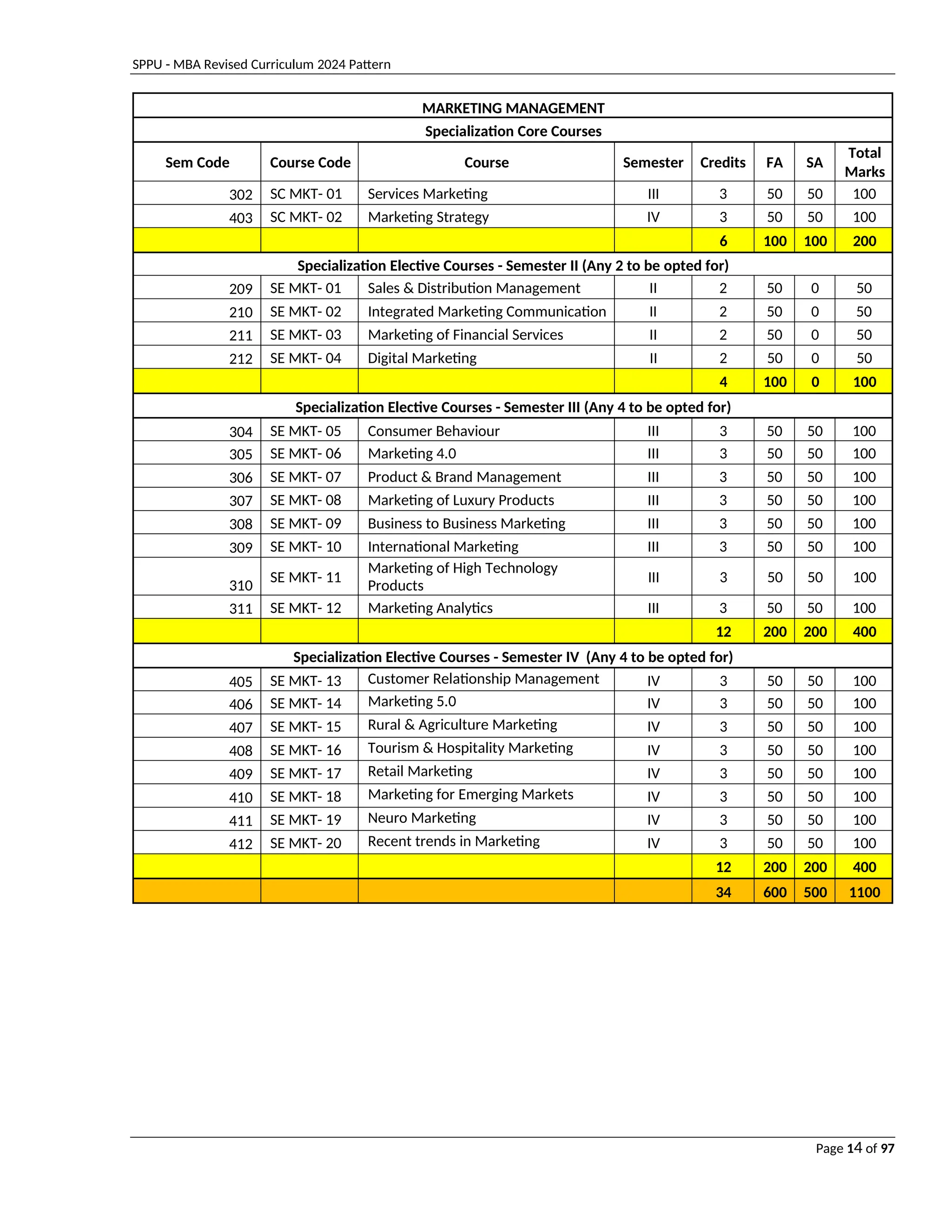
MARKETING MANAGEMENT
Specialization Core Courses
Sem Code Course Code Course Semester Credits FA SA
Total
Marks
302 SC MKT- 01 Services Marketing III 3 50 50 100
403 SC MKT- 02 Marketing Strategy IV 3 50 50 100
6 100 100 200
Specialization Elective Courses - Semester II (Any 2 to be opted for)
209 SE MKT- 01 Sales & Distribution Management II 2 50 0 50
210 SE MKT- 02 Integrated Marketing Communication II 2 50 0 50
211 SE MKT- 03 Marketing of Financial Services II 2 50 0 50
212 SE MKT- 04 Digital Marketing II 2 50 0 50
4 100 0 100
Specialization Elective Courses - Semester III (Any 4 to be opted for)
304 SE MKT- 05 Consumer Behaviour III 3 50 50 100
305 SE MKT- 06 Marketing 4.0 III 3 50 50 100
306 SE MKT- 07 Product & Brand Management III 3 50 50 100
307 SE MKT- 08 Marketing of Luxury Products III 3 50 50 100
308 SE MKT- 09 Business to Business Marketing III 3 50 50 100
309 SE MKT- 10 International Marketing III 3 50 50 100
310
SE MKT- 11
Marketing of High Technology
Products
III 3 50 50 100
311 SE MKT- 12 Marketing Analytics III 3 50 50 100
12 200 200 400
Specialization Elective Courses - Semester IV (Any 4 to be opted for)
405 SE MKT- 13 Customer Relationship Management IV 3 50 50 100
406 SE MKT- 14 Marketing 5.0 IV 3 50 50 100
407 SE MKT- 15 Rural & Agriculture Marketing IV 3 50 50 100
408 SE MKT- 16 Tourism & Hospitality Marketing IV 3 50 50 100
409 SE MKT- 17 Retail Marketing IV 3 50 50 100
410 SE MKT- 18 Marketing for Emerging Markets IV 3 50 50 100
411 SE MKT- 19 Neuro Marketing IV 3 50 50 100
412 SE MKT- 20 Recent trends in Marketing IV 3 50 50 100
12 200 200 400
34 600 500 1100
SPPU - MBA Revised Curriculum 2024 Pattern
Page 15 of 97
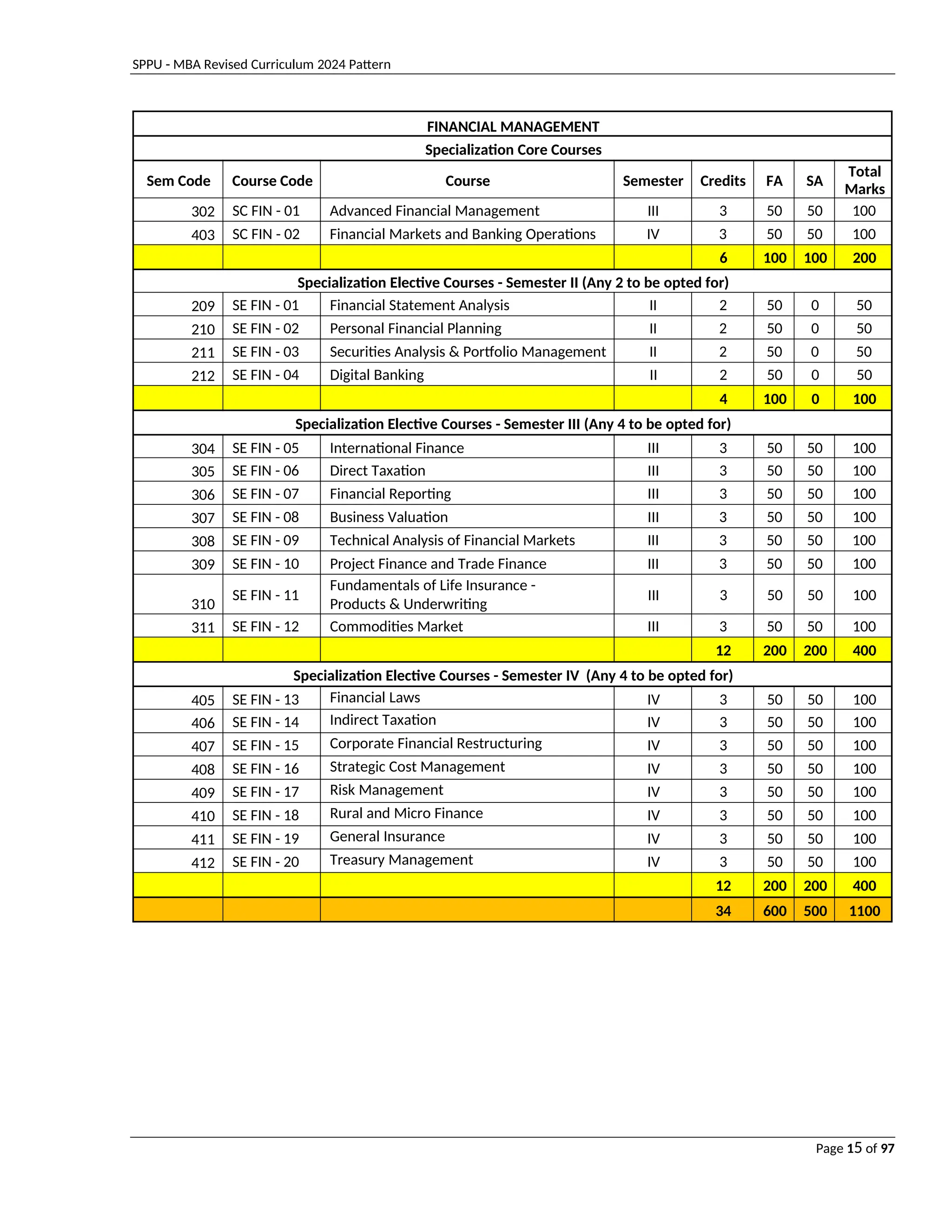
FINANCIAL MANAGEMENT
Specialization Core Courses
Sem Code Course Code Course Semester Credits FA SA
Total
Marks
302 SC FIN - 01 Advanced Financial Management III 3 50 50 100
403 SC FIN - 02 Financial Markets and Banking Operations IV 3 50 50 100
6 100 100 200
Specialization Elective Courses - Semester II (Any 2 to be opted for)
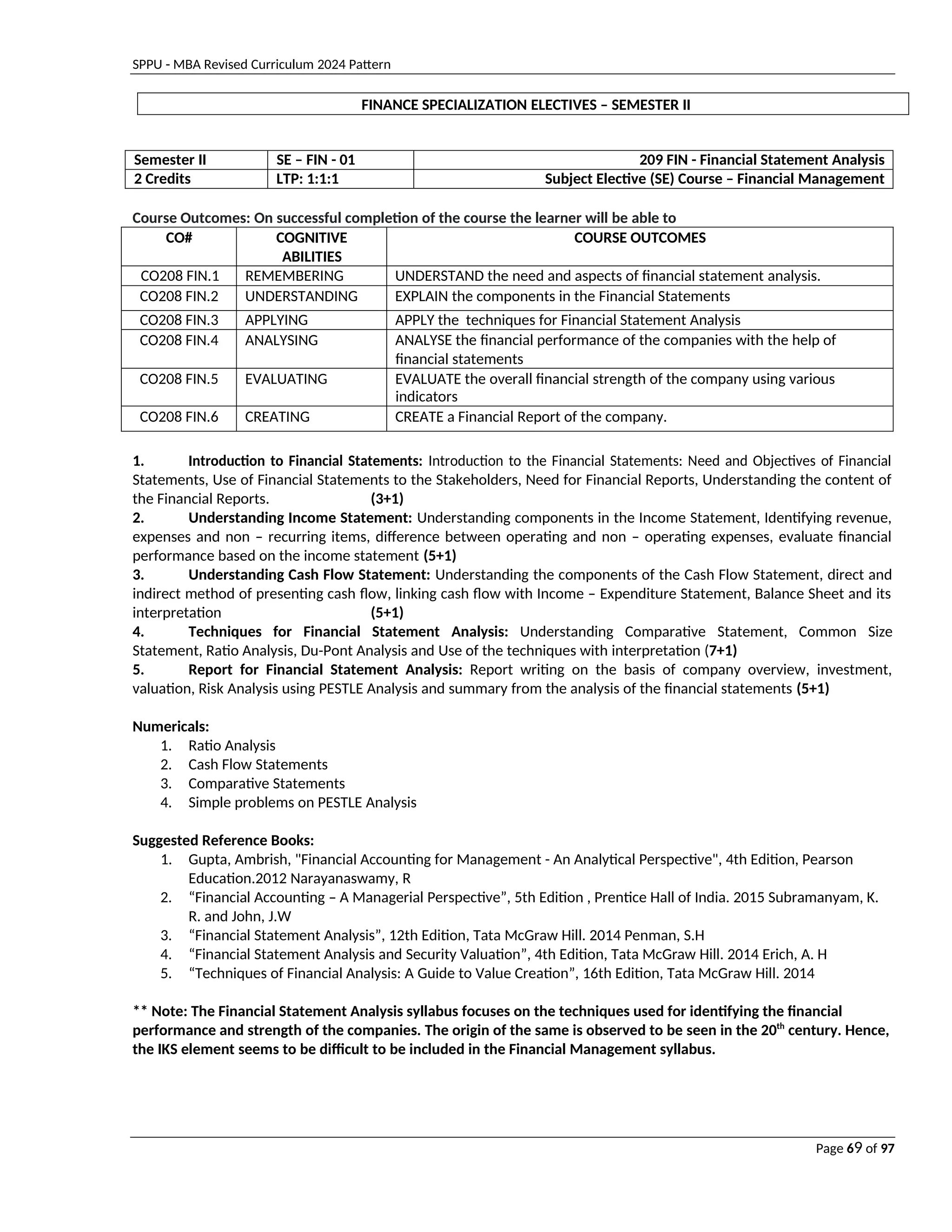
209 SE FIN - 01 Financial Statement Analysis II 2 50 0 50
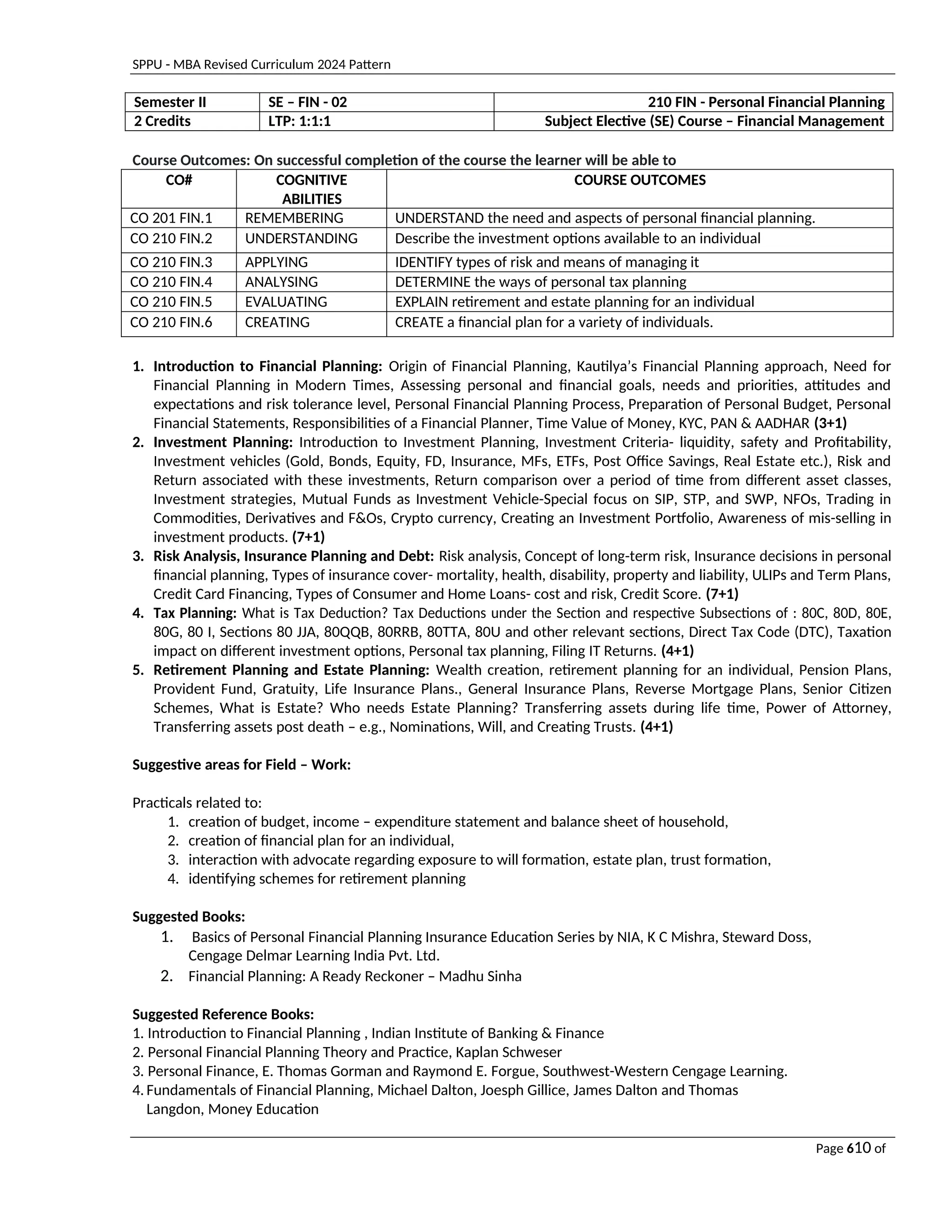
210 SE FIN - 02 Personal Financial Planning II 2 50 0 50
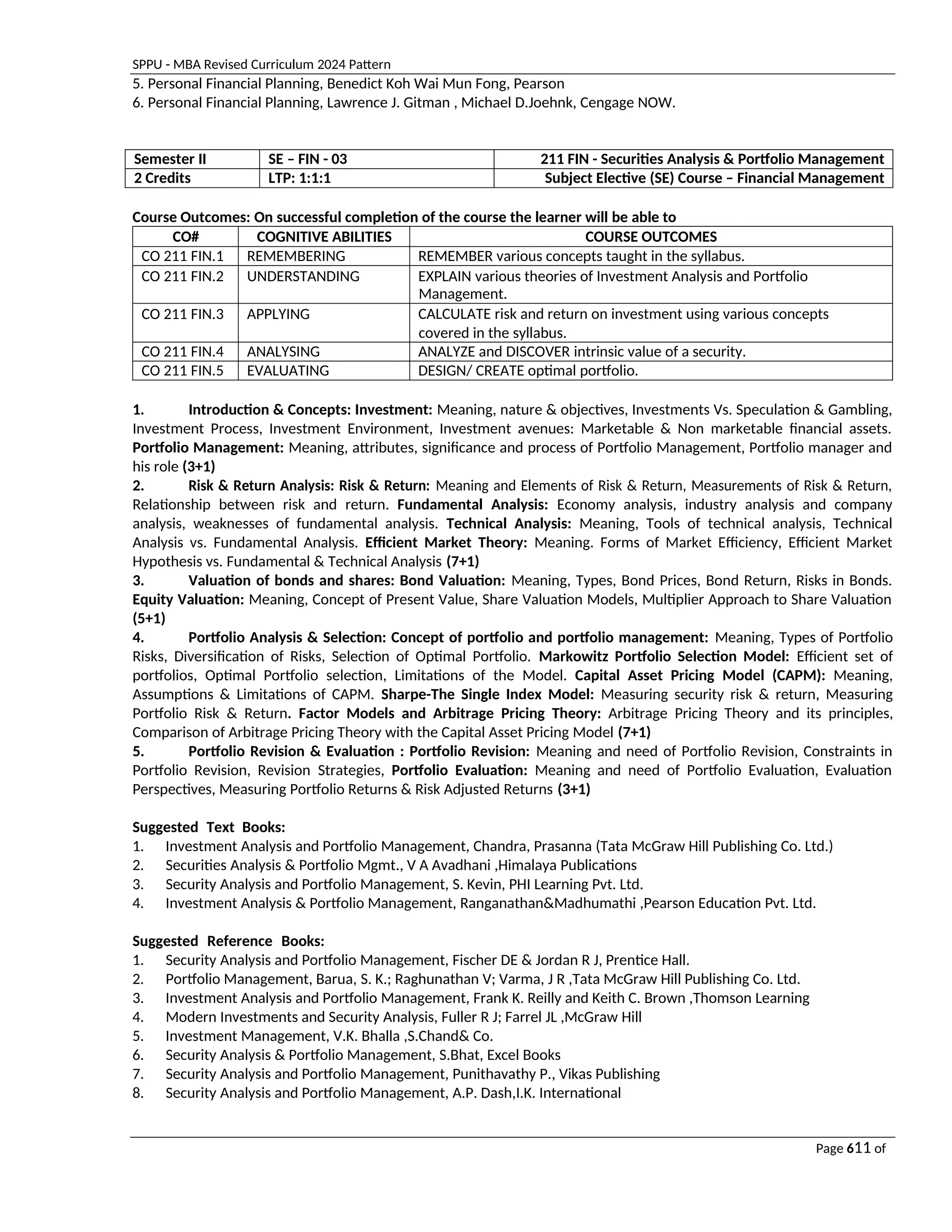
211 SE FIN - 03 Securities Analysis & Portfolio Management II 2 50 0 50
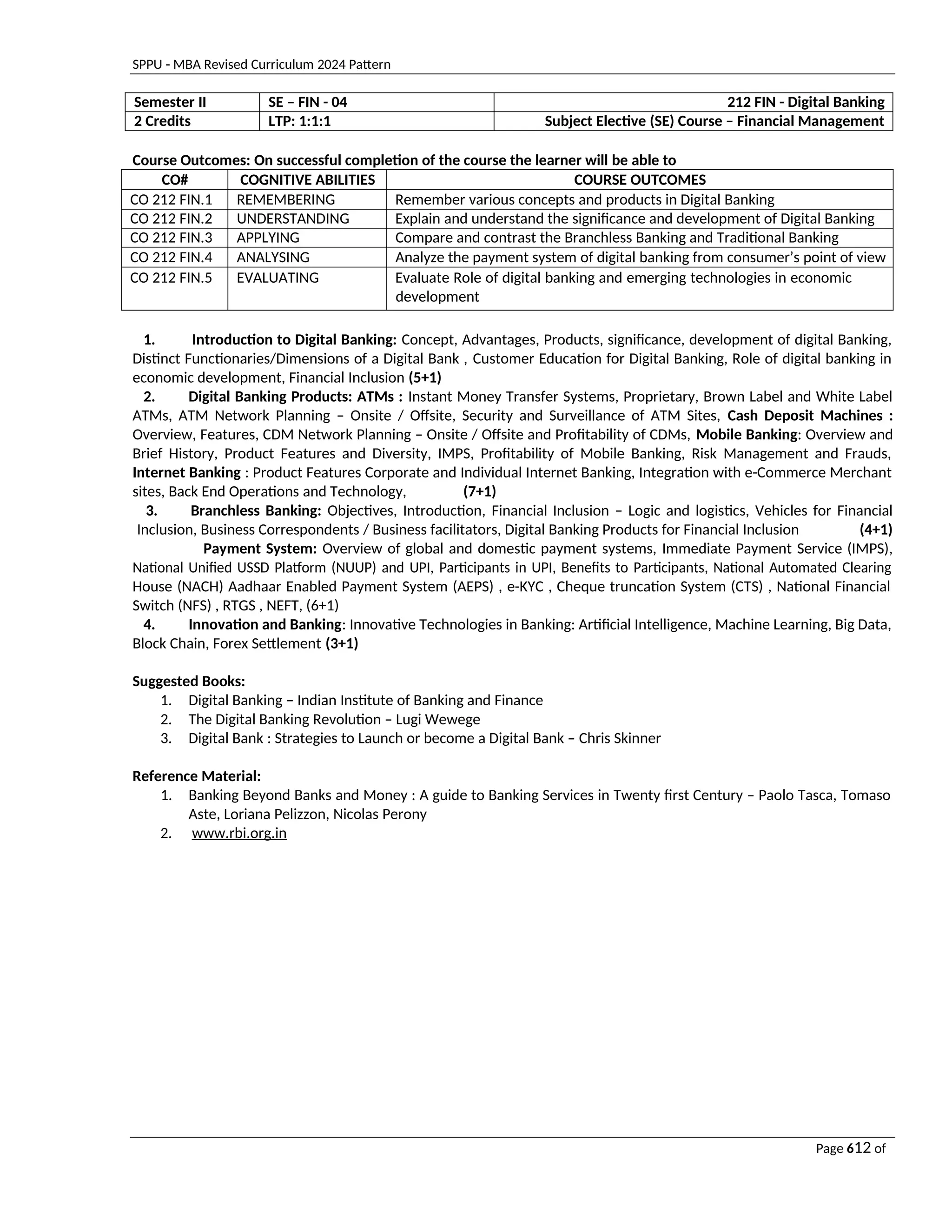
212 SE FIN - 04 Digital Banking II 2 50 0 50
4 100 0 100
Specialization Elective Courses - Semester III (Any 4 to be opted for)
304 SE FIN - 05 International Finance III 3 50 50 100
305 SE FIN - 06 Direct Taxation III 3 50 50 100
306 SE FIN - 07 Financial Reporting III 3 50 50 100
307 SE FIN - 08 Business Valuation III 3 50 50 100
308 SE FIN - 09 Technical Analysis of Financial Markets III 3 50 50 100
309 SE FIN - 10 Project Finance and Trade Finance III 3 50 50 100
310
SE FIN - 11
Fundamentals of Life Insurance -
Products & Underwriting
III 3 50 50 100
311 SE FIN - 12 Commodities Market III 3 50 50 100
12 200 200 400
Specialization Elective Courses - Semester IV (Any 4 to be opted for)
405 SE FIN - 13 Financial Laws IV 3 50 50 100
406 SE FIN - 14 Indirect Taxation IV 3 50 50 100
407 SE FIN - 15 Corporate Financial Restructuring IV 3 50 50 100
408 SE FIN - 16 Strategic Cost Management IV 3 50 50 100
409 SE FIN - 17 Risk Management IV 3 50 50 100
410 SE FIN - 18 Rural and Micro Finance IV 3 50 50 100
411 SE FIN - 19 General Insurance IV 3 50 50 100
412 SE FIN - 20 Treasury Management IV 3 50 50 100
12 200 200 400
34 600 500 1100
SPPU - MBA Revised Curriculum 2024 Pattern
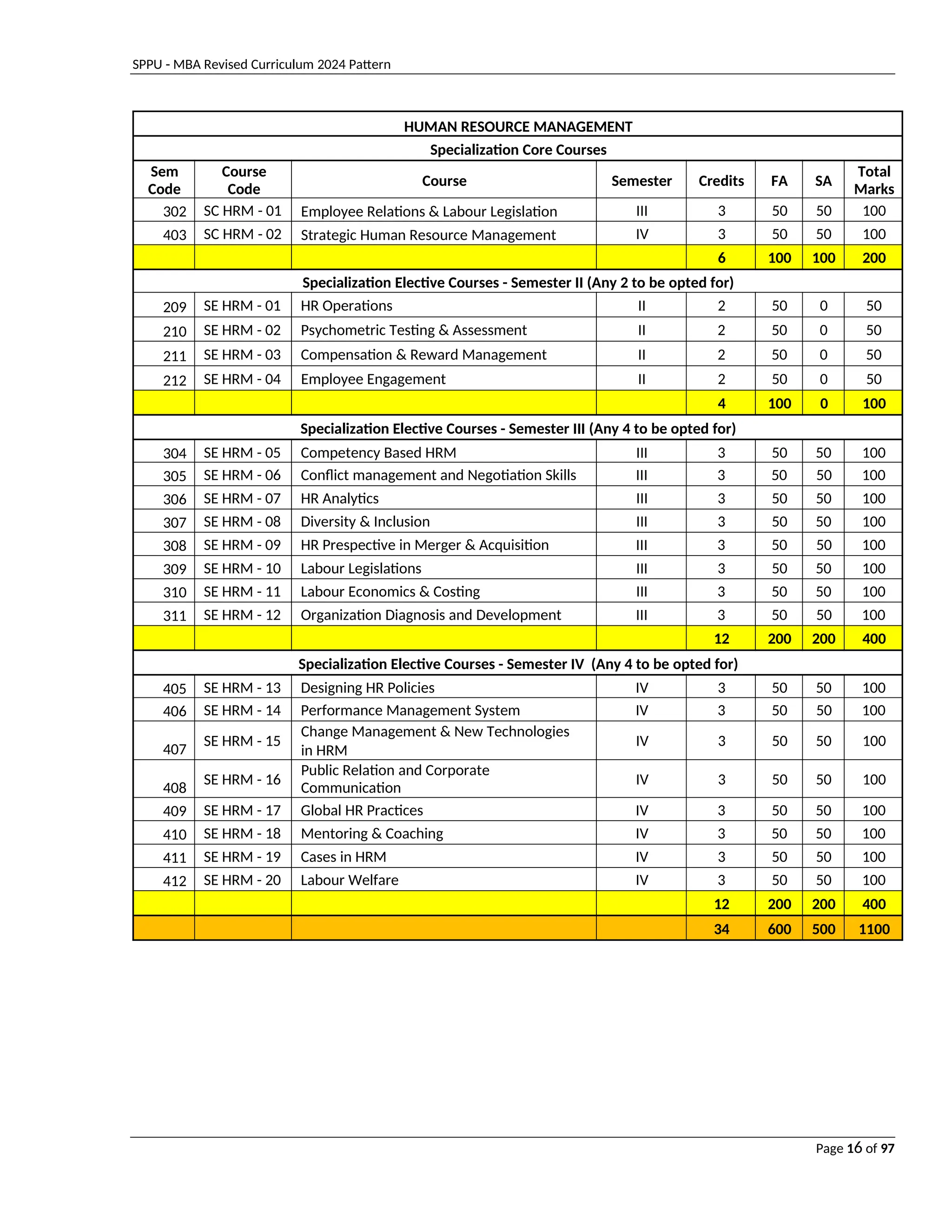
Page 16 of 97
HUMAN RESOURCE MANAGEMENT
Specialization Core Courses
Sem
Code
Course
Code
Course Semester Credits FA SA
Total
Marks
302 SC HRM - 01 Employee Relations & Labour Legislation III 3 50 50 100
403 SC HRM - 02 Strategic Human Resource Management IV 3 50 50 100
6 100 100 200
Specialization Elective Courses - Semester II (Any 2 to be opted for)
209 SE HRM - 01 HR Operations II 2 50 0 50
210 SE HRM - 02 Psychometric Testing & Assessment II 2 50 0 50
211 SE HRM - 03 Compensation & Reward Management II 2 50 0 50
212 SE HRM - 04 Employee Engagement II 2 50 0 50
4 100 0 100
Specialization Elective Courses - Semester III (Any 4 to be opted for)
304 SE HRM - 05 Competency Based HRM III 3 50 50 100
305 SE HRM - 06 Conflict management and Negotiation Skills III 3 50 50 100
306 SE HRM - 07 HR Analytics III 3 50 50 100
307 SE HRM - 08 Diversity & Inclusion III 3 50 50 100
308 SE HRM - 09 HR Prespective in Merger & Acquisition III 3 50 50 100
309 SE HRM - 10 Labour Legislations III 3 50 50 100
310 SE HRM - 11 Labour Economics & Costing III 3 50 50 100
311 SE HRM - 12 Organization Diagnosis and Development III 3 50 50 100
12 200 200 400
Specialization Elective Courses - Semester IV (Any 4 to be opted for)
405 SE HRM - 13 Designing HR Policies IV 3 50 50 100
406 SE HRM - 14 Performance Management System IV 3 50 50 100
407
SE HRM - 15
Change Management & New Technologies
in HRM
IV 3 50 50 100
408
SE HRM - 16
Public Relation and Corporate
Communication
IV 3 50 50 100
409 SE HRM - 17 Global HR Practices IV 3 50 50 100
410 SE HRM - 18 Mentoring & Coaching IV 3 50 50 100
411 SE HRM - 19 Cases in HRM IV 3 50 50 100
412 SE HRM - 20 Labour Welfare IV 3 50 50 100
12 200 200 400
34 600 500 1100
SPPU - MBA Revised Curriculum 2024 Pattern
Page 17 of 97
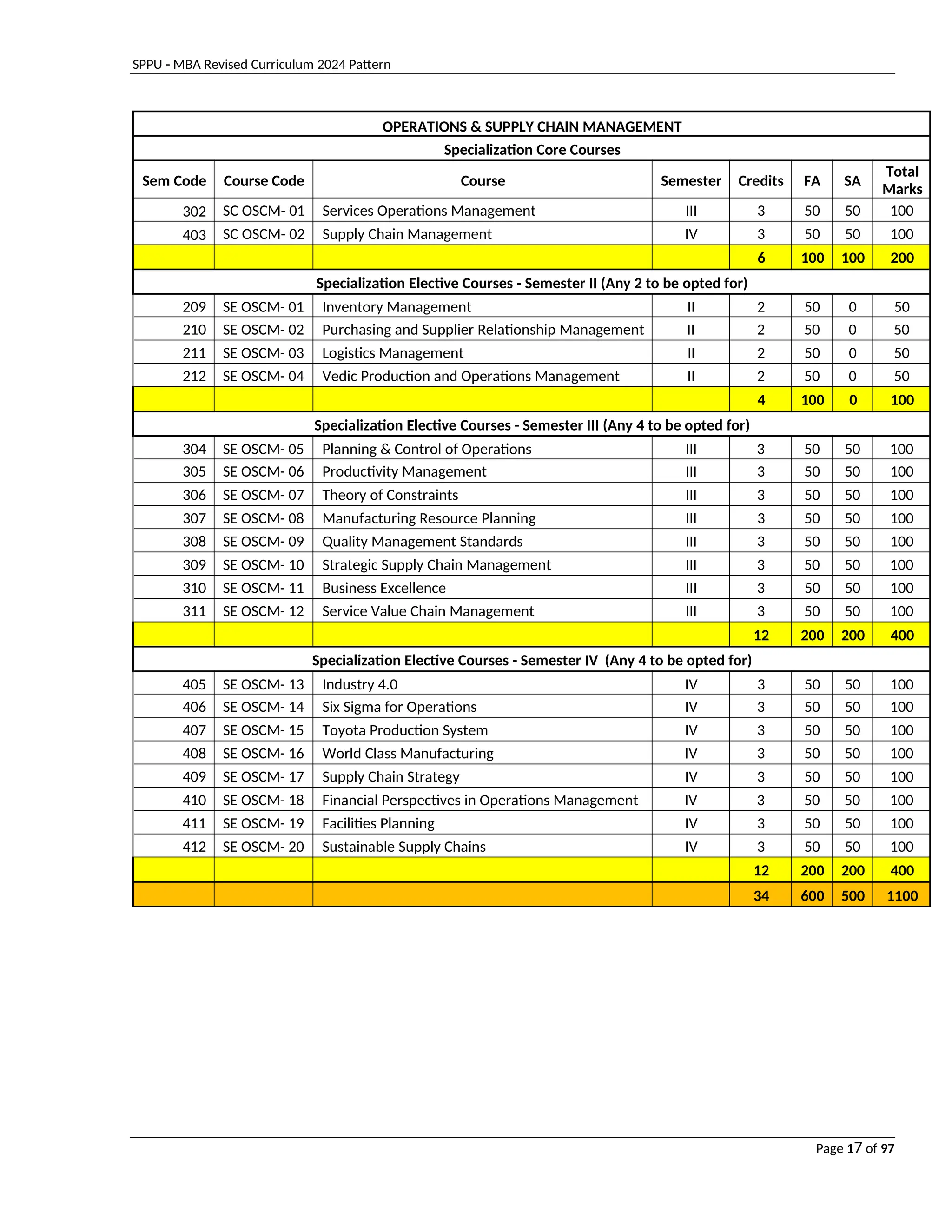
OPERATIONS & SUPPLY CHAIN MANAGEMENT
Specialization Core Courses
Sem Code Course Code Course Semester Credits FA SA
Total
Marks
302 SC OSCM- 01 Services Operations Management III 3 50 50 100
403 SC OSCM- 02 Supply Chain Management IV 3 50 50 100
6 100 100 200
Specialization Elective Courses - Semester II (Any 2 to be opted for)
209 SE OSCM- 01 Inventory Management II 2 50 0 50
210 SE OSCM- 02 Purchasing and Supplier Relationship Management II 2 50 0 50
211 SE OSCM- 03 Logistics Management II 2 50 0 50
212 SE OSCM- 04 Vedic Production and Operations Management II 2 50 0 50
4 100 0 100
Specialization Elective Courses - Semester III (Any 4 to be opted for)
304 SE OSCM- 05 Planning & Control of Operations III 3 50 50 100
305 SE OSCM- 06 Productivity Management III 3 50 50 100
306 SE OSCM- 07 Theory of Constraints III 3 50 50 100
307 SE OSCM- 08 Manufacturing Resource Planning III 3 50 50 100
308 SE OSCM- 09 Quality Management Standards III 3 50 50 100
309 SE OSCM- 10 Strategic Supply Chain Management III 3 50 50 100
310 SE OSCM- 11 Business Excellence III 3 50 50 100
311 SE OSCM- 12 Service Value Chain Management III 3 50 50 100
12 200 200 400
Specialization Elective Courses - Semester IV (Any 4 to be opted for)
405 SE OSCM- 13 Industry 4.0 IV 3 50 50 100
406 SE OSCM- 14 Six Sigma for Operations IV 3 50 50 100
407 SE OSCM- 15 Toyota Production System IV 3 50 50 100
408 SE OSCM- 16 World Class Manufacturing IV 3 50 50 100
409 SE OSCM- 17 Supply Chain Strategy IV 3 50 50 100
410 SE OSCM- 18 Financial Perspectives in Operations Management IV 3 50 50 100
411 SE OSCM- 19 Facilities Planning IV 3 50 50 100
412 SE OSCM- 20 Sustainable Supply Chains IV 3 50 50 100
12 200 200 400
34 600 500 1100
SPPU - MBA Revised Curriculum 2024 Pattern
Page 18 of 97
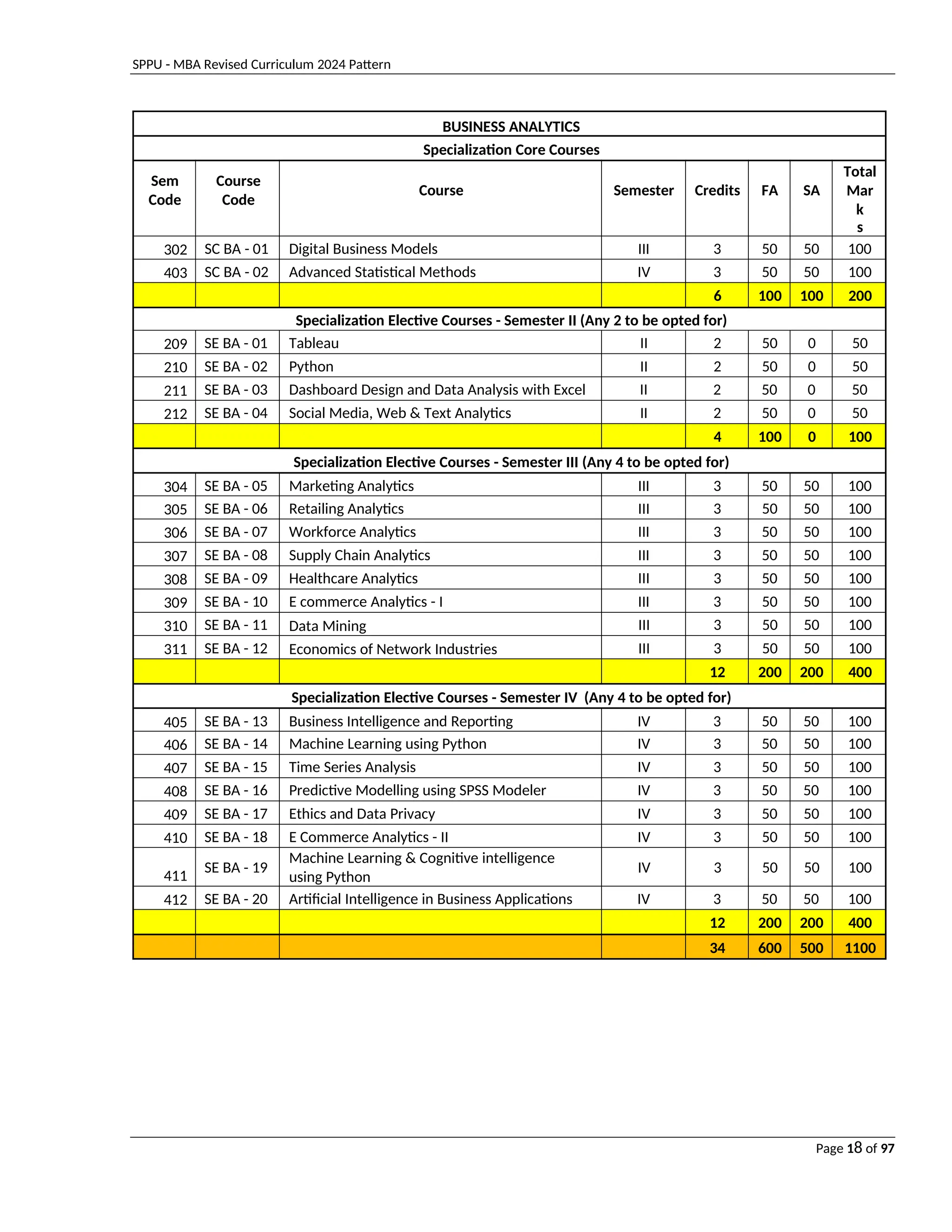
BUSINESS ANALYTICS
Specialization Core Courses
Sem
Code
Course
Code
Course Semester Credits FA SA
Total
Mar
k
s
302 SC BA - 01 Digital Business Models III 3 50 50 100
403 SC BA - 02 Advanced Statistical Methods IV 3 50 50 100
6 100 100 200
Specialization Elective Courses - Semester II (Any 2 to be opted for)
209 SE BA - 01 Tableau II 2 50 0 50
210 SE BA - 02 Python II 2 50 0 50
211 SE BA - 03 Dashboard Design and Data Analysis with Excel II 2 50 0 50
212 SE BA - 04 Social Media, Web & Text Analytics II 2 50 0 50
4 100 0 100
Specialization Elective Courses - Semester III (Any 4 to be opted for)
304 SE BA - 05 Marketing Analytics III 3 50 50 100
305 SE BA - 06 Retailing Analytics III 3 50 50 100
306 SE BA - 07 Workforce Analytics III 3 50 50 100
307 SE BA - 08 Supply Chain Analytics III 3 50 50 100
308 SE BA - 09 Healthcare Analytics III 3 50 50 100
309 SE BA - 10 E commerce Analytics - I III 3 50 50 100
310 SE BA - 11 Data Mining III 3 50 50 100
311 SE BA - 12 Economics of Network Industries III 3 50 50 100
12 200 200 400
Specialization Elective Courses - Semester IV (Any 4 to be opted for)
405 SE BA - 13 Business Intelligence and Reporting IV 3 50 50 100
406 SE BA - 14 Machine Learning using Python IV 3 50 50 100
407 SE BA - 15 Time Series Analysis IV 3 50 50 100
408 SE BA - 16 Predictive Modelling using SPSS Modeler IV 3 50 50 100
409 SE BA - 17 Ethics and Data Privacy IV 3 50 50 100
410 SE BA - 18 E Commerce Analytics - II IV 3 50 50 100
411
SE BA - 19
Machine Learning & Cognitive intelligence
using Python
IV 3 50 50 100
412 SE BA - 20 Artificial Intelligence in Business Applications IV 3 50 50 100
12 200 200 400
34 600 500 1100
SPPU - MBA Revised Curriculum 2024 Pattern
Page 19 of 97
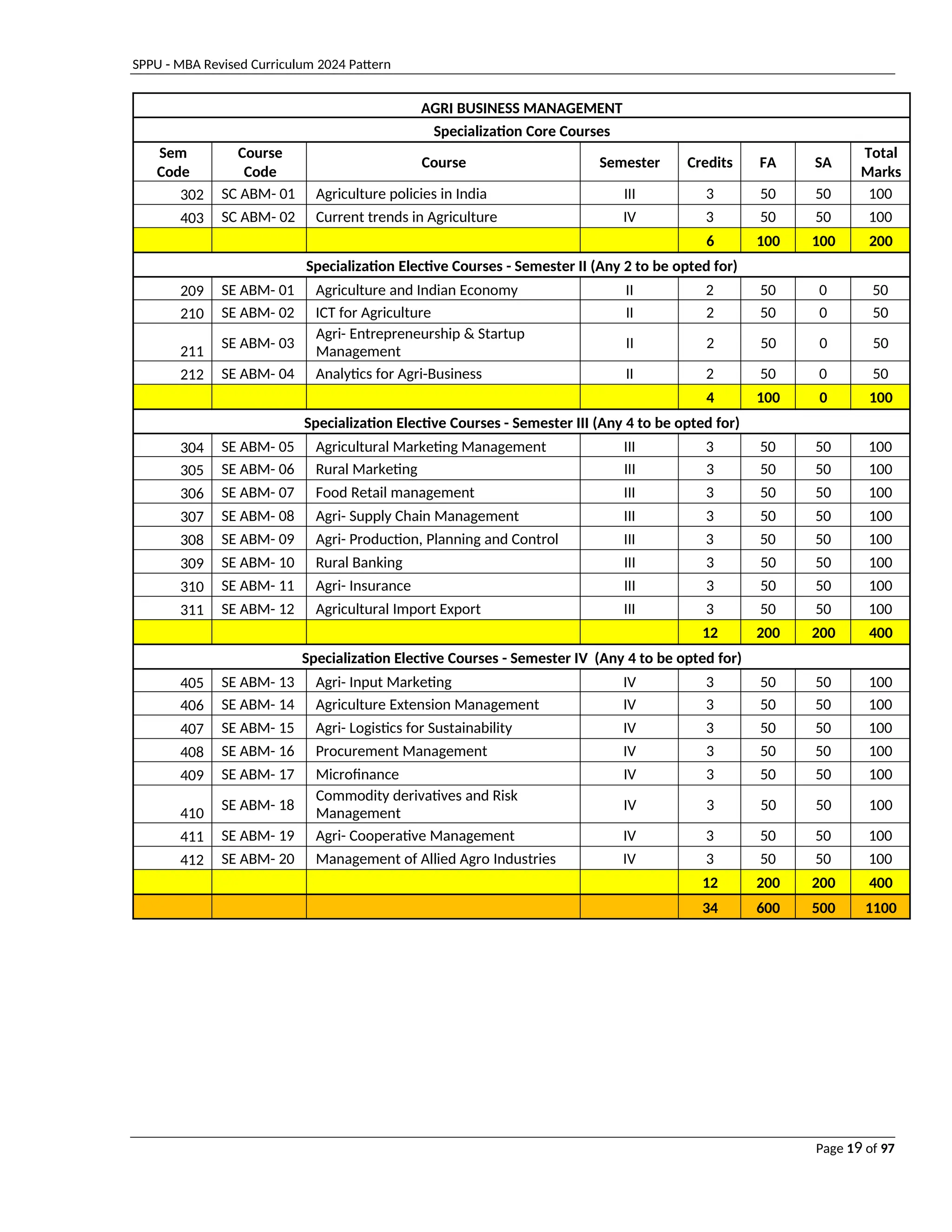
AGRI BUSINESS MANAGEMENT
Specialization Core Courses
Sem
Code
Course
Code
Course Semester Credits FA SA
Total
Marks
302 SC ABM- 01 Agriculture policies in India III 3 50 50 100
403 SC ABM- 02 Current trends in Agriculture IV 3 50 50 100
6 100 100 200
Specialization Elective Courses - Semester II (Any 2 to be opted for)
209 SE ABM- 01 Agriculture and Indian Economy II 2 50 0 50
210 SE ABM- 02 ICT for Agriculture II 2 50 0 50
211
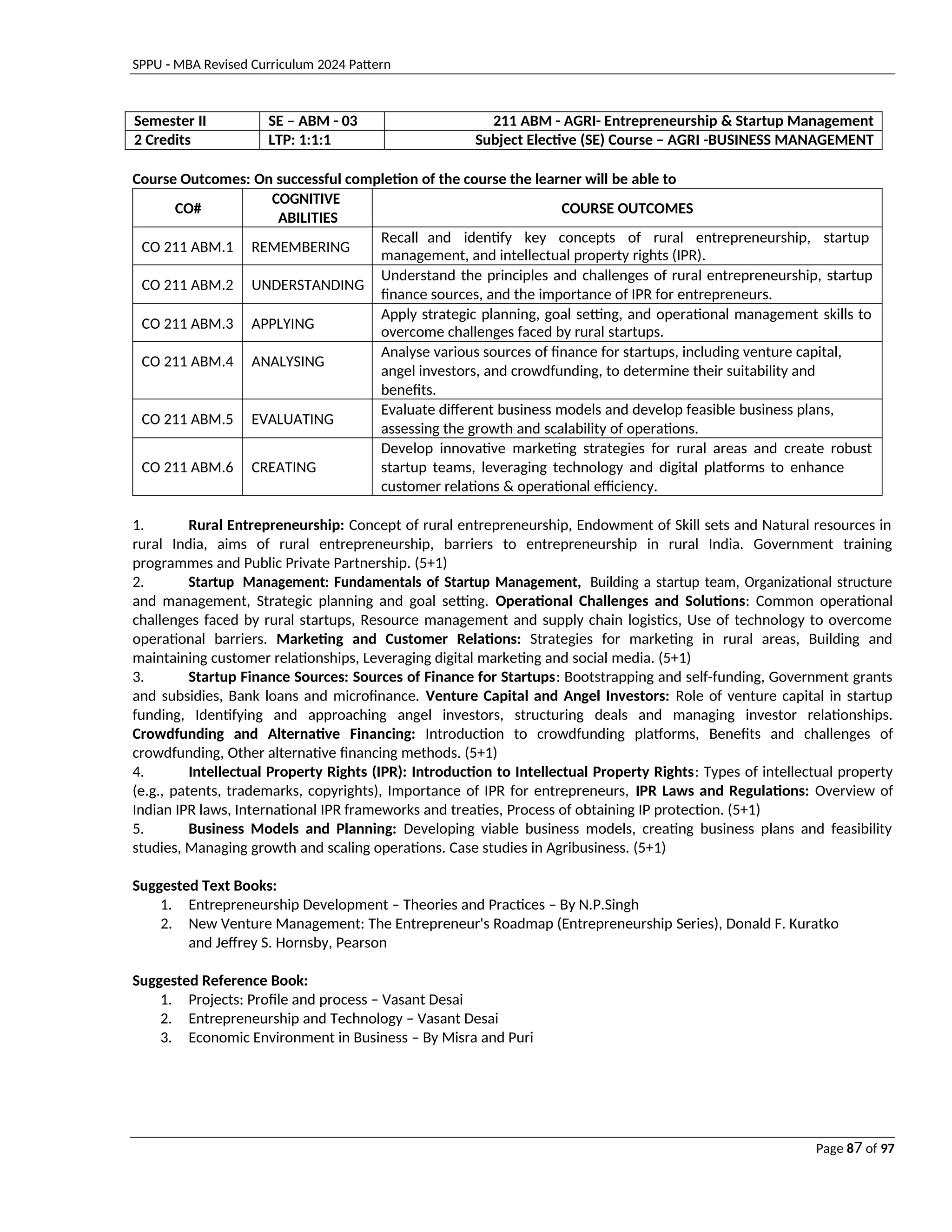
SE ABM- 03
Agri- Entrepreneurship & Startup
Management
II 2 50 0 50
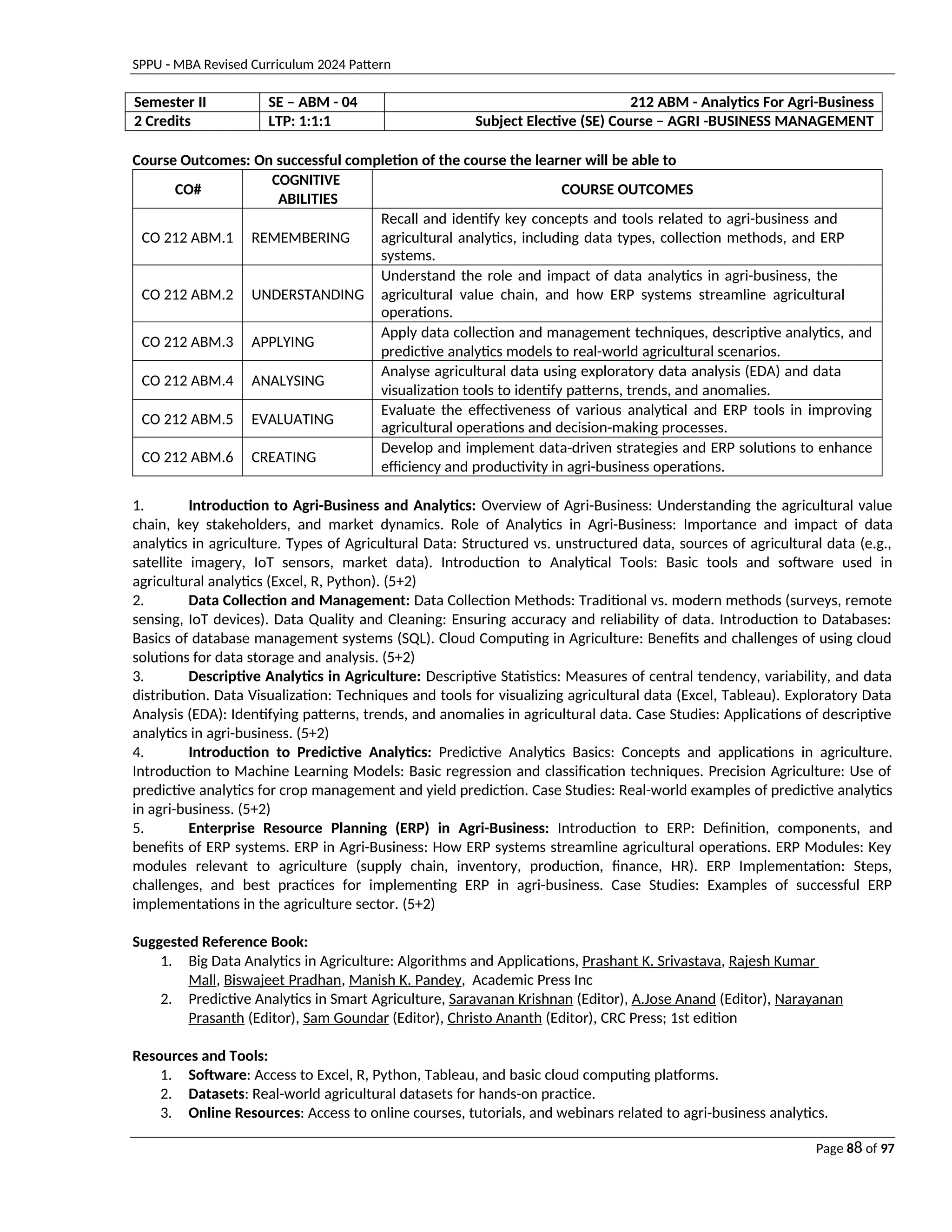
212 SE ABM- 04 Analytics for Agri-Business II 2 50 0 50
4 100 0 100
Specialization Elective Courses - Semester III (Any 4 to be opted for)
304 SE ABM- 05 Agricultural Marketing Management III 3 50 50 100
305 SE ABM- 06 Rural Marketing III 3 50 50 100
306 SE ABM- 07 Food Retail management III 3 50 50 100
307 SE ABM- 08 Agri- Supply Chain Management III 3 50 50 100
308 SE ABM- 09 Agri- Production, Planning and Control III 3 50 50 100
309 SE ABM- 10 Rural Banking III 3 50 50 100
310 SE ABM- 11 Agri- Insurance III 3 50 50 100
311 SE ABM- 12 Agricultural Import Export III 3 50 50 100
12 200 200 400
Specialization Elective Courses - Semester IV (Any 4 to be opted for)
405 SE ABM- 13 Agri- Input Marketing IV 3 50 50 100
406 SE ABM- 14 Agriculture Extension Management IV 3 50 50 100
407 SE ABM- 15 Agri- Logistics for Sustainability IV 3 50 50 100
408 SE ABM- 16 Procurement Management IV 3 50 50 100
409 SE ABM- 17 Microfinance IV 3 50 50 100
410
SE ABM- 18
Commodity derivatives and Risk
Management
IV 3 50 50 100
411 SE ABM- 19 Agri- Cooperative Management IV 3 50 50 100
412 SE ABM- 20 Management of Allied Agro Industries IV 3 50 50 100
12 200 200 400
34 600 500 1100
SPPU - MBA Revised Curriculum 2024 Pattern
Page 20 of 97
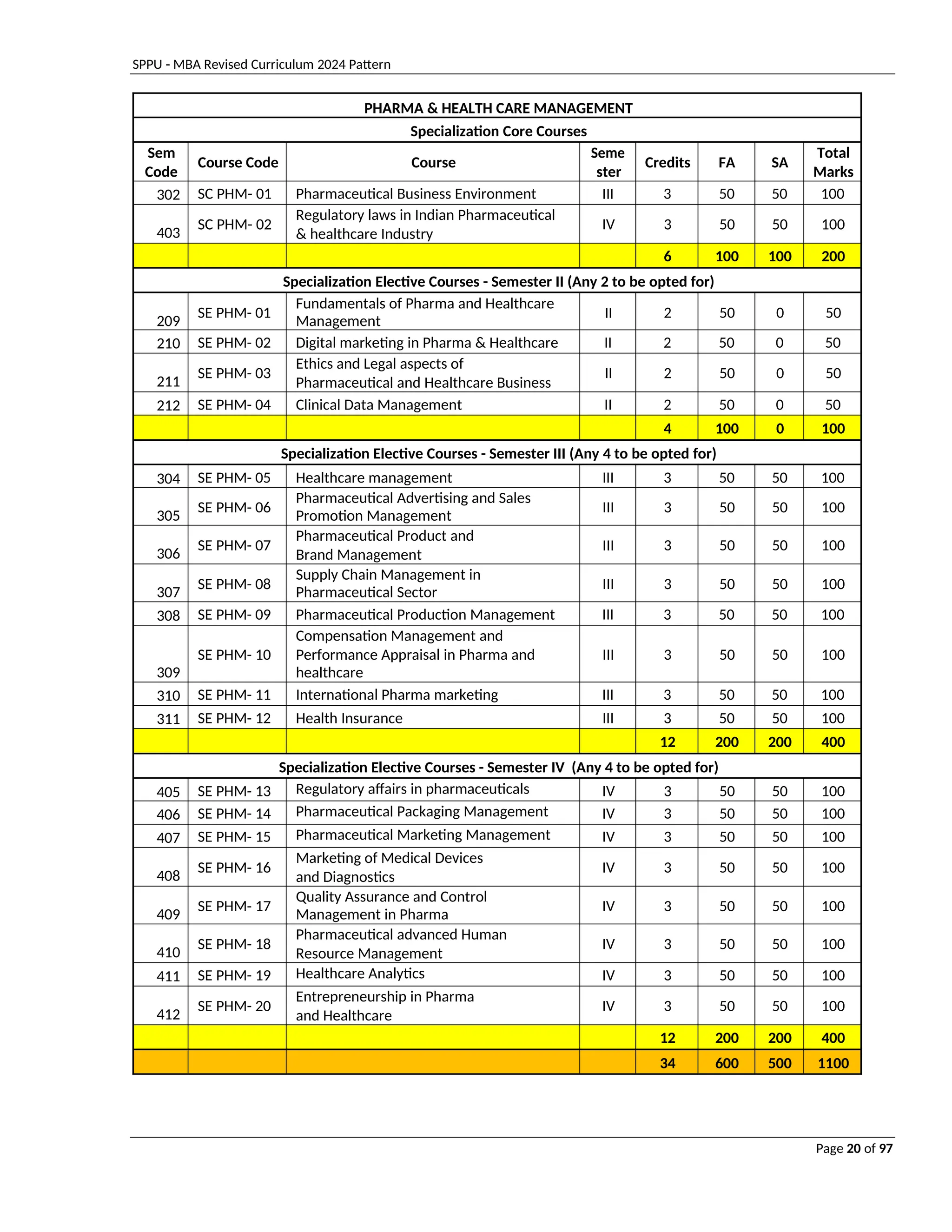
PHARMA & HEALTH CARE MANAGEMENT
Specialization Core Courses
Sem
Code
Course Code Course
Seme
ster
Credits FA SA
Total
Marks
302 SC PHM- 01 Pharmaceutical Business Environment III 3 50 50 100
403
SC PHM- 02
Regulatory laws in Indian Pharmaceutical
& healthcare Industry
IV 3 50 50 100
6 100 100 200
Specialization Elective Courses - Semester II (Any 2 to be opted for)
209
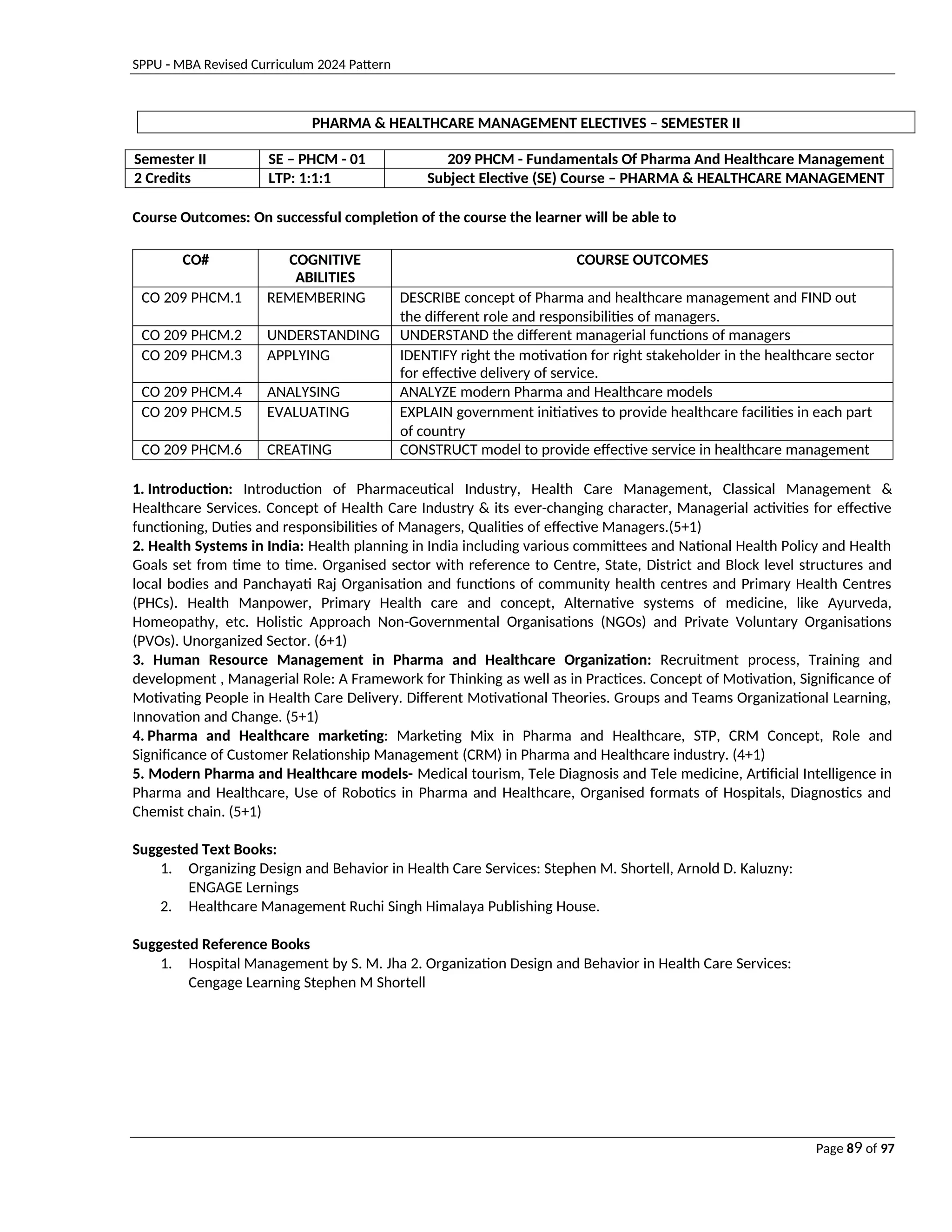
SE PHM- 01
Fundamentals of Pharma and Healthcare
Management
II 2 50 0 50
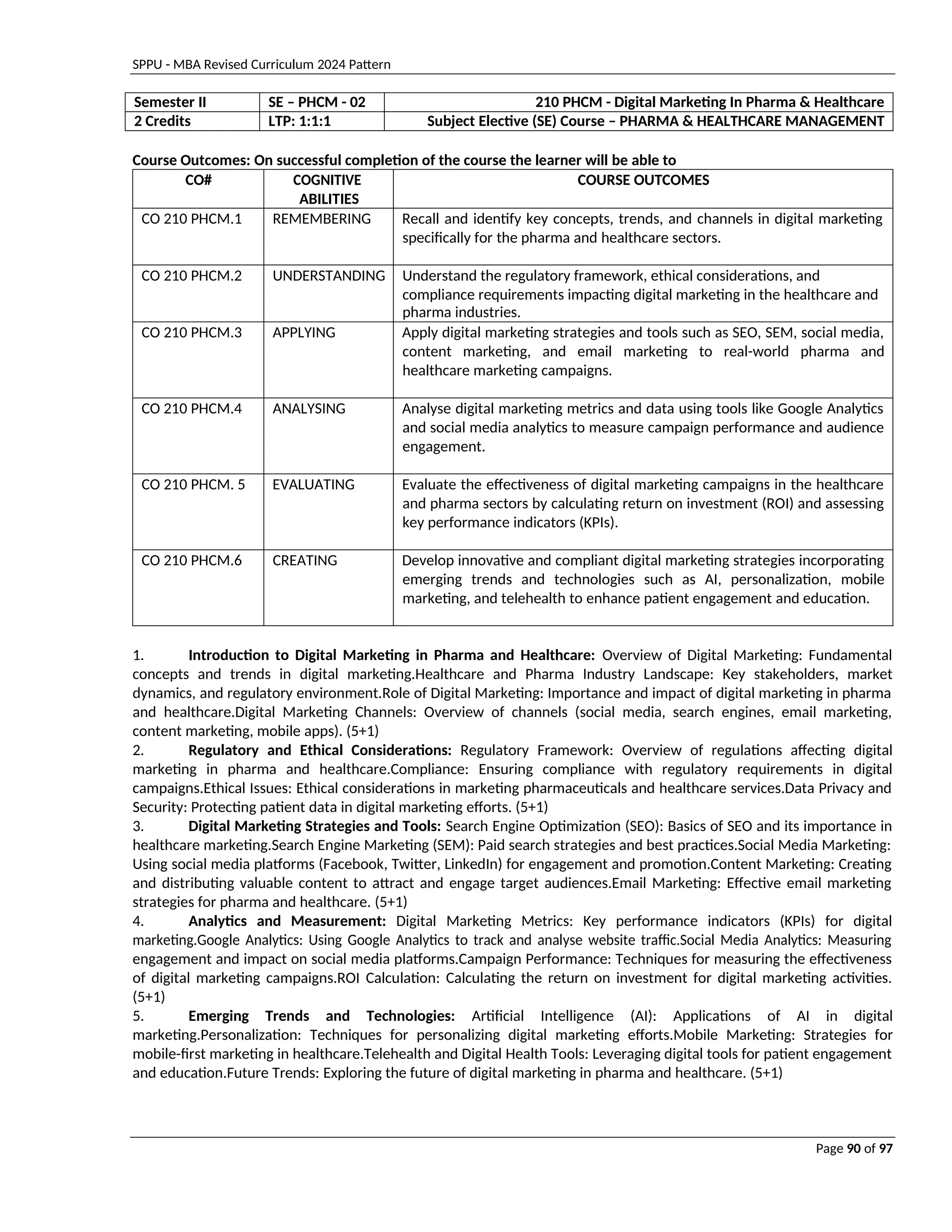
210 SE PHM- 02 Digital marketing in Pharma & Healthcare II 2 50 0 50
211
SE PHM- 03
Ethics and Legal aspects of
Pharmaceutical and Healthcare Business
II 2 50 0 50
212 SE PHM- 04 Clinical Data Management II 2 50 0 50
4 100 0 100
Specialization Elective Courses - Semester III (Any 4 to be opted for)
304 SE PHM- 05 Healthcare management III 3 50 50 100
305
SE PHM- 06
Pharmaceutical Advertising and Sales
Promotion Management
III 3 50 50 100
306
SE PHM- 07
Pharmaceutical Product and
Brand Management
III 3 50 50 100
307
SE PHM- 08
Supply Chain Management in
Pharmaceutical Sector
III 3 50 50 100
308 SE PHM- 09 Pharmaceutical Production Management III 3 50 50 100
309
SE PHM- 10
Compensation Management and
Performance Appraisal in Pharma and
healthcare
III 3 50 50 100
310 SE PHM- 11 International Pharma marketing III 3 50 50 100
311 SE PHM- 12 Health Insurance III 3 50 50 100
12 200 200 400
Specialization Elective Courses - Semester IV (Any 4 to be opted for)
405 SE PHM- 13 Regulatory affairs in pharmaceuticals IV 3 50 50 100
406 SE PHM- 14 Pharmaceutical Packaging Management IV 3 50 50 100
407 SE PHM- 15 Pharmaceutical Marketing Management IV 3 50 50 100
408
SE PHM- 16
Marketing of Medical Devices
and Diagnostics
IV 3 50 50 100
409
SE PHM- 17
Quality Assurance and Control
Management in Pharma
IV 3 50 50 100
410
SE PHM- 18
Pharmaceutical advanced Human
Resource Management
IV 3 50 50 100
411 SE PHM- 19 Healthcare Analytics IV 3 50 50 100
412
SE PHM- 20
Entrepreneurship in Pharma
and Healthcare
IV 3 50 50 100
12 200 200 400
34 600 500 1100
SPPU - MBA Revised Curriculum 2024 Pattern
Page 21 of 97
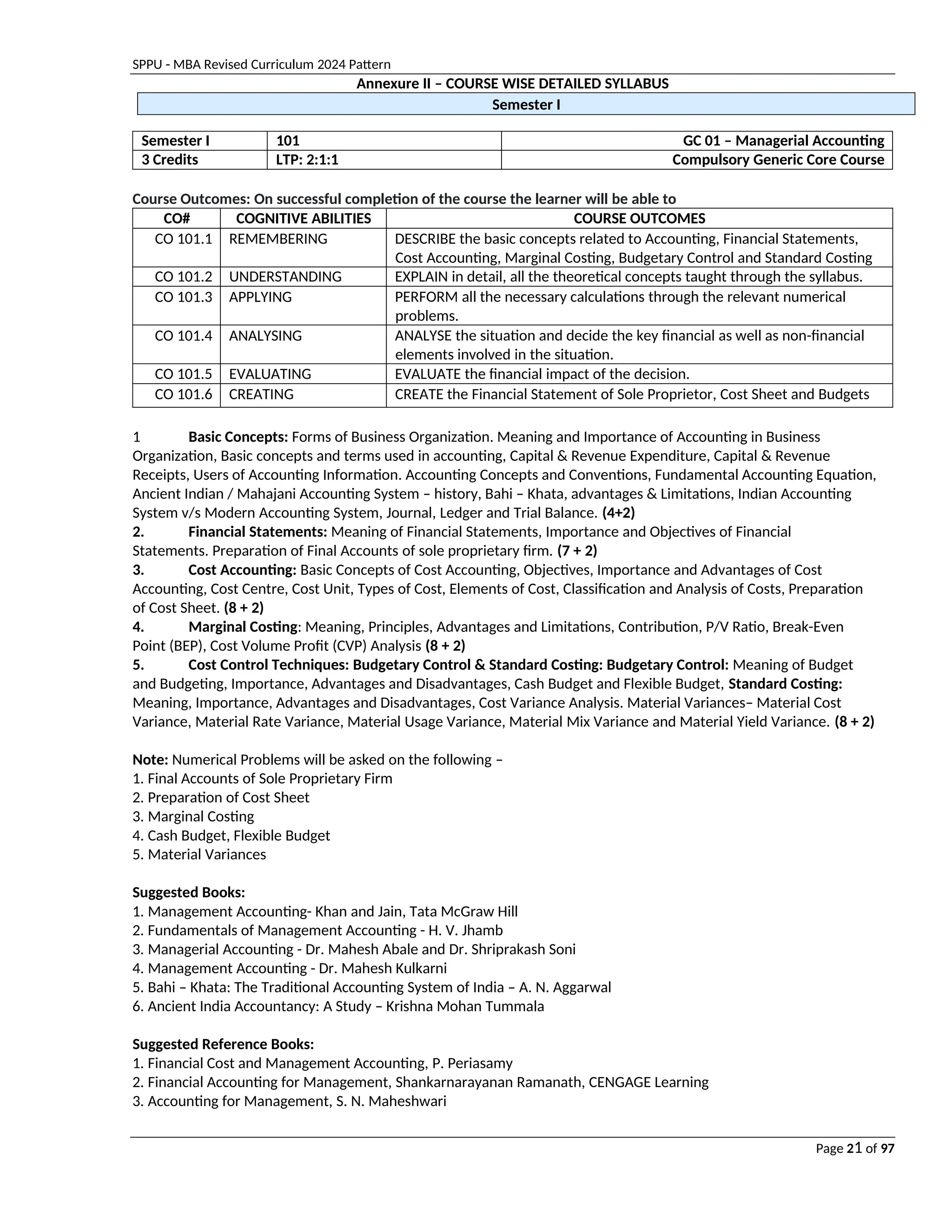
Annexure II – COURSE WISE DETAILED SYLLABUS
Semester I
Semester I 101 GC 01 – Managerial Accounting
3 Credits LTP: 2:1:1 Compulsory Generic Core Course
Course Outcomes: On successful completion of the course the learner will be able to
CO# COGNITIVE ABILITIES COURSE OUTCOMES
CO 101.1 REMEMBERING DESCRIBE the basic concepts related to Accounting, Financial Statements,
Cost Accounting, Marginal Costing, Budgetary Control and Standard Costing
CO 101.2 UNDERSTANDING EXPLAIN in detail, all the theoretical concepts taught through the syllabus.
CO 101.3 APPLYING PERFORM all the necessary calculations through the relevant numerical
problems.
CO 101.4 ANALYSING ANALYSE the situation and decide the key financial as well as non-financial
elements involved in the situation.
CO 101.5 EVALUATING EVALUATE the financial impact of the decision.
CO 101.6 CREATING CREATE the Financial Statement of Sole Proprietor, Cost Sheet and Budgets
1 Basic Concepts: Forms of Business Organization. Meaning and Importance of Accounting in Business
Organization, Basic concepts and terms used in accounting, Capital & Revenue Expenditure, Capital & Revenue
Receipts, Users of Accounting Information. Accounting Concepts and Conventions, Fundamental Accounting Equation,
Ancient Indian / Mahajani Accounting System – history, Bahi – Khata, advantages & Limitations, Indian Accounting
System v/s Modern Accounting System, Journal, Ledger and Trial Balance. (4+2)
2. Financial Statements: Meaning of Financial Statements, Importance and Objectives of Financial
Statements. Preparation of Final Accounts of sole proprietary firm. (7 + 2)
3. Cost Accounting: Basic Concepts of Cost Accounting, Objectives, Importance and Advantages of Cost
Accounting, Cost Centre, Cost Unit, Types of Cost, Elements of Cost, Classification and Analysis of Costs, Preparation
of Cost Sheet. (8 + 2)
4. Marginal Costing: Meaning, Principles, Advantages and Limitations, Contribution, P/V Ratio, Break-Even
Point (BEP), Cost Volume Profit (CVP) Analysis (8 + 2)
5. Cost Control Techniques: Budgetary Control & Standard Costing: Budgetary Control: Meaning of Budget
and Budgeting, Importance, Advantages and Disadvantages, Cash Budget and Flexible Budget, Standard Costing:
Meaning, Importance, Advantages and Disadvantages, Cost Variance Analysis. Material Variances– Material Cost
Variance, Material Rate Variance, Material Usage Variance, Material Mix Variance and Material Yield Variance. (8 + 2)
Note: Numerical Problems will be asked on the following –
1. Final Accounts of Sole Proprietary Firm
2. Preparation of Cost Sheet
3. Marginal Costing
4. Cash Budget, Flexible Budget
5. Material Variances
Suggested Books:
1. Management Accounting- Khan and Jain, Tata McGraw Hill
2. Fundamentals of Management Accounting - H. V. Jhamb
3. Managerial Accounting - Dr. Mahesh Abale and Dr. Shriprakash Soni
4. Management Accounting - Dr. Mahesh Kulkarni
5. Bahi – Khata: The Traditional Accounting System of India – A. N. Aggarwal
6. Ancient India Accountancy: A Study – Krishna Mohan Tummala
Suggested Reference Books:
1. Financial Cost and Management Accounting, P. Periasamy
2. Financial Accounting for Management, Shankarnarayanan Ramanath, CENGAGE Learning
3. Accounting for Management, S. N. Maheshwari
SPPU - MBA Revised Curriculum 2024 Pattern
Page 22 of 97
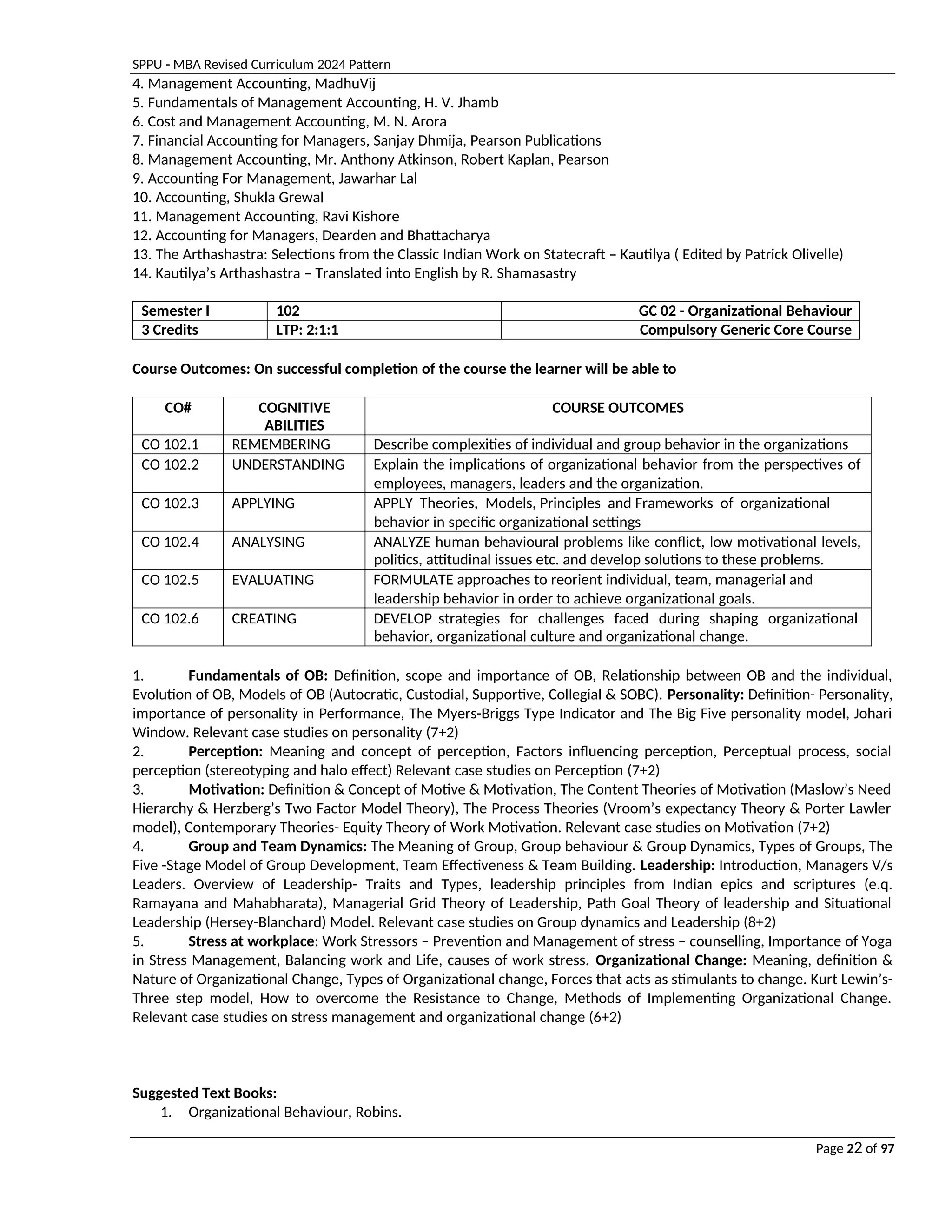
4. Management Accounting, MadhuVij
5. Fundamentals of Management Accounting, H. V. Jhamb
6. Cost and Management Accounting, M. N. Arora
7. Financial Accounting for Managers, Sanjay Dhmija, Pearson Publications
8. Management Accounting, Mr. Anthony Atkinson, Robert Kaplan, Pearson
9. Accounting For Management, Jawarhar Lal
10. Accounting, Shukla Grewal
11. Management Accounting, Ravi Kishore
12. Accounting for Managers, Dearden and Bhattacharya
13. The Arthashastra: Selections from the Classic Indian Work on Statecraft – Kautilya ( Edited by Patrick Olivelle)
14. Kautilya’s Arthashastra – Translated into English by R. Shamasastry
Semester I 102 GC 02 - Organizational Behaviour
3 Credits LTP: 2:1:1 Compulsory Generic Core Course
Course Outcomes: On successful completion of the course the learner will be able to
CO# COGNITIVE
ABILITIES
COURSE OUTCOMES
CO 102.1 REMEMBERING Describe complexities of individual and group behavior in the organizations
CO 102.2 UNDERSTANDING Explain the implications of organizational behavior from the perspectives of
employees, managers, leaders and the organization.
CO 102.3 APPLYING APPLY Theories, Models, Principles and Frameworks of organizational
behavior in specific organizational settings
CO 102.4 ANALYSING ANALYZE human behavioural problems like conflict, low motivational levels,
politics, attitudinal issues etc. and develop solutions to these problems.
CO 102.5 EVALUATING FORMULATE approaches to reorient individual, team, managerial and
leadership behavior in order to achieve organizational goals.
CO 102.6 CREATING DEVELOP strategies for challenges faced during shaping organizational
behavior, organizational culture and organizational change.
1. Fundamentals of OB: Definition, scope and importance of OB, Relationship between OB and the individual,
Evolution of OB, Models of OB (Autocratic, Custodial, Supportive, Collegial & SOBC). Personality: Definition- Personality,
importance of personality in Performance, The Myers-Briggs Type Indicator and The Big Five personality model, Johari
Window. Relevant case studies on personality (7+2)
2. Perception: Meaning and concept of perception, Factors influencing perception, Perceptual process, social
perception (stereotyping and halo effect) Relevant case studies on Perception (7+2)
3. Motivation: Definition & Concept of Motive & Motivation, The Content Theories of Motivation (Maslow’s Need
Hierarchy & Herzberg’s Two Factor Model Theory), The Process Theories (Vroom’s expectancy Theory & Porter Lawler
model), Contemporary Theories- Equity Theory of Work Motivation. Relevant case studies on Motivation (7+2)
4. Group and Team Dynamics: The Meaning of Group, Group behaviour & Group Dynamics, Types of Groups, The
Five -Stage Model of Group Development, Team Effectiveness & Team Building. Leadership: Introduction, Managers V/s
Leaders. Overview of Leadership- Traits and Types, leadership principles from Indian epics and scriptures (e.q.
Ramayana and Mahabharata), Managerial Grid Theory of Leadership, Path Goal Theory of leadership and Situational
Leadership (Hersey-Blanchard) Model. Relevant case studies on Group dynamics and Leadership (8+2)
5. Stress at workplace: Work Stressors – Prevention and Management of stress – counselling, Importance of Yoga
in Stress Management, Balancing work and Life, causes of work stress. Organizational Change: Meaning, definition &
Nature of Organizational Change, Types of Organizational change, Forces that acts as stimulants to change. Kurt Lewin’s-
Three step model, How to overcome the Resistance to Change, Methods of Implementing Organizational Change.
Relevant case studies on stress management and organizational change (6+2)
Suggested Text Books:
1. Organizational Behaviour, Robins.
SPPU - MBA Revised Curriculum 2024 Pattern
Page 23 of 97
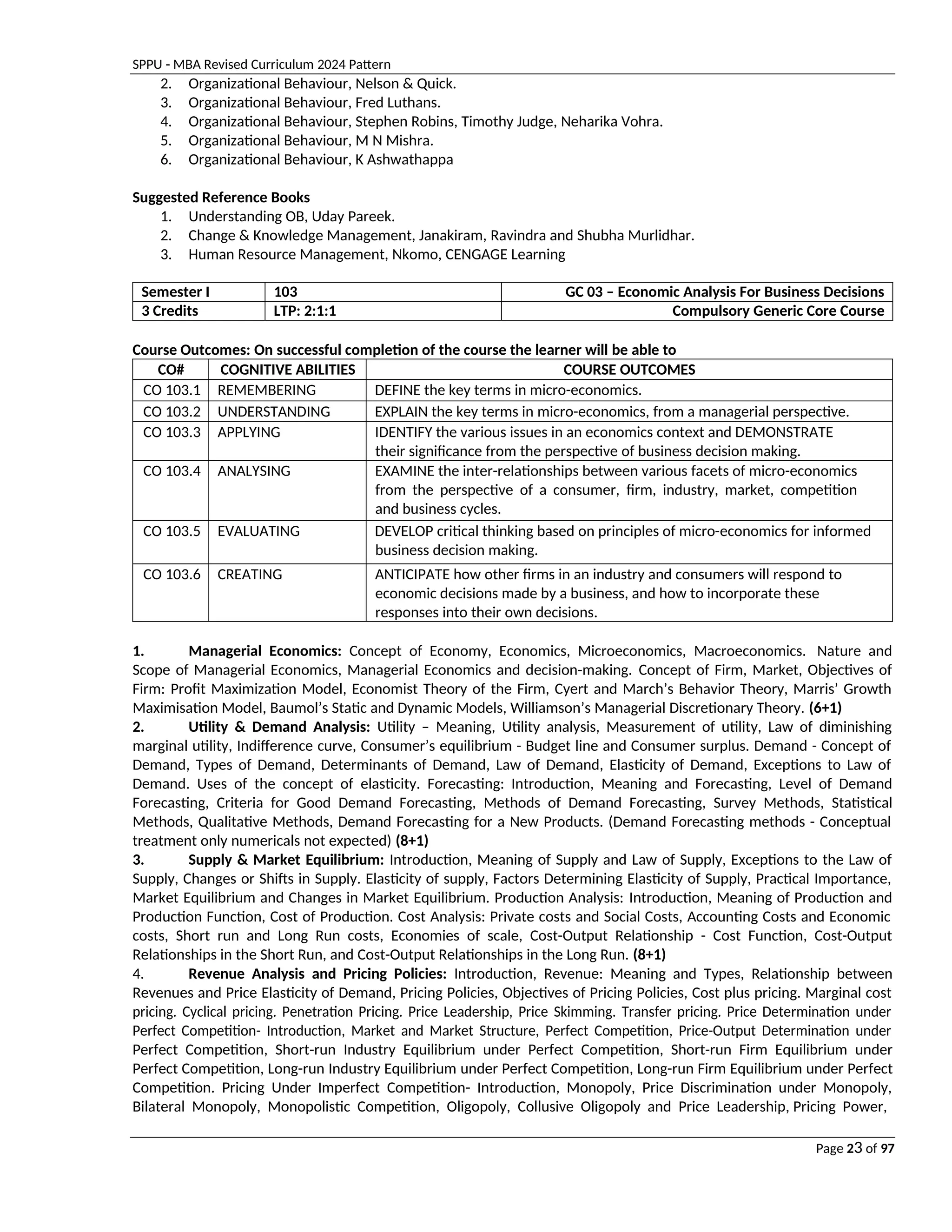
2. Organizational Behaviour, Nelson & Quick.
3. Organizational Behaviour, Fred Luthans.
4. Organizational Behaviour, Stephen Robins, Timothy Judge, Neharika Vohra.
5. Organizational Behaviour, M N Mishra.
6. Organizational Behaviour, K Ashwathappa
Suggested Reference Books
1. Understanding OB, Uday Pareek.
2. Change & Knowledge Management, Janakiram, Ravindra and Shubha Murlidhar.
3. Human Resource Management, Nkomo, CENGAGE Learning
Semester I 103 GC 03 – Economic Analysis For Business Decisions
3 Credits LTP: 2:1:1 Compulsory Generic Core Course
Course Outcomes: On successful completion of the course the learner will be able to
CO# COGNITIVE ABILITIES COURSE OUTCOMES
CO 103.1 REMEMBERING DEFINE the key terms in micro-economics.
CO 103.2 UNDERSTANDING EXPLAIN the key terms in micro-economics, from a managerial perspective.
CO 103.3 APPLYING IDENTIFY the various issues in an economics context and DEMONSTRATE
their significance from the perspective of business decision making.
CO 103.4 ANALYSING EXAMINE the inter-relationships between various facets of micro-economics
from the perspective of a consumer, firm, industry, market, competition
and business cycles.
CO 103.5 EVALUATING DEVELOP critical thinking based on principles of micro-economics for informed
business decision making.
CO 103.6 CREATING ANTICIPATE how other firms in an industry and consumers will respond to
economic decisions made by a business, and how to incorporate these
responses into their own decisions.
1. Managerial Economics: Concept of Economy, Economics, Microeconomics, Macroeconomics. Nature and
Scope of Managerial Economics, Managerial Economics and decision-making. Concept of Firm, Market, Objectives of
Firm: Profit Maximization Model, Economist Theory of the Firm, Cyert and March’s Behavior Theory, Marris’ Growth
Maximisation Model, Baumol’s Static and Dynamic Models, Williamson’s Managerial Discretionary Theory. (6+1)
2. Utility & Demand Analysis: Utility – Meaning, Utility analysis, Measurement of utility, Law of diminishing
marginal utility, Indifference curve, Consumer’s equilibrium - Budget line and Consumer surplus. Demand - Concept of
Demand, Types of Demand, Determinants of Demand, Law of Demand, Elasticity of Demand, Exceptions to Law of
Demand. Uses of the concept of elasticity. Forecasting: Introduction, Meaning and Forecasting, Level of Demand
Forecasting, Criteria for Good Demand Forecasting, Methods of Demand Forecasting, Survey Methods, Statistical
Methods, Qualitative Methods, Demand Forecasting for a New Products. (Demand Forecasting methods - Conceptual
treatment only numericals not expected) (8+1)
3. Supply & Market Equilibrium: Introduction, Meaning of Supply and Law of Supply, Exceptions to the Law of
Supply, Changes or Shifts in Supply. Elasticity of supply, Factors Determining Elasticity of Supply, Practical Importance,
Market Equilibrium and Changes in Market Equilibrium. Production Analysis: Introduction, Meaning of Production and
Production Function, Cost of Production. Cost Analysis: Private costs and Social Costs, Accounting Costs and Economic
costs, Short run and Long Run costs, Economies of scale, Cost-Output Relationship - Cost Function, Cost-Output
Relationships in the Short Run, and Cost-Output Relationships in the Long Run. (8+1)
4. Revenue Analysis and Pricing Policies: Introduction, Revenue: Meaning and Types, Relationship between
Revenues and Price Elasticity of Demand, Pricing Policies, Objectives of Pricing Policies, Cost plus pricing. Marginal cost
pricing. Cyclical pricing. Penetration Pricing. Price Leadership, Price Skimming. Transfer pricing. Price Determination under
Perfect Competition- Introduction, Market and Market Structure, Perfect Competition, Price-Output Determination under
Perfect Competition, Short-run Industry Equilibrium under Perfect Competition, Short-run Firm Equilibrium under
Perfect Competition, Long-run Industry Equilibrium under Perfect Competition, Long-run Firm Equilibrium under Perfect
Competition. Pricing Under Imperfect Competition- Introduction, Monopoly, Price Discrimination under Monopoly,
Bilateral Monopoly, Monopolistic Competition, Oligopoly, Collusive Oligopoly and Price Leadership, Pricing Power,
SPPU - MBA Revised Curriculum 2024 Pattern
Page 24 of 97
Duopoly, Industry Analysis. Profit Policy: Break Even analysis. Profit Forecasting. Need for Government Intervention in
Markets. Price Controls. Support Price. Preventions and Control of Monopolies. System of Dual Price. (11+1)
5. Consumption Function and Investment Function: Introduction, Consumption Function, Investment Function,
Marginal efficiency of capital and business expectations, Multiplier, Accelerator. Business Cycle: Introduction, Meaning
and Features, Theories of Business Cycles, Measures to Control Business Cycles, Business Cycles and Business Decisions.
(7+1)
Suggested Text Books:
1. Managerial Economics, Peterson, Lewis, Sudhir Jain, Pearson, Prentice Hall
2. Managerial Economics, D. Salvatore, McGraw Hill, New Delhi.
3. Managerial Economics, Pearson and Lewis, Prentice Hall, New Delhi
4. Managerial Economics, G.S. Gupta, T M H, New Delhi.
5. Managerial Economics, Mote, Paul and Gupta, T M H, New Delhi.
Suggested Reference Books:
1. Managerial Economics, Homas and Maurice, Tata McGraw Hill
2. Managerial Economics - Analysis, Problems and Cases, P.L. Mehta, Sultan Chand Sons, New Delhi.
3. Managerial Economics, Varshney and Maheshwari, Sultan Chand and Sons, New Delhi.
4. Managerial Economics, D.M.Mithani
5. Managerial Economics, Joel Dean, Prentice Hall, USA.
6. Managerial Economics by H L Ahuja, S Chand & Co. New Delhi.
Semester I 104 GC 04 – Basics Of Marketing
3 Credits LTP: 2:1:1 Compulsory Generic Core Course
Course Outcomes: On successful completion of the course the learner will be able to
CO# COGNITIVE ABILITIES COURSE OUTCOMES
CO 104.1 REMEMBERING RECALL and REPRODUCE the various concepts, principles, frameworks and
terms related to the function and role of marketing.
CO 104.2 UNDERSTANDING DEMONSTRATE the relevance of marketing management concepts and
frameworks to a new or existing business across wide variety of sectors and
ILLUSTRATE the role that marketing plays in the ‘tool kit’ of every
organizational leader and manager.
CO 104.3 APPLYING APPLY marketing principles and theories to the demands of marketing
function and practice in contemporary real world scenarios.
CO 104.4 ANALYSING EXAMINE and LIST marketing issues pertaining to segmentation, targeting
and positioning, marketing environmental forces, consumer buying
behavior, marketing mix and Product Life Cycle in the context of real world
marketing offering (commodities, goods, services, e-products/ e-services).
CO 104.5 EVALUATING EXPLAIN the interrelationships between segmentation, targeting and
positioning, marketing environment, consumer buying behavior, marketing
mix and Product Life Cycle with real world examples.
CO 104.6 CREATING DISCUSS alternative approaches to segmentation, targeting and positioning,
the marketing environment, consumer buying behavior, marketing mix and
Product Life Cycle in the context of real world marketing offering
(commodities, goods, services, e-products/ e-services.).
1. Introduction to Marketing: Definition & Functions of Marketing- Scope of Marketing, Evolution of Marketing,
Core concepts of marketing – Need, Want, Demand, Customer Value, Exchange, Customer Satisfaction, Customer
Delight, Customer loyalty, Concepts of Markets, Marketing V/S Market Competition, Key customer markets, market
places, market spaces, Meta-markets, Digital Markets, Brick & Click Model. Impact of Globalization, Technology and
Social Responsibility on Marketing. New Consumer Capabilities, New Company Capabilities. Functions of Marketing
Manager. Linkage of Marketing functions with all functions in the organization. Company orientation towards market
SPPU - MBA Revised Curriculum 2024 Pattern
Page 25 of 97
place: Product – Production - Sales – Marketing –Societal – Relational, Holistic Marketing Orientation. Selling versus
marketing. Concept of Marketing Myopia. Marketing Process, Understanding Marketing as Creating, Communicating,
and Delivering Value, Meta-markets, Digital Markets, Brick & Click Model, Metaverse, New Consumer Capabilities,
Connected Customers, Digital Natives, informed Vs Distracted customers, Journey of Marketing from Marketing 1.0 to
Marketing 6.0. integrating Traditional and digital Marketing and Sustainable Marketing Digital Transformation in
Marketing: AI, big data, and machine learning transforming marketing strategies, Customer Experience (CX),
Sustainable Marketing. (7+2)
2. Consumer Behavior: Meaning & importance of consumer behavior, Comparison between Organizational
Buying behavior and consumer buying behavior, Buying roles, Five steps consumer buyer decision process – Problem
Recognition, Information Search, Evaluation of Alternatives, Purchase Decision, Post Purchase behavior. Moment of
Truth, Zero Moment of Truth, ZMOT, Moderating effects on consumer behavior, Neuromarketing, Omnichannel
Consumer Behaviour, Behavioral Economics. How People buy Online, Adoption process- Awareness to Advocacy –Aware,
Appeal, Ask, Act, Advocate (5As) and The O Zone (O3) Own, Outer and Other influence, Show rooming and Web
rooming,,Consumerisation. (7+2)
3. Marketing Environment: Concept of Environment, Macro Environment & Micro Environment – Components
and characteristics, Needs & Trends, Major forces impacting the Macro Environment & Micro Environment, Need for
analyzing the Marketing Environment. Analyzing the Political, Economic, Socio-cultural, Technical and Legal
Environment. Demographics, Environmental, Social, and Governance (ESG) Factors, Technological Innovations,
Regulatory Changes. (7+2)
4. Segmentation, Target Marketing & Positioning: Segmentation - Concept, Need & Benefits. Geographic,
Demographic, Psychographic, Behavioural bases of segmentation for consumer goods and services. Bases for
segmentation for business markets. Levels of segmentation, Criteria for effective segmentation. Market Potential &
Market Share. Target Market - Concept of Target Markets and criteria for selection. Segment Marketing, Niche & Local
Marketing, Mass marketing, Long Tail Marketing. Positioning - Concept of differentiation & positioning, Value
Proposition & Unique Selling Proposition, Influencer Marketing, Forrester’s Social Technographics segmentation. (7+2)
5. Marketing Mix: Origin & Concept of Marketing Mix, 7P’s - Product, Price, Place, Promotion, People, Process,
Physical evidence. Product Life Cycle: Concept & characteristics of Product Life Cycle (PLC), Relevance of PLC, Types of
PLC and Strategies across stages of the PLC. Digital Marketing Mix, Customer Journey Mapping, Service-Dominant
Logic, Connected Marketing Mix -four C’s (co-creation, currency, communal activation, and Conversation). (7+2)
Note: Real world examples / cases are expected to be analyzed in the class as well as included in the examination.
Suggested Text Books:
1. Marketing Management, Philip Kotler, Kevin Lane Keller, Abraham Koshy, Mithileshwar Jha, Pearson
2. Marketing Management, Rajan Saxena, TMGH
3. Marketing, Lamb Hair Sharma, Mc Daniel, Cengage Learning
Suggested Reference Books:
1. Principles of Marketing, Philip Kotler, Gary Armstrong, Prafulla Agnihotri, Ehasan Haque, Pearson
2. Marketing Management- Text and Cases, Tapan K Panda, Excel Books
3. Marketing Management, Ramaswamy & Namakumari, Macmillan.
4. Marketing Whitebook
SPPU - MBA Revised Curriculum 2024 Pattern
Page 26 of 97
Semester I 105 GC 05 - Business Analytics
3 Credits LTP: 2:1:1 Compulsory Generic Core Course
Course Outcomes: On successful completion of the course the learner will be able to
CO# COGNITIVE ABILITIES COURSE OUTCOMES
CO 105.1 REMEMBERING Recall the fundamental concepts and terminologies in business analytics
CO 105.2 UNDERSTANDING Explain the differences between business analytics and related fields (e.g.,
business analysis, business intelligence, data science), as well as the ethical
considerations and quality of data in business analytics and key applications
of business analytics.
CO 105.3 APPLYING Utilize basic tools of business analytics, such as data exploration and
visualization tools, to perform basic exploratory data analysis and data
cleaning tasks.
CO 105.4 ANALYSING Break down business problems into key questions and analyze data to derive
meaningful insights for decision-making in various business domains like
marketing, finance, HR, operations, health care, and agri-business
CO 105.5 EVALUATING Assess the effectiveness of different data-driven strategies and analytical
techniques in improving business performance across different sectors
through case studies
CO 105.6 CREATING Design and propose data-driven solutions and strategies to address complex
business challenges, integrating knowledge from marketing, finance, HR,
operations, health care, and agri-business analytics.
1. Business Analytics Basics: Definition of analytics, Evolution of analytics, The Growing Role of Business
Analytics, Business analytics vs business analysis, Business intelligence vs Data Science, Data Analyst Vs Business Analyst,
Types of Analytics - Descriptive, Diagnostic, Predictive, Prescriptive, Concept of insights. Importance of data in business
analytics, Differences between data, information and knowledge, Quality of data, 5Vs of Big Data, Big Data Collection
and Ethics, Data sources and collection methods, Data privacy, security, and ethical considerations. (7+2)
2. Analytical decision-making: Analytical decision-making process, characteristics of the analytical decision-making
process. Breaking down a business problem into key questions that can be answered through analytics, Characteristics
of good questions, Skills of a good business analyst, The Basic Tools of Business Analytics - Data exploration and
visualization (using tools like Excel, Tableau, or Power BI), Concept of Statistical analysis and hypothesis testing
(Hypothesis testing numerical / tests not expected) Data Visualization: Concept of Data Visualization, Popular Data
Visualization tools, Exploratory Data Analysis(EDA), Data Cleaning, Data Inspection. (7+2)
3. Business Analytics in Marketing and Finance: Marketing Analytics, Customer segmentation, targeting, and
positioning, Campaign management and ROI measurement, Data-driven marketing strategies. Financial Analytics - Risk
management and credit scoring, Financial forecasting and planning, Case studies: Financial performance improvement
through analytics (Non Statistical - Conceptual Treatment only). (7+2)
4. Business Analytics in HR and Operations: HR Analytics, Workforce planning and talent management, Employee
engagement and performance measurement, Case studies: Enhancing HR practices with analytics. Operations Analytics
- Process optimization and efficiency improvement, Supply chain analytics and logistics management, Case studies:
Operational excellence through analytics Non Statistical - Conceptual Treatment only). (7+2)
5. Business Analytics in Health Care and Agri Business: Health Care Analytics - Patient care optimization and
resource management, Predictive analytics for health outcomes, Case studies: Improving health care delivery with
analytics. Agri Business Management Analytics - Crop yield prediction and supply chain management, Market analysis
and risk management in agriculture, Case studies: Enhancing agricultural productivity with analytics Non Statistical -
Conceptual Treatment only). (7+2)
Suggested Text Books:
1. Davenport, T. H., & Harris, J. G. (2007). “Competing on analytics: The new science of winning”.
Harvard Business School Press.
2. Provost, F., & Fawcett, T. (2013). “Data science for business: What you need to know about data mining and
data-analytic thinking”. O'Reilly Media.
SPPU - MBA Revised Curriculum 2024 Pattern
Page 27 of 97
3. Sharda, R., Delen, D., & Turban, E. (2019). “Business intelligence, analytics, and data science: A
managerial perspective” (4th ed.). Pearson.
4. Hastie, T., Tibshirani, R., & Friedman, J. (2009). “The elements of statistical learning: Data mining,
inference, and prediction” (2nd ed.). Springer.
5. Knaflic, C. N. (2015). “Storytelling with data: A data visualization guide for business professionals”. Wiley.
6. Pearl, J., & Mackenzie, D. (2018). “The book of why: The new science of cause and effect”. Basic Books.
7. Lewis, M. (2016). “Marketing data science: Modeling techniques in predictive analytics with R and
Python”. Pearson FT Press.
8. Siegel, E. (2016). “Predictive analytics: The power to predict who will click, buy, lie, or die”. Wiley.
9. Winston, W. L. (2014). “Marketing analytics: Data-driven techniques with Microsoft Excel”. Wiley.
10. Narayanan, A., & Bhattacharya, A. (2023). “Big data in finance: Data analytics in financial services and banking”.
Wiley.
11. Fitz-enz, J. (2010). “The new HR analytics: Predicting the economic value of your company's human
capital investments”. AMACOM.
12. Raghupathi, W., & Raghupathi, V. (2014). “Big data analytics in healthcare: Promise and potential”.
Health Information Science and Systems, 2(1), 1-10.
13. Simchi-Levi, D., Kaminsky, P., & Simchi-Levi, E. (2007). “Designing and managing the supply chain:
Concepts, strategies, and case studies” (3rd ed.). McGraw-Hill/Irwin.
Semester I 106 GC 06 – Decision Science
3 Credits LTP: 2:1:1 Compulsory Generic Core Course
Course Outcomes: On successful completion of the course the learner will be able to
CO# COGNITIVE ABILITIES COURSE OUTCOMES
CO 106.1 REMEMBERING DESCRIBE the concepts and models associated with Decision Science.
CO 106.2 UNDERSTANDING UNDERSTAND the different decision-making tools required to achieve
optimization in business processes.
CO 106.3 UNDERSTANDING APPLY appropriate decision-making approach and tools to be used in
business environment.
CO 106.4 APPLYING ANALYSE real life situation with constraints and examine the problems
using different decision-making tools
CO 106.5 ANALYSING EVALUATE the various facets of a business problem and develop problem
solving ability
CO 106.6 CREATING DISCUSS & propose the various applications of decision tools in the present
business scenario.
1. Introduction: Importance of Decision Sciences & role of quantitative techniques in decision making. Linear
Programming: Concept, Formulation & Graphical Solution. Applications related to management functional areas,
Formulation of L.P. Problems, Graphical Solutions (Special cases: Multiple optimal solution, infeasibility,
unbounded solution). (7+2)
2. Transportation Problems: Concept, formulation, Basic initial solution using North West Corner rule,
Least Cost method & Vogel’s Approximation Method (VAM), Optimal solution using Modified Distribution Method
(Special cases: balanced, unbalanced, restriction, prohibited routes and maximization). Concept of degeneracy.
(7+2)
3. Assignment Problems: Concept, Flood’s Technique/ Hungarian method, (Special cases: multiple solutions,
maximization case, unbalanced case, restrictions on assignment) (7+2)
4. Decision Theory: Concept, Decision making under uncertainty (Maximin, Maximax, Minimax regret,
Hurwicz & Laplace principles), Decision making under risk (EMV, EVPI) for items with and without salvage value.
Game Theory: Concept, two person Zero-Sum games, Maximin Minimax Principle, Games without Saddle point-
Mixed strategy, Dominance Rule- Reduction of m x n game and solution of 2×2. (7+2)
5. PERT & CPM: Concept, Drawing network diagram, identifying critical path, Network calculations-
calculating EST, LST, EFT, LFT, Slack, floats. Programme evaluation and review technique (PERT). (7+2)
SPPU - MBA Revised Curriculum 2024 Pattern
Page 28 of 97
Note:
1. In each unit caselet related to management situation in various functional domains shall be discussed by the
subject teacher.
2. Numerical based on functional areas of business are expected on each unit
Suggested Text Books:
1. Quantitative Techniques in Management by N.D. Vohra Tata, McGraw Hill Publications (latest Edition)
2. Operations Research by Hamdy A. Taha, Pearson Publication (latest edition)
3. Operations research by Hira Gupta, S. Chand Publication (latest Edition)
4. Operations Research Theory & Applications by J K Sharma- MacMillan Publishers India Ltd. (latest Edition)
5. Statistical Methods by S.C. Gupta S. Chand Publication (latest edition)
6. Comprehensive Statistical Methods by P.N. Arora, Sumeet Arora, S. Arora S. Chand Publication
Suggested Reference Books:
1. Quantitative techniques & statistics By K L Sehgal Himalaya Publications (latest edition)
2. An introduction to management science: Quantititave approcach for decision making- Cengage Learning-
Anderson (latest edition)
3. Introduction to Operations Research by Billey E. Gilett,TMGH (latest edition)
4. Operations Research by Nita Shah, Ravi Gor, Hardik Soni, PHI (latest Edition).
5. Operations Research by R. Pannerselvam, Prentice Hall India
Semester I 107 GC 07 - Start Up And New Venture Management
2 Credits LTP: 1:1:1 Compulsory Generic Core Course
Course Outcomes: On successful completion of the course the learner will be able to
CO# COGNITIVE ABILITIES COURSE OUTCOMES
CO 107.1 REMEMBERING RECALL the key attributes of successful entrepreneurs, including their
profiles, behaviors, motivations, and the fundamental legal
requirements for starting a business
CO 107.2 UNDERSTANDING DESCRIBE the process of customer discovery and market analysis,
including identifying entrepreneurial opportunities, validating
customers, and developing a business model
CO 107.3 APPLYING APPLY financial planning and budgeting techniques to develop a
comprehensive financial roadmap, including various funding
sources and preparing investment pitches
CO 107.4 ANALYSING ANALYZE the dynamics of entrepreneurial leadership by examining
team-building strategies, governance structures, and the distinction
between leadership and management
CO 107.5 EVALUATING EVALUATE the essential components of a business plan, including
market opportunities, competitive advantages, financial projections,
and risk analysis to determine the feasibility of a business venture
CO 107.6 CREATING DESIGN and present an innovative and compelling business plan using
various presentation methods, such as mind maps and animated
videos, to effectively communicate the business vision and strategy to
potential investors and stakeholders
1. Being an Entrepreneur: The entrepreneur, Profile analysis, behaviour and motivations, Lean Start –up, The
entrepreneurial ecosystem, Entrepreneurs and strategic decisions , Sustainability of Entrepreneurship: Dilemmas of an
entrepreneur for success; Handling doubts on survival of business, Struggles-Causes of failure–Product/ market, financing,
managerial-Resilience. Legal Fundamentals - When, how and where to incorporate. (5)
2. Customer Discovery: Entrepreneurial Opportunity Search and Identification; Market Intelligence, Market
analysis, Market research, Customer validation, developing your business model, Crafting your value proposition,
Product Development , Managing the product development process, Long Tail markets, Product launch goals, Go-
SPPU - MBA Revised Curriculum 2024 Pattern
Page 29 of 97
to-Market
SPPU - MBA Revised Curriculum 2024 Pattern
Page 210 of
97
Strategy, The role of selling in a startup, Sales forecasting for startups, Mapping buyer response modes. Social media
Promotion tools. (7)
3. The Financial Road Map: Planning/Budgeting, Developing a financial roadmap, financial statements: the four
components, How to budget for startup success, Bootstrapping and alternative sources of funding, Informal capital–
Friends & Family, Role of Government in ED, various schemes - PMEGP, CGTMSE, MPDA, SFURTI. Role of MSDE;
Schemes by MSDE: PMKVY, SANKALP, STAR. Crowd funding, Venture capital, Private Equity, Financing Mix and the
Financing continuum shareholding- Cliff -Vesting schedule-Relative importance of Operational Involvement, The Pitch,
Preparing for your investor presentation, Elements of the perfect investment pitch. (6)
4. Entrepreneurial Leadership: Building and managing the founder team, Attracting and retaining the right
people, The Team - Board/Governance, The role of a successful board, Different board models for different ventures,
How to assemble a board of advisors, separating leadership from management, Legal Matters- Organizational form–
partnership, sole proprietorship, Tax, Legal expenses, hiring the service providers. Employee management and
leadership in the workforce, Recruiting, selection and hiring, Hiring the first employee. (5)
5. Business Plan: Need & Objectives, Target audience, Contents - Cover page and table of contents, Executive
summary, Description of the current situation: Basic company information, products/services, management team,
business organization, future goals, vision, and mission, Description of opportunity and market: Who are the buyers,
who are the competitors, what are the competitive advantages of the company? Description of the business model, the
marketing and sales strategy, Basic facts on the financials: Cash flow projection (life line), income statement (bottom
line/profit and loss), balance sheet (business health/assets, liabilities, etc.), funding requirements, Risk analysis and
possible exit strategies. Conclusion and appendixes: Résumés, literature, technical descriptions. Executive summary.
Elevator pitch, Building a strong presentation, innovative methods of presenting a business plan –mind map, animated
videos, etc. (7)
Suggested Text Books:
1. New Venture Management: The Entrepreneur's Roadmap (Entrepreneurship Series), Donald F. Kuratko
and Jeffrey S. Hornsby, Pearson
2. The Manual for Indian Start-ups: Tools to Start and Scale-up Your New Venture, Vijaya Kumar Ivaturi,
Meena Ganesh, Penguin Random House India.
3. Managing New Ventures, Anjan Raichoudhuri, Prentice-Hall of India Pvt.Ltd
4. Develop Your Idea!: Get Off to a Flying Start With Your Startup. Guided Exercises, Templates & Resources
for Exploring New Business Ventures, K. N. Kukoyi
5. Managing Small Business by Longenecker, Moore, Petty and Palich, Cengage Learning, India Edition.
6. Entrepreneurship: New Venture Creation by David H. Holt
7. The Dynamics of Entrepreneurial Development & Management by Desai, Vasant , Himalaya Publishing
House, Delhi
8. Entrepreneurship and Small Business Management by Siropolis
9. Lead like an Entrepreneur by Neal Thornberry
Suggested Reference Books:
1. Fundamentals of Entrepreneurship, Nandan H, PHI
2. Cases in Entrepreneurship by Morse and Mitchell, Sage South Asia Edition.
3. Entrepreneurship – Indian Cases on Change Agents by K Ramchandran, TMGH.
4. Entrepreneurship – The engine of growth, edited by Mark Rice and Timothy Habbershon, Published by
Praeger Perspectives.
5. Entrepreneurship: Theory, Process and Practice by Kuratko, D.F. & Hodgetts, R.M. Thomson Press.
6. Entrepreneurship Development: Small Business Enterprises by Charantimath, P. , Pearson.
7. A Guide to Entrepreneurship by David, Otes , Jaico Books Publishing House, Delhi.
8. Indian Entrepreneurial Culture by A Gupta , New Age International.
9. Make The Move: Demystifying Entrepreneurship by Ishan Gupta, Rajat Khare
SPPU - MBA Revised Curriculum 2024 Pattern
Page 30 of 97
Semester I 108 GC 08 – Indian Knowledge Systems
2 Credits LTP: 2:0:0 Compulsory Generic Core Course
Course Outcomes: On successful completion of the course the learner will be able to
CO# COGNITIVE ABILITIES COURSE OUTCOMES
CO 108.1 REMEMBERING Students will be able to recall key teachings and themes from the
Bhagavad Gita, and identify significant events and principles from the life
of Shivaji
Maharaj.
CO 108.2 UNDERSTANDING Students will be able to explain the role of values, ethics, and spirituality in
leadership and organizational culture as taught in the Bhagavad Gita, and
summarize Shivaji Maharaj's leadership qualities.
CO 108.3 APPLYING Students will be able to apply principles of self-awareness, self-
management, and emotional intelligence from the Bhagavad Gita to real-
world leadership scenarios.
CO 108.4 ANALYSING Students will be able to compare and contrast Indian Knowledge Systems
(IKS) with Western Management Theories (WMT), particularly in terms of
leadership styles, decision-making frameworks, and ethical considerations
CO 108.5 EVALUATING Students will be able to critically evaluate the effectiveness of Jugaad
innovations in various sectors and assess the impact of family and community
roles in Indian business practices
CO 108.6 CREATING Students will be able to design strategic leadership plans that integrate the
principles of the Bhagavad Gita and Shivaji Maharaj’s governance strategies
to address contemporary organizational challenges
1. Leadership and Organizational Behavior from Bhagavad Gita: Overview of the Bhagavad Gita, Historical and
cultural context, Key themes and teachings, Role of values, ethics and spirituality in leadership and organizational
culture, Motivation, Self-awareness and self-management principles, Developing resilience and emotional intelligence,
Inspiring and motivating teams, Team dynamics and conflict resolution in Indian traditions, Gita-based decision-making
frameworks, Conflict resolution strategies, Servant leadership principles, Building high-performance teams, Ethical
dilemmas and decision-making, Reflection and personal growth exercises (5+1)
2. Insights and Lessons from the life of Shivaji Maharaj: Overview of Shivaji Maharaj's life, historical context,
Dharma, Raj Dharma, and Artha, Leadership qualities of Shivaji Maharaj - Leadership in adversity, Leadership styles and
effectiveness in different contexts, Shivaji Maharaj's strategic vision and planning, Innovative strategies in warfare and
governance, Principles of governance in Shivaji's kingdom, Administration structures and decision-making processes,
Efficient and ethical governance, Shivaji Maharaj as an entrepreneur and nation-builder, Economic policies and trade
strategies, Cultural values in Shivaji's leadership, Balancing tradition with modernity in leadership, Relevance of Shivaji
Maharaj's leadership in contemporary management and leadership. (5+1)
3. Comparative Analysis of Indian Knowledge Systems and Western Management Theories: Overview of IKS:
Vedas, Upanishads, Darshanas, Overview of Western management theories (WMT), Philosophical foundations and
cultural contexts; Individualism (IKS) vs. Collectivism (WMT), Hierarchical structures (IKS) vs. egalitarianism (WMT) ,
Holistic decision-making (IKS) vs. analytical approaches (WMT), Intuition and gut feelings (IKS) vs. data-driven decision-
making (WNT), Work-life balance: Concepts of Karma and Dharma vs. Western work ethic, IKS emphasis on
sustainability vs. Western focus on short-term gains, Strategic alignment with societal goals: IKS principles vs.
shareholder value maximization in the West, Synergies and integration of IKS and Western management practices. (5+1)
4. Indigenous Management Practices and Frameworks – Jugaad: Jugaad - Definition and Principles, Key
principles of frugal innovation, Historical context and cultural significance in India; The Jugaad Mindset, Characteristics
of a Jugaad innovator, Comparison with conventional innovation models, Importance of resourcefulness and creativity,
Case Studies of Jugaad Innovation, Analysis of successful Jugaad innovations in India, impact on communities and
industries, Sector- Specific Case Studies – Healthcare, Agriculture, Automobiles, Education, etc., Scaling Jugaad
Innovations, Sustaining Jugaad Innovations, Frugal innovation in other countries, Emerging trends and technologies in
frugal innovation. (5+1)
5. Indigenous Management Practices and Frameworks - The role of family and community in Indian business:
Historical context of family and community roles in Indian business, Joint family systems, Community Networks,
SPPU - MBA Revised Curriculum 2024 Pattern
Page 30 of 97
Characteristics of family-owned businesses, Leadership styles, Cooperative movements in India, Social enterprises and
their impact on local communities, Role of community support in business sustainability, Cultural values and their
SPPU - MBA Revised Curriculum 2024 Pattern
Page 31 of 97
influence on business ethics, Role of traditional values in contemporary business practices, Ethical decision-making
influenced by family and community, Corporate Social Responsibility in the Indian context, Community engagement
strategies, Challenges faced by family and community businesses, Succession planning, leadership transition, Conflict
resolution, Opportunities for growth and innovation, Adapting traditional practices to modern business environments,
Emerging trends and their impact on family and community roles, Technology and globalization’s influence on
traditional practices. (5+1)
Suggested Text Books:
1. "The Bhagavad Gita: A New Translation" by Stephen Mitchell
2. "The Essence of the Bhagavad Gita: Explained by Paramhansa Yogananda" by Swami Kriyananda
3. "The Bhagavad Gita: A New Commentary" by Swami Sivananda
4. "Bhagavad Gita: A New Translation" by Swami Satchidananda
5. "The Bhagavad Gita for Executives" by Swami Parthasarathy
6. "Bhagavad Gita: A New Interpretation for Modern Times" by Stephen Cope
7. "Shivaji: The Great Maratha" by Ranjit Desai
8. "Shivaji and His Times" by Jadunath Sarkar
9. "The Life and Times of Shivaji Maharaj" by Kalpana Roy
10. "Chhatrapati Shivaji Maharaj" by A.K. Priolkar
11. "Leadership Lessons from the Life of Shivaji Maharaj" by Shubhada Joshi
12. "Shivaji: Hindu King in Islamic India" by James W. Laine
13. "Management Insights from Indian Spirituality" by A.V. Narasimha Murthy
14. "Western and Indian Management: Exploring Synergies" by Vipin Gupta
15. "Ancient Indian Wisdom for Self-Development" by Pradip N. Khandwalla
16. "Indian Ethos and Values in Management" by Sankar
17. "East Meets West: Asian Management Approaches" by Kimio Kase
18. "Comparative Management: A Cultural Perspective" by Malcolm Warner
19. "Jugaad Innovation: Think Frugal, Be Flexible, Generate Breakthrough Growth" by Navi Radjou, Jaideep
Prabhu, and Simone Ahuja
20. "Frugal Innovation: How to Do More with Less" by Navi Radjou and Jaideep Prabhu
21. "Reverse Innovation in Healthcare: How to Make Value-Based Delivery Work" by Vijay Govindarajan and
Ravi Ramamurti
22. "The Innovator's Dilemma: When New Technologies Cause Great Firms to Fail" by Clayton Christensen
23. "Frugal Innovation: How to Do More with Less" by Navi Radjou and Jaideep Prabhu
24. "Jugaad: A New Growth Formula for Corporate India" by Sangeeta Talwar
25. "Family Business in India" by R.G. Verma
26. "Business Maharajas" by Gita Piramal
27. "The Indian Family Business Mantra" by D.N. Ghosh
28. "The Spirit of Indian Business" by Elst W. Koenraad
29. "Family Business in India: A Historical and Socio-cultural Perspective" by Dev Nathan
30. "The Indian Family Business" by Frank K. Gunderson and Bruce R. Kunkel
31. "The Tata Group: From Torchbearers to Trailblazers" by Shashank Shah
32. "The Z Factor: My Journey as the Wrong Man at the Right Time" by Subhash Chandra
33. "Dabbawalas: Lessons for Building Lasting Success Based on Values" by Shrinivas Pandit
Indicative Case Studies
1. Amul: The Cooperative Movement - Focus: Cooperative model, rural empowerment, supply
chain management.
2. The Dabbawalas of Mumbai - Focus: Operational excellence, Six Sigma, traditional logistics systems, Supply
chain efficiency, customer satisfaction.
3. Fabindia: Crafting Success- Focus: Handicrafts, sustainable sourcing, social entrepreneurship.
4. Tata Group: Pioneering Corporate Social Responsibility- Focus: CSR practices, ethical business,
community development.
5. Jaipur Foot: Affordable Prosthetics - Focus: Social innovation, frugal engineering, inclusive growth.
6. Patanjali: Revolutionizing FMCG - Focus: Ayurvedic products, brand positioning, market disruption.
SPPU - MBA Revised Curriculum 2024 Pattern
Page 32 of 97
7. SEWA (Self-Employed Women's Association): Empowering Women - Focus: Women
empowerment, microfinance, cooperative movement.
8. ITC’s e-Choupal: Digitizing Rural India - Focus: E-commerce, rural development, supply chain integration.
9. Lijjat Papad: Women’s Cooperative - Focus: Women entrepreneurship, cooperative model,
business sustainability.
10. Haldiram’s: Traditional Snacks, Modern Business - Focus: Brand evolution, quality management,
market expansion.
11. Reliance Jio: Disrupting Telecom - Focus: Market disruption, technology adoption, customer acquisition.
12. Tata Nano: The World's Cheapest Car - Focus: Frugal innovation, product development, market challenges.
13. Biocon: Building a Global Biotech Company - Focus: Research and development, strategic alliances,
global expansion.
14. Shahnaz Husain: Globalizing Ayurveda - Focus: Brand building, international marketing, traditional knowledge.
15. Cafe Coffee Day: Creating a Coffee Culture - Focus: Brand positioning, customer experience, market expansion.
16. Mahindra & Mahindra: Driving Innovation - Focus: Product diversification, innovation strategies,
global expansion.
17. Godrej: From Locks to Consumer Goods - Focus: Diversification, brand evolution, sustainability practices.
18. Infosys: Leadership and Growth - Focus: Corporate governance, employee empowerment, innovation.
19. Tata Steel: Global Expansion and CSR - Focus: Globalization, corporate social responsibility,
sustainable practices.
20. Zomato: Revolutionizing Food Delivery in India - Focus: Technology integration, customer engagement,
market expansion.
Semester I 109 GE 01 - Verbal Communication Lab
2 Credits LTP: 0:2:2 Generic Elective
Course Outcomes: On successful completion of the course the learner will be able to
CO# COGNITIVE ABILITIES COURSE OUTCOMES
CO 109.1 REMEMBERING RECOGNIZE the various elements of communication, channels of
communication and barriers to effective communication.
CO 109.2 UNDERSTANDING EXPRESS themselves effectively in routine and special real world business
interactions.
CO 109.3 APPLYING DEMONSTRATE appropriate use of body language.
CO 109.4 ANALYSING TAKE PART IN professional meetings, group discussions, telephonic calls,
elementary interviews and public speaking activities.
CO 109.5 EVALUATING APPRAISE the pros and cons of sample recorded verbal communications in a
business context.
CO 109.6 CREATING CREATE and DELIVER effective business presentations, using appropriate
technology tools, for common business situations.
1. Basics of Communication: Communication elements and process , Need of Communication Skills for Managers,
Channels ,forms and dimensions of communication , Verbal and non-verbal communication, Principles of nonverbal
communication - through clothes and body language , Persuasive communication: the process of persuasion, formal and
informal persuasion, Barriers to communication and how to overcome the barriers, Principles of effective communication.
(5)
2. Speaking : Characteristics of effective speech, voice quality, rate of speaking, clear articulation, eye contact,
use of expressions, and gestures and posture; Types of managerial speeches: speech of introduction, speech of vote of thanks,
occasional speech, theme speech, formal speeches during meetings. (5)
3. Soft skills: How communication skills and soft skills are inter-related, Body language-posture, eye-contact,
handling hand movements, gait - Voice and tone, Meeting and Boardroom Protocol - Guidelines for planning a meeting,
Before the meeting, On the day of the Meeting, Guidelines for Attending the meeting, For the Chairperson, For
attendees, For Presenters, Telephone Etiquette, Cell phone etiquette, Telephone etiquette guidelines, Mastering the
telephone courtesy, Active listening, Putting callers on hold, Transferring a call, Screening calls, Taking a message, Voice
Mail, Closing the call, When Making calls, Closing the call, Handling rude or impatient clients, Cross-cultural
communication, cultural sensitivity, Cross-cultural issues which affect Communication across different Cultures, Culture
and non-verbal communication, Effective intercultural communication, Business and social etiquette. (7)
SPPU - MBA Revised Curriculum 2024 Pattern
Page 33 of 97
4. Presentation skills: Principles of Effective Presentations, Planning, Structure and Delivery, Principles governing
the use of audiovisual media, Time management - Slide design and transition: representation of textual information into
visuals for effectiveness of communication - Style and persuasiveness of the message - Adherence to the number of slides,
Dynamics of group presentation and individual presentation. (5)
5. Interviews: Essentials of placement interviews, web /video conferencing, tele-meeting. Impression Formation,
Tactics, The Self-presentational Motive, The Compass Qualities; First and Lasting Impressions; Magic Pills; Toxic Traits;
The Social Context: Norms and Roles, The Target’s Values, Physical Appearance; Communication Style; Content of
Communication; Actions; The Environment; Success; Changing from the Outside-in, Current Social Image, The Private
Self, Worrying about Impressions. (5)
Note:
1. The entire course should be delivered with a skills development focus.
2. Video recordings of student’s performances (speaking tasks) should be carried out and used for intensive reviews
for performance improvement.
Suggested Text Books:
1. Business Communication Today, Bovee C L et. al., Pearson Education
2. Business Communication, P.D. Chaturvedi, Pearson Education
3. Business Communication, T N Chhabra, Bhanu Ranjan, Sun India
4. Verbal and Non-Verbal Reasoning, Prakash, P, Macmillan India Ltd., New Delhi
5. Objective English, Thorpe, E, and Thorpe, S, Pearson Education, New Delhi
Suggested Reference Books:
1. Communication Skills for Effective Management, Hargie et. al., Palgrave
2. Communication for Business, Tayler Shinley, Pearson Education
3. Technical Communication, Anderson, P.V, Thomson Wadsworth, New Delhi
4. The Oxford Guide to Writing and Speaking, John Seely, Oxford University Press, New Delhi
5. Dictionary of Common Errors, Turton, N.D and Heaton, J.B, Addision Wesley Longman Ltd.
Semester I 110 GE 02 - Written Analysis And Communication Lab
2 Credits LTP: 0:2:2 Generic Elective
Course Outcomes: On successful completion of the course the learner will be able to
CO# COGNITIVE ABILITIES COURSE OUTCOMES
CO 110.1 REMEMBERING DESCRIBE stages in a typical communication cycle and the barriers to effective
communication.
CO 110.2 UNDERSTANDING SUMMARIZE long essays and reports into précis and executive summaries.
CO 110.3 APPLYING USE Dictionary and Thesaurus to draft and edit a variety of business written
communication.
CO 110.4 ANALYSING EXAMINE sample internal communications in a business environment for
potential refinements.
CO 110.5 EVALUATING COMPOSE variety of letters, notices, memos and circulars.
1. Written Communication: Different types of communication like letters, memos, reports, fax, email,
presentations and multimedia, choosing the means of communication, stages in communication cycle, Barriers to
effective communication, communication systems. (5)
2. Writing Techniques: Rules of good writing, adaptation and selection of words, masculine words, writing with
style- choosing words with right strength and vigor, using a thesaurus, writing effective sentences, developing logical
paragraphs, Précis writing, Developing coherent paragraphs, overall tone, drafting, editing and finalizing the business
letters. Planning the persuasive message, common types of persuasive requests, principles of persuasive
communication. Reformulating and summarizing - What is a summary? Using synonyms & antonyms, reducing phrases,
guidelines for writing summaries, business summaries Comprehension: using a dictionary, grammatical precision,
(phonetics), contextual clues, guidelines for comprehension. (7)
3. Recruitment and employment correspondence: Application letter, curriculum vitae, interview, references,
offer of employment, job description, letter of acceptance, letter of resignation, writing routine and persuasive letters.
SPPU - MBA Revised Curriculum 2024 Pattern
Page 34 of 97
(6)
SPPU - MBA Revised Curriculum 2024 Pattern
Page 35 of 97
4. Internal Communications: Memoranda, meetings - agenda and minutes, Writing memos, circulars, notices and
emails. Positive and negative messages such as Letter of Appreciation, Letter of Congratulations, Warning Letter, Show
Case Notice. Writing Follow up letters and reminders, Writing Sales letters, collection letters, Poster Making. Report
writing - What is a report , Objectives of report, types of report, Report Planning, Types of Reports, Process, Structure
and Layout, planning, Nature of Headings, Ordering of Points, Logical Sequencing, Graphs, Charts, Writing an Executive
Summary, List of Illustration, Technique of writing a report, characteristics of business reports. (6)
5. External Communications: Public notices, invitations to tender bid, auction, notices, etc. Writing business
proposals, Preparing Press Release and Press Notes. (6)
Note:
1. The entire course should be delivered in a workshop and application oriented manner. It is expected that not more
than 10 to 15% of the time should be devoted to the theoretical aspect.
2. Workbooks should be prepared that comprehensively cover major situations of managerial communication and
should be handed over to the students right at the beginning of the course.
3. Students should be asked to submit the completed workbooks at the end of the term.
Suggested Text Books:
1. Business Communication Today, Bovee C L et. al., Pearson Education
2. Business Communication, P.D. Chaturvedi, Pearson Education
3. Business Communication, T N Chhabra, Bhanu Ranjan, Sun India
4. Verbal and Non-Verbal Reasoning, Prakash, P, Macmillan India Ltd., New Delhi
5. Objective English, Thorpe, E, and Thorpe, S, Pearson Education, New Delhi
Suggested Reference Books:
1. Communication Skills for Effective Management, Hargie et. al., Palgrave
2. Communication for Business, Tayler Shinley, Pearson Education
3. Technical Communication, Anderson, P.V, Thomson Wadsworth, New Delhi
4. The Oxford Guide to Writing and Speaking, John Seely, Oxford University Press, New Delhi
5. Dictionary of Common Errors, Turton, N.D and Heaton, J.B, Addision Wesley Longman Ltd.
Semester I 111 GE 03 – Management Fundamentals
2 Credits LTP: 2:0:0 Generic Elective
Course Outcomes: On successful completion of the course the learner will be able to
CO# COGNITIVE ABILITIES COURSE OUTCOMES
CO 111.1 REMEMBERING ENUMERATE various managerial competencies and approaches to
management.
CO 111.2 UNDERSTANDING EXPLAIN the role and need of Planning, Organizing, Decision Making and
Controlling.
CO 111.3 APPLYING MAKE USE OF the principles of goal setting and planning for simple as well as
complex tasks and small projects.
CO 111.4 ANALYSING COMPARE and CONTRAST various organizational structures of variety of
business and not-for-profit entities in a real world context.
CO 111.5 EVALUATING BUILD a list of the decision making criteria used by practicing managers,
leaders and entrepreneurs in routine and non-routine decision making
situations and EVALUATE and EXPLAIN the same.
CO 111.6 CREATING FORMULATE and DISCUSS a basic controlling model in a real life business,
start-up and not-for-profit organizational context.
1. Basic Concepts: Manager, Managing, Workplace, Organization, Management Functions, Mintzberg’s
Managerial Roles, The Universality of Management, Approaches to Management - Early Management, Classical
Approach, Behavioral Approach, Quantitative Approach, Contemporary Approaches. Managerial Competencies:
Communication, team work, planning and administrative, strategic and global competencies; Managerial Skills; How Is
the Manager’s Job Changing?,
SPPU - MBA Revised Curriculum 2024 Pattern
Page 36 of 97
Importance of Customers to the Manager’s Job, Importance of Innovation to the Manager’s Job, Importance of
Sustainability to the Manager’s Job. (6)
2. Planning: Concept, need, nature, Management By Objectives (MBO) - Process of MBO - Benefits of MBO,
Planning and Performance, Goals and Plans, Types of Goals, Types of Plans, Setting Goals and Developing Plans,
Approaches to Setting Goals, Developing Plans, Approaches to Planning, Planning Effectively in Dynamic Environments.
(6)
3. Organizing: Organization, Organizing, Organizational Structures, Principles of Work Specialization ,
Departmentalization, Chain of Command, Span of Control, Centralization and Decentralization, Formalization.
Mechanistic and Organic Structures, Factors Affecting Structural Choice - Strategy, Size, Technology, Environmental
Uncertainty. Traditional Organizational Designs - Simple Structure, Functional Structure, Divisional Structure, Matrix
Structure, Team Structures, Project Structure, Adaptive Organizations – Boundary less Organization, Virtual Organizations,
Learning Organization, Flexi Work, Tele-working, Global Organizations. (6)
4. Decision Making: The Decision-Making Process - Identifying a Problem - Identifying Decision Criteria -
Allocating Weights to the Criteria - Developing Alternatives - Analyzing Alternatives - Selecting an Alternative -
Implementing the Alternative - Evaluating Decision Effectiveness. Making Decisions: Rationality, Bounded Rationality,
The Role of Intuition, The Role of Evidence-Based Management. Types of Decisions & Decision-Making Conditions.
Decision-Making approaches
- Quantitative approach, Environmental Approach, System Approach, Ethical Approach, Intuitive Approach, Case Study
Approach Decision-Making Styles - Linear–Nonlinear Thinking Style Profile, Decision-Making Biases and Errors. Effective
Decision Making in Today’s World - Correctness of decision, Decision environment, Timing of decision, Effective
communication of Decision, Participation in decision Making-Implementation of decision. (7)
5. Controlling: Controlling, Definition, need and Importance, The Control Process, Managerial Decisions in
Controlling, Feed-forward / Concurrent / Feedback Controls. Financial Controls, Information Controls, Benchmarking of
Best Practices. (5)
Suggested Text Books:
1. Fundamentals of Management by Robbins, S.P. and Decenzo, D.A., Pearson Education Asia, New Delhi.
2. Management, Koontz and Wechrich, TMGH
3. Management, Stoner, et. al., Prentice Hall of India, New Delhi.
Suggested Reference Books:
1. Management, Hellregel, Thomson Learning, Bombay
2. Management, Robbins & Coulter, Prentice Hall of Hall of India, New Delhi.
3. Management - Text & Cases, Satya Raju, PHI, New Delhi.
4. Management, Richard L. Draft, Thomson South-Western
Semester I 112 GE 04 - MS Excel
2 Credits LTP: 0:2:2 Generic Elective
Course Outcomes: On successful completion of the course the learner will be able to
CO# COGNITIVE ABILITIES COURSE OUTCOMES
CO 112.1 REMEMBERING SELECT appropriate menus and functions of MS Excel to Create, Format, Import,
Merge, Save, Print Spreadsheets & Charts using business data.
CO 112.2 UNDERSTANDING SHOW how to do basic troubleshooting and fix mistakes most people make
when working with spreadsheets.
CO 112.3 APPLYING USE various functions of MS Excel, Execute pivot table analysis, common
(and powerful functions), and different types of lookups (vlookup, hlookup,
and index/match).
CO 112.4 ANALYSING ILLUSTRATE the use of the most commonly used data-manipulation commands in
MS Excel.
CO 112.5 EVALUATING DERIVE insights from multiple data sources in MS EXCEL and work with it
to answer relevant business questions.
CO 112.6 CREATING CREATE standard Excel Templates for routine business data management and
analysis activities.
SPPU - MBA Revised Curriculum 2024 Pattern
Page 37 of 97
1. Introduction to Spreadsheets - Understanding Microsoft Excel, Excel Workbook Windows, Basic Spreadsheet
Skills, Excel Help System, Opening and Closing Workbooks, Understanding Workbook File Formats, Creating New
Workbooks, Selecting Cells, Auto Sum and Auto Fill Function, Cell Referencing and Request, Formatting Cells, Formatting
Numbers, Placing Cell Alignment, Cell, Rows and Columns, Understanding Worksheets, Editing, Copying and Moving
Cells, Page Layouts in Excel, Proofing Workbooks, Basic Options, Ribbons and Toolbar.(4)
2. Defining Names in Excel, Sorting Data, Using Excel Tables, Filtering Data in Excel, Understand Charts, Chart
Design Options and Tools, Chart Format Tools, Combo Charts, Functions within Excel, Understanding Date Function,
Information Functions, Logical Functions, Find and Replace, Headers and Footers, Adding Comments, Conditional
Formatting. (5)
3. Using Text to Columns, The Paste Special Function, Data Validation, Subtotals and Grouping, Consolidating
Data, Scenario Analysis, Data Tables in Scenario Analysis, What-if Analysis, Mats and Trig Functions, Text Functions in
Excel, Using Lookup Functions, Vlookups, HLookups, Match, Using Statistical Functions, Database Functions, Financial
Functions, Formula Auditing and Error Tracing, Hyperlinks in Excel, Linking Data, Understanding Pivot Tables, Using Pivot
Charts, Workbook Properties, Protecting and Sharing Worksheets, Data Encrypting and Finalising WorkbooksCustom
Number Formats in Excel, Using Custom Lists, Working with Templates, Tracking Changes in Excel, Merging and
Compare Excel Workbooks. (7)
4. Using Pivot tables – Slicers -Report Filters for basic analytics, Contact Management and Marketing With Excel,
Managing Customers, Vendors And Employees, Gaining Product And Service Insights, Sales reports using Excel,
Supervising Sales With Excel, Preparing Invoices, Assessing Account Aging, Analyzing Demographics, Creating Scheduling
And Marketing Calendars, Creating Standard Excel Templates for routine business data management and analysis
activities. (7)
5. Managing Money With Excel, Building & Tracking Budgets, Planning And Tracking Loans, Keeping Account
Registers, Creating Formulas for Financial Applications, PV, PMT, NPER, RATE, Creating Balance Sheet, Investment
Calculations, Depreciation calculations, Lab based Evaluation, Gauging Business Status with Excel, Configuring Cash Flow
Statements, Resolving Business Ratios, Creating Standard Excel Templates for routine business data management and
analysis activities. (7)
Note:
1. The entire course should be delivered in the computer lab in an application oriented manner.
2. Business Applications should be stressed rather than merely teaching Excel as a software.
Suggested Text Books:
1. Excel 2016 Bible, John Walkenbach, John Wiley & Sons
2. Excel: Formulas & Functions, Robert Dinwiddie
3. Excel 2007 for Dummies by Greg Harvey
4. New Perspectives on Microsoft Office Excel 2007
5. Microsoft Excel 2016 Step by Step, Curtis Frye
Semester I 113 GE 05 - Selling & Negotiations Skills Lab
2 Credits LTP: 1:1:1 Generic Elective
Course Outcomes: On successful completion of the course the learner will be able to
CO# COGNITIVE ABILITIES COURSE OUTCOMES
CO 113.1 REMEMBERING DESCRIBE the various selling situations and selling types.
CO 113.2 UNDERSTANDING OUTLINE the pre-sales work to be carried out by a professional salesperson.
CO 113.3 APPLYING IDENTIFY the key individuals involved in a real world sales process for a real
world product/ service / e-product / e-service.
CO 113.4 ANALYSING FORMULATE a sales script for a real world sales call for a product/ service / e-
product / e-service.
CO 113.5 EVALUATING DECONSTRUCT the pros and cons of sample real world sales calls for a
product/ service / e-product / e-service.
CO 113.6 CREATING DEVELOP a sales proposal for a real world product/ service / e-product / e-
service and for a real world selling situation.
1. Basics of Selling: Importance of Selling. Role in the context of organization – survival and growth. Types of Selling
- Different in selling situations, New business versus service selling, Newton’s classification of sales types, McMurry &
SPPU - MBA Revised Curriculum 2024 Pattern
Page 38 of 97
Arnold’s classification of selling types, Consumer indirect selling, Industrial selling, Missionary, Sales Team/group selling
Merchandising, Telesales, Franchise selling, International selling. (5)
2. Pre-Selling Work : Attributes of a Good Salesperson - Personality & physical characteristics, Enthusiasm,
Confidence, Intelligence, Self-worth, Knowledge- product, Competition, organization, market, customer, territory;
People Buy From People, Communication skills, Persuasive skills, Personal Diary, Time management, Managing Sales
Documents and collaterals management. Fear Factor in Sales. Maximising Productivity in a Sales Role, Meetings and
Your Time, The Telephone - Social Media & Online Data Bases as a Sales Tools, Developing Your Script, Mailers, Pre-Call
Planning, Generating Appointments. (7)
3. Selling in Action: Identifying Key Individuals – Prospecting, Influencers and Decision Makers, Talking to the
Right Individuals, Making that Good First Impression, How to Win Friends and Influence People, Dale Carnegies Six
Principles of Relationship, What’s In It For Me?, Honesty and Integrity. (5)
4. Objection handling: Analyzing the Reasons for Objections, Seeing What We Can Do, Listen - Probe - Advise (L-
P- A), Exercise: Objection Handling, Uncovering Objections, Seven Types of Objections, Turning Objections into Selling
Opportunities. Selling Techniques: Cross Selling, Up Selling, Value Added (Suggestive) Selling, Advancing Opportunity,
Exceeding Customer Expectations, Giving Recognition. (6)
5. Sales Conversation, Negotiation & Closure: Starting a Quality Prospecting Conversation, Listeners Control
Conversations, Trial Closing, Creating an Opportunity: Situation vs Problem Questions, Difficulty Questions, Negative
and Positive Answer Questions, Directive Questions, Rhetorical Questions. Problems with Positional Bargaining, Opening
Up the Negotiation, Approaches to Better Negotiation, You Have Alternatives, Reverse Psychology in Negotiation. Sales
Proposals: How to Construct a Sales Proposal, Important Factors to Consider, Putting It All Together. (7)
Note:
1. The course should be delivered from a skills building perspective.
2. Principles should be supplemented by live exercises on personal selling
Suggested Text Books:
1. Selling & Sales Management, Geoffrey Lancaster & David Jobber, Macmillan India Ltd.
2. Negotiation: Communication for diverse settings, Michael L Spangle and Myra Isenhart, Sage South Asia Edition.
3. The Sales Bible: The Ultimate Sales Resource, Jeffrey Gitomer, Wiley India
4. How to win friends and influence People, Dale Carnegie
5. The Art of Closing the Sale, Brian Tracy, Pearson Education.
Suggested Reference Books:
1. Sales Management, Bill Donaldson, Palgrave Publications
2. You can negotiate anything, Herb Cohen
3. Managing Sales Leads, Crocker and Obermayer, American Marketing Association
Semester I 114 GE 06 – Contemporary Frameworks In Management
2 Credits LTP: 1:1:1 Generic Elective
Course Outcomes: On successful completion of the course the learner will be able to
CO# COGNITIVE ABILITIES COURSE OUTCOMES
CO 114.1 REMEMBERING DEFINE Emotional Intelligence (EQ), IDENTIFY the benefits of emotional
intelligence and RELATE the 5 Dimensions of Trait EI Model to the
practice of emotional intelligence.
CO 114.2 UNDERSTANDING DESCRIBE how companies achieve transition from being good companies
to great companies, and DISCUSS why and how most companies fail
to make the transition.
CO 114.3 APPLYING APPLY the 21 laws that make leadership work succesfully to improve
your leadership ability and ILLUSTRATE its positive impact on the whole
organization.
CO 114.4 ANALYSING EXAMINE the fundamental causes of organizational politics and team
failure.
SPPU - MBA Revised Curriculum 2024 Pattern
Page 39 of 97
CO 114.5 EVALUATING EXPLAIN the approach to being effective in attaining goals by aligning
oneself to the "true north" principles based on a universal and timeless
character ethic.
1. Emotional Intelligence : What is Emotional Intelligence, Benefits of EI, Understand the difference between
Trait EI and Ability EI, 5 Dimensions of Trait EI Model - Self Awareness (SA), Managing Emotions (ME), Motivation (M),
Empathy (E), Social Skills (SS) - Self awareness (SA) - Self Awareness, Seeing the other side, Giving in without giving up,
Life Positions
– you and only you can choose your mindset, Managing Emotions (ME) - Self-Regulation, Managing Emotions, The ‘EQ
brain’ and how it works, The science of emotions, Understanding Emotions, Find your self-control, Using Coping Thoughts,
Using Relaxation Techniques, Self-Motivation (M) – Optimism, Pessimism, The balance between optimism and
pessimism, The power of re-framing, Empathy (E) – Empathy, Barriers to empathy, Developing your empathy, Social
Skills (SS) - Social skills, Making an impact, Creating a powerful first impression, Assessing a situation, Being zealous without
being offensive, Traits of a person with high social skills. Determine your EQ
2. The 7 habits of highly effective people: Paradigms and principles, Inside-out, The seven habits - an overview -
Private victory Habit 1. Be proactive: principles of personal vision, Habit 2. Begin with the end in mind: principles of
personal leadership, Habit 3. Put first things first: principles of personal management, Public victory. Paradigms of
interdependence. Habit 4. Think win/win: principles of interpersonal leadership, Habit 5: Seek first to understand, then
to be understood: principles of empathetic communication, Habit 6. Synergize: principles of creative cooperation,
Renewal. Habit 7. Sharpen the sword: principles of balanced self-renewal
3. Five dysfunctions of a team: Absence of trust—unwilling to be vulnerable within the group, Fear of conflict—
seeking artificial harmony over constructive passionate debate, Lack of commitment—feigning buy-in for group
decisions creates ambiguity throughout the organization, Avoidance of accountability—ducking the responsibility to call
peers on counterproductive behavior which sets low standards, Inattention to results—focusing on personal success,
status and ego before team success
4. The 21 irrefutable laws of leadership: The law of the lid, The law of influence, The law of process, The law
of navigation, The law of addition, The law of solid ground, The law of respect, The law of intuition, The law of
magnetism, The law of connection, The law of the inner circle, The law of empowerment, The law of the picture,
The law of buy-in, The law of victory, The law of the big mo, The law of priorities, The law of sacrifice, The law of
timing, The law of explosive growth, The law of legacy.
5. Good to Great: Level 5 Leadership - Leaders who are humble, but driven to do what's best for the company,
First Who, Then What: Get the right people on the bus, then figure out where to go. Find the right people and try them
out in different seats on the bus (different positions in the company), Confront the Brutal Facts: The Stockdale paradox,
Hedgehog Concept: Three overlapping circles: What lights your fire ("passion")? What could you be best in the world at
("best at")? What makes you money ("driving resource")? Culture of Discipline: Rinsing the cottage cheese, Technology
Accelerators: Using technology to accelerate growth, within the three circles of the hedgehog concept, The Flywheel:
The additive effect of many small initiatives.
Suggested Reference Books:
1. Emotional Intelligence, Daniel Goleman
2. The 7 Habits of Highly Effective People: Powerful Lessons in Personal Change, Stephen R. Covey
3. The Five Dysfunctions of a Team: A Leadership Fable , Patrick M. Lencioni
4. The 21 Irrefutable Law of Leadership-John C. Maxwell
5. Good to Great, Jim Collins
Semester I 115 GE 07 – Essentials Of Psychology For Managers
2 Credits LTP: 1:1:1 Generic Elective
Course Outcomes: On successful completion of the course the learner will be able to
CO# COGNITIVE ABILITIES COURSE OUTCOMES
CO 115.1 REMEMBERING DEFINE the basic concepts of psychology.
CO 115.2 UNDERSTANDING EXPLAIN the sensing and perceiving processes.
CO 115.3 APPLYING APPLY principles of learning and conditioning to human behavior.
CO 115.4 ANALYSING ILLUSTRATE the linkages between learning, memory and information processing.
CO 115.5 EVALUATING EXPLAIN the basic intrapersonal processes that influence social perception.
SPPU - MBA Revised Curriculum 2024 Pattern
Page 310 of
97
SPPU - MBA Revised Curriculum 2024 Pattern
Page 311 of
97
1. Basic Concepts: Introduction to Psychology, Definitions of Psychology, Goals of Psychology, History of Psychology,
Modern Psychology, Psychology: Its Grand Issues and Key Perspectives, Psychology - Trends for the New Millennium.
Biological Bases of Behavior: Neurons - Building Blocks of the Nervous System, The Nervous System - its Basic Structure
and Functions, The Brain and Consciousness – states of consciousness, dreams, hallucinations, The Brain and Human
Behavior, Heredity and Behavior - Genetics and Evolutionary Psychology. (6)
2. Sensation and Perception : Sensing and perceiving, Sensory Thresholds, Sensory Adaptation, The Senses - Hearing,
Vision, Perceptual Processes, Information Processing – Bottom Up Processing, Top Down processing, Bottom Up and
Top Down (together) processing, Culture, Experience & Perception, Perceptual Constancy, Perceptual Expectations,
Perceptual illusions, Gestalt Theory, Perceptual Development and Learning. (6)
3. Learning and Conditioning: A Definition of Learning, Classical Conditioning, Instrumental Conditioning, Classical
and Instrumental Conditioning Compared: Biofeedback and Reinforcement, Verbal Learning, Basic Conditioning and
Learning Phenomena, Reinforcement, Schedules of reinforcement, role of reinforcement in developing subordinate
Social Behavior, Transfer of Training, Learning by Observing Models, Biological Limits. (6)
4. Memory: Learning and Memory as Intertwined Processes, Kinds of Information Stored in Memory, Measures of
Retention, The Three Components of Memory – Encoding, Storage, Retrieval, Interference Theory, Decay Theory,
Information Processing I: Separate-Store Models, Information Processing II: Levels of Processing, Issues in Memory. (6)
5. Cognition: Thinking - Mental Imagery, Problem Solving, Decision Making. Concept Formation, Language
development. Relationship between language and thinking. Emotion: Definition of Emotion, the Physiology of Emotion,
Emotional Expression - Verbal & Non Verbal, Labelling Emotions, Theories of Emotion – Common sense theory of emotion,
James Lang theory of emotion, Cannnon Bard Theory of Emotion, Cognitive Arousal Theory of Emotion (6)
Suggested Text Books:
1. Psychology Ciccarelli, S. K & Meyer, G.E Pearson Education Ltd.
2. Introduction to Psychology, Clifford T. Morgan, Richard A King, John R Weisz and John Schopler, Indian Edition
Suggested Reference Books:
1. Essentials of understanding psychology, Feldman.S.R, Tata Mc Graw Hill.
2. Psychology, Baron, R.A and Misra, G. Pearson Education Ltd.
Semester I 116 GE 08 – Demand Analysis And Forecasting
2 Credits LTP: 2:0:0 Generic Elective
Course Outcomes: On successful completion of the course the learner will be able to
CO# COGNITIVE ABILITIES COURSE OUTCOMES
CO 116.1 REMEMBERING DESCRIBE the key terms associated with demand analysis, demand estimation
and demand forecasting.
CO 116.2 UNDERSTANDING SUMMARIZE the use of demand forecasting in various functions of
management.
CO 116.3 APPLYING IDENTIFY the pros and cons of various forecasting methods
CO 116.4 ANALYSING DECONSTRUCT a forecast into its various components
CO 116.5 EVALUATING BUILD a forecast for common products and services using time-series data.
1. Demand Analysis: An Overview, Significance of Demand Analysis and Forecasting, How Predictable Is the Future?
Some Causes of Forecast Error, Myths versus Reality of Forecasting, Data Collection, Storage, and Processing Reality,
Art- of-Forecasting, Reality of Judgmental Overrides, Reality of Unconstrained Forecasts, Constrained Forecasts, and
Plans, Accuracy of Forecast , Short Run Forecast , Long Term Forecast. Applications of Forecasting – Forecasting
economic trends, Sales Forecasts, Staffing forecasts, budgeting, revenue and tax planning, cash flows forecasting, raw
material planning, inventory planning, etc. (5+1)
2. Estimation of Demand - Marketing Research Techniques - Consumer Surveys, Consumer Clinics and Focus
Groups, Market Experiments in Test Stores. Statistical Estimation, Variable Identification, Time Series and Cross
Sectional Data Collection, Specification of the Model, Estimation of the Parameters, Interpretation of Regression
Statistics. (5+1)
3. Forecasting Demand : Overview of Forecasting Methods, Selecting a Forecasting Technique, Purpose of Forecast,
Type of Users, Patterns in the Data Series, Lead Time, Minimum Data Requirement, Desired Accuracy, Cost of
SPPU - MBA Revised Curriculum 2024 Pattern
Page 312 of
97
forecasting,
SPPU - MBA Revised Curriculum 2024 Pattern
Page 40 of 97
Qualitative Forecasting Techniques - Survey and Opinion Polling Techniques, Delphi Method, Cross Impact Analysis,
Historical Analogy. (5+1)
4. Quantitative Forecasting Methods Using Time Series Data: Time Series Analysis - Trend Analysis, Cyclical
Variations, Seasonal Effects, Random Fluctuations, Smoothing Techniques, Moving Averages, Exponential Smoothing,
Single Exponential Smoothing, Holt’s Two-Parameter Method, Holt’s-Winters’ Method, Winters’ Additive Seasonality
Standard Statistical Error Terms, Specific Measures of Forecast Error, Out-of-Sample Measurement, Forecast Value
Added. Barometric Techniques - Leading, Lagging and Coincident Economic Indicators, Diffusion and Composite Indexes,
Choose the Appropriate Forecasting Method Use of Software Packages for Forecasting such as EXCEL. (5+1)
5. New Product Forecasting: Using Structured Judgment, Differences between Evolutionary and Revolutionary
New Products, General Feeling about New Product Forecasting, New Product Forecasting Overview, What Is a
Candidate Product? New Product Forecasting Process, Structured Judgment Analysis, Structured Process Steps, Statistical
Filter Step, Model Step, Forecast Step. (5+1)
Suggested Text Books:
1. Demand-Driven Forecasting: A Structured Approach to Forecasting, Charles W. Chase
2. Demand Forecasting for Managers, Stephan Kolassa
3. Forecasting: Principles and Practice, George Athanasopoulos and Rob J. Hyndman
Suggested Reference Books:
1. Fundamentals of Demand Planning and Forecasting - Forecasting & Planning , Chaman L. Jain and Jack Malheron
Semester I 117 GE 09 - Managing Innovation
2 Credits LTP: 1:1:1 Generic Elective
Course Outcomes: On successful completion of the course the learner will be able to
CO# COGNITIVE ABILITIES COURSE OUTCOMES
CO 117.1 REMEMBERING DESCRIBE the key ideas relevant to innovation, intellectual property, business
models
CO 117.2 UNDERSTANDING INTERPRET the various theories of innovation and EXPLAIN with examples the
types of innovation.
CO 117.3 APPLYING EXPERIMENT WITH innovation as a systematic process and generate
innovative ideas for new products and services.
CO 117.4 ANALYSING DISSECT contemporary start-up businesses for their business models, extent of
innovation, success and failure.
CO 117.5 EVALUATING CREATE an inventory of product and process innovations for daily use consumer
products and routine business processes in a typical organization.
CO 117.6 CREATING CREATE a potential list of innovation needs for India in the local, regional and
national context and ASSESS the likelihood of constructing a business model
around these needs in the current local, regional and national context.
1. Basics of Innovation: Concept of Innovation. Invention and Creativity - Role and relationship with innovation,
Product innovation and process innovation, Radical and incremental innovation, Technological innovation, commercial
or organizational Innovation, Characteristics of innovation in different sectors , Innovation in Indian context, Innovation
and Creativity, Jugad and innovation, Innovation in Current Environment- local, regional and national context. (4)
2. Economics and Management of Innovation: Schumpeter and creative destruction, The evolutionary theory of
Nelson and Winter, The model of the dynamic capabilities of David Teece, Porter and competitive advantages, The value
chain, Drucker and the systematic innovation, Innovations diffusion, Speed, Adoption. Innovation and Knowledge, Tacit
and explicit knowledge, Knowledge as a public good. (5)
3. Models of Innovation – Static Models: Incremental versus Radical Innovation, Abernathy –Clark Model,
Henderson – Clark Model, Disruptive Technological Change Model, Innovation Value – Added Chain, Strategic
Leadership View, Familiarity Matrix, Imitability & Complementary Assets – Teece Model. Dynamic Models: Utterback –
Abernathy Model, Tushman – Rosenkopf technology Life Cycle Model, Foster’s S Curve.(7)
4. Instruments for Innovation: Challenges of Innovation, Innovation as a systematic practice, Steps of Innovation
Management, Learning Cycle, The roles of the innovator, Functional Sources of Innovation – Internal Value Chain,
SPPU - MBA Revised Curriculum 2024 Pattern
Page 41 of 97
Spillovers from Competitors, Suppliers, Customers and Complimentary Innovators, The generation of ideas:
brainstorming, Creativity, Divergent V/s Convergent Thinking, Design Thinking, Blue Ocean Strategy. Experimentation in
Innovation Management, Technology Innovation Process, Idea Championship, Participation for Innovation, Co-creation
for Innovation, Screening the innovative ideas, Proto typing to Incubation. (7)
5. Management and Marketing of Innovation: Innovation Management Planning, Technology Forecasting,
Innovation Sustainable Conditions, Management of Innovation, Concept of IPR. Creation of IPR, Types of IPR, Patents
and Copyrights, Patents in India. Business Models: What is a Business Model? The evolution of the business model, The
Business Model Canvas, Business Models and value proposition, Business Model Failure: Reasons and Remedies,
Incubators: Business Vs Technology, Future markets and Innovation needs for India. (7)
Suggested Text Books:
1. Innovation Management, Allan Afuah, Oxford Indian Edition.
2. Innovation Management, Shlomo Maital and D V R Seshadri, Response Books, Sage Publications, New Delhi.
3. Innovation: the attacker's advantage, Foster, Richard N., London, Macmillan.
4. Adair on Creativity and Innovation, Edited by Neil Thomas, Viva Books
5. Innovating at the Edge – How organizations Evolve and Embed Innovation Capability, Tim Jones, Butterworth-
Hienemann, South Asian Edition.
6. Managing Creativity & innovation, Harvard Business Essentials, Harvard Business School Press
Suggested Reference Books:
1. The Innovator’s ToolKit , Harvard Business Press.
2. Fastrack to Success Innovation , Andy Bruce and David Birchall, Prentice Hall - Financial Times.
3. Getting to Innovation, Arthur B VanGundy, PHI – Eastern Economy Edition
4. Blue Ocean Strategy, Kim & Mauborgne
Semester I 118 GE 10 – Indian Economy
2 Credits LTP: 2:0:0 Generic Elective
Course Outcomes: On successful completion of the course the learner will be able to
CO# COGNITIVE ABILITIES COURSE OUTCOMES
CO 118.1 REMEMBERING DESCRIBE the present state of Indian Economy and LIST major economic
policy issues in the current context.
CO 118.2 UNDERSTANDING EXPLAIN the economic development strategy since Independence and
DISCUSS the priorities in the current context.
CO 118.3 APPLYING ILLUSTRATE the economic impact of Monetary policy and Fiscal Policy,
Economic Reforms, Demographic Transition in India, Changing profile of
GDP,
Growth and Inequality and Trade Policy in the Indian context.
CO 118.4 ANALYSING EXAMINE the changing profile of human capital, employment, productivity
and ILLUSTRATE the linkages with Soft Infrastructure, growth of Start-ups,
GDP composition of India.
CO 118.5 EVALUATING DETERMINE the key priority areas, across various dimensions, for the Indian
Economy in the context of current economic environment.
CO 118.6 CREATING BUILD a case for co-existence of MNCs, Indian Public Sector, Indian Private
Sector, SMEs, MSMEs and Start Ups in the Indian Economy.
1. Perspective of Indian Economy: Indian Economy as a Developing Economy, Basic Characteristics Overview of
Economic Planning, Role of Monetary policy and Fiscal Policy, Budget terminology, Economic Growth, GDP and GDP
Trends, Money Supply & Inflation, Inflation trends, RBI – overview of role and functions, Capital Markets – overview of
role and functions, Concept of Poverty, Estimates of Poverty, Poverty Line, Economic Reforms and Reduction of Poverty,
Concept of Inclusion, Need of inclusive growth, Financial inclusion. Concept of Hard & Soft Infrastructure. Hard
Infrastructure - Transport Infrastructure, Energy Infrastructure, Water management infrastructure, Communication
Infrastructure, Solid waste management, Earth monitoring and measuring networks. Soft Infrastructure - Governance
Infrastructure, Economic infrastructure, Social infrastructure, Critical Infrastructure, Urban infrastructure, Green
infrastructure, Education Infrastructure, Health Infrastructure. (6)
SPPU - MBA Revised Curriculum 2024 Pattern
Page 42 of 97
2. Human Resources and Economic Development : The Theory of Demographic Transition, Size and Growth Rate
of Population in India, Quantitative Population Growth Differentials in Different Countries, The Sex Composition of
Population, Age Composition of Population, Density of Population, Urbanization and Economic Growth in India, The
Quality of Population, Population Projections (2001-2026), Demographic Dividend. Human Development in India - The
Concept and Measures of Human Development, Human development Index for Various States in India, National Human
Development Report, Changing profile of GDP and employment in India, GDP, Employment and Productivity per Worker
in India, Relative Shift in the Shares of NSDP and Employment in Agriculture, Industry and Services in Different States.
(6)
3. Sectoral composition of Indian Economy: Primary, Secondary, Tertiary Sectors, Issues in Agriculture sector in
India ,land reforms, Green Revolution and agriculture policies of India , Industrial development , small scale and cottage
industries, Industrial Policy, Public sector in India, Services sector in India. Areas of Market Failure and Need for State
Intervention, Redefining the Role of the State, Liberalization, Privatization and Globalization (LPG) Model of Development,
Planning commission v/s NITI Aayog, Public Versus Private Sector Debate, Unorganised Sector and India's Informal
Economy. (6)
4. Inequality and Economic Power in India: FDI, Angel Investors and Start-ups, Unicorns, M&A, Investment Models,
Role of State, PPP (Public-Private Partnership), Savings and Investment Trends. Growth of Large Industrial Houses Since
Independence, Growth of Monopolies and Concentration of Economic Power in India, Competition Policy and
Competition Law, Growth and Inequality, India as an Economic Superpower, Growth of the Indian Middle Class, Indian
MNCs : Mergers and Acquisitions, Outsourcing, Nationalism and Globalization, Small-scale and Cottage Enterprises, The
Role of Small-scale Industries in Indian Economy, Poverty, Vulnerability and Unorganized Sector Employment-The High
Degree of Correlation, Estimate of Organized and Unorganized Workers. (6)
5. The Foreign Trade of India: Importance of Foreign Trade for a Developing Economy, Overview of Foreign Trade
Since Independence, Composition of India's Foreign Trade, Direction of India's Foreign Trade, India's Balance of
Payments on Current Account, Balance of Payments Crisis, Balance of Payments Since the New Economic Reforms of
1991, India's Trade Policy, India's Foreign Trade Policy, An Analysis of Trends in Exports and Imports, Special Economic
Zones (SEZs)-An Overview. (6)
Suggested Text Books:
1. Indian Economy , Dutt R and Sundharam K.P.M, S .Chand, Delhi
2. Indian Economy, Agarwal A. N., Vikas Publishing House, Delhi
3. Indian Economy, Misra S.K. and Pury V.K., Himalaya Publishing House, New Delhi
4. Business Environment , Bedi S K, Excel Books
5. Economic Reforms in India - A Critique, Dutt Ruddar, S. Chand, New Delhi .
Suggested Reference Books:
1. Economic Environment of Business , Adhikary, Sultan Chand and Sons
2. Business, Government and Society, George A and Steiner G A, Macmillan
3. Economic Environment of Business , Ghosh, Vikas
4. Business Environment, Francis Cherunilam, Himalaya Publishing House, Bombay
5. Industrial Economy of India, Kuchhal S.C., Chaitanya Publishing House, Allahabad
Semester I 119 GE 11- Geopolitics & World Economic Systems
2 Credits LTP: 2:0:0 Generic Elective
Course Outcomes: At the end of this course, the learner shall be able to
CO# COGNITIVE ABILITIES COURSE OUTCOMES
CO 119.1 REMEMBERING ENUMERATE the various elements of global economic system.
CO 119.2 UNDERSTANDING EXPLAIN the role of key trade organizations in the global economic system.
CO 119.3 APPLYING INDENTIFY the crucial elements of international trade laws.
CO 119.4 ANALYSING ANALYSE the forces that work for and against globalization.
CO 119.5 EVALUATING ASSESS the impact of the elements of the Global Economic System on the
India Economy.
1. Introduction to Global Economic & political Systems: Meaning of Global Economy and its History Structure
and Components of Global Economy, Theory of Hegemonic Stability, Differences among National Economies, Market
SPPU - MBA Revised Curriculum 2024 Pattern
Page 43 of 97
Oriented
SPPU - MBA Revised Curriculum 2024 Pattern
Page 44 of 97
Capitalism, Developmental Capitalism, Social Market Capitalism, Comparative Analysis, Effects of Globalization on
Indian Economy. (6)
2. The Trading System: Debate over Free Trade – Functions of GATT and WTO, The Uruguay Round and World
Trade Organization, Trade Blocs – EU, OECD, OPEC, SAARC, ASEAN, NAFTA, Threats to Open Trading System,
Developments in International Trade Theory, Bi-lateral, Multilateral Trade Agreements, Impact of Trade wars in liberalized
economy. (6)
3. International Trade Laws: International Contracts of Sale of Goods Transactions, International Trade Insurance,
Patents, Trademarks, Copyright and Neighboring Rights. Intellectual property Rights, Dispute settlement Procedures
under GATT & WTO, Payment systems in International Trade, International Labour Organization and International
Labour Laws. (6)
4. International Monetary System: The International Financial System - Reform of International Monetary Affairs
- The Bretton Wood System and the International Monetary Fund, Controversy over Regulation of International Finance,
Developing Countries' Concerns, Exchange Rate Policy of Developing Economies. (6)
5. Contemporary issues and Challenges in Global Economic Environment - Indian perspective: Globalization and
its Advocacy, Globalization and its Impact on India, Fair Globalization and the Need for Policy Framework, Globalization
in Reverse Gear-The Threatened Re-emergence of Protectionism. Euro zone Crisis and its impact on India, Issues in
Brexit, World recession, inflationary trends, impact of fluctuating prices of crude oil, gold etc. (6)
Suggested Text Books:
1. Global Political Economy, Robert Gilpin, Princeton University Press
2. International Trade Law An Interdisciplinary, Raj Bhala, Non-Western Textbook
3. International Trade Law, Indira Carr and Peter Stone
4. Development and Sustainability: India in a Global Perspective edited by Sarmila Banerjee, Anjan Chakrabarty
Suggested Reference Books:
1. International Economics, Paul Krugman, Maurice Obstfeld and Marc Melitz, Pearson, Global Edition
2. Globalizing Capital, A history of the International Monetary system, Barry Eichengreen, Princeton University
Press.
Semester I 120 GE 12 – Business, Government & Society
2 Credits LTP: 2:0:0 Generic Elective
Course Outcomes: On successful completion of the course the learner will be able to
CO# COGNITIVE ABILITIES COURSE OUTCOME
CO 120.1 REMEMBERING DESCRIBE the economic roles of government in the Indian context.
CO 120.2 UNDERSTANDING EXPLAIN the macroeconomic crises around the world.
CO 120.3 APPLYING ILLUSTRATE the interlinkages between economic growth , poverty and
inequality.
CO 120.4 ANALYSING EXAMINE the rationale, success and failures of Public Private Partnerships in the
Indian context.
CO 120.5 EVALUATING ASSESS the forces for and against Globalization and the socio-economic impact
of Globalization.
CO 120.6 CREATING DISCUSS the interplay between technology, business and society.
1. Roles of Business, Government, and Society: Interdependence and Conflict, Regulation of Business, Functions
of State; Economic roles of government; Government and legal environment; Economic roles of Government in India;
Indian experience with overall and sectoral growth, Inter-sectoral linkages and role of foreign direct investment, The
Constitutional environment , Macroeconomic crises since 1990s- Indian and global experiences.
2. Poverty, Inequality and Economic Growth: Industrial Development, Rural-Urban Dynamics, Population and
Development, Finance for Development, Trade and Development, State and the Market, Privatization and Regulation,
Institutions and Growth.
3. Public Private Partnerships: The Rationale for Public Private Partnerships, Different Kinds of Public Private
Partnerships with a special emphasis on the Build Operate and Transfer Model (BOT), Issues in Regulation that come
about with privatization, Pricing mechanisms available to a regulator to ensure universal access and efficiency,
Discussion
SPPU - MBA Revised Curriculum 2024 Pattern
Page 45 of 97
of the privatization experience in different sectors, water, electricity, telecommunication, and railways with a special
emphasis on India.
4. Multinational Corporations: Perspectives on Globalization, Globalization: The MNC and TNC Organizations,
Globalization of Brands, Globalization of the Indian Business and Firms, Coping with Global Competition, Conflict with
Nation States. Domestic and Global forces - for and against Globalization, Brexit and latest developments.
5. Business in a Global Environment: Business as Blending of People Technology and Ethical Behaviour, Achieving
Business Success through Social Responsibilities, Changing Workplace - Influence of demography, influence of technology,
gender issues, social justice and affirmative action, Industrial Relations.
Suggested Text Books:
1. Business, Government and Society: A Managerial Perspective byJohn Steiner, George Steiner, Tata McGraw Hill
2. Business, Government, and Society by Douglas E. Greer, Prentice Hall
3. Business and Its Environment by David P., International Edition
Semester I 121 GE 13 – International Business Environment
2 Credits LTP: 2:0:0 Generic Elective
Course Outcomes: On successful completion of the course the learner will be able to
CO# COGNITIVE ABILITIES COURSE OUTCOMES
CO 121 .1 Remembering Recall and Describe the key concepts of international Business Environment
CO 121 .2 Understanding Understand the relevance of Multinational Corporations (MNCs) in global
trade
CO 121 .3 Applying Demonstrate the significance of FDI and FPI in respect of developing
economy
CO 121 .4 Analysing Analyze the issues related to Labor, Environmental and Global Value chain
CO 121 .5 Evaluating Formulate and discuss the case related to various Agreements under WTO
and contemporary global business environment.
1. Introduction to International Business: Importance, nature and scope of International business; modes of entry
into International Business, internationalization process. Globalization: Meaning, Implications, Globalization as a driver
of International Business. The Multinational Corporations (MNCs) – evolution, features and dynamics of the Global
Enterprises. Consequences of Economic Globalization, Brexit, Reverse globalization. (5+1)
2. International Business Environment: Political Economy of International Business, Economic and Political
Systems, Legal Environment, Cultural Environment, Ethics and CSR in International Business. (5+1)
3. International Financial Environment: Foreign Investments - Pattern, Structure and effects. Theories of Foreign
Direct Investment, Traditional and Modern theories of FDI, Modes of FDI - Greenfield, Brownfield Investments,
Mergers and Acquisitions, Motives of FDI, FDI contrasted with FPI. Basics of Forex Market. (5+1)
4. International Economic Institutions and Agreements: WTO, IMF, World Bank, UNCTAD Tariff and Non-tariff
Barriers. Balance of Payment Account: Concept and significance of balance of payments, Current and capital account
components. Introduction to Basic Concept of IFRS. (5+1)
5. Emerging Issues in International Business Environment: Growing concern for ecology, Digitalisation; Outsourcing
and Global Value chains. Labor and other Environmental Issues, Impact of Pandemic COVID-19 on international trade.
(5+1)
Suggested Text Books:
1. Global Business Management by Adhikary, Manab, Macmillan Publishers, New Delhi.
2. International Business Environment by Black and Sundaram, Prentice Hall of India, New Delhi
3. Economic Environment Of Business by Gosh, Biswanath, South Asia Book, New Delhi.
4. International Business by Aswathappa Tata Mc Graw Hill publications, New Delhi.
5. International Business by P. Subha Rao
Suggested Reference Books:
SPPU - MBA Revised Curriculum 2024 Pattern
Page 46 of 97
1. Going International Response Strategies For Indian Sector by Bhattacharya.B, Wheeler Publishing Co, New Delhi.
2. International Economies by D.N. Krithani.
3. International Business by Roger Bennett
4. Business Environment by C.B. Gupta
5. International Business by Francis Cherunillam
Semester I 122 GE 14 – Project Management
2 Credits LTP: 2:0:0 Generic Elective
Course Outcomes: On successful completion of the course the learner will be able to
CO# COGNITIVE ABILITIES COURSE OUTCOMES
CO 122 .1 Remembering DEFINE the key terms and concepts in project management.
CO 122 .2 Understanding EXPLAIN the Importance of project management methodologies and tools at
the distinct stages in the Project’s life cycle
CO 122 .3 Applying ILLUSTRATE the importance of PM in most industries and businesses
CO 122 .4 Analysing EXAMINE the importance of Leadership specifically in heterogenous and
virtual teams as well as governance and approaches to conflict resolutions
CO 122 .5 Evaluating DESIGN dashboard, status report and index for Key Performance Indicators
of project for the Management
1. Overview of Project Management: Concept of Project, Attributes of a Project, Importance of Project
Management, Project Management Process, Project Lifecycle, Project Stakeholders, Project Management Structures,
Choosing Appropriate Project Management Structure, Implications of Organizational Culture, Main Causes of Project
Failure. Project Definition: Defining Scope, Establishing Priorities, Creating the Work Breakdown Structure (WBS),
integrating the WBS with the organization, Coding the WBS for information system, Project Roll Up, Process Breakdown
Structure, Responsibility Matrices. (5+1)
2. Project Planning: Estimating Project Times and Costs: Factors Influencing Quality of Estimates, Estimation
Guidelines for Time, Costs and resources, Macro versus Micro Estimating, Methods for Estimating Project Times and Costs,
Level of detail, Developing Budgets, Types of Costs, Refining estimates and contingency funds. Developing a Project
Plan: Developing the Project Network, From Work Package to Network, Constructing a Project Network, Activity-on-
Node Fundamentals, Network Computation process, Using the Forward and Backward pass information, Level of Detail
for activities, Extended Network techniques. (5+1)
3. Project Scheduling & Risk Management: Scheduling Resources and Reducing Project Duration: Types of Project
Constraints, Classification of Scheduling Problem, Resource Allocation Methods, Splitting, Multitasking, Benefits of
scheduling resources, Assigning Project work, Multi Project resource Schedules, Rationale for reducing project duration,
Options for accelerating Project Completion, Concept and construction of a Project Cost – Duration Graph, Practical
considerations . Managing Risk: Risk Management process – Risk Identification, Risk Assessment, Risk Response
Development, Contingency Planning, Risk Response Control, Change Control Management. (5+1)
4. Project Organization: The Project Manager: Role and Responsibilities of the project Manager, Planning,
Organizing, Controlling, Skills of the Project Manager – Leadership Abilities, Coaching & mentoring Abilities,
Communication Skills, Interpersonal Skills, Ability to Handle Stress, Problem Solving Skills, Time Management Skills,
Delegation, Management of Change. Managing Project Teams: The five stage team development model, Situational
factors affecting team development, Team effectiveness, Conflict in projects, Sources of Conflict, Handling Conflict.
Managing Virtual Project teams, Project team pitfalls. (5+1)
5. Project Evaluation: Progress and Performance Management and Evaluation: Structure of a Project Monitoring
Information System, Project Control Process, Monitoring Time Performance, Need for an Integrated Information
System, Developing a dashboard, status report and index to monitor progress, Forecasting final project cost, Other
control issues. Project Audit and Closure: Project Audit, Project Audit Process, Project Closure, Team, Team member and
Project Manager Evaluations. (5+1)
Suggested Text Books:
1. Prasanna Chandra, Projects, Planning, Analysis, Selection, Financing, Implementation and Review, Tata
McGraw Hill
2. Samuel Mantel, Jack Meredith, Scott Shafer, Margret Sutton and M.R.Gopalan, Project Management, Wiley India
SPPU - MBA Revised Curriculum 2024 Pattern
Page 47 of 97
3. Effective Project Management, Clements and Gido, Thomson – India Edition.
Suggested Reference Books:
1. Project management Institute, The Guide to the Project Management Body of Knowledge (PMBOK Guide),
PMI Publication
SPPU - MBA Revised Curriculum 2024 Pattern
Page 48 of 97
Semester II
Semester II 201 GC 09– Marketing Management
3 Credits LTP: 2:1:1 Compulsory Generic Core Course
Course Outcomes: On successful completion of the course the learner will be able to
CO# COGNITIVE ABILITIES COURSE OUTCOMES
CO 201.1 REMEMBERING DESCRIBE the key terms associated with the 4 Ps of marketing and
Marketing Planning & Control for a real world marketing
offering(commodities, goods, services, e-products/ e-services.)
CO 201.2 UNDERSTANDING DEMONSTRATE the relevance of marketing mix concepts and Planning &
Control frameworks for a real world marketing offering (commodities,
goods, services, e-products/ e-services.)
CO 201.3 APPLYING APPLY marketing Mix and Planning & Control decisions for a real world
marketing offering (commodities, goods, services, e-products/ e- Services.)
CO 201.4 ANALYSING EXAMINE marketing issues pertaining to Marketing Mix and Marketing Plan
in the context of real world marketing offering (commodities, goods,
services, e-products/ e-services
CO 201.5 EVALUATING EXPLAIN the interrelationships between various elements of Marketing mix
and Planning & Control in the context of real world marketing offering
(commodities, goods, services, e-products/ e-services)
CO 201.6 CREATING DESIGN a Marketing Mix and Marketing Plan for a real world marketing
offering (commodities, goods, services, e-products/ e-services.)
1. Product: Meaning, The Role of Product as a market offering, Goods & Services Continuum Classification of Consumer
products- convenience, shopping, shopping, unsought goods. Classification of industrial products materials and parts,
capital items, supplies and services. Product Levels: The Product Hierarchy, Product Systems and Mixes, Product Line
Analysis, Product Line Length, the Customer Value Hierarchy. New Product Development - Need, Booz Allen & Hamilton
Classification Scheme for New Products, New Product Development Process – Idea Generation to commercialization.
Sustainable practices in Product Design, Go-to-market strategy,Branding: Concept, Definition and Commodity vs. Brand,
Product Vs Brand, and And Concept of Brand equity. Packaging & Labeling: Meaning & role, Types of Packaging,
Sustainable practices in packaging and Labeling, (7 + 2)
2. Pricing: Meaning, The Role of Pricing, Importance and Factors influencing pricing decisions. Setting the Price:
Setting pricing objectives, determining demand, estimating costs, analyzing competitors’ pricing, Selecting Pricing
method, selecting final price. Adapting the Price: Geographical pricing, Price discounts & allowances, Promotional
pricing, Differentiated pricing, concept of transfer pricing, Dynamic pricing (surge pricing, auction Pricing), Pricing in
online marketing (free, premium, freemium).Token based pricing. Price Change: Initiating & responding to price
Changes. Use of Big Data and Generative AI in pricing decisions (7 + 2)
3. Place: Meaning, The Role of Marketing Channels, Channel functions & flows, Channel Levels, Channel Design Decisions
- Analyzing customers’ desired service output levels, establishing objectives & constraints, Identifying & evaluating
major channel alternatives. Channel Options - Introduction to Wholesaling, Retailing, Franchising, Direct marketing,
Introduction to Channels in international Market, Online Interaction versus Offline Interaction -Introduction to Omni
channel & hybrid channel options, Phygital Channels. Show rooming and Web rooming, Market Logistics Decisions –
Order Processing, Warehousing, Customer Fulfilment Center, Dark stores, Inventory, and Logistics. Last-mile logistics,
Role of IOT and Block chains in Market Logistics decisions (7 + 2)
4. Promotion: Meaning, The role of marketing communications in marketing effort. Communication Mix Elements,
Introduction to Advertising, 5Ms of Advertising, Sales Promotion, Personal Selling, Public Relations, Word of Mouth
(WOM), Direct Marketing, Traditional to Digital Promotion =Contextual Marketing, Permission Marketing, Data driven
marketing ,Attention, Interest, Desire, Action (AIDA) to 5A (Aware, Appeal, Ask, Act, and Advocate), Concept of
Integrated Marketing Communications (IMC), Developing Effective Communication -Communication Process, Steps in
developing effective marketing communication - identifying target audience, Determining communication objectives,
designing a message, choosing media, Selecting message source, Collecting feedback. Shaping the overall promotion
mix: promotional mix strategy, push-pull strategies. Role of Generative AI in Promotion decisions (7 + 2)
SPPU - MBA Revised Curriculum 2024 Pattern
Page 49 of 97
5. Product Level Planning: Preparation & evaluation of a product level marketing plan, Nature & contents of Marketing
Plans - Executive Summary, Situation Analysis, Marketing Strategy, Financials, and Control.Marketing Evaluation & Control
- Concept, Process & types of control - Annual Plan Control, Profitability Control, Efficiency Control, Strategic Control,
Marketing Audit, Impact of Technology on Marketing Planning and Control = Connected Marketing Mix -four C’s (co-
creation, currency, communal activation, and Conversation). Application of Agile marketing Practices in Marketing
Planning and control, Use of Immersive Marketing for Marketing Planning and control decisions.(7 + 2)
Note: Real world examples / cases in domestic and international context for commodities, goods, services, e-products/
e-services in terms of Traditional as well as contemporary Marketing Practices are expected to be analyzed in the class
as well as included in the Examination.
Suggested Text Books:
1. Marketing Management: A South Asian Perspective Kotler, Keller, Koshy& Jha, 14 th edition, Pearson
Education,2018.
2. Marketing Management, Rajan Saxena, TMGH,6th Edition ,2019
3. Marketing, Lamb Hair Sharma, Mc Daniel, Cengage Learning,1st Edition ,2016
4. Marketing Management - RamaswamyV. S. &Namakumar S, 4/e, Macmillan Publishers, 2014.
5. Marketing Management -Arun Kumar& Meenakshi N, 2/e, Vikas publications, 2013
6. Marketing Management- Text and Cases, Tapan K Panda, Excel Books, 2008
7. Marketing 4.0: Moving from Traditional to Digital, Philip Kotler, Hermawan Kartajaya, Iwan Seiwan,
2017 8.Marketing 5.0: Technology for Humanity by Philip Kotler, Hermawan Kartajaya, Wiley .2021
9.Marketing 6.0: The Future Is Immersive : Philip Kotler, Hermawan Kartajaya,2023
Suggested References:
1. Marketing Grewal, Levy, Tata McGraw-Hill,7th Edition,2021
2. Marketing, Asian Edition, Paul Bainer, Chris Fill, Kelly Page ,Oxford University Press.2013
3. Principles of Marketing, Philip Kotler, Gary Armstrong, Prafulla Agnihotri, Ehasan Haque, Pearson,13th
Edition 4.Brand Equity Supplement of the Economic Times
5. Brand Wagon Supplement of the Financial Express
6 Strategist Supplement of Business Standard
7 Marketing White book, latest edition
8. https://www.togai.com/blog/generative-ai-pricing-strategies/,accessed on 20th June 2024,at 12 .02 am.
9. Generative AI: The Insights You Need from Harvard Business Review (HBR Insights Series), Harvard Business
Review, Randye Kaye, et al., on 20th June 2024,at 12 .02 am.
10.https://revenueml.com/insights/articles/potential-generative-artificial-intelligence-pricing, accessed on 20th June
2024,at 12 .02 am.
11. https://www.forbes.com/sites/derekrucker/2021/06/16/the-evolution-of-marketing-a-candid-
conversation-with-the-father-of-modern-marketing/, accessed on 20th June 2024,at 12 .02 am
SPPU - MBA Revised Curriculum 2024 Pattern
Page 410 of
97
Semester II 202 GC 10– Financial Management
3 Credits LTP: 2:1:1 Compulsory Generic Core Course
Course Outcomes: On successful completion of the course the learner will be able to
CO# COGNITIVE ABILITIES COURSE OUTCOMES
CO 202.1 REMEMBERING DESCRIBE the basic concepts related to Financial Management, Various
techniques of Financial Statement Analysis, Working Capital, Capital
Structure, Leverages and Capital Budgeting.
CO 202.2 UNDERSTANDING EXPLAIN in detail all theoretical concepts throughout the syllabus
CO 202.3 APPLYING PERFORM all the required calculations through relevant numerical
problems
CO 202.4 ANALYSING ANALYZE the situation and
 comment on financial position of the firm
 estimate working capital required
 decide ideal capital structure
 evaluate various project proposals
CO 202.5 EVALUATING EVALUATE impact of business decisions on Financial Statements,
Working Capital, Capital Structure and Capital Budgeting of the firm
CO 202.6 CREATING CREATE Common Size Comparative Statements, Comparative Financial
Statements using Ratio Analysis (Year-wise, Industry – wise), Comparative
Proposals using Capital Budgeting Techniques
1. Introduction: Introduction to Finance, Meaning and Definition of Financial Management, Objectives of
Financial Management- (Profit Maximization and Wealth Maximization), Modern Approach to Financial
Management- (Investment Decision, Financing Decision, Dividend Policy Decision), Finance and its relation with other
disciplines, Functions of Finance Manager (3 + 2)
2. Techniques of Financial Statement Analysis: Introduction, Objectives of financial statement analysis, various
techniques of analysis viz Common Size Statements, Comparative Statements, Trend Analysis, Ratio Analysis (10 + 2)
3. Working Capital Management: Meaning of Working Capital, its components & types, Operating Cycle,
Factors affecting working capital, Estimation of working capital requirement. (Total Cost Method & Cash Cost Method)
(8 + 2)
4. Capital Structure: Meaning and Factors affecting Capital Structure, Different sources of finance. Concept and
measurement of Cost of Capital (measurement of Specific Cost and WACC), Trading on Equity, Concept of Leverages
and its types. (7 + 2)
5. Capital Budgeting: Meaning, Definition of Capital Budgeting, Time value of money. Tools of evaluation of the
project based on traditional techniques and modern techniques - ARR, Payback Period, Discounted Payback Period,
NPV, PI & IRR (7 + 2)
Note: Numerical Problems will be asked on following topics only—
1. Common Size Statements
2. Comparative Statements
3. Ratio Analysis (Calculation of ratios plus its interpretation)
4. Estimation of working capital requirement (Total Cost Method & Cash Cost Method)
5. Measurement of Specific Cost (Cost of Equity, Preference, Retained Earnings and Debt) and WACC
6. Capital Structure
7. Leverages
8. Capital Budgeting (ARR, Payback Period, Discounted Payback Period, NPV, PI & IRR)
Suggested Books:
1. Financial Management, Shashi K. Gupta and R.K. Sharma (Kalyani Publication)
2. Basics of Financial Management, V.K. Saxena and C. D. Vashist (Sultan Chand & Sons)
3. Financial Management, A Contemporary Approach, Rajesh Kothari (SAGE)
4. Financial Management, Dr. Mahesh Abale & Dr. Shriprakash Soni (Himalaya Publishing House Pvt. Ltd.)
5. Working Capital Management, Theory and Practice, Dr. P. Periasamy (Himalaya Publishing House)
SPPU - MBA Revised Curriculum 2024 Pattern
Page 50 of 97
6. Financial Management, I M Pandey (Vikas Publishing House Pvt. Ltd)
7. Fundamentals of Financial Management, A. P. Rao (Everest Publishing House)
8. Advanced Financial management, N.M. Vechalekar
Suggested Reference Books:
1. Financial Management, Rajiv Srivastava and Anil Misra (OXFORD University Press)
2. Financial Management, Ravi Kishore (Taxmann)
3. Financial management, V.K. Bhalla (S. Chand)
4. Financial Management, Jonathan Berk, Peter DeMarzo and Ashok Thampy (Pearson Publication)
** Note: The Financial Management syllabus focuses on the techniques used for financial decision making at the
organisational level. The origin of the same is observed to be seen in the 20th
century. Hence, the IKS element seems
to be difficult to be included in the Financial Management syllabus.
Semester II 203 GC 11 – Human Resource Management
3 Credits LTP: 2:1:1 Compulsory Generic Core Course
Course Outcomes: On successful completion of the course the learner will be able to
CO# COGNITIVE ABILITIES COURSE OUTCOMES
CO 203.1 REMEMBERING DEFINE the role of Human Resource Functions in an Organization
CO 203.2 UNDERSTANDING UNDERSTAND the emerging trends and practices in HRM.
CO 203.3 APPLYING UTILIZE the different methods of HRM in an organization
CO 203.4 ANALYSING EXAMINE the use of different HRM Practices in an organization.
CO 203.5 EVALUATING ASSESS the outcome of different HRM functions in an organization.
CO 203.6 CREATING DESIGN the HR manual and compensation policy of the organization
1. Human Resource Management: Concept and Challenges - Introduction, Objectives, Scope, Features of HRM,
Role of HRM, Importance of HRM, Policies and Practices of HRM, Functions of HRM, Challenges of HRM. (6+2)
2. Human Resource Planning: Human Resource Planning: Definition, Objectives, Need and Importance, HRP
Process, Barriers to HRP. Job Analysis Process – Contents of Job Description & Job Specification, Job design, Factors
affecting Job design, Job enrichment Vs job enlargement. (7+2)
3. Recruitment and Retention: Recruitment Introduction, Sources of Recruitment, Difference between recruitment
and selection. Applying IKS principles to recruitment, Process- Recruitment and Selection, concept- Induction and
Orientation. Career Planning-Process of career planning, Succession Planning- Process of succession planning, Transfer
and Promotion. Retention of Employees: Importance of retention, strategies of retention. (7+2)
4. Managing Employee Performance and Training: Performance Appraisal & Performance Management –
Definition, Objectives, Importance, Applying IKS principles to Performance and rewards, Appraisal Process and Appraisal
Methods. Training and Development - Definition – Scope, Role of Training in an Organizations, Objectives, Applying IKS
principles to Training, Training and Development Process, Training Need Assessment, Types of training, Difference between
training and development, E-Learning. Benefits of training, Evaluation of Training Effectiveness: Kirkpatrick model. (8+2)
5. Compensation Management: Concept, Objectives, Importance of Compensation Management, Process, Current
Trends in Compensation. Components of salary. Incentives and Benefits – Financial & Nonfinancial Incentive, Fringe
Benefits. Employees Separation - Retirement, Termination, VRS, Suspension. Concept- Grievance and grievance redressal
procedure. (7+2)
Suggested Text Books:
1. Human Resource Management, Dr. S.S. Khanka, Sultan Chanda , Delhi.
2. Human Resource Management, Deepak Bhattacharya, Sage Publishing Ltd.
3. Human Resource Management, Arun Monppa , Tata McGraw Hill Publishing Company
4. Human Resource Management, Mirza & Zaiyaddin
5. Human Resource Management, Dr. P.C.Pardeshi , Niramli Publication.
6. Human Resource Management, R.S.Dwiwedi , Vikas Publishing House.
7. Human Resource Management, C.B.Mamoria , Himalaya Publishing House
8. Human Resource Management, Gary Dessler Dorling Kindersley Pvt Ltd.
9. Human Resource Management: Text and Cases, K Aswathappa , Tata McGraw Hill Publishing Compnay.
SPPU - MBA Revised Curriculum 2024 Pattern
Page 51 of 97
10. Performance Appraisal and Management, Himalaya Publishing House.
Suggested Reference Books:
1. Human Resource Management in Organizations, Izabela Robinson, Jaico Publishing House.
2. Armstrong’s Essential Human Resource Management Practice - A guide to people management, Michael
Armstrong, Koganpage.
3. Applied Psychology in Human Resource Management, Cascio & Aguins, PHI.
Semester II 204 GC 12 – Operations & Supply Chain Management
3 Credits LTP: 2:1:1 Compulsory Generic Core Course
Course Outcomes: On successful completion of the course the learner will be able to
CO# COGNITIVE ABILITIES COURSE OUTCOMES
CO 204.1 REMEMBERING DEFINE basic terms and concepts related to Production, Operations, Services,
Supply Chain and Quality Management.
CO 204.2 UNDERSTANDING EXPLAIN the process characteristics and their linkages with process-product
matrix in a real world context.
CO 204.3 APPLYING DESCRIBE the various dimensions of production planning and control and their
inter-linkages with forecasting.
CO 204.4 ANALYSING CALCULATE inventory levels and order quantities and MAKE USE OF various
inventory classification methods.
CO 204.5 EVALUATING OUTLINE a typical Supply Chain Model for a product / service and ILLUSTRATE
the linkages with Customer Issues, Logistic and Business Issues in a real world
context.
CO 204.6 CREATING ELABORATE upon different operational issues in manufacturing and services
organisations where the decision-making element is emphasized.
1. Introduction to Operations and Supply Chain Management: Definition, Concept, Significance and Functions of
Operations and SCM. Evolution from manufacturing to operations management, Physical distribution to Logistics to
SCM, Physical Goods and Services Perspectives. Quality: Definitions from various Perspectives, Customers view and
Manufacturer's view, Concept of Internal Customer, Overview of TQM and LEAN Management, Impact of Global
Competition, Technological Change, Ethical and Environmental Issues on Operations and Supply Chain functions. (7+2)
2. Operations Processes: Process Characteristics in Operations: Volume Variety and Flow. Types of Processes and
Operations Systems - Continuous Flow system and intermittent flow systems. Process Product Matrix: Job Production,
Batch Production, Assembly line and Continuous Flow, Process and Product Layout. Service System Design Matrix:
Design of Service Systems, Service Blueprinting. (6+2)
3. Production Planning & Control (PPC): Role and Functions of PPC Demand Forecasting: Forecasting as a
Planning Tool, Forecasting Time Horizon, Sources of Data for forecasting, Accuracy of Forecast, Capacity Planning.
Production Planning: Aggregate production Planning, Alternatives for Managing Demand and Supply, Master
Production Schedule, Capacity Planning - Overview of MRP, CRP, DRP , MRP II. Production Control: Scheduling, Loading,
Scheduling of Job Shops and Floor Shops, Gantt Charts. (8+2)
4. Inventory Planning and Control: Continuous and intermittent demand system, concept of inventory, need for
inventory, types of inventory - seasonal, decoupling, and cyclic, pipeline, safety - Implications for Inventory Control
Methods. Inventory Costs - Concept and behavior of ordering cost, carrying cost, and shortage cost. EOQ – definition,
basic EOQ Model, EOQ with discounts. Inventory control - Classification of material - ABC Analysis -VED, HML, FSN,
GOLF, SOS. (Numericals expected on Basic EOQ, EOQ with discounts & ABC), Inventory turns ratios, Fixed Order quantity
Model
- Periodic Review and Re-order Point. (8+2)
5. Supply Chain Management: Supply chain concept, Generalized Supply Chain Management Model - Key Issues
in SCM – Collaboration, Enterprise Extension, responsiveness, Cash-to-Cash Conversion. Customer Service: Supply Chain
Management and customer service linkages, Availability service reliability perfect order, customer satisfaction. Enablers
of SCM - Facilities, Inventory, Transportation, Information, sourcing, Pricing. (6+2)
SPPU - MBA Revised Curriculum 2024 Pattern
Page 52 of 97
Suggested Text Books:
1. Operations Management Theory & Practice, B.Mahadevan , Pearson.
2. Operations Now - Supply Chain Profitability & Performance, Byron J. Finch, McGraw Hill.
3. Production and Operations Management, R B Khanna, PHI, New Delhi..
4. Production & Operations Management, S N Chary, McGraw Hill.
5. Supply Chain Management - Strategy, Planning & Operation,Sunil Chopra, Peter Meindl, D. V. Kalra,
Pearson Education.
6. Decoding Success – Indian Business Management Cases -Kelkar Girish, Ed.Kulkarni Abhay, Orange Books
Suggested Reference Books:
1. Supply Chain Logistics Management, Donald Bowersox, David Closs, M Bixby Cooper, Tata McGraw Hill.
2. Operations Management, William J. Stevenson, TMGH.
3. Operations Management, Lee Krajewski, Larry Ritzman, Manoj Malhotra, Pearson Education.
4. Introduction to Materials Management , J.R. Tony Arnold, Stephen Chapman, Ramakrishnan, Pearson.
Semester II 205 GC 13- Legal Aspects Of Business
2 Credits LTP: 2:0:0 Compulsory Generic Core Course
Course Outcomes: On successful completion of the course the learner will be able to
CO# COGNITIVE ABILITIES COURSE OUTCOMES
CO 205.1 REMEMBERING DESCRIBE the key terms involved in each Act.
CO 205.2 UNDERSTANDING SUMMARIZE the key legal provisions of each Act.
CO 205.3 APPLYING ILLUSTRATE the use of the Acts in common business situations.
CO 205.4 ANALYSING OUTLINE the various facets of basic case laws of each Act from a legal and
managerial perspective.
CO 205.5 EVALUATING DEVELOP critical thinking by making judgments related to use of various
provisions of the Acts in business situations
1. The Indian Contract Act 1872: Meaning and Essentials of contract; Kinds of contract based on validity, formation of
contract- law relating to offer and acceptance, consideration, competency to contract, free consent, void agreements,
Wagering Agreement and Its Essentials, Exceptions to wager, performance of contracts, Contingent Contract, Quasi
Contract, Discharge of contract, Breach of contract-Meaning & remedies; Special contracts- contract of indemnity and
guarantee, Contract of Agency - Creation of Agency – Agent and Principal (Relationship/rights). (5+1)
2. Sale of Goods Act, 1930: Contract of sale of goods, Sale and agreement to sell, Caveat emptor, Conditions &
warranties, Transfer of property or ownership, Performance of the Contract of Sale-delivery of goods by seller and
acceptance of delivery of goods and payment for the same by buyer, Unpaid Seller-Rights of unpaid seller, Sale by
Auction. (5+1)
3. The Negotiable Instrument Act, 1881: Negotiable Instruments – Meaning, Characteristics, Types. Parties, Holder and
holder in due course, Negotiation and Types of Endorsements, Dishonor of Negotiable Instrument – Noting and Protest.
(5+1)
4. The Companies (Amendment) Act, 2015: Company – Definition, Meaning, Features and Types- Private, public, One
Person Company, Incorporation of Company – Memorandum of Association (MOA), Articles of Association (AOA),
Prospectus, share capital and types of shares & Debentures, buy back of shares, Acceptance of deposits, Appointment
of director including woman Director. (5+1)
5. The Consumer Protection Act, 2019: Definition of Consumer w.r.t goods & services, Dispute Redressal Forums –
District, State & National Forum, Composition, Jurisdiction, Powers, Appellate Authority, Unfair & Restrictive Trade
Practices, (5+1)
Suggested Text books:
1. Business Legislations for Management, M.C. Kuchhal
2. Elements of Mercantile Law, N.D.Kapoor
3. Business and Corporate Laws, Dr. P.C. Tulsian
SPPU - MBA Revised Curriculum 2024 Pattern
Page 53 of 97
Suggested Reference Books:
SPPU - MBA Revised Curriculum 2024 Pattern
Page 54 of 97
1. Legal Aspects of Business, Ravinder Kumar
2. Business Laws, S. D. Geet
3. Business Laws, S.S. Gulshan
4. Legal Aspects of Business, Akhileshwar Pathak
Semester II 206 RM 01- Business Research Methods
3 Credits LTP: 2:1:1 Compulsory Generic Core Course
Course Outcomes: On successful completion of the course the learner will be able to
CO# COGNITIVE ABILITIES COURSE OUTCOMES
CO 206.1 REMEMBERING DEFINE various concepts & terms associated with scientific business
research.
CO 206.2 UNDERSTANDING EXPLAIN the terms and concepts used in all aspects of scientific business
research.
CO 206.3 APPLYING MAKE USE OF scientific principles of research to SOLVE contemporary
business research problems.
CO 206.4 ANALYSING EXAMINE the various facets of a research problem and ILLUSTRATE the
relevant aspects of the research process from a data driven
decision perspective.
CO 206.5 EVALUATING JUDGE the suitability of alternative research designs, sampling designs, data
collection instruments and data analysis options in the context of a given
real-life business research problem from a data driven decision perspective.
CO 206.6 CREATING FORMULATE alternative research designs, sampling designs, data collection
instruments, testable hypotheses, data analysis strategies and research
reports to address real-life business research problems.
1. Foundations of Research: Definition of Research, Need of business research, Characteristics of scientific research
method, Typical Research applications in business and management. Questions in Research: Formulation of Research
Problem – Management Question – Research Question – Investigation Question. The process of business research:
Literature review - Concepts and theories - Research questions - Sampling - Data collection - Data analysis - Writing up
- The iterative nature of business research process, Elements of a Research Proposal. Practical considerations: Values –
researcher & organization. Ethical principles - Harm to participants, Lack of informed consent, Invasion of privacy,
Deception, Reciprocity and trust, Affiliation and conflicts of interest. Legal considerations - Data management,
Copyright. (6+1)
2. Research Design: Concept, Features of a robust research design. Exploratory, Descriptive, Quasi Experimental,
Experimental research designs, Concept of Cause and Effect, Difference between Correlation and causation. Types of
Variables – Independent, Dependent, concomitant, mediating, moderating, extraneous variables, Basic knowledge of
Treatment & Control group, Case study design. Cross-sectional and Longitudinal designs, Qualitative and Quantitative
research approaches, Pros and Cons of various designs, choice of a research design. Hypothesis: Definition, research
Hypothesis, Statistical hypothesis, Null hypothesis, Alternative Hypothesis, Directional Hypothesis, Non-directional
hypothesis. Qualities of a good Hypothesis, Framing Null Hypothesis & Alternative Hypothesis. Concept of Hypothesis
Testing - Logic & Importance. (7+1)
3. Data & Measurement: Meaning of data, Need for data. Secondary Data: Definition, Sources, Characteristics,
Advantages and disadvantages over primary data, Quality of secondary data - Sufficiency, adequacy, reliability and
consistency. Primary Data: Definition, Advantages and disadvantages over secondary data. Measurement: Concept of
measurement, What is measured? Problems in measurement in management research - Validity and Reliability, Levels
of measurement - Nominal, Ordinal, Interval, Ratio. Attitude Scaling Techniques: Concept of Scale – Rating Scales viz.
Likert Scales, Semantic Differential Scales, Constant Sum Scales, Graphic Rating Scales – Ranking Scales – Paired
Comparison & Forced Ranking - Concept and Application. Questionnaire: Questionnaire Construction - Personal
Interviews, Telephonic survey Interviewing, Online questionnaire tools. (8+1)
4. Sampling: Basic Concepts: Defining the Universe, Concepts of Statistical Population, Sample, Characteristics of a good
sample. Sampling Frame, determining the sample frame, Sampling errors, Non Sampling errors, Methods to reduce the
errors, Sample Size constraints, Non Response. Probability Sample: Simple Random Sample, Systematic Sample, Stratified
Random Sample, Area Sampling & Cluster Sampling. Non Probability Sample: Judgment Sampling, Convenience Sampling,
SPPU - MBA Revised Curriculum 2024 Pattern
Page 55 of 97
Purposive Sampling, Quota Sampling & Snowballing Sampling methods. Determining size of the sample: Practical
considerations in sampling and sample size, (sample size determination formulae and numericals not expected) (9+1)
5. Data Analysis & Report Writing: Data Analysis: Cleaning of Data, Editing, Coding, Tabular representation of data,
frequency tables, Univariate analysis - Interpretation of Mean, Median Mode; Standard deviation, Coefficient of Variation.
Graphical Representation of Data: Appropriate Usage of Bar charts, Pie charts, Line charts, Histograms. Bivariate
Analysis: Cross tabulations, Bivariate Correlation Analysis - meaning & types of correlation, Karl Person’s coefficient of
correlation and spearman’s rank correlation. Chi-square test including testing hypothesis of association, association of
attributes. Linear Regression Analysis: Meaning of regression, Purpose and use, Linear regression; Interpretation of
regression co-efficient, Applications in business scenarios. Test of Significance: Small sample tests: t (Mean, proportion)
and F tests, Z test. Non-parametric tests: Binomial test of proportion, Randomness test. Analysis of Variance: One way
and two-way Classifications. Research Reports: Structure of Research report, Report writing and Presentation. (10+1)
Note:
1. It is desirable to use MS Excel / SPSS / Systat for delivery of unit 5.
2. For unit 5, Formulae and calculations are not expected. Interpretation of the given data/test outcomes is
expected for appropriate managerial decisions / inferences.
Suggested Text Books:
1. Business Research Methods, Donald Cooper & Pamela Schindler, TMGH.
2. Business Research Methods, Alan Bryman & Emma Bell, Oxford University Press
3. Research Methods for Social Work, Allen, Earl R. Babbie, Cengage
4. Research Methods in Business Studies: A Practical Guide, Pervez Ghauri, Dr Kjell Gronhaug, FT Prentice Hall
Suggested Reference Books:
1. Business Research Methods, William G. Zikmund, Barry J. Babin, Jon C. Carr, Mitch Griffin, Cengage Learning
2. Approaches to social research, Royce Singleton, Bruce C. Straits, Margaret Miller Straits, Oxford University Press
3. Research Methods: The Basics, Nicholas S. R. Walliman, Nicholas Walliman, Routledge,
4. Research Methodology In Management, Dr.V.P.Michael
Semester II 207 RM 02- Desk Research (DR)
2 Credits LTP: 0:1:3 Subject Core Course – Research (Specialization Specific)
Course Outcomes: On successful completion of the course the learner will be able to
CO# COGNITIVE ABILITIES COURSE OUTCOMES
CO207.1 REMEMBERING DESCRIBE the key historical, organizational, market related, financial,
governance, leadership and social responsibility dimensions of a real world
business organization and the relevant industry
CO207.2 UNDERSTANDING SUMMARIZE the regional, national and global footprint of a real world business
organization and the relevant industry
CO207.3 APPLYING DEMONSTRATE an understanding of the regulatory forces acting on a real world
business organization and the relevant industry
CO207.4 ANALYSING COMPARE and CONTRAST, using tables and charts, the market and financial
performance of a real world business organization and the players in an industry
CO207.5 EVALUATING COMPOSE a succinct summary of future plans of a real world business
organization and the relevant industry the company website, shareholders
reports and other information available in the public domain.
CO207.6 CREATING IMAGINE the key challenges and opportunities for a real world business
organization and the relevant industry in the immediate future (1 to 3
years).
1. Industry Analysis – the Basics: Nature of the Industry, Players in the industry, Nature of competition, Market
shares of top 5 & bottom 5 players, Possible Classification of players into Leaders, Challengers, Followers, Nichers,
Positioning & Differentiation strategies of key players. Branding strategies, Pricing Policies, Cartelization if any and
comments thereon, Capacity analysis – total capacity of the industry and break up capacity amongst key players,
Current Capacity Utilization rates, Planned future capacity additions, Geographical spread of plants/facilities/
SPPU - MBA Revised Curriculum 2024 Pattern
Page 56 of 97
capacities
(Domestics as well as Global), Demand Supply balance in the industry – at global, national and regional level, Key factors
SPPU - MBA Revised Curriculum 2024 Pattern
Page 57 of 97
affecting demand, Key supply side constraints, Professional Trade bodies of the Industry, Business Functions carried out
Online by the key players. Online presence of the players, Incremental Innovations in the industry, Disruptive
Innovations in the industry. (5)
2. Promoters & Management Ethos: Background of promoter groups of top 5 and bottom 5 players in the
industry, Management ethos and philosophy, Brief profiles of CMDs, CEOs, and key top management personnel with
their career highlights, Detailed profile of one distinguished top management personnel each from any two players in
the Industry, CSR policy, Corporate Governance Initiatives, Initiatives towards social inclusion, Initiatives towards
environment conservation. (5)
3. External Environment: Controlling ministry and / or regulator if any for the Industry, Regulatory Policies at the
state, national and global level and their impact on the industry as a whole with analysis of impact on top 5 players and
bottom 5 players, Key National and Global issues affecting the industry, Key initiatives by the Government to promote
the industry, Environmental issues, CSR initiatives, Regulatory actions against the players for e.g. Action by SEBI,
Competition Commission of India, MTRP Commission, FDA, etc. against irregularities , legal violations if any. (5)
4. Financials: Profitability, Revenues, Margins of top 5 & bottom 5 players over the last 5 years and
trends/changes therein, Sick players if any and their turnaround strategies, if any, Key factors contributing to costs,
Ratio analysis of financial data for last 5 years for top 5 and bottom 5 companies in the industry. (5)
5. Recent Developments: Impact of key relevant provisions of the latest Fiscal policy on the industry and various
players therein, Analysis of Key relevant provisions of latest Exim Policy in case of industries that are focused on Global
Markets for exports or industries that have significant import components, Key Alliances in the past 5 years and their
performance & impact on other players in the industry, Mergers & Acquisitions, if any. Technological developments,
Labour unrest if any – reasons thereof and impact on the particular player and the industry as a whole, emerging first
generation entrepreneurs, if any, in the industry, Corporate wars & feuds in the industry, if any. (5)
Note:
1. Students working in groups of 3 to 5 each shall select of any TWO industries of their choice, under the guidance of
a faculty.
2. The indepth analysis of the industry shall be carried out jointly by the students
3. Every student shall study one company within this industry independently.
4. Industries selected should be distinct from each other.
5. Students shall submit a structured detailed report.
Suggested Text Books:
1. No text books are prescribed.
2. The course has to be taught using the company annual reports and other publications, company website, social
media feeds, business newspapers and business data bases such as ACE equity, CRISIL / CMIE / ACE Equity /
Money Control / ET / BS database, etc.
SPPU - MBA Revised Curriculum 2024 Pattern
Page 58 of 97
Semester II 208 RM 03 - Field Project (FP)
3 Credits LTP: 0:2:4 Subject Core Course – Research (Specialization Specific)
Course Outcomes: On successful completion of the course the learner will be able to
CO# COGNITIVE ABILITIES COURSE OUTCOMES
CO 208.1 REMEMBERING Recall and list key management concepts and frameworks relevant to their
specialization specific field project.
CO 208.2 UNDERSTANDING Demonstrate an understanding of the specific management theories and
frameworks to real-world business issues.
CO 208.3 APPLYING Apply theoretical knowledge to practical situations in their chosen field of
specialization and demonstrate data driven decision making approach.
CO 208.4 ANALYSING Analyze quantitative and qualitative data collected from the field to identify
patterns, trends, and insights relevant to their specialization.
CO 208.5 EVALUATING Evaluate the effectiveness of different management strategies and
approaches by comparing their field project findings with existing literature
and industry practices from the respective specialization / domain.
CO 208.6 CREATING Create a comprehensive field project report and presentation that integrates
their findings, analysis, and recommendations, demonstrating a professional
and result-oriented approach.
A] Preamble:
1. To integrate theory and practice by providing students with the opportunity to work on real-world issues.
2. To provide experiential learning opportunities that go beyond traditional textbooks and classroom learning.
3. To provide a platform to explore the functional aspects of each specialization.
4. To deepen students' understanding of management concepts and frameworks.
5. To develop application-oriented approach by bridging the gap between theory and practice.
6. To foster the development of critical skills, a professional mindset, and a result-oriented approach.
7. To highlight the insights from the business environment of the geographical region.
B] Guidelines for the Field Projects
B - 1] Nature of the Field Project:
1. Field project must be related to the specialization of the student.
2. Field projects must be done individually. Group projects are not permitted.
3. The project should involve fieldwork; online projects are not permitted.
4. Primary data collection is mandatory.
5. Field projects can be quantitative / qualitative in nature or even use mixed approaches.
6. Field projects can involve surveys, interviews, case studies, visits or observation studies.
7. For surveys, the minimum sample size should be between 100 to 150 participants.
8. For in-depth interviews (lasting at least 45-60 minutes), the sample size should be a minimum of 25 participants.
9. Total Hours of Effort Expected: 90 Hours
B - 2] Permissible Partner Organizations:
Students have the flexibility to conduct their field projects with any of the following organizations:
a) Companies listed on either NSE or BSE in India /abroad
b) Unlisted subsidiaries of Listed Companies.
c) Government / Semi-Government Undertaking / PSU
d) Government Offices
e) Consultancy Firms
f) Start Ups with an existence of 3 years or more and manpower more than 25.
g) Family managed businesses with an existence of 5 years or more and manpower more than 25.
h) Cooperative Societies
SPPU - MBA Revised Curriculum 2024 Pattern
Page 59 of 97
NOTE : Students can also carry out the Field Work without being associated to a specific organization. Such projects
may involve quantitative / qualitative fieldwork related to
a) Contemporary issues of businesses
b) Specialization specific concepts
c) Local or regional concerns
d) Matters of national importance.
B - 3] Linkage with specialization:
The field project topic must be aligned with the specialization chosen and specialization electives offered in Semester II.
It can address local, national, or global issues relevant to the specialization, as guided by the faculty guide / mentor.
B – 4 ] Selecting a Relevant Topic
Consider current trends, issues, or challenges within the domain / specialization across various business (industry)
sectors when conducting their project.
B – 5 ] Identifying the Scope
Define the project's scope to ensure it is manageable within the given timeframe and resources. Set realistic
expectations regarding the project's depth and breadth.
B – 6] Project Objectives - Clearly outline the objectives of your field project.
B – 7] Project Planning and Proposal: Students shall define the scope and objectives of the specialization-specific field
project, develop a project proposal, and gain approval from the institute.
B – 8] Reporting and Presentation: Prepare a professional report & presentation that outlines your project,
methodology, findings, and recommendations as per the outline given below. Your report should be clear, well-
structured, visually appealing & the presentation must be delivered professionally.
Presentation could be through any of the enlisted formats: (this is an indicative list and innovative formats if any
beyond this list may be adopted) -
1. Traditional Slide Deck Presentation
2. Infographics
3. Video presentation
4. Paper presentation
5. Poster presentation
6. Webinar or online presentation
7. TED-style presentation
8. Storytelling Presentation etc.
B – 10] Indicative break up of hours (90 hours)
1. 50 hours - On fieldwork (The field project shall be spread throughout the second semester)
2. 40 hours – Pre and post-field work including proposal making, analysis, report writing, etc.
C] Field Project Proposal Outline
The Field Project proposal, ranging from three to five pages, outlines the development plan for the project. It includes
one or two paragraphs for each of the following components:
1. Field Project Introduction: Provide an overview of the project, including its context and scope.
2. Statement of the Problem: Clearly define the problem the project aims to address.
3. Purpose of the Project: Explain the main objectives and goals of the project.
4. Significance of the Project: Discuss the importance and potential impact of the project.
5. Plan for Developing / Executing the Project: Describe the approach and steps to be taken in developing /
executing the project.
6. Review of the Literature: Include an initial literature review of one or two pages.
SPPU - MBA Revised Curriculum 2024 Pattern
Page 510 of
97
D] Field Project Report Outline
The field project report includes the components mentioned below.
1. Title Page
2. Declaration by student
3. Acknowledgement by student
4. Certificate by the Guide on Institutional Letter Head
5. Certificate by the Partner Organization on Letter Head (if applicable)
6. Table of Contents
7. List of Tables (if needed)
8. List of Figures (if needed)
9. Abstract
D – 1 ] Chapter I - Introduction:
1. Statement of the Problem
2. Purpose /Objectives of the Project
3. Theoretical Framework
4. Significance of the Project
5. Definition of Terms (optional)
D-2] Chapter II - Review of the Literature:
1. Review the existing body of knowledge available on the problem or topic.
D -3 ] Chapter III Method:
1. Describes how the study was completed / conducted, including a specific description of subjects, procedures,
equipment, materials, and other information pertinent to the study,
D-4] Chapter III – Data Collection and Analysis:
1. Collecting relevant data from primary and secondary sources.
2. Analyzing data using appropriate analytical tools and techniques.
D – 5] Chapter III – Results / Findings & Suggestions:
1. Identifying key issues, opportunities, trends etc. based on data analysis.
2. Develop / propose feasible solutions or recommendations.
3. Reflect on the experience, lessons learned, and scope for further work / improvement.
D - 6] Annexures
1. Questionnaires
2. Observation Sheets
3. Field Maps
4. Exhibits
5. Geo Tagged Photos with Sample respondents
6. Any other relevant documents
E] Evaluation Pattern:
Total Marks: 100
Formative Assessment: 50 Marks
Summative Assessment: 50 Marks
E – 1] Formative Assessment Weightage (50 marks):
1. Project Proposal - 5 marks
2. Interim Progress review I / Report I – 5 marks
3. Final Project Report - 10 marks
4. Final Presentation (30 marks with break up as indicated below)
a) Project Objectives - 5 marks
b) Quality of Analysis and Research- 5 marks
SPPU - MBA Revised Curriculum 2024 Pattern
Page 511 of
97
c) Problem Solving and Decision Making- 5 marks
d) Innovation and Impact- 5 marks
e) Documentation and Reporting- 5 marks
f) Reflection- 5 marks
E – 2] Summative Assessment Weightage (50 marks):
1. There shall be a panel of 2 examiners for the Final Viva-Voce
2. University shall nominate External Examiners
3. Director shall nominate Internal Examiner
4. Presentation by each student along with a spiral bound report is mandatory
5. Students will deliver a 15 minutes presentation about their field project.
6. The panel will evaluate the presentation for 25 marks and the viva-voce shall have a weightage of 25 marks.
7. The presentation & the External viva voce shall evaluate the Field Project on:
a) Project Objectives
b) Quality of Analysis and Research
c) Problem Solving and Decision Making
d) Innovation and Impact
e) Documentation and Reporting
f) Reflection
SPPU - MBA Revised Curriculum 2024 Pattern
Page 60 of 97
MARKETING SPECIALIZATION ELECTIVES – SEMESTER II
Semester II SE – MKT- 01 209 MKT- Sales & Distribution Management
2 Credits LTP: 1:0:2 Subject Elective (SE) Course – Marketing Management
Course Outcomes: On successful completion of the course, the learner will be able to
CO# COGNITIVE ABILITIES COURSE OUTCOMES
CO 209 MKT.1 REMEMBERING DESCRIBE the theoretical concepts related to Sales Management and
Distribution Management Domain
CO 209 MKT.2 UNDERSTANDING UNDERSTAND the concepts, techniques and approaches required for
effective decision making in the areas of Sales and Distribution.
CO 209 MKT.3 APPLYING APPLY the concepts related to sales and distribution management.
CO 209 MKT..4 ANALYSING ANALYZE the real life scenarios of sales and distribution management.
CO 209 MKT.5 EVALUATING EVALUATE the existing sales and distribution strategies and
approaches.
CO 209 MKT.6 CREATING DEVELOP generate and evaluate sales and distribution strategies.
1. Overview of Sales Management:
Meaning, Evolution, Nature and importance of sales management, Strategic role of sales management, Objective and
functions of sales management, Emerging trends in Sales Management, Careers in Sales Management; Skills required
for Sales Managers. Impact of Technology on Sales: ERP, Social Platforms, Introduction of Sales Force Automation
Systems (SFA) and Mobile technology in sales Virtual Selling, Data-Driven Sales Management, Ethical Sales Practices.
(5+1)
2. Organizing the Sales Force:
Sales Organization - meaning, Objectives & Structures of Sales Organization, Recruitment, selection and training the
sales force, motivation to sales force, Compensation and Evaluation of Sales Force. Duties and Responsibilities of Sales
Managers and the Effective Sales Executive Personal Selling: Objectives; Personal Selling Process; Relationship selling,
(Primary, Secondary etc. Selling). (5+1)
3. Sales Planning and Control:
Sales Planning Sales Forecasting & Budgeting, Sales Quotas and Targets. Sales Control: Reporting Formats for Primary
and Secondary Sales, Monthly Sales Plan, Territory Sales and Coverage Plan, Daily Sales Call Report, Expired Goods and
Breakage Return Report, Fortnightly Sales Review Report, Order Booking Report, Monthly and Quarterly Sales Report.
Sales Audit: Sales Force Productivity Indicators (Value and Volume); Territory Productivity, per Person per Month
Productivity, Sales to Marketing Expenses Ratio, Predictive Analytics, Customer Lifetime Value (CLV), Sales Enablement
Tools. (5+1)
4. Distribution Management:
Distribution Management: Introduction, need and scope of distribution channels; Marketing channels strategy; Levels of
channels; Designing Channels; Selection and Recruitment of Channel Partners; Channel Conflicts; Techniques to resolve
channel conflicts; Channel Management Decisions; Channel policies, Concept of Vertical Marketing System (VMS) and
Horizontal Marketing System (HMS) Channel Information System: Meaning, purpose, Developing channel information
system, Elements of Channel Information System, Channel performance evaluation criteria, Sustainability in
Distribution, Partner Relationship Management (PRM) Franchising: Significance and importance of Franchisee in
Channel Decision; Advantages of Franchisee; Process of appointment of Franchisee; Franchiser-Franchisee relationship.
ROI calculation at Dealer Level. (5+1)
5. Wholesaling, Retailing & Logistics Management:
Wholesaling: Meaning, functions, classification of wholesalers, Major wholesaling activities and decisions
Retailing: Meaning, Types of Retailers and retailing formats, Retail strategies, E-Tailing: Structure and Developments in
E- tailing, Advantages & Disadvantages of E-Tailing. Concept & scope of logistics, Components of logistics - warehousing
decisions, Transportation decision, Inventory management decisions: Concept of EOQ, ROP, JIT, online inventory
management. Concept and scope of Supply chain management, Components of Supply Chain Management. (5+1)
Note: Case studies and real business world scenarios to be used at the time of teaching, E-Commerce Logistics, Reverse
Logistics, Supply Chain Resilience
SPPU - MBA Revised Curriculum 2024 Pattern
Page 61 of 97
Suggested Text Books:
1. Sales and Distribution Management by Havaldar & Cavale, TMGH
2. Sales Management by Still, Cundiff & Govani, Sandeep Puri Pearson Education
3. Sales and Distribution Management by SL Gupta, Excel books
4. Retail Marketing by Swapna Pradhan TMGH
5. Retailing Management by Michael Levy & Barton Weitz, TMGH
6. Handbook of Logistics & Distribution Management by John L. Gattorna, Jaico Books
Suggested Reference Books:
1. Sales and Distribution Management- Tapan K Panda, Sunil Sahadev, Oxford Higher education.
2. Sales and Distribution Management – A Nag, McGraw Hill Publication
3. Management of Sales Force-Rosann Spiro, William Stanton, Gregory Rich; TMGH
4. Retail Management by Gibson Vedamani , Jaico Books
5. Retail Management by Bajaj, Tuli , Shrivastava, Oxford
6. What the CUSTOMER wants you to KNOW by Ram Charan; Penguin Books India Pvt. Ltd.
Online data source: https://bookboon.com/en/search?query=sales+management
Suggested on line Courses
1. Sales and Distribution Management By Prof. Sangeeta Sahney IIT Kharagpur
2. Sales Training: Practical Sales Techniques-Udemy
3. The Art of Sales: Mastering the Selling Process Specialization-Coursera
Semester II SE – MKT- 02 210 MKT - Integrated Marketing Communications
2 Credits LTP: 1:1:1 Subject Elective (SE) Course – Marketing Management
Course Outcomes: On successful completion of the course the learner will be able to
CO# COGNITIVE ABILITIES COURSE OUTCOMES
CO 210 MKT.1 REMEMBERING DESCRIBE the IMC mix and the IMC planning process.
CO 210 MKT.2 UNDERSTANDING EXAMINE the role of integrated marketing communications in
building brand identity, brand equity, and customer franchise.
CO 210 MKT.3 APPLYING CONSTRUCT a marketing communications mix to achieve the
communications and behavioural objectives of the IMC campaign
plan.
CO 210 MKT.4 ANALYSING ANALYZE and critically evaluate the communications effects and
results of an IMC campaign to determine its success for a variety
of
brands.
CO 210 MKT.5 EVALUATING DESIGN a sales promotion campaign and CHOOSE the avenues for
Public
Relations, Publicity and Corporate Advertising for a consumer and
a business-to-business product.
CO 210 MKT.6 CREATING DEVELOP an integrated cross-media strategy and creative
message and concept to reach the target audience and deliver the
brand promise through an IMC campaign for a variety of brands.
1. Integrated Marketing Communication: Integrated Marketing Communication, Evolution of Integrated Marketing
Communication, Role of IMC in creating brand identity, brand equity, and customer franchise, Communication
Process, Promotional Mix: Tools for IMC, The IMC Planning Process, Global IMC. The Value of IMC plans –
information technology, changes in channel power, increase in competition, brand parity, integration of
information, decline in the effectiveness of mass-media advertising, AIDA, Influencer Marketing, User-Generated
Content (UGC), Voice Search Optimization (5+1)
2. Advertising- I Definition, History, Roles and Functions of Advertising, Types of Advertising, Steps in Development of
Advertisement. Advertising Design: Appeals, Message Strategies & Execution Framework: Advertising Design,
Advertising Theory, Types of Advertising Appeals, Structure of an Advertisement, Message Strategies, Cognitive
SPPU - MBA Revised Curriculum 2024 Pattern
Page 62 of 97
strategies, Execution Strategies, Creating an Advertising, Advertising Effectiveness. Copywriting: Meaning and
SPPU - MBA Revised Curriculum 2024 Pattern
Page 63 of 97
Definition of Copywriting, The Copywriter, Copywriting for Print, Copywriting guidelines, Radio Copywriting, TV
Copywriting, Writing for the Web, Tips for writing good web content. Designing of ads through Canva, Video ads
through various Apps and Softwares, Audio FM ads Creation (5+1)
3. Advertising- II: Media Planning and Strategies: Growth and Importance of Media, Meaning and Role of Media
Planning, Media Plan, Market Analysis, Media Objectives, Developing and Implementing Media Strategies,
Evaluating the effectiveness. Print Media and Outdoor media: Characteristics of the press, Basic media concepts,
Newspapers, Magazines, Factors to consider for magazine advertising, Packaging, Out-of-home Advertising,
Directory Advertising. Broadcast and Internet Media: Meaning of Broadcast Media, Radio as Medium, Television as
Medium, Internet Advertising, Email Advertising. (5+1)
4. Sales Promotion: Scope and Role of Sales Promotion, Growth of Sales Promotion, Consumer Oriented Sales
Promotion, Techniques in Sales Promotion, Trade Oriented Sales Promotion, Coordinating sales promotion and
advertising; Sales promotion abuse; Personal selling, Positive and negative Impacts of Sales Promotion, Innovative
tools of Sales Promotion, Design the sales promotion plan to boost the sales in various types of industries, Digital
Coupons and Promotions, Gamification in Sales Promotion, Social Media Contests (5+1)
5. Public Relations, Publicity and Corporate Advertising: Definition of Public Relations, Publicity and Corporate
Advertising; Difference between public relations and advertising, Functions of Public Relations; Creating positive
image building activities; Preventing or reducing image damage; Sponsorship and Event marketing; Role of internet
in Public Relations, Publicity, Advantages and Disadvantages of Publicity, Case Studies on Public Relations, Publicity
and Corporate Advertising, Crisis Management, Corporate Social Responsibility (CSR), Online Reputation
Management (ORM) (5+1)
Suggested Text Books:
1. Advertising and Promotion, Belch, George and Belch, Michael, Tata McGraw Hill, New Delhi.
2. Integrated Advertising, Promotion and Marketing Communication, Clow, Kenneth & Black, Donald, Pearson
Education, New Delhi.
3. Advertising Management, Jethwaney, Jaishree and Jain, Shruti, Oxford University Press, New Delhi.
4. Advertising and Promotions, Semenik Allen, Cengage Leaning
5. Advertising and Promotion, SHH Kazmi, SatishBatra, Excel Books
6. Advertising and Promotions, Shah, D’Souza, Tata McGraw Hill
Suggested Reference Books:
1. Integrated Marketing Communication, Tom Duncan, McGraw-Hill
2. Integrated Marketing Communication: Trends and Innovations, Shridha Jain, Global India Publications
3. IMC, The Next Generation, Don Schultz and Heidi Schultz, Tata McGraw Hill, New Delhi.
Semester II SE – MKT- 03 211 MKT - Marketing Of Financial Services
2 Credits LTP: 1:1:1 Subject Elective (SE) Course – Marketing Management
Course Outcomes: On successful completion of the course the learner will be able to
CO# COGNITIVE ABILITIES COURSE OUTCOMES
CO 211 MKT.1 REMEMBERING RECALL and DESCRIBE the key terminology of Financial Services.
CO 211 MKT.2 UNDERSTANDING DESCRIBE the various types of financial products and services.
CO 211 MKT.3 APPLYING DEVELOP FAQs for each kind of financial products and services
from an
investment advisor’s perspective.
CO 211 MKT.4 ANALYSING COMPARE and CONTRAST the various types of financial products
and services and ILLUSTRATE their benefits and limitations.
CO 211 MKT.5 EVALUATING EVALUATE the financial products and services from an investment
perspective for various kinds of investors.
CO 211 MKT.6 CREATING COLLECT the application forms for all kinds of investments and
DISCUSS each of them.
1. Financial Market Fundamentals: Equity Markets: Capital Markets, Role in the Economy, Brief History of BSE
and NSE. Trade lifecycle of a financial instrument, Market Participants in the Equity markets with perspectives on 'Buy'
side and 'Sell' side, Key terminologies related to the Equity markets. Bond Markets: Introduction to bond markets, how
SPPU - MBA Revised Curriculum 2024 Pattern
Page 64 of 97
bond
SPPU - MBA Revised Curriculum 2024 Pattern
Page 65 of 97
markets operate? Key terminologies related to the bond markets. Regulatory aspects of the Bond Markets, Key players
in the Bond Markets (such as FIIs, Hedge Funds etc.) Debt Instruments: Debt instruments and their classification based
on type of issuer, and basis characteristics. Money Market Instruments (such as Certificate of Deposit, Re-purchase
''Agreements etc.) Blockchain Technology, Robo-Advisors, ESG Investing, AI in Trading, Cryptocurrency Markets (5+1)
2. Mutual Funds: Basic Concepts: Mutual Funds and their importance, Various entities of a Mutual Fund and their
respective roles - Basic understanding of NAV and calculation of a Fund - NAV, Types of Loads and Commissions charged
on Mutual Funds and their significance. Types: Types of Mutual Funds in India, classified on the basis of Structure,
Investment Objective, and Investment Plan, Relative risks associated with various Mutual Funds in India. Basic
understanding of ETFs and their key features. Differences between a Mutual Fund and an ETF. Basic understanding of a
'Hedge Fund' and its key features, Process of Fund Selection and various related measurement parameters, Various
expenses incurred by a Fund. Investment Advisors: Guidelines for Investment Advisors while selling Mutual Funds to the
clients, Digital Mutual Funds, Thematic Funds, ESG Funds, Smart Beta Funds, Fintech Integration (5+1)
3. Insurance: Basics of Insurance: Basic understanding of insurance products, types of insurance policies – Role of
IRDA, Insurance industry in India. General Insurance: Types of liabilities covered, extent of insurance value, and conditions.
Life Insurance: Basic concept of Life Insurance, its beneficiaries and its types, Concept of Term Insurance and its various
types, Traditional Life Insurance and its difference from Term Insurance, Whole Life Policy and Endowment Policy and
the differences between them. ULIP and its comparison with conventional plans and Mutual Funds. Marketing Channels
in Insurance Markets: Various channel members in the Industry such as Insurance Agents, Distributors, etc. Basic
Understanding: Property and casualty/liability insurance, Commercial Insurance, Health Insurance, Insurtech Innovations,
Cyber Insurance, Microinsurance, Parametric Insurance, Blockchain in Insurance. (5+1)
4. Other Financial Services: Leasing / Hire Purchase: Definition, meaning, types, process, advantages, limitations,
financial implications. Housing Finance: Major institutions involved, types, rate of interest, advantages, scenario in India.
Credit Cards: Meaning, types, growth, advantages and disadvantages, growth in India. Credit Rating Services: Origin,
definition, advantages, credit rating agencies - global and Indian, symbols, CRISIL, ICRA, equity ratings, CIBIL, scope in
India. Other Services: Factoring, forfeiting, bill discounting, consumer finance and venture capital, Peer-to-Peer Lending,
Crowdfunding, Digital Wallets, Neo-banking, Automated Credit Scoring. (5+1)
5. Marketing of Financial Services: Importance of Financial Planning: identification of investment needs for retail
investors, studying investment behavior – Household Vs. Institutional Investors. Alternate Investment Products:
Introduction to Alternate Investments and their various products and services, Portfolio Management Services and their
features, Tax regulations from an Investment Advisor point of view. Career opportunities in Marketing of Financial
Services, Behavioral Finance, Digital Financial Literacy, Financial Inclusion, Personalized Financial Planning, Finfluencers.
(5+1)
Suggested Text Books:
1. Financial Services, M Y Khan, Tata McGraw-Hill
2. Financial Services & Markets, Dr. Punithavathy Pandian, Vikas Publication
3. Marketing of Financial Services, V.A. Avadhani, Himalaya Publishing House
4. Financial Services Marketing, Christine Ennew , Nigel Waite
5. Financial Services, Nalini Prava Tripathy, Prentice Hall of India Private Limited
SPPU - MBA Revised Curriculum 2024 Pattern
Page 66 of 97
Semester II SE – MKT- 04 212 MKT - Digital Marketing
2 Credits LTP: 0:0:4 Subject Elective (SE) Course – Marketing Management
Course Outcomes: On successful completion of the course the learner will be able to
CO# COGNITIVE
ABILITIES
COURSE OUTCOMES
CO 212 MKT.1 REMEMBERING DEFINE various concepts related to Digital Marketing.
CO 212 MKT.2 UNDERSTANDING EXPLAIN the role of Facebook & Instagram, Google Ad words, Youtube
and Email in digital marketing.
CO 212 MKT.3 APPLYING MAKE USE OF Facebook & Instagram, Google Ad words, Youtube and
Email for carrying out digital marketing of real life products.
CO 212 MKT.4 ANALYSING ILLUSTRATE the use of Facebook & Instagram, Google Ad words, Youtube
and Email in
various contexts of Digital Marketing.
CO 212 MKT.5 EVALUATING DESIGN digital media campaign using appropriate mix of Facebook &
Instagram, Google Ad words, Youtube and Email.
CO 212 MKT.6 CREATING CREATE appropriate content for Facebook & Instagram, Google Ad
words, Youtube and Email campaigns.
1. Digital Marketing Planning and Structure: Inbound vs Outbound Marketing, Content Marketing, Understanding
Traffic, Understanding Leads, Strategic Flow for Marketing Activities. WWW, Domains, Buying a Domain, Website
Language & Technology, Core Objective of Website and Flow, One Page Website, Strategic Design of Home Page,
Strategic Design of Products & Services Page, Strategic Design of Pricing Page, Portfolio, Gallery and Contact Us
Page, Call to Action (Real Engagement Happens), Designing Other Pages, SEO Overview, Google Analytics Tracking
Code, Website Auditing, Designing Wordpress Website, Voice Search Optimization, AI-Powered Chatbots, User-
Generated Content, Data Privacy Regulations, Omnichannel Marketing. (12)
2. Facebook & Instagram Marketing : Profiles and Pages, Business Categories, Getting Assets Ready, Creating
Facebook & Instagram Pages, Page Info and Settings, Facebook & Instagram Page Custom URL, Invite Page Likes,
Featured Video, Pin Post and Highlights, Scheduling Posts, Facebook & Instagram Events, Reply and Message,
Facebook & Instagram Insights Reports, Competitor's Facebook & Instagram Page, Ban User on Facebook &
Instagram Page, Connect with Twitter. Facebook & Instagram Ad Campaigns: Organic v/s Paid, Defining Ad
Objective, Performance Matrix, Ad Components, Designing Creative Image, Facebook & Instagram Ad Structure,
Setting Up Facebook & Instagram Ad Account, Create Ad –Targeting, Create Ad –Budgeting, Create Ad –Creative,
Content and CTA, Boosting Page Posts, Page Promotion, Video Promotion, Similar Ads and Audiences, Tracking
Pixels Code, Remarketing - Website Visitors, Custom Audiences - Look Alike, Custom Audience -Saved Group,
Managing and Editing Ads, Ad Reports and Ad Insights, Billing and Account. Facebook & Instagram Business
Manager, People, Pages and Roles, Ad Accounts Configurations, Ad Agencies and Assigning, Shared Login for FB
Business A/c, Power Editor, Email Targeting on Facebook & Instagram, Facebook & Instagram Offers, CTA on Page,
Posts for Location, Save Time with Third Party Tools, Instagram Reels, Facebook Shops, Augmented Reality Ads,
Social Commerce, Influencer Collaborations. (12)
3. Google Adwords: Understanding Adwords, Google Ad Types, Pricing Models, PPC Cost Formula, Ad Page Rank,
Billing and Payments, Adwords User Interface, Keyword Planning, Keywords Control, Creating Ad Campaigns,
Creating Text Ads, Creating Ad Groups, Bidding Strategy for CPC, Case Studies. PPC, CPM, CPA , Other Measuring
Tools, Bidding Strategy on Location, Bidding Strategy on Schedule, Bidding Strategy on Devices, Conversion Tracking
Code, Designing Image Ads, Creating Animated Ads, Examples on Animated Ads, Creating Video Ads, Youtube Video
Promotion, Hi- Jack Competitor’s Video Audience, Case Studies. Remarketing Strategies, Remarketing Rules,
Remarketing Tracking Code, Linking Google Analytics, Designing Remarketing Images, Shared Budget, GWD
Software, Responsive Search Ads, Local Services Ads, AI-Driven Bidding, Customer Match, Performance Max
Campaigns. (12)
4. YouTube Marketing: Video Flow, Google Pages for YouTube Channel, Verify Channel, Webmaster Tool –Adding Asset,
Associated Website Linking, Custom Channel URL, Channel ART, Channel Links, Channel Keywords, Branding
Watermark, Featured Contents on Channel, Channel Main Trailer, Uploading Videos, Uploading Defaults, Creator
Library, Case Studies. Channel Navigation, Video Thumbnail, CTA –Annotation, CTA –Extro, CTA –Cards for Mobile,
Redirect Traffic to Website, Post Upload Enhancements, Live Broadcasting, Managing Playlists, Managing
SPPU - MBA Revised Curriculum 2024 Pattern
Page 67 of 97
Comments, Managing Messages, Monetization with Adsense, Paid YoutubeChannel, Channel Analytics, Real Time
Analytics, Shorts, YouTube Stories, Interactive Video Ads, YouTube Live, YouTube Shopping. (12)
SPPU - MBA Revised Curriculum 2024 Pattern
Page 68 of 97
5. Email Marketing - Content Writing: Email Machine –The Strategy, Email Frequency, Why People Don’t Buy, The Fuel
–Value, Triggers in Email using 4Ps, Sequence of Email Triggers, Email Example - Topic, Intro, Product, Secondary
Value, Fear, Regret, Ask for Sales, Reinforcement, Offers Announcements, Urgency, Cross Sales, Re-Engagement,
Buyer vs Consumer. Email Software and Tools, Importing Email Lists, Planning Email Campaign, Email Templates and
Designs, Sending HTML Email Campaigns, Web Forms Lead Importing, Integrating Landing Page Forms, Campaign
Reports and Insights, Segmentation Strategy, Segmentation Lists, Auto-Responder Series, Triggering Auto –
Responder Emails, Auto Responder Actions, Hyper-Personalization, Dynamic Content, Interactive Emails, GDPR
Compliance, AI-Based Email Automation. (12)
Suggested Text Books:
1. Google Adwords for Beginners: A Do-It-Yourself Guide to PPC Advertising, Cory Rabazinsky,
2. Email Persuasion: Captivate and Engage Your Audience, Build Authority and Generate More Sales With Email
Marketing, Ian Brodie
3. Social Media Marketing All-In-One for Dummies, Jan Zimmerman and Deborah
SPPU - MBA Revised Curriculum 2024 Pattern
Page 69 of 97
FINANCE SPECIALIZATION ELECTIVES – SEMESTER II
Semester II SE – FIN - 01 209 FIN - Financial Statement Analysis
2 Credits LTP: 1:1:1 Subject Elective (SE) Course – Financial Management
Course Outcomes: On successful completion of the course the learner will be able to
CO# COGNITIVE
ABILITIES
COURSE OUTCOMES
CO208 FIN.1 REMEMBERING UNDERSTAND the need and aspects of financial statement analysis.
CO208 FIN.2 UNDERSTANDING EXPLAIN the components in the Financial Statements
CO208 FIN.3 APPLYING APPLY the techniques for Financial Statement Analysis
CO208 FIN.4 ANALYSING ANALYSE the financial performance of the companies with the help of
financial statements
CO208 FIN.5 EVALUATING EVALUATE the overall financial strength of the company using various
indicators
CO208 FIN.6 CREATING CREATE a Financial Report of the company.
1. Introduction to Financial Statements: Introduction to the Financial Statements: Need and Objectives of Financial
Statements, Use of Financial Statements to the Stakeholders, Need for Financial Reports, Understanding the content of
the Financial Reports. (3+1)
2. Understanding Income Statement: Understanding components in the Income Statement, Identifying revenue,
expenses and non – recurring items, difference between operating and non – operating expenses, evaluate financial
performance based on the income statement (5+1)
3. Understanding Cash Flow Statement: Understanding the components of the Cash Flow Statement, direct and
indirect method of presenting cash flow, linking cash flow with Income – Expenditure Statement, Balance Sheet and its
interpretation (5+1)
4. Techniques for Financial Statement Analysis: Understanding Comparative Statement, Common Size
Statement, Ratio Analysis, Du-Pont Analysis and Use of the techniques with interpretation (7+1)
5. Report for Financial Statement Analysis: Report writing on the basis of company overview, investment,
valuation, Risk Analysis using PESTLE Analysis and summary from the analysis of the financial statements (5+1)
Numericals:
1. Ratio Analysis
2. Cash Flow Statements
3. Comparative Statements
4. Simple problems on PESTLE Analysis
Suggested Reference Books:
1. Gupta, Ambrish, "Financial Accounting for Management - An Analytical Perspective", 4th Edition, Pearson
Education.2012 Narayanaswamy, R
2. “Financial Accounting – A Managerial Perspective”, 5th Edition , Prentice Hall of India. 2015 Subramanyam, K.
R. and John, J.W
3. “Financial Statement Analysis”, 12th Edition, Tata McGraw Hill. 2014 Penman, S.H
4. “Financial Statement Analysis and Security Valuation”, 4th Edition, Tata McGraw Hill. 2014 Erich, A. H
5. “Techniques of Financial Analysis: A Guide to Value Creation”, 16th Edition, Tata McGraw Hill. 2014
** Note: The Financial Statement Analysis syllabus focuses on the techniques used for identifying the financial
performance and strength of the companies. The origin of the same is observed to be seen in the 20th
century. Hence,
the IKS element seems to be difficult to be included in the Financial Management syllabus.
SPPU - MBA Revised Curriculum 2024 Pattern
Page 610 of
97
Semester II SE – FIN - 02 210 FIN - Personal Financial Planning
2 Credits LTP: 1:1:1 Subject Elective (SE) Course – Financial Management
Course Outcomes: On successful completion of the course the learner will be able to
CO# COGNITIVE
ABILITIES
COURSE OUTCOMES
CO 201 FIN.1 REMEMBERING UNDERSTAND the need and aspects of personal financial planning.
CO 210 FIN.2 UNDERSTANDING Describe the investment options available to an individual
CO 210 FIN.3 APPLYING IDENTIFY types of risk and means of managing it
CO 210 FIN.4 ANALYSING DETERMINE the ways of personal tax planning
CO 210 FIN.5 EVALUATING EXPLAIN retirement and estate planning for an individual
CO 210 FIN.6 CREATING CREATE a financial plan for a variety of individuals.
1. Introduction to Financial Planning: Origin of Financial Planning, Kautilya’s Financial Planning approach, Need for
Financial Planning in Modern Times, Assessing personal and financial goals, needs and priorities, attitudes and
expectations and risk tolerance level, Personal Financial Planning Process, Preparation of Personal Budget, Personal
Financial Statements, Responsibilities of a Financial Planner, Time Value of Money, KYC, PAN & AADHAR (3+1)
2. Investment Planning: Introduction to Investment Planning, Investment Criteria- liquidity, safety and Profitability,
Investment vehicles (Gold, Bonds, Equity, FD, Insurance, MFs, ETFs, Post Office Savings, Real Estate etc.), Risk and
Return associated with these investments, Return comparison over a period of time from different asset classes,
Investment strategies, Mutual Funds as Investment Vehicle-Special focus on SIP, STP, and SWP, NFOs, Trading in
Commodities, Derivatives and F&Os, Crypto currency, Creating an Investment Portfolio, Awareness of mis-selling in
investment products. (7+1)
3. Risk Analysis, Insurance Planning and Debt: Risk analysis, Concept of long-term risk, Insurance decisions in personal
financial planning, Types of insurance cover- mortality, health, disability, property and liability, ULIPs and Term Plans,
Credit Card Financing, Types of Consumer and Home Loans- cost and risk, Credit Score. (7+1)
4. Tax Planning: What is Tax Deduction? Tax Deductions under the Section and respective Subsections of : 80C, 80D, 80E,
80G, 80 I, Sections 80 JJA, 80QQB, 80RRB, 80TTA, 80U and other relevant sections, Direct Tax Code (DTC), Taxation
impact on different investment options, Personal tax planning, Filing IT Returns. (4+1)
5. Retirement Planning and Estate Planning: Wealth creation, retirement planning for an individual, Pension Plans,
Provident Fund, Gratuity, Life Insurance Plans., General Insurance Plans, Reverse Mortgage Plans, Senior Citizen
Schemes, What is Estate? Who needs Estate Planning? Transferring assets during life time, Power of Attorney,
Transferring assets post death – e.g., Nominations, Will, and Creating Trusts. (4+1)
Suggestive areas for Field – Work:
Practicals related to:
1. creation of budget, income – expenditure statement and balance sheet of household,
2. creation of financial plan for an individual,
3. interaction with advocate regarding exposure to will formation, estate plan, trust formation,
4. identifying schemes for retirement planning
Suggested Books:
1. Basics of Personal Financial Planning Insurance Education Series by NIA, K C Mishra, Steward Doss,
Cengage Delmar Learning India Pvt. Ltd.
2. Financial Planning: A Ready Reckoner – Madhu Sinha
Suggested Reference Books:
1. Introduction to Financial Planning , Indian Institute of Banking & Finance
2. Personal Financial Planning Theory and Practice, Kaplan Schweser
3. Personal Finance, E. Thomas Gorman and Raymond E. Forgue, Southwest-Western Cengage Learning.
4. Fundamentals of Financial Planning, Michael Dalton, Joesph Gillice, James Dalton and Thomas
Langdon, Money Education
SPPU - MBA Revised Curriculum 2024 Pattern
Page 611 of
97
5. Personal Financial Planning, Benedict Koh Wai Mun Fong, Pearson
6. Personal Financial Planning, Lawrence J. Gitman , Michael D.Joehnk, Cengage NOW.
Semester II SE – FIN - 03 211 FIN - Securities Analysis & Portfolio Management
2 Credits LTP: 1:1:1 Subject Elective (SE) Course – Financial Management
Course Outcomes: On successful completion of the course the learner will be able to
CO# COGNITIVE ABILITIES COURSE OUTCOMES
CO 211 FIN.1 REMEMBERING REMEMBER various concepts taught in the syllabus.
CO 211 FIN.2 UNDERSTANDING EXPLAIN various theories of Investment Analysis and Portfolio
Management.
CO 211 FIN.3 APPLYING CALCULATE risk and return on investment using various concepts
covered in the syllabus.
CO 211 FIN.4 ANALYSING ANALYZE and DISCOVER intrinsic value of a security.
CO 211 FIN.5 EVALUATING DESIGN/ CREATE optimal portfolio.
1. Introduction & Concepts: Investment: Meaning, nature & objectives, Investments Vs. Speculation & Gambling,
Investment Process, Investment Environment, Investment avenues: Marketable & Non marketable financial assets.
Portfolio Management: Meaning, attributes, significance and process of Portfolio Management, Portfolio manager and
his role (3+1)
2. Risk & Return Analysis: Risk & Return: Meaning and Elements of Risk & Return, Measurements of Risk & Return,
Relationship between risk and return. Fundamental Analysis: Economy analysis, industry analysis and company
analysis, weaknesses of fundamental analysis. Technical Analysis: Meaning, Tools of technical analysis, Technical
Analysis vs. Fundamental Analysis. Efficient Market Theory: Meaning. Forms of Market Efficiency, Efficient Market
Hypothesis vs. Fundamental & Technical Analysis (7+1)
3. Valuation of bonds and shares: Bond Valuation: Meaning, Types, Bond Prices, Bond Return, Risks in Bonds.
Equity Valuation: Meaning, Concept of Present Value, Share Valuation Models, Multiplier Approach to Share Valuation
(5+1)
4. Portfolio Analysis & Selection: Concept of portfolio and portfolio management: Meaning, Types of Portfolio
Risks, Diversification of Risks, Selection of Optimal Portfolio. Markowitz Portfolio Selection Model: Efficient set of
portfolios, Optimal Portfolio selection, Limitations of the Model. Capital Asset Pricing Model (CAPM): Meaning,
Assumptions & Limitations of CAPM. Sharpe-The Single Index Model: Measuring security risk & return, Measuring
Portfolio Risk & Return. Factor Models and Arbitrage Pricing Theory: Arbitrage Pricing Theory and its principles,
Comparison of Arbitrage Pricing Theory with the Capital Asset Pricing Model (7+1)
5. Portfolio Revision & Evaluation : Portfolio Revision: Meaning and need of Portfolio Revision, Constraints in
Portfolio Revision, Revision Strategies, Portfolio Evaluation: Meaning and need of Portfolio Evaluation, Evaluation
Perspectives, Measuring Portfolio Returns & Risk Adjusted Returns (3+1)
Suggested Text Books:
1. Investment Analysis and Portfolio Management, Chandra, Prasanna (Tata McGraw Hill Publishing Co. Ltd.)
2. Securities Analysis & Portfolio Mgmt., V A Avadhani ,Himalaya Publications
3. Security Analysis and Portfolio Management, S. Kevin, PHI Learning Pvt. Ltd.
4. Investment Analysis & Portfolio Management, Ranganathan&Madhumathi ,Pearson Education Pvt. Ltd.
Suggested Reference Books:
1. Security Analysis and Portfolio Management, Fischer DE & Jordan R J, Prentice Hall.
2. Portfolio Management, Barua, S. K.; Raghunathan V; Varma, J R ,Tata McGraw Hill Publishing Co. Ltd.
3. Investment Analysis and Portfolio Management, Frank K. Reilly and Keith C. Brown ,Thomson Learning
4. Modern Investments and Security Analysis, Fuller R J; Farrel JL ,McGraw Hill
5. Investment Management, V.K. Bhalla ,S.Chand& Co.
6. Security Analysis & Portfolio Management, S.Bhat, Excel Books
7. Security Analysis and Portfolio Management, Punithavathy P., Vikas Publishing
8. Security Analysis and Portfolio Management, A.P. Dash,I.K. International
SPPU - MBA Revised Curriculum 2024 Pattern
Page 612 of
97
Semester II SE – FIN - 04 212 FIN - Digital Banking
2 Credits LTP: 1:1:1 Subject Elective (SE) Course – Financial Management
Course Outcomes: On successful completion of the course the learner will be able to
CO# COGNITIVE ABILITIES COURSE OUTCOMES
CO 212 FIN.1 REMEMBERING Remember various concepts and products in Digital Banking
CO 212 FIN.2 UNDERSTANDING Explain and understand the significance and development of Digital Banking
CO 212 FIN.3 APPLYING Compare and contrast the Branchless Banking and Traditional Banking
CO 212 FIN.4 ANALYSING Analyze the payment system of digital banking from consumer’s point of view
CO 212 FIN.5 EVALUATING Evaluate Role of digital banking and emerging technologies in economic
development
1. Introduction to Digital Banking: Concept, Advantages, Products, significance, development of digital Banking,
Distinct Functionaries/Dimensions of a Digital Bank , Customer Education for Digital Banking, Role of digital banking in
economic development, Financial Inclusion (5+1)
2. Digital Banking Products: ATMs : Instant Money Transfer Systems, Proprietary, Brown Label and White Label
ATMs, ATM Network Planning – Onsite / Offsite, Security and Surveillance of ATM Sites, Cash Deposit Machines :
Overview, Features, CDM Network Planning – Onsite / Offsite and Profitability of CDMs, Mobile Banking: Overview and
Brief History, Product Features and Diversity, IMPS, Profitability of Mobile Banking, Risk Management and Frauds,
Internet Banking : Product Features Corporate and Individual Internet Banking, Integration with e-Commerce Merchant
sites, Back End Operations and Technology, (7+1)
3. Branchless Banking: Objectives, Introduction, Financial Inclusion – Logic and logistics, Vehicles for Financial
Inclusion, Business Correspondents / Business facilitators, Digital Banking Products for Financial Inclusion (4+1)
Payment System: Overview of global and domestic payment systems, Immediate Payment Service (IMPS),
National Unified USSD Platform (NUUP) and UPI, Participants in UPI, Benefits to Participants, National Automated Clearing
House (NACH) Aadhaar Enabled Payment System (AEPS) , e-KYC , Cheque truncation System (CTS) , National Financial
Switch (NFS) , RTGS , NEFT, (6+1)
4. Innovation and Banking: Innovative Technologies in Banking: Artificial Intelligence, Machine Learning, Big Data,
Block Chain, Forex Settlement (3+1)
Suggested Books:
1. Digital Banking – Indian Institute of Banking and Finance
2. The Digital Banking Revolution – Lugi Wewege
3. Digital Bank : Strategies to Launch or become a Digital Bank – Chris Skinner
Reference Material:
1. Banking Beyond Banks and Money : A guide to Banking Services in Twenty first Century – Paolo Tasca, Tomaso
Aste, Loriana Pelizzon, Nicolas Perony
2. www.rbi.org.in
SPPU - MBA Revised Curriculum 2024 Pattern
Page 70 of 97
HUMAN RESOURCES MANAGEMENT ELECTIVES – SEMESTER II
Semester II SE – HRM - 01 209 HRM - HR OPERATIONS
2 Credits LTP: 1:1:1 Subject Elective (SE) Course – Human Resource Management
Course Outcomes: On successful completion of the course the learner will be able to:
CO# COGNITIVE ABILITIES COURSE OUTCOMES
CO 209 HRM.1 REMEMBERING DESCRIBE structure of personnel department, its policies and
maintenance of employee files & records
CO 209 HRM.2 UNDERSTANDING LEARN drafting of communications for disciplinary actions
CO 209 HRM.3 APPLYING DEMONSTRATE the knowledge and calculations of bonus, gratuity,
PF, ESI etc.
CO 209 HRM.4 ANALYSING EXPERIMEMT to calculate the computation of
Workmen compensation, Bonus and Gratuity as per
relevant acts
CO 209 HRM.5 EVALUATING CALCULATE computation of Workmen compensation, Bonus and
Gratuity
CO 209 HRM.6 CREATING FILE returns under various labour laws and prepare salary structure
1. Human Resource Administration: Definition, nature, scope, objective, structure of personnel department, personnel
policy and its types, maintenance of personnel files and records, Drafting communication in personnel department –
Appointment, promotion, transfer, deployment, appreciation letter, notices and circulars. (5+1)
2. Communications about disciplinary measures: Drafting of memo, warning, show cause, charge sheet, suspension,
Inquiry procedure correspondence, termination and dismissal, reinstatement in service. (4+1)
3. Computation under Social Security Laws: The Employee’s Provident Fund and Miscellaneous Provisions Act, 1952 –
Contribution, online procedure for opening of account and required documents, rate of contribution of Employer and
Employee, administrative charges, interests and penalties, PF calculations and Forms, Amendments till date, The
Employee’s State Insurance Act, 1948 – Contributions, all 6 benefits, and calculations related to benefits, calculations for
payment of compensation, applicability, Amendments till date (5+2)
4. Compensation and Labour Welfare: The Workmen’s Compensation Act 1923 – Definition, Permanent, Partial, Total
Disablement arising out of and in course of employment, theory of notional extension, calculation of compensation in
case of death and disability, Amendments till date. The Payment of Bonus Act, 1965 – Definition of Bonus, applicability,
eligibility, minimum, maximum, Set- on and Set- off, disqualification of bonus, Amendments till date.
The Payment of Gratuity Act 1972 – Definition of Gratuity, applicability, eligibility, minimum service condition,
maximum limit, calculation of gratuity in case of retirement, resignation, death and disablement. Amendments till date.
(5+2)
5. Components of Payroll System: Maintenance of Statutory Returns – TDS, Profession tax, Form – 16 A and B, Form 26
AS, PF, ESI, Calculation of CTC and designing salary structure Income from salaries, deductions from salaries, meaning of
salary for different purposes, perquisites, value of rent free accommodation (5+2)
Learning Resources:
Text Books:
1. Personnel Management – C B Mamoria
2. Dynamics of Personnel Administration – Rudrabaswaraj
3. Personnel Management – Edwin Flippo
4. Industrial and Labour Laws – S. P. Jain
5. Employee Relations Management-P N Singh, Pearson Publications
6. Dynamics of Industrial Relations–Mamoria & Mamoria
7. Industrial Relations: Emerging Paradigms, BD Singh, Excel Books, 2004 Edition
SPPU - MBA Revised Curriculum 2024 Pattern
Page 71 of 97
Reference Books:
1. Guide on Labour Management forms and precedents (Law, Practice and Procedure) – S D Puri (Snow white
publication)
2. Introduction of Labour and Industrial Laws by Avatar Singh
3. Elements of Mercantile Law by N. D. Kapoor, Sultan Chand
4. Bare Acts
5. Elements of Mercantile Law-N. D Kapoor
Websites: www.managementstudyguide.com
Journals: Journal of Industrial Relation, Human Capital, Journal of HRM
Semester II SE – HRM - 02 210 HRM - Psychometric Testing & Assessment
2 Credits LTP: 1:1:1 Subject Elective (SE) Course – Human Resource Management
Course Outcomes: On successful completion of the course the learner will be able to
CO# COGNITIVE ABILITIES COURSE OUTCOMES
CO 210 HRM.1 REMEMBERING KNOW various tools of psychometry designed to measure
traits of individuals
CO 210 HRM.2 UNDERSTANDING UNDERSTAND & Conduct the group simulated exercises for
organizational purpose
CO 210 HRM.3 APPLYING IDENTIFY AND ADMINISTER psychometric tools to respondents
CO 210 HRM.4 ANALYSING INTERPRET results and counsel the respondent based on the
results
CO 210 HRM.5 CREATING CREATE Psychometric Tests for the specific traits as required
by the organization
1. Introduction: Psychological Assessment concept and definition ,Objectives & Purpose of Psychological
Tests, Importance of Psychometric and Psychological Measurement. Social, Ethical and Legal Issues in
Testing, Advantages and Limitations of Psychological Testing. Psychological Tests and its Characteristics –
Standardization, Objectivity, Reliability, Validity, Norms. (4+2)
2. Different methods of assessment: Establishment of an Assessment or Testing Procedure for
Industrial/Organizational Setting. Interview as Assessment Technique, Individual tests (personality and
motivation tests, interpersonal tests, analytical tests, ability tests, knowledge tests), Individual exercises
(case study, in-basket exercise, psychomotor exercises), Group exercises (group simulation exercises, role
plays, group discussions, management games) (2+4)
3. Psychological Tests: Test Administration Perspective such as Computer Assisted Testing, Speed and Power
Tests, Paper and Pencil Tests, Objective and Subjective Scoring. ASUFA test (Attribution of Success and
Failure), MBTI (Myers and Briggs Type Indicator), Conflict Management test, Emotional Intelligence, Stress
Management and Personality Traits Tests. Students should be able to administer the test, score the test and
interpret the results of the test. (2+6)
4. FIRO-B test & Belbin team roles test: Theory, Administration and Interpretation of the tests. (2+2)
5. Conduction of Simulated exercises and management games: Prisoner’s Dilemma- Simulated exercise
based on game theory, Broken square game based on team building, individual versus group decision making
simulated exercise, hollow square game for planning versus implementation. Students should be able to
conduct the game and analyze & interpret the results. (4+2)
Suggested Reference Books:
1. Psychometric & assessment Tests by Andrea Shavick
SPPU - MBA Revised Curriculum 2024 Pattern
Page 72 of 97
2. Psychometric Tests For Dummies by Liam Healy
3. Psychometric Tests, Volume 1, Testing Series, The Times testing series edited by Mike Bryon
4. HRD instruments by Dr S W Deshpande
5. Training Instruments in HRD and OD by Udai Pareek, Surabhi Purohit
6. Organisational Behaviour, Fred Luthans 10th edi.
7. Organizational Behaviour by Stephen Robbins
8. Behavioural Exercises and Games; Manual for Trainers by Madhu Deshpande, Prayag Mehta,
Manohar Nadkarni Publication Learning Systems
9. Psychological Testing by Anne Anastasi Susana Urbina
Links for online content: https://www.psychestudy.com/social/weiner-attribution-theory
Semester II SE – HRM - 03 211 HRM - Compensation & Reward Management
2 Credits LTP: 1:1:1 Subject Elective (SE) Course – Human Resource Management
Course Outcomes: On successful completion of the course the learner will be able to:
CO# COGNITIVE
ABILITIES
COURSE OUTCOMES
CO 211 HRM.1 REMEMBERING DESCRIBE concept of compensation and cost
CO 211 HRM.2 UNDERSTANDING UNDERSTAND compensation and reward management process
CO 211 HRM.3 APPLYING COMPARE issues related to compensation and survey of wages &
salary administration in various industries
CO 211 HRM.4 ANALYSING EXPERIMEMT to calculate various types of monetary and profit
sharing incentives
CO 211 HRM.5 EVALUATING CALCULATE income tax as per the current slabs for the employees
under different salary brackets
CO 211 HRM.6 CREATING FORMULATE salary structure incorporating tax saving
components.
1. Compensation, costs and systems: Concept of compensation and cost, advantages of fair compensation
system, compensation policy, elements of cost, cost associated with personnel functions & causes of
labour turnover. Direct & Indirect labour, cost control techniques, role of various departments & types of
worker. Compensation and reward management process, components of remuneration, aspects of
reward management and merits and demerits of various compensation systems. (4+2)
2. Wage and salary administration: Definition and concepts, wage surveys, components of wages, theories
of wages, wage differentials, and executive compensation plans. Wage fixation methods and its norms,
applicability as per various legislation and its provisions. Elements of management compensation, salary
surveys, job evaluation & its objectives. (4+2)
3. Comparisons of compensation surveys in various industries: Issues related to compensation and survey
of wages & salary administration in manufacturing industry. Issues related to compensation & survey of
wages & salary administration in banking & service sector. Issues related to compensation and survey of
wages & salary administration in IT & ITES industry. Issues related to compensation and survey of wages &
salary administration in Infrastructure industry. (4+2)
4. Incentives, reward system & pay restructuring: Meaning and determinants of incentives, wage incentives,
types & forms of profit sharing, non-monetary incentives & cafeteria-style compensation. Incentive
calculation process, possible inputs and outputs of incentive process, preparation of payroll/wage sheets
incorporating incentive payments, disbursement and internal checks, types of non-monitory incentives
and rewards, retention bonus etc. designing salary structure for startup organizations incorporating
rewards and incentives . (4+2)
SPPU - MBA Revised Curriculum 2024 Pattern
Page 73 of 97
5. Tax planning and payroll components: Income from salaries, deductions from salaries, meaning of salary
for different purposes, perquisites, value of rent free accommodation. Tax planning and pay structure of
today and tomorrow, compensation structure, role of compensation and rewards in modern organization,
tax planning and payroll components, how to save income tax. (4+2)
Learning Resources:
Text Books:
1. Compensation & Reward Management, BD Singh, Excel Books
2. Compensation, Milkovich & Newman, Tata McGraw Hill
Reference Books:
1. Strategic Compensation, Joseph J. Martocchio, 3rd Edition, Pearson Education
2. Compensation Management in a Knowledge based world, Richard I. Anderson, 10th edition,
Pearson Education
3. Compensation Management, Er Soni Shyam Singh, Excel Books.
Websites: www.vtu.ac.in
Semester II SE – HRM - 04 212 HRM - Employee Engagement
2 Credits LTP: 1:1:1 Subject Elective (SE) Course – Human Resource Management
Course Outcome: On successful completion of the course, the learner will be able to
CO# COGNITIVE
ABILITIES
COURSE OUTCOMES
CO 212 HRM.1 REMEMBERING IDENTIFY the basic concepts of Employee Engagement and
Employee Ownership.
CO 212 HRM.2 UNDERSTANDING UNDERSTANDING the various factors, models and metrics
involved in Employee engagement.
CO 212 HRM.3 APPICATION DETERMINATION of various Employee Engagement Activities and
types of Employee Ownership practiced in all scales of companies
at various sectors.
CO 212 HRM.4 ANALYSIS IMPLEMENTATION of Engagement strategies and BUILDING
Engagement Culture in companies.
CO 212 HRM.5 EVALUATION EVALUATION of Employee engagement and Employee Ownership
and its impact on the performance of businesses
CO 212 HRM.6 CREATION APPLICATION of Employee engagement practices and Employee
Ownership at various sectors of industry.
1. Employee Engagement: Concept and Evolution ,Definition, Need, Importance, factors of employee
engagement, Creating Collective Vision Mission and Goal, , Advantages from Employee Engagement,
Engagement Models – Fixed Price, Time Material, Dedicated Team, Building your own workspace model.
(5+1)
2. Developing Employee Engagement- Understanding Self Determination Theory, Identifying employee
engagement outcomes, Elements in designing Employee Engagement Activities -Creating Well-Defined Job
Roles, Educating Employees for Engagement, Fostering Personal Connections, Communicating Objectives
and Activities for Employee Engagement ,Levels of Engagement, Building Engagement-Engagement culture,
Barriers to Employee Engagement -Ineffective Communication, Ineffective Leadership, Workplace
frustration.(6+1)
SPPU - MBA Revised Curriculum 2024 Pattern
Page 74 of 97
3. Measuring Employee Engagement - Stages of Employee Engagement, Ways to measure Employee
Engagement, Steps to measure Employee Engagement effectively, Critical Issues in measurement of
Employee engagement, Myths about Employee Engagement, Metrics to measure Employee Engagement-
Feedback from employees, Relationship with colleagues, Satisfaction & Happiness, Relationship with
Leaders, Career Advancement, Rewards & Recognition, Goal Coalition, Welfare and Wellness, Employee as
a Branding Agent.(5+1)
4. Employee Ownership – Significance of Employee Ownership, Traits of Employee Ownership, Impact of
Employee Ownership, Relationship of Employee Ownership with Productivity, Organizational Commitment
and Retention. (4+1)
5. Application of Employee Engagement – Through Job Design, Role Autonomy, Organizational Citizenship
and Discretionary behavior, Desk Research of various Engagement initiatives and Tools to measure
Employee engagement in various sectors, Develop and Design Employee Engagement Plan.(5+1)
Suggested Books:
1. Paul L. Marciano (2010), Carrots and Sticks Don't Work: Build a Culture of Employee
Engagement with ... by , McGraw Hills.
2. Scott Carbonara (2013), Manager's Guide to Employee Engagement, McGraw Hills.
3. Emma Bridger (2018), Employee Engagement: A Practical Introduction, 2nd Edition, Kogan
Page Limited.
4. Bob Kelleher (2014) , Employee Engagement For Dummies, John Wiley and sons Inc.
5. Robert Postlethwaite, Jeremy Gadd, The Employee Ownership Manual, Spiramus Press Ltd.
Online References:
1. https://www.achievers.com/blog/8-elements-employee-engagement/
2. https://www.business2community.com/infographics/a-complete-guide-to-understanding-different-
kinds-of-engagement-models-infographic-02156114
3. https://officevibe.com/employee-engagement-solution/guide
4. https://officevibe.com/blog/why-employee-engagement-is-hard-to-quantify
5. https://builtin.com/employee-engagement/how-to-measure-employee-engagement
6. https://snacknation.com/blog/measuring-employee-engagement/
7. https://www.zenefits.com/workest/how-small-businesses-give-employees-ownership/
SPPU - MBA Revised Curriculum 2024 Pattern
Page 75 of 97
OPERATIONS & SUPPLY CHAIN SPECIALIZATION ELECTIVES – SEMESTER II
Semester II SE – OSCM - 01 209 OSCM - Inventory Management
2 Credits LTP: 1:1:1 Subject Elective (SE) Course – Operations & Supply Chain Management
Course Outcomes: On successful completion of the course the learner will be able to
CO# COGNITIVE ABILITIES COURSE OUTCOMES
CO 209 OSCM.1 REMEMBERING DEFINE the key terms associated with Inventory Management.
CO 209 OSCM.2 UNDERSTANDING CLASSIFY various types of inventory, and inventory costs.
CO. 209 OSCM 3 APPLYING CALCULATE Economic Order Quantity and stock levels under various
conditions.
CO. 209 OSCM 4 ANALYSING COMPARE and CONTRAST various methods of inventory control.
CO 209 OSCM.5 EVALUATING ASSESS various factors influencing Make or Buy decisions.
CO 209 OSCM.6 CREATING SOLVE problems based on ABC classification of inventory.
1. Elements of Inventory Management: Inventory concepts, Pressures for Low Inventory, Pressures for High
Inventory, Role of inventory in Operations, Types of inventory – seasonal, decoupling, cyclic, pipeline, Safety
stock. Inventory costs – carrying costs, ordering costs, shortage costs. (5+1)
2. Inventory Control systems: Continuous Review (Q) systems, Periodic Review (P) systems, ABC
Classification system, Issues in the P and Q systems of inventory control. (5+1)
3. Economic Order Quantity Models: The Basic EOQ Model, Production Quantity Model, Computer
Solution of EOQ model with MS Excel, Quantity Discounts, Computer Solution of Quantity Discounts model with
MS Excel, Reorder Point, Safety Stocks, Service Level, Reorder point with variable demand, Computer Solution of
Reorder point with MS Excel, Order quantity for periodic inventory system, Order quantity with variable demand,
Computer Solution of fixed period model with MS Excel. (5+1)
4. Just-In-Time: Principles of just-in-time, Core logic of JIT, Main features for stocks, Achieving just-in-time
operations, Other effects of JIT, Benefits and disadvantages of JIT, Comparison with other methods of inventory
management. KANBAN as a control tool. Vendor managed inventory, Study of emerging e-commerce models. (5+1)
5. Make Or Buy Decisions: Factors influencing Make Or Buy Decisions-cost, quality, capacity core v/s
noncore, management strategy. Evaluation of performance of Materials function: cost, delivery, quality,
methodology of evaluation, Use of ratios - inventory ratios, inventory analysis like ABC, FSN: Fast slow, Nonmoving,
HML-High Medium, Low, XYZ. Materials Management in JIT Environment. (5+1)
Suggested Text Books:
1. Operations Management: Theory and Practice, B Mahadevan, Pearson.
2. Operations Management- Process and Value Chains, Krajewski, Ritzman, Malhotra, Pearson.
3. Operations Management: Quality and Competitiveness in a Global Environment, Russel land Taylor,
Wiley India.
4. Services Business Management: Dr Abhay Kulkarni, Himalaya publications
Suggested Reference Books:
1. Introduction to Materials Management, J .R. Tony and Arnold.
2. Inventory Control and Management, Donald Waters, Wiley Student Edition.
3. Just-in-Time Manufacturing,Korgaonker, Macmillan
4. Essentials of Inventory Management, Max Muller, JAICO Publishing
SPPU - MBA Revised Curriculum 2024 Pattern
Page 76 of 97
Semester II SE – OSCM - 02 210 OSCM - Purchasing and Supplier Relationship Management
2 Credits LTP: 1:1:1 Subject Elective (SE) Course – Operations & Supply Chain Management
Course Outcomes: On successful completion of the course, the learner will be able to
CO# COGNITIVE ABILITIES COURSE OUTCOMES
CO 2010 OSCM.1 REMEMBERING DEFINE key concepts related to purchasing processes, policies, and
procedures, including types of purchases, objectives of purchasing,
and the roles and responsibilities involved.
CO 2010 OSCM.2 UNDERSTANDING EXPLAIN the importance and impact of purchasing policies and
procedures, including how effective policies are developed, and
discuss the ethical considerations and buyer-supplier relationships
involved in the purchasing process
CO 2010 OSCM.3 APPLYING APPLY principles of purchasing and supply chain management to
evaluate and improve purchasing processes and procedures within
an organization, including the development of sound procedures for
service purchasing.
CO 2010 OSCM.4 ANALYSING ANALYZE and DIFFERENTIATE between various types of purchasing
strategies and contract types, including the process of supplier
evaluation and selection, and assess the impact of these strategies
on organizational objectives.
CO 2010 OSCM.5 EVALUATING EVALUATE the performance measurement systems used in
purchasing and supply chain management, including assessing the
effectiveness of different performance measures and developing a
comprehensive performance evaluation system.
CO 2010 OSCM.6 CREATING DEVELOP and IMPLEMENT a strategic sourcing plan that includes
supplier evaluation and selection, negotiation techniques, and
contract management, ensuring alignment with corporate strategy
and purchasing objective
1. Purchasing Process, Policy & Procedures: Overview of Purchasing & Supply Chain Management, Purchasing
Objectives, Responsibilities of Purchasing, Types of Purchases, Improving Purchase Process, Purchasing Procedures, Policy
Overview – What makes an effective Policy, Advantages & Disadvantages of Policies, Policies defining - Role &conduct of
Purchasing, Buyer-Supplier Relationship, Operational Issues, Ethical considerations in Purchasing. (5+1)
2. Purchasing of Services: Hidden Opportunities, Planning the statement of work, Writing the statement of work,
selecting service contractors, Compensating Service suppliers, Professional services, Technical services, Operating
services, Contract administration, Develop a sound Procedure for Evaluation. (5+1)
3. Strategic Sourcing – Supplier Evaluation & Selection: Linking Purchasing and Corporate Strategy. Translating
Corporate Objectives into Purchasing Goals, Translating Purchasing Objectives into Purchasing Goals, Purchasing
Strategy Development Process, Types of Purchasing Strategies, Supply Base Optimization, Critical Role of In-sourcing
/Outsourcing, The In-sourcing / Outsourcing Decision Process, Make or Buy, Supplier Evaluation and Selection
Process,Need for Supplier Selection, Identifying key sourcing requirements, Evaluation and Selection, Key Supplier
Evaluation Criteria. (5+1)
4. Negotiation & Contracts Management: Objectives of negotiation, when to negotiate, The negotiation Process,
Preparation, Establishing the Objectives, Dynamics of Negotiation, Phases in face-to-face negotiation, Negotiation
Techniques – traditional, collaborative, price analysis, cost analysis. Types of Contracts – Fixed Price, Cost based /
Indexation, Long term, Short term. Consideration when selecting contract types, How to write a Contract. Essential
elements of Contract, Purchase Order (P.O), Difference between P.O & Contract. (5+1)
5. Performance Measurement & Evaluation: Why Measure Performance, Problems with Purchasing Measurement
and Evaluation. Purchasing Measurement Categories – Price Performance Measures, Cost-Effectiveness Measures,
Quality, Time related Measures, Technology Innovation Measures, Physical Environment and Safety, Asset Management
and Integrated SC Measures. Administration and Efficiency Measures, Developing a Performance Measurement and
Evaluation System - Determining which Performance Categories to Measure, Developing Specific Performance
Measures, Establish Performance Objectives for each Measure, Finalize system Details, Implement and Review. (5+1)
SPPU - MBA Revised Curriculum 2024 Pattern
Page 77 of 97
Suggested Text Books:
1. Purchasing & Supply Chain Management by Monczka, Trent, Handfield, Cengage South Western.
2. Purchasing & Supply Chain Management by Lysons and Farrington, Pearson Education.
Suggested Reference Books:
1. Purchasing & Supply Chain Management by Dobler, Burt, TMGH
2. New Directions in Supply Chain Management: Technology & Strategy Implementation by Tonya Boone
and Ram Ganeshan, Jaico Publishing.
3. Extending the Supply Chain by Boyer, Forhlich and Hult, PHI.
Semester II SE – OSCM - 03 211 OSCM - Logistics Management
2 Credits LTP: 1:1:1 Subject Elective (SE) Course – Operations & Supply Chain Management
Course Outcomes: On successful completion of the course, the learner will be able to
CO# COGNITIVE ABILITIES COURSE OUTCOMES
CO 211 OSCM.1 REMEMBERING DEFINE key logistics concepts and terminology, including procurement
logistics, production logistics, distribution logistics, and logistical
infrastructure
CO 211 OSCM.2 UNDERSTANDING DESCRIBE the significance and functions of various logistics systems,
including transport infrastructure, information infrastructure, and
logistics real estate.
CO 211 OSCM.3 APPLYING APPLY knowledge of different modes of transport and logistics services
to analyze and select appropriate transport solutions for specific
logistical needs
CO 211 OSCM.4 ANALYSING ANALYZE and DIFFERENTIATE between various logistics service providers
and their roles in the supply chain, including carriers, forwarders, and IT
service providers
CO 211 OSCM.5 EVALUATING EVALUATE the effectiveness of warehousing and handling systems,
including static and dynamic storage systems, conveyors, and picking
systems, in optimizing inventory management and operational
efficiency
CO 211 OSCM.6 CREATING DESIGN a comprehensive logistics system that integrates various
components, such as transportation, warehousing, and information
infrastructure, to address complex logistical challenges and improve
supply chain performance
1. The Principles of Logistics: Definitions and Significance of Logistics. Logistical System of Services Elements of Logistics,
Distinction between Procurement Logistics, Production Logistics and Distribution Logistics, Service Level, Logistics and
Corporate Strategy, Supply Chains and Networks. (5+1)
2. Logistics Systems: Logistical Infrastructure, Basic Terminology, Types and Functions, Transport Infrastructure and
Superstructure, Transport Routes and Transport Networks, Logistics Real Estate, Logistics Parks, and Freight Villages,
Information Infrastructure and Communication Infrastructure, Telecommunication Infrastructure, Satellite Systems and
Satellite Navigation. (5+1)
3. Transport Systems and Logistics Services: Transport Basics, Significance and Development, Modes of Transport and
Transport Technologies, Transport Value and Transport Affinity, Road Freight Transport, Rail Freight Transport, Sea
Freight Transport, Inland Waterway Transport, Air Freight Transports, Pipeline Transport. (5+1)
4. Logistics Service Providers: Carriers and Forwarders, Courier, Express Parcel and Mail Service Providers, Systems Service
Providers and Contract Logistics Providers. IT in Logistics, Communication Standards, Identification Standards,
Classification of IT in the Fields of Inventory and Warehousing. (5+1)
5. Warehousing, Handling, and Picking Systems: Warehousing, Handling, and Picking Systems, Warehousing Basics,
Storage Facilities, Static Storage Systems, Dynamic Storage Systems, Conveyors, Discontinuous Conveyors, Continuous
Conveyors, Sorters, Packages, Loading Units, and Load Carriers, Picking and Handling, Warehouse Organization,
Inventory, Stock and Provisioning Management. (5+1)
SPPU - MBA Revised Curriculum 2024 Pattern
Page 78 of 97
Suggested Text Books:
1.Logistics by Harald Gleissner and J Christian Femerling
2.Lean Supply Chain and Logistics Management, by Paul Myerson
3.Supply chain logistics management, by Bowersox
Suggested Reference Books:
1.Supply Chain Logistics Management, Donald Bowersox, David Closs, M Bix by Cooper, Tata McGraw Hill.
2.Introduction to Materials Management, J. R. Tony Arnold, Stephen Chapman, Ramakrishnan, Pearson.
3.Supply Chain and Logistics Management: Concepts, Methodologies, Tools, and Applications, by Information
Resources Management Association, US.
Semester II SE OSCM 04 Vedic Production and Operations Management
2 Credits LTP: 1:1:1 Subject Elective (SE) Course – Operations & Supply Chain Management
Course Outcomes: On successful completion of the course, the learner will be able to
CO# COGNITIVE
ABILITIES
COURSE OUTCOMES
CO212 OSCM .1 REMEMBERING IDENTIFY and RECALL key concepts and historical contexts related
to Vedic Production and Operations Management, including the
influence of the Vedic era on production techniques, the role of
yajnas, and the primary elements of ancient texts like the
Arthashastra.
CO212 OSCM .2 UNDERSTANDING EXPLAIN the historical evolution from Vedic production systems to
modern practices, including the comparison of ancient and
contemporary production techniques, and the relevance of Vedic
principles in today's management practices.
CO212 OSCM .3 APPLYING UTILIZE knowledge of Vedic and modern production systems to
develop and implement production strategies and supply chain
management practices that integrate historical insights with
current technological advancements and sustainability principles.
CO212 OSCM .4 ANALYSING ANALYZE and COMPARE Vedic production and supply chain
practices with modern systems, identifying similarities, differences,
and the impact of historical practices on current production and
operations management.
CO212 OSCM .5 EVALUATING ASSESS the effectiveness of integrating Vedic principles with
contemporary production practices, evaluating their impact on
sustainability, ethical management, and overall production
efficiency.
CO212 OSCM .6 CREATING DEVELOP innovative production and operations management
solutions that merge Vedic principles with modern practices,
addressing current challenges and future trends in the industry,
such as Industry 4.0, agile manufacturing, and global supply chain
integration.
1. Introduction to Vedic Production and Operations Management: Overview of Production and Operations
Management, Historical Context: Vedic Era and its Influence on Production Techniques, Comparison of Ancient and
Modern Practices, Relevance of Vedic Principles in Contemporary Management, Craftsmanship and Artisan Techniques,
Resource Utilization and Sustainability, Role of Yajnas (Sacrificial Rituals) in Economic and Production Activities,
Documentation and Literature: Arthashastra and Other Ancient Texts. (6+1)
2. Vedic Supply Chain and Logistics: Trade Routes and Marketplaces, Transport and Communication in the Vedic
Era, Storage and Inventory Management Techniques, Barter System and Early Forms of Currency. (4+1)
SPPU - MBA Revised Curriculum 2024 Pattern
Page 79 of 97
3. Evolution from Vedic to Modern Production Systems: Transition from Ancient to Medieval Production Practices,
Impact of Industrialization and Colonial Influence, Post-Independence Industrial Policies and Reforms, Modernization
and Technological Advancements in Indian Production, Current Trends and Practices in Indian Manufacturing and
Services, Lean Manufacturing, Six Sigma, and Quality Management, Role of Technology: Automation, AI, and IoT in
Operations, Case Studies of Successful Indian Companies. (5+1)
4. Sustainable and Ethical Practices: Vedic Principles of Sustainability and Environmental Management,
Contemporary Approaches to Sustainable Production, Corporate Social Responsibility and Ethical Management,
Integration of Vedic Ethics in Modern Business Practices. (5+1)
5. Future Trends and Innovations: Industry 4.0 and its Implications for Indian Production, Future of Work: Skills
and Workforce Development, Customization and Agile Manufacturing, Global Supply Chain Integration and
Competitiveness, Comparative Study of Vedic and Modern Operations Management Practices, Lessons from Vedic
Practices for Modern Challenges, Case Studies and Practical Applications. (5+1)
Suggested Text Books:
1. Arthashastra by Kautilya (https://library.bjp.org/jspui/bitstream/123456789/80/1/R.%20Shamasastry-
Kautilya%27s%20Arthashastra%20%20%20%281915%29.pdf and https://apps.dtic.mil/sti/pdfs/AD1019423.pdf )
2. Rigveda, Yajurveda, Samaveda, and Atharvaveda (selected hymns related to production and trade)
3. Textbook on IKS by Prof. B Mahadevan, IIM Bengaluru.
4. Kapur K and Singh A.K (Eds) 2005). Indian Knowledge Systems, Vol. 1. Indian Institute of
5. Advanced Study, Shimla. Tatvabodh of sankaracharya, Central chinmay mission trust,
6. Bombay, 1995.
7. Nair, Shantha N. Echoes of Ancient Indian Wisdom. New Delhi: Hindology Books, 2008.
Suggested Reference Books:
1. "Economic History of India" by Romesh Chunder Dutt
2. "The Wonder That Was India" by A.L. Basham
3. Contemporary articles and research papers on Indian Production and Operations Management
SPPU - MBA Revised Curriculum 2024 Pattern
Page 80 of 97
BUSINESS ANALYTICS ELECTIVES – SEMESTER II
Semester II SE – BA - 01 209 BA - Tableau
2 Credits LTP: 1:1:1 Subject Elective (SE) Course – Business Analytics
Course Outcomes: On successful completion of the course the learner will be able to
CO# COGNITIVE ABILITIES COURSE OUTCOMES
CO 209 BA.1 REMEMBERING DEFINE Tableau terminology and SHOW how to Connect to your data, Edit
and save a data source.
CO 209 BA.2 UNDERSTANDING ILLUSTRATE the use of the Tableau interface to effectively create powerful
visualizations and charts.
CO 209 BA.3 APPLYING MAKE USE OF statistical techniques to analyze your data, parameters and
input controls to give users control over certain values.
CO 209 BA.4 ANALYSING INTEGRATE data sources using data blending and Combine data from
multiple tables in the same data source using joins.
CO 209 BA.5 EVALUATING CREATE basic calculations including basic arithmetic calculations, custom
aggregations and ratios, date math, and quick table calculations.
CO 209 BA.6 CREATING BUILD spatial visualizations of non-geographic data by using advanced
geographic mapping techniques and custom images and geocoding.
1. Data Connections: Tableau terminology, Tableau interface/paradigm, Create and save data connections,
Create a live connection to a data source, Explain the differences between using live connections versus extracts, Create
an extract, Save metadata properties in a .TDS, Modify data connections, Add a join, Add a blend, Add a union, Manage
data properties, Rename a data field, Assign an alias to a data value, Assign a geographic role to a data field, Change
data type for a data field (number, date, string, boolean, etc.), Change default properties for a data field (number
format, aggregation, color, date format, etc.) (5+1)
2. Organizing & Simplifying Data: Organize data and apply filters, Filter data, Sort data, Build groups, Build
hierarchies, Build sets, Add a filter to the view, Add a context filter, Add a date filter, Apply analytics to a worksheet,
Add a manual or a computed sort, Add a reference line or trend line, Use a table calculation. (5+1)
3. Field & Chart Types : discrete v. continuous, Measure Names and Measure Values, Generated Fields, Use bins
and histograms, Heat maps, Tree maps, Bullet graphs, bar chart, line chart, stacked bar, Combined Axis Charts, Dual Axis
Charts, Scatter Plots, Data Highlighter, Cross tabs, Motion charts, Bar in bar charts, Box plots, Gantt Bar Charts, Paretos,
Sparklines, geocoding , spatial visualizations of non-geographic data, Using titles, captions and tooltips, Editing axes,
Mark labels and annotations. (5+1)
4. Calculations: Manipulating string and date calculations, Create quick table calculations, Use LOD calculations;
types of LOD calculations, Use Ad-hoc calculations, Work with aggregation options, Build logic statements, Build
arithmetic calculations, Build grand totals and sub-totals, Use calculations in join clauses, Create a calculated field (e.g.
string, date, simple arithmetic), Add a parameter. (5+1)
5. Sharing Insights: Format view for presentation, Use color, Use bolding, Use shapes, Change size of marks,
Select fonts, Create and modify a dashboard, Create a dashboard layout, Add interactive or explanatory elements, Add
dashboard actions, Modify existing dashboard layout for mobile devices, Create a story using dashboards or views,
Share a twbx as a PDF, Share a twbx as an image. (5+1)
Suggested Text Books:
1. Mastering Tableau, David Baldwin
2. Communicating Data with Tableau: Designing, Developing, and Delivering Data Visualizations, Ben Jones
3. Learning Tableau, Joshua N. Milligan
4. Practical Tableau: 100 Tips, Tutorials, and Strategies from a Tableau Zen Master, Ryan Sleeper
SPPU - MBA Revised Curriculum 2024 Pattern
Page 81 of 97
Semester II SE – BA - 02 210 BA - Python
2 Credits LTP: 0:3:1 Subject Elective (SE) Course – Business Analytics
Course Outcomes: On successful completion of the course the learner will be able to
CO# COGNITIVE
ABILITIES
COURSE OUTCOMES
CO 210 BA.1 REMEMBERING RECALL and DESCRIBE the basic syntax and data structures in Python
CO 210 BA.2 UNDERSTANDING EXPLAIN the purpose and usage of functions and modules in Python
CO 210 BA.3 APPLYING USE NumPy and Pandas for data analysis and manipulation.
CO 210 BA.4 ANALYSING ANALYZE datasets through exploratory data analysis and data wrangling
techniques.
CO 210 BA.5 EVALUATING ASSESS the effectiveness of different data visualization techniques for business
insights.
CO 210 BA.6 CREATING Design and implement a data analysis project integrating Python programming
and data visualization techniques.
1. Introduction to Python: Introduction to Python: Setting up the Python environment (Anaconda, Jupyter
Notebook), Data types, Variables, Typecasting in Python, Operators, Taking User Input (Console), Conditional
Statements: If else, Nested If else, and elf.Data types and structures: Lists, Tuples, Dictionaries, Sets .Loops in Python:
For Loop, While Loop, Nested Loops. String Manipulation: Basic Operations, Slicing, Functions, and Methods. [7]
2. Functions & Modules : Function Basics: Scope, Nested functions, Non-local statements, Built-in functions.
Types of functions, Anonymous Function: lambda. Modules: Module basic usage, Creating, importing modules.
Importing functions and variables from different modules. Python built-in modules: Math, Random, Datetime, etc. [3]
3. Data Analysis using Numpy and Pandas: Introduction to Numpy Array: Creating NumPy array, Understanding
ndarray object, Numpy datatypes. Indexing and Slicing, Operations on Arrays, Concatenating Arrays, Reshaping Arrays,
Splitting Arrays. Numpy random module, Statistical Operations on Arrays.Loading Arrays from Files, Saving Numpy
arrays to files. Introduction to Pandas: Introduction to Pandas library for data manipulation. Data structure in Pandas:
Series, DataFrame. Importing and Exporting Data between CSV, Excel and DataFrames. [8]
4. Exploratory Data Analysis (EDA) and Data Wrangling: Introduction to EDA: Purpose, techniques, and
importance. Data Inspection, Handling Missing Data, Data Transformation, Normalization, and Scaling. Data Formatting,
combining missing data, Combining and merging datasets. Descriptive Statistics, Data Aggregations, sorting a
DataFrame. GROUP BY Functions, Altering the Index, Other DataFrame Operations. [6]
5. Data Visualization : Introduction to Visualization Tool: Overview of Data Visualization, Plot Types and libraries.
Matplotlib: Introduction to Matplotlib, Basic Plotting with Matplotlib.Line Plots, Area Plots, Histograms, Bar Charts, Pie
Charts, Box Plots, and Scatter Plots. Customizing plots with labels, titles, colors, and styles. Using visualization for
exploratory analysis and insights. Business case studies and applications of data visualization. [6]
Suggested Text Books:
1. Python Data Analytics: With Pandas, NumPy, and Matplotlib 2nd ed. Edition by Fabio Nelli
2. Core Python Programming by Wesley J. Chun Publisher: Prentice Hall
3. Python Programming: A modular approach by Taneja Sheetal, Kumar Naveen
4. Learning Python 5th ed. by Mark Lutz
5. Python: The Complete Reference by Martin C. Brown
6. Python Data Analytics: With Pandas, NumPy, and Matplotlib 2nd ed. Edition by Fabio Nelli
7. Core Python Programming by Wesley J. Chun Publisher: Prentice Hall
8. Python Programming: A modular approach by Taneja Sheetal, Kumar Naveen
SPPU - MBA Revised Curriculum 2024 Pattern
Page 82 of 97
Suggested Reference Books:
1. "Python for Data Analysis: Data Wrangling with Pandas, NumPy, and Python" by Wes McKinney
2. "Hands-On Machine Learning with Scikit-Learn, Keras, and TensorFlow: Concepts, Tools, and Techniques to Build
Intelligent Systems" by Aurélien Géron
3. "Data Science from Scratch: First Principles with Python" by Joel Grus
Semester II SE – BA - 03 211 BA - Dashboard Design and Data Analysis with Excel
2 Credits LTP: 1:1:1 Subject Elective (SE) Course – Business Analytics
Course Outcomes: On successful completion of the course, the learner will be able to
CO# COGNITIVE
ABILITIES
COURSE OUTCOMES
CO 211 BA.1 REMEMBERING IDENTIFY and DEFINE key concepts related to dashboards, including
their types, design principles, and the core functionalities of Excel
tools
CO 211 BA.2 UNDERSTANDING DESCRIBE the purpose and benefits of different dashboard types and
how specific Excel tools and functions can be applied to
enhance data analysis and presentation
CO 211 BA.3 APPLYING USE Excel functionalities to create and manipulate dashboards,
including implementing data analysis functions, applying conditional
formatting, and utilizing advanced charting techniques to meet
business needs.
CO 211 BA.4 ANALYSING ANALYZE real-world dashboard examples to evaluate design choices,
effectiveness, and adherence to best practices. Apply this analysis to
develop a complete, functional dashboard based on a given business
scenario
CO 211 BA.5 EVALUATING ASSESS the effectiveness of dashboards by evaluating key metrics
and KPIs, and make recommendations for improvement based on
design principles, user feedback, and performance analysis.
CO 211 BA.6 CREATING DESIGN and DEVELOP a comprehensive, user-friendly, format
agnostic dashboard that incorporates all aspects of effective data
presentation, including interactivity features, automation with
macros, and alignment with business objectives.
NOTE: THIS COURSE HAS A PRE-REQUISITE. STUDENTS OPTING FOR THIS COURSE SHOULD HAVE ALSO OPTED FOR GE
04 (112) MS EXCEL
1. Introduction to Dashboards, Definition and Purpose of Dashboards, Types of Dashboards (Operational,
Analytical, Strategic), Dashboard Design Principles, Understanding the target audience and their needs, Key Metrics and
KPIs, Effective Data Presentation, Design Best Practices, Common Pitfalls,
2. Excel tools and functionalities relevant to dashboards - Data Analysis Functions - VLOOKUP, HLOOKUP, INDEX-
MATCH, IF Statements and Nested Formulas, Advanced Conditional Formatting, Data Manipulation - PivotTables and Pivot
Charts, Advanced Filtering and Sorting, Data Visualization Techniques - Advanced Charting Techniques (Secondary Axis,
Trendlines), Visualizing Data with Conditional Formatting, Heat Maps, Data Bars, Color Scales.
3. Interactivity in Dashboards - Using Slicers and Timelines for Interactivity, Creating Dynamic Charts and Tables,
Utilizing Form Controls (Buttons, Drop-down Lists), Integrating Charts, Tables, and Visual Elements, Designing Layout
and User Interface, Testing and Refining Interactivity, Dashboard Automation with Macros - Basics of VBA (Visual Basic
for Applications), Automating repetitive tasks using macros
4. Defining Business Metrics and KPIs - Identifying Relevant Metrics for Business Analysis, Setting Targets and
Benchmarks, Creating and Tracking KPIs, Using Excel Functions to Calculate KPIs, Visualizing KPI Performance
SPPU - MBA Revised Curriculum 2024 Pattern
Page 83 of 97
5. Designing and Analysing Dashboards - Analysis of Real-World Dashboard Examples, Discussion on Design
Choices and Effectiveness, Students will develop a complete dashboard based on a given business scenario, Exporting
dashboards to PDF, PowerPoint, and web formats, Sharing dashboards within organization, Best practices for dashboard
maintenance, Handling data updates and version control
Suggested Text Books:
1. Goswami, P., & Sahu, A. K. (2018). Business Analytics with Excel. PHI Learning.
2. Kumar, P. (2020). Data Analysis with Excel: A Comprehensive Guide. Wiley India.
3. Gupta, S., & Gupta, M. (2019). Business Analytics: Methods and Applications. Pearson India.
4. Sinha, S. (2021). Dashboard Design and Implementation: Principles and Practices. McGraw Hill Education.
Suggested Reference Books:
1. Few, S. (2013). Information Dashboard Design: The Effective Visual Communication of Data. O'Reilly Media.
2. Yates, J., & Whitfield, J. (2021). Excel Dashboards and Reports for Dummies. Wiley.
3. Berinato, S. (2016). Good Charts: The HBR Guide to Making Smarter, More Impactful Data Visualizations.
Harvard Business Review Press.
4. Chartoft, R., & Smith, K. (2018). Excel Dashboards and Reports for Dummies. Wiley.
5. Gerson, S. J., & Gerson, R. (2018). Excel 2019 Power Programming with VBA. Wiley.
6. Swain, J. (2017). Excel Data Analysis for Dummies. Wiley.
Semester II SE – BA - 04 212 BA - Social Media, Web & Text Analytics
2 Credits LTP: 1:1:1 Subject Elective (SE) Course – Business Analytics
Course Outcomes: On successful completion of the course, the learner will be able to
CO# COGNITIVE
ABILITIES
COURSE OUTCOMES
CO212 BA.1 REMEMBERING DEFINE the key terms in Social Media Analytics, Web Analytics and Text
Analytics
CO212 BA.2 UNDERSTANDING EXPLAIN the applications of Social Media Analytics, Web Analytics and Text
Analytics in multiple business domains and scenarios
CO212 BA.3 APPLYING DEVELOP a thought process to harness the power of social media
analytics to improve website or business
CO212 BA.4 ANALYSING ANALYSE Social Media Analytics and Web Analytics Tools
CO212 BA.5 EVALUATING SELECT the right metrics for Social Media Analytics and Web Analytics
CO212 BA.6 CREATING COMBINE various tools and metrics in building high impact dashboard in
multiple business domains and scenarios
1. Social Media Overview: Social Media Introduction, definition, evolution, need of social media, Importance of
Social Media, Social Media Data Sources, Use of Social Media in Business, Objective and KPIs, Measure, Content flow on
Social Network, Challenges, Tools to analyse and measure social data (Facebook, Twitter, Instagram, LinkedIn,
YouTube), Social Analytics and competitors, Strategy planning in Social Media Analytics. (5+1)
2. Social Analytics - Measuring Success: Metric categories: Divide and Conquer, Selecting the best metrics for the
job, Default and Custom Metrics, Elements of effective metrics, Metrics and Strategy. Estimated Metrics: Use and
Common applications, Dashboards : Definition, Purpose, Objectives, default and custom dashboards, Reports: elements
of reporting, good quality of reporting, 360 overview report, Data gathering in social Media Analytics, Types of Analytics
in Social Media, Charts, Machine learning in Social Media. (6+1)
3. Web Analytics Overview: Introduction to Web Analytics, Web Analytics 2.0, Elements of Web Analytics 2.0:
Clickstream, Multiple Outcomes, Experimentation and Testing, Voice of Customer, Competitive Intelligence, Choosing
the right web analytic tool, Critical Web Metrics-Visits and Visitors, Time on Page and Time on Site, Bounce Rates, Exit
Rates, Conversion Rates, and Engagement, Attributes of Great Metrics, Web Metrics Lifecycle Process. (5+1)
4. Web Analytics - Measuring Success: Actionable Outcome KPIs-Task completion Rate, Share of Search, Visitor
Loyalty and Recency, RSS/Feed Subscribers, % of Valuable Exits, Cart and Checkout Abandonment ,Days and Visits to
Purchase, Average Order Value, Identify the Convertible, Measuring Macro and Micro Conversions, Building the action
Dashboard, Consolidated Dashboard, Rules for High-Impact Dashboards. (6+1)
SPPU - MBA Revised Curriculum 2024 Pattern
Page 84 of 97
5. Text Analytics: Introduction to text Analytics, Processing and Understanding Text -Tokenization, Tagging Chunking,
Stemming, Lemmatization, Applications of Text Analytics. (4)
Suggested Text Books:
1. Web Analytics 2.0: The Art of Online Accountability and Science of Customer Centricity by Avinash Kuashik
2. Web Analytics: An Hour a Day by Avinash Kuashik
3. Web Analytics Action Hero: Using Analysis to Gain Insight and Optimize Your Business by Brent Dykes
4. Practical Web Analytics for User Experience by Michael Beasley
5. Text Analytics with Python: A Practical Real-World Approach to Gaining Actionable Insights from your Data
by Dipanjan Sarkar
Suggested Reference Books:
1. Social Media Marketing Step by Step: The Guides to Instagram and Facebook Marketing- Bryan Bren
2. Social Media Analytics Strategy: Using data to optimize Business Performance – Alex Goncalves
3. Effective Advertising and Social Media: Strategy and Analytics – Gerard Tellis
4. Measuring the User Experience: Collecting, Analyzing, and Presenting Usability Metrics by Tom Tullis, Bill
Albert, Morgan Kaufmann
5. Social Media Metrics: How to Measure and Optimize Your Marketing Investment by Jim Sterne, John Wiley & Sons
6. Advanced Web Metrics with Google Analytics by Brian Clifton, John Wiley & Sons
SPPU - MBA Revised Curriculum 2024 Pattern
Page 85 of 97
AGRI -BUSINESS MANAGEMENT ELECTIVES – SEMESTER II
Semester II SE – ABM - 01 209 ABM - Agriculture And Indian Economy
2 Credits LTP: 1:1:1 Subject Elective (SE) Course – AGRI -BUSINESS MANAGEMENT
Course Outcomes: On successful completion of the course the learner will be able to
CO#
COGNITIVE
ABILITIES
COURSE OUTCOMES
CO 209 ABM.1 REMEMBERING DEFINE the key terms in Indian Agriculture/Land Reforms/ economic holding.
CO 209 ABM.2 UNDERSTANDING
EXPLAIN the key terms in the place of agriculture in the national economy/ The
present position of Indian Agriculture with an advanced management
perspective.
CO 209 ABM.3
APPLYING
IDENTIFY the various issues in the Agriculture Industry in India. DEMONSTRATE
their significance from the perspective of Indian farmer & Indian Economy &
business decision making.
CO 209 ABM.4
ANALYSING
EXAMINE the inter-relationships between various facets of Agriculture &
economy from the perspective of a farmer, Labour, firm, industry, market,
competition and business cycles.
CO 209 ABM.5
EVALUATING
DEVELOP critical thinking based on changing pattern of ownership and
operational holdings in India, Farms size, Productivity/ Profitability and farm
efficiency
CO 209 ABM.6
CREATING
ANTICIPATE how other firms in an industry and consumers will respond to
economic decisions made by a business, and how to incorporate these
responses into their own decisions.
1. Indian Agriculture under the Five-Year Plans: The Green Revolution, The place of agriculture in the national
economy, progress of agriculture under the Five-Year Plans, Present position of Indian Agriculture: Looming Crisis, New
Thrust Areas in Agriculture, National Commissions of Farmers and Green Revolution, Crop Pattern in India since 1951.
(5+1)
2. Food Security in India: Green Revolution, Second Green Revolution – the future prospects, Concept of Food
Security, Food self-sufficiency and food security, Poverty and need for Public Distribution Systems, Policy Options for
reforms of PDS, Food Insecurity at Global level, Food Security Act – Salient features and implications. (5+1)
3. Irrigation and other agricultural inputs: Irrigation, multipurpose river valley project - a controversy, irrigation
in the 12th plan, private sector participation in irrigation, fertilizers and manures, improved seeds, soil conservation and
reclamation, livestock and dairy development, mechanization of agriculture. (5+1)
4. Land Reforms: The need and scope for land reforms in a developing economy, the abolition of intermediaries,
tenancy reforms, ceiling on land holdings, an appraisal of land reforms. Size of Farms and Productive Efficiency: Meaning
of economic holding, changing pattern of ownership and operational holdings in India, Farms size, Productivity/
Profitability and farm efficiency, the problem of sub division and fragmentation of holdings, cooperative farming. (5+1)
5. Agriculture Labour: Present position of agricultural Labour in India, Agricultural Labour and Minimum Wages,
Abolition of Bonded Labour, Recommendations of National Commissions on Rural Labour (NCRL). (5+1)
Suggested Text Books:
1. Indian Economy, Datt and Sundharam, S Chand
2. Indian Economy Since Independence, edited by Uma Kapila, Academic Foundation
3. Indian Agriculture - issues and perspectives, Edited by N Janardhana Rao, ICFAI University Press
Suggested Reference Books:
1. Adhikary M. 1986. Economic Environment of Business. S. Chand & Sons.
2. Aswathappa K. 1997. Essentials of Business Environment. Himalaya Publications
3. Francis Cherunilam 2003. Business Environment. Himalaya Publications
SPPU - MBA Revised Curriculum 2024 Pattern
Page 86 of 97
Semester II SE – ABM - 02 210 ABM - ICT For Agriculture
2 Credits LTP: 1:1:1 Subject Elective (SE) Course – AGRI -BUSINESS MANAGEMENT
Course Outcomes: On successful completion of the course the learner will be able to
CO# COGNITIVE ABILITIES COURSE OUTCOMES
CO 210 ABM.1 REMEMBERING RECALL the basic terminologies related to ICT
CO 210 ABM.2 UNDERSTANDING
UNDERSTAND the use of ICT with different aspects & various issues &
challenges for ICT information services
CO 210 ABM.3 APPLYING Apply the GIS Applications in micro resource mapping
CO 210 ABM.4 ANALYSING
ANALYZE the different tools and techniques used under ICT in
Agriculture Management
CO 210 ABM.5 EVALUATING EVALUATE the common ICT platforms for information services
CO 210 ABM.6 CREATING CHOOSE the right ICT as per the requirement of agriculture activity
1. Introduction: Basic terminology, Leapfrogging technology – the mobile phone, ICT and its ramifications for
rural economies, Scope of ICT in Indian Agriculture, Introduction to various ICT-enabled rural services related to land,
education, health, insurance, micro-credit, marketing, etc. Village Resource Centre (VRC), Common resource Centre (CRC),
Tele- education, community radio, etc. Potential impact. (5+1)
2. ICT for production systems management: Scope of ICT in agriculture production, Applicability and challenges
of ICT in logistic and supply chain systems, ICT application in risk management, ICT tools for an agricultural extension activity,
new technology application in operation management e.g. barcode, RFID, QR code, etc. (5+1)
3. ICT for market access: Types of market access ICT service, Pricing services, Scope of e-auction in agriculture
marketing, E-commerce in Agriculture and advantages of E-commerce in Agriculture over the traditional market, Issues
and challenges for market access ICT services, Advantages of and opportunities for market access ICT services. (5+1)
4. ICT for financial inclusion: Types of financial inclusion, ICT services, Transfers and payments, Agricultural credit,
Savings for agricultural needs, Agriculture Insurance, Various government schemes e.g., PMJDY, PMJJY, etc., Bank
Business Correspondence scheme and its impact on Rural areas, Issues and challenges for ICT financial inclusion
services, and Advantages of and opportunities for ICT financial inclusion services. (5+1)
5. Overview of Geographical Information Systems (GIS): Remote Sensing and Image Processing, GPS, GIS Data
Modelling, Geographical Information Systems, Issues and Concerns in Land and Water Management, The GIS Approach.
Planning and implementing a GIS; Case studies on GIS; GIS and Precision farming; GIS Applications in micro resource
mapping, principles in micro-planning, modelling in resource mapping GIS Technology trend and next generation Systems.
(5+1)
Suggested Text Books:
1. Sustainable Agriculture, edited by A. Bandyopadhyay, Bhoovigyan Vikas Foundation
2. Concepts and Techniques of Geographic Information Systems, Lo, C.P. and Yeung, A.K.W. (2002)., Prentice Hall.
3. E- Governance Concepts and case Studies- C.S.R Prabhu, Prentice Hall of India
Suggested Reference Book:
1. Cases on Developing Countries and ICT Integration: Rural Community Development, edited by Rebecca Nthogo
Lekoko, Ladislaus M. Semali, IGI
2. Fundamentals of Geographic Information Systems. DeMers, M.N. (1999) 2nd Ed., Wiley Press.
3. Principles of Geographical Information Systems Burrough, P.A. and R.A. McDonald (1998), Oxford University
Press
SPPU - MBA Revised Curriculum 2024 Pattern
Page 87 of 97
Semester II SE – ABM - 03 211 ABM - AGRI- Entrepreneurship & Startup Management
2 Credits LTP: 1:1:1 Subject Elective (SE) Course – AGRI -BUSINESS MANAGEMENT
Course Outcomes: On successful completion of the course the learner will be able to
CO#
COGNITIVE
ABILITIES
COURSE OUTCOMES
CO 211 ABM.1 REMEMBERING
Recall and identify key concepts of rural entrepreneurship, startup
management, and intellectual property rights (IPR).
CO 211 ABM.2 UNDERSTANDING
Understand the principles and challenges of rural entrepreneurship, startup
finance sources, and the importance of IPR for entrepreneurs.
CO 211 ABM.3 APPLYING
Apply strategic planning, goal setting, and operational management skills to
overcome challenges faced by rural startups.
CO 211 ABM.4 ANALYSING
Analyse various sources of finance for startups, including venture capital,
angel investors, and crowdfunding, to determine their suitability and
benefits.
CO 211 ABM.5 EVALUATING
Evaluate different business models and develop feasible business plans,
assessing the growth and scalability of operations.
CO 211 ABM.6 CREATING
Develop innovative marketing strategies for rural areas and create robust
startup teams, leveraging technology and digital platforms to enhance
customer relations & operational efficiency.
1. Rural Entrepreneurship: Concept of rural entrepreneurship, Endowment of Skill sets and Natural resources in
rural India, aims of rural entrepreneurship, barriers to entrepreneurship in rural India. Government training
programmes and Public Private Partnership. (5+1)
2. Startup Management: Fundamentals of Startup Management, Building a startup team, Organizational structure
and management, Strategic planning and goal setting. Operational Challenges and Solutions: Common operational
challenges faced by rural startups, Resource management and supply chain logistics, Use of technology to overcome
operational barriers. Marketing and Customer Relations: Strategies for marketing in rural areas, Building and
maintaining customer relationships, Leveraging digital marketing and social media. (5+1)
3. Startup Finance Sources: Sources of Finance for Startups: Bootstrapping and self-funding, Government grants
and subsidies, Bank loans and microfinance. Venture Capital and Angel Investors: Role of venture capital in startup
funding, Identifying and approaching angel investors, structuring deals and managing investor relationships.
Crowdfunding and Alternative Financing: Introduction to crowdfunding platforms, Benefits and challenges of
crowdfunding, Other alternative financing methods. (5+1)
4. Intellectual Property Rights (IPR): Introduction to Intellectual Property Rights: Types of intellectual property
(e.g., patents, trademarks, copyrights), Importance of IPR for entrepreneurs, IPR Laws and Regulations: Overview of
Indian IPR laws, International IPR frameworks and treaties, Process of obtaining IP protection. (5+1)
5. Business Models and Planning: Developing viable business models, creating business plans and feasibility
studies, Managing growth and scaling operations. Case studies in Agribusiness. (5+1)
Suggested Text Books:
1. Entrepreneurship Development – Theories and Practices – By N.P.Singh
2. New Venture Management: The Entrepreneur's Roadmap (Entrepreneurship Series), Donald F. Kuratko
and Jeffrey S. Hornsby, Pearson
Suggested Reference Book:
1. Projects: Profile and process – Vasant Desai
2. Entrepreneurship and Technology – Vasant Desai
3. Economic Environment in Business – By Misra and Puri
SPPU - MBA Revised Curriculum 2024 Pattern
Page 88 of 97
Semester II SE – ABM - 04 212 ABM - Analytics For Agri-Business
2 Credits LTP: 1:1:1 Subject Elective (SE) Course – AGRI -BUSINESS MANAGEMENT
Course Outcomes: On successful completion of the course the learner will be able to
CO#
COGNITIVE
ABILITIES
COURSE OUTCOMES
CO 212 ABM.1 REMEMBERING
Recall and identify key concepts and tools related to agri-business and
agricultural analytics, including data types, collection methods, and ERP
systems.
CO 212 ABM.2 UNDERSTANDING
Understand the role and impact of data analytics in agri-business, the
agricultural value chain, and how ERP systems streamline agricultural
operations.
CO 212 ABM.3 APPLYING
Apply data collection and management techniques, descriptive analytics, and
predictive analytics models to real-world agricultural scenarios.
CO 212 ABM.4 ANALYSING
Analyse agricultural data using exploratory data analysis (EDA) and data
visualization tools to identify patterns, trends, and anomalies.
CO 212 ABM.5 EVALUATING
Evaluate the effectiveness of various analytical and ERP tools in improving
agricultural operations and decision-making processes.
CO 212 ABM.6 CREATING
Develop and implement data-driven strategies and ERP solutions to enhance
efficiency and productivity in agri-business operations.
1. Introduction to Agri-Business and Analytics: Overview of Agri-Business: Understanding the agricultural value
chain, key stakeholders, and market dynamics. Role of Analytics in Agri-Business: Importance and impact of data
analytics in agriculture. Types of Agricultural Data: Structured vs. unstructured data, sources of agricultural data (e.g.,
satellite imagery, IoT sensors, market data). Introduction to Analytical Tools: Basic tools and software used in
agricultural analytics (Excel, R, Python). (5+2)
2. Data Collection and Management: Data Collection Methods: Traditional vs. modern methods (surveys, remote
sensing, IoT devices). Data Quality and Cleaning: Ensuring accuracy and reliability of data. Introduction to Databases:
Basics of database management systems (SQL). Cloud Computing in Agriculture: Benefits and challenges of using cloud
solutions for data storage and analysis. (5+2)
3. Descriptive Analytics in Agriculture: Descriptive Statistics: Measures of central tendency, variability, and data
distribution. Data Visualization: Techniques and tools for visualizing agricultural data (Excel, Tableau). Exploratory Data
Analysis (EDA): Identifying patterns, trends, and anomalies in agricultural data. Case Studies: Applications of descriptive
analytics in agri-business. (5+2)
4. Introduction to Predictive Analytics: Predictive Analytics Basics: Concepts and applications in agriculture.
Introduction to Machine Learning Models: Basic regression and classification techniques. Precision Agriculture: Use of
predictive analytics for crop management and yield prediction. Case Studies: Real-world examples of predictive analytics
in agri-business. (5+2)
5. Enterprise Resource Planning (ERP) in Agri-Business: Introduction to ERP: Definition, components, and
benefits of ERP systems. ERP in Agri-Business: How ERP systems streamline agricultural operations. ERP Modules: Key
modules relevant to agriculture (supply chain, inventory, production, finance, HR). ERP Implementation: Steps,
challenges, and best practices for implementing ERP in agri-business. Case Studies: Examples of successful ERP
implementations in the agriculture sector. (5+2)
Suggested Reference Book:
1. Big Data Analytics in Agriculture: Algorithms and Applications, Prashant K. Srivastava, Rajesh Kumar
Mall, Biswajeet Pradhan, Manish K. Pandey, Academic Press Inc
2. Predictive Analytics in Smart Agriculture, Saravanan Krishnan (Editor), A.Jose Anand (Editor), Narayanan
Prasanth (Editor), Sam Goundar (Editor), Christo Ananth (Editor), CRC Press; 1st edition
Resources and Tools:
1. Software: Access to Excel, R, Python, Tableau, and basic cloud computing platforms.
2. Datasets: Real-world agricultural datasets for hands-on practice.
3. Online Resources: Access to online courses, tutorials, and webinars related to agri-business analytics.
SPPU - MBA Revised Curriculum 2024 Pattern
Page 89 of 97
PHARMA & HEALTHCARE MANAGEMENT ELECTIVES – SEMESTER II
Semester II SE – PHCM - 01 209 PHCM - Fundamentals Of Pharma And Healthcare Management
2 Credits LTP: 1:1:1 Subject Elective (SE) Course – PHARMA & HEALTHCARE MANAGEMENT
Course Outcomes: On successful completion of the course the learner will be able to
CO# COGNITIVE
ABILITIES
COURSE OUTCOMES
CO 209 PHCM.1 REMEMBERING DESCRIBE concept of Pharma and healthcare management and FIND out
the different role and responsibilities of managers.
CO 209 PHCM.2 UNDERSTANDING UNDERSTAND the different managerial functions of managers
CO 209 PHCM.3 APPLYING IDENTIFY right the motivation for right stakeholder in the healthcare sector
for effective delivery of service.
CO 209 PHCM.4 ANALYSING ANALYZE modern Pharma and Healthcare models
CO 209 PHCM.5 EVALUATING EXPLAIN government initiatives to provide healthcare facilities in each part
of country
CO 209 PHCM.6 CREATING CONSTRUCT model to provide effective service in healthcare management
1. Introduction: Introduction of Pharmaceutical Industry, Health Care Management, Classical Management &
Healthcare Services. Concept of Health Care Industry & its ever-changing character, Managerial activities for effective
functioning, Duties and responsibilities of Managers, Qualities of effective Managers.(5+1)
2. Health Systems in India: Health planning in India including various committees and National Health Policy and Health
Goals set from time to time. Organised sector with reference to Centre, State, District and Block level structures and
local bodies and Panchayati Raj Organisation and functions of community health centres and Primary Health Centres
(PHCs). Health Manpower, Primary Health care and concept, Alternative systems of medicine, like Ayurveda,
Homeopathy, etc. Holistic Approach Non-Governmental Organisations (NGOs) and Private Voluntary Organisations
(PVOs). Unorganized Sector. (6+1)
3. Human Resource Management in Pharma and Healthcare Organization: Recruitment process, Training and
development , Managerial Role: A Framework for Thinking as well as in Practices. Concept of Motivation, Significance of
Motivating People in Health Care Delivery. Different Motivational Theories. Groups and Teams Organizational Learning,
Innovation and Change. (5+1)
4. Pharma and Healthcare marketing: Marketing Mix in Pharma and Healthcare, STP, CRM Concept, Role and
Significance of Customer Relationship Management (CRM) in Pharma and Healthcare industry. (4+1)
5. Modern Pharma and Healthcare models- Medical tourism, Tele Diagnosis and Tele medicine, Artificial Intelligence in
Pharma and Healthcare, Use of Robotics in Pharma and Healthcare, Organised formats of Hospitals, Diagnostics and
Chemist chain. (5+1)
Suggested Text Books:
1. Organizing Design and Behavior in Health Care Services: Stephen M. Shortell, Arnold D. Kaluzny:
ENGAGE Lernings
2. Healthcare Management Ruchi Singh Himalaya Publishing House.
Suggested Reference Books
1. Hospital Management by S. M. Jha 2. Organization Design and Behavior in Health Care Services:
Cengage Learning Stephen M Shortell
SPPU - MBA Revised Curriculum 2024 Pattern
Page 90 of 97
Semester II SE – PHCM - 02 210 PHCM - Digital Marketing In Pharma & Healthcare
2 Credits LTP: 1:1:1 Subject Elective (SE) Course – PHARMA & HEALTHCARE MANAGEMENT
Course Outcomes: On successful completion of the course the learner will be able to
CO# COGNITIVE
ABILITIES
COURSE OUTCOMES
CO 210 PHCM.1 REMEMBERING Recall and identify key concepts, trends, and channels in digital marketing
specifically for the pharma and healthcare sectors.
CO 210 PHCM.2 UNDERSTANDING Understand the regulatory framework, ethical considerations, and
compliance requirements impacting digital marketing in the healthcare and
pharma industries.
CO 210 PHCM.3 APPLYING Apply digital marketing strategies and tools such as SEO, SEM, social media,
content marketing, and email marketing to real-world pharma and
healthcare marketing campaigns.
CO 210 PHCM.4 ANALYSING Analyse digital marketing metrics and data using tools like Google Analytics
and social media analytics to measure campaign performance and audience
engagement.
CO 210 PHCM. 5 EVALUATING Evaluate the effectiveness of digital marketing campaigns in the healthcare
and pharma sectors by calculating return on investment (ROI) and assessing
key performance indicators (KPIs).
CO 210 PHCM.6 CREATING Develop innovative and compliant digital marketing strategies incorporating
emerging trends and technologies such as AI, personalization, mobile
marketing, and telehealth to enhance patient engagement and education.
1. Introduction to Digital Marketing in Pharma and Healthcare: Overview of Digital Marketing: Fundamental
concepts and trends in digital marketing.Healthcare and Pharma Industry Landscape: Key stakeholders, market
dynamics, and regulatory environment.Role of Digital Marketing: Importance and impact of digital marketing in pharma
and healthcare.Digital Marketing Channels: Overview of channels (social media, search engines, email marketing,
content marketing, mobile apps). (5+1)
2. Regulatory and Ethical Considerations: Regulatory Framework: Overview of regulations affecting digital
marketing in pharma and healthcare.Compliance: Ensuring compliance with regulatory requirements in digital
campaigns.Ethical Issues: Ethical considerations in marketing pharmaceuticals and healthcare services.Data Privacy and
Security: Protecting patient data in digital marketing efforts. (5+1)
3. Digital Marketing Strategies and Tools: Search Engine Optimization (SEO): Basics of SEO and its importance in
healthcare marketing.Search Engine Marketing (SEM): Paid search strategies and best practices.Social Media Marketing:
Using social media platforms (Facebook, Twitter, LinkedIn) for engagement and promotion.Content Marketing: Creating
and distributing valuable content to attract and engage target audiences.Email Marketing: Effective email marketing
strategies for pharma and healthcare. (5+1)
4. Analytics and Measurement: Digital Marketing Metrics: Key performance indicators (KPIs) for digital
marketing.Google Analytics: Using Google Analytics to track and analyse website traffic.Social Media Analytics: Measuring
engagement and impact on social media platforms.Campaign Performance: Techniques for measuring the effectiveness
of digital marketing campaigns.ROI Calculation: Calculating the return on investment for digital marketing activities.
(5+1)
5. Emerging Trends and Technologies: Artificial Intelligence (AI): Applications of AI in digital
marketing.Personalization: Techniques for personalizing digital marketing efforts.Mobile Marketing: Strategies for
mobile-first marketing in healthcare.Telehealth and Digital Health Tools: Leveraging digital tools for patient engagement
and education.Future Trends: Exploring the future of digital marketing in pharma and healthcare. (5+1)
SPPU - MBA Revised Curriculum 2024 Pattern
Page 91 of 97
Suggested Text Books:
1. Internet Marketing, Dave Chaffey, Fiona Ellis-Chadwick, Kevin Johnston, Richard Mayer, Pearson Education.
2. Digital Marketing, Oliver J Rich.
3. Online Marketing, Gerry T. Warner and Joe Wilson Schaefer.
Suggested Reference Books:
1. Digital Marketing, Prof. Seema Gupta, Mcgraw Hill Publications.
2. E- Marketing by Judy Strauss, Adel Ansary, Raymond Frost, Prentice Hall.
3. Introduction to digital marketing in the pharmaceutical industry, Olivier Gryson
4. Digital Pharma Marketing Playbook: Winning with the new rules of Engagement, Subba Rao Chaganti,
Pharmamed Press; St ed. edition
Resources and Tools:
1. Software: Access to Google Analytics, SEO tools, social media management platforms, and email marketing
software.
2. Datasets: Real-world digital marketing data for hands-on practice.
3. Online Resources: Access to online MOOC courses, tutorials, and webinars related to digital marketing in pharma
and healthcare.
Semester II SE – PHCM - 03 211 PHCM - Ethics and Legal aspects of Pharmaceutical and Healthcare
Business
2 Credits LTP: 1:1:1 Subject Elective (SE) Course – PHARMA & HEALTHCARE MANAGEMENT
Course Outcomes: On successful completion of the course the learner will be able to
CO# COGNITIVE
ABILITIES
COURSE OUTCOMES
CO 211 PHCM.1 REMEMBERING Remember ethical theories and principles, regulatory frameworks and
legal requirements governing the pharmaceutical industry.
CO 211 PHCM.2 UNDERSTANDING Understand ethical principles, legal frameworks, and corporate
governance practices essential for pharmaceutical and healthcare
sector.
CO 211 PHCM.3 APPLYING Apply ethical decision-making resolve case studies
CO 211 PHCM.4 ANALYSING Analyze impact of CSR initiatives
CO 211 PHCM.5 EVALUATING Evaluate effectiveness of Whistleblower Policies
CO 211 PHCM.6 CREATING Develop innovative strategies to enhance ethical leadership
1. Ethics and Social Responsibility in Pharma-Managerial ethics and ethical leadership, Ethical decision-making
frameworks and processes, Role of ethics in building trust and reputation in the healthcare sector, ethical dilemmas,
Case studies (5+1)
2. Corporate Social Responsibility (CSR) and Stakeholder Engagement- Corporate Social Responsibility (CSR) in
healthcare- Definition and evolution, Strategies for implementing CSR in pharmaceutical companies, Stakeholder
engagement and its importance in CSR initiatives, Ethical considerations in CSR reporting and
transparency,measurement of CSR activities in healthcare (5+1)
3. Corporate Governance in Pharma- Corporate governance practices and principles, Board of Directors'
responsibilities and ethical considerations, Compliance with industry standards, Case studies on legal and ethical
implications of governance failures (5+1)
4. Whistleblower Policies and Managing Diversity- Whistleblower Definition, importance whistleblower policies in
pharmaceutical companies, Whistleblower protection laws and regulations, effective whistleblower programs- Design
and implementation, Managing diversity in the pharmaceutical workplace with respect to gender, Sexual preference,
race, ethnicity etc.(5+1)
SPPU - MBA Revised Curriculum 2024 Pattern
Page 92 of 97
5. Emerging Issues and Ethical Challenges in Healthcare-Ethical issues in pharmaceutical marketing and promotion,
Patient rights and ethical considerations in clinical trials, Ethical implications of emerging technologies in healthcare (AI,
biotechnology), Global perspectives on healthcare ethics and regulation, Future trends in ethical leadership and
governance in the pharmaceutical industry (5+1)
Suggested Text Books:
1. Legal Aspects Of Health Care Administration by George D. Pozgar (Author)
2. Risk Management and Risk Assessment for Pharmaceutical Manufacturing by Tim Sandle
3. Business Ethics (Concept, Application, Framework and Cultural Impact) k. Aswathappa, J. Ushar
Rani, Sunanda Gundavajhala, Himalaya Publishing House
Suggested Reference Books:
1. Essentials of Law and Ethics for Pharmacy Technicians by Kenneth M. Strandberg
2. Business Ethics: Concepts and Cases, Velasquez, Pearson Education India.
Semester II SE – PHCM - 04 212 PHCM - Clinical Data Management
2 Credits LTP: 1:1:1 Subject Elective (SE) Course – PHARMA & HEALTHCARE MANAGEMENT
Course Outcomes: On successful completion of the course the learner will be able to
CO# COGNITIVE ABILITIES COURSE OUTCOMES
CO 212 PHCM.1 REMEMBERING Define Clinical Data Management (CDM) and its importance in
clinical research,List key terminologies and concepts in CDM.
CO 212 PHCM.2 UNDERSTANDING Explain the role of CDM in clinical trials,Describe the lifecycle of
clinical data from collection to submission.Identify common data
management challenges and solutions
CO 212 PHCM.3 APPLYING Develop a Data Management Plan for a given clinical trial scenario
CO 212 PHCM.4 ANALYSING EXAMINE the role of Government and analyse impact of regulations
on clinical data management practices.
CO 212 PHCM.5 EVALUATING Evaluate the effectiveness of data management strategies
CO 212 PHCM.6 CREATING Develop a project proposal for implementing a new data
management strategy
1.Introduction to Clinical Data Management- Defination, clinical trials, phases of clinical trials, types of data collected in
clinical trials, Importance of CDM in clinical research, data management, Role of clinical data management in clinical
trials. steps in Clinical data management. (5+1)
2-.Data Management Plan (DMP) and Data Quality-Case report forms(CRF), Electronic Data Capture (EDC) systems
Components of a Data Management Plan, Importance of data quality, Quality control measures, Data accuracy and
integrity. Quality control and quality assurance processes, Common issues and challenges in CDM. (5+1)
3.Regulatory Requirements and Standards- Regulatory bodies and their guidelines (FDA, EMA, ICH), Impact of
regulations on clinical data management practices. Good clinical practices(GCP), Stakeholders in Clinical Trials,Standard
Operating Procedures (SOPs) in GCP, Ethical considerations in clinical data management, Data privacy and security.
(5+1) 4.Pharmacovigilance - Definition, History and evolution, Pharmacovigilance Processes and Systems, Good
Pharmacovigilance Practices (GVP), importance of pharmacovigilance in ensuring drug safety. (5+1)
5.Data Analysis and Reporting - Statistical methods used in clinical data analysis, process of data cleaning and preparation
for analysis , introduction of statistical softwares (SAS,SPSS). (5+1)
Suggested Text Books:
1. PRINCIPLES AND PRACTICE OF CLINICAL DATA MANAGEMENT by Dr. PRIYADARSH VASANTHAN
2. Text Book of Pharmacovigilance by Prof. Dr. M K Gupta
3. Textbook of Pharmacovigilance by SK Gupta , Sushma Srivastava
4. Clinical Trials Data Management and Quality Control by Dr Nilesh Panchal
Suggested Reference Books
1. Clinical Research Career Guide by Sarabjit Sindhu
SPPU - MBA Revised Curriculum 2024 Pattern
Page 93 of 97
2. Practical Guide to Clinical Data Management by PROKSCHA
3. Clinical Data Management by RK Rondel
SPPU - MBA Revised Curriculum 2024 Pattern
Page 94 of 97
Semester III
Semester III 303 On The Job Training (OJT)
8 Credits LTP: 0:2:14 Subject Core Course – Specialization Specific
Course Outcomes: On successful completion of the course the learner will be able to
CO# COGNITIVE ABILITIES COURSE OUTCOMES
CO 303.1 REMEMBERING IDENTIFY and DESCRIBE the fundamental aspects of the organization and
industry where the OJT is conducted, including the company's profile, core
business activities, and organizational structure..
CO 303.2 UNDERSTANDING EXPLAIN the relevance and application of theoretical concepts learned in the
classroom to real-world business practices observed during the OJT
CO 303.3 APPLYING UTILIZE relevant theoretical knowledge and technical skills in real-world tasks
and projects during the OJT in a professional setting
CO 303.4 ANALYSING EXAMINE and break down the problems or tasks undertaken during the OJT,
identifying the key issues, underlying causes, and possible solutions.
CO 303.5 EVALUATING ASSESS the effectiveness of the strategies and solutions implemented during
the OJT, from the standpoint of utility to the host organization, the feedback
from the industry mentor.
CO 303.6 CREATING DEVELOP a comprehensive OJT report and presentation that integrates the
learning experiences, data collected, analysis, and outcomes of the
project, demonstrating a clear connection between academic knowledge
and
practical application.
A] Preamble:
On Job Training (OJT) is an integral component of the MBA program that provides students with a unique opportunity to
bridge the gap between theoretical knowledge gained in the classroom and practical application in a real-world
environment. This training aims to equip students with both technical and non-technical skills that are essential for
success in the industry.
Each student shall undertake an On the Job Training ( OJT) at the end of Second Semester and complete the same
before the commencement of the Third Semester.
B] Guidelines for the On-Job Training
(OJT) B - 1] Nature of the OJT:
1. The On the Job Training (OJT) program shall be of 12 weeks (3 months).
2. 8 weeks of training in the organization (industry / bank etc.) with 30 hours of work per week.
3. 4 Weeks of pre and post training work including proposal making, analysis, report preparation and etc.
4. OJT must be conducted outside the academic institution to expose students to real-world work environments.
5. OJT must be related to the specialization of the student.
6. OJT must be done individually. Group projects are not permitted.
7. OJT may involve actual tasks relevant to the area of specialization of the student and as per the demands of
the industry / organization where the student is carrying out the OJT.
8. OJT should involve fieldwork / desk work in the organisation; online OJT is not permitted.
9. Primary data collection is mandatory for Research based OJT.
10. Research based OJT can be quantitative / qualitative in nature or even use mixed approaches.
11. Research based OJT can involve surveys, interviews, case studies or observation studies.
12. It is mandatory for the student to seek advance written approval from the faculty mentor and the Director of
the Institute about the type of work and organization before commencing the OJT.
SPPU - MBA Revised Curriculum 2024 Pattern
Page 95 of 97
B-2] Permissible Partner Organizations:
Students have the flexibility to conduct the OJT with any of the following organizations:
1. Companies listed on either NSE or BSE in India /abroad
2. Unlisted subsidiaries of Listed Companies.
3. Government / Semi-Government Undertaking / PSU
4. Government Offices
5. Start Ups with an existence of 5 years or more and manpower more than 50.
6. Family managed businesses with an existence of 10 years or more and manpower more than 100.
7. Large Cooperative Societies / NGOs with an existence of 5 years or more operating in areas such as agriculture,
food processing, health care, retail, banking, etc.
B-3] OJT mentors:
a) Each student shall be assigned two mentors
i. a faculty mentor from the institution
ii. an industry mentor from the host organization where the student understakes the OJT.
b) Industry Mentor Role: The industry mentor plays a crucial role in guiding the student during the internship.
They ensure that the internee fulfils the requirements of the organization and successfully meets the demands
of the assigned project. Through their expertise and experience, industry mentors provide valuable insights
into real- world practices and industry expectations.
c) Faculty Mentor Role: The faculty mentor serves as the overall coordinator of the OJT program of the assigned /
allotted students. They oversee the entire internship process and evaluate the quality of the OJT in a consistent
manner across all the assigned students. The faculty mentor ensures that the OJT aligns with the MBA
program's objectives and provides valuable learning opportunities. They also facilitate communication
between the institution, industry mentor, and student to ensure a fruitful OJT experience.
B-4] Submission of documentation for OJT:
a) OJT Progress diary: Each student shall maintain an OJT Progress Diary detailing the work carried out and the
progress achieved on a daily basis. Daily entry can be of 3- 4 sentences giving a very brief account of the
learning/activities/ tasks / interaction taken place. The faculty mentor will be monitoring the entries in the
diary regularly. The student shall submit the duly signed and stamped OJT Progress Diary along with the OJT
Report. Soft copy diaries (with time stamp) are also permitted.
b) Formal Evaluation from the industry mentor: The students shall also seek a formal evaluation cum feedback of
their OJT from the industry mentor. The formal evaluation cum feedback by the industry mentor shall
comment on the nature and quantum of work undertaken by the student, the effectiveness and overall
professionalism. The learning outcomes of the OJT and utility of the OJT to the host organization must be
specifically highlighted in the formal evaluation cum feedback by the industry mentor. The OJT evaluation
sheet duly signed and stamped by the industry mentor shall be included in the final OJT report.
c) OJT report: A student is expected to make a report based on the OJT he or she has done in an organization. The
student shall submit TWO hard copies & soft copy of the OJT report to the institute. One hard copy of the OJT
report is to be returned to the student by the Institute after the External Viva-Voce. In the interest of
environmental considerations, students are encouraged to print their OJT reports on both faces of the paper.
Spiral bound copies may be accepted.
B-5] OJT report should contain the following:
The OJT report should be well documented and supported by –
1. Institute’s Certificate
2. Certificate by the Company
3. Formal feedback from the company guide
4. Executive Summary
5. Organization profile
6. Outline of the problem/task undertaken
7. Research methodology & data analysis (in case of research projects only)
8. Relevant activity charts, tables, graphs, diagrams, pictures, screenshots, AV material, etc.
9. Learning of the student through the OJT
SPPU - MBA Revised Curriculum 2024 Pattern
Page 96 of 97
10. Consideration to factors such as environment, safety, ethics, cost, professional (national & international)
standards
11. Contribution to the host organization
12. References in appropriate referencing styles. (APA, MLA, Harvard, Chicago Style etc.)
B-6] Interaction between mentors:
It is suggested that a meet-up involving the intern, industry mentor, and the faculty mentor should be done as a mid-
term review to ensure the smooth conduct of the OJT. The meeting can preferably be online to save time and resources.
The meeting ensures the synergy between all stakeholders of the OJT. A typical meeting can be of around 15 minutes
where at the initial stage the intern briefs about the work and interaction goes for about 10 minutes. This can be
followed by the interaction of the mentors in the absence of the intern. This ensures that issues between the intern and
the organization, if any, are resolved amicably.
B-7] OJT workload for the faculty: Every student is provided with a faculty member as a mentor. So, a faculty mentor
will have a few students under him/her. A faculty mentor is the overall in-charge of the OJT of the allocated students.
He/she constantly monitors the progress of the OJT by regularly overseeing the diary, interacting with the industry
mentor, and guiding on the report writing etc.
B-8] Evaluation Pattern:
Total Marks: 200
Formative Assessment: 100 Marks
Summative Assessment: 100 Marks
1] Formative Assessment Weightage (100 marks):
1. Executive Summary- 5 marks
2. Organization profile - 5 marks
3. Outline of the problem/task undertaken - 10 marks
4. Research methodology & data analysis (in case of research projects only) - 10
marks OR
Relevant activity charts, tables, graphs, diagrams, pictures, screenshots, AV material, etc. - 10 marks
5. Learning of the student through the OJT - 10 marks
6. Consideration to factors such as environment, safety, ethics, cost, professional (national & international)
standards - 10 marks
7. Contribution to the host organization - 10 marks
8. References in appropriate referencing styles. (APA, MLA, Harvard, Chicago Style etc.) - 10 marks
9. Formal feedback from the company guide - 5 marks
10. Regularity of interaction with the faculty mentor- 5 marks
11. Overall quality of the OJT report- 05 marks
12. Internal Viva-Voce - 15 marks
2] Summative Assessment Weightage (100 marks):
1. There shall be a panel of 2 examiners for the Final Viva-Voce
2. University shall nominate External Examiners
3. Director shall nominate Internal Examiners
4. Presentation by each student along with a spiral bound report is mandatory
5. Students will deliver a presentation of 15 minutes about their OJT project.
6. Weightages for summative assessment shall be as follows
a) Presentation – 20 marks
b) Viva-Voce– 30 marks
c) Report– 30 marks
d) Ability to connect with the theoretical & conceptual frame work– 20 marks
The Internal & the External viva-voce shall evaluate the candidate based on:
SPPU - MBA Revised Curriculum 2024 Pattern
Page 97 of 97
1. Adequacy of work undertaken by the student
2. Application of concepts learned in Sem I and II
3. Understanding of the organization and business environment
4. Analytical capabilities
5. Technical Writing & Documentation Skills
6. Outcome of the project – sense of purpose
7. Utility of the project to the organization
8. Variety and relevance of learning experience
Presentation could be through any of the enlisted formats (this is an indicative list and innovative formats if any
beyond this list may be adopted) -
1. Traditional Slide Deck Presentation
2. Infographics
3. Video presentation
4. Paper presentation
5. Poster presentation
6. Webinar or online presentation
7. TED-style presentation
8. Storytelling Presentation etc.

MBA 2024 - NEP 2020 Pattern Syllabus_30072024.docx

  • 1.
    SPPU - MBARevised Curriculum 2024 NEP Pattern Master of Business Administration (MBA) - Revised Curriculum 2024 Pattern 2-year, 4 Semester Full time Programme Choice Based Credit System (CBCS) and Grading System Outcome Based Education Pattern Aligned with NEP MBA I effective from AY 2024-25 MBA II effective from AY 2025-26 1.0 Preamble: The revised MBA Curriculum 2024 integrates the National Education Policy, 2020 ethos with the Choice Based Credit System (CBCS) and Grading System and Outcomes Based Education (OBE) 2.0 Credit: In terms of credits, for a period of one semester of 15 weeks: a) every ONE-hour session per week of L amounts to 1 credit per semester b) a minimum of TWO hours per week of T amounts to 1 credit per semester, c) a minimum of TWO hours per week of P amounts to 1 credit per semester, Each credit is a combination of 3 components viz. Lecture (L) + Tutorials (T) + Practice (Practical / Project Work / Self Study) (P) i.e. LTP Pattern. Indicative LTP, for each course, is documented in the syllabus. The course teacher may, with the consent of the Director / Head of the Department / Designated academic authority of the Institute, modify the LTP of the course in view of the course requirements, nature of the course, the level of learners and the type of pedagogy and assessment tools proposed. 2.1 Session: Each teaching-learning, evaluation session shall be of 60 minutes. However, institutes shall have the flexibility to define their time slots in a manner as to use their faculty and infrastructure resources in the best possible way and ensure effective learning & comply with the credit structure of the respective courses 2.2 Course Announcement: The institute shall announce the elective courses and specializations it proposes to offer the students out of the wider course basket. It is not mandatory to offer all the specializations and all the electives. However, in the spirit of Choice Based Credit System, institutes should offer choices to the students for the elective courses and not offer only the minimum number of electives. 2.3 Course Registration: It is mandatory for every student, to register every semester, for the courses opted for that semester. Each student, on admission shall be assigned to a Faculty Advisor who shall advise her/him about the academic programs and counsel on the choice of courses considering the student’s profile, career goals and courses taken in the earlier semesters. With the advice and consent of the Faculty Advisor, the student shall register for a set of courses he/she plans to take up for the Semester. Students shall have to register for the courses for the semester within first week of Semester I and immediately after conclusion of the preceding term for subsequent Semesters II, III and IV. 3.0 MBA Programme Focus: 3.1 Programme Educational Objectives (PEOs): 1. PEO1: Graduates of the MBA program will successfully integrate core, cross-functional and inter-disciplinary aspects of management theories, models and frameworks with the real world practices and the sector specific nuances to provide solutions to real world business, policy and social issues in a dynamic and complex world. 2. PEO2: Graduates of the MBA program will possess excellent communication skills, excel in cross-functional, multi- disciplinary, multi-cultural teams, and have an appreciation for local, domestic and global contexts so as to manage continuity, change, risk, ambiguity and complexity. 3. PEO3: Graduates of the MBA program will be appreciative of the significance of Indian ethos and values in managerial decision making and exhibit value centered leadership. 4. PEO4: Graduates of the MBA program will be ready to engage in successful career pursuits covering a broad spectrum of areas in corporate, non-profit organizations, public policy, entrepreneurial ventures and engage in life- long learning. 5. PEO5: Graduates of the MBA program will be recognized in their chosen fields for their managerial competence, creativity & innovation, integrity & sensitivity to local and global issues of social relevance and earn the trust &
  • 2.
    SPPU - MBARevised Curriculum 2024 Pattern Page 2 of 97 respect of others as inspiring, effective and ethical leaders, managers, entrepreneurs, intrapreneurs and change agents. 3.2 Programme Outcomes (POs): At the end of the MBA programme the learner will possess the 1. Generic and Domain Knowledge - Ability to articulate, illustrate, analyze, synthesize and apply the knowledge of principles and frameworks of management and allied domains to the solutions of real-world complex business issues 2. Problem Solving & Innovation - Ability to Identify, formulate and provide innovative solution frameworks to real world complex business and social problems by systematically applying modern quantitative and qualitative problem solving tools and techniques. 3. Critical Thinking - Ability to conduct investigation of multidimensional business problems using research based knowledge and research methods to arrive at data driven decisions 4. Effective Communication - Ability to effectively communicate in cross-cultural settings, in technology mediated environments, especially in the business context and with society at large 5. Leadership and Team Work - Ability to collaborate in an organizational context and across organizational boundaries and lead themselves and others in the achievement of organizational goals and optimize outcomes for all stakeholders. 6. Global Orientation and Cross-Cultural Appreciation: Ability to approach any relevant business issues from a global perspective and exhibit an appreciation of Cross Cultural aspects of business and management. 7. Entrepreneurship - Ability to identify entrepreneurial opportunities and leverage managerial & leadership skills for founding, leading & managing startups as well as professionalizing and growing family businesses. 8. Environment and Sustainability - Ability to demonstrate knowledge of and need for sustainable development and assess the impact of managerial decisions and business priorities on the societal, economic and environmental aspects. 9. Social Responsiveness and Ethics - Ability to exhibit a broad appreciation of the ethical and value underpinnings of managerial choices in a political, cross-cultural, globalized, digitized, socio-economic environment and distinguish between ethical and unethical behaviors & act with integrity. 10. LifeLong Learning – Ability to operate independently in new environment, acquire new knowledge and skills and assimilate them into the internalized knowledge and skills. 3.3 Programme Specific Outcomes (PSOs): A] MARKETING MANAGEMENT PSO MKT1: Strategic Marketing Analysis and Decision Making : Graduates specializing in Marketing Management for the MBA programme will be able to Analyze market opportunities and challenges using advanced marketing research tools and techniques. They will develop strategic marketing plans that align with organizational objectives and respond effectively to dynamic market conditions. PSO MKT2: Digital and Social Media Marketing Proficiency: Graduates specializing in Marketing Management for the MBA programme will be able to demonstrate proficiency in leveraging digital and social media platforms to enhance brand visibility and customer engagement. They will design and execute integrated digital marketing campaigns that drive business growth. PSO MKT3: Customer Relationship Management and Service Excellence: Graduates specializing in Marketing Management for the MBA programme will be able to excel in building and maintaining strong customer relationships through effective communication, personalized marketing, and superior customer service. They will implement CRM systems to enhance customer loyalty and satisfaction. PSO MKT4: Innovative Product and Brand Management: Graduates specializing in Marketing Management for the MBA programme will be able to develop innovative product and brand management strategies that address consumer needs and preferences. They will manage product lifecycles, brand portfolios, and execute branding initiatives that strengthen brand equity.
  • 3.
    SPPU - MBARevised Curriculum 2024 Pattern Page 3 of 97 B] FINANCIAL MANAGEMENT PSO FIN1: Financial Analysis and Reporting: Graduates specializing in Financial Management for the MBA programme will be able to demonstrate the ability to analyze and interpret financial statements, conduct financial ratio analysis, and prepare comprehensive financial reports to support decision-making processes. PSO FIN2: Investment and Portfolio Management: Graduates specializing in Financial Management for the MBA programme will be able to Apply knowledge of investment theories, financial instruments, and portfolio management techniques to construct and manage investment portfolios aimed at achieving specific financial goals. PSO FIN3: Corporate Finance and Risk Management: Graduates specializing in Financial Management for the MBA programme will be able to Develop expertise in corporate finance principles, including capital structure, cost of capital, and capital budgeting, while effectively managing financial risks using various risk management tools and techniques. PSO FIN4: Financial Technology and Innovation: Graduates specializing in Financial Management for the MBA programme will be able to Leverage emerging financial technologies (FinTech) and innovative financial solutions to improve financial services delivery, enhance operational efficiency, and support strategic financial planning. C] HUMAN RESOURCE MANAGEMENT PSO HRM1: Strategic HR Planning and Implementation: Graduates specializing in Human Resource Management for the MBA programme will be able to Demonstrate the ability to develop and implement strategic human resource plans that align with organizational goals, ensuring optimal utilization of human capital. PSO HRM2: Talent Acquisition and Development: Graduates specializing in Human Resource Management for the MBA programme will be able to Apply advanced techniques and methodologies for effective talent acquisition, development, and retention, fostering a culture of continuous learning and professional growth. PSO HRM3: Employee Relations and Legal Compliances: Graduates specializing in Human Resource Management for the MBA programme will be able to Ensure compliance with labor laws and ethical standards while managing employee relations, promoting a positive and legally compliant work environment. PSO HRM4: HR Analytics and Performance Management: Graduates specializing in Human Resource Management for the MBA programme will be able to Utilize HR analytics and performance management systems to drive data-driven decisions, enhance employee performance, and achieve organizational excellence. D] OPERATIONS & SUPPLY CHAIN MANAGEMENT PSO OSCM1: Operations Strategy and Process Improvement: Graduates specializing in Operations and Supply Chain Management for the MBA programme will be able to Develop and implement effective operations strategies to enhance process efficiency, reduce waste, and improve overall productivity within organizations. PSO OSCM2: Supply Chain Design and Management: Graduates specializing in Operations and Supply Chain Management for the MBA programme will be able to Design, analyze, and manage end-to-end supply chains to ensure the seamless flow of goods, services, and information, while minimizing costs and meeting customer demands. PSO OSCM3: Data-Driven Decision Making in Operations: Graduates specializing in Operations and Supply Chain Management for the MBA programme will be able to Utilize quantitative and qualitative data analysis techniques to make informed decisions in operations and supply chain management, ensuring alignment with business goals and customer requirements.
  • 4.
    SPPU - MBARevised Curriculum 2024 Pattern Page 4 of 97 PSO OSCM4: Sustainable and Ethical Supply Chain Practices: Graduates specializing in Operations and Supply Chain Management for the MBA programme will be able to Promote and implement sustainable and ethical practices within operations and supply chain management to support environmental sustainability, social responsibility, and ethical governance. E] BUSINESS ANALYTICS PSO BA1: Data-Driven Decision Making: Graduates specializing in Business Analytics for the MBA programme will be able to apply advanced analytical techniques and tools to collect, process, and interpret large datasets, enabling data- driven decision making in various business functions such as marketing, finance, operations, and human resources. PSO BA2: Business Intelligence and Reporting: Graduates specializing in Business Analytics for the MBA programme will be able to Demonstrate proficiency in using business intelligence tools and software to create comprehensive reports and dashboards that effectively communicate insights and support business strategies. PSO BA3: Application of Business Analytics: Graduates specializing in Business Analytics for the MBA programme will be able to Apply business analytics methodologies to various functional areas such as marketing, finance, operations, and human resources. PSO BA4: Integration of Analytics in Business Strategy: Graduates specializing in Business Analytics for the MBA programme will be able to Integrate business analytics methodologies with strategic management practices to drive organizational growth and competitive advantage. F] AGRI-BUSINESS MANAGEMENT PSO ABM1: Agribusiness Management Expertise: Graduates specializing in Agri-Business Management for the MBA programme will be able to Demonstrate comprehensive knowledge and understanding of the principles, practices, and challenges in agribusiness management, including supply chain management, agricultural marketing, and financial management PSO ABM2: Sustainable Agricultural Practices: Graduates specializing in Agri-Business Management for the MBA programme will be able to Apply sustainable agricultural practices and strategies to enhance productivity and profitability while ensuring environmental sustainability and social responsibility in agribusiness operations. PSO ABM3: Innovative Solutions and Technology Integration: Graduates specializing in Agri-Business Management for the MBA programme will be able to Utilize modern technologies and innovative solutions to optimize agribusiness processes, data analytics, and digital marketing, to improve efficiency and competitiveness. PSO ABM4: Leadership and Entrepreneurial Skills: Graduates specializing in Agri-Business Management for the MBA programme will be able to Exhibit strong leadership and entrepreneurial skills to effectively lead teams, manage projects, and launch and grow agribusiness ventures, fostering innovation and driving economic development in the agricultural sector. G] PHARMA & HEALTHCARE MANAGEMENT PSO PHCM1: Pharma & Healthcare Strategy Development: Graduates specializing in Pharma & Health Care Management for the MBA programme will be able to Develop and implement strategic plans for pharmaceutical and healthcare organizations that align with industry regulations, market trends, and organizational goals. PSO PHCM2: Operational Excellence in Pharma & Healthcare: Graduates specializing in Pharma & Health Care Management for the MBA programme will be able to Apply best practices in operations management to optimize processes, enhance efficiency, and ensure quality in pharmaceutical manufacturing and healthcare delivery systems.
  • 5.
    SPPU - MBARevised Curriculum 2024 Pattern Page 5 of 97 PSO PHCM3: Regulatory and Compliance Expertise: Graduates specializing in Pharma & Health Care Management for the MBA programme will be able to Understand and navigate the regulatory environment of the pharmaceutical and healthcare industries to ensure compliance with national and international standards. PSO PHCM4: Healthcare Innovation and Technology Integration: Graduates specializing in Pharma & Health Care Management for the MBA programme will be able to Assess and leverage emerging technologies and innovations to drive advancements in healthcare delivery and pharmaceutical research, enhancing patient care and operational efficiency. 3.4 Graduate Attributes (GAs): At the end of the MBA programme the learner shall exhibit: GA1: Managerial competence GA2: Proficiency in Communication, Collaboration, Teamwork and Leadership GA3: Competence in Creativity & Innovation GA4: Research Aptitude, Scholarship & Enquiry GA5: Global Orientation GA6: Proficiency in ICT & Digital Literacy GA7: Entrepreneurship & Intrapreneurship Orientation GA8: Cross-functional & Inter-disciplinary Orientation GA9: Results Orientation GA10: Professionalism, Ethical, Values Oriented & Socially Responsible behaviour GA11: Life-Long Learning Orientation 4.0 MBA Programme Structure & Evaluation Pattern: MBA NEP STRUCTURE 2024 Type Semester Course Type Number of Courses Credits Total FA SA Total Mandatory I Generic Core 6 3 18 300 300 600 Mandatory I Generic Core 2 2 4 0 100 100 Elective I Generic Elective 2 2 4 100 0 100 TOTAL 10 26 400 400 800 Mandatory II Generic Core 4 3 12 200 200 400 Mandatory II Generic Core 1 2 2 0 50 50 Mandatory II BRM 1 3 3 50 50 100 Mandatory II Desk Research 1 2 2 50 0 50 Mandatory II Field Project 1 3 3 50 50 100 Elective II Subject Elective 2 2 4 100 0 100 TOTAL 10 26 450 350 800 Mandatory III Generic Core 1 3 3 50 50 100 Mandatory III Subject Core 1 3 3 50 50 100 Mandatory III OJT (SIP) 1 8 8 100 100 200 Elective III Subject Elective 4 3 12 200 200 400 TOTAL 7 26 400 400 800 Mandatory IV Generic Core 1 3 3 50 50 100 Mandatory IV Generic Core 1 2 2 0 50 50 Mandatory IV Subject Core 1 3 3 50 50 100 Mandatory IV RP 1 6 6 50 100 150 Elective IV Subject Elective 4 3 12 200 200 400 TOTAL 8 26 350 450 800 35 104 1600 1600 3200
  • 6.
    SPPU - MBARevised Curriculum 2024 Pattern Page 6 of 97 4.1 Course Types 4.1.1 Core courses are the compulsory courses for all the students. Core courses are of two types: Generic Core & Subject Core. 4.1.2 Generic Core: This is the course which should compulsorily be studied by a candidate as a core requirement to complete the requirement of a degree in a said discipline of study. Therefore, Generic Core courses are mandatory and fundamental in nature. These courses cannot be substituted by any other courses. Such courses are also known as Hard Core Courses. 4.1.3 Subject Core: A Core course may be a Subject Core if there is a choice or an option for the candidate to choose from a broad category (grouping) of subjects (specializations). 4.1.4 Elective Course: Elective course is a course which can be chosen from a pool of courses. It may be: a) Very Specialized or advanced course focusing on a specific aspect b) Supportive to the discipline of study c) Providing an extended scope d) Enabling an exposure to some other discipline/domain e) Nurturing candidate’s proficiency/skills. 4.1.5 Generic Elective: An elective course which is common across disciplines / subjects is called a generic elective. ‘Generic Elective’ courses develop generic proficiencies amongst the students. 4.1.6 Subject Elective: A ‘Discipline (specialization) centric’ elective is called ‘Subject Elective.’ Subject Elective courses, in the Semester II, III and IV are focused on a specialization. 4.1.7 Research Methodology Courses: These courses are focused on various aspects of Research. They include – Business Research Methods, Desk Research (DR) and Field Project(FP) in Semester II, On The Job Training (OJT) in Semester III and Research Project (RP) in Semester IV. DR, FP, OJT and RP shall be specialization specific compulsory courses (subject core). BRM shall be a generic compulsory course. 4.1.8 Massive Open Online Courses (MOOCs)1 : Massive Open Online Courses (MOOCs) are such online courses which are developed as per the pedagogy stated in the AICTE regulation (2016) or equiavelent; following the four quadrant approach and made available on the SWAYAM platform of Government of India. Upto 40% credits are permitted through MOOCS. Any Course of 2 Credits can be taken in the form of SWAYAM / NPTEL MOOCS provided the student secures the certificate from SWAYAM / NPTEL. MOOCs from other platforms shall not be considered valid. MOOCS cannot be opted for in case of a 3 credit course. 5.0 Specializations offered: The following specializations shall be offered: 1. Marketing Management (MKT) 2. Financial Management (FIN) 3. Human Resources Management (HRM) 4. Operations & Supply Chain Management (OSCM) 5. Business Analytics (BA) 6. Agri -Business Management (ABM) 7. Pharma & Healthcare Management (PHM) Note: 1. There is no provision for MAJOR and MINOR Specialization Combination. 2. Specialization shall be chosen at the BEGINNING of SEM II. 3. Desk Research, Field Project, On-the Job Training & Research Project shall be in the area of specialization only. i.e. these courses are SUBJECT CORE COURSES. 4. Institutes may offer ONLY SELECT specializations based on industry needs, faculty strength & competencies, student demands, employability potential, etc. 5. Institutes MAY NOT offer a specialization if a minimum of 20% of students are not registered for that specialization. 6. The Institute MAY NOT offer an elective course if a minimum of 20% of students are not registered for that elective course. 1 AICTE (Credit Framework for online learning course through SWAYAM) Regulations, 2016
  • 7.
    SPPU - MBARevised Curriculum 2024 Pattern Page 7 of 97 6.0 Open Elective(s): 1. There is no provision for Open Electives. Students may pursue additional specializations as per the relevant provisions. 7.0 Comprehensive Concurrent Evaluation (CCE) / Concurrent Internal Evaluation (CIE): 1. The course teacher shall prepare the scheme of Comprehensive Concurrent Evaluation (Formative Assessment) before commencement of the term. 2. The scheme of Comprehensive Concurrent Evaluation shall explicitly state the linkages of each CCE with the Course Outcomes and define the targeted attainment levels for each CO. Graduate Attributes may also be considered during the design of CCE scheme. 3. The Director / Head of the Department / designated academic authority shall approve the scheme of Comprehensive Concurrent Evaluation with or without modifications. 4. The course teacher shall communicate to the students, the approved CCE scheme of the course and the same shall also be hosted on the Institute’s website, not later than the first week of the term. 5. Each CCE item shall be of minimum 25 marks. 6. For a 3 Credit Course there shall be a MINIMUM of three CCE items. The final scores shall be converted to 50, using an average or best two out of three formula. 7. For 2 Credit Course there shall be a MINIMUM of two CCE items. The final scores shall be converted to 50. 8. CCE shall be spread through the duration of course and shall be conceptualized, executed, assessed and documented by the course teacher along with student-wise and class-wise attainment levels of the COs and the attainment levels of the course. 9. The assessment outcome of each CCE shall be duly signed by the course teacher, programme coordinator / academic head and the Director / Head of the Department / designated academic authority of the Institute. 10. A copy of the duly signed CCE outcome shall be communicated to the students, within a week of the assessment and course teachers shall guide the students on a need basis. 11. Institute may conduct additional make up / remedial CCE items at its discretion. 12. At the end of the term aggregate CCE scores / grades shall be calculated and the CO attainment levels shall be calculated by the course teacher. The same shall be communicated to the students within a week. 7.1 Comprehensive Concurrent Evaluation Methods: Course teachers shall opt for a combination of one of more CCE methods listed below. Group A (Individual Assessment) – Not more than 1 per course 1. Class Test 2. Open Book Test 3. Written Home Assignment 4. In-depth Viva-Voce Group B (Individual Assessment) – Atleast 1 per course 5. Case Study 6. Caselet 7. Situation Analysis 8. Presentations Group C (Group Assessment) – Not more than 1 per course 9. Field Visit / Study tour and report of the same 10. Small Group Project & Internal Viva-Voce 11. Model Development 12. Role Play 13. Story Telling 14. Fish Bowls Group D (Creative - Individual Assessment) – Not more than 1 per course 15. Learning Diary 16. Scrap Book / Story of the week / Story of the month
  • 8.
    SPPU - MBARevised Curriculum 2024 Pattern Page 8 of 97 17. Creating a Quiz 18. Designing comic strips 19. Creating Brochures / Bumper Stickers / Fliers 20. Creating Crossword Puzzles 21. Creating and Presenting Posters 22. Writing an Advice Column 23. Library Magazines based assessment 24. Peer assessment 25. Autobiography/Biography 26. Writing a Memo 27. Work Portfolio Group E (Use of Literature / Research Publications- Individual Assessment) – Not more than 1 per course 28. Book Review 29. Drafting a Policy Brief 30. Drafting an Executive Summary 31. Literature Review 32. Term Paper 33. Thematic Presentation 34. Publishing a Research Paper 35. Annotated Bibliography 36. Creating Taxanomy 37. Creating Concept maps Group F (Use of Technology - Individual Assessment) – Not more than 1 per course 38. Online Exam 39. Simulation Exercises 40. Gamification Exercises 41. Presentation based on Google Alerts 42. Webinar based assessment 43. Creating Webpage / Website / Blog 44. Creating infographics / infomercial 45. Creating podcasts / Newscast 46. Discussion Boards 7.2 Rubrics: The course teacher shall design Rubrics for each CCE. Rubrics are scoring tools that define performance expectations for learners. The course teacher shall seek approval for the rubrics from the Director / Head of the Department / other designated competent academic authority of the institute. The course teacher shall share the approved Rubrics with the students at the start of the course. The rubric shall detail the following: 1. Linkages of the CCE to COs. 2. A description of the assessment - brief concept note 3. Criteria that will be assessed - the expected learning outcomes. 4. Descriptions of what is expected for each assessment component - the expectations from the student. 5. Substantive description of the expected performance levels indicating mastering of various components - the assessment criteria. 6. The team composition, if applicable. 7. The format and mode of submission, submission timelines 8. Any other relevant details.
  • 9.
    SPPU - MBARevised Curriculum 2024 Pattern Page 9 of 97 7.3 Safeguards for Credibility of CCE: The following practices are encouraged to enhance transparency and authenticity of concurrent evaluation: 1. Involving faculty members from other management institutes. 2. Setting multiple question paper sets and choosing the final question paper in a random manner. 3. One of the internal faculty members (other than the course teacher) acting as jury during activity based evaluations. 4. Involvement of Industry personnel in evaluating projects / field based assignments. 5. Involvement of alumni in evaluating presentations, role plays, etc. 6. 100% moderation of answer sheets, in exceptional cases. 7.4 Retention of CCE Documents: Records of CCE shall be retained for 3 years from the completion of the Academic Year. i.e. Current Academic Year (CAY) + 3 years. 8.0 End Semester Evaluation (ESE): 1. The End Semester Evaluation (Summative Evaluation) shall be conducted by the Savitribai Phule Pune University. 2. The ESE shall have 5 questions each of 10 marks. 3. All questions shall be compulsory with internal choice within the questions. 4. The broad structure of the ESE question paper shall be as follows: Question Number COGNITIVE ABILITIES EVALUATED Nature Q.1 REMEMBERING Answer any 5 out of 8 (2 marks each) Q.2 UNDERSTANDING Answer any 2 out of 3 (5 marks each) Q.3 APPLYING Answer 3 (a) or 3 (b) (10 marks) Q.4 ANALYSING Answer 4 (a) or 4 (b) (10 marks) Q.5 EVALUATING Answer 5 (a) or 5 (b) (10 marks) CREATING 9.0 Programme Flexibility: 9.1 Dropping an Elective Course: 1. Students who opt for an elective course and fail to earn the credits for the elective course (generic / subject / open) are permitted to opt for another elective course (generic / subject / open) in case they feel to do so. 2. In such a case they shall be said to have dropped the original course and opted for a new one. 3. Generic Core (GC), Subject Core (SC) CANNOT be dropped. 4. Generic Elective & Subject Elective can be dropped and replaced with equivalent alternative courses 5. Not more than four courses can be dropped and replaced with equivalent alternative courses during the entire MBA programme. 9.2 Credit Transfer for MOOCs: 1. Since MOOC is a guided self study course 40 - 45 hours of work shall be equivalent to one credit. The faculty shall oversee the progress of the learner as well as evaluate the learner for 50 marks / 2 credits. 2. Students shall apply to the Director / Head of the Department / other designated competent academic authority of the institute in advance and seek permission for seeking credit transfer for the proposed MOOCs, he/she wishes to pursue. 3. For claiming these credits - SWAYAM / NPTEL course / MOOC completion certificate submission to the institute shall be mandatory 10.0 Additional Specialization: 1. A student who has completed the MBA programme under this pattern may enroll for additional specialization after passing out the regular MBA programme. 2. Such students will be exempted from appearing for all the generic core and generic elective courses. 3. Such students shall have to appear for the subject core, subject elective courses, DR, FP, OJT and RP of the additional specialization that they have opted for.
  • 10.
    SPPU - MBARevised Curriculum 2024 Pattern Page 10 of 97 11.0 Passing Standards: 1. A student shall be said to have earned the credits for a course if he/she earns minimum 40% marks. 2. Formative Evaluation and Summative Evaluation shall be separate heads of passing. 12.0 Grading System: The Indirect and Absolute Grading System shall be used, i.e. the assessment of individual Courses in the concerned examinations will be on the basis of marks. However, the marks shall later be converted into Grades by a defined mechanism wherein the overall performance of the learners can be reflected after considering the Credit Points for any given course. The overall evaluation shall be designated in terms of Grade. The 10-point standard scale mandated by UGC shall be used. The performance of a student will be evaluated in terms of two indices, viz. (a) Semester Grade Point Average (SGPA) which is the Grade Point Average for a semester. (b) Cumulative Grade Point Average (CGPA) which is the Grade Point Average for all the completed semesters at any point in time. 13 Miscellaneous 13.1 Scaling Down of CCE Scores: The marks obtained by the student for the CCE SHALL BE SCALED DOWN, to the required extent, if percentage of the marks of CCE exceeds the percentage of marks scored in the ESE (End Semester University Examination) by 25% for the respective course. 13.2 Degree Requirements: The degree requirements for the MBA programme are completion of minimum 104 credits. 13.3 Maximum Attempts per Course: 1. A student shall earn the credits for a given course in maximum FOUR attempts. 13.4Maximum Duration for completion of the Programme: The candidates shall complete the MBA Programme within 4 years from the date of admission. 13.5Attendance: The student must meet the requirement of 75% attendance per semester per course for grant of the term. The institute may condone the shortage in attendance in exceptional circumstances, up to a maximum of 10%. The institute shall have the right to withhold the student from appearing for examination of a specific course if the above requirement is not fulfilled. 13.6 Text Books and Reference Books refer to the latest edition. 13.7 Medium of Instruction: The medium of Instruction & Evaluation shall be English. 13.8 Grade Improvement: 1. A Candidate who has secured any grade other than F (i.e. passed the MBA programme) and desires to avail the Grade Improvement option, may apply under Grade Improvement Scheme within five years from passing that Examination. 2. He/she can avail not more than three attempts, according to the syllabus in existence, for grade improvement. 3. He /she shall appear for University Evaluation of at least 1/3rd of the Generic Core / Subject Core Courses (except SIP) for the purpose of Grade Improvement. Annexures: Annexure I – Semester wise Course List. Annexure II - Detailed syllabus.
  • 11.
    SPPU - MBARevised Curriculum 2024 Pattern Page 11 of 97 Annexure I – LIST OF COURSES OFFERED IN EACH SEMESTER SEMESTER I Sem Code Course Code Course Credits FA SA Marks Mandatory 101 GC – 01 Managerial Accounting 3 50 50 100 Mandatory 102 GC – 02 Organizational Behaviour 3 50 50 100 Mandatory 103 GC – 03 Economic Analysis for Business Decisions 3 50 50 100 Mandatory 104 GC – 04 Basics of Marketing 3 50 50 100 Mandatory 105 GC – 05 Business Analytics 3 50 50 100 Mandatory 106 GC – 06 Decision Science 3 50 50 100 Mandatory 107 GC – 07 Startup and New Venture Management 2 0 50 50 Mandatory 108 GC – 08 Indian Knowledge Systems 2 0 50 50 CORE TOTAL 8 22 300 400 700 Semester I Generic Electives - Any 2 Courses to be Opted from the following list Elective 109 GE 01 Verbal Communication Lab Elective 110 GE 02 Written Analysis and Communication Lab 2 50 0 50 Elective 111 GE 03 Management Fundamentals 2 50 0 50 Elective 112 GE 04 MS Excel Elective 113 GE 05 Selling & Negotiation Skills Lab Elective 114 GE 06 Contemporary Frameworks in Management Elective 115 GE 07 Essentials of Psychology for Managers Elective 116 GE 08 Demand Analysis & Forecasting Elective 117 GE 09 Managing Innovation Elective 118 GE 10 Indian Economy Elective 119 GE 11 Geopolitics & World Economic Systems Elective 120 GE 12 Business, Government & Society Elective 121 GE 13 International Business Environment Elective 122 GE 14 Project Management ELECTIVE TOTAL 2 4 100 0 100 SEMESTER TOTAL 10 26 400 400 800
  • 12.
    SPPU - MBARevised Curriculum 2024 Pattern Page 12 of 97 SEMESTER II Sem Code Course Code Course Credits FA SA Marks Mandatory 201 GC – 09 Marketing Management 3 50 50 100 Mandatory 202 GC – 10 Financial Management 3 50 50 100 Mandatory 203 GC – 11 Human Resources Management 3 50 50 100 Mandatory 204 GC – 12 Operations & Supply Chain Management 3 50 50 100 Mandatory 205 GC - 13 Legal Aspects of Business 2 0 50 50 CORE TOTAL 5 14 200 250 450 Mandatory 206 RM - 01 BRM 3 50 50 100 Mandatory 207 RM - 02 Desk Research 2 50 0 50 Mandatory 208 RM - 03 Field Project 3 50 50 100 RESEARCH TOTAL 3 8 150 100 250 Semester II Specialization Electives - Any 2 Courses to be Opted from the respective elective list Elective 209 SE 01 2 50 0 50 Elective 210 SE 02 2 50 0 50 Elective 211 SE 03 Elective 212 SE 04 ELECTIVE TOTAL 2 4 100 0 100 SEMESTER TOTAL 10 26 450 350 800
  • 13.
    SPPU - MBARevised Curriculum 2024 Pattern Page 13 of 97 SEMESTER III Sem Code Course Code Course Credits FA SA Marks Mandatory 301 GC – 13 Strategic Management 3 50 50 100 Mandatory 302 SC - 01 3 50 50 100 CORE TOTAL 2 6 100 100 200 Mandatory 303 OJT (SC) On the Job Training 8 100 100 200 SIP TOTAL 1 8 100 100 200 Semester III Specialization Electives - Any 4 Courses to be Opted from the respective elective list Elective 304 SE 05 3 50 50 100 Elective 305 SE 06 3 50 50 100 Elective 306 SE 07 3 50 50 100 Elective 307 SE 08 3 50 50 100 Elective 308 SE 09 Elective 309 SE 10 Elective 310 SE 11 Elective 311 SE 12 ELECTIVE TOTAL 4 12 200 200 400 SEMESTER TOTAL 7 26 400 400 800 SEMESTER IV Sem Code Course Code Course Credits FA SA Marks Mandatory 401 GC – 14 Enterprise Performance Management 3 50 50 100 Mandatory 402 GC - 15 Business Ethics 2 0 50 50 Mandatory 403 SC - 02 3 50 50 100 CORE TOTAL 3 8 100 150 250 Mandatory 404 RP Research Project 6 50 100 150 RESEARCH PROJECT TOTAL 1 6 50 100 150 Semester IV Specialization Electives - Any 4 Courses to be Opted from the following list Elective 405 SE 13 3 50 50 100 Elective 406 SE 14 3 50 50 100 Elective 407 SE 15 3 50 50 100 Elective 408 SE 16 3 50 50 100 Elective 409 SE 17 Elective 410 SE 18 Elective 411 SE 19 Elective 412 SE 20 ELECTIVE TOTAL 4 12 200 200 400 SEMESTER TOTAL 8 26 350 450 800 PROGRAMME TOTAL 35 104 1600 1600 3200
  • 14.
    SPPU - MBARevised Curriculum 2024 Pattern Page 14 of 97 MARKETING MANAGEMENT Specialization Core Courses Sem Code Course Code Course Semester Credits FA SA Total Marks 302 SC MKT- 01 Services Marketing III 3 50 50 100 403 SC MKT- 02 Marketing Strategy IV 3 50 50 100 6 100 100 200 Specialization Elective Courses - Semester II (Any 2 to be opted for) 209 SE MKT- 01 Sales & Distribution Management II 2 50 0 50 210 SE MKT- 02 Integrated Marketing Communication II 2 50 0 50 211 SE MKT- 03 Marketing of Financial Services II 2 50 0 50 212 SE MKT- 04 Digital Marketing II 2 50 0 50 4 100 0 100 Specialization Elective Courses - Semester III (Any 4 to be opted for) 304 SE MKT- 05 Consumer Behaviour III 3 50 50 100 305 SE MKT- 06 Marketing 4.0 III 3 50 50 100 306 SE MKT- 07 Product & Brand Management III 3 50 50 100 307 SE MKT- 08 Marketing of Luxury Products III 3 50 50 100 308 SE MKT- 09 Business to Business Marketing III 3 50 50 100 309 SE MKT- 10 International Marketing III 3 50 50 100 310 SE MKT- 11 Marketing of High Technology Products III 3 50 50 100 311 SE MKT- 12 Marketing Analytics III 3 50 50 100 12 200 200 400 Specialization Elective Courses - Semester IV (Any 4 to be opted for) 405 SE MKT- 13 Customer Relationship Management IV 3 50 50 100 406 SE MKT- 14 Marketing 5.0 IV 3 50 50 100 407 SE MKT- 15 Rural & Agriculture Marketing IV 3 50 50 100 408 SE MKT- 16 Tourism & Hospitality Marketing IV 3 50 50 100 409 SE MKT- 17 Retail Marketing IV 3 50 50 100 410 SE MKT- 18 Marketing for Emerging Markets IV 3 50 50 100 411 SE MKT- 19 Neuro Marketing IV 3 50 50 100 412 SE MKT- 20 Recent trends in Marketing IV 3 50 50 100 12 200 200 400 34 600 500 1100
  • 15.
    SPPU - MBARevised Curriculum 2024 Pattern Page 15 of 97 FINANCIAL MANAGEMENT Specialization Core Courses Sem Code Course Code Course Semester Credits FA SA Total Marks 302 SC FIN - 01 Advanced Financial Management III 3 50 50 100 403 SC FIN - 02 Financial Markets and Banking Operations IV 3 50 50 100 6 100 100 200 Specialization Elective Courses - Semester II (Any 2 to be opted for) 209 SE FIN - 01 Financial Statement Analysis II 2 50 0 50 210 SE FIN - 02 Personal Financial Planning II 2 50 0 50 211 SE FIN - 03 Securities Analysis & Portfolio Management II 2 50 0 50 212 SE FIN - 04 Digital Banking II 2 50 0 50 4 100 0 100 Specialization Elective Courses - Semester III (Any 4 to be opted for) 304 SE FIN - 05 International Finance III 3 50 50 100 305 SE FIN - 06 Direct Taxation III 3 50 50 100 306 SE FIN - 07 Financial Reporting III 3 50 50 100 307 SE FIN - 08 Business Valuation III 3 50 50 100 308 SE FIN - 09 Technical Analysis of Financial Markets III 3 50 50 100 309 SE FIN - 10 Project Finance and Trade Finance III 3 50 50 100 310 SE FIN - 11 Fundamentals of Life Insurance - Products & Underwriting III 3 50 50 100 311 SE FIN - 12 Commodities Market III 3 50 50 100 12 200 200 400 Specialization Elective Courses - Semester IV (Any 4 to be opted for) 405 SE FIN - 13 Financial Laws IV 3 50 50 100 406 SE FIN - 14 Indirect Taxation IV 3 50 50 100 407 SE FIN - 15 Corporate Financial Restructuring IV 3 50 50 100 408 SE FIN - 16 Strategic Cost Management IV 3 50 50 100 409 SE FIN - 17 Risk Management IV 3 50 50 100 410 SE FIN - 18 Rural and Micro Finance IV 3 50 50 100 411 SE FIN - 19 General Insurance IV 3 50 50 100 412 SE FIN - 20 Treasury Management IV 3 50 50 100 12 200 200 400 34 600 500 1100
  • 16.
    SPPU - MBARevised Curriculum 2024 Pattern Page 16 of 97 HUMAN RESOURCE MANAGEMENT Specialization Core Courses Sem Code Course Code Course Semester Credits FA SA Total Marks 302 SC HRM - 01 Employee Relations & Labour Legislation III 3 50 50 100 403 SC HRM - 02 Strategic Human Resource Management IV 3 50 50 100 6 100 100 200 Specialization Elective Courses - Semester II (Any 2 to be opted for) 209 SE HRM - 01 HR Operations II 2 50 0 50 210 SE HRM - 02 Psychometric Testing & Assessment II 2 50 0 50 211 SE HRM - 03 Compensation & Reward Management II 2 50 0 50 212 SE HRM - 04 Employee Engagement II 2 50 0 50 4 100 0 100 Specialization Elective Courses - Semester III (Any 4 to be opted for) 304 SE HRM - 05 Competency Based HRM III 3 50 50 100 305 SE HRM - 06 Conflict management and Negotiation Skills III 3 50 50 100 306 SE HRM - 07 HR Analytics III 3 50 50 100 307 SE HRM - 08 Diversity & Inclusion III 3 50 50 100 308 SE HRM - 09 HR Prespective in Merger & Acquisition III 3 50 50 100 309 SE HRM - 10 Labour Legislations III 3 50 50 100 310 SE HRM - 11 Labour Economics & Costing III 3 50 50 100 311 SE HRM - 12 Organization Diagnosis and Development III 3 50 50 100 12 200 200 400 Specialization Elective Courses - Semester IV (Any 4 to be opted for) 405 SE HRM - 13 Designing HR Policies IV 3 50 50 100 406 SE HRM - 14 Performance Management System IV 3 50 50 100 407 SE HRM - 15 Change Management & New Technologies in HRM IV 3 50 50 100 408 SE HRM - 16 Public Relation and Corporate Communication IV 3 50 50 100 409 SE HRM - 17 Global HR Practices IV 3 50 50 100 410 SE HRM - 18 Mentoring & Coaching IV 3 50 50 100 411 SE HRM - 19 Cases in HRM IV 3 50 50 100 412 SE HRM - 20 Labour Welfare IV 3 50 50 100 12 200 200 400 34 600 500 1100
  • 17.
    SPPU - MBARevised Curriculum 2024 Pattern Page 17 of 97 OPERATIONS & SUPPLY CHAIN MANAGEMENT Specialization Core Courses Sem Code Course Code Course Semester Credits FA SA Total Marks 302 SC OSCM- 01 Services Operations Management III 3 50 50 100 403 SC OSCM- 02 Supply Chain Management IV 3 50 50 100 6 100 100 200 Specialization Elective Courses - Semester II (Any 2 to be opted for) 209 SE OSCM- 01 Inventory Management II 2 50 0 50 210 SE OSCM- 02 Purchasing and Supplier Relationship Management II 2 50 0 50 211 SE OSCM- 03 Logistics Management II 2 50 0 50 212 SE OSCM- 04 Vedic Production and Operations Management II 2 50 0 50 4 100 0 100 Specialization Elective Courses - Semester III (Any 4 to be opted for) 304 SE OSCM- 05 Planning & Control of Operations III 3 50 50 100 305 SE OSCM- 06 Productivity Management III 3 50 50 100 306 SE OSCM- 07 Theory of Constraints III 3 50 50 100 307 SE OSCM- 08 Manufacturing Resource Planning III 3 50 50 100 308 SE OSCM- 09 Quality Management Standards III 3 50 50 100 309 SE OSCM- 10 Strategic Supply Chain Management III 3 50 50 100 310 SE OSCM- 11 Business Excellence III 3 50 50 100 311 SE OSCM- 12 Service Value Chain Management III 3 50 50 100 12 200 200 400 Specialization Elective Courses - Semester IV (Any 4 to be opted for) 405 SE OSCM- 13 Industry 4.0 IV 3 50 50 100 406 SE OSCM- 14 Six Sigma for Operations IV 3 50 50 100 407 SE OSCM- 15 Toyota Production System IV 3 50 50 100 408 SE OSCM- 16 World Class Manufacturing IV 3 50 50 100 409 SE OSCM- 17 Supply Chain Strategy IV 3 50 50 100 410 SE OSCM- 18 Financial Perspectives in Operations Management IV 3 50 50 100 411 SE OSCM- 19 Facilities Planning IV 3 50 50 100 412 SE OSCM- 20 Sustainable Supply Chains IV 3 50 50 100 12 200 200 400 34 600 500 1100
  • 18.
    SPPU - MBARevised Curriculum 2024 Pattern Page 18 of 97 BUSINESS ANALYTICS Specialization Core Courses Sem Code Course Code Course Semester Credits FA SA Total Mar k s 302 SC BA - 01 Digital Business Models III 3 50 50 100 403 SC BA - 02 Advanced Statistical Methods IV 3 50 50 100 6 100 100 200 Specialization Elective Courses - Semester II (Any 2 to be opted for) 209 SE BA - 01 Tableau II 2 50 0 50 210 SE BA - 02 Python II 2 50 0 50 211 SE BA - 03 Dashboard Design and Data Analysis with Excel II 2 50 0 50 212 SE BA - 04 Social Media, Web & Text Analytics II 2 50 0 50 4 100 0 100 Specialization Elective Courses - Semester III (Any 4 to be opted for) 304 SE BA - 05 Marketing Analytics III 3 50 50 100 305 SE BA - 06 Retailing Analytics III 3 50 50 100 306 SE BA - 07 Workforce Analytics III 3 50 50 100 307 SE BA - 08 Supply Chain Analytics III 3 50 50 100 308 SE BA - 09 Healthcare Analytics III 3 50 50 100 309 SE BA - 10 E commerce Analytics - I III 3 50 50 100 310 SE BA - 11 Data Mining III 3 50 50 100 311 SE BA - 12 Economics of Network Industries III 3 50 50 100 12 200 200 400 Specialization Elective Courses - Semester IV (Any 4 to be opted for) 405 SE BA - 13 Business Intelligence and Reporting IV 3 50 50 100 406 SE BA - 14 Machine Learning using Python IV 3 50 50 100 407 SE BA - 15 Time Series Analysis IV 3 50 50 100 408 SE BA - 16 Predictive Modelling using SPSS Modeler IV 3 50 50 100 409 SE BA - 17 Ethics and Data Privacy IV 3 50 50 100 410 SE BA - 18 E Commerce Analytics - II IV 3 50 50 100 411 SE BA - 19 Machine Learning & Cognitive intelligence using Python IV 3 50 50 100 412 SE BA - 20 Artificial Intelligence in Business Applications IV 3 50 50 100 12 200 200 400 34 600 500 1100
  • 19.
    SPPU - MBARevised Curriculum 2024 Pattern Page 19 of 97 AGRI BUSINESS MANAGEMENT Specialization Core Courses Sem Code Course Code Course Semester Credits FA SA Total Marks 302 SC ABM- 01 Agriculture policies in India III 3 50 50 100 403 SC ABM- 02 Current trends in Agriculture IV 3 50 50 100 6 100 100 200 Specialization Elective Courses - Semester II (Any 2 to be opted for) 209 SE ABM- 01 Agriculture and Indian Economy II 2 50 0 50 210 SE ABM- 02 ICT for Agriculture II 2 50 0 50 211 SE ABM- 03 Agri- Entrepreneurship & Startup Management II 2 50 0 50 212 SE ABM- 04 Analytics for Agri-Business II 2 50 0 50 4 100 0 100 Specialization Elective Courses - Semester III (Any 4 to be opted for) 304 SE ABM- 05 Agricultural Marketing Management III 3 50 50 100 305 SE ABM- 06 Rural Marketing III 3 50 50 100 306 SE ABM- 07 Food Retail management III 3 50 50 100 307 SE ABM- 08 Agri- Supply Chain Management III 3 50 50 100 308 SE ABM- 09 Agri- Production, Planning and Control III 3 50 50 100 309 SE ABM- 10 Rural Banking III 3 50 50 100 310 SE ABM- 11 Agri- Insurance III 3 50 50 100 311 SE ABM- 12 Agricultural Import Export III 3 50 50 100 12 200 200 400 Specialization Elective Courses - Semester IV (Any 4 to be opted for) 405 SE ABM- 13 Agri- Input Marketing IV 3 50 50 100 406 SE ABM- 14 Agriculture Extension Management IV 3 50 50 100 407 SE ABM- 15 Agri- Logistics for Sustainability IV 3 50 50 100 408 SE ABM- 16 Procurement Management IV 3 50 50 100 409 SE ABM- 17 Microfinance IV 3 50 50 100 410 SE ABM- 18 Commodity derivatives and Risk Management IV 3 50 50 100 411 SE ABM- 19 Agri- Cooperative Management IV 3 50 50 100 412 SE ABM- 20 Management of Allied Agro Industries IV 3 50 50 100 12 200 200 400 34 600 500 1100
  • 20.
    SPPU - MBARevised Curriculum 2024 Pattern Page 20 of 97 PHARMA & HEALTH CARE MANAGEMENT Specialization Core Courses Sem Code Course Code Course Seme ster Credits FA SA Total Marks 302 SC PHM- 01 Pharmaceutical Business Environment III 3 50 50 100 403 SC PHM- 02 Regulatory laws in Indian Pharmaceutical & healthcare Industry IV 3 50 50 100 6 100 100 200 Specialization Elective Courses - Semester II (Any 2 to be opted for) 209 SE PHM- 01 Fundamentals of Pharma and Healthcare Management II 2 50 0 50 210 SE PHM- 02 Digital marketing in Pharma & Healthcare II 2 50 0 50 211 SE PHM- 03 Ethics and Legal aspects of Pharmaceutical and Healthcare Business II 2 50 0 50 212 SE PHM- 04 Clinical Data Management II 2 50 0 50 4 100 0 100 Specialization Elective Courses - Semester III (Any 4 to be opted for) 304 SE PHM- 05 Healthcare management III 3 50 50 100 305 SE PHM- 06 Pharmaceutical Advertising and Sales Promotion Management III 3 50 50 100 306 SE PHM- 07 Pharmaceutical Product and Brand Management III 3 50 50 100 307 SE PHM- 08 Supply Chain Management in Pharmaceutical Sector III 3 50 50 100 308 SE PHM- 09 Pharmaceutical Production Management III 3 50 50 100 309 SE PHM- 10 Compensation Management and Performance Appraisal in Pharma and healthcare III 3 50 50 100 310 SE PHM- 11 International Pharma marketing III 3 50 50 100 311 SE PHM- 12 Health Insurance III 3 50 50 100 12 200 200 400 Specialization Elective Courses - Semester IV (Any 4 to be opted for) 405 SE PHM- 13 Regulatory affairs in pharmaceuticals IV 3 50 50 100 406 SE PHM- 14 Pharmaceutical Packaging Management IV 3 50 50 100 407 SE PHM- 15 Pharmaceutical Marketing Management IV 3 50 50 100 408 SE PHM- 16 Marketing of Medical Devices and Diagnostics IV 3 50 50 100 409 SE PHM- 17 Quality Assurance and Control Management in Pharma IV 3 50 50 100 410 SE PHM- 18 Pharmaceutical advanced Human Resource Management IV 3 50 50 100 411 SE PHM- 19 Healthcare Analytics IV 3 50 50 100 412 SE PHM- 20 Entrepreneurship in Pharma and Healthcare IV 3 50 50 100 12 200 200 400 34 600 500 1100
  • 21.
    SPPU - MBARevised Curriculum 2024 Pattern Page 21 of 97 Annexure II – COURSE WISE DETAILED SYLLABUS Semester I Semester I 101 GC 01 – Managerial Accounting 3 Credits LTP: 2:1:1 Compulsory Generic Core Course Course Outcomes: On successful completion of the course the learner will be able to CO# COGNITIVE ABILITIES COURSE OUTCOMES CO 101.1 REMEMBERING DESCRIBE the basic concepts related to Accounting, Financial Statements, Cost Accounting, Marginal Costing, Budgetary Control and Standard Costing CO 101.2 UNDERSTANDING EXPLAIN in detail, all the theoretical concepts taught through the syllabus. CO 101.3 APPLYING PERFORM all the necessary calculations through the relevant numerical problems. CO 101.4 ANALYSING ANALYSE the situation and decide the key financial as well as non-financial elements involved in the situation. CO 101.5 EVALUATING EVALUATE the financial impact of the decision. CO 101.6 CREATING CREATE the Financial Statement of Sole Proprietor, Cost Sheet and Budgets 1 Basic Concepts: Forms of Business Organization. Meaning and Importance of Accounting in Business Organization, Basic concepts and terms used in accounting, Capital & Revenue Expenditure, Capital & Revenue Receipts, Users of Accounting Information. Accounting Concepts and Conventions, Fundamental Accounting Equation, Ancient Indian / Mahajani Accounting System – history, Bahi – Khata, advantages & Limitations, Indian Accounting System v/s Modern Accounting System, Journal, Ledger and Trial Balance. (4+2) 2. Financial Statements: Meaning of Financial Statements, Importance and Objectives of Financial Statements. Preparation of Final Accounts of sole proprietary firm. (7 + 2) 3. Cost Accounting: Basic Concepts of Cost Accounting, Objectives, Importance and Advantages of Cost Accounting, Cost Centre, Cost Unit, Types of Cost, Elements of Cost, Classification and Analysis of Costs, Preparation of Cost Sheet. (8 + 2) 4. Marginal Costing: Meaning, Principles, Advantages and Limitations, Contribution, P/V Ratio, Break-Even Point (BEP), Cost Volume Profit (CVP) Analysis (8 + 2) 5. Cost Control Techniques: Budgetary Control & Standard Costing: Budgetary Control: Meaning of Budget and Budgeting, Importance, Advantages and Disadvantages, Cash Budget and Flexible Budget, Standard Costing: Meaning, Importance, Advantages and Disadvantages, Cost Variance Analysis. Material Variances– Material Cost Variance, Material Rate Variance, Material Usage Variance, Material Mix Variance and Material Yield Variance. (8 + 2) Note: Numerical Problems will be asked on the following – 1. Final Accounts of Sole Proprietary Firm 2. Preparation of Cost Sheet 3. Marginal Costing 4. Cash Budget, Flexible Budget 5. Material Variances Suggested Books: 1. Management Accounting- Khan and Jain, Tata McGraw Hill 2. Fundamentals of Management Accounting - H. V. Jhamb 3. Managerial Accounting - Dr. Mahesh Abale and Dr. Shriprakash Soni 4. Management Accounting - Dr. Mahesh Kulkarni 5. Bahi – Khata: The Traditional Accounting System of India – A. N. Aggarwal 6. Ancient India Accountancy: A Study – Krishna Mohan Tummala Suggested Reference Books: 1. Financial Cost and Management Accounting, P. Periasamy 2. Financial Accounting for Management, Shankarnarayanan Ramanath, CENGAGE Learning 3. Accounting for Management, S. N. Maheshwari
  • 22.
    SPPU - MBARevised Curriculum 2024 Pattern Page 22 of 97 4. Management Accounting, MadhuVij 5. Fundamentals of Management Accounting, H. V. Jhamb 6. Cost and Management Accounting, M. N. Arora 7. Financial Accounting for Managers, Sanjay Dhmija, Pearson Publications 8. Management Accounting, Mr. Anthony Atkinson, Robert Kaplan, Pearson 9. Accounting For Management, Jawarhar Lal 10. Accounting, Shukla Grewal 11. Management Accounting, Ravi Kishore 12. Accounting for Managers, Dearden and Bhattacharya 13. The Arthashastra: Selections from the Classic Indian Work on Statecraft – Kautilya ( Edited by Patrick Olivelle) 14. Kautilya’s Arthashastra – Translated into English by R. Shamasastry Semester I 102 GC 02 - Organizational Behaviour 3 Credits LTP: 2:1:1 Compulsory Generic Core Course Course Outcomes: On successful completion of the course the learner will be able to CO# COGNITIVE ABILITIES COURSE OUTCOMES CO 102.1 REMEMBERING Describe complexities of individual and group behavior in the organizations CO 102.2 UNDERSTANDING Explain the implications of organizational behavior from the perspectives of employees, managers, leaders and the organization. CO 102.3 APPLYING APPLY Theories, Models, Principles and Frameworks of organizational behavior in specific organizational settings CO 102.4 ANALYSING ANALYZE human behavioural problems like conflict, low motivational levels, politics, attitudinal issues etc. and develop solutions to these problems. CO 102.5 EVALUATING FORMULATE approaches to reorient individual, team, managerial and leadership behavior in order to achieve organizational goals. CO 102.6 CREATING DEVELOP strategies for challenges faced during shaping organizational behavior, organizational culture and organizational change. 1. Fundamentals of OB: Definition, scope and importance of OB, Relationship between OB and the individual, Evolution of OB, Models of OB (Autocratic, Custodial, Supportive, Collegial & SOBC). Personality: Definition- Personality, importance of personality in Performance, The Myers-Briggs Type Indicator and The Big Five personality model, Johari Window. Relevant case studies on personality (7+2) 2. Perception: Meaning and concept of perception, Factors influencing perception, Perceptual process, social perception (stereotyping and halo effect) Relevant case studies on Perception (7+2) 3. Motivation: Definition & Concept of Motive & Motivation, The Content Theories of Motivation (Maslow’s Need Hierarchy & Herzberg’s Two Factor Model Theory), The Process Theories (Vroom’s expectancy Theory & Porter Lawler model), Contemporary Theories- Equity Theory of Work Motivation. Relevant case studies on Motivation (7+2) 4. Group and Team Dynamics: The Meaning of Group, Group behaviour & Group Dynamics, Types of Groups, The Five -Stage Model of Group Development, Team Effectiveness & Team Building. Leadership: Introduction, Managers V/s Leaders. Overview of Leadership- Traits and Types, leadership principles from Indian epics and scriptures (e.q. Ramayana and Mahabharata), Managerial Grid Theory of Leadership, Path Goal Theory of leadership and Situational Leadership (Hersey-Blanchard) Model. Relevant case studies on Group dynamics and Leadership (8+2) 5. Stress at workplace: Work Stressors – Prevention and Management of stress – counselling, Importance of Yoga in Stress Management, Balancing work and Life, causes of work stress. Organizational Change: Meaning, definition & Nature of Organizational Change, Types of Organizational change, Forces that acts as stimulants to change. Kurt Lewin’s- Three step model, How to overcome the Resistance to Change, Methods of Implementing Organizational Change. Relevant case studies on stress management and organizational change (6+2) Suggested Text Books: 1. Organizational Behaviour, Robins.
  • 23.
    SPPU - MBARevised Curriculum 2024 Pattern Page 23 of 97 2. Organizational Behaviour, Nelson & Quick. 3. Organizational Behaviour, Fred Luthans. 4. Organizational Behaviour, Stephen Robins, Timothy Judge, Neharika Vohra. 5. Organizational Behaviour, M N Mishra. 6. Organizational Behaviour, K Ashwathappa Suggested Reference Books 1. Understanding OB, Uday Pareek. 2. Change & Knowledge Management, Janakiram, Ravindra and Shubha Murlidhar. 3. Human Resource Management, Nkomo, CENGAGE Learning Semester I 103 GC 03 – Economic Analysis For Business Decisions 3 Credits LTP: 2:1:1 Compulsory Generic Core Course Course Outcomes: On successful completion of the course the learner will be able to CO# COGNITIVE ABILITIES COURSE OUTCOMES CO 103.1 REMEMBERING DEFINE the key terms in micro-economics. CO 103.2 UNDERSTANDING EXPLAIN the key terms in micro-economics, from a managerial perspective. CO 103.3 APPLYING IDENTIFY the various issues in an economics context and DEMONSTRATE their significance from the perspective of business decision making. CO 103.4 ANALYSING EXAMINE the inter-relationships between various facets of micro-economics from the perspective of a consumer, firm, industry, market, competition and business cycles. CO 103.5 EVALUATING DEVELOP critical thinking based on principles of micro-economics for informed business decision making. CO 103.6 CREATING ANTICIPATE how other firms in an industry and consumers will respond to economic decisions made by a business, and how to incorporate these responses into their own decisions. 1. Managerial Economics: Concept of Economy, Economics, Microeconomics, Macroeconomics. Nature and Scope of Managerial Economics, Managerial Economics and decision-making. Concept of Firm, Market, Objectives of Firm: Profit Maximization Model, Economist Theory of the Firm, Cyert and March’s Behavior Theory, Marris’ Growth Maximisation Model, Baumol’s Static and Dynamic Models, Williamson’s Managerial Discretionary Theory. (6+1) 2. Utility & Demand Analysis: Utility – Meaning, Utility analysis, Measurement of utility, Law of diminishing marginal utility, Indifference curve, Consumer’s equilibrium - Budget line and Consumer surplus. Demand - Concept of Demand, Types of Demand, Determinants of Demand, Law of Demand, Elasticity of Demand, Exceptions to Law of Demand. Uses of the concept of elasticity. Forecasting: Introduction, Meaning and Forecasting, Level of Demand Forecasting, Criteria for Good Demand Forecasting, Methods of Demand Forecasting, Survey Methods, Statistical Methods, Qualitative Methods, Demand Forecasting for a New Products. (Demand Forecasting methods - Conceptual treatment only numericals not expected) (8+1) 3. Supply & Market Equilibrium: Introduction, Meaning of Supply and Law of Supply, Exceptions to the Law of Supply, Changes or Shifts in Supply. Elasticity of supply, Factors Determining Elasticity of Supply, Practical Importance, Market Equilibrium and Changes in Market Equilibrium. Production Analysis: Introduction, Meaning of Production and Production Function, Cost of Production. Cost Analysis: Private costs and Social Costs, Accounting Costs and Economic costs, Short run and Long Run costs, Economies of scale, Cost-Output Relationship - Cost Function, Cost-Output Relationships in the Short Run, and Cost-Output Relationships in the Long Run. (8+1) 4. Revenue Analysis and Pricing Policies: Introduction, Revenue: Meaning and Types, Relationship between Revenues and Price Elasticity of Demand, Pricing Policies, Objectives of Pricing Policies, Cost plus pricing. Marginal cost pricing. Cyclical pricing. Penetration Pricing. Price Leadership, Price Skimming. Transfer pricing. Price Determination under Perfect Competition- Introduction, Market and Market Structure, Perfect Competition, Price-Output Determination under Perfect Competition, Short-run Industry Equilibrium under Perfect Competition, Short-run Firm Equilibrium under Perfect Competition, Long-run Industry Equilibrium under Perfect Competition, Long-run Firm Equilibrium under Perfect Competition. Pricing Under Imperfect Competition- Introduction, Monopoly, Price Discrimination under Monopoly, Bilateral Monopoly, Monopolistic Competition, Oligopoly, Collusive Oligopoly and Price Leadership, Pricing Power,
  • 24.
    SPPU - MBARevised Curriculum 2024 Pattern Page 24 of 97 Duopoly, Industry Analysis. Profit Policy: Break Even analysis. Profit Forecasting. Need for Government Intervention in Markets. Price Controls. Support Price. Preventions and Control of Monopolies. System of Dual Price. (11+1) 5. Consumption Function and Investment Function: Introduction, Consumption Function, Investment Function, Marginal efficiency of capital and business expectations, Multiplier, Accelerator. Business Cycle: Introduction, Meaning and Features, Theories of Business Cycles, Measures to Control Business Cycles, Business Cycles and Business Decisions. (7+1) Suggested Text Books: 1. Managerial Economics, Peterson, Lewis, Sudhir Jain, Pearson, Prentice Hall 2. Managerial Economics, D. Salvatore, McGraw Hill, New Delhi. 3. Managerial Economics, Pearson and Lewis, Prentice Hall, New Delhi 4. Managerial Economics, G.S. Gupta, T M H, New Delhi. 5. Managerial Economics, Mote, Paul and Gupta, T M H, New Delhi. Suggested Reference Books: 1. Managerial Economics, Homas and Maurice, Tata McGraw Hill 2. Managerial Economics - Analysis, Problems and Cases, P.L. Mehta, Sultan Chand Sons, New Delhi. 3. Managerial Economics, Varshney and Maheshwari, Sultan Chand and Sons, New Delhi. 4. Managerial Economics, D.M.Mithani 5. Managerial Economics, Joel Dean, Prentice Hall, USA. 6. Managerial Economics by H L Ahuja, S Chand & Co. New Delhi. Semester I 104 GC 04 – Basics Of Marketing 3 Credits LTP: 2:1:1 Compulsory Generic Core Course Course Outcomes: On successful completion of the course the learner will be able to CO# COGNITIVE ABILITIES COURSE OUTCOMES CO 104.1 REMEMBERING RECALL and REPRODUCE the various concepts, principles, frameworks and terms related to the function and role of marketing. CO 104.2 UNDERSTANDING DEMONSTRATE the relevance of marketing management concepts and frameworks to a new or existing business across wide variety of sectors and ILLUSTRATE the role that marketing plays in the ‘tool kit’ of every organizational leader and manager. CO 104.3 APPLYING APPLY marketing principles and theories to the demands of marketing function and practice in contemporary real world scenarios. CO 104.4 ANALYSING EXAMINE and LIST marketing issues pertaining to segmentation, targeting and positioning, marketing environmental forces, consumer buying behavior, marketing mix and Product Life Cycle in the context of real world marketing offering (commodities, goods, services, e-products/ e-services). CO 104.5 EVALUATING EXPLAIN the interrelationships between segmentation, targeting and positioning, marketing environment, consumer buying behavior, marketing mix and Product Life Cycle with real world examples. CO 104.6 CREATING DISCUSS alternative approaches to segmentation, targeting and positioning, the marketing environment, consumer buying behavior, marketing mix and Product Life Cycle in the context of real world marketing offering (commodities, goods, services, e-products/ e-services.). 1. Introduction to Marketing: Definition & Functions of Marketing- Scope of Marketing, Evolution of Marketing, Core concepts of marketing – Need, Want, Demand, Customer Value, Exchange, Customer Satisfaction, Customer Delight, Customer loyalty, Concepts of Markets, Marketing V/S Market Competition, Key customer markets, market places, market spaces, Meta-markets, Digital Markets, Brick & Click Model. Impact of Globalization, Technology and Social Responsibility on Marketing. New Consumer Capabilities, New Company Capabilities. Functions of Marketing Manager. Linkage of Marketing functions with all functions in the organization. Company orientation towards market
  • 25.
    SPPU - MBARevised Curriculum 2024 Pattern Page 25 of 97 place: Product – Production - Sales – Marketing –Societal – Relational, Holistic Marketing Orientation. Selling versus marketing. Concept of Marketing Myopia. Marketing Process, Understanding Marketing as Creating, Communicating, and Delivering Value, Meta-markets, Digital Markets, Brick & Click Model, Metaverse, New Consumer Capabilities, Connected Customers, Digital Natives, informed Vs Distracted customers, Journey of Marketing from Marketing 1.0 to Marketing 6.0. integrating Traditional and digital Marketing and Sustainable Marketing Digital Transformation in Marketing: AI, big data, and machine learning transforming marketing strategies, Customer Experience (CX), Sustainable Marketing. (7+2) 2. Consumer Behavior: Meaning & importance of consumer behavior, Comparison between Organizational Buying behavior and consumer buying behavior, Buying roles, Five steps consumer buyer decision process – Problem Recognition, Information Search, Evaluation of Alternatives, Purchase Decision, Post Purchase behavior. Moment of Truth, Zero Moment of Truth, ZMOT, Moderating effects on consumer behavior, Neuromarketing, Omnichannel Consumer Behaviour, Behavioral Economics. How People buy Online, Adoption process- Awareness to Advocacy –Aware, Appeal, Ask, Act, Advocate (5As) and The O Zone (O3) Own, Outer and Other influence, Show rooming and Web rooming,,Consumerisation. (7+2) 3. Marketing Environment: Concept of Environment, Macro Environment & Micro Environment – Components and characteristics, Needs & Trends, Major forces impacting the Macro Environment & Micro Environment, Need for analyzing the Marketing Environment. Analyzing the Political, Economic, Socio-cultural, Technical and Legal Environment. Demographics, Environmental, Social, and Governance (ESG) Factors, Technological Innovations, Regulatory Changes. (7+2) 4. Segmentation, Target Marketing & Positioning: Segmentation - Concept, Need & Benefits. Geographic, Demographic, Psychographic, Behavioural bases of segmentation for consumer goods and services. Bases for segmentation for business markets. Levels of segmentation, Criteria for effective segmentation. Market Potential & Market Share. Target Market - Concept of Target Markets and criteria for selection. Segment Marketing, Niche & Local Marketing, Mass marketing, Long Tail Marketing. Positioning - Concept of differentiation & positioning, Value Proposition & Unique Selling Proposition, Influencer Marketing, Forrester’s Social Technographics segmentation. (7+2) 5. Marketing Mix: Origin & Concept of Marketing Mix, 7P’s - Product, Price, Place, Promotion, People, Process, Physical evidence. Product Life Cycle: Concept & characteristics of Product Life Cycle (PLC), Relevance of PLC, Types of PLC and Strategies across stages of the PLC. Digital Marketing Mix, Customer Journey Mapping, Service-Dominant Logic, Connected Marketing Mix -four C’s (co-creation, currency, communal activation, and Conversation). (7+2) Note: Real world examples / cases are expected to be analyzed in the class as well as included in the examination. Suggested Text Books: 1. Marketing Management, Philip Kotler, Kevin Lane Keller, Abraham Koshy, Mithileshwar Jha, Pearson 2. Marketing Management, Rajan Saxena, TMGH 3. Marketing, Lamb Hair Sharma, Mc Daniel, Cengage Learning Suggested Reference Books: 1. Principles of Marketing, Philip Kotler, Gary Armstrong, Prafulla Agnihotri, Ehasan Haque, Pearson 2. Marketing Management- Text and Cases, Tapan K Panda, Excel Books 3. Marketing Management, Ramaswamy & Namakumari, Macmillan. 4. Marketing Whitebook
  • 26.
    SPPU - MBARevised Curriculum 2024 Pattern Page 26 of 97 Semester I 105 GC 05 - Business Analytics 3 Credits LTP: 2:1:1 Compulsory Generic Core Course Course Outcomes: On successful completion of the course the learner will be able to CO# COGNITIVE ABILITIES COURSE OUTCOMES CO 105.1 REMEMBERING Recall the fundamental concepts and terminologies in business analytics CO 105.2 UNDERSTANDING Explain the differences between business analytics and related fields (e.g., business analysis, business intelligence, data science), as well as the ethical considerations and quality of data in business analytics and key applications of business analytics. CO 105.3 APPLYING Utilize basic tools of business analytics, such as data exploration and visualization tools, to perform basic exploratory data analysis and data cleaning tasks. CO 105.4 ANALYSING Break down business problems into key questions and analyze data to derive meaningful insights for decision-making in various business domains like marketing, finance, HR, operations, health care, and agri-business CO 105.5 EVALUATING Assess the effectiveness of different data-driven strategies and analytical techniques in improving business performance across different sectors through case studies CO 105.6 CREATING Design and propose data-driven solutions and strategies to address complex business challenges, integrating knowledge from marketing, finance, HR, operations, health care, and agri-business analytics. 1. Business Analytics Basics: Definition of analytics, Evolution of analytics, The Growing Role of Business Analytics, Business analytics vs business analysis, Business intelligence vs Data Science, Data Analyst Vs Business Analyst, Types of Analytics - Descriptive, Diagnostic, Predictive, Prescriptive, Concept of insights. Importance of data in business analytics, Differences between data, information and knowledge, Quality of data, 5Vs of Big Data, Big Data Collection and Ethics, Data sources and collection methods, Data privacy, security, and ethical considerations. (7+2) 2. Analytical decision-making: Analytical decision-making process, characteristics of the analytical decision-making process. Breaking down a business problem into key questions that can be answered through analytics, Characteristics of good questions, Skills of a good business analyst, The Basic Tools of Business Analytics - Data exploration and visualization (using tools like Excel, Tableau, or Power BI), Concept of Statistical analysis and hypothesis testing (Hypothesis testing numerical / tests not expected) Data Visualization: Concept of Data Visualization, Popular Data Visualization tools, Exploratory Data Analysis(EDA), Data Cleaning, Data Inspection. (7+2) 3. Business Analytics in Marketing and Finance: Marketing Analytics, Customer segmentation, targeting, and positioning, Campaign management and ROI measurement, Data-driven marketing strategies. Financial Analytics - Risk management and credit scoring, Financial forecasting and planning, Case studies: Financial performance improvement through analytics (Non Statistical - Conceptual Treatment only). (7+2) 4. Business Analytics in HR and Operations: HR Analytics, Workforce planning and talent management, Employee engagement and performance measurement, Case studies: Enhancing HR practices with analytics. Operations Analytics - Process optimization and efficiency improvement, Supply chain analytics and logistics management, Case studies: Operational excellence through analytics Non Statistical - Conceptual Treatment only). (7+2) 5. Business Analytics in Health Care and Agri Business: Health Care Analytics - Patient care optimization and resource management, Predictive analytics for health outcomes, Case studies: Improving health care delivery with analytics. Agri Business Management Analytics - Crop yield prediction and supply chain management, Market analysis and risk management in agriculture, Case studies: Enhancing agricultural productivity with analytics Non Statistical - Conceptual Treatment only). (7+2) Suggested Text Books: 1. Davenport, T. H., & Harris, J. G. (2007). “Competing on analytics: The new science of winning”. Harvard Business School Press. 2. Provost, F., & Fawcett, T. (2013). “Data science for business: What you need to know about data mining and data-analytic thinking”. O'Reilly Media.
  • 27.
    SPPU - MBARevised Curriculum 2024 Pattern Page 27 of 97 3. Sharda, R., Delen, D., & Turban, E. (2019). “Business intelligence, analytics, and data science: A managerial perspective” (4th ed.). Pearson. 4. Hastie, T., Tibshirani, R., & Friedman, J. (2009). “The elements of statistical learning: Data mining, inference, and prediction” (2nd ed.). Springer. 5. Knaflic, C. N. (2015). “Storytelling with data: A data visualization guide for business professionals”. Wiley. 6. Pearl, J., & Mackenzie, D. (2018). “The book of why: The new science of cause and effect”. Basic Books. 7. Lewis, M. (2016). “Marketing data science: Modeling techniques in predictive analytics with R and Python”. Pearson FT Press. 8. Siegel, E. (2016). “Predictive analytics: The power to predict who will click, buy, lie, or die”. Wiley. 9. Winston, W. L. (2014). “Marketing analytics: Data-driven techniques with Microsoft Excel”. Wiley. 10. Narayanan, A., & Bhattacharya, A. (2023). “Big data in finance: Data analytics in financial services and banking”. Wiley. 11. Fitz-enz, J. (2010). “The new HR analytics: Predicting the economic value of your company's human capital investments”. AMACOM. 12. Raghupathi, W., & Raghupathi, V. (2014). “Big data analytics in healthcare: Promise and potential”. Health Information Science and Systems, 2(1), 1-10. 13. Simchi-Levi, D., Kaminsky, P., & Simchi-Levi, E. (2007). “Designing and managing the supply chain: Concepts, strategies, and case studies” (3rd ed.). McGraw-Hill/Irwin. Semester I 106 GC 06 – Decision Science 3 Credits LTP: 2:1:1 Compulsory Generic Core Course Course Outcomes: On successful completion of the course the learner will be able to CO# COGNITIVE ABILITIES COURSE OUTCOMES CO 106.1 REMEMBERING DESCRIBE the concepts and models associated with Decision Science. CO 106.2 UNDERSTANDING UNDERSTAND the different decision-making tools required to achieve optimization in business processes. CO 106.3 UNDERSTANDING APPLY appropriate decision-making approach and tools to be used in business environment. CO 106.4 APPLYING ANALYSE real life situation with constraints and examine the problems using different decision-making tools CO 106.5 ANALYSING EVALUATE the various facets of a business problem and develop problem solving ability CO 106.6 CREATING DISCUSS & propose the various applications of decision tools in the present business scenario. 1. Introduction: Importance of Decision Sciences & role of quantitative techniques in decision making. Linear Programming: Concept, Formulation & Graphical Solution. Applications related to management functional areas, Formulation of L.P. Problems, Graphical Solutions (Special cases: Multiple optimal solution, infeasibility, unbounded solution). (7+2) 2. Transportation Problems: Concept, formulation, Basic initial solution using North West Corner rule, Least Cost method & Vogel’s Approximation Method (VAM), Optimal solution using Modified Distribution Method (Special cases: balanced, unbalanced, restriction, prohibited routes and maximization). Concept of degeneracy. (7+2) 3. Assignment Problems: Concept, Flood’s Technique/ Hungarian method, (Special cases: multiple solutions, maximization case, unbalanced case, restrictions on assignment) (7+2) 4. Decision Theory: Concept, Decision making under uncertainty (Maximin, Maximax, Minimax regret, Hurwicz & Laplace principles), Decision making under risk (EMV, EVPI) for items with and without salvage value. Game Theory: Concept, two person Zero-Sum games, Maximin Minimax Principle, Games without Saddle point- Mixed strategy, Dominance Rule- Reduction of m x n game and solution of 2×2. (7+2) 5. PERT & CPM: Concept, Drawing network diagram, identifying critical path, Network calculations- calculating EST, LST, EFT, LFT, Slack, floats. Programme evaluation and review technique (PERT). (7+2)
  • 28.
    SPPU - MBARevised Curriculum 2024 Pattern Page 28 of 97 Note: 1. In each unit caselet related to management situation in various functional domains shall be discussed by the subject teacher. 2. Numerical based on functional areas of business are expected on each unit Suggested Text Books: 1. Quantitative Techniques in Management by N.D. Vohra Tata, McGraw Hill Publications (latest Edition) 2. Operations Research by Hamdy A. Taha, Pearson Publication (latest edition) 3. Operations research by Hira Gupta, S. Chand Publication (latest Edition) 4. Operations Research Theory & Applications by J K Sharma- MacMillan Publishers India Ltd. (latest Edition) 5. Statistical Methods by S.C. Gupta S. Chand Publication (latest edition) 6. Comprehensive Statistical Methods by P.N. Arora, Sumeet Arora, S. Arora S. Chand Publication Suggested Reference Books: 1. Quantitative techniques & statistics By K L Sehgal Himalaya Publications (latest edition) 2. An introduction to management science: Quantititave approcach for decision making- Cengage Learning- Anderson (latest edition) 3. Introduction to Operations Research by Billey E. Gilett,TMGH (latest edition) 4. Operations Research by Nita Shah, Ravi Gor, Hardik Soni, PHI (latest Edition). 5. Operations Research by R. Pannerselvam, Prentice Hall India Semester I 107 GC 07 - Start Up And New Venture Management 2 Credits LTP: 1:1:1 Compulsory Generic Core Course Course Outcomes: On successful completion of the course the learner will be able to CO# COGNITIVE ABILITIES COURSE OUTCOMES CO 107.1 REMEMBERING RECALL the key attributes of successful entrepreneurs, including their profiles, behaviors, motivations, and the fundamental legal requirements for starting a business CO 107.2 UNDERSTANDING DESCRIBE the process of customer discovery and market analysis, including identifying entrepreneurial opportunities, validating customers, and developing a business model CO 107.3 APPLYING APPLY financial planning and budgeting techniques to develop a comprehensive financial roadmap, including various funding sources and preparing investment pitches CO 107.4 ANALYSING ANALYZE the dynamics of entrepreneurial leadership by examining team-building strategies, governance structures, and the distinction between leadership and management CO 107.5 EVALUATING EVALUATE the essential components of a business plan, including market opportunities, competitive advantages, financial projections, and risk analysis to determine the feasibility of a business venture CO 107.6 CREATING DESIGN and present an innovative and compelling business plan using various presentation methods, such as mind maps and animated videos, to effectively communicate the business vision and strategy to potential investors and stakeholders 1. Being an Entrepreneur: The entrepreneur, Profile analysis, behaviour and motivations, Lean Start –up, The entrepreneurial ecosystem, Entrepreneurs and strategic decisions , Sustainability of Entrepreneurship: Dilemmas of an entrepreneur for success; Handling doubts on survival of business, Struggles-Causes of failure–Product/ market, financing, managerial-Resilience. Legal Fundamentals - When, how and where to incorporate. (5) 2. Customer Discovery: Entrepreneurial Opportunity Search and Identification; Market Intelligence, Market analysis, Market research, Customer validation, developing your business model, Crafting your value proposition, Product Development , Managing the product development process, Long Tail markets, Product launch goals, Go-
  • 29.
    SPPU - MBARevised Curriculum 2024 Pattern Page 29 of 97 to-Market
  • 30.
    SPPU - MBARevised Curriculum 2024 Pattern Page 210 of 97 Strategy, The role of selling in a startup, Sales forecasting for startups, Mapping buyer response modes. Social media Promotion tools. (7) 3. The Financial Road Map: Planning/Budgeting, Developing a financial roadmap, financial statements: the four components, How to budget for startup success, Bootstrapping and alternative sources of funding, Informal capital– Friends & Family, Role of Government in ED, various schemes - PMEGP, CGTMSE, MPDA, SFURTI. Role of MSDE; Schemes by MSDE: PMKVY, SANKALP, STAR. Crowd funding, Venture capital, Private Equity, Financing Mix and the Financing continuum shareholding- Cliff -Vesting schedule-Relative importance of Operational Involvement, The Pitch, Preparing for your investor presentation, Elements of the perfect investment pitch. (6) 4. Entrepreneurial Leadership: Building and managing the founder team, Attracting and retaining the right people, The Team - Board/Governance, The role of a successful board, Different board models for different ventures, How to assemble a board of advisors, separating leadership from management, Legal Matters- Organizational form– partnership, sole proprietorship, Tax, Legal expenses, hiring the service providers. Employee management and leadership in the workforce, Recruiting, selection and hiring, Hiring the first employee. (5) 5. Business Plan: Need & Objectives, Target audience, Contents - Cover page and table of contents, Executive summary, Description of the current situation: Basic company information, products/services, management team, business organization, future goals, vision, and mission, Description of opportunity and market: Who are the buyers, who are the competitors, what are the competitive advantages of the company? Description of the business model, the marketing and sales strategy, Basic facts on the financials: Cash flow projection (life line), income statement (bottom line/profit and loss), balance sheet (business health/assets, liabilities, etc.), funding requirements, Risk analysis and possible exit strategies. Conclusion and appendixes: Résumés, literature, technical descriptions. Executive summary. Elevator pitch, Building a strong presentation, innovative methods of presenting a business plan –mind map, animated videos, etc. (7) Suggested Text Books: 1. New Venture Management: The Entrepreneur's Roadmap (Entrepreneurship Series), Donald F. Kuratko and Jeffrey S. Hornsby, Pearson 2. The Manual for Indian Start-ups: Tools to Start and Scale-up Your New Venture, Vijaya Kumar Ivaturi, Meena Ganesh, Penguin Random House India. 3. Managing New Ventures, Anjan Raichoudhuri, Prentice-Hall of India Pvt.Ltd 4. Develop Your Idea!: Get Off to a Flying Start With Your Startup. Guided Exercises, Templates & Resources for Exploring New Business Ventures, K. N. Kukoyi 5. Managing Small Business by Longenecker, Moore, Petty and Palich, Cengage Learning, India Edition. 6. Entrepreneurship: New Venture Creation by David H. Holt 7. The Dynamics of Entrepreneurial Development & Management by Desai, Vasant , Himalaya Publishing House, Delhi 8. Entrepreneurship and Small Business Management by Siropolis 9. Lead like an Entrepreneur by Neal Thornberry Suggested Reference Books: 1. Fundamentals of Entrepreneurship, Nandan H, PHI 2. Cases in Entrepreneurship by Morse and Mitchell, Sage South Asia Edition. 3. Entrepreneurship – Indian Cases on Change Agents by K Ramchandran, TMGH. 4. Entrepreneurship – The engine of growth, edited by Mark Rice and Timothy Habbershon, Published by Praeger Perspectives. 5. Entrepreneurship: Theory, Process and Practice by Kuratko, D.F. & Hodgetts, R.M. Thomson Press. 6. Entrepreneurship Development: Small Business Enterprises by Charantimath, P. , Pearson. 7. A Guide to Entrepreneurship by David, Otes , Jaico Books Publishing House, Delhi. 8. Indian Entrepreneurial Culture by A Gupta , New Age International. 9. Make The Move: Demystifying Entrepreneurship by Ishan Gupta, Rajat Khare
  • 31.
    SPPU - MBARevised Curriculum 2024 Pattern Page 30 of 97 Semester I 108 GC 08 – Indian Knowledge Systems 2 Credits LTP: 2:0:0 Compulsory Generic Core Course Course Outcomes: On successful completion of the course the learner will be able to CO# COGNITIVE ABILITIES COURSE OUTCOMES CO 108.1 REMEMBERING Students will be able to recall key teachings and themes from the Bhagavad Gita, and identify significant events and principles from the life of Shivaji Maharaj. CO 108.2 UNDERSTANDING Students will be able to explain the role of values, ethics, and spirituality in leadership and organizational culture as taught in the Bhagavad Gita, and summarize Shivaji Maharaj's leadership qualities. CO 108.3 APPLYING Students will be able to apply principles of self-awareness, self- management, and emotional intelligence from the Bhagavad Gita to real- world leadership scenarios. CO 108.4 ANALYSING Students will be able to compare and contrast Indian Knowledge Systems (IKS) with Western Management Theories (WMT), particularly in terms of leadership styles, decision-making frameworks, and ethical considerations CO 108.5 EVALUATING Students will be able to critically evaluate the effectiveness of Jugaad innovations in various sectors and assess the impact of family and community roles in Indian business practices CO 108.6 CREATING Students will be able to design strategic leadership plans that integrate the principles of the Bhagavad Gita and Shivaji Maharaj’s governance strategies to address contemporary organizational challenges 1. Leadership and Organizational Behavior from Bhagavad Gita: Overview of the Bhagavad Gita, Historical and cultural context, Key themes and teachings, Role of values, ethics and spirituality in leadership and organizational culture, Motivation, Self-awareness and self-management principles, Developing resilience and emotional intelligence, Inspiring and motivating teams, Team dynamics and conflict resolution in Indian traditions, Gita-based decision-making frameworks, Conflict resolution strategies, Servant leadership principles, Building high-performance teams, Ethical dilemmas and decision-making, Reflection and personal growth exercises (5+1) 2. Insights and Lessons from the life of Shivaji Maharaj: Overview of Shivaji Maharaj's life, historical context, Dharma, Raj Dharma, and Artha, Leadership qualities of Shivaji Maharaj - Leadership in adversity, Leadership styles and effectiveness in different contexts, Shivaji Maharaj's strategic vision and planning, Innovative strategies in warfare and governance, Principles of governance in Shivaji's kingdom, Administration structures and decision-making processes, Efficient and ethical governance, Shivaji Maharaj as an entrepreneur and nation-builder, Economic policies and trade strategies, Cultural values in Shivaji's leadership, Balancing tradition with modernity in leadership, Relevance of Shivaji Maharaj's leadership in contemporary management and leadership. (5+1) 3. Comparative Analysis of Indian Knowledge Systems and Western Management Theories: Overview of IKS: Vedas, Upanishads, Darshanas, Overview of Western management theories (WMT), Philosophical foundations and cultural contexts; Individualism (IKS) vs. Collectivism (WMT), Hierarchical structures (IKS) vs. egalitarianism (WMT) , Holistic decision-making (IKS) vs. analytical approaches (WMT), Intuition and gut feelings (IKS) vs. data-driven decision- making (WNT), Work-life balance: Concepts of Karma and Dharma vs. Western work ethic, IKS emphasis on sustainability vs. Western focus on short-term gains, Strategic alignment with societal goals: IKS principles vs. shareholder value maximization in the West, Synergies and integration of IKS and Western management practices. (5+1) 4. Indigenous Management Practices and Frameworks – Jugaad: Jugaad - Definition and Principles, Key principles of frugal innovation, Historical context and cultural significance in India; The Jugaad Mindset, Characteristics of a Jugaad innovator, Comparison with conventional innovation models, Importance of resourcefulness and creativity, Case Studies of Jugaad Innovation, Analysis of successful Jugaad innovations in India, impact on communities and industries, Sector- Specific Case Studies – Healthcare, Agriculture, Automobiles, Education, etc., Scaling Jugaad Innovations, Sustaining Jugaad Innovations, Frugal innovation in other countries, Emerging trends and technologies in frugal innovation. (5+1) 5. Indigenous Management Practices and Frameworks - The role of family and community in Indian business: Historical context of family and community roles in Indian business, Joint family systems, Community Networks,
  • 32.
    SPPU - MBARevised Curriculum 2024 Pattern Page 30 of 97 Characteristics of family-owned businesses, Leadership styles, Cooperative movements in India, Social enterprises and their impact on local communities, Role of community support in business sustainability, Cultural values and their
  • 33.
    SPPU - MBARevised Curriculum 2024 Pattern Page 31 of 97 influence on business ethics, Role of traditional values in contemporary business practices, Ethical decision-making influenced by family and community, Corporate Social Responsibility in the Indian context, Community engagement strategies, Challenges faced by family and community businesses, Succession planning, leadership transition, Conflict resolution, Opportunities for growth and innovation, Adapting traditional practices to modern business environments, Emerging trends and their impact on family and community roles, Technology and globalization’s influence on traditional practices. (5+1) Suggested Text Books: 1. "The Bhagavad Gita: A New Translation" by Stephen Mitchell 2. "The Essence of the Bhagavad Gita: Explained by Paramhansa Yogananda" by Swami Kriyananda 3. "The Bhagavad Gita: A New Commentary" by Swami Sivananda 4. "Bhagavad Gita: A New Translation" by Swami Satchidananda 5. "The Bhagavad Gita for Executives" by Swami Parthasarathy 6. "Bhagavad Gita: A New Interpretation for Modern Times" by Stephen Cope 7. "Shivaji: The Great Maratha" by Ranjit Desai 8. "Shivaji and His Times" by Jadunath Sarkar 9. "The Life and Times of Shivaji Maharaj" by Kalpana Roy 10. "Chhatrapati Shivaji Maharaj" by A.K. Priolkar 11. "Leadership Lessons from the Life of Shivaji Maharaj" by Shubhada Joshi 12. "Shivaji: Hindu King in Islamic India" by James W. Laine 13. "Management Insights from Indian Spirituality" by A.V. Narasimha Murthy 14. "Western and Indian Management: Exploring Synergies" by Vipin Gupta 15. "Ancient Indian Wisdom for Self-Development" by Pradip N. Khandwalla 16. "Indian Ethos and Values in Management" by Sankar 17. "East Meets West: Asian Management Approaches" by Kimio Kase 18. "Comparative Management: A Cultural Perspective" by Malcolm Warner 19. "Jugaad Innovation: Think Frugal, Be Flexible, Generate Breakthrough Growth" by Navi Radjou, Jaideep Prabhu, and Simone Ahuja 20. "Frugal Innovation: How to Do More with Less" by Navi Radjou and Jaideep Prabhu 21. "Reverse Innovation in Healthcare: How to Make Value-Based Delivery Work" by Vijay Govindarajan and Ravi Ramamurti 22. "The Innovator's Dilemma: When New Technologies Cause Great Firms to Fail" by Clayton Christensen 23. "Frugal Innovation: How to Do More with Less" by Navi Radjou and Jaideep Prabhu 24. "Jugaad: A New Growth Formula for Corporate India" by Sangeeta Talwar 25. "Family Business in India" by R.G. Verma 26. "Business Maharajas" by Gita Piramal 27. "The Indian Family Business Mantra" by D.N. Ghosh 28. "The Spirit of Indian Business" by Elst W. Koenraad 29. "Family Business in India: A Historical and Socio-cultural Perspective" by Dev Nathan 30. "The Indian Family Business" by Frank K. Gunderson and Bruce R. Kunkel 31. "The Tata Group: From Torchbearers to Trailblazers" by Shashank Shah 32. "The Z Factor: My Journey as the Wrong Man at the Right Time" by Subhash Chandra 33. "Dabbawalas: Lessons for Building Lasting Success Based on Values" by Shrinivas Pandit Indicative Case Studies 1. Amul: The Cooperative Movement - Focus: Cooperative model, rural empowerment, supply chain management. 2. The Dabbawalas of Mumbai - Focus: Operational excellence, Six Sigma, traditional logistics systems, Supply chain efficiency, customer satisfaction. 3. Fabindia: Crafting Success- Focus: Handicrafts, sustainable sourcing, social entrepreneurship. 4. Tata Group: Pioneering Corporate Social Responsibility- Focus: CSR practices, ethical business, community development. 5. Jaipur Foot: Affordable Prosthetics - Focus: Social innovation, frugal engineering, inclusive growth. 6. Patanjali: Revolutionizing FMCG - Focus: Ayurvedic products, brand positioning, market disruption.
  • 34.
    SPPU - MBARevised Curriculum 2024 Pattern Page 32 of 97 7. SEWA (Self-Employed Women's Association): Empowering Women - Focus: Women empowerment, microfinance, cooperative movement. 8. ITC’s e-Choupal: Digitizing Rural India - Focus: E-commerce, rural development, supply chain integration. 9. Lijjat Papad: Women’s Cooperative - Focus: Women entrepreneurship, cooperative model, business sustainability. 10. Haldiram’s: Traditional Snacks, Modern Business - Focus: Brand evolution, quality management, market expansion. 11. Reliance Jio: Disrupting Telecom - Focus: Market disruption, technology adoption, customer acquisition. 12. Tata Nano: The World's Cheapest Car - Focus: Frugal innovation, product development, market challenges. 13. Biocon: Building a Global Biotech Company - Focus: Research and development, strategic alliances, global expansion. 14. Shahnaz Husain: Globalizing Ayurveda - Focus: Brand building, international marketing, traditional knowledge. 15. Cafe Coffee Day: Creating a Coffee Culture - Focus: Brand positioning, customer experience, market expansion. 16. Mahindra & Mahindra: Driving Innovation - Focus: Product diversification, innovation strategies, global expansion. 17. Godrej: From Locks to Consumer Goods - Focus: Diversification, brand evolution, sustainability practices. 18. Infosys: Leadership and Growth - Focus: Corporate governance, employee empowerment, innovation. 19. Tata Steel: Global Expansion and CSR - Focus: Globalization, corporate social responsibility, sustainable practices. 20. Zomato: Revolutionizing Food Delivery in India - Focus: Technology integration, customer engagement, market expansion. Semester I 109 GE 01 - Verbal Communication Lab 2 Credits LTP: 0:2:2 Generic Elective Course Outcomes: On successful completion of the course the learner will be able to CO# COGNITIVE ABILITIES COURSE OUTCOMES CO 109.1 REMEMBERING RECOGNIZE the various elements of communication, channels of communication and barriers to effective communication. CO 109.2 UNDERSTANDING EXPRESS themselves effectively in routine and special real world business interactions. CO 109.3 APPLYING DEMONSTRATE appropriate use of body language. CO 109.4 ANALYSING TAKE PART IN professional meetings, group discussions, telephonic calls, elementary interviews and public speaking activities. CO 109.5 EVALUATING APPRAISE the pros and cons of sample recorded verbal communications in a business context. CO 109.6 CREATING CREATE and DELIVER effective business presentations, using appropriate technology tools, for common business situations. 1. Basics of Communication: Communication elements and process , Need of Communication Skills for Managers, Channels ,forms and dimensions of communication , Verbal and non-verbal communication, Principles of nonverbal communication - through clothes and body language , Persuasive communication: the process of persuasion, formal and informal persuasion, Barriers to communication and how to overcome the barriers, Principles of effective communication. (5) 2. Speaking : Characteristics of effective speech, voice quality, rate of speaking, clear articulation, eye contact, use of expressions, and gestures and posture; Types of managerial speeches: speech of introduction, speech of vote of thanks, occasional speech, theme speech, formal speeches during meetings. (5) 3. Soft skills: How communication skills and soft skills are inter-related, Body language-posture, eye-contact, handling hand movements, gait - Voice and tone, Meeting and Boardroom Protocol - Guidelines for planning a meeting, Before the meeting, On the day of the Meeting, Guidelines for Attending the meeting, For the Chairperson, For attendees, For Presenters, Telephone Etiquette, Cell phone etiquette, Telephone etiquette guidelines, Mastering the telephone courtesy, Active listening, Putting callers on hold, Transferring a call, Screening calls, Taking a message, Voice Mail, Closing the call, When Making calls, Closing the call, Handling rude or impatient clients, Cross-cultural communication, cultural sensitivity, Cross-cultural issues which affect Communication across different Cultures, Culture and non-verbal communication, Effective intercultural communication, Business and social etiquette. (7)
  • 35.
    SPPU - MBARevised Curriculum 2024 Pattern Page 33 of 97 4. Presentation skills: Principles of Effective Presentations, Planning, Structure and Delivery, Principles governing the use of audiovisual media, Time management - Slide design and transition: representation of textual information into visuals for effectiveness of communication - Style and persuasiveness of the message - Adherence to the number of slides, Dynamics of group presentation and individual presentation. (5) 5. Interviews: Essentials of placement interviews, web /video conferencing, tele-meeting. Impression Formation, Tactics, The Self-presentational Motive, The Compass Qualities; First and Lasting Impressions; Magic Pills; Toxic Traits; The Social Context: Norms and Roles, The Target’s Values, Physical Appearance; Communication Style; Content of Communication; Actions; The Environment; Success; Changing from the Outside-in, Current Social Image, The Private Self, Worrying about Impressions. (5) Note: 1. The entire course should be delivered with a skills development focus. 2. Video recordings of student’s performances (speaking tasks) should be carried out and used for intensive reviews for performance improvement. Suggested Text Books: 1. Business Communication Today, Bovee C L et. al., Pearson Education 2. Business Communication, P.D. Chaturvedi, Pearson Education 3. Business Communication, T N Chhabra, Bhanu Ranjan, Sun India 4. Verbal and Non-Verbal Reasoning, Prakash, P, Macmillan India Ltd., New Delhi 5. Objective English, Thorpe, E, and Thorpe, S, Pearson Education, New Delhi Suggested Reference Books: 1. Communication Skills for Effective Management, Hargie et. al., Palgrave 2. Communication for Business, Tayler Shinley, Pearson Education 3. Technical Communication, Anderson, P.V, Thomson Wadsworth, New Delhi 4. The Oxford Guide to Writing and Speaking, John Seely, Oxford University Press, New Delhi 5. Dictionary of Common Errors, Turton, N.D and Heaton, J.B, Addision Wesley Longman Ltd. Semester I 110 GE 02 - Written Analysis And Communication Lab 2 Credits LTP: 0:2:2 Generic Elective Course Outcomes: On successful completion of the course the learner will be able to CO# COGNITIVE ABILITIES COURSE OUTCOMES CO 110.1 REMEMBERING DESCRIBE stages in a typical communication cycle and the barriers to effective communication. CO 110.2 UNDERSTANDING SUMMARIZE long essays and reports into précis and executive summaries. CO 110.3 APPLYING USE Dictionary and Thesaurus to draft and edit a variety of business written communication. CO 110.4 ANALYSING EXAMINE sample internal communications in a business environment for potential refinements. CO 110.5 EVALUATING COMPOSE variety of letters, notices, memos and circulars. 1. Written Communication: Different types of communication like letters, memos, reports, fax, email, presentations and multimedia, choosing the means of communication, stages in communication cycle, Barriers to effective communication, communication systems. (5) 2. Writing Techniques: Rules of good writing, adaptation and selection of words, masculine words, writing with style- choosing words with right strength and vigor, using a thesaurus, writing effective sentences, developing logical paragraphs, Précis writing, Developing coherent paragraphs, overall tone, drafting, editing and finalizing the business letters. Planning the persuasive message, common types of persuasive requests, principles of persuasive communication. Reformulating and summarizing - What is a summary? Using synonyms & antonyms, reducing phrases, guidelines for writing summaries, business summaries Comprehension: using a dictionary, grammatical precision, (phonetics), contextual clues, guidelines for comprehension. (7) 3. Recruitment and employment correspondence: Application letter, curriculum vitae, interview, references, offer of employment, job description, letter of acceptance, letter of resignation, writing routine and persuasive letters.
  • 36.
    SPPU - MBARevised Curriculum 2024 Pattern Page 34 of 97 (6)
  • 37.
    SPPU - MBARevised Curriculum 2024 Pattern Page 35 of 97 4. Internal Communications: Memoranda, meetings - agenda and minutes, Writing memos, circulars, notices and emails. Positive and negative messages such as Letter of Appreciation, Letter of Congratulations, Warning Letter, Show Case Notice. Writing Follow up letters and reminders, Writing Sales letters, collection letters, Poster Making. Report writing - What is a report , Objectives of report, types of report, Report Planning, Types of Reports, Process, Structure and Layout, planning, Nature of Headings, Ordering of Points, Logical Sequencing, Graphs, Charts, Writing an Executive Summary, List of Illustration, Technique of writing a report, characteristics of business reports. (6) 5. External Communications: Public notices, invitations to tender bid, auction, notices, etc. Writing business proposals, Preparing Press Release and Press Notes. (6) Note: 1. The entire course should be delivered in a workshop and application oriented manner. It is expected that not more than 10 to 15% of the time should be devoted to the theoretical aspect. 2. Workbooks should be prepared that comprehensively cover major situations of managerial communication and should be handed over to the students right at the beginning of the course. 3. Students should be asked to submit the completed workbooks at the end of the term. Suggested Text Books: 1. Business Communication Today, Bovee C L et. al., Pearson Education 2. Business Communication, P.D. Chaturvedi, Pearson Education 3. Business Communication, T N Chhabra, Bhanu Ranjan, Sun India 4. Verbal and Non-Verbal Reasoning, Prakash, P, Macmillan India Ltd., New Delhi 5. Objective English, Thorpe, E, and Thorpe, S, Pearson Education, New Delhi Suggested Reference Books: 1. Communication Skills for Effective Management, Hargie et. al., Palgrave 2. Communication for Business, Tayler Shinley, Pearson Education 3. Technical Communication, Anderson, P.V, Thomson Wadsworth, New Delhi 4. The Oxford Guide to Writing and Speaking, John Seely, Oxford University Press, New Delhi 5. Dictionary of Common Errors, Turton, N.D and Heaton, J.B, Addision Wesley Longman Ltd. Semester I 111 GE 03 – Management Fundamentals 2 Credits LTP: 2:0:0 Generic Elective Course Outcomes: On successful completion of the course the learner will be able to CO# COGNITIVE ABILITIES COURSE OUTCOMES CO 111.1 REMEMBERING ENUMERATE various managerial competencies and approaches to management. CO 111.2 UNDERSTANDING EXPLAIN the role and need of Planning, Organizing, Decision Making and Controlling. CO 111.3 APPLYING MAKE USE OF the principles of goal setting and planning for simple as well as complex tasks and small projects. CO 111.4 ANALYSING COMPARE and CONTRAST various organizational structures of variety of business and not-for-profit entities in a real world context. CO 111.5 EVALUATING BUILD a list of the decision making criteria used by practicing managers, leaders and entrepreneurs in routine and non-routine decision making situations and EVALUATE and EXPLAIN the same. CO 111.6 CREATING FORMULATE and DISCUSS a basic controlling model in a real life business, start-up and not-for-profit organizational context. 1. Basic Concepts: Manager, Managing, Workplace, Organization, Management Functions, Mintzberg’s Managerial Roles, The Universality of Management, Approaches to Management - Early Management, Classical Approach, Behavioral Approach, Quantitative Approach, Contemporary Approaches. Managerial Competencies: Communication, team work, planning and administrative, strategic and global competencies; Managerial Skills; How Is the Manager’s Job Changing?,
  • 38.
    SPPU - MBARevised Curriculum 2024 Pattern Page 36 of 97 Importance of Customers to the Manager’s Job, Importance of Innovation to the Manager’s Job, Importance of Sustainability to the Manager’s Job. (6) 2. Planning: Concept, need, nature, Management By Objectives (MBO) - Process of MBO - Benefits of MBO, Planning and Performance, Goals and Plans, Types of Goals, Types of Plans, Setting Goals and Developing Plans, Approaches to Setting Goals, Developing Plans, Approaches to Planning, Planning Effectively in Dynamic Environments. (6) 3. Organizing: Organization, Organizing, Organizational Structures, Principles of Work Specialization , Departmentalization, Chain of Command, Span of Control, Centralization and Decentralization, Formalization. Mechanistic and Organic Structures, Factors Affecting Structural Choice - Strategy, Size, Technology, Environmental Uncertainty. Traditional Organizational Designs - Simple Structure, Functional Structure, Divisional Structure, Matrix Structure, Team Structures, Project Structure, Adaptive Organizations – Boundary less Organization, Virtual Organizations, Learning Organization, Flexi Work, Tele-working, Global Organizations. (6) 4. Decision Making: The Decision-Making Process - Identifying a Problem - Identifying Decision Criteria - Allocating Weights to the Criteria - Developing Alternatives - Analyzing Alternatives - Selecting an Alternative - Implementing the Alternative - Evaluating Decision Effectiveness. Making Decisions: Rationality, Bounded Rationality, The Role of Intuition, The Role of Evidence-Based Management. Types of Decisions & Decision-Making Conditions. Decision-Making approaches - Quantitative approach, Environmental Approach, System Approach, Ethical Approach, Intuitive Approach, Case Study Approach Decision-Making Styles - Linear–Nonlinear Thinking Style Profile, Decision-Making Biases and Errors. Effective Decision Making in Today’s World - Correctness of decision, Decision environment, Timing of decision, Effective communication of Decision, Participation in decision Making-Implementation of decision. (7) 5. Controlling: Controlling, Definition, need and Importance, The Control Process, Managerial Decisions in Controlling, Feed-forward / Concurrent / Feedback Controls. Financial Controls, Information Controls, Benchmarking of Best Practices. (5) Suggested Text Books: 1. Fundamentals of Management by Robbins, S.P. and Decenzo, D.A., Pearson Education Asia, New Delhi. 2. Management, Koontz and Wechrich, TMGH 3. Management, Stoner, et. al., Prentice Hall of India, New Delhi. Suggested Reference Books: 1. Management, Hellregel, Thomson Learning, Bombay 2. Management, Robbins & Coulter, Prentice Hall of Hall of India, New Delhi. 3. Management - Text & Cases, Satya Raju, PHI, New Delhi. 4. Management, Richard L. Draft, Thomson South-Western Semester I 112 GE 04 - MS Excel 2 Credits LTP: 0:2:2 Generic Elective Course Outcomes: On successful completion of the course the learner will be able to CO# COGNITIVE ABILITIES COURSE OUTCOMES CO 112.1 REMEMBERING SELECT appropriate menus and functions of MS Excel to Create, Format, Import, Merge, Save, Print Spreadsheets & Charts using business data. CO 112.2 UNDERSTANDING SHOW how to do basic troubleshooting and fix mistakes most people make when working with spreadsheets. CO 112.3 APPLYING USE various functions of MS Excel, Execute pivot table analysis, common (and powerful functions), and different types of lookups (vlookup, hlookup, and index/match). CO 112.4 ANALYSING ILLUSTRATE the use of the most commonly used data-manipulation commands in MS Excel. CO 112.5 EVALUATING DERIVE insights from multiple data sources in MS EXCEL and work with it to answer relevant business questions. CO 112.6 CREATING CREATE standard Excel Templates for routine business data management and analysis activities.
  • 39.
    SPPU - MBARevised Curriculum 2024 Pattern Page 37 of 97 1. Introduction to Spreadsheets - Understanding Microsoft Excel, Excel Workbook Windows, Basic Spreadsheet Skills, Excel Help System, Opening and Closing Workbooks, Understanding Workbook File Formats, Creating New Workbooks, Selecting Cells, Auto Sum and Auto Fill Function, Cell Referencing and Request, Formatting Cells, Formatting Numbers, Placing Cell Alignment, Cell, Rows and Columns, Understanding Worksheets, Editing, Copying and Moving Cells, Page Layouts in Excel, Proofing Workbooks, Basic Options, Ribbons and Toolbar.(4) 2. Defining Names in Excel, Sorting Data, Using Excel Tables, Filtering Data in Excel, Understand Charts, Chart Design Options and Tools, Chart Format Tools, Combo Charts, Functions within Excel, Understanding Date Function, Information Functions, Logical Functions, Find and Replace, Headers and Footers, Adding Comments, Conditional Formatting. (5) 3. Using Text to Columns, The Paste Special Function, Data Validation, Subtotals and Grouping, Consolidating Data, Scenario Analysis, Data Tables in Scenario Analysis, What-if Analysis, Mats and Trig Functions, Text Functions in Excel, Using Lookup Functions, Vlookups, HLookups, Match, Using Statistical Functions, Database Functions, Financial Functions, Formula Auditing and Error Tracing, Hyperlinks in Excel, Linking Data, Understanding Pivot Tables, Using Pivot Charts, Workbook Properties, Protecting and Sharing Worksheets, Data Encrypting and Finalising WorkbooksCustom Number Formats in Excel, Using Custom Lists, Working with Templates, Tracking Changes in Excel, Merging and Compare Excel Workbooks. (7) 4. Using Pivot tables – Slicers -Report Filters for basic analytics, Contact Management and Marketing With Excel, Managing Customers, Vendors And Employees, Gaining Product And Service Insights, Sales reports using Excel, Supervising Sales With Excel, Preparing Invoices, Assessing Account Aging, Analyzing Demographics, Creating Scheduling And Marketing Calendars, Creating Standard Excel Templates for routine business data management and analysis activities. (7) 5. Managing Money With Excel, Building & Tracking Budgets, Planning And Tracking Loans, Keeping Account Registers, Creating Formulas for Financial Applications, PV, PMT, NPER, RATE, Creating Balance Sheet, Investment Calculations, Depreciation calculations, Lab based Evaluation, Gauging Business Status with Excel, Configuring Cash Flow Statements, Resolving Business Ratios, Creating Standard Excel Templates for routine business data management and analysis activities. (7) Note: 1. The entire course should be delivered in the computer lab in an application oriented manner. 2. Business Applications should be stressed rather than merely teaching Excel as a software. Suggested Text Books: 1. Excel 2016 Bible, John Walkenbach, John Wiley & Sons 2. Excel: Formulas & Functions, Robert Dinwiddie 3. Excel 2007 for Dummies by Greg Harvey 4. New Perspectives on Microsoft Office Excel 2007 5. Microsoft Excel 2016 Step by Step, Curtis Frye Semester I 113 GE 05 - Selling & Negotiations Skills Lab 2 Credits LTP: 1:1:1 Generic Elective Course Outcomes: On successful completion of the course the learner will be able to CO# COGNITIVE ABILITIES COURSE OUTCOMES CO 113.1 REMEMBERING DESCRIBE the various selling situations and selling types. CO 113.2 UNDERSTANDING OUTLINE the pre-sales work to be carried out by a professional salesperson. CO 113.3 APPLYING IDENTIFY the key individuals involved in a real world sales process for a real world product/ service / e-product / e-service. CO 113.4 ANALYSING FORMULATE a sales script for a real world sales call for a product/ service / e- product / e-service. CO 113.5 EVALUATING DECONSTRUCT the pros and cons of sample real world sales calls for a product/ service / e-product / e-service. CO 113.6 CREATING DEVELOP a sales proposal for a real world product/ service / e-product / e- service and for a real world selling situation. 1. Basics of Selling: Importance of Selling. Role in the context of organization – survival and growth. Types of Selling - Different in selling situations, New business versus service selling, Newton’s classification of sales types, McMurry &
  • 40.
    SPPU - MBARevised Curriculum 2024 Pattern Page 38 of 97 Arnold’s classification of selling types, Consumer indirect selling, Industrial selling, Missionary, Sales Team/group selling Merchandising, Telesales, Franchise selling, International selling. (5) 2. Pre-Selling Work : Attributes of a Good Salesperson - Personality & physical characteristics, Enthusiasm, Confidence, Intelligence, Self-worth, Knowledge- product, Competition, organization, market, customer, territory; People Buy From People, Communication skills, Persuasive skills, Personal Diary, Time management, Managing Sales Documents and collaterals management. Fear Factor in Sales. Maximising Productivity in a Sales Role, Meetings and Your Time, The Telephone - Social Media & Online Data Bases as a Sales Tools, Developing Your Script, Mailers, Pre-Call Planning, Generating Appointments. (7) 3. Selling in Action: Identifying Key Individuals – Prospecting, Influencers and Decision Makers, Talking to the Right Individuals, Making that Good First Impression, How to Win Friends and Influence People, Dale Carnegies Six Principles of Relationship, What’s In It For Me?, Honesty and Integrity. (5) 4. Objection handling: Analyzing the Reasons for Objections, Seeing What We Can Do, Listen - Probe - Advise (L- P- A), Exercise: Objection Handling, Uncovering Objections, Seven Types of Objections, Turning Objections into Selling Opportunities. Selling Techniques: Cross Selling, Up Selling, Value Added (Suggestive) Selling, Advancing Opportunity, Exceeding Customer Expectations, Giving Recognition. (6) 5. Sales Conversation, Negotiation & Closure: Starting a Quality Prospecting Conversation, Listeners Control Conversations, Trial Closing, Creating an Opportunity: Situation vs Problem Questions, Difficulty Questions, Negative and Positive Answer Questions, Directive Questions, Rhetorical Questions. Problems with Positional Bargaining, Opening Up the Negotiation, Approaches to Better Negotiation, You Have Alternatives, Reverse Psychology in Negotiation. Sales Proposals: How to Construct a Sales Proposal, Important Factors to Consider, Putting It All Together. (7) Note: 1. The course should be delivered from a skills building perspective. 2. Principles should be supplemented by live exercises on personal selling Suggested Text Books: 1. Selling & Sales Management, Geoffrey Lancaster & David Jobber, Macmillan India Ltd. 2. Negotiation: Communication for diverse settings, Michael L Spangle and Myra Isenhart, Sage South Asia Edition. 3. The Sales Bible: The Ultimate Sales Resource, Jeffrey Gitomer, Wiley India 4. How to win friends and influence People, Dale Carnegie 5. The Art of Closing the Sale, Brian Tracy, Pearson Education. Suggested Reference Books: 1. Sales Management, Bill Donaldson, Palgrave Publications 2. You can negotiate anything, Herb Cohen 3. Managing Sales Leads, Crocker and Obermayer, American Marketing Association Semester I 114 GE 06 – Contemporary Frameworks In Management 2 Credits LTP: 1:1:1 Generic Elective Course Outcomes: On successful completion of the course the learner will be able to CO# COGNITIVE ABILITIES COURSE OUTCOMES CO 114.1 REMEMBERING DEFINE Emotional Intelligence (EQ), IDENTIFY the benefits of emotional intelligence and RELATE the 5 Dimensions of Trait EI Model to the practice of emotional intelligence. CO 114.2 UNDERSTANDING DESCRIBE how companies achieve transition from being good companies to great companies, and DISCUSS why and how most companies fail to make the transition. CO 114.3 APPLYING APPLY the 21 laws that make leadership work succesfully to improve your leadership ability and ILLUSTRATE its positive impact on the whole organization. CO 114.4 ANALYSING EXAMINE the fundamental causes of organizational politics and team failure.
  • 41.
    SPPU - MBARevised Curriculum 2024 Pattern Page 39 of 97 CO 114.5 EVALUATING EXPLAIN the approach to being effective in attaining goals by aligning oneself to the "true north" principles based on a universal and timeless character ethic. 1. Emotional Intelligence : What is Emotional Intelligence, Benefits of EI, Understand the difference between Trait EI and Ability EI, 5 Dimensions of Trait EI Model - Self Awareness (SA), Managing Emotions (ME), Motivation (M), Empathy (E), Social Skills (SS) - Self awareness (SA) - Self Awareness, Seeing the other side, Giving in without giving up, Life Positions – you and only you can choose your mindset, Managing Emotions (ME) - Self-Regulation, Managing Emotions, The ‘EQ brain’ and how it works, The science of emotions, Understanding Emotions, Find your self-control, Using Coping Thoughts, Using Relaxation Techniques, Self-Motivation (M) – Optimism, Pessimism, The balance between optimism and pessimism, The power of re-framing, Empathy (E) – Empathy, Barriers to empathy, Developing your empathy, Social Skills (SS) - Social skills, Making an impact, Creating a powerful first impression, Assessing a situation, Being zealous without being offensive, Traits of a person with high social skills. Determine your EQ 2. The 7 habits of highly effective people: Paradigms and principles, Inside-out, The seven habits - an overview - Private victory Habit 1. Be proactive: principles of personal vision, Habit 2. Begin with the end in mind: principles of personal leadership, Habit 3. Put first things first: principles of personal management, Public victory. Paradigms of interdependence. Habit 4. Think win/win: principles of interpersonal leadership, Habit 5: Seek first to understand, then to be understood: principles of empathetic communication, Habit 6. Synergize: principles of creative cooperation, Renewal. Habit 7. Sharpen the sword: principles of balanced self-renewal 3. Five dysfunctions of a team: Absence of trust—unwilling to be vulnerable within the group, Fear of conflict— seeking artificial harmony over constructive passionate debate, Lack of commitment—feigning buy-in for group decisions creates ambiguity throughout the organization, Avoidance of accountability—ducking the responsibility to call peers on counterproductive behavior which sets low standards, Inattention to results—focusing on personal success, status and ego before team success 4. The 21 irrefutable laws of leadership: The law of the lid, The law of influence, The law of process, The law of navigation, The law of addition, The law of solid ground, The law of respect, The law of intuition, The law of magnetism, The law of connection, The law of the inner circle, The law of empowerment, The law of the picture, The law of buy-in, The law of victory, The law of the big mo, The law of priorities, The law of sacrifice, The law of timing, The law of explosive growth, The law of legacy. 5. Good to Great: Level 5 Leadership - Leaders who are humble, but driven to do what's best for the company, First Who, Then What: Get the right people on the bus, then figure out where to go. Find the right people and try them out in different seats on the bus (different positions in the company), Confront the Brutal Facts: The Stockdale paradox, Hedgehog Concept: Three overlapping circles: What lights your fire ("passion")? What could you be best in the world at ("best at")? What makes you money ("driving resource")? Culture of Discipline: Rinsing the cottage cheese, Technology Accelerators: Using technology to accelerate growth, within the three circles of the hedgehog concept, The Flywheel: The additive effect of many small initiatives. Suggested Reference Books: 1. Emotional Intelligence, Daniel Goleman 2. The 7 Habits of Highly Effective People: Powerful Lessons in Personal Change, Stephen R. Covey 3. The Five Dysfunctions of a Team: A Leadership Fable , Patrick M. Lencioni 4. The 21 Irrefutable Law of Leadership-John C. Maxwell 5. Good to Great, Jim Collins Semester I 115 GE 07 – Essentials Of Psychology For Managers 2 Credits LTP: 1:1:1 Generic Elective Course Outcomes: On successful completion of the course the learner will be able to CO# COGNITIVE ABILITIES COURSE OUTCOMES CO 115.1 REMEMBERING DEFINE the basic concepts of psychology. CO 115.2 UNDERSTANDING EXPLAIN the sensing and perceiving processes. CO 115.3 APPLYING APPLY principles of learning and conditioning to human behavior. CO 115.4 ANALYSING ILLUSTRATE the linkages between learning, memory and information processing. CO 115.5 EVALUATING EXPLAIN the basic intrapersonal processes that influence social perception.
  • 42.
    SPPU - MBARevised Curriculum 2024 Pattern Page 310 of 97
  • 43.
    SPPU - MBARevised Curriculum 2024 Pattern Page 311 of 97 1. Basic Concepts: Introduction to Psychology, Definitions of Psychology, Goals of Psychology, History of Psychology, Modern Psychology, Psychology: Its Grand Issues and Key Perspectives, Psychology - Trends for the New Millennium. Biological Bases of Behavior: Neurons - Building Blocks of the Nervous System, The Nervous System - its Basic Structure and Functions, The Brain and Consciousness – states of consciousness, dreams, hallucinations, The Brain and Human Behavior, Heredity and Behavior - Genetics and Evolutionary Psychology. (6) 2. Sensation and Perception : Sensing and perceiving, Sensory Thresholds, Sensory Adaptation, The Senses - Hearing, Vision, Perceptual Processes, Information Processing – Bottom Up Processing, Top Down processing, Bottom Up and Top Down (together) processing, Culture, Experience & Perception, Perceptual Constancy, Perceptual Expectations, Perceptual illusions, Gestalt Theory, Perceptual Development and Learning. (6) 3. Learning and Conditioning: A Definition of Learning, Classical Conditioning, Instrumental Conditioning, Classical and Instrumental Conditioning Compared: Biofeedback and Reinforcement, Verbal Learning, Basic Conditioning and Learning Phenomena, Reinforcement, Schedules of reinforcement, role of reinforcement in developing subordinate Social Behavior, Transfer of Training, Learning by Observing Models, Biological Limits. (6) 4. Memory: Learning and Memory as Intertwined Processes, Kinds of Information Stored in Memory, Measures of Retention, The Three Components of Memory – Encoding, Storage, Retrieval, Interference Theory, Decay Theory, Information Processing I: Separate-Store Models, Information Processing II: Levels of Processing, Issues in Memory. (6) 5. Cognition: Thinking - Mental Imagery, Problem Solving, Decision Making. Concept Formation, Language development. Relationship between language and thinking. Emotion: Definition of Emotion, the Physiology of Emotion, Emotional Expression - Verbal & Non Verbal, Labelling Emotions, Theories of Emotion – Common sense theory of emotion, James Lang theory of emotion, Cannnon Bard Theory of Emotion, Cognitive Arousal Theory of Emotion (6) Suggested Text Books: 1. Psychology Ciccarelli, S. K & Meyer, G.E Pearson Education Ltd. 2. Introduction to Psychology, Clifford T. Morgan, Richard A King, John R Weisz and John Schopler, Indian Edition Suggested Reference Books: 1. Essentials of understanding psychology, Feldman.S.R, Tata Mc Graw Hill. 2. Psychology, Baron, R.A and Misra, G. Pearson Education Ltd. Semester I 116 GE 08 – Demand Analysis And Forecasting 2 Credits LTP: 2:0:0 Generic Elective Course Outcomes: On successful completion of the course the learner will be able to CO# COGNITIVE ABILITIES COURSE OUTCOMES CO 116.1 REMEMBERING DESCRIBE the key terms associated with demand analysis, demand estimation and demand forecasting. CO 116.2 UNDERSTANDING SUMMARIZE the use of demand forecasting in various functions of management. CO 116.3 APPLYING IDENTIFY the pros and cons of various forecasting methods CO 116.4 ANALYSING DECONSTRUCT a forecast into its various components CO 116.5 EVALUATING BUILD a forecast for common products and services using time-series data. 1. Demand Analysis: An Overview, Significance of Demand Analysis and Forecasting, How Predictable Is the Future? Some Causes of Forecast Error, Myths versus Reality of Forecasting, Data Collection, Storage, and Processing Reality, Art- of-Forecasting, Reality of Judgmental Overrides, Reality of Unconstrained Forecasts, Constrained Forecasts, and Plans, Accuracy of Forecast , Short Run Forecast , Long Term Forecast. Applications of Forecasting – Forecasting economic trends, Sales Forecasts, Staffing forecasts, budgeting, revenue and tax planning, cash flows forecasting, raw material planning, inventory planning, etc. (5+1) 2. Estimation of Demand - Marketing Research Techniques - Consumer Surveys, Consumer Clinics and Focus Groups, Market Experiments in Test Stores. Statistical Estimation, Variable Identification, Time Series and Cross Sectional Data Collection, Specification of the Model, Estimation of the Parameters, Interpretation of Regression Statistics. (5+1) 3. Forecasting Demand : Overview of Forecasting Methods, Selecting a Forecasting Technique, Purpose of Forecast, Type of Users, Patterns in the Data Series, Lead Time, Minimum Data Requirement, Desired Accuracy, Cost of
  • 44.
    SPPU - MBARevised Curriculum 2024 Pattern Page 312 of 97 forecasting,
  • 45.
    SPPU - MBARevised Curriculum 2024 Pattern Page 40 of 97 Qualitative Forecasting Techniques - Survey and Opinion Polling Techniques, Delphi Method, Cross Impact Analysis, Historical Analogy. (5+1) 4. Quantitative Forecasting Methods Using Time Series Data: Time Series Analysis - Trend Analysis, Cyclical Variations, Seasonal Effects, Random Fluctuations, Smoothing Techniques, Moving Averages, Exponential Smoothing, Single Exponential Smoothing, Holt’s Two-Parameter Method, Holt’s-Winters’ Method, Winters’ Additive Seasonality Standard Statistical Error Terms, Specific Measures of Forecast Error, Out-of-Sample Measurement, Forecast Value Added. Barometric Techniques - Leading, Lagging and Coincident Economic Indicators, Diffusion and Composite Indexes, Choose the Appropriate Forecasting Method Use of Software Packages for Forecasting such as EXCEL. (5+1) 5. New Product Forecasting: Using Structured Judgment, Differences between Evolutionary and Revolutionary New Products, General Feeling about New Product Forecasting, New Product Forecasting Overview, What Is a Candidate Product? New Product Forecasting Process, Structured Judgment Analysis, Structured Process Steps, Statistical Filter Step, Model Step, Forecast Step. (5+1) Suggested Text Books: 1. Demand-Driven Forecasting: A Structured Approach to Forecasting, Charles W. Chase 2. Demand Forecasting for Managers, Stephan Kolassa 3. Forecasting: Principles and Practice, George Athanasopoulos and Rob J. Hyndman Suggested Reference Books: 1. Fundamentals of Demand Planning and Forecasting - Forecasting & Planning , Chaman L. Jain and Jack Malheron Semester I 117 GE 09 - Managing Innovation 2 Credits LTP: 1:1:1 Generic Elective Course Outcomes: On successful completion of the course the learner will be able to CO# COGNITIVE ABILITIES COURSE OUTCOMES CO 117.1 REMEMBERING DESCRIBE the key ideas relevant to innovation, intellectual property, business models CO 117.2 UNDERSTANDING INTERPRET the various theories of innovation and EXPLAIN with examples the types of innovation. CO 117.3 APPLYING EXPERIMENT WITH innovation as a systematic process and generate innovative ideas for new products and services. CO 117.4 ANALYSING DISSECT contemporary start-up businesses for their business models, extent of innovation, success and failure. CO 117.5 EVALUATING CREATE an inventory of product and process innovations for daily use consumer products and routine business processes in a typical organization. CO 117.6 CREATING CREATE a potential list of innovation needs for India in the local, regional and national context and ASSESS the likelihood of constructing a business model around these needs in the current local, regional and national context. 1. Basics of Innovation: Concept of Innovation. Invention and Creativity - Role and relationship with innovation, Product innovation and process innovation, Radical and incremental innovation, Technological innovation, commercial or organizational Innovation, Characteristics of innovation in different sectors , Innovation in Indian context, Innovation and Creativity, Jugad and innovation, Innovation in Current Environment- local, regional and national context. (4) 2. Economics and Management of Innovation: Schumpeter and creative destruction, The evolutionary theory of Nelson and Winter, The model of the dynamic capabilities of David Teece, Porter and competitive advantages, The value chain, Drucker and the systematic innovation, Innovations diffusion, Speed, Adoption. Innovation and Knowledge, Tacit and explicit knowledge, Knowledge as a public good. (5) 3. Models of Innovation – Static Models: Incremental versus Radical Innovation, Abernathy –Clark Model, Henderson – Clark Model, Disruptive Technological Change Model, Innovation Value – Added Chain, Strategic Leadership View, Familiarity Matrix, Imitability & Complementary Assets – Teece Model. Dynamic Models: Utterback – Abernathy Model, Tushman – Rosenkopf technology Life Cycle Model, Foster’s S Curve.(7) 4. Instruments for Innovation: Challenges of Innovation, Innovation as a systematic practice, Steps of Innovation Management, Learning Cycle, The roles of the innovator, Functional Sources of Innovation – Internal Value Chain,
  • 46.
    SPPU - MBARevised Curriculum 2024 Pattern Page 41 of 97 Spillovers from Competitors, Suppliers, Customers and Complimentary Innovators, The generation of ideas: brainstorming, Creativity, Divergent V/s Convergent Thinking, Design Thinking, Blue Ocean Strategy. Experimentation in Innovation Management, Technology Innovation Process, Idea Championship, Participation for Innovation, Co-creation for Innovation, Screening the innovative ideas, Proto typing to Incubation. (7) 5. Management and Marketing of Innovation: Innovation Management Planning, Technology Forecasting, Innovation Sustainable Conditions, Management of Innovation, Concept of IPR. Creation of IPR, Types of IPR, Patents and Copyrights, Patents in India. Business Models: What is a Business Model? The evolution of the business model, The Business Model Canvas, Business Models and value proposition, Business Model Failure: Reasons and Remedies, Incubators: Business Vs Technology, Future markets and Innovation needs for India. (7) Suggested Text Books: 1. Innovation Management, Allan Afuah, Oxford Indian Edition. 2. Innovation Management, Shlomo Maital and D V R Seshadri, Response Books, Sage Publications, New Delhi. 3. Innovation: the attacker's advantage, Foster, Richard N., London, Macmillan. 4. Adair on Creativity and Innovation, Edited by Neil Thomas, Viva Books 5. Innovating at the Edge – How organizations Evolve and Embed Innovation Capability, Tim Jones, Butterworth- Hienemann, South Asian Edition. 6. Managing Creativity & innovation, Harvard Business Essentials, Harvard Business School Press Suggested Reference Books: 1. The Innovator’s ToolKit , Harvard Business Press. 2. Fastrack to Success Innovation , Andy Bruce and David Birchall, Prentice Hall - Financial Times. 3. Getting to Innovation, Arthur B VanGundy, PHI – Eastern Economy Edition 4. Blue Ocean Strategy, Kim & Mauborgne Semester I 118 GE 10 – Indian Economy 2 Credits LTP: 2:0:0 Generic Elective Course Outcomes: On successful completion of the course the learner will be able to CO# COGNITIVE ABILITIES COURSE OUTCOMES CO 118.1 REMEMBERING DESCRIBE the present state of Indian Economy and LIST major economic policy issues in the current context. CO 118.2 UNDERSTANDING EXPLAIN the economic development strategy since Independence and DISCUSS the priorities in the current context. CO 118.3 APPLYING ILLUSTRATE the economic impact of Monetary policy and Fiscal Policy, Economic Reforms, Demographic Transition in India, Changing profile of GDP, Growth and Inequality and Trade Policy in the Indian context. CO 118.4 ANALYSING EXAMINE the changing profile of human capital, employment, productivity and ILLUSTRATE the linkages with Soft Infrastructure, growth of Start-ups, GDP composition of India. CO 118.5 EVALUATING DETERMINE the key priority areas, across various dimensions, for the Indian Economy in the context of current economic environment. CO 118.6 CREATING BUILD a case for co-existence of MNCs, Indian Public Sector, Indian Private Sector, SMEs, MSMEs and Start Ups in the Indian Economy. 1. Perspective of Indian Economy: Indian Economy as a Developing Economy, Basic Characteristics Overview of Economic Planning, Role of Monetary policy and Fiscal Policy, Budget terminology, Economic Growth, GDP and GDP Trends, Money Supply & Inflation, Inflation trends, RBI – overview of role and functions, Capital Markets – overview of role and functions, Concept of Poverty, Estimates of Poverty, Poverty Line, Economic Reforms and Reduction of Poverty, Concept of Inclusion, Need of inclusive growth, Financial inclusion. Concept of Hard & Soft Infrastructure. Hard Infrastructure - Transport Infrastructure, Energy Infrastructure, Water management infrastructure, Communication Infrastructure, Solid waste management, Earth monitoring and measuring networks. Soft Infrastructure - Governance Infrastructure, Economic infrastructure, Social infrastructure, Critical Infrastructure, Urban infrastructure, Green infrastructure, Education Infrastructure, Health Infrastructure. (6)
  • 47.
    SPPU - MBARevised Curriculum 2024 Pattern Page 42 of 97 2. Human Resources and Economic Development : The Theory of Demographic Transition, Size and Growth Rate of Population in India, Quantitative Population Growth Differentials in Different Countries, The Sex Composition of Population, Age Composition of Population, Density of Population, Urbanization and Economic Growth in India, The Quality of Population, Population Projections (2001-2026), Demographic Dividend. Human Development in India - The Concept and Measures of Human Development, Human development Index for Various States in India, National Human Development Report, Changing profile of GDP and employment in India, GDP, Employment and Productivity per Worker in India, Relative Shift in the Shares of NSDP and Employment in Agriculture, Industry and Services in Different States. (6) 3. Sectoral composition of Indian Economy: Primary, Secondary, Tertiary Sectors, Issues in Agriculture sector in India ,land reforms, Green Revolution and agriculture policies of India , Industrial development , small scale and cottage industries, Industrial Policy, Public sector in India, Services sector in India. Areas of Market Failure and Need for State Intervention, Redefining the Role of the State, Liberalization, Privatization and Globalization (LPG) Model of Development, Planning commission v/s NITI Aayog, Public Versus Private Sector Debate, Unorganised Sector and India's Informal Economy. (6) 4. Inequality and Economic Power in India: FDI, Angel Investors and Start-ups, Unicorns, M&A, Investment Models, Role of State, PPP (Public-Private Partnership), Savings and Investment Trends. Growth of Large Industrial Houses Since Independence, Growth of Monopolies and Concentration of Economic Power in India, Competition Policy and Competition Law, Growth and Inequality, India as an Economic Superpower, Growth of the Indian Middle Class, Indian MNCs : Mergers and Acquisitions, Outsourcing, Nationalism and Globalization, Small-scale and Cottage Enterprises, The Role of Small-scale Industries in Indian Economy, Poverty, Vulnerability and Unorganized Sector Employment-The High Degree of Correlation, Estimate of Organized and Unorganized Workers. (6) 5. The Foreign Trade of India: Importance of Foreign Trade for a Developing Economy, Overview of Foreign Trade Since Independence, Composition of India's Foreign Trade, Direction of India's Foreign Trade, India's Balance of Payments on Current Account, Balance of Payments Crisis, Balance of Payments Since the New Economic Reforms of 1991, India's Trade Policy, India's Foreign Trade Policy, An Analysis of Trends in Exports and Imports, Special Economic Zones (SEZs)-An Overview. (6) Suggested Text Books: 1. Indian Economy , Dutt R and Sundharam K.P.M, S .Chand, Delhi 2. Indian Economy, Agarwal A. N., Vikas Publishing House, Delhi 3. Indian Economy, Misra S.K. and Pury V.K., Himalaya Publishing House, New Delhi 4. Business Environment , Bedi S K, Excel Books 5. Economic Reforms in India - A Critique, Dutt Ruddar, S. Chand, New Delhi . Suggested Reference Books: 1. Economic Environment of Business , Adhikary, Sultan Chand and Sons 2. Business, Government and Society, George A and Steiner G A, Macmillan 3. Economic Environment of Business , Ghosh, Vikas 4. Business Environment, Francis Cherunilam, Himalaya Publishing House, Bombay 5. Industrial Economy of India, Kuchhal S.C., Chaitanya Publishing House, Allahabad Semester I 119 GE 11- Geopolitics & World Economic Systems 2 Credits LTP: 2:0:0 Generic Elective Course Outcomes: At the end of this course, the learner shall be able to CO# COGNITIVE ABILITIES COURSE OUTCOMES CO 119.1 REMEMBERING ENUMERATE the various elements of global economic system. CO 119.2 UNDERSTANDING EXPLAIN the role of key trade organizations in the global economic system. CO 119.3 APPLYING INDENTIFY the crucial elements of international trade laws. CO 119.4 ANALYSING ANALYSE the forces that work for and against globalization. CO 119.5 EVALUATING ASSESS the impact of the elements of the Global Economic System on the India Economy. 1. Introduction to Global Economic & political Systems: Meaning of Global Economy and its History Structure and Components of Global Economy, Theory of Hegemonic Stability, Differences among National Economies, Market
  • 48.
    SPPU - MBARevised Curriculum 2024 Pattern Page 43 of 97 Oriented
  • 49.
    SPPU - MBARevised Curriculum 2024 Pattern Page 44 of 97 Capitalism, Developmental Capitalism, Social Market Capitalism, Comparative Analysis, Effects of Globalization on Indian Economy. (6) 2. The Trading System: Debate over Free Trade – Functions of GATT and WTO, The Uruguay Round and World Trade Organization, Trade Blocs – EU, OECD, OPEC, SAARC, ASEAN, NAFTA, Threats to Open Trading System, Developments in International Trade Theory, Bi-lateral, Multilateral Trade Agreements, Impact of Trade wars in liberalized economy. (6) 3. International Trade Laws: International Contracts of Sale of Goods Transactions, International Trade Insurance, Patents, Trademarks, Copyright and Neighboring Rights. Intellectual property Rights, Dispute settlement Procedures under GATT & WTO, Payment systems in International Trade, International Labour Organization and International Labour Laws. (6) 4. International Monetary System: The International Financial System - Reform of International Monetary Affairs - The Bretton Wood System and the International Monetary Fund, Controversy over Regulation of International Finance, Developing Countries' Concerns, Exchange Rate Policy of Developing Economies. (6) 5. Contemporary issues and Challenges in Global Economic Environment - Indian perspective: Globalization and its Advocacy, Globalization and its Impact on India, Fair Globalization and the Need for Policy Framework, Globalization in Reverse Gear-The Threatened Re-emergence of Protectionism. Euro zone Crisis and its impact on India, Issues in Brexit, World recession, inflationary trends, impact of fluctuating prices of crude oil, gold etc. (6) Suggested Text Books: 1. Global Political Economy, Robert Gilpin, Princeton University Press 2. International Trade Law An Interdisciplinary, Raj Bhala, Non-Western Textbook 3. International Trade Law, Indira Carr and Peter Stone 4. Development and Sustainability: India in a Global Perspective edited by Sarmila Banerjee, Anjan Chakrabarty Suggested Reference Books: 1. International Economics, Paul Krugman, Maurice Obstfeld and Marc Melitz, Pearson, Global Edition 2. Globalizing Capital, A history of the International Monetary system, Barry Eichengreen, Princeton University Press. Semester I 120 GE 12 – Business, Government & Society 2 Credits LTP: 2:0:0 Generic Elective Course Outcomes: On successful completion of the course the learner will be able to CO# COGNITIVE ABILITIES COURSE OUTCOME CO 120.1 REMEMBERING DESCRIBE the economic roles of government in the Indian context. CO 120.2 UNDERSTANDING EXPLAIN the macroeconomic crises around the world. CO 120.3 APPLYING ILLUSTRATE the interlinkages between economic growth , poverty and inequality. CO 120.4 ANALYSING EXAMINE the rationale, success and failures of Public Private Partnerships in the Indian context. CO 120.5 EVALUATING ASSESS the forces for and against Globalization and the socio-economic impact of Globalization. CO 120.6 CREATING DISCUSS the interplay between technology, business and society. 1. Roles of Business, Government, and Society: Interdependence and Conflict, Regulation of Business, Functions of State; Economic roles of government; Government and legal environment; Economic roles of Government in India; Indian experience with overall and sectoral growth, Inter-sectoral linkages and role of foreign direct investment, The Constitutional environment , Macroeconomic crises since 1990s- Indian and global experiences. 2. Poverty, Inequality and Economic Growth: Industrial Development, Rural-Urban Dynamics, Population and Development, Finance for Development, Trade and Development, State and the Market, Privatization and Regulation, Institutions and Growth. 3. Public Private Partnerships: The Rationale for Public Private Partnerships, Different Kinds of Public Private Partnerships with a special emphasis on the Build Operate and Transfer Model (BOT), Issues in Regulation that come about with privatization, Pricing mechanisms available to a regulator to ensure universal access and efficiency, Discussion
  • 50.
    SPPU - MBARevised Curriculum 2024 Pattern Page 45 of 97 of the privatization experience in different sectors, water, electricity, telecommunication, and railways with a special emphasis on India. 4. Multinational Corporations: Perspectives on Globalization, Globalization: The MNC and TNC Organizations, Globalization of Brands, Globalization of the Indian Business and Firms, Coping with Global Competition, Conflict with Nation States. Domestic and Global forces - for and against Globalization, Brexit and latest developments. 5. Business in a Global Environment: Business as Blending of People Technology and Ethical Behaviour, Achieving Business Success through Social Responsibilities, Changing Workplace - Influence of demography, influence of technology, gender issues, social justice and affirmative action, Industrial Relations. Suggested Text Books: 1. Business, Government and Society: A Managerial Perspective byJohn Steiner, George Steiner, Tata McGraw Hill 2. Business, Government, and Society by Douglas E. Greer, Prentice Hall 3. Business and Its Environment by David P., International Edition Semester I 121 GE 13 – International Business Environment 2 Credits LTP: 2:0:0 Generic Elective Course Outcomes: On successful completion of the course the learner will be able to CO# COGNITIVE ABILITIES COURSE OUTCOMES CO 121 .1 Remembering Recall and Describe the key concepts of international Business Environment CO 121 .2 Understanding Understand the relevance of Multinational Corporations (MNCs) in global trade CO 121 .3 Applying Demonstrate the significance of FDI and FPI in respect of developing economy CO 121 .4 Analysing Analyze the issues related to Labor, Environmental and Global Value chain CO 121 .5 Evaluating Formulate and discuss the case related to various Agreements under WTO and contemporary global business environment. 1. Introduction to International Business: Importance, nature and scope of International business; modes of entry into International Business, internationalization process. Globalization: Meaning, Implications, Globalization as a driver of International Business. The Multinational Corporations (MNCs) – evolution, features and dynamics of the Global Enterprises. Consequences of Economic Globalization, Brexit, Reverse globalization. (5+1) 2. International Business Environment: Political Economy of International Business, Economic and Political Systems, Legal Environment, Cultural Environment, Ethics and CSR in International Business. (5+1) 3. International Financial Environment: Foreign Investments - Pattern, Structure and effects. Theories of Foreign Direct Investment, Traditional and Modern theories of FDI, Modes of FDI - Greenfield, Brownfield Investments, Mergers and Acquisitions, Motives of FDI, FDI contrasted with FPI. Basics of Forex Market. (5+1) 4. International Economic Institutions and Agreements: WTO, IMF, World Bank, UNCTAD Tariff and Non-tariff Barriers. Balance of Payment Account: Concept and significance of balance of payments, Current and capital account components. Introduction to Basic Concept of IFRS. (5+1) 5. Emerging Issues in International Business Environment: Growing concern for ecology, Digitalisation; Outsourcing and Global Value chains. Labor and other Environmental Issues, Impact of Pandemic COVID-19 on international trade. (5+1) Suggested Text Books: 1. Global Business Management by Adhikary, Manab, Macmillan Publishers, New Delhi. 2. International Business Environment by Black and Sundaram, Prentice Hall of India, New Delhi 3. Economic Environment Of Business by Gosh, Biswanath, South Asia Book, New Delhi. 4. International Business by Aswathappa Tata Mc Graw Hill publications, New Delhi. 5. International Business by P. Subha Rao Suggested Reference Books:
  • 51.
    SPPU - MBARevised Curriculum 2024 Pattern Page 46 of 97 1. Going International Response Strategies For Indian Sector by Bhattacharya.B, Wheeler Publishing Co, New Delhi. 2. International Economies by D.N. Krithani. 3. International Business by Roger Bennett 4. Business Environment by C.B. Gupta 5. International Business by Francis Cherunillam Semester I 122 GE 14 – Project Management 2 Credits LTP: 2:0:0 Generic Elective Course Outcomes: On successful completion of the course the learner will be able to CO# COGNITIVE ABILITIES COURSE OUTCOMES CO 122 .1 Remembering DEFINE the key terms and concepts in project management. CO 122 .2 Understanding EXPLAIN the Importance of project management methodologies and tools at the distinct stages in the Project’s life cycle CO 122 .3 Applying ILLUSTRATE the importance of PM in most industries and businesses CO 122 .4 Analysing EXAMINE the importance of Leadership specifically in heterogenous and virtual teams as well as governance and approaches to conflict resolutions CO 122 .5 Evaluating DESIGN dashboard, status report and index for Key Performance Indicators of project for the Management 1. Overview of Project Management: Concept of Project, Attributes of a Project, Importance of Project Management, Project Management Process, Project Lifecycle, Project Stakeholders, Project Management Structures, Choosing Appropriate Project Management Structure, Implications of Organizational Culture, Main Causes of Project Failure. Project Definition: Defining Scope, Establishing Priorities, Creating the Work Breakdown Structure (WBS), integrating the WBS with the organization, Coding the WBS for information system, Project Roll Up, Process Breakdown Structure, Responsibility Matrices. (5+1) 2. Project Planning: Estimating Project Times and Costs: Factors Influencing Quality of Estimates, Estimation Guidelines for Time, Costs and resources, Macro versus Micro Estimating, Methods for Estimating Project Times and Costs, Level of detail, Developing Budgets, Types of Costs, Refining estimates and contingency funds. Developing a Project Plan: Developing the Project Network, From Work Package to Network, Constructing a Project Network, Activity-on- Node Fundamentals, Network Computation process, Using the Forward and Backward pass information, Level of Detail for activities, Extended Network techniques. (5+1) 3. Project Scheduling & Risk Management: Scheduling Resources and Reducing Project Duration: Types of Project Constraints, Classification of Scheduling Problem, Resource Allocation Methods, Splitting, Multitasking, Benefits of scheduling resources, Assigning Project work, Multi Project resource Schedules, Rationale for reducing project duration, Options for accelerating Project Completion, Concept and construction of a Project Cost – Duration Graph, Practical considerations . Managing Risk: Risk Management process – Risk Identification, Risk Assessment, Risk Response Development, Contingency Planning, Risk Response Control, Change Control Management. (5+1) 4. Project Organization: The Project Manager: Role and Responsibilities of the project Manager, Planning, Organizing, Controlling, Skills of the Project Manager – Leadership Abilities, Coaching & mentoring Abilities, Communication Skills, Interpersonal Skills, Ability to Handle Stress, Problem Solving Skills, Time Management Skills, Delegation, Management of Change. Managing Project Teams: The five stage team development model, Situational factors affecting team development, Team effectiveness, Conflict in projects, Sources of Conflict, Handling Conflict. Managing Virtual Project teams, Project team pitfalls. (5+1) 5. Project Evaluation: Progress and Performance Management and Evaluation: Structure of a Project Monitoring Information System, Project Control Process, Monitoring Time Performance, Need for an Integrated Information System, Developing a dashboard, status report and index to monitor progress, Forecasting final project cost, Other control issues. Project Audit and Closure: Project Audit, Project Audit Process, Project Closure, Team, Team member and Project Manager Evaluations. (5+1) Suggested Text Books: 1. Prasanna Chandra, Projects, Planning, Analysis, Selection, Financing, Implementation and Review, Tata McGraw Hill 2. Samuel Mantel, Jack Meredith, Scott Shafer, Margret Sutton and M.R.Gopalan, Project Management, Wiley India
  • 52.
    SPPU - MBARevised Curriculum 2024 Pattern Page 47 of 97 3. Effective Project Management, Clements and Gido, Thomson – India Edition. Suggested Reference Books: 1. Project management Institute, The Guide to the Project Management Body of Knowledge (PMBOK Guide), PMI Publication
  • 53.
    SPPU - MBARevised Curriculum 2024 Pattern Page 48 of 97 Semester II Semester II 201 GC 09– Marketing Management 3 Credits LTP: 2:1:1 Compulsory Generic Core Course Course Outcomes: On successful completion of the course the learner will be able to CO# COGNITIVE ABILITIES COURSE OUTCOMES CO 201.1 REMEMBERING DESCRIBE the key terms associated with the 4 Ps of marketing and Marketing Planning & Control for a real world marketing offering(commodities, goods, services, e-products/ e-services.) CO 201.2 UNDERSTANDING DEMONSTRATE the relevance of marketing mix concepts and Planning & Control frameworks for a real world marketing offering (commodities, goods, services, e-products/ e-services.) CO 201.3 APPLYING APPLY marketing Mix and Planning & Control decisions for a real world marketing offering (commodities, goods, services, e-products/ e- Services.) CO 201.4 ANALYSING EXAMINE marketing issues pertaining to Marketing Mix and Marketing Plan in the context of real world marketing offering (commodities, goods, services, e-products/ e-services CO 201.5 EVALUATING EXPLAIN the interrelationships between various elements of Marketing mix and Planning & Control in the context of real world marketing offering (commodities, goods, services, e-products/ e-services) CO 201.6 CREATING DESIGN a Marketing Mix and Marketing Plan for a real world marketing offering (commodities, goods, services, e-products/ e-services.) 1. Product: Meaning, The Role of Product as a market offering, Goods & Services Continuum Classification of Consumer products- convenience, shopping, shopping, unsought goods. Classification of industrial products materials and parts, capital items, supplies and services. Product Levels: The Product Hierarchy, Product Systems and Mixes, Product Line Analysis, Product Line Length, the Customer Value Hierarchy. New Product Development - Need, Booz Allen & Hamilton Classification Scheme for New Products, New Product Development Process – Idea Generation to commercialization. Sustainable practices in Product Design, Go-to-market strategy,Branding: Concept, Definition and Commodity vs. Brand, Product Vs Brand, and And Concept of Brand equity. Packaging & Labeling: Meaning & role, Types of Packaging, Sustainable practices in packaging and Labeling, (7 + 2) 2. Pricing: Meaning, The Role of Pricing, Importance and Factors influencing pricing decisions. Setting the Price: Setting pricing objectives, determining demand, estimating costs, analyzing competitors’ pricing, Selecting Pricing method, selecting final price. Adapting the Price: Geographical pricing, Price discounts & allowances, Promotional pricing, Differentiated pricing, concept of transfer pricing, Dynamic pricing (surge pricing, auction Pricing), Pricing in online marketing (free, premium, freemium).Token based pricing. Price Change: Initiating & responding to price Changes. Use of Big Data and Generative AI in pricing decisions (7 + 2) 3. Place: Meaning, The Role of Marketing Channels, Channel functions & flows, Channel Levels, Channel Design Decisions - Analyzing customers’ desired service output levels, establishing objectives & constraints, Identifying & evaluating major channel alternatives. Channel Options - Introduction to Wholesaling, Retailing, Franchising, Direct marketing, Introduction to Channels in international Market, Online Interaction versus Offline Interaction -Introduction to Omni channel & hybrid channel options, Phygital Channels. Show rooming and Web rooming, Market Logistics Decisions – Order Processing, Warehousing, Customer Fulfilment Center, Dark stores, Inventory, and Logistics. Last-mile logistics, Role of IOT and Block chains in Market Logistics decisions (7 + 2) 4. Promotion: Meaning, The role of marketing communications in marketing effort. Communication Mix Elements, Introduction to Advertising, 5Ms of Advertising, Sales Promotion, Personal Selling, Public Relations, Word of Mouth (WOM), Direct Marketing, Traditional to Digital Promotion =Contextual Marketing, Permission Marketing, Data driven marketing ,Attention, Interest, Desire, Action (AIDA) to 5A (Aware, Appeal, Ask, Act, and Advocate), Concept of Integrated Marketing Communications (IMC), Developing Effective Communication -Communication Process, Steps in developing effective marketing communication - identifying target audience, Determining communication objectives, designing a message, choosing media, Selecting message source, Collecting feedback. Shaping the overall promotion mix: promotional mix strategy, push-pull strategies. Role of Generative AI in Promotion decisions (7 + 2)
  • 54.
    SPPU - MBARevised Curriculum 2024 Pattern Page 49 of 97 5. Product Level Planning: Preparation & evaluation of a product level marketing plan, Nature & contents of Marketing Plans - Executive Summary, Situation Analysis, Marketing Strategy, Financials, and Control.Marketing Evaluation & Control - Concept, Process & types of control - Annual Plan Control, Profitability Control, Efficiency Control, Strategic Control, Marketing Audit, Impact of Technology on Marketing Planning and Control = Connected Marketing Mix -four C’s (co- creation, currency, communal activation, and Conversation). Application of Agile marketing Practices in Marketing Planning and control, Use of Immersive Marketing for Marketing Planning and control decisions.(7 + 2) Note: Real world examples / cases in domestic and international context for commodities, goods, services, e-products/ e-services in terms of Traditional as well as contemporary Marketing Practices are expected to be analyzed in the class as well as included in the Examination. Suggested Text Books: 1. Marketing Management: A South Asian Perspective Kotler, Keller, Koshy& Jha, 14 th edition, Pearson Education,2018. 2. Marketing Management, Rajan Saxena, TMGH,6th Edition ,2019 3. Marketing, Lamb Hair Sharma, Mc Daniel, Cengage Learning,1st Edition ,2016 4. Marketing Management - RamaswamyV. S. &Namakumar S, 4/e, Macmillan Publishers, 2014. 5. Marketing Management -Arun Kumar& Meenakshi N, 2/e, Vikas publications, 2013 6. Marketing Management- Text and Cases, Tapan K Panda, Excel Books, 2008 7. Marketing 4.0: Moving from Traditional to Digital, Philip Kotler, Hermawan Kartajaya, Iwan Seiwan, 2017 8.Marketing 5.0: Technology for Humanity by Philip Kotler, Hermawan Kartajaya, Wiley .2021 9.Marketing 6.0: The Future Is Immersive : Philip Kotler, Hermawan Kartajaya,2023 Suggested References: 1. Marketing Grewal, Levy, Tata McGraw-Hill,7th Edition,2021 2. Marketing, Asian Edition, Paul Bainer, Chris Fill, Kelly Page ,Oxford University Press.2013 3. Principles of Marketing, Philip Kotler, Gary Armstrong, Prafulla Agnihotri, Ehasan Haque, Pearson,13th Edition 4.Brand Equity Supplement of the Economic Times 5. Brand Wagon Supplement of the Financial Express 6 Strategist Supplement of Business Standard 7 Marketing White book, latest edition 8. https://www.togai.com/blog/generative-ai-pricing-strategies/,accessed on 20th June 2024,at 12 .02 am. 9. Generative AI: The Insights You Need from Harvard Business Review (HBR Insights Series), Harvard Business Review, Randye Kaye, et al., on 20th June 2024,at 12 .02 am. 10.https://revenueml.com/insights/articles/potential-generative-artificial-intelligence-pricing, accessed on 20th June 2024,at 12 .02 am. 11. https://www.forbes.com/sites/derekrucker/2021/06/16/the-evolution-of-marketing-a-candid- conversation-with-the-father-of-modern-marketing/, accessed on 20th June 2024,at 12 .02 am
  • 55.
    SPPU - MBARevised Curriculum 2024 Pattern Page 410 of 97 Semester II 202 GC 10– Financial Management 3 Credits LTP: 2:1:1 Compulsory Generic Core Course Course Outcomes: On successful completion of the course the learner will be able to CO# COGNITIVE ABILITIES COURSE OUTCOMES CO 202.1 REMEMBERING DESCRIBE the basic concepts related to Financial Management, Various techniques of Financial Statement Analysis, Working Capital, Capital Structure, Leverages and Capital Budgeting. CO 202.2 UNDERSTANDING EXPLAIN in detail all theoretical concepts throughout the syllabus CO 202.3 APPLYING PERFORM all the required calculations through relevant numerical problems CO 202.4 ANALYSING ANALYZE the situation and  comment on financial position of the firm  estimate working capital required  decide ideal capital structure  evaluate various project proposals CO 202.5 EVALUATING EVALUATE impact of business decisions on Financial Statements, Working Capital, Capital Structure and Capital Budgeting of the firm CO 202.6 CREATING CREATE Common Size Comparative Statements, Comparative Financial Statements using Ratio Analysis (Year-wise, Industry – wise), Comparative Proposals using Capital Budgeting Techniques 1. Introduction: Introduction to Finance, Meaning and Definition of Financial Management, Objectives of Financial Management- (Profit Maximization and Wealth Maximization), Modern Approach to Financial Management- (Investment Decision, Financing Decision, Dividend Policy Decision), Finance and its relation with other disciplines, Functions of Finance Manager (3 + 2) 2. Techniques of Financial Statement Analysis: Introduction, Objectives of financial statement analysis, various techniques of analysis viz Common Size Statements, Comparative Statements, Trend Analysis, Ratio Analysis (10 + 2) 3. Working Capital Management: Meaning of Working Capital, its components & types, Operating Cycle, Factors affecting working capital, Estimation of working capital requirement. (Total Cost Method & Cash Cost Method) (8 + 2) 4. Capital Structure: Meaning and Factors affecting Capital Structure, Different sources of finance. Concept and measurement of Cost of Capital (measurement of Specific Cost and WACC), Trading on Equity, Concept of Leverages and its types. (7 + 2) 5. Capital Budgeting: Meaning, Definition of Capital Budgeting, Time value of money. Tools of evaluation of the project based on traditional techniques and modern techniques - ARR, Payback Period, Discounted Payback Period, NPV, PI & IRR (7 + 2) Note: Numerical Problems will be asked on following topics only— 1. Common Size Statements 2. Comparative Statements 3. Ratio Analysis (Calculation of ratios plus its interpretation) 4. Estimation of working capital requirement (Total Cost Method & Cash Cost Method) 5. Measurement of Specific Cost (Cost of Equity, Preference, Retained Earnings and Debt) and WACC 6. Capital Structure 7. Leverages 8. Capital Budgeting (ARR, Payback Period, Discounted Payback Period, NPV, PI & IRR) Suggested Books: 1. Financial Management, Shashi K. Gupta and R.K. Sharma (Kalyani Publication) 2. Basics of Financial Management, V.K. Saxena and C. D. Vashist (Sultan Chand & Sons) 3. Financial Management, A Contemporary Approach, Rajesh Kothari (SAGE) 4. Financial Management, Dr. Mahesh Abale & Dr. Shriprakash Soni (Himalaya Publishing House Pvt. Ltd.) 5. Working Capital Management, Theory and Practice, Dr. P. Periasamy (Himalaya Publishing House)
  • 56.
    SPPU - MBARevised Curriculum 2024 Pattern Page 50 of 97 6. Financial Management, I M Pandey (Vikas Publishing House Pvt. Ltd) 7. Fundamentals of Financial Management, A. P. Rao (Everest Publishing House) 8. Advanced Financial management, N.M. Vechalekar Suggested Reference Books: 1. Financial Management, Rajiv Srivastava and Anil Misra (OXFORD University Press) 2. Financial Management, Ravi Kishore (Taxmann) 3. Financial management, V.K. Bhalla (S. Chand) 4. Financial Management, Jonathan Berk, Peter DeMarzo and Ashok Thampy (Pearson Publication) ** Note: The Financial Management syllabus focuses on the techniques used for financial decision making at the organisational level. The origin of the same is observed to be seen in the 20th century. Hence, the IKS element seems to be difficult to be included in the Financial Management syllabus. Semester II 203 GC 11 – Human Resource Management 3 Credits LTP: 2:1:1 Compulsory Generic Core Course Course Outcomes: On successful completion of the course the learner will be able to CO# COGNITIVE ABILITIES COURSE OUTCOMES CO 203.1 REMEMBERING DEFINE the role of Human Resource Functions in an Organization CO 203.2 UNDERSTANDING UNDERSTAND the emerging trends and practices in HRM. CO 203.3 APPLYING UTILIZE the different methods of HRM in an organization CO 203.4 ANALYSING EXAMINE the use of different HRM Practices in an organization. CO 203.5 EVALUATING ASSESS the outcome of different HRM functions in an organization. CO 203.6 CREATING DESIGN the HR manual and compensation policy of the organization 1. Human Resource Management: Concept and Challenges - Introduction, Objectives, Scope, Features of HRM, Role of HRM, Importance of HRM, Policies and Practices of HRM, Functions of HRM, Challenges of HRM. (6+2) 2. Human Resource Planning: Human Resource Planning: Definition, Objectives, Need and Importance, HRP Process, Barriers to HRP. Job Analysis Process – Contents of Job Description & Job Specification, Job design, Factors affecting Job design, Job enrichment Vs job enlargement. (7+2) 3. Recruitment and Retention: Recruitment Introduction, Sources of Recruitment, Difference between recruitment and selection. Applying IKS principles to recruitment, Process- Recruitment and Selection, concept- Induction and Orientation. Career Planning-Process of career planning, Succession Planning- Process of succession planning, Transfer and Promotion. Retention of Employees: Importance of retention, strategies of retention. (7+2) 4. Managing Employee Performance and Training: Performance Appraisal & Performance Management – Definition, Objectives, Importance, Applying IKS principles to Performance and rewards, Appraisal Process and Appraisal Methods. Training and Development - Definition – Scope, Role of Training in an Organizations, Objectives, Applying IKS principles to Training, Training and Development Process, Training Need Assessment, Types of training, Difference between training and development, E-Learning. Benefits of training, Evaluation of Training Effectiveness: Kirkpatrick model. (8+2) 5. Compensation Management: Concept, Objectives, Importance of Compensation Management, Process, Current Trends in Compensation. Components of salary. Incentives and Benefits – Financial & Nonfinancial Incentive, Fringe Benefits. Employees Separation - Retirement, Termination, VRS, Suspension. Concept- Grievance and grievance redressal procedure. (7+2) Suggested Text Books: 1. Human Resource Management, Dr. S.S. Khanka, Sultan Chanda , Delhi. 2. Human Resource Management, Deepak Bhattacharya, Sage Publishing Ltd. 3. Human Resource Management, Arun Monppa , Tata McGraw Hill Publishing Company 4. Human Resource Management, Mirza & Zaiyaddin 5. Human Resource Management, Dr. P.C.Pardeshi , Niramli Publication. 6. Human Resource Management, R.S.Dwiwedi , Vikas Publishing House. 7. Human Resource Management, C.B.Mamoria , Himalaya Publishing House 8. Human Resource Management, Gary Dessler Dorling Kindersley Pvt Ltd. 9. Human Resource Management: Text and Cases, K Aswathappa , Tata McGraw Hill Publishing Compnay.
  • 57.
    SPPU - MBARevised Curriculum 2024 Pattern Page 51 of 97 10. Performance Appraisal and Management, Himalaya Publishing House. Suggested Reference Books: 1. Human Resource Management in Organizations, Izabela Robinson, Jaico Publishing House. 2. Armstrong’s Essential Human Resource Management Practice - A guide to people management, Michael Armstrong, Koganpage. 3. Applied Psychology in Human Resource Management, Cascio & Aguins, PHI. Semester II 204 GC 12 – Operations & Supply Chain Management 3 Credits LTP: 2:1:1 Compulsory Generic Core Course Course Outcomes: On successful completion of the course the learner will be able to CO# COGNITIVE ABILITIES COURSE OUTCOMES CO 204.1 REMEMBERING DEFINE basic terms and concepts related to Production, Operations, Services, Supply Chain and Quality Management. CO 204.2 UNDERSTANDING EXPLAIN the process characteristics and their linkages with process-product matrix in a real world context. CO 204.3 APPLYING DESCRIBE the various dimensions of production planning and control and their inter-linkages with forecasting. CO 204.4 ANALYSING CALCULATE inventory levels and order quantities and MAKE USE OF various inventory classification methods. CO 204.5 EVALUATING OUTLINE a typical Supply Chain Model for a product / service and ILLUSTRATE the linkages with Customer Issues, Logistic and Business Issues in a real world context. CO 204.6 CREATING ELABORATE upon different operational issues in manufacturing and services organisations where the decision-making element is emphasized. 1. Introduction to Operations and Supply Chain Management: Definition, Concept, Significance and Functions of Operations and SCM. Evolution from manufacturing to operations management, Physical distribution to Logistics to SCM, Physical Goods and Services Perspectives. Quality: Definitions from various Perspectives, Customers view and Manufacturer's view, Concept of Internal Customer, Overview of TQM and LEAN Management, Impact of Global Competition, Technological Change, Ethical and Environmental Issues on Operations and Supply Chain functions. (7+2) 2. Operations Processes: Process Characteristics in Operations: Volume Variety and Flow. Types of Processes and Operations Systems - Continuous Flow system and intermittent flow systems. Process Product Matrix: Job Production, Batch Production, Assembly line and Continuous Flow, Process and Product Layout. Service System Design Matrix: Design of Service Systems, Service Blueprinting. (6+2) 3. Production Planning & Control (PPC): Role and Functions of PPC Demand Forecasting: Forecasting as a Planning Tool, Forecasting Time Horizon, Sources of Data for forecasting, Accuracy of Forecast, Capacity Planning. Production Planning: Aggregate production Planning, Alternatives for Managing Demand and Supply, Master Production Schedule, Capacity Planning - Overview of MRP, CRP, DRP , MRP II. Production Control: Scheduling, Loading, Scheduling of Job Shops and Floor Shops, Gantt Charts. (8+2) 4. Inventory Planning and Control: Continuous and intermittent demand system, concept of inventory, need for inventory, types of inventory - seasonal, decoupling, and cyclic, pipeline, safety - Implications for Inventory Control Methods. Inventory Costs - Concept and behavior of ordering cost, carrying cost, and shortage cost. EOQ – definition, basic EOQ Model, EOQ with discounts. Inventory control - Classification of material - ABC Analysis -VED, HML, FSN, GOLF, SOS. (Numericals expected on Basic EOQ, EOQ with discounts & ABC), Inventory turns ratios, Fixed Order quantity Model - Periodic Review and Re-order Point. (8+2) 5. Supply Chain Management: Supply chain concept, Generalized Supply Chain Management Model - Key Issues in SCM – Collaboration, Enterprise Extension, responsiveness, Cash-to-Cash Conversion. Customer Service: Supply Chain Management and customer service linkages, Availability service reliability perfect order, customer satisfaction. Enablers of SCM - Facilities, Inventory, Transportation, Information, sourcing, Pricing. (6+2)
  • 58.
    SPPU - MBARevised Curriculum 2024 Pattern Page 52 of 97 Suggested Text Books: 1. Operations Management Theory & Practice, B.Mahadevan , Pearson. 2. Operations Now - Supply Chain Profitability & Performance, Byron J. Finch, McGraw Hill. 3. Production and Operations Management, R B Khanna, PHI, New Delhi.. 4. Production & Operations Management, S N Chary, McGraw Hill. 5. Supply Chain Management - Strategy, Planning & Operation,Sunil Chopra, Peter Meindl, D. V. Kalra, Pearson Education. 6. Decoding Success – Indian Business Management Cases -Kelkar Girish, Ed.Kulkarni Abhay, Orange Books Suggested Reference Books: 1. Supply Chain Logistics Management, Donald Bowersox, David Closs, M Bixby Cooper, Tata McGraw Hill. 2. Operations Management, William J. Stevenson, TMGH. 3. Operations Management, Lee Krajewski, Larry Ritzman, Manoj Malhotra, Pearson Education. 4. Introduction to Materials Management , J.R. Tony Arnold, Stephen Chapman, Ramakrishnan, Pearson. Semester II 205 GC 13- Legal Aspects Of Business 2 Credits LTP: 2:0:0 Compulsory Generic Core Course Course Outcomes: On successful completion of the course the learner will be able to CO# COGNITIVE ABILITIES COURSE OUTCOMES CO 205.1 REMEMBERING DESCRIBE the key terms involved in each Act. CO 205.2 UNDERSTANDING SUMMARIZE the key legal provisions of each Act. CO 205.3 APPLYING ILLUSTRATE the use of the Acts in common business situations. CO 205.4 ANALYSING OUTLINE the various facets of basic case laws of each Act from a legal and managerial perspective. CO 205.5 EVALUATING DEVELOP critical thinking by making judgments related to use of various provisions of the Acts in business situations 1. The Indian Contract Act 1872: Meaning and Essentials of contract; Kinds of contract based on validity, formation of contract- law relating to offer and acceptance, consideration, competency to contract, free consent, void agreements, Wagering Agreement and Its Essentials, Exceptions to wager, performance of contracts, Contingent Contract, Quasi Contract, Discharge of contract, Breach of contract-Meaning & remedies; Special contracts- contract of indemnity and guarantee, Contract of Agency - Creation of Agency – Agent and Principal (Relationship/rights). (5+1) 2. Sale of Goods Act, 1930: Contract of sale of goods, Sale and agreement to sell, Caveat emptor, Conditions & warranties, Transfer of property or ownership, Performance of the Contract of Sale-delivery of goods by seller and acceptance of delivery of goods and payment for the same by buyer, Unpaid Seller-Rights of unpaid seller, Sale by Auction. (5+1) 3. The Negotiable Instrument Act, 1881: Negotiable Instruments – Meaning, Characteristics, Types. Parties, Holder and holder in due course, Negotiation and Types of Endorsements, Dishonor of Negotiable Instrument – Noting and Protest. (5+1) 4. The Companies (Amendment) Act, 2015: Company – Definition, Meaning, Features and Types- Private, public, One Person Company, Incorporation of Company – Memorandum of Association (MOA), Articles of Association (AOA), Prospectus, share capital and types of shares & Debentures, buy back of shares, Acceptance of deposits, Appointment of director including woman Director. (5+1) 5. The Consumer Protection Act, 2019: Definition of Consumer w.r.t goods & services, Dispute Redressal Forums – District, State & National Forum, Composition, Jurisdiction, Powers, Appellate Authority, Unfair & Restrictive Trade Practices, (5+1) Suggested Text books: 1. Business Legislations for Management, M.C. Kuchhal 2. Elements of Mercantile Law, N.D.Kapoor 3. Business and Corporate Laws, Dr. P.C. Tulsian
  • 59.
    SPPU - MBARevised Curriculum 2024 Pattern Page 53 of 97 Suggested Reference Books:
  • 60.
    SPPU - MBARevised Curriculum 2024 Pattern Page 54 of 97 1. Legal Aspects of Business, Ravinder Kumar 2. Business Laws, S. D. Geet 3. Business Laws, S.S. Gulshan 4. Legal Aspects of Business, Akhileshwar Pathak Semester II 206 RM 01- Business Research Methods 3 Credits LTP: 2:1:1 Compulsory Generic Core Course Course Outcomes: On successful completion of the course the learner will be able to CO# COGNITIVE ABILITIES COURSE OUTCOMES CO 206.1 REMEMBERING DEFINE various concepts & terms associated with scientific business research. CO 206.2 UNDERSTANDING EXPLAIN the terms and concepts used in all aspects of scientific business research. CO 206.3 APPLYING MAKE USE OF scientific principles of research to SOLVE contemporary business research problems. CO 206.4 ANALYSING EXAMINE the various facets of a research problem and ILLUSTRATE the relevant aspects of the research process from a data driven decision perspective. CO 206.5 EVALUATING JUDGE the suitability of alternative research designs, sampling designs, data collection instruments and data analysis options in the context of a given real-life business research problem from a data driven decision perspective. CO 206.6 CREATING FORMULATE alternative research designs, sampling designs, data collection instruments, testable hypotheses, data analysis strategies and research reports to address real-life business research problems. 1. Foundations of Research: Definition of Research, Need of business research, Characteristics of scientific research method, Typical Research applications in business and management. Questions in Research: Formulation of Research Problem – Management Question – Research Question – Investigation Question. The process of business research: Literature review - Concepts and theories - Research questions - Sampling - Data collection - Data analysis - Writing up - The iterative nature of business research process, Elements of a Research Proposal. Practical considerations: Values – researcher & organization. Ethical principles - Harm to participants, Lack of informed consent, Invasion of privacy, Deception, Reciprocity and trust, Affiliation and conflicts of interest. Legal considerations - Data management, Copyright. (6+1) 2. Research Design: Concept, Features of a robust research design. Exploratory, Descriptive, Quasi Experimental, Experimental research designs, Concept of Cause and Effect, Difference between Correlation and causation. Types of Variables – Independent, Dependent, concomitant, mediating, moderating, extraneous variables, Basic knowledge of Treatment & Control group, Case study design. Cross-sectional and Longitudinal designs, Qualitative and Quantitative research approaches, Pros and Cons of various designs, choice of a research design. Hypothesis: Definition, research Hypothesis, Statistical hypothesis, Null hypothesis, Alternative Hypothesis, Directional Hypothesis, Non-directional hypothesis. Qualities of a good Hypothesis, Framing Null Hypothesis & Alternative Hypothesis. Concept of Hypothesis Testing - Logic & Importance. (7+1) 3. Data & Measurement: Meaning of data, Need for data. Secondary Data: Definition, Sources, Characteristics, Advantages and disadvantages over primary data, Quality of secondary data - Sufficiency, adequacy, reliability and consistency. Primary Data: Definition, Advantages and disadvantages over secondary data. Measurement: Concept of measurement, What is measured? Problems in measurement in management research - Validity and Reliability, Levels of measurement - Nominal, Ordinal, Interval, Ratio. Attitude Scaling Techniques: Concept of Scale – Rating Scales viz. Likert Scales, Semantic Differential Scales, Constant Sum Scales, Graphic Rating Scales – Ranking Scales – Paired Comparison & Forced Ranking - Concept and Application. Questionnaire: Questionnaire Construction - Personal Interviews, Telephonic survey Interviewing, Online questionnaire tools. (8+1) 4. Sampling: Basic Concepts: Defining the Universe, Concepts of Statistical Population, Sample, Characteristics of a good sample. Sampling Frame, determining the sample frame, Sampling errors, Non Sampling errors, Methods to reduce the errors, Sample Size constraints, Non Response. Probability Sample: Simple Random Sample, Systematic Sample, Stratified Random Sample, Area Sampling & Cluster Sampling. Non Probability Sample: Judgment Sampling, Convenience Sampling,
  • 61.
    SPPU - MBARevised Curriculum 2024 Pattern Page 55 of 97 Purposive Sampling, Quota Sampling & Snowballing Sampling methods. Determining size of the sample: Practical considerations in sampling and sample size, (sample size determination formulae and numericals not expected) (9+1) 5. Data Analysis & Report Writing: Data Analysis: Cleaning of Data, Editing, Coding, Tabular representation of data, frequency tables, Univariate analysis - Interpretation of Mean, Median Mode; Standard deviation, Coefficient of Variation. Graphical Representation of Data: Appropriate Usage of Bar charts, Pie charts, Line charts, Histograms. Bivariate Analysis: Cross tabulations, Bivariate Correlation Analysis - meaning & types of correlation, Karl Person’s coefficient of correlation and spearman’s rank correlation. Chi-square test including testing hypothesis of association, association of attributes. Linear Regression Analysis: Meaning of regression, Purpose and use, Linear regression; Interpretation of regression co-efficient, Applications in business scenarios. Test of Significance: Small sample tests: t (Mean, proportion) and F tests, Z test. Non-parametric tests: Binomial test of proportion, Randomness test. Analysis of Variance: One way and two-way Classifications. Research Reports: Structure of Research report, Report writing and Presentation. (10+1) Note: 1. It is desirable to use MS Excel / SPSS / Systat for delivery of unit 5. 2. For unit 5, Formulae and calculations are not expected. Interpretation of the given data/test outcomes is expected for appropriate managerial decisions / inferences. Suggested Text Books: 1. Business Research Methods, Donald Cooper & Pamela Schindler, TMGH. 2. Business Research Methods, Alan Bryman & Emma Bell, Oxford University Press 3. Research Methods for Social Work, Allen, Earl R. Babbie, Cengage 4. Research Methods in Business Studies: A Practical Guide, Pervez Ghauri, Dr Kjell Gronhaug, FT Prentice Hall Suggested Reference Books: 1. Business Research Methods, William G. Zikmund, Barry J. Babin, Jon C. Carr, Mitch Griffin, Cengage Learning 2. Approaches to social research, Royce Singleton, Bruce C. Straits, Margaret Miller Straits, Oxford University Press 3. Research Methods: The Basics, Nicholas S. R. Walliman, Nicholas Walliman, Routledge, 4. Research Methodology In Management, Dr.V.P.Michael Semester II 207 RM 02- Desk Research (DR) 2 Credits LTP: 0:1:3 Subject Core Course – Research (Specialization Specific) Course Outcomes: On successful completion of the course the learner will be able to CO# COGNITIVE ABILITIES COURSE OUTCOMES CO207.1 REMEMBERING DESCRIBE the key historical, organizational, market related, financial, governance, leadership and social responsibility dimensions of a real world business organization and the relevant industry CO207.2 UNDERSTANDING SUMMARIZE the regional, national and global footprint of a real world business organization and the relevant industry CO207.3 APPLYING DEMONSTRATE an understanding of the regulatory forces acting on a real world business organization and the relevant industry CO207.4 ANALYSING COMPARE and CONTRAST, using tables and charts, the market and financial performance of a real world business organization and the players in an industry CO207.5 EVALUATING COMPOSE a succinct summary of future plans of a real world business organization and the relevant industry the company website, shareholders reports and other information available in the public domain. CO207.6 CREATING IMAGINE the key challenges and opportunities for a real world business organization and the relevant industry in the immediate future (1 to 3 years). 1. Industry Analysis – the Basics: Nature of the Industry, Players in the industry, Nature of competition, Market shares of top 5 & bottom 5 players, Possible Classification of players into Leaders, Challengers, Followers, Nichers, Positioning & Differentiation strategies of key players. Branding strategies, Pricing Policies, Cartelization if any and comments thereon, Capacity analysis – total capacity of the industry and break up capacity amongst key players, Current Capacity Utilization rates, Planned future capacity additions, Geographical spread of plants/facilities/
  • 62.
    SPPU - MBARevised Curriculum 2024 Pattern Page 56 of 97 capacities (Domestics as well as Global), Demand Supply balance in the industry – at global, national and regional level, Key factors
  • 63.
    SPPU - MBARevised Curriculum 2024 Pattern Page 57 of 97 affecting demand, Key supply side constraints, Professional Trade bodies of the Industry, Business Functions carried out Online by the key players. Online presence of the players, Incremental Innovations in the industry, Disruptive Innovations in the industry. (5) 2. Promoters & Management Ethos: Background of promoter groups of top 5 and bottom 5 players in the industry, Management ethos and philosophy, Brief profiles of CMDs, CEOs, and key top management personnel with their career highlights, Detailed profile of one distinguished top management personnel each from any two players in the Industry, CSR policy, Corporate Governance Initiatives, Initiatives towards social inclusion, Initiatives towards environment conservation. (5) 3. External Environment: Controlling ministry and / or regulator if any for the Industry, Regulatory Policies at the state, national and global level and their impact on the industry as a whole with analysis of impact on top 5 players and bottom 5 players, Key National and Global issues affecting the industry, Key initiatives by the Government to promote the industry, Environmental issues, CSR initiatives, Regulatory actions against the players for e.g. Action by SEBI, Competition Commission of India, MTRP Commission, FDA, etc. against irregularities , legal violations if any. (5) 4. Financials: Profitability, Revenues, Margins of top 5 & bottom 5 players over the last 5 years and trends/changes therein, Sick players if any and their turnaround strategies, if any, Key factors contributing to costs, Ratio analysis of financial data for last 5 years for top 5 and bottom 5 companies in the industry. (5) 5. Recent Developments: Impact of key relevant provisions of the latest Fiscal policy on the industry and various players therein, Analysis of Key relevant provisions of latest Exim Policy in case of industries that are focused on Global Markets for exports or industries that have significant import components, Key Alliances in the past 5 years and their performance & impact on other players in the industry, Mergers & Acquisitions, if any. Technological developments, Labour unrest if any – reasons thereof and impact on the particular player and the industry as a whole, emerging first generation entrepreneurs, if any, in the industry, Corporate wars & feuds in the industry, if any. (5) Note: 1. Students working in groups of 3 to 5 each shall select of any TWO industries of their choice, under the guidance of a faculty. 2. The indepth analysis of the industry shall be carried out jointly by the students 3. Every student shall study one company within this industry independently. 4. Industries selected should be distinct from each other. 5. Students shall submit a structured detailed report. Suggested Text Books: 1. No text books are prescribed. 2. The course has to be taught using the company annual reports and other publications, company website, social media feeds, business newspapers and business data bases such as ACE equity, CRISIL / CMIE / ACE Equity / Money Control / ET / BS database, etc.
  • 64.
    SPPU - MBARevised Curriculum 2024 Pattern Page 58 of 97 Semester II 208 RM 03 - Field Project (FP) 3 Credits LTP: 0:2:4 Subject Core Course – Research (Specialization Specific) Course Outcomes: On successful completion of the course the learner will be able to CO# COGNITIVE ABILITIES COURSE OUTCOMES CO 208.1 REMEMBERING Recall and list key management concepts and frameworks relevant to their specialization specific field project. CO 208.2 UNDERSTANDING Demonstrate an understanding of the specific management theories and frameworks to real-world business issues. CO 208.3 APPLYING Apply theoretical knowledge to practical situations in their chosen field of specialization and demonstrate data driven decision making approach. CO 208.4 ANALYSING Analyze quantitative and qualitative data collected from the field to identify patterns, trends, and insights relevant to their specialization. CO 208.5 EVALUATING Evaluate the effectiveness of different management strategies and approaches by comparing their field project findings with existing literature and industry practices from the respective specialization / domain. CO 208.6 CREATING Create a comprehensive field project report and presentation that integrates their findings, analysis, and recommendations, demonstrating a professional and result-oriented approach. A] Preamble: 1. To integrate theory and practice by providing students with the opportunity to work on real-world issues. 2. To provide experiential learning opportunities that go beyond traditional textbooks and classroom learning. 3. To provide a platform to explore the functional aspects of each specialization. 4. To deepen students' understanding of management concepts and frameworks. 5. To develop application-oriented approach by bridging the gap between theory and practice. 6. To foster the development of critical skills, a professional mindset, and a result-oriented approach. 7. To highlight the insights from the business environment of the geographical region. B] Guidelines for the Field Projects B - 1] Nature of the Field Project: 1. Field project must be related to the specialization of the student. 2. Field projects must be done individually. Group projects are not permitted. 3. The project should involve fieldwork; online projects are not permitted. 4. Primary data collection is mandatory. 5. Field projects can be quantitative / qualitative in nature or even use mixed approaches. 6. Field projects can involve surveys, interviews, case studies, visits or observation studies. 7. For surveys, the minimum sample size should be between 100 to 150 participants. 8. For in-depth interviews (lasting at least 45-60 minutes), the sample size should be a minimum of 25 participants. 9. Total Hours of Effort Expected: 90 Hours B - 2] Permissible Partner Organizations: Students have the flexibility to conduct their field projects with any of the following organizations: a) Companies listed on either NSE or BSE in India /abroad b) Unlisted subsidiaries of Listed Companies. c) Government / Semi-Government Undertaking / PSU d) Government Offices e) Consultancy Firms f) Start Ups with an existence of 3 years or more and manpower more than 25. g) Family managed businesses with an existence of 5 years or more and manpower more than 25. h) Cooperative Societies
  • 65.
    SPPU - MBARevised Curriculum 2024 Pattern Page 59 of 97 NOTE : Students can also carry out the Field Work without being associated to a specific organization. Such projects may involve quantitative / qualitative fieldwork related to a) Contemporary issues of businesses b) Specialization specific concepts c) Local or regional concerns d) Matters of national importance. B - 3] Linkage with specialization: The field project topic must be aligned with the specialization chosen and specialization electives offered in Semester II. It can address local, national, or global issues relevant to the specialization, as guided by the faculty guide / mentor. B – 4 ] Selecting a Relevant Topic Consider current trends, issues, or challenges within the domain / specialization across various business (industry) sectors when conducting their project. B – 5 ] Identifying the Scope Define the project's scope to ensure it is manageable within the given timeframe and resources. Set realistic expectations regarding the project's depth and breadth. B – 6] Project Objectives - Clearly outline the objectives of your field project. B – 7] Project Planning and Proposal: Students shall define the scope and objectives of the specialization-specific field project, develop a project proposal, and gain approval from the institute. B – 8] Reporting and Presentation: Prepare a professional report & presentation that outlines your project, methodology, findings, and recommendations as per the outline given below. Your report should be clear, well- structured, visually appealing & the presentation must be delivered professionally. Presentation could be through any of the enlisted formats: (this is an indicative list and innovative formats if any beyond this list may be adopted) - 1. Traditional Slide Deck Presentation 2. Infographics 3. Video presentation 4. Paper presentation 5. Poster presentation 6. Webinar or online presentation 7. TED-style presentation 8. Storytelling Presentation etc. B – 10] Indicative break up of hours (90 hours) 1. 50 hours - On fieldwork (The field project shall be spread throughout the second semester) 2. 40 hours – Pre and post-field work including proposal making, analysis, report writing, etc. C] Field Project Proposal Outline The Field Project proposal, ranging from three to five pages, outlines the development plan for the project. It includes one or two paragraphs for each of the following components: 1. Field Project Introduction: Provide an overview of the project, including its context and scope. 2. Statement of the Problem: Clearly define the problem the project aims to address. 3. Purpose of the Project: Explain the main objectives and goals of the project. 4. Significance of the Project: Discuss the importance and potential impact of the project. 5. Plan for Developing / Executing the Project: Describe the approach and steps to be taken in developing / executing the project. 6. Review of the Literature: Include an initial literature review of one or two pages.
  • 66.
    SPPU - MBARevised Curriculum 2024 Pattern Page 510 of 97 D] Field Project Report Outline The field project report includes the components mentioned below. 1. Title Page 2. Declaration by student 3. Acknowledgement by student 4. Certificate by the Guide on Institutional Letter Head 5. Certificate by the Partner Organization on Letter Head (if applicable) 6. Table of Contents 7. List of Tables (if needed) 8. List of Figures (if needed) 9. Abstract D – 1 ] Chapter I - Introduction: 1. Statement of the Problem 2. Purpose /Objectives of the Project 3. Theoretical Framework 4. Significance of the Project 5. Definition of Terms (optional) D-2] Chapter II - Review of the Literature: 1. Review the existing body of knowledge available on the problem or topic. D -3 ] Chapter III Method: 1. Describes how the study was completed / conducted, including a specific description of subjects, procedures, equipment, materials, and other information pertinent to the study, D-4] Chapter III – Data Collection and Analysis: 1. Collecting relevant data from primary and secondary sources. 2. Analyzing data using appropriate analytical tools and techniques. D – 5] Chapter III – Results / Findings & Suggestions: 1. Identifying key issues, opportunities, trends etc. based on data analysis. 2. Develop / propose feasible solutions or recommendations. 3. Reflect on the experience, lessons learned, and scope for further work / improvement. D - 6] Annexures 1. Questionnaires 2. Observation Sheets 3. Field Maps 4. Exhibits 5. Geo Tagged Photos with Sample respondents 6. Any other relevant documents E] Evaluation Pattern: Total Marks: 100 Formative Assessment: 50 Marks Summative Assessment: 50 Marks E – 1] Formative Assessment Weightage (50 marks): 1. Project Proposal - 5 marks 2. Interim Progress review I / Report I – 5 marks 3. Final Project Report - 10 marks 4. Final Presentation (30 marks with break up as indicated below) a) Project Objectives - 5 marks b) Quality of Analysis and Research- 5 marks
  • 67.
    SPPU - MBARevised Curriculum 2024 Pattern Page 511 of 97 c) Problem Solving and Decision Making- 5 marks d) Innovation and Impact- 5 marks e) Documentation and Reporting- 5 marks f) Reflection- 5 marks E – 2] Summative Assessment Weightage (50 marks): 1. There shall be a panel of 2 examiners for the Final Viva-Voce 2. University shall nominate External Examiners 3. Director shall nominate Internal Examiner 4. Presentation by each student along with a spiral bound report is mandatory 5. Students will deliver a 15 minutes presentation about their field project. 6. The panel will evaluate the presentation for 25 marks and the viva-voce shall have a weightage of 25 marks. 7. The presentation & the External viva voce shall evaluate the Field Project on: a) Project Objectives b) Quality of Analysis and Research c) Problem Solving and Decision Making d) Innovation and Impact e) Documentation and Reporting f) Reflection
  • 68.
    SPPU - MBARevised Curriculum 2024 Pattern Page 60 of 97 MARKETING SPECIALIZATION ELECTIVES – SEMESTER II Semester II SE – MKT- 01 209 MKT- Sales & Distribution Management 2 Credits LTP: 1:0:2 Subject Elective (SE) Course – Marketing Management Course Outcomes: On successful completion of the course, the learner will be able to CO# COGNITIVE ABILITIES COURSE OUTCOMES CO 209 MKT.1 REMEMBERING DESCRIBE the theoretical concepts related to Sales Management and Distribution Management Domain CO 209 MKT.2 UNDERSTANDING UNDERSTAND the concepts, techniques and approaches required for effective decision making in the areas of Sales and Distribution. CO 209 MKT.3 APPLYING APPLY the concepts related to sales and distribution management. CO 209 MKT..4 ANALYSING ANALYZE the real life scenarios of sales and distribution management. CO 209 MKT.5 EVALUATING EVALUATE the existing sales and distribution strategies and approaches. CO 209 MKT.6 CREATING DEVELOP generate and evaluate sales and distribution strategies. 1. Overview of Sales Management: Meaning, Evolution, Nature and importance of sales management, Strategic role of sales management, Objective and functions of sales management, Emerging trends in Sales Management, Careers in Sales Management; Skills required for Sales Managers. Impact of Technology on Sales: ERP, Social Platforms, Introduction of Sales Force Automation Systems (SFA) and Mobile technology in sales Virtual Selling, Data-Driven Sales Management, Ethical Sales Practices. (5+1) 2. Organizing the Sales Force: Sales Organization - meaning, Objectives & Structures of Sales Organization, Recruitment, selection and training the sales force, motivation to sales force, Compensation and Evaluation of Sales Force. Duties and Responsibilities of Sales Managers and the Effective Sales Executive Personal Selling: Objectives; Personal Selling Process; Relationship selling, (Primary, Secondary etc. Selling). (5+1) 3. Sales Planning and Control: Sales Planning Sales Forecasting & Budgeting, Sales Quotas and Targets. Sales Control: Reporting Formats for Primary and Secondary Sales, Monthly Sales Plan, Territory Sales and Coverage Plan, Daily Sales Call Report, Expired Goods and Breakage Return Report, Fortnightly Sales Review Report, Order Booking Report, Monthly and Quarterly Sales Report. Sales Audit: Sales Force Productivity Indicators (Value and Volume); Territory Productivity, per Person per Month Productivity, Sales to Marketing Expenses Ratio, Predictive Analytics, Customer Lifetime Value (CLV), Sales Enablement Tools. (5+1) 4. Distribution Management: Distribution Management: Introduction, need and scope of distribution channels; Marketing channels strategy; Levels of channels; Designing Channels; Selection and Recruitment of Channel Partners; Channel Conflicts; Techniques to resolve channel conflicts; Channel Management Decisions; Channel policies, Concept of Vertical Marketing System (VMS) and Horizontal Marketing System (HMS) Channel Information System: Meaning, purpose, Developing channel information system, Elements of Channel Information System, Channel performance evaluation criteria, Sustainability in Distribution, Partner Relationship Management (PRM) Franchising: Significance and importance of Franchisee in Channel Decision; Advantages of Franchisee; Process of appointment of Franchisee; Franchiser-Franchisee relationship. ROI calculation at Dealer Level. (5+1) 5. Wholesaling, Retailing & Logistics Management: Wholesaling: Meaning, functions, classification of wholesalers, Major wholesaling activities and decisions Retailing: Meaning, Types of Retailers and retailing formats, Retail strategies, E-Tailing: Structure and Developments in E- tailing, Advantages & Disadvantages of E-Tailing. Concept & scope of logistics, Components of logistics - warehousing decisions, Transportation decision, Inventory management decisions: Concept of EOQ, ROP, JIT, online inventory management. Concept and scope of Supply chain management, Components of Supply Chain Management. (5+1) Note: Case studies and real business world scenarios to be used at the time of teaching, E-Commerce Logistics, Reverse Logistics, Supply Chain Resilience
  • 69.
    SPPU - MBARevised Curriculum 2024 Pattern Page 61 of 97 Suggested Text Books: 1. Sales and Distribution Management by Havaldar & Cavale, TMGH 2. Sales Management by Still, Cundiff & Govani, Sandeep Puri Pearson Education 3. Sales and Distribution Management by SL Gupta, Excel books 4. Retail Marketing by Swapna Pradhan TMGH 5. Retailing Management by Michael Levy & Barton Weitz, TMGH 6. Handbook of Logistics & Distribution Management by John L. Gattorna, Jaico Books Suggested Reference Books: 1. Sales and Distribution Management- Tapan K Panda, Sunil Sahadev, Oxford Higher education. 2. Sales and Distribution Management – A Nag, McGraw Hill Publication 3. Management of Sales Force-Rosann Spiro, William Stanton, Gregory Rich; TMGH 4. Retail Management by Gibson Vedamani , Jaico Books 5. Retail Management by Bajaj, Tuli , Shrivastava, Oxford 6. What the CUSTOMER wants you to KNOW by Ram Charan; Penguin Books India Pvt. Ltd. Online data source: https://bookboon.com/en/search?query=sales+management Suggested on line Courses 1. Sales and Distribution Management By Prof. Sangeeta Sahney IIT Kharagpur 2. Sales Training: Practical Sales Techniques-Udemy 3. The Art of Sales: Mastering the Selling Process Specialization-Coursera Semester II SE – MKT- 02 210 MKT - Integrated Marketing Communications 2 Credits LTP: 1:1:1 Subject Elective (SE) Course – Marketing Management Course Outcomes: On successful completion of the course the learner will be able to CO# COGNITIVE ABILITIES COURSE OUTCOMES CO 210 MKT.1 REMEMBERING DESCRIBE the IMC mix and the IMC planning process. CO 210 MKT.2 UNDERSTANDING EXAMINE the role of integrated marketing communications in building brand identity, brand equity, and customer franchise. CO 210 MKT.3 APPLYING CONSTRUCT a marketing communications mix to achieve the communications and behavioural objectives of the IMC campaign plan. CO 210 MKT.4 ANALYSING ANALYZE and critically evaluate the communications effects and results of an IMC campaign to determine its success for a variety of brands. CO 210 MKT.5 EVALUATING DESIGN a sales promotion campaign and CHOOSE the avenues for Public Relations, Publicity and Corporate Advertising for a consumer and a business-to-business product. CO 210 MKT.6 CREATING DEVELOP an integrated cross-media strategy and creative message and concept to reach the target audience and deliver the brand promise through an IMC campaign for a variety of brands. 1. Integrated Marketing Communication: Integrated Marketing Communication, Evolution of Integrated Marketing Communication, Role of IMC in creating brand identity, brand equity, and customer franchise, Communication Process, Promotional Mix: Tools for IMC, The IMC Planning Process, Global IMC. The Value of IMC plans – information technology, changes in channel power, increase in competition, brand parity, integration of information, decline in the effectiveness of mass-media advertising, AIDA, Influencer Marketing, User-Generated Content (UGC), Voice Search Optimization (5+1) 2. Advertising- I Definition, History, Roles and Functions of Advertising, Types of Advertising, Steps in Development of Advertisement. Advertising Design: Appeals, Message Strategies & Execution Framework: Advertising Design, Advertising Theory, Types of Advertising Appeals, Structure of an Advertisement, Message Strategies, Cognitive
  • 70.
    SPPU - MBARevised Curriculum 2024 Pattern Page 62 of 97 strategies, Execution Strategies, Creating an Advertising, Advertising Effectiveness. Copywriting: Meaning and
  • 71.
    SPPU - MBARevised Curriculum 2024 Pattern Page 63 of 97 Definition of Copywriting, The Copywriter, Copywriting for Print, Copywriting guidelines, Radio Copywriting, TV Copywriting, Writing for the Web, Tips for writing good web content. Designing of ads through Canva, Video ads through various Apps and Softwares, Audio FM ads Creation (5+1) 3. Advertising- II: Media Planning and Strategies: Growth and Importance of Media, Meaning and Role of Media Planning, Media Plan, Market Analysis, Media Objectives, Developing and Implementing Media Strategies, Evaluating the effectiveness. Print Media and Outdoor media: Characteristics of the press, Basic media concepts, Newspapers, Magazines, Factors to consider for magazine advertising, Packaging, Out-of-home Advertising, Directory Advertising. Broadcast and Internet Media: Meaning of Broadcast Media, Radio as Medium, Television as Medium, Internet Advertising, Email Advertising. (5+1) 4. Sales Promotion: Scope and Role of Sales Promotion, Growth of Sales Promotion, Consumer Oriented Sales Promotion, Techniques in Sales Promotion, Trade Oriented Sales Promotion, Coordinating sales promotion and advertising; Sales promotion abuse; Personal selling, Positive and negative Impacts of Sales Promotion, Innovative tools of Sales Promotion, Design the sales promotion plan to boost the sales in various types of industries, Digital Coupons and Promotions, Gamification in Sales Promotion, Social Media Contests (5+1) 5. Public Relations, Publicity and Corporate Advertising: Definition of Public Relations, Publicity and Corporate Advertising; Difference between public relations and advertising, Functions of Public Relations; Creating positive image building activities; Preventing or reducing image damage; Sponsorship and Event marketing; Role of internet in Public Relations, Publicity, Advantages and Disadvantages of Publicity, Case Studies on Public Relations, Publicity and Corporate Advertising, Crisis Management, Corporate Social Responsibility (CSR), Online Reputation Management (ORM) (5+1) Suggested Text Books: 1. Advertising and Promotion, Belch, George and Belch, Michael, Tata McGraw Hill, New Delhi. 2. Integrated Advertising, Promotion and Marketing Communication, Clow, Kenneth & Black, Donald, Pearson Education, New Delhi. 3. Advertising Management, Jethwaney, Jaishree and Jain, Shruti, Oxford University Press, New Delhi. 4. Advertising and Promotions, Semenik Allen, Cengage Leaning 5. Advertising and Promotion, SHH Kazmi, SatishBatra, Excel Books 6. Advertising and Promotions, Shah, D’Souza, Tata McGraw Hill Suggested Reference Books: 1. Integrated Marketing Communication, Tom Duncan, McGraw-Hill 2. Integrated Marketing Communication: Trends and Innovations, Shridha Jain, Global India Publications 3. IMC, The Next Generation, Don Schultz and Heidi Schultz, Tata McGraw Hill, New Delhi. Semester II SE – MKT- 03 211 MKT - Marketing Of Financial Services 2 Credits LTP: 1:1:1 Subject Elective (SE) Course – Marketing Management Course Outcomes: On successful completion of the course the learner will be able to CO# COGNITIVE ABILITIES COURSE OUTCOMES CO 211 MKT.1 REMEMBERING RECALL and DESCRIBE the key terminology of Financial Services. CO 211 MKT.2 UNDERSTANDING DESCRIBE the various types of financial products and services. CO 211 MKT.3 APPLYING DEVELOP FAQs for each kind of financial products and services from an investment advisor’s perspective. CO 211 MKT.4 ANALYSING COMPARE and CONTRAST the various types of financial products and services and ILLUSTRATE their benefits and limitations. CO 211 MKT.5 EVALUATING EVALUATE the financial products and services from an investment perspective for various kinds of investors. CO 211 MKT.6 CREATING COLLECT the application forms for all kinds of investments and DISCUSS each of them. 1. Financial Market Fundamentals: Equity Markets: Capital Markets, Role in the Economy, Brief History of BSE and NSE. Trade lifecycle of a financial instrument, Market Participants in the Equity markets with perspectives on 'Buy' side and 'Sell' side, Key terminologies related to the Equity markets. Bond Markets: Introduction to bond markets, how
  • 72.
    SPPU - MBARevised Curriculum 2024 Pattern Page 64 of 97 bond
  • 73.
    SPPU - MBARevised Curriculum 2024 Pattern Page 65 of 97 markets operate? Key terminologies related to the bond markets. Regulatory aspects of the Bond Markets, Key players in the Bond Markets (such as FIIs, Hedge Funds etc.) Debt Instruments: Debt instruments and their classification based on type of issuer, and basis characteristics. Money Market Instruments (such as Certificate of Deposit, Re-purchase ''Agreements etc.) Blockchain Technology, Robo-Advisors, ESG Investing, AI in Trading, Cryptocurrency Markets (5+1) 2. Mutual Funds: Basic Concepts: Mutual Funds and their importance, Various entities of a Mutual Fund and their respective roles - Basic understanding of NAV and calculation of a Fund - NAV, Types of Loads and Commissions charged on Mutual Funds and their significance. Types: Types of Mutual Funds in India, classified on the basis of Structure, Investment Objective, and Investment Plan, Relative risks associated with various Mutual Funds in India. Basic understanding of ETFs and their key features. Differences between a Mutual Fund and an ETF. Basic understanding of a 'Hedge Fund' and its key features, Process of Fund Selection and various related measurement parameters, Various expenses incurred by a Fund. Investment Advisors: Guidelines for Investment Advisors while selling Mutual Funds to the clients, Digital Mutual Funds, Thematic Funds, ESG Funds, Smart Beta Funds, Fintech Integration (5+1) 3. Insurance: Basics of Insurance: Basic understanding of insurance products, types of insurance policies – Role of IRDA, Insurance industry in India. General Insurance: Types of liabilities covered, extent of insurance value, and conditions. Life Insurance: Basic concept of Life Insurance, its beneficiaries and its types, Concept of Term Insurance and its various types, Traditional Life Insurance and its difference from Term Insurance, Whole Life Policy and Endowment Policy and the differences between them. ULIP and its comparison with conventional plans and Mutual Funds. Marketing Channels in Insurance Markets: Various channel members in the Industry such as Insurance Agents, Distributors, etc. Basic Understanding: Property and casualty/liability insurance, Commercial Insurance, Health Insurance, Insurtech Innovations, Cyber Insurance, Microinsurance, Parametric Insurance, Blockchain in Insurance. (5+1) 4. Other Financial Services: Leasing / Hire Purchase: Definition, meaning, types, process, advantages, limitations, financial implications. Housing Finance: Major institutions involved, types, rate of interest, advantages, scenario in India. Credit Cards: Meaning, types, growth, advantages and disadvantages, growth in India. Credit Rating Services: Origin, definition, advantages, credit rating agencies - global and Indian, symbols, CRISIL, ICRA, equity ratings, CIBIL, scope in India. Other Services: Factoring, forfeiting, bill discounting, consumer finance and venture capital, Peer-to-Peer Lending, Crowdfunding, Digital Wallets, Neo-banking, Automated Credit Scoring. (5+1) 5. Marketing of Financial Services: Importance of Financial Planning: identification of investment needs for retail investors, studying investment behavior – Household Vs. Institutional Investors. Alternate Investment Products: Introduction to Alternate Investments and their various products and services, Portfolio Management Services and their features, Tax regulations from an Investment Advisor point of view. Career opportunities in Marketing of Financial Services, Behavioral Finance, Digital Financial Literacy, Financial Inclusion, Personalized Financial Planning, Finfluencers. (5+1) Suggested Text Books: 1. Financial Services, M Y Khan, Tata McGraw-Hill 2. Financial Services & Markets, Dr. Punithavathy Pandian, Vikas Publication 3. Marketing of Financial Services, V.A. Avadhani, Himalaya Publishing House 4. Financial Services Marketing, Christine Ennew , Nigel Waite 5. Financial Services, Nalini Prava Tripathy, Prentice Hall of India Private Limited
  • 74.
    SPPU - MBARevised Curriculum 2024 Pattern Page 66 of 97 Semester II SE – MKT- 04 212 MKT - Digital Marketing 2 Credits LTP: 0:0:4 Subject Elective (SE) Course – Marketing Management Course Outcomes: On successful completion of the course the learner will be able to CO# COGNITIVE ABILITIES COURSE OUTCOMES CO 212 MKT.1 REMEMBERING DEFINE various concepts related to Digital Marketing. CO 212 MKT.2 UNDERSTANDING EXPLAIN the role of Facebook & Instagram, Google Ad words, Youtube and Email in digital marketing. CO 212 MKT.3 APPLYING MAKE USE OF Facebook & Instagram, Google Ad words, Youtube and Email for carrying out digital marketing of real life products. CO 212 MKT.4 ANALYSING ILLUSTRATE the use of Facebook & Instagram, Google Ad words, Youtube and Email in various contexts of Digital Marketing. CO 212 MKT.5 EVALUATING DESIGN digital media campaign using appropriate mix of Facebook & Instagram, Google Ad words, Youtube and Email. CO 212 MKT.6 CREATING CREATE appropriate content for Facebook & Instagram, Google Ad words, Youtube and Email campaigns. 1. Digital Marketing Planning and Structure: Inbound vs Outbound Marketing, Content Marketing, Understanding Traffic, Understanding Leads, Strategic Flow for Marketing Activities. WWW, Domains, Buying a Domain, Website Language & Technology, Core Objective of Website and Flow, One Page Website, Strategic Design of Home Page, Strategic Design of Products & Services Page, Strategic Design of Pricing Page, Portfolio, Gallery and Contact Us Page, Call to Action (Real Engagement Happens), Designing Other Pages, SEO Overview, Google Analytics Tracking Code, Website Auditing, Designing Wordpress Website, Voice Search Optimization, AI-Powered Chatbots, User- Generated Content, Data Privacy Regulations, Omnichannel Marketing. (12) 2. Facebook & Instagram Marketing : Profiles and Pages, Business Categories, Getting Assets Ready, Creating Facebook & Instagram Pages, Page Info and Settings, Facebook & Instagram Page Custom URL, Invite Page Likes, Featured Video, Pin Post and Highlights, Scheduling Posts, Facebook & Instagram Events, Reply and Message, Facebook & Instagram Insights Reports, Competitor's Facebook & Instagram Page, Ban User on Facebook & Instagram Page, Connect with Twitter. Facebook & Instagram Ad Campaigns: Organic v/s Paid, Defining Ad Objective, Performance Matrix, Ad Components, Designing Creative Image, Facebook & Instagram Ad Structure, Setting Up Facebook & Instagram Ad Account, Create Ad –Targeting, Create Ad –Budgeting, Create Ad –Creative, Content and CTA, Boosting Page Posts, Page Promotion, Video Promotion, Similar Ads and Audiences, Tracking Pixels Code, Remarketing - Website Visitors, Custom Audiences - Look Alike, Custom Audience -Saved Group, Managing and Editing Ads, Ad Reports and Ad Insights, Billing and Account. Facebook & Instagram Business Manager, People, Pages and Roles, Ad Accounts Configurations, Ad Agencies and Assigning, Shared Login for FB Business A/c, Power Editor, Email Targeting on Facebook & Instagram, Facebook & Instagram Offers, CTA on Page, Posts for Location, Save Time with Third Party Tools, Instagram Reels, Facebook Shops, Augmented Reality Ads, Social Commerce, Influencer Collaborations. (12) 3. Google Adwords: Understanding Adwords, Google Ad Types, Pricing Models, PPC Cost Formula, Ad Page Rank, Billing and Payments, Adwords User Interface, Keyword Planning, Keywords Control, Creating Ad Campaigns, Creating Text Ads, Creating Ad Groups, Bidding Strategy for CPC, Case Studies. PPC, CPM, CPA , Other Measuring Tools, Bidding Strategy on Location, Bidding Strategy on Schedule, Bidding Strategy on Devices, Conversion Tracking Code, Designing Image Ads, Creating Animated Ads, Examples on Animated Ads, Creating Video Ads, Youtube Video Promotion, Hi- Jack Competitor’s Video Audience, Case Studies. Remarketing Strategies, Remarketing Rules, Remarketing Tracking Code, Linking Google Analytics, Designing Remarketing Images, Shared Budget, GWD Software, Responsive Search Ads, Local Services Ads, AI-Driven Bidding, Customer Match, Performance Max Campaigns. (12) 4. YouTube Marketing: Video Flow, Google Pages for YouTube Channel, Verify Channel, Webmaster Tool –Adding Asset, Associated Website Linking, Custom Channel URL, Channel ART, Channel Links, Channel Keywords, Branding Watermark, Featured Contents on Channel, Channel Main Trailer, Uploading Videos, Uploading Defaults, Creator Library, Case Studies. Channel Navigation, Video Thumbnail, CTA –Annotation, CTA –Extro, CTA –Cards for Mobile, Redirect Traffic to Website, Post Upload Enhancements, Live Broadcasting, Managing Playlists, Managing
  • 75.
    SPPU - MBARevised Curriculum 2024 Pattern Page 67 of 97 Comments, Managing Messages, Monetization with Adsense, Paid YoutubeChannel, Channel Analytics, Real Time Analytics, Shorts, YouTube Stories, Interactive Video Ads, YouTube Live, YouTube Shopping. (12)
  • 76.
    SPPU - MBARevised Curriculum 2024 Pattern Page 68 of 97 5. Email Marketing - Content Writing: Email Machine –The Strategy, Email Frequency, Why People Don’t Buy, The Fuel –Value, Triggers in Email using 4Ps, Sequence of Email Triggers, Email Example - Topic, Intro, Product, Secondary Value, Fear, Regret, Ask for Sales, Reinforcement, Offers Announcements, Urgency, Cross Sales, Re-Engagement, Buyer vs Consumer. Email Software and Tools, Importing Email Lists, Planning Email Campaign, Email Templates and Designs, Sending HTML Email Campaigns, Web Forms Lead Importing, Integrating Landing Page Forms, Campaign Reports and Insights, Segmentation Strategy, Segmentation Lists, Auto-Responder Series, Triggering Auto – Responder Emails, Auto Responder Actions, Hyper-Personalization, Dynamic Content, Interactive Emails, GDPR Compliance, AI-Based Email Automation. (12) Suggested Text Books: 1. Google Adwords for Beginners: A Do-It-Yourself Guide to PPC Advertising, Cory Rabazinsky, 2. Email Persuasion: Captivate and Engage Your Audience, Build Authority and Generate More Sales With Email Marketing, Ian Brodie 3. Social Media Marketing All-In-One for Dummies, Jan Zimmerman and Deborah
  • 77.
    SPPU - MBARevised Curriculum 2024 Pattern Page 69 of 97 FINANCE SPECIALIZATION ELECTIVES – SEMESTER II Semester II SE – FIN - 01 209 FIN - Financial Statement Analysis 2 Credits LTP: 1:1:1 Subject Elective (SE) Course – Financial Management Course Outcomes: On successful completion of the course the learner will be able to CO# COGNITIVE ABILITIES COURSE OUTCOMES CO208 FIN.1 REMEMBERING UNDERSTAND the need and aspects of financial statement analysis. CO208 FIN.2 UNDERSTANDING EXPLAIN the components in the Financial Statements CO208 FIN.3 APPLYING APPLY the techniques for Financial Statement Analysis CO208 FIN.4 ANALYSING ANALYSE the financial performance of the companies with the help of financial statements CO208 FIN.5 EVALUATING EVALUATE the overall financial strength of the company using various indicators CO208 FIN.6 CREATING CREATE a Financial Report of the company. 1. Introduction to Financial Statements: Introduction to the Financial Statements: Need and Objectives of Financial Statements, Use of Financial Statements to the Stakeholders, Need for Financial Reports, Understanding the content of the Financial Reports. (3+1) 2. Understanding Income Statement: Understanding components in the Income Statement, Identifying revenue, expenses and non – recurring items, difference between operating and non – operating expenses, evaluate financial performance based on the income statement (5+1) 3. Understanding Cash Flow Statement: Understanding the components of the Cash Flow Statement, direct and indirect method of presenting cash flow, linking cash flow with Income – Expenditure Statement, Balance Sheet and its interpretation (5+1) 4. Techniques for Financial Statement Analysis: Understanding Comparative Statement, Common Size Statement, Ratio Analysis, Du-Pont Analysis and Use of the techniques with interpretation (7+1) 5. Report for Financial Statement Analysis: Report writing on the basis of company overview, investment, valuation, Risk Analysis using PESTLE Analysis and summary from the analysis of the financial statements (5+1) Numericals: 1. Ratio Analysis 2. Cash Flow Statements 3. Comparative Statements 4. Simple problems on PESTLE Analysis Suggested Reference Books: 1. Gupta, Ambrish, "Financial Accounting for Management - An Analytical Perspective", 4th Edition, Pearson Education.2012 Narayanaswamy, R 2. “Financial Accounting – A Managerial Perspective”, 5th Edition , Prentice Hall of India. 2015 Subramanyam, K. R. and John, J.W 3. “Financial Statement Analysis”, 12th Edition, Tata McGraw Hill. 2014 Penman, S.H 4. “Financial Statement Analysis and Security Valuation”, 4th Edition, Tata McGraw Hill. 2014 Erich, A. H 5. “Techniques of Financial Analysis: A Guide to Value Creation”, 16th Edition, Tata McGraw Hill. 2014 ** Note: The Financial Statement Analysis syllabus focuses on the techniques used for identifying the financial performance and strength of the companies. The origin of the same is observed to be seen in the 20th century. Hence, the IKS element seems to be difficult to be included in the Financial Management syllabus.
  • 78.
    SPPU - MBARevised Curriculum 2024 Pattern Page 610 of 97 Semester II SE – FIN - 02 210 FIN - Personal Financial Planning 2 Credits LTP: 1:1:1 Subject Elective (SE) Course – Financial Management Course Outcomes: On successful completion of the course the learner will be able to CO# COGNITIVE ABILITIES COURSE OUTCOMES CO 201 FIN.1 REMEMBERING UNDERSTAND the need and aspects of personal financial planning. CO 210 FIN.2 UNDERSTANDING Describe the investment options available to an individual CO 210 FIN.3 APPLYING IDENTIFY types of risk and means of managing it CO 210 FIN.4 ANALYSING DETERMINE the ways of personal tax planning CO 210 FIN.5 EVALUATING EXPLAIN retirement and estate planning for an individual CO 210 FIN.6 CREATING CREATE a financial plan for a variety of individuals. 1. Introduction to Financial Planning: Origin of Financial Planning, Kautilya’s Financial Planning approach, Need for Financial Planning in Modern Times, Assessing personal and financial goals, needs and priorities, attitudes and expectations and risk tolerance level, Personal Financial Planning Process, Preparation of Personal Budget, Personal Financial Statements, Responsibilities of a Financial Planner, Time Value of Money, KYC, PAN & AADHAR (3+1) 2. Investment Planning: Introduction to Investment Planning, Investment Criteria- liquidity, safety and Profitability, Investment vehicles (Gold, Bonds, Equity, FD, Insurance, MFs, ETFs, Post Office Savings, Real Estate etc.), Risk and Return associated with these investments, Return comparison over a period of time from different asset classes, Investment strategies, Mutual Funds as Investment Vehicle-Special focus on SIP, STP, and SWP, NFOs, Trading in Commodities, Derivatives and F&Os, Crypto currency, Creating an Investment Portfolio, Awareness of mis-selling in investment products. (7+1) 3. Risk Analysis, Insurance Planning and Debt: Risk analysis, Concept of long-term risk, Insurance decisions in personal financial planning, Types of insurance cover- mortality, health, disability, property and liability, ULIPs and Term Plans, Credit Card Financing, Types of Consumer and Home Loans- cost and risk, Credit Score. (7+1) 4. Tax Planning: What is Tax Deduction? Tax Deductions under the Section and respective Subsections of : 80C, 80D, 80E, 80G, 80 I, Sections 80 JJA, 80QQB, 80RRB, 80TTA, 80U and other relevant sections, Direct Tax Code (DTC), Taxation impact on different investment options, Personal tax planning, Filing IT Returns. (4+1) 5. Retirement Planning and Estate Planning: Wealth creation, retirement planning for an individual, Pension Plans, Provident Fund, Gratuity, Life Insurance Plans., General Insurance Plans, Reverse Mortgage Plans, Senior Citizen Schemes, What is Estate? Who needs Estate Planning? Transferring assets during life time, Power of Attorney, Transferring assets post death – e.g., Nominations, Will, and Creating Trusts. (4+1) Suggestive areas for Field – Work: Practicals related to: 1. creation of budget, income – expenditure statement and balance sheet of household, 2. creation of financial plan for an individual, 3. interaction with advocate regarding exposure to will formation, estate plan, trust formation, 4. identifying schemes for retirement planning Suggested Books: 1. Basics of Personal Financial Planning Insurance Education Series by NIA, K C Mishra, Steward Doss, Cengage Delmar Learning India Pvt. Ltd. 2. Financial Planning: A Ready Reckoner – Madhu Sinha Suggested Reference Books: 1. Introduction to Financial Planning , Indian Institute of Banking & Finance 2. Personal Financial Planning Theory and Practice, Kaplan Schweser 3. Personal Finance, E. Thomas Gorman and Raymond E. Forgue, Southwest-Western Cengage Learning. 4. Fundamentals of Financial Planning, Michael Dalton, Joesph Gillice, James Dalton and Thomas Langdon, Money Education
  • 79.
    SPPU - MBARevised Curriculum 2024 Pattern Page 611 of 97 5. Personal Financial Planning, Benedict Koh Wai Mun Fong, Pearson 6. Personal Financial Planning, Lawrence J. Gitman , Michael D.Joehnk, Cengage NOW. Semester II SE – FIN - 03 211 FIN - Securities Analysis & Portfolio Management 2 Credits LTP: 1:1:1 Subject Elective (SE) Course – Financial Management Course Outcomes: On successful completion of the course the learner will be able to CO# COGNITIVE ABILITIES COURSE OUTCOMES CO 211 FIN.1 REMEMBERING REMEMBER various concepts taught in the syllabus. CO 211 FIN.2 UNDERSTANDING EXPLAIN various theories of Investment Analysis and Portfolio Management. CO 211 FIN.3 APPLYING CALCULATE risk and return on investment using various concepts covered in the syllabus. CO 211 FIN.4 ANALYSING ANALYZE and DISCOVER intrinsic value of a security. CO 211 FIN.5 EVALUATING DESIGN/ CREATE optimal portfolio. 1. Introduction & Concepts: Investment: Meaning, nature & objectives, Investments Vs. Speculation & Gambling, Investment Process, Investment Environment, Investment avenues: Marketable & Non marketable financial assets. Portfolio Management: Meaning, attributes, significance and process of Portfolio Management, Portfolio manager and his role (3+1) 2. Risk & Return Analysis: Risk & Return: Meaning and Elements of Risk & Return, Measurements of Risk & Return, Relationship between risk and return. Fundamental Analysis: Economy analysis, industry analysis and company analysis, weaknesses of fundamental analysis. Technical Analysis: Meaning, Tools of technical analysis, Technical Analysis vs. Fundamental Analysis. Efficient Market Theory: Meaning. Forms of Market Efficiency, Efficient Market Hypothesis vs. Fundamental & Technical Analysis (7+1) 3. Valuation of bonds and shares: Bond Valuation: Meaning, Types, Bond Prices, Bond Return, Risks in Bonds. Equity Valuation: Meaning, Concept of Present Value, Share Valuation Models, Multiplier Approach to Share Valuation (5+1) 4. Portfolio Analysis & Selection: Concept of portfolio and portfolio management: Meaning, Types of Portfolio Risks, Diversification of Risks, Selection of Optimal Portfolio. Markowitz Portfolio Selection Model: Efficient set of portfolios, Optimal Portfolio selection, Limitations of the Model. Capital Asset Pricing Model (CAPM): Meaning, Assumptions & Limitations of CAPM. Sharpe-The Single Index Model: Measuring security risk & return, Measuring Portfolio Risk & Return. Factor Models and Arbitrage Pricing Theory: Arbitrage Pricing Theory and its principles, Comparison of Arbitrage Pricing Theory with the Capital Asset Pricing Model (7+1) 5. Portfolio Revision & Evaluation : Portfolio Revision: Meaning and need of Portfolio Revision, Constraints in Portfolio Revision, Revision Strategies, Portfolio Evaluation: Meaning and need of Portfolio Evaluation, Evaluation Perspectives, Measuring Portfolio Returns & Risk Adjusted Returns (3+1) Suggested Text Books: 1. Investment Analysis and Portfolio Management, Chandra, Prasanna (Tata McGraw Hill Publishing Co. Ltd.) 2. Securities Analysis & Portfolio Mgmt., V A Avadhani ,Himalaya Publications 3. Security Analysis and Portfolio Management, S. Kevin, PHI Learning Pvt. Ltd. 4. Investment Analysis & Portfolio Management, Ranganathan&Madhumathi ,Pearson Education Pvt. Ltd. Suggested Reference Books: 1. Security Analysis and Portfolio Management, Fischer DE & Jordan R J, Prentice Hall. 2. Portfolio Management, Barua, S. K.; Raghunathan V; Varma, J R ,Tata McGraw Hill Publishing Co. Ltd. 3. Investment Analysis and Portfolio Management, Frank K. Reilly and Keith C. Brown ,Thomson Learning 4. Modern Investments and Security Analysis, Fuller R J; Farrel JL ,McGraw Hill 5. Investment Management, V.K. Bhalla ,S.Chand& Co. 6. Security Analysis & Portfolio Management, S.Bhat, Excel Books 7. Security Analysis and Portfolio Management, Punithavathy P., Vikas Publishing 8. Security Analysis and Portfolio Management, A.P. Dash,I.K. International
  • 80.
    SPPU - MBARevised Curriculum 2024 Pattern Page 612 of 97 Semester II SE – FIN - 04 212 FIN - Digital Banking 2 Credits LTP: 1:1:1 Subject Elective (SE) Course – Financial Management Course Outcomes: On successful completion of the course the learner will be able to CO# COGNITIVE ABILITIES COURSE OUTCOMES CO 212 FIN.1 REMEMBERING Remember various concepts and products in Digital Banking CO 212 FIN.2 UNDERSTANDING Explain and understand the significance and development of Digital Banking CO 212 FIN.3 APPLYING Compare and contrast the Branchless Banking and Traditional Banking CO 212 FIN.4 ANALYSING Analyze the payment system of digital banking from consumer’s point of view CO 212 FIN.5 EVALUATING Evaluate Role of digital banking and emerging technologies in economic development 1. Introduction to Digital Banking: Concept, Advantages, Products, significance, development of digital Banking, Distinct Functionaries/Dimensions of a Digital Bank , Customer Education for Digital Banking, Role of digital banking in economic development, Financial Inclusion (5+1) 2. Digital Banking Products: ATMs : Instant Money Transfer Systems, Proprietary, Brown Label and White Label ATMs, ATM Network Planning – Onsite / Offsite, Security and Surveillance of ATM Sites, Cash Deposit Machines : Overview, Features, CDM Network Planning – Onsite / Offsite and Profitability of CDMs, Mobile Banking: Overview and Brief History, Product Features and Diversity, IMPS, Profitability of Mobile Banking, Risk Management and Frauds, Internet Banking : Product Features Corporate and Individual Internet Banking, Integration with e-Commerce Merchant sites, Back End Operations and Technology, (7+1) 3. Branchless Banking: Objectives, Introduction, Financial Inclusion – Logic and logistics, Vehicles for Financial Inclusion, Business Correspondents / Business facilitators, Digital Banking Products for Financial Inclusion (4+1) Payment System: Overview of global and domestic payment systems, Immediate Payment Service (IMPS), National Unified USSD Platform (NUUP) and UPI, Participants in UPI, Benefits to Participants, National Automated Clearing House (NACH) Aadhaar Enabled Payment System (AEPS) , e-KYC , Cheque truncation System (CTS) , National Financial Switch (NFS) , RTGS , NEFT, (6+1) 4. Innovation and Banking: Innovative Technologies in Banking: Artificial Intelligence, Machine Learning, Big Data, Block Chain, Forex Settlement (3+1) Suggested Books: 1. Digital Banking – Indian Institute of Banking and Finance 2. The Digital Banking Revolution – Lugi Wewege 3. Digital Bank : Strategies to Launch or become a Digital Bank – Chris Skinner Reference Material: 1. Banking Beyond Banks and Money : A guide to Banking Services in Twenty first Century – Paolo Tasca, Tomaso Aste, Loriana Pelizzon, Nicolas Perony 2. www.rbi.org.in
  • 81.
    SPPU - MBARevised Curriculum 2024 Pattern Page 70 of 97 HUMAN RESOURCES MANAGEMENT ELECTIVES – SEMESTER II Semester II SE – HRM - 01 209 HRM - HR OPERATIONS 2 Credits LTP: 1:1:1 Subject Elective (SE) Course – Human Resource Management Course Outcomes: On successful completion of the course the learner will be able to: CO# COGNITIVE ABILITIES COURSE OUTCOMES CO 209 HRM.1 REMEMBERING DESCRIBE structure of personnel department, its policies and maintenance of employee files & records CO 209 HRM.2 UNDERSTANDING LEARN drafting of communications for disciplinary actions CO 209 HRM.3 APPLYING DEMONSTRATE the knowledge and calculations of bonus, gratuity, PF, ESI etc. CO 209 HRM.4 ANALYSING EXPERIMEMT to calculate the computation of Workmen compensation, Bonus and Gratuity as per relevant acts CO 209 HRM.5 EVALUATING CALCULATE computation of Workmen compensation, Bonus and Gratuity CO 209 HRM.6 CREATING FILE returns under various labour laws and prepare salary structure 1. Human Resource Administration: Definition, nature, scope, objective, structure of personnel department, personnel policy and its types, maintenance of personnel files and records, Drafting communication in personnel department – Appointment, promotion, transfer, deployment, appreciation letter, notices and circulars. (5+1) 2. Communications about disciplinary measures: Drafting of memo, warning, show cause, charge sheet, suspension, Inquiry procedure correspondence, termination and dismissal, reinstatement in service. (4+1) 3. Computation under Social Security Laws: The Employee’s Provident Fund and Miscellaneous Provisions Act, 1952 – Contribution, online procedure for opening of account and required documents, rate of contribution of Employer and Employee, administrative charges, interests and penalties, PF calculations and Forms, Amendments till date, The Employee’s State Insurance Act, 1948 – Contributions, all 6 benefits, and calculations related to benefits, calculations for payment of compensation, applicability, Amendments till date (5+2) 4. Compensation and Labour Welfare: The Workmen’s Compensation Act 1923 – Definition, Permanent, Partial, Total Disablement arising out of and in course of employment, theory of notional extension, calculation of compensation in case of death and disability, Amendments till date. The Payment of Bonus Act, 1965 – Definition of Bonus, applicability, eligibility, minimum, maximum, Set- on and Set- off, disqualification of bonus, Amendments till date. The Payment of Gratuity Act 1972 – Definition of Gratuity, applicability, eligibility, minimum service condition, maximum limit, calculation of gratuity in case of retirement, resignation, death and disablement. Amendments till date. (5+2) 5. Components of Payroll System: Maintenance of Statutory Returns – TDS, Profession tax, Form – 16 A and B, Form 26 AS, PF, ESI, Calculation of CTC and designing salary structure Income from salaries, deductions from salaries, meaning of salary for different purposes, perquisites, value of rent free accommodation (5+2) Learning Resources: Text Books: 1. Personnel Management – C B Mamoria 2. Dynamics of Personnel Administration – Rudrabaswaraj 3. Personnel Management – Edwin Flippo 4. Industrial and Labour Laws – S. P. Jain 5. Employee Relations Management-P N Singh, Pearson Publications 6. Dynamics of Industrial Relations–Mamoria & Mamoria 7. Industrial Relations: Emerging Paradigms, BD Singh, Excel Books, 2004 Edition
  • 82.
    SPPU - MBARevised Curriculum 2024 Pattern Page 71 of 97 Reference Books: 1. Guide on Labour Management forms and precedents (Law, Practice and Procedure) – S D Puri (Snow white publication) 2. Introduction of Labour and Industrial Laws by Avatar Singh 3. Elements of Mercantile Law by N. D. Kapoor, Sultan Chand 4. Bare Acts 5. Elements of Mercantile Law-N. D Kapoor Websites: www.managementstudyguide.com Journals: Journal of Industrial Relation, Human Capital, Journal of HRM Semester II SE – HRM - 02 210 HRM - Psychometric Testing & Assessment 2 Credits LTP: 1:1:1 Subject Elective (SE) Course – Human Resource Management Course Outcomes: On successful completion of the course the learner will be able to CO# COGNITIVE ABILITIES COURSE OUTCOMES CO 210 HRM.1 REMEMBERING KNOW various tools of psychometry designed to measure traits of individuals CO 210 HRM.2 UNDERSTANDING UNDERSTAND & Conduct the group simulated exercises for organizational purpose CO 210 HRM.3 APPLYING IDENTIFY AND ADMINISTER psychometric tools to respondents CO 210 HRM.4 ANALYSING INTERPRET results and counsel the respondent based on the results CO 210 HRM.5 CREATING CREATE Psychometric Tests for the specific traits as required by the organization 1. Introduction: Psychological Assessment concept and definition ,Objectives & Purpose of Psychological Tests, Importance of Psychometric and Psychological Measurement. Social, Ethical and Legal Issues in Testing, Advantages and Limitations of Psychological Testing. Psychological Tests and its Characteristics – Standardization, Objectivity, Reliability, Validity, Norms. (4+2) 2. Different methods of assessment: Establishment of an Assessment or Testing Procedure for Industrial/Organizational Setting. Interview as Assessment Technique, Individual tests (personality and motivation tests, interpersonal tests, analytical tests, ability tests, knowledge tests), Individual exercises (case study, in-basket exercise, psychomotor exercises), Group exercises (group simulation exercises, role plays, group discussions, management games) (2+4) 3. Psychological Tests: Test Administration Perspective such as Computer Assisted Testing, Speed and Power Tests, Paper and Pencil Tests, Objective and Subjective Scoring. ASUFA test (Attribution of Success and Failure), MBTI (Myers and Briggs Type Indicator), Conflict Management test, Emotional Intelligence, Stress Management and Personality Traits Tests. Students should be able to administer the test, score the test and interpret the results of the test. (2+6) 4. FIRO-B test & Belbin team roles test: Theory, Administration and Interpretation of the tests. (2+2) 5. Conduction of Simulated exercises and management games: Prisoner’s Dilemma- Simulated exercise based on game theory, Broken square game based on team building, individual versus group decision making simulated exercise, hollow square game for planning versus implementation. Students should be able to conduct the game and analyze & interpret the results. (4+2) Suggested Reference Books: 1. Psychometric & assessment Tests by Andrea Shavick
  • 83.
    SPPU - MBARevised Curriculum 2024 Pattern Page 72 of 97 2. Psychometric Tests For Dummies by Liam Healy 3. Psychometric Tests, Volume 1, Testing Series, The Times testing series edited by Mike Bryon 4. HRD instruments by Dr S W Deshpande 5. Training Instruments in HRD and OD by Udai Pareek, Surabhi Purohit 6. Organisational Behaviour, Fred Luthans 10th edi. 7. Organizational Behaviour by Stephen Robbins 8. Behavioural Exercises and Games; Manual for Trainers by Madhu Deshpande, Prayag Mehta, Manohar Nadkarni Publication Learning Systems 9. Psychological Testing by Anne Anastasi Susana Urbina Links for online content: https://www.psychestudy.com/social/weiner-attribution-theory Semester II SE – HRM - 03 211 HRM - Compensation & Reward Management 2 Credits LTP: 1:1:1 Subject Elective (SE) Course – Human Resource Management Course Outcomes: On successful completion of the course the learner will be able to: CO# COGNITIVE ABILITIES COURSE OUTCOMES CO 211 HRM.1 REMEMBERING DESCRIBE concept of compensation and cost CO 211 HRM.2 UNDERSTANDING UNDERSTAND compensation and reward management process CO 211 HRM.3 APPLYING COMPARE issues related to compensation and survey of wages & salary administration in various industries CO 211 HRM.4 ANALYSING EXPERIMEMT to calculate various types of monetary and profit sharing incentives CO 211 HRM.5 EVALUATING CALCULATE income tax as per the current slabs for the employees under different salary brackets CO 211 HRM.6 CREATING FORMULATE salary structure incorporating tax saving components. 1. Compensation, costs and systems: Concept of compensation and cost, advantages of fair compensation system, compensation policy, elements of cost, cost associated with personnel functions & causes of labour turnover. Direct & Indirect labour, cost control techniques, role of various departments & types of worker. Compensation and reward management process, components of remuneration, aspects of reward management and merits and demerits of various compensation systems. (4+2) 2. Wage and salary administration: Definition and concepts, wage surveys, components of wages, theories of wages, wage differentials, and executive compensation plans. Wage fixation methods and its norms, applicability as per various legislation and its provisions. Elements of management compensation, salary surveys, job evaluation & its objectives. (4+2) 3. Comparisons of compensation surveys in various industries: Issues related to compensation and survey of wages & salary administration in manufacturing industry. Issues related to compensation & survey of wages & salary administration in banking & service sector. Issues related to compensation and survey of wages & salary administration in IT & ITES industry. Issues related to compensation and survey of wages & salary administration in Infrastructure industry. (4+2) 4. Incentives, reward system & pay restructuring: Meaning and determinants of incentives, wage incentives, types & forms of profit sharing, non-monetary incentives & cafeteria-style compensation. Incentive calculation process, possible inputs and outputs of incentive process, preparation of payroll/wage sheets incorporating incentive payments, disbursement and internal checks, types of non-monitory incentives and rewards, retention bonus etc. designing salary structure for startup organizations incorporating rewards and incentives . (4+2)
  • 84.
    SPPU - MBARevised Curriculum 2024 Pattern Page 73 of 97 5. Tax planning and payroll components: Income from salaries, deductions from salaries, meaning of salary for different purposes, perquisites, value of rent free accommodation. Tax planning and pay structure of today and tomorrow, compensation structure, role of compensation and rewards in modern organization, tax planning and payroll components, how to save income tax. (4+2) Learning Resources: Text Books: 1. Compensation & Reward Management, BD Singh, Excel Books 2. Compensation, Milkovich & Newman, Tata McGraw Hill Reference Books: 1. Strategic Compensation, Joseph J. Martocchio, 3rd Edition, Pearson Education 2. Compensation Management in a Knowledge based world, Richard I. Anderson, 10th edition, Pearson Education 3. Compensation Management, Er Soni Shyam Singh, Excel Books. Websites: www.vtu.ac.in Semester II SE – HRM - 04 212 HRM - Employee Engagement 2 Credits LTP: 1:1:1 Subject Elective (SE) Course – Human Resource Management Course Outcome: On successful completion of the course, the learner will be able to CO# COGNITIVE ABILITIES COURSE OUTCOMES CO 212 HRM.1 REMEMBERING IDENTIFY the basic concepts of Employee Engagement and Employee Ownership. CO 212 HRM.2 UNDERSTANDING UNDERSTANDING the various factors, models and metrics involved in Employee engagement. CO 212 HRM.3 APPICATION DETERMINATION of various Employee Engagement Activities and types of Employee Ownership practiced in all scales of companies at various sectors. CO 212 HRM.4 ANALYSIS IMPLEMENTATION of Engagement strategies and BUILDING Engagement Culture in companies. CO 212 HRM.5 EVALUATION EVALUATION of Employee engagement and Employee Ownership and its impact on the performance of businesses CO 212 HRM.6 CREATION APPLICATION of Employee engagement practices and Employee Ownership at various sectors of industry. 1. Employee Engagement: Concept and Evolution ,Definition, Need, Importance, factors of employee engagement, Creating Collective Vision Mission and Goal, , Advantages from Employee Engagement, Engagement Models – Fixed Price, Time Material, Dedicated Team, Building your own workspace model. (5+1) 2. Developing Employee Engagement- Understanding Self Determination Theory, Identifying employee engagement outcomes, Elements in designing Employee Engagement Activities -Creating Well-Defined Job Roles, Educating Employees for Engagement, Fostering Personal Connections, Communicating Objectives and Activities for Employee Engagement ,Levels of Engagement, Building Engagement-Engagement culture, Barriers to Employee Engagement -Ineffective Communication, Ineffective Leadership, Workplace frustration.(6+1)
  • 85.
    SPPU - MBARevised Curriculum 2024 Pattern Page 74 of 97 3. Measuring Employee Engagement - Stages of Employee Engagement, Ways to measure Employee Engagement, Steps to measure Employee Engagement effectively, Critical Issues in measurement of Employee engagement, Myths about Employee Engagement, Metrics to measure Employee Engagement- Feedback from employees, Relationship with colleagues, Satisfaction & Happiness, Relationship with Leaders, Career Advancement, Rewards & Recognition, Goal Coalition, Welfare and Wellness, Employee as a Branding Agent.(5+1) 4. Employee Ownership – Significance of Employee Ownership, Traits of Employee Ownership, Impact of Employee Ownership, Relationship of Employee Ownership with Productivity, Organizational Commitment and Retention. (4+1) 5. Application of Employee Engagement – Through Job Design, Role Autonomy, Organizational Citizenship and Discretionary behavior, Desk Research of various Engagement initiatives and Tools to measure Employee engagement in various sectors, Develop and Design Employee Engagement Plan.(5+1) Suggested Books: 1. Paul L. Marciano (2010), Carrots and Sticks Don't Work: Build a Culture of Employee Engagement with ... by , McGraw Hills. 2. Scott Carbonara (2013), Manager's Guide to Employee Engagement, McGraw Hills. 3. Emma Bridger (2018), Employee Engagement: A Practical Introduction, 2nd Edition, Kogan Page Limited. 4. Bob Kelleher (2014) , Employee Engagement For Dummies, John Wiley and sons Inc. 5. Robert Postlethwaite, Jeremy Gadd, The Employee Ownership Manual, Spiramus Press Ltd. Online References: 1. https://www.achievers.com/blog/8-elements-employee-engagement/ 2. https://www.business2community.com/infographics/a-complete-guide-to-understanding-different- kinds-of-engagement-models-infographic-02156114 3. https://officevibe.com/employee-engagement-solution/guide 4. https://officevibe.com/blog/why-employee-engagement-is-hard-to-quantify 5. https://builtin.com/employee-engagement/how-to-measure-employee-engagement 6. https://snacknation.com/blog/measuring-employee-engagement/ 7. https://www.zenefits.com/workest/how-small-businesses-give-employees-ownership/
  • 86.
    SPPU - MBARevised Curriculum 2024 Pattern Page 75 of 97 OPERATIONS & SUPPLY CHAIN SPECIALIZATION ELECTIVES – SEMESTER II Semester II SE – OSCM - 01 209 OSCM - Inventory Management 2 Credits LTP: 1:1:1 Subject Elective (SE) Course – Operations & Supply Chain Management Course Outcomes: On successful completion of the course the learner will be able to CO# COGNITIVE ABILITIES COURSE OUTCOMES CO 209 OSCM.1 REMEMBERING DEFINE the key terms associated with Inventory Management. CO 209 OSCM.2 UNDERSTANDING CLASSIFY various types of inventory, and inventory costs. CO. 209 OSCM 3 APPLYING CALCULATE Economic Order Quantity and stock levels under various conditions. CO. 209 OSCM 4 ANALYSING COMPARE and CONTRAST various methods of inventory control. CO 209 OSCM.5 EVALUATING ASSESS various factors influencing Make or Buy decisions. CO 209 OSCM.6 CREATING SOLVE problems based on ABC classification of inventory. 1. Elements of Inventory Management: Inventory concepts, Pressures for Low Inventory, Pressures for High Inventory, Role of inventory in Operations, Types of inventory – seasonal, decoupling, cyclic, pipeline, Safety stock. Inventory costs – carrying costs, ordering costs, shortage costs. (5+1) 2. Inventory Control systems: Continuous Review (Q) systems, Periodic Review (P) systems, ABC Classification system, Issues in the P and Q systems of inventory control. (5+1) 3. Economic Order Quantity Models: The Basic EOQ Model, Production Quantity Model, Computer Solution of EOQ model with MS Excel, Quantity Discounts, Computer Solution of Quantity Discounts model with MS Excel, Reorder Point, Safety Stocks, Service Level, Reorder point with variable demand, Computer Solution of Reorder point with MS Excel, Order quantity for periodic inventory system, Order quantity with variable demand, Computer Solution of fixed period model with MS Excel. (5+1) 4. Just-In-Time: Principles of just-in-time, Core logic of JIT, Main features for stocks, Achieving just-in-time operations, Other effects of JIT, Benefits and disadvantages of JIT, Comparison with other methods of inventory management. KANBAN as a control tool. Vendor managed inventory, Study of emerging e-commerce models. (5+1) 5. Make Or Buy Decisions: Factors influencing Make Or Buy Decisions-cost, quality, capacity core v/s noncore, management strategy. Evaluation of performance of Materials function: cost, delivery, quality, methodology of evaluation, Use of ratios - inventory ratios, inventory analysis like ABC, FSN: Fast slow, Nonmoving, HML-High Medium, Low, XYZ. Materials Management in JIT Environment. (5+1) Suggested Text Books: 1. Operations Management: Theory and Practice, B Mahadevan, Pearson. 2. Operations Management- Process and Value Chains, Krajewski, Ritzman, Malhotra, Pearson. 3. Operations Management: Quality and Competitiveness in a Global Environment, Russel land Taylor, Wiley India. 4. Services Business Management: Dr Abhay Kulkarni, Himalaya publications Suggested Reference Books: 1. Introduction to Materials Management, J .R. Tony and Arnold. 2. Inventory Control and Management, Donald Waters, Wiley Student Edition. 3. Just-in-Time Manufacturing,Korgaonker, Macmillan 4. Essentials of Inventory Management, Max Muller, JAICO Publishing
  • 87.
    SPPU - MBARevised Curriculum 2024 Pattern Page 76 of 97 Semester II SE – OSCM - 02 210 OSCM - Purchasing and Supplier Relationship Management 2 Credits LTP: 1:1:1 Subject Elective (SE) Course – Operations & Supply Chain Management Course Outcomes: On successful completion of the course, the learner will be able to CO# COGNITIVE ABILITIES COURSE OUTCOMES CO 2010 OSCM.1 REMEMBERING DEFINE key concepts related to purchasing processes, policies, and procedures, including types of purchases, objectives of purchasing, and the roles and responsibilities involved. CO 2010 OSCM.2 UNDERSTANDING EXPLAIN the importance and impact of purchasing policies and procedures, including how effective policies are developed, and discuss the ethical considerations and buyer-supplier relationships involved in the purchasing process CO 2010 OSCM.3 APPLYING APPLY principles of purchasing and supply chain management to evaluate and improve purchasing processes and procedures within an organization, including the development of sound procedures for service purchasing. CO 2010 OSCM.4 ANALYSING ANALYZE and DIFFERENTIATE between various types of purchasing strategies and contract types, including the process of supplier evaluation and selection, and assess the impact of these strategies on organizational objectives. CO 2010 OSCM.5 EVALUATING EVALUATE the performance measurement systems used in purchasing and supply chain management, including assessing the effectiveness of different performance measures and developing a comprehensive performance evaluation system. CO 2010 OSCM.6 CREATING DEVELOP and IMPLEMENT a strategic sourcing plan that includes supplier evaluation and selection, negotiation techniques, and contract management, ensuring alignment with corporate strategy and purchasing objective 1. Purchasing Process, Policy & Procedures: Overview of Purchasing & Supply Chain Management, Purchasing Objectives, Responsibilities of Purchasing, Types of Purchases, Improving Purchase Process, Purchasing Procedures, Policy Overview – What makes an effective Policy, Advantages & Disadvantages of Policies, Policies defining - Role &conduct of Purchasing, Buyer-Supplier Relationship, Operational Issues, Ethical considerations in Purchasing. (5+1) 2. Purchasing of Services: Hidden Opportunities, Planning the statement of work, Writing the statement of work, selecting service contractors, Compensating Service suppliers, Professional services, Technical services, Operating services, Contract administration, Develop a sound Procedure for Evaluation. (5+1) 3. Strategic Sourcing – Supplier Evaluation & Selection: Linking Purchasing and Corporate Strategy. Translating Corporate Objectives into Purchasing Goals, Translating Purchasing Objectives into Purchasing Goals, Purchasing Strategy Development Process, Types of Purchasing Strategies, Supply Base Optimization, Critical Role of In-sourcing /Outsourcing, The In-sourcing / Outsourcing Decision Process, Make or Buy, Supplier Evaluation and Selection Process,Need for Supplier Selection, Identifying key sourcing requirements, Evaluation and Selection, Key Supplier Evaluation Criteria. (5+1) 4. Negotiation & Contracts Management: Objectives of negotiation, when to negotiate, The negotiation Process, Preparation, Establishing the Objectives, Dynamics of Negotiation, Phases in face-to-face negotiation, Negotiation Techniques – traditional, collaborative, price analysis, cost analysis. Types of Contracts – Fixed Price, Cost based / Indexation, Long term, Short term. Consideration when selecting contract types, How to write a Contract. Essential elements of Contract, Purchase Order (P.O), Difference between P.O & Contract. (5+1) 5. Performance Measurement & Evaluation: Why Measure Performance, Problems with Purchasing Measurement and Evaluation. Purchasing Measurement Categories – Price Performance Measures, Cost-Effectiveness Measures, Quality, Time related Measures, Technology Innovation Measures, Physical Environment and Safety, Asset Management and Integrated SC Measures. Administration and Efficiency Measures, Developing a Performance Measurement and Evaluation System - Determining which Performance Categories to Measure, Developing Specific Performance Measures, Establish Performance Objectives for each Measure, Finalize system Details, Implement and Review. (5+1)
  • 88.
    SPPU - MBARevised Curriculum 2024 Pattern Page 77 of 97 Suggested Text Books: 1. Purchasing & Supply Chain Management by Monczka, Trent, Handfield, Cengage South Western. 2. Purchasing & Supply Chain Management by Lysons and Farrington, Pearson Education. Suggested Reference Books: 1. Purchasing & Supply Chain Management by Dobler, Burt, TMGH 2. New Directions in Supply Chain Management: Technology & Strategy Implementation by Tonya Boone and Ram Ganeshan, Jaico Publishing. 3. Extending the Supply Chain by Boyer, Forhlich and Hult, PHI. Semester II SE – OSCM - 03 211 OSCM - Logistics Management 2 Credits LTP: 1:1:1 Subject Elective (SE) Course – Operations & Supply Chain Management Course Outcomes: On successful completion of the course, the learner will be able to CO# COGNITIVE ABILITIES COURSE OUTCOMES CO 211 OSCM.1 REMEMBERING DEFINE key logistics concepts and terminology, including procurement logistics, production logistics, distribution logistics, and logistical infrastructure CO 211 OSCM.2 UNDERSTANDING DESCRIBE the significance and functions of various logistics systems, including transport infrastructure, information infrastructure, and logistics real estate. CO 211 OSCM.3 APPLYING APPLY knowledge of different modes of transport and logistics services to analyze and select appropriate transport solutions for specific logistical needs CO 211 OSCM.4 ANALYSING ANALYZE and DIFFERENTIATE between various logistics service providers and their roles in the supply chain, including carriers, forwarders, and IT service providers CO 211 OSCM.5 EVALUATING EVALUATE the effectiveness of warehousing and handling systems, including static and dynamic storage systems, conveyors, and picking systems, in optimizing inventory management and operational efficiency CO 211 OSCM.6 CREATING DESIGN a comprehensive logistics system that integrates various components, such as transportation, warehousing, and information infrastructure, to address complex logistical challenges and improve supply chain performance 1. The Principles of Logistics: Definitions and Significance of Logistics. Logistical System of Services Elements of Logistics, Distinction between Procurement Logistics, Production Logistics and Distribution Logistics, Service Level, Logistics and Corporate Strategy, Supply Chains and Networks. (5+1) 2. Logistics Systems: Logistical Infrastructure, Basic Terminology, Types and Functions, Transport Infrastructure and Superstructure, Transport Routes and Transport Networks, Logistics Real Estate, Logistics Parks, and Freight Villages, Information Infrastructure and Communication Infrastructure, Telecommunication Infrastructure, Satellite Systems and Satellite Navigation. (5+1) 3. Transport Systems and Logistics Services: Transport Basics, Significance and Development, Modes of Transport and Transport Technologies, Transport Value and Transport Affinity, Road Freight Transport, Rail Freight Transport, Sea Freight Transport, Inland Waterway Transport, Air Freight Transports, Pipeline Transport. (5+1) 4. Logistics Service Providers: Carriers and Forwarders, Courier, Express Parcel and Mail Service Providers, Systems Service Providers and Contract Logistics Providers. IT in Logistics, Communication Standards, Identification Standards, Classification of IT in the Fields of Inventory and Warehousing. (5+1) 5. Warehousing, Handling, and Picking Systems: Warehousing, Handling, and Picking Systems, Warehousing Basics, Storage Facilities, Static Storage Systems, Dynamic Storage Systems, Conveyors, Discontinuous Conveyors, Continuous Conveyors, Sorters, Packages, Loading Units, and Load Carriers, Picking and Handling, Warehouse Organization, Inventory, Stock and Provisioning Management. (5+1)
  • 89.
    SPPU - MBARevised Curriculum 2024 Pattern Page 78 of 97 Suggested Text Books: 1.Logistics by Harald Gleissner and J Christian Femerling 2.Lean Supply Chain and Logistics Management, by Paul Myerson 3.Supply chain logistics management, by Bowersox Suggested Reference Books: 1.Supply Chain Logistics Management, Donald Bowersox, David Closs, M Bix by Cooper, Tata McGraw Hill. 2.Introduction to Materials Management, J. R. Tony Arnold, Stephen Chapman, Ramakrishnan, Pearson. 3.Supply Chain and Logistics Management: Concepts, Methodologies, Tools, and Applications, by Information Resources Management Association, US. Semester II SE OSCM 04 Vedic Production and Operations Management 2 Credits LTP: 1:1:1 Subject Elective (SE) Course – Operations & Supply Chain Management Course Outcomes: On successful completion of the course, the learner will be able to CO# COGNITIVE ABILITIES COURSE OUTCOMES CO212 OSCM .1 REMEMBERING IDENTIFY and RECALL key concepts and historical contexts related to Vedic Production and Operations Management, including the influence of the Vedic era on production techniques, the role of yajnas, and the primary elements of ancient texts like the Arthashastra. CO212 OSCM .2 UNDERSTANDING EXPLAIN the historical evolution from Vedic production systems to modern practices, including the comparison of ancient and contemporary production techniques, and the relevance of Vedic principles in today's management practices. CO212 OSCM .3 APPLYING UTILIZE knowledge of Vedic and modern production systems to develop and implement production strategies and supply chain management practices that integrate historical insights with current technological advancements and sustainability principles. CO212 OSCM .4 ANALYSING ANALYZE and COMPARE Vedic production and supply chain practices with modern systems, identifying similarities, differences, and the impact of historical practices on current production and operations management. CO212 OSCM .5 EVALUATING ASSESS the effectiveness of integrating Vedic principles with contemporary production practices, evaluating their impact on sustainability, ethical management, and overall production efficiency. CO212 OSCM .6 CREATING DEVELOP innovative production and operations management solutions that merge Vedic principles with modern practices, addressing current challenges and future trends in the industry, such as Industry 4.0, agile manufacturing, and global supply chain integration. 1. Introduction to Vedic Production and Operations Management: Overview of Production and Operations Management, Historical Context: Vedic Era and its Influence on Production Techniques, Comparison of Ancient and Modern Practices, Relevance of Vedic Principles in Contemporary Management, Craftsmanship and Artisan Techniques, Resource Utilization and Sustainability, Role of Yajnas (Sacrificial Rituals) in Economic and Production Activities, Documentation and Literature: Arthashastra and Other Ancient Texts. (6+1) 2. Vedic Supply Chain and Logistics: Trade Routes and Marketplaces, Transport and Communication in the Vedic Era, Storage and Inventory Management Techniques, Barter System and Early Forms of Currency. (4+1)
  • 90.
    SPPU - MBARevised Curriculum 2024 Pattern Page 79 of 97 3. Evolution from Vedic to Modern Production Systems: Transition from Ancient to Medieval Production Practices, Impact of Industrialization and Colonial Influence, Post-Independence Industrial Policies and Reforms, Modernization and Technological Advancements in Indian Production, Current Trends and Practices in Indian Manufacturing and Services, Lean Manufacturing, Six Sigma, and Quality Management, Role of Technology: Automation, AI, and IoT in Operations, Case Studies of Successful Indian Companies. (5+1) 4. Sustainable and Ethical Practices: Vedic Principles of Sustainability and Environmental Management, Contemporary Approaches to Sustainable Production, Corporate Social Responsibility and Ethical Management, Integration of Vedic Ethics in Modern Business Practices. (5+1) 5. Future Trends and Innovations: Industry 4.0 and its Implications for Indian Production, Future of Work: Skills and Workforce Development, Customization and Agile Manufacturing, Global Supply Chain Integration and Competitiveness, Comparative Study of Vedic and Modern Operations Management Practices, Lessons from Vedic Practices for Modern Challenges, Case Studies and Practical Applications. (5+1) Suggested Text Books: 1. Arthashastra by Kautilya (https://library.bjp.org/jspui/bitstream/123456789/80/1/R.%20Shamasastry- Kautilya%27s%20Arthashastra%20%20%20%281915%29.pdf and https://apps.dtic.mil/sti/pdfs/AD1019423.pdf ) 2. Rigveda, Yajurveda, Samaveda, and Atharvaveda (selected hymns related to production and trade) 3. Textbook on IKS by Prof. B Mahadevan, IIM Bengaluru. 4. Kapur K and Singh A.K (Eds) 2005). Indian Knowledge Systems, Vol. 1. Indian Institute of 5. Advanced Study, Shimla. Tatvabodh of sankaracharya, Central chinmay mission trust, 6. Bombay, 1995. 7. Nair, Shantha N. Echoes of Ancient Indian Wisdom. New Delhi: Hindology Books, 2008. Suggested Reference Books: 1. "Economic History of India" by Romesh Chunder Dutt 2. "The Wonder That Was India" by A.L. Basham 3. Contemporary articles and research papers on Indian Production and Operations Management
  • 91.
    SPPU - MBARevised Curriculum 2024 Pattern Page 80 of 97 BUSINESS ANALYTICS ELECTIVES – SEMESTER II Semester II SE – BA - 01 209 BA - Tableau 2 Credits LTP: 1:1:1 Subject Elective (SE) Course – Business Analytics Course Outcomes: On successful completion of the course the learner will be able to CO# COGNITIVE ABILITIES COURSE OUTCOMES CO 209 BA.1 REMEMBERING DEFINE Tableau terminology and SHOW how to Connect to your data, Edit and save a data source. CO 209 BA.2 UNDERSTANDING ILLUSTRATE the use of the Tableau interface to effectively create powerful visualizations and charts. CO 209 BA.3 APPLYING MAKE USE OF statistical techniques to analyze your data, parameters and input controls to give users control over certain values. CO 209 BA.4 ANALYSING INTEGRATE data sources using data blending and Combine data from multiple tables in the same data source using joins. CO 209 BA.5 EVALUATING CREATE basic calculations including basic arithmetic calculations, custom aggregations and ratios, date math, and quick table calculations. CO 209 BA.6 CREATING BUILD spatial visualizations of non-geographic data by using advanced geographic mapping techniques and custom images and geocoding. 1. Data Connections: Tableau terminology, Tableau interface/paradigm, Create and save data connections, Create a live connection to a data source, Explain the differences between using live connections versus extracts, Create an extract, Save metadata properties in a .TDS, Modify data connections, Add a join, Add a blend, Add a union, Manage data properties, Rename a data field, Assign an alias to a data value, Assign a geographic role to a data field, Change data type for a data field (number, date, string, boolean, etc.), Change default properties for a data field (number format, aggregation, color, date format, etc.) (5+1) 2. Organizing & Simplifying Data: Organize data and apply filters, Filter data, Sort data, Build groups, Build hierarchies, Build sets, Add a filter to the view, Add a context filter, Add a date filter, Apply analytics to a worksheet, Add a manual or a computed sort, Add a reference line or trend line, Use a table calculation. (5+1) 3. Field & Chart Types : discrete v. continuous, Measure Names and Measure Values, Generated Fields, Use bins and histograms, Heat maps, Tree maps, Bullet graphs, bar chart, line chart, stacked bar, Combined Axis Charts, Dual Axis Charts, Scatter Plots, Data Highlighter, Cross tabs, Motion charts, Bar in bar charts, Box plots, Gantt Bar Charts, Paretos, Sparklines, geocoding , spatial visualizations of non-geographic data, Using titles, captions and tooltips, Editing axes, Mark labels and annotations. (5+1) 4. Calculations: Manipulating string and date calculations, Create quick table calculations, Use LOD calculations; types of LOD calculations, Use Ad-hoc calculations, Work with aggregation options, Build logic statements, Build arithmetic calculations, Build grand totals and sub-totals, Use calculations in join clauses, Create a calculated field (e.g. string, date, simple arithmetic), Add a parameter. (5+1) 5. Sharing Insights: Format view for presentation, Use color, Use bolding, Use shapes, Change size of marks, Select fonts, Create and modify a dashboard, Create a dashboard layout, Add interactive or explanatory elements, Add dashboard actions, Modify existing dashboard layout for mobile devices, Create a story using dashboards or views, Share a twbx as a PDF, Share a twbx as an image. (5+1) Suggested Text Books: 1. Mastering Tableau, David Baldwin 2. Communicating Data with Tableau: Designing, Developing, and Delivering Data Visualizations, Ben Jones 3. Learning Tableau, Joshua N. Milligan 4. Practical Tableau: 100 Tips, Tutorials, and Strategies from a Tableau Zen Master, Ryan Sleeper
  • 92.
    SPPU - MBARevised Curriculum 2024 Pattern Page 81 of 97 Semester II SE – BA - 02 210 BA - Python 2 Credits LTP: 0:3:1 Subject Elective (SE) Course – Business Analytics Course Outcomes: On successful completion of the course the learner will be able to CO# COGNITIVE ABILITIES COURSE OUTCOMES CO 210 BA.1 REMEMBERING RECALL and DESCRIBE the basic syntax and data structures in Python CO 210 BA.2 UNDERSTANDING EXPLAIN the purpose and usage of functions and modules in Python CO 210 BA.3 APPLYING USE NumPy and Pandas for data analysis and manipulation. CO 210 BA.4 ANALYSING ANALYZE datasets through exploratory data analysis and data wrangling techniques. CO 210 BA.5 EVALUATING ASSESS the effectiveness of different data visualization techniques for business insights. CO 210 BA.6 CREATING Design and implement a data analysis project integrating Python programming and data visualization techniques. 1. Introduction to Python: Introduction to Python: Setting up the Python environment (Anaconda, Jupyter Notebook), Data types, Variables, Typecasting in Python, Operators, Taking User Input (Console), Conditional Statements: If else, Nested If else, and elf.Data types and structures: Lists, Tuples, Dictionaries, Sets .Loops in Python: For Loop, While Loop, Nested Loops. String Manipulation: Basic Operations, Slicing, Functions, and Methods. [7] 2. Functions & Modules : Function Basics: Scope, Nested functions, Non-local statements, Built-in functions. Types of functions, Anonymous Function: lambda. Modules: Module basic usage, Creating, importing modules. Importing functions and variables from different modules. Python built-in modules: Math, Random, Datetime, etc. [3] 3. Data Analysis using Numpy and Pandas: Introduction to Numpy Array: Creating NumPy array, Understanding ndarray object, Numpy datatypes. Indexing and Slicing, Operations on Arrays, Concatenating Arrays, Reshaping Arrays, Splitting Arrays. Numpy random module, Statistical Operations on Arrays.Loading Arrays from Files, Saving Numpy arrays to files. Introduction to Pandas: Introduction to Pandas library for data manipulation. Data structure in Pandas: Series, DataFrame. Importing and Exporting Data between CSV, Excel and DataFrames. [8] 4. Exploratory Data Analysis (EDA) and Data Wrangling: Introduction to EDA: Purpose, techniques, and importance. Data Inspection, Handling Missing Data, Data Transformation, Normalization, and Scaling. Data Formatting, combining missing data, Combining and merging datasets. Descriptive Statistics, Data Aggregations, sorting a DataFrame. GROUP BY Functions, Altering the Index, Other DataFrame Operations. [6] 5. Data Visualization : Introduction to Visualization Tool: Overview of Data Visualization, Plot Types and libraries. Matplotlib: Introduction to Matplotlib, Basic Plotting with Matplotlib.Line Plots, Area Plots, Histograms, Bar Charts, Pie Charts, Box Plots, and Scatter Plots. Customizing plots with labels, titles, colors, and styles. Using visualization for exploratory analysis and insights. Business case studies and applications of data visualization. [6] Suggested Text Books: 1. Python Data Analytics: With Pandas, NumPy, and Matplotlib 2nd ed. Edition by Fabio Nelli 2. Core Python Programming by Wesley J. Chun Publisher: Prentice Hall 3. Python Programming: A modular approach by Taneja Sheetal, Kumar Naveen 4. Learning Python 5th ed. by Mark Lutz 5. Python: The Complete Reference by Martin C. Brown 6. Python Data Analytics: With Pandas, NumPy, and Matplotlib 2nd ed. Edition by Fabio Nelli 7. Core Python Programming by Wesley J. Chun Publisher: Prentice Hall 8. Python Programming: A modular approach by Taneja Sheetal, Kumar Naveen
  • 93.
    SPPU - MBARevised Curriculum 2024 Pattern Page 82 of 97 Suggested Reference Books: 1. "Python for Data Analysis: Data Wrangling with Pandas, NumPy, and Python" by Wes McKinney 2. "Hands-On Machine Learning with Scikit-Learn, Keras, and TensorFlow: Concepts, Tools, and Techniques to Build Intelligent Systems" by Aurélien Géron 3. "Data Science from Scratch: First Principles with Python" by Joel Grus Semester II SE – BA - 03 211 BA - Dashboard Design and Data Analysis with Excel 2 Credits LTP: 1:1:1 Subject Elective (SE) Course – Business Analytics Course Outcomes: On successful completion of the course, the learner will be able to CO# COGNITIVE ABILITIES COURSE OUTCOMES CO 211 BA.1 REMEMBERING IDENTIFY and DEFINE key concepts related to dashboards, including their types, design principles, and the core functionalities of Excel tools CO 211 BA.2 UNDERSTANDING DESCRIBE the purpose and benefits of different dashboard types and how specific Excel tools and functions can be applied to enhance data analysis and presentation CO 211 BA.3 APPLYING USE Excel functionalities to create and manipulate dashboards, including implementing data analysis functions, applying conditional formatting, and utilizing advanced charting techniques to meet business needs. CO 211 BA.4 ANALYSING ANALYZE real-world dashboard examples to evaluate design choices, effectiveness, and adherence to best practices. Apply this analysis to develop a complete, functional dashboard based on a given business scenario CO 211 BA.5 EVALUATING ASSESS the effectiveness of dashboards by evaluating key metrics and KPIs, and make recommendations for improvement based on design principles, user feedback, and performance analysis. CO 211 BA.6 CREATING DESIGN and DEVELOP a comprehensive, user-friendly, format agnostic dashboard that incorporates all aspects of effective data presentation, including interactivity features, automation with macros, and alignment with business objectives. NOTE: THIS COURSE HAS A PRE-REQUISITE. STUDENTS OPTING FOR THIS COURSE SHOULD HAVE ALSO OPTED FOR GE 04 (112) MS EXCEL 1. Introduction to Dashboards, Definition and Purpose of Dashboards, Types of Dashboards (Operational, Analytical, Strategic), Dashboard Design Principles, Understanding the target audience and their needs, Key Metrics and KPIs, Effective Data Presentation, Design Best Practices, Common Pitfalls, 2. Excel tools and functionalities relevant to dashboards - Data Analysis Functions - VLOOKUP, HLOOKUP, INDEX- MATCH, IF Statements and Nested Formulas, Advanced Conditional Formatting, Data Manipulation - PivotTables and Pivot Charts, Advanced Filtering and Sorting, Data Visualization Techniques - Advanced Charting Techniques (Secondary Axis, Trendlines), Visualizing Data with Conditional Formatting, Heat Maps, Data Bars, Color Scales. 3. Interactivity in Dashboards - Using Slicers and Timelines for Interactivity, Creating Dynamic Charts and Tables, Utilizing Form Controls (Buttons, Drop-down Lists), Integrating Charts, Tables, and Visual Elements, Designing Layout and User Interface, Testing and Refining Interactivity, Dashboard Automation with Macros - Basics of VBA (Visual Basic for Applications), Automating repetitive tasks using macros 4. Defining Business Metrics and KPIs - Identifying Relevant Metrics for Business Analysis, Setting Targets and Benchmarks, Creating and Tracking KPIs, Using Excel Functions to Calculate KPIs, Visualizing KPI Performance
  • 94.
    SPPU - MBARevised Curriculum 2024 Pattern Page 83 of 97 5. Designing and Analysing Dashboards - Analysis of Real-World Dashboard Examples, Discussion on Design Choices and Effectiveness, Students will develop a complete dashboard based on a given business scenario, Exporting dashboards to PDF, PowerPoint, and web formats, Sharing dashboards within organization, Best practices for dashboard maintenance, Handling data updates and version control Suggested Text Books: 1. Goswami, P., & Sahu, A. K. (2018). Business Analytics with Excel. PHI Learning. 2. Kumar, P. (2020). Data Analysis with Excel: A Comprehensive Guide. Wiley India. 3. Gupta, S., & Gupta, M. (2019). Business Analytics: Methods and Applications. Pearson India. 4. Sinha, S. (2021). Dashboard Design and Implementation: Principles and Practices. McGraw Hill Education. Suggested Reference Books: 1. Few, S. (2013). Information Dashboard Design: The Effective Visual Communication of Data. O'Reilly Media. 2. Yates, J., & Whitfield, J. (2021). Excel Dashboards and Reports for Dummies. Wiley. 3. Berinato, S. (2016). Good Charts: The HBR Guide to Making Smarter, More Impactful Data Visualizations. Harvard Business Review Press. 4. Chartoft, R., & Smith, K. (2018). Excel Dashboards and Reports for Dummies. Wiley. 5. Gerson, S. J., & Gerson, R. (2018). Excel 2019 Power Programming with VBA. Wiley. 6. Swain, J. (2017). Excel Data Analysis for Dummies. Wiley. Semester II SE – BA - 04 212 BA - Social Media, Web & Text Analytics 2 Credits LTP: 1:1:1 Subject Elective (SE) Course – Business Analytics Course Outcomes: On successful completion of the course, the learner will be able to CO# COGNITIVE ABILITIES COURSE OUTCOMES CO212 BA.1 REMEMBERING DEFINE the key terms in Social Media Analytics, Web Analytics and Text Analytics CO212 BA.2 UNDERSTANDING EXPLAIN the applications of Social Media Analytics, Web Analytics and Text Analytics in multiple business domains and scenarios CO212 BA.3 APPLYING DEVELOP a thought process to harness the power of social media analytics to improve website or business CO212 BA.4 ANALYSING ANALYSE Social Media Analytics and Web Analytics Tools CO212 BA.5 EVALUATING SELECT the right metrics for Social Media Analytics and Web Analytics CO212 BA.6 CREATING COMBINE various tools and metrics in building high impact dashboard in multiple business domains and scenarios 1. Social Media Overview: Social Media Introduction, definition, evolution, need of social media, Importance of Social Media, Social Media Data Sources, Use of Social Media in Business, Objective and KPIs, Measure, Content flow on Social Network, Challenges, Tools to analyse and measure social data (Facebook, Twitter, Instagram, LinkedIn, YouTube), Social Analytics and competitors, Strategy planning in Social Media Analytics. (5+1) 2. Social Analytics - Measuring Success: Metric categories: Divide and Conquer, Selecting the best metrics for the job, Default and Custom Metrics, Elements of effective metrics, Metrics and Strategy. Estimated Metrics: Use and Common applications, Dashboards : Definition, Purpose, Objectives, default and custom dashboards, Reports: elements of reporting, good quality of reporting, 360 overview report, Data gathering in social Media Analytics, Types of Analytics in Social Media, Charts, Machine learning in Social Media. (6+1) 3. Web Analytics Overview: Introduction to Web Analytics, Web Analytics 2.0, Elements of Web Analytics 2.0: Clickstream, Multiple Outcomes, Experimentation and Testing, Voice of Customer, Competitive Intelligence, Choosing the right web analytic tool, Critical Web Metrics-Visits and Visitors, Time on Page and Time on Site, Bounce Rates, Exit Rates, Conversion Rates, and Engagement, Attributes of Great Metrics, Web Metrics Lifecycle Process. (5+1) 4. Web Analytics - Measuring Success: Actionable Outcome KPIs-Task completion Rate, Share of Search, Visitor Loyalty and Recency, RSS/Feed Subscribers, % of Valuable Exits, Cart and Checkout Abandonment ,Days and Visits to Purchase, Average Order Value, Identify the Convertible, Measuring Macro and Micro Conversions, Building the action Dashboard, Consolidated Dashboard, Rules for High-Impact Dashboards. (6+1)
  • 95.
    SPPU - MBARevised Curriculum 2024 Pattern Page 84 of 97 5. Text Analytics: Introduction to text Analytics, Processing and Understanding Text -Tokenization, Tagging Chunking, Stemming, Lemmatization, Applications of Text Analytics. (4) Suggested Text Books: 1. Web Analytics 2.0: The Art of Online Accountability and Science of Customer Centricity by Avinash Kuashik 2. Web Analytics: An Hour a Day by Avinash Kuashik 3. Web Analytics Action Hero: Using Analysis to Gain Insight and Optimize Your Business by Brent Dykes 4. Practical Web Analytics for User Experience by Michael Beasley 5. Text Analytics with Python: A Practical Real-World Approach to Gaining Actionable Insights from your Data by Dipanjan Sarkar Suggested Reference Books: 1. Social Media Marketing Step by Step: The Guides to Instagram and Facebook Marketing- Bryan Bren 2. Social Media Analytics Strategy: Using data to optimize Business Performance – Alex Goncalves 3. Effective Advertising and Social Media: Strategy and Analytics – Gerard Tellis 4. Measuring the User Experience: Collecting, Analyzing, and Presenting Usability Metrics by Tom Tullis, Bill Albert, Morgan Kaufmann 5. Social Media Metrics: How to Measure and Optimize Your Marketing Investment by Jim Sterne, John Wiley & Sons 6. Advanced Web Metrics with Google Analytics by Brian Clifton, John Wiley & Sons
  • 96.
    SPPU - MBARevised Curriculum 2024 Pattern Page 85 of 97 AGRI -BUSINESS MANAGEMENT ELECTIVES – SEMESTER II Semester II SE – ABM - 01 209 ABM - Agriculture And Indian Economy 2 Credits LTP: 1:1:1 Subject Elective (SE) Course – AGRI -BUSINESS MANAGEMENT Course Outcomes: On successful completion of the course the learner will be able to CO# COGNITIVE ABILITIES COURSE OUTCOMES CO 209 ABM.1 REMEMBERING DEFINE the key terms in Indian Agriculture/Land Reforms/ economic holding. CO 209 ABM.2 UNDERSTANDING EXPLAIN the key terms in the place of agriculture in the national economy/ The present position of Indian Agriculture with an advanced management perspective. CO 209 ABM.3 APPLYING IDENTIFY the various issues in the Agriculture Industry in India. DEMONSTRATE their significance from the perspective of Indian farmer & Indian Economy & business decision making. CO 209 ABM.4 ANALYSING EXAMINE the inter-relationships between various facets of Agriculture & economy from the perspective of a farmer, Labour, firm, industry, market, competition and business cycles. CO 209 ABM.5 EVALUATING DEVELOP critical thinking based on changing pattern of ownership and operational holdings in India, Farms size, Productivity/ Profitability and farm efficiency CO 209 ABM.6 CREATING ANTICIPATE how other firms in an industry and consumers will respond to economic decisions made by a business, and how to incorporate these responses into their own decisions. 1. Indian Agriculture under the Five-Year Plans: The Green Revolution, The place of agriculture in the national economy, progress of agriculture under the Five-Year Plans, Present position of Indian Agriculture: Looming Crisis, New Thrust Areas in Agriculture, National Commissions of Farmers and Green Revolution, Crop Pattern in India since 1951. (5+1) 2. Food Security in India: Green Revolution, Second Green Revolution – the future prospects, Concept of Food Security, Food self-sufficiency and food security, Poverty and need for Public Distribution Systems, Policy Options for reforms of PDS, Food Insecurity at Global level, Food Security Act – Salient features and implications. (5+1) 3. Irrigation and other agricultural inputs: Irrigation, multipurpose river valley project - a controversy, irrigation in the 12th plan, private sector participation in irrigation, fertilizers and manures, improved seeds, soil conservation and reclamation, livestock and dairy development, mechanization of agriculture. (5+1) 4. Land Reforms: The need and scope for land reforms in a developing economy, the abolition of intermediaries, tenancy reforms, ceiling on land holdings, an appraisal of land reforms. Size of Farms and Productive Efficiency: Meaning of economic holding, changing pattern of ownership and operational holdings in India, Farms size, Productivity/ Profitability and farm efficiency, the problem of sub division and fragmentation of holdings, cooperative farming. (5+1) 5. Agriculture Labour: Present position of agricultural Labour in India, Agricultural Labour and Minimum Wages, Abolition of Bonded Labour, Recommendations of National Commissions on Rural Labour (NCRL). (5+1) Suggested Text Books: 1. Indian Economy, Datt and Sundharam, S Chand 2. Indian Economy Since Independence, edited by Uma Kapila, Academic Foundation 3. Indian Agriculture - issues and perspectives, Edited by N Janardhana Rao, ICFAI University Press Suggested Reference Books: 1. Adhikary M. 1986. Economic Environment of Business. S. Chand & Sons. 2. Aswathappa K. 1997. Essentials of Business Environment. Himalaya Publications 3. Francis Cherunilam 2003. Business Environment. Himalaya Publications
  • 97.
    SPPU - MBARevised Curriculum 2024 Pattern Page 86 of 97 Semester II SE – ABM - 02 210 ABM - ICT For Agriculture 2 Credits LTP: 1:1:1 Subject Elective (SE) Course – AGRI -BUSINESS MANAGEMENT Course Outcomes: On successful completion of the course the learner will be able to CO# COGNITIVE ABILITIES COURSE OUTCOMES CO 210 ABM.1 REMEMBERING RECALL the basic terminologies related to ICT CO 210 ABM.2 UNDERSTANDING UNDERSTAND the use of ICT with different aspects & various issues & challenges for ICT information services CO 210 ABM.3 APPLYING Apply the GIS Applications in micro resource mapping CO 210 ABM.4 ANALYSING ANALYZE the different tools and techniques used under ICT in Agriculture Management CO 210 ABM.5 EVALUATING EVALUATE the common ICT platforms for information services CO 210 ABM.6 CREATING CHOOSE the right ICT as per the requirement of agriculture activity 1. Introduction: Basic terminology, Leapfrogging technology – the mobile phone, ICT and its ramifications for rural economies, Scope of ICT in Indian Agriculture, Introduction to various ICT-enabled rural services related to land, education, health, insurance, micro-credit, marketing, etc. Village Resource Centre (VRC), Common resource Centre (CRC), Tele- education, community radio, etc. Potential impact. (5+1) 2. ICT for production systems management: Scope of ICT in agriculture production, Applicability and challenges of ICT in logistic and supply chain systems, ICT application in risk management, ICT tools for an agricultural extension activity, new technology application in operation management e.g. barcode, RFID, QR code, etc. (5+1) 3. ICT for market access: Types of market access ICT service, Pricing services, Scope of e-auction in agriculture marketing, E-commerce in Agriculture and advantages of E-commerce in Agriculture over the traditional market, Issues and challenges for market access ICT services, Advantages of and opportunities for market access ICT services. (5+1) 4. ICT for financial inclusion: Types of financial inclusion, ICT services, Transfers and payments, Agricultural credit, Savings for agricultural needs, Agriculture Insurance, Various government schemes e.g., PMJDY, PMJJY, etc., Bank Business Correspondence scheme and its impact on Rural areas, Issues and challenges for ICT financial inclusion services, and Advantages of and opportunities for ICT financial inclusion services. (5+1) 5. Overview of Geographical Information Systems (GIS): Remote Sensing and Image Processing, GPS, GIS Data Modelling, Geographical Information Systems, Issues and Concerns in Land and Water Management, The GIS Approach. Planning and implementing a GIS; Case studies on GIS; GIS and Precision farming; GIS Applications in micro resource mapping, principles in micro-planning, modelling in resource mapping GIS Technology trend and next generation Systems. (5+1) Suggested Text Books: 1. Sustainable Agriculture, edited by A. Bandyopadhyay, Bhoovigyan Vikas Foundation 2. Concepts and Techniques of Geographic Information Systems, Lo, C.P. and Yeung, A.K.W. (2002)., Prentice Hall. 3. E- Governance Concepts and case Studies- C.S.R Prabhu, Prentice Hall of India Suggested Reference Book: 1. Cases on Developing Countries and ICT Integration: Rural Community Development, edited by Rebecca Nthogo Lekoko, Ladislaus M. Semali, IGI 2. Fundamentals of Geographic Information Systems. DeMers, M.N. (1999) 2nd Ed., Wiley Press. 3. Principles of Geographical Information Systems Burrough, P.A. and R.A. McDonald (1998), Oxford University Press
  • 98.
    SPPU - MBARevised Curriculum 2024 Pattern Page 87 of 97 Semester II SE – ABM - 03 211 ABM - AGRI- Entrepreneurship & Startup Management 2 Credits LTP: 1:1:1 Subject Elective (SE) Course – AGRI -BUSINESS MANAGEMENT Course Outcomes: On successful completion of the course the learner will be able to CO# COGNITIVE ABILITIES COURSE OUTCOMES CO 211 ABM.1 REMEMBERING Recall and identify key concepts of rural entrepreneurship, startup management, and intellectual property rights (IPR). CO 211 ABM.2 UNDERSTANDING Understand the principles and challenges of rural entrepreneurship, startup finance sources, and the importance of IPR for entrepreneurs. CO 211 ABM.3 APPLYING Apply strategic planning, goal setting, and operational management skills to overcome challenges faced by rural startups. CO 211 ABM.4 ANALYSING Analyse various sources of finance for startups, including venture capital, angel investors, and crowdfunding, to determine their suitability and benefits. CO 211 ABM.5 EVALUATING Evaluate different business models and develop feasible business plans, assessing the growth and scalability of operations. CO 211 ABM.6 CREATING Develop innovative marketing strategies for rural areas and create robust startup teams, leveraging technology and digital platforms to enhance customer relations & operational efficiency. 1. Rural Entrepreneurship: Concept of rural entrepreneurship, Endowment of Skill sets and Natural resources in rural India, aims of rural entrepreneurship, barriers to entrepreneurship in rural India. Government training programmes and Public Private Partnership. (5+1) 2. Startup Management: Fundamentals of Startup Management, Building a startup team, Organizational structure and management, Strategic planning and goal setting. Operational Challenges and Solutions: Common operational challenges faced by rural startups, Resource management and supply chain logistics, Use of technology to overcome operational barriers. Marketing and Customer Relations: Strategies for marketing in rural areas, Building and maintaining customer relationships, Leveraging digital marketing and social media. (5+1) 3. Startup Finance Sources: Sources of Finance for Startups: Bootstrapping and self-funding, Government grants and subsidies, Bank loans and microfinance. Venture Capital and Angel Investors: Role of venture capital in startup funding, Identifying and approaching angel investors, structuring deals and managing investor relationships. Crowdfunding and Alternative Financing: Introduction to crowdfunding platforms, Benefits and challenges of crowdfunding, Other alternative financing methods. (5+1) 4. Intellectual Property Rights (IPR): Introduction to Intellectual Property Rights: Types of intellectual property (e.g., patents, trademarks, copyrights), Importance of IPR for entrepreneurs, IPR Laws and Regulations: Overview of Indian IPR laws, International IPR frameworks and treaties, Process of obtaining IP protection. (5+1) 5. Business Models and Planning: Developing viable business models, creating business plans and feasibility studies, Managing growth and scaling operations. Case studies in Agribusiness. (5+1) Suggested Text Books: 1. Entrepreneurship Development – Theories and Practices – By N.P.Singh 2. New Venture Management: The Entrepreneur's Roadmap (Entrepreneurship Series), Donald F. Kuratko and Jeffrey S. Hornsby, Pearson Suggested Reference Book: 1. Projects: Profile and process – Vasant Desai 2. Entrepreneurship and Technology – Vasant Desai 3. Economic Environment in Business – By Misra and Puri
  • 99.
    SPPU - MBARevised Curriculum 2024 Pattern Page 88 of 97 Semester II SE – ABM - 04 212 ABM - Analytics For Agri-Business 2 Credits LTP: 1:1:1 Subject Elective (SE) Course – AGRI -BUSINESS MANAGEMENT Course Outcomes: On successful completion of the course the learner will be able to CO# COGNITIVE ABILITIES COURSE OUTCOMES CO 212 ABM.1 REMEMBERING Recall and identify key concepts and tools related to agri-business and agricultural analytics, including data types, collection methods, and ERP systems. CO 212 ABM.2 UNDERSTANDING Understand the role and impact of data analytics in agri-business, the agricultural value chain, and how ERP systems streamline agricultural operations. CO 212 ABM.3 APPLYING Apply data collection and management techniques, descriptive analytics, and predictive analytics models to real-world agricultural scenarios. CO 212 ABM.4 ANALYSING Analyse agricultural data using exploratory data analysis (EDA) and data visualization tools to identify patterns, trends, and anomalies. CO 212 ABM.5 EVALUATING Evaluate the effectiveness of various analytical and ERP tools in improving agricultural operations and decision-making processes. CO 212 ABM.6 CREATING Develop and implement data-driven strategies and ERP solutions to enhance efficiency and productivity in agri-business operations. 1. Introduction to Agri-Business and Analytics: Overview of Agri-Business: Understanding the agricultural value chain, key stakeholders, and market dynamics. Role of Analytics in Agri-Business: Importance and impact of data analytics in agriculture. Types of Agricultural Data: Structured vs. unstructured data, sources of agricultural data (e.g., satellite imagery, IoT sensors, market data). Introduction to Analytical Tools: Basic tools and software used in agricultural analytics (Excel, R, Python). (5+2) 2. Data Collection and Management: Data Collection Methods: Traditional vs. modern methods (surveys, remote sensing, IoT devices). Data Quality and Cleaning: Ensuring accuracy and reliability of data. Introduction to Databases: Basics of database management systems (SQL). Cloud Computing in Agriculture: Benefits and challenges of using cloud solutions for data storage and analysis. (5+2) 3. Descriptive Analytics in Agriculture: Descriptive Statistics: Measures of central tendency, variability, and data distribution. Data Visualization: Techniques and tools for visualizing agricultural data (Excel, Tableau). Exploratory Data Analysis (EDA): Identifying patterns, trends, and anomalies in agricultural data. Case Studies: Applications of descriptive analytics in agri-business. (5+2) 4. Introduction to Predictive Analytics: Predictive Analytics Basics: Concepts and applications in agriculture. Introduction to Machine Learning Models: Basic regression and classification techniques. Precision Agriculture: Use of predictive analytics for crop management and yield prediction. Case Studies: Real-world examples of predictive analytics in agri-business. (5+2) 5. Enterprise Resource Planning (ERP) in Agri-Business: Introduction to ERP: Definition, components, and benefits of ERP systems. ERP in Agri-Business: How ERP systems streamline agricultural operations. ERP Modules: Key modules relevant to agriculture (supply chain, inventory, production, finance, HR). ERP Implementation: Steps, challenges, and best practices for implementing ERP in agri-business. Case Studies: Examples of successful ERP implementations in the agriculture sector. (5+2) Suggested Reference Book: 1. Big Data Analytics in Agriculture: Algorithms and Applications, Prashant K. Srivastava, Rajesh Kumar Mall, Biswajeet Pradhan, Manish K. Pandey, Academic Press Inc 2. Predictive Analytics in Smart Agriculture, Saravanan Krishnan (Editor), A.Jose Anand (Editor), Narayanan Prasanth (Editor), Sam Goundar (Editor), Christo Ananth (Editor), CRC Press; 1st edition Resources and Tools: 1. Software: Access to Excel, R, Python, Tableau, and basic cloud computing platforms. 2. Datasets: Real-world agricultural datasets for hands-on practice. 3. Online Resources: Access to online courses, tutorials, and webinars related to agri-business analytics.
  • 100.
    SPPU - MBARevised Curriculum 2024 Pattern Page 89 of 97 PHARMA & HEALTHCARE MANAGEMENT ELECTIVES – SEMESTER II Semester II SE – PHCM - 01 209 PHCM - Fundamentals Of Pharma And Healthcare Management 2 Credits LTP: 1:1:1 Subject Elective (SE) Course – PHARMA & HEALTHCARE MANAGEMENT Course Outcomes: On successful completion of the course the learner will be able to CO# COGNITIVE ABILITIES COURSE OUTCOMES CO 209 PHCM.1 REMEMBERING DESCRIBE concept of Pharma and healthcare management and FIND out the different role and responsibilities of managers. CO 209 PHCM.2 UNDERSTANDING UNDERSTAND the different managerial functions of managers CO 209 PHCM.3 APPLYING IDENTIFY right the motivation for right stakeholder in the healthcare sector for effective delivery of service. CO 209 PHCM.4 ANALYSING ANALYZE modern Pharma and Healthcare models CO 209 PHCM.5 EVALUATING EXPLAIN government initiatives to provide healthcare facilities in each part of country CO 209 PHCM.6 CREATING CONSTRUCT model to provide effective service in healthcare management 1. Introduction: Introduction of Pharmaceutical Industry, Health Care Management, Classical Management & Healthcare Services. Concept of Health Care Industry & its ever-changing character, Managerial activities for effective functioning, Duties and responsibilities of Managers, Qualities of effective Managers.(5+1) 2. Health Systems in India: Health planning in India including various committees and National Health Policy and Health Goals set from time to time. Organised sector with reference to Centre, State, District and Block level structures and local bodies and Panchayati Raj Organisation and functions of community health centres and Primary Health Centres (PHCs). Health Manpower, Primary Health care and concept, Alternative systems of medicine, like Ayurveda, Homeopathy, etc. Holistic Approach Non-Governmental Organisations (NGOs) and Private Voluntary Organisations (PVOs). Unorganized Sector. (6+1) 3. Human Resource Management in Pharma and Healthcare Organization: Recruitment process, Training and development , Managerial Role: A Framework for Thinking as well as in Practices. Concept of Motivation, Significance of Motivating People in Health Care Delivery. Different Motivational Theories. Groups and Teams Organizational Learning, Innovation and Change. (5+1) 4. Pharma and Healthcare marketing: Marketing Mix in Pharma and Healthcare, STP, CRM Concept, Role and Significance of Customer Relationship Management (CRM) in Pharma and Healthcare industry. (4+1) 5. Modern Pharma and Healthcare models- Medical tourism, Tele Diagnosis and Tele medicine, Artificial Intelligence in Pharma and Healthcare, Use of Robotics in Pharma and Healthcare, Organised formats of Hospitals, Diagnostics and Chemist chain. (5+1) Suggested Text Books: 1. Organizing Design and Behavior in Health Care Services: Stephen M. Shortell, Arnold D. Kaluzny: ENGAGE Lernings 2. Healthcare Management Ruchi Singh Himalaya Publishing House. Suggested Reference Books 1. Hospital Management by S. M. Jha 2. Organization Design and Behavior in Health Care Services: Cengage Learning Stephen M Shortell
  • 101.
    SPPU - MBARevised Curriculum 2024 Pattern Page 90 of 97 Semester II SE – PHCM - 02 210 PHCM - Digital Marketing In Pharma & Healthcare 2 Credits LTP: 1:1:1 Subject Elective (SE) Course – PHARMA & HEALTHCARE MANAGEMENT Course Outcomes: On successful completion of the course the learner will be able to CO# COGNITIVE ABILITIES COURSE OUTCOMES CO 210 PHCM.1 REMEMBERING Recall and identify key concepts, trends, and channels in digital marketing specifically for the pharma and healthcare sectors. CO 210 PHCM.2 UNDERSTANDING Understand the regulatory framework, ethical considerations, and compliance requirements impacting digital marketing in the healthcare and pharma industries. CO 210 PHCM.3 APPLYING Apply digital marketing strategies and tools such as SEO, SEM, social media, content marketing, and email marketing to real-world pharma and healthcare marketing campaigns. CO 210 PHCM.4 ANALYSING Analyse digital marketing metrics and data using tools like Google Analytics and social media analytics to measure campaign performance and audience engagement. CO 210 PHCM. 5 EVALUATING Evaluate the effectiveness of digital marketing campaigns in the healthcare and pharma sectors by calculating return on investment (ROI) and assessing key performance indicators (KPIs). CO 210 PHCM.6 CREATING Develop innovative and compliant digital marketing strategies incorporating emerging trends and technologies such as AI, personalization, mobile marketing, and telehealth to enhance patient engagement and education. 1. Introduction to Digital Marketing in Pharma and Healthcare: Overview of Digital Marketing: Fundamental concepts and trends in digital marketing.Healthcare and Pharma Industry Landscape: Key stakeholders, market dynamics, and regulatory environment.Role of Digital Marketing: Importance and impact of digital marketing in pharma and healthcare.Digital Marketing Channels: Overview of channels (social media, search engines, email marketing, content marketing, mobile apps). (5+1) 2. Regulatory and Ethical Considerations: Regulatory Framework: Overview of regulations affecting digital marketing in pharma and healthcare.Compliance: Ensuring compliance with regulatory requirements in digital campaigns.Ethical Issues: Ethical considerations in marketing pharmaceuticals and healthcare services.Data Privacy and Security: Protecting patient data in digital marketing efforts. (5+1) 3. Digital Marketing Strategies and Tools: Search Engine Optimization (SEO): Basics of SEO and its importance in healthcare marketing.Search Engine Marketing (SEM): Paid search strategies and best practices.Social Media Marketing: Using social media platforms (Facebook, Twitter, LinkedIn) for engagement and promotion.Content Marketing: Creating and distributing valuable content to attract and engage target audiences.Email Marketing: Effective email marketing strategies for pharma and healthcare. (5+1) 4. Analytics and Measurement: Digital Marketing Metrics: Key performance indicators (KPIs) for digital marketing.Google Analytics: Using Google Analytics to track and analyse website traffic.Social Media Analytics: Measuring engagement and impact on social media platforms.Campaign Performance: Techniques for measuring the effectiveness of digital marketing campaigns.ROI Calculation: Calculating the return on investment for digital marketing activities. (5+1) 5. Emerging Trends and Technologies: Artificial Intelligence (AI): Applications of AI in digital marketing.Personalization: Techniques for personalizing digital marketing efforts.Mobile Marketing: Strategies for mobile-first marketing in healthcare.Telehealth and Digital Health Tools: Leveraging digital tools for patient engagement and education.Future Trends: Exploring the future of digital marketing in pharma and healthcare. (5+1)
  • 102.
    SPPU - MBARevised Curriculum 2024 Pattern Page 91 of 97 Suggested Text Books: 1. Internet Marketing, Dave Chaffey, Fiona Ellis-Chadwick, Kevin Johnston, Richard Mayer, Pearson Education. 2. Digital Marketing, Oliver J Rich. 3. Online Marketing, Gerry T. Warner and Joe Wilson Schaefer. Suggested Reference Books: 1. Digital Marketing, Prof. Seema Gupta, Mcgraw Hill Publications. 2. E- Marketing by Judy Strauss, Adel Ansary, Raymond Frost, Prentice Hall. 3. Introduction to digital marketing in the pharmaceutical industry, Olivier Gryson 4. Digital Pharma Marketing Playbook: Winning with the new rules of Engagement, Subba Rao Chaganti, Pharmamed Press; St ed. edition Resources and Tools: 1. Software: Access to Google Analytics, SEO tools, social media management platforms, and email marketing software. 2. Datasets: Real-world digital marketing data for hands-on practice. 3. Online Resources: Access to online MOOC courses, tutorials, and webinars related to digital marketing in pharma and healthcare. Semester II SE – PHCM - 03 211 PHCM - Ethics and Legal aspects of Pharmaceutical and Healthcare Business 2 Credits LTP: 1:1:1 Subject Elective (SE) Course – PHARMA & HEALTHCARE MANAGEMENT Course Outcomes: On successful completion of the course the learner will be able to CO# COGNITIVE ABILITIES COURSE OUTCOMES CO 211 PHCM.1 REMEMBERING Remember ethical theories and principles, regulatory frameworks and legal requirements governing the pharmaceutical industry. CO 211 PHCM.2 UNDERSTANDING Understand ethical principles, legal frameworks, and corporate governance practices essential for pharmaceutical and healthcare sector. CO 211 PHCM.3 APPLYING Apply ethical decision-making resolve case studies CO 211 PHCM.4 ANALYSING Analyze impact of CSR initiatives CO 211 PHCM.5 EVALUATING Evaluate effectiveness of Whistleblower Policies CO 211 PHCM.6 CREATING Develop innovative strategies to enhance ethical leadership 1. Ethics and Social Responsibility in Pharma-Managerial ethics and ethical leadership, Ethical decision-making frameworks and processes, Role of ethics in building trust and reputation in the healthcare sector, ethical dilemmas, Case studies (5+1) 2. Corporate Social Responsibility (CSR) and Stakeholder Engagement- Corporate Social Responsibility (CSR) in healthcare- Definition and evolution, Strategies for implementing CSR in pharmaceutical companies, Stakeholder engagement and its importance in CSR initiatives, Ethical considerations in CSR reporting and transparency,measurement of CSR activities in healthcare (5+1) 3. Corporate Governance in Pharma- Corporate governance practices and principles, Board of Directors' responsibilities and ethical considerations, Compliance with industry standards, Case studies on legal and ethical implications of governance failures (5+1) 4. Whistleblower Policies and Managing Diversity- Whistleblower Definition, importance whistleblower policies in pharmaceutical companies, Whistleblower protection laws and regulations, effective whistleblower programs- Design and implementation, Managing diversity in the pharmaceutical workplace with respect to gender, Sexual preference, race, ethnicity etc.(5+1)
  • 103.
    SPPU - MBARevised Curriculum 2024 Pattern Page 92 of 97 5. Emerging Issues and Ethical Challenges in Healthcare-Ethical issues in pharmaceutical marketing and promotion, Patient rights and ethical considerations in clinical trials, Ethical implications of emerging technologies in healthcare (AI, biotechnology), Global perspectives on healthcare ethics and regulation, Future trends in ethical leadership and governance in the pharmaceutical industry (5+1) Suggested Text Books: 1. Legal Aspects Of Health Care Administration by George D. Pozgar (Author) 2. Risk Management and Risk Assessment for Pharmaceutical Manufacturing by Tim Sandle 3. Business Ethics (Concept, Application, Framework and Cultural Impact) k. Aswathappa, J. Ushar Rani, Sunanda Gundavajhala, Himalaya Publishing House Suggested Reference Books: 1. Essentials of Law and Ethics for Pharmacy Technicians by Kenneth M. Strandberg 2. Business Ethics: Concepts and Cases, Velasquez, Pearson Education India. Semester II SE – PHCM - 04 212 PHCM - Clinical Data Management 2 Credits LTP: 1:1:1 Subject Elective (SE) Course – PHARMA & HEALTHCARE MANAGEMENT Course Outcomes: On successful completion of the course the learner will be able to CO# COGNITIVE ABILITIES COURSE OUTCOMES CO 212 PHCM.1 REMEMBERING Define Clinical Data Management (CDM) and its importance in clinical research,List key terminologies and concepts in CDM. CO 212 PHCM.2 UNDERSTANDING Explain the role of CDM in clinical trials,Describe the lifecycle of clinical data from collection to submission.Identify common data management challenges and solutions CO 212 PHCM.3 APPLYING Develop a Data Management Plan for a given clinical trial scenario CO 212 PHCM.4 ANALYSING EXAMINE the role of Government and analyse impact of regulations on clinical data management practices. CO 212 PHCM.5 EVALUATING Evaluate the effectiveness of data management strategies CO 212 PHCM.6 CREATING Develop a project proposal for implementing a new data management strategy 1.Introduction to Clinical Data Management- Defination, clinical trials, phases of clinical trials, types of data collected in clinical trials, Importance of CDM in clinical research, data management, Role of clinical data management in clinical trials. steps in Clinical data management. (5+1) 2-.Data Management Plan (DMP) and Data Quality-Case report forms(CRF), Electronic Data Capture (EDC) systems Components of a Data Management Plan, Importance of data quality, Quality control measures, Data accuracy and integrity. Quality control and quality assurance processes, Common issues and challenges in CDM. (5+1) 3.Regulatory Requirements and Standards- Regulatory bodies and their guidelines (FDA, EMA, ICH), Impact of regulations on clinical data management practices. Good clinical practices(GCP), Stakeholders in Clinical Trials,Standard Operating Procedures (SOPs) in GCP, Ethical considerations in clinical data management, Data privacy and security. (5+1) 4.Pharmacovigilance - Definition, History and evolution, Pharmacovigilance Processes and Systems, Good Pharmacovigilance Practices (GVP), importance of pharmacovigilance in ensuring drug safety. (5+1) 5.Data Analysis and Reporting - Statistical methods used in clinical data analysis, process of data cleaning and preparation for analysis , introduction of statistical softwares (SAS,SPSS). (5+1) Suggested Text Books: 1. PRINCIPLES AND PRACTICE OF CLINICAL DATA MANAGEMENT by Dr. PRIYADARSH VASANTHAN 2. Text Book of Pharmacovigilance by Prof. Dr. M K Gupta 3. Textbook of Pharmacovigilance by SK Gupta , Sushma Srivastava 4. Clinical Trials Data Management and Quality Control by Dr Nilesh Panchal Suggested Reference Books 1. Clinical Research Career Guide by Sarabjit Sindhu
  • 104.
    SPPU - MBARevised Curriculum 2024 Pattern Page 93 of 97 2. Practical Guide to Clinical Data Management by PROKSCHA 3. Clinical Data Management by RK Rondel
  • 105.
    SPPU - MBARevised Curriculum 2024 Pattern Page 94 of 97 Semester III Semester III 303 On The Job Training (OJT) 8 Credits LTP: 0:2:14 Subject Core Course – Specialization Specific Course Outcomes: On successful completion of the course the learner will be able to CO# COGNITIVE ABILITIES COURSE OUTCOMES CO 303.1 REMEMBERING IDENTIFY and DESCRIBE the fundamental aspects of the organization and industry where the OJT is conducted, including the company's profile, core business activities, and organizational structure.. CO 303.2 UNDERSTANDING EXPLAIN the relevance and application of theoretical concepts learned in the classroom to real-world business practices observed during the OJT CO 303.3 APPLYING UTILIZE relevant theoretical knowledge and technical skills in real-world tasks and projects during the OJT in a professional setting CO 303.4 ANALYSING EXAMINE and break down the problems or tasks undertaken during the OJT, identifying the key issues, underlying causes, and possible solutions. CO 303.5 EVALUATING ASSESS the effectiveness of the strategies and solutions implemented during the OJT, from the standpoint of utility to the host organization, the feedback from the industry mentor. CO 303.6 CREATING DEVELOP a comprehensive OJT report and presentation that integrates the learning experiences, data collected, analysis, and outcomes of the project, demonstrating a clear connection between academic knowledge and practical application. A] Preamble: On Job Training (OJT) is an integral component of the MBA program that provides students with a unique opportunity to bridge the gap between theoretical knowledge gained in the classroom and practical application in a real-world environment. This training aims to equip students with both technical and non-technical skills that are essential for success in the industry. Each student shall undertake an On the Job Training ( OJT) at the end of Second Semester and complete the same before the commencement of the Third Semester. B] Guidelines for the On-Job Training (OJT) B - 1] Nature of the OJT: 1. The On the Job Training (OJT) program shall be of 12 weeks (3 months). 2. 8 weeks of training in the organization (industry / bank etc.) with 30 hours of work per week. 3. 4 Weeks of pre and post training work including proposal making, analysis, report preparation and etc. 4. OJT must be conducted outside the academic institution to expose students to real-world work environments. 5. OJT must be related to the specialization of the student. 6. OJT must be done individually. Group projects are not permitted. 7. OJT may involve actual tasks relevant to the area of specialization of the student and as per the demands of the industry / organization where the student is carrying out the OJT. 8. OJT should involve fieldwork / desk work in the organisation; online OJT is not permitted. 9. Primary data collection is mandatory for Research based OJT. 10. Research based OJT can be quantitative / qualitative in nature or even use mixed approaches. 11. Research based OJT can involve surveys, interviews, case studies or observation studies. 12. It is mandatory for the student to seek advance written approval from the faculty mentor and the Director of the Institute about the type of work and organization before commencing the OJT.
  • 106.
    SPPU - MBARevised Curriculum 2024 Pattern Page 95 of 97 B-2] Permissible Partner Organizations: Students have the flexibility to conduct the OJT with any of the following organizations: 1. Companies listed on either NSE or BSE in India /abroad 2. Unlisted subsidiaries of Listed Companies. 3. Government / Semi-Government Undertaking / PSU 4. Government Offices 5. Start Ups with an existence of 5 years or more and manpower more than 50. 6. Family managed businesses with an existence of 10 years or more and manpower more than 100. 7. Large Cooperative Societies / NGOs with an existence of 5 years or more operating in areas such as agriculture, food processing, health care, retail, banking, etc. B-3] OJT mentors: a) Each student shall be assigned two mentors i. a faculty mentor from the institution ii. an industry mentor from the host organization where the student understakes the OJT. b) Industry Mentor Role: The industry mentor plays a crucial role in guiding the student during the internship. They ensure that the internee fulfils the requirements of the organization and successfully meets the demands of the assigned project. Through their expertise and experience, industry mentors provide valuable insights into real- world practices and industry expectations. c) Faculty Mentor Role: The faculty mentor serves as the overall coordinator of the OJT program of the assigned / allotted students. They oversee the entire internship process and evaluate the quality of the OJT in a consistent manner across all the assigned students. The faculty mentor ensures that the OJT aligns with the MBA program's objectives and provides valuable learning opportunities. They also facilitate communication between the institution, industry mentor, and student to ensure a fruitful OJT experience. B-4] Submission of documentation for OJT: a) OJT Progress diary: Each student shall maintain an OJT Progress Diary detailing the work carried out and the progress achieved on a daily basis. Daily entry can be of 3- 4 sentences giving a very brief account of the learning/activities/ tasks / interaction taken place. The faculty mentor will be monitoring the entries in the diary regularly. The student shall submit the duly signed and stamped OJT Progress Diary along with the OJT Report. Soft copy diaries (with time stamp) are also permitted. b) Formal Evaluation from the industry mentor: The students shall also seek a formal evaluation cum feedback of their OJT from the industry mentor. The formal evaluation cum feedback by the industry mentor shall comment on the nature and quantum of work undertaken by the student, the effectiveness and overall professionalism. The learning outcomes of the OJT and utility of the OJT to the host organization must be specifically highlighted in the formal evaluation cum feedback by the industry mentor. The OJT evaluation sheet duly signed and stamped by the industry mentor shall be included in the final OJT report. c) OJT report: A student is expected to make a report based on the OJT he or she has done in an organization. The student shall submit TWO hard copies & soft copy of the OJT report to the institute. One hard copy of the OJT report is to be returned to the student by the Institute after the External Viva-Voce. In the interest of environmental considerations, students are encouraged to print their OJT reports on both faces of the paper. Spiral bound copies may be accepted. B-5] OJT report should contain the following: The OJT report should be well documented and supported by – 1. Institute’s Certificate 2. Certificate by the Company 3. Formal feedback from the company guide 4. Executive Summary 5. Organization profile 6. Outline of the problem/task undertaken 7. Research methodology & data analysis (in case of research projects only) 8. Relevant activity charts, tables, graphs, diagrams, pictures, screenshots, AV material, etc. 9. Learning of the student through the OJT
  • 107.
    SPPU - MBARevised Curriculum 2024 Pattern Page 96 of 97 10. Consideration to factors such as environment, safety, ethics, cost, professional (national & international) standards 11. Contribution to the host organization 12. References in appropriate referencing styles. (APA, MLA, Harvard, Chicago Style etc.) B-6] Interaction between mentors: It is suggested that a meet-up involving the intern, industry mentor, and the faculty mentor should be done as a mid- term review to ensure the smooth conduct of the OJT. The meeting can preferably be online to save time and resources. The meeting ensures the synergy between all stakeholders of the OJT. A typical meeting can be of around 15 minutes where at the initial stage the intern briefs about the work and interaction goes for about 10 minutes. This can be followed by the interaction of the mentors in the absence of the intern. This ensures that issues between the intern and the organization, if any, are resolved amicably. B-7] OJT workload for the faculty: Every student is provided with a faculty member as a mentor. So, a faculty mentor will have a few students under him/her. A faculty mentor is the overall in-charge of the OJT of the allocated students. He/she constantly monitors the progress of the OJT by regularly overseeing the diary, interacting with the industry mentor, and guiding on the report writing etc. B-8] Evaluation Pattern: Total Marks: 200 Formative Assessment: 100 Marks Summative Assessment: 100 Marks 1] Formative Assessment Weightage (100 marks): 1. Executive Summary- 5 marks 2. Organization profile - 5 marks 3. Outline of the problem/task undertaken - 10 marks 4. Research methodology & data analysis (in case of research projects only) - 10 marks OR Relevant activity charts, tables, graphs, diagrams, pictures, screenshots, AV material, etc. - 10 marks 5. Learning of the student through the OJT - 10 marks 6. Consideration to factors such as environment, safety, ethics, cost, professional (national & international) standards - 10 marks 7. Contribution to the host organization - 10 marks 8. References in appropriate referencing styles. (APA, MLA, Harvard, Chicago Style etc.) - 10 marks 9. Formal feedback from the company guide - 5 marks 10. Regularity of interaction with the faculty mentor- 5 marks 11. Overall quality of the OJT report- 05 marks 12. Internal Viva-Voce - 15 marks 2] Summative Assessment Weightage (100 marks): 1. There shall be a panel of 2 examiners for the Final Viva-Voce 2. University shall nominate External Examiners 3. Director shall nominate Internal Examiners 4. Presentation by each student along with a spiral bound report is mandatory 5. Students will deliver a presentation of 15 minutes about their OJT project. 6. Weightages for summative assessment shall be as follows a) Presentation – 20 marks b) Viva-Voce– 30 marks c) Report– 30 marks d) Ability to connect with the theoretical & conceptual frame work– 20 marks The Internal & the External viva-voce shall evaluate the candidate based on:
  • 108.
    SPPU - MBARevised Curriculum 2024 Pattern Page 97 of 97 1. Adequacy of work undertaken by the student 2. Application of concepts learned in Sem I and II 3. Understanding of the organization and business environment 4. Analytical capabilities 5. Technical Writing & Documentation Skills 6. Outcome of the project – sense of purpose 7. Utility of the project to the organization 8. Variety and relevance of learning experience Presentation could be through any of the enlisted formats (this is an indicative list and innovative formats if any beyond this list may be adopted) - 1. Traditional Slide Deck Presentation 2. Infographics 3. Video presentation 4. Paper presentation 5. Poster presentation 6. Webinar or online presentation 7. TED-style presentation 8. Storytelling Presentation etc.