Rob Darrow, Ed.D.
EDL 280T, Ed Tech
May 2013
Rob’s Wiki:
http://robdarrow.wikispaces.com
Introductions
 Me: Director, Member Services, iNACOL
(www.inacol.org). Retired online school
principal, doctorate, consultant
(www.onlinelearningvisions.com),
father of a 22-year-old,
 My online learning journey
 You: Your dissertation topic and your
career goal?
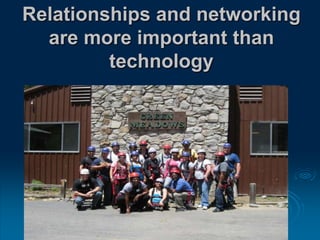
Relationships and networking
are more important than
technology
Relationships transform
people
 Teachers are the most important people in
the implementation of any technology
 Teachers are more important than
technology
A little tech history
 Life was easier when there were no books
 Find the generation ppt
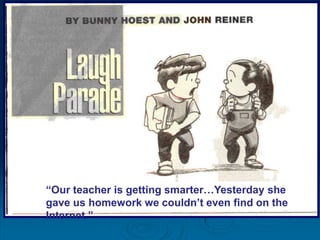
“Our teacher is getting smarter…Yesterday she
gave us homework we couldn’t even find on the
Internet.”
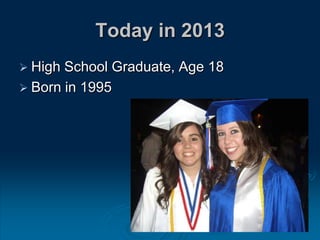
Today in 2013
 High School Graduate, Age 18
 Born in 1995
August 16, 2007
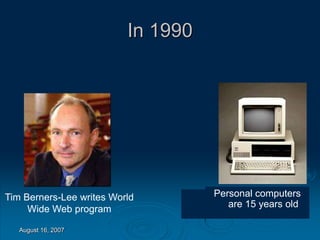
In 1990
Personal computers
are 15 years old
Tim Berners-Lee writes World
Wide Web program
August 16, 2007
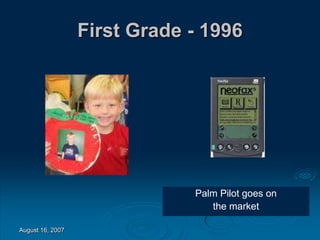
First Grade - 1996
Palm Pilot goes on
the market
August 16, 2007
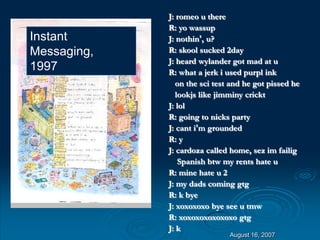
J: romeo u there
R: yo wassup
J: nothin’, u?
R: skool sucked 2day
J: heard wylander got mad at u
R: what a jerk i used purpl ink
on the sci test and he got pissed he
lookjs like jimminy crickt
J: lol
R: going to nicks party
J: cant i’m grounded
R: y
J: cardoza called home, sez im failig
Spanish btw my rents hate u
R: mine hate u 2
J: my dads coming gtg
R: k bye
J: xoxoxoxo bye see u tmw
R: xoxoxoxoxoxoxo gtg
J: k
Instant
Messaging,
1997
August 16, 2007
Fourth Grade - 1999
Sean Fanning creates
Napster
August 16, 2007
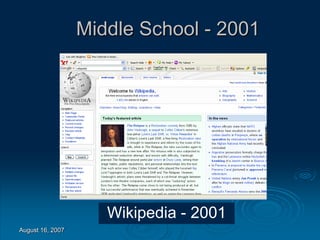
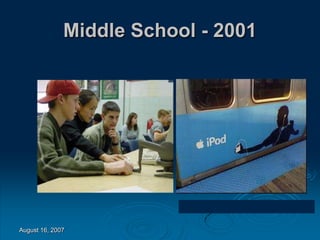
Middle School - 2001
Wikipedia - 2001
August 16, 2007
Middle School - 2001
August 16, 2007
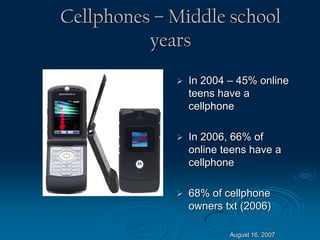
Cellphones – Middle school
years
 In 2004 – 45% online
teens have a
cellphone
 In 2006, 66% of
online teens have a
cellphone
 68% of cellphone
owners txt (2006)
August 16, 2007
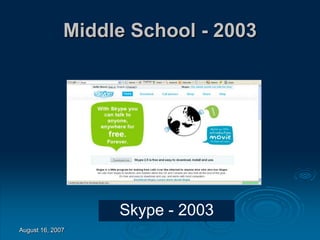
Middle School - 2003
Skype - 2003
August 16, 2007
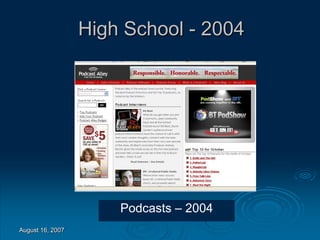
High School - 2004
Podcasts – 2004
August 16, 2007
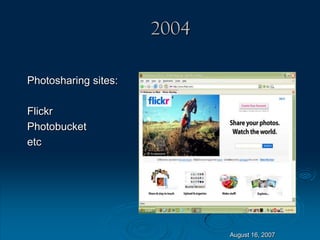
2004
Photosharing sites:
Flickr
Photobucket
etc
August 16, 2007
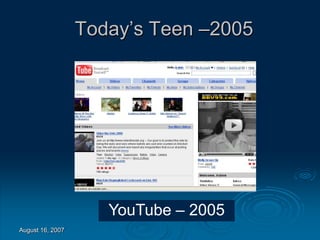
Today’s Teen –2005
YouTube – 2005
August 16, 2007
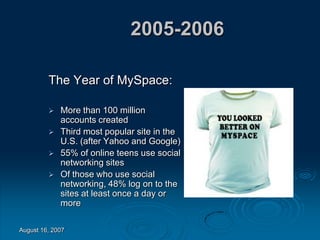
2005-2006
The Year of MySpace:
 More than 100 million
accounts created
 Third most popular site in the
U.S. (after Yahoo and Google)
 55% of online teens use social
networking sites
 Of those who use social
networking, 48% log on to the
sites at least once a day or
more
August 16, 2007
Today – 2007 - 2013
 What has happened in the last 5
years?
August 16, 2007
What are our future
predictions?
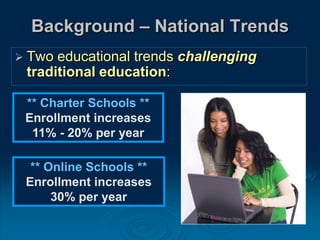
Background – National Trends
** Online Schools **
Enrollment increases
30% per year
** Charter Schools **
Enrollment increases
11% - 20% per year
 Two educational trends challenging
traditional education:
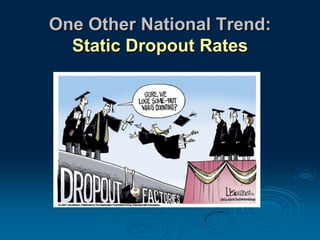
One Other National Trend:
Static Dropout Rates
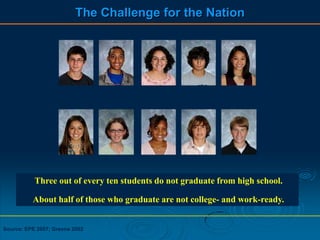
Three out of every ten students do not graduate from high school.
The Challenge for the Nation
Source: EPE 2007; Greene 2002
About half of those who graduate are not college- and work-ready.
Research and Dropouts
“Lack of school success is
probably the greatest single
cause which impels pupils to
drop out of school.”
 Ayres (1909). Laggards in our schools.
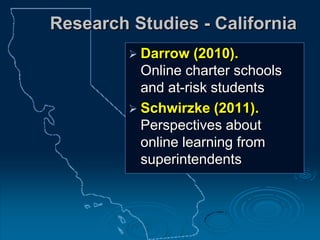
Research Studies - California
 Darrow (2010).
Online charter schools
and at-risk students
 Schwirzke (2011).
Perspectives about
online learning from
superintendents
California
 13% of the total U.S. K-12 public
school student enrollment
 20% of the U.S. public charter
school enrollment
 Top rated state regarding
charter school law and policy
 National Alliance for Public Charter Schools (2010)
Recommendations (Schwirzke, 2011)
 State policies need to be developed to:
 Identify standard definitions for online and
blended learning
 Create a framework for online and blended
learning
 Change to a funding model for online courses
that allows fractional per-pupil funds to follow
students down to the individual course, not
just the full-time program
Recommendations (Darrow, 2010)
 Need a uniform way to count online school
students
 Innovation grants and research grants needed
for online learning in California
 Common standards for K-12 online learning
should be adopted
 Ongoing finance model for online schools
needed in California; current school funding
finance models don’t fit with online courses
Defining Terms
 Traditional Learning
 attend courses daily in face-to-face setting
 Online Learning
 attend courses online where 70% instruction
is online
 Blended Learning
 attend courses online where 30% instruction
is online
 Charter School
 independently operated public schools of
choice
Online Programs
Computer Assisted
 Computer assessment and
computer placed
 Complete lesson (teacher in a
box)
 Multiple choice test (Pass,
continue; Fail, repeat)
 Adult facilitated (credentialed
or classified)
 Education 2020
 Plato
 Apex Learning
Teacher Lead
 Teacher places students
 Teacher at end of every course
 Students advance based on
teacher assessment (some may
be multiple choice)
 Online interaction (e.g. discussion
boards, synchronous online
lessons/office hours)
 K-12, Inc.
 Florida Virtual School
 Connections Academy
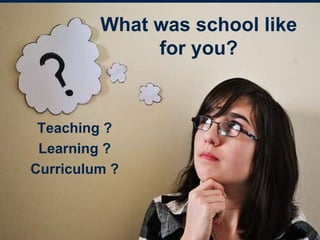
What was school like
for you?
Teaching ?
Learning ?
Curriculum ?
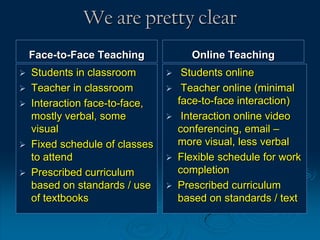
We are pretty clear
Face-to-Face Teaching
 Students in classroom
 Teacher in classroom
 Interaction face-to-face,
mostly verbal, some
visual
 Fixed schedule of classes
to attend
 Prescribed curriculum
based on standards / use
of textbooks
Online Teaching
 Students online
 Teacher online (minimal
face-to-face interaction)
 Interaction online video
conferencing, email –
more visual, less verbal
 Flexible schedule for work
completion
 Prescribed curriculum
based on standards / text
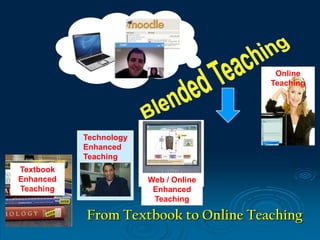
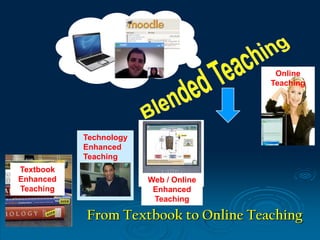
From Textbook to Online Teaching
Online
Teaching
Textbook
Enhanced
Teaching
Technology
Enhanced
Teaching
Web / Online
Enhanced
Teaching
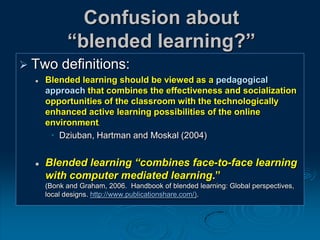
Confusion about
“blended learning?”
 Two definitions:
 Blended learning should be viewed as a pedagogical
approach that combines the effectiveness and socialization
opportunities of the classroom with the technologically
enhanced active learning possibilities of the online
environment,
• Dziuban, Hartman and Moskal (2004)
 Blended learning “combines face-to-face learning
with computer mediated learning.”
(Bonk and Graham, 2006. Handbook of blended learning: Global perspectives,
local designs. http://www.publicationshare.com/).
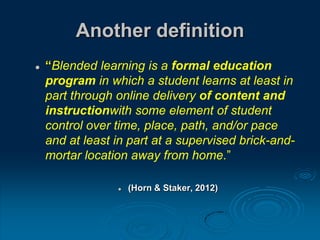
Another definition
 “Blended learning is a formal education
program in which a student learns at least in
part through online delivery of content and
instructionwith some element of student
control over time, place, path, and/or pace
and at least in part at a supervised brick-and-
mortar location away from home.”
 (Horn & Staker, 2012)
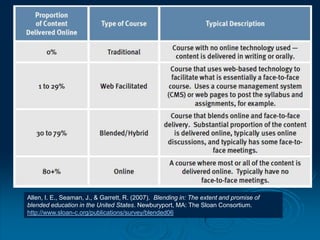
Allen, I. E., Seaman, J., & Garrett, R. (2007). Blending in: The extent and promise of
blended education in the United States. Newburyport, MA: The Sloan Consortium.
http://www.sloan-c.org/publications/survey/blended06
Why does this matter?
 The goal is student achievement, but…if
we don’t know what “it” looks like:
 We can’t measure it
 We can’t study it (researchers)
 We don’t know if it’s making a difference
 We can’t teach it to others
From Textbook to Online Teaching
Online
Teaching
Textbook
Enhanced
Teaching
Technology
Enhanced
Teaching
Web / Online
Enhanced
Teaching
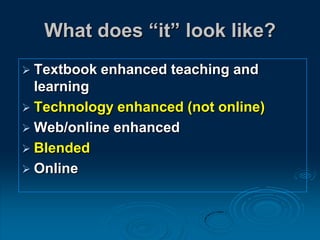
What does “it” look like?
Where do you fit?
 Textbook enhanced teaching and
learning
 Technology enhanced (not online)
 Web/online enhanced
 Blended
 Online
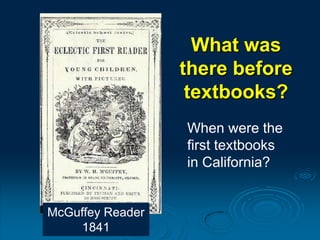
What was
there before
textbooks?
McGuffey Reader
1841
When were the
first textbooks
in California?
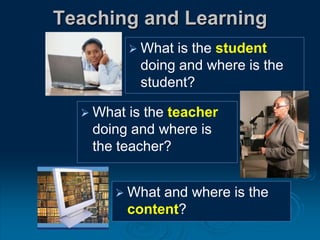
Teaching and Learning
 What is the student
doing and where is the
student?
 What is the teacher
doing and where is
the teacher?
 What and where is the
content?
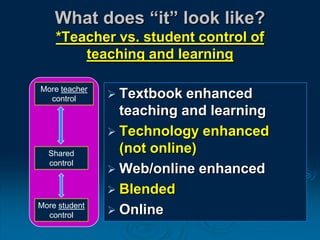
What does “it” look like?
*Teacher vs. student control of
teaching and learning
 Textbook enhanced
teaching and learning
 Technology enhanced
(not online)
 Web/online enhanced
 Blended
 Online
More teacher
control
Shared
control
More student
control
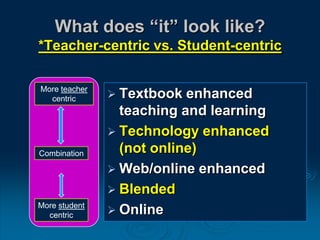
What does “it” look like?
*Teacher-centric vs. Student-centric
 Textbook enhanced
teaching and learning
 Technology enhanced
(not online)
 Web/online enhanced
 Blended
 Online
More teacher
centric
Combination
More student
centric
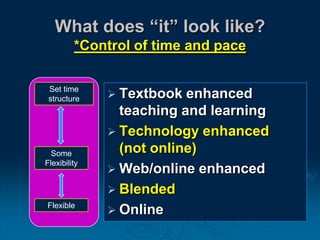
What does “it” look like?
*Control of time and pace
 Textbook enhanced
teaching and learning
 Technology enhanced
(not online)
 Web/online enhanced
 Blended
 Online
Set time
structure
Some
Flexibility
Flexible
What does “it” look like?
 Textbook enhanced teaching and
learning
 Technology enhanced (not online)
 Web/online enhanced
 Blended
 Online
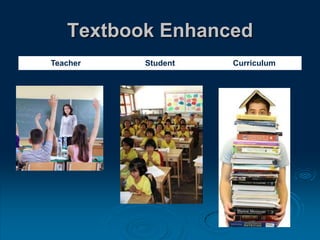
Textbook Enhanced
Teacher Student Curriculum
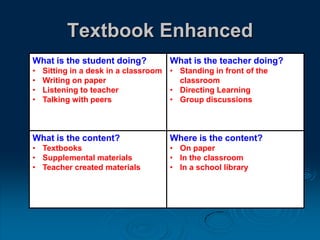
Textbook Enhanced
What is the student doing?
• Sitting in a desk in a classroom
• Writing on paper
• Listening to teacher
• Talking with peers
What is the teacher doing?
• Standing in front of the
classroom
• Directing Learning
• Group discussions
What is the content?
• Textbooks
• Supplemental materials
• Teacher created materials
Where is the content?
• On paper
• In the classroom
• In a school library
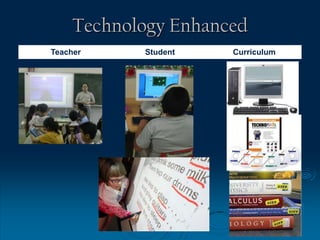
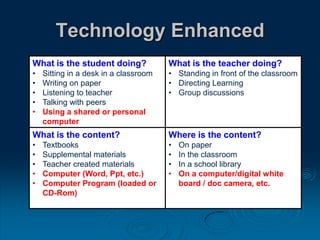
Technology Enhanced
Teacher Student Curriculum
Technology Enhanced
What is the student doing?
• Sitting in a desk in a classroom
• Writing on paper
• Listening to teacher
• Talking with peers
• Using a shared or personal
computer
What is the teacher doing?
• Standing in front of the classroom
• Directing Learning
• Group discussions
What is the content?
• Textbooks
• Supplemental materials
• Teacher created materials
• Computer (Word, Ppt, etc.)
• Computer Program (loaded or
CD-Rom)
Where is the content?
• On paper
• In the classroom
• In a school library
• On a computer/digital white
board / doc camera, etc.
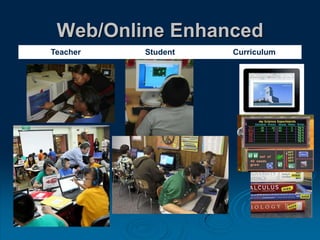
Web/Online Enhanced
Teacher Student Curriculum
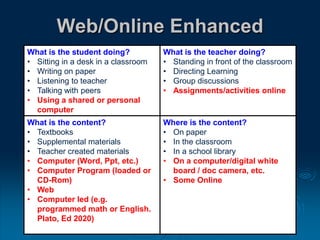
Web/Online Enhanced
What is the student doing?
• Sitting in a desk in a classroom
• Writing on paper
• Listening to teacher
• Talking with peers
• Using a shared or personal
computer
What is the teacher doing?
• Standing in front of the classroom
• Directing Learning
• Group discussions
• Assignments/activities online
What is the content?
• Textbooks
• Supplemental materials
• Teacher created materials
• Computer (Word, Ppt, etc.)
• Computer Program (loaded or
CD-Rom)
• Web
• Computer led (e.g.
programmed math or English.
Plato, Ed 2020)
Where is the content?
• On paper
• In the classroom
• In a school library
• On a computer/digital white
board / doc camera, etc.
• Some Online
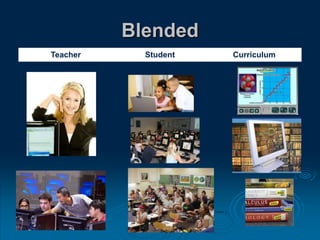
Blended
Teacher Student Curriculum
Blended
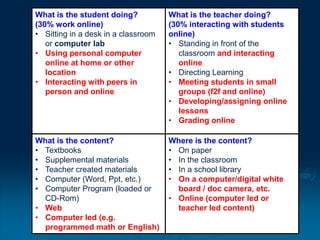
What is the student doing?
(30% work online)
• Sitting in a desk in a classroom
or computer lab
• Using personal computer
online at home or other
location
• Interacting with peers in
person and online
What is the teacher doing?
(30% interacting with students
online)
• Standing in front of the
classroom and interacting
online
• Directing Learning
• Meeting students in small
groups (f2f and online)
• Developing/assigning online
lessons
• Grading online
What is the content?
• Textbooks
• Supplemental materials
• Teacher created materials
• Computer (Word, Ppt, etc.)
• Computer Program (loaded or
CD-Rom)
• Web
• Computer led (e.g.
programmed math or English)
Where is the content?
• On paper
• In the classroom
• In a school library
• On a computer/digital white
board / doc camera, etc.
• Online (computer led or
teacher led content)
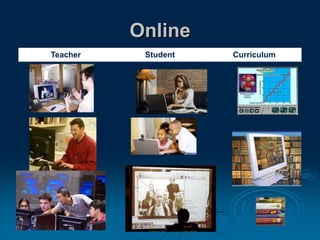
Online
Teacher Student Curriculum
Online
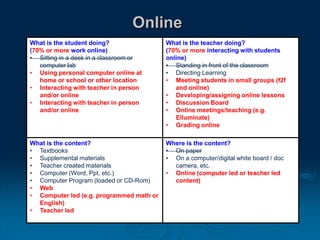
What is the student doing?
(70% or more work online)
• Sitting in a desk in a classroom or
computer lab
• Using personal computer online at
home or school or other location
• Interacting with teacher in person
and/or online
• Interacting with teacher in person
and/or online
What is the teacher doing?
(70% or more interacting with students
online)
• Standing in front of the classroom
• Directing Learning
• Meeting students in small groups (f2f
and online)
• Developing/assigning online lessons
• Discussion Board
• Online meetings/teaching (e.g.
Elluminate)
• Grading online
What is the content?
• Textbooks
• Supplemental materials
• Teacher created materials
• Computer (Word, Ppt, etc.)
• Computer Program (loaded or CD-Rom)
• Web
• Computer led (e.g. programmed math or
English)
• Teacher led
Where is the content?
• On paper
• On a computer/digital white board / doc
camera, etc.
• Online (computer led or teacher led
content)
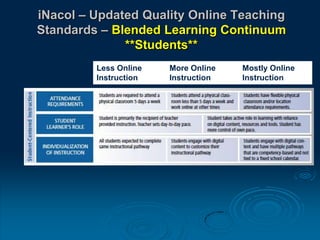
iNacol – Updated Quality Online Teaching
Standards – Blended Learning Continuum
**Students**
Less Online
Instruction
More Online
Instruction
Mostly Online
Instruction
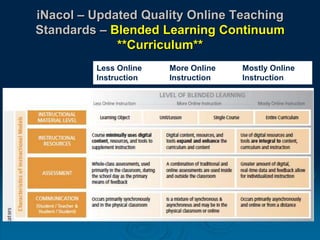
iNacol – Updated Quality Online Teaching
Standards – Blended Learning Continuum
**Curriculum**
Less Online
Instruction
More Online
Instruction
Mostly Online
Instruction
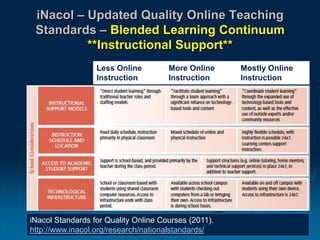
iNacol – Updated Quality Online Teaching
Standards – Blended Learning Continuum
**Instructional Support**
Less Online
Instruction
More Online
Instruction
Mostly Online
Instruction
iNacol Standards for Quality Online Courses (2011).
http://www.inacol.org/research/nationalstandards/
A Quiz! - Practice
 Students are told to take out their math
books and turn to p. 45 to learn about
adding fractions.
Quiz 1
 Students must create a short video to
demonstrate their learning about the
Pythagorean Theorem in their Algebra
course. Students put together the key
points, add in their voice and background
music and then upload the video to
YouTube. The web address is posted in
the assignment area for the teacher to
grade.
Quiz 2
 Students are directed by the teacher to go
to the National Geographic website to
complete the activity there about the
different continents of the world. Students
turn in the assignment digitally through the
online classroom drop box.
Quiz 3
 Students are working together on a wiki to
identify the key concepts needed to know
about when taking the Advanced
Placement U.S. History exam. The
students decide which students will focus
on different topics and then set a time
when they can meet online to review each
part of the wiki.
Quiz 4
 Students are presenting about what they
learned about the Battle of Gettysburg in
the Civil War. They have created a
PowerPoint and are advancing the slides
on the digital white board in the front of
the classroom. In addition, each student
listening has a “clicker” to answer
questions about the presentation while the
students are presenting.
Where are the majority of
schools today?
 Everyone will become blended with time
Questions? Contact
Rob’s Wiki:
http://robdarrow.wikispaces.com

May17.what is edtech 280T

  • 1.
    Rob Darrow, Ed.D. EDL280T, Ed Tech May 2013 Rob’s Wiki: http://robdarrow.wikispaces.com
  • 2.
    Introductions  Me: Director,Member Services, iNACOL (www.inacol.org). Retired online school principal, doctorate, consultant (www.onlinelearningvisions.com), father of a 22-year-old,  My online learning journey  You: Your dissertation topic and your career goal?
  • 3.
    Relationships and networking aremore important than technology
  • 4.
    Relationships transform people  Teachersare the most important people in the implementation of any technology  Teachers are more important than technology
  • 5.
    A little techhistory  Life was easier when there were no books  Find the generation ppt
  • 9.
    “Our teacher isgetting smarter…Yesterday she gave us homework we couldn’t even find on the Internet.”
  • 10.
    Today in 2013 High School Graduate, Age 18  Born in 1995
  • 11.
    August 16, 2007 In1990 Personal computers are 15 years old Tim Berners-Lee writes World Wide Web program
  • 12.
    August 16, 2007 FirstGrade - 1996 Palm Pilot goes on the market
  • 13.
    August 16, 2007 J:romeo u there R: yo wassup J: nothin’, u? R: skool sucked 2day J: heard wylander got mad at u R: what a jerk i used purpl ink on the sci test and he got pissed he lookjs like jimminy crickt J: lol R: going to nicks party J: cant i’m grounded R: y J: cardoza called home, sez im failig Spanish btw my rents hate u R: mine hate u 2 J: my dads coming gtg R: k bye J: xoxoxoxo bye see u tmw R: xoxoxoxoxoxoxo gtg J: k Instant Messaging, 1997
  • 14.
    August 16, 2007 FourthGrade - 1999 Sean Fanning creates Napster
  • 15.
    August 16, 2007 MiddleSchool - 2001 Wikipedia - 2001
  • 16.
  • 17.
    August 16, 2007 Cellphones– Middle school years  In 2004 – 45% online teens have a cellphone  In 2006, 66% of online teens have a cellphone  68% of cellphone owners txt (2006)
  • 18.
    August 16, 2007 MiddleSchool - 2003 Skype - 2003
  • 19.
    August 16, 2007 HighSchool - 2004 Podcasts – 2004
  • 20.
    August 16, 2007 2004 Photosharingsites: Flickr Photobucket etc
  • 21.
    August 16, 2007 Today’sTeen –2005 YouTube – 2005
  • 22.
    August 16, 2007 2005-2006 TheYear of MySpace:  More than 100 million accounts created  Third most popular site in the U.S. (after Yahoo and Google)  55% of online teens use social networking sites  Of those who use social networking, 48% log on to the sites at least once a day or more
  • 23.
    August 16, 2007 Today– 2007 - 2013  What has happened in the last 5 years?
  • 26.
    August 16, 2007 Whatare our future predictions?
  • 27.
    Background – NationalTrends ** Online Schools ** Enrollment increases 30% per year ** Charter Schools ** Enrollment increases 11% - 20% per year  Two educational trends challenging traditional education:
  • 28.
    One Other NationalTrend: Static Dropout Rates
  • 29.
    Three out ofevery ten students do not graduate from high school. The Challenge for the Nation Source: EPE 2007; Greene 2002 About half of those who graduate are not college- and work-ready.
  • 30.
    Research and Dropouts “Lackof school success is probably the greatest single cause which impels pupils to drop out of school.”  Ayres (1909). Laggards in our schools.
  • 31.
    Research Studies -California  Darrow (2010). Online charter schools and at-risk students  Schwirzke (2011). Perspectives about online learning from superintendents
  • 32.
    California  13% ofthe total U.S. K-12 public school student enrollment  20% of the U.S. public charter school enrollment  Top rated state regarding charter school law and policy  National Alliance for Public Charter Schools (2010)
  • 33.
    Recommendations (Schwirzke, 2011) State policies need to be developed to:  Identify standard definitions for online and blended learning  Create a framework for online and blended learning  Change to a funding model for online courses that allows fractional per-pupil funds to follow students down to the individual course, not just the full-time program
  • 34.
    Recommendations (Darrow, 2010) Need a uniform way to count online school students  Innovation grants and research grants needed for online learning in California  Common standards for K-12 online learning should be adopted  Ongoing finance model for online schools needed in California; current school funding finance models don’t fit with online courses
  • 35.
    Defining Terms  TraditionalLearning  attend courses daily in face-to-face setting  Online Learning  attend courses online where 70% instruction is online  Blended Learning  attend courses online where 30% instruction is online  Charter School  independently operated public schools of choice
  • 36.
    Online Programs Computer Assisted Computer assessment and computer placed  Complete lesson (teacher in a box)  Multiple choice test (Pass, continue; Fail, repeat)  Adult facilitated (credentialed or classified)  Education 2020  Plato  Apex Learning Teacher Lead  Teacher places students  Teacher at end of every course  Students advance based on teacher assessment (some may be multiple choice)  Online interaction (e.g. discussion boards, synchronous online lessons/office hours)  K-12, Inc.  Florida Virtual School  Connections Academy
  • 37.
    What was schoollike for you? Teaching ? Learning ? Curriculum ?
  • 38.
    We are prettyclear Face-to-Face Teaching  Students in classroom  Teacher in classroom  Interaction face-to-face, mostly verbal, some visual  Fixed schedule of classes to attend  Prescribed curriculum based on standards / use of textbooks Online Teaching  Students online  Teacher online (minimal face-to-face interaction)  Interaction online video conferencing, email – more visual, less verbal  Flexible schedule for work completion  Prescribed curriculum based on standards / text
  • 39.
    From Textbook toOnline Teaching Online Teaching Textbook Enhanced Teaching Technology Enhanced Teaching Web / Online Enhanced Teaching
  • 40.
    Confusion about “blended learning?” Two definitions:  Blended learning should be viewed as a pedagogical approach that combines the effectiveness and socialization opportunities of the classroom with the technologically enhanced active learning possibilities of the online environment, • Dziuban, Hartman and Moskal (2004)  Blended learning “combines face-to-face learning with computer mediated learning.” (Bonk and Graham, 2006. Handbook of blended learning: Global perspectives, local designs. http://www.publicationshare.com/).
  • 41.
    Another definition  “Blendedlearning is a formal education program in which a student learns at least in part through online delivery of content and instructionwith some element of student control over time, place, path, and/or pace and at least in part at a supervised brick-and- mortar location away from home.”  (Horn & Staker, 2012)
  • 42.
    Allen, I. E.,Seaman, J., & Garrett, R. (2007). Blending in: The extent and promise of blended education in the United States. Newburyport, MA: The Sloan Consortium. http://www.sloan-c.org/publications/survey/blended06
  • 43.
    Why does thismatter?  The goal is student achievement, but…if we don’t know what “it” looks like:  We can’t measure it  We can’t study it (researchers)  We don’t know if it’s making a difference  We can’t teach it to others
  • 44.
    From Textbook toOnline Teaching Online Teaching Textbook Enhanced Teaching Technology Enhanced Teaching Web / Online Enhanced Teaching
  • 45.
    What does “it”look like? Where do you fit?  Textbook enhanced teaching and learning  Technology enhanced (not online)  Web/online enhanced  Blended  Online
  • 46.
    What was there before textbooks? McGuffeyReader 1841 When were the first textbooks in California?
  • 47.
    Teaching and Learning What is the student doing and where is the student?  What is the teacher doing and where is the teacher?  What and where is the content?
  • 48.
    What does “it”look like? *Teacher vs. student control of teaching and learning  Textbook enhanced teaching and learning  Technology enhanced (not online)  Web/online enhanced  Blended  Online More teacher control Shared control More student control
  • 49.
    What does “it”look like? *Teacher-centric vs. Student-centric  Textbook enhanced teaching and learning  Technology enhanced (not online)  Web/online enhanced  Blended  Online More teacher centric Combination More student centric
  • 50.
    What does “it”look like? *Control of time and pace  Textbook enhanced teaching and learning  Technology enhanced (not online)  Web/online enhanced  Blended  Online Set time structure Some Flexibility Flexible
  • 51.
    What does “it”look like?  Textbook enhanced teaching and learning  Technology enhanced (not online)  Web/online enhanced  Blended  Online
  • 52.
  • 53.
    Textbook Enhanced What isthe student doing? • Sitting in a desk in a classroom • Writing on paper • Listening to teacher • Talking with peers What is the teacher doing? • Standing in front of the classroom • Directing Learning • Group discussions What is the content? • Textbooks • Supplemental materials • Teacher created materials Where is the content? • On paper • In the classroom • In a school library
  • 54.
  • 55.
    Technology Enhanced What isthe student doing? • Sitting in a desk in a classroom • Writing on paper • Listening to teacher • Talking with peers • Using a shared or personal computer What is the teacher doing? • Standing in front of the classroom • Directing Learning • Group discussions What is the content? • Textbooks • Supplemental materials • Teacher created materials • Computer (Word, Ppt, etc.) • Computer Program (loaded or CD-Rom) Where is the content? • On paper • In the classroom • In a school library • On a computer/digital white board / doc camera, etc.
  • 56.
  • 57.
    Web/Online Enhanced What isthe student doing? • Sitting in a desk in a classroom • Writing on paper • Listening to teacher • Talking with peers • Using a shared or personal computer What is the teacher doing? • Standing in front of the classroom • Directing Learning • Group discussions • Assignments/activities online What is the content? • Textbooks • Supplemental materials • Teacher created materials • Computer (Word, Ppt, etc.) • Computer Program (loaded or CD-Rom) • Web • Computer led (e.g. programmed math or English. Plato, Ed 2020) Where is the content? • On paper • In the classroom • In a school library • On a computer/digital white board / doc camera, etc. • Some Online
  • 58.
  • 59.
    Blended What is thestudent doing? (30% work online) • Sitting in a desk in a classroom or computer lab • Using personal computer online at home or other location • Interacting with peers in person and online What is the teacher doing? (30% interacting with students online) • Standing in front of the classroom and interacting online • Directing Learning • Meeting students in small groups (f2f and online) • Developing/assigning online lessons • Grading online What is the content? • Textbooks • Supplemental materials • Teacher created materials • Computer (Word, Ppt, etc.) • Computer Program (loaded or CD-Rom) • Web • Computer led (e.g. programmed math or English) Where is the content? • On paper • In the classroom • In a school library • On a computer/digital white board / doc camera, etc. • Online (computer led or teacher led content)
  • 60.
  • 61.
    Online What is thestudent doing? (70% or more work online) • Sitting in a desk in a classroom or computer lab • Using personal computer online at home or school or other location • Interacting with teacher in person and/or online • Interacting with teacher in person and/or online What is the teacher doing? (70% or more interacting with students online) • Standing in front of the classroom • Directing Learning • Meeting students in small groups (f2f and online) • Developing/assigning online lessons • Discussion Board • Online meetings/teaching (e.g. Elluminate) • Grading online What is the content? • Textbooks • Supplemental materials • Teacher created materials • Computer (Word, Ppt, etc.) • Computer Program (loaded or CD-Rom) • Web • Computer led (e.g. programmed math or English) • Teacher led Where is the content? • On paper • On a computer/digital white board / doc camera, etc. • Online (computer led or teacher led content)
  • 62.
    iNacol – UpdatedQuality Online Teaching Standards – Blended Learning Continuum **Students** Less Online Instruction More Online Instruction Mostly Online Instruction
  • 63.
    iNacol – UpdatedQuality Online Teaching Standards – Blended Learning Continuum **Curriculum** Less Online Instruction More Online Instruction Mostly Online Instruction
  • 64.
    iNacol – UpdatedQuality Online Teaching Standards – Blended Learning Continuum **Instructional Support** Less Online Instruction More Online Instruction Mostly Online Instruction iNacol Standards for Quality Online Courses (2011). http://www.inacol.org/research/nationalstandards/
  • 65.
    A Quiz! -Practice  Students are told to take out their math books and turn to p. 45 to learn about adding fractions.
  • 66.
    Quiz 1  Studentsmust create a short video to demonstrate their learning about the Pythagorean Theorem in their Algebra course. Students put together the key points, add in their voice and background music and then upload the video to YouTube. The web address is posted in the assignment area for the teacher to grade.
  • 67.
    Quiz 2  Studentsare directed by the teacher to go to the National Geographic website to complete the activity there about the different continents of the world. Students turn in the assignment digitally through the online classroom drop box.
  • 68.
    Quiz 3  Studentsare working together on a wiki to identify the key concepts needed to know about when taking the Advanced Placement U.S. History exam. The students decide which students will focus on different topics and then set a time when they can meet online to review each part of the wiki.
  • 69.
    Quiz 4  Studentsare presenting about what they learned about the Battle of Gettysburg in the Civil War. They have created a PowerPoint and are advancing the slides on the digital white board in the front of the classroom. In addition, each student listening has a “clicker” to answer questions about the presentation while the students are presenting.
  • 70.
    Where are themajority of schools today?  Everyone will become blended with time
  • 71.