
Key Elements for Blended
Learning Planning and
Implementation
Dr. Rob Darrow
Director of Member Services, iNACOL
eLearning Strategies Symposium
December 2013

Rob’s Wiki: http://robdarrow.wikispaces.com
www.inacol.org
Introductions
• A little about you:
–
–
–
–

Teachers
Administrators
Other
K-6; 7-8; 9-12; college

• Me
– Lifelong Californian – Educated in Ca public schools
PreSchool-doctorate
– Online charter school principal, school librarian and
teacher (Taught K-8)
– Full time with iNACOL, Director of Member Services
International Association for K12 Online Learning (iNACOL)
• iNACOL is the premier K-12 nonprofit in blended and
online learning. Membership Organization.
• 4100+ members in K-12 virtual schools and online
learning representing over 50 countries
• Provides leadership, advocacy, research, training, and
networking with experts in K-12 online learning.
• “Ensure all students have access to a world-class
education and quality blended and online learning
opportunities that prepare them for a lifetime of
success.”
Blended and Online
Learning Symposium
November 4-7, 2014
Palm Springs, Ca
• Over 2000
experts, educators, administrators, compa
nies and thought leaders
iNACOL Supporting Documents
www.inacol.org/resources
• iNACOL Blended Learning Roadmap
(NYC)
• Mean What You Say: Defining and
Integrating Personalized, Blended and
Competency Education
• Transforming K-12 Rural Education
through Blended Learning: Barriers
and Promising Practices
Rob’s Wiki: http://robdarrow.wikispaces.com
Session Focus
• There are 6 Elements to Implementing
and Maintaining a successful blended
learning program.
• Promising practices for each element that
can be replicated.
• Tools for blended learning.
• Observations from NY City Schools
My Belief: Tipping Point
• K-12 Online Learning already there
• Every school will become a blended
learning school to better personalize
learning for all students
• Ultimate goal: College and career ready
students and 100% graduation rate
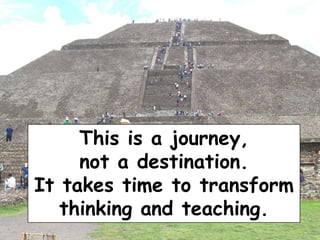
This is a journey,
not a destination.
It takes time to transform
thinking and teaching.
Activity
Where do you fit?
Where does your school fit?
• Continuum:
From Textbook Enhanced to Online
Teaching and Learning
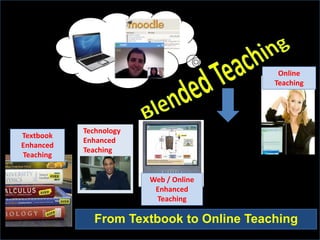
Online
Teaching

Textbook
Enhanced
Teaching

Technology
Enhanced
Teaching

Web / Online
Enhanced
Teaching

From Textbook to Online Teaching
Defining blended learning
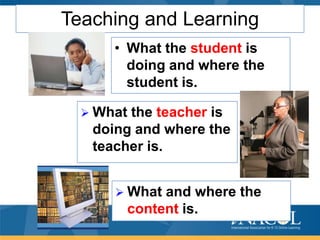
Teaching and Learning
• What the student is
doing and where the
student is.
 What

the teacher is
doing and where the
teacher is.
 What

and where the
content is.
Blended Learning Definition
• “a formal education program in which a student
learns at least in part through online delivery of
content and instruction with some element of
student control over time, place, path, and/or
pace and at least in part at a supervised brickand-mortar location away from home…”
- (Horn and Staker, 2013)
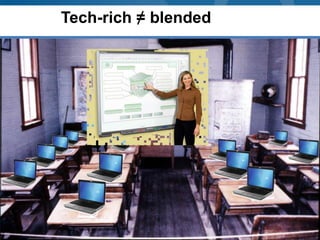
Tech-rich = blended
Generally Defining Terms
• Traditional = the way it has always been
done
– (e.g. teacher lecture, quarterly benchmark
testing, if students don’t get it, the teacher
moves on, limited use of technology)

• Blended = use of technology, course
management system and data to
personalize learning for students; student
centric classroom
iLearnNYC & iNACOL Partnership
• One year – 2012-13 School Year
• Visitations, interactions, focus on 8 lab
schools
– Weekly phone calls with district support staff
– Conversations with administrators, teachers
and students

• End Product: Blended Learning Roadmap
(see handout)
Key Learning
• Clear Goals need to be established, written
and discussed in ongoing way
• Leadership determines sustainability and
success (Administrators and Teachers)
• Collaborative leadership style is essential
• School culture of support, innovation
(it is ok to try and fail)
• Ongoing professional development
(formal and informal)
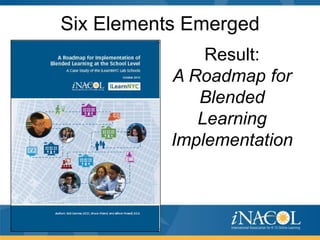
Six Elements Emerged
Result:
A Roadmap for
Blended
Learning
Implementation
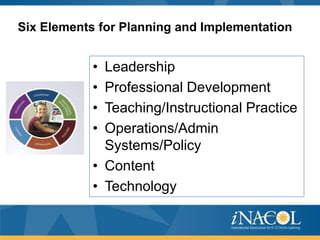
Six Elements for Planning and Implementation

•
•
•
•

Leadership
Professional Development
Teaching/Instructional Practice
Operations/Admin
Systems/Policy
• Content
• Technology
1. Leadership
School Implementation
• Identified administrator/leader and teachers at each school
• Ongoing interactions (one-on-one, formal and informal) and
meetings of those involved in iLearn
• Administrators, teachers and administrators work together
towards the blended learning goals established in each school

Promising Practices
• School culture of innovation and empowerment
• Start small and build
• Communication is strong and occurs between involved people
in a variety of ways (one-to-one, phone, email, chat, etc.)
School Example: Leadership
At Mott Hall V:
• Daily walk-throughs at Mott Hall V by
principal and assistant principal
• Weekly meeting time built into school work
day
• Designated lead blended learning teacher
School Example: Leadership
At Seth Low MS:
• Planning started the year before with the
principal designating an assistant principal to
take the leadership
• Identified teachers in 6th and 8th grade in
variety of subjects
• Technology tools and support in place (even
the security guard helps)
• Resourceful in use of available resources
2. Professional Development
School Implementation
• Both formal and informal (Schedule ongoing group and
individual support – online and face-to-face)
• Modeling, webinars, small conferences, workshops, cohort
meetings
• Support teacher / school librarian / implementation managers
are key

Promising Practices
•
•
•
•

Scheduled Time (within work week)
Participating Teachers as Resources
Professional Sharing / Professional Learning Community
School Support
School Example: Professional Development

At Goddard HS:
– IM has identified two teachers to work oneon-one to push individual growth
– Scheduled time to collaborate and share for
participating teachers
– Leadership and IM communicate regularly
about PD needs, offerings and resources to
meet these needs
3. Teaching/Instructional Practices
School Implementation
• Common Vocabulary / Resources
– Blended Learning Continuum, Blended Learning Rubric, Observation Form

• Support for new blended learning teachers – modeling and
mentoring
• Analyzing real-time data to personalize learning for each student

Promising Practices
•
•
•
•
•

Classroom Setup
Data Analysis
Individualized Instruction
Student Engagement
Digital Content
School Example:
Teaching/Instructional Practice
Olympus Academy has primarily implemented a flex model of
blended learning in which content and instruction are delivered
primarily by the Internet, students move on an individually
customized schedule. A certified teacher along with instructional
support assistants provide face-to-face support through as smallgroup instruction, group projects, and individual tutoring.
4. Operations/Management Systems/Policy
School Implementation
• Restructuring of the traditional school class / school day
• Emphasis on using real-time student performance data
• Change in instructional delivery model

Promising Practices
•
•
•
•

Removal of institutional barriers / policies
Operational support
Policy development examples
Data-driven instruction
School Examples: Operations/Management
Systems/Policy
Because Olympus Academy specially targets students who
are at least 16 year of age and are significantly behind in
credit acquisition, school administration and teachers
recognize that students need online content and instructional
practices that is adaptive to their personal needs and allows
for flexibility in pacing.
School Examples: Operations/Management
Systems/Policy

HSEF

• Online French Course to offer more course offerings for
students
• AP Environmental Science for more AP Offerings –
teacher developed
• PM School – math courses
Principal: “When you walk into the blended learning
classrooms, you notice how teachers are facilitators
that are constantly moving around the room, and you
can immediately see how much more students are
engaged in their learning.”
5. Content
School Implementation
• Common course management system
• Content providers to choose
• Professional development and teacher sharing about content
provider and platform use

Promising Practices
• Content Decision Making (purchase or build your own)
• Customizable platform – teachers use base curriculum and
customize based on student needs
• Customizable for individual students
School Examples: Content

•
•

Balancing the strengths of teachers between content creation and utilization
of pre-set online courses.
Use of OER materials to supplement online courseware
School Examples: Content

• Expand foreign language options by
offering online French offered by a teacher
at another school (A la carte model)
• Expand AP options by developing AP
Environmental Science (A la carte model)
6. Technology
School Implementation
• School leadership ensures that technology needs of students
and teachers are addressed, and proper training provided.
• Dedicated technical support for the blended learning programs.
• School leadership is visible in their own use of technology;
modeling expectations.

Promising Practices
• Technology Training
• Technology Support – Technician on site
• Hardware and Software in place to use
School Examples: Technology

•
•

Francis Lewis has dedicated tech support onsite to support
administrators, teachers and implementation managers with the network and
devices used in the school.
Because Francis Lewis instructors involved in the blended learning program
utilize a variety of both vendor content, Open Educational Resources (OER)
materials, and teacher-created online courses, the implementation of common
learning management system is very important
School Examples: Technology

• Full-time dedicated technical support
• One LMS, will be helpful as teachers begin
to develop own content. Currently using
vendor developed and OER
• Laptop carts, interactive white
boards, projectors in participating
classrooms
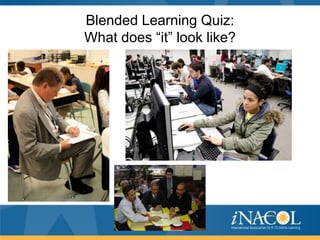
Blended Learning Quiz:
What does “it” look like?
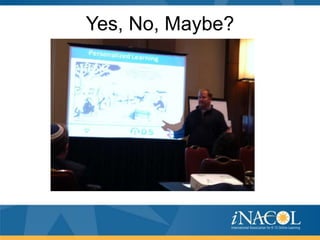
Yes, No, Maybe?
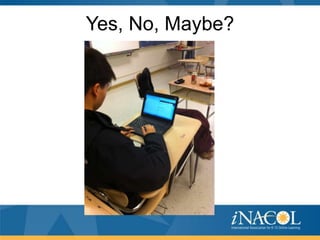
Yes, No, Maybe?
Yes, No, Maybe?
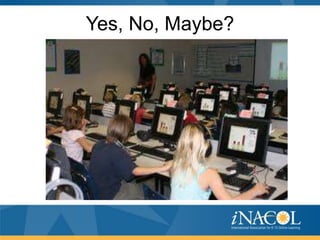
Yes, No, Maybe?
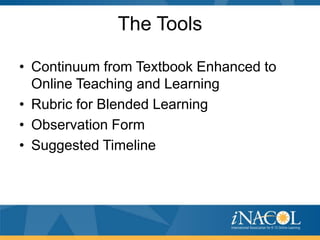
The Tools
• Continuum from Textbook Enhanced to
Online Teaching and Learning
• Rubric for Blended Learning
• Observation Form
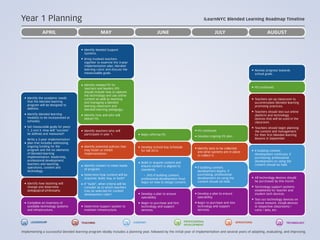
• Suggested Timeline
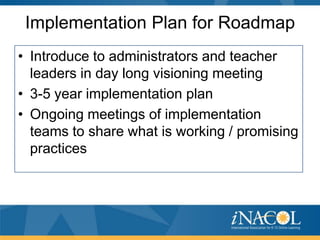
Implementation Plan for Roadmap
• Introduce to administrators and teacher
leaders in day long visioning meeting
• 3-5 year implementation plan
• Ongoing meetings of implementation
teams to share what is working / promising
practices
Handouts - Use and Improve
• Links / Documents
• Resources
– Continuum from Textbook Enhanced to Online
Teaching and Learning
– Rubric
– iLearnNYC Observation Form
Questions?
Comments?
Contact Information
• Rob Darrow – rdarrow@inacol.org
Rob’s Wiki: http://robdarrow.wikispaces.com

Key Elements for Blended Learning

  • 1.
    Key Elements forBlended Learning Planning and Implementation Dr. Rob Darrow Director of Member Services, iNACOL eLearning Strategies Symposium December 2013 Rob’s Wiki: http://robdarrow.wikispaces.com www.inacol.org
  • 2.
    Introductions • A littleabout you: – – – – Teachers Administrators Other K-6; 7-8; 9-12; college • Me – Lifelong Californian – Educated in Ca public schools PreSchool-doctorate – Online charter school principal, school librarian and teacher (Taught K-8) – Full time with iNACOL, Director of Member Services
  • 3.
    International Association forK12 Online Learning (iNACOL) • iNACOL is the premier K-12 nonprofit in blended and online learning. Membership Organization. • 4100+ members in K-12 virtual schools and online learning representing over 50 countries • Provides leadership, advocacy, research, training, and networking with experts in K-12 online learning. • “Ensure all students have access to a world-class education and quality blended and online learning opportunities that prepare them for a lifetime of success.”
  • 4.
    Blended and Online LearningSymposium November 4-7, 2014 Palm Springs, Ca • Over 2000 experts, educators, administrators, compa nies and thought leaders
  • 5.
    iNACOL Supporting Documents www.inacol.org/resources •iNACOL Blended Learning Roadmap (NYC) • Mean What You Say: Defining and Integrating Personalized, Blended and Competency Education • Transforming K-12 Rural Education through Blended Learning: Barriers and Promising Practices Rob’s Wiki: http://robdarrow.wikispaces.com
  • 6.
    Session Focus • Thereare 6 Elements to Implementing and Maintaining a successful blended learning program. • Promising practices for each element that can be replicated. • Tools for blended learning. • Observations from NY City Schools
  • 7.
    My Belief: TippingPoint • K-12 Online Learning already there • Every school will become a blended learning school to better personalize learning for all students • Ultimate goal: College and career ready students and 100% graduation rate
  • 8.
    This is ajourney, not a destination. It takes time to transform thinking and teaching.
  • 9.
    Activity Where do youfit? Where does your school fit? • Continuum: From Textbook Enhanced to Online Teaching and Learning
  • 10.
  • 11.
  • 12.
    Teaching and Learning •What the student is doing and where the student is.  What the teacher is doing and where the teacher is.  What and where the content is.
  • 13.
    Blended Learning Definition •“a formal education program in which a student learns at least in part through online delivery of content and instruction with some element of student control over time, place, path, and/or pace and at least in part at a supervised brickand-mortar location away from home…” - (Horn and Staker, 2013)
  • 14.
  • 15.
    Generally Defining Terms •Traditional = the way it has always been done – (e.g. teacher lecture, quarterly benchmark testing, if students don’t get it, the teacher moves on, limited use of technology) • Blended = use of technology, course management system and data to personalize learning for students; student centric classroom
  • 16.
    iLearnNYC & iNACOLPartnership • One year – 2012-13 School Year • Visitations, interactions, focus on 8 lab schools – Weekly phone calls with district support staff – Conversations with administrators, teachers and students • End Product: Blended Learning Roadmap (see handout)
  • 17.
    Key Learning • ClearGoals need to be established, written and discussed in ongoing way • Leadership determines sustainability and success (Administrators and Teachers) • Collaborative leadership style is essential • School culture of support, innovation (it is ok to try and fail) • Ongoing professional development (formal and informal)
  • 18.
    Six Elements Emerged Result: ARoadmap for Blended Learning Implementation
  • 19.
    Six Elements forPlanning and Implementation • • • • Leadership Professional Development Teaching/Instructional Practice Operations/Admin Systems/Policy • Content • Technology
  • 20.
    1. Leadership School Implementation •Identified administrator/leader and teachers at each school • Ongoing interactions (one-on-one, formal and informal) and meetings of those involved in iLearn • Administrators, teachers and administrators work together towards the blended learning goals established in each school Promising Practices • School culture of innovation and empowerment • Start small and build • Communication is strong and occurs between involved people in a variety of ways (one-to-one, phone, email, chat, etc.)
  • 21.
    School Example: Leadership AtMott Hall V: • Daily walk-throughs at Mott Hall V by principal and assistant principal • Weekly meeting time built into school work day • Designated lead blended learning teacher
  • 22.
    School Example: Leadership AtSeth Low MS: • Planning started the year before with the principal designating an assistant principal to take the leadership • Identified teachers in 6th and 8th grade in variety of subjects • Technology tools and support in place (even the security guard helps) • Resourceful in use of available resources
  • 23.
    2. Professional Development SchoolImplementation • Both formal and informal (Schedule ongoing group and individual support – online and face-to-face) • Modeling, webinars, small conferences, workshops, cohort meetings • Support teacher / school librarian / implementation managers are key Promising Practices • • • • Scheduled Time (within work week) Participating Teachers as Resources Professional Sharing / Professional Learning Community School Support
  • 24.
    School Example: ProfessionalDevelopment At Goddard HS: – IM has identified two teachers to work oneon-one to push individual growth – Scheduled time to collaborate and share for participating teachers – Leadership and IM communicate regularly about PD needs, offerings and resources to meet these needs
  • 25.
    3. Teaching/Instructional Practices SchoolImplementation • Common Vocabulary / Resources – Blended Learning Continuum, Blended Learning Rubric, Observation Form • Support for new blended learning teachers – modeling and mentoring • Analyzing real-time data to personalize learning for each student Promising Practices • • • • • Classroom Setup Data Analysis Individualized Instruction Student Engagement Digital Content
  • 26.
    School Example: Teaching/Instructional Practice OlympusAcademy has primarily implemented a flex model of blended learning in which content and instruction are delivered primarily by the Internet, students move on an individually customized schedule. A certified teacher along with instructional support assistants provide face-to-face support through as smallgroup instruction, group projects, and individual tutoring.
  • 27.
    4. Operations/Management Systems/Policy SchoolImplementation • Restructuring of the traditional school class / school day • Emphasis on using real-time student performance data • Change in instructional delivery model Promising Practices • • • • Removal of institutional barriers / policies Operational support Policy development examples Data-driven instruction
  • 28.
    School Examples: Operations/Management Systems/Policy BecauseOlympus Academy specially targets students who are at least 16 year of age and are significantly behind in credit acquisition, school administration and teachers recognize that students need online content and instructional practices that is adaptive to their personal needs and allows for flexibility in pacing.
  • 29.
    School Examples: Operations/Management Systems/Policy HSEF •Online French Course to offer more course offerings for students • AP Environmental Science for more AP Offerings – teacher developed • PM School – math courses Principal: “When you walk into the blended learning classrooms, you notice how teachers are facilitators that are constantly moving around the room, and you can immediately see how much more students are engaged in their learning.”
  • 30.
    5. Content School Implementation •Common course management system • Content providers to choose • Professional development and teacher sharing about content provider and platform use Promising Practices • Content Decision Making (purchase or build your own) • Customizable platform – teachers use base curriculum and customize based on student needs • Customizable for individual students
  • 31.
    School Examples: Content • • Balancingthe strengths of teachers between content creation and utilization of pre-set online courses. Use of OER materials to supplement online courseware
  • 32.
    School Examples: Content •Expand foreign language options by offering online French offered by a teacher at another school (A la carte model) • Expand AP options by developing AP Environmental Science (A la carte model)
  • 33.
    6. Technology School Implementation •School leadership ensures that technology needs of students and teachers are addressed, and proper training provided. • Dedicated technical support for the blended learning programs. • School leadership is visible in their own use of technology; modeling expectations. Promising Practices • Technology Training • Technology Support – Technician on site • Hardware and Software in place to use
  • 34.
    School Examples: Technology • • FrancisLewis has dedicated tech support onsite to support administrators, teachers and implementation managers with the network and devices used in the school. Because Francis Lewis instructors involved in the blended learning program utilize a variety of both vendor content, Open Educational Resources (OER) materials, and teacher-created online courses, the implementation of common learning management system is very important
  • 35.
    School Examples: Technology •Full-time dedicated technical support • One LMS, will be helpful as teachers begin to develop own content. Currently using vendor developed and OER • Laptop carts, interactive white boards, projectors in participating classrooms
  • 36.
    Blended Learning Quiz: Whatdoes “it” look like?
  • 37.
  • 38.
  • 39.
  • 40.
  • 41.
    The Tools • Continuumfrom Textbook Enhanced to Online Teaching and Learning • Rubric for Blended Learning • Observation Form • Suggested Timeline
  • 43.
    Implementation Plan forRoadmap • Introduce to administrators and teacher leaders in day long visioning meeting • 3-5 year implementation plan • Ongoing meetings of implementation teams to share what is working / promising practices
  • 44.
    Handouts - Useand Improve • Links / Documents • Resources – Continuum from Textbook Enhanced to Online Teaching and Learning – Rubric – iLearnNYC Observation Form
  • 45.
  • 46.
    Contact Information • RobDarrow – rdarrow@inacol.org Rob’s Wiki: http://robdarrow.wikispaces.com

Editor's Notes